FA4-MS28: Applications of molecular crystals simulations
26th European Crystallographic Meeting, ECM 26, Darmstadt, 2010 Acta Cryst. (2010). A66,
Page s233 s233
theory. First the electron charge density distribution was obtained from high resolution X-ray experiment at low temperature using XD package [1]. The crystal structure was refined using the multipolar model of Hansen and Coppens (1978) [2]. The study of the molecular electron charge density distribution reveals the nature of inter-molecular interactions including charge transfer [3]. Thereafter the results obtained were the subject of a comparison to those determined by theoretical calculation.
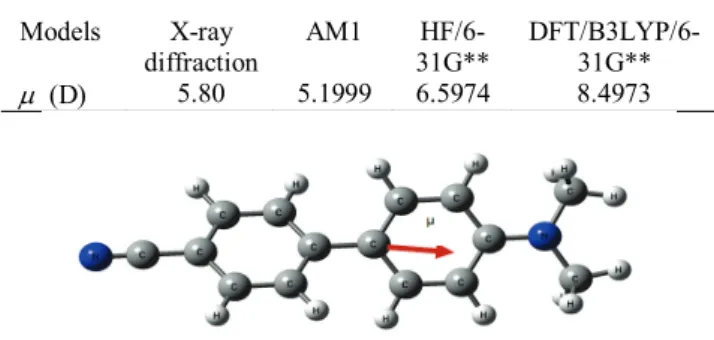
The agreement between the experimental and theoretical results such as: atomic net charge, molecular dipole moment, electrostatic potential and electron density was satisfactory. Table and figure below gives the molecular dipole obtained with different models and the orientation of the X-ray diffraction dipole moment in the molecule of DMACB, respectively.
Table: Magnitude of the molecular dipole moment Models X-ray
diffraction AM1 31G** HF/6- DFT/B3LYP/6-31G**
µ (D) 5.80 5.1999 6.5974 8.4973
Figure: Orientation of dipole moment in DMACB
[1] Koritsanszky, T.; Howard, S.; Richter, T.; Su, Z.; Mallinson, P.R.; Hansen, N.K. XD a Computer Program Package, University of Berlin 2003. [2] Hansen & Coppens, Acta Cryst. (1978), A34, 909-921. [3] Coppens, P. X-ray Charge Densities and Chemical Bonding. New York: Oxford, 1997.
Keywords: Charge density, XD and Gaussian Software
FA4-MS28-P04
On the the use of single crystal diffractometer data
necessary for performing the 2
ndand 4
threstricted
moment method. Prabal Dasgupta, Bholanath Mondal
Department of Central Scientific Services, Indian
Association for the Cultivation of Science,
Kolkata-700032 India
E-Mail: [email protected]
With the advent of epoch-making paper by Groma & Borbely [1] &Borbely et al[2] renaissance of 2nd & 4th restricted moment method for evaluation of crystallite size has taken place..Above mentioned authors have reported that they have made use of high resolution XRD data .Present work aims to explore if the same technique may be applied to commonly used double crystal diffractometer data? To probe this,background & instrumental broadening corrected 111& 200 line of commercial gradeNi ( in continous as well as in step-scan mode) were subjected to such analysis..M2 & M4/q2 plots suggest that peak broadening in these materials are mainly crystallite size-related broadening. Different step-widths varying from0.005 to 0.03 and scan rate varying from 0.2 to 2.5 sec were chosen so as to ascertain the quality of data that yields more or less same crystallite size( within 5%) from the 2nd & 4th moment plot.It was revealed that XRD data
with stepwidth of 0.01deg or less and scan speed of at least 2.0 sec step -1 in the step- scan mode as well as in continous mode yields satisfactory converegence.
[1] Borbely A. & Groma I.Appl. Phys.Lett.79 p-1772-1774,2001 [2] Borbely A., Revesz A. & Groma I.,Z.Krist.,Suppl,23,p-87,2006 Keywords: applied crystallography materials, powder method,crystallite size strain
FA4-MS28-P05
Theoretical and Crystallographic calculations on
meta-Nitrophenol: a non linear optical compound.
Fodil HAMZAOUI, Mokhtaria DRISSI, Naima
BOUBEGRA, Abdelkader CHOUAIH Laboratoire
SEA2M – Facultés des Sciences & Technologies –
University of . Mostaganem Algeria.
Email: [email protected]
We investigated, in the present work, theoretically and experimentally the electron density distribution and electrostatic potential around the molecule m-Nitrophenol (m-NPH). The experimental determination and results of the molecule have been calculated from a high-resolution X-ray diffraction study. The X-ray experiment showed that there is an important accumulation of the electronic density around the connections of hydroxyl and nitro groups. Moreover, the lone pairs of the oxygen atoms were perfectly localized [1]. The x-ray data refinements were holed by using the XD software. XD uses the multipolar pseudo-atom model for the electron-density refinement [2]. The experimental charge electron-density of the molecule m-NPH obtained by the multipolar model of Hansen and Coppens [3] is compared to the theoretical charge density determined from ab initio calculation. Theoretical calculations were performed with the Gaussian package at the density-functional (DFT) level of theory and semi empirical methods. The theoretical calculations carried out on the isolated molecule give results (net atomic charge, dipole moment, electrostatic potential …) in good agreement with those found in the experimental investigation.
Table below gives the molecular dipole moment in the inertial frame obtained with different models.
Table 1. Magnitude of the molecular dipole moment Models refinement Multipolar AM1 MNDO Ab initio
µ (D) 5.80 6.03 6.12 5.89
[1] Hamzaoui, F.; Baert, F.; Wojcik, G. Electron-density study of m-nitrophenol in the orthorhombic structure. Acta Cryst. B 1996, 52, 159-164. [2] Hansen & Coppens, Acta Cryst. (1978), A34, 909-921. [3] Hamzaoui F., Drissi M., Chouaih A., Vergoten G., International Journal of molecular Sciences, 2007, 8, 103-115
Keywords: charge density, XD Software
FA4-MS28-P06
PPDock-Portal Patch Dock: a web server for drug
virtual screen and visualizing the docking structure
by GP and X-Score. Po-Tsang Huang, Pei-Hua Lo,
Chi-Hwa Wang, Chin-Tzong Pang, Kuo-Long Lou.
Institutes of Biochemistry and Molecular Biology,
College of Medicine, National Taiwan University
FA4-MS28: Applications of molecular crystals simulations
26th European Crystallographic Meeting, ECM 26, Darmstadt, 2010 Acta Cryst. (2010). A66,
Page s234 s234
E-mail: [email protected]
PPDock-PortalPatch Dock (http://140.112.135.49/ppdock/) is a web server that focuses on the search of binding site(s) between the proteins and the drug molecules through docking simulations by applying the genetic programming algorithm (GP) and x-score scoring function. The target protein is at first regarded as a rigid body, whereas the drug molecule is allowed to be entirely flexible. As the starting step, one can obtain the coordinates file of the target protein from the PDB
server (Protein Data Bank: http://www.rcsb.org/pdb/home/home.do; “.pdb” format) and
then convert the coordinates of the drug molecule(s) to “.mol2” format by way of E-BABEL server (http://www.vcclab.org/lab/babel/). These two files will be used as the input files. For the docking results, the drug molecules will remain as .mol2 format and an Excel file consisting of the number of generations calculated with GP, the number of “evolution” trees, the values for score, the values for RMSD and the file names will be generated as the output file. All the results will be sent via e-mail. One can also check the results by visualizing the accomplished docking structures on line in 20 minutes.
During the test period, the server has been running for one month and accepted 120 inputs, including both from our group and about 10-15 individuals from outsides. For these trials, upon utilization of the X-Score as the scoring function, our PPDock software has produced an accuracy rate ranging from 66% to 76% in 100 protein-ligand complexes. In addition, a major purpose to add GP into the virtual screen system was to improve the search efficiency of docking. According to our results, the aforementioned trials were indeed faster than through other servers. It is reliable to use this virtual screen system to perform the docking simulations with both high accuracy and efficiency. Our new web service is now web-available and free for worldwide users in accelerating the development and design of new lead compounds.
Keywords: Docking, Genetic Programming, X-score, Jmol
FA4-MS28-P07
Crystal Structures and Radical-Scavenging
Mechanism Investigation by X-Ray and Quantum
Mechanical Methods of Antioxidant Triazolyl-
Benzimidazole Derivatives
.
Arzu Karayel
a, Süheyla
Özbey
a, Gülgün Ayhan-Kılcıgil
b, Canan Kuş
ba
Physics Engineering Department, Hacettepe
University, 06800 Ankara, Turke,
bDepartment of
Pharmaceutical Chemistry, Faculty of Pharmacy,
Ankara University, 06100 Ankara, Turkey
E-mail:
[email protected]
The three dimensional structures of triazolyl-benzimidazole derivatives were determined by X-ray diffraction method and structure-properties relationships were investigated using the molecular structure. Free DPPH· radical scavenging mechanisms were clarified by density functional theory (DFT) on B3LYP/6-311+G (2D, 2P) level. According to the biological activity results all of the compounds were found to interact with DPPH· strongly (78-88 %) at 10-3 M concentration [1]. It is well known that, there exist two mechanisms for an antioxidant to scavenge free DPPH·. The first one is a direct H-atom abstraction process, and the second
one is a proton concerted electron-transfer process [2]. N-H bond dissociation enthalphies (BDEs) and ionization potentials (IPs) were calculated to find which mechanism of reaction’s pathways is permitted. Our theoretical analysis indicates that free radical scavenging mechanisms of the compounds were direct H-atom abstraction processes rather than electron transfer. This mechanism will be helpful to elucidate the structure activity relationships for the novel antioxidants and to design novel compounds with better antioxidant properties.
[1] Ayhan-Kılcıgil G., Kus C., Coban T., Can-Eke B., Iscan M., Journal of Enzyme Inhibition and Medicinal Chemistry, 2004, 19(2), 129-135. [2] Litwinienko G., Ingold K.U., J. Org. Chem., 2003, 68, 3433-3438.
Keywords: antioxidant, DFT methods, DPPH· radical scavenging mechanism
FA4-MS28-P08
CRYSTAL and CRYSCOR: two powerful tools for
the ab-initio study of crystalline solids. Lorenzo
Maschio
a, Bartolomeo Civalleri
a, Silvia Casassa
a,
Roberto Orlando
b, Cesare Pisani
a, Roberto Dovesi
aa
Università di Torino, Italy,
bUniversita` del Piemonte
Orientale, Alessandria, Italy
E-mail: [email protected]
CRYSTAL [1] (www.crystal.unito.it) is a general-purpose program for the study of crystalline solids. It computes the electronic structure of periodic systems (3D, 2D, 1D) within Hartree Fock, density functional or various hybrid approximations. The Bloch functions of the periodic systems are expanded as linear combinations of atom centered Gaussian functions. Powerful screening techniques are used to exploit real space locality. Space group symmetry is also fully exploited.
CRYSCOR [2] (www.cryscor.unito.it) is a program performing electronic structure calculations for 1D,- 2D- and 3D-periodic non-conducting systems at the correlated (presently local second order Møller-Plesset Perturbation Theory, LMP2) level. It uses the Hartree-Fock reference provided by CRYSTAL. It allows to obtain high quality results on total and cohesive energy, as well as the correlation-corrected density matrix, which can be used for the evaluation of diverse properties, like Compton profiles.
The new version of CRYSTAL, CRYSTAL09, and the first public version of CRYSCOR have been recently released. In this poster the main features and capabilities of the two codes will be outlined, along with the most interesting and up to date applications to a variety of crystalline systems and properties, with a main focus on the newly implemented features.
[1] R. Dovesi, R. Orlando, B. Civalleri, C. Roetti, V.R. Saunders, C.M. Zicovich-Wilson Z. Kristallogr. 220, 571–573 (2005)
[2] C. Pisani, L. Maschio, S. Casassa, M. Halo, M. Schütz, D. Usvyat, J. Comput. Chem. 29 (13), 2113-2124 (2008)