HAL Id: inria-00534882
https://hal.inria.fr/inria-00534882
Submitted on 10 Nov 2010
HAL is a multi-disciplinary open access
archive for the deposit and dissemination of sci-entific research documents, whether they are pub-lished or not. The documents may come from teaching and research institutions in France or abroad, or from public or private research centers.
L’archive ouverte pluridisciplinaire HAL, est destinée au dépôt et à la diffusion de documents scientifiques de niveau recherche, publiés ou non, émanant des établissements d’enseignement et de recherche français ou étrangers, des laboratoires publics ou privés.
To cite this version:
Rinaldo M. Colombo, Paola Goatin, Giulio Maternini, Massimiliano D Rosini. Macroscopic Models for Pedestrian Flows. Big events and transport : the transportation requirements for the management of large scale events, Oct 2010, Venice, Italy. �inria-00534882�
Macroscopic Models for Pedestrian Flows
Rinaldo M.Colombo 1
Paola Goatin 2
Giulio Maternini 3
Massimiliano D.Rosini 4
1 Department of Mathematics, Brescia (Italy) 2 INRIA Sophia Antipolis - Méditerranée (France)
3 DICATA, Brescia (Italy)
4 Warsaw University ICM, Warsaw (Poland)
Abstract
In this paper we present macroscopic models for pedestrian flows that recently appeared in the literature. The first one was proposed by Colombo, Rosini, 2005. In a 1D setting, this model properly describes the movements of pedestrians, the onset of panic and the dynamics of a panicking crowd. Furthermore, its assumptions were experimentally confirmed by an empirical study of a crowd crush, see Helbing, Johansson, Al-Abideen, 2007. Then, we consider a 2D model that aims at describing similar phenomena while taking care of more complex geometries. Numerical integrations show that some realistic features are captured.
Keywords: Crowd Modeling, Macroscopic Pedestrian Flow models, Conservation
Laws
Introduction
The modeling and analysis of traffic phenomena can be performed at different scales. We can distinguish between the following main approaches: continuum (or macroscopic), kinetic, microscopic and cellular automata models. Differently from microscopic or cellular automata models, continuum models aim at minimizing the number of equations and parameters, while capturing the essence of various features of traffic evolution.
Since the introduction of the classical LWR model, see Lighthill, Whitham, 1955, and Richards, 1956, continuum modeling of traffic phenomena has captured the attention of engineers, architects, physicists and mathematicians. "Traffic" is here understood to comprehend both vehicular and pedestrian traffic. In particular, we present a nonclassical conservation law describing people escaping from a room. This model, first presented in Colombo, Rosini, 2005,
relies on a particular fundamental diagram (i.e. the flow-density relation) and a suitable nonclassical evolution. The former was recently experimentally observed by Helbing, Johansson, Al-Abideen, 2007. The latter contributes to a more realistic description of near-to-panic situations.
This framework is able to capture relevant features of the outflow of people thorough an exit in standard and up to emergency situations. In fact, pedestrians evacuating a closed space accumulate near to door exits. The rise of panic may create a dramatic fall in the overall people outflow. Effective methods often adopted to speed up the evacuation of a large room are in some senses nonintuitive. For instance, the evacuation time may be reduced by carefully inserting a well designed “obstacle”, such as a second door or a tall column, at a suitable location before the exit. This obstacle reduces the interpedestrian pressure in front of the door exit, decreases the magnitude of clogging, makes the overall outflow higher and more regular, see Colombo, Rosini, 2009 and Colombo, Facchi, Maternini, Rosini, 2009. This can be interpreted as a sort of Braess' paradox for pedestrian flows, see Braess, 1968. Indeed, at very small crowd densities, these “obstacles” do hinder the crowd outflow. Nevertheless, at high densities, their role may turn out to be essential in lowering the evacuation time.
The optimal management problem concerning the choice of the best position of such an obstacle is a crucial issue. Numerical integrations of the present models, both in the 1D and in the 2D setting, allow to compute the evacuation time in various conditions and to compare the results obtained in the two cases: with an obstacle or without it. At the designing level, these tools may thus help in choosing among various architectural solutions. Moreover, macroscopic models also allow for a rigorous analytical treatment of the optimal positioning of these obstacles.
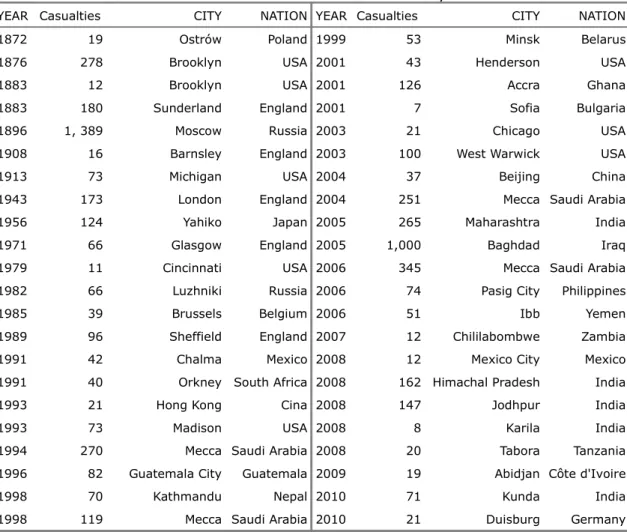
Hopefully, modern developments may help prevent some of the approximately two thousand deaths that annually occur in accidents owing to, or related to, crowding. In Table 1 we give a non-exhaustive survey of severe crowd accidents. Often, lower evacuation times cold have helped preventing or, at last diminishing the effects of these accidents.
A possible benchmarking of crowd dynamics models may be based on the answers that different model give to the following questions:
Clog doors: When, how and why does the efficiency of the exit fall
down?
Braess' paradox: When, how and why is the obstacle helpful in the
evacuation?
Table 1: The main crowd accidents occurred in the recent years in the world
YEAR Casualties CITY NATION YEAR Casualties CITY NATION
1872 19 Ostrów Poland 1999 53 Minsk Belarus
1876 278 Brooklyn USA 2001 43 Henderson USA
1883 12 Brooklyn USA 2001 126 Accra Ghana
1883 180 Sunderland England 2001 7 Sofia Bulgaria
1896 1, 389 Moscow Russia 2003 21 Chicago USA
1908 16 Barnsley England 2003 100 West Warwick USA
1913 73 Michigan USA 2004 37 Beijing China
1943 173 London England 2004 251 Mecca Saudi Arabia
1956 124 Yahiko Japan 2005 265 Maharashtra India
1971 66 Glasgow England 2005 1,000 Baghdad Iraq
1979 11 Cincinnati USA 2006 345 Mecca Saudi Arabia
1982 66 Luzhniki Russia 2006 74 Pasig City Philippines
1985 39 Brussels Belgium 2006 51 Ibb Yemen
1989 96 Sheffield England 2007 12 Chililabombwe Zambia
1991 42 Chalma Mexico 2008 12 Mexico City Mexico
1991 40 Orkney South Africa 2008 162 Himachal Pradesh India
1993 21 Hong Kong Cina 2008 147 Jodhpur India
1993 73 Madison USA 2008 8 Karila India
1994 270 Mecca Saudi Arabia 2008 20 Tabora Tanzania
1996 82 Guatemala City Guatemala 2009 19 Abidjan Côte d'Ivoire
1998 70 Kathmandu Nepal 2010 71 Kunda India
1998 119 Mecca Saudi Arabia 2010 21 Duisburg Germany
Source: http://en.wikipedia.org/wiki/Stampede
The models presented below, in particular the 1D one, do provide answers to the questions above. We stress that these results are obtained in a continuum setting. This means that the key quantity describing the crowd is a density, i.e. a function assigning to time t and to a space coordinate x the quantity ρ(t,x) such that the total number of pedestrians that at time t are in a region A is ∫A ρ(t,x) dx,
see Cristiani et al., 2010. In particular, no proper volume for pedestrians is introduced.
A 1D macroscopic model describing pedestrian flow
We want to describe the evacuation of pedestrians from a narrow corridor or a bridge, mathematically represented by the interval [0,D], see Fig. 1. We assume that the escaping pedestrians have to pass through an “exit door” sited at D. Before reaching it, they have to go through an “obstacle” at d, whose role is to regulate the evacuation process in the sense that will be explained later.
Obviously, the total number of pedestrians is conserved. We also assume that the average velocity v of the pedestrians at time t and location x is a function of the crowd density ρ(t, x), namely v = v(ρ), so that the crowd flow is f(ρ) = ρ v(ρ). Then, we are led to the conservation law
∂tρ + ∂xf(ρ) = 0 (1)
analogous to the classical LWR model.
Fig. 1: Evacuation of a corridor [0,D] through the exit door at D. An obstacle at d
regulates the crowd flow. At the initial time pedestrians are assumed to be uniformly distributed along the segment [a,b].
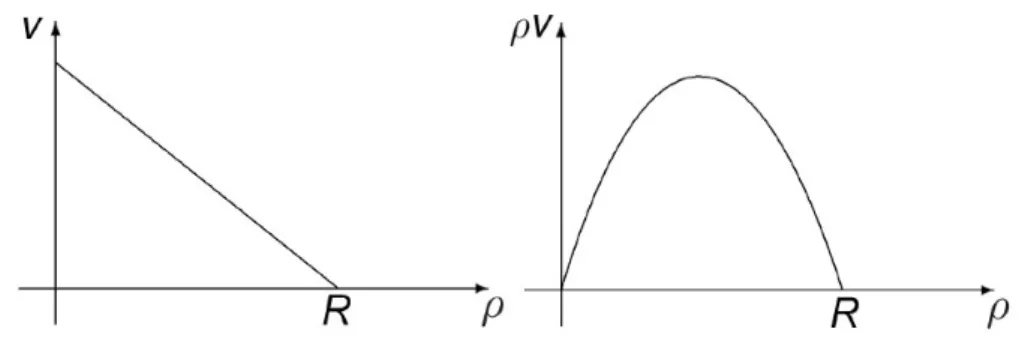
One might be now lead to force pedestrian flow to follow the same description provided in the case of vehicular traffic by the classical LWR model. This would amount first to introduce also for pedestrians a speed law and a fundamental diagram, roughly speaking, such as those in Fig. 2. Then, the standard classical definitions of entropy solutions could be applied, see Bressan, 2000. However, the resulting model would not be able to capture relevant patterns that are typical of crowd dynamics and that are not present in vehicular traffic. In particular, the resulting description of the behavior of pedestrians in panic situations would be hardly acceptable. More than that, the very definition of panic would be difficult.
From the analytical point of view, we stress that classical solutions to (1) satisfy the maximum principle, see Lefloch, 2002, Chapter IV, Theorem 2.1(a). This elementary analytical result prevents any increase in the maximal density, in contrast with a realistic
description of panic, where a sort of overcompression arises in panic situation and is often a cause of major accidents.
Fig. 2: Qualitative behaviour of, left, the speed law and, right, the fundamental
diagram typically used in the classical LWR model for vehicular traffic.
The model proposed by Colombo and Rosini in 2005, relies on an extension of the interval of the possible crowd densities: beyond the interval [0,R] of the standard densities they introduced the panic states corresponding to densities in the interval ]R,R*]. Therefore, the
speed law and the fundamental diagram proposed in Colombo, Rosini, 2005, are those here displayed in Fig. 3.
Fig. 3: Qualitative behaviour of, left, the speed law and, right, the fundamental
diagram introduced in Colombo, Rosini, 2005, to describe pedestrian flows. Note the density interval ]R,R*]: it contains the panic states.
We point out that the shape of the fundamental diagram showed in Fig. 3 matches experimental measurements of a crowd crush, see Helbing, Johansson, Al-Abideen, 2007 and Fig. 4.
However, to avoid the implications of the maximum principle, which prevents standard solutions to grow above the maximal value of the initial datum, also the very definition of solution needs to be suitably
modified. The introduction of nonclassical (or non-entropic) shocks allows the sharp increasing of the crowd density and the appearance of panic states. We refer to Colombo, Rosini, 2005 and Colombo, Rosini, 2009, for the detailed definitions and the analytical results. An example of how panic can arise is described in the following section. Roughly speaking, the presence of a sufficiently large density jump between a small density upstream and a density close to R downstream create the condition for panic emergence.
Fig. 4: Fundamental diagram as postulated in Colombo, Rosini, 2005. The
superimposed dots are the experimental measurements from Helbing, Johannson, Al-Abideen, 2007.
Assume that, at the initial time t = 0, the crowd is uniformly distributed in [a,b] ⊂ [0,D], with a relatively high density ρ ∈ [0,R]. Consider two doors in d and D, b < d ≤ D, with maximal loads p, P : [0,R*] → [0,max f], respectively. High densities at the doors affect on
their efficiency, and therefore proper choices of the functions p and P are p = p1 χ[0,R] + p2 χ]R,R*] and P = P1 χ[0,R] + P2 χ]R,R*], with P2 < p2 <
P1 < p1. Roughly speaking, the first door is larger than the second
one, p > P, and the high densities of people close to the doors clog them, p1 > p2 and P1 > P2. Mathematically, this situation is described
by the following Cauchy problem with constraints. ∂tρ + ∂xf(ρ) = 0 for t≥0, x [0,D]∈
ρ(0,x) = ρχ[a,b](x) for x [0,D]∈ f(ρ(t,d))≤p(ρ(t,d)) for t>0
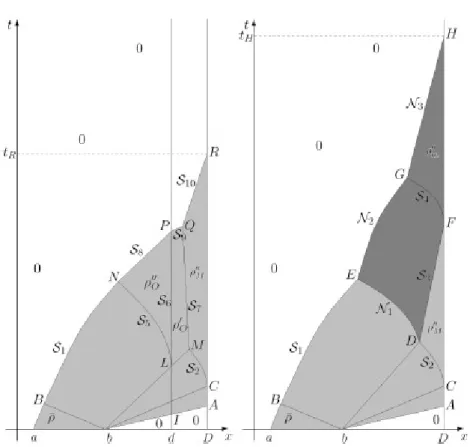
By applying the wave front tracking method, and solving a certain number of Riemann problems, it is possible to construct a solution to (2), see Fig. 5.
If there is no door at x=d, the situation is represented in Fig. 5, right. At time t=0, the crowd starts moving towards the exit sited at D. At t=A the first pedestrians reach the door. The outflow at D increases up to C, when the maximal outflow through the door is reached. Then, a queue is formed, corresponding to the (classical) shock S2. Between t=C and t=F the exit works at its maximum efficiency. At t=K, the backward moving shock S2 causes panic to arise. Indeed, at that point, pedestrians behind the shock meet a sharp sudden increase in the density. The nonclassical shock N1 arises and all the dark shaded area above N1 is filled with crowd in panic states. At t=F the overcompressed states reach the exit and the efficiency of the door is reduced.
The effect of the second door in x=d is represented in Fig. 5, left. As before, at time t=0, pedestrians start moving rightwards and the first one exit the door D at t=A. At t=C, a backward moving shock S2
appears. However, now, at t=L the maximal through flow of the door at d is reached. Therefore, a second classical backward moving shock S5 is formed at t=L. As a consequence, S2 may not cause the insurgence of panic states. The exit at D works at its maximum efficiency all along the segment between t=C and t=R, resulting in a lower evacuation time.
The detailed construction of these solutions can be found in Colombo, Rosini, 2009, section 4.2.
We observe that, in this particular situation, the evacuation time without the first door is larger than the evacuation time with the first door. The presence of the obstacle avoids the density to reach these high values, thus allowing for a faster evacuation of the corridor.
Moreover, changing the position of the first door, namely, letting varying d in [b,D], we obtain the graph for the evacuation time represented in Fig. 6. Remarkably, there is an interval of values of d such that the presence of the first door helps for the evacuation time, showing that the model properly describe the Braess' paradox for pedestrian flows. Furthermore, it is also clear that the presence of a first door too close to the second one does not have any effect on the evacuation time.
Fig. 5: The solution to (9): left, of the whole system and, right, neglecting the
third equation, i.e. without the obstacle at d. Note that the evacuation time tR on
the left is smaller than the analogous time tH on the right.
Fig. 6: The horizontal dotted line is the evacuation time without the obstacle at d,
see Figure 5, right. The solid line is the evacuation time as a function of the position of the first door, d, see Figure 5, left.
A 2D dynamic continuum pedestrian flow model
We consider here a 2D macroscopic model introduced by Xia, Wong, Shu, 2009. In this case, the pedestrian flow is governed by the conservation law for the mass variable
∂tρ(x,t) + ·∇ f(x,t) = 0 for t≥0, x∈Ω, (3)
where x=(x,y) is the space coordinate and ·∇ f(x,t) = ∂xf1(x,t) +
∂yf2(x,t) is the usual divergence. Ω represents the two-dimensional
walking facility whose boundary is given by ∂Ω=Γ0∪Γw, Γ0 denoting the
exit and Γw the solid wall boundary.
The pedestrian flow is defined in its magnitude and direction by the following relations:
∥f(x,t) = ∥ ρ(x,t) v(ρ(x,t)),
f(x,t) // ( -∇ϕ x)-ω c(( ∇ ρ(x,t)) ),
where v=v(ρ) denotes the magnitude of the mean pedestrian velocity. The former relation assigns the modulus of the flow, while the latter defines its direction. The speed v=v(ρ) is assumed to be a function of the form
v(ρ) = vmax (1-ρ/ρmax).
The flow direction is governed by the minimum travel cost ϕ from point x to the destination (exit) Γ0 . This cost is computed as ϕ a
solution to the Eikonal equation
∥ ∇ϕ(x) = ∥ 1/vmax, x∈Ω, (4)
(ϕ x) = 0, x∈Γ0 .
The function c=c(ρ)= 1/v(ρ) + βρ2, for a suitable β>0, defines the
local travel cost due to pedestrian density. Essentially, the model assumes that pedestrians seek to minimize their travel cost based on their knowledge of the location of the exit, but are ready to modify their trajectories in order to avoid high densities.
The following numerical simulations have been carried out using the fast sweeping method (described in Zhao, 2004) to solve the Eikonal equation (4) and the classical Lax-Friedrichs scheme to integrate the conservation law (3). We considered a group of people exiting a room with and without an obstacle in front of the door (see Fig. 7).
Fig. 7: Initial situation at time t=0 considered in the numerical simulations. Left,
exit without obstacle and, right, exit with obstacle. The uniform initial crowd density of people is set to ρ0=1.
Again, without any assumption whatsoever on the proper volume of pedestrians, Fig. 8 shows that the presence of the obstacle avoids high concentrations and diminishes the exit time, thus confirming the Braess' paradox. The parameters chosen in this integration are vmax=0.5, ρmax=4, ω=0.4 and β=0.2.
t=0.9
t=1.3
t=1.7
Fig. 8: Numerical simulations of a crowd exiting a room. Left, without obstacle
and, right, with an obstacle in front of the door. This experiment confirms that there are situations in which the presence of the obstacle diminishes the evacuation time. This is obtained avoiding high inter-pedestrian pressure or, equivalently, high crowd densities.
Conclusions
We presented two macroscopic crowd dymanics models and some of their analytical properties. These models do capture some relevant features of pedestrian flows, in particular in the case of the evacuation of a closed space, e.g. a corridor or a room. Numerical integrations are possible, allowing a detailed description of the phenomena. Furthermore, the time necessary for people to exit the corridor can be computed.
Reasonable qualitative behaviors of the solutions are described. In particular, the models presented account for the possible decrease in the evacuation time thanks to the careful insertion of an obstacle at a well chosen position in front of the exit. This phenomenon, an analog of Braess' paradox, see Braess, 1968, is clearly non generic.
References
Braess, D. (1968) “Ueber ein Paradoxon aus der Verkehrsplanung”,
Unternehmensforschung, 12, pp. 258-268
Bressan, A. (2000) Hyperbolic systems of conservation laws, Oxford University Press, Oxford
Bressan, A. (2004) The front tracking method for systems of conservation laws, Handb. Differ. Equ., North-Holland, Amsterdam.
Bressan, A., Colombo, R.M. (1995 ) “The semigroup generated by 2x2 conservation laws”, Arch. Rational Mech. Anal., 133(1), pp. 1-75
Clements, R.R., Hughes, R.L. (2004) “Mathematical modelling of a medieval battle: the Battle of Agincourt”, Math. Comput. Simulation, 64(2), pp. 259-269
Colombo, R.M., Goatin, P. (2007) “A well posed conservation law with a variable unilateral constraint”, J. Differential Equations, 234, pp. 654-675
Colombo, R.M., Rosini, M.D. (2005) “Pedestrian flows and nonclassical shocks”,
Math. Methods Appl. Sci., 28, pp. 1553-1567
Colombo, R.M., Rosini, M.D. (2009) “Existence of nonclassical solutions in a pedestrian flow model”, Nonlinear Analysis: Real World Applications, 10(5), pp. 2716-2728
Colombo, R.M., Facchi, G., Maternini, G., Rosini, M.D. (2009) “On the continuum Modeling of Crowds”, In Proceedings of Hyp2008, 67(2), pp. 517-526
Colombo, R.M., Maternini, G. (2004) “A New Simulation Model for the Management of Unstable Traffic Flow In New Technologies and Modeling for Roads: Applications to Design and Management”, Atti SIIV, Firenze
Cristiani, E., Piccoli, B., Tosin, A., (2010) “Modeling self-organization in pedestrians and animal groups from macroscopic and microscopic viewpoints”, in G. Naldi, L. Pareschi, G. Toscani, Eds., Mathematical Modeling of Collective Behavior in
Socio-Economic and Life Sciences, p. 337-364, Birkhäuser Boston, 2010.
Helbing, D., Johansson, A., Al-Abideen, H.Z. (2007) “The Dynamics of crowd disasters: An empirical study”, Physical Review E, 75(4)
Holden, H., Risebro, N. H. (2002) Front tracking for hyperbolic conservation laws, Applied Mathematical Sciences. Springer-Verlag, New York.
Hughes, R.L. (2003) “The flow of human crowds”, Annual review of fluid mechanics,
35, pp. 169-182
Leoch, P.G. (2002) Hyperbolic systems of conservation laws, Lectures in Mathematics ETH Z urich. Birkh auser Verlag, Basel.
Lighthill, M.J., Whitham, G.B. (1955) “On kinematic waves. II. A theory of traffic flow on long crowded roads”, Proc. Roy. Soc. London. Ser. A., 229, pp. 317-345 Richards, P.I. (1956) “Shock waves on the highway”, Operations Res., 4, pp. 42-51 Rosini, M.D. (2009) “Nonclassical interactions portrait in a macroscopic pedestrian ow model”, J. Differential Equations, 246(1), pp. 408-427
Xia, Y., Wong, S.C., Shu, C.-W. (2009) “Dynamic continuum pedestrian flow model with memory effect”, Physical Review E, v79 , article number 066113.
Zhao, H. (2004) “A fast sweeping method for Eikonal equations”, Mathematics of