HAL Id: hal-00115211
https://hal-insu.archives-ouvertes.fr/hal-00115211
Submitted on 16 Jun 2017
HAL is a multi-disciplinary open access
archive for the deposit and dissemination of
sci-entific research documents, whether they are
pub-lished or not. The documents may come from
teaching and research institutions in France or
L’archive ouverte pluridisciplinaire HAL, est
destinée au dépôt et à la diffusion de documents
scientifiques de niveau recherche, publiés ou non,
émanant des établissements d’enseignement et de
recherche français ou étrangers, des laboratoires
granite pluton (French Massif Central) and its tectonic
implications
Jean-Yves Talbot, Yan Chen, Michel Faure, Wei Lin
To cite this version:
Jean-Yves Talbot, Yan Chen, Michel Faure, Wei Lin.
AMS study of the Pont-de-Montvert–
Borne porphyritic granite pluton (French Massif Central) and its tectonic implications.
Geophysi-cal Journal International, Oxford University Press (OUP), 2000, 140, pp.677-686.
�10.1046/j.1365-246X.2000.00067.x�. �hal-00115211�
Geophys. J. Int. (2000) 140, 677–686
AMS study of the Pont-de-Montvert–Borne porphyritic granite
pluton ( French Massif Central ) and its tectonic implications
Jean-Yves Talbot, Yan Chen, Michel Faure and Wei Lin
UMR 6530, Universite´ d’Orle´ans, France, 45067 Orle´ans Cedex 2 France. E-mail: yan.chen@uni-orleans. f r
Accepted 1999 November 10. Received 1999 November 9; in original form 1998 November 11
S U M M A R Y
Thermomagnetic experiments, isothermal remanent magnetization (IRM), hysteresis loops, X-ray reflection analyses, optic microscopic observations, bulk magnetic susceptibility and natural remanent magnetization (NRM) show that the susceptibility signal of 56 sites in the Pont-de-Montvert–Borne pluton is derived mostly from biotite with a very small proportion of ferromagnetic material. Low anisotropy degree (P parameter) and consistent AMS orientations among monzonite, enclaves and aplitic dykes indicate that the AMS was acquired during pluton emplacement in the subsolidus phase. Magnetic fabrics demonstrate that linear deformation is prominent in the area where the granite is in direct contact with micaschists, and that planar deformation becomes more important in the area where the pluton is surrounded by non-porphyritic peraluminous granites. AMS measurements also show that shallow plunging E–W-stretching lineations are the dominant structure over most of the studied area. Foliation orientations follow the pluton contour in the western part, indicating that the Pont-de-Montvert–Borne pluton is probably rooted in the west and extruded towards the east. These AMS results agree to some extent with fabric inferred from mineral preferred orientation. The AMS data support an E–W extensional tectonic setting during the Pont-de-Montvert–Borne pluton emplacement, which resulted from the Late Carboniferous crustal thinning of the Hercynian orogeny.
Key words: AMS, French Massif Central, Hercynian Belt, pluton emplacement.
Massif Central. The Pont-de-Montvert–Borne pluton, which I N T R O D U C T I O N
intruded the Ce´vennes micaschist during the Middle Late It is already well established that the development of planar Carboniferous, is a syntectonic pluton. As shown by the and linear fabrics in plutons is controlled by both magma kinematic indicators in the pluton aureole (sigmoidal quartz crystallization dynamics and the regional stress field. Therefore, veins, shear bands, boudinaged andalousite, sigmoidal biotite or the structure of a pluton provides significant information on quartz pressure shadows around contact minerals), the pluton the regional tectonics. The role of granitic plutons as markers terminations are characterized by the-east and top-to-of the late stage top-to-of the orogenic evolution top-to-of the Hercynian the-west shearing at the eastern and western terminations, Belt in the French Massif Central has recently been pointed respectively (Faure et al. 1992). Along the northern and southern out (e.g. Faure & Pons 1991; Faure 1995). One difficulty in the contacts, coaxial flow predominates where mineral fabrics have already been analysed by means of field and universal stage, but study of granite fabrics lies in measuring the planar and linear
mineral preferred orientations, especially if the deformation is with controversial interpretations (Fernandez 1977; Mialhe 1980; Faure et al. 1992). Fernandez (1977) and Mialhe (1980) used weak. Such studies generally involve time-consuming techniques
using a universal stage (Marre 1982). An alternative method the K-feldspar megacryst subfabrics to determine the structure of the Pont-de-Montvert and Borne massifs, respectively. The is to analyse the anisotropy of magnetic susceptibility (AMS)
(Graham 1954). This method helps the mechanisms of pluton N–S orientation of K-feldspar, and the planar deformation which generally follows the contour of the pluton with a emplacement to be better understood, as has been
demon-strated for several granitic plutons (e.g. Khan 1962; Ellwood principal E–W orientation led these authors to conclude that these plutons were intruded during N–S extensional tectonics. & Whitney 1980; Bouchez et al. 1990; Rochette et al. 1992).
AMS analyses are applied here to the Pont-de-Montvert– They further suggested that the pluton is of tabular shape dipping 40° to 50° north. In contrast, Faure et al. (1992) Borne monzonitic pluton in the southeastern part of the French
677 © 2000 RAS
argued that this technique is not suitable for studying the age is geologically the most acceptable (see discussion in Faure 1995). Recently, U-Pb measurements on zircon and monazite tectonic structure of granitic plutons. Based on field
obser-vations of enclaves, aplite dykes and cleavage of biotite and from these bodies yielded emplacement ages of around 320–315 Ma (Lancelot, personal communication). Biotite and plagioclase, they found that the planar structure shows the
same orientation as determined by Fernandez (1977) and muscovite40Ar/39Ar ages from granite and hornfels range from 314 to 304 Ma (P. Monie´, work in progress). These younger Mialhe (1980); however, the linear structure is subhorizontal
E–W trending, indicating an E–W stretching. Faure et al. ages attest to a partial re-opening of the isotopic system related to a perigranitic hydrothermal event responsible for gold (1992) suggested, moreover, that the monzonite-micaschist
contact should incline towards the south in the south flank mineralization (Charonnat et al. 1997).
Owing to abundant structural indicators such as schlieren, and towards the north in the north of the pluton.
In light of these uncertainties, an AMS study was undertaken enclaves, aplitic joints and mineral preferred orientation, the structure of the Pont-de-Montvert–Borne pluton has been to assess the fabric elements in the pluton. The origin of AMS
is discussed in terms of magnetic mineralogy and granite extensively investigated (Fernandez 1977; Mialhe 1980; Faure et al. 1992). Weakly developed mineral fabrics and the lack of rheology. Both conventional petrofabric and AMS techniques
are compared and are used to constrain the tectonic setting mylonites have led to differing interpretations. For example, according to Fernandez (1977), the Pont-de-Montvert–Borne and emplacement mechanism of the Pont-de-Montvert–Borne
pluton. pluton exhibits a submeridian mineral lineation, whereas Faure et al. (1992) describe a consistent E–W-trending lineation. G E O L O G I C A L S E T T I N G
S A M PL I N G The French Massif Central comprises a large area, geologically
related to the Hercynian orogeny, which formed during the About 350 orientated cores were collected with a portable gasoline drill from 56 sites widely distributed in the Pont-Palaeozoic Gondwana–Laurussia collision (e.g. Matte 1986,
and references therein). The French Massif Central records Montvert–Borne pluton (Fig. 1). Five to 10 cores of several centimetres in length and 2.5 cm in diameter have been sampled several tectonic metamorphic and magmatic events that took
place between the Silurian and the Late Carboniferous (see from each site, over a surface area of more than 10 m2. Most of the sites lie near the pluton boundaries, with fewer from the Faure et al. 1999 for a recent review and references). In the
northern part of the Massif, compression ended in the Late central part. The collection is composed mainly of monzonite with less than 10 per cent of aplite and enclave rocks. The Devonian to Early Carboniferous (#360–350 Ma), whereas it
lasted up to the Middle Carboniferous (#330 Ma) in the south. cores were orientated, when it was possible, by both magnetic and sun compasses. The mean difference between magnetic The entire massif experienced extensional tectonics during the
Middle to Late Carboniferous (#320–300 Ma), again with and sun measurements was less than 0.5°. extension beginning earlier in the north than in the south
(Faure 1995). The Ce´vennes area forms the southeastern
L A B O R AT O R Y M E A S U R E M E N T S part of the French Massif Central (Fig. 1). It consists of a
wide micaschist-quartzite series that experienced a prograde Before AMS measurements were taken, several methods were employed to identify the magnetic carriers. A thermo-greenschist to lower amphibolite facies metamorphism (Rakib
1996). The flat-lying foliation and N–S- to NE–SW-trending magnetic experiment was carried out to determine the Curie temperatures using CS3 apparatus and a KLY3 kappabridge. stretching lineation (L1) is related to southward nappe-stacking
during the Hercynian orogeny (Mattauer & Etchecopar 1976; Magnetic susceptibility falls significantly at about 580°C, which indicates the presence of magnetite (Fig. 2). A minor Matte 1986; Faure et al. 1999). The metamorphism is dated at
around 340 Ma using 40Ar/39Ar on biotite and muscovite residual signal above 580°C could be an indication of haematite (Fig. 2). The isothermal remanent magnetization (IRM) was (Caron 1994; Monie´ et al. 1999). After southward thrusting,
the Ce´vennes micaschists experienced another ductile defor- measured on several representative specimens using an IM30 impulse magnetizer and a JR5 spinner magnetometer (Fig. 3). mation characterized by E–W to NW–SE stretching lineations
(L2). The early compressional foliation is cut by low-angle IRM acquisition increases rather rapidly at weak applied magnetic fields up to 150 mT, and then slows down thereafter. shear bands often associated with sigmoidal quartz veins,
related to a late orogenic extensional stage of Middle–Late The specimens are not saturated by 1.0 T (Fig. 3). The IRM curves suggest the probable presence of ferromagnetic minerals; Carboniferous age (Faure 1995). The shear criteria indicate a
top-to-the-east motion of the hanging wall. however, their concentration should not be important as the highest IRM intensity does not exceed 7×10⁻² A m−1 for The metamorphic sequence in the Ce´vennes is intruded in
the north and south by the Mont-Loze`re and Aigoual-St- standard-size samples (Fig. 3).
X-ray reflection analyses on a Philips diffractometer with Guiral-Liron plutons, respectively (Fig. 1). The Mont-Loze`re
massif shows several petrographic facies ( Van Moort 1966). a Cobalt tube, and microscopic observations were obtained before defining the principal magnetic susceptibility carriers. The non-porphyritic peraluminous Signaux granite and the
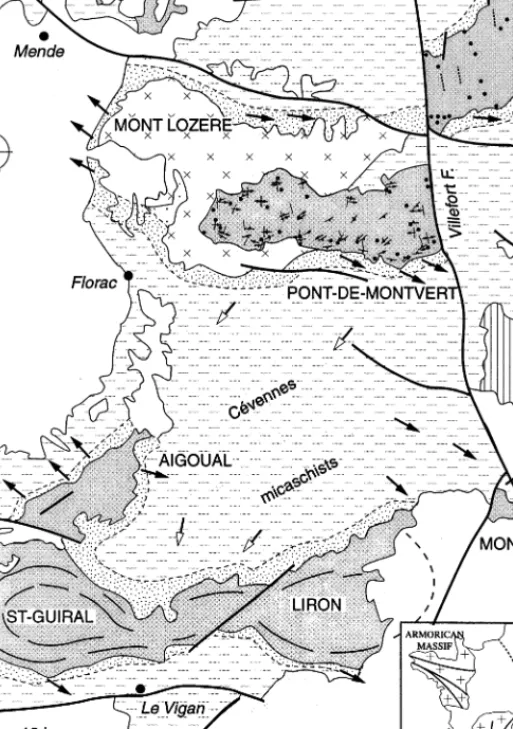
porphyritic Pont-de-Montvert monzonite form the main parts Fig. 4 shows one of the X-ray reflection analyses, which indicates that the main minerals are quartz, K-feldspar, plagio-of the massif. The Borne massif lies in the eastern part plagio-of the
porphyritic monzonite and was left-laterally offset by the N–S- clase (anorthite, albite) and biotite (annite), with a very small proportion of opaque minerals ( haematite). Optical obser-striking Villefort fault in the Late Permian (Fig. 1). Here, the
Pont-de-Montvert and Borne massifs are treated as an single vations from several thin sections confirm the X-ray studies, in agreement with previous petrographic studies ( Van Moort entity. Available Rb-Sr ages of the Pont-de-Montvert–Borne
AMS study of the Pont-de-Montvert–Borne granite pluton 679
Figure 1. Structural map of the Ce´vennes area, showing the granitic massifs. Fabric elements in the Pont-de-Montvert–Borne pluton are according to Faure et al. (1992). The inset shows the study area in the French Palaeozoic massifs.
Hysteresis loops of some samples were also determined (Fig. 6a) shows a monomodal asymmetric distribution, ranging from 10 to 600×10−6 SI and averaging 140±60×10−6 SI. using a translation inductometer within an electromagnet
pro-viding a field of up to 1.0 T at the Palaeomagnetic Laboratory Enclaves possess magnetic susceptibilities slightly higher than those of the granites and aplites. The low BMS possibly of Saint Maur (Paris). A strong dominant effect of the
para-magnetic minerals is evidenced by the almost perfectly linear indicates an abundance of paramagnetic material, with little magnetite. The range of values is compatible with that of superimposition of the two curves produced during increasing
and decreasing magnetic fields (Fig. 5). The paramagnetic paramagnetic minerals such as biotite (Tarling & Hrouda 1993), which are the main paramagnetic mineral components susceptibility is about 10−9 m3 kg−1, and the saturation
remanent magnetization is very weak (#10−4 A m2 kg−1), in these rocks.
The natural remanent magnetization (NRM) of each confirming that the ferromagnetic minerals are in very small
proportion relative to the other minerals in the samples. specimen was also measured on a JR5 spinner magnetometer. The NRM (Fig. 6b) has a relatively narrow range of asym-The bulk magnetic susceptibility (BMS) was measured with
a KLY3 kappabridge. The histogram of the BMS intensity metrically distributed intensities from 0 to 26×10−4 A m−1
generally well grouped with E–W declinations and sub-horizontal (<30°) inclinations, especially for the sites in the Borne massif and the eastern part of the Pont-de-Montvert massif, where the pluton is not surrounded by non-porphyritic peraluminous granite (e.g. sites 14, 29). Otherwise, in the western part of the Pont-de-Montvert pluton, where the massif is in contact with non-porphyritic peraluminous granite, Kmin is better grouped, while K
max and Kint are more mixed (e.g. sites 41, 42, 53). The planar anisotropy is locally more pro-nounced than the linear one but its orientation varies with respect to its location in the pluton (Fig. 7). The foliation plunges towards the margins of the massif near the southern and western border (e.g. sites 38, 41, 56, 53 in Fig. 7). The plunge angles of foliation are also variable with respect to
Figure 2. Thermomagnetic curves in air. The rapid decrease of
magnetic susceptibility at about 580°C and 630 °C indicates the the border, being steeper in the south (40° to 50°) than in the
existence of ferromagnetic minerals. north (10° to 20°).
D I S C U S SI O N A N D C O N L U SI O N S
The magnetic mineralogical experiments show that the specimens possess low NRM intensities (average=6.4±5.6×10⁻⁴ A m−1). The weak bulk magnetic susceptibilities (average=1.4±0.65× 10⁻⁴ SI) fall in the ‘non-magnetic’ granite category (Ellwood & Wenner 1981), in which biotite normally carries the paramagnetic signal (Borradaile et al. 1987; Zapletal 1990). Thermomagnetic and IRM experiments indicate the existence of ferromagnetic minerals, but the magnetic susceptibility and remanence level are very low (Figs 2 and 3). X-ray reflection analyses and optic microscopic observations show that the modal mineral assemblage is composed of quartz, biotite, K-feldspar and plagioclase with very little opaque mineral content (Fig. 4). Thus, the ferromagnetic mineral concentration should be very low with only a minor influence on the AMS measurements.
Two parameters were computed to describe the shape and intensity of the magnetic susceptibility tensor. The first is the ellipsoid shape parameter (T ) (Jelinek 1981; Hrouda 1982; see Table 1 for its formula), which varies from−1 (prolate) to +1 (oblate), and the second is the anisotropy degree (P), which relates to the fabric intensity (Jelinek 1981; see Table 1 for its
Figure 3. Acquisition of isothermal remanent magnetization, showing
formula). Most of the sites possess negative T -values, indicating
partial magnetic saturation with weak IRM intensity.
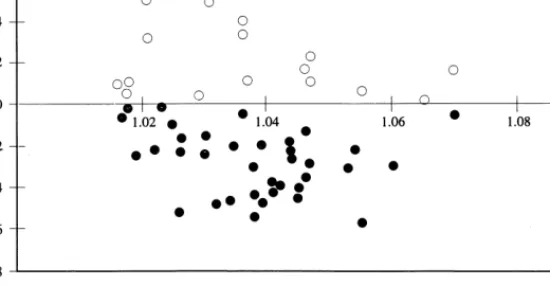
that linear deformation is dominant (Table 1 and Fig. 8). In this study, P-values are low, ranging from 1.01 to 1.07 (Table 1 and Fig. 8). Interestingly, several samples collected from enclaves with a weak average of 6.4±5.6×10⁻⁴ A m−1. The weak
value and narrow range of NRM may indicate that the sampled and aplites show similar AMS orientations (sites 06, 08 and 44 in Fig. 7).
rocks are of ‘non-magnetic’ granite and relatively homogenous
in their magnetic mineralogy (Ellwood & Wenner 1981). One of the most interesting aspects of the application of magnetic fabrics is a new understanding of the mechanisms leading to fabric development in magmatic rocks. In the ME A S U R E M E N T S O F T H E A N I S O T RO P Y
plutonic rocks where emplacement occurred through magma OF MA G N E T I C SU S C E P T I B I L I T Y
flow, the magnetic anisotropy is generally characterized by low values, less than 10 per cent (Hargraves et al. 1991). Thus, it AMS measurements were carried out on 377 specimens from
56 sites with a KLY3 kappabridge of #10−9 SI sensitivity. The is important to know if the observed fabrics were acquired during magmatic flow before granite crystallization, during three principal axes of the magnetic susceptibility ellipsoid
(K
max≥Kint≥Kmin) are denoted by squares, triangles and pluton emplacement in the subsolidus stage, or during a late tectonic stage after emplacement and cooling. In this study, circles, respectively, in Fig. 7 (see also Table 1). For each site,
the spatial distribution of these three axes has been defined this last possibility is ruled out because the deformation magnitude (P parameter) is weak, ranging from 1.01 to 1.07 by declination (Dec), inclination (Inc), precision parameters
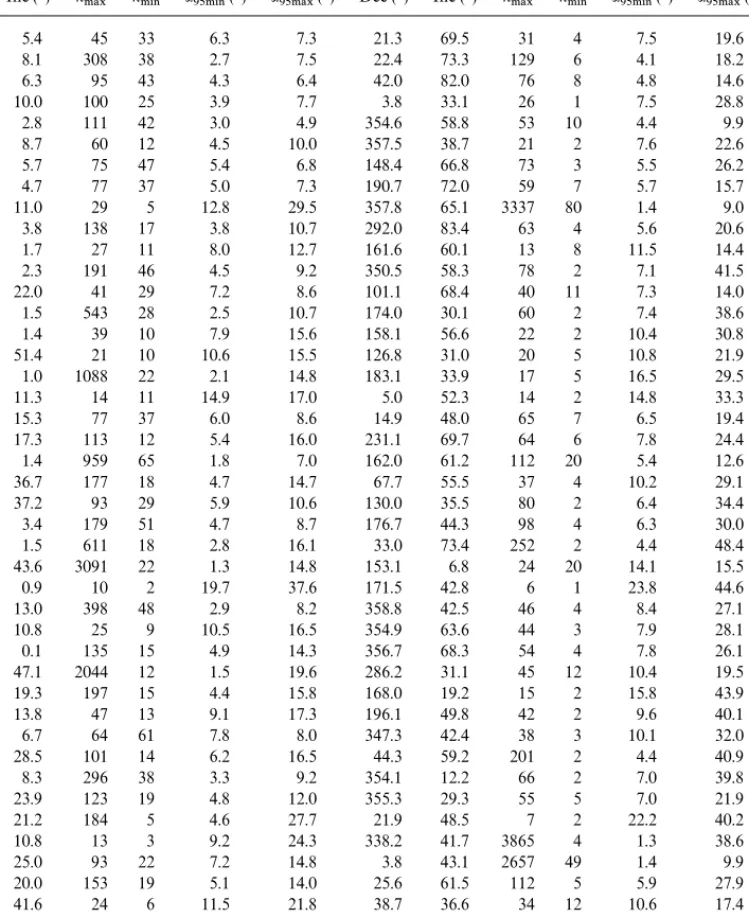
(kmax and kmin) and confidence intervals at the 95 per cent level (Fig. 8 and Table 1) with an average of 1.04±0.01. This range of values indicates that the magnetic fabrics were not obtained (a95max and a95min; Table 1; Bingham 1964). Fig. 7 gives the
stereographic distribution of the three principal magnetic fabric after pluton emplacement (Hrouda & Chlupacova 1980; King 1966). Consequently, in spite of the presence of some important axes of each sample for each site. Within each site, Kmax is
AMS study of the Pont-de-Montvert–Borne granite pluton 681
Table 1. Summary of the principal results of the AMS measurements. N: number of measured specimens; Dec, Inc, kmax, kmin, a95min and a95max: declination, inclination, Bingham (1964) bimodal statistics data; K
max, Kint, Kmin: principal axes of the magnetic fabric; P: corrected anisotropy degree*; T: ellipsoid shape parameter†.
Site N K
max Kmin P T
Dec (°) Inc (°) k
max kmin a95min (°) a95max (°) Dec (°) Inc (°) kmax kmin a95min (°) a95max (°)
1 11 274.7 5.4 45 33 6.3 7.3 21.3 69.5 31 4 7.5 19.6 1.045 −0.428 2 9 263.5 8.1 308 38 2.7 7.5 22.4 73.3 129 6 4.1 18.2 1.041 −0.379 3 11 263.9 6.3 95 43 4.3 6.4 42.0 82.0 76 8 4.8 14.6 1.038 −0.445 4 13 268.7 10.0 100 25 3.9 7.7 3.8 33.1 26 1 7.5 28.8 1.046 −0.36 5 19 89.0 2.8 111 42 3.0 4.9 354.6 58.8 53 10 4.4 9.9 1.053 −0.315 6 16 266.9 8.7 60 12 4.5 10.0 357.5 38.7 21 2 7.6 22.6 1.038 −0.537 7 9 261.3 5.7 75 47 5.4 6.8 148.4 66.8 73 3 5.5 26.2 1.039 −0.482 8 10 85.2 4.7 77 37 5.0 7.3 190.7 72.0 59 7 5.7 15.7 1.041 −0.225 9 4 265.2 11.0 29 5 12.8 29.5 357.8 65.1 3337 80 1.4 9.0 1.032 −0.474 10 10 87.1 3.8 138 17 3.8 10.7 292.0 83.4 63 4 5.6 20.6 1.047 −0.287 11 11 252.1 1.7 27 11 8.0 12.7 161.6 60.1 13 8 11.5 14.4 1.037 0.107 12 5 255.1 2.3 191 46 4.5 9.2 350.5 58.3 78 2 7.1 41.5 1.026 −0.237 13 9 280.6 22.0 41 29 7.2 8.6 101.1 68.4 40 11 7.3 14.0 1.036 −0.048 14 6 86.4 1.5 543 28 2.5 10.7 174.0 30.1 60 2 7.4 38.6 1.030 −0.248 15 8 268.8 1.4 39 10 7.9 15.6 158.1 56.6 22 2 10.4 30.8 1.026 −0.153 16 8 257.6 51.4 21 10 10.6 15.5 126.8 31.0 20 5 10.8 21.9 1.070 −0.06 17 4 260.2 1.0 1088 22 2.1 14.8 183.1 33.9 17 5 16.5 29.5 1.025 −0.109 18 6 261.8 11.3 14 11 14.9 17.0 5.0 52.3 14 2 14.8 33.3 1.045 −0.426 19 7 266.8 15.3 77 37 6.0 8.6 14.9 48.0 65 7 6.5 19.4 1.046 −0.129 20 6 99.6 17.3 113 12 5.4 16.0 231.1 69.7 64 6 7.8 24.4 1.054 −0.218 21 6 68.7 1.4 959 65 1.8 7.0 162.0 61.2 112 20 5.4 12.6 1.060 −0.297 22 5 266.7 36.7 177 18 4.7 14.7 67.7 55.5 37 4 10.2 29.1 1.039 −0.181 23 6 255.5 37.2 93 29 5.9 10.6 130.0 35.5 80 2 6.4 34.4 1.042 −0.387 24 5 82.4 3.4 179 51 4.7 8.7 176.7 44.3 98 4 6.3 30.0 1.035 −0.21 25 4 267.7 1.5 611 18 2.8 16.1 33.0 73.4 252 2 4.4 48.4 1.034 −0.472 26 4 55.6 43.6 3091 22 1.3 14.8 153.1 6.8 24 20 14.1 15.5 1.044 −0.257 27 5 256.8 0.9 10 2 19.7 37.6 171.5 42.8 6 1 23.8 44.6 1.047 0.110 28 6 256.6 13.0 398 48 2.9 8.2 358.8 42.5 46 4 8.4 27.1 1.044 −0.183 29 7 245.9 10.8 25 9 10.5 16.5 354.9 63.6 44 3 7.9 28.1 1.045 0.172 30 6 259.0 0.1 135 15 4.9 14.3 356.7 68.3 54 4 7.8 26.1 1.038 −0.353 31 4 57.7 47.1 2044 12 1.5 19.6 286.2 31.1 45 12 10.4 19.5 1.041 −0.425 32 5 75.6 19.3 197 15 4.4 15.8 168.0 19.2 15 2 15.8 43.9 1.055 −0.581 33 5 82.4 13.8 47 13 9.1 17.3 196.1 49.8 42 2 9.6 40.1 1.065 0.022 34 5 251.8 6.7 64 61 7.8 8.0 347.3 42.4 38 3 10.1 32.0 1.038 −0.334 35 5 234.7 28.5 101 14 6.2 16.5 44.3 59.2 201 2 4.4 40.9 1.019 −0.239 36 6 258.0 8.3 296 38 3.3 9.2 354.1 12.2 66 2 7.0 39.8 1.030 −0.157 37 7 249.6 23.9 123 19 4.8 12.0 355.3 29.3 55 5 7.0 21.9 1.023 0.005 38 5 248.1 21.2 184 5 4.6 27.7 21.9 48.5 7 2 22.2 40.2 1.021 −0.520 39 4 105.7 10.8 13 3 9.2 24.3 338.2 41.7 3865 4 1.3 38.6 1.022 −0.196 40 4 247.8 25.0 93 22 7.2 14.8 3.8 43.1 2657 49 1.4 9.9 1.031 0.484 41 5 251.3 20.0 153 19 5.1 14.0 25.6 61.5 112 5 5.9 27.9 1.028 0.042 42 6 269.1 41.6 24 6 11.5 21.8 38.7 36.6 34 12 10.6 17.4 1.018 0.323 43 4 254.4 18.0 60 16 9.0 17.4 2.9 31.3 13 6 15.4 22.8 1.016 0.100 44 5 225.7 51.0 16 1 15.5 47.6 5.0 29.3 21 8 15.3 23.7 1.018 0.031 45 6 266.9 13.6 44 21 9.4 13.4 141.6 61.0 1769 67 1.7 8.5 1.047 0.226 46 7 263.5 2.9 76 38 6.0 8.5 158.3 74.6 59 10 6.9 16.3 1.030 −0.146 47 4 281.3 26.0 76 19 8.0 15.9 19.1 27.7 36 2 11.7 41.1 1.018 0.109 48 7 259.5 29.5 36 11 9.4 16.8 101.5 26.6 19 2 13.0 38.2 1.024 −0.309 49 7 273.1 4.1 154 2 4.3 34.0 165.6 67.8 9 5 17.3 23.6 1.018 0.057 50 6 105.4 4.5 31 3 10.1 30.7 8.2 34.5 33 9 12.1 22.9 1.036 0.405 51 6 261.7 63.5 10 6 17.7 23.1 70.0 21.5 12 4 16.0 27.9 1.055 0.064 52 7 292.9 42.2 41 3 8.9 31.5 75.5 47.3 66 8 7.0 19.2 1.018 0.502 53 4 296.0 25.2 6 3 26.8 35.9 67.2 58.2 16 3 17.3 38.2 1.018 0.003 54 6 263.5 7.7 6 2 22.9 33.4 167.9 31.2 18 5 16.2 30.2 1.017 −0.053 55 6 206.9 3.0 26 2 12.2 40.4 93.5 52.1 21 5 13.5 25.6 1.036 0.335 56 5 270.8 39.4 44 8 10.5 23.4 84.8 48.8 58 2 8.2 42.1 1.046 0.179
* P=exp{2[(ln Kmax−ln Kmean)2+(ln Kint−ln Kmean)2+(ln Kmin−ln Kmean)2]}1/2 with Kmean=(Kmax+Kint+Kmin)/3; Jelinek (1981). † T=[2 ln(Kint/Kmin)/ln(Kmax/Kmin)]−1; Jelinek (1981); Hrouda (1982).
Figure 4. Representative spectra of X-ray diffraction of powder of porphyritic monzonite with the interpretation of mineral composition. Q: Quartz, Alb: Albite; Ann: Annite, Ano: Anorthite; Hmt: Hematite.
enclaves are indistinguishable from their monzonitic host rock (Fig. 7). The same conclusion applies to the leucogranitic aplitic joints. These observations demonstrate that the porphyritic monzonite, enclaves and aplite dykes all experienced the same deformation under the same tectonic system. Magmatic flow can hardly account for the development of the anisotropy of magnetic susceptibility, which was therefore acquired in the subsolidus stage after a significant amount of crystallization of the monzonite. Furthermore, the consistency of AMS orientations between the monzonite and aplitic joints indicates that the emplacement of granite and the intrusion of dykes are contemporary, as also suggested by their petrographic similarity.
Figure 5. Hysteresis curve showing linear and superposing induced The lineation and foliation orientations of each site are
magnetic moments with respect to increasing and decreasing applied shown in Fig. 9. An E–W-trending lineation is well developed
magnetic fields. throughout the pluton (Fig. 9a). Planar deformation is more
important in the west, especially where the pluton is sur-faults, such as the Villefort and Ce´vennes faults (Fig. 1), the rounded by non-porphyritic peraluminous granite (Fig. 9b). Pont-de-Montvert–Borne pluton probably did not experience The foliation planes generally dip away from the pluton and any severe internal deformation after its emplacement. This dip more steeply along the southern border than along the conclusion allows the two massifs to be reconstructed to their northern one (Fig. 9b). The map of the shape parameter (T ) initial relative position as a single pluton (Figs 9 and 10). shows the distribution of linear and planar magnetic fabrics in the study area (Fig. 10a). As observed in Figs 7, 9 and 10(a), Moreover, for a given locality, the AMS characteristics of the
AMS study of the Pont-de-Montvert–Borne granite pluton 683 Figure 7. Equal-area projection of the directions of magnetic susceptibility principal axes for 56 sites with their geographical position. Squares, triangl es and circles represent the K max , K int and K min principal axes, respectively. Solid, open and grey symbols correspond to monzonite, enclave and aplite, respectively. © 2000 RAS, GJI 140, 677–686
Figure 8. Plots of the shape (T ) and anisotropy degree (P) parameters showing low deformation degree and dominant linear deformation. Solid and open symbols indicate linear (prolate) and planar (oblate) shapes, respectively. See Table 1 for the calculations.
Figure 9. Magnetic fabric maps of Pont-de-Montvert–Borne pluton restored to its initial shape before left-lateral displacement along the Villefort fault. (a) magnetic lineation with plunge angle and ( b) magnetic foliation with dip angle. For a given site, a solid or open symbol indicates the dominance of linear or planar deformation, respectively.
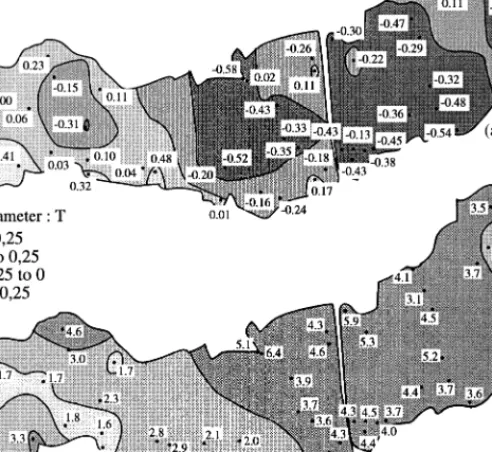
linear fabric dominates the Borne pluton while the planar in zones where the porphyritic monzonite is in direct contact with micaschists. Conversely, in zones where the porphyritic one is more important along the southern and southwestern
borders in the Pont-de-Montvert pluton. Fig. 10(b) shows that monzonite is in contact with non-porphyritic peraluminous granite, the planar fabric predominates (Fig. 10).
the anisotropy magnitude (P parameter) is heterogeneous
at the pluton scale. In general, the P parameter is higher where As a whole, the planar and linear patterns are in good agreement with granite fabric inferred from mineral preferred the linear fabric is dominant and lower where the planar
deformation is dominant. The heterogeneity of this P parameter AMS orientation (Faure et al. 1992). The well-marked E–W linear fabric shown by stretched enclaves and N–S-trending may be due to different types of contacts between igneous and
AMS study of the Pont-de-Montvert–Borne granite pluton 685
Figure 10. Maps of anisotropy parameters of the Pont-de-Montvert–Borne pluton. (a) shape parameter T ; ( b) magnitude of anisotropy, P, in per cent.
fabric. Recent gravity investigations in the Mont Loze`re area R E F E R E N C E S (Marthelet et al. 1999) show that the most important negative
Bingham, C., 1964. Distribution on a sphere and on the projective
gravity anomaly is located in the west corner of the
Pont-de-plane, PhD thesis, Yale University, New Haven, CT.
Montvert–Borne pluton, which is interpreted as the granite Borradaile, G.L., Keeler, W., Alford, C. & Sarvas, P., 1987. Anisotropy root. Moreover, the anomaly gradient is steeper along the of magnetic susceptibility of some metamorphic minerals, Phys. southern border than along the northern one. This observation Earth planet. Inter., 48, 161–166.
is in agreement with the foliation dip pattern, namely steep in Bouchez, J.L., Delas, C., Gleizes, G., Ne´de´lec, A. & Rochette, P., 1990.
the south and gentle in the north (Fig. 9b). The intrusion was Microstructure and magnetic susceptibility applied to emplacement kinematics of granites: example of the Foix Pluton (French Pyrenees),
almost horizontally eastwards, as shown by the E–W-stretching
T ectonophysics, 184, 157–171.
lineation with low dip angle (Fig. 9a).
Caron, C., 1994. Les mine´ralisations Pb-Zn associe´es au Pale´ozoı¨que
The Hercynian orogenic belt is a Devonian–Carboniferous
infe´rieur d’Europe me´ridionale, Trac¸age isotopique Pb-Pb des gıˆtes
collision orogen between Gondwana and Laurussia. After
de l’Iglesiente (SW Sardaigne) et des Ce´vennes, Evolution du socle
the main compression ceased in the Early Carboniferous in the
encaissant par la ge´ochronologie U-PB, Ar-Ar et K-Ar, PhD thesis,
French Massif Central, the tectonics evolved into an E–W
Universite´ de Montpellier, Montpellier.
extensional regime coincident with the emplacement of numerous
Charonnat, X., Faure, M. & Chauvet, A., 1997. Relationship between
granitic plutons (e.g. Faure & Pons 1991; Faure 1995). The Au-Sb mineralization, Mont Loze`re granite, Ale`s coal, basin and structure of the Pont-de-Montvert–Borne pluton inferred from Villefort fault (French Massif Central ), Euro. Un. Geosc., 9, 547 both AMS and mineral fabrics, together with structural analysis (abstract).
of the host rocks and a gravimetric survey, is in agreement Ellwood, B.B. & Wenner, D.B., 1981. Correlation of magnetic susceptibility with18O: 16O data in orogenic granites of the southern
with this interpretation.
Appalachian Piedmont, Earth Planet. Sci. L ett., 59, 200–202. Ellwood, B.B. & Whitney, J.A., 1980. Magnetic fabric of the Elberton
A C K N O WL E D G M E N T S granite, Northeast Georgia, J. geophys. Res., 85, 1481–1486.
Faure, M., 1995. Late orogenic Carboniferous extensions in the
This study has been supported by the CNRS-BRGM-Ministe`re
Variscan French Massif Central, T ectonics, 14, 132–153.
de l’Education Nationale program GEOFRANCE 3D. The
Faure, M. & Pons, J., 1991. Crustal thinning recorded by the shape of
authors wish to thank S. Gilder and J. Pons for valuable
the Namurian–Westphalian leucogranite in the Variscan belt of the
suggestions for improving the redaction of this paper, as well Northwest Massif Central, France, Geology, 19, 730–733.
as M. Le Goff for his help in the laboratory work. The authors Faure, M., Pons, J. & Babinault, J.-F., 1992. Le pluton du Pont-de-are greatly indebted to Professor Tarling and an anonymous Montvert: un granite syntectonique entravase´ vers l’Est pendant le
reviewer for their critical and constructive reading of the de´se´paississement crustal varisque du Massif Central franc¸ais, C. R. Acad. Sci. Paris, 315, 201–208.
manuscript. This is contribution GEOFRANCE 3D no. 75.
Faure, M., Charonnat, X. & Chauvet, A., 1999. Sche´ma structural et Mattauer, M. & Etchecopar, A., 1976. Argumentation en faveur de chevauchements de type himalayen dans la chaıˆne hercynienne du e´volution tectonique du domaine para-autochtone ce´venol de la
chaıˆne hercynienne (Massif Central franc¸ais), C. R. Acad. Sci. Paris, Massif Central franc¸ais, Coll. Int. CNRS, 268, 261–267.
Matte, P., 1986. La chaıˆne varisque parmi les chaıˆnes pale´ozoı¨ques 328, 401–407.
Fernandez, A., 1977. Sur la structure et la mise en place du granite pe´ri-atlantiques, mode`le d’e´volution et position des grands blocs continentaux au Permo-Carbonife`re, Bull. Soc. Ge´ol. France, 8, porphyroı¨de du Pont-de-Montvert (Mont Loze`re, Massif Central
franc¸ais), C. R. Som. Soc. ge´ol. France, 3, 137–140. 9–24.
Mialhe, J., 1980. Le massif granitique de la Borne (Ce´vennes), e´tude Graham, J.W., 1954. Magnetic susceptibility anisotropy, an
unexploited petrofabric element, Geol. Soc. Am. Bull., 65, 1257–1258. pe´trographique, ge´ochimique, ge´ochronologique et structurale, PhD thesis, University of Clermont-Ferrand.
Hargraves, R.B., Johnson, D. & Chan, C.Y., 1991. Distribution
anisotropy: the cause of AMS in igneous rocks? Geophys. Res. L ett., Monie´, P., Bouchot, V., Faure, M., Charonnat, X. & Najoui, K., 1999. 39Ar/40Ar laser-probe dating of W-Au-Sb deposits in the southern 18, 2193–2196.
Hrouda, F., 1982. Magnetic anisotropy of rocks and its application in French massif Central (Ce´vennes and Chaˆtaigneraie), Eur. Un. Geosci., 10, 477 (abstract).
geology and geophysics, Geophys. Surv., 5, 37–82.
Hrouda, F. & Chlupacova, M., 1980. The magnetic fabric in the Rakib, A., 1996. Le me´tamorphisme re´gional de basse pression des Ce´vennes occidentales: une conse´quence directe de la mise en place Nasavrky Massif, Cas Mineral. Geol., 25, 17–27.
Jelinek, V., 1981. Characterization of the magnetic fabric of rocks. du doˆme thermique vellave (Massif Central franc¸ais), PhD thesis, Universite´ de Montpellier, Montpellier.
T ectonophysics, 79, 563–567.
Khan, M.A., 1962. The anisotropy of magnetic susceptibility of some Rochette, P., Jackson, M. & Aubourg, C., 1992. Rock magnetism and the interpretation of anisotropy of magnetic susceptibility, Rev. igneous and metamorphic rocks, J. geophys. Res., 67, 2873–2885.
King, R.F., 1966. The magnetic fabric of some Irish granites, Geol. J., Geophys., 30, 209–226.
Tarling, D.H. & Hrouda, F., 1993. T he Magnetic Anisotropy of Rocks, 5, 43–66.
Marre, J., 1982. Me´thode d’analyse Structurale des Granitoı¨des, Bureau Chapman & Hall, London.
Van Moort, J.C., 1966. Les roches cristallophylliennes des Ce´vennes de Recherches ge´ologiques et Minie`res, Orle´ans.
Marthelet, G., Diament, M. & Truffert, C., 1999. Un leve´ gravime´trique et les roches plutoniques du Mont Loze`re, Ann. Fac. Sci. Clermont-Ferrand, 31 (14), 1–272.
de´taille´ dans le Ce´vennes: apport a` l’imagerie crustale (programme
Ge´oFrance 3D—Massif central ), C. R. Acad. Sci. Paris, 328, Zapletal, K., 1990. Low-field susceptibility anisotropy of some biotite crystals, Phys. Earth planet. Inter., 63, 85–97.