READ THESE TERMS AND CONDITIONS CAREFULLY BEFORE USING THIS WEBSITE. https://nrc-publications.canada.ca/eng/copyright
Vous avez des questions? Nous pouvons vous aider. Pour communiquer directement avec un auteur, consultez la première page de la revue dans laquelle son article a été publié afin de trouver ses coordonnées. Si vous n’arrivez pas à les repérer, communiquez avec nous à [email protected].
Questions? Contact the NRC Publications Archive team at
[email protected]. If you wish to email the authors directly, please see the first page of the publication for their contact information.
NRC Publications Archive
Archives des publications du CNRC
This publication could be one of several versions: author’s original, accepted manuscript or the publisher’s version. / La version de cette publication peut être l’une des suivantes : la version prépublication de l’auteur, la version acceptée du manuscrit ou la version de l’éditeur.
Access and use of this website and the material on it are subject to the Terms and Conditions set forth at
Influence of superplasticizers on the hydration of cement
Ramachandran, V. S.
https://publications-cnrc.canada.ca/fra/droits
L’accès à ce site Web et l’utilisation de son contenu sont assujettis aux conditions présentées dans le site LISEZ CES CONDITIONS ATTENTIVEMENT AVANT D’UTILISER CE SITE WEB.
NRC Publications Record / Notice d'Archives des publications de CNRC:
https://nrc-publications.canada.ca/eng/view/object/?id=523be69c-c079-49a8-a330-8a71968f30cb https://publications-cnrc.canada.ca/fra/voir/objet/?id=523be69c-c079-49a8-a330-8a71968f30cb
'
Sef
National Research
Conseil national
7%!/
11
*
Council Canada
de recherches Canada
INFLUENCE O F SUPERPLASTICIZERS ON THE HYDRATION O F CEMENT
by
V.
S. R a m a c h a n d r a n R e p r i n t e d , with p e r m i s s i o n , f r o m P o l y m e r s i n Concrete, P r e - p r i n t s Vol.II
3 r d I n t e r n a t i o n a l C o n g r e s s on P o l y m e r s i n Concrete K o r i y a m a , Japan, 1 3-
1 5 May 1981 p. 1071-
1081 DBR P a p e r No. 1017 Division of Building R e s e a r c h P r i c e $1.25 OTTAWA NRCC 19868I
,
C
SOMMAIRE
Les caractgristiques d'hydratation et d'adsorption-dcsorption du ciment Portland, de l'aluminate tricalcique, du m6lange gypse- aluminate tricalcique et du silicate tricalcique ont 6te, gtudises, en prgsence de solutions aqueuses contenant des con- centrations variables de f ormald6hyde m6laminesulf one (FMS)
.
Les courbes calorimgtriques de conduction de l'aluminate tricalcique hydrate en pr6sence de 0, 1, 2, et 4 % de FMS (par rapport B l'aluminate) ont manifest6 un effect ignifugeant. L'hydratation du systzme gypse-aluminate tricalcique due B la formation d'ettringite s'est accsl6rse. Les systzmes aluminate tricalcique et gypse-aluminate adsorbent tous deux de facon irr6versible de grandes quantiti6s de FMS. L'hydratation du silicate tricalcique a 6t6 retard6e par le FMS. Initialement, le silicate tri- calcique adsorbe moins de FMS que la phase aluminate; cependant au bout de quelques heurqs, l'adsorption augmente. L'hydrata- tion du ciment est alors retardge, et augmente en msme temps que la quantitd de FMS. C o m e dans la phase silicatse, le ciment ad- sorbe initialement moins de FMS.I
r
Q
b
IIIII
I
~flji[b~!
~[IIIII
111
----
-0
Influence of Superplasticizers on the Hydration of Cement
By V.S. Ramachandran
Synopsis: Hydration and adsorption-desorption characteristics of portland cement, tricalcium aluminate, tricalcium aluminate-gypsum and
tricalcium silicate were investigated in aqueous solutions of varying concentrations of sulfonated melamine formaldehyde (SMF). Conduction calorimetric curves of tricalcium aluminate hydrated in the presence of 0, 1, 2 and 4% SMF (with respect to the aluminate) showed a retardation effect. The hydration of tricalcium aluminate-gypsum system, in terms of formation of ettringite, was accelerated. Both tricalcium aluminate and the aluminate-gypsum systems adsorb irreversibly large amounts of SMF. The hydration of tricalcium silicate was retarded by SMF.
Tricalcium silicate adsorbs initially less SMF than does the aluminate phase; after a few hours, however, the adsorption increases. Cement hydration is also retarded, increasing as the amount of SMF is
increased. As in the silicate phase, cement adsorbs less SMF initially.
KEY WORDS: superplasticizers, absorption, calorimeter, sulfonated melamine formaldehyde, tricalcium aluminate, tricalcium silicate, cement, hydration
Dr. V.S. Rarnachandran is Head, Materials Section, DBRINRC, Canada, working on physico-chemical processes and their influence on the
properties of concrete. He is the author of 110 research papers and four books, and is a fellow of the Royal Society of Chemistry (U.K.), of the Institute of Ceramics (U.K.) and the American Ceramic Society.
INTRODUCTION
A superplasticizer or high-range water reducer, a newly developed admixture, is capable of reducing the mix water requirement of concrete by about 30%. Although four types of superplasticizer are recognized, most data pertain to the use of sulfonated melamine formaldehyde (SMF)
or sulfonated naphthalene formaldehyde (SNF) and attention has been directed mainly to the practical aspects of the properties of fresh and hardened concrete (1,2).
In early literature it was tacitly assumed that superplasticizers influence the hydration and related behaviour of cement only marginally, if at all. Consequently, little attention was accorded to the investi- gation of the effect of superplasticizers on the hydration behaviour of cement and cement components ( 3 ) .
It is beginning to be recognized that many of the physico- mechanical properties such as workabilitv, water reduction, setting, slump, strength, heat development, durability, etc., are directly or indirectly related to the chemical and mineralogical composition of cement, waterlcement ratio, type and amount of admixture, temperature, etc.
From a practical standpoint, a study of the action of a super- plasticizer on the hydration behaviour of cement would be useful, but the superplasticizer may act in a complex way on the hydration of the individual phases and on their hydration products. It is more meaning- ful to study the role of superplasticizers on the hydration of indivi- dual cement components and thus extend the knowledge to cement itself. This paper briefly describes the effect of different amounts of sulfo- nated melamine formaldehyde on the adsorption and hydration character- istics of C3A, C3A
+
gypsum and C3S ( C = CaO, S = Si02, A = A1203,H = H20) and attempts to apply these results to explain the behaviour of cement.
Materials
--
The sample of tricalcium silicate used in this work was made available by Tetratech International, USA, and contained 0.5% MgO. Tricalcium aluminate was made by firing stoichiometric amounts of
CaC03 and A1203. The sample contained 0.1% Na20. The mixture of tricalcium aluminate and gypsum was made by combining C3A and CaS04.2H20 in the ratio 1 : 0.25. Gypsum was of reagent quality. Portland cement type I was used and it had the following mineralogical composition: C3S = 59.81%, C2S = 12.98%, C3A = 8.20%, C4AF = 7.52%, CaS04 = 6.85%. It contained Na20 = 0.26% and K20 = 0.29%. The soluble Na20 and K20 were 0.20% and 0.26%, respectively. Blain surface area of cement was 393 m2/kg.
The sulfonated melamine formaldehyde (SMF) was a commercial sample.
Hydration
The hydration of C3A, C3A
+
gypsum, C3S, and portland cement was carried out at ambient temperature at a water:solid ratio of 2 in the presence of 0, 1, 2 or 4% StIF with respect to the solid. At specified intervals each sample was placed in excess of cold acetone, washed with cold acetone, subsequently evacuated for 24 hours using liquid air trap, and subjected to thermal analysis.Adsorption
--
Adsorption of SMF (in an aqueous solution) on some of the samples was determined at different times at a water:solid ratio of 2.
Typically, 25 cc of 1% SFlF was added to 12.5 g of the sample and at specific intervals the suspensions were centrifuged, a known amount of the supernatant solution was diluted, and the concentration of SMF estimated by the spectrophotometric method at a wavelength of 219 mu. The difference in the amount of SMF added originally and that left in the solution gave the percentage of SMF adsorbed by the solid.
Methods
A differential scanning calorimeter (DSC) cell supplied as a module to the du Pont 990 thermal- analysis system was used to obtain
thermograms. The rate of heating was maintained at 20°C/min. Calcium hydroxide formed in some of the reactions was determined by the endo- thermal area for the dehydration of Ca(OH)2.
The rate of heat development during hydration was determined by a conduction calorimeter having a sensitivity of 20 mV/W.
RESULTS AND DISCUSSION
Hydration of C3A
-
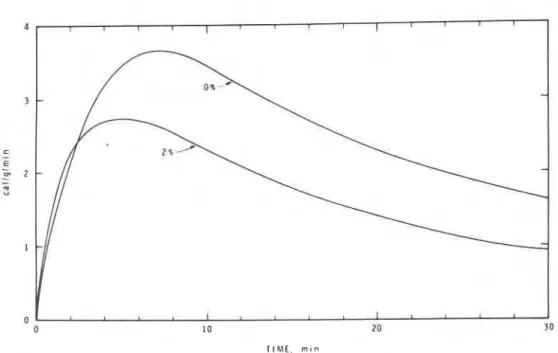
The conduction calorimetric curve of C3A hydrated in the presence of 2% SMF is compared with that of C3A hydrated in the absence of the admixture (Fig. 1). Within a few seconds of contact with water a rapid
Fig. 1. Conduction calorimetric curves of C3A hydrated in the presence of SMF
rate of heat development occurs, with a peak at about 8 to 9 min for the sample without admixture. Although the rate of heat development is high initially in the presence of SMF, the total amount developed in the first 30 min is decreased. It is evident that SMF acts as a
retarder for the hydration of C3A. Sulfonated naphthalene formaldehyde (SNF) also retards hydration of C3A ( 4 . 5 ) .
Differential thermal investigation showed that SKF retards the conversion of C3A to the hexagonal phase and subsequently to the cubic hydrate.
Adsorption of SMF on C3A in an aqueous medium occurs in substantial amounts, even within a few seconds (Fig. 2)
.
The hexagonal phase also adsorbs irreversibly large amounts of SMF. Complexes formed between SMF and the hydrating C3A and hexagonal aluminate surfaces are capable of retarding the5 min I5 h n I l h l f . h
Fig. 2. SMF adsorption on cement compounds during hydration
10 20 TIME, m i n
Fig. 3. Conduction calorimetric curves of C3A
+
gypsum+
H20containing SMF
hydration and interconversions. This mechanism is similar to that reported for the hydration of C3A in the presence of calcium lignosulfonate ( 6 , 7 ) .
Hydration of C3A
+
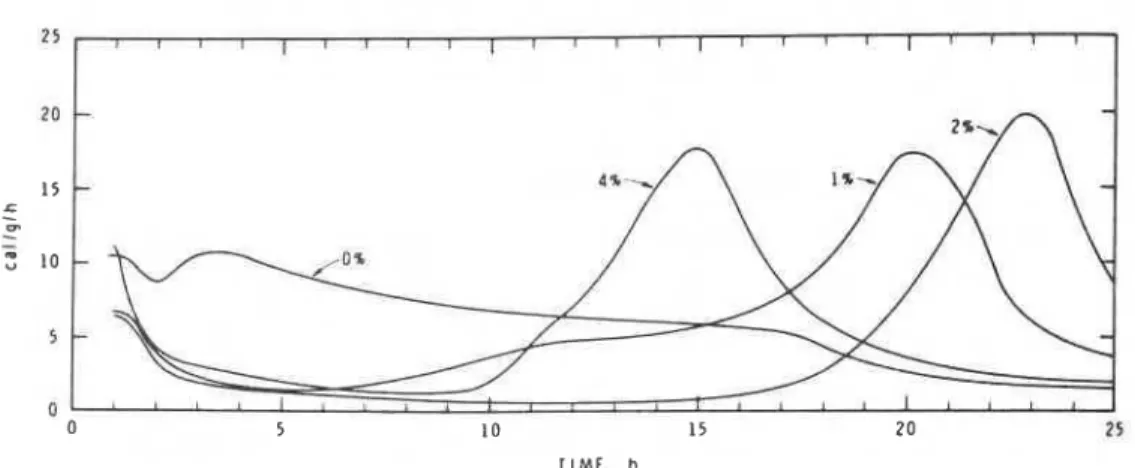
Gypsum Mixture -Figure 3 shows the conduction calorimetric curves for a
C3A
+
gypsum mixture hydrated in the presence of 0, 1, 2 and4%
SMF. Immediately following contact with water reaction occurs in all specimens, with evolution of heat. The peak, indicating the maximum rate of heat development, occurs within the first 4 min for allsamples. The amplitude of the peak as well as the total amount of heat produced in the first 30 min is larger for samples containing SMF. The
heat effect is associated mainly with the formation of ettringite (C3A.3CaS04.31H20). The rate of formation of ettringite is therefore increased as the amount of SMF added to the C3A
+
gypsum mixture is increased.Adsorption experiments indicate that a C3A
+
gypsum mixturerapidly adsorbs large amounts of SMF in an aqueous medium. Adsorption of SPIF leads to dispersion of the aluminate phase, and formation of ettringite by the reaction of gypsum with C3A surface is thus facilita- ted. The admixture may adsorb on C3A and on the surface of the ettr$n- gite. The sulfonated naphthalene formaldehyde has been reported either to retard or not influence the C3A
+
gypsum reaction (8,9). These results are not comparable with those of SMF because the water:solid ratio, the percentage gypsum, and the amount of admixture used were different.Fig.
4.
Conduction calorimetric curves for C3A+
gypsum+
H20containing SPfF
In addition to the first peak, which occurs in the first few minutes, samples containing SMF exhibit a second peak after a longer period, viz, at about 20 h with 1% SMF, at about 23 h with 2% SHF, and at about 15 h with 4% SMF. The sample without admixture indicates only a continuous hump (Fig. 4). This peak generally occurs after all the gypsum has reacted with the C3A phase and is ascribed to the reaction involving excess C3A with the formation of low sulfoaluminate
(C3A.CaS04.12H20). hexagonal aluminate hydrate (CqA H13) or their solid solution. The conduction calorimetric curves show that formation of ettringite and conversion to other aluminate hydrates are more gradual in the mixture containing no SMF. Tn addition to the formation of larger amounts of ettringite in the presence o f S?lF, adsorption of SMF takes place, and this delays the appearance of the second peak. The time of appearance of the second peak may depend on various factors such as: a) the extent of initial dispersion of C3A; b) the thickness and crystallinity of ettringite layers; c) the amount of adsorption of SMF on C3A or the ettringite layer, and d) orientation of the adsorbed molecule.
Hydration of C3S
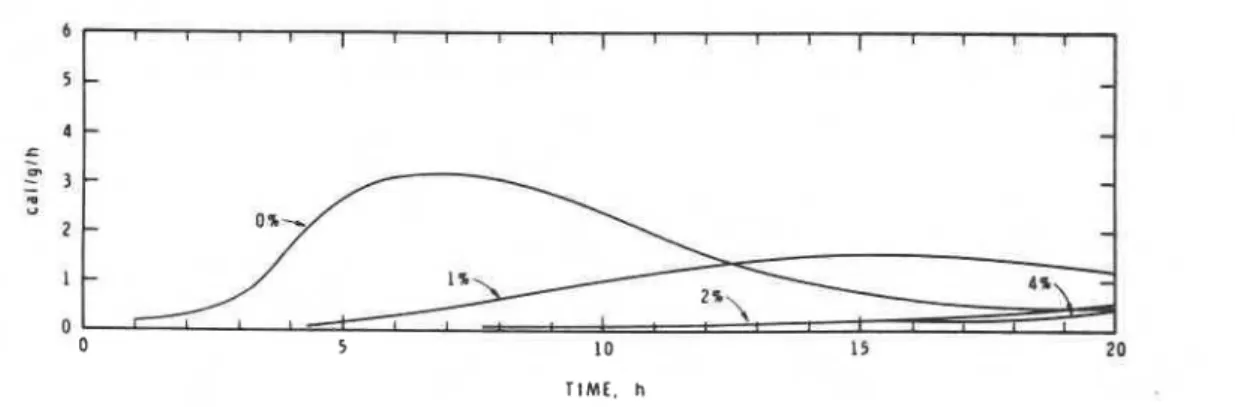
The conduction calorimetric curves for C3S hydrated in the presence of 0 , 1, 2 and 4% SMF are shown in Fig. 5. Tricalcium silicate shows an induction period of about 2 to 23 h, after which hydration accelerates, with a peak at about 6 to 7 h. The rate of hydration gradually decreases thereafter, and at about 17 h it becomes quite slow. By the addition of 1% SMF both the induction period and peak are shifted to higher temperatures, indicating a substantial retardation of hydration. At 2 and 4% SMF further retardation of hydration becomes evident by the very low rate of heat development. The differential thennograms of C3S hydrated in the presence of SMF for
1, 8 or 24 h are shown in Fig. 6. U D to about 8 h there is no indica- tion of Ca(OH)2, as would normally be expected in C3S hydrated in the absence of an admixture. At one day, hydration of C 3 S has advanced
b I , , , , , , , , , , l , , l , , ,
TIME, h
Fig. 5. Influence of SMF on the conduction calorimetric curves of C3S hydration
considerably, as evidenced by the endothermic peak at about 450°C due to decomposition of Ca(OH)2.
The adsorption characteristics of C3S exposed to an aqueous
solution of SMF are shown in Fig. 2. In the first hour a small amount
of adsorption (0.5%) occurs on the surface of hydrating C3S, and this may retard hydration. Further adsorption after 5 h may be due both to
the increased dispersion of C3S particles and the hydrated C3S.
r I I I I 1 1 I liydration of Cement
1 I I I I I I I
0 100 2 0 0 3 0 0 4 0 0 5 0 0 600 100
T E M P E R A T U R E . ' C
Fig. 6. DSC curves for C3S hydrated in the presence of SMF
Conduction calorimetric curves of cement hydrated with
0, 1, 2 and 4% SMF are shown
in Fig. 7. In the absence of
an admixture, the hump with a
peak at about 5 to 6 h denotes
the hydration effect of the C3S component in cement. Addition of SHF results in retardation of hydration. The C3S peak is shifted to higher temperatures, the total amount of heat produced in the first 10 h is decreased, and the induction period is extended
by 1 to 2 h. A comparison of
the curves for C3S (Fig. 5)
and those for portland cement
(Fig. 7) indicates that pure
C3S is retarded more effec- tively by SMF than it is when present in cement. In cement the C3A and C4AF components rapidly adsorb large amounts of SMF, so that only low
5 I , I I ~ . I I I I I - I ~ I ~ ' ~ T d
-
-
r 3 --
m-
- : 2 - 1-
O ~ ' ' ' r ~ ~ ~ ' L ~ L ' ' L ' L I L 0 5 10 I5 2 0 H Y D R A l l O N hFig. 7. Conduction calorimetric curves of portland cement hydrated in the presence of SMF
amounts of SMF are available in the aqueous phase to retard the hydration of C3S.
Although SMF in small amounts may retard hydration of cement initially, it may subsequently act as an accelerator, as does the admixture triethanolamine (10). Figure 8 shows the total heat
developed in cement containing 0 , 0.3 and 0.6% SMF. At periods beyond
12 to 14 h the total heat (representing hydration degree) of cement
containing 0.3 and 0.6% SMF is much higher than that of cement containing no admixture. 80
-
I I I I I_---
_ _ _ - - -
/ 6 0 rn-
- 'D .2 z' 0-
+ 2 4 0-
c.2-
LL L L 0 + u ,., I H Y D R A T I O N hFig. 8 . Effect of SMF oc heat development in hydrating cement
The amount of SMF adsorbed on cement varies with length of
exposure to the solution (Fig. 2). Within a few seconds there is a
steep increase in adsorption due to the C3A-C4AF components in the
cement. Adsorption is almost nil up to about
4
to 5 h but after thatit is continuous. Adsorption beyond about 5 h is due to the hydrating
C3S component in cement.
In Fig. 7 the initial heat effects illustrated by the curves below 1 h indicate that larger amounts of heat are produced in cement samples containing SMF. It may be concluded that SMF accelerates the formation of ettringite. Evidence from other work also suggests the occurrence of increased reaction between C3A and gypsum in cements containing sulfonated naphthalene formaldehyde (11,121.
Hydration of cement with SMF may also influence the composition of the C-S-H product. For example, after two days of hydration the amount
of Ca(OH)2 produced with SMF was in the order of 0.6% SMF > 0.3% SMF >
0% SMF, whereas the degree of hydration (in terms of ignition loss) was
in the order of 0.3% SMF > 0.6% SMF > 0% SMF. This indicates that
although cement with 0.3% SMF is hydrated to a greater extent than that
with 0.6% SMF, the former produces less Ca(OH)2. This can be explained
by the formation of C-S-H with a relatively higher CIS ratio in the presence of 0.3% SMF. Larger amounts of CaC12 produce a similar effect (13).
CONCLUSIONS
Addition of sulfonated melamine formaldehyde in small amounts influences the kinetics of hydration of cement and individual minerals constituting portland cement. The hydration of C3A and C3S is
retarded, whereas the formation of ettringite from C3A
+
gypsum mixtureis accelerated. There is evidence that superplasticizer influences the
CaO/Si02 ratio of the calcium silicate hydrate product. All these
compounds adsorb the superplasticizer irreversibly although to
different extents. Data obtained for cement minerals can be extended to predict the hydration behaviour of cement.
ACKNOWLEDGEMENTS
The author wishes to thank G.M. Polomark for experimental
assistance. This paper is a contribution from the Division of Building Research, National Research Council of Canada, and is published.with the approval of the Director of the Division.
REFERENCES
1. Superplasticizers in Concrete, SP-62, American Concrete Institute, p. 427, 1979.
2. "Technology of Concrete," 4th International Symposium, Monterrey, Mexico, 1979 (unpaged).
3. Ramachandran, V.S., "Admixtures," American Ceramic Society, Cements Research Progress
Cements Research Progress Cements Research Progress Cements Research Progress
-
1976, pp. 97-140 (Chap 4) ;-
1977, pp. 119-157 (Chap 6);-
1978, pp. 117-146 (Chap 6);-
1979, pp. 109-137 (Chap 6).4.
Sakai, E., Raina, K., Asaga, K., Goto, S. and Kondo, R., "Influenceof Sodium Aromatic Sulfonates on the Hydration of Tricalcium Aluminate with or without Gypsum," Cement and Concrete Research, Vol. 10, No. 3, 1980, pp. 311-319.
5. Massazza, F., Costa, U. and Corbella, E., "Influence of
0.Naphthalene Sulfonate Formaldehyde Condensate Superplasticizing Admixture on C3A Hydration," Seminar on Reactions of Aluminates
During the Setting of cements," Eindhoven, The Netherlands
13-14 April 1977.
6. Ramachandran, V.S.. "Elucidation of the Role of Chemical Admixtures
in Hydrating Cements by DTA Technique," Thermochimica Acta, V. 3,
-
1972, pp. 343-366.
7. Ramachandran, V.S., "Effect of Calcium l~ignosulfonate on Tricalcium
Aluminate and its Hydration Products," blntCriailx et Constructions, --
V. 5, No. 26, 1972, pp. 67-76.
8. Massazza, F. and Costa, U., "Effect of Superplasticizers on the C3A
Hydration," Seminar A, 7th International Congress on the Chemistry of Cements, Paris, 1980.
9. Collepardi, M. and Baldini, (:. , "~ydration of C3A in the Presence
of L i g n o s u l f o n a t e - c a r b o n a t e System or Sulfonated Naphthalene
Polymer," Seminar A, 7th International Congress on the Chemistrv of Cements, Paris, 1980.
10. Ramachandran, V.S., "Influence of Triethanolamine on the Hydration Characteristics of Tricalcium Silicate," Journal of Applied
Chemistry and Biotechnology, V. 22, No. 11, 1972, pp. 1125-1138.
11. Odler, I. and Becker, Th., "~ffect of Liquefying Agents on
Properties and Hydration of Portland Cement and Tricalcium Silicate
Pas.tes," Cement and Concrete Research, V. 10, No. 3, 1980,
12. Khalil, S.M. and Ward, M.A., "Effect of Sulphate Content of Cement Upon Heat Evolution and Slump Loss of Concretes Containing
High-Range Water-Reducers," Magazine of Concrete Research, V. 32, No. 110, 1980, pp. 28-38.
13. Ramachandran, V.S., Calcium Chloride in Concrete, Applied Science
This publication is being distributed by the Division of Building R e s e a r c h of the National R e s e a r c h Council of Canada. I t shouldnot b e r e p r o d u c e d in whole o r in p a r i without p e r m i s s i o n of the original publisher. The Di- vision would be glad to b e of a s s i s t a n c e in obtaining s u c h permission.
Publications of the Division m a y be obtained by m a i l - ing the a p p r o p r i a t e r e m i t t a n c e ( a Bank, E x p r e s s , o r P o s t Office Money O r d e r , o r a cheque, m a d e payable to the R e c e i v e r G e n e r a l of Canada. c r e d i t NRC) t o the National R e s e a r c h Council of Canada, Ottawa. K1A OR6. Stamps a r e not acceptable.
A l i s t of a l l publications of the Division i s available and m a y be obtained f r o m the Publications Section, Division of Building Research, National R e s e a r c h Council of Canada, Ottawa. KIA OR 6.