HAL Id: cea-01468382
https://hal-cea.archives-ouvertes.fr/cea-01468382
Submitted on 15 Feb 2017HAL is a multi-disciplinary open access archive for the deposit and dissemination of sci-entific research documents, whether they are pub-lished or not. The documents may come from teaching and research institutions in France or abroad, or from public or private research centers.
L’archive ouverte pluridisciplinaire HAL, est destinée au dépôt et à la diffusion de documents scientifiques de niveau recherche, publiés ou non, émanant des établissements d’enseignement et de recherche français ou étrangers, des laboratoires publics ou privés.
Further details on the plasma E x B staircase
Guilhem Dif-Pradalier, G Hornung, Philippe Ghendrih, Yanick Sarazin, F
Clairet, L Vermare, P Diamond, J Abiteboul, T Cartier-Michaud, C
Ehrlacher, et al.
To cite this version:
Guilhem Dif-Pradalier, G Hornung, Philippe Ghendrih, Yanick Sarazin, F Clairet, et al.. Further de-tails on the plasma E x B staircase. 7th IAEA Technical Meeting on ”Theory of Plasmas Instabilities”, Frascati, Italy, Mar 2015, France. 2015. �cea-01468382�
Further details on the plasma E × B staircase
G. Dif-Pradalier1, G. Hornung2, Ph. Ghendrih1, Y. Sarazin1, F. Clairet1, L. Vermare3, P. H. Diamond4,5, J. Abiteboul6, T. Cartier-Michaud1, C. Ehrlacher1, D. Est`eve1, X.
Garbet1, V. Grandgirard1, ¨O. D. G¨urcan3, P. Hennequin3, Y. Kosuga7, G. Latu1, P.
Morel3, C. Norscini1, R. Sabot1 and A. Storelli3
1CEA, IRFM, F-13108 St. Paul-lez-Durance cedex, France
2Department of Applied Physics, Ghent University, 9000 Gent, Belgium
3Laboratoire de Physique des Plasmas, Ecole Polytechnique, 91128 Palaiseau, France 4CASS & CMTFO, University of California at San Diego, San Diego, CA 92093, USA 5WCI Center for Fusion Theory, NFRI, Daejeon 305-333, Korea
6Max-Planck-Institut fr Plasmaphysik, 85748 Garching, Germany
7Institute for Advanced Study, Kyushu University, Fukuoka 816-8580, Japan
Corresponding Author: [email protected]
Abstract:
Turbulence in hot magnetised plasmas spontaneously has been shown to spontaneously organise on global scales into the so-called ”E × B staircase”. Further characterisation of this structure is detailed below.
The E × B staircase [1, 3] is a spontaneously formed, self-organising pattern of quasi-regular, long-lived and localised shear flow and stress layers. These layers coincide with long-lived pressure corrugations and are interspersed between regions of turbulent avalanching. The typical spacing between these layers is mesoscale and sets the outer scale of turbulent avalanching. The staircase is observed in near-marginal turbulence drive con-ditions and thus in situations reminiscent of self-organised criticality (SOC) behaviour. In the avalanching regions, the turbulence is near-marginal and the plasma profiles are stiff. The staircase pattern is really a global dynamic organisation of the turbulence at all scales: small-scale turbulence organises into avalanches and fluctuating zonal flows; avalanches saturate at mesoscales and organise the fluctuating zonal flows into mean zonal flows. Both avalanches and mean flows separate in space and the pattern repeats itself at macroscales.
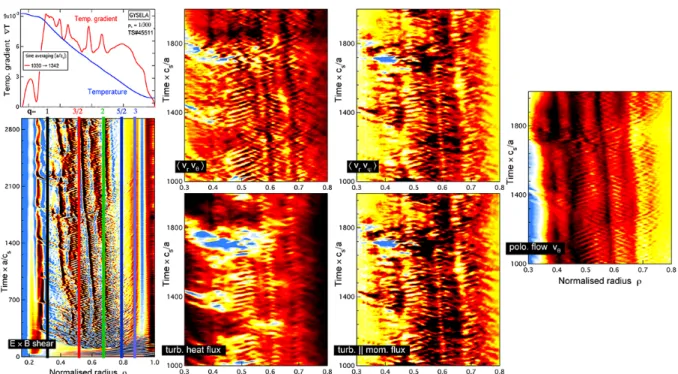
Arguably the most visible manifestation of the plasma E×B staircase is the character-istic pattern of flows and stresses that long-lastingly define “valleys” of hindered transport where a strong and localised shear radially organises the heat and momentum fluxes. This is especially visible on the flux-surface averaged E × B shear γE×B = r∂r(Er/rB) as the
dark patterns suggest in Fig.1. Interestingly, a similar pattern holds on all other tur-bulent fields: Fig.1 displays the flux-surface averaged poloidal hvrvθi and toroidal hvrvϕi
FTP/1-2
2FIG. 1: (Colour online) The general features of the plasma staircase are all visible here: (i) the strong, long-lived and coherent shear flows defining “valleys” of hindered transport, (ii) the mean profile corrugations here displayed on the temperature gradient and (iii) the radial transport dominated by avalanche-like events in-between the staircase steps. Details of the E × B shear [left], Reynolds stresses: poloidal hvrvθi [top left] and toroidal hvrvϕi
[top right], of the turbulent heat flux Q [middle left], the turbulent parallel momentum flux Mk [middle right] and of the poloidal flow vθ [bottom] between 1000 a/cs and 2000 a/cs.
and the poloidal flow vθ. Most results here are based on Gysela computations mimicking
the experimental parameters of the ToreSupra shot #45511 [4].
The long-lasting strong and localised stresses hvrvθi and hvrvϕi organise the
fluctua-tions on flux surfaces whilst inducing long-lived correlafluctua-tions akin to the radiation stresses of the planetary staircase and provide the elasticity required for the flows [i.e. the equiv-alents for tokamaks of the “planetary jets”] to survive the impinging bath of heat and momentum avalanches. These flows —which we can also refer to as the “plasma jets” in what follows— define “valleys” of minimum transport, see Fig.2 and section 1. They are likely three-dimensional and organise on adjacent flux surfaces. The fact that the same patterning remains quasi-ubiquitous in all turbulent fields is a first indication of the sig-nificant role of the staircase structure in determining and regulating the transport. The connection between the E×B staircase and the departure of the poloidal flow from its oft-invoked neoclassical prediction through the turbulent generation of poloidal momentum is further studied in Ref.[5].
The steps that appear on the mean plasma profiles from corrugations on the distri-bution function are a second visible manifestation of the staircase. These steps appear with a quasi-constant mesoscale spacing ∆ and are especially visible when displaying
the mean radial gradients —Fig.1 shows the mean temperature gradient ∇T temporally-averaged over 0.53 ms between 1030 a/cs and 1343 a/cs. The mean normalised gradient
R/LT = R∇T /T could interchangeably be used as in [1] or in Figs.?? and ??.
The last key feature of the plasma staircase is the nonlocal avalanching behaviour visible on all fields in Figs.1. This nonlocality has been discussed in [1] and is further detailed in section 5. The essential conclusion is that the heat transport computed in flux-driven gyrokinetics —i.e. embedding both local/diffusive and nonlocal/non-diffusive transport with no assumption a priori on their respective existence nor on their respec-tive weights— is irreconcilable with a local [∼ ρi] and diffusive approach in-between the
corrugations, is eminently mesoscale [∆ ∼ (ρiLT)α with 0 < α < 1] and leaves a clear
footprint on the transport even at macroscales [∼ LT]. This scale ∆ is genuinely not local
—it is well above the local expectation of a few eddy sizes [a few ∼ ρi] and defines a
most probable scale for the heat avalanche distribution —see Fig.??, which is somewhat different from the usual Self-Organised Criticality (SOC)/sandpile behaviour. For an ex-perimental characterisation of nonlocality, see the review [6]. An interesting proposition as to how mesoscales could emerge as a heat flux “jamming” process may be found in [7, 2]; this approach really emphasises the plasma as a heat engine. Interestingly, the heat avalanching also goes hand-in-hand with a momentum avalanching [8, 9]. All of these nonlocal, nondiffusive, avalanching signatures intrinsic to the plasma staircase are arguably what sets it apart from its planetary counterpart.
1
Corrugations detailed: flow–profile–stress interplay
We now detail the spontaneous emergence of the flow and stress pattern and the occur-rence of profile corrugations. Fig.2 shows a zoom of the data displayed in Fig.1 in the vicinity of the central staircase between ρ = 0.48 and ρ = 0.61. The profiles are averaged between t = 1860 a/cs and t = 2480 a/cs.
As in the planetary staircase, the region of sharp temperature gradient [sharp potential vorticity (PV) gradient] coincides with the location ρflow where a strong poloidal shear
flow has nucleated and endures. Being sheared, this flow [the jet in the planetary case] is associated with a bipolar shear structure for γE×B: the flanks of the flow are differentially
rotating from its core. The poloidal flow profile in Fig.2 is strongly peaked with a definite sign (here positive) and confined to the region of steep temperature gradient [the analogous of the eastward mean zonal jet in the Earth case] it is flanked on either side by contra-rotating flows in what must be the dissipative regions. The downstream flank of this “plasma jet”: ρ > ρflow —the radial orientation is dictated by the central location of the heat source— corresponds to a region of intense mixing and intense Reynolds stress activity hvrvθi. This is again reminiscent of the strong Rossby wave-mediated stresses in
the flanks of the planetary jets that are key to the onset and sustainment of the planetary staircase.
In the plasma case, there is a clear interplay between avalanches and corrugations: this intense mixing region downstream of a corrugation is the locus of emission of the heat avalanches and the local free energy reservoir for the nonlocal avalanche-mediated
FTP/1-2
4FIG. 2: (Colour online) Detail of the flow–mean profile–stress interplay next to a staircase step [a corrugation]; averages are between 1860 a/cs and 2480 a/cs. Adapted from [3].
transport —see section 5. On the other hand, the staircase pattern of shear layers acts as regularly spaced (with spacing ∼ ∆) weak elastic transport barriers: some avalanches carry a sufficient momentum to carry across these shear layers —which are disturbed or even break before reforming in the avalanche wake as e.g. around time 1760 a/cs in Fig.1—
but most do not, halt and dump their energy upstream of the corrugations. A related behaviour has been observed in 2D flux-driven modeling of the plasma edge [10].
2
Experimental observation of the E × B staircase
The spatially resolved measurement of poloidal flows is notoriously difficult in tokamak plasmas. As the radial extent δflow of the corrugations —comparable to the radial extent
of the plasma jets— is quite narrow, typically around ten Larmor radii: δflow ∼ 8 − 15ρi in
Fig.2 the experimental observation of the staircase structure by these means is uneasy. A way out of this conundrum has been shown in Ref.[3] where the experimental characteri-sation of the E × B staircase through fluctuation correlations has been reported. From a transport perspective corrugations act indeed so as to partially decouple at regular radial intervals the upstream from the downstream plasma. The experimental characterisation of the staircase is thus possible through the measurement of turbulent fluctuations with a sufficient radial and temporal precision and through the construction of a radial (ex-perimental) [11] distribution of turbulence correlation lengths. The staircase pattern is thus identified through radially localised, abrupt changes in the correlation pattern of the turbulent fluctuations. The 3D correlation length Lc of the electric potential fluctuations
in Gysela can be computed as a function of time, radius and poloidal angle, this quantity being a proxy for the correlation length of the turbulent density fluctuations, accessible in experiments –see [3] for further details.
Note that high resolution measurements of turbulent fluctuations in radius and time are probably necessary as the staircase structure has a dynamics of its own, especially through the possible meandering of the plasma jets on the order of a few milliseconds, see below section 3. The experimental characterisation of the staircase steps is facilitated by the fact that they are not correlated with low-order q rationals: the turbulence large-scale organisation that leads to the staircase onset can thus be set apart from magnetohydro-dynamic (MHD) activity, see section 4 for further discussion.
3
The meandering of the plasma jets
The staircase dominantly depends on the distance to criticality, understood in terms of distance to instability threshold and is sensitive to the way the distribution function is evolved, i.e. is hindered when assumptions of scale separation are made. It is not however a static structure. It displays two kinds of dynamics: (i) the corrugations [the plasma jets] are transport barriers for most of the avalanches yet may be destroyed by rare but large-scale ones impinging on them; they usually reform in the wake of such large-scale passing avalanches, not necessarily at the exact same location. The typical lifetime of the
FTP/1-2
6FIG. 3: (Colour online) How the meandering of the plasma staircase leads to its smearing out when the time integration is too large. Radial coarse-graining leads to the same result. This may have strong implications for the experimental characterisation of the plasma staircase.
corrugated structure and its associated shear flow depends on the distance to criticality: the farther from criticality, the less robust the shear pattern and thus the easier they are to destroy.
Corrugations may endure from milliseconds to several tens of milliseconds [the upper limit right now being the duration of the computed dynamics] but as they do (ii) they also meander and merge, which is not without analogies again with their planetary coun-terpart. This is visible in most of the time–radius plots displayed above, especially in Figs.1 and 2, and in similar plots in Ref.[3]. In the Earth case, meandering of the polar jets is well observed and may have important implications for climate forecast as vortices [cyclones/anticyclones] in the vicinity of a jet may often trigger a strong meandering of the jet —and thus especially impact the wind pattern, on the scale of the vortices. In the plasma case, the plasma jets tend to remain at a constant drive of the mean gradient ∇p. The combination of the impinging bath of avalanches and of the mean temperature evolution induces the meandering of the corrugations and of the flow-stress pattern. De-pending on the source and thus on the mean profile dynamics, the staircase may propagate to outer regions in the case of a large power input; inversely in low power-input regimes. This is not without consequences, especially from an experimental point of view —see also section 2: because of this meandering measurements involving a radial averaging or integrated over too long periods of time significantly underestimates the steep local gradients across the jets and the associated along-jet mean shear shown in Fig.?? and non-neoclassical poloidal velocities [5], thus missing the underlying structure. This is displayed in Fig.3 in the case of a meandering temperature gradient. The gradient is computed through sliding profile averages of ∼ 312 a/cs that roughly correspond to ∼ 0.53 ms
starting at time 1030 a/cs —as in Fig.1. For visualisation purposes, a negative offset of
0.002 is applied to each time-slice. Clearly the staircase pattern exists throughout the time slice displayed here yet a global averaging between 1030 and 2892 a/cs effectively
FIG. 4: (Colour online) Normalised temperature gradient averaged between 2100 and 2892 a/cs. No clear connection between low-order q rationals and corrugations can be
inferred. This is even clearer in Ref.[3], Fig.4.
smears it out.
4
No relation to low-order q rational surfaces
The jet-corrugation meandering shown in the previous section may certainly explain why the measurement of the plasma staircase is uneasy from an experimental point of view. An interesting feature though of the plasma staircase in the perspective of its measurement is the fact that no clear connection —should it be regarding its nucleation or its statistically most probable positions can be made with low-order safety factor q rationals. This could prove important to disentangling experimentally the plasma staircase with respect to magnetohydrodynamic (MHD) activity.
The rationale behind a possible connection between plasma jets and low-order q ra-tionals comes from linear or quasi-linear theory: in a local picture the high wave number ITG modes resonate on distinct q = m/n surfaces. These modes are assumed to play the dominant role in turbulence generation and the turbulence itself is therefore strongly radially pinned. Close to a low-order rational, and especially close to the minimum of reversed q profile a gap forms in the density of rational surfaces. Experimentally and in early modeling attempts [40, 41] transport barriers have been shown to nucleate next to these low-order surfaces. Again envisioning the plasma jets as weak transport barriers, a natural idea is to further test this idea for staircase formation.
This is discussed in Fig.4 where the locations of the temperature corrugations are plotted agains the (fixed) locations of the low-order q = 1, 3/2, 2, 5/2 and 3 rationals. The temperature profile is averaged from 2100 to 2892 a/cs. Except maybe for the q = 2
surface no connection may be inferred. As for the q = 2 surface the apparent correlation in fact comes from the choice of the averaging timeslice. This becomes even clearer in Fig.1 (left) Ref.[3], Fig.4 where the radial-temporal staircase dynamics is shown and where neither the birth location of the corrugations nor their dynamics seem to be crucially impacted by the safety factor profile. Let us note however that proximity with a
low-FTP/1-2
8FIG. 5: (Colour online) Two situations are compared: all other parameters being equal, the safety factor profile is either parabolic or reversed.
order q rational is an easy constraint to match; if these effects exist they are very likely subdominant as compared to the proclivity of the plasma jets to meander so as to remain at a quasi-constant mean background gradient. This is further backed by the observation in Fig.1 and Ref.[3], Fig.4 that a corrugation may spontaneously leave a low-order q surface —see e.g. the dynamics of the corrugation at time 1450 a/cs: after having spent
some time close to the q = 2 surface, it spontaneously departs from it and keeps drifting away. As the temperature profile is still building up at time 1450 a/cs, the outside-in
dynamics of the corrugation is consistent with the proclivity to remain at constant ∇p.
Statistically, the jet locations may spend some time lingering about low-order q ratio-nals that could perhaps be envisioned as “sticky” locations —see e.g. between 700 and 1400 a/cs for the q = 2 surface. Interestingly also, synergistic interactions between
stair-case steps and low-order q rational may occur, as evoked in the stair-case of the S0 staircase
step in Ref.[3], Fig.3. All latter studies have been made for “usual” L–mode parabolic q profiles, monotonically increasing towards the edge. Comparison with a reversed q profile is shown in Fig.5. Two computations have been run, only differing through the choice of the radial profile of the safety factor: either parabolic or reversed. At mid radius the two profiles cross the q = 3/2 surface. Though the 3/2 surface seems to play no special role in the parabolic case, the corrugation and thus the location of the mean zonal flow appears as weakly drawn to this minimum q = 3/2 location in the reversed shear case. This effect however seems largely subdominant as the flow is not rigorously located at the minimum q location and as it meanders at later times. An interesting question however lies with the role of magnetic shear in the dynamics of the staircase steps: could a coalescence of the steps be obtained in precise and reproducible situations, and where? If so, this could open the way to nucleating a transport barrier at this location. This question will be further addressed in forthcoming work.
5
Heat flux and the role of avalanching
As mentioned above, the shear layers at the staircase steps are best envisioned as weak and permeable transport barriers. This fact is easily seen in the lowest frame of Fig.2: in the vicinity of a corrugation the turbulent heat flux decreases abruptly; at the same location the temperature gradient locally steepens so that the neoclassical heat flux locally takes over as the dominant heat transport mechanism due to the local quasi-quenching of the turbulence. This interplay is consistent with the fact that the total heat flux flowing through a magnetic surface is constant on average in a flux-driven system.
Given the strong inhomogeneity of the mixing processes discussed in this paper, one may be curious as to what is the nature of transport on meso- to macroscales where the major contribution to the transport comes from the turbulence. Key questions are: does the transport change in nature or is it still possibly described by a local Fick’s law:
Qstep(r) = −n(r)χ(r)∇T (r) (1)
and if so how is the heat diffusivity behaving: is it smoothly varying across the radius and in time as the system evolves or does it undergo abrupt changes? In both cases, either having the transport changing in nature or abrupt variations of an effective heat diffusivity χeff would undermine the validity of a Fick’s law as being at a basic level representative
of the underlying transport processes within the plasma. It would also certainly preclude scale separations either in space, in time or in both to be able to adequately capture the trajectory of the system in phase-space.
In order to answer these questions and to avoid pre-conceptions that may cloud the results let us write the heat flux in a more general way than in Eq.(1):
Qturb(r) = − Z
K(r, r0) ∇T (r0) dr0 (2)
where K is a generalised diffusivity. Let us focus on a given radial location r0. The
important point is the following: for all positions r0 ∈ [0, a], a being the minor radius, finding K(r0, r0) defines the extension over which an action of the thermodynamic force
∇T (r0) at location r0 may extend and impact the transport processes at r
0. Let ∆ be that
distance, defined as the typical e-folding scale length of the kernel K (|r0− r0|). Finding
K is thus key to discriminating the nature of the transport interactions in the plasma: either local if 0 ≤ ∆ ≤ `c or genuinely nonlocal if ∆ `c.
This procedure is detailed in Ref.[1]: kernel K may a priori represent any distribution. In cases where K is best approximated by a Dirac function or as a distribution such that its e-folding decay length is comparable to `c, Eq.(2) describes a situation macroscopically
akin to that modeled by Eq.(1). In the opposite limit, meso- or macro-scale typical e-folding decay lengths for K mark long-range actions-at-a-distance as crucial players for the underlying transport. Even more fundamentally, if K is such that it has a divergent second moment —as e.g. is the case for L´evy distributions— the heat flux has an unbounded variance and in this case the underlying transport processes are irreconcilable with a local and diffusive framework and more generally with any kind of scale separation.
FTP/1-2
10The question thus comes to determining K fully consistently from a model where no scale separation is a priori assumed. This is often possible and a generic procedure is proposed and discussed in [1]; the key insight is to interpret the kernel K(r, r0) as a function of |r − r0| and to recognise in Eq.(2) a convolution product. With these premises the kernel K(|r − r0|), a priori undisclosed, may be fully self-consistently inferred from the complete data with no scale separation —here that of Gysela using the self-consistent heat flux Qturb and temperature gradient. Differential mixing and spatial heterogeneities
are thus included. Three essential conclusions stand out:
• K is best described in the general case as a L´evy distribution and may adequately be approximated as a Cauchy–Lorentz distribution:
K(r, r0) = Λ π
∆/2
(∆/2)2+ |r − r0|2 (3)
with an e-folding scale length ∆ ∼ 10 `c. Given the above discussion, the transport
is not local, not diffusive and not described by Eq.(1);
• heat avalanches, dominantly born downstream of the staircase steps —see section 1, play a critical role in mediating the long-distance heat response of the system. The mesoscale ∆ defines the typical outer scale of the avalanche distribution, as shown in Ref.[1], Fig.2. Remarkably, nonlocal avalanching fills-in all the space left unaffected by the immediate vicinity of the shear pattern at the staircase steps, i.e. the mean flows;
• though interesting from a basic physics point of view this nonlocality is unfortunate for the practical viability of confinement and would prove deleterious if as the system increases in size [1/ρ? increases] the typical avalanche scale [the kernel width ∆]
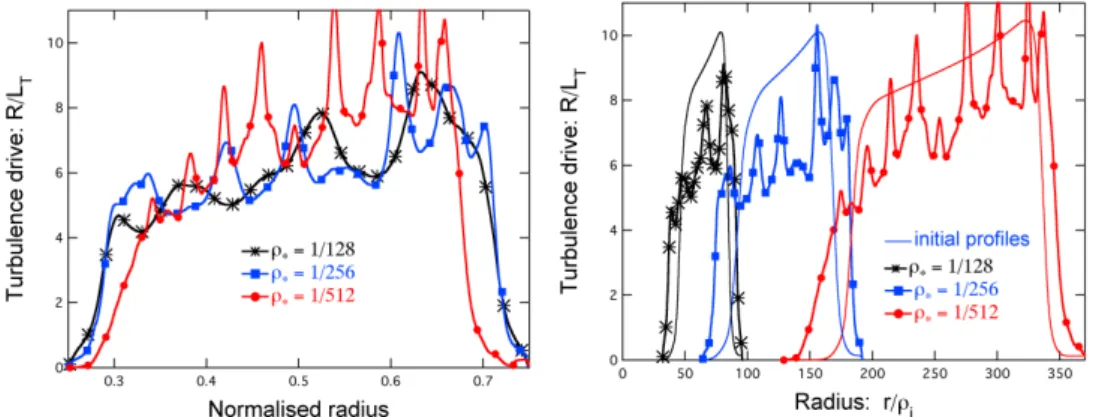
would fill-in the whole volume, reaching the system size as commonly observed in sand piles [14, 15, 10]. Arguably the most mesmerising feature of the self-organising dynamics described in this paper is the spontaneous saturation at mesoscales of this unfavourable nonlocal transport, clearly visible through the saturation of ∆ and of the avalanche size in Ref.[1], Fig.2. This behaviour is similarly observed through the ρ? = ρi/a scans in Fig.6.
What is striking when scanning ρ? in the Bohm-like regime [ρ? = 1/128], at the
“transi-tion” [ρ? = 1/256] and deep into the so-called “local” or gyro-Bohm regime [ρ? = 1/512]
is twofold: (i) the nature of transport itself when no radial and temporal coarse graining is a applied (at micro- and mesoscales) does not fundamentally change —this is discussed above and shown in [1]. It is only when applying an extended coarse-graining on the data that the effective macroscale transport coefficients change with ρ?, see below. On
the other hand what does change (ii) is the overall staircase pattern, as clearly seen in Fig.6. Both figures show the same data, organised differently. The bottom figure shows the three computations in units of the Larmor radius. Quite remarkably, the typical scale ∆ between the corrugations that was discussed in section 5 increases from ρ? = 1/128
FIG. 6: (Colour online) Robustness of the staircase pattern with the size of the plasma column ρ?. Interstingly around ρ? ∼ 1/256 the typical spacing of the corrugations ∆
saturates, defining an upper scale for the nonlocal avalanching.
the typical outer scale of the avalanche distribution [the typical extension of nonlocality] similarly saturates at mesoscales around 20 to 30 ρi due to the staircase build-up and to
its mesoscale shear pattern, as also summarised in [3]. The staircase exists throughout all plasma sizes; only the number of shear layers increases once the system is large enough that ∆ has reached its saturated outer scale. This is clearly visible in Fig.6, right panel.
Conclusions
The E × B staircase is a robust and probably quid generic feature of drift-wave zonal-flow systems. It is robust with respect to many plasma parameters (collisionality, size, history) and appears mostly sensitive to distance to instability threshold and scale separation as-sumptions. It has been recently observed experimentally and thus appears as a novel, robust and captivating means for the plasma to organise its substantial amount of free energy. Corrugations in the thermodynamic forces spontaneously develop and endure; long-lived shear flows nucleate at these locations. The strong heterogeneities in the mix-ing processes lead to spatially-differentiated transport mechanisms: radially, mesoscale domains of a strongly nonlocal, non-diffusive and avalanche-mediated character alternate with narrow bands of a more diffusive type where the shear layers are located. These narrow layers behave as quasi-regularly spaced weak elastic transport barriers, the strong in-between avalanching accounting for a significant profile stiffness.
The system self-organises into “patches” whilst physically separating distinct trans-port mechanisms into distinct regions: patches of strong turbulent mixing with large-scale systematic redistribution of angular momentum, heat and possibly density are thus dy-namically bounded by narrow banded regions of self-reinforcing flows of variable porosities that either preclude or hinder inter-patch redistributions1. The staircase structure is key
1This tends to remind e.g. of the organisation in ferromagnetic materials and the fact that the staircase
FTP/1-2
12to arresting the expansion of nonlocality to macroscales and containing it to mesoscales.
Acknowledgements
The authors want to thank Ch. Passeron, K. Ida, D. E. Newman, R. Sanchez and ac-knowledge fruitful interactions at the Festival de Th´eorie, Aix-en-Provence, 2009, 2011 & 2013 and at the Kavli Institute for Theoretical Physics, Santa Barbara, 2014. This re-search was supported in part by the National Science Foundation under Grant No. NSF PHY11-25915 and carried out in the framework of the ANR-GYPSI and ANR-ESPOIR projects (ANR-10-BLAN-941 and ANR-09-BLAN-0035-01). Computations were run on the Helios supercomputer. This project has received funding from the European Union’s Horizon 2020 research and innovation programme under grant agreement number 633053. The views and opinions expressed herein do not necessarily reflect those of the European Commission.
This work is dedicated to the memory of Steve Jaeger, untimely deceased.
References
[1] G. Dif-Pradalier, P. H. Diamond, V. Grandgirard, Y. Sarazin, J. Abiteboul, X. Gar-bet, Ph. Ghendrih, A. Strugarek, S. Ku, and C. S. Chang. On the validity of the local diffusive paradigm in turbulent plasma transport. Phys. Rev. E, 82(2):025401(R), Aug 2010.
[2] G. Dif-Pradalier, G. Hornung, Ph. Ghendrih, Y. Sarazin, F. Clairet, L. Vermare, P. H. Diamond, J. Abiteboul, T. Cartier-Michaud, C. Ehrlacher, D. Est`eve, X. Gar-bet, V. Grandgirard, ¨O. D. G¨urcan, P. Hennequin, Y. Kosuga, G. Latu, P. Maget, P. Morel, C. Norscini, R. Sabot, and A. Storelli. Finding the elusive e b staircase in magnetized plasmas. Phys. Rev. Letters, 114(085004), 2015.
[3] L. Vermare, P. Hennequin, ¨O. D. G¨urcan, C. Bourdelle, F. Clairet, X. Garbet, R. Sabot, and the Tore Supra Team. Impact of collisionality on fluctuation char-acteristics of micro-turbulence. Physics of Plasmas (1994-present), 18(1):012306, 2011.
[4] G. Dif-Pradalier, V. Grandgirard, Y. Sarazin, X. Garbet, and Ph. Ghendrih. Inter-play between gyrokinetic turbulence, flows, and collisions: Perspectives on transport and poloidal rotation. Physical Review Letters, 103(6):065002, 2009.
[5] K. Ida, Z. Shi, H. Sun, S. Inagaki, K. Kamiya, J. Rice, N. Tamura, P. H. Diamond, T. Estrada, C. Hidalgo, X. L. Zou, G. Dif-Pradalier, T. S. Hahm, U. Stroth, A. Field, K. Itoh, X. Ding, J. Dong, S. I. Itoh, Y. Sakamoto, and S. Oldenb¨urger. Towards an emerging understanding of nonlocal transport. In 24rd IAEA Fusion Energy Conference, 2012.
[6] Y. Kosuga, P. H. Diamond, and ¨O. D. G¨urcan. How the propagation of heat-flux modulations triggers e×b flow pattern formation. Phys. Rev. Lett., 110:105002, Mar 2013.
[7] Y. Kosuga, P. H. Diamond, G. Dif-Pradalier, and ¨O. D. G¨urcan. E × B shear pattern formation by radial propagation of heat flux waves). Physics of Plasmas (1994-present), 21(5):–, 2014.
[8] S. Ku, J. Abiteboul, P.H. Diamond, G. Dif-Pradalier, J.M. Kwon, Y. Sarazin, T.S. Hahm, X. Garbet, C.S. Chang, G. Latu, E.S. Yoon, Ph. Ghendrih, S. Yi, A. Stru-garek, W. Solomon, and V. Grandgirard. Physics of intrinsic rotation in flux-driven itg turbulence. Nuclear Fusion, 52(6):063013, 2012.
[9] J. Abiteboul, Ph. Ghendrih, V. Grandgirard, T. Cartier-Michaud, G. Dif-Pradalier, X. Garbet, G. Latu, C. Passeron, Y. Sarazin, A. Strugarek, O. Thomine, and D. Zarzoso. Turbulent momentum transport in core tokamak plasmas and penetra-tion of scrape-off layer flows. Plasma Physics and Controlled Fusion, 55(7):074001, 2013.
[10] Ph. Ghendrih, G. Ciraolo, G. Dif-Pradalier, C. Norscini, Y. Sarazin, J. Abiteboul, T. Cartier-Michaud, X. Garbet, V. Grandgirard, and A. Strugarek. Fusion plasma turbulence described by modified sandpile dynamics. The European Physical Journal E, 37(4), 2014.
[11] G. Hornung, F. Clairet, G. L. Falchetto, R. Sabot, H. Arnichand, and L. Vermare. Turbulence correlation properties measured with ultrafast sweeping reflectometry on tore supra. Plasma Physics and Controlled Fusion, 55(12):125013, 2013.
[12] X. Garbet, Y. Baranov, G. Bateman, S. Benkadda, P. Beyer, R. Budny, F. Crisanti, B. Esposito, C. Figarella, C. Fourment, P. Ghendrih, F. Imbeaux, E. Joffrin, J. Kin-sey, A. Kritz, X. Litaudon, P. Maget, P. Mantica, D. Moreau, Y. Sarazin, A. Pankin, V. Parail, A. Peeters, T. Tala, G. Tardini, A. Thyagaraja, I. Voitsekhovitch, J. Wei-land, R. Wolf, and JET EFDA contributors. Micro-stability and transport modelling of internal transport barriers on jet. Nuclear Fusion, 43(9):975, 2003.
[13] R. E. Waltz, M. E. Austin, K. H. Burrell, and J. Candy. Gyrokinetic simulations of off-axis minimum-q profile corrugations. Physics of Plasmas, 13(5):052301, 2006. [14] B. A. Carreras, D. Newman, V. E. Lynch, and P. H. Diamond. A model realization
of self-organized criticality for plasma confinement. Physics of Plasmas, 3(8):2903– 2911, 1996.
[15] R. Sanchez, B. Ph. van Milligen, and B. A. Carreras. Probabilistic transport models for plasma transport in the presence of critical thresholds: Beyond the diffusive paradigm. Physics of Plasmas, 12(5):056105, 2005.