The Bidimensionality Theory
and Its Algorithmic Applications
by
MohammadTaghi Hajiaghayi
B.S., Sharif University of Technology, 2000
M.S., University of Waterloo, 2001
Submitted to the Department of Mathematics
MASSACHUSETTS INS OF TECHNOLOGY
JUN 2 8 2005
LIBRARIE
in partial fulfillment of the requirements for the degree of
DOCTOR OF PHILOSOPHY
at the
MASSACHUSETTS INSTITUTE OF TECHNOLOGY
June 2005
) MohammadTaghi Hajiaghayi, 2005. All rights reserved.
The author hereby grants to MIT permission to reproduce and
distribute publicly paper and electronic copies of this thesis document
in whole or in part.
Author
...
Department of Mathematics
A
April 29, 2005
Certified by ...
Erik D. Demaine
Associate Professor of Electrical Engineering and Computer Science
Accepted by ...
.
"""',.Thesisupervisor
..
...
odolfo Ruben
Rodolfo Ruben Rosales
Chairman, Applied Mathematics Committee
Accepted by
...
f,
Pavel I. Etingof
Chairman, Department Committee on Graduate Students
The Bidimensionality Theory
and Its Algorithmic Applications
by
MohammadTaghi Hajiaghayi
Submitted to the Department of Mathematics
on April 29, 2005, in partial fulfillment of the requirements for the degree of DOCTOR OF PHILOSOPHY
Abstract
Our newly developing theory of bidimensional graph problems provides general techniques for designing efficient fixed-parameter algorithms and approximation algorithms for
NP-hard graph problems in broad classes of graphs. This theory applies to graph problems that are bidimensional in the sense that (1) the solution value for the k x k grid graph (and
similar graphs) grows with k, typically as Q(k2), and (2) the solution value goes down when contracting edges and optionally when deleting edges. Examples of such problems include feedback vertex set, vertex cover, minimum maximal matching, face cover, a series of
vertex-removal parameters, dominating set, edge dominating set, r-dominating set, connected dominating set, connected edge dominating set, connected r-dominating set, and unweighted
TSP tour (a walk in the graph visiting all vertices). Bidimensional problems have many structural properties; for example, any graph embeddable in a surface of bounded genus
has treewidth bounded above by the square root of the problem's solution value. These
properties lead to efficient-often subexponential-fixed-parameter algorithms, as well as polynomial-time approximation schemes, for many minor-closed graph classes. One type of minor-closed graph class of particular relevance has bounded local treewidth, in the sense that the treewidth of a graph is bounded above in terms of the diameter; indeed, we show that such a bound is always at most linear. The bidimensionality theory unifies and improves several previous results. The theory is based on algorithmic and combinatorial
extensions to parts of the Robertson-Seymour Graph Minor Theory, in particular initiating a parallel theory of graph contractions. The foundation of this work is the topological theory
of drawings of graphs on surfaces and our results regarding the relation (the linearity) of the size of the largest grid minor in terms of treewidth in bounded-genus graphs and more generally in graphs excluding a fixed graph H as a minor.
In this thesis, we also develop the algorithmic theory of vertex separators, and its
relation to the embeddings of certain metric spaces. Unlike in the edge case, we show that embeddings into L1 (and even Euclidean embeddings) are insufficient, but that the
additional structure provided by many embedding theorems does suffice for our purposes. We obtain an O( lo-gn) approximation for min-ratio vertex cuts in general graphs, based on a new semidefinite relaxation of the problem, and a tight analysis of the integrality gap which is shown to be O('Iogn). We also prove various approximate
max-flow/min-vertex-cut theorems, which in particular give a constant-factor approximation for min-ratio vertex cuts in any excluded-minor family of graphs. Previously, this was known only for planar graphs, and for general excluded-minor families the best-known ratio was O(log n). These results have a number of applications. We exhibit an O(Vlo/g) pseudo-approximation for finding balanced vertex separators in general graphs. Furthermore, we obtain improved approximation ratios for treewidth: In any graph of treewidth k, we show how to find a tree decomposition of width at most O(kx/lg-k), whereas previous algorithms yielded O(k log k). For graphs excluding a fixed graph as a minor, we give a constant-factor approximation
for the treewidth; this via the bidimensionality theory can be used to obtain the first
polynomial-time approximation schemes for problems like minimum feedback vertex set and minimum connected dominating set in such graphs.
Thesis Supervisor: Erik D. Demaine
Acknowledgments
First and foremost, I am deeply indebted to my thesis advisor, Professor Erik De-maine, and my academic advisor, Professor Tom Leighton, for being enthusiastic and genius supervisors. Erik and I were more friends than advisor and advisee and we spent countless hours together exchanging puzzles, research ideas, and philosophies. Between us, we have explored lots of plausible ideas in algorithm design, many two or more times. His insights (technical and otherwise) have been invaluable to me. Erik also helped me a lot with his useful suggestions on the presentation of the re-sults and the writing style. I am grateful to Tom for his perceptiveness, and his deep insights over the years on my research. He provided me a great source of inspiration. Both Erik and Tom have been extremely generous in giving me a great deal of their valuable time and sharing with me their ideas and insights. This research would have been impossible without their helps and encouragements.
I thank Professor Uriel Feige, Professor Fedor Fomin, Professor Naomi Nishimura, Professor Prabhakar Ragde, Professor Paul Seymour, Professor Dan Spielman, Pro-fessor Dimitrios Thilikos, and James Lee for fruitful collaborations and discussions in the areas related to this thesis. I especially thank Paul Seymour for many helpful discussions and for providing a portal into the Graph Minor Theory and revealing some of its hidden structure that we use in this thesis. Thanks go to Professor Daniel Kleitman who served on my committee, read my thesis, and gave me useful comments. Furthermore, I would like to thank the staff and the faculty of the Department of Mathematics and Computer Science and Artificial Intelligence Laboratory at MIT, especially Kathleen Dickey and Linda Okun, for providing such a nice academic envi-ronment. I am also grateful to the researchers at IBM T.J. Watson Research Center and Microsoft Research for two great summers in the research industry.
My friends here at MIT, namely Reza Alam, Mihai Badoiu, Saeed Bagheri, Mohsen Bahramgiri, Eaman Eftekhary, Nick Harvey, Fardad Hashemi, Susan Ho-henberger, Nicole Immorlica, Ali Khakifirooz, Bobby Kleinberg, Mahnaz Maddah, Mahammad Mahdian, Vahab Mirrokni, Eddie Nikolova, Hazhir Rahmandad, Mohsen
Razavi, Navid Sabbaghi, Saeed Saremi, Anastasios Sidiropoulos, Ali Tabaei, Mana Taghdiri, David Woodruff, Sergey Yekhanin, and many others played important roles in making my life more enjoyable. Also, I would like to extend my appreciation to thank my previous advisors in University of Waterloo, namely Professor Naomi Nishimura, and in Sharif University of Technology, namely Professor Ebad Mahmood-ian and Professor Mohammad Ghodsi, and my many other friends in Iran, Canada and USA for their warmest friendship. I am blessed to have such excellent companies. Last but not least, my dear parents and my family receive my heartfelt gratitude for their sweetest support and never-ending love. I always feel the warmth of their love, even now that we are so far away. I wish to thank my brother, Mahdi, and my sisters, Monir and Mehri, for being the greatest source of love. This thesis is dedicated to my parents and my family.
Contents
1 Introduction and Overview
1.1 Graph Terminology. 1.2 Graph Classes .1.2.1 Definitions of Graph Classes ...
1.3 Structural Properties.
1.3.1 Background.
1.3.2 Structure of Single-Crossing-Minor-Free Graphs 1.3.3 Structure of H-Minor-Free Graphs ... 1.3.4 Structure of Apex-Minor-Free Graphs ... 1.3.5 Grid Minors.
1.4 Bidimensional Parameters/Problems. 1.5 Parameter-Treewidth Bounds. 1.6 Separator Theorems.
1.7 Local Treewidth .
1.8 Subexponential Fixed-Parameter Algorithms ... 1.9 Fixed-Parameter Algorithms for General Graphs .... 1.10 Polynomial-Time Approximation Schemes ... 1.11 Half-Integral versus Fractional Multicommodity Flow 1.12 Thesis Structure .
2 Approximation Algorithms for Single-Crossing-Minor-Free Graphs
2.1 Background. 2.1.1 Preliminaries. 13 14 15 15 17 18 20 20 22 23 24 25 26 27 29 30 32 34 34 37 38 38
2.1.2 Locally Bounded Treewidth ... 2.2 Clique-sum Decompositions.
2.2.1 Relating Clique Sums to Treewidth and Local Treewidth . . . 2.2.2 Decomposition Algorithm.
2.3 Locally Bounded Treewidth of Single-Crossing-Minor-Free Graphs . . 2.3.1 Bounded Local Treewidth.
2.3.2 Local Treewidth and Layer Decompositions ... 2.4 Approximating Treewidth.
2.5 Polynomial-time Approximation Schemes ...
2.5.1 General Schemes for Approximation on Special Classes of Graphs 2.5.2 Approximation Schemes for Single-Crossing-Minor-Free Graphs 2.6 Concluding Remarks. 39 40 40 41 47 47 50 54 58 58 59 63
3 Exponential Speedup of Fixed-Parameter Algorithms for
Single-Crossing-Minor-Free Graphs
65
3.1 Background ... 67
3.1.1 Preliminaries ... 67
3.2 Fixed-Parameter Algorithms for Dominating Set . ... 70 3.3 Algorithms for Parameters Bounded by the Dominating-Set Number . 72
3.3.1 Variants of the Dominating Set Problem ... 3.3.2 Vertex Cover.
3.3.3 Edge Dominating Set ... 3.3.4 Clique-Transversal Set.
3.3.5 Maximal Matching.
3.3.6 Kernels in Digraphs ...
3.4 Fixed-Parameter Algorithms for Vertex-Removal Problems . 3.4.1 Feedback Vertex Set .
3.4.2 Improving Bounds for Vertex Cover ... 3.5 Further Extensions. 3.6 Concluding Remarks. 74 75 76 77 77 78 79 81 82 84 86
4 Fixed-Parameter Algorithms for the (k, r)-Center in Planar Graphs
and Map Graphs
89
4.1 Preliminary Results ... .. 92
4.2 Combinatorial Bounds ... 94
4.3 (k, r)-Centers in Graphs of Bounded Branchwidth ... 97
4.4 Algorithms for the (k, r)-Center Problem . . . . 104
4.5 Concluding Remarks ... 105
5 Subexponential Parameterized Algorithms on Bounded-Genus Graphs
and H-Minor-Free Graphs
109
5.1 Graphs on Surfaces . . . .. . . 1115.1.1 Preliminaries. . . . .111
5.1.2 Bounding the Representativity . . . .. . 113
5.2 Bidimensional Parameters and Bounded-Genus Graphs ... 115
5.2.1 Definitions . . . .. . . 116
5.2.2 Examples ... 116
5.2.3 Subexponential Algorithms and Planar Graphs . ... 118
5.2.4 Parameter-Treewidth Bound for Bounded-Genus Graphs . . . 119
5.2.5 Combinatorial Results and Further Improvements ... . 124
5.2.6 Algorithmic Consequences . . . 125
5.3 H-Minor-Free Graphs ... 126
5.3.1 Almost-Embeddable Graphs and r-Dominating Set ... . 127
5.3.2 H-Minor-Free Graphs and Dominating Set ... 128
5.4 Concluding Remarks . ... 133
6 Diameter and Treewidth in Minor-Closed Graph Families
137
7 Bidimensional Parameters and Local Treewidth
143
7.1 Definitions and Preliminary Results ... . 1447.2 Combinatorial Lemmas ... ... . 146
7.4 Algorithmic Consequences and Concluding Remarks ... 151
8 Graphs Excluding a Fixed Minor have Grids Almost as Large as
Treewidth
155
8.1 Overview of Proof of Main Theorem ... 1578.2 Proof of Main Theorem. ... 158
9 Improved Approximation Algorithms for Minimum-Weight Vertex
Separators and Treewidth
9.1 Related Work. 9.2 Results and Techniques ... 9.3 A Vector Program for Minimum-Ratio Vertex Cuts 9.3.1 The Quadratic Program ... 9.3.2 The Vector Relaxation ... 9.3.3 Adding Valid Constraints. 9.4 Algorithmic Framework for Rounding ... 9.4.1 Line Embeddings and Vertex Separators . . 9.4.2 Line Embeddings and Distortion ... 9.4.3 Analysis of the Vector Program ... 9.5 Approximate Max-Flow/Min-Vertex-Cut Theorems 9.5.1 Rounding to Vertex Separators ... 9.5.2 The Rounding ... 9.5.3 Excluded Minor Families ... 9.6 An Integrality Gap for the Vector Program ... 9.7 Balanced Vertex Separators and Applications . . . 9.7.1 More General Weights 9.7.2 9.7.3 165 ... 168.. ... 169.. ... 172.. ... 173.. ... 175... ... 175.. ... .177 ... 179.. ... 181... ... 182.. ... .184 ... 186.. ... 186.. ... 188.. ... 188.. ... 191.....
.191
Reduction from Min-Ratio Cuts to Balanced Separators. Approximating Treewidth .
10 Open Problems Regarding Bidimensionality
193 194
List of Figures
1-1 Interesting classes of graphs. Arrows point from more specific classes
to more inclusive classes ... 16
1-2 Example of a 5-sum of two graphs. ... 19
2-1 Examples of single-crossing graphs ... 39
2-2 The graph V8... . 49
2-3 The replacement of the part of path P between a and b by edge {a, b}. 51 2-4 A graph and two branch decompositions of it. The first has width 4 and the second has width 3. ... 55
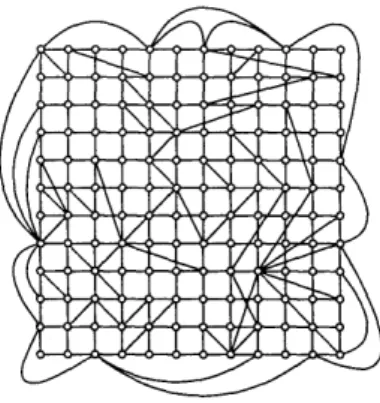
4-1 A partially triangulated (12 x 12)-grid. . . . ... 106
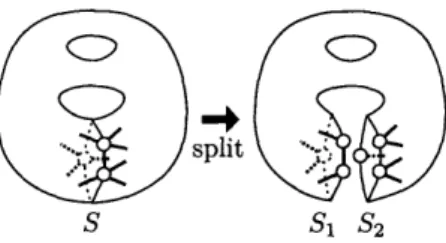
5-1 Splitting a noose ... 122
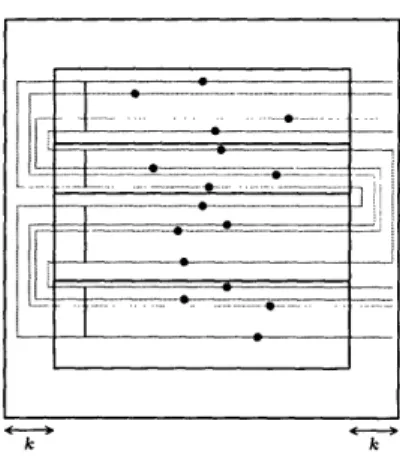
6-1 Construction of the minor k x k grid K ... 140
6-2 In the k x k grid K, we (a) lift the vertex v', (b) contract the adjacent columns, and (c) contract the adjacent rows, to form a (k- 2) x (k- 2) grid K'. Vertex v' is adjacent to all vertices in the grid, though the figure just shows four neighbors for visibility ... 140
7-1 An augmented 12 x 12 grid with span 8. ... 146
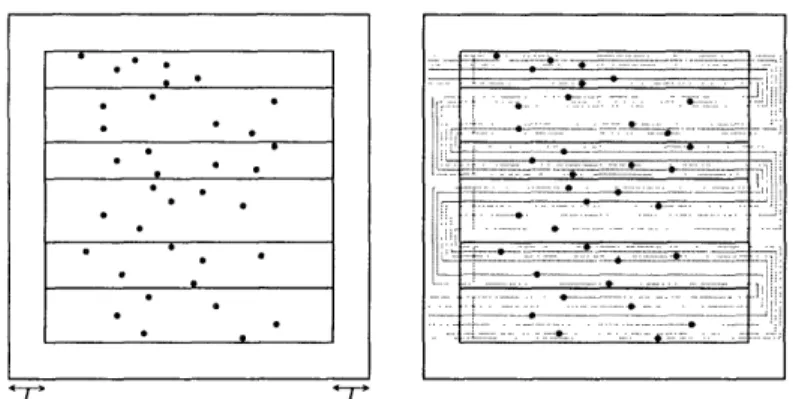
7-2 Left: The grid H, the points in S", and their grouping. Here = 6. Right: Construction of the minor x grid R passing through the
points
in
...
...
... ...
. ..
.
147
Chapter 1
Introduction and Overview
The newly developing theory of bidimensional graph problems, developed in a series of
papers [74, 72, 64, 65, 63, 66, 62, 73, 71, 70], provides general techniques for designing
efficient fixed-parameter algorithms and approximation algorithms for NP-hard graph problems in broad classes of graphs. This theory applies to graph problems that are
bidimensional in the sense that (1) the solution value for the k x k grid graph (and
similar graphs) grows with k, typically as Q(k2), and (2) the solution value goes
down when contracting edges and optionally when deleting edges. Examples of such problems include feedback vertex set, vertex cover, minimum maximal matching, face cover, a series of vertex-removal parameters, dominating set, edge dominating set, R-dominating set, connected R-dominating set, connected edge R-dominating set, connected R-dominating set, and unweighted TSP tour (a walk in the graph visiting all vertices). Bidimensional problems have many structural properties; for example, any graph in an appropriate minor-closed class has treewidth bounded above in terms of the problem's solution value, typically by the square root of that value. These proper-ties lead to efficient-often subexponential-fixed-parameter algorithms, as well as polynomial-time approximation schemes, for many minor-closed graph classes. One type of minor-closed graph class of particular relevance has bounded local treewidth, in the sense that the treewidth of a graph is bounded above in terms of the diameter; indeed, such a bound is always at most linear.
theory is based on algorithmic and combinatorial extensions to parts of the Robertson-Seymour Graph Minor Theory, in particular initiating a parallel theory of graph contractions. The foundation of this work is the topological theory of drawings of graphs on surfaces.
This chapter is organized as follows. We start with our graph terminology in Section 1.1. Section 1.2 defines the various graph classes of increasing generality to which bidimensionality theory applies. Section 1.3 describes several structural properties of graphs in these classes, in particular from Graph Minor Theory, that form the basis of bidimensionality. Section 1.4 defines bidimensional parameters and problems and gives some examples. Section 1.5 describes one of the main structural properties of bidimensionality, namely, that the treewidth is bounded in terms of the parameter value. Sections 1.6-1.11 describe several consequences of bidimensionality theory: separator theorems, bounds on local treewidth, fixed-parameter algorithms, and polynomial-time approximation schemes. Finally in Section 1.12, we describe the structure of this thesis.
1.1 Graph Terminology
We assume the reader is familiar with general concepts of graph theory such as graphs, trees, and planar graphs. The reader is referred to standard references for appropriate background [40]. For exact definitions of various NP-hard problems in this paper, the reader is referred to Garey and Johnson's seminal book [99]. Here we review a few terms used in this thesis; others will be defined in the context of their use.
Throughout this thesis, all graphs are finite, simple, and undirected, unless in-dicated otherwise. A graph G is represented by G = (V, E), where V (or V(G)) is the set of vertices and E (or E(G)) is the set of edges; we use n to denote IVI when
G is clear from context. An edge e in a graph G between u and v is denoted by {u, v} or, equivalently, {v, u}. Here, vertices u and v are called the endpoints of e.
A graph G' = (V', E') is a subgraph of G if V' C V and E' C E, and is an induced
both endpoints in V'. The (disjoint) union of two disjoint graphs G1 and G2, G1 UG2,
is a graph G formed by merging vertex and edge sets, so that V(G) = V(G1) U V(G2)
and E(G) = E(G
1) U E(G
2).
We define the r-neighborhood of a set S C V(G), denoted by Ne(S), to be the set of vertices at distance at most r from at least one vertex of S C V(G); if r = 1, we
simply use the notation NG(S) and if S = {v}, we simply use the notation N~(v). We also define NG[v] = NG(v) - {v}. The diameter of G, denoted by diam(G), is the maximum over all distances between pairs of vertices of G. An n-clique (Kn) is an n-vertex graph in which every pair of vertices is connected by an edge. The vertices of the graph
Kn,m
can be partitioned into sets V1 and V2 such that IVI
= n,IV21 = m, and the edge set consists of all edges {u, v} such that u E V1 and v E V2.
A graph G = (V, E) is k-connected if for any S C V(G) such that SI < k, G[V - S] is connected.
1.2 Graph Classes
In this section, we introduce several families of graphs, each playing an important role in both the Graph Minor Theory and the bidimensionality theory. Refer to Figure 1-1. All of these graph classes are generalizations of planar graphs, which are well-studied in algorithmic graph theory. Unlike planar graphs and map graphs, every other class of graphs we consider can include any particular graph G; of course, this inclusion requires a bound or excluded minor large enough depending on G. This property distinguishes this line of research from other work considering exclusion of particular minors, e.g., K3,3, K5, or K6.
1.2.1 Definitions of Graph Classes
The first three classes of graphs relate to embeddings on surfaces. A graph is planar if it can be drawn in the plane (or the sphere) without crossings. A graph has genus
Figure 1-1: Interesting classes of graphs. Arrows point from more specific classes to
more inclusive classes.
at most g if it can be drawn in an orientable surface of genus g without crossings.l A class of graphs has bounded genus if every graph in the class has genus at most g for
a fixed g.
Given an embedded planar graph and a two-coloring of its faces as either nations or lakes, the associated map graph has a vertex for each nation and an edge between two vertices corresponding to nations (faces) that share a vertex. The dual graph is defined similarly, but with adjacency requiring a shared edge instead of just a shared vertex. Map graphs were introduced by Chen, Grigni, and Papadimitriou [58] as a generalization of planar graphs that can have arbitrarily large cliques. Thorup [162] gave a polynomial-time algorithm for constructing the underlying embedded planar graph and face two-coloring for a given map graph, or determining that the given graph is not a map graph.
We view the class of map graphs as a special case of taking fixed powers of a family of graphs. The kth power Gk of a graph G is the graph on the same vertex set
V(G) with edges connecting two vertices in Gk precisely if the distance between these
vertices in G is at most k. For a bipartite graph G with bipartition V(G) = U U W, the half-square G2[U] is the graph on one side U of the partition, with two vertices
adjacent in G2[U] precisely if the distance between these vertices in G is 2. A graph is
1
This definition also includes graphs that can be drawn in non-orientable surfaces of low genus,
a map graph if and only if it is the half-square of some planar bipartite graph [58]. In fact, this translation between map graphs and half-squares is constructive and takes polynomial time.
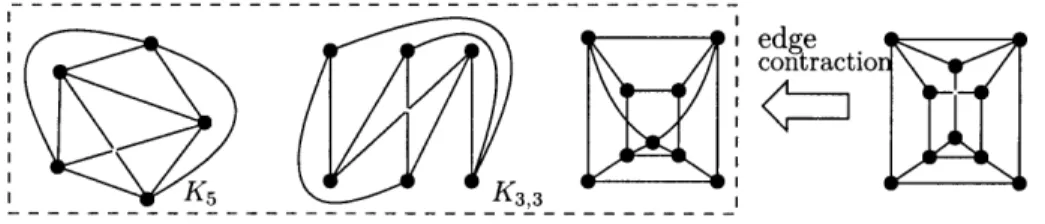
The next three classes of graphs relate to excluding minors. Given an edge e =
{v, w} in a graph G, the contraction of e in G is the result of identifying vertices v and w in G and removing all loops and duplicate edges (the resulting graph is denoted
by G/e). A graph H obtained by a sequence of such edge contractions starting from G is said to be a contraction of G. A graph H is a minor of G if H is a subgraph of some contraction of G. We use the notation H < G (resp. H _c G) for H is a minor
(a contraction) of G. A graph class C is minor-closed if any minor of any graph in C is also a member of C. A minor-closed graph class C is H-minor-free if H , C. More generally, we use the term "H-minor-free" to refer to any minor-closed graph class that excludes some fixed graph H.
A single-crossing graph is a minor of a graph that can be drawn in the plane with at most one pair of edges crossing. Note that a single-crossing graph may not itself be drawable with at most one crossing pair of edges; see Section 2.1. Such graphs were first defined by Robertson and Seymour [142]. A minor-closed graph class is
single-crossing-minor-free if it excludes a fixed single-crossing graph.
An apex graph is a graph in which the removal of some vertex leaves a planar graph. A graph class is apex-minor-free if it excludes some fixed apex graph. Such graph classes were first considered by Eppstein [85, 87], in connection to the notion of bounded local treewidth as described in Section 1.7.
The next section describes strong structural properties of the last three classes of graphs (minor-excluding classes) in terms of the first two classes of graphs (embed-dable on surfaces) and other ingredients.
1.3 Structural Properties
Graphs from single-crossing-minor-free and H-minor-free graph classes have powerful structural properties from the Graph Minor Theory. First we need to define treewidth,
pathwidth, and clique sums.
1.3.1
Background
Treewidth: Many difficult graph problems can be solved efficiently when the input is restricted to graphs of bounded treewidth (see e.g., Bodlaender's survey [31]). The notion of treewidth first was introduced by Robertson and Seymour [143]. To define this notion, first we consider a representation of a graph as a tree, called a tree decomposition. Precisely, a tree decomposition of a graph G = (V, E) is a pair (T, X) in which T = (I, F) is a tree and X = {XiI i E I} is a family of subsets of V(G) such
that
1. UiE Xi = v;
2. for each edge e = {u, v} E E, there exists an i E I such that both u and v belong to Xi; and
3. for all v E V, the set of nodes {i E I I v E Xi} forms a connected subtree of T.
To distinguish between vertices of the original graph G and vertices of T in the tree decomposition, we call vertices of T nodes and their corresponding Xi's bags. The
width of the tree decomposition is the maximum size of a bag in X minus 1. The treewidth of a graph G, denoted by tw(G), is the minimum width over all possible
tree decompositions of G. A tree decomposition is called a path decomposition if
T = (I, F) is a path. The pathwidth of a graph G, denoted pw(G), is the minimum
width over all possible path decompositions of G.
A graph of bounded treewidth is a graph of treewidth at most k, for k a constant independent of the size of the graph. A related notion is that of a k-tree [152], a graph G such that either G is a k-clique or G has a vertex u of degree k such that
u is adjacent to a k-clique, and the graph obtained by deleting u and all its incident
edges is a k-tree. It has been shown that for any k, the class of graphs of treewidth at most k is equivalent to the class of partial k-trees, that is, subgraphs of k-trees [127].
h
G =G1 G2
Figure 1-2: Example of a 5-sum of two graphs.
Clique sum: The notion of clique sums goes back to characterizations of K3,3
-minor-free and K5-minor-free graphs by Wagner [164] and serves as an important
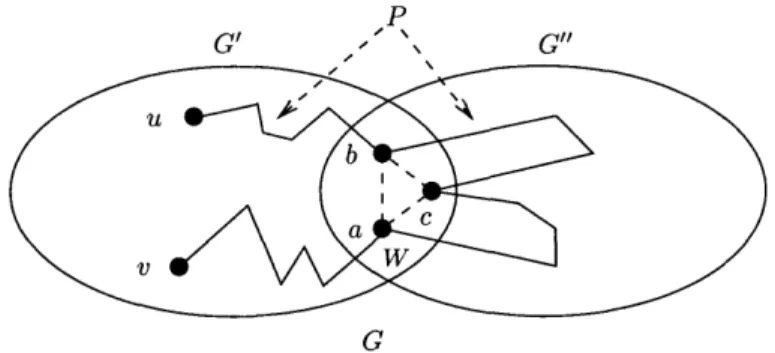
tool in the Graph Minor Theory. Suppose G1 and G2 are graphs with disjoint vertex
sets and let k > 0 be an integer. For i = 1, 2, let Wi C V(Gi) form a clique of size k and let G' be obtained from Gi by deleting some (possibly no) edges from the induced subgraph Gi[Wi] with both endpoints in Wi. Consider a bijection h: W1 -+ W2. We
define a k-sum G of G1and G2, denoted by G = G1 EDk G2or simply by G = G1 G2,
to be the graph obtained from the union of G' and G' by identifying w with h(w) for all w E W1. The images of the vertices of W1 and W2 in G1 Ok G2 form the join set.
Note that each vertex v of G has a corresponding vertex in G1 or G2 or both. It is also worth mentioning that is not a well-defined operator: it can have a set of possible results. More specifically, the result of ® will depend on which (if any) edges are removed from the cliques as well as which bijection is selected, so the operation
o
can have a set of possible results, and hence is not well-defined. A series of k-sums (not necessarily unique) that generate a graph G is called a decomposition of G intoclique-sum operations.
The reader is referred to [77] to see more results on clique-sum classes.
1.3.2 Structure of Single-Crossing-Minor-Free Graphs
The structure of single-crossing-minor-free graphs can be described as follows:Theorem 1.1 ([142]). For any fixed single-crossing graph H, every H-minor-free
graph can be obtained by a sequence of k-sums, 0 < k < 3, of planar graphs and graphs of bounded treewidth, where the bound on treewidth depends on H.
This theorem generalizes characterizations of K3,3-minor-free and K5-minor-free
graphs [164]. A graph is K3,3-minor-free if and only if it can be obtained by k-sums,
0 < k < 2, of planar graphs and K5. A graph is K5-minor-free if and only if it can
be obtained by k-sums, 0 k < 3, of planar graphs and V8 (the length-8 cycle C8
together with eight edges joining diametrically opposite vertices).
This structural property of single-crossing-minor-free graphs has since been strength-ened to ensure that the summands are minors of the original graph and to provide algorithms for finding the decomposition:
Theorem 1.2 ([72], see also Chapter 2). For any fixed single-crossing graph H, there
is an O(n4)-time algorithm to compute, given an H-minor-free graph G, a decom-position of G as a sequence of k-sums, 0 k < 3, of planar graphs and graphs of bounded treewidth (where the bound on treewidth depends on H), each of which is a
minor of G.
1.3.3 Structure of H-Minor-Free Graphs
The structure of H-minor-free graphs is described by a deep theorem of Robertson and Seymour [149]. Intuitively, their theorem says that, for every graph H, every H-minor-free graph can be expressed as a "tree structure" of pieces, where each piece is a graph that can be drawn in a surface in which H cannot be drawn, except for a bounded number of "apex" vertices and a bounded number of "local areas of non-planarity" called vortices. Here the bounds depend only on H.
Roughly speaking, we say that a graph G is h-almost embeddable in a surface S if there exists a set X of size at most h of vertices, called apex vertices or apices, such that G - X can be obtained from a graph Go embedded in S by attaching at most h graphs of pathwidth at most h to Go within h faces in an orderly way. More precisely, a graph G is h-almost embeddable in S if there exists a vertex set X of size at most
h (the apices) such that G - X can be written as Go U G1U .. U Gh, where
1. Go has an embedding in S;
2. the graphs Gi, called vortices, are pairwise disjoint;
3. there are faces F1,..., F of Go in S, and there are pairwise disjoint disks
D1,. . ., Dh in S, such that for i = 1,..
h, Di C Fi and Ui := V(Go)n V(Gi) =
V(Go)
n
Di; and
4. the graph Gi has a path decomposition (Bu)UEU, of width less than h, such that
u E Bu for all u E Ui. The sets Bu are ordered by the ordering of their indices u as points along the boundary cycle of face Fi in Go.
An h-almost embeddable graph is apex-free if the set X of apices is empty. Now, the deep result of Robertson and Seymour is as follows:
Theorem 1.3 ([149]). For every graph H, there exists an integer h > 0 depending
only on V(H)I such that every H-minor-free graph can be obtained by at most
h-sums of graphs that are h-almost-embeddable
in some surfaces in which H cannot be
embedded.
In particular, if H is fixed, any surface in which H cannot be embedded has bounded genus. Thus, the summands in the theorem are h-almost-embeddable in bounded-genus surfaces.
Another way to view Theorem 1.3 is that every H-minor-free graph G has a tree decomposition (T, X) such that, for each node i E V(T), the induced subgraph G[Xi] augmented with additional edges to form a clique on the vertices that overlap with the parent's bag, and a clique on the vertices that overlap with each child's
bag, is h-almost-embeddable in a bounded-genus surface. (This augmented graph is called the torso [Xi] in, e.g., [103, 81].) The intersections between bag Xi and its parent's bag, and with each child's bag, correspond to the join sets in the clique-sum decomposition. Our development primarily follows the original clique-sum viewpoint of Robertson and Seymour, but we will also occasionally view the sums as being
organized into the tree T.
Theorem 1.3 is very general and appeared in print only recently. However already
several nice applications (see e.g. [39, 103, 75]) are known.
As observed by Seymour [154], the constructive proof of Theorem 1.3 in [149] also establishes the following algorithmic result. (Grohe [103] also shows how to obtain a similar result using Robertson and Seymour's theorem that every minor-closed class of graphs has a polynomial-time membership test [149].)
Theorem 1.4. [149, 154] For any graph H, there is an algorithm with running time
n° (1 ) that either computes a clique-sum decomposition as in Theorem 1.3 for any
given H-minor-free graph G, or outputs that G is not H-minor-free. The exponent
in the running time depends on H.1.3.4
Structure of Apex-Minor-Free Graphs
Apex-minor-free graph classes are an important subfamily of H-minor-free graph classes. The general structural theorem for H-minor-free graphs applies in this con-text as well. However, reductions developed in [66] suggest that the decomposition can be restricted to a particular form in the apex-minor-free case:
Conjecture 1.5 ([66]). For every graph H, there is an integer h > 0 depending only
on IV(H)I such that every H-minor-free graph can be obtained by at most h-sums of graphs that are h-almost-embeddable in some surfaces in which H cannot be embedded and whose apices are connected via edges only to vertices within vortices.
1.3.5 Grid Minors
The r x r grid is the canonical planar graph of treewidth O(r). In particular, an important result of Robertson, Seymour, and Thomas [151] is that every planar graph of treewidth w has an Q(w) x Q(w) grid graph as a minor. Thus every planar graph of large treewidth has a grid minor certifying that its treewidth is almost as large (up to constant factors). Recently, this result has been generalized to any H-minor-free
graph class:
Theorem 1.6 ([71], see also Chapter 8). For any fixed graph H, every H-minor-free
graph of treewidth w has an Q(w) x Q(w) grid as a minor.
Thus the r x r grid is the canonical H-minor-free graph of treewidth O(r) for any fixed graph H. This result is also best possible up to constant factors. Chapter 8 discusses the remaining issue of bounding the constant factor and its dependence
on H.
A similar but weaker bound plays an important role in the Graph Minor Theory [144]: for any fixed graph H and integer r > 0, there is an integer w > 0 such that every H-minor-free graph with treewidth at least w has an r x r grid graph as a minor. This result has been re-proved by Robertson, Seymour, and Thomas [151], Reed [141], and Diestel, Jensen, Gorbunov, and Thomassen [80]. Among these proofs, the best known bound on w in terms of r is that every H-minor-free graph of treewidth larger than 2 051V(H)13r has an r x r grid as a minor [151]. Theorem 1.6 therefore offers an
exponential (and best possible) improvement over previous results.
Theorem 1.6 cannot be generalized to arbitrary graphs: Robertson, Seymour, and Thomas [151] proved that some graphs have treewidth Q(r2 lg r) but have grid minors
only of size O(r) x O(r). The best known relation for general graphs is that having treewidth more than 202r5 implies the existence of an r x r grid minor [151]. The best possible bound is believed to be closer to (r2Ig r) than
2 (r5), perhaps even equal
1.4 Bidimensional Parameters/Problems
Bidimensionality has been introduced and developed in a series of papers [74, 72, 64,
65, 63, 66, 62, 73, 71, 70]. Although implicitly hinted at in [74, 72, 64, 65], the first use of the term "bidimensional" was in [63].
First we define "parameters" as an alternative view on optimization problems. A
graph parameter P (or just a parameter P, when it clear in the context) is a function
mapping graphs to nonnegative integers. The decision problem associated with P asks, for a given graph G and nonnegative integer k, whether P(G) k. Many
optimization problems can be phrased as such a decision problem about a graph
parameter P.
Now we can define bidimensionality. A parameter is g(r)-bidimensional (or just
bidimensional) if it is at least g(r) in an r x r "grid-like graph" and if the
parame-ter does not increase when taking either minors (g(r)-minor-bidimensional) or con-tractions (g(r)-contraction-bidimensional). The exact definition of "grid-like graph" depends on the class of graphs allowed and whether we are considering minor- or contraction-bidimensionality. For minor-bidimensionality and for any H-minor-free graph class, the notion of a "grid-like graph" is defined to be the r x r grid, i.e., the planar graph with r2 vertices arranged on a square grid and with edges connecting horizontally and vertically adjacent vertices. For contraction-bidimensionality, the notion of a "grid-like graph" is as follows:
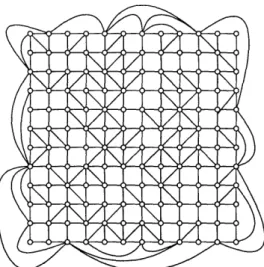
1. For planar graphs and single-crossing-minor-free graphs, a "grid-like graph" is an r x r grid partially triangulated by additional edges that preserve planarity. 2. For bounded-genus graphs, a "grid-like graph" is such a partially triangulated
r x r grid with up to genus(G) additional edges ("handles").
3. For apex-minor-free graphs, a "grid-like graph" is an r x r grid augmented with additional edges such that each vertex is incident to 0(1) edges to nonboundary vertices of the grid. (Here 0(1) depends on the excluded apex graph.)
graphs).2
Examples of bidimensional parameters include the number of vertices, the diam-eter, and the size of various structures such as feedback vertex set, vertex cover, minimum maximal matching, face cover, a series of vertex-removal parameters, dom-inating set, edge domdom-inating set, R-domdom-inating set, connected domdom-inating set, con-nected edge dominating set, concon-nected R-dominating set, and unweighted TSP tour (a walk in the graph visiting all vertices). (See [63, 62] for arguments of either contraction- or minor-bidimensionality for the above parameters.) We also say that the corresponding optimization problems based on these parameters, e.g., finding the minimum-size dominating set, are bidimensional. With the exception of diameter, all of these bidimensional problems are O(r2)-bidimensional, which is the most common
case (and in some papers used as the definition of bidimensionality). Diameter is the main exception, being only O(r)-contraction-bidimensional for planar graphs, single-crossing-minor-free graphs, and bounded-genus graphs, and only (lg r)-contraction-bidimensional for apex-minor-free graphs.
1.5 Parameter-Treewidth Bounds
The genesis of bidimensionality was in fact the notion of a parameter-treewidth bound.
A parameter-treewidth bound is an upper bound f(P(G)) on the treewidth of a graph
with parameter P. Given a graph parameter P, we say that a graph family F has
the parameter-treewidth
property for P if there is a strictly increasing function f such
that every graph G E F has treewidth at most f(P(G)). In many cases, f(k) can even be shown to be sublinear in k, often O(vi), where k = P(G) for a graph G. Parameter-treewidth bounds have been established for many parameters and graph
classes; see, e.g., [2, 116, 93, 6, 50, 123, 107, 64, 72, 74, 62, 66, 63]. Essentially
all of these bounds can be obtained from the theory of bidimensional parameters. Thus bidimensionality is the most powerful method so far for establishing
parameter-2For the parameters to which we have applied bidimensionality, contraction-bidimensionality
does
not seem to extend beyond apex-minor-free graphs, but perhaps a suitably extended definition could
treewidth bounds, encompassing all such previous results for H-minor-free graphs. The central result in bidimensionality that generalizes these bounds is that every bidimensional parameter has a parameter-treewidth bound, in its corresponding fam-ily of graphs as defined in Section 1.4. More precisely, we have the following result:
Theorem 1.7 ([71, 62], see also Chapters 8 and 7). If the parameter P is
g(r)-bidimensional, then for every graph G in the family associated with the parameter P,
tw(G) = O(g-
1(P(G))). In particular, if g(r) = O(r
2), then the bound becomes
tw(G)
=O(PG).
This theorem is based on the grid-minor bound from Theorem 1.6 and the proof of a weaker parameter-treewidth bound, tw(G) = (g-1(p(G)))(9S-(P(G))), established in [62] (see also Chapter 7). The stronger bound of tw(G) = O(g-1(P(G))) was
obtained first for planar graphs [64](see also Chapter 4), then
single-crossing-minor-free graphs [74, 72](see also Chapters 2 and 3), then bounded-genus graphs [63, 73]
(see also Chapter 5), and finally apex-minor-free graphs for contraction-bidimensional parameters and H-minor-free graphs for minor-bidimensional parameters [71]
(The-orem 1.7 above).
We can extend the definition of g(r)-minor-bidimensionality to general graphs by again defining a "grid-like graph" to be the r x r grid. Still we can obtain a parameter-treewidth bound [151, 68], but the bound is weaker: tw(G) = 2(9-1 ( ))5
1.6 Separator Theorems
If we apply the parameter-treewidth bound of Theorem 1.7 to the parameter of the number of vertices in the graph, which is minor-bidimensional with g(r) = r2, then we
immediately obtain the following (known) bound on the treewidth of an H-minor-free graph:
Theorem 1.8 ([9, Proposition 4.5], [103, Corollary 24], [71]). For any fixed graph H,
A consequence of this result is that every vertex-weighted H-minor-free graph G has a vertex separator of size O(v/V(G)I) whose removal splits the graph into two parts each with weight at most 2/3 of the original weight [9, Theorem 1.2]. This generalization of the classic planar separator theorem has many algorithmic applications; see e.g. [9, 5]. Also, this result shows that the structural properties of H-minor-free graphs given by Theorem 1.3 are powerful enough to conclude that these graphs have small separators, which we expect from such a strong theorem.
Chapter 8 discusses the issue of how tight a lead constant can be obtained in such a result.
1.7 Local Treewidth
Eppstein [87] introduced the diameter-treewidth property for a class of graphs, which requires that the treewidth of a graph in the class is upper bounded by a function of its diameter. He proved that a minor-closed graph family has the diameter-treewidth property precisely if the graph family excludes some apex graph. In particular, he proved that any graph in such a family with diameter D has treewidth at most 220().
(A simpler proof of this result was obtained in [65] (see also Chapter 6).)
If we apply the parameter-treewidth bound of Theorem 1.7 to the diameter pa-rameter, which is contraction-bidimensional with g(r) = O(lg r) [65], then we imme-diately obtain the following stronger diameter-treewidth bound for apex-minor-free graphs:
Theorem 1.9 ([71], see also Chapter 8). For any fixed apex graph H, every
H-minor-free graph of diameter D has treewidth 20(D) .
This theorem is not the best possible. In some sense it is necessarily limited be-cause it still does not exploit the full structure of H-minor-free graphs from Theorem 1.3. The difficulty is that, in a grid-like graph, the 0(1) edges from a vertex to non-boundary vertices can accumulate to make the diameter small. However, it is possible to show that, effectively, not too many vertices can have such edges. This fact comes
from the property that there are a bounded number of apices in the clique sum de-composition of Theorem 1.3, and in an apex-minor-free graph, each apex cannot have more than a bounded number of edges to "distant" vertices. Based on this fact, a complicated proof establishes the following even stronger diameter-treewidth bound in apex-minor-free graphs:
Theorem 1.10 ([66]). For any fixed apex graph H, every H-minor-free graph of
diameter D has treewidth O(D).
This diameter-treewidth bound is the best possible up to constant factors. Thus this theorem establishes that, in minor-closed graph families, having any diameter-treewidth bound is equivalent to having a linear diameter-diameter-treewidth bound. As men-tioned before, no minor-closed graph families beyond apex-minor-free graphs can have any diameter-treewidth bound. Theorem 1.10 is therefore the ultimate characteriza-tion of diameter-treewidth bounds in minor-closed graph families (up to constant factors).
The proof of Theorem 1.10 is the basis for Conjecture 1.5. In fact, Theorem 1.10 would not be hard to prove assuming Conjecture 1.5.
The diameter-treewidth property has been used extensively in a slightly modified form called the bounded-local-treewidth property, which requires that the treewidth of any connected subgraph of a graph in the class is upper bounded by a function of its diameter. For minor-closed graph families, these two properties are identical. Graphs of bounded local treewidth have many similar properties to both planar graphs and graphs of bounded treewidth, two classes of graphs on which many problems are substantially easier. In particular, Baker's approach for polynomial-time approxi-mation schemes (PTASs) on planar graphs [23] applies to this setting. As a result, PTASs are known for hereditary maximization problems such as maximum indepen-dent set, maximum triangle matching, maximum H-matching, and maximum tile salvage; for minimization problems such as minimum vertex cover, minimum domi-nating set, minimum edge-domidomi-nating set; and for subgraph isomorphism for a fixed pattern [72, 87, 110]. Graphs of bounded local treewidth also admit several efficient
fixed-parameter algorithms. In particular, Frick and Grohe [96] give a general frame-work for deciding any property expressible in first-order logic in graphs of bounded local treewidth. Theorem 1.10 substantially improves the running time of these algo-rithms, in particular improving the running time of the PTASs from 2220(1/) n° (1 ) to
2°(l/e)nO(l), where n is the number of vertices
in
the graph.1.8 Subexponential Fixed-Parameter Algorithms
A fixed-parameter algorithm is an algorithm for computing a parameter P(G) of a graph G whose running time is h(P(G)) no(M) for some function h. The exponent O(1) must be independent of G; thus the exponentiality of the algorithm is bounded by the parameter P(G), and the dependence on n is only polynomial. A typical function
h for many fixed-parameter algorithms is h(k) = 20(k). In the last six years, several
researchers have obtained exponential speedups in fixed-parameter algorithms in the sense that the h function reduces exponentially, e.g., to 2° (`). For example, the first fixed-parameter algorithm for finding a dominating set of size k in planar graphs [3] has running time 0(8kn); subsequently, a sequence of subexponential algorithms and improvements have been obtained, starting with running time 0(46¥3n) [2], then 0(2274n) [116], and finally O(215.'13Jvk
+
n3 + k4) [93]. Other subexponential algorithms for other domination and covering problems on planar graphs have alsobeen obtained [2, 6, 50, 123, 107].
All subexponential fixed-parameter algorithms developed so far are based on show-ing a sublinear parameter-treewidth bound and then usshow-ing an algorithm whose run-ning time is singly exponential in treewidth and polynomial in problem size. As men-tioned in Section 1.5, essentially all sublinear treewidth-parameter bounds proved so far can be obtained through bidimensionality. Theorem 1.7 and the techniques of [62] yield the following general result for designing subexponential fixed-parameter algorithms:
Theorem 1.11 ([71, 62], see also Chapters 8 and 7). Consider a g(r)-bidimensional
decomposition of G of width at most w. Then there is an algorithm computing P on any graph G in P's corresponding graph class, with running time [h(O(g-l(k))) +
2
°(9-(k))]n
° (1). In particular,
if
g(r)
=E)(r
2) and h(w)
= 20(w2),then
this
running
time is subexponential in k.
In particular, this result gives subexponential fixed-parameter algorithms for many bidimensional parameters, including feedback vertex set, vertex cover, minimum max-imal matching, a series of vertex-removal parameters, dominating set, edge dominat-ing set, R-dominatdominat-ing set, clique-transversal set, connected dominatdominat-ing set, connected edge dominating set, connected R-dominating set, and unweighted TSP tour.
For minor-bidimensional parameters, these algorithms apply to all H-minor-free graphs. The next section describes to what extent these algorithms can be extended to general graphs.
For contraction-bidimensional parameters, these algorithms apply to apex-minor-free graphs. On the other hand, subexponential fixed-parameter algorithms can be obtained for dominating set, which is contraction-bidimensional, on H-minor-free
graphs [63] (see also Chapter 5), map graphs [64] (see also Chapter 4), and fixed powers of planar graphs (or even fixed powers of H-minor-free graphs) [64, 63]. These
algorithms are necessarily more complicated than those produced from Theorem 1.11, because apex-minor-free graphs are precisely the minor-closed graph classes for which domatinating set has a parameter-treewidth bound [62] (see Chapter 7). An intriguing open question is whether these techniques can be extended to other contraction-bidimensional problems than dominating set, for fixed powers of H-minor-free graphs and/or other classes of graphs.
1.9 Fixed-Parameter Algorithms for General Graphs
As mentioned in Section 1.5, minor-bidimensionality can be defined for general graphs as well. In this section we show how the bidimensionality theory in this case leads to a general class of fixed-parameter algorithms.
every minor-closed graph property is characterized by a finite set of forbidden minors. More precisely, for any property P on graphs such that a graph having property P implies that all its minors have property P, there is a finite set {(H, H2,... , Hh of
graphs such that a graph G has property P if and only if G does not have Hi as a minor for all i = 1,2,..., h. The algorithmic consequence of this result is that there exists an O(n3)-time algorithm to decide any fixed minor-closed graph property, by finitely many calls to an O(n3)-time minor test [147]. This consequence has been
used to show the existence of polynomial-time algorithms for several graph problems, some of which were not previously known to be decidable [91].
However, all of these algorithmic results (except the minor test) are nonconstruc-tive: we are guaranteed that efficient algorithms exist, but are not told what they are. The difficulty is that we know that a finite set of forbidden minors exists, but lack "a means of identifying the elements of the set, the cardinality of the set, or even the order of the largest graph in the set" [91]. Indeed, there is a mathematical sense in which any proof of the finite-forbidden-minors theorem must be nonconstructive
[97].
We can apply these graph-minor results to prove the existence of algorithms to compute parameters, provided the parameters never increase when taking a minor. For any fixed parameter and any fixed k > 0, there is an O(n3)-time algorithm that
decides whether a graph has parameter value k. Unfortunately, the existence of
these algorithms does not necessarily imply the existence of a single fixed-parameter algorithm that works for all k > 0, because the algorithms for individual k (in par-ticular the set of forbidden minors) might be uncomputable. We do not even know an upper bound on the running time of these algorithms as a function of n and k, because we do not know the dependence of the size of the forbidden minors on k.
In [68], fixed-parameter algorithms are constructed for nearly all parameters that never increase when taking a minor, with explicit time bounds in terms of n and k. Essentially, by assuming a few very common properties of the parameter, we obtain the generalized form of minor-bidimensionality.
never increases when taking minors, is at least the sum over the connected components of a disconnected graph, and can be computed in h(w) no(1 ) time given a width-w tree
decomposition of the graph. Then there is an algorithm that decides whether P is at most k on a graph with n vertices in [22°(g )5 + h(20(gV ) 5)] n0() time.
As mentioned in [68], a conjecture of Robertson, Seymour, and Thomas [151] would improve the running time to h(O(k lg k)) n° ( ), which is 20(klgk)n °(1) for the typical case of h(w) = 2°(w). This conjectured time bound almost matches the fastest known fixed-parameter algorithms for several parameters, e.g., feedback vertex set, vertex cover, and a general family of vertex-removal problems [91].
1.10 Polynomial-Time Approximation Schemes
Recently, the bidimensionality theory has been extended to obtain polynomial-time approximation schemes (PTASs) for essentially all bidimensional parameters, includ-ing those mentioned above [70]. These PTASs are based on techniques that generalize and in some sense unify the two main previous approaches for designing PTASs in planar graphs, namely, the Lipton-Tarjan separator approach [132] and the Baker layerwise decomposition approach [23]. The PTASs apply to H-minor-free graphs for minor-bidimensional parameters and to apex-minor-free graphs for contraction-bidimensional parameters. To achieve this level of generality, [70] uses the sublinear
parameter-treewidth bound of Theorem 1.7 as well as an 0(1)-approximation
algo-rithm for treewidth in H-minor-free graphs [90] (see also Chapter 9).
Before we can state the general theorem for constructing PTASs, we need to define a few straightforward required conditions, which are commonly satisfied by most bidimensional problems. The theorem considers families of problems in which we are given a graph and our goal is to find a minimum-size set of vertices and/or edges satisfying a certain property. Such a problem naturally defines a parameter and therefore the notion of bidimensionality. A minor-bidimensional problem has the
1. If a graph G has k connected components G1, G2, ... , Gk, then an optimal solution for G is the union of optimal solutions for each connected component Gi. 2. There is a polynomial-time algorithm that, given any graph G, given any vertex cut C whose removal disconnects G into connected components G, G2, ... , Gk,
and given an optimal solution Si to each connected component Gi of G - C, computes a solution S for G such that the number of vertices and/or edges in S within the induced subgraph G[C U UiEIV(Gi)] consisting of C and some connected components of G - C is EiEI Sil + O(ICl) for any I C {1, 2,..., k}.
In particular, the total cost of S is at most opt(G - C) + O(ICl).
3. Given any graph G, given any vertex cut C, and given an optimal solution opt to G, for any union G' of some subset of connected components of G - C,
lopt
n G'
I= lopt(G')l
+ O(ICl).
For contraction-bidimensional problems, the exact requirements on the problem are slightly different but similarly straightforward. The main distinction is that the connected components are always considered together with the cut C. As a result, the merging algorithm in Condition 2 must take as input a solution to a generalized form of the problem that does not count the cost of including all vertices and edges from the cut C. We refer to [70] for the exact definition of the separation property
in this case.
Theorem 1.13 ([70]). Consider a bidimensional problem satisfying the separation
property. Suppose that the problem can be solved on a graph G with n vertices in f(n, tw(G)) time. Suppose also that the problem can be approximated within a factor
of a in g(n) time. For contraction-bidimensional
problems, suppose further that both
of these algorithms also apply to the generalized form of the problem. Then there is a(1 + )-approximation algorithm whose running time is O(nf(n, O(a
2/e)) + n
3g(n))
for the corresponding graph class of the bidimensional problem.
This result shows a strong connection between subexponential fixed-parameter tractability and approximation algorithms for combinatorial optimization problems
on H-minor-free graphs. In particular, this result yields a PTAS for the following minor-bidimensional problems in H-minor-free graphs: feedback vertex set, face cover (defined just for planar graphs), vertex cover, minimum maximal matching, and a series of vertex-removal problems. Furthermore, the result yields a PTAS for the following contraction-bidimensional problems in apex-minor-free graphs: dominating set, edge dominating set, R-dominating set, connected dominating set, connected edge dominating set, connected R-dominating set, and clique-transversal set.
1.11 Half-Integral versus Fractional
Multicommod-ity Flow
Chekuri, Khanna, and Shephard [54] proved that, for planar graphs, the gap between the optimal half-integral multicommodity flow and the optimal fractional multicom-modity flow is at most a polylogarithmic factor. Also, they gave a combinatorial proof of the result that, for planar graphs, the gap between the maximum flow and the min-imum cut in product multicommodity flow (and thus uniform multicommodity flow) instances is at most a constant factor. The latter result was proved before by Klein, Plotkin, and Rao for H-minor-free graphs using primal-dual methods [120], and has many applications in embeddings of H-minor-free graphs. As mentioned by Chekuri et al. [54], our Theorem 1.6 can be used to generalize the half-integral/fractional gap bound and the combinatorial proof of the max-flow/min-cut gap bound to H-minor-free graphs.
1.12 Thesis Structure
This thesis is organized as follows. We start by demonstrating structural properties of single-crossing-minor-free graphs and their consequences in designing polynomial-time approximation algorithms and subexponential fixed-parameter algorithms for a wide variety of graph problems in Chapters 2 and 3. In Chapter 4, we design fixed-parameter algorithms for the (k, r)-center problem, a generalization of the
dom-inating set problem, on planar graphs and map graphs. At the end of this chapter, we introduce the concept of bidimensionality for planar graphs. In Chapter 5, we formally define the concept of bidimensionality for bounded-genus graphs. In ad-dition, we introduce a general approach for developing algorithms on H-minor-free graphs, based on the corresponding algorithms on bounded-genus graphs and struc-tural results about H-minor-free graphs at the heart of Robertson and Seymour's graph-minors work. Chapters 6 and 7 extend the concept of bidimensionality for apex-minor-free graphs and H-minor-free graphs. In Chapter 8, we prove the linear-ity of the size of grid minors in terms of the treewidth, by which we improve several combinatorial bounds and running times of algorithms in two previous Chapters 6 and 7. In Chapter 9, we develop the algorithmic theory of vertex separators and its relation to the embeddings of certain metric spaces, by which we improve the approx-imation factor of treewidth for both general graphs and H-minor-free graphs. We also mention how these improvements can be coupled with bidimensionality to obtain the first polynomial-time approximation schemes for problems like minimum connected dominating set and minimum feedback vertex set in apex-minor-free graphs and H-minor-free graphs. Finally, in Chapter 10, we demonstrate some major directions for future research in the theory of bidimensionality.
It is worth mentioning that the journal versions of Chapters 2, 3, 4, 6, and 7
appeared in order in [72, 74, 64, 65, 62] and the conference versions of Chapters 5, 8, 9,
and this chapter appeared in order in [63, 71, 90, 67]. In particular, each chapter is joint work with the set of collaborators listed in the corresponding references.
Chapter 2
Approximation Algorithms for
Single-Crossing-Minor-Free Graphs
The development of algorithms for NP-complete problems on restricted classes of graphs has resulted in structural characterizations of algorithmic utility. For example, algorithms for graphs of bounded treewidth rely on techniques using separator proper-ties resulting from tree decompositions. In this chapter we focus on graph classes ob-tained by excluding a single-crossing graph as a minor. We present a polynomial-time algorithm that determines a clique-sum decomposition of such a graph, a representa-tion of the graph as a collecrepresenta-tion of planar graphs and graphs of small treewidth Our result generalizes previous decomposition results for graphs excluding special single-crossing graphs such as K3,3 [20] and K5 [118]. A second structural property is that of
locally bounded treewidth which allows a layer decomposition, enabling us to represent
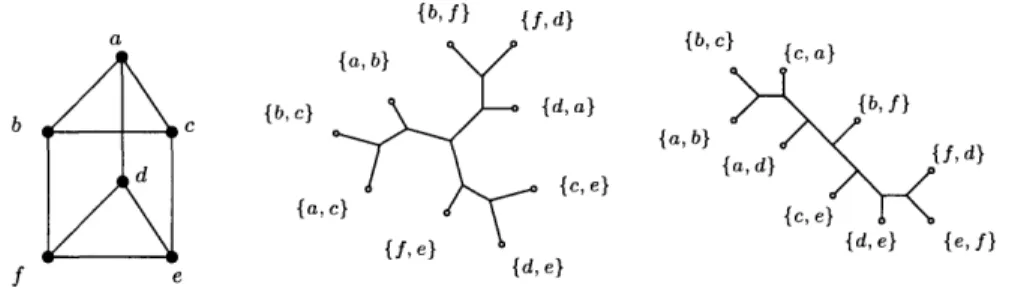
a graph as a collection of subgraphs, each of bounded treewidth (formal definitions follow in Section 2.3). In order to take advantage of the bound on treewidth of the subgraphs, we give a tree decomposition algorithm for this special case, adding to the toolkit of tree decomposition algorithms for small bounds on treewidth [16, 133, 153] and r-outerplanar graphs [2] that reduce the prohibitively high constant factors found
in algorithms for more general graphs [125, 35, 32].
Included among the results in this chapter are several applications of our struc-tural characterizations and algorithms. Using clique-sum decompositions, we
ob-tain the first constant-factor approximation algorithm for treewidth of nonplanar graphs. Furthermore, we use properties of layer decompositions to form polynomial-time approximation schemes for a range of maximization and minimization problems (Section 2.5), as well as fixed-parameter algorithms for dominating set and related problems (Section 3.5).
We present decomposition results followed by algorithms for NP-complete prob-lems. Sections 2.1 through 2.3 present general results from which applications are derived in Sections 2.4 and 2.5. First, in Section 2.1, we introduce the concepts used throughout the chapter (though some of them are defined intuitively in Chapter 1). Next, in Section 2.2, we demonstrate how graphs excluding single-crossing graphs as minors can be characterized using a clique-sum decomposition. The fact that such graphs have bounded local treewidth is established in Section 2.3, which also gives an algorithm for computing the tree decomposition of a local neighborhood in a graph. The rest of the chapter contains results that follow from these properties: an approximation algorithm for treewidth (Section 2.4), polynomial-time approxima-tion schemes for optimizaapproxima-tion problems (Secapproxima-tion 2.5), and summary of our results and directions for further research (Section 2.6). We defer the applications regarding fixed-parameter algorithms for dominating set and its variants to Chapter 3.
2.1 Background
2.1.1
Preliminaries
Recall that a graph is planar if it can be drawn in the plane so that its edges intersect only at their endpoints; such a drawing is called an embedding. An embedding par-titions the plane into connected regions called faces; the unbounded region is called the outer face. A graph with all vertices on the outer face is called outerplanar, a
k-outerplanar graph has the property that k successive deletions of the vertices on
the outer face results in the empty graph.