HAL Id: tel-02884122
https://tel.archives-ouvertes.fr/tel-02884122
Submitted on 29 Jun 2020HAL is a multi-disciplinary open access
archive for the deposit and dissemination of sci-entific research documents, whether they are pub-lished or not. The documents may come from teaching and research institutions in France or abroad, or from public or private research centers.
L’archive ouverte pluridisciplinaire HAL, est destinée au dépôt et à la diffusion de documents scientifiques de niveau recherche, publiés ou non, émanant des établissements d’enseignement et de recherche français ou étrangers, des laboratoires publics ou privés.
A context manager for solving conflicts between
designer’s viewpoints
The Can Do
To cite this version:
The Can Do. A context manager for solving conflicts between designer’s viewpoints. Ubiquitous Computing. COMUE Université Côte d’Azur (2015 - 2019), 2019. English. �NNT : 2019AZUR4106�. �tel-02884122�
Un manageur de contextes résolvant les
conflits entre les points de vue des
concepteurs
The Can DO
Université Côte d’Azur, CNRS, I3S
Présentée en vue de l’obtention du grade de docteur en
informatique d’Université Côte d’Azur
Dirigée par : Nhan Le-Thanh Co-encadrée par : Gaëtan Rey Soutenue le : 16/12/2019
Devant le jury, composé de :
Patrick Brézillon,Professeur, Sorbonne Université Parisa Ghodous, Professeur, Université Lyon 1 Thanh Binh Nguyen, Assoc. Prof, Danang Université Peter Sander, Professeur, Université Côte d’Azur
Gaëtan Rey, Maître de conférences,Université Côte d’Azur Jean-Yves Tigli, Maître de conférences,Université Côte d’Azur
Un manageur de contextes résolvant les conflits
entre les points de vue des concepteurs
Jury :
Président du jury*
Peter Sander, Professeur, Université Côte d’Azur, CNRS
Laboratoire d'Informatique, Signaux et Systèmes de Sophia Antipolis (I3S) Rapporteurs
Patrick Brézillon, Professeur,
Sorbonne Université, Paris, France,
Laboratoire d'Informatique de Paris 6 (LIP6) Thanh Binh Nguyen, Associate Professor, Université de Danang, Vietnam
Faculté d'informatique Examinateurs
Parisa Ghodous, Professeur,
Université Claude Bernard Lyon 1, France
Laboratoire d'InfoRmatique en Image et Systèmes d'information Gaëtan Rey, Maître de conférences,
Université Côte d’Azur, CNRS
Laboratoire d'Informatique, Signaux et Systèmes de Sophia Antipolis (I3S) Jean-Yves Tigli, Maître de conférences,
Université Côte d’Azur, CNRS
iii
Un manageur de contextes résolvant les conflits entre les points de vue des
concepteurs
Résumé
De nos jours, les systèmes auto-adaptatifs (AAS) sont devenus des éléments essentiels pour piloter les applications dans le domaine de l’informatique ambiante. Ils offrent des capacités d'autoadaptation dynamique de leurs comportements en réponse aux situations contextuelles et aux besoins actuels de l'utilisateur.
Cette thèse vise à proposer des solutions pour surmonter les défis de développement des systèmes auto-adaptatif tels que la modélisation et la gestion du contexte pour ces systèmes et l'amélioration de leur capacité d'adaptation. L’étude se concentre sur deux aspects : la séparation des préoccupations contextuelles dans la modélisation du contexte et l'amélioration de la réactivité du système auto-adaptatif. Pour séparer les préoccupations contextuelles, nous introduisons la notion de points de vue indépendants et fournissons un mécanisme pour les utiliser dans le processus de modélisation du contexte. Ce mécanisme simplifie également la tâche du concepteur car il lui permet de se concentrer uniquement sur son domaine d'expertise pour modéliser sa préoccupation contextuelle (son point de vue). Pour améliorer la réactivité de SAS, nous fournissons un nouveau modèle d'architecture utilisant un manager de contextes (MC) pour prendre en charge le système auto-adaptatif dans le traitement du contexte. Dans cette architecture, le MC se concentre sur l'identification de la situation contextuelle actuelle, en fonction des points de vue spécifiques dont il a la charge, dans le but de déployer les règles d'adaptation adapter à cette situation. Le SAS n’a alors plus qu’à gérer un ensemble de règles limité, déjà adapté à la situation courante.
Dans notre approche, chaque point de vue spécifique a été construit indépendamment des autres par des concepteurs différents. Chaque point de vue correspond à une préoccupation particulière, et il convient d’utiliser plusieurs points de vue en même temps pour répondre à tous les scénarios usages. Par conséquent, les possibilités de conflit entre les points de vue, à un moment donné, existent. Néanmoins, il est impossible de résoudre les conflits entre les points de vue au moment de la conception parce que nous ne sommes pas en mesure de prévoir tous les scénarios d’usages, les combinaisons de points de vue dépendant de l'emplacement, de l'activité, de la réglementation et des choix de l'utilisateur. C'est pourquoi nous proposons plusieurs solutions pour détecter et résoudre les conflits entre les points de vue dans le manager de contextes.
Mots clés : Informatique ambiante, système auto-adaptatifs, modélisation du contexte gestion du contexte, résolution de conflits
iv
A context manager for solving conflicts between designer’s viewpoints
Abstract
Presently, self-adaptive systems (SAS) have become an essential feature in ubiquitous computing applications. They provide a capable of dynamically self-adapting their behavior in response to the user’s current situation and needs.
This thesis aims at providing several solutions for overcoming challenges on the development of self-adaptive system such as context modeling, context handling and improving adaptation ability. Our study focuses on two aspects: separating contextual concerns in context modeling and improving the responsiveness of self-adaptive system. To separate contextual concerns, we introduce the notion of independent viewpoints and provide a mechanism to use them for the context modeling process. This mechanism also simplifies the designers’ task because it allows the designers to focus only on their expertise domain to modeling their contextual concern. To improve the responsiveness of SAS, we provide a new architectural pattern using context-aware management (CAM) to support self-adaptive system in handling context. In this architecture, the CAM focuses on the current context identification according to the specific viewpoints which it is in charge of, having the goal to deploy the adaptation rules to this situation. The SAS only has to manage a limited set of rules, already adapted to the current situation.
In our approach, each specific viewpoint was built independently by different designers. Each viewpoint is related to a different scenario setup, but they might operate in one system at the same time. Therefore, the possibilities of conflict between viewpoints at one time always exist. Nevertheless, it is impossible to solve conflicts between viewpoints at design time because we are not able to predict all the users’ scenarios and the combinations of viewpoints because they depend on the location, activity, regulation and user’s choice. Therefore, we propose several solutions to detect and solve the conflicts between viewpoints in the context-aware management layer.
Keywords: Ubiquitous computing, self-adaptive system, context modeling, context manager, conflict resolution.
v
Acknowledgments
I would really like to express my profound gratitude to all those who have helped me throughout the Ph.D. period, both directly and indirectly.
First and foremost, I would like to express my sincere appreciation to my supervisor Prof. Nhan Le-Thanh, who guided me throughout my Ph.D. study. I thank him for his invaluable guidance, supervision, and continuous support during the past four years. I would like to thank my principal advisor, Assoc. prof. Gaëtan Rey, who provided scientific guidance, tireless support, encouragement, and inspiration throughout my Ph.D. study. His guidance helped me in overcoming obstacles I have been facing during my research and writing of this thesis. Without his assistance in every step throughout my research process, my thesis would have never been accomplished.
My sincere thanks also to Assoc. prof. Jean-Yves Tigli. The door to his office was always open whenever I had any questions about my research or thesis writing. So, I want to say to him: “thank you for your unconditional support, encouragement, shared knowledge, and thoughtful guidance.”
I wish to extend my deep appreciation to the reviewers, Prof. Patrick Brézillon and Assoc. prof. Thanh Binh Nguyen, who gave their time and attention to reviewing my manuscript and evaluating my work. Their invaluable comments and advice helped me in improving the quality of my manuscript and overcoming the research limitations. I am deeply honored to have Prof. Parisa Ghodous and Prof. Sander Peter as members of my Ph.D. committee. I would like to thank them for accepting the invitation.
Many thanks to the Vietnam Ministry of Education and Training (MOET) and Campus France for granting me financial support for the Ph.D. studies for four years, and provided me an opportunity to live and study in France.
I am indebted to all my fellow doctoral students and friends in Sophia Antipolis for their continuous support, cooperation, and of course friendship. In addition, I would like to thank my best friend, Huu Duyen Nguyen, for her enthusiastic support.
Finally, I must express my very profound gratitude to my family for being my biggest supporters, especially during many years of study. Most importantly, huge thank you to my wife, Thanh Tra Phan, for her unconditional support and for always believing in me. To her, I would like to dedicate not only this thesis but also my heart.
The Can DO
vi
Contents
List of Figures ... ix List of Tables... xi CHAPTER 1: Introduction ... 1 1.1 Ubiquitous computing ... 11.2 Context-aware and mobility of the user ... 3
1.2.1 What is Context? ... 3
1.2.2 Context-aware system... 4
1.2.3 The mobility of user and changes of contextual information ... 5
1.3 Overview of challenges ... 6
1.4 Outline ... 8
CHAPTER 2: Background and State of the Art ... 9
2.1 Context modeling ... 9
2.1.1 Context metamodel ... 10
2.1.2 Context ontology model ... 11
2.1.3 Graphical model ... 13 2.1.4 Discussion ... 15 2.2 Adaptation system ... 17 2.2.1 Context toolkit ... 18 2.2.2 Adaptation middleware ... 18 2.2.3 Context-aware system... 20 2.2.4 Self-adaptive system ... 24 2.2.5 Discussion ... 25 2.3 Chapter conclusion ... 27
CHAPTER 3: Context intermediate model and Architecture pattern ... 29
3.1 Context-aware management (CAM) ... 29
3.2 Context model solution. ... 31
3.2.1 Problem with designing a single big context model ... 31
3.2.2 Separate concerns: the solution to solve the problems related to designing a single big context model ... 32
3.3 Special viewpoints in context domain ... 33
vii 3.5 Activity design: Architecture of self-adaptive system and context intermediate
model ... 37
3.5.1 The model architecture of self-adaptive system ... 37
3.5.2 Context intermediate model ... 38
3.6 The methods of generating the context model from the models of concerns .... 42
3.6.1 Generating the context model with the Business process viewpoint ... 42
3.6.2 Generating the context model with Tasks model viewpoint ... 46
3.7 Valid and Invalid state... 50
3.7.1 Problems related to observation ... 50
3.7.2 The state identification ... 50
3.7.3 The proposed solution to filter states and react to invalid states. ... 52
3.8 Chapter conclusion ... 53
CHAPTER 4: Conflict detection and solution ... 55
4.1 Conflicts between adaptation rules of viewpoints in self-adaptive system ... 55
4.2 State of the art ... 57
4.3 Objectives of state definition ... 60
4.4 Detect the conflicts between the objective of states in different viewpoints ... 64
4.4.1 State of the art ... 64
4.4.2 Conflict detection algorithms ... 66
4.5 Chapter conclusion ... 73
CHAPTER 5: Solving conflicts between objective of states ... 75
5.1 Introduction ... 75
5.2 State of the art ... 76
5.3 Using priority to classify the objective of states ... 77
5.4 Conflict resolution ... 80
5.4.1 Solving conflict between viewpoints based on priority level ... 81
5.4.2 Solving conflict based on getting maximum of services ... 86
5.4.3 Solving conflict based on the combination of priority and maximum supported services ... 90
5.5 Chapter conclusion ... 92
CHAPTER 6: Adaptation rules deployment and Implementations ... 94
viii
6.2. Objective designer database ... 97
6.3 Adaptation rules deployment ... 97
6.3.1 First solution ... 98
6.3.2 Second solution ... 99
6.3.3 Third solution ... 100
6.4 Implementations ... 101
6.4.1 Tools for designer... 102
6.4.2 Context-aware management (CAM) ... 103
6.4.3 The simulator of self-adaptive system and observation system ... 106
6.5 Chapter conclusion ... 107
CHAPTER 7: Conclusion and Future works... 109
7.1 General considerations ... 109
7.2 Research contributions ... 110
7.2.1 Simplifying the designer’s task ... 110
7.2.2 Detecting and solving the conflicts between viewpoints ... 111
7.2.3 Improve reactivity of SAS ... 112
7.3 Future works ... 112
Bibliography ... 114
ix
List of Figures
Figure 1.1: User applications in ubiquitous computing environments ... 2
Figure 1.2: The adaptation to the environment using self-adaptive system ... 2
Figure 1.3: User mobility in dynamic environments ... 5
Figure 1.4: The classical model of a self-adaptive system ... 6
Figure 2.1: Context meta-model [Shishkov-2018] ... 10
Figure 2.2: CAMN: Context metamodel on TriPlet ... 11
Figure 2.3: The CONON upper ontology for smart home application ... 12
Figure 2.4: Hierarchical design of a Context ontology [Aguilar-2018]... 13
Figure 2.5: The graphical context modeling follows fact type [Henricksen-2003] ... 14
Figure 2.6: Architecture of an adaptation system [Keling-2011] ... 17
Figure 2.7: Architecture diagram of Context Toolkit ... 18
Figure 2.8: The SOCAM architecture ... 19
Figure 2.9: Context and user driven self-adaptation [Tigli-2009] ... 20
Figure 2.10: Context Broker architecture CoBra ... 22
Figure 2.11: Context-aware system [Mahmud-2018] ... 23
Figure 2.12: Taxonomy of Self-adaptive system architecture [Krupitzer-2015] ... 25
Figure 3.1: Generic context manager main functionalities [Vieira-2007] ... 30
Figure 3.2: Context-aware management structure [Kim-2008] ... 31
Figure 3.3: A single big context model in self-adaptive system ... 32
Figure 3.4: Using CIM as standard data for all viewpoints... 33
Figure 3.5: The procedure for managing architectural contests [Marcinkowski-2012] . 34 Figure 3.6: Use of task models in the design cycle [Paternò-2002] ... 35
Figure 3.7: Using special viewpoints in context modeling ... 36
Figure 3.8: Model architecture of system ... 37
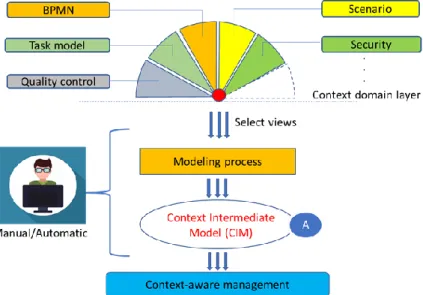
Figure 3.9: The data flow of viewpoint in CAM ... 38
Figure 3.10: Each viewpoint is managed independently in CAM ... 39
Figure 3.11: The XML schema of context Intermediate model ... 41
Figure 3.12: Using BPMN to describe specific viewpoint in context modeling ... 43
Figure 3.13: The E-Order process that is described by graphical notation. ... 44
Figure 3.14: Using CTT to describe specific viewpoint in context modeling ... 46
Figure 3.15: The UML notation for activity diagram [Nóbrega-2005] ... 47
Figure 3.16: The Hotel reservation process that is described by ConcurTaskTrees... 48
Figure 3.17: The updated version of CIM with adding Invalid state ... 51
Figure 3.18: The filter state in CAM ... 52
Figure 3.19: Detection Invalid states algorithm ... 53
Figure 4.1: The conflict management in Context-aware management (CAM) ... 56
Figure 4.2: Ontological context-aware using 5W&1H question [Kim-2012]... 58
x
Figure 4.4: The 2W1H description of the objective of state ... 60
Figure 4.5: The 2W1H contextual ontology based on 5W1H-STPO [Yang-2011] ... 61
Figure 4.6: Contextual ontology of “where” class [Rey-2005] ... 62
Figure 4.7: The modified of class “what” and “how” of CA5W1HOnto ... 62
Figure 4.8: Adding the Objectives of state in the schema of CIM ... 63
Figure 4.9: Conflict analysis between two actions [Maternaghan-2013] ... 65
Figure 4.10: Conflict ability checking process ... 66
Figure 4.11: The relationship between “what” elements of two OOSs (O1(a), O2(a)) ... 67
Figure 4.12: The relationship between “where” elements of two OOSs (O1(b), O2(b)) . 68 Figure 4.13: The relationship between “how” elements of two OOSs (O1(c), O2(c)) ... 68
Figure 4.14: Relation properties between “How” elements in 2W1H ontology... 69
Figure 4.15: The conflict situations when space O1(b) cover a part or all space O2(b) .. 71
Figure 5.1: The conflict relation of two OOSs ... 75
Figure 5.2: The objective of state description with 2W1H&1P ... 78
Figure 5.3: The updated version of Contextual ontology database 2W1H&1P ... 79
Figure 5.4: Classifying and solving conflict between multiple OOSs ... 80
Figure 5.5: The input and output of the conflict solving process ... 93
Figure 6.1: The output of context-aware management. ... 94
Figure 6.2: The final version of CIM schema ... 96
Figure 6.3: Objective designer database ... 97
Figure 6.4: Requesting AR for OOS in CAM ... 98
Figure 6.5: Mapping OOS to AR by using objective designer database ... 99
Figure 6.6: Using the local database to save time in compute order for SAS ... 100
Figure 6.7: The CAM associate AR for all OOSs automatically ... 101
Figure 6.8: The specific tool to convert BPMN viewpoint into CIM format... 102
Figure 6.9: The specific tool to convert CTT viewpoint into CIM format ... 102
Figure 6.10: The XML validator tool ... 103
Figure 6.11: The architecture of CAM for implementation ... 103
Figure 6.12: The CAM life cycle ... 104
Figure 6.13: The viewpoint life cycle ... 105
Figure 6.14: The observation simulator interface ... 106
Figure 6.15: The adaptation simulator interface ... 107
Figure 7.1: The diagram of context description in our approach ... 110
xi
List of Tables
Table 2.1: Evaluating current context modeling initiatives ... 16
Table 2.2: Evaluating current adaptation system approaches ... 27
Table 3.1: The mapping from BPMN to CIM standard data type ... 43
Table 4.1: Objectives conflict analysis results ... 70
Table 4.2: Objectives conflict analysis of O1 and O2 ... 70
Table 4.3: An example of the conflict situation between eight OOS in one system ... 73
Table 5.1: Sample Priority matrix [Glaser-2015] ... 76
Table 5.2: Default priority and role schema ... 77
Table 5.3: The four levels of priority in the description of the OOS ... 78
Table 5.4: The priority level of OOS at the current time. ... 80
Table 5.5: The classifying OOS based on priority level. ... 80
Table 5.6: The result of checking “same OOS” in each priority level ... 82
Table 5.7: Conflict situation and the result of checking process in step 2 ... 83
Table 5.8: The updated table of OOSs in four priority levels ... 84
Table 5.9: The number of conflicts in class CP2... 84
Table 5.10: The conflict situation of O4 and O8 with other OOSs in the lower level ... 84
Table 5.11: The result of the conflict checking and solving in class CP2 ... 85
Table 5.12: The result of the conflict checking and choice OOS for adaptation ... 85
Table 5.13: The priority levels and conflict situations of eight OOS. ... 87
Table 5.14: The number of the conflicts of each OOS with others. ... 87
Table 5.15: Conflict situations without O5. ... 88
Table 5.16: The conflict solving without O5 and O6 ... 88
Table 5.17: The conflict solving without O7 ... 89
Table 5.18: The result of solving conflict between OOSs follow solution two. ... 89
Table 5.19: The conflict situations and priority levels of OOSs ... 91
Table 5.20: The conflict number of each OOS with the other OOSs ... 91
Table 5.21: The conflict situation without O1 ... 92
1
PhD Thesis, The Can DO, December 2019
CHAPTER 1: Introduction
1.1 Ubiquitous computing
During the past four decades, the rapid development of semiconductors and communication technology has created a revolution in embedded and mobile devices. It promotes a growing trend of embedding computational capacity into everyday objects to make them effectively communicate and perform a useful task in a way that minimizes the interaction required between the end-user and computers. Moreover, the advances in sensor technology, wireless communication, and information infrastructures such as GPS, Wi-Fi, and mobile device technology expose users to an enormous amount of mobile services available anywhere and anytime. The rapid development of embedded devices, mobile services, and communication technology make computation seam to appear everywhere.
The term “Ubiquitous Computing” was first introduced by Weiser [Weiser-1993], he defined that “ubiquitous computing is the method of enhancing computer use by making many computers available throughout the physical environment, but making them effectively invisible to the user.” According to Weiser, we are able to understand that ubiquitous computing is the integration of microcomputers into physical objects of any shape such as embedded systems, mobile devices, etc. Ubiquitous computing becomes useful tools but an invisible force to the user because they provide a list of services at the center of interactions between application layer and devices. Moreover, the main power of ubiquitous computing comes from the interconnection between many different kinds of individual computing devices. They communicate with each other through wireless or cable networks and use local information to adapt to the requirement of the user. On the other hand, ubiquitous computing is depicted by the omnipresent and mobile accessibility of services themselves. These services do not depend on the target platform; they will be automatically tailored to the physical capacity of a target device, whether it is a smartphone, embedded system, or other mobile devices.
The power of ubiquitous computing has changed the way we interact with other people or digital devices in physical spaces [Sen-2010]. The user can use ubiquitous devices for many different purposes such as entertainment, business, group activity, etc. (as shown in figure 1.1) at anytime and anyplace.
Chapter 1: Introduction 2
PhD Thesis, The Can DO, December 2019
Figure 1.1: User applications in ubiquitous computing environments
Moreover, ubiquitous computing has also changed the ways we use the computer in our daily life. The users do not need to supply explicit instructions or make decisions because it has a variety of self-adaptive systems (SAS) operates automatically in the background and interacting on behalf of the user [Baldauf-2007]-[Miraoui-2008], as shown in figure 1.2.
We might see that ubiquitous computing is not only a special field of technology but also an application of information and communications technology. It is integrated into our daily lives more than ever before. The main goal of this integration is to adapt the requirements of users everywhere and at any time. Ubiquitous devices use sensors and communication protocols to collect information of both their users and the environment and then adjust their behavior accordingly.
Chapter 1: Introduction 3
PhD Thesis, The Can DO, December 2019
1.2 Context-aware and mobility of the user
1.2.1 What is Context?
Currently, it is impossible to expect a static execution environment for computer applications because the world around an application is constantly changing. In each situation, the information on the ubiquitous environment is different and changes over time. In such a dynamic environment, the interaction and management of all various devices that a user may be using will be a difficult task. Moreover, when we talk about the user’s mobility, we need to take into account the changing of the factors affecting user applications such as environment, connection, situation, devices, etc. Many works have been done to define the term “Context” in various domains of sciences such as economy, computer science, philosophy, etc. Bazire et al. provided an analysis of a database with 150 context definitions to identify the main elements of the context [Bazire-2005]. Their work might help us understand the context before using it.
In this thesis, we only focus on the definitions of context in the domain of computer science. It is not difficult to find many different definitions of context from Web sources. However, we only point out some typical definitions accepted by the majority of researchers. Hull believed that the context simply is “the aspects of a current situation”[Hull-1997]. Schilit indicated context is “the set of location, identities of nearby people and objects and changes to those objects” [Schilit-1995]. Concurrent view with Schilit, Brown said that context is “location, identities of the people around the user, the time of day”[Brown-1997]. While Brézillon defined that “Context is what constrains a problem solving without intervening in it explicitly” [Brézillon-1999]. On the other hand, Henricksen suggested that the context as “the set of circumstances surrounding it are of relevance to its completion”[Henricksen-2002]. In addition, Chen et al. defined context is “extending to model the activities and tasks that are taking place in a location” [Chen H.-2004]. Also, we highlight that the context definition of Dey is the most accepted one, he considered context as “any information that can be used to characterize the situation of entities (i.e., whether a person, place or object) that are considered relevant to the interaction between a user and an application, including the user and the application themselves” [Dey A.-2001].
We have many definitions of context because each researcher has their definition own way. Nevertheless, we also see that most of these definitions lack standardization and generality. They focus on enumerating the situation of entities for context and pieces of information related to interactions between users and applications. Within this thesis, context is considered in relation to the designer’s concern. We do not consider the context definition according to the type of attributes or entities observed. Recently, Li
Chapter 1: Introduction 4
PhD Thesis, The Can DO, December 2019
et al. also offered the following definition, context “is any piece of information that can represent changes of the circumstance (either static or dynamic). Further, it could be useful for understanding the current situation and predicting potential changes” [Li-2015]. We almost agree with the definition of Li because it provides a great help for designers to identify and classify the type of a given context before modeling it. Based on this definition, we can divide the general context into many context elements corresponding to each designer’s concern. The context of each designer’s concern is established based on the set of circumstances surrounding it. Within this thesis, we describe the context through a set of situations of the multiple-element components of the environment. In that environment, the application designers have the freedom to observe anything necessary and interest them depending on their viewpoint. Each designer writes their viewpoints that correspond to their application purpose and contextual concerns. And, each viewpoint decomposes into a set of states, and each state is defined by a set of specific predicates for each viewpoint. Therefore, we can say that context is the set of possible situations for a set of specific viewpoints.
1.2.2 Context-aware system
Context-awareness is an essential part of the pervasive computing system, which was introduced since the early 1990s. However, the term context-aware computing was introduced by Mark Weiser in 1991 [Weiser-1991], and the term “context-aware” was first used by Schilit et al. in 1995 [Schilit-1995]. Since then, many researchers have proposed definitions of context-aware such as the definition by Ryan: “if an application has the ability to monitor input from sensing devices and choose the suitable context according to user’s need or interests, then it can be labeled as a context-aware application” [Ryan-1997]. While Pascoe described context-aware is “the ability of computing devices to detect and sense, interpret and respond to aspects of a user’s local environment and the computing devices themselves” [Pascoe-1998].
It really has many different definitions of context-aware, but the definition of Dey is widely accepted by the research community. He defined that “A system is context-aware if it uses context to provide relevant information and/or services to the user, where relevancy depends on the user's task” [Dey-2001]. Besides, the context-aware definition of Weiser [Weiser-1991] is also used by many researchers today. According to Weiser, we can understand that context-aware may be any hardware or software that use to collect necessary context information of both user and environment to build user application. Within this thesis, we are in line with Weiser’s definition. We use multiple devices and observation services to collect context information based on the requirements of the user’s application.
Chapter 1: Introduction 5
PhD Thesis, The Can DO, December 2019
1.2.3 The mobility of user and changes of contextual information
Today with the development of communication technology, users can activate and use ubiquitous applications everywhere. However, when the user’s location changes, it required that the system must update the changes of context to keep the continuity of user application. For example, when the user uses digital applications to manage electric devices in their home through the smartphone. If the user moves from their home to the office, then there are many things change around them such as communication, connection, device, etc. These changes may change application behavior and application functionality of adaptation system. In the world of ubicomp, communication between devices may be provided by wireless transmission, physically cabled connections or 4G network, etc. When the user’s location changes, the network protocol changes, and different protocols may need to be employed.
Location information is also an important part of contextual information because it stored information about the social situation and physical conditions. When a user moves, their relationship to stationary objects and another mobile user change also. And the physical conditions such as light, humidity, temperature, etc. in destination places are also different. That is the reason why we need an adaptation system which can not only manage context information but also automatically adapts to its changing environment and requirements of user and devices [Gutowski-2017].
Figure 1.3: User mobility in dynamic environments
Many works had been completed to build an adaptation system (context-aware system/self-adaptive system) that is used to manage necessary context information and to keep the continuity of user application on the ubiquitous environment. However, while developing the adaptation system, the developer faces challenges related to different research domains such as context modeling and improving the adaptation ability of adaptation systems, etc.
Chapter 1: Introduction 6
PhD Thesis, The Can DO, December 2019
1.3 Overview of challenges
Today, we might see that software applications are able to adapt to their environment. The works of Weiser, Dey, Schilit, etc. on ubiquitous computing, context definition, and context-aware system paved the way for a multitude of solutions to this problem.Most of these solutions were based on self-adaptive system (SAS) as shown in Figure 1.4. It operates according to the cycle of observation-decision and action. Depending on the status of context observation, the SAS makes decisions based on the set of adaptation rules which define the adaptation capacities of the system. This solution can provide an automatic adaptation of software application to dynamic context.
Figure 1.4: The classical model of a self-adaptive system
The main goal of using the automatic adaptation of software applications is to keep continuity of services on whatever the context. Therefore, with user mobility, we must account for adapting applications to all situations of life. That means we must find a solution to improve the adaptation capacities of the SAS. But with regards to figure 1.4, when we want to improve the adaptation capacities of the system, we have to increase the number of user situations that we need modeling. However, that work also create more challenges for designers [Siadat-2012].
Challenge A. Simplifying the designer’s task on context modeling
Given the array of mobility of the user, the number of user situations will increase significantly. However, when we want to significantly increase the context situation that we wish to support, the context modeling will become more complicated. It requires that the designers to build a single large model of context and combine many concepts in the context modeling process. To do that, the designers must be experts because they have to work on many different domains of context. This work makes the task of the designer more difficult, tedious, and even impossible.
With challenge A, we pose the following two research questions to determine the requirements on context modeling and to indicate how to support designers in context modeling process.
Chapter 1: Introduction 7
PhD Thesis, The Can DO, December 2019
1) What are the advantages and limitations of the current context modeling techniques? 2) What is the solution to simplify the designer’s task in the context modeling process? By answering question one, we get an overview of the requirements for context modeling. Research question two aims to find out a mechanism to make simpler the designer’s task in the context modeling process.
Challenge B. Improve the adaptation capacities of self-adaptive systems
With the classical self-adaptive system, if we want to improve the adaptation capacities, we must add more adaptation rules to drive the decision process. However, the increase of adaptation rules in SAS can lead to two other problems: the conflict between adaptation rules and the lack of reactivity of the SAS.
B1. Solving conflicts between adaptations
When we improve the adaptation capacities of SAS by adding more adaptation rules, it is more likely we face potential problems that may increase the conflict ability between adaptation rules on the SAS. In that case, we need a solution to solve conflicts between adaptation rules, but solving these conflicts at design time is impossible because it means that we have to predict all concerns that will be related to the context of the ubiquitous environment. Moreover, we must calculate all cases of conflict ability that could never take place at the real operation of the system. To solve the problem relating to the increasing of AR, we must develop an automatic method of detection and conflict resolution.
With challenge B1, we pose the research questions three and four to evaluate the current solutions in development adaptation system and to propose another way to solve the problems related to adaptation conflicts in SAS.
3) What are the main requirements that development of adaptation systems should meet?
4) How to detect and solve the conflicts between adaptations at runtime? B2. Improving reactivity of self-adaptive system
With the significant increase in adaptation rules at runtime, it makes the decision step on SAS become more complex and more time consuming. In this case, the contextual information may have changed when the system was idle at the decision time. It makes the adaptations of SAS in a situation where the performed adjustment of the system does not make sense and it must begin a new cycle of adaptation with other context observation cycles. This problem has the effect of significantly reducing the responsiveness of self-adaptive system.
Chapter 1: Introduction 8
PhD Thesis, The Can DO, December 2019
With challenge B2, we pose the research question five to indicate the main challenges in improving the reactivity of SAS and figures out the solution for these challenges. 5) How to improve the responsiveness of self-adaptive systems?
1.4 Outline
Within this thesis, each chapter focus on solving the different problems of each research domain related to self-adaptive system. Therefore, the state of the art has been divided according to the different issues studied in the different chapters.
In the following, chapter 2 gives a background for the used concepts in this thesis and state of the art in adaptation system. In this chapter, we present a discussion that focuses on two main branches of research, namely context modeling and adaptation system development.
Chapter 3 presents state of the art related to using context-aware management in self-adaptive system and shows away for using independent viewpoints to model context based on using the new architecture of self-adaptive system. We describe the Context intermediate model and implementation with two special viewpoints: BPMN and CTT. We also propose a solution to filter and validate the state of the applied viewpoints. Chapter 4 presents state of the art in the conflict detection and proposes to use the objective of state in detecting the conflicts between viewpoints.
Chapter 5 presents state of the art in adaptation conflict resolution and proposes the method to solve the conflicts between viewpoints in the CAM.
Chapter 6 describes the solutions to deploy adaptation rules and implementations of our framework.
Chapter 7 concludes the thesis by recalling the context definition and presenting the main contributions of the thesis. Finally, we identify the main topics that require further investigation for future work.
9
PhD Thesis, The Can DO, December 2019
CHAPTER 2: Background and State of the Art
This chapter presents the state of the art in context modeling and adaptation system. We analyze the related works to indicate the advantages and limitations of the current solutions in context modeling and adaptation system development. This analysis can also figure out the requirements which we must solve to overcome challenges presented in chapter 1. It is also the answering for the first and the third research question.
What are the advantages and limitations of the current context modeling techniques? What are the main requirements that development of an adaptation system should meet?
Chapter 2 is organized as follows: Section 2.1 presents the current related context modeling techniques, then we present a discussion about the criteria and requirements for context modeling. In section 2.2, we analyze the advantages and disadvantages of the current architecture of adaptation systems. Section 2.3 presents the conclusions related to the works mentioned in the state of the art and proposes a research orientation of our approach.
2.1 Context modeling
Currently, due to an increase of ubiquitous computing devices integrated into our surroundings, compounded with the requirement about the mobility of both users and devices, it will be very important for ubiquitous systems and software applications to be context-aware. Many studies have already been done on the use of context-awareness as a solution for developing ubiquitous computing applications. And most of these studies focus on the approaches to modeling context information and context reasoning techniques. Context information is captured using sensors or gathered from heterogeneous sources [Dey-2001], and the context modeling formulates all the data from these sources into an understandable manner.
There are many works in context modeling presented in the researches of [Bettini-2010], [Baldauf-2007], [Chen G.-2000], [Strang-2004], etc. Most of them choose to model the physical environment, and some others model the current user's situation. However, it is not easy to find a solution to model context, which can solve all the basic issues of the context modeling. This section includes an overview of the context modeling on the ubiquitous computing domain based on supporting the requirements
Chapter 2: Background and State of the Art 10
PhD Thesis, The Can DO, December 2019
that context modeling should meet such as domain-independent, reuse ability, separation of concerns, imperfection, context interpretation, etc.
2.1.1 Context metamodel
A context metamodel defines a language and the semantics of the key concepts that can be used to define the context. Many authors used metamodel as a solution to solve problems of context modeling. They defined a metamodel for guiding a context modeling in different applications [Vieira-2010], [Jaouadi-2015], proposing a graphical modeling notation [Henricksen-2002], using the specification meta-object facility to allow a precise syntax and an abstract representation common to all the models [Leite-2007]. On the other hand, Fuchs et al. [Fuchs-2005] proposed a metamodel to define contextual information and its association. They also defined some additional requirements of context modeling such as evolutionary development, interoperability, reasoning and ease of use. Their work can provide a way to restrict the interoperability of service to those that use information models. In addition, their context modeling technique can also adopt a widely used conceptual metamodeling architecture.
Shishkov et al. derived a meta-model using the notation of UML [Shishkov-2018] as shown in figure 2.1. This meta-model describes a system and its environment based on the composing of numerous entities that can be components or agents. Each entity can enact different roles categorized into four roles: user, processor, actuator, and sensor. These entities are subject of regulations and they are restricted by corresponding rules. This solution uses general context modeling for all applications, so it cannot support the ability to separate concerns on context modeling process. However, this meta-model can easy to modify and reconfigure to use in different adaptation systems.
Chapter 2: Background and State of the Art 11
PhD Thesis, The Can DO, December 2019
TriPlet [Motti-2013] is structured in three core components: a metamodel is called Context-aware metamodel, a reference framework called Context-aware reference framework, and a Context-aware design space that supports stakeholders in the analysis and evaluation the adaptable application for context-aware system.
Figure 2.2: CAMN: Context metamodel on TriPlet
The context-aware metamodel in the TriPlet approach named CAMN that is used to abstract concepts that is necessary for model context, to establish the relationships between these concepts, and to define their properties. The main goal of this study is that it offers the methodology for building context-aware applications. However, the TriPlet establishes mappings between adaptation and context information based on covering all adaptation needs without being specific to a particular application scenario or domain. Therefore, this study does not support capabilities of reuse the context model in different adaptation systems. Moreover, it also makes the designer’s task more complicated.
2.1.2 Context ontology model
Context ontology is a solution using Ontology to represent semantics, concepts, and relationships in the context data [Ejigu-2007]. We might see that it is formed by the combination of several ontologies that deals with questions concerning what entities exist in the pervasive environment and how such entities may be grouped or classified, related within a hierarchy, and subdivided according to similarities and differences. The use of ontologies on developing context models brings us several benefits and additional
Chapter 2: Background and State of the Art 12
PhD Thesis, The Can DO, December 2019
functionalities such as formal knowledge representation, logic reasoning, knowledge sharing and reuse.
Some researchers used Ontology techniques to model context such as works of [Chaari-2006], [Wang-2004], etc. These works focus on defining generic context storage and processing model to create the intelligence to analyze the context information and deduce the meaning out of it. They use ontology to make their model independent of programming and application environments. Moreover, the standardization of the structure of the context representation provides semantic descriptions and relationships of entities.
Wang et al. proposed an encoded context ontology named CONON for modeling context information. It is based on OWL for reasoning and representation of contexts in ubiquitous computing environments [Wang-2004], as shown in Figure 2.3. Their approach provides a reusable infrastructure for context-aware mechanisms and solutions for sharing knowledge and learning for context interpretation. In CONON, Wang et al. propose the solution to separate application domains, encouraging to improve the reuse of general concepts.
Figure 2.3: The CONON upper ontology for smart home application
This solution also provides a flexible interface for defining specific application knowledge. They divide their context model into upper ontology and specific ontology. The main task of upper ontology at a high-level is capturing general features of basic contextual entities. In lower-level, specific ontology used to collect ontology set, which use to define the details of general concepts and their features in all sub-domains. Nevertheless, this solution requires the designers must be experts because they have to use the knowledge of the different domains in context modeling.
Chapter 2: Background and State of the Art 13
PhD Thesis, The Can DO, December 2019
Xu et al. introduced an ontology-based general and extensible context model (CACOnt) for modeling context information and providing inference mechanisms [Xu-2013]. CACOnt structured in two ontologies components: the generic context ontologies for capturing basic concepts about context and context extensibility ontologies for adding domain-specific ontologies in a hierarchical manner. This separation can reduce the scale of context knowledge and improve the reusability of general concepts in context modeling. In addition, CACOnt provides a hybrid approach of context reasoning and a semantic similarity-based rule matching algorithm. However, this study does not offer a solution to separate contextual concerns in different tasks. Therefore, it exists a limitation on the reusability of the context ontology among several independent applications.
Aguilar et al. used a CAMeOnto meta-ontology for context modeling [Aguilar-2018]. This ontology is based on the 5W questions, and it is characterized by two levels: general ontology and specific domain context ontology, as shown in figure 2.4. In this study, the context is categorized into three types: boundary context, external context and internal context. And they describe context through six contextual classes include user, activity, time, device, services, and location. This approach allows reuse context model in development applications without too much modification. However, this study does not support a mechanism to separate concerns in context modeling.
Figure 2.4: Hierarchical design of a Context ontology [Aguilar-2018]
2.1.3 Graphical model
“Graphical models are a marriage between probability theory and graph theory. They provide a natural tool for dealing with two problems that occur throughout applied
Chapter 2: Background and State of the Art 14
PhD Thesis, The Can DO, December 2019
mathematics and engineering – uncertainty and complexity – and in particular they are playing an increasingly important role in the design and analysis of machine learning algorithms” [Jordan-1998]. The graphical models are commonly used in probability theory, statistics—particularly and machine learning for context modeling. One of the graphical models very well known on the general-purpose modeling instrument is Unified Modeling Language (UML), which is also appropriate to model the context. This is shown in the approach of Bauer [Bauer-2001], where contextual aspects are modeled as UML extensions.
Henricksen et al. introduced a nicely designed graphics-oriented context model [Henricksen-2003], as shown in Figure 2.5. It is a context extension to the Object role modeling (ORM) approach [Halpin-1998] according to some contextual classification and description properties. In the approach of Halpin, ORM is a conceptual modeling approach that comprised both a graphical model notation and accompanying design methodology. With ORM, the basic modeling concept is the fact in the pervasive environment, and the modeling of each domain using ORM such a tool to identify appropriate fact types. Henricksen extended ORM to allow fact types can be categorized into static, profiled, sensed or derived that can support a variety of context management tasks.
Figure 2.5: The graphical context modeling follows fact type [Henricksen-2003] Moreover, the modeling solution of Henricksen can provide the ability to update context information in both static and dynamic situations of the facts in the pervasive environment. Nevertheless, this study does not mention any solution to simplify the designer’s task and to reuse the context model of designer’s concerns in different applications.
Chapter 2: Background and State of the Art 15
PhD Thesis, The Can DO, December 2019
2.1.4 Discussion
In order to have a good understanding of relevant works and characterize the contributions of each approach, we propose some criteria and requirements for the context modeling process that use as an important aspect to compare these approaches. Some of these criteria and requirements are inspired by the works reviewed in the above section, and some other requirements have been identified based on our problematic that presented in chapter 1:
Separate concerns: Is a design principle for separating a model of each application into the distinct model. It can provide a higher degree of freedom for some aspects of the model design and deployment. The designer can modify or improve each concern’s section of code without having to know the other concerns of application.
Reusability of concerns: It is the ability to reuse special designer’s concerns to model context in different applications. Each single context concern can be reused by designers depending on the application’s requirement and user situation.
Context interpreting: It is the ability of context modeling technique to transform contextual information collected from the ubiquitous environment into a significant format easier to handle and use by context-aware management layer at runtime [Jaouadi I.-2015].
Simplifying expert task: The context modeling process does not require that experts must understand the structure and semantics of the context modeling framework. The experts need only knowledge in their expertise domain and focus on it to build their applications.
Moving forward, we will discuss each of these requirements to clarify the advantages and limitations of the current approaches in literature.
- Separating concerns: The use of independent models in context modeling for each application is necessary and useful in order to simplify the designer’s task. The works of Wang, Fuck, and Henricksen provide a solution to build a complex context model by using ontology or a special type of metamodel, where they combine many different concepts on one big model to represent many situations of the user. They also focus on evaluating the feasibility of logic-based context reasoning for non-time-critical applications in a ubiquitous environment. It requires that they must deal with the limitation of computational resources and increasing of conflict ability between adaptation rules at runtime.
- Reusability of concerns: if we do not have a separation between application semantics and low-level details of context acquisition, it leads to a loss of generality and reduces
Chapter 2: Background and State of the Art 16
PhD Thesis, The Can DO, December 2019
the reusability of contextual concerns in different applications and difficult to use simultaneously in multiple ubiquitous applications. The metamodel on the study of Motti and Fuchs is used to abstracts necessary concepts, establish their relationships, and define their properties in context modeling. They used a context model on the instance layer, so these works require a combination between application semantics and low-level details of context acquisition. This solution may limit the reusability of context concerns on other applications.
- Context Interpretation: In many current context-aware frameworks such as [Chaari-2006], [Vieira-2010], etc. we see that context data must go through multiple layers before reaching an application, due to the need for additional abstraction. This can be much more difficult for the adaptation layer to read and analyze complex information from context modeling. In order to support this problem, the context must often be interpreted before it can be used by the adaptation layer.
- Simplifying expert task: With some approaches (as the works of Henricksend, Chaari, etc.), we might see that the driver for sensor or other hardware and software that are used for detecting context are directly hardwired into their applications. This work required the designer to code and use whatever protocol that deals with the sensor detail when they build an application. Moreover, the designer must also develop context-aware management founded upon the modeling constructs. It makes the task of the designer become very complicated and burdensome.
In Table 2.1, we present a comparative table evaluating the aforementioned context modeling initiatives using the dimensions are requirements just presented above. We annotate the symbol “++” or “+”, which indicates that the approach addresses and partially address the requirement with context modeling process, and the symbol “-” does not address the given dimension.
Table 2.1: Evaluating current context modeling initiatives Requirements Approach Context interpreting Separating concerns Simplifying expert task Reusability of concerns [Henricksen-2003] ++ + - - [Wang-2004] + + - + [Chaari-2006] - + - + [Motti-2013] + - + - [Xu-2013] + + - + [Jaouadi-2015] ++ - - ++ [Shishkov-2018] + - + + [Aguilar-2018] ++ - + +
Chapter 2: Background and State of the Art 17
PhD Thesis, The Can DO, December 2019
We might see that all of the approaches towards context modeling presented above do not investigate the benefits of conceptual modeling in the design process. Many approaches support a modeling solution focus on providing a solution for context domain-independent, rich and dynamics on present all aspects of context. However, most of them do not indicate the solution to separate concerns and simplify the expert’s task in context modeling.
2.2 Adaptation system
An adaptation system is a system that uses middleware and an adaptation platform for providing user application according to the pervasive environment. Many works related to adaptation system have been done within the last two decades as initiatives about self-adaptive system, context-aware system, context toolkit, adaptation middleware such as [Dey-2001], [Bolchini-2013], [Keling-2011], [Cheung-Foo-Wo-2007], [Brun-2009], etc.
Figure 2.6: Architecture of an adaptation system [Keling-2011]
Both do sense changes in their environment and respond by changing their behavior. However, the context toolkit and context-aware system focuses on modeling and reasoning relevant environmental and respond to an anticipated change of application or context while self-adaptive system focuses on how the system responds to unanticipated environmental changes.
Chapter 2: Background and State of the Art 18
PhD Thesis, The Can DO, December 2019
2.2.1 Context toolkit
Dey et al. introduced a context toolkit based on combining of the sensor to support the rapid prototype of context [Dey-2001]. This approach provides a solution for the reusability of model components, development of applications, acquisition, and use of complex context. Moreover, it provides the methods to access such information, translating the contextual information into high-level formats that are easier to handle by the adaptation system. And it allows the separation of the acquisition process and the context representation of the adaptation system. The architecture of the Context toolkit can be used to build a context-aware application that allows the reusability of components in different applications. Moreover, it supports the evolution of applications and the use of complex context information. However, this study does not mention any solution to separate context management and adaptation layer. This work can lead to reducing the responsiveness of the adaptation system when we increase the number of user’s scenarios or applications.
Figure 2.7: Architecture diagram of Context Toolkit
2.2.2 Adaptation middleware
An adaptation middleware is a middleware that provides mechanisms or services to achieve adaptation tasks. It allows the user application to support many concurrent users, connect to many different data sources, and interoperate with another middleware service.
In recent years, many context-aware middleware architectures such as [Li-2015], [Yu J.-2010],[Sain-2010],[Fahy-2004] etc. have been proposed to provide adaptive behavior to the continually changing environment proactively. Most of these architectures developed were based on adapting the requirement of the adaptation system such as
Chapter 2: Background and State of the Art 19
PhD Thesis, The Can DO, December 2019
context collecting, context controlling, adapting of application, separation context management and application, etc. In this section, we present some middleware architecture that would partially respond or have most the requirements align with an adaptation system.
SOCAM [Gu-2005] is a service-oriented context-aware middleware which aims to provide efficient infrastructure support for building a context-aware application in a ubiquitous environment. The main power of SOCAM is the ability to convert contexts information from various physical space of context into a semantic space where contextual information can be easily used and shared by context-aware application. The SOCAM architecture provided an intelligent system of reasoning about the context based on OWL for context modeling. This approach allows the developer to define rules and specify method to be invoked when a condition of the current situation becomes true. It also allows the recording of adaptation rules and updates the contextual information when the system detects context changes. This architecture provides a context database to store both the current context and the past contexts which can help improving the responsiveness of context-aware system. However, this study does not mention any solution to reduce the conflicts between adaptation rules at runtime.
Figure 2.8: The SOCAM architecture
WComp [Tigli-2009] is a typical AOP-based adaptive middleware; it uses a concept named Aspect of Assembly for adaptation, as shown in Figure 2.9. The WComp middleware model is structured among three main paradigms: event-based Web services, a lightweight component-based approach to design dynamic composite services, and an adaptation approach using the original concept called Aspect of Assembly. These paradigms provide two solutions to design ubiquitous computing applications dynamically. With applications in a common and usual context, a
Chapter 2: Background and State of the Art 20
PhD Thesis, The Can DO, December 2019
component-based approach paradigm can support a solution to design higher-level composite Webservices and increment the graph of cooperating services for the ubiquitous computing applications. The second solution uses a compositional approach for adaptation system using the aspect of assembly.
Figure 2.9: Context and user driven self-adaptation [Tigli-2009]
This paradigm suited to drive a set of composite services in reaction to changing preferences of users or a particular changing of context information. This approach provides a user-driven approach as a solution to make adaptation middleware adapt to the application to its environment. It allows the user to intervene on the base assembly and operate directly on the assembly as to erase or integrate the behaviors and functionalities of the adaptation system. In this study, the conflicts between adaptations are solved in the adaptation rules level. It leads to a limitation of responsiveness when the number of adaptation rules increases significantly.
2.2.3 Context-aware system
The context-aware system is a system or system component to gather information about its environment at any given time and adapt behaviors accordingly. It uses software and hardware to collect and analyze data to guide responses automatically. It focuses on modeling and reasoning about relevant environments by using an ontology, metamodel, etc. to respond to an anticipated change of application or configuration setting.
We can find many works that have been done in the area of the context-aware framework with many major categories as device communication, self-learning, application-oriented [David-2005], [Dey-1998], [Nandyala-2016], [Perera-2013]. In this
Chapter 2: Background and State of the Art 21
PhD Thesis, The Can DO, December 2019
part, we present some context-aware frameworks based on context-aware application and interaction with context view.
PersonisAD [Assad-2007] is a context-aware framework that builds upon the homogenous modeling of all the entities relevant such as people, sensors, devices and places to supporting ubiquitous applications. This approach provides a context model technique that organized as a tree of the context model, which contains components of the model. Conversely, the PersonisAD framework also provides a powerful and consistent response to the changing of context information. The main power of this framework is supporting ability personalized ubiquitous services, integrating the collection of diverse types of evidence about the ubiquitous environment, and interpreting it flexibly. The limitation of this study is the lack of context information storage. The authors also do not provide any mechanism to solve the conflicts between adaptations generated by the PersonisAD framework.
Costa [Costa-2007] proposed an integrated solution for the development of context-aware system, focusing on context modeling and context handling platform. Their context modeling abstractions support application designers with proper conceptual foundations that are used to adapt to the requirements of a specific application. This approach also proposes a model-driven for the specification of a situation in the context-aware application, and context-context-aware application behaviors can be presented as the logic rules, which are called event-control and action rules. They use context processor component to handle context concerns, gather context information from the user’s environment, and generate context and situation events. In this approach, they use controller Components to monitor conditions rules and observe events through context processors. When the condition is satisfied, the controller component will trigger actions on the action performer. This solution can simplify the designer’s task on application development and improve the ability to integrate multiple applications in the same system. However, this study does not indicate the problem of the conflicts between adaptations of applications and solution.
Achilleo et al.[Achilleos-2010] proposed a model-driven methodology that supports the creation of a context modeling framework. It can simplify the task of the design and implementation of pervasive services. Their model-driven methodology also provides a higher level of automation in software generation. They built a Context-aware pervasive service creation framework (CA-PSCF), which enables the designer to define a context model at an abstract level. The CA-PSCF supports a validation of context models to determine valid and invalid definitions, and then it rectifies these invalid definitions before the implementation phase. This solution allows designers to define independent context models following their concerns and reuse them for different applications.
Chapter 2: Background and State of the Art 22
PhD Thesis, The Can DO, December 2019
However, the CA-PSCF does not mention to the conflict ability between independent models when the system merges them at runtime.
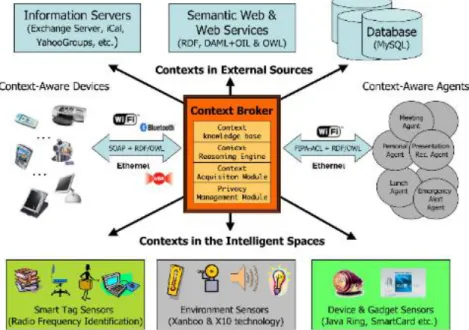
Context Broker architecture [Chen H.-2003] is an architecture for supporting context-aware applications, as shown in figure 2.10.
Figure 2.10: Context Broker architecture CoBra
The central theme of this approach is a broker agent that maintains a shared model of context based on Web ontology language (OWL) for all computing entities in the space on behalf of a set of collaborating agents, services, users and devices. The CoBra architecture acquires contextual information from different sources such as smart sensors, devices and gadgets. It consists of four functional components which includes context knowledge base, context reasoning engine, context acquisition module and privacy management module. CoBra provides a policy language that allows users to control distribution and notification of the user context information. Nevertheless, the CoBra architecture still has the limitation on separation between context-aware management and adaptation system. Moreover, this architecture requires that the developer use too much expert knowledge to configure the system.
CAISDA [Jaouadi I.-2015] provides the architecture of context-aware framework, which simplifies the designer task and the implementation of context-aware systems. At design time, the developer must use a special model tool to build a context model of its application that is consistent with the metamodel provided by CAISDA. At runtime, this approach using Context providers to collect information from different heterogeneous sources and convert it to an understandable structure by the system. Moreover, they use a Context controller to detect the change of context and notify the system for

![Figure 2.5: The graphical context modeling follows fact type [Henricksen-2003]](https://thumb-eu.123doks.com/thumbv2/123doknet/14589475.729976/26.918.241.728.586.900/figure-graphical-context-modeling-follows-fact-type-henricksen.webp)
![Table 2.1: Evaluating current context modeling initiatives Requirements Approach Context interpreting Separating concerns Simplifying expert task Reusability of concerns [Henricksen-2003] ++ + - - [Wang-2004] + + -](https://thumb-eu.123doks.com/thumbv2/123doknet/14589475.729976/28.918.176.811.802.1076/evaluating-initiatives-requirements-interpreting-separating-simplifying-reusability-henricksen.webp)
![Figure 2.6: Architecture of an adaptation system [Keling-2011]](https://thumb-eu.123doks.com/thumbv2/123doknet/14589475.729976/29.918.250.734.496.895/figure-architecture-adaptation-keling.webp)
![Figure 2.11: Context-aware system [Mahmud-2018]](https://thumb-eu.123doks.com/thumbv2/123doknet/14589475.729976/35.918.186.812.399.733/figure-context-aware-system-mahmud.webp)
![Figure 3.2: Context-aware management structure [Kim-2008]](https://thumb-eu.123doks.com/thumbv2/123doknet/14589475.729976/43.918.255.733.142.492/figure-context-aware-management-structure-kim.webp)

![Figure 3.5: The procedure for managing architectural contests [Marcinkowski-2012]](https://thumb-eu.123doks.com/thumbv2/123doknet/14589475.729976/46.918.198.788.315.1017/figure-procedure-managing-architectural-contests-marcinkowski.webp)