
HAL Id: hal-01174139
https://hal.archives-ouvertes.fr/hal-01174139
Submitted on 27 May 2020
HAL is a multi-disciplinary open access
archive for the deposit and dissemination of sci-entific research documents, whether they are pub-lished or not. The documents may come from teaching and research institutions in France or abroad, or from public or private research centers.
L’archive ouverte pluridisciplinaire HAL, est destinée au dépôt et à la diffusion de documents scientifiques de niveau recherche, publiés ou non, émanant des établissements d’enseignement et de recherche français ou étrangers, des laboratoires publics ou privés.
Anatexis at the roof of an oceanic magma chamber at
IODP Site 1256 (equatorial Pacific): an experimental
study
Martin Erdmann, Lennart A. Fischer, Lyderic France, Chao Zhang,
Marguerite Godard, Jurgen Koepke
To cite this version:
Martin Erdmann, Lennart A. Fischer, Lyderic France, Chao Zhang, Marguerite Godard, et al.. Ana-texis at the roof of an oceanic magma chamber at IODP Site 1256 (equatorial Pacific): an exper-imental study. Contributions to Mineralogy and Petrology, Springer Verlag, 2015, 169 (4), pp.39. �10.1007/s00410-015-1136-5�. �hal-01174139�
Anatexis at the roof of an oceanic magma chamber at IODP Site
1256 (equatorial Pacific): An experimental study
Martin Erdmann1,2,*, Lennart A. Fischer1, Lydéric France2, Chao Zhang1, Marguerite
Godard3, and Jürgen Koepke1
1
Institut für Mineralogie, Leibniz Universität Hannover, Callinstr. 3, 30167 Hannover,
Germany 2
CRPG; UMR 7358, CNRS; Université de Lorraine, 15 rue Notre Dame des Pauvres, 54501 Vandœuvre-lès-Nancy, France
3
Géosciences, Université Montpellier 2, Place Eugène Bataillon, 34095 Montpellier, France
*corresponding author: [email protected]; phone: +49 511 762
5074; fax: +49 511 762 3045
Keywords
Experimental petrology
Partial melting
Fast-spreading mid-ocean ridge
Oceanic plagiogranite
Granoblastic hornfels
ABSTRACT
Replenished axial melt lenses at fast-spreading mid-oceanic ridges may move upward and intrude into the overlying hydrothermally-altered sheeted dikes, resulting in high-grade contact metamorphism with the potential to trigger anatexis in the roof rocks. Assumed products of this process are anatectic melts of felsic composition and granoblastic, two-pyroxene hornfels, representing the residue after partial melting. Integrated Ocean Drilling Program expeditions 309, 312, and 335 at Site 1256 sampled such a fossilized oceanic magma chamber in the eastern equatorial Pacific. In this study, we simulated magma chamber roof rock anatectic processes by performing partial melting experiments using six different protoliths from the Site 1256 sheeted dike complex, spanning a lithological range from poorly- to strongly-altered basalts to partially- or fully-recrystallized granoblastic hornfels.
Results show that extensively altered starting material lacking primary magmatic minerals cannot reproduce the chemistry of natural felsic rocks recovered in ridge environments, especially elements sensitive to hydrothermal alteration (e.g., K, Cl). Natural geochemical trends are reproduced through partial melting of moderately-altered basalts from the lower sheeted dikes. Two-pyroxene hornfels, the assumed residue, were reproduced only at low melting degrees (<20 vol%). The overall amphibole absence in the experiments confirms the natural observation that amphibole is not produced during peak metamorphism. Comparing experimental products with the natural equivalents reveals that water activity (aH2O) was
significantly reduced during anatectic processes, mainly based on lower melt aluminum oxide and lower plagioclase anorthite content at lower aH2O. High silica melt at the expected
temperature (1000-1050°C; peak thermal overprint of two-pyroxene hornfels) could only be reproduced in the experimental series performed at aH2O=0.1.
INTRODUCTION
Anatectic processes associated with the dynamic behavior of crystal mush zones with an overlying axial melt lens (AML) at fast-spreading mid-ocean ridges have major influences on the composition of the oceanic crust. Based on geophysical studies (e.g., Caress et al. 1992; Crawford et al. 1999; Lamoureux et al. 1999; Dunn et al. 2000) and field observations in ophiolites (e.g., Nicolas et al. 1988, 2000; Gillis and Coogan 2002; Umino et al. 2003; France et al. 2009), the crystal mush zone at fast-spreading mid-ocean ridges has a melt fraction of less than 20% (e.g., Caress et al. 1992; Crawford et al. 1999;Lamoureux et al. 1999; Dunn et al. 2000), and is located between the Moho and the sheeted dikes. At the top of the crystal mush zone, directly beneath or within the sheeted dike root zone, a small (~50 – 100 m thick and ~1000 m wide) melt lens is commonly present (e.g, Detrick et al. 1987). This AML, locally filled with nearly-pure basaltic melt (e.g., Detrick et al. 1987; Dunn et al. 2000), feeds the basalts of the upper crust and is assumed to be the place where the main stage of mid-ocean ridge basalt (MORB) differentiation occurs. The AML roof is a very complex horizon, where magmatic processes interact with metamorphic overprint and hydrothermal influence (Coogan et al. 2003; Nicolas et al. 2008; France et al. 2009, 2013). Below this horizon the AML is filled with a basaltic magma at a temperature of ~1200°C, and above it the seawater-derived hydrothermal cells operate at temperatures <600°C (Alt et al. 2010). The two convective systems are thought to be separated by a thin conductive boundary layer (~100 m thick; e.g., Lister 1974) that has a maximum thermal gradient of approximately 3°C/m (Koepke et al. 2008), by far the most extreme quasi-steady-state thermal boundary on Earth. This boundary layer consists of granoblastic hornfels and former hydrothermally-altered sheeted dikes, which were contact-metamorphosed by the heat of the underlying dynamic AML.
The combination of water influx due to the dehydration of the previously hydrothermally altered dikes and heat supply from an underlying AML (Detrick et al. 1987) may result in anatexis of magma chamber roofs (e.g., Gillis and Coogan 2002; Coogan et al. 2003; France et al. 2009, 2010, 2013, 2014). This is an important process at fast-spreading ridges, since the generated anatectic melts have the potential to skew the composition of fresh MORB (France et al. 2014). Evidence for MORB contamination by assimilation of altered lithologies at crustal levels is widespread at fast-spreading ridges (e.g., Perfit et al. 1983; Michael and Chase 1987; Michael and Cornell 1998; Coogan et al. 2003; Wanless et al. 2010, 2011; France et al. 2014).
Apart from MORB contamination, anatexis at the AML roof is recognized to be an important process that generates felsic melt in the sheeted dike root-zone of oceanic crust (e.g., Gillis and Coogan 2002; Koepke et al. 2004; Brophy 2009; France et al. 2010; Wanless et al. 2010; Grimes et al. 2013), where cross-cutting felsic dikes and veins are often observed (e.g.,
Wilson et al. 2006; France et al. 2009). The origins of these dikes and veins have been debated for decades (see below) yet are still poorly understood. Beard and Lofgren (1991)
pointed out that if dehydration melting of hydrated basaltic rocks is a primary mechanism for the formation of silicic melts, large volumes of anhydrous, pyroxene- and plagioclase-rich restites would be predicted. It is verified that such rocks exist as granoblastic hornfels, sandwiched between the AML and the sheeted dikes, and they are well known both from modern oceanic crust (e.g., Wilson et al. 2006; Gillis 2008; Koepke et al. 2008; France et al. 2009, 2014)and from the Oman and Troodos ophiolites (e.g. Gillis and Coogan, 2002; Gillis, 2008; France et al., 2009).
The aim of the present study is to experimentally reproduce the complex anatectic processes occurring at the roof of fast-spreading oceanic ridge magma chambers by using six natural analogues recovered from Site 1256 of the Integrated Ocean Drilling Program (IODP)
expeditions 309, 312, and 335 as starting materials. These materials span a lithological range from poorly- to strongly-altered dike basalt to partially- or fully-recrystallized granoblastic hornfels. The samples are well suited for characterizing the solidus temperatures for the different starting materials as well as for evaluating the compositional spectrum of the experimental melts and the residual minerals, and for addressing the question of whether water-saturated conditions are required for partial melting. Since the compositions of felsic veins as well as of the granoblastic hornfels from the drilled dike/gabbro transition at Site 1256 are available, a direct comparison of the experimental products with the corresponding natural counterparts is possible, enabling a very straightforward approach for unraveling the complex magmatic-metamorphic processes ongoing at the dike/gabbro transitions at fast-spreading mid-oceanic ridges.
BACKGROUND
Oceanic plagiogranites and granoblastic hornfels
Oceanic crustal plagiogranites (see Koepke et al. 2007 for a review and definition) are typically found, although not in large volumes, in the upper oceanic crust. They have been described as vein networks and/or discrete intrusive bodies in ophiolites (Gillis and Coogan 2002; France et al. 2009, 2014) and as small felsic veins in the relatively young oceanic crust (e.g., Dick et al. 2000; Blackman et al. 2004; Teagle et al. 2006). The dike/gabbro transition of present day oceanic crust has been sampled at only three locations, all related to crust formed at the East Pacific Rise (EPR; IODP Site 1256, Pito Deep, and Hess Deep). Especially at Site 1256, oceanic plagiogranites have been typically recognized as small felsic veins (Wilson et al. 2006; Koepke et al. 2007), often in association with granoblastic hornfels. As the origin of SiO2-enriched rocks is still under controversial debate (extreme fractionation vs.
partial melting vs. liquid immiscibility; e.g., Koepke et al. 2007), these rock associations are key to our understanding of felsic melt generation in oceanic crust. Focusing on partial
melting, as this study does, the general survey of protoliths, products, and residues can shed light on this complex process.
Rocks from the conducting boundary layer were first described as pyroxene and/or hornblende hornfels (e.g., Gillis and Roberts 1999), which are very-fine-grained to microcrystalline granoblastic rocks corresponding to partially-to-completely re-crystallized, hydrothermally-altered dike rocks. The typical mineral assemblage of the pyroxene hornfels is clinopyroxene, orthopyroxene, magnetite, ilmenite, and plagioclase (±amphibole). The presence of primary amphibole divides these rocks into “dry” and “wet” granoblastic subtypes. A detailed review of granoblastic hornfels evolution and characteristics for a present day oceanic crust is given by Koepke et al. (2008) and Alt et al. (2010).
Granoblastic hornfels were initially observed in ophiolites in intimate association with uppermost gabbros typically located within the dike/gabbro transition zone (Rothery 1983; Nicolas and Boudier 1991). Other studies from the Troodos and Oman ophiolites focused on processes occurring at the roof of a fossil AML and arrived at the general conclusion that the hornfels are the residues of a partial melting event above the AML, while the felsic veins correspond to the related anatectic melts (Gillis and Roberts 1999; Gillis and Coogan 2002; Gillis 2008; France et al. 2009). Granoblastic hornfels are also common in modern oceanic fast-spreading crust and can be directly linked to magma chamber roof processes, because they are sampled within the top of a frozen AML (Wilson et al. 2006; Gillis 2008; Koepke et al. 2008; Alt et al. 2010). Moreover, because the conductive boundary layer above an AML is mainly composed of granoblastic hornfels (Gillis 2008), these rocks are crucial for understanding the heat flux in the hydrothermally-influenced oceanic crust and the role of this altered crust as potential contaminator of fresh MORB melts.
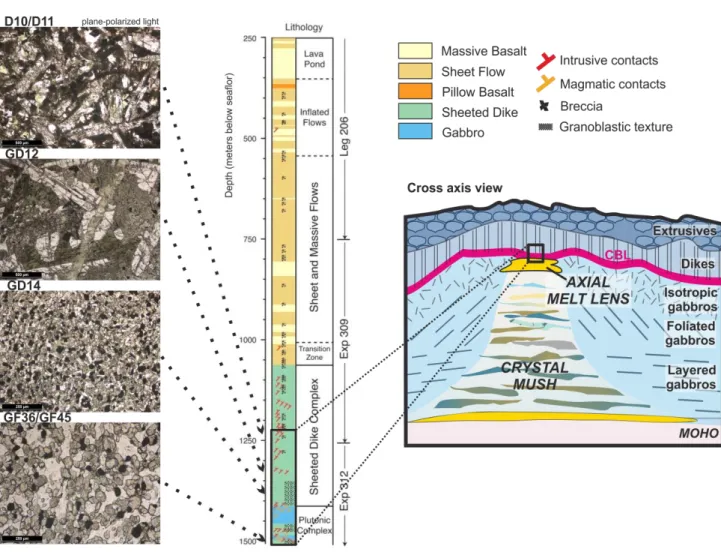
IODP Site 1256, located in the eastern Pacific Ocean in ~ 15 Ma old crust, is the only place on Earth where the dike-gabbro transition has been penetrated in a continuous drill section (Fig. 1; Wilson et al. 2006) and is, thus, perfectly suitable as a source of samples in this study. The gabbro sequence, interpreted as part of the frozen melt lens (Koepke et al. 2011), was reached within seismic layer 2 at 1407 m below seafloor (mbsf). This shallow level for the gabbros may be related to the high magmatic budget associated with the superfast EPR spreading rate (up to 220 mm/year; Wilson 1996) 19 to 12 Ma ago. The extrusive part of the crust at Site 1256 is composed of a ~100 m thick sequence of lava primarily comprised of a >74 m thick ponded flow, followed by ~700 m of sheet flows and massive lavas, and a relatively thin (~350 m) sequence of sheeted dikes. The lower ~60 m of the sheeted dikes are partially to completely re-crystallized to granoblastic hornfels, named "granoblastic dikes" by IODP Expedition 312 scientists (Teagle et al. 2006; Koepke et al. 2008; Alt et al. 2010). One hundred meters below the granoblastic hornfels two intrusive bodies of gabbro (52 m and 24 m thick) are present, separated by 24 m of granoblastic hornfels (Teagle et al. 2006; Koepke et al. 2011). The uppermost gabbros are strongly hydrothermally altered, indicating a deep influence of hydrothermal circulation. These gabbros, interpreted as part of an in-situ frozen AML (Koepke et al. 2011), bear xenoliths of granoblastic hornfels, considered as relics of former dikes, indicating that contamination of a melt lens by overlying roof rocks played a significant role in the evolution of the magmatic system (Teagle et al. 2006; France et al. 2009; Koepke et al. 2011).
Previous experiments testing an anatectic origin of felsic melt in oceanic crust
Numerous experiments on the dehydration melting of amphibolites and greenstones have been performed in the last decades, in order to investigate the formation of Archean TTG rocks (tonalites, trondhjemites, and granodiorites; Barker 1979; see summarizing chapter on “Dehydration Melting” in Johannes and Holtz 1996). Additionally, some partial melting
experiments conducted under hydrous conditions using basaltic compositions as starting material showed that felsic melt production is possible by this process (Holloway and Burnham 1972; Helz 1973; Beard and Lofgren 1991; Kawamoto 1996). However, results of these studies are, for the most part, not directly applicable to the formation of felsic melt at the roof of a mid-ocean ridge AML, as most of the corresponding experiments were performed under elevated pressures (≥300 MPa) in order to simulate typical dehydration melting processes related to subduction zones or deep continental basements. Such conditions are not relevant for anatectic processes occurring at the AML roof; these processes are characterized by low lithostatic pressures (≤ 100 MPa) under potentially high water activity (aH2O) due to
the low water solubility in silicate melts under such shallow pressures. Moreover, these studies used natural starting materials which are different from the lithologies present at the roof of oceanic magma chambers. One study that included experiments at low pressure (100 MPa) was performed by Beard and Lofgren (1991) who systematically investigated the effects of pressure and water on different metamorphosed protoliths. For simulating anatectic processes operating in the deep oceanic crust (e.g., Koepke et al. 2005a,b), partial melting experiments were performed using oceanic gabbro as starting material (Koepke et al. 2004; Wolff et al. 2013; Koepke et al. 2014). However, these studies used fresh, rather primitive cumulate gabbro as starting material, and did not address the special compositional nature of the AML roof rocks which consist of a rock spectrum ranging from hydrated, altered basalts to dry granoblastic hornfels.
The first experimental study using hydrothermally-altered basalt from the lower sheeted dikes as starting material was performed by France et al. (2010). The starting material for that study, however, was sampled in the Oman ophiolite, which may not be the best proxy for fast spreading ridges, because typical basalts from Oman are relatively enriched in SiO2, Al2O3,
and K2O and depleted in TiO2 for a given MgO content as consequence of formation in a fore
(2010) was thus relatively enriched in SiO2, Al2O3, and K2O (54.1, 16.2, and 0.2 wt%,
respectively, on an anhydrous basis); this rarely corresponds to the more primitive MORBs at Site 1256. Moreover, their starting material was fully altered (greenschist facies condition) and lacked any primary magmatic mineral, which is uncommon at Site 1256, where the roof rocks are basalts bearing either primary phases or partially- to fully-recrystallized granoblastic hornfels. Thus, a direct application of France et al. (2010) experimental resultsto Hole 1256D should be performed with caution.
EXPERIMENTAL AND ANALYTICAL TECHNIQUES
Starting material
Six different samples from IODP Site 1256 were used as starting material for hydrous partial melting experiments, representative of the different basaltic lithologies of the drilled section. For petrographic details, modal amounts, and texture type classification indicating the grade of contact-metamorphic overprint according to Koepke et al. (2008) see Table A1 (electronic supplementary). The rocks were sampled at the lower part of the sheeted dike complex, close to the AML. Two of the samples are basalts showing different grades of typical hydrothermal alteration (D10: 27 % alteration, D11: 11 %), containing low-grade hydrous alteration phases (e.g. actinolite, chlorite, secondary oxides) and preserved primary magmatic phases (plagioclase, clinopyroxene, oxides). Sample GD12 is a basalt with an initial granoblastic overprint (type 5 according to the classification of Koepke et al. 2008); GD12 is the sample with the highest grade of secondary low-grade alteration (43%). Three samples show a strong imprint of contact-metamorphism expressed by granoblastic, hornfelsic textures composed of newly-formed plagioclase, clinopyroxene, orthopyroxene, and oxides. Sample GD14 shows a "wet", amphibole-rich paragenesis equilibrated in the amphibolite facies, while GF36 and GF38 are "dry" two-pyroxene hornfelses with amphibole only present as a secondary alteration phase in very small amounts (Table A1). Two of the six samples are significantly
enriched in amphibole: GD12 has 36% actinolitic amphibole as a result of hydrothermal alteration, while GD14 has 20% hornblendic amphibole regarded as part of the prograde contact-metamorphism leading to the granoblastic overprint (see also microphotographs in Fig. 1).
Major and trace element data of the starting materials were determined by inductively coupled plasma optical emission spectroscopy (ICP-OES) and ICP-mass spectrometry (MS), respectively, at “ACTLABS” (Activation Laboratories Ltd., Ancaster, Ontario, Canada). While the major element compositions of the starting materials vary only slightly (e.g., SiO2
48.6-51.5 wt%; Al2O3 12.1-15.0 wt%; see Table 1), the trace element pattern of the whole
rocks varies significantly from slightly enriched to more depleted compositions in comparison to typical N-MORB (see Fig. A1 in the electronic supplementary material). The starting materials with anhydrous granoblastic textures (two-pyroxene hornfels GF36 and GF45) are strongly depleted in light rare earth elements (LREEs) displaying marked Sr and Eu positive anomalies, and negative Zr and Hf anomalies as is typical of residues from a former partial melting event (France et al. 2014).
Felsic rocks from IODP Site 1256
A characteristic feature of the granoblastic hornfelses at IODP Site 1256 is that they contain intrusions of felsic, evolved plutonic rocks. These are small, irregular patches, veins (~1-2 mm wide), and dikelets (<1.5 cm wide) consisting of oxide gabbro, diorite, tonalite, and trondhjemite (Wilson et al. 2006; Teagle et al. 2012) with a fine- to medium-grained granular texture. Here, for the comparison to experimental anatectic melts, we focus only on those felsic veins and dikelets of the Hole 1256D drill core characterized as tonalites based on the mineral mode. They are the most evolved samples of the sample suite and are minor secondary altered. Thus, they are best suited for a comparison with the experimental equivalents. The chemical bulk rock analyses of the tonalites show SiO2 contents varying
between 62 and 70 wt% with contents of MgO varying between 1.1 and 2.1 wt% (Tab. 1). High amounts of P2O5 (0.19 to 0.60 wt%) demonstrate the evolvedcharacter of the tonalites.
N-MORB normalized rare earth element (REE) patterns of the tonalites are roughly flat with pronounced negative Ba, Rb, and Sr anomalies (Fig. A1). The positive Zr anomaly is strong and gradually enhanced by decreasing total REEs. Major and trace element compositions of the tonalitic veins from IODP Site 1256 also match those of typical oceanic plagiogranites from the Oman and Troodos ophiolites that form small-scale intrusions within the gabbro-dike transition (Rollinson 2009; Gillis and Coogan 2002).
Experiments
For the experiments, the natural rocks were crushed and sieved. France et al. (2010)
investigated the influence of starting material grain size on the composition of the experimental phases, and showed that the experimental products up to a grain size of 250 µm exhibit identical phase compositions. Thus, a starting material grain size of 125 to 200 µm was used here in order to obtain larger melt pools in low-temperature experiments, under virtually equilibrium conditions. Additionally, for low-temperature experiments close to the solidus we used "micro-rocks" as starting material (mm-sized fragments of the whole rocks; see Wolff et al. 2013) in order to obtain melt pools large enough for analysis. To ensure comparability among starting compositions, deionized water was added to the majority of the experiments in order to guarantee water-saturated conditions. Since all runs were performed at temperatures ≤1030°C, Au capsules were used which afforded the advantage of avoiding Fe loss to the capsule material.
To simulate conditions prevailing directly above the AML, an H2-controlled internally-heated
pressure vessel (IHPV) at the Institut für Mineralogie in Hannover, Germany was used. Temperature varied from 910°C to 1030°C in steps of 30°. The vessel was pressurized with argon gas to 100 MPa. This corresponds to a lithostatic pressure found at ~2-3 km depth in
oceanic crust. Even though this is slightly deeper than the environment where the samples used were obtained at the EPR, this pressure enables a direct comparison to other experimental studies (e.g., Beard and Lofgren 1991; France et al. 2010). Moreover, at lower pressure it is difficult to ensure stable conditions in the vessel, especially with regard to a defined oxygen fugacity (fO2). The fO2 corresponds to QFM +1 (QFM corresponds to the fO2
of the quartz-fayalite-magnetite oxygen buffer) and was set with a defined PH2, depending on
the experimental temperature, controlled by a Shaw membrane (e.g., Scaillet et al. 1992). While the fO2 for primitive, dry MORB melts is suggested to be slightly below (e.g. Bézos
and Humler 2005) or slightly above QFM (Cottrell and Kelly 2011), the supposed hydrothermal influence in nature and the accompanying mostly water-saturated conditions in our experiments justify this higher fO2. A lower fO2 was simulated in one experimental series
at T=1000°C where CO2 was added to the fluid phase in order to lower the aH2O and, thus,
the fO2 (e.g., Scaillet et al. 1995). These experiments aim to answer the question of whether
extensive hydrothermal influence and, thus, water-saturated conditions are required to produce anatectic melts at the AML roof. Additionally, two experimental series were performed at higher pressure (i.e. 200 MPa) at T=1000 and 1030°C to test the pressure influence on phase stabilities (corresponding to ~ 6 km crustal depth). The pressure was monitored with a strain gauge manometer with an uncertainty of ±5 MPa. The temperature range over the sample was ±10°C. Experimental run products (six capsules with the six different starting materials were run at the same time) were isobarically quenched, using a rapid quench unit. All experimental conditions are listed in Table 2 and the detailed setup of the rapid-quench IHPV that was used is described in Berndt et al. (2002).
Electron-probe micro analyzer (EPMA)
Experimental products (glass and minerals) were analyzed with the Cameca SX 100 electron microprobe in Hannover. For minerals, we used 15 kV high voltage, 15 nA beam current, 10
seconds counting time on peak and 10 seconds on background, and a focused beam. For analysis of water-bearing glasses, which is problematic due to “alkali-loss” effects (e.g.,
Morgan and London 2005), a special procedure was applied following Koepke et al. (2004). The beam current was set to 4 nA and the counting time varied for the different elements; 4 s for K, 8 s for Si, Al, Ti, and Fe, 10 s for Na and Zr, 12 s for Mg, 16 s for Ca, and 30 s for Ba, P, S, Cl, and Mn. Alkalis were measured first. Background counting time was always the same as peak counting time. Whenever possible, a defocused beam with a spot size of 5, 10, or 20 μm was used, and Na loss was checked by comparing the results of measurements with different beam sizes on identical glasses of an experimental sample with larger melt pools. Standard glasses with compositions similar to the experimental glasses and with known water contents have been used for estimating water contents in experimental glasses by applying the “by-difference” method (e.g., Devine et al. 1995). Even though the uncertainties are relatively high (± 0.5-0.7 wt% according to Parat et al. 2008), the application of the “by-difference” method controls the problem of small melt pools precluding water determination with a direct method such as infrared spectroscopy. With known melt composition and water content the
aH2O was calculated following the thermodynamic model of Burnham (1981) for a given
water solubility in a melt subjected to known pressure (major effect) and temperature (minor effect).
RESULTS
Attainment of equilibrium
Attainment of global equilibrium in partial-melting experiments is strongly dependent on the grain size (see review of Johannes and Koepke 2001). The use of fine-grained starting material (i.e. ≤10 µm) enhances the chance of achieving overall equilibrium. However, in-situ analyses of newly-formed experimental phases are virtually impossible due to tiny crystals and melt pools (e.g., Koepke et al. 2003). Consequently, here we use a relatively large grain
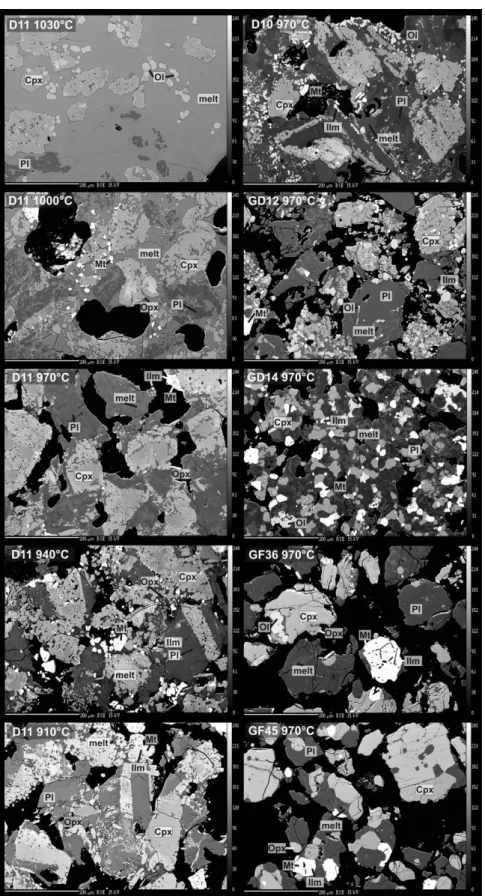
size of 125-200 µm. As expected, in some experiments cores of unaffected starting material are still present after the experiment (e.g. clinopyroxene at D11 and T ≤970°C, Fig. 2). However, longer run durations (i.e. several weeks) did not guarantee that residual mineral cores in the starting material would dissolve (e.g., Wolf and Wyllie 1994; Johannes and Koepke 2001). The partial melting experiments of Johannes and Koepke (2001) used a starting material with a grain size of ~ 10 µm; even after 36 days, unreacted cores of the starting material were observed. Thus, the possibility of disequilibrium melting and the subsequent effect on interpretation of results should be considered. Wolff et al. (2013)
addressed the potentially unsystematic effects caused by unreacted starting material cores which do not take part in the general melting reaction on both phase relations and phase compositions. Because the effect is strongest at low temperatures, this should be considered when comparing low-temperature runs with those performed at higher temperature. However, the achievement of at least local equilibrium in our experiments is supported by several observations: (1) Compositions of newly-formed mineral phases, both as isolated crystals and as rim growth, are homogeneous within a sample, i.e., no zonation in newly-formed phases; (2) newly-formed crystals at higher temperature (e.g., olivine at ≥1000°C) are commonly euhedral; at lower temperatures plagioclase forms sponge-like grains that are homogenous in composition and widely infiltrated by melts (e.g., D10 at 970°C in Fig. 2); (3) all phase compositions vary systematically with temperature, and compositional trends are consistent with trends expected from the literature; and (4) melt compositions vary systematically with temperature and are homogeneous within each experiment.
Experiments close to the solidus using altered dikes as starting materials (D10 and D11) were duplicated with mm-sized pieces of the starting material in order to obtain melt pools large enough for de-focused EPMA measurements. It is obvious that the conditions of these experiments are far away from global equilibrium conditions. However, when comparing phase compositions (melt and minerals) of these experiments with those performed with a
fine-grained powder under the same conditions, it can be stated that they are identical within analytical error. Such an experimental procedure has previously been shown to be suitable
(Wolff et al. 2013).
Phase Relations
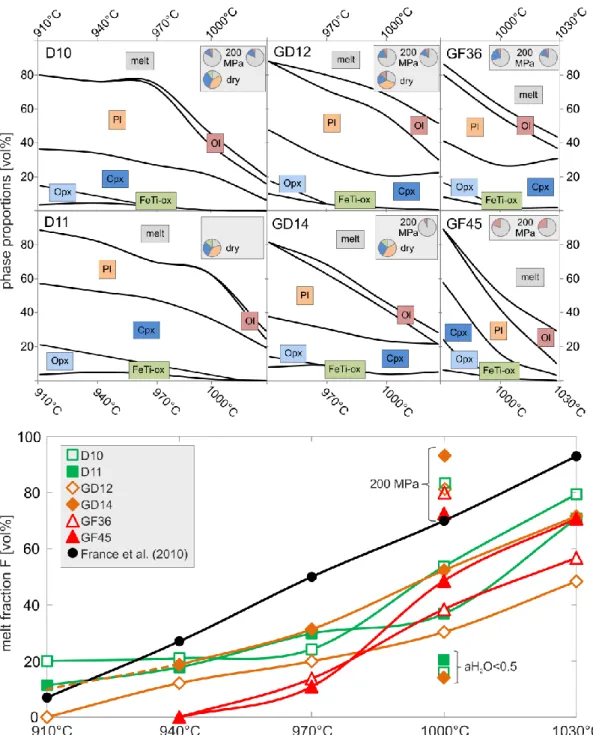
Phase relations of the experiments are illustrated in Figure 3a and highlighted with backscattered electron (BSE) images for starting material D11 at different temperatures and for all starting compositions at 970°C in Figure 2 (see also experimental conditions in Table 2). Each experiment was analyzed with ImageJ image processing and analysis software (Schneider et al. 2012) which determined solid phase and melt proportions using BSE image grey scales. In most experiments, the residual assemblage is composed of clinopyroxene + plagioclase (except for GD14 at T=1030°C) + titanomagnetite (except for D10, D11, and GF45 at T=1030°C). Ilmenite is stable in all runs at T≤970°C. Olivine occurs only at higher temperatures (variable from 940°C to 1000°C) and replaces orthopyroxene. Orthopyroxene and olivine only coexist in the GF36 composition at T=970°C. The reaction from orthopyroxene to olivine with increasing temperature is crucial because this relation can be used for constraining the temperature of granoblastic hornfels formation, since the natural rocks are in general orthopyroxene-bearing and practically free of olivine. Olivine is present in most of our experiments at T≥970°C except for in sample D11 (only present at T=1030°C) and for GF45 (only present at T≥1000°C), implying that the formation temperatures of the natural granoblastic lithologies were generally below 1000°C.
Although most experiments were water saturated, amphibole is absent in all experimental products. This is in contrast to Beard and Lofgren (1991) who produced strongly peraluminous water-saturated melts that coexisted with an amphibole-rich residual assemblage. Such a scenario is also observed in granoblastic rocks from the Troodos ophiolite where amphiboles occur as interstitial crystals and are interpreted to be magmatic (Gillis and
Coogan 2002). However, magmatic amphiboles are not observed in granoblastic rocks from Site 1256. Moreover, results of our study show that for the boundary conditions applied here, amphibole is not a required phase for the residue, implying that the absence of amphibole in natural granoblastic hornfels does not necessarily indicate that these rocks were formed under low aH2O. Phase relations and reactions for the starting materials that were used are
formulated in Table 3 in order to emphasize the temperature at which the anhydrous granoblastic mineral assemblage could be reproduced.
Additionally, for one experimental series at T=1000°C and 100 MPa, beside water, a second fluid phase (CO2) was added in order to test the effect of lower aH20 (<0.5) on phase relations
and composition. As expected, a reduced aH20 shifted the solidus temperature to significantly
higher values. The phase relations and modal fractions of this experiment (~20 vol% melt, ~40 vol% plagioclase, ~30 vol% pyroxenes, ~10 vol% Fe-Ti oxides; Fig. 3a) is very similar to the corresponding run performed under water saturation at T=940°C. Hence, runs with “dry” granoblastic hornfels as starting material (GF36, GF45) are below the solidus under a reduced
aH20. Crystallization of Fe-Ti oxides proceeds at significantly higher temperatures in
water-undersaturated experiments compared to the corresponding experiments at water saturation, which is probably due to the more reduced redox conditions at lower aH20 (e.g., Berndt et al.
2005) which destabilizes Fe-Ti oxides.
In addition to the 100 MPa experiments, two runs (T=1000°C and 1030°C) were performed at 200 MPa and water-saturated conditions in order to study the influence of pressure on phase assemblages. Pressure is expected to influence phase relations because fluid and water solubilities are strongly dependent on pressure (e.g., Holtz et al. 1992, 2001; Berndt et al. 2002). Previous crystallization experiments have shown that the main pressure effect is the shift of plagioclase saturation to lower temperatures (e.g., Feig et al. 2006). Accordingly, plagioclase crystallization was suppressed in runs performed at 200 MPa, while remaining
stable in all comparable experiments at 100 MPa (Fig. 3a). The 200 MPa pressure (equivalent to ~6 km depth) represents an unrealistic depth for the AML roof at the fast-spreading EPR, but may be suitable for slower spreading-rates (e.g. 5-7 km depth at the Mid-Atlantic Ridge;
Wilson et al. 2006; McCaig and Harris 2012). Thus, experiments at higher pressure provide important preliminary data on the phases occurring in this geological setting, where coupled magmatic–hydrothermal interactions have already been recognized (McCaig and Harris 2012).
Composition of the anatectic melts
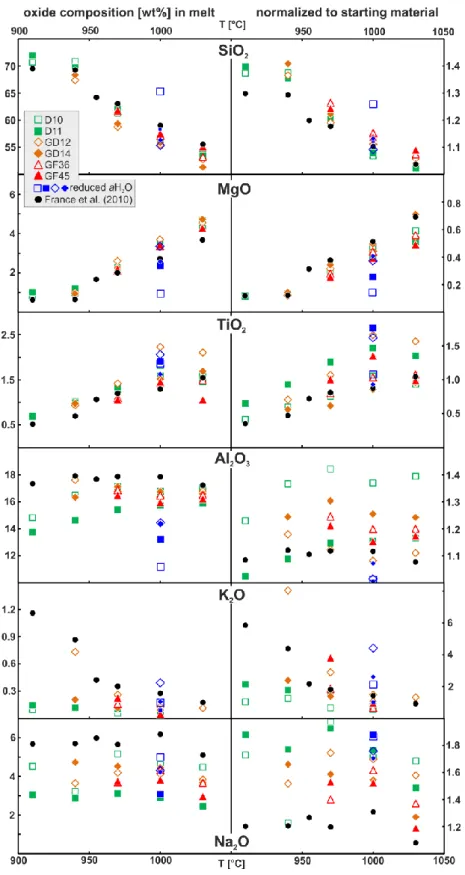
The degree of partial melting (melt fraction F; see Figure 3b) is, as expected, strongly temperature dependent but also varies significantly with the starting material. The first melts of D10 and D11, analyzable by EPMA, occur at T=910°C (F ≈ 10-20 vol%). First melts of GD12 and GD14 occur at T=940°C (F ≈ 10-20 vol%), and of GF36 and GF45 at T=970°C (F ≈ 10 vol%). This trend is in agreement with the increasingly refractory character of the starting material, varying from altered sheeted dikes (D10, D11) to partially re-crystallized (GD12, GD14) to fully re-crystallized granoblastic hornfels (GF36, GF45). The first melts of D10 and D11 are high in SiO2 contents at 70.7 and 72.0 wt%, respectively. The first GD12
and GD14 melts = 67.4 and 68.4 wt% SiO2, respectively, while GF36 and GF45 are less
evolved (61.7 and 61.9 wt% SiO2, respectively; Fig. 4, left column). Melt compositional
evolution with increasing melt fraction and temperature is consistent for all starting materials and follows the expected trend (i.e. towards the bulk rock composition; Fig. 4 and Tab. 4).
In order to better track the effect of the different protoliths on the extent of enrichment or depletion with regard to the different elements at different melting degrees (or temperatures), all melt compositions were normalized to the starting material composition (Fig. 4, right column). These plots show that the degree of enrichment or depletion of a specific element in the melt is distinctly different depending on the protolith. A strong discrepancy between the
different protoliths, even within the same lithological subtype (D10 compared to D11 and GD12 compared to GD14), is distinctive for Al2O3 and the alkalis, which are mainly
controlled by plagioclase crystallization (present in all experiments at 100 MPa except for GD14 at T=1030°C). With respect to Al2O3, starting material D11 is characterized by an
increase with increasing temperature, while GD12, GF36, and GF45 decrease. D10 and GD14 increase initially up to T=970°C followed by a slight decrease at higher temperature. Al2O3 in
D11 is ~2.0 wt% lower at T≤970°C than are all other compositions, resulting in a weak enrichment when normalized to the starting material, while D10 is strongly enriched (Fig. 4). K2O is generally low in all experiments due to low concentrations in the protolith. However,
the behavior for varying degrees of melting is significantly different. Although the K2O
content is relatively constant for the anatectic melts of the altered basalt, anatectic melts of one “hydrous” (GD12) and one “dry” (GF45) granoblastic hornfels are strongly enriched with initial melting; this is clearly shown when normalized to the starting material (Fig. 4). In contrast, Na2O is only subtly lowered with increasing temperature within individual samples
even though the variation between the different protoliths is significant (Fig. 4). Moreover, the normalized starting material diagram for Na2O reveals the challenge of achieving global
equilibrium in partial melting experiments. The normalized value of sample D10 at T=940°C is far from the trend, suggesting that in this experiment the number of relict phases is particularly high. However, as this is the only obvious outlier, it can be assumed that, although present, relict phases in other experiments have less influence over the chemical composition of the melt.
TiO2 and FeO in the melt are strongly affected by a decrease in magnetite and ilmenite
crystallization with increasing temperature. TiO2 exhibits relatively constant increases up to
T=1000°C where the highest content can be observed, followed by a slight decrease at higher temperature (Fig. 4). This peak is due to the absence of ilmenite at T ≥1000°C. P2O5 contents
GD14 at T=970°C where an increase of up to 0.62 wt% is observed. Cl content in the melt (see Fig. 7d), which can be used as a tracer for sea water contamination due to hydrothermal circulation, is strongly dependent upon the Cl contents of the starting material (1000 ppm for GD12, 300-600 ppm for all others, Table 1) and is accordingly highest in the first melt using the GD12 starting material, reaching 0.91 wt% in the run performed at T=940°C (for a detailed description and illustration of Cl and P2O5 see section “Comparison of the
experimental melts with felsic rocks from Site 1256” in the Discussion).
Experiments at T=1000°C with water-undersaturated samples (i.e. ~0.8 wt% H2O, aH2O ~0.1
for D10; ~2.0 wt% H2O, aH2O ~0.45 for D11, GD12, and GD14) at 100 MPa correspond in
terms of melt fraction and mineral proportions to those performed at T=940°C at water saturation (Fig. 3). Thus, GF36 and GF45 are below the solidus. D10 contains 65.7 wt% SiO2
at aH2O ~0.1, while it shows minor enrichment at aH2O ~0.45 with variations between 54.9
and 58.9 wt%. Al2O3 is distinctively lower at reduced aH2O resulting in contents from 11.3 to
14.4 wt%, in each case close to the starting material (Fig. 4). The FeO content at water-undersaturated conditions is notably higher, resulting in a potentially higher degree of Fe-oxide crystallization (e.g., magnetite) at lower temperature, while TiO2 is only slightly
affected by reduced aH2O and, thus, more reducing conditions. P2O5 (0.4 to 1.0 wt%) and Cl
(0.1 to 0.8 wt%) are higher in all water-undersaturated experiments than in water-saturated experiments (see Fig. 7).
200 MPa experiments (at T=1000 and 1030°C) display a high melt fraction (from 70 to 94 vol%) triggered by the higher water content (4.5 to 5.1 wt%) in the melt at higher pressure (Berndt et al. 2002). This results in a melt composition similar to that of the starting material. SiO2 contents do not exceed 54.4 wt% and the Al2O3 content is too low to crystallize
plagioclase, in contrast to experiments at shallower pressure (i.e., 100 MPa).
The average mineral compositions of the starting materials and the corresponding experiments are presented in Table 4. In most experiments, at low temperature and correspondingly low melt fraction, the assemblages and the compositions of the newly-formed minerals correspond to those of the natural granoblastic hornfels from the IODP Site 1256 or the Oman ophiolite dike/gabbro transition (e.g., Koepke et al. 2008; Alt et al. 2010; France et al. 2010; Zhang et al. 2014). At higher temperature and higher melt fraction, orthopyroxene is often replaced by minor amounts of olivine, which is not present in natural granoblastic hornfels. Because olivine is absent in all starting materials it is always newly formed. It is stable at T≥970°C, except for starting material GF45 (≥1000°C) and D11 (only at 1030°C) and mostly forms euhedral crystals (see BSE images in Fig. 2). Forsterite contents increase with temperature from 61.2 mol% (GD14 at 970°C) to 76.8 mol% (GD12 at 1030°C). All other olivine-bearing experiments fall within this range.
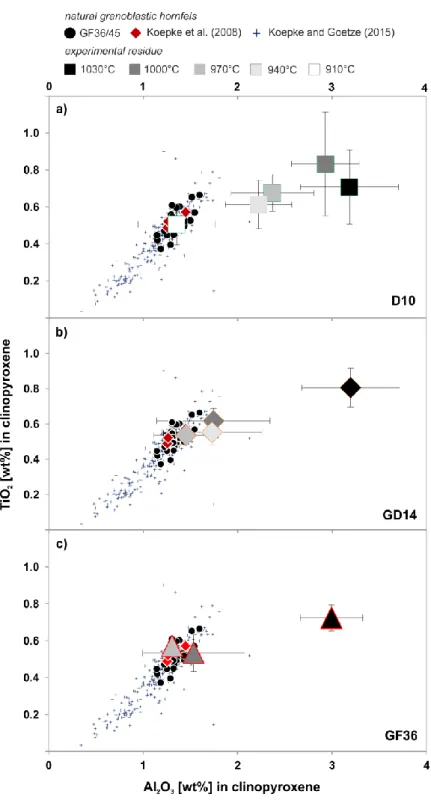
Newly formed clinopyroxenes are present in all experiments at 100 MPa both at the rim of residual protolith clinopyroxenes and as isolated euhedral crystals (see BSE images in Fig. 2) Compositions are always homogeneous within individual experimental runs. The application of the Al-in-clinopyroxene thermometer of France et al. (2010), which was calibrated in a comparable system, reveals good agreement with the experimental temperature. While TiO2 is
in a narrow range within all experiments using one starting material (Fig. 5), Al2O3 and Mg#
(Mg# = Mg/(Mg+Fetotal)) continuously increase with temperature from Al2O3 = 1.35 wt% and
Mg# = 65 (D10 at 910°C) to Al2O3 = 3.19 wt% and Mg# = 87 (D10 at 1030°C).
Clinopyroxene compositions of all other experiments fall within this range. Orthopyroxene typically grows at the rim of clinopyroxene relics and only rarely forms euhedral crystals. Mg# (62.3 to 70.0), Al2O3 (0.90 to 1.45 wt%), TiO2 (0.25 to 0.34 wt%), and CaO (1.71 to
2.21 wt%) increase systematically with temperature, best demonstrated by sample D11, where orthopyroxene is stable over the widest temperature range (i.e. from 910°C to 1000°C).
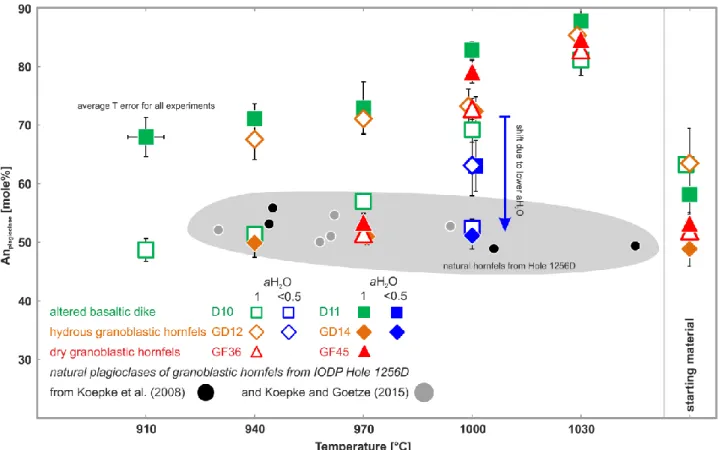
Plagioclase is present in all 100 MPa experiments (except for GD14 at T=1030°C). It occurs either as euhedral crystals or as rim overgrowths around relic cores. The Anorthite (An) content (in mol%) varies systematically with temperature with an average increase of <2 %/10°C for D11 and up to ~5 %/10°C for GF36 and GF45. An contents vary up to 20 mol% between the different protolith compositions at the same temperature (Fig. 6). The FeOt
content of plagioclase increases with temperature coinciding with the increase of FeOt in the
melt, up to 1.39 wt% (D10 at 1000°C). In D10 and D11 metastable An was observed. As previously proposed by France et al. (2010) this phase may form during the breakdown of prehnite, which is present as an alteration phase in the starting material, following the reaction:
1 prehnite ↔ 2 anorthite + 1 wollastonite + H2O.
Titanomagnetite is present in all experimental runs up to T=1000°C and, additionally, in GD12, GD14, and GF36 at T=1030°C. TiO2 content varies between 9.09 wt% (GF36) and
16.52 wt% (D10). Ilmenite is only present in experiments up to T=970°C; its Al2O3 content is
generally relatively low (≤0.5 wt%, except for D11 at T=910°C), while MgO uniformly increases with temperature (from 2.79 to 4.99 wt%).
Elevated pressure (i.e. 200 MPa) has only a minor effect on the composition of the crystallized phases when compared to experiments at the same temperature at 100 MPa. Lower aH2O (<0.5) influences the chemistry of crystallized phases; this is mainly due to the
change to more reducing conditions. Olivine equilibrates at higher FeO contents (from +6 to +16 wt%), and, thus, to lower Mg# (down to 24 units lower). FeO in clinopyroxene and, in particular, orthopyroxene is also enriched (up to 11 wt% higher) compared to all other experiments at aH2O = 1, while plagioclase compositions transform to more evolved
water-saturated conditions. The Fe2+/ΣFe-ratio calculated for oxides is lower at water-saturated conditions (e.g., for D10: Fe2+/ΣFe = 0.8-0.9 at aH2O ~0.1, and Fe2+/ΣFe = 0.5 at aH2O = 1). DISCUSSION
Influence of the starting material composition on anatectic products
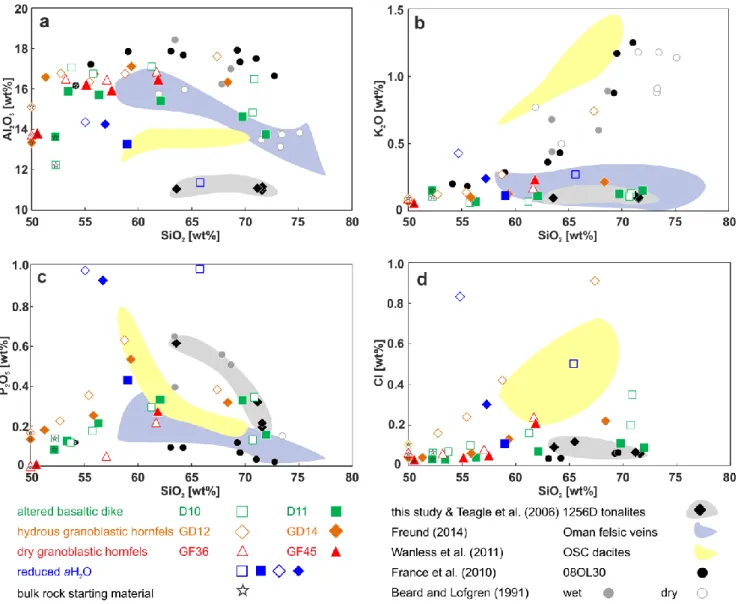
One of the main objectives of the present study was to evaluate the influence of the starting material composition (modal and chemical) on the modal and chemical composition of experimental results. Our results will be compared hereafter to France et al. (2010), who examined partial melting effects of a fully altered dike from the Oman ophiolite, and to selected experiments of Beard and Lofgren (1991), who studied the anatexis of greenschist and hornblende hornfels at 100 MPa. As a whole, anatectic melts produced in the present study display lower SiO2 concentrations than melts produced at similar temperatures by Beard
and Lofgren (1991) (Fig. 7). This is probably related to the more primitive and less altered character of our starting material. However, this discrepancy with our experimental melts is limited to higher temperature (or high partial melting degree). It is less pronounced for Beard and Lofgren’s (1991) first dry anatectic melts at lower temperature (i.e. ≤970°C), whereas their low temperature wet partial melts remain at relatively low SiO2. This is due to a
distinctively higher melt fraction with added water (+10 to 15 vol% at T=950°C). However, in experiments with low melt fraction at temperatures close to the solidus (~900°C) all anatectic melts (wet and dry) of Beard and Lofgren (1991), France et al. (2010), and altered basalts from this study (D10, D11) exhibit SiO2 contents in a similar range (~70 to 75 wt%).
The alteration of protoliths mainly influences the melt composition for minor elements that are particularly sensitive to hydrothermal alteration (e.g., K, Cl). As an example, the observed enrichment in K2O is highly sensitive to the K2O content of the starting material. Anatectic
enriched in France et al. (2010) and Beard and Lofgren (1991); i.e., starting material K2O=0.20 and 0.16 wt%, respectively. K2O can be enriched in the starting material due to
alteration by seawater circulation, which is in agreement with the fully altered character of the
France et al. (2010) starting material and the amphibole rich/pyroxene poor starting materials of Beard and Lofgren (1991).
Although K2O in sample GD12 (0.09 wt%) is similar to that in the other starting materials
used it is significantly enriched in the first melts. That is not the case for the five other samples used in this study (Fig. 7b) which also include potentially different melt fractions. Despite low K2O in the protolith, GD12 generally shows the strongest alteration imprint. This
is expressed by the substitution of clinopyroxene for secondary amphibole. GD12 also shows the highest Cl concentration in the protolith (0.10 wt%), potentially caused by rock/seawater interaction during hydrothermal alteration with the consequence that Cl contents of the anatectic melts leads to the most pronounced enrichment trend (Fig. 7d). The same effect is obvious for phosphorous, where the protolith with the highest P2O5 (GD12) shows the
strongest enrichment in the experimental melts (Fig. 7c). However, the concentration of Cl and P2O5 in protolith GD12 is relatively small compared to the average of Cl and P2O5 in the
D10, D11, and GD14 protoliths (Cl: 0.10 to 0.05; P2O5: 0.17 to 0.12; see Table 1). Moreover,
despite the distinctive altered character of France et al.’s (2010) starting material, that material is low in P2O5 (0.12 wt%; Cl not given) and their experimental melts show only moderate
enrichment trends for both Cl and P2O5. Thus, the degree to which the protoliths have been
altered seems to have a minor influence on the concentration of phosphorus in anatectic melts, but rather the effective concentration of phosphorus in the starting material phase assemblages. Consequently, P2O5 concentration in the melt is dominated by the amount of
apatite and the degree of apatite melting. Although Cl is slightly enriched in GD12, an additional influence of the alteration degree on strong Cl enrichment is likely to be the major source for elevated Cl contents in seafloor alteration.
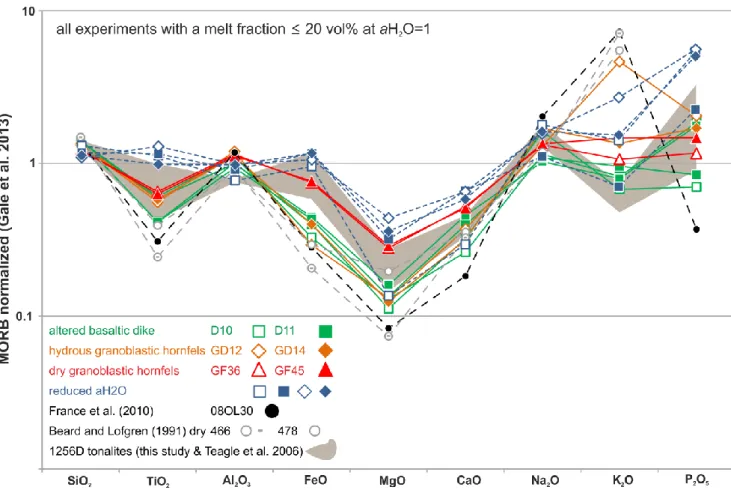
The MORB normalized diagram (Gale et al. 2013) of all oxides for experiments with a melt fraction ≤20 vol% highlights the different influence of our starting materials and those of
Beard and Lofgren (1991) and France et al. (2010) on the generated melts (Fig. 8). Anatectic melts from other experimental studies generally exhibit lower MORB normalized values and are distinctly enriched in K2O. Moreover, a different evolution in MORB normalized values is
apparent for France et al.’s (2010) anatectic melts which exhibit a step from low TiO2 to
enriched Al2O3, followed by low values for FeO, MgO, and CaO and strong enrichment in
Na2O and K2O finalized by pronounced low P2O5 values. This deviation from the anatectic
melts of this study highlights again the difference between the Oman ophiolite protolith used by France et al. (2010) and the IODP Site 1256 protoliths used in this study.
The large span in crystallized plagioclase composition is also reflected in the difference in the starting materials (Fig. 6). In experiments at a given temperature, the spread in An values is ~ 20 mol% (T≤940°C), caused by varying Ca/Na ratios of the different starting materials (D11 > D10; GD12 > GD14). This spread decreases with increased temperature, revealing a deviation of only 6 mol% at 1030°C at generally high An values (>80 mol%).
Temperature evolution through the sheeted dike complex root zone
Equilibrium temperatures of the peak metamorphic overprint recorded by two-pyroxene thermometry (Brey and Koehler 1990; Andersen et al. 1993) of pyroxene hornfels, sampled at the AML roof either in modern oceanic crust or in ophiolites, give an estimation of temperatures of the anatectic processes in the dike/gabbro transition (e.g. Gillis and Coogan 2002; Gillis 2008; Koepke et al. 2008; Alt et al. 2010; Koepke and Goetze, in press). Temperature calculations of granoblastic rocks from Hess Deep, for example, result in an average temperature of 900 to 950°C (Gillis 2008), perfectly matching the temperatures of our experiments for relatively small melt fractions, which produce highly-evolved partial melts under water-saturated conditions. Similar values were estimated for hornfels from the
Troodos and Oman ophiolite dike/gabbro transitions (e.g., T=850-1050°C; Gillis and Coogan 2002; Gillis 2008). Amphibole-plagioclase thermometry generally yields lower temperatures for the studied sample suites (400-700°C), reflecting the record of hydrothermal alteration at relatively high temperatures (amphibolite facies) mainly after the contact metamorphic overprint (Gillis and Coogan 2002; Gillis 2008; Alt et al. 2010).
For two-pyroxene hornfels of the dike/gabbro transition penetrated at Site 1256, several studies deal with the temperature evolution of this particular zone (Koepke et al. 2008, 2011; France et al. 2009; Alt et al. 2010; Zhang et al. 2014). While Alt et al. (2010) applied the two-pyroxene thermometer of Brey and Koehler (1990) and report equilibrium temperatures of 800°C-924°C, the QUILF two-pyroxene thermometer of Andersen et al. (1993) applied by
Koepke et al. (2008, 2011) and France et al. (2009) determined distinctly higher temperatures for the peak metamorphic overprint (935°C-1045°C), where the metamorphic grade is highest (presence of two-pyroxene hornfels). In those granoblastic hornfels from the Site 1256 dike/gabbro transition, which underwent hydrothermal alteration after the metamorphic imprint, amphiboles are ubiquitous, enabling the application of amphibole thermometers (i.e., plagioclase-amphibole by Holland and Blundy 1994, and Ti-in-amphibole by Ernst and Liu 1998). As noted above, results reveal distinctly lower equilibrium temperatures for this event.
Koepke et al. (2008) obtained temperatures of 708°C-854°C and 650°C-747°C by using the plagioclase-amphibole thermometer and the Ti-in-amphibole thermometer, respectively. Even though Alt et al. (2010) calculated temperatures with the Ti-in-amphibole thermometry of up to 913°C for individual samples, the majority of estimated temperatures are significantly lower, consistent with the hypothesis that hornfels cooling proceeded under hydrous conditions due to seawater-derived hydrothermal circulation.
The great advantage of using IODP Site 1256 samples as starting material is that experimental melts and residues can be directly compared to their natural equivalents. The compositions of mm-to-cm-thick felsic veins, consisting of tonalites cutting granoblastic hornfels in the drill core from Site 1256, are used for comparison. These are regarded as products of in-situ partial melting of AMC roof basalts (Koepke et al. 2008, Alt et al. 2010, Zhang et al. 2014). In Figure 7 we also included the compositions of small felsic veins cutting hornfels sampled from the dike/gabbro transitions of the southern Oman Semail ophiolite blocks (Freund 2014); these are also regarded as anatectic melts generated in the roof rocks of AMLs (France et al. 2009, 2014). It is important to note that plagiogranites in the Oman ophiolite, in general, are very heterogeneous in composition and size and are believed to have been formed by different processes (i.e., fractional differentiation of wet, subduction-zone related basalt or melting of sediments from the subducted slab (Rollinson 2009; Haase et al. 2015).
The relatively wide compositional range of the Oman felsic veins (i.e. SiO2 ~ 58 – 77 wt%)
covers the complete range of SiO2 contents of the experimental results at T≤ 970°C (Fig. 7).
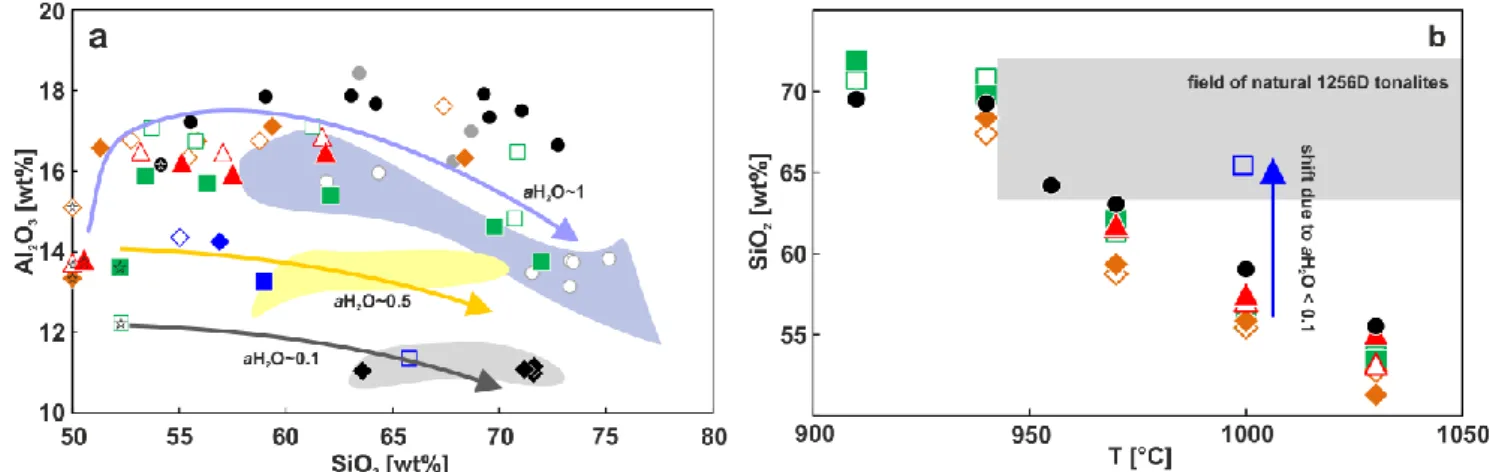
While most major and minor elements of the experimental melts with relatively low melt fraction (≤20 vol%) fit quite well with 1256D tonalites, there is a large discrepancy with respect to Al2O3 (Fig. 7). While the Oman plagiogranites show Al2O3 contents similar to those
of the experimental melts (Fig. 7), the tonalites from 1256D sampled to date are significantly lower in Al2O3. Al2O3 in the melt is mainly influenced by plagioclase crystallization which is,
in turn, controlled mainly by the prevailing aH2O (e.g., Gaetani et al. 1993; Feig et al. 2006;
Koepke et al. 2009). Most of the experiments of this study were performed under water-saturated conditions with aH2O close to 1 (i.e. total H2O in the melt ~3.5 wt%) leading to high
Al2O3 contents in the melt (Fig. 7a), indicating that 1256D tonalitic melt generation proceeded
K2O is very low in 1256D tonalites and Oman felsic veins (≤0.12 wt%, and ≤0.36 wt%,
respectively) and, thus, accords with the experimental melt trends except for GD12, which is the sample showing strong hydrothermal alteration (Fig. 7b). While P2O5 is generally low
(0.11 to 0.38 wt%) for most experimental melts, it is significantly higher in less-evolved 1256D tonalites (0.58 to 0.64 wt%). Those high values are only observed in samples GD12 and GD14, which show a peak in P2O5 at intermediate temperature/composition. At higher
SiO2 contents 1256D tonalites have the same P2O5 range as experimental melts and even
mirror the step towards lower P2O5 between T=940°C and 910°C shown by altered basaltic
dikes (Fig. 7c). This is most likely caused by stable apatite in the residue, which in turn would dramatically decrease the content of rare earth elements, Y, and Sr of the first melts because they are compatible in apatite and apatite is, thus, a trap for Y and Sr (Prowatke and Klemme 2006). This would be one explanation for the lower-than-expected trace element enrichments of anatectic melts in comparison to those predicted for melts generated by large extents of fractional crystallization (Brophy 2009; France et al. 2014). Oman plagiogranites are generally low in P2O5 (≤0.36 wt%) and are in the range of experimental anatectic melts.
Chlorine concentrations are generally low, even in the very first experimental melts (≤0.35 wt%). This is in agreement with 1256D tonalites which are also low in Cl (max. 0.12 wt%) and which are well reproduced by the compositional trend of melts from D11 starting material. Only the melts generated with starting material GD12, which is the sample with the most pronounced secondary alteration, is again out of the range compared to the melts produced by the other protoliths and contains 0.91 wt% Cl. In Figure 7d we also plotted evolved lavas from the 9° N overlapping spreading center (OSC) at the EPR (Wanless et al. 2011). Wanless et al.’s (2011) andesitic and dacitic lavas are enriched in Cl (up to 0.71 wt%) and reflect the trend to Cl-enriched experimental melts found in GD12. Wanless et al. (2011)
concluded that this enrichment is, in part, due to a combination of partial melting and assimilation of a previously hydrothermalized protolith at the roof of the AML. The results of
our study show that such Cl enrichment in anatectic melts is possible, provided that the protoliths are strongly altered, as is the case for sample GD12.
Comparison of the experimental residue with granoblastic hornfels from IODP Site
1256
As discussed above, in most of our experiments performed at lower temperatures, the residual minerals coexisting with felsic melts are plagioclase, clino- and orthopyroxene, and Fe-Ti oxides; exactly the same minerals compose the granoblastic hornfels at the roof of AMLs. In the following, the experimental residual phases are compared with mineral data from natural granoblastic hornfels recovered from Hole 1256D (Koepke et al. 2008; Koepke and Goetze, in press).
With respect to the TiO2 versus Al2O3 trend (Fig. 5), the high-temperature experiments (i.e.
1000°C and 1030°C) show clinopyroxene enrichment in both TiO2 and Al2O3 in comparison
to the starting material. With decreasing temperature, TiO2 and Al2O3 decrease. For the
hydrated basalts as protolith, clinopyroxene compositions at T=910°C (see example for starting material D10, Fig. 5a) match those of natural “dry” granoblastic hornfels from 1256D, but those from higher temperature deviate significantly. When using the more refractory “hydrous” and “dry” granoblastic hornfels as starting material (GD and GF), clinopyroxenes at all temperatures fit quite well with the clinopyroxene compositions of the natural rocks, except for the highest temperature condition (see examples for starting materials GD14 and GF36, Fig. 5b and c). Thus, TiO2 and Al2O3 in the experimental
clinopyroxenes are controlled by both starting material and temperature, if the starting material for the natural processes at the dike/gabbro transitions was already refractory due to previous dehydration processes (corresponding to our GD and GF samples). Our results imply that a partial melting event proceeded at T˂1030°C, which is also consistent with the
composition of the coexisting melt which is too low in SiO2 at T>1000°C compared to 1256D
tonalites.
The plagioclase compositions in granoblastic hornfels from Site 1256 vary only slightly, between 49 and 56 mol% An. The corresponding equilibrium temperatures for the granoblastic hornfels were estimated by the two-pyroxene geothermometer (Koepke et al. 2008; Koepke and Goetze, in press) and are shown in Figure 6. The experimental plagioclases produced with D11 and GD12 starting materials are generally too high in An when compared to the natural hornfelses from Hole 1256D (Fig. 6), which is a consequence of the high Ca/Na ratios in these rocks (see above). Plagioclases from the other starting materials at T≤970°C are within the compositional range of the plagioclases from the natural hornfels. However, all these evaluations are based on experiments performed under water saturation. In the following, we argue that this was probably not the case during the anatectic processes at the roof of the Site 1256 AML.
The role of water activity
There are several lines of evidence that partial melting processes at the roof of the AML, producing felsic melts and granoblastic hornfels, proceed under reduced aH2O rather than at
water-saturated conditions.
(I) When comparing the Al2O3 contents of the experimental melts generated under
water-saturated conditions with 1256D tonalites, it is obvious that the experimental melts contain significantly higher Al2O3, provided that sampled
1256D tonalites are representative of the partial melt composition (Fig. 7a). Most of our experiments were performed under water saturation; it is well-known that water surpresses plagioclase stability (e.g., Gaetani et al. 1993; Feig et al. 2006; Koepke et al. 2009), resulting in melts which are strongly
enriched in Al2O3 compared to corresponding experiments with reduced aH2O.
However, this enrichment in Al2O3 relative to starting compositions is not
present in experiments performed at 1000°C and aH2O ≈ 0.5 (D11, GD12,
GD14) and at aH2O ≈ 0.1 (D10) (Fig. 9a). Moreover, the trend of 1256D
tonalites is perfectly matched by the strongly water-undersaturated D10 sample (aH2O ~ 0.1). Figure 9a shows that either a very low aH2O is required during
the anatectic processes (i.e. aH2O ≤0.1) at T~1000°C or a moderately-reduced
aH2O (e.g., aH2O ~0.5) is required at T˂1000°C. It is important to add a note
of caution here, since our database on tonalites from the drilled core at Site 1256 comprises only three samples, a number which is too low to guarantee full representativeness. However, these rocks form a coherent group in terms of petrographic features and geochemical compositions. Thus, we believe that the conclusion drawn here is justified.
(II) The two-pyroxene geothermometer of Andersen et al. (1993) applied to the granoblastic hornfels (data from Koepke et al. 2008; Koepke and Goetze, in press) indicated equilibrium temperatures from 930 to 1045°C and is, thus, in accord with scenarios discussed above for very low or moderately-reduced
aH2O. Irrespective of the high Al2O3 contents, water-saturated melts over this
temperature range exhibit a relatively high melt fraction (up to 50 vol%, see Fig. 3b) resulting in SiO2 contents of less than 62 wt%, which are lower than
the Site 1256 felsic veins (Fig. 9b). Only by reducing the aH2O can higher
SiO2 contents at temperatures corresponding to those calculated for the
hornfels be reached.
(III) At T=1000°C, which is in the range of natural granoblastic hornfels formation temperatures, experimental An contents match the plagioclase composition
from the natural hornfels at water-undersaturated conditions (Fig. 6). The best fit at that temperature results from a run with aH2O ~ 0.1.
(IV) At the equilibrium temperatures estimated for natural granoblastic hornfels (average ~ 970°C; Koepke et al. 2008; Koepke and Goetze, in press) in most of our water-saturated experiments, olivine becomes a stable residual phase, crystallizing at the expense of orthopyroxene (Fig. 3a), which is not in accord with the natural phase assemblage where olivine is rare. Despite minor amounts of olivine coexisting with orthopyroxene, our experiments show that reduced aH2O leading to lower melt fractions has the same effect as lower
temperatures, thus shifting the ‘olivine-in’ curve to higher temperatures, which is in accord with the natural record.
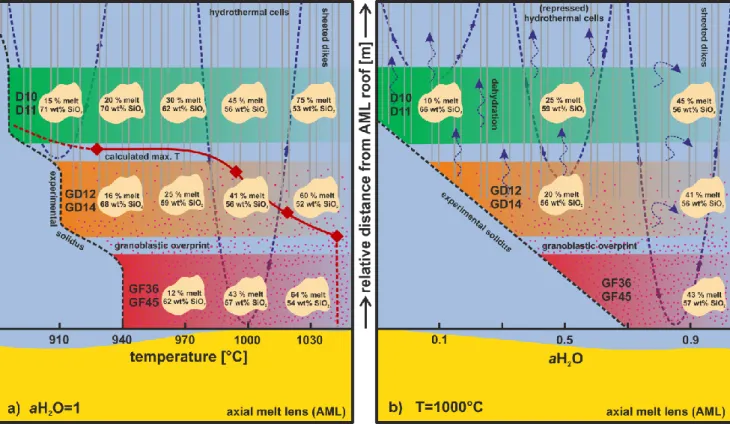
These observations raise the question of how anatectic processes can occur under strongly water-undersaturated conditions if distinct hydrothermal influence at the dike/gabbro transition is assumed. This is especially true at low degrees of melting, where a small amount of water in the protolith can lead to high aH2O in the melt. Hence, for low aH2O virtually no
water can be present close to the melt lens and water-bearing alteration phases of potential protoliths must lose their water at the initial stage of partial melting. Additionally, pressure fluctuations should be minor because decreasing pressure, caused by an ongoing upward movement of the AML, in turn increases the aH2O. A possible model (Fig. 10b) allows the
hydrothermal flux to penetrate most of the oceanic crust until deep in the sheeted dike complex. However, at a certain distance from the AML (~50 to 100m according to Zhang et al. 2014) prevailing conditions hamper water migration deeper into the conducting boundary where anatexis starts. In addition, due to the metamorphic imprint triggered from below by the heat of an advancing melt lens, alteration phases containing H2O or OH− groups produced
by an earlier hydrothermal alteration lose their water, causing the protolith to become "dry". Hence, for partial-melting processes, only minor amounts of water are available due to
previously-altered protoliths. In our model most of the water released due to the breakdown of alteration phases migrates up at the prevailing supercritical conditions because it is an ‘open cooking pot’ rather than a closed system with a lid. Thus, an aH2O below 0.5 can be reached.
The absence of amphibole-rich rocks as possible protoliths for felsic melt generation
Amphibole-rich protoliths are often used to explain the generation of felsic melts at mid-ocean ridges (e.g., Haase et al. 2005; Brophy 2008; Rollinson 2009; Wanless et al. 2010). However, one surprising aspect of this study is that amphibole was never produced as a residual phase in our experiments, although most experiments were performed under water-saturated conditions. The reason for the absence of amphibole is probably the very low pressure at which the experiments were performed, since it is well-known that too-low pressure destabilizes amphibole (e.g., Rutherford and Devine 2003). The absence of amphibole is in agreement with the natural drilling record from IODP Site 1256, where amphibole exists in those two-pyroxene hornfelses from the lowermost horizon of the sheeted dikes only as a secondary phase generated by a stage of hydrothermal overprint after the peak metamorphism (e.g. Zhang et al. 2014; Koepke and Goetze, in press). Amphibole as part of the prograde metamorphic paragenesis occurs only at a higher crustal level where the heat supply of the underlying AML is minor, away from the zone where the main anatectic processes are ongoing. Koepke et al. (2008) and Alt et al. (2010) present equilibration temperatures varying from 650°C to 854°C and from 464°C to 913°C, respectively, for amphiboles in hornfelses, and similar amphibole-bearing hornfelses with equilibrium temperatures between 850 and 900°C were reported from Pito Deep (EPR) and the Troodos ophiolite (Gillis 2008). These temperatures are in the range of the solidus of altered basalts (France et al. 2010; this study). Thus, such rocks may be regarded as residues remaining after a partial melting process, provided the aH2O was very high; this possibility can be excluded
![[PDF] Cours JAVA : Conteneurs de Swing | Télécharger PPT](data:image/gif;base64,R0lGODlhAQABAIAAAP///wAAACH5BAEAAAAALAAAAAABAAEAAAICRAEAOw==)