Publisher’s version / Version de l'éditeur:
Vous avez des questions? Nous pouvons vous aider. Pour communiquer directement avec un auteur, consultez la première page de la revue dans laquelle son article a été publié afin de trouver ses coordonnées. Si vous n’arrivez pas à les repérer, communiquez avec nous à [email protected].
Questions? Contact the NRC Publications Archive team at
[email protected]. If you wish to email the authors directly, please see the first page of the publication for their contact information.
https://publications-cnrc.canada.ca/fra/droits
L’accès à ce site Web et l’utilisation de son contenu sont assujettis aux conditions présentées dans le site LISEZ CES CONDITIONS ATTENTIVEMENT AVANT D’UTILISER CE SITE WEB.
Building Note (National Research Council of Canada. Division of Building Research), 1952-02-01
READ THESE TERMS AND CONDITIONS CAREFULLY BEFORE USING THIS WEBSITE. https://nrc-publications.canada.ca/eng/copyright
NRC Publications Archive Record / Notice des Archives des publications du CNRC : https://nrc-publications.canada.ca/eng/view/object/?id=626958fa-f38f-4cd4-8774-89fd7b702a2c https://publications-cnrc.canada.ca/fra/voir/objet/?id=626958fa-f38f-4cd4-8774-89fd7b702a2c
NRC Publications Archive
Archives des publications du CNRC
This publication could be one of several versions: author’s original, accepted manuscript or the publisher’s version. / La version de cette publication peut être l’une des suivantes : la version prépublication de l’auteur, la version acceptée du manuscrit ou la version de l’éditeur.
Access and use of this website and the material on it are subject to the Terms and Conditions set forth at
A deep bench mark for precise levelling Peckover, F. L.
CANAL Ser THL B92 no. 11 c. 2
mt
A
DEEP
BENCH MARK FOR PRECISE LEVELLINGby
F.
.L,
PeakoverThe c o n s t r u c t i o n of large
or
spec1 a1 s t r u c t u r e s , and t h e Investigation
of problems connected with t h e v e r t l c a l movement of s t r u c t u r e s r e q u i r e t h a t a bench mark be u n a f f e c t e d by s u r f a c e and
s o i l movements and y e t be economical in i n s t a l l a t i o n and o p e r a t ion, This N o t e d e s c r i b e s a method of i n s t a l l i n g a deep
bench mark w i t h o r d i n a r y m a t e r i a l s and
t h e equipment of a m a l l machine shop.
February, 1952
A
DEEP
BENCH 1.IARK FOR PRECISELEVELLING
A bench mark i s a survey point f i x e d to a r e l a -
t i v e l y permanent o b j e c t t o prsv5de a r e f e r e n c e l e v e l f o r
a s long as is required.
The provision sf bench marks
i n
engineerfng c o n s t r u c t i o n 5 s usually a simple and T a f r l y r o u t i n e proce- d u r e .In
the construction of hlghways o r s m a l l b u l l d h g s which are r a p i d l y e r e c t e d , a bench rnar~k I s e a s i l y o b t a i n e dby using a nearby rock, tree or b u l l d i n g .
In
t h econstructSon of l a r g e or s p e c i a l s t r u c t u r e s and f cr inve s-
t f g a t i o n d p u r p o s e s , however, it o f t e n b e c o r n s necessary to
keep a r e c o r d of e l e v a t i o n s
i n
a more precLse manner, For this purpose, more c a m f u l l y chosen.heneh marks are r e q u l r s d and the u s u a l p r a c t i c e is 50 locate them on b e d r o c k orl a r g e s t r u c t u r e s ,
B e d r o c k or s t r u c t u ~ e s resting upon it provide
the most r e l i a b l e r e f e r e n c e l e v e l , When these are not a v a i l a b l e , choice of an a c c u r a t e d a t u m c . a l l s f o r
considerable c a r e , S m a l l buildings o r other i n s t a l -
l a t i o n s r e s t i n g at s h a l l o w d e p t h s are often f o m d to move up and down, slowly but a p p r e c i a b l y , m d aTe t h e r e f ore
quite u n s u i t a b l e f o r u s e as a datum over a p e r i o d of more than a f e w days, Such movements of t h e g ~ o u n d are
b r o u g h t a b o u t b y m o f sture and volume changes in c e r t a i n
sails, c a u s e d mainly by changing rainrall a d --ather .
P n v a r i o u s seasons of t h e y e s r , These raoverrent;~ may be
g r e a t enough to a f f e c t structures f currdsd a2 depths of
as m u c h as 12 o r 15 f e e t , Consequently, bench marks must
be f o u n d e d , as a g e n e r a l y u l e , at depths g m a t e r than this if r e a s o n a b l e accuracy is t o be o b t a l n e d over an
When t h e r e i s no s u i t a b l e structure a v a i l a b l e t o c a r r y the bench mark to t h e necessary d e p t h a s p e c i a l i n s t a l l a t i o n m a J hdve to be made, Such an i n s t a l l a t f o n is c a l l e d a "deep bench m a ~ k ,
his'
note deserilbes a d e s l g n of a deep bench nark which can be p r e p a r s d
w i t h o r d f n u y tools and t h e assS_stance of a Small machflae shop, Components of a Deep Bench Nark
A deep bench mark r e q u i r e s essentflally a f i r m connectSon w i t h a n m d e ~ l y b g deep s t r a t u m of soil or rock which will move n o
more than a n e g l i g i b l e amount. Thfs connection
must
be u n a f f e c t e dby surface and seasonal soil movements, which are usually verticalo
One method of achieving this is -t;o e x ~ e n d a r o d i n t o the ground f o r
a s u f f i c i e n t d e p t h and t o p r o t e c t it f r o m movements of t h e surroun- ding s o 5 1 by "1 o u t e r casing. If t h e l o w e r end of' the rod is firmly
seated, then a c c u r a t e l e v e l s may ,be o b t a t n a d f r o m t h e t o p end,
A deep bench mark of t h f s t y p e 4 s shorn diagrammatically in F f g , 1 m d d e t a E l e d
in
F i g , 2 , The c e n t r a l rod 03" this I n s t a l - l a t i o n is a t t a c h e d at the l o w e r end to a steel shoe, d e t a i l e d I nF l g ,
3
{a) which s e r v e s I n i t i a l l y as- a d r f v e point and l a t e r as asu9t;able connection w i t h the ground at d e p t h . A l l b u t the l o w e r extremity of the c e n t r a l r o d i s e n c l o s e d
in
a p l p e casing whficlar i s e s and f a l l s w l t h the surrounding ground, l e a v i n g the rod
mar-
r e c t e d . Corrosion and f r f c t L o n between t h e rad and c a s f n g are
m i n l m f z e d b y f i l l 9 n g t h e intervenir,g space w l t h heavy a f l., T h e
upper end o f the rod I s p r o t e c t e d a g a l n s t damage by a durable cover,
the lid of which 1s removed when l e v e l readfngs are t a k e n ,
A b i l l of necessary m a t e r i a l s f o r t h e i n s t a l l a t i o n i s given i n Table 1,
Preparing f o r I n s t a l l a t i o n
The l o c a t i o n of a deep bench mark s h o u l d be c h o s e n c a r e f u l -
ly
wf th two ob j e c t s in mind;maximum
use andm i n i m u m
d i s t w b a n e e ,For maximum use it should be p l a c e d s o t h a t i t may be s i g h t e d e a s i l y from a number of a n g l e s , The p a s s i b X l i t y of df s k u r b m c e , however, r e q u i r e s t h a t it s h o u l d be inconspicuous and p r o t e c t e d from o r d i n a r y
p e d e s t r i m or v e h i c l e t r a f f i c *
It
shoul5 be l o c a t e d on l e v e l groundand at l e a s t a f e w feet away f r o m the n e a r e s t tree,
When the site is chosen, a number of' p r e p a r a t o r y s t e p s
s h o u l d be taken. First, a l i m i t i n g d e p t h I s chosen and this s h o u l d
be the smaller of t w o f i g u r e s : the d e p t h at which k t 9s t h o u g h t t h a t bed rock lies, o r the d s p t h to which it fs e s t i m a t e d that the bench mark c a n be d r i v e n ,
If
the l a t t e r f i g w e governs, it s h o u l dbe at l e a s t 25 feet and p r e f e r a b l y more. The l e n g t h
of
c e n t r a l r o d and casing are chosen accordfngly, w i t h due a l l o w a n c e f o ~ unforeseen c o n d i t i o n s ,Heans of d r i v i n g t h e installatfon to the r e q u i r e d d e p t h are a l s o chosen i n advance, In s o f t s o i l reasonable p e n e t r a t f o n can be o b t a i n e d w i t h a heavy sledge hammer. Tn t h i s case the casfng pipe
should be p r o t e c t e d by hammering o n a hardwood pad resting on
r e g u l a r p i p s cap. F o r o r d i n a r y d r i v i n g b e t t e r r e s u l t s may be obtained by usfng a d r i v e connection s i m f l a r to t h a t shown in Fig.
3
( b ) ,This can be made of p a r t s which are e a s i l y o b t a i n a b l e ,
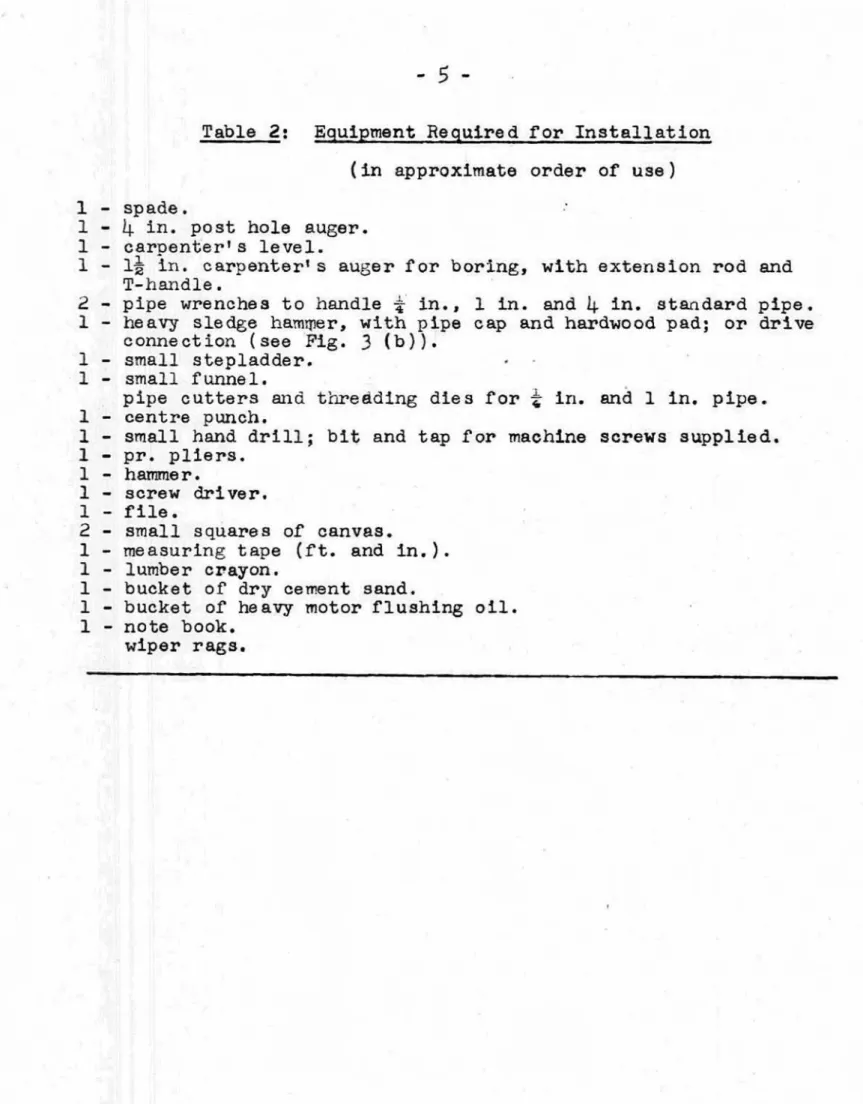
A 1 P s t of s u g g e s t e d tools for f i e l d use is given in Table 2 . Installat Ion P r o c e d u r e
The following details of procedure w i l l vary depending on l o c a l condftlans and personal choice.
After s o d or o t h e r s u r f ace covering I s removed o v e r
an
area about 2 feet s q u a r e , bore w i t h a 4-inch p o s t h o l e auger to a d e p t h of3
f e e t arid i n s t a l lthe
b-fnch p3pe and c o u p l i n g to support the sLdes of t h e hole. Boldtng Ohis p i p e v e r t i c a l l y in the hole9 b a c k f i l l . the space surrounding t h e pipe w i t h dry sand t o k e e p it firmlyin
p l a c e , The t o p of the coupling s h o u l d bean
inch or t w o below t h e groundsurf ace,
Proceed with a 1%-inch bore hale, uslng a carpenter's auger, below t h e 4-Pnch p i p e to a d e p t h where the ground is soft enough
to
commence d r i v i n g , Then l o w e r the 1 - i n c h p i p e En t h e prepared h o l e w i t h drEve p o i n t in position ( see Flg.
3
( a ) ) , A l o e s e l g connec.ted $-inch pipe m a g be used t o keep the d r i v e p o i n t in place while cas2ngis l o w e r e d and then removed. An a c c u r a t e a c c o u n t of the length of p i p e b e l o w ground s h o u l d b e k e p t f r o m t h i s time,
Using a d r i v e connection or hammer, d r i v e t h e p o i n t v e r t i c a l - ly i n t o %he ground, a d d i n g l e n g t h s of 1-inch p i p e as r e q u l s e d . S t o p
d r i v i n g at t h e first sign of solfd resistance so as n o t to d i s p l a c e the dpf ve point)
or
at a maximum d e p t h chosenIn
advance, R e m o m the drive connection and f i l l the 2-inch p l p e v e q slowly with heavy oflaEstfrnate the l e n g t h of t h e c e n t r a l p o d r e q u i r e d to reach a f i n i s h e d e l e w a t l o n of
4
i n c h e s below top of &-Inch coupling, Cut the %-inch p i p e t a this l e n g t h , allowing f o r couplings and l e a v i n git t h r e a d e d at b o t h ends. Then lower I t w f t h l n t h e 1-fnch p i p e , a d d b g s u c c e s s i v e lengths, Add one e x t r a l e n g t h and by means- of this, s c r e w the $-Inch p i p e i n t o the r e c e s s p r o v i d e d f o r
it
In
thed r i v e shoe,
NOH d r i v e the 1-inch p i p = about 2 feet, using d r i v e c o n n e c t i o n or an i m p r o v i s e d yoke and automobile jacks, making s u r e
t h a t t h e c e n t r a l r o d remafns atationarg. This will disconnect the casing p i p e f r o m t h e d r i v e shoe. Cut and t h r e a d the 1-inch p l p e
close t o $pound l e v e l , About
1
inch b e l o w t h e thread, prepare h o l e sDr*Sve the 1-fnch c a s i n g down again to a l e v e l 8 inches
b e l a w t o p of 4-inch p i p e coupling. Then remove top Length of c e n t r a l r o d andpinch top end o f r o d t o
ram
h o i n t on which l e v e l s can beread. T u r n in centering screws by hand t o g u i d e c e n t r a l rod and screw c e n t e r i n g f l a n g e on 1-inch pipa. Then when count~rsunk plw is screwed into position
in
4-inch
p i p e coupling, t h e bench markis
ready for u s e .This design of a bench mark s h o u l d require a m i n i m u m
b u t
nevertheless i m p o r t a n t amount of maintenance. In spring and f a l l it is s u g g e s t e d t h a t the top of the i n n e r rod be coated w i t h grease and oil added to the casing to guard a g a i n s t c o r r o s i o n ,
In a d d i t i o n ,
the i n s t a l l a t i o n should be
caref
u l l g inspe cted for damage, Any subsidence of t h e surrounding g o m d should be made good so t h a t t h e bench mark w i l l remain idcanspicuoua m d not be s u b j e c t to damage.The difference in l e v e l between t h e t o p of the central rod and t o p of' 'the p i p e casing s h o u l d be checked.
If
t h i s does n o tchange, the centering screws should be i n s p e c t e d
to
make a w e that they arenot
restricting movement of the rod.A s9mple design of a deep bench mmk has been o u t l i n e d f o r use
in l o c a t f o n s where
an accurate reference l e v e l is r e q u i r e d but n e i t h e r bed rock nar deep roundations are w i t h i n reach. Available equipment may requlre a l t e r a t i o n s In some of the d e t a f l s d e s c r i b e d b u t t h e s e are n o t i m p o r t a n t as long as the b a s i c p r b c k p l e s of thed e s i g n are r e t a i n e d ,
Table 1: Bill ,of Merterlals for Deep
Bench Mark
( In approximate o r d e r or inst allat f
on)
1-
4
in, g a l v a n i z e d
iron p i p e , 3 ft. long.1
-
4
in.
g a l v a n i z e diron
p l p e coupling.1 ina galvanized i r o n p i p e in
4
ft. l e n g t h s , t h r e a d e d b o t h ends, w i t h c o u p l i n g s ( s e e p ,2
f o r
choice of number of p i e c e s ) .4
in.
g a l v a n i z e d i r o n p i p a in4
ft- lengths, thrsaded b o t h ends,w i t h c o u p l i n g s [ s e e p . 2 for choice sf number of p i e c e s ) . 1
-
s t e e l d r i v e shoe ( s e e Fig.3
(a)
),3
-
m a ~ h f n e screws, & h. long.1
-
1 in. f l o o r f l a n g e ,4
in. diameter.Table 2: Equipment Required
for
I n s t a l l a t i o n(in
appmximate orderof u s e )
spade.4
in.
p o s t hole auger, cargenter' s l e v e l .16 in. carpenterf s a u g e r
f o r
boring, w i t h extension rad and T-handle.pipe wrenches to handle
$ in.,
1 in. and4
in.
standard plpe. heavy sledge hammr,with
pipe cap and hardwood pad; or d r i v e c o n n e c t i o n ( s e e Fig.3
(b)).s m a l l s t e p l a d d e r .
.
. s m a l l f u n n e l .p l p e c u t t e r s and threddlng d l e s
for
2
in. snd 1in.
p i p e . centre punch.s m a l l hand drill; b i t and t a p f a r machine
screws
s u p p l i e d .p r . p l i e r s . hammer.
screw driver. f ila
.
small squares of canvas.
measuring taps (ft. and in,).
lumber crayon.
b u c k e t of d r y cement sand,
bucket of heavy motor flushfng oil.
note book, w i p e r rags.
P A O T E C J f V E C A P GROUND S U R F A C E
-
DATUM L E V E L2
C E N T R A L R O Da
F, Tk
h X T3-
0c
k
zz
% T h R O D OUTER P R O T E C T / N G F q U M C A S I N G S O I L CENTRAL M O V Ec
R
z
2
D R I V E S H O E , GE ST/NG AT CONSTANT L E V E L .I )
c
SPC- PLUG A. .V,, k 4 ' ' P I P E L Q U P L / N L i_ - - - -
JPATDM- - - -
LEVEL I " F L 0 0 4 F L A N G E L E N T L R l N G S C q E l V S-
& s ~ ~1170.V ~ %P/PE LOUPLEP IN SECT/DNS.I" CIALV, !RON PJPE COUPLED IN SECTIONS- S T E E L D R I V E S H O E
/ P I P E C A S I N G B E V E L T b G U / P E C E N T R A L RO HOLE TAPPEP I N T O TAPPEP H O L E , P f N R I V E SA'dE ASSEMBLY F O R P R l V E N G