A Container-Based Lightweight Fault Tolerance
Framework for High Performance Computing
Workloads
byMohamad Sindi
MASSACHUSETTS INSTITUTE OF TECHNOLOGYOCT 18 2019
LIBRARIES
B.S. Computer Science, University of Kansas, 2003
M.S. Computer Science, George Washington University, 2009
Submitted to the Center for Computational Engineering and the Department of Civil and Environmental Engineering in Partial Fulfillment of the Requirements for the Degree of
Doctor of Philosophy in Computational Science & Engineering at the
MASSACHUSETTS INSTITUTE OF TECHNOLOGY
SEPTEMBER 2019
© 2019 Massachusetts Institute of Technology. All rights reserved
A uthor ...
Si
Certified by ... P Accepted by ... P Accepted by ...Sign
Signature redacted
Center for Computational EngineeringAugust 16, 2019
gnature redacted
...
John R. Williams rofe sorof Civil and Environmental Engineering Thesis Supervisor
Signature
redacted
Colette L. Heald rofessor of Civil and Environmental Engineering Chair, Graduate Program Committee
ture redacted,
Nicolas Hadjiconstantinou
A Container-Based Lightweight Fault Tolerance Framework for High Performance Computing Workloads
by
Mohamad Sindi
Submitted to the Center for Computational Engineering and the Department of Civil and Environmental Engineering on August 16, 2019 in Partial Fulfillment of the
Requirements for the Degree of
Doctor of Philosophy in Computational Science & Engineering
Abstract
According to the latest world's top 500 supercomputers list, ~90% of the top High Performance Computing (HPC) systems are based on commodity hardware clusters, which are typically designed for performance rather than reliability. The Mean Time Between Failures (MTBF) for some current petascale systems has been reported to be several days, while studies estimate it may be less than 60 minutes for future exascale systems. One of the largest studies on HPC system failures showed that more than 50% of failures were due to hardware, and that failure rates grew with system size. Hence, running extended workloads on such systems is becoming more challenging as system sizes grow. In this work, we design and implement a lightweight fault tolerance framework to improve the sustainability of running workloads on HPC clusters. The framework mainly includes a fault prediction component and a remedy component.
The fault prediction component is implemented using a parallel algorithm that proactively predicts hardware issues with no overhead. This allows remedial actions to be taken before failures impact workloads. The algorithm uses machine learning applied to supercomputer system logs. We test it on actual logs from systems from Sandia National Laboratories (SNL). The massive logs come from three supercomputers and consist of
~750 million logs (~86 GB data). The algorithm is also tested online on our test cluster.
We demonstrate the algorithm's high accuracy and performance in predicting cluster nodes with potential issues.
The remedy component is implemented using the Linux container technology. Container technology has proven its success in the microservices domain. We adapt it
inside containers, we are able to migrate workloads from nodes predicted to have hardware issues, to healthy nodes while workloads are running. This does not introduce any major interruption or performance overhead to the workload, nor require application modification. We test with multiple real HPC applications that use the Message Passing Interface (MPI) standard. Tests are performed on various cluster platforms using different MPI types. Results demonstrate successful migration of HPC workloads, while maintaining integrity of results produced.
Thesis Supervisor: John R. Williams
Title: Professor of Civil and Environmental Engineering
(The Arabic texts included are prayers thanking God, my parents, and my wife)
Acknowledgments
It is an understatement to say that pursuing a PhD at MIT is challenging. I am grateful to the many who helped throughout this journey. First, I am grateful to God, the most gracious, the most merciful, for his countless blessings and for giving me the opportunity to pursue my PhD at the best engineering school in the world. I am grateful for the patience and guidance he has bestowed upon me to succeed in this journey. It is a dream to be part of this magnificent institute, and with his grace, I am beyond humbled to be a part of it.
I would like to thank my advisor Professor John R. Williams. Without his continuous
support and encouragement, this journey would have been impossible to complete. I appreciate the valuable guidance he provided me whenever I needed it, and the flexibility he gave me to experiment and pursue new research ideas. I am truly grateful for his mentorship and the opportunities he has given me. I am also appreciative and thankful to all of my committee members. I thank Professor Saurabh Amin for kindly serving as my committee's chair. His insightful suggestions and recommendations always helped me improve the quality of my writings and work, be it from our very first proposal meeting discussions, and until our final committee meeting. I would like to thank Christopher Hill, whom I now consider a friend and a colleague in our domain of work in HPC. I
appreciate his invitations to attend research-related HPC conferences, which I enjoyed attending along with his company. I also appreciate his guidance and bringing my attention to related research that is taking place in other local universities. His review of the thesis's first draft was beyond thorough and helped improve the quality of the work. I am thankful to Dr. Abel Sanchez, whom I think is one of the kindest academics I have met on campus. I have learned a lot from the classes he taught at MIT along with Professor Williams. I was academically exposed to practical examples in machine learning and classification problems, which inspired part of my research. The classes were also helpful in learning valuable soft skills, such as documenting and presenting research work through videos, which I ended up utilizing as part of this work.
I would like to thank my dear parents, Othman Sindi and Najwa Rafie, and my
siblings. Even though we were thousands of miles apart, their perpetual encouragement, prayers, loving, and caring is what has gotten me through challenging times during my studies. I pray God to bless them and reward them for all what they have provided me.
This journey would have not been tolerable without my loving wife, Nada Alamro, being by my side. Thank you for being there when I needed it, and for your sincere love and caring throughout the past few years. I pray God to bless you and bring comfort to you as you have brought it upon me.
I would like to thank Saudi Aramco for all of the support they have been providing me throughout my work with them for the past 20 years, and for their scholarship to
Dr. Dogru always made sure to ask about me whenever he was visiting Cambridge. The delightful meetings we had together during his visits were always encouraging and supportive. He has been a mentor and a father figure to me, and I am forever grateful to him.
My technical research would have not been easily done without the generous support I have received from various research entities. I would like to thank the Sandia National
Laboratories (SNL) and Dr. Adam Oliner for providing the HPC systems data, which was crucial to this research. It is not easy to come across such data, and I am very grateful for their support and efforts in providing it. I would like to thank Imperial College London, especially Dr. Tim Greaves, for their support with the Fluidity CFD code. Dr. Greaves went beyond expectations in providing me a specific Fluidity build for MPICH and creating an installation repository just for me, which was not publically available at that time. I would like to thank the team supporting the OPM Flow simulator, especially Dr. Arne Morten Kvarving, Dr. Alf Birger Rustad, and Dr. Markus Blatt. At the time of testing, the Red Hat version of the OPM Flow application was not MPI enabled, and the gentlemen helped providing me a new build repository that supported MPI. I would also like to thank Amazon and Schlumberger for providing me research grants and allowing me to use their computational platforms and software as part of my research.
I truly appreciate our CEE and CCE administrative staff, especially Kiley Clapper,
Max Martelli, Kathleen Briana, Sarah Smith, and Kate Nelson for all of their support. Lastly and mostly, I would like to thank all of my friends and colleagues in MIT's Geonumerics group, CCES, Saudi Aramco Dhahran, and ASC Cambridge, there are too many of them to list.
Contents
C hapter 1 Introduction ... . 16
1.1 Problem Background and Literature Review ... . 16
1.2 Scope of W ork ... 24
1.3 Contributions... 31
1.4 D issertation Outline ... . 32
Chapter 2 Fault Prediction Component ... 34
2.1 The D ata... 34
2.2TheA lgorithm ... 37
2.2.1A lgorithm Overview ... . 37
2.2.2 M achine Learning M odel of the A lgorithm ... . 44
2.2.3 Training Data for M achine Learning ... . 45
2.2.4 A lgorithm Sum m ary ... . 47
Chapter 3 R em edy Com ponent ... 61
3.1 Overview of Proposed Remedy Environment ... 62
3.2 System Design ... 63
3.2.1 Hardware Cluster Setup ... 63
3.2.2 Software Setup ... 64
3.2.3 Container Setup... 67
3.2.4 Network Setup ... 68
3.2.5 Summary of System Design... 69
3.3 Selected HPC Applications for Testing ... 70
3.4Testingand Results ... 72
3.4.1 Container Performance Benchmarks ... 73
3.4.2 Container M igration Testing... 86
3.4.3ResultsIntegrity Check... 91
3.4.4 Container Demo Videos... 96
3.5 Challenges and Solutions... 99
3 .6 S u m m ary ... 10 5 Chapter 4 Framework Integration and Testing ... 106
4.1 Overall View of Integrated Framework ... 106
4.2 Integration with the HPC Resource M anager ... 108
4.3FullCycleTesting of Framework ... 113
4 .4 S u m m ary ... 117
C hapter 5 Conclusions and Future W ork ... 118
5.1 Summary and Conclusions ... 118
5.2 Future W ork ... 120
Bibliography ... 122 10
List of Figures
Figure 1.1: Summary comparison of fault prediction method to previous related work.. 28 Figure 1.2: Summary comparison of remedy method to previous related work ... 30 Figure 2.1: Example Linux syslog message showing date, time, node name, and log m e ssag e ... 3 6
Figure 2.2: Parallel processing architecture based on Spark framework... 40 Figure 2.3: Using Bayes theorem to calculate probabilities of nodes being good or bad. 46 Figure 2.4: Example log line manually tagged by SNL with EXTFS to indicate potential d isk issu e ... 4 6 Figure 2.5: Pseudo-code summarizing parallel algorithm to predict nodes with hardware issu e s ... 4 8 Figure 2.6: Confusion matrix for classification results... 53
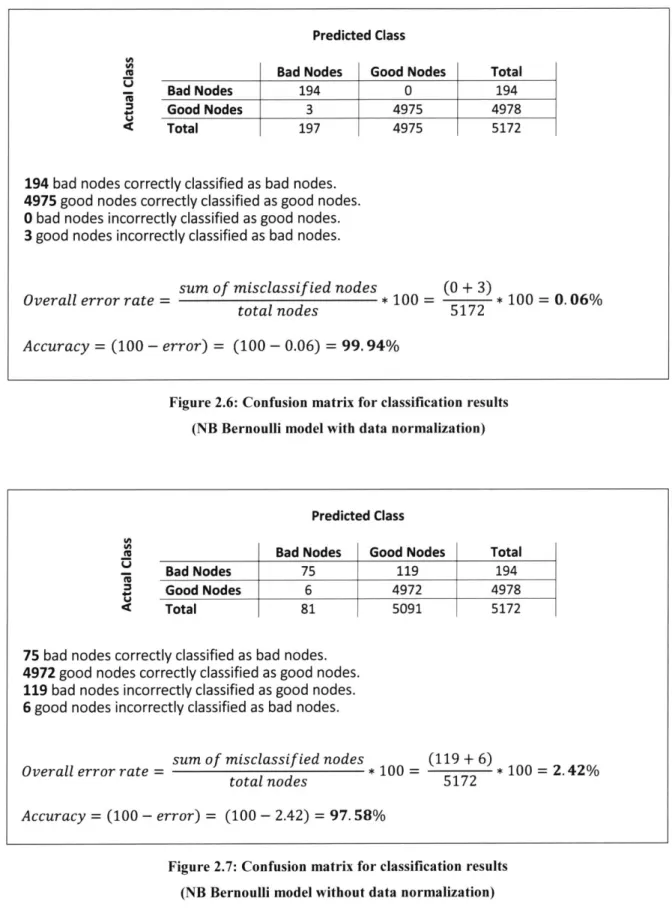
Figure 2.7: Confusion matrix for classification results... 53
Figure 2.8: Example log line containing insignificant text token of a disk sector number 5 4
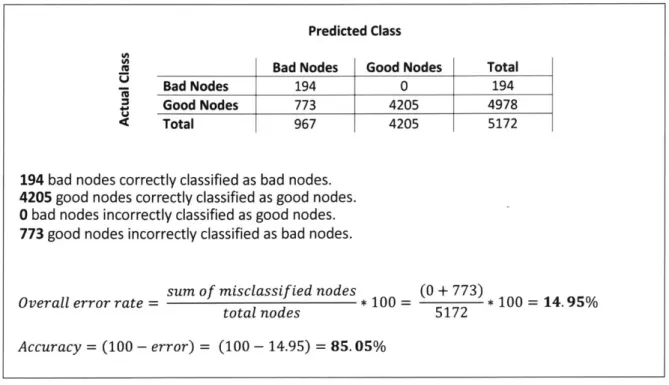
Figure 2.9: Confusion matrix for classification results... 55
Figure 2.10: Parallel algorithm performance on multiple cores when processing sup ercom puter logs ... 57
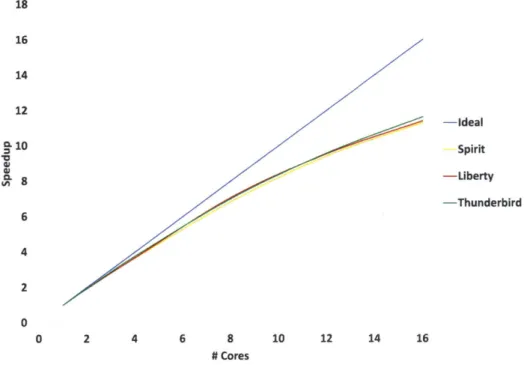
Figure 2.11: Parallel algorithm scalability on multiple cores when processing sup ercom puter logs ... 58
Figure 3.1: Summary of system design architecture... 70
Figure 3.2: Point-to-point MPI benchmarks for IG network ... 75
Figure 3.3: Point-to-point MPI benchmarks for 1OG network ... 76
Figure 3.4: Point-to-point MPI benchmarks for 25G network ... 77
Figure 3.5: Collective MPI benchmarks for IG network ... 78
Figure 3.6: Collective MPI benchmarks for lOG network ... 79
Figure 3.7: Collective MPI benchmarks for 25G network ... 80
Figure 3.8: Benchmarks on m4.2xlarge instances ... 83
Figure 3.9: Benchmarks on c5.9xlarge instances... 84
Figure 3.10: Benchmarks on m4.16xlarge and i3.metal instances ... 85
Figure 3.11: Overview of container migration test... 87
Figure 3.12: Container migration steps... 89
Figure 3.13: Results integrity check for the Palabos simulation ... 93
Figure 3.14: Results integrity check for the ECLIPSE simulator... 93
Figure 3.15: Results integrity check for the Fluidity simulation ... 94
Figure 3.16: Md5sum integrity check for gif files produced by the Palabos simulation.. 95 Figure 3.17: Md5sum integrity check for ParaView pvtu files produced by the Fluidity
sim u latio n ... 9 5
Figure 4.1: Full cycle of overall framework environment... 108
Figure 4.2: Overall TORQUE resource manager setup with containers ... 111 Figure 4.3: Prologue script for TORQUE resource manager to generate containers host
file ... 1 12 Figure 4.4: Example TORQUE script to launch MPI job on containers ... 112 Figure 4.5: Summary of monitoring daemon performed tasks ... 114
List of Tables
Table 2.1: Breakdown of system log sizes... . 37
Table 2.2: Number of parallel RDD partitions created and sizes ... 41
Table 2.3: Reduced error logs after removing redundancy... 42
Table 2.4: Effect of RDD repartitioning on algorithm's performance ... 43
Table 2.5: Prediction results for nodes with memory issues ... 50
Table 2.6: Prediction results for nodes with disk issues ... 50
Table 2.7: Newly discovered categories of hardware issues ... 51
Table 2.8: Tuned Linux and Spark system parameters... 56
Table 3.1: Summary of tested HPC applications ... 71
Table 3.2: Input models used for application testing ... 82
Table 3.4: Average container migration times (using enhanced iol disks)... 90
Table 3.5: Video links for container dem os... 96
Table 4.1: Examples of injected logs to simulate hardware error precursor ... 115
Chapter 1
Introduction
1.1 Problem Background and Literature Review
High Performance Computing (HPC) supercomputers are used in many domains and industries. For example, such systems are heavily used in the oil and gas industry for performing reservoir simulations and seismic studies. The healthy operation of these systems in fields like the oil and gas industry is crucial to having a smooth workflow during the process of oil exploration and production. Such systems, however, are typically built of commodity hardware that is designed for performance rather than reliability. According to the latest June 2019 world's top 500 supercomputers list, 90.6% of the world's top supercomputers are based on commodity hardware HPC clusters [1]. Today's most powerful HPC supercomputers are running in petascale computing power with thousands of compute nodes consisting of several millions of compute processing
cores [2]. The Mean Time Between Failures (MTBF) for some of these petascale systems has been reported to be several days [3], while studies estimate the MTBF for future exascale systems to be less than 60 minutes [4], [5]. One of the largest studies conducted on HPC system failures was done on data collected for 9 years from more than 22 production HPC systems installed at Los Alamos National Lab (LANL) [6]. The study showed that more than 50% of the failures were due to hardware (e.g. memory, disk, and
CPU failures) and that failure rates grew with system size. Hence, running sustainable
workloads on such systems is becoming more challenging as the size of the HPC system grows. As exascale systems will become reality in the next few years, the need for better fault tolerance methods in HPC systems is becoming more crucial than ever.
The current de facto standard method to tolerate HPC workload failures is the application checkpoint-restart (CR) mechanism. In this scenario, the application periodically saves its state (i.e. checkpoint) in case a failure occurs, and once a failure occurs, the application can be restarted from its last checkpoint. The Berkeley Lab Checkpoint/Restart (BLCR) library [7] is popularly used to provide such mechanism for MPI-based applications [8], which requires installing additional Linux kernel modules on the system. In general, CR can have several limitations when it comes to large-scale HPC workloads. CR can have an impact on the performance and scalability of the application. It can introduce an undesirable overhead due to the needed writing and reading of data to storage systems to save and retrieve the checkpoint data. High CR overheads ultimately may lead to lowering the parallel efficiency of the workload as compute processors can spend more time doing the checkpoint process, rather than actually doing the workload's computation. Several studies showed that for a petascale system, the CR overhead could
be more than 50% of the total application execution time [9]-[11]. Other studies also estimate that future exascale systems could have a MTBF that is even smaller than the time required to complete a CR process [12]. The CR files can also consume significant storage space, which is undesirable for computer centers with limited storage or imposed disk usage quota per user. The CR mechanism is also more of a reactive fault tolerance method rather than a proactive one, meaning it will remedy the fault after the fact that your workload had failed due to a system failure, which leads to the interruption of your workload.
Other studies [13] have attempted to do proactive fault detection locally on HPC cluster nodes using third-party tools like the Intelligent Platform Management Interface (IPMI) tool [14], which also has its own limitations. In order for IPMI to work, the HPC node requires having an additional piece of hardware installed, called the baseboard management controller (BMC) chip, which provides the monitoring intelligence to the IPMI tool. The IPMI software will also need to be set up on each node individually as it is not a native standard tool in the operating system. Such mechanism used to continuously monitor the health of nodes may also introduce an undesirable overhead on the system, as the fault probing procedure is performed locally on each node.
Studies such as [15], [16] have also attempted to do fault detection by analyzing system health logs serially with less emphasis on having a time-efficient approach to do the analyzation. As mentioned previously, the MTBF for future exascale systems is estimated to be less than one hour. Hence, the use of serial algorithms to analyze massive system logs will not be efficient timewise as we are restricted with a relatively small MTBF value. Also to reduce the latency of obtaining results when doing online detection
on live supercomputer systems, study [16] used a sliding bounded history approach to limit the amount of log history information being processed, hence this could lead to an undesirable omitting or overlooking of some valuable data when analyzing the system health logs as a whole. Study [17], which is also related to [16], reported that their log analysis detection algorithm had a precision of 75% only. In addition, they only reported the precision of the algorithm when run on a limited amount of data that was collected for only a short period of three weeks from one system (8.3 million logs out of hundreds of millions). The frequency of running the detection algorithm was also limited to every 15 minutes, which could be insufficient if applied to a large system with a small MTBF.
Other studies [13], [18] used third-party tools such as Ganglia [19] and Nagios [20] to monitor system resources to detect system problems. However, such approaches also have their own challenges. The periodic polling done to monitor the system's health by local monitoring agents such as the Ganglia daemons can have an impact on the performance and scalability of the application in a large-scale HPC environment. Having these monitoring agents continuously running on the compute nodes can consume some of the system's compute and network resources instead of having them fully dedicated towards the HPC workload running on the system [21], [22]. Also monitoring tools such as Nagios can have limited analysis capabilities (e.g. simple pattern matching) and are infamous for being difficult to set up and maintain.
Another study [23] tried predicting failures based on data mainly from systems running the Windows operating system, which is not a popular operating system in the HPC domain. As illustrated in the latest June 2019 world's top 500 supercomputers list, none of the world's top systems are running on Windows [1]. In addition, the average
accuracy of the prediction methods reported was less than 80%. Methods used in the study such as the Hidden Markov Model (HMM) are also known for their undesired computational complexity, especially as the size of the data being processed grows larger. High computational costs during predictions are undesirable because we are restricted with small MTBF values for large systems, hence we cannot afford to use a mechanism that is time demanding during the prediction process.
Other studies like [24], [25] were limited in targeting only one specific type of failures, hard disks, and their prediction was based on analyzing data collected from a third-party tool called SMART [26]. In [24], they used a binning process to limit the amount of data being processed which can lead to some loss of information in the data being analyzed. In [25], they also used a sliding window approach, similar to [16], to limit the amount of data being processed when doing predictions, which may also lead to overlooking valuable data as a whole when predicting the likelihood of a failure. The study used the Support Vector Machine (SVM) approach to do the predictions, and in their best case, only 73% accuracy was achieved in predictions.
Study [27] tried predicting disk failures in a disk storage system. The predictions were based on analyzing kernel-level event logs that were collected from the storage system. The study used a Naive Bayes approach to do the predictions and they were able to predict all bad disks with only one false positive. However, the storage system being analyzed was small in size (only seventeen storage nodes) and the dataset used for testing was oversimplified and very small (only four failures in entire data). This study also targeted storage systems only and not complete HPC systems. The logs analyzed also seemed to be storage-vendor specific and not standard.
Another approach that has been studied to tolerate failures in HPC environments is the use of virtual machine (VM) technologies and their migration capabilities. Studies have previously investigated the use of VMs to migrate workloads from an unhealthy machine to another as a proactive fault tolerance measure [13], [28]. However, VMs have their own challenges in terms of the performance overhead they introduce. Traditional out of the box VM technologies can introduce a resource and performance overhead due to the virtual emulation of devices (e.g. network adapter) through a hypervisor. Some earlier studies showed that the network latency with VMs can be more than twice in some cases compared to a native system [29], [30]. Nevertheless, VM technologies have been evolving over time and efforts to improve their performance continue. Huang et al. [31] proposed a prototype I/O bypass mechanism to reduce the IO overhead involved with VMs. Another more recent I/O bypass method is the single root input/output virtualization (IOV) specification [32]. Liu [33] evaluated the performance of SR-IOV on 10 Gigabit networks and still reported a network latency overhead of around 41% comparing to native performance. The study also reported that SR-IOV introduced a 46%
CPU utilization overhead on the system it ran on. Jose et al. [34] evaluated the
performance of the Ohio State University (OSU) Micro-Benchmarks [35] with SR-IOV over InfiniBand [36], where collective benchmarks did not perform well, while point-to-point benchmarks were acceptable. Musleh et al. [37] later attempted to improve the performance of SR-IOV over InfiniBand by performing none trivial experimental tuning of network interrupts. The SR-IOV technology also currently still has its own challenges. SR-IOV is limited to having a hardware/software environment that supports this feature
is one of the main desirable features of VMs. For example, the current Red Hat Enterprise Linux (RHEL) 7 documentation clearly states that VM migration is not supported when SR-IOV is enabled [39]. Nevertheless, research attempts are currently ongoing to enable VM migration with SR-IOV, however such functionality it is still not mainstream and could require custom modifications to hypervisors or the use of custom Linux kernel modules and additional nonstandard third-party libraries [40], [41].
Another type of migration that has been studied in the domain of HPC is the process-level migration. In this case, the actual MPI processes are targeted for migration, rather than migrating a VM that contains them. Reber [42] attempted to use the Checkpoint-Restore in Userspace (CRIU) tool [43] to perform parallel process migration, however, they were not successful in migrating parallel MPI processes and were only able to migrate the serial none parallel version of their application. Another tool targeted to checkpoint and migrate MPI processes is the Distributed MultiThreaded CheckPointing (DMTCP) package [44]. The tool requires launching an additional coordinator process on one of the hosts involved in the computational environment. The application binaries will also have to be started through the tool's proxy launching script, which may add an overhead for the running application, especially if the application involves system calls. In addition, the tool does not work with graphical applications using X-Windows extensions like OpenGL, and currently cannot checkpoint graphical xterm terminals.
The current emerging alternative to using VMs is the container technology. Throughout the past recent years, several studies have looked into adopting containers into HPC environments. Jacobsen et al. [45] did some early work in deploying Docker-based containers in HPC environments. As a result, they implemented a system called
Shifter, which enables launching user-defined images of containers. Kurtzer et al. [46] developed a type of containers called Singularity with HPC in mind. Its implementation mitigates security implications that are present in other container types such as Docker. A few studies have also compared the performance of containers to those of VMs and native systems. Soltesz et al. [47] and Felter et al. [48] reported that the performance of containers was close to native and always outperformed the VMs, especially with I/O intensive and latency-sensitive workloads. Xavier et al. [49] compared the performance of three container types (LXC, Docker, and Singularity) to a native system and reported that Singularity performed the best. Ruiz et al. [50] evaluated the performance of the NPB benchmarks [51] in an LXC container environment over a 10 Gigabit network. They reported a performance overhead of up to 30% on some of the network intense runs. Their container network setup, however, was using the bridged networking scheme. This is different from the host-routed networking scheme used in this work, which relatively has a lower overhead. Zacharov et al. [52] even looked into evaluating the performance of Nvidia Docker containers when running scientific workloads on Nvidia general-purpose graphics processing units (GPGPUs). The performance overhead comparing container to native was less than 4% in the worst-case scenario. More recent studies from Ohio State University's Network-Based Computing (NBC) Laboratory have also looked into using containers in HPC [53]-[55]. This included performing various benchmarks and investigating methods to improve the performance of HPC applications on container-based environments. These studies were mainly performed in an InfiniBand environment using the MVAPICH MPI library.
Compared to the well-explored domain of VM migration, container migration is a young research topic that has not been extensively explored yet, especially in the scope of HPC. A few studies, however, have attempted to perform container migration in Linux environments. Pickartz et al. [56] implemented a prototype libvert-based custom Linux driver to enable container migration with the help of the CRIU tool. However, the study did not seem to test migration with a real application, but rather with an artificially induced memory load on the system. Another study proposed a mechanism to migrate Docker containers based on a logging and replay method [57]. They used a nonstandard tool called ReVirt [58] to accomplish this. The migrated application, however, was a standalone web application and not HPC related. A more recent study looked into migrating containers using the CRIU tool [59]. However, the migrated container didn't have a real application running in it either, but rather only had a simple run of a serial Linux tool called memhog [60], which just allocates memory on a system.
1.2 Scope of Work
Based on our literature analysis in the previous section, we believe that proactive fault tolerance methods for HPC systems need to be improved in terms of fault prediction accuracy, performance (i.e. time needed to do fault prediction), and overhead reduction on the HPC workload running on the system. Hence, our proposed fault tolerance framework differs from previous work as it aims to overcome the limitations discussed in the literature review section.
In this work, we design and implement a lightweight fault tolerance framework for HPC systems with the aim to improve the sustainability of running workloads on HPC
clusters. The framework consists mainly of two components. The first is a fault prediction component, which proactively predicts hardware issues in the HPC system. The second is a remedy component, which takes remedial actions towards the HPC workloads running on the affected system.
The fault prediction component is implemented using a fast and accurate parallel algorithm that proactively predicts hardware failures in HPC systems with no overhead. Such predictions can alert system users and allow them to take remedial actions before failures impact workloads. The algorithm uses a machine learning approach for predictions when applied to supercomputer system logs. We test the algorithm on actual logs obtained from HPC systems from Sandia National Laboratories (SNL). The massive logs are generated by three supercomputers and consist of -750 million logs, which equal
-86 GB of text data. The algorithm is also tested online on our test cluster. We
demonstrate our algorithm's high accuracy and performance in predicting cluster compute nodes with potential issues.
The work done to implement the fault prediction component of our fault tolerance framework differs in several aspects from the related work discussed in the literature review section. We designed the fault prediction algorithm to run externally from the nodes and it uses Linux's native syslog service as its data source for log probing, hence no performance overhead is imposed locally on any of the compute nodes of the HPC system.
The algorithm is also designed to run in parallel in a time-efficient manner, which is significantly less than the estimated MTBF of future exascale systems. It also uses the Naive Bayes method, which is known to have a low linear computational complexity. In
addition to the algorithm being computationally efficient, this efficiency does not compromise the accuracy of the predictions as we target to achieve an accuracy greater than 95% when it comes to detecting true positives along with having low false positives and false negatives. The algorithm is also able to process massive supercomputer system logs entirely without having to sample or omit any valuable data.
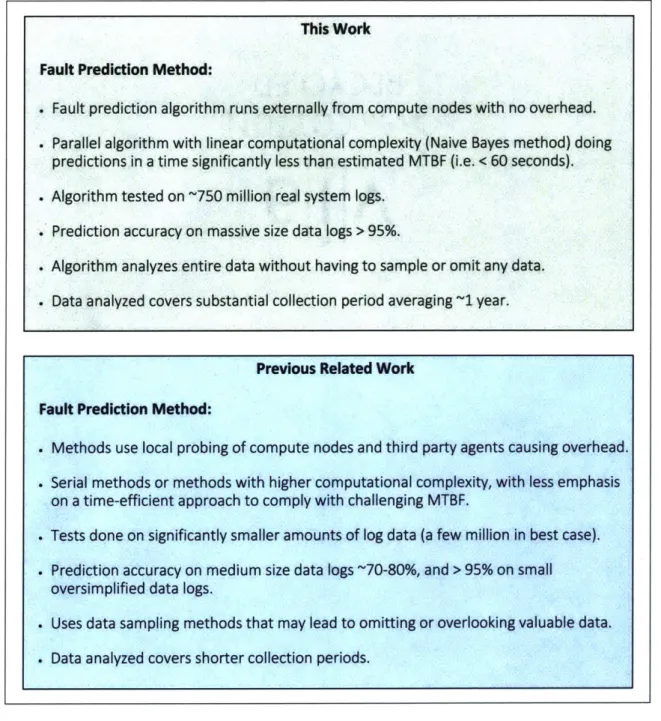
Our work also involves analyzing a significant amount of real failures from Linux HPC supercomputers used in national labs and does not involve any artificial data or data from uncommon operating systems. The capabilities of our algorithm are also demonstrated on the complete data collected over a substantial period averaging around a year's long of data collection. Figure 1.1 shows a pictorial summary comparing how our fault prediction work differs from previous work discussed in the literature review section.
The second component of our fault tolerance framework is the remedy component. It is implemented using the Linux container technology. The container technology has proven its success in the microservices domain (e.g. webservers) as a scalable and lightweight technology used in data centers such as Google's. In our work, we adapt the container technology towards HPC workloads to make use of its resilience potential. By running HPC workloads inside containers, we are capable of migrating these workloads from compute nodes anticipating hardware problems, to healthy spare compute nodes while the workload is running. The migration process is orchestrated with CRIU. The container environment does not introduce any major interruption or performance overhead to the running workload. It does not require any application modification either. We test the remedy component with various real HPC applications that are MPI-based. Tests are performed on clusters with different hardware node specs, network
interconnects, and MPI implementations. Results demonstrate successful migration of HPC workloads inside containers with minimal interruption, while maintaining the integrity of the results produced.
We have prepared and shared several annotated YouTube videos to demonstrate the container migration of the various HPC workloads tested. This includes standard computational workloads, as well as workloads that produce in-situ visualization during the migration. To the best of our knowledge, we believe such video demonstration involving CRIU container migration of real HPC workloads is a first.
In addition to the container migration testing, this work performs comprehensive benchmarks comparing the performance of the container environment to the native system. The benchmarks are performed using various real HPC applications. Benchmark results show that running such applications inside containers provides a performance almost identical to the native system with negligible overhead.
This Work Fault Prediction Method:
. Fault prediction algorithm runs externally from compute nodes with no overhead.
. Parallel algorithm with linear computational complexity (Naive Bayes method) doing
predictions in a time significantly less than estimated MTBF (i.e. < 60 seconds).
. Algorithm tested on ~750 million real system logs.
.Prediction accuracy on massive size data logs > 95%.
.Algorithm analyzes entire data without having to sample or omit any data.
.Data analyzed covers substantial collection period averaging ~1year.
Previous Related Work Fault Prediction Method:
. Methods use local probing of compute nodes and third party agents causing overhead.
. Serial methods or methods with higher computational complexity, with less emphasis
on a time-efficient approach to comply with challenging MTBF.
. Tests done on significantly smaller amounts of log data (a few million in best case).
. Prediction accuracy on medium size data logs ~70-80%, and >95% on small
oversimplified data logs.
. Uses data sampling methods that may lead to omitting or overlooking valuable data.
. Data analyzed covers shorter collection periods.
Figure 1.1: Summary comparison of fault prediction method to previous related work
The work done to implement the remedy component of our fault tolerance framework differs in several aspects from the related work discussed in the literature review section. All of the container migration related work we came across was done using serial or artificial workloads. To the best of our knowledge, we believe this work is the first in the HPC domain to demonstrate successful migration of distributed MPI-based real HPC workloads using CRIU and containers. We use real HPC applications from different domains to test the container migration and performance. Most of the related work, with either VMs or containers, used generic benchmarks such as the High Performance LINPACK (HPL) [61] or the NAS Parallel Benchmarks (NPB) [51], which are still valuable tests, but not truly reflective of real HPC applications. In addition, most of the related work focus their study and solution on a single implementation of MPI (e.g. MVAPICH), a single type of interconnect (e.g. InfiniBand), or a single type of machine specs (e.g. fixed memory size). However in this work, we cover a broader scope of study. We test our container environment with three of the popularly used MPI implementations, MPICH [62], Open MPI [63], and Intel MPI [64]. We test three different interconnects which include, 1, 10, and 25 Gigabit Ethernet networks. We also test on four different machine types that vary in specs (e.g. different memory architectures, memory sizes, and
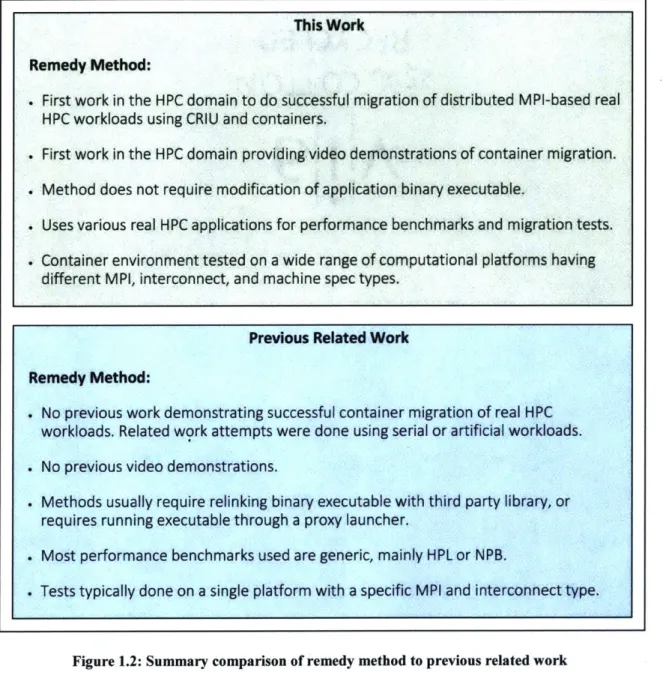
CPU cores). Figure 1.2 shows a pictorial summary comparing how our remedy
This Work Remedy Method:
. First work in the HPC domain to do successful migration of distributed MPI-based real
HPC workloads using CRIU and containers.
. First work in the HPC domain providing video demonstrations of container migration.
. Method does not require modification of application binary executable.
. Uses various real HPC applications for performance benchmarks and migration tests.
. Container environment tested on a wide range of computational platforms having
different MPI, interconnect, and machine spec types.
Previous Related Work Remedy Method:
. No previous work demonstrating successful container migration of real HPC
workloads. Related work attempts were done using serial or artificial workloads.
. No previous video demonstrations.
. Methods usually require relinking binary executable with third party library, or
requires running executable through a proxy launcher.
. Most performance benchmarks used are generic, mainly HPL or NPB.
. Tests typically done on a single platform with a specific MPI and interconnect type.
Figure 1.2: Summary comparison of remedy method to previous related work
30
1.3 Contributions
The main contributions of this work can be summarized as follows:
1) We provide a proactive fault tolerance method for HPC systems that is
improved in terms of fault prediction accuracy, performance (i.e. time needed to do fault prediction), and overhead reduction on workload compared to previous related work.
2) The use of the container technology in the HPC domain as a fault tolerance mechanism is a field that has not been thoroughly explored yet. To the best of our knowledge, we believe this work is the first in this domain to demonstrate successful migration of MPI-based real HPC workloads using CRIU and containers.
3) We implement a code fix to the open-source CRIU library to enable successful
migration of containers having NFS mounts inside of them.
4) We prepare and share several annotated YouTube videos to demonstrate the container migration of the various HPC workloads tested. This includes standard computational workloads, as well as workloads that produce in-situ visualization during the migration. To the best of our knowledge, we believe
such video demonstration is also a first in the HPC domain.
5) Related work benchmarking containers mainly use generic HPC benchmarks (e.g. HPL and NPB) on a single system. In this work, we do comprehensive benchmarks using various real scientific HPC applications on a wide range of computational platforms. The benchmarks provide results comparing the performance on containers compared to the native system and quantify the overhead involved.
6) As the use of containers in HPC is a relatively young topic, we believe that the
challenges we faced with the wide range of tests performed, and the solutions adopted, are all valuable experiences to share with the HPC community.
1.4 Dissertation Outline
In Chapter 2, we go over the implementation of the fault prediction component of the fault tolerance framework. We start by discussing the specifics of the data being analyzed, followed by the details of the prediction algorithm. We discuss the machine learning algorithm, as well as the training data used. We also provide pseudo code to summarize the algorithm's functionality. We share the results obtained with the algorithm and discuss them in terms of accuracy, performance, and scalability. Finally, a summary and conclusion is presented.
In Chapter 3, we go over the proposed remedy environment that will be used once faults are predicted on a system. We start with an overview of the environment, followed
by the system design details of the implementation. This includes the setup details of the
hardware, software, containers, and network. We also present the various HPC applications that are being tested with the environment. After that, we discuss the tests performed and the results obtained. We also discuss the challenges faced during the testing and the solutions that were adopted to overcome them. A summary and conclusion is presented at the end.
In Chapter 4, we go over the integration of the fault prediction component, the remedy component, the HPC resource manager, and our custom monitoring daemon, which all ultimately compose the full HPC fault tolerance framework. We first present an overview of the fully integrated framework. Next, we discuss our method to integrate the HPC resource manager into the container environment. We follow by discussing our tests and demonstrating the framework's successful full functionality. We conclude with a summary afterwards.
Finally, Chapter 5 concludes the overall work and summarizes our main contributions. We also discuss future research directions for testing our framework on other computationalplatforms.
Chapter 2
Fault Prediction Component
In this chapter, we discuss the implementation details of the fault prediction component of the framework. First, we present the details of the analyzed data. Next, we discuss the details of the prediction algorithm. The machine learning algorithm is presented, and the preparation of the training data is discussed as well. We summarize the algorithm with pseudo code afterwards. Results obtained with the algorithm are then discussed. Finally, a summary and conclusion is presented.
2.1 The Data
Our work targets HPC systems running the Linux operating system, as it is currently the most widely used operating system for HPC systems. The latest June 2019 list of the world's top 500 supercomputers shows that 100% of the systems are running on Linux
[1]. The main data source that HPC system administrators consider looking at to
investigate health issues with an HPC system is the Linux system logs. The Linux operating system by default collects these system logs locally on each node of an HPC cluster in a text format. Such operation is considered native and standard for the Linux operating system to perform. This makes it a desirable source of data as there is no added overhead for collecting the data locally on the nodes, unlike non-native third-party methods discussed previously in the literature review section. These system logs are insightful to monitor issues related to the system, which could help in predicting hardware failures. The system health data logs collected locally from nodes are typically forwarded and aggregated in a repository for archiving purposes in data centers. Linux's standard 'syslog' logging daemon provides a lightweight out of the box functionality to forward such logs to a central archival repository [65]. The log forwarding is usually done through the node's general Ethernet network. This does not interfere with the workload taking place on the cluster since the workload is usually running on a separate high bandwidth network such as an InfiniBand network. These logs are typically collected in HPC centers for security purposes as they contain details of activities taking place on the system.
The collected system logs follow the open-source syslog Berkeley Software Distribution (BSD) protocol standard used by Linux [66]. This means that logs within a certain Linux distribution would have a standard and similar structure in terms of content. Figure 2.1 shows an example line of such logs where it contains information such as the date and time of when the log was generated, name of node that generated the log, and the actual log message.
2015.11.12.07:52:29 node123 kernel: EXT3-fs error (device sda3) in ext3_dirty_inode: 10 failure
Figure 2.1: Example Linux syslog message showing date, time, node name, and log message
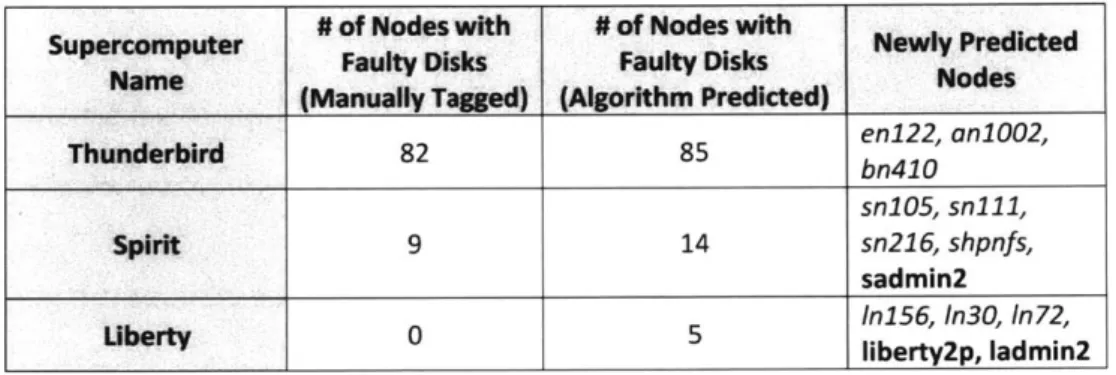
Obtaining such system logs for research purposes can be very challenging. HPC systems are mainly used by national labs or industrial entities. These logs usually contain sensitive data such as user names, IP addresses, and other security-related data. This makes it difficult for HPC centers to publically share the data. Centers would typically have to anonymize the data before sharing it. This can be a tedious and time-consuming process, which centers may be unwilling to go through. In addition, HPC centers usually would like to publically show the positive side of the systems they own, for example, how powerful or stable the systems are, and where they rank among the world's top supercomputers. Hence, centers can be reluctant to sharing system failure data as it could affect the global image of these prestigious systems. HPC hardware vendors may also be hesitant to share failure data, as it is a bad advertisement for their hardware products. We tried to contact personnel from some US national labs to acquire such data. Personnel from two national labs were contacted, Los Alamos National Labs (LANL) and Sandia National Labs (SNL). We chose to contact these two entities as they had a history of providing HPC related data for researches. LANL confirmed that they collect and have such data logs from their systems, however unfortunately they no longer release such collections of data for a number of reasons they did not want to go into. As for SNL, we were able to get anonymized system logs from three of their former supercomputers.
The data provided by SNL was collected from three supercomputers, Thunderbird, Spirit, and Liberty. Data obtained from the supercomputers consisted of -750 million
logs and equal to ~86 GB of text data. The collection period for these logs varied among the three supercomputers and consisted of several hundred days of log collection for each, with an average of around 372 days of log collection. Just to have a relative perspective of how large this data is, the size of the entire recent English language Wikipedia data is around 127 GB [67]. We counted the number of raw system logs from each of the three
SNL supercomputers and Table 2.1 shows the approximate size breakdown for each.
Supercomputer Name Total Log Size (GB) Number of Raw Log Lines
Thunderbird 27 211,212,192
Spirit 34 272,298,969
Liberty 25 265,569,231
Table 2.1: Breakdown of system log sizes
2.2
The Algorithm
In this section, the implementation of the fault prediction algorithm is presented. First, an overview of the algorithm is described, followed by a section presenting the machine learning model of the algorithm. After that, we describe the training data used with the machine learning approach. Finally, we provide a summary of the algorithm's steps.
2.2.1 Algorithm Overview
The next step after obtaining the system logs was to develop an algorithm to automate predicting nodes with faulty hardware as a proactive measure. With an estimated MTBF of less than one hour for future exascale systems, we wanted to design an algorithm that can process massive system logs consisting of hundreds of millions of lines of logs in only a matter of a few minutes or less. With that in mind, we planned to develop a
parallel algorithm that runs on a multi-processor platform in order to process this large amount of data in a timely manner. Some exascale plans refer to designing systems in two different scenarios, a slim node, and a fat node scenario [11], [68]. In both cases, the system will provide a total of a billion computing cores. With slim nodes, the system would have 1,000,000 nodes, each having 1000 cores. In the fat node scenario, the system would have 100,000 nodes, each having 10,000 cores. We can get a rough estimate of the size of system logs produced by such a massive system based on the average amount of logs produced per day per node by the supercomputers at SNL. If we went with the worst-case scenario in terms of the number of nodes (i.e. slim nodes setup), this gave us an estimate of around 60 GB of system logs data produced per day for such an exascale system. With this in mind, we targeted that our algorithm should be able to process similar amounts of data in a matter of a few minutes or less.
We decided to use the open-source Apache Spark framework as our development framework for the algorithm [69]. Spark provides utilities to write programs that can run in parallel on a local multi-core system, and even on a distributed clustered system. It is also currently being used by large enterprise entities such as Amazon and Yahoo. The framework gives you the flexibility to write your code in several options of programming languages including Scala, Java, and Python and provides APIs for all of these languages to access the parallel functions available in Spark. It also provides the capability of loading big data and having it processed fast in-memory once it is loaded. This was a very desirable feature for us as it supported our need to process tens of gigabytes of supercomputer system logs data in a scalable and parallel fashion. As Spark provides APIs for several programming languages, we have chosen Scala as our language of
implementation [70]. This choice was made because the Spark parallel functions beneath the hood were also implemented in Scala, hence using Scala gave the best performance out of the three programming language options. We also discussed this choice with the inventor of Spark, MIT's Professor Matei Zaharia, who also confirmed that Scala is the recommended language to be used with Spark for performance.
In order to have a better understanding of how our algorithm works, we briefly introduce some of the parallel processing concepts that we utilize from the Spark framework. The main data element which enables parallelism in Spark is called a resilient distributed dataset (RDD) [71]. We can think of an RDD as a collection of partitions of
our original dataset in which each partition can be operated on in parallel by a computer's processing core. This is a similar concept to the MapReduce model used in big data processing [72], in which we have a map step that splits a dataset into smaller parts and works on them, then we have a reduce step that collects and combines the solutions from the smaller parts to produce a result. However in the case of RDDs, most of the processing of these partitions can be done in-memory. This can improve the performance of the algorithm significantly compared to models like MapReduce, where processing the data can involve slower frequent accessing of data from disk. Another concept that Spark uses for parallel processing is the concept of a driver and worker. A driver can be thought of as your main program that is responsible for scheduling tasks on the workers to process the partitions of your dataset, and collecting the results of those tasks. The workers, on the other hand, are the executors of those scheduled tasks, which we can think of as the multiple computing cores working in parallel. Figure 2.2 illustrates the concept of RDDs and the driver/worker model with the Spark framework.
Logs transformec RDD with multi task partition Supercomputer logs read from disk Disk Storage Driver Iinto ple ts Worker 1 is task -result task- -+ task Worker 2 result RDD partition 1 Data cached in memory 1 RDD partition 2 Data cached in memory 2 RDD partition 3 Data cached in memory 3 Worker 3 Figure 2.2: Parallel processing architecture based on Spark framework
The algorithm starts by loading the syslog data for one of the three supercomputers from disk, and then decomposes it into smaller partitions using the Spark library. This is the first step needed in order to be able to process the large log file in parallel by multiple computer cores. The number of partitions calculated by Spark mainly depends on the size of the original data file. The number of partitions is not necessarily a one-to-one mapping with the number of parallel processing cores available. Instead, the number of partitions is an integer multiple of the number of processing cores available. This results in an oversubscription of tasks on the processing cores, which usually leads to a better performance and cores' utilization since a single task typically does not fully utilize an entire processing core on its own. Table 2.2 shows the number of partitions initially
calculated for the three supercomputer log files, where each partition is on average roughly 32 MB in size.
Supercomputer Name Total Log Size (GB) # RDD Partitions Size of Each Partition (MB)
Thunderbird 27 828 32.61
Spirit 34 1,018 33.40
Liberty 25 769 32.51
Table 2.2: Number of parallel RDD partitions created and sizes
The structure of each log line follows a tabular format consisting of columns. Hence, once the log dataset has been transformed into parallel RDD partitions, the algorithm then transforms each line of logs into a comma-separated values (CSV) structure, which is also done in parallel. The CSV structure gives us more flexibility later on to manipulate the data.
We notice that the content of such supercomputer logs can have a significant amount of redundancy in it by nature. For example, if a compute node was having a hard disk issue and was producing a log message similar to that in Figure 2.1, each time the node tries to access that troubled disk, the same message can be reported in the logs repeatedly. As we have shown in Table 2.1, the number of logs for each supercomputer was quite significant and averaging to around a quarter of a billion logs per supercomputer. With this in mind, the algorithm next tries to reduce the dimensionality of the data by removing the redundancy in it. We use a concept borrowed from the databases world and the Structured Query Language (SQL) language to accomplish this. The SQL language provides a "distinct" statement, which is typically used to return distinct values from a database table. Our algorithm applies a similar distinct concept but to an RDD structure that we preprocess in a tuple format containing the node name and the logs. This enables
us to remove the redundant error entries from the log files in a parallel fashion. By removing the redundancy, this improves the overall processing time of the data, and reduces the memory footprint on the processing cores. We were amazed that this step of the algorithm reduced the size of the datasets dramatically with an average of around 86% reduction in log size. Table 2.3 shows the results of applying the reduction step of the algorithm to the datasets from the three supercomputers.
Supercomputer Name # Raw Log Lines # Reduced Error Log Lines Reduction %
Thunderbird 211,212,192 52,452,811 75
Spirit 272,298,969 34,453,762 87
Liberty 265,569,231 11,589,710 96
Table 2.3: Reduced error logs after removing redundancy
To improve the performance even further, the algorithm also tunes the number of RDD partitions that Spark originally created and reduces it depending on the percentage of log reduction. For example, in the case of Thunderbird, only 25% of the data remained after the reduction, hence the algorithm reduces the number of RDD partitions generated
by Spark to 25% as well, resulting in 207 partitions instead of the original 828. The
repartitioning improved the average overall runtime of the algorithm by around 34% when running on 16 computing cores as shown in Table 2.4. Having too many partitions for a reduced amount of data could cause a communication overhead and not enough amount of work for the processes working on the partitions, hence our repartitioning technique helps improve the performance as the data is reduced.
Elapsed Time with Elapsed Time with Performance
Supercomputer Name Original Partitioning Tuned Partitioning Improvement
(seconds) (seconds) %
Thunderbird 66 47 40
Spirit 71 54 31
Liberty 41 31 32
Table 2.4: Effect of RDD repartitioning on algorithm's performance
Looking at the content of the raw logs, we can also see that the order of logs coming from the different nodes of a cluster is scattered, meaning that logs from different nodes will be interleaved between each other. The next step that the algorithm perfons is to scan the hundreds of millions of interleaved log lines and group the logs coming from each specific node together. This process is done in parallel and produces tuple objects containing a node name and a list of all its logs. At this stage, we have a reduced preprocessed data structure containing each node's name and the logs associated with it.
Compute nodes that compose a cluster typically have identical or similar specs in terms of hardware and software installed on them, hence they tend to produce very similar syslog system logs. In addition, as we have previously shown in Figure 2.1, system logs provided by the Linux syslog standard are descriptive of the events taking place and can have meaningful word semantics as they are meant to be read by system administrators. The vocabulary used in the logs in terms of errors is also somehow limited. With this in mind, the algorithm tries to predict the faultiness of nodes using the statistical characteristics of the logs. We use a machine learning approach to do the predictions, which is covered in more details in the following section.
2.2.2 Machine Learning Model of the Algorithm
The algorithm uses a Naive Bayes (NB) classifier model with a Bernoulli setup to predict node failures [73]. The model is considered a supervised machine learning approach to do predictions. This means we train the model by exposing it to some previous precursor failure/non-failure data from one of the HPC systems provided by
SNL, then the model tries to predict if nodes in other HPC system logs would have
failures or not. In the domain of machine learning, this is considered a classification problem that has a discrete number of outcomes. In this case, it is a binary outcome of either "0" meaning that the node was predicted as not faulty, or "1" meaning the node was predicted as a faulty node. This is similar to the concept of using NB classifiers for spam detection in emails [74]. As an analogy, we can think of the content of an email to be classified as spam or not to be equivalent to the content of logs coming from a specific node in the HPC system, which needs to be classified as faulty or not. The classification of the text "document" is then done based on its words content. The training data containing previous precursor failures/non-failures from HPC systems will ultimately build two sets of vocabulary for us, one for faulty nodes and one for normal nodes. The Bernoulli model of the NB classifier will use a binary mechanism (0 or 1) to flag the absence or presence of words in a document in one of the two sets of vocabulary we have. The Bernoulli model does not care about how frequently a word occurs in a document, it just cares if the word occurred or not. This also explicitly models the absence of words in a document. This is different from the typical NB classifier used in classification problems, usually referred to as the Multinomial NB model, where the frequency of word occurrences is taken into account [73]. The decision to use the Bernoulli model instead of