HAL Id: halshs-02021447
https://halshs.archives-ouvertes.fr/halshs-02021447
Submitted on 1 Mar 2019
HAL is a multi-disciplinary open access
archive for the deposit and dissemination of
sci-entific research documents, whether they are
pub-lished or not. The documents may come from
teaching and research institutions in France or
abroad, or from public or private research centers.
L’archive ouverte pluridisciplinaire HAL, est
destinée au dépôt et à la diffusion de documents
scientifiques de niveau recherche, publiés ou non,
émanant des établissements d’enseignement et de
recherche français ou étrangers, des laboratoires
publics ou privés.
Mapping Regional Traditions in Chinese Astronomy and
Mathematics, 311–618 CE
Daniel Patrick Morgan
To cite this version:
Daniel Patrick Morgan. Mapping Regional Traditions in Chinese Astronomy and Mathematics, 311–
618 CE. On cultures of scientific practice in ancient mathematical sciences, Apr 2019, Paris, France.
�halshs-02021447�
Mapping Regional Traditions in Chinese Astronomy and
Mathematics, 311–618
CEDaniel Patrick MORGAN (墨子涵)*
Paper delivered at
On Cultures of Scientific Practice in Ancient Mathematical Sciences,
Université Paris Diderot, 10–13 April 2019
Abstract The period of disunion from 311 to 589 CE saw the territories of the former Han Empire (206 BCE–220 CE) carved up into as many as twelve contemporaneous states ruled by a tumultuous succession of some forty different bloodlines, the majority of which were ‘bar-barian’ in origin. As it happens, this was also one of the most fruitful periods in the history of Chinese-language astronomy and mathematics. Experts were divided, working on the same problems in rival capitals, increasingly disconnected in written and oral tradition except as punctuated by violent redistributions of human and material resources by invading armies. If ever there were a place and time to go looking for ‘different mathematical cultures’ in early imperial China (Chemla 2009; 2016; 2017a; 2018; Zhu Yiwen 2016), these 278 years are it. Catering to this particular mission of the SAW Project, this paper will break the history of astronomy and mathematics in this period into that of four distinct regional networks, be-tween which we can effectively divide more than a dozen received texts and what we know of many more that have not survived in full. Grounding our sources in their immediate geo-political and interpersonal context, this paper will argue that the dividing lines between re-gional traditions is often stronger than those between genres of mathematics within li 曆 and
suan 筭.
Question and Methodology
Given the topic and the context of this conference, I thought it appropriate to dedi-cate my paper to the following question: Were it my goal to find and prove the existence of different mathematical cultures in early imperial China, how would I do that? The question is essentially Karine’s, and the answer is inspired from Chris-tine and John’s work on regional sources in Cuneiform, so allow me to begin with a brief review of the literature.
In her first article on the topic, Chemla (2009) introduces the concept of ‘math-ematical culture’ as a category by which to group and juxtapose sources for suan attesting to ‘different ways of doing mathematics’. As a category, a ‘culture’ is something that at once transcends the individual author and individual work and
divides what our historical subjects indiscriminately label suan. As an observer's category, moreover, it is for the modern author to define, which Chemla does by
*
I thank the organisers of this conference for their kind invitation, and I would also like to emphasise that this PDF is a speech presenting the preliminary results of a work in progress, so please forgive me if it is light on citations and heavy on mistakes.
choosing nine criteria constituent of a ‘mathematical culture’ and, thus, sufficient to distinguish two texts self-identifying as suan as products of ‘different cultures’:1
Au nombre des composantes qui me semblent pertinentes pour saisir la spécificité d’une culture et qui requièrent par suite toute notre attention, j’identifie les éléments suivants : [1] les Problèmes, c’est-à-dire les situations et les valeurs numériques que leurs énoncés impliquent ; [2] les Nombres, qui font l’objet de « procédures » ; [3] les
Procédures, que, dans une terminologie technique moderne, on désigne du terme
d’« algorithmes » ; [4] les Types de texte, comme nous l’avons déjà évoqué avec les « Classiques » et les « commentaires » ; [5] les Instruments de calcul ; [6] les
Fi-gures ; [7] les Démonstrations ; [8] les Valeurs épistémologiques ; [9] les Types d’institutions et de groupes sociaux, de profils individuels, etc. (Chemla 2009: 108). Of these, Karine immediately eliminates ‘[9] institutions, social groups, and indi-vidual profiles’ from consideration, citing that:
Pour ce qui est de cette dernière dimension, les documents nous font défaut pour permettre un examen détaillé du contexte et de l’organisation sociale propre à l’activité mathématique en Chine ancienne, et nous ne pourrons donc pas approfondir cet aspect pourtant essentiel de toute culture au sens où je l’entends (ibid.).
In this, her 2009 paper, and a host of talks and articles to follow (Chemla 2016; 2017a; 2017b; 2018), Karine then proceeds to group and juxtapose two sets of sources within suan mathematics according to their differences and commonalities vis-à-vis the first eight criteria on her list. In a similar vein, Zhu Yiwen (2016) and Chemla and Zhu (forthcoming) expand the scope of analysis to include suan math-ematics as appear in Kong Yingda (574–648 CE) and Jia Gongyan’s (fl. 637 CE) subcommentaries to the Confucian Classics. The results of this effort are summa-rised in Table 1.
Karine and Yiwen can obviously speak for their own results, so let me stop at that and outline how I would work within this framework to meet the same objec-tives given my own particular interests, training, and experience. In a nutshell, there are four directions in which I would take this in terms of sources and methodology.
First, Karine and Yiwen’s work on this topic has focused exclusively on suan, which is but one branch of the astral and mathematical sciences such as our histori-cal subjects saw fit to divide the tree of knowledge and organized contemporary libraries (see Fig. 1). I would look at all the branches. There are three reasons for this. One, to different degrees, all of these other fields involve mathematics. Two, the best place to find evidence of ‘different mathematical cultures’ is probably
across actor-defined categories of mathematics (conversely, any such differences
1
Note that I will be placing scare quotes around the word ‘culture’ and the idea of ‘different mathematical cultures’ throughout to remind the reader that these are observer’s categories originating, in this study, from the definitions given them in Chemla (2009). I do this so as to avoid equivocation and, also, so as to avoid slipping into speaking of them as actors’ catego-ries, as sometimes happens even to the best of us: ‘cela signifie que les acteurs du VIIe siècle les considéraient de fait comme associés à une même culture mathématique’ (Chemla 2016: 18); ‘I interpret the fact that these canons… were taught in the same curriculum at the time, as evidence that for 7th century actors they could be considered as related to the same math-ematical culture’ (Chemla 2018: 5).
C u lt u re A C ul tu re B C ul tu re C C ul tu re D C ul tu re E C he m la ( 2009) ‘Cl a ssi cs’ MS Sua ns h us hu ( −2 nd c. ) N ine C h apt er s (1 st c. ) ‘C o m m e n ta ri es ’ co m. L iu H u i ( 3 rd c. ) co m. L i C hunf eng ( 7 th c. ) C he m la ( 2016) C he m la ( 2017b) ‘Ca n o n s’ N ine C h apt er s (1 st c. ) M as te r Sun (3 rd c. ) ‘Th e M a nu sc ri pt s’ MS Shu ( −3 rd c. ) MS Sua ns h us hu ( −2 nd c. ) Z hu ( 20 16a ) ‘M a th . c o m m. ’ co m. L i C hunf eng ( 7 th c. ) ‘C o nf uc ia n c o m m .’ co m. Ji a G ongy an ( 7 th c. ) C h eml a (2017a ) ‘E a rl y p eri o d ’ N ine C h apt er s (1 st c. ) co m. L iu H ui ( 3r d c. ) ‘S eco n d p eri o d ’ L iu Y i ( 1 1 th c. ) Y an g H u i ( 13 th c. ) C he m la ( 2018) ‘T he T en C a no ns ’ N ine C h apt er s (1 st c. ) M as te r Sun (3 rd c. ) co m. L iu H u i ( 3 rd c. ) co m. L i C hunf eng ( 7 th c. ) [an d t h e ot he rs ] ‘Th e M a nu sc ri pt s’ MS Shu ( −3 rd c. ) MS Sua ns h us hu ( −2 nd c. ) ‘C o nf uc ia n c o m m .’ co m. K ong Y ing da ( 7 th c. ) co m. Ji a G ongy an ( 7 th c. ) [‘ S eco n d p eri o d ’] L iu Y i ( 1 1 th c. ) Y an g H u i ( 13 th c. ) [S eco n d p eri o d 2 ] Q in J ius ha o ( 1 3 th c. ) C h em la & Z h u (f or thc om ing ) ‘M a th. C a no n/ s’ N ine C h apt er s (1 st c. ) M as te r Sun (3 rd c. ) co m. L iu H u i ( 3 rd c. ) co m. L i C hunf eng ( 7 th c. ) and t he ot he rs ‘C o nf uc ia n C a no n/ s’ co m. K ong Y ing da ( 7 th c. ) co m. Ji a G ongy an ( 7 th c. ) T a bl e 1 ‘D if fer en t m at h e m at ical cu lt u res ’ as d el in eat ed b y K ar in e C h em la an d Z h u Y iw en . N o te t h at C h em la t ran si ti o n s f ro m ‘ cl as si c ’ t o ‘ ca non’ i n h er tr an sla tio n o f jin g 經 a ft er 2009 , w hi ch s he us es t o de si g na te bot h a s ing le c la ss ic al w or k a nd c ol le ct ion for m ed th er eo f. A s c onc er ns t he r ed arro w s, one not es t ha t C he m la ( 2009 ) f oc us es ‘ au x N euf C hap it re s, e n m ent ionna nt pa rf oi s l e L iv re de pr oc édur es m at hé m at ique s [S uans hus hu ], qui à m o n s en s ad h ér ai t à l a m ê m e c u lt u re ’ ( 10 8) a s d is tin ct f ro m ‘ la p rat iq u e d e dé m ons tr at ion do nt t é m oi g ne nt l es c om m ent ai re s [ of L iu H ui a nd L i C hunf eng ] et l a cu lt u re à l aq u el le el le ad h èr e’ (1 2 7 ), w hi ch C he m la a nd Z hu l at er r ecl as si fy v ia t h e s a m e cr it er ia .
Fig . 1 F iel d s an d s u b fi el d s o f ‘ th e as tr al an d m at h e m at ic al s ci en ce s’ as o rg an is ed i n i m p er ial l ib rar y cat al o g u es , hi st or ic al m onog ra ph s ( zh i 志 ), et c. , fir st c en tu ry BC E t o s ev en th cen tu ry CE . ‘T he A st ra l a nd Ma th em at ic al S ci en ces ’ 天文 ti an wen ‘H ea ven ly P at ter ns ’ 天體 ti an ti C os m ol og y 儀 yi [S ph er e] Ins tru m ent s 占 zh an Om en ol og y 星經 ·圖 x in g jin g/ tu St ar C at al og ue s and C ha rt s 曆算 li s ua n Ma th . A st ron om y an d M at he m at ic s 律 lü Ton o-m et rol og y 曆 li Ma th . A st ron om y 譜 pu C hr on ol og y 表 ·漏 b iao l ou Gn omo n an d C le psy dr a 算 su an M ath em ati cs
would provide us a control against which to assess differences within actor-defined categories). Third, these fields are interrelated, and the majority of people we know to have been active in one were active in several.
Second, in Table 2 you will the titles filed under the classifications ‘Heavenly Patterns’ (Tianwen) and ‘Astronomy and Numbers’ (Li shu) in the catalogue of the Sui (581–618 CE) imperial library. In blue are the works of suan mathematics that have come down to us through the written tradition, such as feature in Karine and Yiwen’s work on the subject of ‘mathematical cultures’. As you can see, these six sources constitute but a fraction of the literary output in these fields up to the sev-enth century CE. Now, if we extend our analysis to include the other astral and mathematical sciences, in green, then we have more than four times as many to work with in this particular sample. Much more importantly, if we include lost
works for which we have authors and/or dates, in orange, then we are looking at a
completely different scale of analysis. Now, it is true that we cannot apply Karine’s first eight criteria to an analysis of their contents, but many of these authors have
biographies, have authored other, extant works, and feature here and there in
histor-ical writing. And what we are looking at in Table 2 is just one catalogue: if you collate lost titles across all early imperial sources, you get hundreds of works with authors and/or dates.
Third, if we are looking for ‘different mathematical cultures’, and if we can lo-calise hundreds of authored works in time and space, then it strikes me that we had best choose a really messy period to look at – one where continental China is divid-ed into multiple warring courts. The messiest in this regard is probably the period from 317 to 618 CE, known as the ‘Five Barbarians and Sixteen Kingdoms’ and the ‘Northern and Southern Dynasties’ (see Fig. 2). Think about it: if there were expert communities working on these subjects in isolation from one another in a half doz-en differdoz-ent cities over these three hundred years, half of them governed and heavily populated by non-Chinese, then it is here where one would most expect to find some cultural differences in the way that people are doing mathematics.
Fourth is people. It’s true that we cannot always go into the biographical detail that we would like in ancient history, but we have more documentary evidence for institutions, social groups, and individual profiles in Chinese sources than probably any other written tradition prior to modern times. Modern scholars have made par-ticularly fruitful use of these materials as concerns ‘astronomy’ (tianwen and li) and
lü tono-metrology.2 Admittedly, we do know significantly less about suan
mathe-matics in this regard: many of the authors of extant works are basically unknown, and, sadly, suan is one of the two branches of the astral and mathematical sciences not to have histories written about it from the first century BCE on. Still, even in focusing on only the ‘great men’, histories like Wu Wenjun et al. (1998–2004) find plenty to say. An excellent example of how much is there and what can be done with it is Christopher Cullen’s chapter in the 2009 Oxford Handbook of the History
of Mathematics, entitled ‘People and Numbers’. Stepping out of the typical focus on
2
On the history of astronomical institutions covering the period in question, see Deane (1989) and Chen & Zhang (2008). On social groups, see for example Cullen (2007) and other poli-tics-focused studies like Yabuuti (1969), Hasebe (1991), Kawahara (1996), Chen Meidong (2007), Cullen (2017a), or Morgan (2017a). On individual profiles, see De Crespigny (1976), Chen Meidong (2003), Chen Jiujin (2008), Xu Jie (1999), Xu Xingwu (2005), and Lien (2011). In tono-metrology, see Goodman (2010) and Hegesh (2018: 120–169).
天文 ‘ H ea v en ly P a tt er n s’ 曆數 ‘ A st ro n o m y a n d N um be rs ’ T a bl e 2 W o rk s in th e a str al an d m at h e m at ical s ci en ce s as reco rd ed i n t h e cat al o g u e o f th e S ui ( 58 1 – 61 8 CE ) im p er ia l li b ra ry . Bl u e: e x ta nt w or k s of suan m at h e m at ic s. G re en : ot he r w or k s e x ta nt i n w hol e or in i m por ta nt p ar t thr o ug h cita tio n . O ra n g e: w o rk s w ith aut hor a nd/ or da te . 周髀一卷 趙嬰注 。 天文十二 卷史崇 注。 荊州占二 十卷宋 通直郎 劉嚴撰 。 四分曆三 卷 新造曆法 一卷 雜曆二卷 周髀一卷 甄鸞重 述。 天文十二 次圖一 卷 翼氏占風 一卷 三統曆法 三卷, 劉歆撰 開皇甲子 元曆一 卷 雜曆術一 卷 周髀圖一 卷 婆羅門天 文經二 十一卷 婆羅門 捨仙人 日月暈三 卷梁日 月暈圖 二卷。 趙隱居四 分曆一 卷 曆術一卷 華州刺 史張賓 撰。 三棊推法 一卷。 靈憲一卷 張衡撰 。 婆羅門竭 伽仙人 天文說 三十卷 孝經內記 二卷 魏甲子元 三統曆 一卷 七曜本起 三卷後 魏甄叔 遵撰。 太史注記 六卷 渾天象注 一卷吳 散騎常 侍王蕃 撰。 婆羅門天 文一卷 京氏釋五 星災異 傳一卷 姜氏三紀 曆一卷 七曜小甲 子元曆 一卷 太史記注 六卷 渾天義二 卷 陳卓四方 宿占一 卷 京氏日占 圖三卷 曆序一卷 姜氏撰 。 七曜曆術 一卷 見行曆一 卷 渾天圖一 卷石氏 黃帝五星 占一卷 夏氏日旁 氣一卷 許氏撰 。 乾象曆三 卷吳太 子太傅 闞澤撰 。 七曜曆法 四卷。 八家曆一 卷 渾天圖一 卷 五星占一 卷丁巡 撰。 日食茀候 占一卷 。 乾象曆五 卷,漢 會稽都 尉劉洪 等注; 七曜要術 一卷 漏刻經一 卷何承 天撰。 渾天圖記 一卷 五星占一 卷 魏氏日旁 氣圖一 卷 闞澤注五 卷, 七曜曆法 一卷 霍融、何 承天、 楊偉等 撰三卷 昕天論一 卷,姚 信撰; 五星占一 卷陳卓 撰。 日旁雲氣 圖五卷 乾象五星 幻術一 卷。 推七曜曆 一卷 漏刻經一 卷祖暅 撰。 安天論六 卷,虞 喜撰; 星占二十 八卷孫 僧化等 撰。 天文占雲 氣圖一 卷 曆術一卷 吳太史 令吳範 撰。 五星曆術 一卷 漏刻經一 卷梁中 書舍人 朱史撰 。 圖天圖一 卷, 星占一卷 雜望氣經 八卷, 景初曆三 卷晉楊 偉撰。 天圖曆術 一卷 漏刻經一 卷梁代 撰。 原天論一 卷, 石氏星經 七卷, 陳卓記 ; 候氣占一 卷, 景初曆術 二卷, 陳永定七 曜曆四 卷 天監五年 修漏刻 事一卷 神光內抄 一卷。 石氏星官 十九卷 , 章賢十二 時雲氣 圖二卷 。 景初曆法 三卷, 陳天嘉七 曜曆七 卷 漏刻經一 卷陳太 史令宋 景撰。 定天論三 卷 星經七卷 ,郭歷 撰。 天文洪範 日月變 一卷 景初曆略 要二卷 。 陳天康二 年七曜 曆一卷 雜漏刻法 十一卷 皇甫洪 澤撰。 天儀說要 一卷陶 弘景撰 。 天官星占 十卷陳 卓撰。 洪範占二 卷 景初壬辰 元曆一 卷楊冲 撰。 陳光大元 年七曜 曆二卷 晷漏經一 卷 玄圖一卷 天官星占 二十卷 ,吳襲 撰。 洪範五行 星曆四 卷。 正曆四卷 晉太常 劉智撰 。 陳光大二 年七曜 曆一卷 九章術義 序一卷 石氏星簿 經讚一 卷 星占八卷 黃道晷景 占一卷 河西甲寅 元曆一 卷涼太 史趙 𢾺𢾺 撰。 陳太建年 七曜曆 十三卷 九章算術 十卷劉 徽撰。 星經二卷 有星占十 八卷。 晷景記二 卷。 甲寅元曆 序一卷 趙 𢾺𢾺 撰。 陳至德年 七曜曆 二卷 九章算術 二卷徐 岳、甄 鸞重述 。 甘氏四七 法一卷 中星經簿 十五卷 日行黃道 圖一卷 宋元嘉曆 二卷何 承天撰 。 陳禎明年 七曜曆 二卷 九章算術 一卷李 遵義疏 。 巫咸五星 占一卷 星官簿贊 十三卷 , 日月交會 圖鄭玄 注一卷 , 元嘉曆統 二卷, 開皇七曜 年曆一 卷 九九算術 二卷楊 淑撰。 天儀說要 一卷陶 弘景撰 。 星書三十 四卷, 日月本次 位圖二 卷。 元嘉中論 曆事六 卷, 仁壽二年 七曜曆 一卷 九章別術 二卷 錄軌象以 頌其章 一卷內 有圖。 雜家星占 六卷, 月暈占一 卷 元嘉曆疏 一卷, 七曜曆經 四卷張 賓撰。 九章算經 二十九 卷徐岳 、甄鸞 等撰。 天文要集 四十卷 晉太史 令韓楊 撰。 論星一卷 日月食暈 占四卷 元嘉二十 六年度 日景數 一卷 春秋去交 分曆一 卷 九章算經 二卷徐 岳注。 天文集占 十卷晉 太史令 陳卓定 。 著明集十 卷 日食占一 卷 曆術一卷 何承天 撰。 曆日義說 一卷 九章六曹 算經一 卷 天文要集 四卷 雜星圖五 卷 日月薄蝕 圖一卷 驗日食法 三卷, 何承天 撰; 律曆注解 一卷 九章重差 圖一卷 劉徽撰 。 天文要集 三卷 天文外官 占八卷 日變異食 占一卷 論頻月合 朔法五 卷, 龍曆草一 卷 九章推圖 經法一 卷張崚 撰。 天文集占 十卷。 雜星占七 卷 日月暈珥 雲氣圖 占一卷 雜曆七卷 , 推漢書律 曆志術 一卷 綴術六卷 石氏天文 占八卷 。 雜星占十 卷 君失政大 雲雨日 月占二 卷。 曆法集十 卷, 推曆法一 卷崔隱 居撰。 孫子算經 二卷 甘氏天文 占八卷 。 海中星占 一卷 二十八宿 十二次 一卷 曆術十卷 ; 曆疑質讞 序二卷 趙 𢾺𢾺 算經一卷 天文占六 卷李暹 撰。 論星一卷 。 二十八宿 分野圖 一卷 京氏要集 曆術四 卷,姜 岌撰。 興和曆疏 二卷 夏侯陽算 經二卷 天文占一 卷 星圖海中 占一卷 五緯合雜 一卷 曆術一卷 崔浩撰 。 七曜曆數 算經一 卷趙 𢾺𢾺 撰。 張丘建算 經二卷 天文占氣 書一卷 解天命星 宿要決 一卷 五星合雜 說一卷 神龜壬子 元曆一 卷後魏 護軍將 軍祖瑩 撰。 算元嘉曆 術一卷 五經算術 錄遺一 卷 天文集要 鈔二卷 摩登伽經 說星圖 一卷 垂象志一 百四十 八卷 魏後元年 甲子曆 一卷 七曜曆疏 一卷李 業興撰 。 五經算術 一卷 天文書二 卷 星圖二卷 太史注記 六卷 壬子元曆 一卷後 魏校書 郎李業 興撰。 七曜義疏 一卷李 業興撰 。 算經異義 一卷張 纘撰。 雜天文書 二十五 卷。 星書圖七 卷。 靈臺祕苑 一百一 十五卷 太季才 撰。 甲寅元曆 序一卷 趙 𢾺𢾺 撰。 七曜術算 二卷甄 鸞撰。 張去斤算 疏一卷 雜天文橫 占一卷 彗星占一 卷 魏武定曆 一卷 七曜曆疏 五卷太 史令張 冑玄撰 。 算法一卷 天文橫圖 一卷高 文洪撰 。 妖星流星 形名占 一卷 齊甲子元 曆一卷 宋氏撰 。 陰陽曆術 一卷趙 𢾺𢾺 撰。 黃鍾算法 三十八 卷 天文集占 圖十一 卷 太白占一 卷 宋景業曆 一卷景 業,後 齊散騎 常侍。 朔氣長曆 二卷, 皇甫謐 撰; 算律呂法 一卷 天文五行 圖十二 卷, 流星占一 卷 周天和年 曆一卷 甄鸞撰 。 曆章句二 卷, 眾家算陰 陽法一 卷 天文雜占 十六卷 ,亡。 石氏星占 一卷吳 襲撰。 甲子元曆 一卷李 業興撰 。 月令七十 二候一 卷, 婆羅門算 法三卷 天文錄三 十卷梁 奉朝請 祖暅撰 。 候雲氣一 卷 周大象年 曆一卷 王琛撰 。 三五曆說 圖一卷 。亡。 婆羅門陰 陽算曆 一卷 天文志十 二卷吳 雲撰。 星官次占 一卷 曆術一卷 王琛撰 。 雜注一卷 婆羅門算 經三卷 天文志雜 占一卷 吳雲撰 。 彗孛占一 卷 壬辰元曆 一卷 曆注一卷 天文雜占 十五卷 ,亡。 二十八宿 二百八 十三官 圖一卷 甲午紀曆 術一卷 曆記一卷
Fig . 2 Th e ‘M es sy P er io d ’. I m age m odi fi ed f ro m A lv in Le e (CC BY ).
big names and the authors of ‘mathematical classics’ (suanjing), Cullen (2009) makes a list of people mentioned as being ‘good at’, learning, or teaching suan mathematics under the Han (206 BCE–220 CE). The list comes out to twenty-two people, and he outlines the role that mathematics played in their education, associa-tions, writing, public service, and career trajectories.3
***
Cullen has already done this for the Han, and it is easy enough to reproduce, so, out of curiosity, I went ahead and did the same thing for ‘the Messy Period’ (317– 618 CE) over the course of about ten days.
More specifically, I ran an exhaustive database search of all received texts in the lay and Buddhist canon available through CBETA, the Chinese Text Project, Kan-ripo, and Scripta Sinica looking for: (1) authors and co-authors of written works – extant or lost – in any of the astral and mathematical sciences (hereafter AMS); (2) authors of unwritten work in observation, experiment, testing, instrument-building, or theory in the AMS; (3) meaningful contributors to public debate in the AMS; (4) people identified as having learned, taught, or been ‘good at’ either a subject or specific work within the AMS; (5) people holding specialist posts in the AMS, e.g. professor of tono-metrology or student of mathematics (below).
Once I knew who I was looking for, I then ran a full database search on each of their names, gathering every single occurrence thereof in the historical record into individual files. Having thus circumscribed everything that there is to know about a given person, I then sorted all appearances chronologically and, where available, synthesised this with the individual’s personal timeline as outlined in his official biography. By way of caveat, I got way too many results, so I decided to eliminate
zhan omenology from consideration, which basically cut things in half. Also, in the
case of particularly well-known figures with ample biographies, I did not always bother supplementing the latter with all further historical mentions of their names if the hit count was above fifty.
In the end, looking at practitioners of only the most mathematical of the astral and mathematical sciences over the three centuries from 317 to 618 CE, I got 224 names, 131 of which have biographies; 227 works for which we have authors and/or dates; and a total of about a thousand pages of primary sources, single spaced, in Word, of purely biographical information. What kind of information?
3
Another excellent example, for that matter, is the survey of individual profiles involved in the redaction and reception history of the Nine Chapters on Mathematical Procedures in Chemla & Guo (2004: 54–70), which cites the lengthy, extant biographies of the mathemati-cians and/as mathematical astronomers Zhang Cang 張蒼 (253–152 BCE), Zhang Heng 張衡 (78–139), Zheng Xuan 鄭玄 (127–200), Wang Can 王粲 (177–217), Wang Fan 王蕃 (228– 266), Zu Chongzhi 祖沖之 (429–500), Xindu Fang 信都芳 (d. 543/550), Yin Shao 殷紹 (fl. 458), Gu Yue 顧越 (480–569), Liu Zhuo 劉焯 (544–610), and Li Chunfeng 李淳風 (602–670). For me, it is difficult to reconcile all the people and biographical sources referen-ced in Chemla & Guo (2004: 54–70) with the claim, five years later, that ‘les documents nous font défaut pour permettre un examen détaillé du contexte et de l’organisation sociale propre à l’activité mathématique en Chine ancienne’ as concerns ‘les Types d’institutions et de groupes sociaux, de profils individuels, etc.’ (Chemla 2009: 108), given that the former was of crucial help in compiling the sources discussed in this talk.
Well, where we have a biography, in particular, we often get a person’s dates, place of birth, education, friends, family members, and associates, movements, posts and noble titles held, competencies, hobbies, research activities, and publications, and, sometimes, his height.
I have never worked with this many sources all at once, particularly not for a forty-minute talk, so the only thing that I could think to do was model my approach on how Christine and John have treated the regional division and circulation of written knowledge in Babylon, Nippur, and Uruk.4 More specifically, I will divide people and works into regional networks – networks localised in time and space, oriented around the capital of a given territory, and whose members and works are clearly in interaction. I will give you a geographical and chronological overview of where and when these networks were active, the conditions of their isolation, and the ways in which they communicated and were consolidated. Lastly, in the Appen-dix, I’ve given you a selective bibliography of the period as divided into six major regional networks for you to consult as we go along. This presentation is going to be rough and rapid, but my goal is simply to give you an idea of what we do know about institutions, social groups, and individual profiles in the astral and mathemat-ical sciences and to get us thinking about how we might integrate these sources into a discussion of ‘mathematical cultures’.
The Fall of Luoyang and the Rise of Hexi, 311–439
CEAlright, let’s get into a little history. In 280 CE, after the disintegration of the Han Empire (206 BCE–220 CE) and the War of the Three Kingdoms (220–280), Emperor Wu of the Western Jin (r. 266–290) manages to reunify the former territories of the Han. Unfortunately, his death ten years later leads to the War of the Eight Princes (291–306). This is a civil war between brothers fighting for control of the regency using mercenary nomad armies, and, after killing each one another for thirteen years in a Chinese civil war, the nomad mercenaries ultimately decide to band to-gether and to turn against their masters. By 317, the nomad coalition manages to split the empire in two and push the Chinese out of their homeland in the Yellow and Wei River Valleys, resulting in one of the greatest exoduses in human history. The Jin (266–420) court moves south with waves of refugees to the untamed Yang-tze River Valley, it loses the Sichuan Basin to a millenarian Taoist uprising, and it maintains only brief, nominal control over the Hexi Corridor.
For the next hundred and twenty years, the north is divided by continuous war-fare between non-Chinese forces, and the Chinese in the South are desperately busy defending themselves from further incursions amidst difficulties integrating popula-tions, customs, and power structures. North and South, these hundred and twenty years see almost no activity in the astral and mathematical sciences excepting the practice of military omenology5. Rather, the only place that is reliably producing mathematical writings from this point on is the Hexi Corridor.
4
E.g. Proust (2007) and Steele (2016). 5
By my current count, there are a total of nine figures potentially active in these fields in the South, 317–437. Five of these are people who lived through the events of 317, and whose undated involvement in the astral and mathematical sciences may well fall prior to this date. The most historically significant of these are the hermits Yu Xi 虞喜 (fl. 307–346) and Ge
Fig . 3 P o lit ic al d iv is io n s in 3 3 8 CE , h ig h lig h ti n g k e y co m m an d er ies an d d is tr ict s al o n g t h e H ex i C o rr id o r ( F . Li an g ).
It is to the Hexi Corridor that we owe the first extant commentary to the
Gno-mon of Zhou (Zhoubi), written by Zhao Ying (AKA Zhao Shuang), who appears as
a regional administrator in Lanchi in 322.6 Sixty years later, we have the celebrated astronomer Jiang Ji (fl. 384), who serves the Former Qin (351–394) court at Chang’an during its brief reunification of the North, but who originates from the once Former Liang (320–376) city of Tianshui.7 And thirty years after that, we have Zhao Fei of Dunhuang (fl. 412), the celebrated mathematician and astronomer roy-ale of the Northern Liang (397–439) court at Guzang (see Appendix for a bibliog-raphy of the Hexi Corridor).8
These are the three most important mathematicians and astronomers active in this hundred-and-twenty-year span; they all come out of the same region, centred on Dunhuang and Guzang, and, more than that, their work shares a number of peculiar traits in common. Namely, what we know from fragmentary sources indicates that Zhao Fei was working in the tradition of the ancient ‘quarter-remainder astronomy’ (sifen li), which he brought up to date and modified with his own innovations. One tell-tale sign is his use of the bu ‘obscuration’ among his astronomical resonance periods, as recorded in Kaiyuan zhanjing, 105.5b, and, as Li Chunfeng (602–670) tells us in his history of the period:
Coming to the Western Liang, they also worked on the obscuration divisor, but the traces of the matter contradict one another, leaving us unable to record it in detail.9
This is peculiar, because the ‘quarter-remainder’ framework had been abandoned everywhere else in the empire something like a century and a half earlier, the last mention of which is by Du Yu (222–285):
Hong 葛洪 (283–343). Of the other four, there are two monks noted for their skill in suan mathematics – Huiyuan 慧遠 (334–416) and Dao’an 道安 (d. 385) – and the other two are of somewhat ambiguous status in the history of mathematical astronomy. First, there is Wang Shuozhi 王朔之, who wrote the quickly forgotten Universal Astronomy (Tongli 通曆) in 352 CE. Second, there is Xu Guang 徐廣 (352–425), He Chengtian’s 何承天 (370–447) uncle, whose work measuring gnomon shadows He Chengtian cites as having informed his move-ment of the winter solstice sun in 443.
6
On the Gnomon of Zhou and Zhao Ying’s commentary, see Cullen (1995; 1996). On Zhao Ying 趙嬰 (AKA Zhao Shuang 趙爽) and the Gnomon of Zhou’s connection with the North-West, see Morgan (2018).
7
On Jiang Ji 姜岌, see Chen Meidong (2003: 252–254) and the entry ‘Jiang Ji’ in Martin & Chaussende (2019).
8
On Zhao Fei 趙𢾺𢾺, see Chen Meidong (2003: 254–255) and Wu Wenjun (1998–2004: vol. 4, 106–107).
9
至於西涼,亦為蔀法,事迹糾紛,未能詳記, Sui shu, 17.416. Divided into Former (320–376 CE), Later (386–403 CE), Southern (397–414 CE), Northern (397–439 CE; 442– 460 CE), and Western (400–421 CE) branches, the Liang 涼 was a distant north-western state based in the Hexi or Gansu Corridor. All of these are ‘Western’ as viewed from the Central States, so it is safe to assume that Li Chunfeng might not be distinguishing between them. The ‘obscuration divisor’ (bufa 蔀法) is a resonance period first used in the Han Quarter-remainder li (Sifen li) of 85 CE and the quarter-remainder-style li treated in the astronomical portion of the Gnomon of Zhou, on which see Cullen (1996: esp. 25; 2017b: esp. 153–155).
Following my discourse on mathematical astronomy, coming to the mid-Xianning period (275–280), expert suan mathematicians Li Xiu and Bu Xian made a procedure [text] in accordance with the essence of [my] discourse, calling it the Supernal
Meas-ure Astronomy and submitting it to the [Western Jin] court. Their procedMeas-ures
accord-ed with the quarter-remainder numbers for solar motion while slightly increasing [those for] lunar motion, and in accordance the idea of ‘a change in constitution eve-ry three hundred years’, they calculated from two respective [system] origins…10
One notes that this is precisely the tradition in which Zhao Ying was also working, both in his commentary to the Gnomon of Zhou and, in all likelihood, in the ‘Hermit
Zhao’s Quarter Remainder Astronomy, 1 roll,’ recorded in the Sui imperial
li-brary.11 Moreover, one notes that Jiang Ji likewise experimented with multiple origins a generation or so after the Southern hermit Yu Xi (fl. 307–346) came up with the solution to the precession of the equinoxes that would eventually emerge the historical winner: the ‘year difference’ (suicha).12
Another couple of decades later, in 437, the now Xiongnu emperor of the Northern Liang initiates a book exchange with the Chinese emperor of the Liu Song (420–479). He sends the Chinese emperor 19 books in 154 volumes, the majority of which are about the history of the region or written by authors from Dunhuang, and, in return, he requests the court diaries of the previous dynasties to the east. Included in the books sent from Guzang to Jiankang were the Gnomon of Zhou, Zhao Fei’s biography, and one of Zhao Fei’s latest astronomical procedure texts:
In [437 CE], [Emperor Juqu] Maoqian [of the Northern Liang] (r. 433–439 CE) pre-sented a memorial and a tribute of regional items. Also offered as tribute were the
10
余為曆論之後,至咸寧中,善算者李修、卜顯,依論體為術,名乾度曆,表上朝廷。 其術合日行四分數而微增月行,用三百歲改憲之意,二元相推, Jin shu, 18.564. Prior to this, according to Li Chunfeng, ‘The Liu Clan in Shu (221–263) still used the Han
Quarter-remainder Astronomy’ 其劉氏在蜀,仍漢四分曆 (Jin shu, 17.503), Liu Hong’s 劉洪
(fl. 167–206) Supernal Icon Astronomy (Qianxiang li 乾象曆) having become ‘the exemplar of calculation for the subsequent age’ 洪術為後代推步之師表 (ibid.) everywhere else. For a study and translation of the Quarter-remainder and Supernal Icon, see Cullen (2017b). 11
趙隱居四分曆一卷, Sui shu, 34.1022. 12
An ‘origin’ (yuan 元) is a hypothetical zero-point in the far past at which all calendrical and astronomical phenomena are aligned. According to Li Chunfeng’s description in Jin shu, 18.570, Jiang Ji used a ‘a simplified method for the planets that began with first [morning] visibility and that was not tied to the origin itself. As such, his [normal] calculations ran until the beginning of [the lower?] origin, and he extended his simplified method for modern use. He bent [the rules] in search of something that would work, and it was [indeed] suitable for each [period, ancient and modern], thus did the author set out his two methods separately’ 五 星約法,據出見以為正,不繫於元本。然則算步究於元初,約法施於今用,曲求其趣, 則各有宜,故作者兩設其法也. Already mentioned in Note 5, Yu Xi is one of the more important figures in the astral and mathematical sciences active in the Chinese south over the period 317–437 CE. Yu Xi was a hermit and a classical commentator whose two main claims to fame in the history of science were a work on cosmology roundly declaimed as nonsense from the fifth century on (Antian lun 安天論) and the proposition that a difference between the length of the tropical and sidereal year might explain the difference between those stars reported as culminating at dawn and dusk at the solstices and equinoxes in the ancient clas-sics compared to those of the fourth century CE. On Yu Xi, see Chen Meidong (2003: 241– 242, 251) and the entry ‘Yu Xi’ in Martin & Chaussende (2019).
Zhoushengzi in 13 rolls, On Seasonal Duties in 12 rolls, A Comprehensive Summary of the Three Kingdoms in 20 rolls, Questions on Customs in 11 rolls, Treatise on the Thirteen Provinces in 10 rolls, Literary Examinations in 6 rolls, Biography of the Four Classifications [of Writing] in 4 rolls, Veritable Records of Dunhuang in
10 rolls, The History of Liang in 10 rolls, Biography of Han Imperial Virtue in 25 rolls, Lost Laws in 7 rolls, Wei Arguments (?) in 9 rolls, The Collected Works of
Xie Ai in 8 rolls, Ancient and Modern Characters in 2 rolls, The Mulberrymound Sensei in 3 rolls, The Gnomon of Zhou in 1 roll, Annals of the Three Unities of the Sequence of Emperors and Kings (?) in 1 roll, the Biography of Zhao Fei and [his] Jiayin-origin li in 1 roll and Praises of Master Kong in 1 roll, for a total of 154 rolls.
[Emperor Juqu] Maoqian also requested the court diaries of the Jin (265–420 CE) and Zhao (318–351 CE) and a various selection of several dozen other books, which Em-peror Taizu [of the Liu-Song] (r. 424–453 CE) granted him.13
Two years after that, in 439, the Northern Wei (386–535) then conquer the region, reunifying the North and moving all human and library resources out of Guzang to their own capital at Pingcheng. At Pingcheng, these newly acquired resources are placed under the supervision of the scholar Cui Hao of Qinghe (d. 450), who is charged with their integration, notably in the framework of collective projects to produce compendia and a unified history of the previous period.14
***
For a hundred and twenty years up to this point, the North and South have essential-ly gone dark as concerns mathematics and mathematical astronomy. Within a span of two years, however, both get an injection of books from the Hexi Corridor, and,
immediately, there is an explosion of activity in Pingcheng (N) and Jiankang (S).
In the North, the first new author in these fields in more than a century is the same Cui Hao, who immediately begins writing in mathematical astronomy and attempts his own reform. Instead, the court simply opts for a wholesale adoption of Zhao Fei’s recently acquired work:
When [Emperor] Shizu (r. 408–452) stepped up to reign, he immediately pacified the various [northern barbarians] and then ordered the Duke of Dong Commandery and former minister of works, Cui Hao, to comb through and synthesise their numbers. Hao was broadly steeped and deeply conversant [in all things, so] he reworked [the/their] astronomical procedures and authored On Five Agents [Metaphysics]. … Even so, Hao and company’s research was incomplete and inaccurate, [so] when
13 【元嘉】十四年,茂虔奉表獻方物,并獻『周生子』十三卷,『時務論』十二卷, 『三國總略』二十卷,『俗問』十一卷,『十三州志』十卷,『文檢』六卷,『四科 傳』四卷,『燉煌實錄』十卷,『涼書』十卷,『漢皇德傳』二十五卷,『亡典』七 卷,『魏駮』九卷,『謝艾集』八卷,『古今字』二卷,『(乘)〔桑〕丘先生』三 卷,『周髀』一卷,『皇帝王歷三合紀』一卷, 『趙𢾺𢾺傳』并『甲寅元歷』一卷, 『孔子讚』一卷,合一百五十四卷。茂虔又求晉、趙起居注諸雜書數十件,太祖賜之,
Song shu, 96.2416. As presented from the Northern Liang perspective, see Shiliuguo chunqiu,
95.4a–b. 14
On the 437 book exchange, the position of Dunhuang as a bastion of Han culture, and the role of Cui Hao in integrating the human and library resources of Guzang with those in Ping-cheng, see Trombert (2005).
Gaozong (440–465) took the throne, [the court] then [decided to] use Zhao Fei of Dunhuang’s Jiayin51 [origin] astronomy.15
What is more, two further commentaries to the Gnomon of Zhou come out of the North over the following period, including Zhen Luan’s subcommentary to Zhao Ying’s commentary (below).16 And everything that survives of northern mathemat-ical astronomy over the same period points to the continued use of Zhao Fei’s mod-ified ‘quarter-remainder’ framework as well as, if any, the ‘double origin’ solution to the precession of the equinoxes.17
In the South, by contrast, experts ignore the Gnomon of Zhou, and they reject the ‘double origin’ in favour of Yu Xi’s ‘year-difference’ (suicha). That said, they do adapt one of Zhao Fei’s tell-tale innovations to their own framework for astro-nomical resonance periods: the idea of ‘breaking the rule’ to move from an interca-lary period of 235 months:19 years to one of 4836 months:391 years. In the South, no one talks about Zhao Fei, and credit for his new 4836-month-to-391-year ‘rule’ eventually goes to Zu Chongzhi (429–500), the first Southern astronomer to publish on the matter.18
Sadly, the Hexi corridor stops producing experts and writings in these fields after its conquest and intellectual pillage in 439, and, for the next hundred years, we can focus our attention North and South.
15
世祖應期,輯寧諸夏,乃命故司徒、東郡公崔浩錯綜其數。浩博涉淵通,更修曆術, 兼著五行論。是時故司空、咸陽公高允該覽羣籍,贊明五緯,并述洪範。然浩等考察 未 及 周密 , 高宗 踐祚 , 乃用敦 煌 趙𣤆𣤆 甲 寅之 曆, 然 其星度 , 稍為 差 遠, Wei shu, 107A.2660. This would appear to correspond to Cui Hao’s Wuyin yuan li 五寅元曆 of 440/451 CE mentioned in ibid., 107A.2659. In addition, Sui shu, 34.1023, records a
‘Astro-nomical Procedures, 1 roll, written by Cui Hao’ 曆術一卷崔浩撰; Jiu Tang shu, 47.2038,
records a ‘Lecture Notes on Mathematical Astronomy, 1 roll, written by Cui Hao’ 曆疏一卷 崔浩撰; and Xin Tang shu, 59.1547, records a ‘Cui Hao’s Tono-metrological and
Astronom-ical Proceduces, 1 roll’ 崔浩律曆術一卷. Note that prior to Cui Hao’s involvement with
these fields, there was also the iron armillary sphere built at Pingcheng in 398 by Xie Lan 斛 蘭 and Chao Chong 晁崇 of Xiangping, the former of whom has a Xianbei surname, and the latter of which previously served the Later Yan (384–409) as astronomer royale in the far North-East prior to its conquest by the Northern Wei.
16
The other is Xindu Fang’s 信都芳 (d. 543/550) Zhoubi sishu zhu 周髀四術注, cited in Sui
shu, 19.526.
17
More specifically, the North sees the continued use of the bu ‘obscuration’ up into Zhang Bin 張賓 (fl. 568–584) et al.’s Kaihuang li 開皇曆 of 584 CE (Sui shu, 17.421). One sees Northern Astronomers ‘break the rule’ 破章 (of 235 months:19 years) as early as Li Yexing 李業興 (484–549 CE) et al.’s Zhengguang li 正光曆 of 518/520 CE. And in place of the [Southern] suicha 歲差 ‘year difference’, one sees Northern astronomers like Zhang Hong 張 洪 (fl. 500–515) produce titles like the Jiawu-Jiaxu Double-Origin Astronomy (Jiawu, Jiaxu
eryuan li 甲午、甲戌二元曆) reminiscent of Li Xiu, Bu Xian, Jiang Ji’s solutions.
18
See for example Chouren zhuan huibian, ‘Fanli’ 凡例, p. 3. For the first signs of an awareness of the inadequacy of an intercalary ‘rule’ of 235 months to 19 years in the work of fellow Southerner He Chengtian, in 443, see Liu Hongtao (2003: 241, 286).
The Turko-Mongol (Xianbei) Northern Wei, 439–535
CEOf the two, the situation in the Turko-Mongol (Xianbei) Northern Wei (386–535) is by far the more interesting, so let’s start there. Furthermore, to keep on point, let’s frame our approach to the practice of mathematics and mathematical astronomy in this region in specific terms of institutions, social groups, and individual profiles.
As to institutions, the Northern Wei inherited those of the Han as passed down through the Cao-Wei (220–265) and Jin (265–420). First, there was a bureau for everything having to do with astronomy: the Office of the Grand Clerk (taishi ling) or ‘Clerk’s Office’ (shiguan), a subsidiary of the Ministry of Rights (taichang). Tono-metrology (lü) was more or less the official responsibility of the Office of the Grand Musician (taiyue ling), also under the Ministry of Rights, as well as the Im-perial Library (bishu sheng), between which tono-metrological standards were stored. We know that suan mathematics and li mathematical astronomy were some-times taught alongside the classics at the Imperial Academy (taixue), another sub-sidiary of the Ministry of Rites.19 Lastly, we also know that suan mathematics was practiced in the National Treasury, local Accounts Sections, Granaries, and other accounting offices here and there. The workings and organisation of these institu-tions is well-documented and well-understood amongst historians of China, but this is not entirely relevant for our purposes here. I say this because the majority of writing, projects, and innovations in these fields come from people working other jobs in the civil service, so we can think of these institutions as resource centres rather than, say, secret laboratories holding a monopoly on a given field of study.20
It is worth noting that what is new about the Northern Wei in this regard is that, within a few decades of its reunification of the North and absorption of the intellec-tual tradition of the Hexi Corridor, the court launches a series of major legal and administrative reforms. One of these reforms is the addition of students of mathe-matics (suansheng) to the Imperial Secretariat and Buddhist Temples and the ap-pointment of professors (boshi) in the astral sciences and tono-metrology.21 This is an important turning point, because the study of these subjects had never really been institutionalised in the same way as classical studies, and this change in
19
Such, for example, was the education that Zheng Xuan 鄭玄 (127–200) received at the Imperial Academy (Morgan forthcoming). In a similar vein, one notes that the mathemati-cian-astronomer polymaths Liu Zhuo 劉焯 (544–610) and Liu Xuan 劉炫 (c.546–c.613) were disciples of Xiong Ansheng 熊安生 (c.499–578), a prominent academician (boshi) of the Northern Qi and Zhou specialising in the ritual classics (Zhou shu, 45.813). Xiong Ansheng, for his part, was a student of the wandering classical scholar Xu Zunming 徐遵明 (475–529), among whose other students one finds the important Northern/Eastern Wei as-tronomer Li Yexing 李業興 (484–549), father of asas-tronomer-mathematician Li Chongzu 李 崇祖 (fl. 539–550).
20
For a history of institutions in the imperial bureaucracy, see Balazs (1968), Bielenstein (1980), and Hucker (1985); as concerns the astral sciences specifically, see Deane (1989) and Chen & Zhang (2008). For studies focusing on the elites working inside, outside, and across these institutions in the astral and mathematical sciences, see Cullen (2009; 2017a), Good-man (2010), and Morgan (2015; 2017a). Equally important are studies of the vast amount of administrative accounting documents that have been excavated from the early imperial peri-od [citation].
21
tion policy will go on to have long-term effects on the social organisation of math-ematical astronomy and the formation of a mathmath-ematical canon, schools, and exams under the Tang (618–907).22 Anyways, the effects take a couple of centuries to sink in, so let’s move on to social groups as reconstructed from individual profiles.
***
In Table 3 you will find a list of the seventeen people on record as active in suan mathematics in Northern courts from 439 to 581 CE. We know all of these peoples’ dates and places of birth, and fourteen of seventeen have biographies. Each of these men has an interesting personal history worthy of exploring in its own right, but in thinking about them as a group, there are two points to take away from this table. First, these men neatly break down into several distinct social classes: most im-portantly, there are Buddhist monks and there are laymen, and amongst the laymen we have a mix of noblemen and/as civil servants of varying ranks. Second, of our seventeen mathematicians, we know eleven to have been active in other branches of the astral and mathematical sciences, namely li mathematical astronomy, zhan omenology, lü tono-metrology, and tianti cosmology.
This second point goes to support my assertion in the introduction (following Cullen, Wu Wenjun et al., etc.): if we are going to talk about ‘mathematical cul-tures’, we cannot isolate practitioners of suan mathematics from those of these other fields, because, often, they are the same people. And this is extremely good news for the history of mathematics, because what it means is that all the histories, biog-raphies, and modern, people-oriented scholarship in the astral sciences and tono-metrology is of direct relevance to thinking about social groups and individual pro-files in the history of mathematics.23
***
In this region, the simple fact that we cannot disentangle practitioners of li mathe-matical astronomy from practitioners of suan mathematics more than quintuples the number of individual profiles that must be taken into consideration in a discussion of ‘mathematical cultures’. If we narrow or focus back down to the ninety-five years from 439 to 535 CE and include everyone in the North on record as active in these fields, then we are dealing with a total of one people. So, the eighty-one individuals on this slide are all active in different, overlapping constellations of the eight, non-divinatory subfields of the astral and mathematical sciences as orient-ed around the same capital city in the same ninety-five years, but can we treat them as a community? Yes; yes we can.
Twenty-four of these individuals belong to the same nine clans – e.g. Lu Bian 盧辯 (fl. 534–560), Lu Daoqian 盧道虔 (d. 534), Lu Daoyue 盧道約 (486–543), and Lu Yuanming 盧元明 (fl. 528–539) – and we can assume that they received similar family educations therein. Twenty-three of these individuals worked on the
22
As concerns the astral sciences, one notes a strong shift in in-house training, bans on pri-vate practice, and the rise of clans at the astronomical bureau over the following centuries (Morgan 2016; 2017b). As concerns mathematics, see Keller & Volkov (2016: 58–63). 23
N a me D at es C m d o f B ir th B io M at h MA Om TM C os 1 D ia o C ho ng 刁沖 fl . 515 – 52 0 B oha i 勃海 x x x 2 F an S ha o 范紹 d. 52 8 D unh ua ng 敦煌 x x 3 G ao Q ian zh i 高謙之 486 – 52 7 B oha i 勃海 x x 4 G ao Y un 高允 390 – 48 7 B oha i 勃海 x x x x 5 L i M us hu 李穆叔 fl . 535/ 57 7 Z ha o 趙郡 - x x 6 L iu X ua n 劉炫 c. 546 – c. 61 3 H ej ian 河間 x x x x 7 L iu Z hu o 劉焯 554 – 61 0 H ej ian 河間 x x x x x 8 L u D aoqi an 盧道虔 d. 53 4 F an y an g 范陽 x x x 9 卍 R at n am at i 勒那漫提 fl . 508 Indi a 天竺 x x x 10 卍 S hi F as ha ng 釋法上 495 – 58 0 L in lü 林 慮 x x 11 卍 S hi S eng fa n 釋僧範 476 – 55 5 Z ha o 趙郡 x x x 12 X ia o H u i 蕭撝 515 – 57 3 L an lin g 蘭陵 x x 13 X ia o J i 蕭吉 d. 60 6 L in xi an g 臨湘 x x x 14 X ind u F an g 信都芳 d. 54 3/ 55 0 H ej ian 河間 x x x x 15 Y in S ha o 殷紹 fl . 458 C h an g le 長樂 x x 16 Z ha ng Q iuj ia n 張丘建 fl . 431/ 48 4 Q ing he 清河 - x 17 Z he n L ua n 甄鸞 fl . 535 – 57 0 Jul u 鉅鹿 - x x T a bl e 3 S u an m at h e m at ici an s in t he N or th, 4 39 – 5 81 CE . T he s y m bol 卍 ind ic at es a B u dd hi st m onk . A bbr ev ia ti ons : M at h [em at ics ( suan )] , M [at h em at ical ] A [s tr o n o m y ( li )] , O m [e nol o gy ( zhan )] , T [o n o -] M [e tr o lo g y ( lü ), C os [m ol og y ( tia n ti )] .
same astronomical reform project in 503–518, and if you take the period’s other large-scale collaborative projects into consideration, they end up linking to all nine clans and just about every other individual on this list. And this is not to mention relations of professional association or master-disciple lineages, which are there, but which I have not yet had the time to map.24
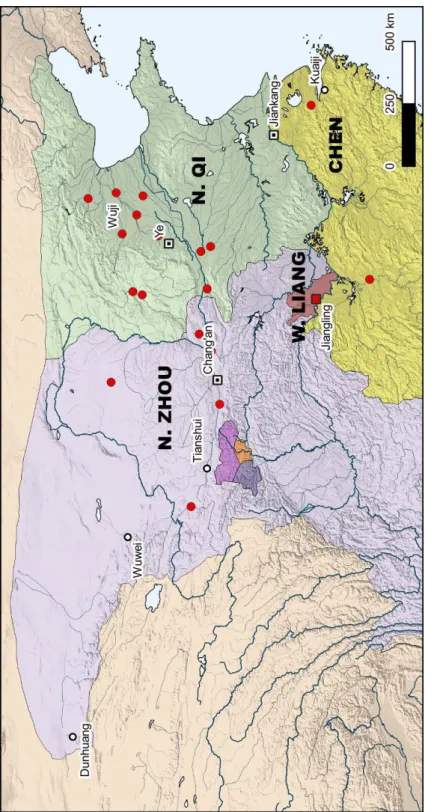
What I have had time to map is where these people grew up – the fifty-nine of them, that is, for whom we have a place of birth (see Fig. 4). The red dots here are scaled by the number, so the big dot on the new capital at Luoyang represents twelve people, and the smallest dots represent one.
Admittedly, the people who grew up in these places usually bounced around be-tween their hometown, the capital, and regional postings, but there are three rather important pieces of information that we can extract from a global view of where these people are from. First, as stated earlier, the Hexi Corridor basically dries up of mathematical talent after 439 (with the one exception of Fan Shao, on Table 3). Second, no one is from the South, so it seems fair to treat what’s happening in the North in isolation, as we did with the Hexi Corridor in the century prior. Third, one notes that the vast majority of talent comes out of the North China Plain. And this is important, because this is the area in which these experts were educated in their childhood; it is the area to which many of them would normally return in retirement to teach; and it is an area that will keep popping up as we go along. For the sake of concision, I will refer to this area as the ‘mathematical breadbasket’.
***
One of the guys to come out of this area is Zhang Qiujian. Zhang Qiujian is one of the two mathematicians that doesn’t have a biography, but he is one whose work was canonised in the Ten Mathematical Classics (Suanjing shishu) of 656 CE and transmitted into modern times.
We know where this man is from, because he signs his preface ‘Zhang Qiujian of Qinghe’ (below). We also know that he was writing in the North sometime be-tween 431 and 484 CE, because one of the problems in his eponymous mathematical classic involves a Northern Wei tax relief policy that was in effect between these dates.25 To make matters interesting, Zhang Qiujian’s is one of the extant works of
suan that Karine and Yiwen have yet to really focus on in their research on
distin-guishing ‘different mathematical cultures’, so it is something of a blank slate as concerns cultural categorisation, if you will.
Now, the first thing that I would do as concerns the identifying the ‘mathemati-cal culture’ that produced this text is to situate the text within everything we know about the institutions, social groups, and individual profiles in this specific milieu, then look for connections with what is happening elsewhere in the astral and math-ematical sciences in this region, in these ninety-five years. For example, we know that Zhang Qiujian comes out of the educational breadbasket of Northern mathe-matics and mathematical astronomy. We know that the Mathematical Classic of
Zhang Qiujian was written in a time of massive institutional reforms, including the
24
For an example of the sort of academic ties that can be traced between members of the Northern mathematical community, see Note 19.
25
Fig . 4 H o m et o w n s o f m at h e m at ic ian s an d m at h em at ical as tr o n o m e rs act iv e i n t h e N o rt h er n W ei , 4 3 9 – 5 35 CE ( lar g es t d o t = 1 2 pe opl e)
establishment of the first official professorships and government students in the astral and mathematical sciences. Furthermore, at the end of his preface is a rather unambiguous statement of purpose:
Thus, for the sake of later students who are fond of study but do not possess the means to arrive [at an understanding of the works of Xiaohou Yang and Master Sun], I have provided here a big-picture outline, trying not to make their methods any more complicated or taxing than they already are in the hope of making them easier to un-derstand. Zhang Qiujian of Qinghe respectfully [signs this] preface.26
It seems safe to conclude from all this that Zhang Qiujian is writing a textbook for this new age.
Now, Zhang Qiujian describes himself as ‘outlining’ and ‘simplifying’ the works of Xiahou Yang of Pinglu (n.d., North) and Master Sun (280/317 CE, South), both of whose ‘mathematical classics’ were canonised alongside his own two centu-ries later, and he also reworks eighteen problems from the Nine Chapters on
Math-ematical Procedures (c.5/c.93 CE). In sum, Zhang Qiujian lives in a very specific
milieu in the fifth-century North, but he’s also plugged into a centuries-old written tradition extending north and south. The author understands the more ‘complicated’ mathematics therein, but he has chosen to write a simple, lower-level introduction for ‘students’ (sheng). Moreover, this particular book is dedicated to suan matics, but the author is living in a context where most people who study mathe-matics also seem to study some aspect of astronomy.
Given these sorts of considerations, I am at a loss as to how draw the sort of neat lines of ‘different mathematical cultures’ around or through Zhang Qiujian’s ancient sources and immediate context such as we see in Table 1, particularly when they are not lines that our subjects draw themselves. In the comments, I would be curious to hear your ideas on how this could be done and, more importantly, how it would help us better understand this text or the others, listed in the Appendix, pro-duced in the same milieu. For now, let’s leave that an open question and move on down to the South.
The Chinese South, 437–589
CEExcluding omenology, there are all of sixty people on record as active in the astral and mathematical sciences in the Southern courts at Jiankang and Jiangling over the 272 years from 317 to 589 CE. By means of comparison, that is one born every four
and a half years in the South compared to one born every fourteen months in the
Northern Wei. Moreover, most of the activity and surviving works are concentrated in the three decades immediately following the sino-Xiongnu book exchange, when we get the important work of He Chengtian (370–447), Qian Lezhi (fl. 436–443), and Zu Chongzhi (429–500) in mathematics, astronomy, and instrumentation as well as the testing, debate, and reforms around that.27 After this, the South progres-sively loses momentum in terms of creative output. This, for example, is all that Li
26
余為後生好學有無由以至者,故舉其大㮣,而為之法不復煩重,庶其易曉云耳。清 河張邱建謹序, Zhang Qiujian suanjing, ‘Xu’, p.4b.
27
Chunfeng has to say about the Chen dynasty (557–589) in his history of li mathe-matical astronomy for this period:
The Chen Clan followed the Liang (502–557), using Zu Chongzhi’s astronomy with-out further innovation or reform.28
There is, frankly, not much more than that to say about any other branch of the astral and mathematical sciences in the sixth-century South, excepting omenology and the ‘steady drip’, if you will, of writings about the clepsydra.
As to institutions, we are, to the best of my knowledge, dealing with the same basic set-up as inherited by the Northern Wei, the difference being that there is no concerted state involvement with mathematical education and research like in the North. Anyways, most of our fifty-five practitioners were not employed in special-ist, technical posts.
Moving to social groups, one notes that, both proportionally and in absolute
terms, there are a lot more people involved in suan mathematics in the South: out
the grand total of fifty-six practitioners of the eight branches of the astral and math-ematical sciences considered, there are twenty-three, listed in Table 4, that are ex-plicitly involved in suan. That makes about 38 per cent, compared to only about 21 per cent in the North. There are also a lot more monks. This might just be a question of preservation bias, but what matters is that eighteen of these guys have biographies, so, once again, there is plenty to be said about individual profiles.
Considered in aggregate, we see a similar level of polymathy in these individual profiles: about a third of our Southern mathematicians were also involved in lü tono-metrology or some aspect of astronomy, so, once again, it is hard to justify treating this list as a closed group independent of practitioners in these other fields. Zooming out to the sixty individuals active in all the astral and mathematical sci-ences (excluding omenology), let us ask, once again, if the list we see on this slide constitutes a community. The answer, in this case, is ‘yes and no’.
Eight of these men are monks, whose recorded lives rarely intersect with the lay experts, and another three are hermits. Of the remaining forty-nine, fourteen belong to the same five clans, and, thus, family traditions, e.g. Yu Shen 庾詵 (fl. 502), Yu Manqian 庾曼倩 (6th cent.), and Yu Jicai 庾季才 (d. 603). For the most part, how-ever, there’s not much tying these individuals together beyond their involvement in the same fields. There are two reasons for this. First, there was very little creative output in these fields in the South, and what little there was is sporadic and discon-nected, at least as it is recorded in bibliographies, histories, and biographies. Second, where we do have historical accounts of innovation, testing, debate, and reform in the South, there is nothing like the number of participants and co-authors that you see in the North. This makes it hard to speak of these sixty individuals as members of one tight-knit community, but maybe that in itself is this community’s defining characteristic: that the astral and mathematical sciences were more solitary, individ-ualist, and text-oriented affairs in the South.
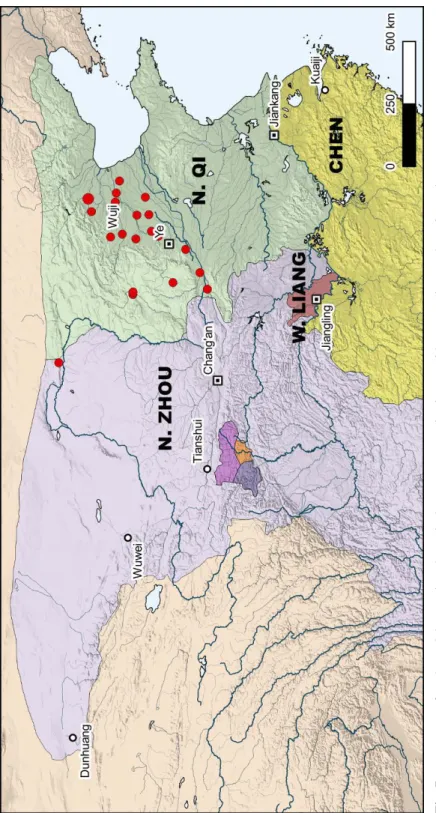
The map in Fig. 5 tells a similar story. Of forty-three provenanced practitioners, only nineteen are from the heart of the South, in Yellow. The other half are almost all from the same areas in the North where the Northern Wei was getting all of its mathematicians – territories that the South progressively lost over the course of
28
N a me D at es C m d o f B ir th B io M at h MA Om TM C ha . In st . C os 1 F u M anr o ng 伏曼容 421 – 50 2 P ing cha ng 平昌 x x 2 G eng X un 耿詢 fl . 589 – 61 1 D an ya n g 丹陽 x x x x x x 3 G u Y ue 顧越 480 – 56 9 W u C m d. 吳郡 x x x x 4 G ua n K ang zhi 關康之 415 – 47 7 H edong 河東 - x 5 卍 Gu ṇab h ad ra 求那跋陀羅 394 – 46 8 C en t. I n d ia 中天竺 x x x 6 Ji ang Z ha n 江湛 407 – 45 3 Ji ya n g 濟陽 x x 7 K ong S ha ns hi 孔山士 d. 4 50 K u aiji 會稽 x x 8 M ao Q ich en g 毛栖誠 fl . c. 502 X in gy an g 滎陽 - x x 9 P i Y anz ong 皮延宗 fl . 443 - - x x x 10 卍 S hi D aoa n 釋道安 d. 3 85 C ha ng sha n 常山 x x 11 卍 S h i H u iju n 釋慧頵 564 – 63 7 Q ing he 清河 x x 12 卍 S hi H ui y ua n 釋慧遠 334 – 41 6 Y an m en 雁門 x x 13 卍 S hi S eng ha n 釋僧含 fl . 430 - x x x 14 卍 S hi T ang ua ng 釋曇光 fl . 465 – 47 2 K u aiji 會稽 x x 15 X ia o H u i 蕭撝 515 – 57 3 L an lin g 蘭陵 x x 16 X ia o J i 蕭吉 d. 6 06 L in xi an g 臨湘 x x x 17 Y u C ha ng su n 虞長孫 5t h c ent . - - x 18 Y u M an qi an 庾曼倩 6t h c ent . X in ye 新野 x x 19 Y u S he n 庾詵 fl . 502 X in ye 新野 x x 20 Z ha ng Z ua n 張纘 499 – 54 9 - x x 21 卍 Z hi S eng na 支僧納 fl . 430 - - x 22 Z hu Y i 朱异 483 – 54 9 W u C m d. 吳郡 x x 23 Z u C h ong zhi 祖沖之 429 – 50 0 F an y an g 范陽 x x x x T a bl e 4 Sua n m at h e m at ici an s in t he So u th , 3 17 – 5 89 CE . T he s y m bol 卍 indi ca te s a B u dd hi st m onk . A bbr ev ia ti ons : M at h [em at ics ( suan )] , M [at h em at ical ] A [s tr o n o m y ( li )] , O m [e nol og y ( zhan )], T [o n o -] M [e tr o lo g y ( lü ), Ch a[ rt s] ( tu ), I ns t[ ru m ent s] , a nd C os [m ol ogy ( tia n ti )] .
Fig . 5 H om et ow ns of m at he m at ic ia ns a nd m at he m at ic al a st ronom e rs a ct iv e i n t he S out h, 31 7 – 5 89 CE ( lar g es t d o t = 4 pe opl e) .