HAL Id: hal-00298764
https://hal.archives-ouvertes.fr/hal-00298764
Submitted on 4 Sep 2006HAL is a multi-disciplinary open access
archive for the deposit and dissemination of sci-entific research documents, whether they are pub-lished or not. The documents may come from teaching and research institutions in France or abroad, or from public or private research centers.
L’archive ouverte pluridisciplinaire HAL, est destinée au dépôt et à la diffusion de documents scientifiques de niveau recherche, publiés ou non, émanant des établissements d’enseignement et de recherche français ou étrangers, des laboratoires publics ou privés.
Modeling and analysis of collective management of
water resources
A. Tilmant, P. van der Zaag, P. Fortemps
To cite this version:
A. Tilmant, P. van der Zaag, P. Fortemps. Modeling and analysis of collective management of water resources. Hydrology and Earth System Sciences Discussions, European Geosciences Union, 2006, 3 (5), pp.2707-2733. �hal-00298764�
HESSD
3, 2707–2733, 2006 Operation of reservoir resources A. Tilmant et al. Title Page Abstract Introduction Conclusions References Tables Figures J I J I Back CloseFull Screen / Esc
Printer-friendly Version Interactive Discussion
EGU
Hydrol. Earth Syst. Sci. Discuss., 3, 2707–2733, 2006 www.hydrol-earth-syst-sci-discuss.net/3/2707/2006/ © Author(s) 2006. This work is licensed
under a Creative Commons License.
Hydrology and Earth System Sciences Discussions
Papers published in Hydrology and Earth System Sciences Discussions are under open-access review for the journal Hydrology and Earth System Sciences
Modeling and analysis of collective
management of water resources
A. Tilmant1, P. van der Zaag2, and P. Fortemps31
UNESCO-IHE, Department of Management and Institution, Delft, The Netherlands
2
Delft University of Technology, Delft, The Netherlands
3
Facult ´e Polytechnique de Mons, Department of Applied Mathematics and Operational Research, Mons, Belgium
Received: 4 July 2006 – Accepted: 17 August 2006 – Published: 4 September 2006 Correspondence to: A. Tilmant ([email protected])
HESSD
3, 2707–2733, 2006 Operation of reservoir resources A. Tilmant et al. Title Page Abstract Introduction Conclusions References Tables Figures J I J I Back CloseFull Screen / Esc
Printer-friendly Version Interactive Discussion
EGU Abstract
Integrated Water Resources Management (IWRM) recommends, among other things, that the management of water resources systems be carried out at the lowest appro-priate level in order to increase the transparency, acceptability and efficiency of the decision-making process. Empowering water users and stakeholders transforms the 5
decision-making process by enlarging the number of point of views that must be con-sidered as well as the set of rules through which decisions are taken. This paper investigates the impact of different group decision-making approaches on the operat-ing policies of a water resource. To achieve this, the water resource allocation problem is formulated as an optimization problem which seeks to maximize the aggregated 10
satisfaction of various water users corresponding to different approaches to collective choice, namely the utilitarian and the egalitarian ones. The optimal operating policies are then used in simulation and compared. The concepts are illustrated with a multipur-pose reservoir in Chile. The analysis of simulation results reveals that if this reservoir were to be managed by its water users, both approaches to collective choice would 15
yield significantly different operating policies. The paper concludes that the transfer of management to water users must be carefully implemented if a reasonable trade-off between equity and efficiency is to be achieved.
1 Introduction
The management of large-scale water resources, such as multipurpose reservoirs, 20
has traditionally been carried out by public administration. The motivations for a public management are both political and financial: to promote equity and arbitrate conflicts among water users, to maintain ownership on a strategic infrastructure, to ensure that certain water services viewed as public goods are preserved, and to promote the de-velopment of water resources which are highly capital intensive with long time invest-25
HESSD
3, 2707–2733, 2006 Operation of reservoir resources A. Tilmant et al. Title Page Abstract Introduction Conclusions References Tables Figures J I J I Back CloseFull Screen / Esc
Printer-friendly Version Interactive Discussion
EGU 1998;WCD,2000) the performance of many multipurpose schemes has not met the
expected targets. Consequently, a (partial) transfer of management to water users is often cited as a potential alternative to a public (centrally-organized) administration.
This paper investigates the impacts of different approaches to collective choice on the management of a water resource system. More specifically, an optimization model 5
is developed to determines optimal release policies for a multipurpose reservoir while explicitly considering multiple water users and different group decision-making ap-proaches. The model seeks to maximize the aggregated satisfaction of the different water users and relies on flexible constraints to quantitatively model preferences for-mulated by the water users. The use of flexible constraints instead of objective func-10
tions is motivated by the fact that a flexible constraint includes a threshold below which a solution will be rejected and a threshold above which solutions are equally feasible
(Dubois et al.,1996). In other words, between these two thresholds, the flexible
con-straint behaves as a local objective. In addition, flexible concon-straints also remove barrier language for non-technical water users since they can be described by linguistic vari-15
ables and mathematically encoded as fuzzy sets. The idea here is that fuzzy sets are used as a vehicle to capture and process linguistically described water users’ prefer-ences formulated by both technical and non-technical water users. In this paper, the terms “stakeholder”, “water user”, “actor” and “objective” play the same role: supplying preferences across alternatives. They can therefore be used interchangeably.
20
The optimal decision is defined as the solution for which the global satisfaction of the different water users is maximal. An aggregation of water users’ preferences is therefore needed and must be carried out taking into account the complex rules that characterize the group decision-making. This paper illustrates the impact of these de-cision rules on the performance of a multipurpose reservoir as if it were managed by 25
the water users. The second section is devoted to flexible constraints and objectives. Section three presents various flexible constraints satisfaction problems and how they can be interpreted in social choice theory. Then, the optimization of reservoir operation is discussed in section four and the case study introduced in section five. Simulation
re-HESSD
3, 2707–2733, 2006 Operation of reservoir resources A. Tilmant et al. Title Page Abstract Introduction Conclusions References Tables Figures J I J I Back CloseFull Screen / Esc
Printer-friendly Version Interactive Discussion
EGU
sults associated to various group decision-making approaches are analyzed in section six. Finally, concluding remarks are presented.
2 Flexible constraints versus objectives
Many water resources systems have been developed and managed to meet the de-mands for water formulated by multiple users, some of them with multiple objectives. 5
Unfortunately, these objectives can seldom be fully satisfied due to the presence of various constraints, which can be of physical, legal or financial nature. The major dif-ference between constraints and objectives comes from the imperativeness with which they must be satisfied: satisfying a constraint is more imperative than satisfying an objective (Slany,1996). An objective function, on the other hand, associates to each 10
alternative (or solution) r a value g(r) so as to provide a complete ranking of the set of feasible solutions: r g r0 if and only if g(r)≥g(r0), which means “the objective g prefers r to r0”.
The notion of flexible (fuzzy) constraint is an attempt to represent both constraints and objectives by fuzzy sets. Let < be the set of all solutions (feasible, non-feasible or 15
partially feasible) and O a fuzzy relation related to the constraint C. A flexible constraint
C can be described by a fuzzy set defined by O in <. For a solution r ∈ <, the
mem-bership grade µO(r) associated by O to r specifies the satisfaction level of r according to the constraint C:
µO(r)=1. means r totally satisfies C
20
µO(r)∈]0, 1[. means r partially satisfies C
µO(r)=0. means r totally violates C
µO(r)≥µO(r
0
). means r is preferred to r0
For a classical constraint, the relation O is binary, whereas for a flexible constraint,
O is a fuzzy relation. In other words, O is the fuzzy set of solutions more or less
HESSD
3, 2707–2733, 2006 Operation of reservoir resources A. Tilmant et al. Title Page Abstract Introduction Conclusions References Tables Figures J I J I Back CloseFull Screen / Esc
Printer-friendly Version Interactive Discussion
EGU
satisfying the flexible constraint C. The relation O therefore rank-orders the feasible solutions like an objective function. But the flexible constraint differs from the objective function in that it also models a threshold below which a solution will be rejected and a threshold above which solutions are equally feasible. In a sense, a flexible constraint can be viewed as the association of a constraint and a criterion; the former defines the 5
support of the flexible constraint, while the latter rank-orders the solutions according to preferences (Dubois et al.,1996).
The methodology described in this paper heavily relies on preferences formulated by water users. These preferences will be encoded as fuzzy sets in the optimization algorithm. More specifically, the membership grade µ translate water user satisfaction 10
on the unit interval: the membership grade is 1 when the alternative completely satis-fies the water user, and it is equal to 0 when the solution is completely rejected by the same water user. In the ]0, 1[ interval, solutions are partially accepted/rejected. Note that the term satisfaction has a logical meaning here: to “satisfy” a preference means that the prior conditions defining the preference are met. This definition has therefore 15
no psychological sense in that it does not reflect a mental state of pleasure.
3 Flexible constraint satisfaction problems
Classical Constraint Satisfaction Problems (CSP) rely on “crisp” (hard) constraints: con-straints can either be satisfied or not. InCSP, a solution must satisfy all constraints of
the problem. A problem is said to be “underconstrained” if it accepts more than one 20
solution. In that case, the decision maker has to consider other constraints to di ffer-entiate between these solutions. In contrast, when there is no solution, the problem is said to be “overconstrained” and one or more constraints must be relaxed. The Flexi-ble Constraint Satisfaction ProFlexi-blem (FCSP) generalizesCSPby substituting at least one hard constraint by a flexible constraint. In a sense, this allows the decision maker to 25
introduce an objective function in the problem, which can be used to relax an “overcon-strained” problem, or to differentiate the solutions of an “underconstrained” problem.
HESSD
3, 2707–2733, 2006 Operation of reservoir resources A. Tilmant et al. Title Page Abstract Introduction Conclusions References Tables Figures J I J I Back CloseFull Screen / Esc
Printer-friendly Version Interactive Discussion
EGU
Define C as a finite set of flexible constraints {C1, C2, . . . , CJ}, O as a finite set of fuzzy relations {O1, O2, . . . , OJ} and r as an alternative (r ∈ <). Each alternative r is associated with a profile µr=(µO
1(r), µO2(r), . . . , µOJ(r)) ∈ [0, 1] J
, where µO
j(r) is the
satisfaction level of the jthflexible constraint associated with the alternative r.
To rank the alternatives or select an alternative that best satisfies the flexible con-5
straints, one can compute the global scores D(r) from the profile of any alternative r using an aggregation satisfaction D : RJ→R. In classical constraint satisfaction prob-lem, the most common definition of the aggregated satisfaction D is based on the minimum operator (the min-ordering):
D(r)= µO
1∩O2∩...∩OJ(r)= minC j∈C
µO
j(r) (1)
10
The minimum operator belongs to a family of operators called triangular norms which have interesting mathematical properties (Zimmermann,1991).
The best solutions r∗ are therefore those for which the aggregated satisfaction D is maximum: r∗ = max r∈< Cminj∈C µO j(r) (2) 15
The solutions r∗ maximize the satisfaction level of the least satisfied constraint, and therefore theFCSPis a max-min optimization problem (max-min solutions). The use of the min operator has been advocated by (Bellman and Zadeh,1970). They adopted a logic point of view, interpreting the intersection of two fuzzy sets (which is obtained by combining with the min operator their membership grade functions) as the “logical 20
AND” between two statements. It must be pointed out that this max-min approach is
coherent with the properties of a flexible constraint, namely it cannot be violated. Any solution with a zero satisfaction level for a single constraint is rejected as impossible.
In social choice theory, the min-ordering corresponds to an egalitarian approach: every member (water user) has a veto power like the permanent members of theUN
HESSD
3, 2707–2733, 2006 Operation of reservoir resources A. Tilmant et al. Title Page Abstract Introduction Conclusions References Tables Figures J I J I Back CloseFull Screen / Esc
Printer-friendly Version Interactive Discussion
EGU
Security council. As soon as one user rejects a solution, it is globally rejected by the whole group.
Despite its pleasing mathematical properties, the min-ordering has two major draw-backs:
– it lacks of discrimination power by concentrating on the worst aspects of the
alter-5
natives;
– maxmin solutions are not Pareto optimal, meaning that the satisfaction of other
water users could still be improved without deteriorating the satisfaction of the least-satisfied water user.
The first issue has been addressed by several authors, e.g. (Dubois et al., 1996; 10
Dubois and Fortemps, 1999), who have proposed various refinements such as the
leximin or the discrimin orderings. The second drawback has a practical dimension; the fact that Pareto optimality cannot be guaranteed implies that certain water users will not easily accept the solutions since the resource is not efficiently managed. However, as the solutions are taken on the basis of the least-satisfied water user, they are consistent 15
with the notion of justice as discussed byRawls(1970).
An alternative definition of the aggregated satisfaction D is based on the maximum operator. It represents a group decision-making in which each participant is a potential dictator (max-ordering). Here, as soon as a water user is fully satisfied with a solution, it is accepted by the whole group. In other words, this approach looks for the full 20
satisfaction of at least one water user, nothwithstanding the satisfaction of the other users. Then the optimal solutions are the solutions of a maximax optimization problems (max-max solutions). However, the max-ordering suffers from the same drawbacks as the min-ordering.
In between these two extremes the utilitarian decision-making approach builds an 25
HESSD
3, 2707–2733, 2006 Operation of reservoir resources A. Tilmant et al. Title Page Abstract Introduction Conclusions References Tables Figures J I J I Back CloseFull Screen / Esc
Printer-friendly Version Interactive Discussion
EGU
with the highest utility are the ones preferred (max-sum solutions):
r∗ = max r∈< X j µO j(r) (3)
In contrast to max-min or max-max solutions, max-sum solutions are consistent with the tradition of multicriteria decision making and the idea of trade-off.
The utilitarian approach to collective choice also often implies that the actors, and 5
thus their constraints, do no have the same importance. For example, diverting water for municipal water supply may be more important than for irrigation purposes. If a constraint is more important, it should play a more significant role in the aggregation function (Eq. 3). Various methods exist for including relative importance. Here, the constraints are ordered with respect to each other by giving them a priority degree, 10
which can be considered as a weight. From pairwise comparisons between constraints, it is possible to determine the weights using a procedure developed bySaaty(1980). This procedure starts with the construction of a J×J matrix A in which the element ai j gives the relative importance of the constraint Ci with respect to the constraint Cj. Note that the element aj i is calculated from aj i=1/ai j. Table1 lists the values of aj i 15
and their definitions. The weight vectorw is then obtained from
Aw= λmaxw (4)
where λmaxis the maximum eigenvalue of A. This vector is the importance associated with each of the constraints Cj for j ∈ [1, 2, . . . , J ]. More details about this methodol-ogy can be found inSaaty(1980).
20
We further assume that the weight factors are normalized according to X
j
wj = 1, wj ∈ [0, 1]. (5)
Once the weight vector is calculated, it can be introduced in the definition of the utili-tarian, aggregated, satisfaction D by, for example, directly multiplying the satisfaction
HESSD
3, 2707–2733, 2006 Operation of reservoir resources A. Tilmant et al. Title Page Abstract Introduction Conclusions References Tables Figures J I J I Back CloseFull Screen / Esc
Printer-friendly Version Interactive Discussion
EGU
level µO
j by its weight wj. The optimization problem (Eq.3) becomes the well-known
weighted sum:
Dp(r)=X
j
wjµO
j(r) (6)
The weighted sum is, in turn, a particular case of the generalized averaging operator when the parameter p=1 (Kaymak and van Nauta Lemke,1998)
5 Dp(r)= {X j wjµpO j(r)} 1/p , p∈ \{0} (7) and D0(r)=Y j µO j(r) wj (8)
As a matter of fact, when p→∞ the aggregation function (Eq. 7) becomes equiva-lent to the max-operator, whereas when p→−∞ the aggregation is equivaequiva-lent to the 10
min-opeator. In between these two extremes, the aggregation Function (7) can be tai-lored to model utilitarian decision-making. With the aggregation Function (7), the best solution rp,∗of the FCSP is given by
rp,∗= max r∈< { X j wjµpO j(r)} 1/p, p∈ \{0} (9) and 15 r0,∗ = max r∈< Y j µO j(r) wj (10)
As mentioned early, the aggregation should also produce Pareto-optimal solutions. Utilitarian solutions (i.e solutions corresponding to finite values of p in Eq.9) are all Pareto optimal, but notwithstanding this fact, these solutions might not necessarily be
HESSD
3, 2707–2733, 2006 Operation of reservoir resources A. Tilmant et al. Title Page Abstract Introduction Conclusions References Tables Figures J I J I Back CloseFull Screen / Esc
Printer-friendly Version Interactive Discussion
EGU
well perceived by water users since compensation between water users’ satisfaction is assumed. In other words, a consensus might be difficult to reach, because certain water users might consider the resulting operating policy as a “zero-sum” game, while others might see it as a “positive-sum” game. It must be stressed here that the utilitarian and egalitarian conceptions of collective choice assume that:
5
– decision makers will choose among alternatives by articulating prior preferences; – disagreement is the result of competition for the use of water.
The first assumption is often criticized by political scientists, because it fails to ad-equately take into account those water services that can be viewed as public goods (Sagoff,1998): a typical example is flood control. In other words, these two concep-10
tions only deal with “consumer” (water user) preferences and not “citizen” preferences.
4 Reservoir operation optimization
The different group decision-making approaches discussed in the previous section and their impacts on the management of a water resources are illustrated with a multipur-pose reservoir operation problem. The reservoir operation problem typically consists 15
in determining release decisions that should be made in order to meet the demands formulated by various water users/uses such as hydropower generation, flood control, low flow maintenance, recreation, irrigation, etc. Various models have been developed in the past to address this operation problem. Deterministic models use a specific se-quence of streamflows to determine operating policies. Stochastic models like stochas-20
tic dynamic programming (SDP), on the other hand, rely on statistical descriptions of
the streamflow and forecast process to obtain operating policies. Labadie (2004) has recently carried out a review of these techniques.
In Stochastic Dynamic ProgrammingSDP, release decisions are made to maximize
(minimize) current benefits (costs) plus the expected benefits (costs) from future op-25
HESSD
3, 2707–2733, 2006 Operation of reservoir resources A. Tilmant et al. Title Page Abstract Introduction Conclusions References Tables Figures J I J I Back CloseFull Screen / Esc
Printer-friendly Version Interactive Discussion
EGU
reservoir operation studies, the most common state variables are the volume of wa-ter in the reservoirs and a description of current hydrologic conditions (Tejada-Guibert
et al., 1995). Let n be the number of stages remaining until the end of the planning horizon, rt be the release during period t, atthe inflow during period t, stthe storage at the beginning of time period t, E the expectation operator, α the discount factor, and 5
gtthe benefit of system operation during period t.
Considering the reservoir operation problem as periodic and infinite-horizon the long-term optimal operating policy can be found by the recursive solution of the functional
SDPequation Fn∗(st, at)= max rt {gt(st, at, rt) 10 + E at+1|at αFn∗−1(st+1, at+1)} (11) subject to
max[rmin, st+ at− smax] ≤ rt≤ min[rmax, st+ at− smin] (12) where smin and smaxare the lower and upper bounds on storage, rmin and rmaxare the lower and upper bounds on release.
15
The recursive Eq. (11) is carried out until the change in the cost-to-go function from one iteration to the next becomes nearly constant for each point of the discrete state space domain (Loucks and van Beek,2005). In this study, the time span of a stage is one month, and the period is one year. In practice, to solve theSDPmodel (Eq. 11),
the hydrologic state and the storage variables must be discretized into na and ns in-20
tervals, respectively, each represented by a characteristic value (Yakowitz,1982). The continuous domain (at, st) is thus replaced by a grid so that an approximate solution of (Eq.11) can be developed by evaluating (Eq.11) at the grid points only. Here, 12 grids of 110 points are used (na=5 and ns=22). When the algorithm moves from one stage (e.g. n−1) to the next (e.g. n), the values of Fn−1are available only at the grid points. 25
In this study, the release decisions are determined from a variant ofSDPin which the objective function of the recursive equation is no longer an economic one, but rather
HESSD
3, 2707–2733, 2006 Operation of reservoir resources A. Tilmant et al. Title Page Abstract Introduction Conclusions References Tables Figures J I J I Back CloseFull Screen / Esc
Printer-friendly Version Interactive Discussion
EGU
corresponds to aFCSP in which the flexible constraints encode the satisfaction levels of the different water users and objectives. It must be stressed here that the physical constraints are still modeled by hard constraints. Denote µO
j,t(st, at, rt) as the
satisfac-tion of the j th water user/objective at time t when the storage is st, the inflow is atand the decision is rt. Let wj,t be the relative importance of the j th water user/objective at 5
time t withP
j
wj,t=1. In addition, let Dn(st, at) be the expected satisfaction-to-go from the optimal operation of the system from the current period t (n remaining stages) to the end of the planning horizon given that the system’s state in period t is (st, at). The steady-state release policies are found by solution of:
D∗n(st, at)= [maxr t{ PJ−1 j=1ωj,tµ p Oj,t(st, at, rt)+ P at+1ρ(at+1 | at)ωJ,tD ∗p n−1(st+1, at+1)}] p−1 (13) 10
where ρ(.) are flow transition probabilities estimated from historical flow records. Similar approaches can be found in (Fontane et al., 1997; Esogbue and Kaprzyk,
1998;Tilmant et al.,2002b) to derive operating policies of multipurpose reservoirs with imprecise operating objectives. A comparison betweenFSDPandSDPderived policies is described in (Tilmant et al.,2002a).
15
In this study, the so-called Flexible SDP (FSDP) functional Eq. (13) will be used to
derive reservoir operating policies corresponding to different group decision-making approaches as encountered in social choice theory. SeveralFSDP models will be de-veloped with p=1, p→∞ and p→−∞ to determine optimal release decisions and then simulate the operation of the multipurpose reservoir with these three different rules. 20
Meaningful performance indicators, such as the reliability in meeting irrigation water demands, will then be estimated from simulation results and used to compare the three
HESSD
3, 2707–2733, 2006 Operation of reservoir resources A. Tilmant et al. Title Page Abstract Introduction Conclusions References Tables Figures J I J I Back CloseFull Screen / Esc
Printer-friendly Version Interactive Discussion
EGU
5 Case study
The Colb `un reservoir in Chile is used to illustrate the impact of different decision-making approaches on the performance of a water resource. This reservoir is located in the Maule river basin near Santiago. Water in the basin was used primarily for irriga-tion and more recently for hydropower generairriga-tion. The development of hydropower has 5
been a source of tension between irrigators and the hydropower companies because:
– the operation of the hydropower plants affects the hydrological regime therefore
violating the prior rights of farmers for constant flows;
– water diverted for hydropower generation does not immediately return to the river
therefore bypassing many farmers. 10
To mitigate the impact on farmers, hydropower companies have constructed addi-tional hydraulic infrastructures (irrigation offtakes, canals). This has had practical impli-cations for the management of the Colb `un reservoir as the elevation of a major irrigation canal imposes a lower limit on the storage level therefore reducing the usable storage capacity by as much as 30% (from 1515 hm3 to 950 hm3). In addition, hydropower 15
companies are also bound to respect pre-defined monthly release targets reflecting agricultural demands. Consequently, the number of objectives J for the Colb `un reser-voir is four: (1) hydropower generation, (2) storage control for flood prevention during the high flow season and lateral irrigation during the low flow season, (3) downstream irrigation, and (4) the need to ensure satisfactory continuing operation, i.e. to avoid fu-20
ture shortfalls in any of the first three operating objectives. Table2lists the objectives and their associated control/state variables.
The generalFSDPmodel for the Colb `un reservoir can be written as:
D∗n(st, at)= [maxr t{ P3 j=1ωj,tµ p Oj,t(st, at, rt)+ P at+1ρ(at+1 | at)ω4,tD ∗p n−1(st+1, at+1)}] p−1 (14)
HESSD
3, 2707–2733, 2006 Operation of reservoir resources A. Tilmant et al. Title Page Abstract Introduction Conclusions References Tables Figures J I J I Back CloseFull Screen / Esc
Printer-friendly Version Interactive Discussion
EGU
with the same restrictions on the state and decision variables as in Eq. (11). The membership functions µO
j and weighting coefficients ωi were derived from existing
operating rules as well as from discussions with experts familiar with the system. Note that the membership function for the hydropower objective is the production function normalized on the unit interval.
5
As mentioned above, this formulation is implemented with three different aggregation operators corresponding to utilitarian or egalitarian approaches to collective choice. There are therefore threeFSDPmodels as listed in Table4.
The FSDP-MODEL I corresponds to the egalitarian approach to group decision-making in which each water user has a veto power. As pointed out early, this ap-10
proach is also the most equitable as the decision maximizes the satisfaction of the least-satisfied water user.
D∗n(st, at)= maxr t minµ,D{µOj,t(st, at, rt), . . . , P at+1ρ(at+1 | at)D ∗ n−1(st+1, at+1)} (15)
TheFSDP-MODEL II corresponds to the utilitarian approach to group decision-making
in which each water user no longer has a veto power but where their relative impor-15
tance is now considered. Here, the optimal solutions r∗(st, at) are all Pareto optimal and compensation between high and low satisfaction degrees is now permitted, which implies that most water users will perceive these solutions as a ’‘zero-sum” game.
D∗n(st, at)= maxr t{ P3 j=1ωj,tµOj,t(st, at, rt)+ P at+1ρ(at+1 | at)ω4,tD ∗ n−1(st+1, at+1)} (16)
Finally, theFSDP-MODELIII corresponds to the egalitarian approach to group decision-20
HESSD
3, 2707–2733, 2006 Operation of reservoir resources A. Tilmant et al. Title Page Abstract Introduction Conclusions References Tables Figures J I J I Back CloseFull Screen / Esc
Printer-friendly Version Interactive Discussion
EGU
approach is considered here for comparison purposes.
D∗n(st, at)= maxr t maxµ,D{µOj,t(st, at, rt), . . . , P at+1ρ(at+1 | at)D ∗ n−1(st+1, at+1)} (17)
FSDP-derived operating rules are then used in simulation. Simulation results consist of the end-of-the month storage level, the monthly release through the turbines, the losses, and the average monthly hydroelectric production. Each simulation run starts 5
with initial volume in storage of 1449 hm3and uses historical monthly inflows recorded during the 1988–2000 period.
6 Simulation results
The performance indicators that are used to investigate the impact of the different group decision-making approaches on the performance of the Colb `un reservoir are
10
– the reliability in meeting downstream irrigation demands δ=P (st≥sT) where sT is the minimum allowable storage volume for lateral irrigation
– the reliability in delivering water for lateral irrigation β = P (rt≥dt) where dt is the target release for downstream irrigation in period t
– (iii) the average annual production of hydroelectricity γ.
15
Simulated performances corresponding to the threeFSDPmodels and to the ‘’88–”00 time period are listed in Table5.
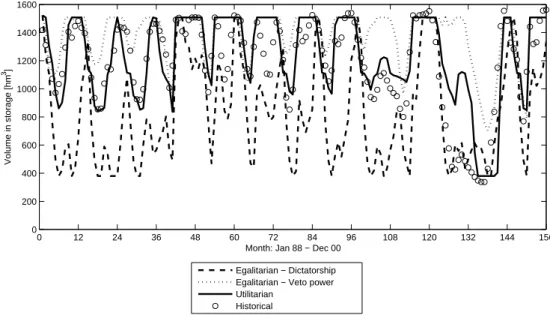
The examination of Table 5and Fig. 2reveals that the three conceptions of collec-tive choice yield different release policies. The egalitarian approach with dictatorship tend to favor high releases therefore lowering the volume in storage. The reason is to 20
be found in that this conception of collective choice concentrates on the satisfaction of the most satisfied decision maker, which is here either the hydropower company or
HESSD
3, 2707–2733, 2006 Operation of reservoir resources A. Tilmant et al. Title Page Abstract Introduction Conclusions References Tables Figures J I J I Back CloseFull Screen / Esc
Printer-friendly Version Interactive Discussion
EGU
downstream farmers whose satisfaction degrees µO
1 are in general larger than that of
the two other objectives (µO
1, µO3>µO2, µO4) because hydropower generation increases
more rapidly with the release term rather that with the head term. The opposite behav-ior is observed with the egalitarian approach with veto power. As a matter of fact, this approach encourages high pool elevation throughout the year as both the lateral 5
irrigation and future operation objectives are likely to be the least satisfied objectives if aggressive release are implemented to meet downstream irrigation water demands and the production of hydroelectricity.
In between these two extremes, the utilitarian approach generates more balanced release policies, which is consistent with the fact that trade-offs are now considered 10
between aggressive and conservative objectives. This approach explicitly recognizes that high satisfaction levels can compensate lower satisfaction levels in order to de-rive a policy that compromises between the two extreme egalitarian approaches to collective choice. The simulation results speak for themselves: (i) the storage levels corresponding to the utilitarian approach lie often somewhere in between the storage 15
levels corresponding to the two egalitarian approaches, and (ii) this is confirmed by the performance indicators as (δI<δII<δIII) and (βI>βII>βIII). The same observation can be made for the average annual production of hydroelectricity (with γI>γII>γIII). The third model generates more energy because it better exploits the volume in storage with a drawdown/refill cycle that takes place over the entire reservoir.
20
In practice, the proposed methodology can be seen as a loop in which, on one hand, waters users provide their preferences and, on the other hand, these preferences are processed by the FSDP model which then provides water users with short and long-term consequences. These consequences must be easily interpreted by water users thanks to the use of several indicators such as satisfaction, reliability, resiliency, 25
economic performance (costs vs. benefits, value-at-risk, cashflow-at-risk), etc. The interpretation should then encourage discussion between water users and ultimately generates a new set of preferences, and thus a new loop in Fig.3, which would lead to consensual solutions.
HESSD
3, 2707–2733, 2006 Operation of reservoir resources A. Tilmant et al. Title Page Abstract Introduction Conclusions References Tables Figures J I J I Back CloseFull Screen / Esc
Printer-friendly Version Interactive Discussion
EGU
7 Conclusions
This paper illustrates the impact of various conceptions of collective choice on the performance of a water resource system. The group decision-making process is math-ematically formulated as a flexible constraint satisfaction problem which assumes both quantification and commensurability of preferences. From these demanding assump-5
tions, an aggregation operator must be carefully selected to identify consensual solu-tions. Results show that extreme conceptions of collective choice, i.e. veto-power and dictatorship, generate extreme release policies. Utilitarian approaches appear to be more consistent even though compensatory effects between low and high satisfaction levels are not easily accepted by water users.
10
The proposed model can provide some insights into how the decision-making pro-cess will affect current and future allocations and ultimately the satisfaction of the users. Various risk indicators can also be derived from long-term simulations which capture the inherent uncertainties attached to this water resource management problem. The model can also be used to arbitrate between efficiency and equity principles for allo-15
cating water among competing users.
Potential refinements include (i) the improvement of aggregation operators, (ii) the consideration of “public” water services, i.e. the operating objectives that can be viewed as public goods (e.g. flood control) and their aggregation with “individual” ob-jectives (e.g. hydropower, navigation), and (iii) the elicitation of preferences. Further 20
researches will concentrate on other decentralized allocation mechanisms such as ca-pacity sharing (Tilmant and van der Zaag,2006).
References
Bellman, R. and Zadeh, L.: Decision-making in a fuzzy environment, Manage. Sci., 17, 141– 164, 1970. 2712
HESSD
3, 2707–2733, 2006 Operation of reservoir resources A. Tilmant et al. Title Page Abstract Introduction Conclusions References Tables Figures J I J I Back CloseFull Screen / Esc
Printer-friendly Version Interactive Discussion
EGU
Dinar, A., Rosegrant, M., and Meinzen-Dick, R.: Water allocation mechanisms: Principles and examples, World Bank Technical Paper, 1997. 2708
Dubois, D. and Fortemps, P.: Computing improved optimal solutions to max-min flexible con-straint satisfaction problems, Eur. J. Operational Res., 118, 95–126, 1999. 2713
Dubois, D., Fargier, H., and Prade, H.: Refinements of the maximin approach to decision-5
making in a fuzzy environement, Fuzzy sets and systems, 81, 103–122, 1996. 2709,2711, 2713
Esogbue, A. and Kaprzyk, J.: Fuzzy dynamic programming, in: Handbook of fuzzy sets series, vol. 5, 281–307, Kluwer Academic Publishers, Boston, 1998. 2718
Fontane, D., Gates, T., and Moncada, E.: Planning reservoir operation with imprecise objec-10
tives, J. Water Resour. Plann. Manage., 123, 154–163, 1997. 2718
Hjorth, P., Kundzewicz, W., Kutchment, L., and Rosbjerg, D.: Critiques of present reservoirs, in: Sustainable Reservoir Development and Management, edited by nbr 251, I. P., 125–247, Wallingford, UK, 1998. 2708
Kaymak, U. and van Nauta Lemke, H.: A sensitivity analysis approach to introducing weight 15
factors into decision functions in fuzzy multicriteria decision making, Fuzzy sets and systems, 97, 169–182, 1998. 2715
Labadie, J. W.: Optimal operation of multireservoir systems: State-of-the-Art review, J. Water Resour. Plann. Manage., 130, 93–111, 2004. 2716
Loucks, D. and van Beek, E.: Water resources systems planning and management, UNESCO 20
Publishing, Paris, France, 2005. 2717
Rawls, J.: A theory of Justice, Cambridge University Press, Mass, USA, 1970. 2713 Saaty, T.: The analytic hierarchy process, McGraw-Hill, New York, 1980. 2714
Sagoff, M.: Aggregation and deliberation in valuing environmental public goods: A look beyond contingent pricing, Ecol. Economics, 24, 213–230, 1998. 2716
25
Slany, W.: Scheduling as a fuzzy multiple criteria optimization problem, Fuzzy sets and sys-tems, 78, 197–222, 1996. 2710
Tejada-Guibert, A., Johnson, S., and Stedinger, J.: The Value of Hydrologic Information in Stochastic Dynamic Programming Models of a Multireservoir System, Water Resour. Res., 31, 2571–2579, 1995. 2717
30
Tilmant, A. and van der Zaag, P.: Towards good governance of hydraulic works: A review of management instruments, in: EGU Meeting, Vienna, Austria, 2006. 2723
non-HESSD
3, 2707–2733, 2006 Operation of reservoir resources A. Tilmant et al. Title Page Abstract Introduction Conclusions References Tables Figures J I J I Back CloseFull Screen / Esc
Printer-friendly Version Interactive Discussion
EGU
fuzzy optimal reservoir operating policies, J. Water Resour. Plann. Manage., 128, 390–398, 2002a. 2718
Tilmant, A., Fortemps, P., and Vanclooster, M.: Effect of averaging operators in fuzzy optimisa-tion of reservoir operaoptimisa-tion, Water Resour. Manage., 16, 1–22, 2002b. 2718
WCD: World Commission on Dams. Dams and Development: A New Framework for Decision-5
making, Earthscan Publications Ltd, London and Sterling, VA, 2000. 2709
Yakowitz, S.: Dynamic programming application in water resources, Water Resour. Res., 18, 673–696, 1982. 2717
HESSD
3, 2707–2733, 2006 Operation of reservoir resources A. Tilmant et al. Title Page Abstract Introduction Conclusions References Tables Figures J I J I Back CloseFull Screen / Esc
Printer-friendly Version Interactive Discussion
EGU Table 1. Relative importance according to Saaty (1980).
Relative Definition importance
1 Equal importance
3 Weak importance of one over the other 5 Strong importance of one over the other 7 Demonstrated importance
9 Absolute importance 2,4,6,8 Intermediate values
HESSD
3, 2707–2733, 2006 Operation of reservoir resources A. Tilmant et al. Title Page Abstract Introduction Conclusions References Tables Figures J I J I Back CloseFull Screen / Esc
Printer-friendly Version Interactive Discussion
EGU Table 2. Reservoir objectives.
Hydropower Storage Downstream Future generation Control irrigation operation
µO 1,t µO2,t µO3,t Dn−1 rt + + + + st + + rt+1 + st+1 + +
HESSD
3, 2707–2733, 2006 Operation of reservoir resources A. Tilmant et al. Title Page Abstract Introduction Conclusions References Tables Figures J I J I Back CloseFull Screen / Esc
Printer-friendly Version Interactive Discussion
EGU Table 3. Weighting coefficients – utilitarist approach.
Hydropower Storage Downstream Future generation control irrigation operation
HESSD
3, 2707–2733, 2006 Operation of reservoir resources A. Tilmant et al. Title Page Abstract Introduction Conclusions References Tables Figures J I J I Back CloseFull Screen / Esc
Printer-friendly Version Interactive Discussion
EGU Table 4. Aggregation parameters.
Egalitarian Utilitarian Egalitarian Veto-power Dictatorship Model I Model II Model III
p p→−∞ p=1 p→+∞ ωj no yes no
HESSD
3, 2707–2733, 2006 Operation of reservoir resources A. Tilmant et al. Title Page Abstract Introduction Conclusions References Tables Figures J I J I Back CloseFull Screen / Esc
Printer-friendly Version Interactive Discussion
EGU Table 5. Simulated performances.
Egalitarian Utilitarian Egalitarian Veto-power Dictatorship Model I Model II Model III
δ [%] 68 70 74
β [%] 95 85 34
HESSD
3, 2707–2733, 2006 Operation of reservoir resources A. Tilmant et al. Title Page Abstract Introduction Conclusions References Tables Figures J I J I Back CloseFull Screen / Esc
Printer-friendly Version Interactive Discussion
EGU Fig. 1. Group decision-making approaches and their aggregation operators.
HESSD
3, 2707–2733, 2006 Operation of reservoir resources A. Tilmant et al. Title Page Abstract Introduction Conclusions References Tables Figures J I J I Back CloseFull Screen / Esc
Printer-friendly Version Interactive Discussion EGU 0 12 24 36 48 60 72 84 96 108 120 132 144 156 0 200 400 600 800 1000 1200 1400 1600
Month: Jan 88 − Dec 00
Volume in storage [hm
3]
Egalitarian − Dictatorship Egalitarian − Veto power Utilitarian Historical 0 12 24 36 48 60 72 84 96 108 120 132 144 156 0 200 400 600 800 1000 1200 1400 1600
Month: Jan 88 − Dec 00
Volume in storage [hm
3]
Egalitarian − Dictatorship Egalitarian − Veto power Utilitarian
Historical
HESSD
3, 2707–2733, 2006 Operation of reservoir resources A. Tilmant et al. Title Page Abstract Introduction Conclusions References Tables Figures J I J I Back CloseFull Screen / Esc
Printer-friendly Version Interactive Discussion
EGU Fig. 3. Representation of theFSDPmethodology.