EMERGING SHIFTS IN POWER RELATIONS
by Katina Cummings B.A., Marshall University
(1978)
Submitted in partial fulfillment of the requirements for the degree of
Master of City Planning at the
Massachusetts Institute of Technology December 1980
) Katina Cummings 1980
Signature of Author
Certified by
Accepted by
Department
0-
Urban Studies and Planning December 19, 1980 Alan M. Strout Thesis Supervisor Larildy C. Keye) Chairman, MCP Committee MASSACHUSEUS STtTUTE OF E 1OGYMAR 19 1981
LIBRARIESAbstract
Collective bargaining is a social process which defines and is defined by the distribution of power between two adversarial groups. As labor and management engage in bargaining over material rewards, they also compete over procedural issues that are not distributive in nature -- such as the structure of the bargaining machinery. Opposing developments in the bituminous coal industry are producing conflict which points to the collapse of the thirty-year-old national wage agreement, signed by the United Mine Workers of America (UMW) and the
Bituminous Coal Operators Association (BCOA), the bargaining arm of the industry. 1) Through merger and acquisition activity, steel firms and (more recently) oil companies are penetrating the economic struc-ture of coal ownership and production. This movement toward greater economic concentration has afforded highly integrated, non-coal
cor-porations the opportunity to consolidate their political influence within the BCOA. 2) The UMW has instituted recent reforms that have
"democratized" the collective bargaining process, evoking a 3) counter-response by the largest member corporations to legitimize their
authority at the collective bargaining table and beyond. It appears that in the near future, pattern bargaining and/or individual company negotiations will replace the national contract in coal -- the UMW's major source (and product) of collective power.
The oil and steel coalitions are deliberately creating the conditions necessary to achieve a shift in power relations, providing management a more advantageous bargaining position, at the direct
expense of UMW strength. Increasing western U.S. operations (largely surface) while maintaining production covered under the national wage agreement allows the large corporations to determine the collective bargaining rules used in both the East and the West. Evidence suggests that the growing non-union status of western mines coupled with
management's historic endorsement of company-by-company negotiations will carry over to national contract talks.
Given the declining economic strength of the UMW, the competi-tion between the UMW and other unions for members, and the growing impotence of a national strike policy, the probability of the UMW becoming a regional union increases. This would reduce the UMW's national status as an advocate of worker health and safety laws and its influence in formulating national energy policy. The use of joint labor-management committees to handle non-monetary issues restricts the formal bargaining agenda and serves to regulate group conflict. "Bargaining by committee" institutionalizes an already deteriorated relationship and escalates the conflict even further -- calling for power interventions to restore bargaining parity.
Acknowledgements
This exploratory project was shaped by the creative thinking and cooperation of many individuals. I express deep appreciation for invaluable assistance, first to members of my thesis committee -- David Noble, for his perceptive feedback during the extended conceptual "birthing" stage and for reminding me of the larger
context; Frank Emspak, for channeling my observations into addressing the right questions; and to Alan Strout, for his persistent and
critical questioning. Thanks also to Penelope Johnson for typing the manuscript,and to my family for their continued patience and moral and financial support. Finally, this thesis is for the mine workers in the Appalachian coalfields, whose struggle has become a
Table of Contents page Title Page Abstract Acknowledgements Table of Contents Introduction Notes Chapter 1: Notes
Bargaining Structure and The Entrance of New Coal
Power Relations: Managers
Chapter 2: The National Contract: A Source of Power for the United Mine Workers
Notes
Chapter 3: Management Ideology: Home-Grown and Imported Notes Chapter 4: Notes Chapter 5: Notes Chapter 6:
Movement Toward a Pattern Contract
Movement Toward Regional and/or Separate Company Contracts
Prospects for the 1981 Contract Talks: Precipitating Events
Notes
Chapter 7: Conclusions and Policy Implications Notes Epilogue 1 2 3 4 5 12 13 36 39 62 65 103 108 123 125 144 147 167 170 182 183
Introduction
Studying group and class behavior requires an understanding of the forces of change which interact to produce conflict. The intro-duction of particular changes in an organization is neither a natural process nor an act independent of predetermined ends. Instead, change is purposely introduced through manipulation of the formal (structural) mechanisms of the organization and/or of its more informal characteris-tics (e.g., shift in work schedules). Where a mechanism exists to represent the common interests of members from two distinct groups
(such as collective bargaining), change is sought to alter the existing power relationship between parties. In this context, changes are
introduced in one organization to counteract changes already implemented by the other organization that alter the operation of the joint mecha-nism. In short, intraorganizational change both leads to and results from interorganizational conflict. Often, the "reforms" follow an evolutionary course that goes undetected by one of the parties, and therefore can lead to submerged (but nevertheless intense) group conflict.
Industrial change is no exception. There are two rival
developments in the bituminous coal industry producing a tense confron-tation between the two major parties. The first development is the substantial transformation of the economic structure of the coal
industry over approximately the past fifteen years. Oil companies and other non-coal companies now dominate the ownership and production of bituminous coal in this country as a direct result of continual coal industry merger and acquisition activity. Consequently, the industry
of the 1970s and 1980s can be described as more heterogeneous than ever before. Previously, coal production was operated by numerous smaller coal companies which held no other energy investment interests and served local or neighborhood markets. No single producer accounted for more than 5 percent of the annual total tonnage, though a few large firms did control a significant proportion of output. Because entry into the bituminous industry was relatively easy, thousands of mines operated on the margin, threatening price instability. Further-more, strike activity directed against individual mines often resulted in the closing of the mine and sometimes the company.
The entrance of new corporate ownership in coal has meant the penetration of a new school of managers and different management policies toward organized labor. It has been argued that as certain companies become more horizontally integrated, a revised set of manage-ment tools should be applied to "fit" particular characteristics of the newly acquired industry. For example, in reference to utility companies buying coal companies, "many utility executives do not fully appreciate that the management requirements for the effective operation of an electric utility are radically different from those necessary for the effective operation of a coal business." 2
"Cross-fertiliza-tion" of industrial behavior appears, then, to be taking hold in the coal industry. In addition, more centralized decision-making at the highest levels of the corporate hierarchy appears to be a manifestation of the penetration of outside industries.
A second series of changes can be observed within the United Mine Workers of America (UMWA) and points to a development antithetical to that of the industry. Since the early 1970s, measures to
"democra-tize" the Union have been implemented by UMW leadership to increase the input of rank-and-file members in national Union policy-making and at the mine site. Moreover, the age distribution of the UMWA membership has shifted, becoming more bimodal "with a median age that has been falling relatively rapidly in the past few years."3 It is believed that the younger mine worker (who, moreover, tends to be more highly educated than his/her predecessors) is more radical and therefore demanding both of the Union leadership and company management in achieving improved working conditions and economic benefits.
It is the convergence of these two opposing developments that is apparently inducing conflict between parties at the collective bargaining table. In response, business is mobilizing against the rising democratic tide within the UMW by taking advantage of the Union's declining economic and bargaining power in order to make the Union's subordinate position permanent. Much of the conflict resulting from the shifting pattern of UMW power and business response is centering at the collective bargaining table. More specifically, this thesis will show that labor-management policies which have proved successful or advantageous to managers in other industries (namely oil and steel) are being imposed upon the coal industry, and in particular, on the bargaining institution itself. The desires of industry executives to decentralize the national bargaining arm that currently operates in coal is meeting resistance from the Union. This conflict epitomizes the current power struggle between the UMW and the Bituminous Coal Operators Association (BCOA), the collective bargaining unit of the industry. It is worthwhile to point out that decentralization of
is designed to argue that initial forces underlying the movement's success are now in motion.
In the first chapter, a general review of bargaining processes and structure will be presented, followed by an assessment of the
changes in the economic structure of the coal industry. Political advantages accrued to the largest producers within the BCOA by way of their economic positions will conclude the chapter. Chapter Two will identify the long-standing interests of the UMW in creating and maintaining a national collective bargaining structure. By contrast, the growth of a management ideology in the coal industry rooted in traditions of the more capital-intensive oil and steel industries will be discussed in the third chapter. To the extent that a number of leading oil and steel firms were instrumental in obstructing efforts toward industry-wide contracts in these industries, their interests in influencing existing industry-wide bargaining structure in coal should be assessed. In Chapter Four, recent trends that point to the development of "pattern negotiations" will be presented, while Chapter Five will look at the potential for individual company negotiations with the UMW. Both of these structures are seen as possible substitutes for the existing national bargaining unit in coal. In Chapter Six, it
is argued that the BCOA's adoption of new bargaining guidelines was designed not only to reconcile dissident members and centralize autho-rity within the organization but to legitimize the formal authoautho-rity of top corporate (non-coal) executive officers within the bargaining
structure. In the final chapter, the impact of structural changes on the process and outcomes of bargaining will be generally assessed with concluding observations on policy implications -- both long and
short-term -- such issues suggest for different actors.
In short, this thesis will address the general question of the functioning of the collective bargaining mechanism following the
formation of a severely imbalanced power relationship between parties. The following pages will show that the economic leadership of a few oil and steel companies within coal affords them the political
opportunity to unilaterally determine the joint bargaining procedures to be used during collective bargaining. The fact that the policy-setters in the BCOA are producing an increasing proportion of non-union coal suggests a weakened commitment to the collective bargaining
institution, in general, and national bargaining, in particular. More-over, these managers are subtly communicating a willingness to use their authority to decentralize the national bargaining structure in order to institutionalize an unequal bargaining relationship with the Union.
Some of the major conclusions reached in this analysis include: 1) Two pattern agreements, one each for underground and surface mines, may likely develop in the relatively near future, 2) A type of "pattern bargain" may be the result of the next (and possible future) round of contract talks, since only the nine largest company representatives
(three of whom compose the bargaining team) within the 130-plus-member BCOA will be responsible for the creation and final ratification of the wage agreement, 3) Over the longer term, a "hybrid arrangement"
involving both national and company-wide bargaining is likely to be instituted, 4) as a consequence, the survival of the UMW as a strong, national representative of mine workers is at stake, and 5) power
interventions by a third party are probably necessary to restore a more balanced, healthy collective bargaining relationship between
parties.
It is rather disconcerting to this author that while a myriad of researchers sponsored by various government agencies have
investi-gated the impact of oil companies on the economic status of the coal industry (such as degree of competition, size of product markets), none has asked qualitative questions linking this movement to effects on the labor force (especially the unionized segment) -- either at the mine site or the bargaining table. The intent, purpose, and future
actions of corporations whose decisions are shielded from the public view quite obviously are difficult to measure. Because the questions raised in this thesis presented problems in meeting the empirical research requirement of hypothesis generation and testing, many
researchers have failed to address such issues of power relations within the coal industry in a systematic way. The conceptual base was
developed out of careful observations of and insights into recent collective bargaining in coal. A review of social science and labor-management relations in literature on coal industry negotiations
proved the literature deficient in the development of either the
conceptual framework or methodology used in this work. The methodology incorporated data from original sources, unpublished manuscripts and speeches, and drew heavily on personal interviews with both union and industry representatives.
It is hoped that the reader will be sensitive to both the limitations and potentials of the qualitative nature of the questions asked and to the flexibility of the design structure. In addition, it
is my hope as a student of industrial relations and as a future prac-titioner in the labor relations field that this research will be considered an initial step in engaging academicians and practitioners alike in research designed to resolve those underlying power issues of managerial control which are associated with unequal ownership of the means of production.
INTRODUCTION -- Notes
1. Morton S. Baratz, The Union and the Coal
Yale University Press, 1955), p. xv. Industr (New Haven: 2. Zachariah Allen, "Who is Captive When Utilities Buy Coal Companies?" Public Utilities Fortnightly 103 (4 January 1979): 17.
3. Henry S. mination: The Case Economy 86, no. 51
Farber, "Individual Preferences and Union Wage Deter-of the United Mine Workers," Journal Deter-of Political
Chapter 1: Bargaining Structure and Power Relations: The Entrance of New Coal Managers
The character of labor-management relations is based on a dia-lectical process shaped by opposing forces of stability and instability, conflict and consensus. These dynamics, which generate and are gene-rated by changes in the power relationship between parties, are at work during collective bargaining. Two general types of bargaining
processes can be identified: 1) substantive bargaining or "bargaining for bucks" and other tangible rewards, and 2) procedural bargaining or "bargaining over bargaining."
The first type of bargaining fills most of the literature on collective bargaining, since it analyzes the formal activity through which labor and management jointly decide terms and conditions of employment at the work-place for a given period of time. Because collective bargaining establishes a body of "law", it can be studied as a contract-making process between parties with distinct sets of
interests. Moreover, the collective agreement assumes the function of creating a "framework for a system of industrial jurisprudence" which defines the institutional "rights" of workers and managers in the bargaining relationship and provides for the administration of the agreement, including adjudication of grievances. During this "series of continuous transactions, 2 flexibility in "negotiation and maneuver, for trading elimination of some items against concessions on others,"3 usually exists.
The second type of bargaining process extends beyond a give-and-take of "union demands and management reactions." In procedural
bar-gaining, the parties focus their attentions less on material matters such as pensions and more on intangible issues such as defining the
"rules of the bargaining game" (which include the size and composition of the bargaining team, use of technical experts during negotiations,
scope of issues to be negotiated, structural mechanisms available during a possible impasse, and choice of bargaining tactics). In other words, just as labor and management bargain over the level of wage increases, the parties can negotiate on whether or not pensions should be contained in a separate supplemental contract or within the major (master) agreement.
Procedural bargaining is a more subtle, less visible, and
informal activity which often occurs simultaneously during substantive bargaining. It can even occur outside the collective bargaining
environment and before negotiations formally begin. Unlike substantive bargaining, procedural bargaining does not produce a written contrac-tual commitment. Instead, it creates a code of behavior defining how each party ought to behave in manipulating the mechanics of bargaining so as to enhance its own interests and restrict the agenda of the opposing party. Thus, in the "bargaining for bargaining" process, authority is used to institute particular procedures, rules, and
structural mechanisms which will maximize one party's strategic advan-tage over the other.
One element of procedural bargaining which is "bargained over" is the structure of the collective bargaining mechanism itself. Bar-gaining structure can be defined as the scope of the barBar-gaining units -- that is, the employees and employers covered or affected by the terms of the agreement, plus the "distribution within unions and
management of the power to make bargaining decisions."4
The collective bargaining literature has largely ignored the role of bargaining structure on the outcomes of substantive bargaining and on the success of the contract's implementation. In short, bar-gaining structure has been treated only as an end product, rather than a vehicle to affect interorganizational (and interpersonal) change. By viewing bargaining structure as a physical consequence of other parts of the bargaining "system", researchers side-step important issues of the origins of its development and sources of structural change.
For example, it has been argued that the structure of bargaining is determined by various environmental elements, both economic and non-economic, which in turn mold bargaining performance or conduct. Moreover, bargaining structure "tends to reflect the structure of business on the one hand and structure of unionism on the other." 5
Kochan argues one step further that the structure of bargaining
reflects the inter-relationships of structural characteristics in both the union and industry:
... the factors influencing choices or decisions concerning the structure of bargaining, the structure of the union, and the structure of the employer are tightly intertwined
... changes in the structure of bargaining, in the structure of management, and in the structure of the union are likely to set off a chain reaction in the other two.6
It should be emphasized that this thesis defines bargaining structures having two inter-locking components: 1) the circumscribed area of the bargaining or negotiating unit and 2) distribution of decision-making power between parties. It will be demonstrated here that the first component is largely a function of the second.
Con-sequently, bargaining structure does not merely reflect the interplay of union and company structural characteristics -- it is a competitive
social relationship in which parties seek to gain advantages in
bargaining power. We can therefore see the inherent contradiction of bargaining structure -- it is both a tool used by parties to establish a mutually acceptable agreement and a product of procedural and sub-stantive bargaining processes. If it can be assumed that bargaining
is a social process between parties, then bargaining structure is determined by and determines the quality of that relationship.
In regard to the first part of the bargaining structure defini-tion, structure is a dual construct of size and location and therefore takes on a physical or territorial property of inclusion or exclusion. The degree of centralization or decentralization of the bargaining structure is a major item of contention between labor and management. Procedural negotiations include determining whether a single contract that covers workers in the entire industry should be negotiated
(centralized) or whether union representatives (often of more than one union) should meet with company officials to negotiate a company-wide agreement (less centralized).
The variation in structure of bargaining among American indus-tries is wide, ranging from decentralized to centralized types. Bar-gaining structure can be generally classified on a continuum according to the contract negotiated, from industry-wide to company sub-unit, as sketched below.
Figure 1-1. TYPES OF CONTRACTS NEGOTIATED UNDER COLLECTIVE BARGAINING
Industry-wide National Pattern Company-wide Company sub-unit
centralized **************************************** decentralized
This continuum suggests that two dimensions of interest converge to form a bargaining unit: 1) broadness or narrowness of union participa-tion and 2) level of employer participaparticipa-tion. Employee or union
interests are expressed in bargaining either on a single plant or multi-plant level. The degree of centralization of employer interests
depends on whether or not the company negotiates individually (single-employer) or together with other firms (multi-(single-employer). In terms of the continuum presented above, a decentralized bargaining unit would consist of a single plant or work-site that is under contract with a single company, such as the unit used in the chemical industry. An example of a more centralized bargaining unit would be a multi-plant single-employer unit, such as those found in the auto and copper industries. Probably the most centralized bargaining structure that exists today takes the form of a relationship between a multi-employer
body and a single national union, as has traditionally operated in the bituminous coal industry. The institutional nature of the bargaining structure mentioned above also influences which issues should be
negotiated as part of the major (wage) contract and those which will be treated in a supplemental contract (usually more plant-specific topics
What is important here is that the extent of centralization of the bargaining structure is considered more advantageous to the
interests of one party and less advantageous to the interests of the other. Put simply, there is an understanding between labor and manage-ment that more centralized bargaining structures give greater benefits
to the union while imposing greater costs on the companies. The reasoning is that centralization of bargaining provides situational parity with industry negotiators. Then uniform contracts can be
implemented that treat workers in the same occupation as doing work of equal value, no matter where they happen to work. Centralized bargain-ing also allows more potent collective pressure to be applied against industry actions. Alternately, decentralized bargaining accrues greater benefits to the management team while imposing costs on the union. These benefits and costs are both actual and perceived, as will be examined in subsequent chapters. The centralized or decentralized nature of the bargaining structure, then, is believed to define who "loses" and who "wins" what during substantive bargaining.
The second component of bargaining structure, distribution of decision-making power over bargaining issues, can be studied as a vehicle for changing the balance of power between parties. Especially during procedural bargaining, the relevance of bargaining structure takes on a different meaning. It suggests both a distribution of deci-sion-making authority and the exercise of that authority to define the relative bargaining positions between the two parties.
One of the operating assumptions adopted in this research is that parties in a collective bargaining relationship seldom negotiate from positions of equal strength. Usually, one party has been able to
achieve greater access to and control over material resources, specialized personnel/staff, bargaining skills, information, etc., creating a disequilibrium of power at the bargaining table. Such disparities lead to relations of inequality, widening the adversarial relationship between the parties. The "ownership" of bargaining power, then, and the consequent ability of the holder of power to obstruct the subordinate group in attaining its legitimate goals, can create determinate relations of domination and subordination.
Furthermore, unequal relations inevitably lead to conflict --both overt and covert -- which is continually altering the power relationship between parties. Some have argued that the competitive relationship between employers and employees is "necessarily conflictu-al. Conflict over bargaining structures arises when one side does not accept the bargaining unit of the other. Moreover, engaging in procedural bargaining with the purpose of shifting the bargaining structure can be a way for one party to compensate for losses (per-ceived or actual) suffered as a result of substantive bargaining. This compensation may take the form of one party seeking to use its power or authority over the opposing party by de-legitimizing the
institutional rights of the latter.
The important point here is that structural changes extend beyond processes of bargaining -- they are part of a struggle for power. "Conflict groups," according to Dahrendorf, "engage in
conflicts that effecl structure changes." 9 Put another way, conflict
between groups over power becomes manifested in operating rules and standards that jointly guide the organizations, thereby becoming
context at hand: "a facility for getting what one group, the holders of power, wants by preventing another group, the 'outs', from getting what it wants."10 In the collective bargaining context, the meaning of power is most clearly brought to light by identifying the existence and use of "withholding power." The employer derives bargaining leverage from the capability of firing/hiring workers, opening and closing of plants, management prerogatives in discipline, etc. The worker, on the other hand, has historically relied on withholding
his/her labor from the employer, whether through strike activity or "slow-down" of production.
Coercive power, which uses negative incentives to influence the other party, becomes relevant to the struggle over bargaining structure between mine workers and coal operators for several reasons. First, the employer is becoming increasingly less dependent on the organized segment of the mining force and consequently, more dependent on non-unionized employees and/or fewer total employees, for reasons
to be explained in subsequent chapters. Second, as differentials authority and power grow more disparate between parties, coercion becomes a more attractive tool to the stronger party. One of the theses of this research is that management's efforts to legitimize its own decision-making power within the collective bargaining structure involves a type of submerged coercion -- containing and domesticating dissent of the unionized segment of the coal industry. Most likely, the range of permissible competition and conflict will be narrowed considerably both at the mine site and at the bargaining table. This raises serious questions as to the traditional function
of collective bargaining as a "conflict resolving" process.
Collective bargaining structure, then, should be viewed as inherently unstable and dynamic because it is responsive to economic and political contingencies of opposing parties. Changes in bargaining structure represent purposive and deliberate decisions and actions. In order for a group to realize its special interests (and legitimize its authority), it will try to manipulate structural mechanisms in the bargaining environment. In short, a change in bargaining structure signifies a change in the power relations between management and
labor.
To show why these developments are currently taking hold in the coal industry, a number of propositions that provide the theoretical underpinnings of this research should be presented. First, changes in the economic structure of an industry, namely toward greater concen-tration of ownership and production, can become a major source of
conflict in relations with unions. Second, the accumulation of material resources or economic power subsumes political strength. Third,
changes in the structure and goals of management organization accompany-ing greater concentration also constitute a potential source of
conflict, to the extent that "adapting" old habits to a different labor force and collective bargaining situation runs into resistance.
As mentioned in the Introduction, the coal industry has been invaded by concentrated corporations -- primarily from other energy-related industries, such as oil and electric utilities. Since the 1960s, oil companies have been regularly acquiring coal companies (beginning in 1963, with the acquisition of Pittsburgh and Midway Coal Company by Gulf Oil Corporation; Continental Oil Corporation acquired
Consolidated Coal, 1966; Occidental Petroleum bought Island Creek Coal Company, 1968).12
During the 1950s, Consolidated and Island Creek, along with Pittston, Bethlehem Mines and Westmoreland Coal, actively bought out their competitors (smaller coal companies). According to both
government and oil industry figures, companies owned either partly or totally by oil and gas companies today produce approximately 25 percent of total coal output. By the end of 1985, the projection for steam coal production by this same class of companies is 50 percent,13 with 18 oil and gas companies projected to have 32 percent of total U.S. coal capacity.1 4
The consolidation movement within the coal industry reflects a trend toward vertical and/or horizontal integration in the energy market. Aside from producing, transporting, and marketing of oil,
petroleum companies are participating increasingly in mining, refining, and ownership of coal reserves, and uranium mining. In some instances, nuclear power plant construction and even solar energy development have become the "new frontier" for oil firms.
Today, of the top fifteen coal operating organizations, five are oil company subsidiaries. Ranking second and fifth, respectively, in national production are Consolidation Coal, owned by Continental Oil, and Island Creek Coal, owned by Occidental Petroleum. The
third-largest producer, AMAX, is 20.6 percent owned by Standard Oil of Cali-fornia, and the eleventh-largest producer, Arch Mineral, is owned by Ashland Oil and Hunt Petroleum Corporation.15 The fifteen leaders collectively produced 42 percent of the estimated 1979 bituminous tonnage, compared with 37.5 percent for the top fifteen in 1978.
Also, it is worth noting that the top fifty operators increased their industry share to 65 percent in 1979, the highest level since 1974, when the acquisition and merger movements were at a peak. Moreover, the fifty biggest bituminous and lignite coal mines in 1979 produced 28.3 percent of estimated total production, an increase of over 110 million tons in 1978.16 Thus, the concentration of production by diversified firms is relatively high and appears to be on the upswing.
The frequency of coal properties and mineral rights being
purchased by absentee energy companies is probably most clearly illus-trated in West Virginia, the second-largest coal-producing state in the country. Three major types of ownership patterns characterize the historical development of the coal-rich state. In the northern areas, the ownership of surface and mineral rights has not changed hands for approximately 100 years. Valley Camp Coal Company, which became a subsidiary of Quaker State Oil in 1976, and Consolidation Coal control a large proportion of the coal rights in northern coal counties. mining their own reserves as opposed to leasing their properties to
other firms. Valley Camp, however, leases several thousand acres of its holdings to its subsidiary, Kanawha Hocking Coal and Coke Company.
Like the northern counties, sales transactions are not common in the southern part of the state, where a few major land-holding companies have leased out their mineral rights since the early days of land-grant programs. In the seventh-largest coal producing county of the state, Wyoming County, Pocahontas Land Company, a wholly-owned subsidiary of Norfolk and Western Railway Company, owns 125,000 acres of land (out of a total county acreage of 324,672 -- a figure which
Georgia Pacific Corporation, a national lumber and paper company head-quartered in Portland, Oregon, Western Pocahontas Corporation and Youghiogheny & Ohio Coal Company (the latter owned by Panhandle Eastern Pipeline Co.), approximately 90 percent of the county's mineral and surface rights are controlled. These land-holding
companies lease their property almost exclusively to large companies, such as Consolidation Coal, Island Creek Coal, U.S. Steel, and Pittston Company. Coal lease information for Wyoming County from the West
Virginia State Tax Department shows that Georgia Pacific leases several seams of minable coal to Island Creek Coal Company, a major producer in that area. Another recent example of the increasing trend toward ownership of coal rights by highly diversified integrated corporations occurred in October of 1979, when Bethlehem Steel negotiated a 35,000
acre sale of land in Logan and parts of Boone County to Dal-Tex Coal Corporation, a Delaware-based oil company. Sun Oil Company, the 20th-largest industrial corporation in 1979 according to Fortune 500, pur-chased 40,000 acres of coal rights in Nicholas, Braxton, and Webster counties from Tennessee-based Shamrock Coal Company.
In the middle part of the state, active sales and long-term leasing arrangements are characteristic of coal transactions with heavy participation from oil companies. For example, during the last five years, Carter Oil Company, an affiliate of Exxon, has leased/purchased
approximately 100,000 acres of large blocks of uncommitted minable coal from individual landowners (including small farmers) in Braxton and adjacent counties. In nearby Randolph County, La Rosa Fuel and AMAX Coal Company (the latter under the name Meadowlark Farms) have leased/ purchased thousands of acres for mining purposes. Much of this property
is owned by individuals. Eastern Associated Coal Company (a subsidiary of Eastern Gas), the Pittston Coal Company, and Mid-Allegheny are also listed as top owners of mineral rights in central West Virginia.
The take-over of coal by outside "non-coal" corporations and the trend toward concentration in ownership and production have led to a decline in the number of active mines. During the mid-1940s, when the coal industry was economically healthy due to the demands of World War II, roughly 8000 mines producing 1000 tons or more annu-ally were operating in a "highly competitive market."18 Between 1950 and 1955, the first major acquisition period, the number of active mines dropped to under 6,000.19 Between 1969 and 1974, marking the second period of ownership transition, there was a decline in the number of operating underqround mines from 4,000 to 1,400.20 Prelimi-nary figures for 1979 show that approximately 6,000 underground mines and surface operations were active in that year.21
The acquisition movement led by big oil has also created dis-tributional effects on the size of operating companies. For example, the number of companies producing three million tons and over
increased from 74 in 1970 to 127 in 1979, with the percentage of total production by this group (Class I) increasing steadily from 59 to 66 percent. The absolute number of small and medium-sized producers (from 100,000 to three million tons) declined, as did their share of total production, during the same period of industry growth.22 Thus, increased levels of production are due to fewer small producers and a greater number of larger, more diversified companies. Furthermore, the influence of the larger companies is often obscured by these figures, primarily in Appalachian states, where companies as a matter
of regular economic policy, lease a portion of their lands to other firms for mining purposes.
Another standard used to measure the extent of non-coal compa-nies' influence is the distribution of ownership of coal reserves capable of being mined or "uncomputed productive capacity."23 Slightly more than one-fourth of total recoverable U.S. coal reserves were owned by oil companies in 1978.24 The Department of Justice reported in 1978 that the four and eight firm concentration ratios (a numerical estimation of the degree to which the largest firms dominate the
marketplace) for uncommitted non-federal reserves were 25.5 and 34.9 percent, respectively. 25 (These blocks of reserves are neither owned nor leased by the U.S. government and have not been committed to sale.) Other sources indicate that for the top twenty coal reserve owners in 1979, we see a four firm and an eight firm concentration ratio at 29.4 and 47.3 percent, respectively. Of these twenty, eleven are oil companies or oil affiliates.2 6
Many studies have analyzed (documented) in lengthy detail the extent of changes in ownership, production trends, concentration reserve ratios, and size of market variables in the coal market as a result of oil company penetration. The central point here is that the link between ownership and production concentration in the coal
industry and the stability of the current bargaining structure have not yet been determined. The idea that concentrated economic control
translates into other non-material advantages such as increased authority did not originate with American unions. Marx was probably the first to write of the inseparate identification of material domi-nation with social control, authority, and political power. On the
concept of cultural and ideological "hegemony", Gramsci traces the origins of "imposed value consensus" on a specific social group to that group's material domination.27 More recently, W. Wimpsinger, current president of the International Association of Machinists and Aerospace Workers Union (IAM), argued that the "disease" of the corporate state is already a reality because "economic power means political power. They are virtually synonymous."28
By participating in more than one industry, conglomerates widen unequal patterns of ownership and control of property. This
behavior gives the firms the capacity to "balance adverse developments in one industry with favorable developments in others."2 9 In effect, unions come to represent a smaller proportion of the total workforce employed by diversified firms. In more practical terms, owners'
prerogatives cast in managerial authority to create hiring and firing policies, fix wage rates, close and open operations, and control disci-plinary regulations, are inevitably extended to the collective
bargaining table.
To illustrate that political advantages accompany economic concentration in the coal industry involves two steps: 1) the
companies that operate from positions of economic leadership possess the political tools to potentially change the bargaining unit and 2) behavioral indications of managers' intent and practices to alter the bargaining unit and the balance of employer-employee power in collective bargaining. The first stage of this process will be taken up in subsequent chapters.
Because the United Mine Workers Union negotiates an industry-wide contract every three years with the industry's multi-employer
association, the Bituminous Coal Operators Association (BCOA), the interorganizational distribution of decision-making power among
members will be studied. The National Bituminous Coal Wage Agreement (NBCWA) covers approximately 130 members of BCOA and is also signed by another 2,000 operators who are typically small producers. One method to measure formally the relationship between economic and political advantages is simply to compare individual company's voting powers within the organization over a given period. Since the incep-tion of BCOA, the number of votes assigned to each company has been based on total production tonnage from the previous year. As a result, the larger producers have historically carried the most votes. For example, according to the BCOA by-laws, a company (or association of companies) producing up to one million tons receives one vote, two million gets two votes, and so on. Though the absolute number of votes has changed over the years as a result of demand and supply changes for coal and of membership additions and subtractions, it is useful to observe the proportional changes in the distribution of votes
in the BCOA over time and the proportion of votes controlled by the largest producing companies.30
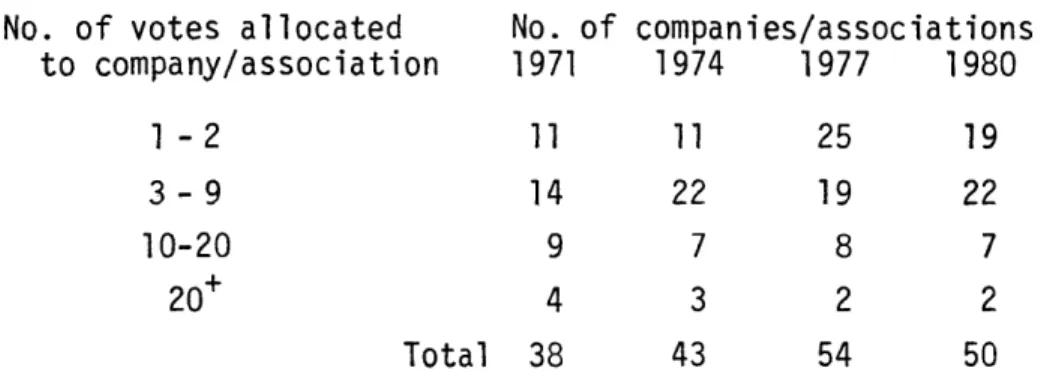
Table 1-1. DISTRIBUTION OF VOTING STRENGTH IN BCOA, BY YEAR OF CONTRACT NEOGTIATION*
No. of votes allocated No. of companies/associations to company/association 1971 1974 1977 1980 1 -2 11 11 25 19 3-9 14 22 19 22 10-20 9 7 8 7 20+ 4 3 2 2 Total 38 43 54 50
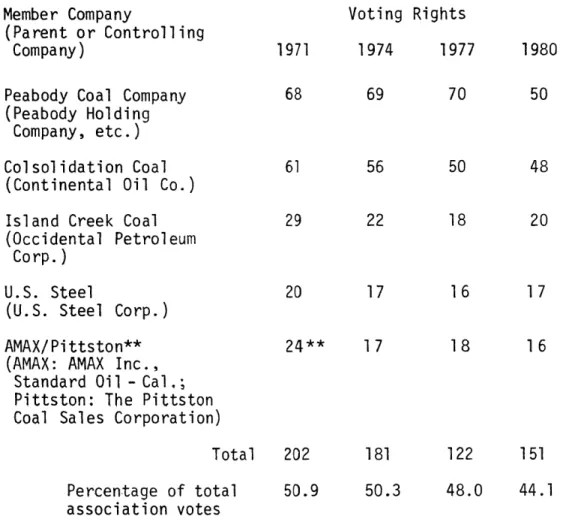
Table 1-2. VOTE ALLOCATION OF FIVE LARGEST MEMBERS IN BCOA BY YEAR OF CONTRACT NEGOTIATIONS*
Member Company
(Parent or Controlling Company)
Peabody Coal Company (Peabody Holding
Company, etc.) Colsolidation Coal (Continental Oil Co.) Island Creek Coal (Occidental Petroleum
Corp.) U.S. Steel
(U.S. Steel Corp.) AMAX/Pittston** (AMAX: AMAX Inc.,
Standard Oil - Cal.; Pittston: The Pittston Coal Sales Corporation)
Tot Percentage of total association votes 1971 Voting 1974 68 61 29 20 69 56 22 17 24** 17 al 202 50.9 181 50.3
* Based on previous year's production reported by member for dues paying purposes.
** In 1971, Pittston Was the fifth-largest coal producer in the BCOA. Thereafter,AMAX assumed this position.
In the first table, which traces the distribution of voting strength among BCOA members from 1971 to 1980, two significant shifts emerge. First, there are proportionately more companies in 1980 holding one or two votes than there were nearly a decade earlier. Of the fifty BCOA members listed for 1980, 19 or 38 percent are delegated only one or two votes in the Association, as compared with
Rights 1977 70 50 18 16 18 122 48.0 1980 50 48 20 17 16 151 44.1
29 percent in this category in 1971. This piece of evidence clearly suggests an increased diffusion of decision-making power toward the
smaller producers, whose representation grew within the Association during this period. However, since 1977, this trend appears to be reversing as the relative influence of companies in the 1 - 2 vote category has dropped substantially.
Second, the number of companies holding more than 20 votes has decreased by half, from four in 1971 to two in 1980, as shown in Table 2-1, suggesting that fewer companies today, both absolutely and as a percentage of total BCOA members, each control a block of votes greater than 20. A decline in the "over 20" vote category indicates that even though two firms that left this category were absorbed by the next smallest category, the voting strength of these "medium-sized"
companies stabilized rather than increased.
The second table depicts concentration of voting strength held by the largest firms in the industry. Nearly 45 percent of the total votes delegated to BCOA members in 1980 are controlled by the five largest producers. Of this heterogeneous group, only one (Peabody Coal Company) is a primary coal producer, and it is controlled largely by non-coal corporations, such as Peabody Holding Company, Equitable Life Insurance Society and Boeing Company. Moreover, the two largest coal producers, Peabody and Consolidation, together control nearly 30 percent of the entire membership's votes. The figures from Table 1-2 also illustrate that the vote allocation of leading coal producers since 1971 has declined steadily, from nearly 51 percent in 1971 to 44.1 percent in 1980. It is interesting to note the reason why the
faster rate between 1977 and 1980. The answer is clear that Peabody Coal is producing approximately 20 million tons less under the upcoming 1981 bituminous agreement than under the current 1977 wage contract.
Peabody has made up for this drop in production by increasing its Western (largely non-union) operations, which are not covered by the
National Bituminous Coal Wage Agreement (NBCWA) and therefore are not included in BCOA figures. A representative from a Southern West Virginia independent coal operator claims that Peabody is primarily a "western outfit" which "doesn't care about underground Eastern"
commercial development and therefore "has no business in negotiations." Data from the 1980 Keystone Coal Industry Manual confirm the operator's first point. Peabody operates approximately 45 active mines
in ten states, 8 of which lie in the West and Midwest (Arizona,
Arkansas, Colorado, Illinois, Indiana, Missouri, Montana, and Oklahoma). Moreover, only 30 percent of its total 1978 tonnage came from
underground mines (primarily in "eastern" areas of Kentucky and Ohio), with the large remainder from strip operations.31 The fact that
nearly one-quarter of the company's production will not be covered by the 1981 NBWA indicates a correlation between an increase in western surface operations and the growth of non-unionized (or at
least, non-UMW) mines.
The case of AMAX Coal, the third-largest coal producer and the fifth-ranking company in the BCOA, supports these findings more
clearly. Under the 1981 contract, more than half of this company's tonnage (54.2 percent) will not be governed by the provisions of the
NBCWA, 32 The collective bargaining implications presented by these trends point to three plausible alternatives: the mines not included
under the NBCWA will 1) continue to operate as non-certified (non-unionized), 2) be organized by other unions competing with the United Mine Workers, such as the Progressive Mine Workers in the West, or 3) as a consequence, will operate under separate contracts negotiated by the Union with individual member companies of the BCOA.
A central issue related to the voting privileges of the largest member companies is whether the influence of individual
"industry coalitions" during bargaining is proportionate to the
relative voting strength of these groups within the BCOA. Voting data compiled from BCOA records show that oil company owned and/or controlled producers account for 27.8 percent of the total votes allocated to organization members for 1980 business. Interestingly enough, the
second-largest coalition was comprised of "coal only" companies (which include regional coal producers' associations) with 19.0 percent, closely followed by steel members controlling 16.7 percent of total votes. Peabody Coal Company, which has 50 votes or 14.6
percent of the total, is treated separately from the "coal only" companies in this discussion because it is parented by seven (over-whelmingly non-coal) companies.
The 1980 BCOA bargaining team will consist of high-ranking company officials from U.S. Steel, Consolidation Coal, and Peabody Coal. Assuming for the moment that each company negotiator will
participate in the negotiations on an equal basis, and that U.S. Steel and Consol Coal represent the remaining steel and oil members in the
BCOA, respectively, it can easily be observed that their bargaining influence is disporportionate (inflated) to the respective voting strength of the companies in the Association. Moreover, because the
chief executive officers of these same companies will serve on an 11-member bargaining policy committee, their influence can be expected to increase. Of the 11 operator members with the largest wage
agreement production (based on 1977-79 average tonnage), three are chief executive officers of oil companies, three represent steel
members, and two come from primary metal companies. It is significant to note that the "coal only" companies with nearly one-fifth of the total Association tonnage receive no representation at all on the
bargaining committee and carry disporportionate (small) and indirect influence on the bargaining policy committee. This issue will be explored further in Chapter Six.
Implications
First, the evidence presented above indicates a gradual although not major dispersion of voting strength among the smallest producers. The distribution of one to two votes among additional companies creates a fragmentation of interests and weakened representation. This,
coupled with the relative stability (though divergent interests) of the companies controlling 3 to 20 votes (middle categories) makes the formation of a coalition for the purpose of block voting strength
unlikely. Second, the inequitable distribution of votes within the Association, reflecting shifts in the economic structure of the
indus-try, creates a potential setting for intraorganizational conflict, which surfaced during the 1978 contract talks, as will be discussed. Third, as the largest voting members within BCOA continue to expand their activities into western surface mines, this appears to be accom-panied by declining certification of tonnage under the NBCWA. In
other words, the NBCWA has an increasingly reduced role in the formal labor-management plans adopted by these companies. Most importantly, the shift to western surface mines (and often non-unionized operations) does not appear to weaken the political influence of the company
during national contract negotiations. Instead, it gives the owner greater independence and flexibility in choosing an appropriate set of labor-management policies. In short, as the bargaining stature of the largest firms expands in the West, it remains firm in the "eastern" negotiations. Thus, the probability of the NBCWA transforming into an "eastern" agreement becomes more likely, as companies find the current national bargaining structure an unattractive alternative for their new operations.
Finally, it has been demonstrated that the oil and steel coali-tions within the BCOA carry greater voting and bargaining privileges than their tonnage position would indicate. Since the voting rights of the largest five companies were not found to have increased from the 1971 negotiations to the present and since the bargaining influence of the steel and oil coalitions relative to "coal only" companies has remained fairly stable, two questions arise: Have the oil and steel member companies altered their long-standing preferences with regard to the appropriate structure of collective bargaining? Or, have these goals remained the same but changes in the "external" environment (including internal UMW operations) encouraged a more active pursuit of their implementation?
Support for the latter explanation is offered in the following chapter, which traces the United Mine Workers' historic advocacy of
multi-employer bargaining. In addition, the Union's overall declining power as a pre-condition of increased corporate control will be
Chapter 1 -- Notes
1. George W. Taylor, Government Regulation of Industrial Relations, Prentice-Hall Industrial Relations and Personnel Series (New York: Prentice-Hall, Inc., 1948), p. 25.
2. Jack Barbash, "Price and Power in Collective Bargaining," Journal of Economic Issues 11, no. 4 (December 1977): 848.
3. Lloyd G. Reynolds, Labor Economics and Labor Relations, 7th ed. (Englewood Cliffs: Prentice-Hall, Inc., 1978), p. 443.
4. Arnold R. Weber, ed., The Structure of Collective Bargaining, 3rd series (Chicago: The Free Press of Glencoe, Inc., 1961), p. vii.
5. Peter Henle, "Union Policy and Size of Bargaining Unit," in The Structure of Collective Bargaining, ed. Arnold R. Weber, p. 107.
6. Thomas A. Kochan, Collective Bargaining and Industrial Relations, The Irwin Series in Management and the Behavioral Sciences
(Homewood, Illinois: Richard D. Irwin, Inc., 1980), p. 86. 7. Ibid., p. 94.
8. Richard Hyman, Industrial Relations: A Marxist Introduction (London: Macmillan, 1975), p. 27.
9. Ralf Dahrendorf, Class and Class Conflict in Industrial Society (Stanford: Stanford University Press, 1959), p. 210.
10. Talcott Parsons, "The Distribution of Power in American Society," World Politics 10 (October 1957): 139.
11. Jack Barbash, "Collective Bargaining and the Theory of
Conflict," British Journal of Industrial Relations 18 (March 1980): 83. 12. For a well-documented account of merger and acquisition
activity in the coal industry, see Thomas C. Woodruff, "The Bituminous Coal Industry and the Structure of the Appalachian Labor Market"
(Ph.D. diss., Massachusetts Institute of Technology, 1974), chapter 6. 13. "The Oil Majors Bet on Coal," Business Week, 24 September 1979, p. 105.
14. Paul Ryan, Jr. and Thomas C. Ryan, An Analysis of Petroleum Company Investments in Non-Petroleum Energy Sources, Book I, prepared for U.S. Department of Energy (Washington, D. C.: U.S. Government Printing Office, December 1979), p. 28.
15. "Top 15 Coal Producing Groups in 1979," Keystone Coal Industry Manual (New York: McGraw Hill Mining Publications, 1980); p. 686.
16. "The 50 Biggest Bituminous and Lignite Mines in 1979," Keystone Coal Industry Manual, p. 687.
17. The historical information on coal development patterns in West Virginia was provided by Donald Hebb, tax analyst with the West Virginia Tax Department, interview, Charleston, West Virginia, July
1980.
18. Morton S. Baratz, The Union and the Coal Industry (New Haven: Yale University Press, 1955), p. 52.
19. Woodruff, "The Bituminous Coal Industry."
20. The President's Commission on Coal, Coal Data Book (Washing-tion, D. C.: U.S. Government Printing Office, 1980), p. 119.
21. "Salient Statistics U.S. Bituminous and Lignite," Keystone Coal Industry Manual, 1980, p. 685.
22. Keystone Coal Industry Manual, 1971 and 1980, p. 6 in each manual.
23. U.S. Department of Justice, Competition in the Coal Industry (Washington, D. C.: Government Printing Office, 1978), p. 57.
24. Martha A. Brannan, Market Shares and Individual Company Data for U.S. Energy Markets: 1950-1978, discussion paper prepared for the American Petroleum Institute (Washington, D. C., November 1979), p. 162.
25. U.S. Department of Justice, Competition, p. 63.
26. "The Coal Reserves Picture: Estimated Tonnages Held by Indi-vidual Firms," Keystone Coal Industry Manual, 1980, p. 706.
27. A. Gramsci, Selections from the Prison Notebooks (London: Lawrence and Wishart, 1971).
28. William W. Wimpisinger, "Pyramids of Wealth: A Threat to Labor Relations," in C. Steward Sheppard and Donald C. Carroll, eds., Working in the Twenty-First Century (New York: Wiley and Sons, 1980), p. 64.
29. Daniel T. Carroll, "What Future for the Conglomorates?" Harvard Business Review 47 (May-June 1969): 4.
30. The following discussion is based on an analysis of an internal document, "BCOA Membership Voting Rights" for 1971, 1974, 1977, 1980, provided by Morris Feibusch, Vice-President of Public Relations, BCOA, September 1980.
31. Keystone Coal Industry Manual, 1980, p. 866. 32. Keystone Coal Industry Manual, 1980, p. 808.
Chapter 2: The National Contract: A Source of Power for the United Mine Workers
The emerging conflict over the form of bargaining stucture in coal should be placed in larger contexts of 1) organizational change and 2) the historic place of the UMW in shaping collective bargaining in the coal industry. The significance of organizational change
suggests that two opposing movements appear to be developing simultane-ously. On the one hand, as new economic actors have entered the coal
industry, a shift to top-level, more centralized decision-making appears to have taken hold. On the other hand, the UMW has recently
experienced a period of internal "democratization". It is the collision of these two divergent movements that is contributing to the conflict over bargaining structure. A paradox emerges that as the actual power-holders within their respective organizations (the rank-and-file, increasingly, on the UMW side and the high-ranking executives on the corporate side) move into more visible and leading positions on the bargaining team, their resistance to each other's bargaining unit intensifies.
It is widely agreed upon by both industry and union observers that the Union has evolved into a more democratic organization, marked by the election of Arnold Miller as UMW president in 1972. Miller was a candidate running on a platform of the "Miners for Democracy" (MFD), a reform coalition that led to the ouster of former Union president Tony Boyle and which has since disappeared. At the 1973 UMW convention, a number of constitutional changes were passed by the participants, designed in part to "open up" the collective bargaining
process to the regular union membership. First, the rank-and-file gained the right to ratify the tentative agreement through written ballot in district elections. Previously, a Policy and Scale Committee had full authority to ratify the contract. This committee was made up of miners elected on a proportional basis of Union district membership. Second, a bargaining council, composed of union district
presidents and executive board members, was established. The
39-member council is authorized to approve or reject the tentative contract negotiated by the three-member bargaining team, as well as to assist the negotiators throughout the contract discussions. Third, district union officials would now be directly elected by the membership, breaking the past practice of presidential appointment. Fourth, in 1974, district bargaining conferences of local union representatives were held to formulate contract demands to be approved by the Union bargaining team.
All four reforms certainly hold meaning for the internal operating stability of the UMW, but also carry long-term effects for the collective bargaining relationship. For it is these very "reforms", under the umbrella of "democratization", that managers cite as the
cause of labor-management conflict today. D. Cook, chairman of American Electric Power, which owns and operates numerous mines, has claimed that "the new democracy is the new anarchy." These changes, which have contributed to the formation of a "new breed" of miner, have become a source of management opposition, partly because
increased solidarity and militancy will probably impede the BCQA's goal of making decentralized bargaining structures acceptable to the Union.
Industry officials are somewhat familiar with the UMW's historic role in influencing coal companies to adopt a national contract. Moreover, they understand the relationship between union organizational strength and industry-wide bargaining. The next
section will trace the circuitous course of collective bargaining in the coal industry from the birth of the UMW in the late 1800s. The following pages will show how central the achievement of the
national agreement became to the union's early successes in improving wages and working conditions.
The mine workers' achievement of national multi-employer bar-gaining in 1950 traces its history to the 1890s. The national contract
has historic importance in consolidating UMW power and continues to serve as an apogee for other unions as well. The pre-1950 period encompasses wide experience with regional competition and compacts,
pattern-setting arrangements, and above all, aggressive pursuance of industry-wide bargaining -- arrangements which, though set in a dif-ferent context, the UMW may be forced to accept once again.
During the last half of the 19th century, when ownership of coal rights was "widely decentralized and competition ruthless,"2 and when immigrants of many tongues and religions entered the coalfields, attempts at forming local and intrastate unions were very difficult.
In 1885, miners from seven states3 organized the first interstate labor association, the National Federation of Miners and Mine Laborers. The following year, this federation signed the first interstate
agreement on wages with operators from these same states and also reached agreement on the establishment of a Board of Arbitration and