HAL Id: cea-02435076
https://hal-cea.archives-ouvertes.fr/cea-02435076
Submitted on 10 Jan 2020HAL is a multi-disciplinary open access archive for the deposit and dissemination of sci-entific research documents, whether they are pub-lished or not. The documents may come from teaching and research institutions in France or abroad, or from public or private research centers.
L’archive ouverte pluridisciplinaire HAL, est destinée au dépôt et à la diffusion de documents scientifiques de niveau recherche, publiés ou non, émanant des établissements d’enseignement et de recherche français ou étrangers, des laboratoires publics ou privés.
J.-P. Grouiller, C. Coquelet, C. Venard
To cite this version:
J.-P. Grouiller, C. Coquelet, C. Venard. Plutonium recycling capabilities of ASTRID reactor. Inter-national Conference on Fast Reactors and Related Fuel Cycles: Next Generation Nuclear Systems for Sustainable Development (FR17), Jun 2017, Yekaterinburg, Russia. �cea-02435076�
Plutonium recycling capabilities of ASTRID reactor
Jean-Paul Grouiller, Christine Coquelet, Christophe Venard †
Commissariat à l'Energie Atomique et aux Energies Alternatives (CEA) / French Alternative Energies and Atomic Energy Commission - Nuclear Energy Division Cadarache Centre, 13108 – France
E-mail contact of main author: [email protected]
Abstract: Among the ASTRID’s main goals is the demonstration of a closed fuel cycle at industrial scale, in particular with the recycling of plutonium coming from the reprocessing of PWR-UOX and MOX fuels and also the MOX coming from ASTRID itself. Associated with the fuel cycle facilities, fabrication and reprocessing, the lessons learned from this industrial demonstration will be transposable to a commercial Sodium Fast Reactors (SFR) and the associated fuel cycle. The paper presents the capability of the ASTRID reactor with its innovative CFV core (low sodium void coefficient), to recycle Pu from the reprocessing of PWR-MOX fuels. The safety and performances goals assigned to the CFV core by the ASTRID project are maintained.
The impacts on the physic aspects linked to various initial characteristics (initial Pu content, decay heat), fuel subassemblies (fresh and spent) has been evaluated to identify the plutonium needs and the impact on the fuel management (interim storage, handling) and on its associated fuel cycle (transport, facilities).
1. Introduction
ASTRID (Advanced Sodium Test Reactor for Industrial Demonstration) is a technology demonstrator of a 4th generation Sodium Fast Reactor (SFR) system with an electric power of about 600 MWe. The general objectives of ASTRID must therefore ensure a level of safety at least equivalent to that of 3th generation reactor like EPR reactors and take into account the lessons learnt from the accident in Fukushima. It will test the options and strengthened safety provisions strengthened to prepare the fast neutron reactor system. The ASTRID innovations are designed to meet these objectives towards safety, but also to demonstrate significant progress in terms of operability and availability. In the nuclear island, the innovations consist in particular in a new design of the reactor core, named “CFV” core. This concept, featuring a very low void reactivity effect, makes it possible to render the core naturally resistant to accidental transients.
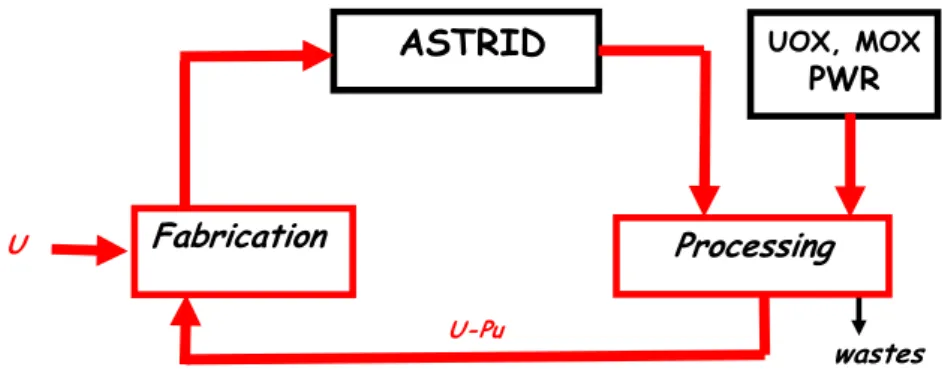
One of the strengths of the SFR is the ability to use, without limitation, the plutonium produced by PWRs or by themselves (Figure 1) and to ensure hence a sustainable plutonium management by using its energy potential, and by reducing its presence in the final waste. At the beginning of the basic design phase of the project, the concept of the ASTRID core supposes recycled Pu to be from the reprocessing of the PWR (MOX) fuel for the first core at the equilibrium cycles.
The paper presents the “CFV BD 16/10” core, its performances and the physical characteristics of the fresh and spent fuel containing Pu from MOX-PWR fuels.
†
Figure 1: closed fuel cycle for ASTRID
2. Lay-out of the “CFV BD 16/10” core
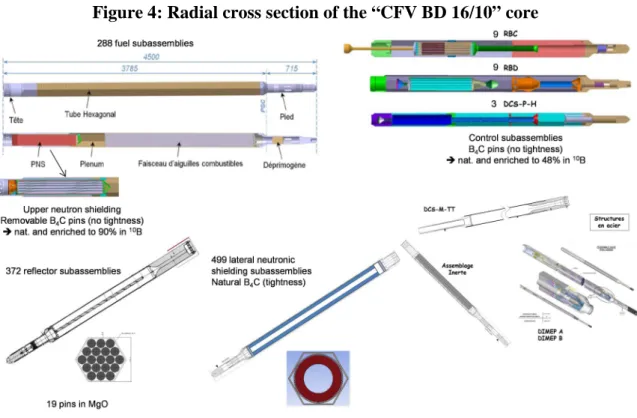
The design of the ASTRID core is guided by safety objectives. One of the foremost safety objectives is to obtain a negative reactivity coefficient in the case of voiding of the sodium, in order to position the concept in a very favorable way to possible accidents in which the loss of primary coolant flow is lead to an increase in the temperature of the primary sodium. The design is furthermore aiming for a low loss of reactivity during the cycle, what is beneficial regarding the consequences of an inadvertent control rod withdrawal. This core concept with a low void effect, called CFV [1], (Figure 2) is based on a heterogeneous axial fuel zone a sodium plenum above the active zone and a superior neutron protection (PNS) composed of B4C pins (Figure 3). The active zone of the core has a “crucible” shape, with a 80 cm high
inner core (60 cm fissile) and a 90 cm high outer zone. An internal fertile UO2 zone (height 20
cm) is inserted in the inner core. An inferior fertile blanket (30 cm) assures a breeding gain close to 0. The fuel material is (U, Pu)O2, for which there is an extensive positive experience.
Figure 2: RZ cut of the CFV core
Figure 3: Fuel subassembly
ASTRID Fabrication U U-Pu wastes Processing UOX, MOX PWR PNS
The safety and performance goals assigned to the CFV core by the ASTRID project can be synthesized as follows:
• a favorable natural behavior, possible assisted by some Complementary Safety Provisions (DSC-P) during Unprotected Loss Of Flow (ULOF) transients to avoid sodium boiling with sufficient margins or an unprotected Control Rod Withdrawal (CRW) with a criterion of "0% molten fuel",
• a negative sodium void effect,
• a search for the best performance in terms of fuel burn-up and S/A residence time. The configuration of the “CFV BD 16/10” core incorporates the conclusions and recommendations of the various reviews that occurred at the end of the conceptual design phase:
• Innovative architecture of the control and shutdown rods called “RID” architecture. This architecture is composed of 2 kinds of rods, RBC (control and shutdown device) and RBD (diverse control and shutdown device). They both manage the core reactivity during the cycle of irradiation. Three RBC contribute to the power regulation.
• Complementary safety provisions for prevention (DCS-P) and mitigation (DCS-M) for severe accidents have been implemented in the core: three hydraulic absorber rods DCS-P on decreased flow (DCS-P-H) and 21 crossing pipes DCS-M (DCS-M-TT).
• Lateral neutron shielding provided by 11 S/As rows with MgO S/As and B4C S/As. • B4C upper neutron shielding pins, the lower part of which is enriched to 90% in 10B to
provide a negative sodium void coefficient.
• Introduction of an internal storage for spent fuels and debugging positions for the fuel with cladding failure.
• 5 slab penetrations for experimental devices
At the beginning of the Basic Design phase, some evolutions are taken into account in the core design, compared to the core at the end of the conceptual design phase [2].
The most significant are:
• The first experimental results on pins with AIM1 cladding irradiated in the Phenix reactor, lead us to define the fuel residence time for the first equilibrium phase with AIM1 cladding to 1080 EFPD,
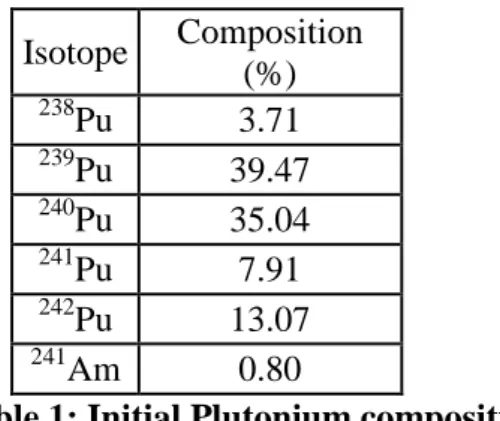
• An initial Pu originating from spent MOX PWR fuels (table 1)
• An external buffer zone [3] with a handling ramp to load and unload the subassemblies in the core.
Isotope Composition (%) 238 Pu 3.71 239 Pu 39.47 240 Pu 35.04 241 Pu 7.91 242 Pu 13.07 241 Am 0.80
Table 1: Initial Plutonium composition
The Pu of the “CFV BD 16/10” core is supposed to come from PWR MOX fuel reprocessing. The selected composition is a fifty-fifty mix of Pu originating from MOX fuel:
• With a burn up of 40 GWd/t and a cooling time of 27 years before reprocessing,
We suppose an aging time of 2 years between the fuel reprocessing and the core divergence. Figure 4 shows a radial cross section of the “CFV core BD 16/10” core with different areas for the equilibrium management. Different types of S/As are illustrated on Figure 5.
Figure 4: Radial cross section of the “CFV BD 16/10” core
3. The main performances of the “CFV BD 16/10” core
Calculations were performed with the CEA's reference code system:
• ERANOS [4,5] for neutronic,
• DARWIN [6] for physic of fuel cycle.
The “CFV BD 16/10” core, cladded with AIM1, is managed with 4 batches of fuel S/As, 45 from the inner core and 27 from the outer core.
• The fuel residence time is 1080 EFPD and the equilibrium cycle length is 270 EFPD.
• A load factor of 86% including inter cycles stops, and risks lead to a cycle length of 314 calendar days,
• The Pu enrichment in the fuel is determined to meet a reactivity criteria of 490pcm at the end of cycle, taking into account margins for fine control and uncertainties on reactivity calculations. Considering the Pu-quality cited above, the reactivity loss per day amounts to approx. 1.3 pcm/day.
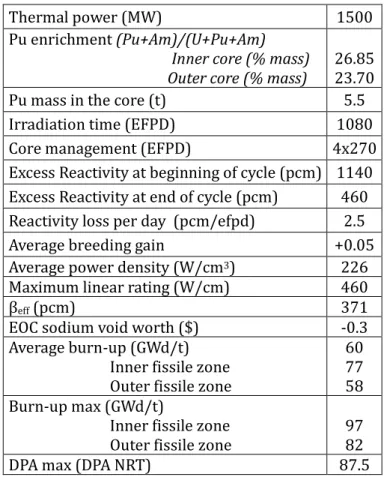
The main neutronic performances are presented in Table 2. Supposing the MOX-PWR Pu, the “CFV BD 16/10” core with AM1 cladding, complies with the performance requirements of the ASTRID specifications in terms of fuel residence time, fuel cycle length, average discharge burn-up, breeding gain and a negative sodium void worth.
Thermal power (MW) 1500
Pu enrichment (Pu+Am)/(U+Pu+Am)
Inner core (% mass) Outer core (% mass)
26.85 23.70 Pu mass in the core (t) 5.5 Irradiation time (EFPD) 1080 Core management (EFPD) 4x270 Excess Reactivity at beginning of cycle (pcm) 1140 Excess Reactivity at end of cycle (pcm) 460 Reactivity loss per day (pcm/efpd) 2.5 Average breeding gain +0.05 Average power density (W/cm3) 226 Maximum linear rating (W/cm) 460 βeff (pcm) 371 EOC sodium void worth ($) -0.3 Average burn-up (GWd/t) Inner fissile zone Outer fissile zone 60 77 58 Burn-up max (GWd/t) Inner fissile zone Outer fissile zone 97 82 DPA max (DPA NRT) 87.5
Table 2: main performances of the “CFV BD 16/10” core
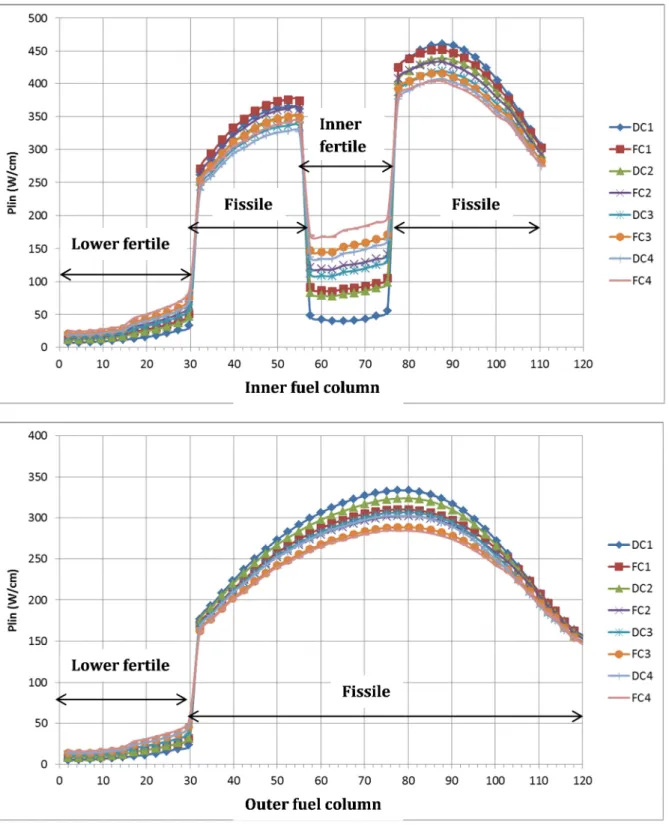
Figure 6 shows the evolution of the linear power in a central pin at the beginning and the end of each cycle (DCx and FCx), for the S/As in the inner and outer core. The maximum linear
power is around 460 W/cm in the inner core and 380 W/cm in the outer core. The power in the fertile inner plate increases about a factor 3.5 on 1080 EFPD.
Figure 6: Axial linear power
4. The material balance
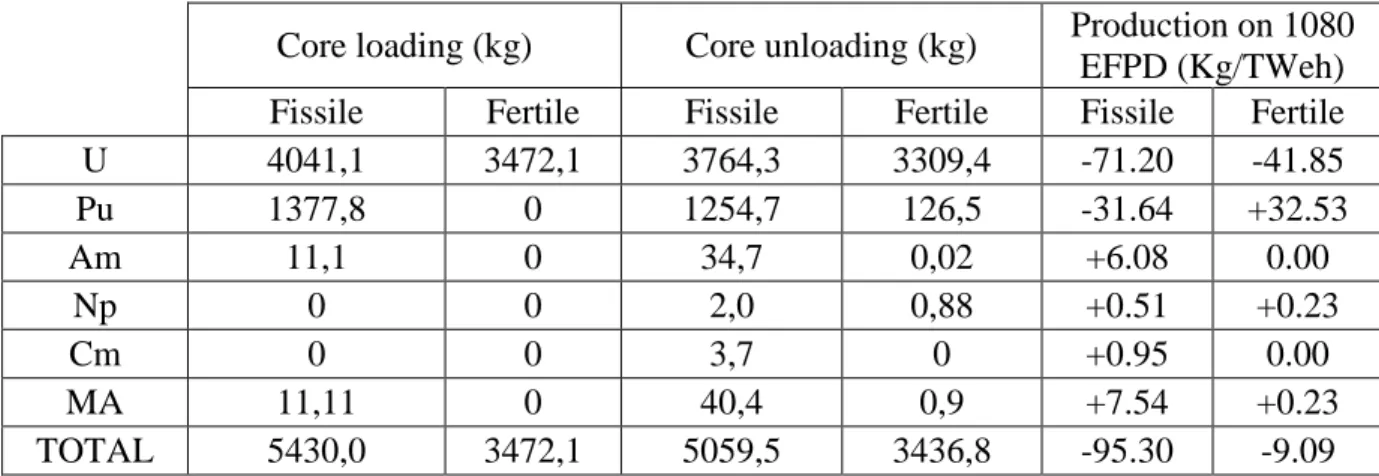
The actinides balance for the reload (45 S/As from the inner core and 27 from the outer core) is given in the table 3.
Core loading (kg) Core unloading (kg) Production on 1080 EFPD (Kg/TWeh) Fissile Fertile Fissile Fertile Fissile Fertile U 4041,1 3472,1 3764,3 3309,4 -71.20 -41.85 Pu 1377,8 0 1254,7 126,5 -31.64 +32.53 Am 11,1 0 34,7 0,02 +6.08 0.00 Np 0 0 2,0 0,88 +0.51 +0.23 Cm 0 0 3,7 0 +0.95 0.00 MA 11,11 0 40,4 0,9 +7.54 +0.23 TOTAL 5430,0 3472,1 5059,5 3436,8 -95.30 -9.09
Table 3: Mass balance of Actinides for 1 reload batch
During the equilibrium phase the needs in plutonium are around 1.6 t/year for fabricate one reload batch of the “CFV BD 16/10” core.
4.1.The physic characteristics for the fresh fuel
The thermal power of the fresh S/As is one of the necessary data for handling and storage designs in the fabrication facility and on the ASTRID facility. It is also a key data for the design of transportation packing.
The thermal power of the fresh S/As of the “CFV BD 16/10” core is around:
• 440 W for the S/As in the inner core,
• 580 W for the S/As in the outer core,
The thermal power represents about 25.4 W/kg of Pu; 238Pu contributes to 80 % of that thermal power. At the equilibrium phase, the capacity of fresh fuel storage is dimensioned for one reload [3]; in the case of the “CFV BD 16/10” core, the thermal power of that storage is around 35 kW.
4.2.The physic characteristics for the spent fuel
Table 4 gives the average isotopic composition of the Plutonium in a spent reload batch after 1080 EFPD. Compared to the Pu from MOX PWR fuel (table 1), we note an increase of the Pu fissile content after the first recycling in the “CFV BD 16/10” core.
Isotope Composition (%) 238 Pu 2.68 239 Pu 45.83 240 Pu 33.63 241 Pu 6.01 242 Pu 11.86
Table 4: Average Pu composition in the spent reload batch
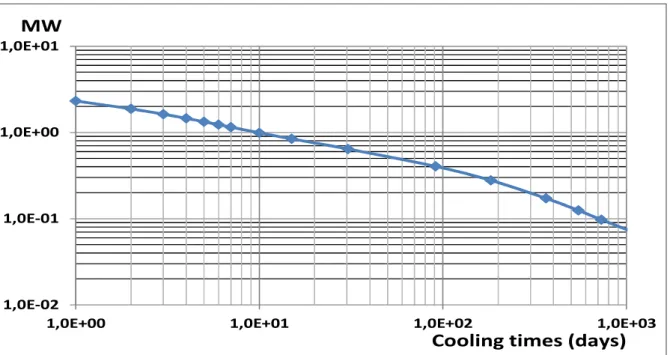
Figure 7 shows the decay heat, without uncertainties, of the “CFV BD 16/10” core at end of cycle in the equilibrium phase. Uncertainties at 1 σ currently selected for the decay heat of spent fuels are:
- 20% for the cooling times below 10 seconds, - 10% for the cooling times above 10 seconds.
After ten days of cooling, the decay heat of the core is around 4.0 MW with an uncertainty (1
σ) of 10% for that cooling time.
Figure 7: Decay heat of the “CFV BD 16/10” core
Figure 8 shows the decay heat, without uncertainties, of one reload batch (72 S/As) of the “CFV BD 16/10” core after 1080 EFPD. This curve represents the decay heat of the reload batch placed in internal storage. After 1 cycle (314 days with a load factor 0.86) in internal storage, the decay heat, with 10% of uncertainties, of the reload batch is around 220 kW. At this time, the average decay heat of the used S/As is lower than 3.0 kW.
Figure 8: Decay heat of the reload in internal storage
1 10 100
1,0E-08 1,0E-07 1,0E-06 1,0E-05 1,0E-04 1,0E-03 1,0E-02 1,0E-01 1,0E+00 1,0E+01 1,0E+02
MW
Cooling time (days)
1,0E-02 1,0E-01 1,0E+00 1,0E+01
1,0E+00 1,0E+01 1,0E+02 1,0E+03
MW
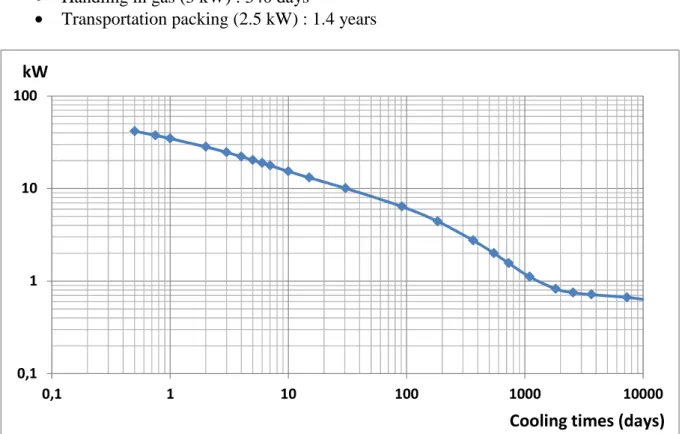
Figure 9 shows the decay heat profile maximum, without uncertainties, of spent S/As after 1080 EFPD. The limits of decay heat for the different handlings of maximum spent S/As give cooling times the following minimum:
• Handling in sodium (40 kW) : 1 day
• Handling in gas (3 kW) : 340 days
• Transportation packing (2.5 kW) : 1.4 years
Figure 9: Decay heat of the spent S/As fuel “CFV BD 16/10”
5. Conclusion
One of the ASTRID’s main goals is to demonstrate a full fuel cycle closing at industrial scale; in particular with the recycling of plutonium coming from the reprocessing of the MOX fuels from PWRs. The safety and performances goals assigned to the core by the ASTRID project are maintained with that Pu in the “CFV Basic Design 16/10” core for the first core equilibrium phase of ASTRID. Physic impacts linked to various aspects, Pu content, decay heat, for fuel subassemblies (fresh and spent) have been evaluated to identify the plutonium needs and the impacts on ASTRID fuel management (interim storage, handling). The results show the capability of the ASTRID reactor with its innovative CFV core (low void sodium worth), to recycle Pu from the reprocessing of MOX fuels of PWR, during its operation. 0,1 1 10 100 0,1 1 10 100 1000 10000 kW
Acknowledgments
The authors wish to thank all the teams involved in the core design at the CEA.
References
[1] P. SCIORA et al., “Low void effect core design applied on 2400 MWth SFR reactor” Proc. of ICAPP 2011-Nice, France, May 2-5, 2011 - Paper 11048
[2] C. VENARD et al., “The ASTRID core at the end of the conceptual design phase” Proc. of FR’17- Yekaterinburg, Russian Federation, June 26-29
[3] F. DECHELETTE et al. “ASTRID fuel handling for Basic design” Proc. of FR’17- Yekaterinburg, Russian Federation, June 26-29
[4] G. RIMPAULT et al., "The ERANOS code and data system for fast reactor neutronic analyses" Proc. Int. Conf. on Physics of reactors, Seoul, Korea, 2002
[5] R. LE TELLIER et al., "High-order discrete ordinate transport in hexagonal geometry: a new capability in ERANOS" – 21st Int. Conf. on Transport Theory (ICTT-21), Torino, Italy, 2009
[6] L. SAN FELICE et al., “Experimental validation of the DARWIN 2.3 package for fuel cycle applications” - Nuclear Technology, V184, N2, 2012
Nomenclature
ASTRID: Advanced Sodium Technological Reactor for Industrial Demonstration BD: Basic Design
CFV: "Coeur à Faible Vidange" Low Sodium void Core DCS: Safety complementary device
DCS-P: Prevention Safety complementary device DCS-P-H: hydraulic trigger DCS on flow decrease DCS-M: Mitigation Safety complementary device DCS-M-TT: Crossing pipe DCS-M
EBZ: External Buffer Zone EFPD: Equivalent Full Power Day IS: Internal Storage
LNP: Lateral Neutronic Protection MA: Minor Actinides
PNS: Superior Neutronic Protection PWR : Pressurized Water Reactor RBC: Control and shutdown device
RBD: Diverse control and shutdown device S/As: Subassembly