HAL Id: hal-01576420
https://hal.archives-ouvertes.fr/hal-01576420
Submitted on 23 Aug 2017
HAL is a multi-disciplinary open access
archive for the deposit and dissemination of
sci-entific research documents, whether they are
pub-lished or not. The documents may come from
teaching and research institutions in France or
abroad, or from public or private research centers.
L’archive ouverte pluridisciplinaire HAL, est
destinée au dépôt et à la diffusion de documents
scientifiques de niveau recherche, publiés ou non,
émanant des établissements d’enseignement et de
recherche français ou étrangers, des laboratoires
publics ou privés.
Supramolecular Chemistry for Pressure Sensitive
Adhesives ?
Xavier Callies, Cécile Fonteneau, Cyril Vechambre, Sandrine Pensec, Laurent
Bouteiller, Guylaine Ducouret, Costantino Creton, J.-M. Chenal, Laurent
Chazeau
To cite this version:
Xavier Callies, Cécile Fonteneau, Cyril Vechambre, Sandrine Pensec, Laurent Bouteiller, et al..
Supramolecular Chemistry for Pressure Sensitive Adhesives ?. The 2013 Annual Meeting of the
Ad-hesion Society, Mar 2013, Daytona Beach, United States. �hal-01576420�
Supramolecular Structure for Pressure Sensitive Adhesives
X. Callies
a, C. Fonteneau
b, C. Véchambre
c, S. Pensec
b, L. Bouteiller
b, G. Ducouret
a, C. Creton
a,
J-M. Chenal
c, L. Chazeau
ca
Laboratoire SIMM, CNRS, UPMC, ESPCI, 10 rue Vauquelin, Paris, 75005, France
bLaboratoire LCP, UPMC, 3 rue Galilée, Ivry sur Seine, 94200, France
cLaboratoire MATEIS, CNRS, INSA Lyon, 7 avenue Jean Capelle, Villeurbanne, 69100, France
[email protected]
Introduction
The elaboration of self-healing materials recently showed the great potential of supramolecular chemistry in material science. While these materials are clearly non flowing solids, reversible interactions give a high mobility to the molecular structure and thus make self-repair possi-ble1. While many industrial Pressure Sensitive Adhesives (PSA) can contain this kind of interaction in their structure (acrylic acid), our research project aims to elaborate soft adhesive materials with short polymer chains functional-ized with strongly interacting moieties. Unlike standard PSA, the viscoelastic properties of these systems would be neither due to entanglements, nor cross linker density but would depend mainly on the strength of the reversible interactions and the molecular structure.
The study of the rheological, structural and adhesive properties of model linear poly(butylacrylate) (PnBA) polymers functionalized in the middle by a polar core will be shown and discussed. By changing the length of our polymer chain, our samples showed a high diversity of rheological behavior and above all, showed promising adhesive properties for future supramolecular soft adhe-sives.
Experimental
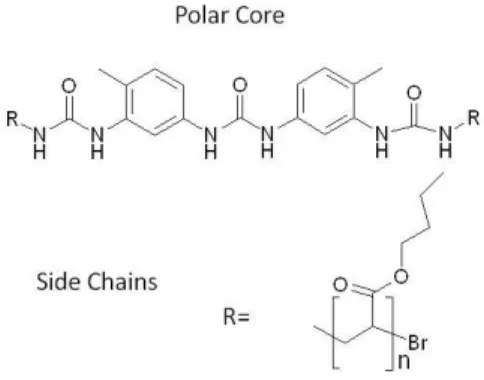
Supramolecular Adhesives were synthesized by a functional initiator approach. First self-assembling com-pounds bearing several urea groups and two carbon-halogen moieties were prepared. In a second step these compounds were used as initiator for the ATRP polymeri-zation of n-butyl acrylate. Therefore, several poly-n-butyl acrylates of known molecular weight and with various polar cores were obtained. A typical structure is shown on Figure 1. The nature of the polar core is inspired by the study on bis-urea functionalized poly(isobutylene) (PIBUT) which shows surprising adhesive properties on low-energy surfaces2. The polar cores are expected to interact with each other by hydrogen bonds.
Dynamic rheological measurements were performed on a strain-controlled rheometer ARES LS1 from TA In-struments equipped with a plate-plate geometry (diameter 8,0 mm, gap 0,8 mm). Frequency sweeps were carried out in the linear viscoelastic regime at 25°C.
Fig 1: Example of polar core used in this study. The tri-urea functionalized core is linked to two linear poly-n-butyl acrylates (R). The degree of polymerization changes from one sample to another.
The Small Angle X-ray Scatter (SAXS) experiments were conducted on a device equipped with a copper rotat-ing anode (λ = 1.54 Å) (Rigaku Corporation, Tokyo, Ja-pan), a Gobel’s mirrors collimation system (ELEXIENCE, Verrières le Buisson, France) and a two-dimensional de-tector (Princeton Instrument SCX2D, Trenton, NJ, USA). The distance between sample and detector was set at 550 mm. The maximum scattering peak (qmax) allows to
calcu-late the long period (Lp) with Lp = 2Π/qmax.
Probe tack experiments were performed on our cus-tom-designed probe tester allowing to observe the debond-ing process through the transparent glass substrate. The probe was brought into contact with the adhesive layer at 10μm/s until a set compressive force was reached. After 10s, the probe was removed at 100μm/s.
Results and Discussion
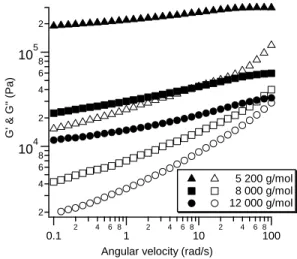
The linear rheology characterization of the samples showed two regimes depending on PnBA molecular weight. For the molecular weights between 5 500g/mol and 20 000g/mol the response was similar to that of an elastic gel while the response of a viscoelastic fluid is obtained for higher Mw. This evolution of viscoelastic properties with the length of the side chain could be ex-plained by the level of self-assembly of the polar cores and thus by the presence of a physical network in the bulk matrices.
At low molecular weight, the polar core concentration is high enough to observe an elastic plateau at room tem-perature in the experimental range of frequencies. When the length of the side chains increases, the polar cores concentration decreases and the H-bond network becomes less dense. This would account for the decrease of the elastic plateau when the molecular weight increases as shown on Figure 2.
Fig 2: Linear rheology curves at 25°C for three low mo-lecular weight poly-n-butyl acrylates functionalized with a tri-urea core. The storage modulus G’ is represented by filled markers and the loss modulus G’’ by unfilled mark-ers.
Fig 3: Linear rheology curves at 25°C for two high molec-ular weight poly-n-butyl acrylates functionalized with a tri-urea core. The storage modulus G’ is represented with filled markers, the loss modulus with unfilled markers.
Beyond 40 000g/mol, the H-bond network is not dense enough to prevent samples from flowing at low frequency. This flowing ability is characterized by the fact that the viscous modulus G’’ is higher than the elastic modulus G’ at low frequency. However the evolution of the elastic and viscous moduli with frequency for our supramolecular polymers is quite different than for non functionalized
poly(butylacrylate). G’ α ω0,80 and G’’ α ω0,76 are observed for our two highest molecular weight whereas Maxwell-like polymers would show G’ α ω and G’’ α ω2 at low
frequency. This non Newtonian behavior would be due to the interactions between polar cores which form a very diluted network in the bulk matrices.
It is worth saying that the transient entanglement net-work of poly(butyl acrylate) chains have only an influence on the rheological properties of the highest molecular weights (Mw>40 000g/mol). It would account for the presence of a crossing point between the G’ and G’’ curves at high frequency as well as for the viscosity increase with the molecular weight. However, as the molecular weight between entanglements3 for poly(butylacrylate) is close to 30 000g/mol, the elasticity of our shortest functionalized polymers is only due to the H-bond network.
As shown in Fig 4, nanoscale supramolecular organi-zation at low molecular weight is highlighted by SAXS experiments which allows to measure a characteristic dis-tance of the self-assembly of the polar cores. Beyond 40 000g/mol, no Bragg peak is observed. This could be explained either by the disappearance of a long range H bonded organization or by the dilution of the H-bonded network.
Fig 4: Halo observed in SAXS experiment for poly-n-butyl acrylates functionalized with a tri-urea core, Mw=5200g/mol. The Bragg peak at 1.05nm-1 corresponds to a characteristic distance of 6nm.
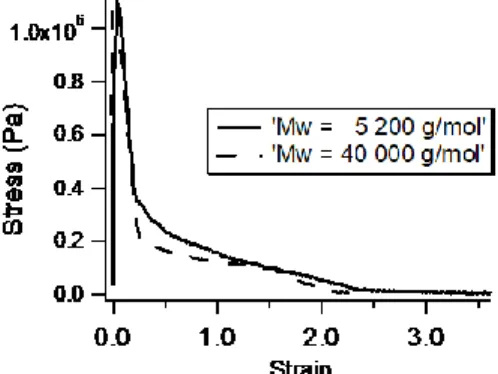
In probe-tack experiments, the experimental curves σ=f(ε) observed for our systems are similar to typical PSA responses. The stress peak due to the nucleation of bubbles at very small strain is followed by a stress plateau which characterizes the mechanical response of the fibrils at high strain. The stress peak doesn’t only depend on the rheolo-gy of the samples but also on several physical parameters such as the adhesive thickness and the cleanliness of the steel probe. That’s why the main differences between our supramolecular adhesives are contained in the plateau following the initial peak.
As it is observed in Fig 5, the shoulder after the stress peak and the stress plateau are higher as the molecular weight decreases. The fibrils become stiffer as the supra-molecular network becomes denser. However the strain at failure is quite similar for all molecular weights. These results reveal softening mechanisms at high strain for our supramolecular systems. This could be due to the relaxa-tion of the stress by the hydrophobic side chains or an orientation of the supramolecular aggregates.
2 4 6 8 104 2 4 6 8 105 2 G ' & G '' ( P a) 0.1 2 4 6 81 2 4 6 810 2 4 6 8100
Angular velocity (rad/s)
5 200 g/mol 8 000 g/mol 12 000 g/mol 6 103 2 4 6 104 2 4 6 105 G ' & G '' ( P a) 0.1 2 4 6 8 1 2 4 6 8 10 2 4 6 8 100 Angular velocity (rad/s)
57 000 g/mol 85 000 g/mol
Fig 5: Probe tack curves at room temperature for two dif-ferent poly-n-butyl acrylates functionalized with a tri-urea core. The thickness of the adhesive layer is 100μm and the probe is removed at 100μm/s.
However, our adhesives are different from commer-cial adhesives since our supramolecular polymers don’t show strain hardening at high strains. A cohesive failure is observed for all our samples. When debonding, cracks propagate through the adhesives layer and some pieces of adhesive remain on the stainless steel probe. Further im-provement would require additional strain hardening mechanisms. Our model PSA are however fully soluble.
Conclusions
We showed that the rheological behavior of linear poly(butylacrylate) chains functionalized in the middle by a specific polar core depends on the polar core concentra-tion in the bulk matrices. For low molecular weights of the PnBA and hence high concentration of polar cores, an elastic gel behavior is observed and this is possibly due to a supramolecular network through the matrix. At high molecular weight, this network is diluted and samples are highly viscoelastic liquids. Unlike rheology results, all samples show similar adhesive properties. Even if the supramolecular network allows to increase the level of the plateau, cracks still propagates in the adhesive layer and the failure is cohesive.
Acknowledgements
We thank CNRS, UPMC and ESPCI for technical support and the French ANR program (ANR-10-BLAN-0801-01 Supradhesion) for financial support.
References
1. P. Cordier, F. Tournilhac, C. Soulié-Ziakovic and L. Leibler, Nature, 2008, 451, pp 977-980.
2. J. Courtois, I. Baroudi, N. Nouvel, E. Degrandi, S. Pensec, G. Ducouret, C. Chaneac, L. Bouteiller and C. Creton, Adv. Funct. Materials, 2010, 20, pp 1803-1811.
3. N. Jullian, F. Leonardi, B. Grassl, J. Peyrelasse and C. Derail, Applied Rheology, 2010, 20, pp 33685