A framework to introduce flexibility
A framework to introduce flexibility
A framework to introduce flexibility
A framework to introduce flexibility
in crop modelling
in crop modelling
in crop modelling
in crop modelling::::
ffffrom conceptual model
rom conceptual model
rom conceptual modellllling
rom conceptual model
ing
ing
ing
to software engineering
to software engineering
to software engineering
to software engineering and back
and back
and back
and back
Myriam ADAM Myriam ADAMMyriam ADAM Myriam ADAMThesis committee Thesis committeeThesis committee Thesis committee
Thesis supervisors Thesis supervisorsThesis supervisors Thesis supervisors
Prof. dr. ir. H. Van Keulen
Professor at the Plant Production Systems Group Wageningen University
Prof. dr. J. Wery
Professor of Agronomy at Montpellier SupAgro Director of “Unité Mixte de Recherche” System #1230 CIRAD-INRA-Supagro, Cedex, France
Thesis co Thesis coThesis co
Thesis co----supervisorsupervisorsupervisorsupervisorssss Prof. dr. F.A. Ewert Professor of Crop Science
Institute of Crop Science and Resource Conservation (INRES) University of Bonn, Germany
Dr. ir. P.A. Leffelaar
Associate Professor at the Plant Production Systems Group Wageningen University
Other members Other membersOther members Other members
Prof. dr. ir. G. Van Straten, Wageningen University Prof. dr. H.B.J. Leemans, Wageningen University
Dr. ir. H. Hengsdijk, Plant Research International, Wageningen Dr. H. Scholten, Wageningen University
This research was conducted under the auspices of the C.T. De Wit Graduate School of Production Ecology and Resource Conservation.
A framework to introduce flexibility
A framework to introduce flexibility
in crop modelling
in crop modelling
in crop modelling
in crop modelling::::
from conceptual modelling
to software engineering and back
Myriam ADAM Myriam ADAMMyriam ADAM Myriam ADAM Thesis Thesis Thesis Thesis
submittted in fulfilment of the requirements for the degree of doctor at Wageningen University
by the authority of the Rector Magnificus Prof. dr. M.J. Kropff
in the presence of the
Thesis Committee appointed by the Academic Board to be defended in public
on Friday 22 October 2010 at 1:30 p.m. in the Aula
Myriam ADAM
A framework to introduce flexibility in crop modelling: from conceptual modelling to software engineering and back
190 pages
Thesis, Wageningen University, Wageningen, NL (2010)
With references, with summaries in English, Dutch and French
This thesis is an account of the development and use of a framework to introduce flexibility in crop modelling. The construction of such a framework is supported by two main beams: the implementation and the modelling beam. Since the beginning of the 1990s, the implementation beam has gained increasing attention in the crop modelling field, notably with the development of APSIM (Agricultural Production Systems sIMulator) in Australia, OMS (Object Modelling System) in the United States, and APES (Agricultural Production and Externalities Simulator) in Europe. The main focus of this thesis is on the modelling beam and how to combine it with the
implementation beam. I first explain how flexibility is adopted in crop modelling and what is required for the implementation beam of the framework, namely libraries of modules representing the basic crop growth and development processes and of crop models (i.e. modelling solutions). Then, I define how to deal with this flexibility (i.e. modelling beam) and more specifically I describe systematic approaches to facilitate the selection of the appropriate model structure (i.e. a combination of modules) for a specific simulation objective. While developing the framework, I stress the need for better documentation of the underlying assumptions of the modules and of the criteria applied in the selection of these modules for a particular simulation objective. Such documentation should help to point out the sources of uncertainties associated with the development of crop models and to reinforce the role of the crop modeller as an intermediarybetween the software engineer, coding the modules, and the end users, using the model for a specific objective. Finally, I draw conclusions for the prospects of such a framework in the crop modelling field. I see its main contribution to (i) a better understanding in crop physiology through easier testing of alternatives hypotheses, and (ii) integrated studies by facilitating model reuse.
Keywords KeywordsKeywords
Keywords: model structure, uncertainty, modularity, software design patterns, good modelling practices, crop growth and development.
Abstract v
Chapter 1 General Introduction 1
Chapter 2 Software engineering techniques:
the implementation beam of the framework 11
Chapter 3 Systems analysis:
the modelling beam of the framework 35
Chapter 4 Criteria of selection: data availability and scale 61
Chapter 5 Criteria of selection: crop type 89
Chapter 6 General Discussion 117
References 133 Appendices 147 Summary 159 Samenvatting 165 Résumé 171 Glossary 177 Acknowledgements 179 Curriculum vitae 181 List of publications 183
PE&RC education Statement form 187
Funding 190
CHAPTER 1CHAPTER 1CHAPTER 1CHAPTER 1
3
1. Crop modelling, the Wageningen crop models and their (re)use
1. Crop modelling, the Wageningen crop models and their (re)use
1. Crop modelling, the Wageningen crop models and their (re)use
1. Crop modelling, the Wageningen crop models and their (re)use
Modelling is a way to simplify a system. A system is defined as a part of reality that contains interacting components. Crops are populations of plants of which the growth is managed by humans for any of various uses they may have for (parts of) these plants. Crop modelling is a way to simplify the part of reality (i.e. system) known as a crop.
At first, crop models were mainly developed to increase understanding of the basic processes of crop growth and development. Taking the crop models developed at Wageningen University over the years as a reference, good examples of such models are ELCROS (Elementary CROp growth Simulator, De Wit et al., 1970), BACROS (BAsic CROp growth Simulator, De Wit, 1978), and SUCROS (Simple and Universal CROp growth Simulator, Van Keulen et al., 1982). Subsequently, the focus in
modelling became more application-oriented and models were developed to increase understanding of the degree to which the main biotic and abiotic factors constrain crop yields. Among the Wageningen crop models, an example of such a model is WOFOST (WOrld FOod STudies, Van Keulen and Wolf, 1986), which is still used for yield forecasting in the European Union (e.g. in the MARS project, Monitoring
Agricultural ResourceS, http://mars.jrc.it/).
The increasing number of applications resulted in the development of a multitude of different models, and soon the need was felt to combine different models in one single framework for handling the modelling and analysis needs of different cropping
systems in different environments. Two examples of such simulation frameworks are DSSAT (Decision Support System for Agrotechnology Transfer, Jones et al., 2003) and APSIM (Agricultural Production systems SIMulator, Keating et al., 2003). They
provide structures to easily incorporate new models and to enable the simulation of different crops. So far, no such framework can be identified within the pedigree of crop growth simulation models of Wageningen’s “School of De Wit” (Bouman et al., 1996; Van Ittersum et al., 2003).
Finally, the emphasis shifted towards addressing the need to create generic crop modelling tools to support scientific investigations and facilitate decision-making for crop managers (Hammer et al., 2002). Generic models are based on common model algorithms and structure to simulate ‘all’ crops, with differences among crops being reflected in the use of different crop-specific sets of parameters. Among the crop growth simulation models of the “School of De Wit”, examples of such a model are GECROS (Genotype-by-Environment interaction CROp growth Simulator, Yin and Van Laar, 2005) or WOFOST (Van Keulen and Wolf, 1986).
Chapter 1
4
Diversity of models leads to a diversity of reuses and abuses of models (Boote et al., 1996). Models are used to describe, simulate, extrapolate and ultimately understand the function of dynamic systems. This is not different for crop models: they can be, and are, used for various objectives (from understanding crop functioning to scenario analysis exploration) by different users (from researchers to policy makers) and at various scales (from gene to globe). Because of this plethora of models and their uses, the quest for balance in crop modelling between the objectives of the simulation and the approaches selected has become a subtle exercise. It involved navigating between very detailed modelling approaches, aiming at process understanding for a wide range of conditions rather than at yield prediction, and very empirical approaches primarily aiming at prediction and specific to a particular location (Monteith, 1996; Rastetter et al., 1992).
As a response to this quest for a better balance, emphasis has been put on the development of frameworks which support flexible model composition, the
composition depending on the problem at stake. Progress in computer science and software engineering [e.g. object-oriented programming (Reynolds and Acock, 1997) and, more recently, component-oriented programming (Qureshi and Hussain, 2008)] supports the development of modular approaches to create such modelling
frameworks that serve as vehicles to assemble models according to different modelling aims. As a result, in the past 10 years, modular frameworks have been promoted as a way (i) to carry out comparatives studies, in which they are viewed as playing a
heuristic role, and (ii) to integrate crop models in systems with broader boundaries, by building on crop models already existing capability (Hammer et al., 2002). In the Wageningen crop models, the development of FSE (Fortran Simulation Environment, Van Kraalingen, 1995) and FST (Fortran Simulation Translator, Rappoldt and Van Kraalingen, 1996) can be considered attempts for creating such frameworks.
Moreover, Wageningen’s recent involvement in the development of APES
(Agricultural Production and Externalities Simulator, Donatelli et al., 2010) within the SEAMLESS project (Van Ittersum et al., 2008) is an example of this new emphasis. Development of such modular frameworks creates flexibility in crop modelling. But how can we deal with modularity and flexibility in crop modelling, and how can we create balanced composition?
2. Modularity and flexibility in crop modelling: implementation level
2. Modularity and flexibility in crop modelling: implementation level
2. Modularity and flexibility in crop modelling: implementation level
2. Modularity and flexibility in crop modelling: implementation level
Modularity is the property of a system to be made up of relatively independent, but interacting components or parts. In crop modelling, it refers to the possibility to assemble a model from different components and/or modules representing crop5 growth and development processes and soil water and nitrogen dynamics. The extent to which a system is broken down into small parts (e.g. component and modules) is called granularity. A component is a piece of software used for composition of a model, while a module is a conceptualization of a process implemented within a component (e.g. radiation use efficiency or photosynthesis to calculate biomass production).
Flexibility refers to the quality of being adaptable. In crop modelling, flexibility is given through the ability to create different modelling solutions (MS) on the basis of the specific objective of the simulation study. A modelling solution (i.e. crop model) is the result of the combination of different modules and components, selected in
dependence of the system studied (a crop model adapted to a given crop, in a given environment and for a given question).
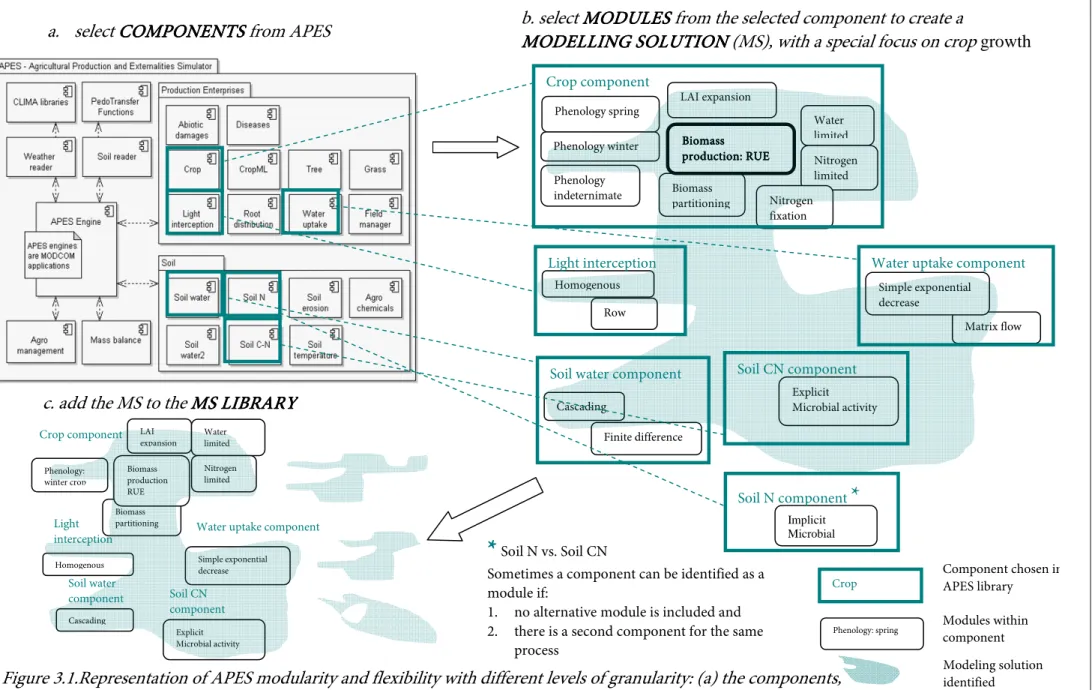
Granularity (i.e. level of decomposition) was also advocated by Zeigler and Marshall (1991) in the development of the Discrete Event System Specification (DEVS). Figure 1.1 illustrates the different levels of granularity introduced above in comparison with the terminology from Zeigler et al. (2000). The DEVS is based on a collection of models to be assembled to satisfy a new requirement (system of systems, SoS), and these models are an assemblage of what they called primitives (Figure 1.1).
(a) (b)
Figure 1.1. Modularity and flexibility are represented via different levels of granularity within (a) DEVS vs. (b) APES and this thesis.
Accordingly, flexibility and modularity in crop modelling result in the construction of building blocks with different levels of granularity, representative for different parts of the systems under study. The construction of these building blocks is facilitated by what Van Evert et al. (2005) called an “implementation-level” framework, the main purpose of which is to link existing models, often treated as black boxes. Subsequently, the main research questions arising from modularity and flexibility are: (i) how do we make existing models work together; and (ii) how do we design new modelling
solutions for easier and balanced assembly? Models
System of System (SoS)
Reusability framework Composition framework Components Modelling solution (MS) Modelling framework Implementation framework Modules Primitive
Chapter 1
6
3. Definition of concept for model construction
3. Definition of concept for model construction
3. Definition of concept for model construction
3. Definition of concept for model construction: modelling level
: modelling level
: modelling level
: modelling level
Model conceptualization remains the heart of the matter (Donatelli et al., 2002), and there is a need to couple principles of systems analysis with the application of new software engineering techniques (i.e. use of design patterns, component-oriented design) in crop modelling. These current software engineering techniques enable an easy plug-and-play of modules (Papajorgji, 2005). However, such an easy assemblage of modules needs to be associated with guidance for model adaptation/re-assembly for the system studied (a given crop, in a given context, and for a given question). This guidance should be provided by a structured and coherent set of concepts to (i)
capture similarities and differences among crops and (ii) define the basic properties of the cropping system. These concepts can be translated into selection criteria or
systematic approaches to guide the user of the framework in the selection of modules or components, to assemble a new MS.
A concept can be defined as the “logic to assemble of the appropriate modules”. The development of such a concept should be based on systems analysis principles, enabling to go from the objective of the simulation to the right assembly of modules, representative of the Genotype × Environment × Management interactions of the cropping system under study (Figure 1.2). The formulation of concepts supports the construction of the model structure, in agreement with the users’ simulation objective. Indeed, these concepts contextualize the model for a specific application (Villa, 2007) by (i) arriving at an accurate and unambiguous problem definition, (ii) identifying the relevant factors to consider for construction of the model, and finally (iii) defining the model structure, i.e. the modelling solution.
Figure 1.2. From objective(s) to the “right modelling solution”: construction of a concept to guide the user in module selection.
Formulating concepts is achieved mainly through comparison of the various existing crop modelling approaches (i.e. modules) and on the basis of a thorough
understanding of crop physiology and the user’s demand. Concepts represent this understanding and should, therefore, correspond to the main criteria guiding the selection of a specific modelling solution (Figure 1.2). To this end, those concepts express rules to identify the specific combinations of modules needed for the
Objective Concept Concept Concept Concept
Rules to identify the “right” model structure corresponding to a specific GxExM context
Definition of criteria and/or approaches for module selection
The “right” modelling solution
7 simulation objective. Formulation of these concepts produces an explicit analysis of the trade-offs in terms of level of details and generality among crop modelling
approaches. The resulting criteria and systematic approaches can be considered as the “modelling-level” framework (Van Evert et al., 2005), aiming at guiding the user in the selection of modules and the assembly of the modelling solution. To define these criteria and to use systematic approaches helping to go from the simulation objective to the “right modelling solution” (Figure 1.2.), various type of experts are involved among which are crop physiologists, agronomists, crop modeller, and software engineers.
4. Objective
4. Objective
4. Objective
4. Objective
Given this context, a project was launched to develop an approach that should facilitate model (re-)use, by integrating new software engineering techniques in crop modelling (Donatelli et al., 2002) and system analysis, to enable to build models from (physiologically) meaningful components (Ewert, 2008). This project was initiated within the SEAMLESS project (Van Ittersum et al., 2008) to re-enforce collaboration between the various developers of the crop component of the Agricultural Production and Externalities Simulator (APES). The key idea of this collaboration was the
development of a modular approach that would allow exchange of models (or parts of models, i.e. modules), substitution of processes, depending on the user demand and objective (which may vary from local to regional and larger scale). This thesis focuses more specifically on the definition of criteria or approaches to guide the selection of modules to assemble a modelling solution for specific applications (e.g. exploration of management options at the whole-farm scale; integrated assessment of agricultural systems at regional scale; assessment of climate change impact on crop productivity at global scale).
The general objective objective objective objective of this thesis is the development of a framework to assemble different crop models depending on the crop system to analyse and the simulation objective. This framework is operational at the two main levels explained before: the implementation level and the modelling level. After briefly describing the main principles used for the implementation level (Chapter 2), the remainder of the thesis focuses on the modelling level. At the modelling level, two aspects receive particular attention, i.e. identification and definition of physiological similarities and differences among crops and explicit description of the context of the simulation. From this general objective, more specific objectives are derived:
• Incorporate different crop growth and development modelling approaches in the framework (implementation level);
Chapter 1
8
• Explicitly formulate the hypotheses underlying different simulation approaches and their validity domains (modelling level);
• Develop systematic approaches to select the relevant modules to build a
modelling solution that meets a specific simulation objective (modelling level).
5. Outline
5. Outline
5. Outline
5. Outline
Creating a “generic” crop modelling framework for design and assessment of innovative cropping systems requires the development of a modular and flexible
structure associated with concepts that will help modellers and end-users to select modules and to construct the crop model (i.e. modelling solution) they need for their objective. In this thesis (Figure 1.3), Chapter 2 describes how to bring the modularity into the framework, and how new software techniques can be applied in crop
modelling. From the software design presented in Chapter 2, two distinct libraries can be distinguished in the framework: one including the different modelling approaches (i.e. modules describing the basic crop processes), and one including the result of the assemblage of these modules into a new modelling solution (i.e. a crop model for a given crop, in a given context, for a given question).
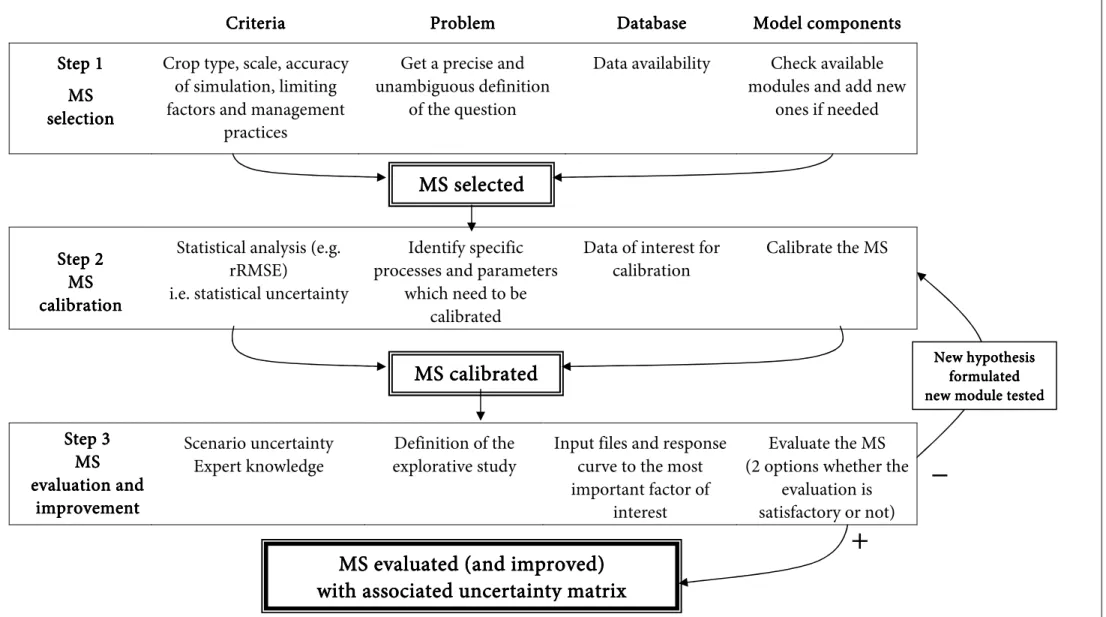
Chapter 3 tackles the issue of flexibility and defines a methodology (guideline) to select and combine these different approaches into a modelling solution according to specific criteria (e.g. physiological specificities of the crop, data availability, level of detail of the modules, limiting factors of production). This methodology emphasizes the
importance of explicitly formulating the hypotheses underlying different simulation approaches and their validity domains. From the principles laid out in Chapters 2 and 3, it is concluded that the framework is built from two main beams: (i) the
implementation beam and (ii) the modelling beam (Figure 1.3). However, there is a need to (i) further investigate on the development of concepts for the selection of modules, and more specifically (ii) refine the criteria guiding this selection. These are the subjects of Chapters 4 and 5 (Figure 1.3).
In Chapters 4 and 5, we used the principles discussed and elaborated previously, and studied two specific case studies, developing a set of concepts to select the relevant modules to build a modelling solution that meets a specific modelling objective.
Although the two chapters do not explicitly apply the whole methodology presented in Chapter 3, we can see them as an example of how to operationalise the part of the framework on the selection of modules (i.e. modelling beam).
Chapter 4 deals with the scale and data availability criteria, focussing on an analysis of the effects of modelling detail in simulating crop productivity under a wide range of climatic conditions. Through comparison of various modelling approaches (modules),
9 we identified the importance of clarifying the assumptions underlying the
quantification of a parameter value, as a parameter may represent a different meaning (and hence a different numerical value), depending on the approach selected. We also demonstrated that when addressing issues at global scale with rather scanty data, one needs to be aware of the potential consequences of the simplification of processes, as this may lead to the omission of important relationships.
Chapter 5 focuses on crop physiology and more specifically on the “crop type”
criterion. It emphasizes the importance of integrating crop physiologist’s knowledge in all the modelling processes when crop type-specific modules are selected. In practice, it illustrates an approach that supports the integration of crop physiological knowledge into the framework. It emphasizes that the modeller should have a thorough
understanding of the conceptual model and should communicate/interact efficiently with software engineers in developing a new modelling solution for a new crop.
Chapter 6 synthesizes the main outcomes of the previous chapters, highlighting what is needed for the development of a framework to introduce flexibility in crop modelling and what the potential future of such a framework could be.
Figure 1.3. Schematic outline of this dissertation, based on two main beams: (i) the implementation beam, defined by software engineering techniques and (ii) the modelling beam, defined by an approach supporting the selection of modules. Two specific case studies refine the criteria for modules selection, considering the (i) scale and accuracy of simulations, and (ii) crop type.
Chapter 1
Objective: a framework to introduce flexibility in crop modelling Need of software engineering and criteria to define model structure Implementation beam of the framework Software engineering to create the libraries Chapter 2
Selection for the level of detail according to scale and accuracy of simulations
Chapter 4
Selection for crop type: need of integration of physiological
knowledge
Chapter 5
Modelling beam of the framework
Systematic evaluation to support module selection
Chapter 3
Chapter 6
CHAPTER 2 CHAPTER 2CHAPTER 2 CHAPTER 2
Software engineering techniques:
the implementation beam of the framework
∗
∗
This chapter has been published as:
Adam, M., Ewert, F., Leffelaar, P.A., Corbeels, M., Van Keulen, H., Wery, J., 2010. CROSPAL, software that uses agronomic expert knowledge to assist modules selection for crop growth simulation. Environmental Modelling & Software 25, 946-955.
Chapter 2 12 Abstract Abstract Abstract Abstract
Crop growth models are used for a wide range of objectives. For each objective a specific model has to be developed, because the reusability of a model is often limited by the necessity of a fundamental restructuring to adapt it to a different objective. To overcome this
limitation, we developed a method to facilitate model restructuring by a novel combination of software technology with expert knowledge.
This resulted in the decision-making software application CROSPAL (CROp Simulator: Picking and Assembling Libraries). CROSPAL includes (i) a library of processes each containing different modelling approaches for each crop physiological process and (ii) a procedure based on expert knowledge of how to combine the different processes for the objective of the simulation.
A brief overview of the state of the art in crop modelling is presented, followed by an account of the developed concept to improve flexibility in crop modelling considering expert
knowledge. We describe the design of the software and how expert knowledge is integrated. The use of CROSPAL is illustrated for the modelling of crop phenology. We conclude that CROSPAL is a helpful tool to improve flexibility in crop modelling considering expert knowledge but further development and evaluation is required to extend its range of application to more processes and issues crop modelling is presently addressing. Keywords
Keywords Keywords
Keywords: crop models, design pattern, phenology, model flexibility, physiological processes, libraries.
13
1. Introduction
1. Introduction
1. Introduction
1. Introduction
Crop growth modelling started in the late 1960s with De Wit (1965). Initially, crop models were developed to increase understanding of the mechanisms (i.e.
physiological processes) underlying crop growth and development. Subsequently, the focus in crop modelling became more application-oriented and models were used to increase the understanding of the degree to which the main abiotic factors (weather and soil) constrain crop yields (Van Ittersum and Rabbinge, 1997). As a result, each crop growth model tended to focus on one crop and one specific set of conditions. Different modelling approaches have been developed to simulate the same process. For instance, for the simulation of biomass accumulation, various algorithms have been used. Some models comprise a very detailed description of the processes related to photosynthesis and respiration, while others use the radiation use efficiency
approach, representing the detailed photosynthesis and respiration models by one parameter. Similar differences in modelling approaches and detail can be found for other crop physiological processes. Therefore, the quest for balance in crop modelling has become a subtle exercise, navigating between very detailed modelling approaches aiming at process understanding for a wide range of conditions, and empirical
approaches primarily aiming at prediction, but specific to a particular set of (local) biophysical conditions (Monteith, 1996; Rastetter et al., 1992).
The crop modelling community, being aware of the specificity of the many models developed, and searching for greater generality, initiated the development of more generic models. Such generic models aim at widening the range of applicability of crop simulation models. Some examples are WOFOST (Supit et al. 1994), CROPGRO (Jones et al., 2003), STICS (Brisson et al., 2003), and EPIC/CROPSYST (Stockle et al., 2003). Reflecting on these efforts, Brisson et al. in Wallach et al. (2006: p.261) stated that “the generic nature of a model does not preclude crop specificity, but it is indicative for the efforts being made towards a common approach based on agro-physiology”. Common model algorithms and structure are adopted for all crop species and differences among species are defined in species-specific sets of parameters.
Although each of these models has been widely applied, they still strongly reflect a specific modelling community (e.g. WOFOST, one of the Wageningen models; STICS, a French model; EPIC/CROPSYST, a model developed by the American crop
modeller’s community). The degree to which models have been applied outside the community of the developers, can mainly be attributed to the accessibility of the specific model and the efforts to disseminate the model by the team that was involved in its original development.
Chapter 2
14
Furthermore, as modelling became more application-oriented in the 1990s, attempts were made to combine different models to analyze cropping systems in different environments and with different management practices. DSSAT (Decision Support System for Agrotechnology Transfer, Jones et al., 2003) and APSIM (Agricultural Production Systems sIMulator, Keating et al., 2003) are two prominent examples of such simulation frameworks. The main objectives of these models are (i) to simulate productivity of cropping systems, taking into account weather, crop genetics, soil water, soil carbon and nitrogen dynamics, and management in single or multiple seasons and in crop rotations at any location, a common feature shared by all crop models and (ii) to provide a modular structure to facilitate incorporation of new modules - a specific objective of DSSAT and APSIM. Interaction among components takes place at the cropping system level where crop, soil and climate are identified as the key sub-systems. Thus, although these cropping system models apply principles of modularity, their structure does not allow an easy plug-in pull-out of lower level (e.g. plant process level) modules for different simulation objectives. The crop growth and development module essentially constitutes the main entity. The mechanistic detail of the physiological processes considered within the crop module cannot be easily
replaced by another formulation. The crop module runs as a whole and within this module, processes are inseparable. For instance, substituting the phenology module implemented within APSIM by an alternative module (developed and required for another application) is not straightforward.
To overcome this limitation, Wang et al. (2002) proposed a generic crop model template for APSIM, based on four main components: (i) a standard crop interface, (ii) a generic crop model structure, (iii) a crop process library and (iv) a crop
parameter file. The crop parameter file enables to switch between different modelling approaches, represented in the crop process library. Principles applied in this
framework were already mentioned in the late 1990s when Hammer (1998) described a tree structure of a generic crop template, enabling to switch between optional
processes within sub-modules. Later, this framework was applied by Van Oosterom et al. (2006) substituting the module of floral initiation with a gene network module. Such work is essential for further development of a crop modelling framework to facilitate the change of the structure of crop models.
However, despite the merit of addressing modelling choices at the level of
physiological processes, no clear evidence of consistent substitution is presented. The framework facilitates substitution in terms of software engineering, but does not facilitate the user to ensure that a new method substituting another is compatible to
15 the modelling approaches of the other physiological processes to which it will be
linked. This is particularly important for the temporal resolution of processes to avoid stiff systems.
Thus, the exchange of a modelling approach for a specific physiological process may require changes in the modules of other crop processes that may not be self-evident and may complicate the plug-in pull-out procedure. Also, the links among key
physiological processes may become unbalanced (Monteith, 1996) and not suitable to the objective of the simulation. Although the framework presented by Wang et al. (2002) is a step towards the facilitation of including various modules representative of various crop growth processes, the issue of consistency in substituting one module by another within cropping system models has not been explicitly addressed yet. It remains to clarify how to identify and “evaluate the alternatives” (Hammer, 1998, p.30). Day (2001, p.217) stated “Isolating the critical processes is the first step. Describing them at an appropriate level of detail, preferably only one or two levels below that of the output of interest, is the next target.” Similarly, Acock and Acock (1991) pointed out the difference in the level of detail needed if the main objective is prediction or understanding of the mechanism representing processes in the crop system (“up to two levels of organization below the level of prediction”, p.56).
In crop modelling, the Soil-Plant-Atmosphere System Simulation (SPASS, Wang and Engel, 2000), the object-oriented crop model by Acock and Reddy (1997), the generic crop model template in APSIM (GCROP, Wang et al., 2002), the Agricultural
Production and Externalities Simulator (APES, Donatelli et al., 2010) and the
Common Modelling Framework of Moore et al. (2007) are illustrative examples of the few attempts to apply modularity to the simulation of the essential processes common to crop development and growth. However, explicit procedures are lacking for
selecting the appropriate processes depending on the simulation objectives and defining the relationships among these processes which we specifically address in this study. Combining principles from Wang et al. (2002), object-oriented design and the use of hierarchical configuration adopted by Moore et al. (2007), we designed
CROSPAL (CROp Simulator: Picking and Assembling Libraries), a crop modelling framework for the user to pick and assemble the crop simulator he/she needs. Not only should the choice of the level of detail be governed by quantitative criteria such as characteristic time of the models but also by the definition of criteria representing the objective and the targeted output of the simulation.
Chapter 2
16
2. CROSPAL design: concept for a crop modelling framework
2. CROSPAL design: concept for a crop modelling framework
2. CROSPAL design: concept for a crop modelling framework
2. CROSPAL design: concept for a crop modelling framework
In the proposed crop modelling framework, we apply the principle of modularity to facilitate the re-use of crop models and modules for individual processes. We include modules with different descriptions of the key plant physiological processes for the user to compose the crop model (i.e. crop simulator) that meets best the simulation objective. The crop modelling framework guides the user in the selection of these descriptions to support consistency in the considered processes linked to a crop simulator. Through principles of systems analysis, comprising among others the definition of system boundaries, simplification of reality, problem definition, and identification of attributes of interest leading to the definition of criteria, the
appropriate combination of modelling approaches is defined for a specific simulation objective. The crop modelling framework comprises (i) a library of plant process descriptions with different modelling approaches for each process and (ii) a procedure or workflow describing how to combine the different processes for an application, resulting in (iii) a library of crop simulators (i.e. crop models developed for specific applications).
To build the framework, we need (i) to define a set of basic crop growth and development processes according to our understanding of the crop system, (ii) to provide different modelling approaches for each process, (iii) to express expert knowledge in the form of explicit criteria to ensure consistency in the selection and linkage of modelling approaches for a specific application and (iv) to use object-oriented design to provide flexibility to the framework (Donatelli et al., 2006 a,b).
2.1. Library of crop growth and development processes 2.1. Library of crop growth and development processes 2.1. Library of crop growth and development processes 2.1. Library of crop growth and development processes
Wery (2005) defined the major crop growth and development processes as leaf area expansion, production of assimilates, partitioning of assimilates, phenology
(vegetative and reproductive development), nitrogen dynamics, and transpiration. This representation of crop physiology is supported by Hay and Porter’s (2006) description of the physiology of crop yield where they identified “the interlinked processes that form the basis of crop growth and yield” as phenological development, leaf canopy development and biomass production and its partitioning over the plant organs. This categorization gives information on growth and development of the crop in response to any change in the environment of the system. Each of these basic crop growth and development processes can be modelled in various ways and with different mechanistic details (Table 2.1), resulting in a variety of crop models.
17 Table 2.1. Proposed crop growth and development processes and selected corresponding crop modelling approaches (adapted from Wery, 2005). For comparison, the template proposed by Wang et al. (2002) is also included.
Plant growth and development processes Plant growth and development processes Plant growth and development processes
Plant growth and development processes Modelling Modelling ApproachesModelling Modelling ApproachesApproachesApproaches Proposed structure
Proposed structure Proposed structure
Proposed structure Related Related Related Related 7 main 7 main 7 main 7 main
components in GCROP * components in GCROP * components in GCROP * components in GCROP * (Figure 1 in Wang et al., 2002)
Light interception: leaf area expansion, leaf canopy development C: canopy E: senescence • Development stage dependent • Biomass accumulation dependent
Dry matter production B: biomass (B1)
Partly D: root system (root biomass)
• Water use efficiency (WUE)
• Radiation use efficiency (RUE)
• Minimum (RUE,WUE)
• Farquhar approach: Photosynthesis,
Assimilation, Respiration Phenology: vegetative and
reproductive development
A: phenology • Leaf appearance rate based on photo-thermal time
• Gene network model
• Simple regression Partitioning/allocation:
development of sink and assimilate partitioning
B: biomass • Predetermined allocation
• Source/ sink Production level: e.g.
Water stress
Partly D: root system ( root depth)
F-G: water and nitrogen
• Stomatal conductance
• Transpiration, water uptake
• Nitrogen uptake
* Letters A-G refer to the essential processes of a generic crop model template (Wang et al., 2002).
The library of these different modelling approaches for each individual crop growth and development processes is constructed using principles from object-oriented design to support flexibility for model development. The next step in the construction of the crop modelling framework is to define rules to help the user to select and
combine the appropriate modelling approaches of these physiological processes according to the simulation objective.
Chapter 2
18
2.2. Procedure to combine the modelling approaches: building 2.2. Procedure to combine the modelling approaches: building 2.2. Procedure to combine the modelling approaches: building
2.2. Procedure to combine the modelling approaches: building a library of crop a library of crop a library of crop a library of crop simulators
simulators simulators simulators
In the crop modelling framework, we aim at explicit identification of the most important characteristics of the system and how these will influence the selection of the modelling approaches to build the crop simulator. The key relationships among the different processes represented in the system are based on the knowledge of the expert and his/her understanding of the functioning of the system.
Crop growth and development is the result of the interaction of (i) the availability of resources, (ii) the ability of the crop to capture these resources and convert them into biomass and (iii) the way management of the system affects 1 and 2. Accordingly, to select the appropriate combination of modelling approaches, we apply five criteria: (i) crop physiology, (ii) limiting factors, (iii) scale (temporal and spatial), (iv)
management practices, and (v) accuracy/adequacy of simulation. These criteria represent the main factors determining the simulation of crop performance. They consider Genotype x Environment x Management interactions (Yin et al., 2004), including effects of technological changes (Ewert, et al., 2005), scale and data availability.
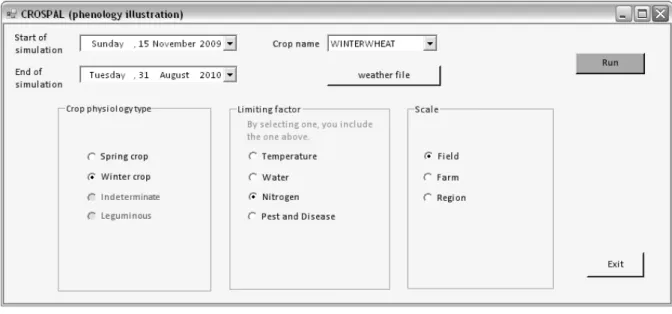
To represent these criteria and guide the user in constructing or selecting a consistent crop simulator, we designed a graphical user interface (GUI) that helps to define the combination of the different modelling approaches. We established the following hierarchy. First, we select the modelling approach depending on crop physiology (crop type), limiting factors and scale (Figure 2.1a). Such criteria will guide the selection of the main basic crop processes to include. For example, if the user wants to simulate potential crop yield of winter wheat at field level, the choice of ‘winter crop’ in the GUI will direct him to pick a photo-vernal thermal modelling approach for
phenology. Second, according to the choices made, another more detailed window appears to select the management and the required accuracy of the simulation (Figure 2.1b). On the basis of these selections, we retrieve a pre-defined crop model structure (crop simulator), corresponding to the user’s objective. The definition of these criteria and how they influence the selection of the modelling approaches is the result of expert knowledge embedded into CROSPAL.
19 a. First set of criteria to decide upon
b. Second set of criteria
Different screens may appear depending on the choice made on a. We present the most complete one.
Figure 2.1. The graphical user interface (GUI) of the crop modelling framework (CROSPAL) in two main windows to illustrate the hierarchy of criteria in the choice of the model
structure.
In this way the framework provides (i) pre-defined crop models to be selected from a library of crop simulators depending on the application (these crop simulators
encapsulate the expert knowledge from crop modellers and software engineers), and (ii) guiding rules for the more advanced user, to develop crop models (bottom up approach, picking and assembling from the library of crop modelling approaches), extending the expert knowledge in CROSPAL. The pre-defined models can directly be run through the GUI, while the rules are the result of the process of going through the criteria guiding the user to characterize the level of modelling detail needed (Chapter
Chapter 2
20
3). Once the user (a crop modeller or agronomist) has defined this level of detail, not only will he/she use the modelling approaches already included, but also the user or an associated software engineer may create the missing pieces to enrich the framework.
Thus, the novelty of the framework resides in the development of this workflow or procedure that encapsulates expert knowledge (agronomist or crop modeller) into crop models (crop simulators developed by a software engineer) for various
applications. These different crop simulators will result from rules that explicitly state why a specific approach has been selected. Such a framework facilitates the
comparison of different modelling approaches and enhances testing and comparing different approaches to particular processes, so that scientific understanding can advance. We are aware that there is rarely one unique modelling solution. However, we think that this framework can guide the user to define the best solution for a specific objective, given the available expert knowledge and the available data.
Importantly, the expert knowledge is not static, but will evolve through the use of the framework, e.g. through comparisons of models composed of different modelling approaches for similar processes, or validation of results generated by different developed models using experimental data.
2.3. Software design to incorporate expert knowledge in t 2.3. Software design to incorporate expert knowledge in t 2.3. Software design to incorporate expert knowledge in t
2.3. Software design to incorporate expert knowledge in the definition of crop he definition of crop he definition of crop he definition of crop simulators
simulators simulators simulators
To include new modelling approaches into the framework, a clear understanding of the software design is needed. The possibility to easily add a new modelling approach and combine it with already existing ones is based on software engineering techniques. Software engineering techniques such as object-oriented design have been applied for a long time in the industrial sector, but have only recently been introduced in the field of agricultural research (e.g. APES, Donatelli et al., 2010). In software engineering, the main purpose of a design pattern is to describe simple and elegant solutions to specific and recurrent problems (Gamma et al., 1995). Design patterns can also be used in the development of a crop growth and development modelling framework. In our
particular case, we decided to use the “plug and play” architecture (Papajorgji, 2005).
The use of the plug and play architecture provides the capability of automatically creating new configurations, and is based on: (i) the strategy design pattern, which is a behavioural pattern: “defining a family of algorithms, encapsulating each one, and making them interchangeable” (Gamma et al., 1995), and (ii) the abstract factory design pattern which is a creational pattern: “providing an interface for creating families of related or interdependent objects without specifying the concrete classes”
21 (Gamma et al., 1995). Strategy and abstract factory design patterns are combined in such a way that the strategy design pattern permits to set up the library of plant processes and the abstract factory design pattern allows to create the library of crop simulators (combination of these different processes). The strategy design pattern is also used to define the model granularity within APES components (Donatelli et al., 2010). A full description and concrete application of some of these components can be found in Donatelli et al. (2006a, 2006b, and 2010). Descriptions of other components (e.g. soil water, soil nitrogen and carbon) can be found on the APES website
(http://www.apesimulator.org/).
The abstract factory defines the basic structure of the model. For instance, the abstract crop class includes various methods (e.g. CreateDM(), CreatePheno(), Figure 2.2a) that represent the crop growth and development processes. The different modelling approaches for each of these processes are encapsulated in various strategies (e.g. BiomassProd_LUE class or BiomassProd_LUE_CS class, Figure 2.2b). The strategy design pattern describes a family of mutually interchangeable modelling approaches. Each family of strategies defines the basic crop growth and development processes where exchangeability of modelling approaches is possible.
Furthermore, the abstract factory design pattern facilitates the creation of a new crop simulator in such a way that a new concrete factory can be added easily (e.g.
Concrete_Crop_Winter, Figure 2.2a). The concrete factory is the reflection of the expert’s perception of the system or/and the result of the different criteria checked by the user in agreement with his/her simulation objective. If none of the concrete factories available corresponds to the expert’s choices, a new concrete factory can easily be created. Finally, the use of the abstract factory allows including a common approach in line with the generic models’ principles.
Thus, through the use of the plug and play architecture (Papajorgij, 2005), we include in the framework an explicit link to the representation of the expert knowledge of the system. The creation of new concrete factories corresponds to the development of new crop model structures (i.e. crop simulator) and the use of the abstract factory provides flexibility in the choice of modelling approaches. For instance, if the user wants to simulate potential crop yield of winter wheat at field level, the choice of a winter crop in the GUI will direct him to pick the Concrete_Crop_Winter presented in Figure 2.2a, while if the user wants to simulate spring wheat, then the Concrete_Crop_Spring will be selected. In the same way, if the user wants to simulate crop yield of winter wheat for the whole of Europe, the Concrete_Crop_Winter_Teffect will be selected, as the range of temperatures within Europe might be an important characteristic to consider (Ewert et al., 1999).
a. The abstract factory design creating a basic changeable structure of the crop model. C ha pt er 2 22 Abstract_Crop # Abstract_Crop() + CreateDM() + CreateDMorgans() + CreateLAI() + CreatePheno() + CreateRootDepth() Concrete_Crop_Winter_Teff + Concrete_Crop_Winter_Teffect() + CreateDM() + CreateDMorgans() + CreateLAI() + CreatePheno() + CreateRootDepth() Concrete_Crop_Winter + Concrete_Crop_Winter() + CreateDM() + CreateDMorgans() + CreateLAI() + CreatePheno() + CreateRootDepth() Concrete_Crop_Sring_Teff + Concrete_Crop_Sring_Teffect() + CreateDM() + CreateDMorgans() + CreateLAI() + CreatePheno() + CreateRootDepth() Concrete_Crop_Spring + Concrete_Crop_Spring() + CreateDM () + CreateDMorgans() + CreateLAI() + CreatePheno() + CreateRootDepth() Concrete_Crop_SpringLeavesNumber + Concrete_Crop_SpringLeavesNumber() + CreateDM() + CreateDMorgans() + CreateLAI() + CreatePheno() + CreateRootDepth()
b. The strategy design pattern applied to the CreateDM() corresponding to the dry matter process.
Figure 2.2. The main design patterns implemented to develop the crop modelling framework: a) the abstract factory design pattern and b) the strategy design pattern.
So ftw ar e e n gin ee rin g t ec hn iq ue s: t he im ple m en ta tio n b ea m o f t he fr am ew or k 23 Biomass_CreateDM # Biomass_CreateDM() : + Update (Crop.Data.Variables.Rates, Crop.Data.Variables.Auxiliary, Crop.Data.Variables.Exogenous Crop.Data.Variables.RatesExternal Crop.Data.Variables.StatesExternal ) Biomass_LUE _inputs: _outputs: _param: LUE: + par: strategyName: - BiomassProd_LUE() : + BiomassProd_LUE() - calculate():void + Update():void «property + RadiationUseEfficiencyVarInfo() : Biomass_LUE_Temp _inputs: _outputs: _param: LUE: + par: + pheno: strategyName: - BiomassProd_LUE_Temp() + BiomassProd_LUE_Temp() -calculate():void + Update( ):void «property + AirTemperatureBase() : + RadiationUseEfficiency() :
Chapter 2
24
Not only does the application of this design prevent implementation of inconsistent combinations of objects, but it also provides flexibility to the framework. This
flexibility lies in the possibility of creating new combinations of modelling approaches (i.e. crop simulators). However, if the user’s overall vision of crop growth and
development is totally different from the one formulated in the abstract factory, a change in the design is required. This is not a "shortcoming" of the pattern, but it rather points to the degree to which object-oriented systems are amenable to adding or removing abstractions. In that sense, the expert knowledge enters the framework at different levels. First, the abstract factory defines the key plant physiological processes according to crop physiologists’ knowledge (which have been already pre-defined according to crop physiology, Section 2.1). Second, through the selection of criteria (GUI), the agronomist expert defines different modelling approaches (strategies) and ways to combine them (concrete factories). To illustrate the principles and the design described above, an example is presented to define different modelling approaches that can be used to represent the phenology of a crop and identify the appropriate approaches for a set of different research objectives.
3. Application of CROSPAL: example of crop phenology
3. Application of CROSPAL: example of crop phenology
3. Application of CROSPAL: example of crop phenology
3. Application of CROSPAL: example of crop phenology
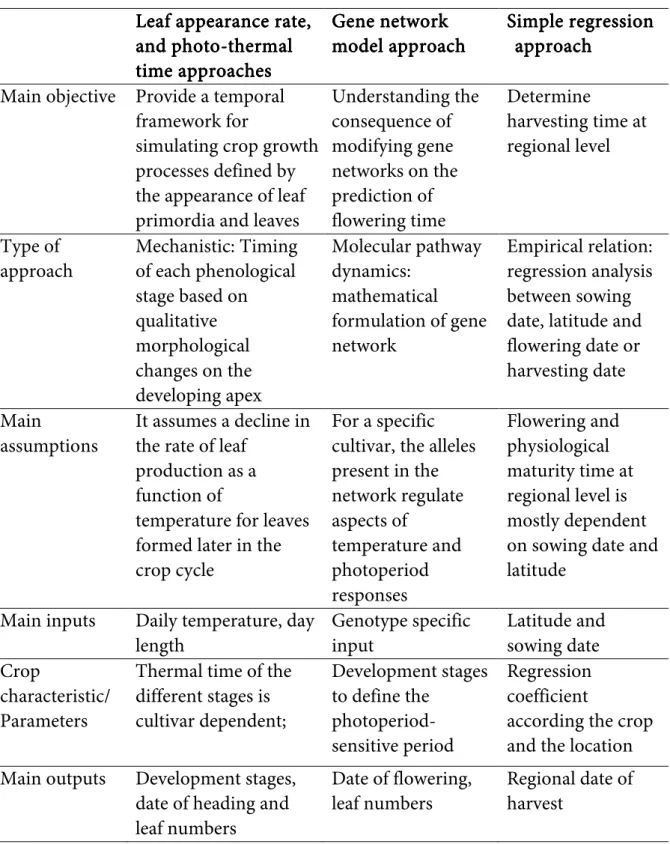
As mentioned by Hammer et al. (2002), crop modelling is moving in two directions, one from cropping level to higher integration levels such as farms and regions and the second from crop level to the lower level of integration, such as the genetic level. We claim that the development of the proposed crop modelling framework supports both directions, as different modelling approaches can be included and considered for further application depending on the objective of the user of CROSPAL. We use the example of phenology to further illustrate this. Phenology is the sequence and rate of initiation of developmental events (i.e. phases) in the course of the life cycle of a crop, from germination of seeds to maturity of the plant and ripening of the seeds. The sequence of the different phases is invariable, but their timing is dependent on environmental conditions, such as temperature and day length. In evaluating crop growth models, phenology is the first process to be assessed because it is a driver of most of the other plant processes. It can be considered at 3 levels of detail (Table 2.2): (i) the crop level, based on the classical photo-thermal modelling approach, (ii) the gene network level, on the basis of a more detailed and mechanistic approach, and (iii) a more aggregated summary, based on the timing of flowering and ripening according to a simple regression on environmental factors. Each of these approaches has its specificities and targeted applications. The most suitable approach for a specific objective is selected on the basis of expert knowledge.
25 Table 2.2. Main characteristics of the modelling approaches studied to simulate phenology. Leaf appearance rate, Leaf appearance rate, Leaf appearance rate, Leaf appearance rate,
and photo and photo and photo
and photo----thermal thermal thermal thermal time approaches time approaches time approaches time approaches
Gene network Gene network Gene network Gene network model approach model approachmodel approach model approach Simple regression Simple regression Simple regression Simple regression approach approach approach approach Main objective Provide a temporal
framework for
simulating crop growth processes defined by the appearance of leaf primordia and leaves
Understanding the consequence of modifying gene networks on the prediction of flowering time Determine harvesting time at regional level Type of approach Mechanistic: Timing of each phenological stage based on qualitative morphological changes on the developing apex Molecular pathway dynamics: mathematical formulation of gene network Empirical relation: regression analysis between sowing date, latitude and flowering date or harvesting date Main
assumptions
It assumes a decline in the rate of leaf
production as a function of
temperature for leaves formed later in the crop cycle
For a specific cultivar, the alleles present in the network regulate aspects of temperature and photoperiod responses Flowering and physiological maturity time at regional level is mostly dependent on sowing date and latitude
Main inputs Daily temperature, day length Genotype specific input Latitude and sowing date Crop characteristic/ Parameters
Thermal time of the different stages is cultivar dependent; Development stages to define the photoperiod-sensitive period Regression coefficient
according the crop and the location Main outputs Development stages,
date of heading and leaf numbers
Date of flowering, leaf numbers
Regional date of harvest
Chapter 2
26
3.1. Definition of the 3.1. Definition of the 3.1. Definition of the
3.1. Definition of the different modelling approaches (different strategies)different modelling approaches (different strategies)different modelling approaches (different strategies)different modelling approaches (different strategies) The most commonly used approach to simulate crop development is based on the temperature sum (thermal time) above a base temperature. The base temperature represents the temperature below which development ceases. The development rate is defined as the inverse of the duration of a development phase. The approach assumes that within a range of temperatures, crop development rate increases proportionally with increasing temperature (Roberts and Summerfield, 1987). The crop enters the next development stage when the thermal time requirement for the current phase is satisfied (Van Keulen and Seligman, 1987). A similar approach is based on the rate of leaf appearance and final number of main stem leaves. Jamieson et al. (1995)
demonstrated that: (i) leaf primordia appearance in wheat can be predicted on the basis of temperature alone, and (ii) final leaf number is controlled by the
photoperiodic and vernalization responses of the crop. In this approach, the
production rate of leaf primordia is considered to be independent of day length and sowing date (Miglietta ,1992) .
A more mechanistic approach to simulate flowering time is based on QTL (Quantitative Trait Loci) analysis, determining the sensitivity of the crop to
photoperiod. This approach enables to predict the effect of a modified gene network on flowering time (Van Oosterom et al., 2006). According to day length, different crop phenotypes will react differently. Integration of such an approach in a crop model enables to link information at the molecular level with the phenotypic performance of the crop. Analysis of the gene network gives a better insight in why a crop responds in a certain manner to different environmental conditions (e.g. day length).
A much simpler approach that can be used to predict flowering is based on empirical observations and simple regressions between flowering time and latitude (Hammer et al., 1996), or sowing time and the duration of the growth cycle. To derive such
regressions for various crops, regional data for different crops in different regions are required. The main assumption underlying this approach is that sowing date is the most important factor in determining flowering and physiological maturity of a specific crop or variety in a region.
Each of these approaches can be implemented as a strategy according to the strategy design pattern. The choice of the strategy for a specific objective is done via the selection of the factory that corresponds to the criteria identified in the following section.
27 3.2.
3.2. 3.2.
3.2. SelectionSelectionSelectionSelection of modelling approaches given an objectiveof modelling approaches given an objectiveof modelling approaches given an objectiveof modelling approaches given an objective
Accurate prediction of crop development is essential for accurately simulating morphogenesis and yield components, and is also important in scheduling
management practices and assessing the response of a specific cultivar to e.g. weather variability. All three approaches mentioned above have been applied in (different) crop models. One of these approaches will be most appropriate for a specific objective of the simulation. Consideration of expert knowledge will help to find the most
relevant approach for each situation. One could imagine users of CROSPAL, having the following different modelling aims:
Aim 1: Explain the gene influence on photoperiod sensitivity of cultivars to flowering time;
Aim 2: Determine the right timing for management practices such as fertilizer application or disease control according to the development stage of the crop; Aim 3: Study crop productivity and harvesting time in a long-term perspective (e.g. under different management practices) for different regions.
Table 2.3 summarizes the possible applications of phenology modelling approaches, and the selected model approaches according to the simulation objective or aim. Table 2.3. Objectives, criteria and modelling approaches selected to simulate phenology. Objective of Objective of Objective of Objective of simulation simulation simulation simulation
Main criteria determining the Main criteria determining the Main criteria determining the Main criteria determining the choice choice choice choice Approach chosen Approach chosen Approach chosen Approach chosen Understanding the principle of development
Crop physiology:Need of a mechanistic, ontogenetic approach
Gene network model
Scheduling
management practices
Management practices
Fertilization: importance of the double ridge stage in wheat Pesticide application: number of leaves Thermal time and Leaf appearance Regional yield prediction
Scale: Simulation over a broad geographical range
Simple regression
Aim 1:
The main objective of this simulation is to increase understanding of the variation in the response of a crop or cultivar to environmental factors. More specifically, the user wants to predict the phenotypic consequences (e.g. time of flowering) for a crop with a new gene combination. The gene network model expresses the photoperiod sensitivity
Chapter 2
28
of a crop in having either a recessive or dominant gene (Van Oosterom et al., 2006). Clearly, to achieve this aim, an eco-physiological QTL model should be incorporated into a crop simulation model. Such an approach will allow the user to test different gene combinations and determine how the crop responds to different environmental conditions.
Aim 2:
(a) The timing of fertilizer application should match the temporal variation in nutrient (e.g. nitrogen) demand. To accurately match supply with demand, it is important to identify the periods of high nitrogen requirements. Kirby et al. (1989) showed that in wheat the developing shoot apex is most sensitive to fertilizer application at the double ridge stage. This stage was shown to be best approximated by the thermal time
approach (Miglietta and Porter, 1992) that allows explicit identification of the timing of each critical development stage such as the double ridge, terminal spikelet, ear emergence, etc. Therefore, from knowledge retrieved from the literature, we identified the thermal time approach as most appropriate in determining the timing of fertiliser application.
(b) The timing of plant disease control can often be linked to a specific development stage. However, for practical purposes it is often identified by a certain number of leaves (Bindi et al., 1995). Although the thermal time approach defines the
temperature sum from one phenological stage to another, it does not take into account that thermal time between successive leaves may vary with cultivar, planting date and location. The leaf appearance rate approach does account for such differences. The approach determines the number of leaves and therefore the timing of a specific stage as characterized by a certain number of leaves, and holds over a wide range of sowing dates and latitudes. Thus, for determination of the timing of disease control measures, the leaf appearance rate approach is most appropriate.
Aim 3:
For studies aiming at estimating e.g. the long-term effects on harvest time and crop productivity of a farmer’s adaptation of management practices to new policies, a simple approach that predicts the length of the crop cycle and of the grain filling period is needed. In long-term model predictions, it was demonstrated that empirical approaches, based on observations and simple regressions predicted yield as well or even better than more detailed agro-climatic crop models (Hammer et al. 1996). Indeed, due to poor knowledge of some input data, the use of a simple approach can lead to a good trade-off between accuracy and likely cost of application in a forecasting mode.
29 wheat over a long-time series at regional level (e.g. the SEAMLESS project, Van
Ittersum et al., 2008), a very simple approach such as the regression model will be robust (and sufficient) for large-scale applications. The main criteria to decide on this regression model (between sowing date, latitude and harvesting date) are the scale (i.e. regional application) and the availability of data.
3.3. Workflow of the methodology and use 3.3. Workflow of the methodology and use 3.3. Workflow of the methodology and use
3.3. Workflow of the methodology and use of CROSPALof CROSPALof CROSPAL of CROSPAL
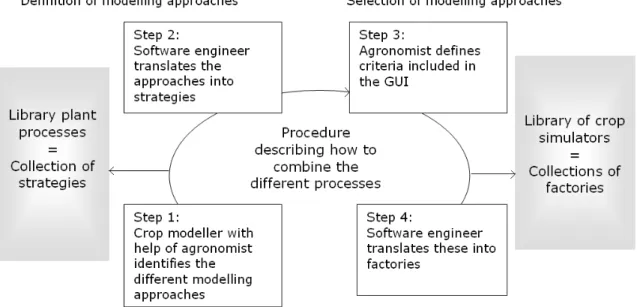
Figure 2.3 shows the key steps of our methodology for the construction of a crop simulator using expert knowledge, combining knowledge from agronomists, crop modellers and software engineers. Following the methodology explained above (Section 2), first the crop modeller with the help of the agronomist identifies the different modelling approaches to describe phenology that should be included in the framework. Then, the software engineer translates these into strategies (step 2). In a third step, the agronomist, having his objective in mind, identifies the key criteria for the simulation of the crop system and selects them within the GUI. Finally, the
software engineer creates the (different) concrete factories (if needed) according to the selection criteria considered in the GUI (step 4).
Figure 2.3. Key steps in the crop modelling framework to select the model structure on the basis of expert knowledge.
Chapter 2
30
Figure 2.4. Main screens of the CROSPAL GUI used to schedule the timing of pesticide application for a wheat crop.
To illustrate the outcome of this methodology, we describe the case where the user of CROSPAL (e.g. an agronomist) wants to identify the best pesticide application time for a wheat crop (aim 2). The user of CROSPAL (e.g. an agronomist) sees the need to define some specific development stages, which are practically identified by a certain number of leaves (Bindi et al., 1995). Before the user of CROSPAL, an agronomist, starts to run CROSPAL, step 1 and 2 (inclusion of various modelling approaches within the software) have already been realized in collaboration with a crop modeller and a software engineer, as a starting point for the use of the CROSPAL. Then, running CROSPAL, the user will identify the main characteristics of his system following the GUI of CROSPAL (step 3, Figure 2.4): (i) spring wheat, (ii) growth in water and nitrogen limiting conditions, and (iii) field level. Resulting from this particular selection, a second window will appear where the user will have to select different criteria related to the management practices at field level (key criteria for this particular case). The user will define a homogenous field with a pre-defined irrigation schedule and the importance of the determination of leaf number, which will
automatically require detailed experimental data (Figure 2.4). Following these various selections, the user interface of CROSPAL will indicate that a leaf appearance rate modelling approach is required and that it is not yet included in the framework.
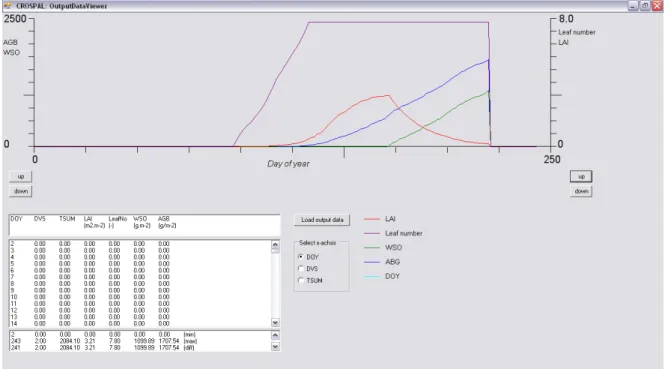
31 Figure 2.5. Main outputs of the crop simulator in CROSPAL resulting from the selection for simulation aiming at scheduling pesticide application for a wheat crop.
LAI: leaf area index; WSO: Weight Storage Organs; ABG: Above ground Biomass; DOY: Day Of the Year.
Finally, with support of a software engineer, the user will include this approach as a new strategy and define a new concrete factory (step 4). Figure 2.5 shows the results of the simulation after incorporation of the leaf appearance rate approach and the
associated factory. This sequence of steps facilitates the use of a procedure in which the information will not be lost. Not only does such a methodology help to define various crop simulators, based on previous experiences/expert knowledge, but the proposed crop modelling framework also presents a clear procedure for the future modeller to create his/her own crop model structure from the existing library within the framework.
4. Discussion and conclusions
4. Discussion and conclusions
4. Discussion and conclusions
4. Discussion and conclusions
In this study, we described CROSPAL, a crop modelling framework for users to define different combinations of modelling approaches of crop growth and development processes to build a crop model for a specific objective. This framework focuses on the main challenge to adequately combine different crop modelling approaches of
processes to a crop model with consistent and appropriate scales of process complexity (Voinov et al., 2004; Rastetter et al., 1992). CROSPAL relies on the explicit inclusion and utilization of expert knowledge through the definition of selection criteria in a GUI, the graphical interface between the software engineer (coding the strategies and factories) and the agronomist or crop modeller (defining the main basic crop