Computational Study of Self-Assembly in Block
Copolymer/Superparamagnetic Nanoparticle Composites under
External Magnetic Fields
Vinay Raman
Bachelor of Technology (B. Tech) in Chemical Engineering, Indian Institute of Technology Madras, Chennai, India (2007)
Masters in Chemical Engineering Practice (M.S.C.E.P), Massachusetts Institute of Technology, Cambridge, MA, USA (2009)
Submitted to the Department of Chemical Engineering in partial fulfillment of the requirements for the degree of
Doctor of Philosophy in Chemical Engineering
Massachusetts Institute of Technology
October, 2013
© 2013, Massachusetts Institute of Technology. All rights reserved.
Signature of the A uthor... ...-.. . . ---' Department of Cjemical Fnbneering, October 24, 2013 Certified. by...
C e r tif ie d b y ... ..V ... -. .. . -I ... T- A - l- -H-at-- t--
--''f *T. Alan Hatton
Ralph Landau Professor of Chemical Engineering Practice Thesis Supervisor Certified by...
Bradley D. Olsen Paul M. Cook Assistant Professor of Chemical Engineering ''- Thesis Supervisor Accepted by...
Patrick S. Doyle Singapore Research Professor of Chemical Engineering Chairman, Committee for Graduate Students
MASSACHUSETS 11T1MU'TE OF TECHNOLOGY
MAR
2
5
2013
Computational Study of Self-Assembly in Block
Copolymer/Superparamagnetic Nanoparticle Composites under
External Magnetic Fields
by
Vinay Raman
Submitted to the Department of Chemical Engineering on October 24, 2013 in Partial Fulfillment of the Requirements for the
Degree of Doctor of Philosophy in Chemical Engineering
Abstract
This computational and theoretical study investigates the self-assembly of superparamagnetic nanoparticles and block copolymers under external magnetic fields. A variety of morphological transitions are observed based on the field orientation, nanoparticle loading, and selectivity of the nanoparticles for the blocks. For symmetric block copolymers, chaining of superparamagnetic nanoparticles under in-plane magnetic fields is shown to achieve long range orientational order of the block copolymer nanodomains and is found to be dependent on nanoparticle size, volume fraction and magnetization strength. A critical selectivity of the particles for one nanodomain is observed, above which strong alignment results and below which comparatively disordered structures are formed. Higher magnetization strengths are found to
reduce equilibrium defect densities in the nematic-isotropic ordering of lamellar thin films, as corroborated by scaling arguments.
For asymmetric coil fractions forming hexagonal block copolymer nanostructure, the in-plane field induced chaining of the nanoparticles selective for the minority block, leads to the formation of stripe phases oriented parallel to the magnetic field. Furthermore, in-plane field induced chaining of nanoparticles selective for the majority block leads to alignment of hexagonal morphology with <100> direction oriented parallel to the external magnetic field. Out of plane magnetic fields induce repulsive dipolar interactions between the nanoparticles that annihilate the defects in the hexagonal morphology of the block copolymer when the nanoparticle is selective for the minority block. Honeycomb lattices are obtained using nanoparticles selective for majority block under out of plane magnetic fields for certain specific nanoparticle loadings. Commensurability of nanoparticle size and loadings with the block copolymer structure is critical in optimizing the ordering of the final composite.
Kinetics of alignment in block copolymer nanocomposites is studied using External Potential Dynamics (EPD) method, wherein an equivalent evolution equation for potential fields is solved instead of conservation equation for the monomer segments. The dynamics study reveals an interesting interplay of nanoparticle mobility, dipolar interaction strength and nanoparticle-polymer interaction strength on the rate of alignment of domains.
Thesis Supervisor: T. Alan Hatton
Title: Ralph Landau Professor of Chemical Engineering Practice Thesis Supervisor: Bradley D. Olsen
Acknowledgements
First of all, I would like to sincerely thank my advisors Prof. T. Alan Hatton and Prof. Bradley D. Olsen for their unconditional support, guidance and help during my thesis work. The interdisciplinary nature of my research necessitated support and guidance in nanotechnology as well as in soft matter especially polymers. I was fortunate to work with two advisors who are experts in their fields. While I benefitted immensely from Alan's expertise in nanotechnology especially superparamagnetic nanoparticles, my research gained a great momentum with Brad's expertise in block copolymers. Alan was instrumental in getting me started with the project in the first place, after having tried my luck at a couple other projects that did not pan out as expected. I learnt a great deal from Alan's holistic approach of looking at the problems. His comments and views always put my thoughts in perspective and was a great guiding force. His personable nature and calm demeanor is very welcoming, comforting and very encouraging.
I found Brad to be very meticulous and focus-driven advisor; needless to mention his expertise in the field of polymers/soft matter. I learnt a lot from his style of working and basically tried to emulate his approach to problem solving during my thesis. I found his approach of breaking down the whole problem into a bunch of key scientific questions and subsequently directing the research in answering those questions to be exemplary. I followed this approach throughout my research and was quite successful in achieving my goals. My understanding of polymers increased many folds just by discussing my research with him. I immensely benefitted from his hands-on style of working and the great collaborative culture of the Olsen group. His witty, humorous and easy going nature is very likeable and he is a great advisor to work with.
I would like to thank my committee comprising of Prof. Patrick S. Doyle and Prof. Arijit Bose. Their help and guidance during my committee meetings was of great help to fine tune my project.
I would like to sincerely thank both the Hatton and the Olsen group members. Their support and help is very much appreciated. I forged a great working relationship with all my group members. They were all very helpful and easy going. The working atmosphere was very welcoming and encouraging. I sincerely wish to thank my colleague and dear friend, Dr. Seok Joon Kwon of Hatton group for introducing me to the field of phase-field modeling. Discussions with him were very rewarding and we shared great experiences during our research. I convey my heartfelt thanks and my best wishes to him for his career and life. And Thanks to you all (Paul, Demetra, Xiao, Jie, Mao, Lev, and Abhinav) for making my stay at MIT memorable and fun.
I would like to thank all the Olsen group members. Mitchell Wang, Charlotte Stewart-Sloan, Bokyung Kim, Carla Thomas, Matt Glassman, Christopher Lam, and Shenchang Tang were a great support. I immensely benefitted from these gifted individuals and would forever be grateful for their great support. All the Olsen group members were very friendly and their focus and passion towards research is infectious. I feel fortunate to have worked with such smart people in my life.
I would like to thank to my friends, Chaitanya Bandi, Amith Somnath, Abhinav Akhoury, Christopher Lam, and Amar Dani, for their support. Last but not the least; I would like to thank my family (Dr. Raman Gopalan, Sriranjini Raman, and Ajay Raman) for their never-ending love and unconditional support.
Table of Contents
List of FiguresChapter 1: Current Progress in the Computational Modeling of Block Copolymer
Nanocomposites 16
1.1 Introduction 16
1.2 Localization of Nanoparticles in Block Copolymer Domains 18
1.2.1 Entropic Effects 19
1.2.2 Surface Modification of Nanoparticles: Enthalpic Interactions 21 1.3 Predicting the Phase Behavior of Block Copolymer Nanocomposites 24 1.3.1 Spatial Distribution of Nanoparticles in Block Copolymer Domains 25 1.3.2 Nanoparticle Induced Morphological Transitions in Block Copolymers 28 1.3.3 Confinement Effects on Block Copolymer Nanocomposites 30 1.4 Methods to Simulate Self-Assembly in Block Copolymer Composites 32 1.4.1 Self-Consistent Field Theory/Density Functional Theory (SCFT/DFT) 32
1.4.2 Hybrid Particle-Field (HPF) Technique 34
1.4.3 Dissipative Particle Dynamics (DPD) 35
1.4.4 Cell Dynamics Simulations of Time Dependent Ginzburg-Landau Model 38
1.4.5 Other Methods 38
1.5 Treatment of Particle-Particle Interactions 39
1.6 Thesis Goals 39
1.7 Conclusions 40
2.1 Introduction 46
2.2 Theory 47
2.2.1 Hybrid Particle-Field (HPF) Theory 47
2.2.2 External Potential Dynamics (EPD) 51
2.2.3 Time Dependent Ginzburg-Landau Model 54
2.2.4 Dynamic Self-Consistent Field Theory (DSCFT) 57
2.3 Implementation of Hybrid Particle-Field Theory 60
2.3.1 Pseudo-spectral Operator Splitting Method 62
2.3.2 Gaussian Quadrature 63
2.4 Implementation of TDGL Model 63
2.5 Implementation of Dynamics Self -Consistent Field Theory 64
2.6 References 66
Chapter 3: Orientational Ordering of Symmetric Block Copolymers Using Chaining of
Superparamagnetic Nanoparticles under External Magnetic Fields 71
3.1 Introduction 71
3.2 Simulation Methodology 74
3.3 Results 77
3.3.1 Effect of Dipolar Interaction Strength 77
3.3.2 Scaling Analysis 80
3.3.3 Effect of Nanoparticle Size 82
3.3.5 Effect of Nanoparticle-Diblock Copolymer Interactions 88
3.3.6 Quantification of Orientational Ordering 91
3.4 Conclusions 93
3.5 References 94
Chapter 4: Magnetic Field Induced Morphological Transitions in Block Copolymer
Superparamagnetic Nanoparticle Composites 103
4.1 Introduction 103
4.2 Simulation Methodology 106
4.3 Results 107
4.3.1 Influence of Dipolar Interactions on Block Copolymer Morphology 107 4.3.2 Conditions for Symmetry Matching in Out-of-Plane Magnetic Fields 109 4.3.3 Effect of Nanoparticle Size on Symmetry Matching Conditions 111 4.3.4 Effect of Magnetic Field on Morphological Transitions 113
4.3.5 Formation of Honeycomb Lattices 115
4.3.6 Effect of In-Plane Magnetic Fields on Hexagonal Morphology 119
4.4 Conclusions 124
4.5 References 125
Chapter 5: Kinetics of Magnetic Field Induced Alignment of Block Copolymer
Superparamagnetic Nanoparticle Composites 130
5.1 Introduction 130
5.3 Results 133
5.3.1 Nanoparticle Dipolar Interaction Strength 133
5.3.2 Effect of Nanoparticle-Block Copolymer Interaction 136
5.3.3 Effect of Nanoparticle Mobility 138
5.3.4 Conclusions 140
5.4 Results from TDGL Model 140
5.4.1 Defect Annihilation in Hexagonal Phase of Block Copolymers 141
5.4.1.1 Effect of Nanoparticle Dipolar Strength 141
5.4.1.2 Effect of Nanoparticle Surface Affinity 143
5.5 Conclusions 144
5.6 References 145
List of Figures
Figure 1.1. Common thermodynamically stable periodic phases of linear diblock copolymer (AB), different structures are obtained upon increasing the coil fractionfA (1)... --... 17 Figure 1.2. Morphological Transitions induced by increase in nanoparticle volume fraction (11). (a) and (b) TEM images of Au nanoparticles in the PS domains of PS-b-P2VP; (c) and (d) HPF simulation results. Upon increasing the volume fraction of Nanoparticles, a phase transition is observed from lamellar phase to hexagonal phase...20 Figure 1.3. Localization of Au nanoparticles by surface functionalization (12), (a) and (b) PS-coated Au nanoparticles are localized inside PS domains (light regions) of PS-b-P2VP block copolymer, while in (c) and (d) PVP coated Au nanoparticles are found inside P2VP dom ain s... . . 22 Figure 1.4. Effect of areal chain density of homopolymer ligands on the nanoparticle location in the BCP (13), Cross-sectional TEM image of PS-b-P2VP block copolymer with PS coated nanoparticles (M, of PS coating = 3.4 kg/mol) with differential areal chain densities of the PS coatings (a) 1.64 chains/nm2, (b) 1.45 chains/nm2, (c) 1.22 chains/nm2 and (d) 0.83 chains/nm2. Scale bar 100 nm ... 23 Figure 1.5. DPD study of interfacial stabilization by Janus type nanoparticles (23), different geometries of Janus nanoparticles were explored (a), (b) spheres, (c), (d) disks, (e), (f) rods with different types of surface chemistries... 28 Figure 1.6. Phase diagram for a mixture of linear symmetric block copolymer (f = 0.5) and
selective nanoparticles of different sizes q; and different nanoparticle - block copolymer interaction strengths (ep). The diameter of the nanoparticle is scaled by the diameter of the polymer bead, and E* = C-^ .Ref. (28)... 29
EAB
Figure 1.7. Self-assembly of block copolymer nanoparticle mixtures confined between concentric circular A-like walls, (a, b)f= 0.55, ri = 3.0 Rg, ro = 6.4 Rg, crp=0.06 (c, d)f 0.55, ri
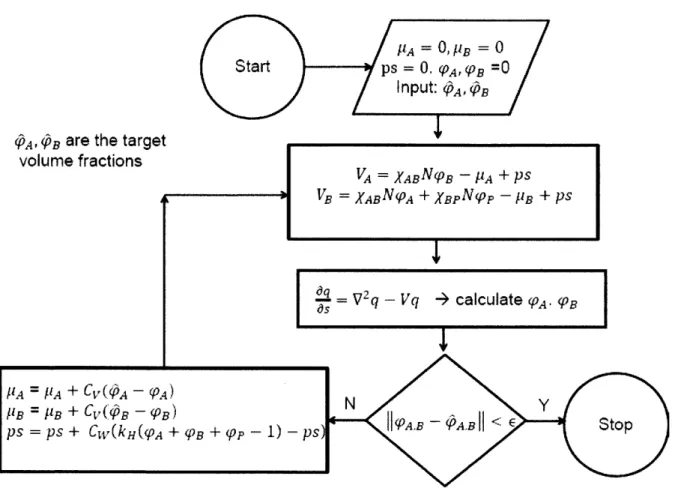
Figure 2.1. Constrained optimization routine to calculate the chemical potentials YA, yB, the
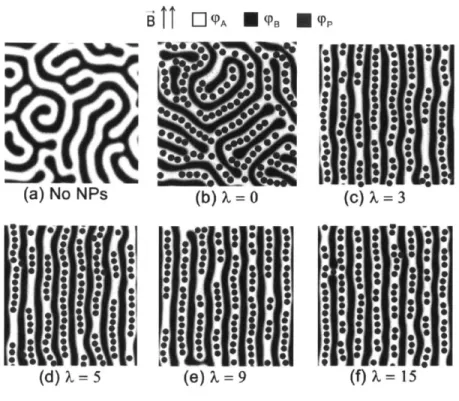
convergence tolerance is set at, e = 10-3...66 Figure 3.1. Complete alignment of the block copolymer observed at long times (10 000 BD moves), with similar final equilibrium morphology obtained for all nonzero magnetization strengths, (P p = 0.1, Rp = 0.51Rg, XApN = 0, XBpN = 30, XABN = 20, L = 3 2Rg, (a) without
nanoparticles/magnetic field, (b) X = 0, (c) X = 3, (d) X = 5, (e) X = 9, (f) k = 15, magnetic field
applied along the y-axis. Bright regions are rich in block A (PA 0.5); dark regions are rich in block B (VB > 0.5). Nanoparticles, represented by blue circles (yp 0.5), are seen in block
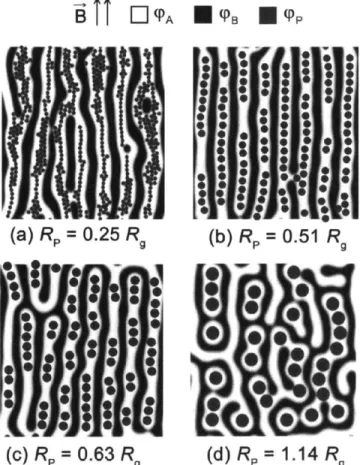
A ... 7 8 Figure 3.2. Schematic of energy penalty due to deformation of nanoparticle chains in external magnetic fields; dp is the nanoparticle diameter, and . is the width of the diffuse layer around the nanoparticle... 80 Figure 3.3. Effect of nanoparticle size on the diblock copolymer self-assembly, L = 3 2Rg, cPp= 0.1, k = 9, XBpN = 30= 30: (a) Rp = 0.25Rg (y =0.69); (b) Rp = 0.51Rg (y = 0.91); (c) Rp = 0.63 Rg
(y = 0.77); (d) R = 1.14Rg (y = 0.31)... 83 Figure 3.4. Effect of nanoparticle volume fraction on the alignment of diblock copolymer
domains, k = 9, XBpN = 30, Rp = 0.51Rg, L = 3 2Rg: (a) Op = 0.04, (b) Op
= 0.06, (c) Op = 0.08, (d) Op = 0.1, (e) Op = 0.12, (f) Op = 0.14, (g) Op = 0.16, (h) Op = 0.18...85
Figure 3.5. Effect of magnetization strength on the OOT: (a) k = 3, (b) k = 5, (c) k = 9, (d) k =
15. The nanoparticles (blue circles) were sequestered in block A, and their loading was kept fixed at Op = 0.18. The interaction strength between the nanoparticles and block B was XspN = 30, Rp = 0.51Rg. More of the lamellar phase was observed for higher magnetization stren gth ... 87 Figure 3.6. Effect of surface affinity of the nanoparticles for the blocks; k= 9, Op = 0.12, L = 3 2Rg, XApN = 0, XABN = 20, Rp = 0.51Rg: (a) neutral particles (y = -0.38) and (b)
XBpN = 10 (y = -0.21) lead to perpendicular alignment, (c) mixed lamellar-cylindrical phase (y =-0.12) is observed, (d) good alignment is observed for XypN = 22 (y =0.86)...89 Figure 3.7. Effect of neutral nanoparticles on BCP alignment, ) = 9, L = 32Rg, XBPN =0, XAPN =0,
Figure 3.8. Variation of the orientational order parameter with number of BD moves per nanoparticle. As the simulation proceeds, the diblock copolymer aligns in the direction of the magnetic field, and different magnetization strengths give similar y at long times. Qualitatively, it is seen that at higher magnetization strengths the initial rate of change in the value of y is higher, suggesting faster alignment at higher magnetization strengths. XBpN = 30, (Dp = 0 .12 ... . . 92
Figure 3.9. Variation of y with nanoparticle loading (Dp) for different magnetization strengths; there exists an optimal range of loadings over which the best orientational order is observed with
minimal defects, XBpN = 30, XApN = 0, XABN = 20, Rp = 0.51Rg, L = 3 2Rg...93
Figure 4.1. Effect of dipolar interactions on the morphology of the block copolymer nanocomposite,. Rp = 0.5 Rg, XBpN= 30; (a) - (e) non-magnetic nanoparticles; (f) - (j) magnetic
field (H) is out of plane (along z axis); (k) - (o) magnetic field (H) is in-plane (along y axis);
Local volume fractions for block A (bright regions), B (dark regions) and nanoparticles (blue spheres) are represented by IA, 4B,and 4 p respectively; A represents ratio of dipolar interaction
energy to therm al energy...109
Figure 4.2. Effect of nanoparticle size on the morphology of block copolymer composite, H field is out of plane, resulting in repulsive dipolar interactions between the nanoparticles; A = 9, XApN
= 0, XBpN = 30, (a) Rp = 0.25 Rg, 'Dp=0.0125, (b) Rp = 0.5 Rg, Dp=0.05, (c) Rp = 0.75 Rg,
DOp=.1125, (d) Rp = 1 Rg, (Dp=0.2. The choice of these loadings results in equal nanoparticle num ber densities for all particle sizes...112 Figure 4.3. Effect of nanoparticle volume fraction on the morphological transitions in the block
copolymer,f= 0.3, XApN = 0, XBPN = 30,,XABN = 20, Rp = 0.5 Rg...113
Figure 4.4. Effect of out-of-plane magnetic field on the stripe-forming phase,f= 0.5, XABN = 20,
XApN = 0, XBpN = 30, RP = 0.5 Rg, A = 9...114
Figure 4.5. Effect of out of plane magnetic fields (H), when the nanoparticles are selective for the
majority block; f =0.7, XAPN = 0, XBpN = 30, Rp = 0.5 Rg, (a) A = 9, p=O.ll, (b)A/ = 9,
cp=0.12, Red-blue hexagon pairs denote dislocations in the block copolymer (BCP) and 5-7
Figure 4.6.f= 0.7, XApN = 0, XBpN = 30, XABN = 20, honeycomb lattices not formed for non-magnetic nanoparticles (A = 0), (a) (P* = 0.11, and (b) P*l = 0.12; honeycomb lattices not formed
for superparamagnetic nanoparticles (A = 9), when Op # *, (c) Op = 0.05, (d) Op = 0 .1 3 ... 1 17
Figure 4.7. Schematic of honeycomb lattice formation, nanoparticles (blue circles) occupy the interstitial spaces of the hexagonal phase formed by the block copolymer (black dots refers to m inority block B )...117
Figure 4.8. Honeycomb lattice not formed for nanoparticle sizes,f= 0.7, XApN = 0, XBpN = 30,
XABN = 20, A = 9, (a) Rp = 0.25 Rg, c*P = 0.03, and (b) Rp = 0.75 Rg, 0*I = 0.27. These volume
fractions are chosen to be optimal for honeycomb lattice formation, as calculated by geometrical arguments. Therefore, particle size is also critical to lattice formation...119
Figure 4.9. Effect of in-plane magnetic fields on the morphological transitions in the block copolymer as a function of nanoparticle loading,f= 0.3, XApN = 0, XBpN = 30, XABN = 20, X = 9, Rp = .5Rg... ... ... 120
Figure 4.10. Orientational alignment of hexagonal phase of the minority block (B) by chaining of nanoparticles sequestered in the majority block (A) in the direction of external magnetic field (H)
along the y axis; A = 9, XBpN = 30, RP = 0.5 Rg, (a) cp =0.05, (b) cp=0.08, (c) cp=0.1, (d)
Op=0.14; Red - green hexagons refer to dislocations, Voronoi maps shaded with orientational order parameter, for the corresponding volume fractions are given in (e
-h )...12 1
Figure 4.11. Schematic of alignment of hexagonal phase of the block copolymer (minority block B, black dots), by chaining of superparamagnetic nanoparticles (blue circles) in the presence of in-plane m agnetic fields...122
Figure 4.12. Distortion of hexagonal phase of the minority block at very high nanoparticle
volume fractions,
f
= 0.7, XApN = 0, XBpN = 30, XABN = 20, X = 9, Rp = 0.5 Rg. (a) ctp =max =0.18,(b)p=0.19> cpax...123
Figure 5.1. Structural evolution of block copolymer superparamagnetic nanoparticle composite subjected to external magnetic field applied along y axis; filled contour plot of volume fraction
of monomer A (blue circles represent nanoparticles). A = 15, XABN = 20, XBPN = 30, Rp =0.5 Rg, cDp=O. 11, r = 2.5 * 102At po, u=0.2, domain spacing = 4 Rg, L 16 Rg...133
Figure 5.2. Effect of dipolar interactions on the alignment of block copolymer nanocomposite,
(a) - (d) A = 3, (e) - (h) A = 5, (i) - (1) A = 9, XABN = 20, XBPN = 30, Rp =0.5 Rg, CIp=O.11,
T = 2.5 * 102A tpoty, O=0.2...134
Figure 5.3. Temporal evolution of orientational order parameter (y) for different dipolar interaction strengths, L = 32 Rg, XABN = 20, XBPN = 30, Rp =0.5 Rg, Op=0.11, T =
2.5 * 102A tpo y, a =0.2 ... 135
Figure 5.4. Effect of nanoparticle-block B interaction strength on the structural evolution of the block copolymer nanocomposite; higher interaction strength leads to faster alignment of lamellae
along the magnetic field direction. A = 9, XABN = 20, XAPN = 0, Rp =0.5 Rg, Dp=O.l1,r = 2.5 * 102A t po ,, a=0.04...136
Figure 5.5. Block Copolymer nanocomposite at t = 1400-. A = 9, XABN = 20, XAPN = 0, Rp =0.5
Rg, cIp=O.lIz = 2.5 * 102Atpoly, u=0.04, (a)
XBPN = 22, (b) XBPN = 30, (c) XBPN = 40,
(d) X Bp N = 5 0 ... 137
Figure 5.6. Effect of nanoparticle mobility on the alignment of block copolymer, A = 15, XABN
= 20, XBPN = 30, Rp =0.5 Rg, Dp=O.Il,r = 2.5 * 10 2Atp oy...138
Figure 5.7. Effect of high nanoparticle mobility on block copolymer ordering, A = 15, XABN =
20, XBPN = 30, Rp =0.5 Rg, p=0. 11 = 2.5 * 102Atpol,...139 Figure 5.8. Effect of dipolar interaction on the kinetics of defect annihilation in hexagonal
morphology, Op =-0.06, V) = fl =0.03, f = 0.3, a = 0.06, r = 0.3, a = 0.23, v = 0.38, D = 0.3, L =64 Rg...143 Figure 5.9. Effect of nanoparticle-block copolymer interaction on the kinetics of defect annihilation, the dipolar interaction strength, A = 9, Op =0.06, P =0.03, f = 0.3, a = 0.06,
Chapter 1
Current Progress in the Computational Modeling
Of Block Copolymer Nanocomposites
1.1 Introduction
Block Copolymers (BCPs) are polymers derived from more than one type of monomeric species. The simplest BCPs are linear diblock copolymers that contain polymer chains of two different types of monomeric species connected together by a covalent bond (Figure 1.1). They cannot undergo macrophase separation, since they are essentially single component systems (due to the covalent bond), unlike a blend of homopolymers. Instead they undergo microphase separation forming a variety of periodic structures (or phases) belonging to different symmetry groups such as lamellar, cylinders, gyroid phases, spheres etc (see Figure 1.1). Thermodynamic incompatibility drives the microphase separation of the diblock copolymer (AB) wherein the contacts between similar blocks (A-A, B-B) are maximized and that between dissimilar blocks (A-B) are minimized respectively. The segregation between the dissimilar blocks is characterized by Flory-Huggins parameter XAB. The diblock copolymer (AB) is characterized by two other parameters viz. N which is the overall polymerization index or degree of polymerization; andfA, which is the coil fraction of monomeric species A, defined as fA = NA
11
A B
- I
spheres cylinders gyroid lamellae
fA
gyroid cylinders spheres
Figure 1.1. Common thermodynamically stable periodic phases of linear diblock copolymer (AB), different structures are obtained upon increasing the coil fractionfA (1).
These periodic micro-domain phases can accommodate nanoparticles of specified affinity paving way for fabrication of novel hierarchically structured nanocomposite materials with properties of both the block copolymer host materials as well as those of nanoparticle inclusions. The ability to control these block copolymer morphologies at length scales of the order of domain sizes combined with the multitude of choices available in terms nanoparticle shape, size
11
and type, creates exciting new opportunities to engineer these nanocomposite materials for a variety of applications (2).
1.2 Localization of Nanoparticles in Block Copolymer Domains
The properties of block copolymer nanocomposites are highly sensitive to the location of the nanoparticles within the block copolymer domains. For instance, Bockstaller and Thomas (3) showed the effect of nanoparticle location on the optical properties of the block copolymer nanocomposite. It was demonstrated that nanocomposites, in which nanoparticles were segregated at the interface, showed enhanced absorption of incident light (3).
Nanoparticle location can stabilize the morphology of the block copolymer. Kim et al. (4) showed that, upon surface modification, the nanoparticles segregated at the block copolymer interfaces and behaved as surfactants. A decrease in lamellar thickness was observed, upon addition of such nanoparticle "surfactants" to lamellar forming block copolymer, up to a critical value of nanoparticle volume fraction, beyond which stable bicontinuous morphology was obtained.
Nanoparticle localization can also induce phase transitions in the block copolymers. Kim et al. (5) showed that localization of gold nanoparticles in the PS domains of the lamellar forming PS-b-P2VP block copolymer in resulted in higher local volume fraction of nanoparticles within the PS domains. This led to a phase transition from lamellar morphology to hexagonal morphology. The lamellar morphology was intact in those regions where the volume fraction of the Au nanoparticles was low. Thus, it is imperative to understand the mechanisms underlying the localization of the nanoparticles within block copolymer domains for an efficient design of
these novel hierarchically structured materials. The localization of the nanoparticles depends two types of nanoparticle BCP interactions viz. (1) Excluded volume interactions or Entropic interactions (2) Enthalpic interactions.
1.2.1 Entropic Effects
The excluded volume interactions between the nanoparticles and the block copolymer play a major role in the location of the nanoparticles within the block copolymer matrix and also affect their dispersion within the domains. Since the nanoparticles are hard solids, the polymer chains have to stretch around these nanoparticles, thereby causing a loss in the conformational entropy of the polymer chains. The elastic free energy cost of placing a single nanoparticle inside a polymer chain is directly proportional to the nanoparticle size (6),
41R 3
AEbr P P(Z) 13
where P(z) is the pressure field at location z from the block copolymer interface. Hence, for larger nanoparticles, the elastic free energy cost is higher due to which they are expelled from the bulk of the block copolymers. This elastic free energy penalty can also cause morphological transitions as shown by Lee et al. (7), who observed that at fixed diblock copolymer composition, nanoparticle volume fraction and surface affinities, a phase transition is seen from lamellar morphology to cylindrical morphology with increase in nanoparticle size.
Lee et al. (8) also studied the effect of entropy on the spatial distribution of non-selective nanoparticles in a block copolymer thin film confined between two A-like surfaces. They found that nanoparticles, which are expelled from the bulk of the lamellar forming block copolymer
copolymer - substrate mediate the interfacial interactions between the block copolymer film and
the substrate and cause a reorientation of the lamellae normal to the A-like walls, which would have otherwise been oriented parallel to the substrate surface in the absence of the nanoparticles.
Excluded volume interactions between the nanoparticles and the block copolymer are significant for sufficiently high volume fractions of the nanoparticles (even for smaller sized ones) and can cause morphological transitions in the block copolymer (Figure 1.2). The effect of nanoparticle volume fraction on the Order to Order Transitions (OOT) has been studied both experimentally (5, 9) and theoretically (10, 11).
experimental TEM hybrid particle SCFT
(a)()
increasing
particle 50,
50 density
Figure 1.2. Morphological Transitions induced by increase in nanoparticle volume fraction (11). (a) and (b) TEM images of Au nanoparticles in the PS domains of PS-b-P2VP; (c) and (d) HPF
simulation results. Upon increasing the volume fraction of Nanoparticles, a phase transition is observed from lamellar phase to hexagonal phase.
1.2.2 Surface Modification of Nanoparticles: Enthalpic Interactions
Enthalpic interactions between the nanoparticles and the block copolymer can be tuned by chemical modification of the nanoparticle surfaces. In a composite made of block copolymer AB and nanoparticles, the nanoparticles are localized in A domains if the nanoparticle surface has favorable enthalpic interactions with A monomers and vice-versa. Hence, one of the strategies to localize the nanoparticles within one of the domains has been to coat the nanoparticle surfaces with homopolymer chains (of lower molecular weight) similar to that of the preferred domains.
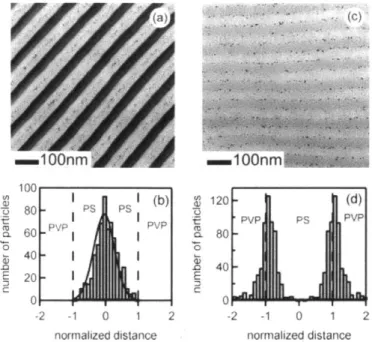
Chiu et al. (12) sequestered Au nanoparticles preferentially one of the domains of poly(styrene-b-2-vinyl pyridine) (PS-b-P2VP) by coating Au nanoparticles with short chains of PS and PVP homopolymers. PS coated Au nanoparticles were localized inside the PS domains of the symmetric PS-b-P2VP block copolymer while PVP coated Au nanoparticles were localized inside the P2VP domains (Figure 1.3).
.... 100nm ... 00nm 100 (b) 120- (d) 80- PS PS A PVP PS PVP CI. 60- 80-0 0 40 20 -0 - 0 9 -2 -1 0 1 2 -2 -1 0 1 2 normalized distance normalized distance
Figure 1.3. Localization of Au nanoparticles by surface functionalization, (a) and (b) PS-coated Au nanoparticles are localized inside PS domains (light regions) of PS-b-P2VP block copolymer, while in (c) and (d) PVP coated Au nanoparticles are found inside P2VP domains; Ref. (12).
The nature and the properties of the homopolymer ligands on the nanoparticle surface determine the enthalpic interactions between the nanoparticles and the block copolymer. The strength of these enthalpic interactions can be tuned by changing the areal chain density of the homopolymers ligands on the nanoparticles surfaces (13, 14). Higher areal chain density confers stronger interaction between the nanoparticle surface and the preferred domains of the block copolymer, resulting in the sequestration of the nanoparticles in the interior of the BCP domains, while lower areal chain density results in weaker nanoparticle - BCP interactions. Consequently, the nanoparticles are found at the block copolymer interface.
$ 4, 4,
-- 4- -Al
.<.6 ~ W
47~
Figure 1.4. Effect of areal chain density of homopolymer ligands on the nanoparticle location in the BCP (13), Cross-sectional TEM image of PS-b-P2VP block copolymer with PS coated nanoparticles (M, of PS coating = 3.4 kg/mol) with differential areal chain densities of the PS coatings (a) 1.64 chains/nm2, (b) 1.45 chains/nm2, (c) 1.22 chains/nm2 and (d) 0.83 chains/nm2. Scale bar 100 nm.
The molecular weight of the homopolymer ligands plays a major role in determining the strength of the nanoparticle- BCP enthalpic interactions (14) as it affects the areal chain density of homopolymer coating. The critical areal chain density, above which the polymer coated nanoparticles are located at the interior of the preferred domains and below which they are located at the block copolymer interface, decreases with increase in molecular weight of the polymer ligand. Kim et al. (14) found that the critical areal chain density scaled with molecular weight of the polymer ligands as,
ZC~Rq
~ m;0.6(12where Rg is the radius of gyration of the block copolymer chain, M, is the molecular weight of the polymer ligand. Thus, for polymer coated nanoparticles, larger the molecular weight of the polymer coating, lesser areal chain density of the coating is required for the localizing the nanoparticles within the center of the preferred BCP domains.
1.3 Predicting the Phase Behavior of Block Copolymer Nanocomposites
While the location of the nanoparticles within the block copolymer domains can be tuned by surface chemistry and entropic effects, the block copolymers do not just template the arrangement of the nanoparticles. The nanoparticles can have a significant effect on the morphology of the block copolymers (15). Lin et al. (15) showed that Cadmium Selenide (CdSe) nanoparticles can mediate interfacial interactions between the cylinder forming block copolymer and the substrate, and can cause an orientation of the cylindrical domains normal to the surface even when the majority block is strongly attracting to the substrate. Nanoparticles can act as surfactants and stabilize the block copolymer interface leading to stable bicontinuous morphologies (4). Nanoparticles can also control the ordering the block copolymers during solvent annealing by interacting with the solvent vapor (16). Park et al. (16) showed that the blending of hydrophilic Au-PEO nanoparticles with thin films of PS-b-PMMA block copolymers induced the orientation of PMMA cylindrical microdomains perpendicular to the surface, which would otherwise orient parallel to the substrate surface in the absence of the nanoparticles.
The theoretical and computational research on the self-assembly of block copolymers and nanoparticles have focused on two main aspects: (1) spatial distribution of nanoparticles in the
block copolymer, (2) morphological transitions induced by the nanoparticles. In this section, various computational studies on block copolymer nanocomposites are reviewed.
1.3.1 Spatial Distribution of Nanoparticles in Block Copolymer Domains
The work by Thompson et al. (17) was one of the first studies to employ an approach combing the SCFT technique with Density Functional Theory (DFT) of nanoparticles to predict the spatial distribution of the nanoparticles within the block copolymer melt. The non-ideal or steric free energy for excluded volume interactions between the nanoparticles, derived by P. Tarazona (18, 19) was used. The major prediction from this study was the effect of nanoparticle size and volume fraction on their spatial distribution in the block copolymer melt. It was found that larger nanoparticles caused greater loss in conformational entropy of the block copolymer chains compared to smaller nanoparticles for the same nanoparticle loading. As the volume fraction of the large nanoparticles was increased, they segregated to the central core of the preferred microdomain, while smaller nanoparticles, that have higher translational entropy, were found more uniformly dispersed within the preferred microdomain for same surface affinity of the nanoparticles. In a follow up study (20), two different types of self-assembled morphologies were predicted for block copolymer nanocomposites containing selective nanoparticles. These were termed as 'Center-Filled-Lamellar/Cylinder' (CFL/CFC) and 'Edge-Filled-Lamellar/Cylinder' (EFL/EFC). CFL morphologies were found for larger nanoparticles that were segregated to the core, while EFL morphologies were found for smaller nanoparticles.
Thus, the choice of EF or CF morphology depends on the packing considerations of the nanoparticles (entropic effect). Smaller particles can fit in side by side, squeezing the polymer at
are found sequestered in the core (20). When d/L > 0.3 (d being the nanoparticle diameter, and L is the domain size of the preferred domain), nanoparticles are predicted to be localized at the center of the domain, whereas they move outwards toward the interface for d/L < 0.3 (21).
Liu and Zhong (22) used Dissipative Particle Dynamics (DPD) simulations to predict the spatial distribution of a binary mixture of nanoparticles in a lamellar block copolymer. They found that nanoparticles segregated in different microdomains based on their surface affinity with the blocks. Moreover, their simulation results showed that for binary nanoparticle mixtures/lamellar copolymer systems, when both types of nanoparticles are compatible with the same block, a trilayer sheet is formed within a single domain, in which larger nanoparticles localize at the center of the domain while the smaller ones are found near interfaces forming a sheet on either side of the larger nanoparticles. Lee et al. (21) obtained similar results for binary nanoparticle mixtues/block copolymer systems. They studied both cylinder forming block copolymers and lamellar forming block copolymers using SCFT/DFT technique.
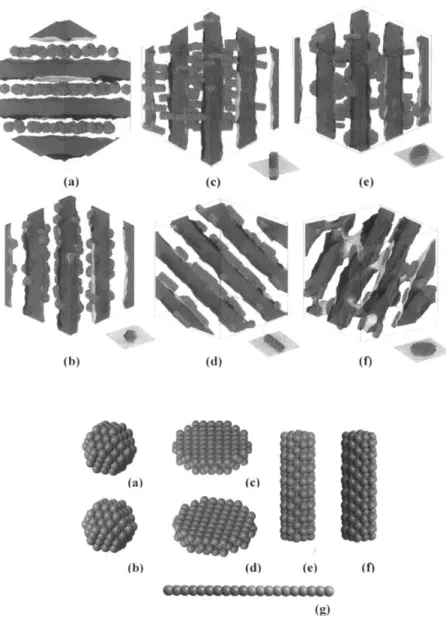
Yan et al. (23) studied the self-assembly of Janus nanoparticles of different geometries (spheres, rods and disks) and looked their interfacial segregation using DPD technique (Figure 1.5). They observed that Janus nanoparticles stabilized the block copolymer interfaces and conferred a control over the shear behavior of the composite and enhanced processing properties of the composite.
Maly et al. (24) investigated the positioning and ordering of nanoparticles in lamellar forming and cylinder forming block copolymers using DPD technique, wherein the DPD parameters were calculated from the multi-scale modeling approach, using lower scale atomistic simulations. Their results corroborated earlier studies on the effect of nanoparticle coating type
and volume fraction on their positioning in the block copolymer matrices. In addition, they also observed morphological transitions in the block copolymers upon increasing the nanoparticle volume fraction.
Most accurate predictions, till date, of the spatial distribution of nanoparticles in lamellar forming block copolymers has been provided by Matsen and Thompson (25) who used a SCFT technique similar to Sides et al. (11), taking into account the excluded volume interactions between the nanoparticles and the block copolymers. Since, dilute concentrations of nanoparticles were studied, inter-particle interactions were ignored and the nanoparticles were treated as true three-dimensional spheres. Their theory allowed for the bending of the interface with the nanoparticle position. One of their important findings was the strong tendency of the block copolymer interface to follow the position of the particle and its detachment from the nanoparticle.
(a) (b) (a) (b) I I I
I
I
(c) (e) (d) () (c) (d) (e) (f) (g)Figure 1.5. DPD study of interfacial stabilization by Janus type nanoparticles (23), different geometries of Janus nanoparticles were explored (a), (b) spheres, (c), (d) disks, (e), (f) rods with different types of surface chemistries.
1.3.2 Nanoparticles induced Morphological Transitions in Block Copolymers
The interplay of enthalpic stabilization of nanoparticles and entropic penalty of polymer chain stretching around the nanoparticles causes morphological transitions in block copolymers
induced phase transitions in block copolymers (27). Schultz et al. (28) used Discontinuous Molecular Dynamics simulations (DMD) to predict the phase behavior of linear diblock copolymer (AB) nanoparticle mixtures. The interaction strength between the monomer species XABand the volume fraction of the nanoparticles was varied to construct the phase diagram (Figure 1.5). Lamiellae Cylinders 40 PL 30 c1, Disorder 20 ' 0 0.1 02 0.3 04 Lamiellae 40 30 PL Cylinders I 0 20 1 0 0. 1 0.2 0.3 0.4 oil) ' amellae 40 * * 0 PL Disorder 30 P 2 'e 0 010 20 * ' ' ' 0 01 0,2 0.3 0.4 op Lainellae P1. 40 * * 0 30 Disorder e) a 2 2 20 . . . 1) 0.1 0.2 0.3 0A4 50 Lamella PI, \ 40e PL Disorder 30 c) o*=4P 0 P D 201 0 0.1 0.2 0.3 0.4 p Laniellae L+11 40 I 1 0D+11 * 0 0 31) Disorder * * II 4% 20 f) L*-4 r*-20 0 0 0.1 0.2 0.3 0.4 p
Figure 1.6. Phase diagram for a mixture of linear symmetric block copolymer (f = 0.5) and
selective nanoparticles of different sizes o and different nanoparticle - block copolymer interaction strengths (e*). The diameter of the nanoparticle is scaled by the diameter of the polymer bead, and e* = C^P .Ref. (28).
EAB
Their simulation demonstrated the effect of the nanoparticle size and their volume fraction on the Order Disorder Transition (ODT) and Order to Order Transition (OOT) of the
block copolymers. They also showed that neutral nanoparticles were localized at the interfaces while selective nanoparticles were found in the preferred microdomains.
Xu et al. (29) studied the effect of polymer grafted nanoparticles on the phase transitions in the block copolymer using SCFT. They showed that by controlling the nanoparticle volume fraction, chain length and the grafting density of polymer coating the ordered morphologies (lamellar or hexagonal) of the composite could be controlled, and the spatial distribution of the nanoparticles could be tuned. The nonstructural transitions were attributed to the competition between entropy and enthalpy.
1.3.3 Confinement Effects on Block Copolymer Nanocomposites
The morphology of the block copolymer nanocomposites undergoes a great change upon confinement. Lee et al. (8, 30) modeled the self-assembly of block copolymer nanoparticle mixtures confined between two parallel hard walls. They considered a mixture linear symmetric diblock copolymers (AB) and hard non-selective nanoparticles confined between two A-like walls. They found that due to enthalpic and entropic interactions, the non-selective nanoparticles are driven to the block copolymer-substrate interfaces. They mediate the interfacial interactions between the block copolymer and the substrate surface, resulting in a reorientation of the lamellae from parallel to perpendicular orientation. The simulations revealed that the polymer mediated depletion attraction between the particles and walls could be used to modify the wetting properties of the substrates and affect the morphology of the composite. This simulation prediction was verified experimentally (31). A follow up study by the same group (32) used a combination of the computer simulations (SCFT/DFT) and the scaling theory to illustrate the
effect of nanoparticle localization at the block copolymer substrate interface on the wetting properties of the substrate and its subsequent effect on the morphology of the composite.
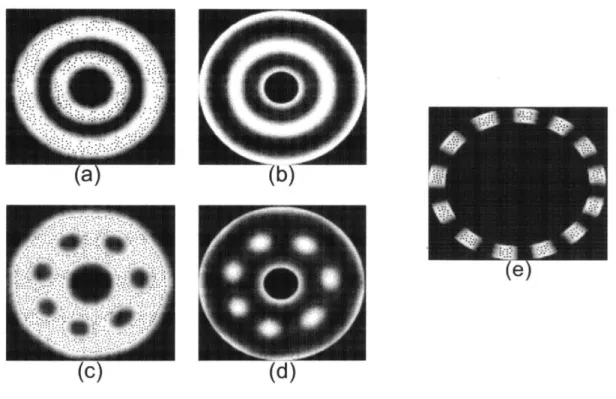
Pan et al. (33) investigated the effect of confinement by two concentric circular walls on the block copolymer nanoparticle mixtures using a combination of SCFT and Hybrid Particle-Field (HPF) technique. They observed that increase in nanoparticle concentration favored a phase transition from cylindrical phase to concentric lamellar rings phase or from concentric lamellar rings phase to cylindrical phase. When the separation distance between the concentric circular walls was sufficiently small, they effectively behaved as two parallel walls and perpendicularly oriented lamellar morphology was obtained.
a
(b)
ee
(c)
Figure 1.7. Self-assembly of block copolymer nanoparticle mixtures confined between concentric circular A-like walls, (a, b)f= 0.55, ri = 3.0 Rg, r. = 6.4 Rg, (Dp=0.06 (c, d)f= 0.55, ri = 3.0 Rg, r0= 6.4 Rg, CPD=0.23, (e)f= 0.55, ri = 5.0 Rg, r. = 6.4 Rg, cDp=0.05; Ref. (33).
1.4 Methods to Simulate Self-Assembly in Block Copolymer Nanocomposites
There have been many techniques to simulate the self-assembly in block copolymer nanocomposites. They range from full scale atomistic simulations to continuum methods as mentioned in the previous sections. We briefly overview some of the most popular computer simulation techniques used for block copolymer nanocomposites in this section.
1.4.1 Self-Consistent Field Theory/ Density Functional Theory (SCFT/DFT) Technique
This technique was introduced by Thompson et al. (17, 20). It combines the SCFT technique for polymers and DFT technique for nanoparticles. A typical simulation considers a mixture of linear diblock copolymer (AB) and solid spherical nanoparticles of radius R. Each diblock copolymer chain consists of N segments with a volume of p-'. The coil fraction of the A block is denoted by f, while the interactions between the two blocks is represented by dimensionless Flory-Huggins interaction
parameterXAB-The essence of the "Field theory" is the transformation of the many-body interactions that each monomer segments have with each other to a single interaction that the monomer segment has with the average potential energy field created by the other monomer segments. The free energy of the block copolymer nanocomposite is expressed as,
F = Fe + Fd
+
F, (1.3)The free energy comprises of three terms, (1) Enthalpic interaction energy (F), (2) Diblock Entropic free energy (Fd), (3) Particle Entropic free energy (F,). The enthalpic (F) is given by,
Fe = V
1f
dZ{X ABNYAfB + XApNpA PP + XBpNcPBYp (1.4)V is the volume of the system, XApand XBpare parameters for interaction of the nanoparticles
with monomer segments A and B respectively. VA, VB, and (ppare the volume fractions of
monomers A, B and the nanoparticles respectively.
The free energy for diblock entropic energy is obtained from the overall partition function of system and the "mean" potential energy fields created by monomers segments A, and B (WA and
WB),
Fd = (1 - (p)ln(V(l-jp)
)
f d{wyA + WB(PB} (1.5)Qd V
Qd is the overall partition function of the block copolymer subject to potential fields WA and WB.
It is obtained from the solution of modified diffusion equations for chain propagators (see Chapter 2, Hybrid Particle Feld technique section for more details). O, is the overall volume fraction of the nanoparticles.
Finally, the particle entropic free energy is expressed as,
F, = ' In
(
)
- f d{wppp} + f d{ppTh(Spp)} (1.6)a Qpa
Qpis the overall partition function of the nanoparticle subjected to the external potential field wp.
qp is the locally averaged volume fraction of the nanoparticles. The local volume fraction of the nanoparticles is obtained from,
The parameter a ratio of nanoparticle volume to the volume single block copolymer chain expressed as,
_ 41rR3pO 47 R 3 - 1/2
3N 3 RO)
The relevant length scale of the system is the natural size of the polymer, given by R" = aN1/2 and N(= a6p2N) is the invariant polymerization index of the block copolymer. The statistical Kuhn length (or the dimension of the single monomer segment) is given by a. F, essentially describes the steric free energy between the nanoparticles using the Carnahan - Starling approximation, derived by Tarazona (18, 19).
The simulation involves calculation of the mean fields wA, wBand wpusing saddle point
approximation applied to the free energy functional (equation 1.3) subjected to the incompressibility constraint,
(PAVr) + qVBV) +
y
1,(ir)
=1(1.9)This yields a set of equations that are solved self-consistently to obtain the equilibrium
structures.
1.4.2 Hybrid Particle- Field (HPF) Technique
This technique, introduced by Sides et al. (11), is the first one to respect the nanoparticles as discrete entities while taking into account all the excluded volume interactions and entropic interactions (monomer/monomer, monomer/nanoparticle). This is accomplished by the use of cavity functions, which simulate the hard sphere nature of the nanoparticles. The cavity functions
are means to represent discontinuities in the continuous potential energy field created by the monomer segments at the nanoparticle locations. We extensively employ this technique in this thesis and more details about its theory and implementation can be found in the next chapter.
1.4.3 Dissipative Particle Dynamics (DPD)
This simulation technique was first developed to simulate hydrodynamic behavior, by Hoogerbrugge and Koelman (34, 35). The simulation method monitors the trajectories of 'soft spheres' whose motion is governed by simple collision rules. Polymers are modeled using bead-spring type particles. However, the link between the parameters in this method and the Flory Huggins X parameters was first established by Groot and Warren (36). Following their seminal paper, the DPD technique was widely accepted as one of the popular techniques for simulating polymeric fluids. The DPD technique has also been widely used for simulating block copolymers and block copolymer nanocomposites (22-24, 37-39).
We briefly overview the essential features this useful technique in this section. In DPD method, the polymers are modeled as bead-spring type particles. The time evolution of all the particles is governed by Newton's equation of motion. For every time step, the set of particle position vectors and velocities {r,vi) are evolved using a modified version of velocity-verlet algorithm (40),
ri(t + At) = ri (t) + At. vi (t) + (At)2.
fi
(t) (1.20a)2
i (t + At) = vi(t) + A. At.
f
1 (t) (1.20b)v1(t + At) = v (t) + .{ff (t) +
fi(t
+ At)) (1.20d)The masses of the particles are assumed to be equal to 1, so the forces acting on the particles are equal to their accelerations. If the parameter A is chosen to be equal to 0.5, the velocity-Verlet algorithm is obtained. But in DPD, A=0.65 is chosen for accurate temperature control (37). The force fi(t) in the equations 1.20(a-d), is given by the sum of a conservative force, a drag force and a pair-wise additive random force and a spring force (for polymeric beads),
fi (+t) = Zj F + FP + FR + FA (1.21)
The particles are modeled as soft spheres and the conservative force Fjj is given by,
C= -ai
(1
-jri
1j)
j, if Irij < 10, if
IrijI
> 1 (1.22)a 1 is the maximum repulsion between the particles I and
j
and rij =r - r r.
The drag forces and random forces are modeled as,FU = yto - (1.23)
( is a random variable with zero mean and variance 1, and u' = 2ykBT, the weighting function awjj(r) = (1 - rij) for rij < 1 and equal to zero for rij > 1. The choice of the weighting
functions is based on the conservation of the angular momentum for the particles.
In order to map the real polymer onto this model (36-38), the compressibility of the polymer is matched by using appropriate values of the repulsion parameter between 'like' particles/beads, aii,
aiip = 75kBT (1.25)
The Flory Huggins X parameter is matched to the repulsion parameter between 'unlike' particles/beads (37), a11,
ai= a + 3.2 7Xij for p = 3 (1.26a)
aj ~ ai + 1.45xix for p = 5 (1.26b)
The reasoning for the choice of these parameters and logic behind this formalism can be found
here (36, 37).
In addition to these forces, the beads comprising a polymer chain are tied together using a harmonic spring, which is represented by,
F =-Cri (1.27)
In the simulation, the radius of interaction (R,), the particle mass (m) and temperature () are chosen to be equal 1, and the unit of time is given by,
T = Rc m/kBT (1.28)
In case of block copolymer nanocomposites, the size of the nanoparticles and the monomer segments (polymer beads) are different. Hence in the DPD method, all the particles will not have the same sizes and the radius of interaction between the particles of different types will differ
(23).
1.4.4 Cell Dynamics Simulations (CDS) of Time Dependent Ginzburg-Landau Model (TDGL)
The TDGL model is a microscale method for studying the structural evolution of the block copolymer. It is based on Cahn-Hilliard-Cook model for polymeric systems (41). The TDGL model was extended by (42) to include the nanoparticles. CDS is a unique and effective method to solve partial differential equations involving Laplacians. This technique was introduced by Oono and Puri (43). More details about this technique can be found in Chapter 2.
1.4.5 Other Techniques
In addition to the aforementioned widely used techniques, there have been other computational/theoretical techniques such as (1) Discontinuous Molecular Dynamics simulations
(28), (2) Monte-Carlo simulations of coarse-grained polymer models (44), (3) Strong-segregation
1.5 Treatment of Particle-Particle Interactions
In most of the aforementioned computational studies on the block copolymer nanocomposites, the treatment of the interparticle interactions is almost always absent, primarily due to the fact that most of these studies have involved dilute concentrations of nanoparticles, wherein the interparticle interactions can be ignored to avoid computational costs (47).
Furthermore, only a few computational/theoretical studies respect the nanoparticles as discrete entities and accommodate for excluded volume interactions between nanoparticles and the block copolymer (11, 33, 45).
Particle-particle interactions have to be considered explicitly in order to accurately predict the phase behavior of block copolymer nanoparticle mixtures. Especially, long range interparticle interactions can have a drastic effect on the morphology of the block copolymer
(48). The role of long range interparticle interactions on the morphology of the block copolymer nanocomposites warrants a detailed study as it opens up another dimension to control the morphology of the block copolymer nanocomposite. The various interactions that exist between particles and the strategies to control these interparticle interactions can be reviewed here (49).
1.6 Thesis Goals
The main goal of this thesis is to investigate the effect of dipolar interactions on the morphology of the block copolymer nanocomposite computationally and theoretically. The following chapters consider a mixture of linear diblock copolymer (AB) and superparamagnetic nanoparticles under uniform external magnetic fields. Both thermodynamics of phase separation and kinetics of the self-assembly is given a detailed treatment. This thesis is the first study to
perform mesoscale SCFT simulations for block copolymer superparamagnetic nanoparticle composites considering the nanoparticles as hard spheres and accounting for the excluded volume interactions between the nanoparticles and block copolymers explicitly. The long ranged interparticle interactions are most accurately represented in a bid to delineate their effect on the phase transitions in the block copolymer nanocomposite.
1.7 Conclusions
This chapter provides an overview of the computational and theoretical studies on block copolymer nanocomposites done in the literature so far. The major thrust of all the computational studies has been to predict the spatial distribution of the nanoparticles and phase transitions in the block copolymer due to the complex interplay of enthalpic and entropic interactions between the block copolymer and the nanoparticles. While some studies have accounted for interparticle interactions, most do little justice in accurately representing the exact nature of the interparticle interactions. The paradigm of using the interparticle interactions to control the self-assembly of these nanocomposites and to exploit the symmetries of nanoparticle structures to modify the phase behavior of the block copolymer is relatively new and warrants a detailed study.
1.8 References
1. S. B. Darling, Directing the self-assembly of block copolymers. Progress in Polymer
Science 32, 1152-1204 (2007).
2. M. R. Bockstaller, R. A. Mickiewicz, E. L. Thomas, Block Copolymer Nanocomposites: Perspectives for Tailored Functional Materials. Advanced Materials 17, 1331 (2005).
3. M. R. Bockstaller, E. L. Thomas, Proximity Effects in Self-Organized Binary Particle
-Block Copolymer Blends. Physical Review Letters 93, 166106 (2004).
4. B. J. Kim, G. H. Fredrickson, C. J. Hawker, E. J. Kramer, Nanoparticle Surfactants as a Route to Bicontinuous Block Copolymer Morphologies. Langmuir 23, 7804-7809 (2007).
5. B. J. Kim, J. J. Chiu, G. R. Yi, D. J. Pine, E. J. Kramer, Nanoparticle-Induced Phase Transitions in Diblock-Copolymer Films. Advanced Materials 17, 2618-2622 (2005). 6. V. Pryamitsyn, V. Ganesan, Strong Segregation Theory of Block
Copolymer-Nanoparticle Composites. Macromolecules 39, 8499-8510 (2006).
7. J. Y. Lee, R. B. Thompson, D. Jasnow, A. C. Balazs, Effect of Nanoscopic Particles on the Mesophase Structure of Diblock Copolymers. Macromolecules 35, 4855-4858 (2002). 8. J.-Y. Lee, R. B. Thompson, D. Jasnow, A. C. Balazs, Entropically Driven Formation of
Hierarchically Ordered Nanocomposites. Physical Review Letters 89, 155503 (2002).
9. S.-W. Yeh, K.-H. Wei, Y.-S. Sun, U. S. Jeng, K. S. Liang, CdS Nanoparticles Induce a Morphological Transformation of Poly(styrene-b-4-vinylpyridine) from Hexagonally Packed Cylinders to a Lamellar Structure. Macromolecules 38, 6559 (2005).
10.
Q.
Pan, C. Tong, Y. Zhu, Self-Consistent-Field and Hybrid Particle-Field Theory Simulation of Confined Copolymer and Nanoparticle Mixtures. ACS Nano 5, 123 (2011). 11. S. W. Sides, B. J. Kim, E. J. Kramer, G. H. Fredrickson, Hybrid Particle-FieldSimulations of Polymer Nanocomposites. Physical Review Letters 96, 250601 (2006). 12. J. J. Chiu, B. J. Kim, E. J. Kramer, D. J. Pine, Control of Nanoparticle Location in Block