HAL Id: hal-02629304
https://hal.inrae.fr/hal-02629304
Submitted on 27 May 2020
HAL is a multi-disciplinary open access
archive for the deposit and dissemination of
sci-entific research documents, whether they are
pub-lished or not. The documents may come from
teaching and research institutions in France or
abroad, or from public or private research centers.
L’archive ouverte pluridisciplinaire HAL, est
destinée au dépôt et à la diffusion de documents
scientifiques de niveau recherche, publiés ou non,
émanant des établissements d’enseignement et de
recherche français ou étrangers, des laboratoires
publics ou privés.
Copyright
Forest Insects and Climate Change
Deepa S. Pureswaran, Alain Roques, Andrea Battisti
To cite this version:
Deepa S. Pureswaran, Alain Roques, Andrea Battisti. Forest Insects and Climate Change. Current
Forestry Reports, Springer, 2018, 4 (2), pp.35 - 50. �10.1007/s40725-018-0075-6�. �hal-02629304�
FOREST ENTOMOLOGY (E BROCKERHOFF, SECTION EDITOR)
Forest Insects and Climate Change
Deepa S. Pureswaran1&Alain Roques2&Andrea Battisti3 Published online: 30 April 2018
# The Author(s) 2018 Abstract
Purpose of Review Climate change affects populations of forest insect pests in a number of ways. We reviewed the most recent literature (2013–2017) on this subject including previous reviews on the topic. We provide a comprehensive discussion of the subject, with special attention to insect range expansion, insect abundance, impacts on forest ecosystems, and effects on forest insect communities. We considered forest insects according to their major guilds and biomes.
Recent Findings Effects of climate change on forest insects are demonstrated for a number of species and guilds, although generalizations of results available so far are difficult because of species-specific responses to climate change. In addition, disentangling direct and indirect effects of climate change is complex due to the large number of variables affected. Modeling based on climate projections is useful when combined with mechanistic explanations.
Summary Expansion of either the true range or the outbreak range is observed in several model species/groups of major insect guilds in boreal and temperate biomes. Mechanistic explanations are provided for a few species and are mainly based on increase in winter temperatures. In relation to insect abundance, climate change can either promote outbreaks or disrupt trophic interac-tions and decrease the severity of outbreaks. There is good evidence that some recent outbreaks of bark beetles and defoliating insects are influenced by climate change and are having a large impact on ecosystems as well as on communities of forest insects. Keywords Biome . Community . Guild . Impact . Outbreak . Range . Review
Introduction
There is general consensus among scientists that the global climate is changing at an unprecedented rate, with many regions experiencing warming trends, frequent high tem-perature extremes, and shifts in precipitation patterns [1••].
An increase of 0.61 °C in global mean temperature record-ed since the beginning of the twentieth century (i.e., com-paring the years 1850–1900 and 1986–2005, 5–95% CI is
0.55–0.67 °C) [1,2], and the predicted warming of 2–6 °C
by 2100 [3] have direly increased the need to understand the impacts of climate change.
Interactions and feedbacks between climate and the health of forest ecosystems are expected [4]. Changes in disturbance patterns mediated by climate warming are predicted to be the greatest impacts on forests in the coming decades [5]. Current increases in frequency and intensity of biotic and abiotic dis-turbances to forest ecosystems have been attributed, at least in part, to climate change [1••], but uncertainties remain in a
number of cases. Outbreaks of forest insects are major agents of mortality and ecosystem change in forests worldwide, and climate has been attributed to be an important driver of chang-es to disturbance regimchang-es mediated by forchang-est insects. Large-scale tree mortality resulting from drought, fire, and/or insect outbreaks can result in loss of carbon sinks and have feed-backs on climate change, with serious consequences for bio-diversity and ecosystem function [6•,7].
Disturbances have been defined asBdisrupting the function of an ecosystem and changing resource availability or the physical environment^ [5]. Consequences of disturbance can result in loss of resilience accompanied by major ecological This article is part of the Topical Collection on Forest Entomology
* Deepa S. Pureswaran [email protected] 1
Natural Resources Canada, Canadian Forest Service, Laurentian Forestry Centre, 1055, rue du PEPS, Québec, QC G1V 4C7, Canada
2 Institut National de la Recherche Agronomique (INRA), UR 0633,
Zoologie Forestière, 45075 Orléans, France 3
Department of Agronomy, Food, Natural resources Animals and Environment (DAFNAE), University of Padova,
transformations [8]. Forest insect outbreaks are major distur-bances by native or non-native insects, as they can be syn-chronous over large geographic areas and cause region-wide mortality of host trees in a relatively short period of time [9,
10,11•,12]. Disturbance due to forest insects have been re-corded to increase land surface temperature and cause declines in gross primary productivity [13,14].
Predicted geophysical impacts of climate change include floods, droughts, and rise in sea levels. General circulation models predict the greatest warming at high latitudes in win-ter, a decrease in precipitation at mid-latitudes in summer, and an increase in frequency of extreme climatic events such as storms and droughts [4]. Bark beetles, for example, can cause tree mortality following severe drought that is associated with warm temperatures, due to positive feedbacks on their popu-lations from availability of susceptible hosts and favorable temperatures, amplified over spatial and temporal scales [10,
15•]. Predictions of insect outbreaks suggest changes in
spa-tiotemporal patterns of defoliators and bark beetles. Bentz et al. [16] predict that spruce bark beetle, Dendroctonus rufipennis, outbreaks may occur throughout the range of spruce in North America in the future. Outbreak dynamics of the spruce budworm, Choristoneura fumiferana, are pre-dicted to change, move further north, and on to secondary host species [17,18]. Similarly, cyclical outbreaks of larch bud moth, Zeiraphera griseana, are predicted to decrease in mag-nitude in optimal mid-elevation zones of the Alps, and to shift toward higher altitudes [19]. However, predictions on future outbreak dynamics of defoliators remain uncertain as there is conflicting evidence on outbreak severity [20]. In general, poleward and upward shifts of pests and pathogens have been documented, but predictions are complicated due to interac-tions and uncertainties associated with changing weather pat-terns, extreme climate events, and differing responses of plants and insects to these events [21]. The consequences of higher frequency of extreme events are still poorly document-ed. For example, both positive and negative effects of climate on expansion and population dynamics can occur, as was ob-served in the pine processionary moth, Thaumetopoea pityocampa, during summer heat waves in 2003. This heat wave led to a collapse of the front edge population in France by killing early stages of the insect [22], while at the same time, triggering a record annual expansion in the Italian Alps by facilitating female flight [23].
Insect populations are particularly responsive to climate change because of their sensitivity to temperature, short gen-eration times, and high flight capacity. Observations of insect herbivory on an oak lineage during Quaternary climate change indicate that there was higher damage during warm and wet periods [24]. In recent years, the magnitude and severity of epidemics have increased, with outbreak populations expanding to northern and high-elevation areas, where in the past, such disturbances were relatively rare [10, 18, 25•].
Long-term surveys and examination of outbreak dynamics of five species of European Lepidoptera between 1800 and 2011 revealed climate-driven changes in outbreak severity, cyclicity, and frequency, but there were mixed effects of tem-perature on outbreak activity [12,26,27]. It is often argued that the frequency and severity of C. fumiferana outbreaks in North America have increased in the twentieth century. A regional tree ring chronology study [28] represents the longest and most replicated reconstruction of outbreak dynamics in North America (1551–1995). They identified nine potential outbreaks and three uncertain outbreaks in a 400-year period and concluded that while outbreak frequency was higher dur-ing the twentieth century (~ 30 years) compared to the 1660– 1850 period (~ 50 years), higher outbreak frequency might have occurred prior to 1660 (~ 28 years). While there is evi-dence that recent warmer temperatures have permitted the expansion of bark beetle outbreaks to higher latitudes and elevations than in the past, similar trends are more ambiguous to discern for Lepidoptera [20].
Reports of forest decline are becoming more frequent and habitat shifts are occurring throughout the continental USA, bringing to the limelight the importance of interactions involv-ing drought, insects, and fire [29]. Climate and weather can have direct effects on trees, as drought and storms can weaken trees and predispose them to attack by bark beetles and path-ogens. Climate can also have direct effects on insects as they are small poikilotherms with limited thermoregulation ability [30]. For example, in the hemlock wooly adelgid, Adelges tsugae, nymphs were observed 3 months ahead of their nor-mal phenology in December 2015, the warmest recorded December in Tennessee, USA, accelerating their development [31]. Intense but not moderate drought appears to favor bark beetle performance and tree mortality, although its impact is not consistent among species [32]. Warm temperatures result in changes in physiology and accelerated development in in-sects [33], particularly in northern latitudes where the growing season is short. Changes in phenology and phenological mis-matches with host trees and/or natural enemies can alter tro-phic relationships and either favor or be detrimental to forest insect populations [34,35]. Physiological changes in insects in response to temperature can facilitate changes in their dis-tribution patterns [21]. Field-based experimental manipula-tions of host plants [36] and insects to determine their relative responses to changes in temperature [37–39] can help predict the nature and extent of range shifts and to better understand how forest ecosystems will respond to climate change [40].
In this paper, we review the current state of knowledge on the response of forest insects to climate change, with special attention to insect range expansion, population dynamics, and impacts on communities and forest ecosystems. We systemat-ically analyzed literature from the past 5 years (2013–2017) for direct, indirect, and interacting effects of climate change on forest insect outbreaks and used reviews from earlier
publications (e.g., [41•]). We compiled information from
dif-ferent biomes and geographical areas on the effect of climate change on forest insects, dealing with range expansion, pop-ulation abundance, host shifts, and community interactions. We highlight the importance of using experimental manipula-tions to test the effect of climate warming on the phenology and performance of host trees, forest insects, and their natural enemies to better predict the response of communities and ecosystems to climate change. We identify gaps in current knowledge and suggest areas for future research that would advance our understanding of the impacts of climate change.
Literature Review and Analysis
We screened the peer-reviewed literature between 1948 and 2017 using Scopus on 7 July 2017 with Bforests^ AND Binsect*^ AND Bclimat*^ AND Bchang*^ as our search terms. We obtained 1246 hits of papers containing these terms in the title, key words, or abstract. We focused our search on papers published between 2013 and 2017, and removed pa-pers where the title or abstract revealed that they were not relevant. A total of 213 papers were selected for further anal-ysis. These papers were classified based on whether they ad-dressed (1) climatic drivers (temperature, precipitation, wind, CO2, O3); (2) their biomes (subarctic, boreal, temperate,
sub-tropical or sub-tropical); (3) forest type (natural or planted); (4) forest interactions (fire, drought, growth, dispersal, carbon, pathogens, trade); (5) feeding guilds (defoliators, bark beetles and wood borers, gall makers, sap suckers, seed and cone insects); (6) response of plants and/or insects (performance, phenology, voltinism); and (7) outcomes of climate change (range shift, host shift, outbreak dynamics). Forty of these papers were reviews or book chapters, which we then separat-ed from the primary literature. We further addseparat-ed relevant pa-pers that were accepted or in press and not picked up by Scopus.
Range Expansion
The range edge of forest herbivores is not easy to detect, especially when populations occur at low densities [41•].
Consequently, range expansion is difficult to document in nature, unless individuals are conspicuous, occur at high den-sity, or cause obvious symptoms on trees. There are a few species of native forest insects for which range expansion has been precisely ascertained and related to climatic vari-ables, including T. pityocampa [42] and bark beetles [10]. In addition, introductions of non-native forest insects into novel geographic areas represent an opportunity to assess potential range expansion zones, although in this case, it is not always clear whether the expansion is limited by niche availability or
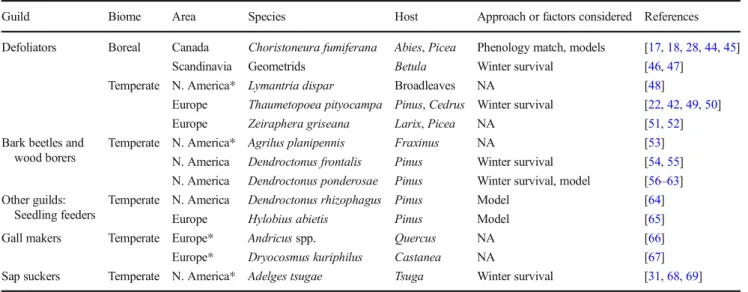
climatic factors [43]. Through analysis of case studies report-ed in Table1, we address the above questions and provide an interpretation that could facilitate further research in this field.
Defoliators
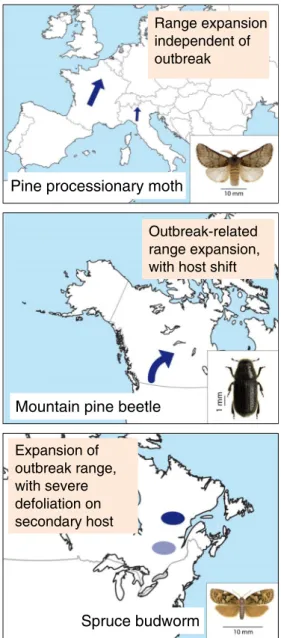
Range expansion linked to climate change has been observed in a dozen model species/groups in the boreal and temperate biomes, with mechanistic explanations provided for a few species. Increase in winter temperature appears to be the factor facilitating the survival and the occupation of geographic areas that were previously inaccessible due to harsh climate. Such a direct effect has been observed for geometrids associ-ated with mountain birch, the autumnal moth, Epirrita autumnata, and the winter moth, Operophtera brumata, in the boreal areas of northern Europe, where eggs now encoun-ter more favorable conditions during winencoun-ter [46,47]. In the case of T. pityocampa in Europe, larvae intensify feeding with more permissive winter temperatures, resulting in range ex-pansion that is independent of population outbreaks [23,42,
49] (Fig.1). An interesting indirect effect involving the host plant has been hypothesized and modeled for C. fumiferana in Canada, which is associated with balsam fir as its main host and black spruce as a secondary host. Climate change is pre-dicted to advance the phenology of the secondary host that is more abundant at the upper latitudinal edge, making it more susceptible to defoliation during outbreaks, and thus facilitat-ing expansion of the outbreak area into higher latitudes [17,
18,44,45,70] (Fig.1). In Z. griseana, increased late winter and early spring temperatures create a phenological mismatch between larval hatching and spring budburst of larch at the optimal elevation belt (1800–2000 m), resulting in a shift to-ward higher elevations [51,52]. Models are available to pre-dict further range expansion of species for which the mecha-nism of response is known, and tests with independent data have shown they are reliable [71,72]. However, generaliza-tion is difficult because of the specificity of reacgeneraliza-tion norms and ecological adaptations.
Other species have been observed to expand their ranges, and often, climate change has been invoked to explain these patterns. Climate-matching models, that may or may not include species-specific parameters, have been used to predict future scenarios. These tools are use-ful to build hypotheses about mechanisms and to encour-age scientists to design experiments tailored to individual species, although we should use caution before drawing general conclusions about the effects of climate change on range expansions [73–75].
Non-native defoliators also expand their range in response to climate change. In the case of the gypsy moth, Lymantria dispar, in North America, the reaction norm of larvae varies within the range, with local adaptations that may explain re-cent colonization of the upper part of the range [48]. This
indicates that selection can act on a relatively short time scale to enable populations to quickly adapt to new conditions caused by climate change.
Bark Beetles and Wood Borers
Bark beetles of the genus Dendroctonus have recently provided evidence of range expansion in North America where they are responsible for large outbreaks in different geographical regions. In the southeastern USA, the south-ern pine beetle, Dendroctonus frontalis, is moving north due to milder winters that enhance performance [54,55]. In the north-west, the mountain pine beetle, Dendroctonus ponderosae, is expanding northward and eastward for the same reason [56, 57, 71]. These obligate tree-killing in-sects require a large number of individuals to mass-attack trees and overcome their defenses. As they can disperse for long distances, it is difficult to precisely define the edge of their range and document expansions. Most of what is known depends on the availability of precise in-formation on the location of dead trees and the cause of death, which are now available due to modern surveil-lance technology. These species are difficult to detect when associated with weakened trees under endemic con-ditions, whereas damage and tree mortality become obvi-ous during epidemics. Therefore, the range edge generally considered is that of the epidemic range, and the margins of the endemic range remain largely unknown. During the expansion of the epidemic range of North American Dendroctonus spp., a number of interactions directly or indirectly related to climate change have played an impor-tant role [58,59•,60–62]. Increase in temperature resulted in higher beetle performance, change in phenology, asso-ciated microbes, and their interactions. The northward and
eastward expansion of D. ponderosae in Canada exposed a new host species, jack pine, to attack and successful colonization by the beetle, resulting in the invasion of previously unoccupied regions [60, 63•] (Fig. 1). Bentz and Jönsson [62] review quantitative models that predict the influence of temperature and precipitation on bark beetle outbreaks. Ecological niche models such as Maxent are now used for several species to match suitable climate habitats and predict range expansions [63•].
Although we have evidence of range expansion for other bark and wood-boring insects, the mechanisms have not yet been clearly explained. Of these, two non-native insects that became invasive in various parts of the world, the emerald ash borer, Agrilus planipennis [53], and the Sirex woodwasp, Sirex noctilio [76], have large expansion potential in their newly invaded areas. Human-mediated transportation has been attributed to have facilitated the expansion of A. planipennis in the USA.
Other Guilds
Two native species feeding on seedlings, one scolytine beetle [64] and one weevil [65], have been considered in climate-matching studies, and in both cases, there is potential for range expansion with increasing temperature under different scenar-ios of climate and host plants. Similarly, climate-matching provides estimates of range expansion for a few species of non-native gall makers, such as cynipid gall wasps [66,67] and sap suckers. The best studied species is A. tsugae in east-ern North America, which is expanding its range due to low winter mortality, fast development rates in early spring [31,
68,69], and improved potential to overcome cold snaps [77].
Table 1 Range expansion of forest insect pests
Guild Biome Area Species Host Approach or factors considered References
Defoliators Boreal Canada Choristoneura fumiferana Abies, Picea Phenology match, models [17,18,28,44,45]
Scandinavia Geometrids Betula Winter survival [46,47]
Temperate N. America* Lymantria dispar Broadleaves NA [48]
Europe Thaumetopoea pityocampa Pinus, Cedrus Winter survival [22,42,49,50]
Europe Zeiraphera griseana Larix, Picea NA [51,52]
Bark beetles and wood borers
Temperate N. America* Agrilus planipennis Fraxinus NA [53]
N. America Dendroctonus frontalis Pinus Winter survival [54,55]
N. America Dendroctonus ponderosae Pinus Winter survival, model [56–63]
Other guilds: Seedling feeders
Temperate N. America Dendroctonus rhizophagus Pinus Model [64]
Europe Hylobius abietis Pinus Model [65]
Gall makers Temperate Europe* Andricus spp. Quercus NA [66]
Europe* Dryocosmus kuriphilus Castanea NA [67]
Sap suckers Temperate N. America* Adelges tsugae Tsuga Winter survival [31,68,69]
Range Expansion Rates
Estimates of the speed at which forest insects are expanding are available for a few species and rely mainly on comparing the edge of the expansion front over time, varying from a few hundred meters in T. pityocampa in the Alps, to hundreds of kilometers in C. fumiferana in Canada. Although this is large-ly dependent on the local population density of insects, dis-persal potential alone does not determine expansion. Climatic and host-related factors in the new range are crucial for the successful establishment of expanding populations. There are,
however, cases when dispersal occurs under particularly suit-able climatic conditions, such as warm nights that favor the spread of moths at the range edge [23]. In D. ponderosae, rates of spread and thereby, range expansion, can be determined using dispersal rates and population growth rates that are governed by host tree interactions as well as climate [71]. Inadvertent human transportation of insects can facilitate range expansion in both native [50] and non-native pests [53,78]. In non-native pests, it can be difficult to disentangle active from passive dispersal, unless genetic fingerprinting of expanding populations reveals how they arrived in the new range.
Insect Abundance
The effects of climate change on insect performance are im-portant to predict population trajectories of forest insects and the impacts of outbreaks on forest ecosystems [63•] (Table2). Temperature and precipitation have direct impacts on trees and are major drivers of population change in insects. Most of the data available so far on forest insect epidemics are restricted to temperate and boreal ecosystems. In temperate climates, insects respond positively to temperature [33] and their abundance can peak at warm temperatures [89]. Warm spring temperatures can also favor tree growth, advance budburst, and produce high-quality foliage that can potentially aid early larval feeding. Hot, dry summers can modify tree defenses and resistance to herbivory. Elevated temperature and ozone can increase the emission of volatile organic com-pounds and modify herbivory [84]. Temperate insects are gen-erally cold tolerant and exhibit adaptations such as diapause and super-cooling tolerance that can facilitate shifts to north-ern latitudes or higher elevations even with a slight increase in temperature [85]. However, warm temperatures can be dele-terious by disrupting development rates and diapause require-ments [44]. Climate change can therefore either favor out-breaks, or disrupt trophic interactions, and decrease the sever-ity of outbreaks (Table2). For example, variation in precipi-tation negatively affects caterpillar parasitism [106]. Also, outbreaks of Z. griseana across the Alps have collapsed since the 1980s [93], even though recent temperatures are warmer than those of the past.
Defoliators
In boreal and temperate defoliators, an increase in temperature generally favors population growth. Increasing temperature and precipitation had positive effects on tree growth during an epidemic of C. fumiferana [79], potentially increasing early instar larval survival. Tree ring chronologies of jack pine bud-worm, Choristoneura pinus, revealed that cool May tempera-tures followed by warm, dry summers favored outbreaks on
Range expansion independent of outbreak
Pine processionary moth
Outbreak-related range expansion, with host shift
Mountain pine beetle
Expansion of outbreak range, with severe defoliation on secondary host Spruce budworm
Fig. 1 Scenarios of range expansion related to climate change in three important forest pests, the pine processionary moth, T. pityocampa (large arrow: latitudinal expansion in northern France, small arrow: elevational expansion in the Italian Alps), the mountain pine beetle, D. ponderosae (the arrow indicates the expansion from British Columbia to Alberta), and the eastern spruce budworm, C. fumiferana (light blue oval: outbreak of
Table 2 Ef fects of climate change on insect abun dance and host shifts Guild B iome Area Species H ost R es ponse and/or mechanism R eferences Defoliators B oreal Canada Choristoneur a fumiferana Abies , Pic ea Impact on growth [ 79 ] Canada Choristoneur a pinus Pinus Change dynamics [ 80 ] Rus sia Chrys omela lapponica Salix N atur al enemies medi ate d ef fe ct [ 81 ] Boreal T emperate S candinavia Europe Oper ophtera brumata Betula B roadleaves B ird predation P h enology shift [ 82 ] [ 83 ] T emperate N E E urope Aca n tholy d a p ostic alis P inus sy lve stri s Increased outbreak freque ncy at upper rang e edge [ 84 , 85 ] W est er n N . A mer ica Choristoneur a occidentalis P seudotsuga Dendrochronology evidence of dro ught associated outbreaks [ 86 ] Europe L ymantria dispar Quer cus O u tbr eak se ver ity [ 87 ] N. A m er ic a L ymantria d ispar* Broadleav es P h enology match [ 88 ] N. A m er ic a M a la cosoma disst ria Broadleav es Host shift and phenology [ 37 – 39 , 88 ] US A M elanaspis tenebricosa Broadleav es Urban habitat proxy for h ig h tem per at u re ef fe ct s [ 89 ] Sw ede n Neodi prion ser tife r P inus Gr adi ent [ 90 ] N. A fr ica Thaumetopoea bon jeani Cedrus Increased outbreak freque ncy at upper rang e edge [ 91 •] Europe Thaumetopoea pinivo ra P inus Increased outbreak freque ncy at upper rang e edge [ 91 •] It al y Thaumetopoea pityocampa P inus Increased outbreak freque ncy at upper rang e edge [ 92 ] Europe Thaumetopoea pr ocessionea Q uer cus Increased outbreak freque ncy at upper rang e edge [ 91 •] Europe Zeiraphera griseana La rix Disruption of popu lation cycle [ 93 ] T ropical C os ta Rica Roths chil d ia leb eau (S at urni id ae ) Cas earia ni tida (S al ica ce ae) T emperature and performance [ 94 ] Bark beetles and woo d borers T emper ate N A m er ic a Agrilus planipennis F raxinus Drought [ 95 ] NA m er ic a Dendr octonus ponder osae P inus Host shift in range expansion [ 58 , 96 •] Europe Ips typographus Picea P h enology model P henips [ 97 ] Europe M o no chamus gallopr ovincia lis Pinus Insect surv ival under fluctuating temperature [ 98 ] Other guilds: Se edli ng fee d er s T emperate E urope Hylobius abietis Coni fe rs V o ltini sm and performance [ 97 , 99 ] Cone and seed insects Boreal Ca nada Several species Conife rs Increased seed p roduction [ 100 ] Sap suckers Boreal Rus sia Sap suckers Many Impact on growth [ 101 , 102 ] T emper ate U K Elatobium abietinum Picea Wi n te r su rv iv al [ 103 ] A u str ali a Psyll ids E uca lyptus Ra inf all , CO 2 [ 104 , 105 ]
jack pine and scots pine between 1956 and 1986, resulting in five outbreaks of C. pinus, with jack pine being primarily affected, and scots pine showing a 1-year lag in defoliation [80]. Similar dendrochronological evidence suggests that western spruce budworm, Choristoneura occidentalis, out-breaks increased after 1890 in northwestern USA when fire disturbance decreased and that outbreaks generally began near the end of warm, dry periods [86]. In Europe, populations of T. pityocampa respond positively to higher than average sum-mer temperature and spring rainfall, although the mechanisms are unclear and patterns vary depending on local environmen-tal conditions [92]. Increased outbreak frequency at upper range limits have been observed in several Thaumetopoea spp., but the link with climate warming is still to be ascertained [91•]. Higher temperatures did not affect survival,
but reduced development time of sawflies by up to 41% [90], potentially increasing the risk of outbreaks. If larval develop-ment time is shorter at warmer temperatures, predation risk could decrease. However, interactions can be complex, as per-formance of natural enemies can also improve with warmer temperatures [107].
Positive relationships between temperature, drought, and herbivory do not necessarily occur. Dendrochronological analyses of Z. griseana outbreaks over 500 years reveal peri-odicities of 4, 8, and 16 years throughout the time series, except during 1690–1790, and since 1980, suggesting that disruption of periodicity may be related to changes in climate [93]. Although still peaking at 8–10-year intervals, present outbreaks show a ca. threefold decrease in larval density com-pared to the outbreaks that occurred before the 1970s (Roques, unpublished data). Manipulative forest warming mesocosm experiments enable us to quantify the relative responses of host trees and their herbivores to changes in ambient temper-ature. Studies using forest tent caterpillar, Malacosoma disstria, and its host trees under controlled conditions exam-ined its relative response to changes in temperature [37–39]. Under warmer temperature regimes in late winter and spring, tree phenology generally advanced more than insect phenolo-gy, altering synchrony between O. brumata and oak budbreak in the Netherlands between 1975 and 2000 [83, 108]. However, in some years, eggs may hatch up to 30 days before oak leaves appear, although this effect is not predicted to be consistent. Genetic variability in the date of egg hatch, and possible host shifts, are likely to allow adaptation through severe selection in the original population [109].
In dry, tropical forests, high temperature and low precipi-tation decreased growth and development of Saturniid cater-pillars feeding on Salicaceae, compared to cooler, wetter con-ditions [94]. Young oak trees did not suffer greater herbivory when exposed to L. dispar larvae under drought conditions [87], and inadequate winter chilling disrupted synchrony be-tween L. dispar and its host trees, potentially decreasing the severity of outbreaks [88]. In four species of leaf beetles,
Chrysomela spp., that feed on willows in subarctic Russia, spring and fall temperatures increased by 2.5 to 3.0 °C over a 21-year period (1993–2014) [81]. While host plant quality increased with temperature, beetle abundance did not increase. Chrysomela lapponica populations actually declined due to the impact of natural enemies and declining pollution, sug-gesting that changes in air quality might confound data on long-term population dynamics. Trophic interactions can af-fect population abundance and outbreak dynamics. In subarc-tic mountain birch forests, defoliation rates are higher during outbreaks in high elevations. Pepi et al. [82] showed that pre-dation rates on E. autumnata and O. brumata larvae were almost twice as high in low versus high elevation sites, and that release from predation pressure at high elevations can favor outbreaks in these cooler habitats. It therefore appears that top-down effects can override bottom-up effects of cli-mate warming in some tri-trophic systems.
Bark Beetles and Wood Borers
Population abundance and outbreaks of bark beetles are gen-erally related to drought, except for D. frontalis, for which the relationship with precipitation is obscure [32]. D. ponderosae outbreaks occur throughout western North America and the recent outbreak in British Columbia, Canada, was unprece-dented in its scale and impact [10]. By the end of the outbreak, populations of the beetle had breached the Rocky Mountains, and moved into the boreal forest where host shifts and repro-duction on jack pine, a novel host species, have been recorded. Other species of potential hosts include red pine and eastern white pine. Novel hosts exhibited lower defenses to attack than co-evolved hosts such as lodgepole and ponderosa pine [96•]. Warmer temperatures associated with climate change
are a significant factor in recent outbreaks and range expan-sion of D. ponderosae due to positive influences on develop-ment phenology and winter survival [110,111]. Diapause and winter survival influence voltinism and population abun-dance. Whether or not D. ponderosae population structure and voltinism would change with warmer temperatures has been speculated. Along latitudinal and elevational gradients in the western USA, the number of days required to complete a generation was similar in both cool and warm sites. [61,62]. Thermal units required to complete a generation were lowest at cool sites, but individuals did not become bivoltine even at the warmest sites. The need to maintain cold sensitive life stages in the winter prevents bivoltinism from evolving in this species [61,62]. There is evidence that the invasion of popu-lations into more northern latitudes was possible due to chang-es in cellular and metabolic functions, with genome scale dif-ferentiation, that allow populations to better withstand cooler northern climates and facilitate longer dispersal distances. Such landscape-wide selective adaptation has permitted
D. ponderosae populations to colonize and reproduce in pre-viously inaccessible areas [59•].
The likelihood of bivoltinism in D. rufipennis as the cli-mate warms is also uncertain because it inhabits relatively colder habitats that necessitate obligate winter diapause and slow developmental rates [112]. In its coldest locations, D. rufipennis is semivoltine, having a generation every 2 years. In these areas, cool temperatures experienced by larvae can result in a facultative pre-pupal diapause, followed by an ob-ligate diapause by teneral adults the following winter. In a warmer climate, accelerated development could result in pop-ulations transitioning to univoltine life cycles due to elimina-tion of the pre-pupal diapause phase [112]. The phenology of the European spruce bark beetle, Ips typographus, has been predicted with models such as PHENIPS [112] to estimate flight periods, diapause, and development in the context of climate change. Berec et al. [97] predict that changes in voltinism will not exceed two generations per year, as they expect only minor changes in development time under current climate change scenarios. At the southern edge of the range, however, under warm autumn conditions, a third generation can be produced, with emerging beetles dispersing in the spring and summer [113]. Multivoltine populations of I. typographus have resulted in high timber loss at low and medium elevations of the southeastern Alps [113].
In the longhorn beetle, Monochamus galloprovincialis, a vector of the invasive pinewood nematode, temperature fluc-tuations decrease longevity, while there is no effect of ambient higher temperatures on survival [98]. Another highly invasive species, A. planipennis, is predicted to drive ash, Fraxinus spp. to extinction in North America, as current and future winter temperatures may not be cold enough to cause signif-icant mortality of larvae in much of its invaded range [95].
Other Guilds
Voltinism of the pine weevil, Hylobius abietis, is expected to increase with climate change as well as the impact on regener-ation, with severe implications on management practices [100,
114]. Seed and cone insects are poorly studied in relation to climate change response. Since most species are host-specific and depend on tight synchrony with cone development to share the cone niche [115–117], climate change is likely to affect interactions between cones and insects as well as between in-sect species. However, adult emergence of three species of larch cone flies, Strobilomyia spp., appeared to adjust tightly to the earlier blossoming of larch in the Alps, which has ad-vanced 12–15 days since the 1980s (Roques, unpublished ob-servations). Reproductive loss occurred in about 85% of black spruce, Picea mariana; balsam fir, Abies balsamea; eastern larch, Larix laricina; and white spruce, Picea glauca; sampled across three treeline zones in the Mealy Mountains in Labrador, suggesting that cone insects can limit treeline
expansion due to climate change [118]. Drought prompts out-breaks of the green spruce aphid, Elatobium abietinum, only at moderate levels of tree stress, and climate change seems to facilitate outbreaks [103]. In Australia, outbreaks of eucalypt psyllids are dependent on rainfall affecting changes in host quality, although the roles of climate change and CO2
enrich-ment remain to be clarified [104,105].
Outbreaks Related to Climate Change Effects
on Forest Ecosystems
Impacts of insect outbreaks due to climate change effects on forest ecosystems have become evident in recent years and are summarized in Table3. Outbreaks impact forest ecosystems and the mechanisms are dependent on the insect guild and region [132]. Impacts can vary from fluctuations in tree growth to changes in the succession of the ecosystem, where-by forest regeneration may not occur to replace dead trees. Although the relationships between climate change and out-break propensity of forest insects are still a matter of discus-sion (see previous chapter), some recent outbreaks (e.g., D. ponderosae), have large impacts on the ecosystem and can generate feedbacks on climate change [6,133]. The mech-anisms by which insect outbreaks may affect ecosystem dy-namics are numerous, and in the analysis below, we address them in defoliators and bark and wood-boring insects.
Defoliators
The impact of defoliation in boreal ecosystems are the best-known models. The C. fumiferana outbreak in Canada is linked to an increase in both tree mortality and fire ignition. However, observations during the past few decades and pre-dictions based on climate scenarios document an overall reduc-tion of impacts or a shift to higher latitudes [119,120]. In northern Europe, the impacts of natural and simulated defolia-tion by geometrids on the growth of mountain birch, under controlled conditions mimicking climate change, do not appear to be important, and may depend on interactions with water and nutrient availability [121,122]. The effects of geometrid defoliation in the outbreak range expansion area are instead rather conspicuous, as they involve a shift from oligotrophic to eutrophic communities in the understory layer [123], with consequences for the abundance of mammalian herbivores [25•]. An interesting study on the abundance of an insect
her-bivore of an understory plant along a temperature gradient has shown that insect abundance is temperature-limited while the plant is not, indicating a potential for increased herbivory with climate change [125]. In North America, defoliation of M. disstria appears to reduce the capacity of aspen to cope with climate change-related droughts, although the mechanisms are not clearly elucidated [126]. Similarly, defoliation of the
Siberian moth, Dendrolimus sibiricus, on fir has been associ-ated with climate change in central Asia, and with significant tree mortality [124].
Bark Beetles and Wood Borers
The recent outbreak of D. ponderosae in North America was a magnitude larger in area and severity than previously recorded outbreaks, resulting in questions on long-term impacts of tree mortality on forest ecosystems. The range of one of its dom-inant pine hosts, lodgepole pine, appears to shrink at the lower edge, as seedling recruitment does not compensate for the accelerated mortality of trees [127]. Wildfires and bark beetle outbreaks are often correlated, as they respond to common climatic drivers, rather than to their interactions [128,129]. The outbreak converted forests that were net carbon sinks into net carbon sources for several years during following the out-break, due to severe reduction in net primary production [6,
133]. However, simulations of long-term impacts on the car-bon cycle and regeneration of killed stands of lodgepole pine predict potential recovery from tree mortality, depending on local climatic conditions and natural vegetation [130,131]. In the Greater Yellowstone ecosystem, high-elevation whitebark pine that was previously not affected by the beetle due inhos-pitable climate is now being killed by D. ponderosae [134]. It appears that whitebark pine mortality will continue, and re-generation will be slow [134], making research and forest management high priorities in this vulnerable ecosystem.
Impact of Climate Change on Forest Insect
Communities
Climate change is predicted to disrupt trophic interactions if one or more members of the community respond positively or negatively to changes in temperature or precipitation. In par-ticular, species may shift their phenology at different rates,
having cascading and potentially deleterious effects on the community (Table4). A 40-year time series of phenological events in plants, birds, reptiles, insects, and fungi in Russia revealed that phenology advanced most significantly in plants, compared to other taxa. However, inter-annual variation in plants, reptiles, and insects was highly synchronized, indicat-ing that there was a community-level shift in phenological synchrony [136], suggesting that communities may have a certain adaptive capacity to resist changes in phenological synchrony. In general, with increasing climatic variability, parasitism levels are predicted to decrease as host-specific parasitoids would have difficulties tracking host populations [106]. Parasitism rates and parasitoid diversity also decreased with elevation, with endoparasitoids of endophagous insects being most protected from the impacts of climate change [144]. Outbreaks of phytophagous insects are therefore pre-dicted to increase because of lower parasitism rates as the climate warms [106,144].
Defoliators
Herbivory is associated with budburst and tree growth, both of which respond strongly to temperature. Herbivore density, diversity and consumption of foliage on high latitude geno-types of silver birch, Betula pendula, were correlated with birch phenology, providing evidence that climate indirectly affects herbivore communities [137]. While it is generally proposed that climate-induced herbivory will increase at higher latitudes, this has seldom been tested. Diversity and abundance of leaf miners of birch from 59° to 69° N in Europe decreased with latitude [101], due to a stronger re-sponse to summer temperatures at northern latitudes, suggest-ing that herbivory will likely increase at higher latitudes with climate warming. Host plant preferences can also change at warmer temperatures. Jing et al. [140] measured developmen-tal parameters of three defoliators and their preferences for five host plants at temperatures from 16 to 31 °C and showed
Table 3 Outbreaks related to climate change effects on forest ecosystems and host tree distribution
Guild Biome Area Species Host Response and/or mechanism References
Defoliators Boreal Canada Choristoneura fumiferana Abies, Picea Defoliation of spruce
budworm and fire ignition and tree mortality
[119,120]
Finland Geometrids Betula Impact of defoliation on growth [121,122]
Scandinavia Operophtera brumata Broadleaves Understory vegetation change [18,123]
Sub-boreal Altaj Russia Dendrolimus sibiricus Abies Increase of defoliation [124]
Temperate Europe Cheilosia fasciata Allium ursinum Host plant abundance along
elevation gradient
[125]
N. America Malacosoma disstria Populus Starting decline by defoliation [126]
Bark beetles and wood borers
Temperate N. America Dendroctonus ponderosae Pinus Host plant range shrinking.
Relationships with wild fire. Impacts on carbon
that with increase in temperature, development time was shorter, and survival rate and fitness increased. A shift in feed-ing preference for host plants also occurred, leadfeed-ing to in-creased herbivory on certain plants and a potential altering of forest communities.
Sensitivity of communities to climate warming can be stud-ied using elevation gradients to monitor community responses to variation in temperature and precipitation. In a temperate forest on Changbai Mountain in China, ground beetle and geometrid moth assemblages shifted more strongly with alti-tude compared to changes in vegetation, suggesting that cli-mate change will facilitate a shift in their distribution, and raising concerns about extinction of mountain-top communi-ties that may be unable to move further uphill [145]. The effect of future atmospheres on forest insect communities have also been explored with CO2enrichment studies [138]. The effects
of CO2and O3on herbivore abundance and species richness
did not significantly alter aspen arthropod community compo-sition, but occasionally altered birch insect community com-position, suggesting that spatiotemporal responses of insect communities are difficult to predict, because of their variability.
Changes due to climate warming may not necessarily result in serious, long-term deleterious effects on communities or ecosystems. Population dynamics of subarctic moth assem-blages were observed over 32 years in Finnish Lapland where there were rapid increases in temperature and precipitation in the study site [135]. Even though populations increased over this period, per capita rates of change were negatively associ-ated with climate change variables in time series models. It appears that negative effects of climate change on population growth can be buffered by other ecological factors [135,139].
Bark Beetles and Wood Borers
In Europe, trapping bark beetles along an altitudinal gradient revealed that there was no effect of elevation on species rich-ness. There was a positive relationship between the abundance
of aggressive tree-killing beetles and temperature, while less aggressive species exhibited the opposite trend [141]. The au-thors suggest that with warming, spruce forests may face in-creasing damage from aggressive species, threatening growth and survival of Norway spruce at low elevations and southern latitudes. Similar patterns were observed in Mexico in non-aggressive, pine-infesting bark beetles along an altitudinal gra-dient [142]. Species richness and abundance were highest at the lowest elevation and there was a positive relationship be-tween temperature and bark beetle abundance. At lower eleva-tions, projected rise in temperature is predicted to cause higher damage by bark beetles on susceptible tree species.
Predators, competitors, and mutualists play an important role in the population dynamics of bark beetles. Predators such as woodpeckers, clerid beetles, and flies can cause high mortality on adult beetles and larvae [146]. The direct impacts of warming on predation rates and bark beetle performance are not known, and we need to consider phenological re-sponses of natural enemies to changes in temperature regimes in future studies [15•]. Warm temperatures can directly and
indirectly influence the composition of mutualistic fungi and determine beetle fitness. Simulations of temperature variabil-ity on persistence of fungi in mutualistic associations with D. ponderosae showed that thermal migration between warm and cool conditions would stabilize mutualisms in the long-term [147]. If climate change forces one of the main mutualists out of the association, beetle fitness and outbreak potential could decrease [147].
Other Guilds
Ecological factors and community interactions appear to mod-erate the responses that warming might elicit. In open-top w a r m i n g e x p e r i m e n t s , p o p u l a t i o n s o f t h e a p h i d , Chaitophorus populicola, were higher when tended by mutu-alistic ants, regardless of temperature [139]. In their study, plant stress decreased with warming only when both ants and C. populicola aphids were associated in mutualistic
Table 4 Effects of climate change on forest insect communities
Guild Biome Region Species Host Approach References
Defoliators Boreal Finland Moths NA Time series light trapping (also outbreak) [135]
Russia Several taxa NA Time series [136]
Finland Several taxa Betula Effect of temperature on communities [137]
Finland Leaf miners NA Latitudinal gradient [101]
Temperate N. America Betula, Populus CO2, O3FACE [138]
N. America Chaitophorus populicola Populus FACE and insect mutualism [139]
Eastern China Lepidoptera Various Species response to temperature [140]
Bark beetles and wood borers
Temperate Europe Bark beetles Picea Effect of temperature on communities [141]
C. America Bark beetles Pinus Effect of temperature on communities [142]
interactions, suggesting that such interspecific interactions could buffer the effects of warming on herbivore communi-ties. Temperature-based predictions of beetle abundance from several families in South Korea indicate that species can vary in their response to temperature [143]. Of the 18 species they analyzed, 6 were predicted to increase in abundance and 12 were predicted to decrease. They predicted that as the climate warms, more beetle species will decrease in abundance. There are very few studies on climate change and tropical insect communities. A unique study using a 137-month time series of 100 species of fruit-feeding butterflies in Uganda showed that temporal shifts in peaks of butterfly abundance were cor-related with temporal shifts in peaks of vegetation greenness depending on temperature and precipitation, and that assem-blages of ENSO warm phase years differed from other years [148]. Projected changes in climate can be used to predict patterns of species distribution and richness. Distribution models for 43 species of flightless Australian ground beetles suggest that with upward shifts in distribution, species current-ly confined to lower and drier mountain ranges will be more vulnerable to climate change impacts than those restricted to the highest and wettest mountains. Poor ecological conditions would make communities more susceptible to the negative consequences of climate change.
Conclusions
1. Information available on the relationships between cli-mate change and forest insects has increased in the last few years. The effects of climate change are clear in some species, but cannot be generalized to all species, even within the same guild or biome. The direction of the effect of climate change can vary from positive to negative and it is often difficult to disentangle indirect and direct ef-fects, as well as tri-trophic interactions. Predictions based on the link between climate change and insect distur-bances are important, as insects are critical to forest suc-cession [5,149]. Modeling is a useful tool, although pre-dictions can be misleading when input data are scarce or not appropriate. The mechanistic nature of process-based phenology models permit predictions of population dy-namics in a changing climate [63•].
2. In both defoliators and bark and wood-boring insects, relationships between tree mortality and environmental factors provide strong evidence that changes in magni-tude, frequency, and intensity of recent outbreaks are driv-en by direct or indirect effects of climate. Warm temper-atures can decrease winter mortality and diapause require-ments, thereby shortening generation time and increasing voltinism. Indirect positive effects on insects can occur through deleterious effects of warm temperatures and drought on defenses of host trees. Species-specific
responses to temperature can result in variable impacts of climate change on outbreak behavior.
3. Several species of defoliators and bark beetles now have higher survival and reproductive rates at high elevations and more northern latitudes than in the past. Populations are therefore expanding into new ranges, affecting novel and evolutionarily naïve host species. Novel host species are not equipped with the same defense capacities as co-evolved hosts and can suffer greater damage from herbiv-ory. Whether or not forest ecosystems will be resilient to disturbance regimes they have not co-evolved with, re-quires long-term monitoring of forest regeneration and ecosystem impacts.
4. Climate change can disrupt trophic interactions depend-ing on species-specific responses of individuals at each trophic level to increase in temperature. More studies are needed on the temperature dependence of functional re-sponses of predator-prey systems to predict the outcomes of climate change scenarios. To this end, functional re-sponse settings added to greenhouse studies or field mesocosm experiments can be used to evaluate physio-logical and behavioral responses to increase in ambient temperature across trophic levels and assess the extent to which climate change will alter trophic interactions. 5. Mechanistic studies linking climate change variables to
plant and insect performance are needed, especially when factors other than temperature are considered. Microcosm studies with CO2or O3enrichment treatments, or rainfall
simulations with closed-top chambers can be used to mea-sure plant and insect responses to modified conditions under climate change.
6. Historical datasets about herbivory in forests can be used to reconstruct damage dynamics in relation to climate change, provided the role of the main variables can be disentangled [102,150]. Climate change studies conducted so far con-cern mainly temperate and boreal forests. More research is needed on the impact of climate change on species and communities in subtropical and tropical forests.
Acknowledgements The authors thank Paolo Paolucci for drawing
Fig.1. Comments and suggestions from two anonymous reviewers
helped improve the manuscript.
Funding The authors thank the University of Padova for a visiting scien-tist grant 2017, the Canadian Forest Service for research funds (O&M) and the Natural Sciences and Engineering Research Council of Canada for a Discovery Grant to DSP.
Compliance with Ethical Standards
Conflict of Interest The authors have no conflicts of interests to declare.
Human and Animal Rights and Informed Consent This article contains
Open AccessThis article is distributed under the terms of the Creative C o m m o n s A t t r i b u t i o n 4 . 0 I n t e r n a t i o n a l L i c e n s e ( h t t p : / / creativecommons.org/licenses/by/4.0/), which permits unrestricted use, distribution, and reproduction in any medium, provided you give appro-priate credit to the original author(s) and the source, provide a link to the Creative Commons license, and indicate if changes were made.
References
Papers of particular interest, published recently, have been highlighted as:
• Of importance •• Of major importance
1.•• Field CB, Barros VR, Mach KJ, Mastrandrea MD, van Aalst M,
Adger WN, Arent DJ, Barnett J, Betts R, Bilir TE, Birkmann J, Carmin J, Chadee DD, Challinor AJ, Chatterjee M, Cramer W, Davidson DJ, Estrada YO, Gattuso J-P, Hijioka Y, Hoegh-Guldberg O, Huang HQ, Insarov GE, Jones RN, Kovats RS, Romero-Lankao P, Larsen JN, Losada IJ, Marengo JA, McLean RF, Mearns LO, Mechler R, Morton JF, Niang I, Oki T, Olwoch JM, Opondo M, Poloczanska ES, Pörtner H-O, Redsteer MH, Reisinger A, Revi A, Schmidt DN, Shaw MR, Solecki W, Stone DA, Stone JMR, Strzepek KM, Suarez AG, Tschakert P, Valentini R, Vicuña S, Villamizar A, Vincent KE, Warren R, White LL, Wilbanks TJ, Wong PP, and Yohe GW. Technical summary. In: Field CB, Barros VR, Dokken DJ, Mach KJ, Mastrandrea MD, Bilir TE, Chatterjee M, Ebi KL, Estrada YO, Genova RC, Girma B, Kissel ES, Levy AN, MacCracken S, Mastrandrea PR, and White LL. Editors. Climate change 2014: Impacts, adaptation, and vulnerability. Part A: global and sectoral aspects. Contribution of working group II to the fifth assessment report of the intergovernmental panel on climate change. Cambridge University Press, Cambridge; pp. 35-94. Sets the scene for cur-rent and future climate change research.
2. Nicholls N. et al. Observed climate variability and change. In:
Climate change 1995: the science of climate change. Intergovernmental Panel on Climate Change (IPCC). Cambridge Univ. Press, Cambridge; 1996. p. 133.
3. Christensen JH, Hewitson B, Busuioc A et al. Regional climate
projections. In: Solomon S, Qin D, Manning M, Chen Z, Marquis M, Averyt KB, Tignor M, Miller HL. Editors. Climate change 2007: the physical science basis. Contribution of Working Group I to the Fourth Assessment Report of the Intergovernmental Panel on Climate Change. Cambridge University Press, Cambridge;
2007. pp. 847–940.
4. Price DT, Alfaro RI, Brown KJ, Flannigan MD, Fleming RA,
Hogg EH, et al. Anticipating the consequences of climate change
for Canada’s boreal forest ecosystems. Environ Rev. 2013;21:
322–65.
5. Seidl R, Thom D, Kautz M, Martin-Benito D, Peltoniemi M,
Vacchiano G, et al. Forest disturbances under climate change.
Nat Clim Chang. 2017;76:395–402.
6.• Kurz WA, Dymond CC, Stinson G, Rampley GJ, Neilson ET,
Carroll AL, et al. Mountain pine beetle and forest carbon feedback
to climate change. Nature. 2008;452:987–90. One of the largest
ever documented impacts of an insect on forest and carbon cycle.
7. Anderegg WRL, Hicke JA, Fisher RA, Allen CD, Aukema J,
Bentz B, et al. Tree mortality from drought, insects, and their
interactions in a changing climate. New Phytol. 2015;208:674–83.
8. Millar CI, Stephenson NL. Temperate forest health in an era of
emerging megadisturbance. Science. 2015;349:823–6.
9. Williams DW, Liebhold AM. Climate change and the outbreak
ranges of two north American bark beetles. Agric For Entomol.
2002;4:87–99.
10. Raffa KF, Aukema BH, Barbara J, Bentz BJ, Carroll AL, Hicke JA
JA, et al. Cross-scale drivers of natural disturbances prone to an-thropogenic amplification: the dynamics of bark beetle eruptions.
Bioscience. 2008;58:501–17.
11.• Myers JH, Cory JS. Population cycles in forest Lepidoptera
revisited. Annu Rev Ecol Evol Syst. 2013;44:565–92. A
thor-ough review on major factors affecting Lepidoptera popula-tion cycles.
12. Allstadt AJ, Haynes KJ, Liebhold AM, Johnson DM. Long-term
shifts in the cyclicity of outbreaks of a forest-defoliating insect.
Oecologia. 2013;172:141–51.
13. Cooper LA, Ballantyne AP, Holden ZA, Landguth EL.
Disturbance impacts on land surface temperature and gross pri-mary productivity in the western United States. J Geophys Res
Biogeosci. 2017;122:930–46.
14. Williams CA, Gu H, MacLean R, Masek JG, Collatz GJ.
Disturbance and the carbon balance of US forests: a quantitative review of impacts from harvests, fires, insects, and droughts. Glob
Planet Chang. 2016;143:66–80.
15.• Raffa KF, Aukema BH, Bentz BJ, Carroll AL, Hicke, J.A., Kolb,
T.E. Responses of tree-killing bark beetles to a changing climate. In: Bjorkman C, Niemela P. Climate change and insect pests. 2015. CAB international; pp. 173-201. An overview of relation-ships between climate change and bark beetle outbreaks.
16. Bentz BJ, Regniere J, Fettig CJ, Hansen EM, Hayes JL, Hicke JA,
et al. Climate change and bark beetles of the western United States
and Canada: direct and indirect effects. Bioscience. 2010;60:602–
13.
17. Candau J-N, Fleming R. Forecasting the response of spruce
bud-worm defoliation to climate change in Ontario. Can J For Res.
2011;41:1948–60.
18. Pureswaran DS, De Grandpré LD, Paré D, Taylor A, Barrette M,
Morin H, et al. Climate-induced changes in host tree-insect phe-nology may drive ecological state-shift in boreal forests. Ecology.
2015;96:1480–91.
19. Johnson DM, Bjørnstad ON, Liebhold AM. Landscape geometry
and travelling waves in the larch budmoth. Ecol Lett. 2004;7:967–
74.
20. Weed AS, Ayres MP, Hicke JA. Consequences of climate change
for biotic disturbances in north American forests. Ecol Monogr.
2013;83:441–70.
21. Bebber DP. Range expanding pests and pathogens in a warming
world. Annu Rev Phytopathol. 2015;53:335–56.
22. Robinet C, Rousselet J, Roques A. Potential spread of the pine
processionary moth in France: preliminary results from a
simula-tion model and future challenges. Ann For Sci. 2014;71:149–60.
23. Battisti A, Stastny M, Buffo E, Larsson S. A rapid altitudinal range
expansion in the pine processionary moth produced by the 2003
climatic anomaly. Glob Chang Biol. 2006;12:662–71.
24. Su T, Adams JM, Wappler T, Huang Y-J, Jacques FMB, Liu Y-S,
et al. Resilience of plant-insect interactions in an oak lineage
through quaternary climate change. Paleobiol. 2015;41:174–86.
25.• Jepsen JU, Biuw M, Ims RA, Kapari L, Schott T, Vindstad OPL,
et al. Ecosystem impacts of a range expanding forest defoliator at
the forest-tundra ecotone. Ecosystems. 2013;16:561–75.
Demonstrates the cascading effects of climate-induced out-break of forest defoliators on northern ecosystem dynamics.
26. Haynes KJ, Allstadt AJ, Klimetzek D. Forest defoliator outbreaks
under climate change: effects on the frequency and severity of outbreaks of five pine insect pests. Glob Chang Biol. 2014;20:
27. Klapwijk MJ, Csóka G, Hirka A, Björkman C. Forest insects and climate change: long-term trends in herbivore damage. Ecol Evol.
2013;3:4183–96.
28. Boulanger Y, Arseneault D, Morin H, Jardon Y, Bertrand P,
Dagneau C. Dendrochronological reconstruction of spruce bud-worm (Choristoneura fumiferana) outbreaks in southern Quebec for the last 400 years. Can J For Res. 2012;42:1264–76.
29. Clark JS, Iverson L, Woodall CW, Allen CD, Bell DM, Bragg DC,
et al. The impacts of increasing drought on forest dynamics, struc-ture, and biodiversity in the United States. Glob Chang Biol.
2016;22:2329–52.
30. Huey RB, Berrigan D, Gilchr GW, Herron JC. Testing the
adap-tive significance of acclimation: a strong inference approach.
Amer Zool. 1999;39:323–36.
31. Leppanen C, Simberloff D. Implications of early production in an
invasive forest pest. Agr For Entomol. 2017;19:217–24.
32. Kolb TE, Fettig CJ, Ayres MP, Bentz BJ, Hicke JA, Mathiasen R,
Stewart JE, Weed AS. Observed and anticipated impacts of drought on forest insects and diseases in the United States For
Ecol Manag 2016;380:321–334.
33. Roitberg BD, Mangel M. Cold snaps and heat waves on
arthro-pods. Ecol Entomol. 2016;41:653–9.
34. Furlong MJ, Zalucki MP. Climate change and biological control:
the consequences of increasing temperatures on host–parasitoid
interactions. Curr Opin Insect Sci. 2017;20:39–44.
35. Myers JH, Sarfraz RM. Impacts of insect herbivores on plant
populations. Annu Rev Entomol. 2017;62:207–30.
36. Chung H, Muraoka H, Nakamura M, Han S, Muller O, Son Y.
Experimental warming studies on tree species and forest
ecosys-tems: a literature review. J Plant Res. 2013;126:447–60.
37. Schwartzberg EG, Jamieson MA, Raffa KF, Reich PB,
Montgomery RA, Lindroth RL. Simulated climate warming alters phenological synchrony between an outbreak insect herbivore
and host trees. Oecologia. 2014;175:1041–9.
38. Jamieson MA, Schwartzberg EG, Raffa KF, Reich PB, Lindroth
RL. Experimental climate warming alters aspen and birch phyto-chemistry and performance traits for an outbreak insect herbivore. Glob Chang Biol. 2015;21:2698–710.
39. Uelmen JA Jr, Lindroth RL, Tobin PC, Reich PB, Schwartzberg
EG, Raffa KF. Effects of winter temperatures, spring degree-day accumulation, and insect population source on phenological syn-chrony between forest tent caterpillar and host trees. For Ecol
Manag. 2016;362:241–50.
40. Fordham DA. Mesocosms reveal ecological surprises from
cli-mate change. PLoS Biol. 2015;13:e1002323.
41.• Battisti A, Larsson S. Climate change and insect pest distribution
range. In: Bjorkman C and Niemela P. Editors. Climate change
and insect pests. CAB international; 2015. p. 1–15. Provides
con-ceptual framework for the study of range expansion of insects in relation to climate change.
42. Robinet C, Baier P, Pennerstorfer J, Schopf A, Roques A.
Modelling the effects of climate change on the potential feeding activity of Thaumetopoea pityocampa (Den. & Schiff.) (Lep., Notodontidae) in France. Glob Ecol Biogeog. 2007;16:460–71.
43. Blackburn TM, Pyšek P, Bacher S, Carlton JT, Duncan RP, et al.
(2011) A proposed unified framework for biological invasions.
TREE. 2011; 26:333–339.
44. Régnière J, St-Amant R, Duval P. Predicting insect distributions
under climate change from physiological responses: spruce
bud-worm as an example. Biol Invas. 2012;14:1571–86.
45. Gray DR. Quantifying the sources of epistemic uncertainty in
model predictions of insect disturbances in an uncertain climate. Ann For Sci. 2017;74:48.
46. Jepsen JU, Hagen SB, Ims RA, Yoccoz NG. Climate change and
outbreaks of the geometrids Operophtera brumata and Epirrita
autumnata in subarctic birch forest: evidence of a recent outbreak
range expansion. J Anim Ecol. 2008;77:257–64.
47. Ammunét T, Kaukoranta T, Saikkonen K, Repo T, Klemola T.
Invading and resident defoliators in a changing climate: cold tol-erance and predictions concerning extreme winter cold as a
range-limiting factor. Ecol Entomol. 2012;37:212–20.
48. Thompson LM, Faske TM, Banahene N, Grim D, Agosta SJ,
Parry D, Tobin PC, Johnson DM, Grayson KL. Variation in growth and developmental responses to supraoptimal tempera-tures near latitudinal range limits of gypsy moth Lymantria dispar (L.), an expanding invasive species. Physiol Entomol. 2017;
https://doi.org/10.1111/phen.
49. Battisti A, Stastny M, Netherer S, Robinet C, Schopf A, Roques
A, et al. Expansion of geographic range in pine processionary moth caused by increasing winter temperatures. Ecol Appl.
2005;15:2084–96.
50. Robinet C, Imbert CE, Rousselet J, Sauvard D, Garcia J, Goussard
F, et al. Human-mediated long-distance jumps of the pine processionary moth in Europe. Biol Invas. 2012;14:1557.
51. Esper J, Büntgen U, Frank DC, Nievergelt D, Liebhold A. 1200
years of regular outbreaks in alpine insects. Proc Royal Soc Biol
Sci. 2007;274:671–9.
52. Johnson DM, Büntgen U, Frank DC, Kausrud K, Haynes KJ,
Liebhold AM, et al. Climatic warming disrupts recurrent alpine
insect outbreaks. Proc Natl Acad Sci U S A. 2010;107:20576–81.
53. Muirhead JR, Leung B, Van Overdijk C, Kelly DW, Nandakumar
K, Marchant KR, et al. Modelling local and long-distance dispers-al of invasive emerdispers-ald ash borer, Agrilus planipennis (Coleoptera)
in North America. Diver Distrib. 2006;12:71–9.
54. Ungerer MJ, Ayres MP, Lombardero MJ. Climate and the northern
distribution limits of Dendroctonus frontalis Zimmermann
(Coleoptera: Scolytidae). J Biogeogr. 1999;26:1133–45.
55. Trân JK, Ylioja T, Billings RF, Régnière J, Ayres MP. Impact of
minimum winter temperatures on the population dynamics of
Dendroctonus frontalis. Ecol Appl. 2007;17:882–99.
56. De la Giroday HMC, Carroll AL, Aukema BH. Breach of the
northern Rocky Mountain geoclimatic barrier: initiation of range expansion by the mountain pine beetle. J Biogeogr. 2012;39:
1112–23.
57. Sidder AM, Kumar S, Laituri M, Sibold JS. Using spatiotemporal
correlative niche models for evaluating the effects of climate change on mountain pine beetle. Ecosphere. 2016;7:e01396.
58. Adams AS, Aylward FO, Adams SM, Erbilgin N, Aukema BH,
Currie CR, et al. Mountain pine beetles colonizing historical and naïve host trees are associated with a bacterial community highly enriched in genes contributing to terpene metabolism. Appl
Environ Microbiol. 2013;79:3468–75.
59.• Raffa KF, Powell EN, Townsend PA. Temperature-driven range
expansion of an irruptive insect heightened by weakly coevolved
plant defenses. Proc Natl Acad Sci USA. 2013;110:2193–8.
Describes the interactions of the mountain pine beetle with a novel host plant.
60. Janes JK, Li Y, Keeling CI, Yuen MMS, Boone CK, Cooke JEK,
et al. How the mountain pine beetle (Dendroctonus ponderosae) breached the Canadian rocky mountains. Mol Biol Evol. 2014;31:
1803–15.
61. Bentz B, Vandygriff J, Jensen C, Coleman T, Maloney P, Smith S,
et al. Mountain pine beetle voltinism and life history characteris-tics across latitudinal and elevational gradients in the western
United States. For Sci. 2014;60:434–49.
62. Bentz BJ, Duncan JP, Powell JA. Elevational shifts in thermal
suitability for mountain pine beetle population growth in a
chang-ing climate. Forestry. 2016;89:271–83.
63.• Bentz BJ, Jönsson AM. Modeling bark beetle responses to climate
change. In: Vega FE, Hofstetter RW, editors. Bark beetles. San