EcoGRAFI
2nd International Conference on Bio-based Building Materials & 1st Conference on ECOlogical valorisation of GRAnular and FIbrous materials
June 21th - 23th 2017 Clermont-Ferrand, France
BIO-BASED PLASTER FOR IMPROVED INDOOR AIR QUALITY
D. Maskell1*, C. F. da Silva1, K. Mower2, C. Rana2, A. Dengel2, R. J. Ball1, M. P. Ansell1, A.Thomson1, U. Peter3, P. J. Walker1 1 BRE CICM, University of Bath, Bath, UK
2 BRE, Watford, UK 3 Lhoist, Belgium
*Corresponding author; e-mail: [email protected]
Abstract
People in industrialised countries spend approximately 80% of their time indoors. As such, the internal environment quality can have a significant impact on occupant health and wellbeing. Additionally, the demand for increased building energy efficiency has the potential to degrade Indoor Air Quality (IAQ) through a reduction of air exchange rates. In many forms of construction, the walls and ceilings are plastered, providing a large surface area exposed to the indoor environment. There is a growing recognition of the important role this surface may have on IAQ through regulation of relative humidity. Another, less well known, impact is that porous coatings have the potential to adsorb Volatile Organic Compounds (VOCs) from the air, which offers further potential to improve IAQ. This paper presents work from the development of a novel bio-based plaster with improved hygrothermal performance and VOC sorption characteristics. Cellulose flakes, used for blown insulation, were added into a cement-lime substrate in three different proportions. A range of mechanical, hygrothermal, VOC emission and VOC adsorption properties were investigated to evaluate the potential of the bio-based cement-lime plaster to improve IAQ. The bio-based cement-cement-lime plaster resulted in an improved thermal conductivity and an improvement in the material’s moisture buffering capacity and VOC adsorption capacity. With 5% addition of cellulose flakes, the hygrothermal performance increased by over 25%. This material also showed the ability to capture VOCs and formaldehyde from the air, reducing the concentrations of these compounds by up to 22% and 70 % respectively. Therefore, the impact of the implementation of this plaster includes potential benefits regarding better operational performance of the building and improved occupant health and wellbeing.
Keywords:
Moisture Buffering, Volatile Organic Compounds, health and wellbeing,
1 INTRODUCTION
All new buildings within the EU are required to be nearly zero-carbon, with high levels of energy performance by 2020, (European Union directive, 2010/31/EU). There are similar requirements for the improvement of existing building stock. Currently, about 35% of the EU's buildings are over 50 years old (EC, 2016). By improving the energy efficiency of existing buildings, the total EU energy consumption could be improved by 5 - 6% (EC, 2016). Space heating accounts for 55% - 67% of a European domestic dwelling’s fuel consumption (Economidou et al., 2011). Reduction of heat loss through increasing levels of airtightness, along with higher levels of insulation, are typically adopted. However, increasing airtightness can lead to the unintended degradation of Indoor Air Quality (IAQ).
The IAQ is key to the health and wellbeing of indoor
al., 2009, WHO, 2010) especially considering that people typically spend 80% of their life indoors (Dengel, 2014 and WHO, 2010). The symptoms associated with poor IAQ include headaches, eye and respiratory irritation, dizziness and nausea, fatigue, difficulty in concentration, chest tightness and muscle aches; in cases of prolonged exposure, this has the potential to cause chronic health effects (WHO 2010 and Mølhave et al., 1997).
IAQ is influenced by ventilation, temperature and humidity, airborne particulate matter and airborne chemical pollutants, including Volatile Organic Compounds (VOCs) (Crump et al., 2009). Regulation of the IAQ can be achieved either actively through HVAC systems or passively through materials that are able to adsorb VOCs (da Silva et al., 2016), break them down (Giampiccolo et al., 2016), and regulate relative humidity (McGregor et al., 2015).
There is growing literature on the optimum levels of relative humidity and acceptable levels of VOCs for building occupant health and wellbeing. The optimum levels of relative humidity are between 40% and 60%, with levels outside of this range associated with discomfort, health risks and degradation of a building (Fang et al., 1998, Toftum et al., 1998 and Lucas et al., 2002). The World Health Organization (WHO, 2010) provides discussion on the effects of individual pollutants and comment that combined exposure is inevitable, but there is limited data on the quantified effects. Total Volatile Organic Compounds (TVOC), is a measure of the total pollutants with individual VOCs factored against a base line of toluene. Mølhave et al., (1997) provided an approximate guideline on the potential impacts on health associated with levels of TVOC as given in Table 1.
Table 27: Impact of TVOC (Mølhave et al., 1997)
Values of TVOC Health impact
< 200 µg/m3 No irritation or discomfort expected
200 – 3,000 µg/m3 Irritation and discomfort may be possible
3,000 – 25,000 µg/m3 Discomfort expected and headache possible
> 25,000 µg/m3 Toxic range where other neurotoxic effects may occur
The embodied environmental impact of building materials is of increasing significance as regulations reduce the operational energy use of buildings (Sturgis and Roberts, 2010). There is an increasing range of materials that can meet this requirement for low embodied energy whilst also performing at a level required by the building design. These include materials such as clay, (Thomson et al. 2015), lime (Maskell et al., 2015a) and bio-based materials (da Silva et al., 2016), which also have beneficial IAQ regulation properties compared to conventional materials. Bio-based insulation materials such as wool (Mansour et al., 2016) have also been shown to have excellent VOC adsorption and humidity buffering properties. However, insulation materials are not directly exposed to the indoor environment and so have a more limited impact on IAQ. An alternative approach is to include aggregates of these materials within a surface finish. Stefanowski, et al., (2015) demonstrated the ability to incorporating highly absorbing bio-based aggregates within a MDF composite.
The aim of this paper is to quantify the improvement of IAQ properties by the incorporation of cellulosic material into lime plaster. The paper presents the results of moisture buffering and VOC adsorption tests for a cellulose content of up to 5% by mass. The significance of this is the ability to improve IAQ passively through the substitution of existing building materials. This approach improves the health and wellbeing of occupants working and living in air-tight, low-energy buildings.
2 MATERIALS AND METHODS
2.1 Materials
Cellulose flakes typically used for blown-in insulation were considered for incorporation within a lime plaster. The flakes, as an insulation material, would result in an approximate density of 45kg/m3 with a thermal conductivity of 0.0498W/mK (Maskell et al., 2015b). The composition of the lime plaster was developed specifically for the cellulose flakes and is presented in Table 2. This was necessary due to the impact of the lightweight aggregate on the paste workability. Formulations have thus been optimised with a view to their paste workability. Two different sand grades were used to control the workability and the aggregate grading was slightly modified when the lightweight aggregate was added. The formulation composition and the results are given in Table 2 with the typical specimens shown in Figure 1.
Table 28: Composition of Lime
2.2 Methods
Physical and mechanical performance
The bulk density of the hardened mixes was deter- mined in ambient conditions following EN 1015-10 (1999). The flexural and compressive strength was determined in accordance with EN 1015-11 (1999). Specimens were loaded under displacement control at a rate of 0.2 mm/min and 0.5 mm/min for the determination of flexural and compressive strength respectively.
Figure 1: Cement-lime Specimens
Cellulose flakes (wt%) Lime binder (wt%) Sand 1 (wt%) Sand 2 (wt%) Water (wt%) Slump (mm) 0 15.0 30.0 55.0 16.5 165.0 2.5 17.5 31.0 49.0 25.0 164.0 5 20.0 27.5 47.5 33.6 165.0
Moisture Buffering
There are various methods available with which to characterise the moisture buffering effect of a material. In Germany one method for clay plaster is described in DIN 18947, but no Euro-norm exists. The NORD test (Rode et al., 2005) is widely used, with similar methods used by the Japanese standard (JIS A 1470-1, 2002) and the ISO method (ISO 24353:2008). Roels & Janssen (2006) comment that although there is similarity between the test methods, the differences lead to non-comparable results. Of the three standards, the ISO standard test has introduced ranges of RH and time profiles that are representative of indoor occupancy whilst also presenting a robust basis for expression of results, and so this standard was adopted for this study.
The cyclic test method for mid-level humidity was adopted. This method required specimens to be pre- conditioned at a relative humidity of 63 % and a temperature of 23 ºC before cyclic climatic variations were started. Four cycles of the following conditions were run whilst the mass of the specimen was logged:
• step1:12h
relative humidity of 75 % and temperature of 23C;
• step2:12h
relative humidity of 50 % and temperature of 23C.
Specimens were tested using environmental chambers programmed to subject the specimens to the humidity cycles set out above. Mass balances installed inside the chambers were used to record specimen mass at 5 minute intervals. A screen was placed around the mass balance to minimize the influence of air movement over the surface of the specimens during testing. An anemometer was used to measure wind speed at the specimen surface and was found to be an average of 0.1 m/s. Fourth cycle moisture adsorption and desorption content values and rates were calculated in accordance with section 8.3 of ISO 24353:2008.
IAQ - TVOCs and formaldehyde emissions and adsorption/desorption test
Standard methods for the determination of the emission and sorption of VOCs and aldehydes from building products exist (ISO 16000 series). A Field Laboratory Emissions Cell (FLEC), as per ISO 16000-10:2006, is typically used for the emission testing of materials. This technique introduces air at the circumference of a circular plate, which forms a seal with the specimen. This air is then forced in close contact with the surface of the specimen, and is extracted from the centre of the circle. This technique has two main disadvantages specific to cement-lime based materials. Firstly, not all materials tested are amenable to be studied by the FLEC as they do not make a good seal, and are difficult to cut into thin disks. Secondly, the FLEC is purely a surface technique; any emission/adsorption results may be difficult to relate to any studies when the experiments are scaled up. An alternative method was developed at BRE using ‘two-litre’ chambers. The chamber method has been used in previous studies for emissions testing at BRE (Crump et al., 1996, Brown et al., 1993 and Yu & Crump, 1998) and adsorption/desorption behaviour (Da Silva et al. 2016)
Specimens with nominal dimensions 200 x 60 x 50 mm
that all emissions and sorption interactions would occur on the material surface. These were placed in horizontally mounted cylindrical chambers, with nominal internal dimensions of 300 mm long and 90 mm diameter, giving a nominal volume of approximately 1.9 litres, commonly referred to as ‘two-litre chambers’.
Air maintained at 23 °C (± 2 °C) and 50 % (± 5 %) RH is fed in one end of the cylinder and through a baffle to induce turbulence. The air stream is then allowed to flow over the specimen with the exhaust vented through a stainless steel screw cap (with a non- emitting rubber sealing washer) at the other end of the cylinder. The exhaust air was sampled for VOCs and formaldehyde. Emissions were sampled after 3 and 28 day of exposure as per BS EN ISO 16000-9:2006. Three VOCs (toluene, limonene and dodecane) and formaldehyde were chosen for the study of adsorption/desorption behaviour in order to represent a range of VOC molar masses and chemical characteristics typically found within indoor environments. Formaldehyde is considered a very-VOC due to its very low boiling point. It is often found in indoor environments and can cause severe health effects (WHO 2010). Toluene is an aromatic hydrocarbon and its emissions sources can be solvents, tobacco smoke, cooking activities, fuels, etc. Limonene is classified as terpene because it is produced by a variety of plants and some insects. This chemical compound was chosen because it is often found in indoor environments together with other terpenes (such as α-pinene) and furthermore it is widely used in cleaning products and indoor fresheners when a citrus fragrance is desired. Dodecane is a straight chain alkane composed only of carbon and hydrogen atoms. It was selected to represent the majority of alkanes emitted from building materials, fuels
The adsorption/desorption experiments were performed in the same two-litre chambers as the emissions tests, following the procedure described by Da Silva et al. (2016). The rig has the capacity to test several materials simultaneously and to run one reference chamber (containing no material) for comparison in dynamic conditions at 6 air changes per hour. The valves placed before the chambers allow the flow of either pure air or dopant air (a mixture of toluene, limonene, dodecane and formaldehyde in air) into the chambers.
The VOCs were sampled using Tenax TA 60-80 mesh sorbent tubes, and analysed according to ISO 16000- 6:2011. The concentrations of VOCs and TVOC were analysed by thermal desorption and Gas Chromatography (ATD/GC) using a Flame Ionisation Detector (FID) for quantification of compounds. The chemical compounds were identified by Mass Spectrometry (MS). Formaldehyde was sampled using 2,4-dinitrophenylhydrazine cartridges, which were then solvent extracted and analysed by HPLC according to ISO 16000-3:2011. The overall uncertainty of these analyses was 6.2 %.
3 RESULTS AND DISSCUSION
3.1 Physical and Mechanical properties
Three specimens of each mix were tested for density and flexural strength and six specimens were tested for compressive strength. The results are presented in
Table 3: Mechanical properties Mass fraction of cellulose (%) Density Flexural Strength Compressive strength [kg/m3] [N/mm2] [N/mm2] 0.0 1758 1.09 2.73 2.5 1473 0.63 1.48 5.0 1306 0.41 0.98
As intended, the addition of the cellulose flakes reduced the density of the cement-lime coatings and this reduced the mechanical strength properties as expected. The addition of small quantities of cellulose flakes resulted in non-proportional decreases in physical and mechanical properties.
There is a strong correlation between the increasing water content and the decrease in density, which is not unexpected. The addition of bio-aggregates was likely to have had two interactions with water; causing an increase in demand to meet suitable workability criteria. The first is the absorption of the water into the cellulose flakes, which would have altered the hydraulic reactions of the cement-lime over time. Secondly, the presence of the cellulose flakes would have imparted distinct micro-structural characteristics to the resulting coating materials, changing the capacity of the binder to interact with water.
The mechanical performance of the cement-lime based coatings with bio-aggregates has been significantly reduced. This is partially attributed to the reduction in density, with a very strong correlation between density and both compressive and flexural strength, Figures 2 and 3 respectively.
Figure 2: Reduction in compressive strength with reduction in density
Figure 3: Reduction in flexural strength with reduction in density
3.2 Moisture buffering
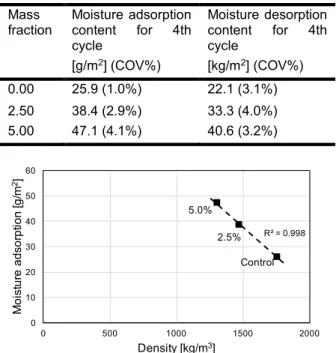
A key objective of making bio-based aggregate additions to cement-lime coatings was to enhance their moisture buffering potential. The inclusion of cellulose flake aggregates was anticipated to change the pore structure of the cement-lime coating and actively participate in the internal environment regulation. The data for adsorption and desorption mass content are presented below in Table 4, along with the Coefficient of Variation (COV). As anticipated the inclusion of bio-aggregates improved the adsorption and desorption mass content and this has a strong correlation to density as shown in Figures 4 and 5. The addition of a relatively low, 5%, mass proportion of cellulose flakes improved the base mix adsorption mass content by 82%. A similar though less pronounced result was found for the desorption mass content.
Table 4: Moisture buffering properties Mass fraction Moisture adsorption content for 4th cycle Moisture desorption content for 4th cycle [g/m2] (COV%) [kg/m2] (COV%) 0.00 25.9 (1.0%) 22.1 (3.1%) 2.50 38.4 (2.9%) 33.3 (4.0%) 5.00 47.1 (4.1%) 40.6 (3.2%)
Figure 4: Increase in moisture adsorption with decrease in density
Figure 5: Increase in moisture adsorption with decrease in density
3.3 IAQ – VOC emissions and
adsorption/desorption properties.
Two specimens were tested for emissions of TVOC and formaldehyde. The results are presented in Table 5. Significantly low emission levels of formaldehyde and TVOCs were observed. The addition of 5% of cellulose flakes reduced emission rates of TVOCs from 25 to 21 µg/m2h. Formaldehyde emissions of both
R² = 0.991 0 0.5 1 1.5 2 2.5 3 3.5 0 500 1000 1500 2000 C o m p re s s iv e S tr e n g th [N /m m 2] Density [kg/m3] Control 2.5% 5.0% R² = 0.997 0 0.2 0.4 0.6 0.8 1 1.2 1.4 0 500 1000 1500 2000 F le x u ra l S tr e n g th [ N /m m 2] Density [kg/m3] Control 2.5% 5.0% R² = 0.998 0 10 20 30 40 50 60 0 500 1000 1500 2000 M o is tu re a d s o rp ti o n [ g /m 2] Density [kg/m3] Control 2.5% 5.0% R² = 0.999 0 10 20 30 40 50 60 0 500 1000 1500 2000 M o is tu re d e s o rp ti o n [ g /m 2] Density [kg/m3] Control 2.5% 5.0%
specimens are close to the limit of quantification of the HPLC which is estimated to be 3 µg/m3 and are thus considered as negligible. After 28 days no VOC or formaldehyde emissions were detected.
Table 5: Formaldehyde and TVOC specific area emission rate after 3 and 28 days. Mass
fraction
TVOC emission after 3 and 28 days (in brackets)
Formaldehyde emission after 3 and 28 days (in brackets)
[µg/m2h] [µg/m2h]
0.0 25 (ND) 5 (4)
5.0 21 (ND) 7 (ND)
ND – not detected
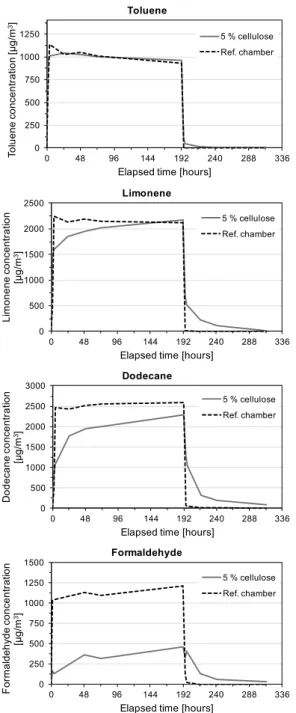
VOCs and formaldehyde adsorption/desorption behaviour of the cement-lime based coating with 5% cellulose flakes is presented in Figure 6.
Figure 6: VOCs and formaldehyde adsorption and desorption behaviour of lime based coating with 5 %
For each organic pollutant, the concentration in the material test chamber was compared with the reference chamber (containing no material), where the difference represents the amount of VOC adsorbed. Concentrations in the reference chamber quickly reached their maximum in less than five hours. The maximum concentration in the reference chamber was limited by the emission rate of the VOCs and formaldehyde sources. In the desorption phase, concentrations in the air dropped to 0 µg/m3 after one hour. Cement-lime based coating with bio-based cellulose aggregates showed an ability to remove, limonene, dodecane and formaldehyde from the air. Toluene was adsorbed only during the first 24 hours of starting the experiment. More polar organic pollutants such as formaldehyde were preferentially adsorbed. After 8 days of exposure to the polluted air, cement-lime based coating with 5 % cellulose flakes was removing 70 % of formaldehyde from the air, see Table 6. Toluene was the least adsorbed pollutant followed by limonene. After 48 hours, the concentration of toluene in the material chamber was reaching the concentration level in the reference chamber which means that the surface of the material was not able to adsorb more toluene. The same was observed for limonene after 192 hours. In the desorption phase, all VOCs and formaldehyde were slowly released from the material surface. In a real room, this behaviour would maintain the concentrations of harmful gases at lower levels than would be expected from the potential emission source, therefore reducing the negative health impact
Table 6: VOC and formaldehyde adsorption after 48 and 192 hours of exposure
Organic pollutant Adsorbed after 48 hours Adsorbed after 192 hours Toluene 0 % 0 % Limonene 11 % 0 % Dodecane 23 % 12 % Formaldehyde 68 % 70 % 4 SUMMARY
There has been significant development of cement-lime based coating materials through the inclusion of varying amounts of cellulose materials for the improvement of VOC adsorption/desorption properties and hygrothermal properties. The inclusion of bio-aggregates was intended for different purposes. Those that passively change the physical properties of the coatings, such as density and porosity, and those that play an active role in IAQ regulations.
The addition of bio-aggregates improved some properties of the coatings and this was clearly seen in that the aggregate addition led to the intended reduction of density. This reduction in density is beneficial for moisture buffering but had an impact on the mechanical properties of the coatings. The cause of this reduction in density is not linear with increasing mass fractions of aggregate additions. This has largely been attributed to the increase in water demand to achieve suitable workability requirements. The aggregates affect the mixing of water in two ways: changing the granularity of the mix and absorbing water into the aggregate microstructure. This raises
0 250 500 750 1000 1250 0 48 96 144 192 240 288 336 T o lu e n e c o n c e n tr a ti o n [µ g /m 3]
Elapsed time [hours] Toluene 5 % cellulose Ref. chamber 0 500 1000 1500 2000 2500 0 48 96 144 192 240 288 336 L im o n e n e c o n c e n tr a ti o n [µ g /m 3]
Elapsed time [hours] Limonene 5 % cellulose Ref. chamber 0 500 1000 1500 2000 2500 3000 0 48 96 144 192 240 288 336 D o d e c a n e c o n c e n tr a ti o n [µ g /m 3]
Elapsed time [hours] Dodecane 5 % cellulose Ref. chamber 0 250 500 750 1000 1250 1500 0 48 96 144 192 240 288 336 F o rm a ld e h y d e c o n c e n tr a ti o n [µ g /m 3]
Elapsed time [hours] Formaldehyde
5 % cellulose Ref. chamber
the possibility that the current methods of quantifying suitable workability requirements are not entirely compatible with the use of of bio-aggregates.
In addition to the improved moisture buffering properties, cement-lime based coating with a low amount of bio-aggregates showed good capacity to remove harmful gases from air, thus improving the indoor air quality in both ways. The long term performance of the coatings and the impact on occupant health and wellbeing needs to be established.
There are different approaches that can be taken for future use of the coatings. These, in part, depend on the final application and could include incorporation of areas of exposed porous plaster into buildings instead of finishing all walls with fine plaster. This would help to maximise the potential IAQ improvement demonstrated in this paper.
5 ACKNOWLEDGMENTS
This project has received funding from the European Union’s Seventh Framework Programme for research, technological development and demonstration under grant agreement no 609234.
6 REFERENCES
2010/31/EU, European Directive 2010/31/EU of the European Parliament and of the Council of 19 May 2010 on the energy performance of buildings, 2010. Crump, D., Dengel, A. and Swainson, M. (2009) Indoor Air Quality in Highly Energy Efficient Homes – A Review. IHS BRE, London, UK.
da Silva, C. F., Rana, C., Maskell, D., Dengel, A., Ansell, M. P., & Ball, R. J. (2016). Influence of Eco-materials on Indoor Air Quality. Green Materials, 4 (2), 72-80.
Dengel, A. (2014) The very air we breathe. RICS Property Journal – Residential Environment, 32-33. EC, 2016,
https://ec.europa.eu/energy/en/topics/energy-efficiency/buildings
Economidou, M., Atanasiu, B., Despret, C., Maio, J., Nolte, I., and Rapf, O. (2011). Europe's Buildings under the Microscope. A Country-by-Country Review of the Energy Performance of Buildings. Buildings Performance Institute Europe (BPIE).
Fang, L., Clausen, G. and Fanger, P. O. (1998). Impact of temperature and humidity on the perception of indoor air quality. Indoor air, 8(2), 80-90.
Giampiccolo, A., Ansell, M. P., Tobaldi, D. M. and Ball, R. J. (2016). Synthesis of Co-TiO2 Nanostructured Photo-Catalytic Coatings for MDF Substrates. Green Materials, 1-31.
Lucas, F., Adelard, L., Garde, F. and Boyer, H. (2002). Study of moisture in buildings for hot humid climates. Energy and Buildings, 34(4), 345-355.
Mansour, E., Curling, S., Stéphan, A. and
Ormondroyd, G. (2016). Absorption of volatile organic compounds by different wool types. Green Materials, 4(1), 1-7.
Maskell, D., Thomson, A., Lawrence, R., Shea, A. and Walker, P. (2015a). The impact of bio-aggregate addition on the hygrothermal properties of lime plasters. In 15th International Conference on Non-conventional Materials and Technologies (NOCMAT 2015). University of Manitoba.
Maskell, D., da Silva, C. F., Mower, K., Cheta, R., Dengel, A., Ball, R. & Shea, A. (2015b). Properties of bio-based insulation materials and their potential impact on indoor air quality.
McGregor, F., Heath, A., Maskell, D., Fabbri, A. and Morel, J. C. (2015). A review on the buffering capacity of earth building materials. Proceedings of the Institution of Civil Engineers-Construction Materials, 1-11.
Menzies, D. and Bourbeau, J. (1997) Building-related illness. New England Journal of Medicine 331(21): 1524–1531.
Mølhave, L., Clausen, G., Berglund, B., Ceaurriz, J. D., Kettrup, A., Lindvall, T. and Younes, M. (1997). Total volatile organic compounds (TVOC) in indoor air quality investigations. Indoor Air, 7(4), 225-240. Thomson, A., Maskell, D., Walker, P., Lemke, M., Shea, A. and Lawrence, R., 2015. Improving
hygrothermal properties of clay. In: 15th International Conference on Non-conventional Materials and Technologies (NOCMAT 2015), University of Manitoba.
Toftum, J., Jørgensen, A. S. and Fanger, P. O. (1998). Upper limits of air humidity for preventing warm respiratory discomfort. Energy and Buildings, 28(1), 15-23.
WHO, 2010 WHO guidelines for indoor Air Quality: selected pollutants. ISBN 978 92 890 0213 4.