Publisher’s version / Version de l'éditeur:
Vous avez des questions? Nous pouvons vous aider. Pour communiquer directement avec un auteur, consultez la première page de la revue dans laquelle son article a été publié afin de trouver ses coordonnées. Si vous n’arrivez pas à les repérer, communiquez avec nous à [email protected].
Questions? Contact the NRC Publications Archive team at
[email protected]. If you wish to email the authors directly, please see the first page of the publication for their contact information.
https://publications-cnrc.canada.ca/fra/droits
L’accès à ce site Web et l’utilisation de son contenu sont assujettis aux conditions présentées dans le site LISEZ CES CONDITIONS ATTENTIVEMENT AVANT D’UTILISER CE SITE WEB.
Internal Report (National Research Council of Canada. Institute for Research in Construction), 1987
READ THESE TERMS AND CONDITIONS CAREFULLY BEFORE USING THIS WEBSITE.
https://nrc-publications.canada.ca/eng/copyright
NRC Publications Archive Record / Notice des Archives des publications du CNRC : https://nrc-publications.canada.ca/eng/view/object/?id=8c3d2c11-5a02-4d0c-a72c-a6cc00c039cb https://publications-cnrc.canada.ca/fra/voir/objet/?id=8c3d2c11-5a02-4d0c-a72c-a6cc00c039cb
NRC Publications Archive
Archives des publications du CNRC
For the publisher’s version, please access the DOI link below./ Pour consulter la version de l’éditeur, utilisez le lien DOI ci-dessous.
https://doi.org/10.4224/20374345
Access and use of this website and the material on it are subject to the Terms and Conditions set forth at
A Report on the Alexis Nihon Office Complex Fire
Gosselin, G. C.; Mawhinney, J. R.
i
i
-
I
National Research Conseil national Council Canada de recherches Canada
Institute for lnstitut de Research in recherche en Construction construction
A R e ~ o r t
on the Alexis Nihon Office C o m ~ l e x
Fire
G.C. Gosselin and J.R. Mawhinnev
ANALYZED
Internal
Report
No.
531
Date of issue: April 1987
NRC-
CISTI L I B R A R YB ! ~ ~ L ~ O T H ' ~ Q U E
cN*t@-
=>STThis is an internal report of the lnstitute for Research in Construction. Although not intended for distribution, it may be cited as a reference in other publications.
A Report on the
Alexis Nihon Office Complex Fire
On October 26th, 1986, a major fire gutted numerous floors of a 15 storey office tower located between Boulevard Maisonneuve and
St-Catherine Street at Atwater Street, directly over the boundary between the City of Westmount and Montreal (Figure 1). The fire, which raged out of control for close to 10 hours according to newspaper reports, started at approximately 5:00 p.m. on a Sunday afternoon.
On becoming aware of the incident on Monday the 27th, IRC staff members Guy C. Gosselin and Jack R. Mawhinney secured authorization to visit the fire site from Assistant Fire Chief Raymond Thgrien of the Service de prGvention des incendies, City of Montreal, and travelled to the site on Tuesday for a one-day preliminary fact-gathering visit. On Friday and Saturday of the same week, Dr. David Yung, also of IRC, accompanied fire protection specialist Michael S. Isner of the National Fire Protection Association to the fire site to gather additional information and study NFPA's approach towards conducting fire investigations.
This report presents the findings of the on-site fire science study conducted by IRC staff members, and is based strictly on the information collected during the above-mentioned visits. Two information-sharing sessions were held between IRC staff and Michael Isner of NFPA, the first prior to his visit of the fire site on Thursday October 30th, and the second on Monday November 3rd before his return to NFPA headquarters. The
observations reported and commented on below largely incorporate the discussions held during these two sessions. The report describes how we think the fire protection systems are arranged, based on our preliminary visual inspections of the building and on discussions with people
knowledgeable about various portions of the systems. Follow-up visits would have been necessary to review structural and mechanical plans of the
building systems and to actually inspect water pumps, valves and connections. Time and workload restrictions precluded such follow-up visits. Our efforts to learn more about the status of the various systems by telephone communication were largely frustrated by legal advice issued to
clients recommending that they do not release further information pending the outcome of an official inquiry.
It must be noted that the purpose of IRC's on-site fire visit was to gather information concerning the spread of fire, the spread of smoke. evacuation procedures (if applicable), fire fighting operations and overall effectiveness of the building's fire protection and control features. Real fire information of this sort can prove valuable when planning future
research programs or projects, and potentially serve as feedback to the Code writing committees in their ongoing assessment of the effectiveness of fire protection measures mandated by the National Building and Fire Codes. A
determination of the cause of the fire was not within the scope of the study, and no effort was made by IRC staff to collect information which would allow such a determination.
The Structure
The building consists of a 15 storey tower, attached to a larger 5 storey complex housing assembly, mercantile and low hazard industrial operations (see Figure 2 ) . The first two levels of the tower contain assembly and mercantile occupancies. Above them, a 3 storey open-air parking garage is located. The top ten floors of the tower (numbered 6 to
16, there being no designated 13th floor) consist of multi-tenanted office occupancies.
The building, a protected steel, noncombustible structure, was reportedly built in 1966. We were unable to ascertain exactly which particular regulations or Codes were in effect at the time the building permit was issued, but were told by Division Chief Bourdeau that it might have been designed in accordance with the City of Westmount's bylaws, since much of the plaza is located in that City.
A typical office floor plan is shown in Figure 3. The floor area, approximately 27 m x 105 m (90 ft x 345 ft), is served by two stairshafts (hereafter labelled North and South) containing
three
separate exits (the South shaft contains two separate "scissors" stairs). A service core,centrally located in the tower, contains a bank of six elevators, four vertical service shafts, two washrooms, the "North" stairshaft and an electrical room. Another electrical room is located near the South exit stairshaft, which is itself approximately 45 m away from the North exit stairwell.
Recently, most floors are occupied by two tenants each, with suite separations projecting out from the central service core. It appears that, on some floors, the South exit stairshaft is located within a tenanted suite and accessible only by the occupants of that suite outside business hours. Consequently, only one accessible exit is available (the North stairshaft) for the occupants in the remainder of the floor area.
The Fire Protection Systems
A
-
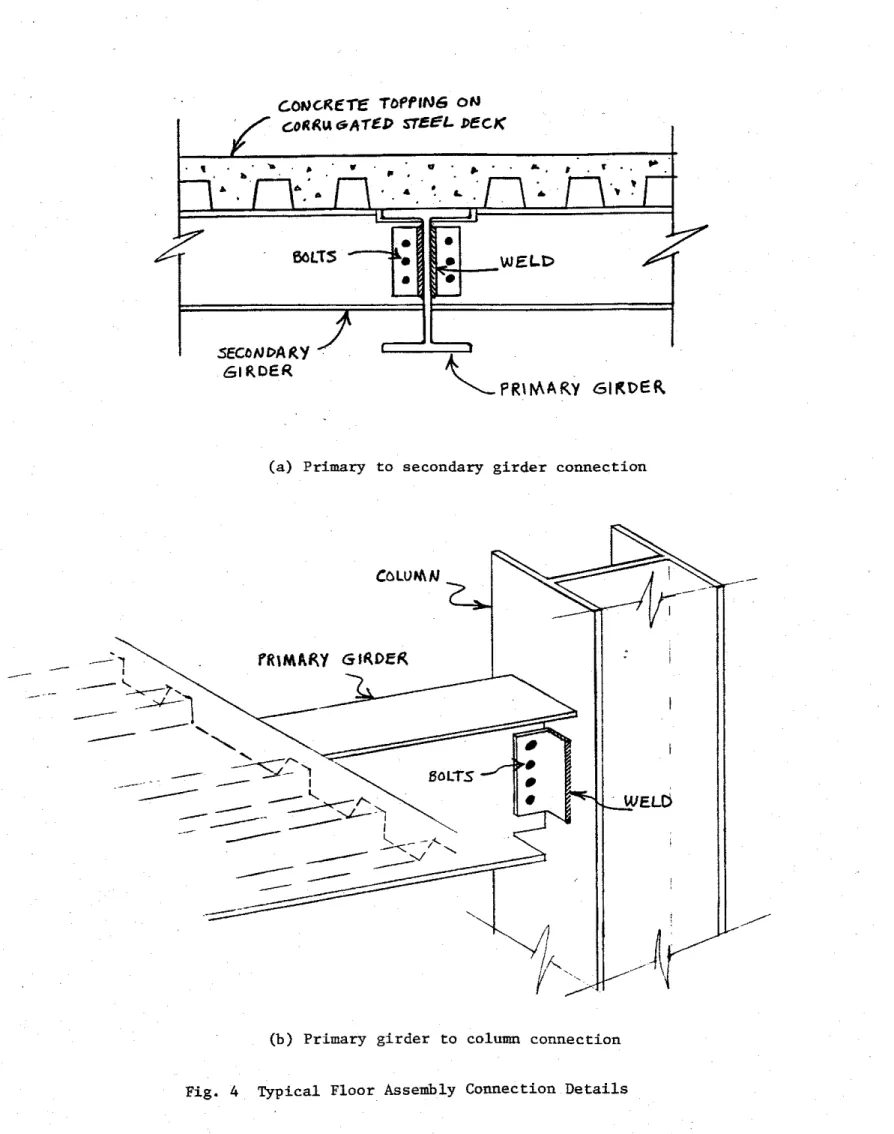
StructuralAll floor assemblies consist of concrete slabs on corrugated steel decks, supported by secondary structural steel I-beams, which are themselves attached to primary steel girders. The floor assemblies are attached to structural steel columns spaced 9 m (30 ft) on centre along both axes. The secondary to primary girder connections and girder to column connections all consist of double angle connectors bolted to the supported element, and welded to the supporting element (see sketch in Figure 4). The structural fire protection ( 2 h fire resistance-rating is specified in the 1960 edition of the NBC) is provided by a sprayed-on cementitious or mineral-fibre
material. In his oral report, Michael Isner indicated that the thickness of protection, as observed on floors unaffected by the fire, is more
substantial for the columns than the floor beams and girders. He reported having measured thicknesses of 32 mm on columns and 19 mm on beams and
girders.
The exit stairwells are enclosed by a ULC listed, non-loadbearing gypsum wallboard on steel studs shaftwall construction. The wallboard membrane consists of two layers of 12.7 mm thick Fire Code "C" (Type X) gypsum wallboard. All vertical fire separations appear to have been made of
gypsum wallboard on steel stud type of construction, except for the central service core and electrical rooms which are enclosed by cast in place
concrete and masonry blocks, respectively.
B
-
Alarm and Detection SystemsA central alarm and control station is located on the second floor of the building and staffed around the clock. Two watchpersons were reportedly
on duty at the time of the incident: one manning the control station, the other making regular inspection rounds. In the office tower, the primary detection system consists of manually operated pull stations located near exits. Smoke detectors were installed only in mechanical rooms and at the top of elevator shafts. Heat detectors were installed only in the two electrical rooms on each floor. There is no voice communication system, except for the two-way radios carried by the watchpersons. There is no smoke alarm or detector nor any heat detector in the tenanted portions of the floor areas.
C
-
Fire Suppression Systems (i) Sprinkler systemsThe lower shopping levels are fully sprinklered with wet-pipe sprinkler systems; the three overlying parking levels, which are unheated, are
protected by dry-pipe sprinkler systems. No sprinklers are installed above the parking levels in the office tower in which the fire occurred, but a new apartment tower located immediately to the west is fully sprinklered, with separate fire pumps and wet-pipe alarm sprinkler valves located in a
mechanical room on the third parking level (5th storey).
(ii) Standpipe systems
Standpipe and hose systems are installed throughout the complex. The three unheated parking levels are served by a "dry" standpipe system, that is, water is prevented from entering the piping by a specially-designed deluge valve, which releases the water only when a special pull station,
located at each hose reel, is activated. (This pull station actually releases pressurized air from a pilot line: the drop in pressure in the pilot line trips the deluge valve, and allows water to fill the standpipe piping. )
A separate standpipe system consisting of two wet standpipe risers extends to the 15th floor of the office tower. Starting fnom the 6th floor, hose cabinets are installed on each floor level near the exit stairwells. Each hose cabinet contains a 38 nm hose valve, approximately 25 m of 38 mm
hose, a 65 mm hose valve, a hose wrench, and a portable fire extinguisher. The 65 mu hose valves are intended for use by trained fire fighters as a
supply for their large hose streams, and to eliminate the delay that would be incurred by having to run supply hoses up the stairwells from street level.
(iii) Water supply
We were not able to determine conclusively how the standpipe risers in the office tower are connected to the water supply system for the building. Rased on observations made, and on discussion with a sprinkler contractor's employee who was familiar with other sprinkler and standpipe systems in the building, there are two possibilities. The first is that the standpipe risers are connected to a 250 nnn diameter "ring main" located around the perimeter of one of the basement levels. The second possibility is that the standpipe risers are connected only to the domestic water system, with
provision for the fire department to pump directly into the standpipe in the event of a fire.
Consider first the possibility that the standpipe risers are connected to the 250 mm ring main in the basement. There will necessarily be one or more connections from this ring main to the city water system, although we did not actually locate the points where the connecting pipes enter the building. There are several fire department pumper connections located around the perimeter of the complex which permit the fire department pumper trucks to pressurize the building fire suppression systems, with the ring main acting as a manifold.
The sprinkler contractor's employee, mentioned above, had been working for over a year on the installation of a sprinkler system in the new
Apartment Tower located just to the west of the office tower in which the fire occurred. He was very familiar with how those systems operate, and was able to demonstrate that the pressure gauges on all of the sprinkler valves had been either overpressurized, or subjected to a water-hammer pressure shock, possibly as a result of the efforts of the fire department to pressurize the office tower standpipe risers. Also, sometime during the night, a break occurred in a mechanical coupling on a pipe between the ring main and the control valves for the Apartment Tower sprinkler system pumps, which caused a significant loss in pressure for all systems connected to the ring main. The above observations support the concept that at least some of the standpipe risers, and certainly the sprinkler system risers, are
connected to the basement ring main.
There was also evidence to support the second possibility, that the standpipe system is connected to the domestic water system, but depends on the fire department connection as the only source of fire fighting water. The conclusion that the office tower standpipe risers are connected to the ring main conflicts with the Plan dlIntervention prepared by the City of Plontreal Fire Department for the Alexis Nihon Plaza. This plan relates each pumper connection visible from the street to specific standpipe or sprinkler system risers in the building. It identifies two pumper connections on Atwater Avenue: one on the South end that supplies the standpipes for the ground floor and the floor above, and one on the North end that supplies the standpipes for the floors above the parking levels, i.e. the office tower in which the fire occurred. Thus, at the time of preparation of the Plan
dlIntervention, the Fire Department determined that there was a specific pumper connection to supply the risers in the office tower, rather than a general interconnection of all pumper connections via the basement ring main.
Further support for the second possibility comes from the fact that we were able to identify a point on the standpipe system where a 100 nun water supply line connects to a visible portion of the supply pipe to the
valves, on either side of
a
double check valve, an arrangement that is consistent with a Montreal Bylaw that requires such backflow protection whenever domestic water lines are connected to fire protection supply lines. If the standpipe risers are not connected to the ring main, then theconnection to the domestic water supply could be the only permanent water supply to the risers.
(iv) Fire pumps
A brief search was conducted to discover if a fire pump had been installed to boost the water supply to the standpipe risers in the office tower. Generally, standpipe and hose systems are designed to deliver approximately 1800 L/min at 450 KPa (500 USgpm at 65 psi) at the topmost outlet. The City water pressure in Montreal would not be expected to deliver that m c h water without the aid of a pump. The sprinkler
contractor's employee indicated that the 100 mm connection referred to above came from a pump room, which we were unable to locate. Therefore we were not able to determine whether the pump was intended to meet fire fighting water demands, or only domestic water supply demands, or how it was
connected to the city water system.
It would have been instructive to learn whether the pump was automatically or manually started; what was its capacity; whether all
important valves were open, and whether the domestic system was affected by the pressure shock that affected the other fire suppression systems. As
mentioned earlier, however, follow-up visits could not be scheduled.
The Fire Incident
Around 17:OO on Sunday, October 26th 1986. a woman on the 15th storey (Floor 16) smelled smoke and went down to the control facility on the 2nd floor to alert the security people. We do not know if a call was made to the fire department at this time. The two security guards went up to Floor 16 and saw "thick" smoke but no fire. They then proceeded to check lower storeys, coming down one floor through separate exit stairwells and criss- crossing the floor area to the other exit stairwell before descending
another flight. After having noticed smoke on both Floors 15 and 14, a guard descended to and entered the elevator lobby on the 9th floor and, not detecting any smoke, proceeded to the South exit stairwell. Entering one of the scissors stairs and looking up, he noticed some flaming in the area of the 10th floor landing.
Either upon hearing the report of smoke on the top floor or upon observing flames on the 10th floor, a security guard called the fire
department at 17:15 from the control facility. The first responding crew is reported to have arrived at 17:20 and to have confirmed the intervention at 17:28. It appears that fire fighting crews were sent via the North
stairwell to the 15th storey to ventilate the area. Another crew was sent up the South staiwell, presumably to investigate the security guard's report of flames on the 10th floor landing. The latter crew apparently extinguished a small fire in the stairwell's communication cabinet on the 10th floor but could not proceed to enter the floor area at that level because the door was too hot to open and/or the door was locked from the suite side (both statements were made to IRC staff at different times during our investigation).
The statement that the door was too hot to open, if correct, suggests that a fire on the 10th floor was already fully developed at the time fire fighters determined the exact location of the outbreak. An attempt to put out the 10th floor fire was eventually made from the North staiwell but with no success, for reasons to be elaborated on later. We will only note here that the fire grew in intensity to a point where a second alarm had to be given, reportedly at 17:45, a third at 17:54, and additional alarms at 18:23 and 18:37. A total of 200 fire fighters were said to have combatted the blaze, which eventually destroyed (approximately) 75% of the contents on the 10th floor, 40% on the llth, 60% on the 12th and 100% on the 16th floor. In addition, partial floor collapses were sustained on the 10th and 12th floors (Figures 5 and 6), and the roof above Floor 16 (15th storey) deflected considerably (Figure 7).
Performance of the Fire Suppression Systems
After locating the fire on the 10th floor of the tower, the first fire fighters on the scene attempted to apply water from hoses connected to a hose cabinet in the elevator lobby near the North stairwell, probably on the 8th or 9th floor. From the beginning, there was a problem of inadequate water pressure to properly operate the hoses, so that increasingly urgent radio messages were sent to the pumper truck operator for more pressure. The pumper trucks had by then connected to the pumper connections on the street, and thus should have been able to pressurize the interior standpipe risers. However, for an unknown reason, the increased pressure generated by the pumpers in the ring main did not affect the pressure in the office tower standpipes.
Various accounts were given to describe actions taken by fire fighters in an attempt to increase the water pressure in the standpipe. One such account described how a fire fighter operated one of the pull boxes at a hose station on one of the parking levels. As previously described, this device released air from a dry-pilot line and in turn released water held back by the deluge valve located in the basement. According to this
account, that action "solved the problem". However, from our understanding of the various standpipe systems, the parking level standpipe system is not connected to the riser for the North stairwell in the Office Tower. That action would only have provided water to the top of the parking levels, which was still 5 storeys below the floor on which the fire was located. Fire fighters would then have had to run hoses up the stairwell from the parking garage level.
A second account reported that the shortage of water in the standpipe system was a result of a break in piping inside the building, but that after the break was isolated by closing certain valves, the water supply was
normal. However, we were informed that the break in internal piping happened after midnight, whereas the critical water shortages were in the first few hours of the fight against the fire, between 17:30 and 19:OO. Thus, it is not clear at this time whether this break was a critical factor in limiting fire fighting actions in the building.
If the office tower standpipe risers are supplied only by the domestic water connection, in conjunction with a dedicated pumper connection as described earlier, pressurizing the ring main would not be expected to have any effect on the water pressure in the office tower riser. If the fire department had connected to the pumper connection supplying the riser, as indicated in the Plan dlIntervention, they should have been able to
pressurize the system. Until we confirm how the water supply connection to the standpipe risers is actually arranged, the reasons for the inability to achieve adequate pressure and flow will remain unknown.
It was reported to us that the water supply problem was eventually remedied by directly connecting hoses from the pumper trucks at street level to one or more of the 65 imn hose valves in upper floor hose cabinets. These
supply hoses were extended to 9th floor windows using one of the aerial ladders. If the cause of the inability to pressurize the interior standpipe using the fire department connections was, for example, a closed valve or a blocked pipe at a lower level, this action was the only way available to by- pass the blockage.
The standpipe risers in the office tower were intended to provide fire fighters with primary fire suppression capability. For an undetermined reason, the water supply to these risers was limited to what could be provided by the 100 mm domestic water connection, at least until a direct connection was made between pumper trucks and one of the hose valves on an upper floor. Repeated attempts to boost the pressure in the standpipe
system via pumper connections resulted in over pressurization of internal piping connected to the ring main, and probably contributed to failure of certain pipe fittings. Their failure in turn compromised the water supply to all other fire suppression systems in the Alexis Nihon building complex. The delay in obtaining adequate water pressure and flow for fire fighting purposes probably contributed significantly to the impact this fire had on
.. Fire Spread Scenario
On the basis of the visual inspections carried out by IRC staff and the information gathered with respect to the fire fighting operations, the
following fire spread scenario is suggested as the most likely one for the incident.
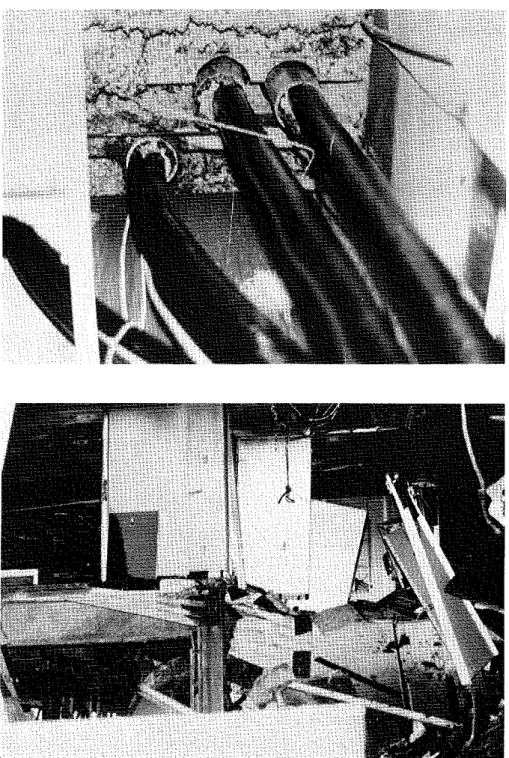
First, there is little doubt that the fire started on the 10th floor. The exact location, however, is uncertain and the cause unknown. It may have started in the communication cabinet located within the South exit stairwell, and spread into the adjacent floor area through an inadequately firestopped electrical and communication cable opening poked through the gyproc shaftwall. Or, vice versa, the fire may have started first on the tenanted floor area side, and spread to the communication cabinet via the same small opening. Irrespective of where the fire actually started, there is evidence to suggest that it spread through the fire separation enclosing the South exit stairwell via the poke-through hole for communication cables (see Figure 8). Similar holes were observed on Floors 14 and 15 (Figure 9). As a matter of fact, it was apparent that fire had broken out of the
stairwell onto the tenanted floor area on Floor 14 through this unprotected penetration. Fortunately, the spread of fire onto that floor was limited to a few metres within the concealed ceiling space, allowing this determination to be made.
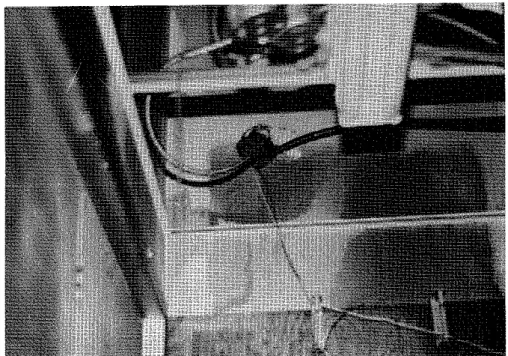
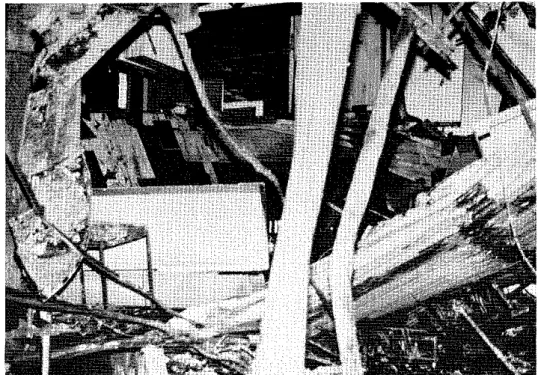
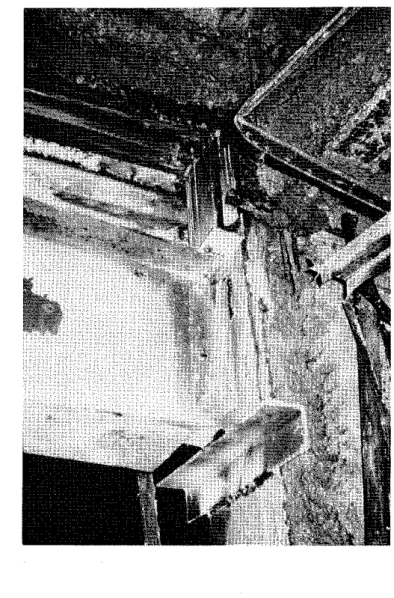
At some point during the fire on the 10th floor, a 9.1 m x 9.1 m (30 f t x 30 ft) floor/ceiling section immediately adjacent to the South stairwell collapsed (see Figures 10 and 11). Close inspection of girder to column connections suggested that collapse was likely due to a failure of the welds attaching the angle connectors to the columns (Figures 12 and 13). The angle connectors, which were bolted to the girders, remained attached to
the latter. The exact timing of the collapse could not be ascertained
during our visit; however, assuming that (a) the welds were not substandard, (b) the sprayed-on protection was uniformly applied over all areas of the floor assembly, and (c) fire fighters could not effectively cool off the fire on the 10th floor due to inadequate water pressure, one can estimate
that collapse would not have occurred until 2 or 3 hours after the reporting of the incident.
This estimate appears to be in line with one newspaper report which indicated that an order to evacuate the restaurants along St-Catherine Street was given at approximately 20:15 ( 3 hours after the general alarm),
because of concerns that the structural elements on the fire floor were beginning to show some sign of structural weakness. If, on the other hand, collapse actually occurred within the first 2 hours of the fire (perhaps fire fighters have noted the approximate time of this event), then the adequacy of the welds or of the sprayed-on protection is in question.
From the 10th floor, the fire spread vertically to the 11th and 12th, and finally gutted the 15th storey in its entirety, leaving the 13th and 14th floor levels relatively undamaged. This spread scenario was
particularly intriguing and a greater part of the one-day visit made by the authors was spent analyzing the possible vertical spread mechanisms.
The vertical window to window separation along the exterior wall was estimated at 1.4 m on the basis of window heights (=2.1 m) and storey
heights (z3.5 m). This spandrel protection (see Figure 14).should have been quite effective in preventing storey-to-storey convective fire spread by flames projecting out of exterior windows. This claim is supported by observations of unconsumed combustible items, such as nylon strings on vertical blinds, bookcases, desks, etc., located immediately adjacent to windows on floors directly above heavily damaged areas on the storey below. Pictures taken at advanced stages of the fire and published in local
newspapers also support the assumption that the fire did not spread to upper storeys via flames issuing out of windows.
From the point of view of an interior spread mechanism, we investigated three possibilities: (i) convective spread due to inadequate firestopping of electrical or plumbing penetrations through floor assemblies, (ii) heat conduction through the concrete floor slabs or (iii) convective spread through a breach in the floor assemblies. The first of these possibilities was considered unlikely after closely inspecting most of the pipe and
conduit penetrations i n areas of the f l o o r s which had been completely consumed by the f i r e . We were not able t o detect any through-opening i n these areas. A s the p i c t u r e s i n Figures 15 and 16 i l l u s t r a t e , the s e r v i c e penetrations appear t o have been adequately firestopped. Naturally, a heated m e t a l l i c pipe o r conduit could have conducted s u f f i c i e n t heat t o i g n i t e combustible materials on the f l o o r above. However, t h i s scenario would have been possible only i f combustible items were s t o r e d i n d i r e c t contact with the conduits.
The second p o s s i b i l i t y of s u f f i c i e n t heat conducting through the f l o o r s l a b s was r e j e c t e d a f t e r observing t h a t no combustion had taken place on f l o o r assemblies d i r e c t l y above the areas of the 10th f l o o r collapse and t h e 12th f l o o r p a r t i a l collapse (see Figures 17 and 18, respectively). These a r e the areas where one woald have expected the f i r e t o be t h e h o t t e s t and, hence, where t h e p o t e n t i a l f o r conductive heat spread would have been t h e g r e a t e s t . Yet t h i s did not occur.
We believe the most l i k e l y spread mechanism between t h e 10th f l o o r l e v e l and the two l e v e l s above i t was by convective spread of hot gases and flames i n the area of the South e x i t s t a i r w e l l . I n collapsing, the f l o o r panel on the 10th storey t o r e down the f i r e separation around the South s t a i r s h a f t , and allowed hot convective gases t o e n t e r the s t a i r w e l l ( s e e Figure 19). Since the f i r e separations around the s t a i r w e l l on the next two f l o o r s up (11th and 12th s t o r e y s ) were a l s o breached due t o collapse o r p a r t i a l collapse of beams and g i r d e r s immediately adjacent t o and supporting these separations, f i r e could have spread onto these two f l o o r areas
(Figure 20). No s t r u c t u r a l collapse occurred immediately below the 13th f l o o r e x i t s h a f t walls, leaving the f i r e separations i n t a c t to prevent spread on t h a t storey.
We conclude t h a t the f i r e eventually broke out of the top of t h e s t a i r w e l l on t h e top f l o o r because of the excessively long heat exposure from hot gases collected a t t h a t location. I n doing so, t h e s t a i r w e l l would have vented i t s e l f , r e s u l t i n g i n a reduced heat exposure on the s t a i r s h a f t walls on the 13th and 14th storeys and explaining why f i r e did not break out of the s t a i r w e l l (with a minor exception) on those f l o o r l e v e l s . This event
likely occurred at least 3 or 4 hours after the initial outbreak, and one may thus speculate that a quicker extinguishment of the fires on the floors below could have prevented the complete loss of the top storey.
Implications for the National Building and National Fire Codes of Canada
The 1985 edition of the National Building Code requires such a building to be of noncombustible construction and to possess 2 h structural fire resistance. It is commonly assumed that the structural fire protection requirements for high buildings are sufficient to allow the structure to withstand a complete burnout of the combustible fuel within a compartment. Evidently, the Alexis-Nihon structure did not withstand complete burnout. Consequently, either the requirements are not as conservative as commonly believed, or the built-in fire protection in the Alexis-Nihon tower did not meet the minimum requirements. Unfortunately, our brief observations at the fire site did not allow us to determine if the structural fire protection features in the building actually met the requirements. An indication of the exact time the floor collapsed on the 10th floor would certainly be useful in determining whether the structural fire protection was adequate and sufficient.
The potential life safety hazards implied by the possibility that the code requirements may not be sufficient to withstand burnout assumes
importance only if fire fighting action is inadequate. Under normal circumstances, we assume that the required level of protection are
sufficient to allow fire fighters to respond and mount an effective interior attack to put the fire out (given an adequate water supply and pressure). However, in the event that fire fighting intervention is hampered by an inadequate water supply or pressure, should we rely on the compartmentation requirements of the Code as sufficient protection for people trapped above the fire floor? Perhaps this question should be addressed by code writing committees. The property protection implications of such an event are much clearer, as evidenced by the devastation caused by this fire. However, the NBC's primary objective is life safety rather than protection of capital assets and property. Normally, the latter objective can only be achieved by going beyond the minimum requirements of the Code.
The lack of automatic f i r e and smoke detection may have brought about some delay i n t h e detection and reporting of f i r e conditions. Subsection 3.2.4. of t h e 1985 NBC does not require any detection u n i t a d d i t i o n a l t o those provided i n the o f f i c e tower, with the possible exception of Clause 3.2.4.10.(2) ( a ) which requires f i r e d e t e c t o r s (heat o r smoke) t o be
i n s t a l l e d i n storage rooms. Whether or not the d e f i n i t i o n of storage room would be i n t e r p r e t e d by the a u t h o r i t y having j u r i s d i c t i o n as including
storage areas within an o f f i c e building i s open t o question. However, there i s no evidence t o suggest t h a t the i n s t a l l a t i o n of these devices i n enclosed storage rooms would have r e s u l t e d i n quicker detection i n the Alexis Nihon f i r e , s i n c e the f i r e probably did not s t a r t i n a storage room. Furthermore, the f i r e f i g h t i n g response might not have been improved by detecting t h i s p a r t i c u l a r f i r e 5 t o 10 minutes e a r l i e r , because of the water supply
problems eventually encountered. However, had the f i r e been detected i n i t s e a r l y stages and i t s l o c a t i o n c o r r e c t l y annunciated a t the c e n t r a l alarm and c o n t r o l f a c i l i t y (i.e. had smoke d e t e c t o r s been i n s t a l l e d i n the tenanted o f f i c e spaces), i t i s possible t h a t the f i r e f i g h t i n g response could have been quick enough t o enahle a complete suppression even with the reduced water pressure. However, t h i s is pure speculation a t t h i s stage.
Very l i t t l e can be s a i d about the subject of the a b i l i t y of the f i r e protection f e a t u r e s of the building t o help accomplish the primary objective of the NBC, i.e. l i f e s a f e t y of the occupants, s i n c e the building was
v i r t u a l l y vacant a t the time of the f i r e . We could not determine whether or not the f i r e separations served as e f f i c i e n t b a r r i e r s t o the spread of smoke i n the e a r l y stages of the f i r e . Certainly, the f a c t t h a t smoke was f i r s t noticed on the top f l o o r suggests t h a t some upward spread did take place, but t h i s may have been f a i r l y normal due t o leakage around doors. The 1985 NBC would require a building of t h a t height t o be f u l l y sprinklered o r
conform t o s t r i n g e n t smoke control provisions (e-g., s h a f t pressurization or smoke d i l u t i o n ) .
A s noted e a r l i e r , it appears t h a t the occupants on some f l o o r s would have had access only t o a s i n g l e e x i t , due t o the l o c a t i o n of the s c i s s o r s s t a i r s i n t o a lockable s u i t e (unless our reading of the f l o o r plans i s erroneous). This s i t u a t i o n could c e r t a i n l y c r e a t e a problem i n the event of
an emergency. For instance, a fire might break out in close proximity to the North exit stairwell and contaminate it at a time when the suite doors leading to the alternate exit are locked for some reason (e.g. business bankruptcy of the tenant, renovations, etc.). The NRC clearly requires two separate and unobstructed means of egress (two alternate escape routes) out of a (public) corridor serving a room or suite of the size of those in the Alexis Nihon Complex.
The relevant portions of the National Fire Code include Section 2.8, Emergency Planning, and the maintenance requirements in Section 6 . 4 ,
Standpipe and Hose Systems, and Section 6 . 6 , Water Supply Systems for Fire Protection. Section 2.8 requires the owner to prepare a Fire Safety Plan with the assistance of the Fire Department so that the fire protection features in a building will be well understood by both parties. Section 6 . 4
requires standpipe system to be maintained in conformance with NFPA 1 4 ,
"Installation of Standpipe and Hose Systems". This standard requires
"systematic periodic inspections" of all portions of the standpipe system by personnel who "shall be held strictly responsible for its condition". In the NFC. Article 6 . 6 . 1 . 1 . requires that water supplies be maintained so as to be capable of providing the flow and pressure for which they were
designed. Article 6 . 6 . 1 . 2 . requires weekly inspection of valves controlling water supplies to any fire protection system, and Article 6 i 6 . 3 . 3 . requires weekly start-up of fire pumps.
We were not able to determine the extent to which the maintenance and planning requirements recommended by the NFC were carried out in the Alexis Nihon building. Bowever, it is likely that if the requirements in the NFC had been observed, problems such as closed valves or non-operating fire pumps would have been identified before the fire occurred. A Fire Safety Plan had been prepared by the Montreal Fire Department but, for an unknown reason, the operation of the Office Tower Standpipe system was not clearly indicated. It will not be possible to identify which pre-fire actions might have prevented the water supply difficulties that occurred at this fire until the source of the problem is determined.
The example of this fire nevertheless indicates that there is room for improvement of the requirements in the NFC for maintenance of standpipe systems. The Standing Committee on Fire Safety in Buildings has approved a proposal for the 1990 edition of the Code to require full flow testing every five years of standpipe systems from the topmost outlet on the riser, which is usually on the roof of the building. The Committee feels that standpipe system are so important to fire fighting in high buildings that the cost of conducting flow tests at five year intervals is justified. Despite the inconvenience, its value as conclusive proof that interior piping is not blocked is unquestionable. The problems experienced by fire fighters in the Alexis Nihon building fire are a clear demonstration of the need for such flow tests.
Concluding Remarks
The inability to obtain adequate water flow from the standpipe riser in the Alexis Nihon office tower delayed the efforts of fire fighters to gain control of the fire. It is possible that either a control valve on the supply to the standpipe risers was partially or fully closed, that the pipe was blocked in some way, or that the fire department did not connect to the correct pumper connection. If someone familiar with the arrangement of the standpipe system risers and the piping supplying that system had been
available to advise the fire department, the water supply problem might have been remedied sooner. Interconnection with the domestic water supply was of only marginal value as an auxiliary source, due to the restricted size of the piping and the fact that pumps intended to meet the domestic demand are not adequate to supply water at the pressure and flow needed for fire
fighting on the upper floors of a high building. The need for periodic full flow testing of standpipe risers from the highest outlet, as proposed for the 1990 National Fire Code, is reinforced by the experience gained from this fire.
This on-site fire engineering study provided a valuable opportunity for IRC staff to learn how to conduct post-fire investigations. Again, it must be stressed that a determination of the likely cause of the fire was not within the scope of the investigation, which centered around evaluating the
performance of the building's fire protection measures in abating fire spread, and the effectiveness of current NBC and NFC requirements in achieving a reasonable level of fire safety. Both fire researchers and codes-oriented personnel may benefit from this and future investigations.
The authors wish to thank the fire prevention unit of the City of Montreal for allowing access to the fire site and providing comments and information regarding the incident.
Guy C. Gosselin Research Officer Fire Research Section
Jack R. Mawhinney Technical Advisor
L - L A I
.,
..iI
'I i ' 4:
-
5 4 :I-:
Z ' 0.z
I P I ''
1CONCRETE TOPPIN6 ON C O R R U G A T E D STEEL DECK
I . .
.
' . -
.
. w . ' , .' -
a .-
. . . . ) I
I
SECONDARYI
61 R D E 4 <PRIMARY GIRDER(a) Primary to secondary girder connection
(b) Primary girder to column connection
Fig. 8 (Left) Melted communication cables hanging from poke-through hole in South exit stairwell (11th floor).
Fig. 9 (Below) Poke-through hole in the South exit fire separation leading from
communication cabinet to concealed ceiling on 14th floor.
Fig. 10 (Left) South-East view of collapsed floor section.
Fig. 1 1 (Left) North-West view of collapsed floor assembly
Fig. 12 (Right) Partial collapse of primary girder showing shear failure of weld connection between angle and column
Fig. 13 (Left) Partial collapse of another girder again showing failure of the welded connection.
Fig. 14 (Below) View of office tower from Atwater Street showing spandrel protection between storeys.
Fig. 15 eft) Firestopped electrical cable penetrations through floor slab.
Fig. 16 (Below) Service penetrations through floor assembly below the fire floor.
Fig. 17 (Left) Unburned combustible items directly above collapsed 10th floor assembly.
d m 5 r( .rl 0) s 3 $4 m m Q u m