Evaluating Design Decay during Software Evolution
par Salima Hassaine
D´epartement d’informatique et de recherche op´erationnelle Facult´e des arts et des sciences
Th`ese pr´esent´ee `a la Facult´e des arts et des sciences en vue de l’obtention du grade de Philosophiæ Doctor (Ph.D.)
en Informatique
Aoˆut, 2012
c
Universit´e de Montr´eal Facult´e des arts et des sciences
Cette th`ese intitul´ee:
Evaluating Design Decay during Software Evolution
pr´esent´ee par : Salima Hassaine
a ´et´e ´evalu´ee par un jury compos´e des personnes suivantes :
Pr´esident-rapporteur : Guy Lapalme
Directeur de recherche : Yann-Ga¨el Gu´eh´eneuc
Codirectrice : Sylvie Hamel
Membre du jury : Bruno Dufour
Examinateur externe : David W. Binkley Repr´esentant du doyen de la FAS : Radu I. Iftimie
Les logiciels sont en constante ´evolution, n´ecessitant une maintenance et un d´eveloppement continus. Ils subissent des changements tout au long de leur vie, que ce soit pendant l’ajout de nouvelles fonctionnalit´es ou la correction de bogues dans le code. Lorsque ces logiciels ´evoluent, leurs architectures ont tendance `a se d´egrader avec le temps et deviennent moins adaptables aux nouvelles sp´ecifications des utilisateurs. Elles deviennent plus complexes et plus difficiles `a maintenir. Dans certains cas, les d´eveloppeurs pr´ef`erent refaire la conception de ces architectures `
a partir du z´ero plutˆot que de prolonger la dur´ee de leurs vies, ce qui engendre une augmentation importante des coˆuts de d´eveloppement et de maintenance. Par cons´equent, les d´eveloppeurs doivent comprendre les facteurs qui conduisent `a la d´egradation des architectures, pour prendre des mesures proactives qui facilitent les futurs changements et ralentissent leur d´egradation.
La d´egradation des architectures se produit lorsque des d´eveloppeurs qui ne comprennent pas la conception originale du logiciel apportent des changements au logiciel. D’une part, faire des changements sans comprendre leurs impacts peut conduire `a l’introduction de bogues et `a la retraite pr´ematur´ee du logiciel. D’autre part, les d´eveloppeurs qui manquent de connaissances et–ou d’exp´erience dans la r´esolution d’un probl`eme de conception peuvent introduire des d´efauts de con-ception. Ces d´efauts ont pour cons´equence de rendre les logiciels plus difficiles `a maintenir et ´evoluer. Par cons´equent, les d´eveloppeurs ont besoin de m´ecanismes pour comprendre l’impact d’un changement sur le reste du logiciel et d’outils pour d´etecter les d´efauts de conception afin de les corriger.
Dans le cadre de cette th`ese, nous proposons trois principales contributions. La premi`ere contribution concerne l’´evaluation de la d´egradation des architectures logicielles. Cette ´evaluation consiste `a utiliser une technique d’appariement de dia-grammes, tels que les diagrammes de classes, pour identifier les changements struc-turels entre plusieurs versions d’une architecture logicielle. Cette ´etape n´ecessite l’identification des renommages de classes. Par cons´equent, la premi`ere ´etape de notre approche consiste `a identifier les renommages de classes durant l’´evolution de l’architecture logicielle. Ensuite, la deuxi`eme ´etape consiste `a faire l’appariement de plusieurs versions d’une architecture pour identifier ses parties stables et celles
iii qui sont en d´egradation. Nous proposons des algorithmes de bit-vecteur et de clustering pour analyser la correspondance entre plusieurs versions d’une archi-tecture. La troisi`eme ´etape consiste `a mesurer la d´egradation de l’architecture durant l’´evolution du logiciel. Nous proposons un ensemble de m´etriques sur les parties stables du logiciel, pour ´evaluer cette d´egradation. La deuxi`eme contri-bution est li´ee `a l’analyse de l’impact des changements dans un logiciel. Dans ce contexte, nous pr´esentons une nouvelle m´etaphore inspir´ee de la s´eismologie pour identifier l’impact des changements. Notre approche consid`ere un change-ment `a une classe comme un tremblement de terre qui se propage dans le logiciel `
a travers une longue chaˆıne de classes interm´ediaires. Notre approche combine l’analyse de d´ependances structurelles des classes et l’analyse de leur historique (les relations de co-changement) afin de mesurer l’ampleur de la propagation du changement dans le logiciel, i.e., comment un changement se propage `a partir de la classe modifi´ee `a d’autres classes du logiciel. La troisi`eme contribution concerne la d´etection des d´efauts de conception. Nous proposons une m´etaphore inspir´ee d’un syst`eme immunitaire naturel. Comme toute cr´eature vivante, la conception de syst`emes est expos´ee aux maladies, qui sont des d´efauts de conception. Les approches de d´etection sont des m´ecanismes de d´efense pour les conception des syst`emes. Un syst`eme immunitaire naturel peut d´etecter des pathog`enes similaires avec une bonne pr´ecision. Cette bonne pr´ecision a inspir´e une famille d’algorithmes de classification, appel´es syst`emes immunitaires artificiels (AIS), que nous utilisions pour d´etecter les d´efauts de conception.
Les diff´erentes contributions ont ´et´e ´evalu´ees sur des logiciels libres orient´es ob-jets et les r´esultats obtenus nous permettent de formuler les conclusions suivantes: • Les m´etriques Tunnel Triplets Metric (T T M) et Common Triplets Metric (CT M ), fournissent aux d´eveloppeurs de bons indices sur la d´egradation de l’architecture. La d´ecroissance de T T M indique que la conception originale de l’architecture s’est d´egrad´ee. La stabilit´e de T T M indique la stabilit´e de la conception originale, ce qui signifie que le syst`eme est adapt´e aux nouvelles sp´ecifications des utilisateurs.
• La s´eismologie est une m´etaphore int´eressante pour l’analyse de l’impact des changements. En effet, les changements se propagent dans les syst`emes
comme les tremblements de terre. L’impact d’un changement est plus im-portant autour de la classe qui change et diminue progressivement avec la distance `a cette classe. Notre approche aide les d´eveloppeurs `a identifier l’impact d’un changement.
• Le syst`eme immunitaire est une m´etaphore int´eressante pour la d´etection des d´efauts de conception. Les r´esultats des exp´eriences ont montr´e que la pr´ecision et le rappel de notre approche sont comparables ou sup´erieurs `a ceux des approches existantes.
Mots cl´es: d´egradation de l’architecture, impact des changements, d´efauts de conception.
ABSTRACT
Software systems evolve, requiring continuous maintenance and development. They undergo changes throughout their lifetimes as new features are added and bugs are fixed. As these systems evolved, their designs tend to decay with time and become less adaptable to changing users’ requirements. Consequently, software designs become more complex over time and harder to maintain; in some not-so-rare cases, developers prefer redesigning from scratch rather than prolonging the life of existing designs, which causes development and maintenance costs to rise. Therefore, developers must understand the factors that drive the decay of their designs and take proactive steps that facilitate future changes and slow down decay. Design decay occurs when changes are made on a software system by developers who do not understand its original design. On the one hand, making software changes without understanding their effects may lead to the introduction of bugs and the premature retirement of the system. On the other hand, when developers lack knowledge and–or experience in solving a design problem, they may introduce design defects, which are conjectured to have a negative impact on the evolution of systems, which leads to design decay. Thus, developers need mechanisms to understand how a change to a system will impact the rest of the system and tools to detect design defects.
In this dissertation, we propose three principal contributions. The first con-tribution aims to evaluate design decay. Measuring design decay consists of using a diagram matching technique to identify structural changes among versions of a design, such as a class diagram. Finding structural changes occurring in long-lived, evolving designs requires the identification of class renamings. Thus, the first step of our approach concerns the identification of class renamings in evolving designs. Then, the second step requires to match several versions of an evolving design to identify decaying and stable parts of the design. We propose bit-vector and in-cremental clustering algorithms to match several versions of an evolving design. The third step consists of measuring design decay. We propose a set of metrics to evaluate this design decay. The second contribution is related to change im-pact analysis. We present a new metaphor inspired from seismology to identify the change impact. In particular, our approach considers changes to a class as an
earth-quake that propagates through a long chain of intermediary classes. Our approach combines static dependencies between classes and historical co-change relations to measure the scope of change propagation in a system, i.e., how far a change propa-gation will proceed from a “changed class” to other classes. The third contribution concerns design defect detection. We propose a metaphor inspired from a natural immune system. Like any living creature, designs are subject to diseases, which are design defects. Detection approaches are defense mechanisms of designs. A natural immune system can detect similar pathogens with good precision. This good precision has inspired a family of classification algorithms, Artificial Immune Systems (AIS) algorithms, which we use to detect design defects.
The three contributions are evaluated on open-source object-oriented systems and the obtained results enable us to draw the following conclusions:
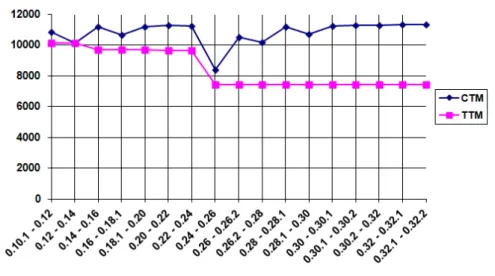
• Design decay metrics, Tunnel Triplets Metric (T T M) and Common Triplets Metric (CT M ), provide developers useful insights regarding design decay. If T T M decreases, then the original design decays. If T T M is stable, then the original design is stable, which means that the system is more adapted to the new changing requirements.
• Seismology provides an interesting metaphor for change impact analysis. Changes propagate in systems, like earthquakes. The change impact is most severe near the changed class and drops off away from the changed class. Using external information, we show that our approach helps developers to locate easily the change impact.
• Immune system provides an interesting metaphor for detecting design defects. The results of the experiments showed that the precision and recall of our approach are comparable or superior to that of previous approaches.
CONTENTS
CHAPTER 1: INTRODUCTION . . . . 2
1.1 Research Context . . . 2
1.2 Problem Statement and Contributions . . . 6
1.3 Motivating Scenario . . . 9
1.4 Roadmap . . . 11
CHAPTER 2: RELATED WORK . . . . 12
2.1 Design Decay Evaluation . . . 12
2.1.1 Software Design Evolution . . . 13
2.1.2 Discussion . . . 14
2.1.3 Renamings Detection . . . 15
2.1.4 Discussion . . . 15
2.2 Change Impact Analysis . . . 16
2.2.1 Structure-based Change Impact Analyses . . . 16
2.2.2 History-based Change Impact Analyses . . . 17
2.2.3 Probabilistic Approaches . . . 18
2.2.4 Hybrid Approaches . . . 18
2.2.5 Discussion . . . 19
2.3 Design Defects . . . 20
2.3.1 Specification of Design Defects . . . 20
2.3.2 Detection of Design Defects . . . 21
2.3.3 Impact of Design Defects . . . 22
2.3.4 Discussion . . . 23
CHAPTER 3: DESIGN DECAY EVALUATION . . . . 24
3.1 Approach . . . 26
3.1.1 Step 1: Extraction of Design Diagrams . . . 28
3.1.2 Step 2: Detection of Class Renaming . . . 28
3.1.3 Step 3: Design Diagram Matching . . . 36
3.1.4 Step 4: Design Diagram Clustering . . . 41
3.1.5 Step 5: Design Decay Evaluation . . . 43
3.2 Study Definition and Design . . . 44
3.2.2 Research Questions . . . 45
3.2.3 Analysis Methods . . . 46
3.3 Empirical Study Results . . . 52
3.4 Summary . . . 64
CHAPTER 4: A SEISMOLOGY-INSPIRED APPROACH TO STUDY THE CHANGE IMPACT . . . . 66
4.1 The Earthquake Metaphor . . . 68
4.1.1 Seismology . . . 68
4.1.2 Change Impact Analysis . . . 69
4.1.3 Change Impact Analysis and Seismology . . . 70
4.2 Approach . . . 71
4.2.1 Step 1: Measuring Class Importance . . . 72
4.2.2 Step 2: Identifying Class Levels . . . 73
4.2.3 Step 3: Identifying Impacted Classes . . . 76
4.3 Empirical Study Design . . . 77
4.3.1 Objects . . . 77
4.3.2 Research Questions . . . 78
4.3.3 Analysis Methods . . . 78
4.4 Empirical Study Results . . . 80
4.5 Discussions . . . 86
4.6 Threats to Validity . . . 87
4.7 Summary . . . 88
CHAPTER 5: AN IMMUNE-INSPIRED APPROACH FOR THE DETECTION OF DESIGN DEFECTS . . . . 89
5.1 Biological Background . . . 90
5.2 Immune-inspired Metaphore . . . 94
5.3 Artificial Immune System . . . 94
5.4 Comparison with Kessentini et al. [75] Approach . . . . 99
5.5 Study Definition and Design . . . 102
5.5.1 Objects . . . 103
5.5.2 Research Questions . . . 103
5.6 Study Results, Analyses and Discussions . . . 104
5.7 Threats to Validity . . . 108
ix
CHAPTER 6: CONCLUSION . . . 110
6.1 Dissertation Summary . . . 110
6.2 Dissertation Findings and Conclusions . . . 112
6.3 Opportunities for Future Research . . . 112
6.3.1 Estimating the “mortality” rate of classes . . . 113
6.3.2 Analysing class renamings . . . 113
6.3.3 Predicting futures changes . . . 113
6.3.4 Predicting “buggy” changes . . . 114
6.3.5 Identifying refactoring opportunities . . . 114
BIBLIOGRAPHY . . . 117
APPENDIX A: DEFINITIONS OF METRICS AND QUALITY AT-TRIBUTES . . . 134
A.1 Definitions of metrics . . . 134
A.2 Software Quality Attributes . . . 137
APPENDIX B: SPECIFICATION OF CODE SMELLS AND AN-TIPATTERNS . . . 138
B.1 Detailed Definitions of the code Smells . . . 138
1.1 Steps of software maintenance process (From [101]) . . . 3
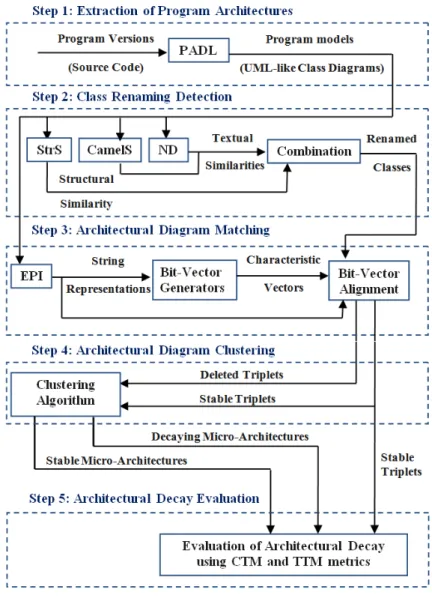
3.1 Approach Overview . . . 27
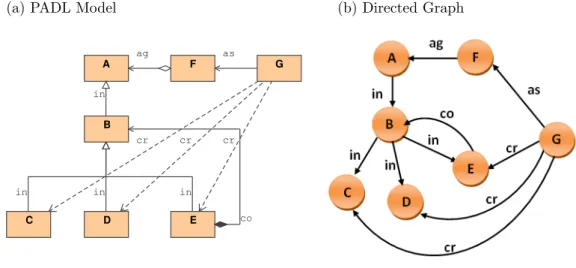
3.2 An example of class diagram (PADL Model) . . . 28
3.3 An example of class renaming . . . 30
3.4 String Representation of a software design (from [73]) . . . 37
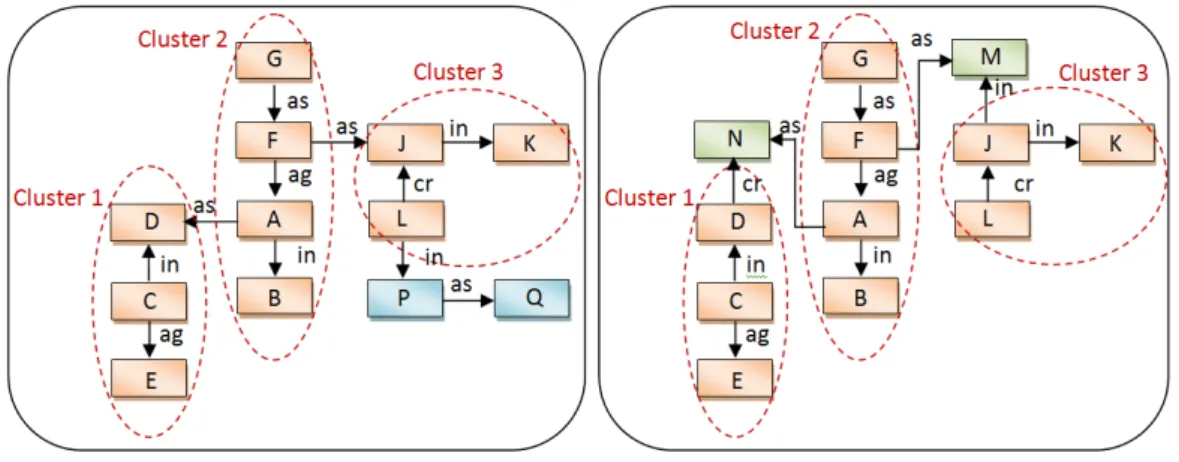
3.5 Example of Clustering, each Cluster represents a SµD . . . 42
3.6 F measure in function of thresholds values for CamelS and ND Sim-ilarities . . . 53
3.7 The evolution of the ArgoUML design . . . 55
3.8 The evolution of the DNSjava design . . . 56
3.9 The evolution of the JFreeChart design . . . 57
3.10 The evolution of the Rhino design . . . 58
3.11 The evolution of the XercesJ design . . . 59
4.1 Epicenters distribution in space and time. The map shows the ex-pected number of earthquakes of a given magnitude occurring within a given radius from each point (From [104]) . . . 69
4.2 Earthquake Metaphor . . . 71
4.3 Representations of a simple example system (from [73]) . . . 74
4.4 Example of identifying impacted classes by the epicenter class A. The time window T = 2 min. The impacted classes are B and C . 76 4.5 Change propagation from XMLEventImpl . . . 81
4.6 Change propagation from TypeValidator . . . 82
5.1 The development of T-cells (from [71]) . . . 91
5.2 The immune system mechanism. I-II show the invade entering the body. III T-cells are activated, which then activate the B-cells, IV is the antigen matching and the antibody production, VI the antigen’s destruction (from [31]) . . . 92
5.3 The Clonal Selection Principle. The B-cells with low affinity recep-tors are eliminated. The B-cells with high affinity (carrying receprecep-tors specific for the antigen) are cloned and differentiate into plasma and memory cells (from [31]) . . . 93
LIST OF TABLES
3.1 Statistics for the first and last version of each system . . . 45
3.2 Amount of class renaming . . . 49
3.3 Sample sizes after startified Sampling . . . 49
3.4 The performance of ADvISE in terms of precision and recall for class renaming detection . . . 54
3.5 Contingency table (ArgoUML) and Fisher test results for unstable classes with at least one bug . . . 61
3.6 Contingency table (Rhino) and Fisher’s test for unstable classes with at least one bug . . . 61
3.7 Contingency table (ArgoUML) and Fisher’s test for unstable classes with at least one design defect . . . 62
3.8 Contingency table (Rhino) and Fisher’s test for unstable classes with at least one design defect . . . 62
3.9 Execution time (in seconds) for each step of ADvISE . . . 62
4.1 Mapping between Change Impact Analysis and Seismology . . . 70
4.2 Statistics for the systems. . . 77
4.3 Epicenter classes in Rhino, the top 4 most important classes, ac-cording to rh(c) value. For each class c, we calculated the page rank value pr(c), its rank r(c) according to pr(c), the number of changes h(c), and their combination rh(c) . . . . 80
4.4 Epicenter classes in XercesJ, the top 4 most important classes, ac-cording to rh(c) value. For each class c, we calculated the page rank value pr(c), its rank r(c) according to pr(c), the number of changes h(c), and their combination rh(c) . . . . 80
4.5 Duncan’s test applied on “number of changes of the impacted classes” in Rhino . . . 84
4.6 Duncan’s test applied on “number of changes of the impacted classes” in XercesJ . . . 84
4.7 Duncan’s test applied on “number of earthquakes” in Rhino . . . . 85
4.8 Duncan’s test applied on “number of earthquakes” in XercesJ . . . 85
5.2 Comparison of AIS-based Design Defects Detection . . . 99
5.3 System characteristics . . . 103
5.4 Intra-system detection on XercesJ: 3-fold cross validation . . . 105
5.5 Inter-system detection, trained on Blobs, FDs and SCs . . . 106
5.6 Results of applying the detection approaches. Group1 represents the training on Blob. Group2 represents the training on Blob, FD, SC. (In each row, the first line is the number of detected classes, the second is the number of classes being design defects, the third is the precision. Numbers in parentheses are the percentages of classes being reported) . . . 106
LIST OF ACRONYMS
ADvISE Architectural Decay In Software Evolution AIS Artificial Immune Systems
AIRS Artificial Immune Recognition System ANOVA ANalysis Of VAriance
API Application Programming Interface AURA AUtomatic change Rule Assistant
BBN Bayesian Belief Network CLONALG CLONal selection ALGorithm
CVS Concurrent Versions System DECOR Defect dEtection for CORrection
FD Functional Decomposition
IDS Immune-inspired approach for the Detection of Smells OO Object Oriented
PADL Pattern and Abstract-level Description Language SC Spaghetti Code
SVN apache SubVersioN
To my brothers and sister
ACKNOWLEDGEMENTS
Feeling gratitude and not expressing it is like wrapping a present and not giving it.
William Arthur Ward (1921–1994).
Many people accompanied me during the endeavor of my doctoral studies. I am deeply grateful for their support. First of all, I would like to thank my supervisor, Yann-Ga¨el Gu´eh´eneuc, for giving me a chance to select research problems and pursue them. He taught me how to assess the research value of each proposal and how to be selective. He is a patient and thoughtful mentor; he listens to his students, not only what they are saying but also what they are not saying. I am proud to be one of his students. I would also like to thank my co-supervisor, Sylvie Hamel, for her support and advocacy. Her advice as a bioinformatic researcher was very valuable to this dissertation.
My thankful admiration goes to Prof. Giuliano Antoniol, for his advice. He always made time to listen to my research ideas. A great thanks goes also to Prof. Bram Adams for his insightful discussions and his valuable comments on this dissertation.
Special thanks go to Prof. David W. Binkley for enthusiastically accepting to be my external examiner and for reviewing my dissertation. I thank Prof. Bruno Dufour and Prof. Radu I. Iftimie for accepting to be on my committee and for reviewing my dissertation. I thank Prof. Guy Lapalme who have enthusiastically accepted to chair my doctoral committee.
Great thanks to my fellow doctoral students from the Ptidej and Soccer labs for creating an enjoyable working environment. Special thanks go to Annie Ying, Fehmi Jaafar, Foutse Khomh, and Segla Kpodjedo. I always enjoy discussing and brainstorming research ideas with you. I would also like to thank my all friends who made the long experience of graduate school more manageable.
Special grateful to my parents Ahmed Hassaine and Soltana Belhandouz for their unconditional love and support, and for believing in me–whenever and wher-ever. They taught me the importance of passion and persistence in everything I
do. I am also grateful to my grandmother Kheira who always prays for me. Many thanks to my sister Nacima and my brothers Amine and Aymen for their unlim-ited love. I owe special thanks to my uncle AbdelKader Merini for his support and encouragement. Finally, I thank God for making my dream come true.
This research was partially supported by FQRNT, NSERC, and the Research Chairs in Software Patterns and Patterns of Software and in Software Evolution.
CHAPTER 1
INTRODUCTION
1.1 Research Context
Software systems play a crucial role in modern societies. They are omnipresent from small game applications on smart phones to large embedded systems, such as navigation systems in spacecraft.
Software systems must evolve to adapt to new requirements to stay useful, else they risk an early death [88, 89]. Therefore, they undergo changes throughout their lifetimes as developers add features, fix defects, or implement changing re-quirements. As these systems evolve, their designs tend to decay with time and they become less adaptable to new, emerging requirements [29, 133]. Thus, the systems become more complex over time and harder to maintain [12, 61].
Software maintenance is “the process of modifying a software system or com-ponent after delivery to correct faults, improve performance or other attributes, or adapt to a changed environment” [2]. The steps of the maintenance process [101] are change management, change impact analysis, system release planning, change design, implementation, testing and system release/integration (see Figure 1.1). While “traditional maintenance” is thought of as only as corrective maintenance, which deals with fixing bugs in the code, there are three other types of maintenance that are related to software evolution [128]: adaptive maintenance deals with adapt-ing the software to new environments, perfective maintenance deals with addadapt-ing new functionalities to the software according to changes in user requirements, and preventive maintenance deals with updating documentation and making the sys-tem more maintainable. The long-term effect of corrective, adaptive, and perfective maintenance increases the system’s complexity [129]. As systems are continuously changed, their complexity increases and their maintenance cost grow unless pre-ventive maintenance is done to maintain or reduce it.
Over the past two decades, maintenance has been recognised as the most costly and difficult phase in the software life cycle [12, 125]. The maintenance effort has
Figure 1.1 – Steps of software maintenance process (From [101]).
been estimated to be frequently more than 70% of the overall software development cost [114]; an increase due in part to design decay.
Design decay is a broad term, because a software design can be interpreted either as architectural design or detailed design. Architectural design is “the struc-ture or strucstruc-tures of the system, which comprises software elements, the externally visible properties of those elements, and the relations among them” [1]. It aims at organising the system in components that meet a set of non-functional require-ments [11] relying on architectural styles [48], i.e., principles of organisation to optimize certain quality requirements, such as the client-server architecture. De-tailed design is concerned with the contents of the identified components [22], i.e., a set of functional requirements relying on design patterns [47], which are “good” so-lutions to recurring design problems. In this dissertation, we use the term software design to mean the detailed design.
Parnas [109] attributed design decay to a phenomenon that he called ignorant surgery. This phenomenon occurs when changes are made on a system by people who do not understand its original design; these new changes sometimes invalidate
4 the original design of the system and cause design decay. A system that has been repeatedly changed and maintained in this manner is understood by fewer people over time, i.e., neither the original designers of the system, nor those who made the changes understand the modified system. As a result, the documentation becomes increasingly inaccurate and future changes become more difficult, because they take longer and are more likely to introduce new bugs [109]. Experience [115] shows that 40% of bugs are introduced while correcting previous bugs. Therefore, every new maintenance activity becomes more expensive, because the cost of removing these bugs is high [109].
Van Gurp et al. [134] attributed design decay to a phenomenon that they called design erosion. This phenomenon is due to the cumulative, negative ef-fect of changes on the quality of a system. They suggested that decayed de-signs make systems more prone to bugs and that, in some not-so-rare cases, a software design and its implementation code must be thrown away because they are too hard to maintain, unless the decay can be stopped before the design is completely unworkable [51, 133, 134]. This phenomenon was observed in many systems [20, 127, 133, 134], such as the Mozilla Web browser: “Netscape was ex-periencing fierce competition from Microsoft’s Internet Explorer. They decided to release their own browser as open source and started working on transforming it into the next generation browser. After half a year of development the develop-ers of the open-source Netscape came to the conclusion that the original Netscape source was eroded beyond repair. They took a major decision and started from scratch” [133]. This example illustrates the difficulty that developers face in main-taining decayed software design and its implementation code. On the one hand, design decay may become an obstacle for further development. On the other hand, fixing design decay may be expensive. In fact, some developers may prefer to re-design from scratch rather than spend effort on trying to fix the existing re-design. Therefore, developers must understand the factors that drive design decay and take proactive steps that facilitate future changes and ensure that software design does not decay.
Moreton [101] argued that controlling the input of the maintenance process is essential to ensure an effective maintenance. The change management and change impact analysis are the first two steps in the maintenance process (see Figure 1.1).
Change management is the identification, estimation, allocation, and monitoring of the resources used to perform a change [1]. Change impact analysis is defined by Pfleeger and Bohner [112] as the evaluation of the many risks associated with the change, including estimates of the effects on resources, effort, and schedule, while Arnold and Bohner [17] defined change impact analysis as identifying the potential consequences of a change, or estimating what needs to be modified to accomplish a change. The software maintenance process can only be optimised if precise and unambiguous information is available about the potential change impact. Experience [109] shows that making changes without understanding their effects can lead to the premature retirement of a system. Therefore, change impact analysis is essential to reduce the amount of corrective maintenance, because fewer bugs will be introduced, and thus design decay will slow and its effects will be limited.
A major factor affecting the effort required for maintenance is the design qual-ity of systems [145]. Design qualqual-ity deterioration manifests itself in the form of design defects, which are “poor” solutions to recurring software design and imple-mentation problems, such as code smells [44] and design anti-patterns [23]. They occur generally in object-oriented systems when developers lack knowledge and–or experience in solving a design problem or applying some design patterns: “some-thing that looks like a good idea, but which backfires badly when applied” [36]. They are conjectured to have a negative impact on some quality characteristics (eg., change-proneness and fault-proneness [76, 78]) and evolution of systems [23, 44].
Design quality is assessed and improved mainly during formal technical reviews that involve expert inspections. Experience [145] shows that developers spend a lot of time in correcting defects before completing a maintenance task. Thus, the detection of design defects early in the process could substantially reduce the cost of subsequent steps in the development and maintenance phases [114]: designs free of design defects are easier to implement, change, and maintain. However, their manual detection in large designs are highly time and resource consuming and error-prone activities [121], because design defects crosscut classes and methods and their descriptions are subject to misinterpretation.
6
1.2 Problem Statement and Contributions
The above section lead us to formulate our thesis:
Thesis:
Software maintenance is severally impacted by design decay, uncontrolled changes, and design defects. Therefore, to assist developers during software maintenance, we propose to evaluate design decay, to analyse change impact, and to detect design defects.
To verify our thesis, we propose to address three main problems: design decay evaluation, change impact analysis, and design defects detection. To confirm our findings, we propose to use external information, such as bug reports and mailing lists, and to improve the precision and recall of design defects detection.
Problem 1: Design Decay Evaluation
Authors [69, 109, 110, 134, 138] suggest that design decay is the deviation of a software design from the original one. Others [72, 82] suggest stability or resilience as a primary criterion for evaluating a design. However, none of the mentioned studies have been developed to quantify design decay.
To analyse design stability, we must study the traceability of classes across several versions, even if these classes are renamed. Other authors proposed different approaches to analyse the evolution of software designs [80, 82, 141–143]. Most of these previous approaches aim at finding design changes and class renamings occurring in long-lived evolving designs. Identifying class renamings can provide a useful support when a project manager is interested to study the evolution of a set of classes across all the versions of a system. Indeed, if a class disappears in a given release, it could have been renamed or simply deleted. Thus, identifying class renamings is also relevant to study class traceability across versions, which is useful for evaluating design decay. However, existing approaches [82, 143] have somewhat limited performances in time, precision, and recall.
Therefore, our first contribution [64, 65] is a novel approach, called ADvISE, that exploits a set of metrics to measure design decay during software evolution
(see Chapter 3). The first step in measuring design decay is to use a diagram matching technique to identify structural changes among versions of a software design. Finding structural changes occurring in long-lived, evolving designs requires the identification of class renamings. Thus, the first step of our approach concerns the identification of class renamings in evolving designs. Then, the second step requires matching several versions of an evolving design to identify decaying and stable parts of a software design. We propose bit-vector and incremental clustering algorithms to match several versions of an evolving design and find stable and decaying micro-designs1. The third step consists of measuring the design decay as a whole using stable and decaying micro-designs and we propose a set of metrics that measure design decay. Finally, we perform an empirical study of the impact of bugs and design defects on design decay. We found that decaying designs are more prone to bugs and to design defects than other designs, confirming the importance and usefulness of measures of design decay a posteriori.
Problem 2: Change Impact Analysis
Existing approaches for change impact analysis are based on class dependen-cies and use static, dynamic, and–or textual analyses [7, 17, 86, 87]. However, in object-oriented systems, the relations between classes make change impact difficult to anticipate because of possible hidden propagation [19]. Historical analysis of data from software repositories [21, 46, 146, 150] provides useful information that complement static and dynamic analyses. Such techniques identify change-impact relations based on the co-changes of software artefacts within a change-set. How-ever, they may fail to capture how changes are spread over “space” (eg., in class diagram) and through a long chain of relations, i.e., they cannot capture how far changes propagate from a given class to the others and whether two co-changing classes are in direct relations or are separated through a long chain of relations. Consequently, they could not help developers prioritise their changes according to the forecast scope of changes.
1We use the concept of “micro-design” to mean any subset of a software design, eg., a set of
8 Therefore, our second contribution [63] is a novel approach to change impact analysis specifically designed to study the scope of change propagation. In Chapter 4, we propose a metaphor between seismology and change impact analysis. In particular, if we analyse the relations chain of a changed class, we may have the intuition that the classes impacted by a change are near the changed class. However, in some cases, the actual classes that must be modified are far away from the changed class. If these classes are not considered before implementing a change, bugs may occur. Our approach considers changes to a class as an earthquake that propagates through a long chain of intermediary classes. Our approach combines static dependencies between classes and historical co-change relations to measure the scope of change propagation in a system, i.e., how far a change propagation will proceed from the epicenter (the changed class) to other classes.
Problem 3: Design Defects Detection
Several detection approaches [96, 99, 102] detect design defects according to sets of rules and thresholds defined on various metrics. However, threshold values are not easy to define. For example, the Blob and Spaghetti Code design defects (see Appendix B) both describe classes that are too large and too complex. However, a class that is considered large in a given system could be considered average in another. Also, all previous approaches [77, 99, 118] require experts’ knowledge and interpretation of the design defects. They focus on detecting one design defect at a time, while some defects share similar characteristics, and exclude classes that are not identical to the defect (given some thresholds). Yet, in the course of our experiments with various detection approaches (based on rules [99], Bayesian Beliefs Networks [77], and B-Splines [118]), we noticed that
• Several smells have similarities. For example, the Blob and Spaghetti Code antipatterns both describe classes that are too large and too complex; the Blob further describing that these classes should relate to data classes.
• Classes similar but not equal to some design smell are also of interest to developers and quality assurance personnel because they could, in the future, emerge as smells themselves in the “submarine”2 effect [118].
Moreover, previous approaches have somewhat limited performances in time, precision, and recall.
Therefore, our third contribution [62] is a novel approach for design defects detection, called IDS (Immune-based Detection Strategy), based on Artificial Im-mune Systems, and presented in Chapter 5. A natural imIm-mune system protects the body by identifying, learning from, and defending against invading pathogens. Similarly, our contribution is built on the same defense mechanism: a software design is comparable to a body, that we wish to protect from pathogens, such as design defects. Design defect detection approaches are the defense mechanisms of the software design. Like pathogens, design defects come in a variety of forms with some defects being only slightly different from others. A natural immune system can handle such similar pathogens with good precision. This good precision is essential for the body and have inspired a family of supervised learning and clas-sification algorithms: Artificial Immune Systems (AIS). We use an AIS algorithm, called Immunos-99 [24], to detect design defects.
1.3 Motivating Scenario
Developers are often concerned with different types of maintenance [128]. In corrective maintenance, developers must understand why a previous change intro-duces a bug and how it can be fixed. In adaptive and perfective maintenance, developers must understand how to adapt the system to new environments or how to add new functionalities without introducing new bugs. In preventive mainte-nance, developers are often required to detect design defects and correct them to make the system more maintainable and ensure that its design does not decay.
In a typical maintenance scenario, developers are often concerned with imple-menting new changes in the code. They usually have existing knowledge of the
2The term “submarine” was introduced by Oliveto et al [118], it is used when several classes
may be very close to be identified as antipatterns but remain under the threshold during their evolution.
10 code, or a tip from an expert on the system, and know of at least one class that is relevant to the maintenance task. However, developers need help identifying the impact of a change and in locating the rest of the code that is relevant to the maintenance task. As the design decays, maintenance costs, developers time and effort increase. Therefore, developers should evaluate the design decay to assess the ratio cost / benefit before implementing new changes.
To illustrate the difficulty developers sometimes face during maintenance, we outline the main steps involved in a maintenance task:
• Step 1: Design Decay Evaluation. First of all, developers should evaluate whether the design of the current system version is decaying. For example, the release notes of XercesJ3, a family of software packages for parsing XML, report that XercesJ 2.0.0 is a nearly complete rewrite of the XercesJ 1.x code to make the code cleaner, more modular, and easier to maintain. It includes a completely redesigned and rewritten XML Schema validation engine. This example illustrates the importance of measuring design decay, because devel-opers can decide to start rewriting another version from scratch instead of working on the current version. Section 3.1 (p. 26) explains how to evaluate design decay.
• Step 2: Change Impact Analysis. Once developers decide which classes should be changed they can analyse the impact of their changes, to identify the set of classes that should be modified to accomplish the change. For example, the bug ID2005514 reports a bug in Rhino5, an open-source imple-mentation of a JavaScript interpreter, that was introduced by a developer when he implemented a change to class Kit and missed a required change to class DefiningClassLoader. This example illustrates the importance of identifying the impacted classes before implementing a change. Section 4.2 (p. 71) explains our change impact analysis.
• Step 3: Design Defects Detection. Finally, developers should improve the quality of software design by detecting design defects and correcting them.
3 http://xerces.apache.org/ 4 https://bugzilla.mozilla.org/show_bug.cgi?id=200551 5 http://www.mozilla.org/rhino/
For example, in XercesJ v2.7.0 there are 44 design defect instances. Section 5.3 (p. 94) explains how to identify these design defects.
In summary, our approaches help developers evaluate design decay, identify the change impact, and detect design defects to ensure efficient maintenance and to limit the impact of design decay.
1.4 Roadmap
The remainder of this dissertation provides the following content: Chapter 2 (p. 12) reviews related work on design decay, change impact analysis, and design defects detection. Chapter 3 (p. 24) reports our first contribution, evaluating design decay. Chapter 4 (p. 66) reports our second contribution, studying the scope of change propagation using the seismology metaphor.Chapter 5 (p. 89) reports our third contribution, which concerns design smells detection using an Artificial Immune System. Chapter 6 (p. 110) presents the conclusions of this dissertation and outlines some directions of future research. Appendix A (p. 134) presents the definitions of metrics and quality attributes considered in this dissertation. Appendix B (p. 138) presents the complete list of code smells and antipatterns considered in this dissertation with their definitions.
CHAPTER 2
RELATED WORK
This chapter provides a survey of existing work we build on. The structure of the chapter is as follows: Section 2.1 provides a description of leading work in design decay. Section 2.2 discusses the state of the art in change impact analysis. Section 2.3 summarises exiting work in design defect detection.
2.1 Design Decay Evaluation
Design decay is the deviation of actual software design from the original, i.e., the violation of design choices during evolution [69, 110, 138]. Van Gurp et al. [134] suggest that decayed designs make systems more prone to bugs and that, in some not-so-rare cases, a software design and the resulting source code must be thrown away because it is too hard to maintain, unless the decay can be stopped before the design is completely unworkable [51]. Macia et al. [93] presented a case study on the impact of design antipatterns on design decay.
Perry et al. [110] suggested that design decay is due to violations of the archi-tecture caused by evolution. Eick et al. [41] suggested that a piece of code has decayed if it is more difficult to change than it used to be. Van Gurp et al. [134] defined design decay as the cumulative, negative effect of changes on the quality of a software system. Hochstein et al. [69] defined design decay as the deviation of actual or concrete design from planned or conceptual design. Williams et al. [138] defined design decay as the deviation from the original design. Parnas [109] sug-gested that the structure of the software system degrades when changes to software are made by people who do not understand the original design concept, because the modifications often invalidate the initial design.
Design decay evaluation relates to two main research directions: design evolu-tion and class renamings detecevolu-tion. Techniques for analysing the design evoluevolu-tion detect structural changes between versions of a software design, typically repre-sented as class diagrams. Identifying class renamings can provide useful support
when a project manager is interested in studying the evolution of a set of classes across all the versions of a software system. In fact, even if a class disappears in a given version, it could have been renamed, or simply deleted. Thus, identifying class renamings is essential to the study of class traceability across versions, which is useful for evaluating design decay. The following sections present related work on design evolution and renamings detection techniques.
2.1.1 Software Design Evolution
Antoniol et al. [4] proposed an approach that helps users deal with inconsis-tencies by pointing out regions of code that do not match, i.e., added, deleted, and modified classes and methods. They first recovered UML-like class diagrams from the source code of a software system in the Abstract Object Language (AOL). Then, they compared the recovered designs of subsequent software versions using bipartite graph matching. Nodes in the graphs represent the classes of a version and the similarity between two graphs is derived from class and attribute/method names by means of String Edit Distance. Their approach does not identify relations between classes or class renamings.
Antoniol et al. [5] proposed an automatic approach, based on cosine similar-ity of class identifiers to automatically identify links between classes (obtained from refactoring) of two subsequent releases. In particular, the approach aimed at identifying cases of class replacement, split, merge, as well as feature migration from/to other classes. They represented classes of different releases as documents and queries, then applied a vector space model that treats documents and queries as vectors [45], with documents ranked against queries by computing a similarity function between the corresponding vectors. Their approach does not take into account the relations between classes.
Xing and Stroulia [143] presented the UMLDiff tool to automatically detect structural changes between two versions of a software design. They modeled each design as a directed graph, where nodes are software entities (packages, classes, interfaces, and their fields and methods), and edges represent the relation between them. They used UMLDiff to compare the two directed graphs in terms of ad-ditions, removals, renamings, and signature changes of software entities. They
14 also used UMLDiff to study class evolution [142] at the design level to understand phases and styles of evolution [141].
Kpodjedo et al. [82] proposed Error Correcting Graph Matching (ECGM), to study design diagram evolution. Their algorithm is derived from search-based techniques: given two design diagrams D1 and D2, the authors aim to find, among the large set of all possible matchings, a solution that is the best true match between classes of D1 and D2. They identified evolving classes that maintain a stable structure of relations (association, aggregation, and inheritance) with other classes and that constitute the stable backbone of a software design.
Kimelman et al. [80] designed a Bayesian framework to perform diagram match-ing. They represented diagrams as graphs whose nodes have attributes, such as name, type, connections to other nodes, and containment relations. Probabilistic models are used for rating the quality of candidate correspondences based on var-ious features of the nodes in the graphs. Given the probabilistic models, they can find high-quality correspondences between two diagrams using search algorithms.
2.1.2 Discussion
We share with all the above techniques the notion that design decay is the deviation of a software design from the original one. Existing approaches for design evolution compare two versions of a software design to study its evolution. However, to the best of our knowledge, no work aimed at automatically quantifying design decay exists. In Chapter 3, we propose an approach to evaluate design decay. The first step in measuring design decay is to use a diagram matching technique to identify structural changes among versions of a software design. Finding structural changes occurring in long-lived, evolving designs requires the identification of class renamings. Thus, we propose a set of structural and textual similarity measures to identify class renamings in evolving designs. The second step requires matching several versions of an evolving design. Then, we propose a bit-vector algorithm to match several design versions. The final step is to measure design decay. We propose a set of software metrics that measure design decay: the Tunnel Triplets Metric and Common Triplets Metric. We use these metrics to study the impact of design defects on design decay.
2.1.3 Renamings Detection
Eshkevari et al. [43] presented a study of identifier renamings in software sys-tems, studying how terms (identifier tokens) change in source code identifiers. They proposed an approach based on the normalized edit distance to detect identifier re-namings. Wei et al. [140] developed AURA, a novel hybrid approach that combines call dependency and text similarity analyses to provide developers with change rules when adapting their systems from one version of a framework to the next. Dagenais et al. [38] developed SemDiff, a tool that recommends replacements for framework methods that were accessed by a client system and deleted during the evolution of the framework. Sch¨afer et al. [122] mined framework-usage change rules from already-ported instantiations. The three previous approaches compute support and confidence value on call dependency analysis. Godfrey et al. [52] presented a semi-automatic hybrid approach to perform origin analysis using text similarity, metrics, and call dependency analyses. Xing and Stroulia [144] developed Diff-CatchUp to analyse textual and structural similarities of UML class diagram to recognise API changes. Kim et al. [79] presented an automated approach to infer high-level renaming patterns.
2.1.4 Discussion
The above techniques detect renamings at the method level using text-based similarities. Thus, they cannot detect renamed methods that do not have similar names with their target methods. Call dependency-based approaches provide useful information to identify renamed methods that may not be detected by text-based approaches. However, they cannot detect renamed methods for target methods that are not used in framework. In Chapter 3, we propose similarity measures to detect renamings at class level, which could also be adapted to detect renamings at method level.
16
2.2 Change Impact Analysis
Change impact analysis aims at identifying software artefacts being affected by a change; it provides the potential consequences of a change and estimates the set of artefacts that must be modified to accomplish a change [17].
2.2.1 Structure-based Change Impact Analyses
Arnold and Bohner proposed several models of change propagation [7, 17]. These models are based on code dependencies and algorithms, including slicing and transitive closure, to assist in assessing the impact of changes. Dependency analy-sis of source code is performed using static or dynamic analyses. When performing change impact analysis with call graphs, the impact of a change in a method is the transitive closure of all callers and callees. Therefore, it can be inaccurate, by re-porting false candidates that do not change (low precision) and failing to estimate some classes that actually do change because the analysis is restricted to method calls (low recall).
Weiser et al. [137] proposed program slicing techniques to determine the code that may affect the location of a failure. Static slicing is typically based on data-and control-flow graphs that are computationally expensive to process data-and analyse and can report large slices [16]. Thus, dynamic slicing [3, 148] and probabilis-tic slicing [120], have been proposed in the literature to reduce the size of slices. However, their analysis is expensive.
Law et al. [87] argued that static slicing is much more precise than transitive closure on call graphs but it may return large sets of classes that are supposed to be impacted by a change. Dynamic slicing can improve the conservative behavior of static slicing. However, it is subject to the risk of lower precision and recall as it depends on the chosen scenarios (i.e., the executed test cases). Consequently, Law et al. [87] introduced a new approach to method-level change impact analysis. They used path profiling technique [86] to compress dynamic traces, then they applied PathImpact algorithm to predict dynamic change impact. Their approach can provide potentially more useful predictions of change impact than method-level static slicing in situations where specific system behaviors are the focus.
Rajlich et al. [116] described some incremental change activities, such as impact analysis and change propagation, in which programming concepts and program dependencies play a key role. They argued that different kinds of class interactions have different likelihoods of change propagation.
Zaidman et al. [147] proposed a technique for uncovering important classes in a system architecture. They used a technique that was originally developed to iden-tify important hubs on the Internet, i.e., pages with many links to “authorative” pages [81]. They verified that important classes in the system correspond to the hubs in the dynamic call-graph of a system.
2.2.2 History-based Change Impact Analyses
Ying et al. [146] and Zimmermann et al. [150] proposed to mine version-control systems, using association rules, to identify logical couplings [46] between classes. A change occurring in class A may have an impact on another class B if in the past they changed together. Such historical analysis can capture change couplings that cannot be captured by static and dynamic analyses.
Bouktif et al. [21] used a technique from speech recognition to infer cause–effect relations from the revision histories. Their approach relies on dynamic time warping to group files with histories of changes of different lengths. The value of their approach is that precision and recall are higher than previous approaches [146, 150]. Canfora et al. [28] proposed an approach based on information-retrieval tech-niques to derive the set of classes impacted by a proposed change request. They argued that the histories of change requests are a useful descriptor of classes when used for change impact analysis.
German et al. [49] proposed a method that determines the impact of previous code changes on a particular code segment based on a change impact graph. Given the location of a failure, their method annotates the neighbours of this failure in the graph by marking the recent changes. Thus, it determines all the changed areas of the software system that affect the reported location of a failure.
18
2.2.3 Probabilistic Approaches
Zhou et al. [149] and Mirarab et al. [98] presented a change propagation analysis based on Bayesian networks that incorporates static source code dependencies as well as different features extracted from the history of systems and uses a sliding window algorithm to group them. Their change propagation model can predict future change couplings. Mirarab et al. [98] used Bayesian belief networks as a probabilistic tool to make such predictions systematically. Their approach mainly relies on dependency metrics calculated using static analysis and change history extracted from a version-control system.
Antoniol et al. [6] incorporated static source code dependencies and other fea-tures extracted from the release history of a system, such as author information. Then, they applied the LPC/Cepstrum technique to mine a version-control system for classes having evolved in the same or very similar ways. Their approach can find classes having very similar maintenance evolution histories.
Ceccarelli et al. [33] proposed the use of a generalisation of univariate autore-gression model to capture the evolution and inter-dependencies between multiple time series. They applied the bivariate Granger causality test [54] to infer the mutual dependencies between classes, analysing the time series representing the change histories of a class A to predict the changes of another class B. Their preliminary results showed that change impact relations inferred with the Granger causality test are complementary to those inferred with association rules.
2.2.4 Hybrid Approaches
Girba et al. [50] proposed an approach, named Yesterday’s Weather, to identify classes that are likely to change in the next version. This approach is based on the retrospective empirical observation that classes that changed the most in the recent history will also undergo important changes in the near future.
Malik and Hassan [94] proposed the use of adaptive change propagation heuris-tics. These heuristics combine the use of history heuristics, containment heuristics, call-use depends heuristics, and code ownership heuristics. The proposed adaptive heuristics use a best heuristic table to track, for each change entity, the best
heuris-tic, and uses the development replay framework [67] to measure the performance of that heuristic.
Hassan et al. [66] proposed a model of change propagation, based on several heuristics for predicting the set of classes that should change after a particular class has been changed. In their approach, they combined various sources of data for change impact analysis, such as static dependencies between classes and historical co-change relations.
2.2.5 Discussion
Some existing approaches for change impact analysis are based on class depen-dencies and use static, dynamic, and–or textual analysis [7, 17, 86, 87]. However, in object-oriented systems, the relations between classes make change impact dif-ficult to anticipate because of possible hidden propagation [19]. Historical analy-sis [21, 46, 146, 150] of data from software repositories provides useful information that complement static and dynamic analyses. Such techniques learn change im-pact relations based on the co-changes of software artefacts within a change-set. However, they may fail to capture how changes are spread over “space” (i.e., among classes in class diagram) and through class levels (i.e., the distance between co-changed classes). Thus, they could not help developers prioritise their changes according to the forecast scope of changes, which can lead to poor effort and cost estimations.
Consequently, none of these approaches have been used to study how far changes propagate from a given class, i.e., whether two co-changing classes are in direct relation or are separated through a long chain of relations. In particular, if we analyse the relation chain for a changed class, we may have the intuition that the classes impacted by a change are near the changed class. However, in some cases, the actual classes that must be modified are far away from the changed class. If these classes are not considered before implementing a change, bugs will occur. In Chapter 4, we propose a change propagation analysis specifically designed to study the scope of change propagation, based on a metaphor between seismology and change impact analysis. We use this approach to study the impact of design defects on change propagation.
20
2.3 Design Defects
Code smells [44] and antipatterns [23], collectively called in the following de-sign defects, are poor solutions to recurring software dede-sign problems. They occur generally in object-oriented systems when developers lack knowledge and–or expe-rience to solve a design problem or apply a design pattern [47].
2.3.1 Specification of Design Defects
Several books relate to design defects. Webster [136] wrote the first book on anti-patterns in object-oriented development; his contribution covers conceptual, political, coding, and quality-assurance problems. Riel [117] defined 61 heuristics characterising “good” object-oriented programming. These heuristics deal with classes, objects, and relations. They allow developers to assess the quality of their systems manually and provide a basis to improve designs and implementations. Fowler [44] defined 22 code smells that are low-level design defects in the source code of systems, suggesting that developers should apply refactorings. Code smells are described in an informal style and associated with methods to locate them through manual inspection of the source code. M¨antyl¨a [95] and Wake [135] proposed classifications of code smells. Brown’s book [23] is more focused on the design and implementation of object-oriented systems than Webster’s. Brown et al. described about 40 anti-patterns textually, which are general object-oriented design defects and include well-known antipatterns, such as Blob.
These books provide in-depth views on heuristics, code smells, and anti-patterns aimed at a wide academic and industrial audience. However, it is difficult to build detection and correction algorithms from their textual descriptions, because they lack precision and are prone to misinterpretations. We build upon this work to propose an approach to characterise design defects and identify classes with similar characteristics. We use the term defect to acknowledge that, in certain contexts, a smell or an antipattern may be unavoidable and the best way to design and–or implement (part of) a system. For example, parsers are often Spaghetti Code.
2.3.2 Detection of Design Defects
Several approaches to specify and detect design defects have been proposed in the literature. They range from manual approaches, based on inspection tech-niques [131], to metric-based heuristics [96, 99, 102], where smells are detected according to sets of rules and thresholds defined on various metrics. Manual ap-proaches were defined, for example, by Travassos et al. [131], who introduced man-ual inspections and reading techniques to detect code smells.
Marinescu [96] presented a metric-based approach to detect smells with detec-tion strategies, which capture deviadetec-tions from good design principles and consist of combining metrics with set operators and comparing their values against absolute and relative thresholds. Similarly to Marinescu, Munro [102] proposed metric-based heuristics to detect code smells; the heuristics are derived from template similar to the one used for design patterns [47]. He also performed an empirical study to justify the choice of metrics and thresholds.
Moha et al. [99] proposed the DECOR method to specify and automatically generate detection algorithms. DECOR includes a domain-specific language based on a literature review of existing work. It also includes algorithms and a platform to automatically convert specifications into detection algorithms and apply these algorithms on any system. DECOR produces detection algorithm with good pre-cision and perfect recall while allowing quality assurance personnel to adapt the specifications to their context.
Khomh et al. [77] argued that threshold-based approaches do not handle the uncertainty of the detection results and, therefore, miss borderline classes, i.e., classes with characteristics of design smells “surfacing” slightly above or “sinking” slightly below the thresholds because of minor variations in their characteristics. Consequently, they proposed a Bayesian Belief Network (BBN) for the detection of design smells in systems, which output the probability that a class exhibiting the characteristics of a smell truly concerns a smell. Thus, their approach handles the degree of uncertainty for a class to be a smell. They also showed that BBNs can be calibrated using historical data both from a similar and from a different context.
Oliveto et al. [118] proposed ABS, an approach to detect design smells in sys-tems using signatures of the classes and of the smells. ABS is based on a similarity
22 computed via a numerical analysis technique using B-splines. The basis of ABS is the building of signatures of classes based on quality metrics, as in [59], using specific interpolation curves (i.e., B-splines [37]) of plots mapping metrics and their values for the class. They computed the similarity of a given class to an antipattern by calculating the distance between the curve of the class and the curves of classes previously classified as antipatterns. They reported a case study and claimed that ABS outperforms previous approaches in precision and recall while being simpler in practice.
Some visualisation techniques [124], were used to find a compromise between fully-automatic detection techniques, which are efficient but lose track of the con-text, and manual inspections, which are slow and subjective. Other approaches perform fully-automatic detection and use visualisation to present the detection results [85, 132].
Catal et al. [32] used several machine learning algorithms to predict the defective modules. They investigated the effects of dataset size, metrics set, and feature selection techniques for software fault prediction problem. They employed several algorithms based Artificial Immune Systems.
Kessentini et al. [75] independently used an Artificial Immune System to es-timate the risks of classes to deviate from “normality”, i.e., a set of classes rep-resenting a “good” design. They used structural data to describe a design, i.e., classes, fields and methods. They showed that 90% of the most risky classes in GanttProject and Xerces contained defects.
2.3.3 Impact of Design Defects
Despite the above studies on design defects, only a few studies empirically anal-ysed the impact of design defects on source code-related phenomena, in particular class change- and fault-proneness.
Bois et al. [18] showed that the decomposition of God Classes into a number of collaborating classes using well-known refactorings can improve comprehension. They did not consider source code evolution phenomena.
Wei and Shatnawi [91] investigated the relation between the probability of a class being faulty and some antipatterns based on three versions of Eclipse, showed
that classes with the antipatterns God Class, Shotgun Surgery, and Long Method have a higher probability to be faulty than other classes. They concluded that there was a need for broader studies to validate their results.
Olbrich et al. [107] analysed the historical data of Lucene and Xerces over several years and concluded that God Classes and Shotgun Surgery have a higher change frequency than other classes; with God Classes featuring more changes. They neither performed an analysis to control the effect of the size on their results nor studied the kinds of changes affecting these antipatterns.
Khomh et al. [76, 78] studied the impact of classes with design defects (code smells and antipatterns) on change proneness and fault proneness. They showed that classes participating in design defects are more change- and fault-prone than classes not participating in design defects.
2.3.4 Discussion
Previous approaches advanced the state-of-the-art in the specification and de-tection of design defects but all require expert knowledge and interpretation. More-over, they focus on detecting one kind of design defect at a time, while some design defects are similar and classes with characteristics similar but no identical to some design defects are also of interest to developers and quality assurance personnel. In Chapter 5, we propose an immune-inspired approach for the detection of de-sign defects. We use object-oriented metrics [34] computed on instances of smells as input to our algorithm following our parallel between object-oriented software systems and living bodies. We analyses our approach in two distinct, industrial-like scenarios. We also discuss all the advantages of our approach over previous approaches, including precision and recall.
This previous work raised the community awareness regarding the impact of code smells and antipatterns on software development. We build on this previous work and propose a more detailed and extensive empirical study of the impact of design defects on design decay phenomena (see Chapter 3).
CHAPTER 3
DESIGN DECAY EVALUATION
Software design plays an important role in software development, because it contains information that eases the communication among stakeholders, including developers and project managers. Each stakeholder is concerned with different software characteristics1 that are affected by the design. For example, developers use designs to verify whether their implementation conforms to earlier design deci-sions. Project managers use designs to create teams and allocate resources among them. Architects are concerned with ensuring that the design meets their design goals [11]. The above examples illustrate the importance of software design during development. Thus, each stakeholder must keep track of the design stability. On top of that, there is often a gap between the design and its implementation [103] from the start, because it is not easy to design software reflecting the intention of developers [70].
Software systems evolve continuously, requiring continuous maintenance and development. They undergo changes throughout their lifetimes as developers add features, fix bugs, or implement changing requirements. As these systems evolve, their designs tend to decay with time and they become less adaptable to new, emerging requirements [29, 133]. Design decay is the deviation of actual software design from the original one, i.e., the violation of design choices during evolution [69, 110, 138]. Van Gurp et al. [134] suggested that decayed designs make systems more prone to bugs and that, in some not-so-rare cases, a software design and its implementation must be thrown away because it is too hard to maintain, unless the decay can be stopped before the design is completely unworkable [51]. Macia et al. [93] presented a case study on the impact of design defects on design decay. Their study revealed that 78% of design decay in the software systems was related to design defects [23].
In this chapter, we propose a novel approach, ADvISE, that uncovers design decay indicators, which could serve as symptoms of decay, in the context of an
![Figure 1.1 – Steps of software maintenance process (From [101]).](https://thumb-eu.123doks.com/thumbv2/123doknet/7917689.265139/19.892.223.758.161.513/figure-steps-software-maintenance-process.webp)