HAL Id: tel-01986122
https://tel.archives-ouvertes.fr/tel-01986122
Submitted on 18 Jan 2019HAL is a multi-disciplinary open access archive for the deposit and dissemination of sci-entific research documents, whether they are pub-lished or not. The documents may come from teaching and research institutions in France or abroad, or from public or private research centers.
L’archive ouverte pluridisciplinaire HAL, est destinée au dépôt et à la diffusion de documents scientifiques de niveau recherche, publiés ou non, émanant des établissements d’enseignement et de recherche français ou étrangers, des laboratoires publics ou privés.
Adapting Communications in Cloud Games
Richard Ewelle Ewelle
To cite this version:
Richard Ewelle Ewelle. Adapting Communications in Cloud Games. Networking and Internet Archi-tecture [cs.NI]. Université Montpellier, 2015. English. �NNT : 2015MONTS145�. �tel-01986122�
Délivré par L’UNIVERSITE DE MONTPELLIER
Préparée au sein de l’école doctoraleI2S
Et de l’unité de recherche LIRMM
Spécialité :INFORMATIQUE
Présentée par Richard EWELLE EWELLE
Date de soutenance : 28/08/2015 devant le jury composé de
Mr. Stefano CERRI,Pr,Université de Montpellier Directeur de thèse Mr. Claude Frasson, Pr,University of Montréal Rapporteur Mr. Abderrafiaa KOUKAM, Pr,Université de
Technologie de Belfort-Montbéliard" (UTBM),
Rapporteur
Mr. Abdelkader GOUAICH, MCf,Université Montpellier,
Co-encadrant de thèse
Mr. Laurent LEFEVRE,HDR,Inria, École normale supérieure de Lyon
Examinateur
Mr. Chouki TIBERMACINE, MCf,Université de Montpellier
Examinateur
ADAPTER LES COMMUNICATIONS DES
JEUX DANS LE CLOUD
Acad´
emie de Montpellier
U n i v e r s i t ´
e
M o n t p e l l i e r II
Sciences et Techniques du Languedoc
Ph.D Thesis
pr´esent´ee au Laboratoire d’Informatique de Robotique et de Micro´electronique de Montpellier pour
obtenir le diplˆome de doctorat
Sp´ecialit´e : Informatique Formation Doctorale : Informatique
´
Ecole Doctorale : Information, Structures, Syst`emes
Adapting Communications in Cloud Games
parRichard EWELLE EWELLE
Version du August 28, 2015 Supervisor
Stefano CERRI, Professor . . . LIRMM, Universit´e Montpellier, France Joint supervisor
Abdelkader GOUAICH, Associate professor . . . LIRMM, Universit´e Montpellier, France Reviewers
Abderrafiaa KOUKAM, Professor . Universit´e de Technologie de Belfort-Montb´eliard, France Claude FRASSON, Professor . . . Universit´e de Montr´eal, Canada Examinators
Laurent LEFEVRE, HDR . . . Inria, ´Ecole normale sup´erieure de Lyon, France Chouki TIBERMACINE, Associate professor . . . Universit´e Montpellier, France
i
Contents
Contents iii
Remerciements 1
1 Introduction 3
1.1 Cloud computing and video games . . . 5
1.2 Cloud gaming advantages . . . 6
1.3 Cloud gaming limitations. . . 8
1.3.1 Quality of experience (QoE) . . . 8
1.3.2 Data security . . . 9
1.4 Problem statement . . . 10
1.5 Contributions . . . 11
1.6 Structure of the thesis . . . 12
2 Background 13 2.1 Video games . . . 14
2.2 Online video games . . . 16
2.3 Cloud gaming . . . 18
2.3.1 The video streaming approach . . . 20
2.3.2 The game objects replication approach . . . 21
2.4 Quality of experience . . . 22
2.4.1 Lag in online games. . . 23
2.4.2 Causes of lags . . . 24
2.4.3 Attempts to fix the lag . . . 26
2.5 Adaptation . . . 29
2.5.1 Adaptation in video games . . . 29
2.5.2 Communications adaptation . . . 30
2.6 Conclusion. . . 31
3 Adapting Communications in Cloud Games 33 3.1 Inclusion criteria . . . 34
3.2 Analysis framework . . . 34
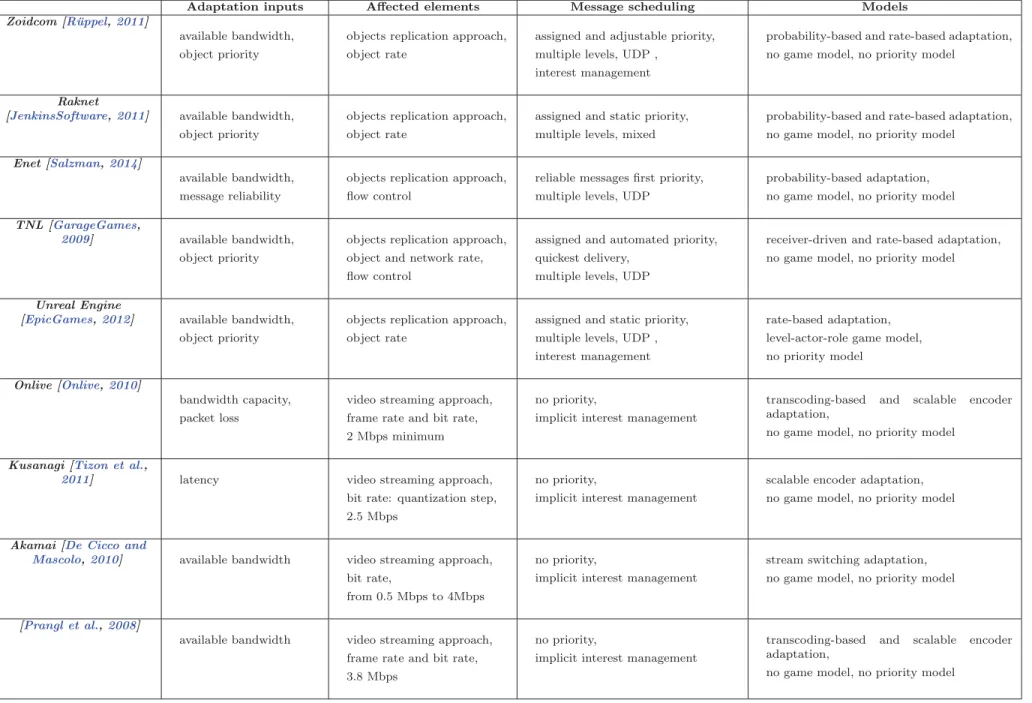
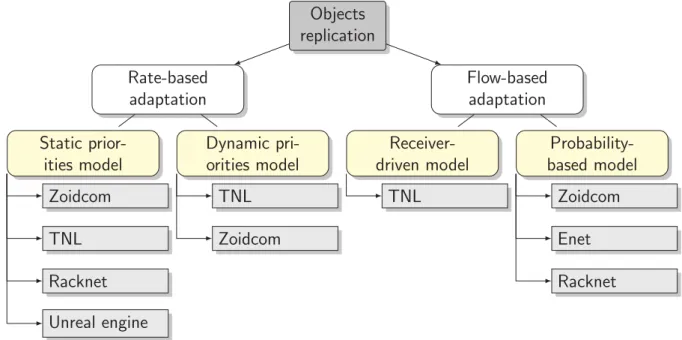
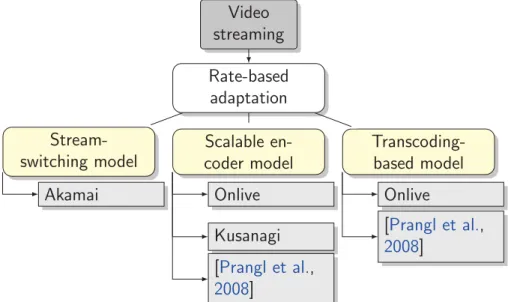
3.3 Related work . . . 36
3.4 Discussion . . . 46
3.5 Conclusion. . . 49
4 Framework Overview and Background 51 4.1 Framework overview . . . 52
4.2 Level of Detail. . . 56 iii
iv CONTENTS
4.3 Agents and organization . . . 58
4.4 Gameplay components . . . 62
4.5 Conclusion. . . 65
5 Communication Adaptation Process 67 5.1 Adapting game communications . . . 68
5.1.1 The network based LoD approach . . . 68
5.1.2 QoE utility . . . 71
5.1.3 Theoretical properties . . . 72
5.2 Organizational level of detail . . . 75
5.2.1 The organization model . . . 75
5.2.2 LoD and organization . . . 76
5.2.3 Example . . . 77
5.3 GC based level of detail . . . 80
5.3.1 Initial importance distribution . . . 81
5.3.2 Updating importance . . . 83 5.3.3 LoD and GCs . . . 88 5.3.4 Example . . . 90 5.4 Conclusion. . . 96 6 Experimental Evaluation 97 6.1 Prototype . . . 98
6.1.1 Overall game architecture . . . 98
6.1.2 Game model . . . 99
6.1.3 ”My Duck Hunt” game . . . 102
6.1.4 ”Crazy runner” game . . . 104
6.1.5 Game communications adaptation. . . 105
6.2 Experimentation . . . 107
6.2.1 Organization based adaptation . . . 108
6.2.2 Gameplay components based adaptation . . . 112
6.2.3 Overall discussion . . . 120 6.3 Conclusion. . . 120 7 Conclusion 123 7.1 Contributions . . . 124 7.2 Results . . . 125 7.3 Future works . . . 126 A List of publications 129 Bibliography 131 List of Figures 141 List of Tables 142
Remerciements
Une th`ese est une route que l’on ne parcours pas seul. Pour cela avant de vous pr´esenter mon travail, je tiens `a remercier tous ceux qui m’ont aid´e `a la r´ealisation de ce travail.Mes premiers remerciements vont `a mes directeurs de th`ese, le Professeur Stefano A. Cerri et le Docteur Abdelkader GOUA¨ICH, pour leurs conseils et encouragements exprim´es tout le long de mon parcours de th`ese.
Je tiens ´egalement `a remercier tous les membres de l’´equipe SMILE du LIRMM, pour leur amiti´e, leur soutien, leur accueil dans le groupe et les collaborations scientifiques.
Je ne saurais terminer sans remercier le seigneur mon Dieu sans qui rien de ceci ne serait possible, les membres de ma grande famille au Cameroun pour leurs encourage-ments, leurs pri`eres et leur pr´esence malgr´e la distance.
C
h
a
p
t
e
r
1
Introduction
Contents
1.1 Cloud computing and video games . . . 5
1.2 Cloud gaming advantages . . . 6
1.3 Cloud gaming limitations . . . 8
1.3.1 Quality of experience (QoE) . . . 8
1.3.2 Data security . . . 9
1.4 Problem statement. . . 10
1.5 Contributions . . . 11
1.6 Structure of the thesis . . . 12
Cloud computing sector has received considerable attention from global and local In-formation Technology (IT) stakeholders, national governments, and international agen-cies. For example, IBM1 has established cloud computing centres in China, India,
Viet-nam, Brazil, and South Korea. Other global IT majors such as Microsoft2, VMware3,
Salesforce4, Dell5, and Parallels6 are actively searching for opportunities around the
world. 1. http://www.ibm.com/cloud-computing/ 2. http://www.microsoft.com/enterprise/microsoftcloud/ 3. http://www.vmware.com/cloud-computing/ 4. https://www.salesforce.com/ 5. http://www.dell.com/learn/us/en/555/dell-cloud-computing 6. http://sp.parallels.com 3
4 CHAPTER 1. INTRODUCTION Many definitions of cloud computing exist and there seems to be no consensus on what a cloud is. But, generally speaking, cloud computing could be understood as a hardware and software infrastructure able to provide services at any traditional IT layer : software, platform, and infrastructure, with minimal deployment time and reduced costs. The National Institute of Standard and Technology defines cloud computing as ”a model for enabling ubiquitous, convenient, on-demand network access to a shared pool of configurable computing resources (e.g., networks, servers, storage, applications, and services) that can be rapidly provisioned and released with minimal management effort or service provider interaction” [Mell and Grance,2011]. In software provisioning for exam-ple, a high-performance web application can be easily deployed in a remotely virtualized server running on a distributed hardware infrastructure. Charges are considered only for resources actually used, while sharing the cloud infrastructure with other users.
It is difficult to talk about cloud computing without referring to the grid computing paradigm because of their similarities and the fact that cloud computing originates from grid computing. As a matter of fact, cloud computing can conceptually be viewed as a kind of grid computing with respect to the definition of grid computing. Grid computing pioneers Ian Foster and Carl Kesselman, define a grid as ”a system that coordinates distributed resources using standard, open, general-purpose protocols and interfaces to deliver nontrivial qualities of service” [Foster and Kesselman,1999]. This definition shows the similitude between grid and cloud computing in terms of hardware and software infrastructure providing an inexpensive access to high-end computing resources for better quality of service. Giving a detailed comparison of these notions is out of the scope of this thesis but for further information about their similarities, refer to [Foster et al.,2008].
Video games increasingly gain attention from the entertainment industry and scien-tific community. Beginning with basic games, they quickly evolved into rich, interactive, animated and intricate virtual environments approaching movies in terms of visual ex-citement. This popularity, led the adoption of video games in other training/teaching disciplines and gave birth to what is now called serious games. Serious games refer to using video games for serious purposes. They enable video games to become more than just entertainment tools, but real assets to help increase the effectiveness of training and teaching. Moving these game applications to the cloud will increase their accessibility and therefore their popularity. This is referred to as cloud gaming. In fact, cloud gaming is a type of online gaming that allows direct and on-demand streaming of games onto a receiving device.
This chapter introduces the context of this research which is building video games with cloud gaming paradigm. More precisely this thesis is about delivering player’s quality of experience (QoE) by putting in place an intelligent client-server communications in cloud gaming platforms. The end result is an adaptive communications scheme that deals with network constraints while maintaining an acceptable user experience.
After exposing the motivations behind the use of cloud computing for video games, we analyse and discuss the state of art of cloud gaming systems; the research question is then stated and followed by an overall presentation of our proposition and contributions.
1.1. CLOUD COMPUTING AND VIDEO GAMES 5
1.1
Cloud computing and video games
The potential of cloud computing is vast, and current cloud computing application sectors include academics, health-care, business and entertainment.
Why cloud computing
Depending on the sector, cloud computing adoption is motivated by many factors. Here are some examples of institutions that embraced cloud computing:
— In scientific research, for some universities, high-end computing power avail-ability through cloud computing for research purposes is welcomed. For instance, researchers at the Medical College of Wisconsin Biotechnology and Bioengineer-ing Center in Milwaukee are makBioengineer-ing protein research more affordable to scientists worldwide [Susa,2009]. They do this by renting processing time on Google’s power-ful cloud-based servers. Since with cloud computing there is neither maintenance, nor setup overhead, researchers are able to reduce the cost of their studies and analyze their data in greater depth than it was previously attainable.
— In healthcare, as a good example of cloud computing utility, Max Healthcare, a large hospital chain in India, moved its Health Information System (HIS) to a private cloud-computing system provisioned by Dell. This makes it easier for Max Healthcare to treat and follow up with patients from any of its locations across the country. As Max Healthcare adds more hospitals to their network, the cloud deployment gives a near plug-and-play capability for information technology deployment [Groen, 2012].
In May 2009, Guang Dong Hospital of Traditional Chinese Medicine has imple-mented a suite of healthcare data-sharing and analytics technologies, known as Clinical and Health Record Analytics and Sharing (CHAS). Hospitals use CHAS to share electronic medical records (EMRs), incorporating this data across the hospital network [Kshetri, 2010].
Cloud computing adoption for health purpose have also generated a lot of interest in the research community in the past few years. For instance [Doukas et al., 2010] and [Rolim et al., 2010] , propose a telemedecine service that automates patient’s information workflow from data collection to information processing and delivery in healthcare institutions using cloud computing.
— In business and entertainment, just like in education and healthcare, infor-mation technologies implementation in business organizations is a high resource-consuming process. Using cloud computing in business has been an effective way to deal with this issue. In media and entertainment industry, using cloud computing, media companies are able to develop new and better ways to quickly and efficiently deliver content to fine-grained targeted consumers while potentially reducing costs. Companies such as Amazon, Apple, Google and Netflix are big players for deliver-ing entertainment via the cloud. Some of the most used cloud applications nowa-days include Google apps, Youtube, Instagram, Spotify, Netflix, Facebook, Twitter, LinkedIn.
To summarize, it is clear that cloud computing can be beneficial for many industries. Among others, the entertainment industry is particularly well suited for cloud comput-ing. In fact, cloud gaming operators exploit cloud computing accessibility and ubiquity
6 CHAPTER 1. INTRODUCTION features to deliver game content around the globe. Cloud gaming enables video games to be played with various types of client devices and to be accessed as easily as movies and music through the Internet.
Cloud gaming
Cloud gaming, also referred to as on-demand gaming [Nvidia,2014], is a type of online gaming that is similar to video on demand. It allows a direct and on-demand streaming of video games using ”thin” clients. In the architecture point of view, cloud gaming is a client-server system, where the actual game is stored and run on operator’s data center (server) and graphics or game states are directly streamed to client devices. Clients game states are therefore synchronized with the server, in order to replicate the game as it is executed on the server. Massive computation and storage resources of data centres enable users to shift their workload to remote servers. Consequently, with the supply from remote servers, thin clients can be more convenient and also more powerful, than traditional thick clients without the server’s supply.
Cloud gaming nowadays is a reality and companies such as Onlive7, G-Cluster8,
StreamMyGame9, Gaikai10and T5-Labs11are already offering commercial cloud gaming
services.
This new sector is also seen as a serious competitor for traditional game market. This has prompted video game majors such as Sega, Ubisoft, Epic Games, Atari, Warner Bros, Disney Interactive studio to establish partnerships with Onlive to distribute their games [Onlive, 2014].
1.2
Cloud gaming advantages
Besides computing power and storage volume, five main reasons can motivate usage of cloud gaming:
— Flexibility: cloud gaming takes advantage of cloud computing flexibility to adjust resources allocation based on dynamic demands, in a manner which is transparent to players.
— Ubiquity: games are available at anytime from almost any device including thin clients such as smart phones and tablets. With broadband internet connections, it is even possible to access games from literally everywhere in the world.
— Cost : for game studios, cloud computing offers a cost and energy efficient cen-tralization of gaming infrastructures. In fact, game studios are able to reduce their operating cost by delegating the responsibility of operating and maintaining game infrastructures to cloud gaming providers. For players, having to buy an expensive PC or console to play good quality video games is no longer a necessity. Cheap thin clients such as smartphones and tablets are already very popular, and can be used to access these same games via cloud gaming.
7. http://www.onlive.com/ 8. http://www.g-cluster.com/ 9. http://streammygame.com/ 10. https://www.gaikai.com/ 11. http://www.t5labs.com/
1.2. CLOUD GAMING ADVANTAGES 7
— Security compliance and privacy: player’s game data (sensitive of not) are collected in a single point of control. This centralized approach reduces hacking and ”cheating” possibilities since only the server holds the game logic. Players are able to access these data from everywhere and at any time. In health oriented serious games for instance, patient’s clinical information and training curves are strictly confidential, that is the reason why it is paramount to centralize these data and host them on certified operator’s premises.
— Set up overheads and compatibility issues: trying new games sometimes requires to install new softwares and deal with hardware incompatibility between the game and player’s device. This can be a time consuming and dissuasive task that can even prevent players from purchasing new games.
This problem is also present in most institutions adopting video games as a peda-gogical tool in a large scale. For instance, we encountered this problem in MoJOS project. MoJOS was a serious gaming project, started in 2009, with the objective of creating a health-oriented game engine, with a focus on arm rehabilitation after a stroke [MojOS, 2009]. During the course of this project, we deployed several re-habilitation games in hospitals such as the hospital Lapeyronie in Montpellier and the hospital of Grau du roi. The installation and the configuration of the whole serious gaming system was a very time consuming task. Some therapists were even reluctant to use this technology because of this setup overhead and the time it took to start a training session. In addition, most healthcare institutions do not have the finances to hire new personnel dedicated to setting up these games for patients. With cloud gaming, video games are hosted and upgraded at the server level, rather than on each individual client device. There is no need to constantly upgrade clients computers and no compatibility issues when trying new games.
— A new economic model: with cloud gaming, video games are available online on subscription. Players can start playing games right after the subscription, without having to wait for games to be shipped or go to a physical store to purchase games. Some of these features are exhibited in the onlive cloud gaming solution as shown in figure 1.1.
8 CHAPTER 1. INTRODUCTION
1.3
Cloud gaming limitations
As promising as it is, cloud gaming is also facing many challenges that, if not well re-solved, may prevent its adoption. The most important are related to quality of experience perceived by players and data security.
1.3.1
Quality of experience (QoE)
In various formal and informal definitions, player experience has been framed as a ”subjective measure of the degree to which a system meets the target user’s tacit and explicit expectations for experience” [Beauregard and Corriveau, 2007]. In video games, player experience is a broad concept that determines player’s overall perception of a game. It includes many subjective factors influencing the degree of satisfaction of the player with a game. Some of these factors are: his/her feelings, his/her understanding of the game rules, difficulty of the game, interactions, aesthetics, storytelling etc.
Quality of experience, can be considered as the objective component of player ex-perience. It represents measurable technical aspects of game quality and has a direct relationship with the traditional Quality of Service (QoS). In fact, in video games, it is proven that QoS metrics such as video frame rate and response time have a direct influ-ence on player’s perceived QoE [Wu et al.,2009]. Moreover factors such as the amount of game entities in the virtual world and the resulting processing load have also been corre-lated to the user QoE [Miller et al., 2014] . These QoS metrics are easy to measure and have consistent thresholds beyond which player’s QoE is degraded [Miller et al., 2014].
In centralized networked games, as far as objective game quality is concerned, system response time plays a significant role. It can be defined by the time needed to detect a user-initiated input event, to send it to the server, to process it, to send the updated game state to the client and to render the updated game state on the output device. This definition shows that, along side with processing power, available bandwidth for inputs and updates transmission can have a considerable impact on response time therefore on player’s QoE.
As a matter of fact, there is a strong correlation between network conditions, game’s responsiveness and video quality. Low bandwidth capacity and a drastic presence of limiting network factors such as delay, jitter or packet loss, can cause important lag in the player-game interaction and eventually decrease the smoothness of the game video. That is one of the reasons why, depending on requested video quality, cloud gaming providers always set a minimum bandwidth requirement to play a game. For instance, Onlive [Onlive,2010] requires a minimum bandwidth of 2 Mbps for all their games, which are delivered only in HDTV 720p format. Unlike Onlive, StreamMyGame supports game streaming in a variety of resolutions, from 240p to 1080p, requiring an Internet connection between 256 Kbps(240p) and 30 Mbps(1080p).
We can see with these examples that, cloud gaming services have very strong require-ments in terms of network resources. In fact in order to ensure the delivery of QoS for bulk data transfer generated by cloud games, a certain amount of network resources should be available on the receiving end.
The bandwidth related issues of cloud gaming can therefore be summarized as follows: — Thin clients with low bandwidth capabilities as well as people located in areas with limited network resources, can not take full advantage of cloud gaming at its current state. Another example is people subscribed to a 3G/4G networks with limited data
1.3. CLOUD GAMING LIMITATIONS 9
connection per month can not afford playing games with bulk data transmissions. An interesting alternative will be, letting clients with low bandwidth access these games, and even better, allowing clients with different network capabilities to play the same game with approximately the same QoE.
— In current cloud gaming systems, a client with unstable network resources, will see its game session stopped if its network throughput drastically dropped bellow the required minimum. These network conditions fluctuations can happen in case of congested network due to the presence of concurrent network traffic for example. Cloud gaming platforms therefore need to take into account network conditions changes, while minimizing game disruption which is very detrimental to player experience.
The objective of this thesis is then to make it possible for devices with low and/or unstable network capabilities, to run cloud games with an acceptable QoE.
1.3.2
Data security
The recurrent dilemma presented by cloud computing for security professionals is to be able to embrace its benefits while maintaining security controls over sensitive data and assets. According to Vormetric [Vormetric, 2012], some of the most important data security challenges of cloud include:
— There is a crucial need to protect confidential data. These sensitive data are gen-erally protected by the law. Therefore cloud providers have to put in place the adequate security ( confidentiality, integrity, availability) policy in order to ensure that sensitive data are kept safe. In practice, a cloud provider may have control and visibility into your data, and this constitutes a violation of the law on personal data. This is the main reason why, most healthcare institutions hesitate when it comes to moving their systems in the cloud.
— In order to reduce costs, most cloud service providers share physical resources and services between multiple consumers and client organizations (tenants). In this scenario, a tenant can deliberately or inadvertently interfere with the security of the other tenants. To prevent this to happen, there is a necessity to apply a logical segregation and other controls between tenants.
— Data mobility worldwide is regulated by the law. There are often legal issues be-tween cloud service providers and governments, relative to government rules such as the EU Data Privacy Directives and the CNIL in France, with regards to sen-sitive data. Cloud providers must have the required certifications and respect the regulation in place, in order to store or process sensitive data.
— Lack of standards about how cloud service providers securely recycle disk space and erase existing data. Meaning that your data may still be accessible even after ”deletion” from operator’s data base.
All these challenges make it difficult for cloud service providers to deliver their services with adequate level of security. All over the world, there are regulations over sensitive data like medical data to make the service providers (hosting or processing these data) accountable for any security flaw. In this thesis, we will not focus on security concerns, but it is worth noting that any public cloud gaming service needs to follow the guidelines of the regulations in place concerning sensitive data. This includes meeting the security challenges caused by the cloud. These challenges are even more present in serious gaming.
10 CHAPTER 1. INTRODUCTION
1.4
Problem statement
Our study focuses on the interaction between video games and cloud platform, more precisely on the efficiency of the game data synchronization mechanism between client and server for QoE support. Even though the motivations for this thesis was in serious gaming, our approach and contributions have to be generic enough to be applied to all game categories. We aim at building a distributed game engine for cloud games, and application programming interfaces (APIs) with pre-defined network-based functions that enable an efficient execution of video games in the cloud.
In cloud gaming, bandwidth issues represent an important challenge as explained in section1.3.1. Hence in the context of health oriented serious games for example, facilities with lossy and/or unstable network access, will not be able to train their patients via these traditional cloud gaming services. This is the reason why, in order to preserve game accessibility and ubiquity, we need to: (i) weaken these network constraints; (ii) minimize the effects of network conditions fluctuations on player’s QoE; (iii) ensure the transmission of the game content.
Thus the general question guiding this thesis is:
✎
✍
☞
✌
– How to build cloud games that are accessible on devices with limited and/or unstable network resources, while maintaining an acceptable player’s QoE?
In order to respond to this question, we have identified the following research chal-lenges: (i) a game model aware of game’s communications needs; (ii) game’s communi-cations adaptation to network conditions.
Game model
In fact, in order to be able to decrease game’s network resources constraints and respond to network fluctuations, game systems have to be able to control the amount of network communications generated by games.
We consider a game as a collection of scenes populated with game objects. These objects represent physical game entities that players see on the screen. They are the only game elements that are synchronized between client and server, as they are sufficient to reproduce game scenes in a client-server game architecture. The first step in attempting to control game’s network communications is therefore to find a model representing the game communications profile in terms of game objects and network resources. Actu-ally, game objects can have different importance in game scene, therefore they may be subjected to different network requirements vis-a-vis state updates transmission. Thus the communications adaptation process needs to know this abstract representation of the game in order to deliver appropriate QoS to each game object.
Communications adaptation
In shared networks, individual throughput of each user can change at any moment. In addition, the ”best-effort” nature of Internet, makes it prone to delay, latency and jitter. Each of these network factors can contribute to response time’s prolongation. In online games, a prolonged response time creates lags in player’s interaction with the game and
1.5. CONTRIBUTIONS 11
consequently results to a bad player’s QoE. As a matter of fact, network delay, a cause of lag in player-game interaction is considered as ”fun killer” in online games in general. We therefore need a system capable of: (i) fostering player experience by controlling game’s communications in low bandwidth networks in order to provide QoE support against lag in cloud games; (ii) adapting game’s communications to current network conditions in unstable network setups.
1.5
Contributions
The contributions of this thesis are summarized as follow:
Game models
During the course of this thesis, we presented two adaptive game models enabling us to express different sensitivity to network lag, thus different communications needs among game objects, depending on their importance in the game scene. These models are then used to adjust objects’ importance as the game evolves. They are based on principles of agents organizations and gameplay components.
With agent organization, the focus is made on objects’ functional role in the game scene. Then a mapping is made between roles and importance values. In that way, a change in object’s role changes the object’s importance. Our organizational model clusters game objects with the same role in groups and the network resources attributed to game objects are proportional to their role in the game organization.
With gameplay components (introduced in [Francillette et al., 2012]), complex game mechanics are decomposed in simple components also known as OCR loops. These loops are then combined hierarchically to form a gameplay components tree representing the game. Each node of the tree is assigned an importance value that changes as the tree evolves (nodes are added or removed) and each game object is associated with a node. Each time a gameplay component is added or removed from the tree, and even when it simply ends, the importance values of the rest of the tree are recalculated. This enables nodes’ importance values to adapt to the changes in the game tree.
Adapting communications for cloud games
The main contribution of this thesis consists of a game’s communications adaptation to maintain player’s QoE, inspired by level of detail principles [Wissner et al.,2010]. The idea is to monitor current network conditions, and changes in game objects’ importance in the game scene, and use our adaptation model to adjust game’s communications accordingly. The game models presented above are used to manage changes in objects’ importance.
This communications adjustment is performed in two steps: the first step is reorga-nizing the game model, in case of changes in game objects’ importance; and the second is selecting appropriate communications levels for game objects. A communications level identifies the amount of network resources attributed to the game objects (determined by synchronization rate). This adaptation can affect game communications in two ways: (i) it decreases game communications when network conditions are low, by replacing objects’ current communications levels by levels with lower synchronization rate; (ii) it increases game communications in case of favorable network conditions. This bidirec-tional adaptation approach results in the maintenance of an acceptable QoE in case of
12 CHAPTER 1. INTRODUCTION network resources shortage and the improvement of the QoE in case of better network throughput.
We validate our approach using prototype games in a controlled environment and assess user’s QoE in pilot experiments. Results show that the proposed adaptation framework provides a significant QoE enhancements, compared to a solution without adaptation.
1.6
Structure of the thesis
The rest of the document is organized as follows:
— Chapter 2 presents the backgrounds of the thesis by emphasizing on main concepts such as video games, cloud gaming, quality of experience and game adaptation. — Chapter 3 presents the state of the art in cloud gaming and the attempts to maintain
acceptable player’s QoE in constrained networks by adapting game communications to the network conditions. This study enables us to point out the weaknesses of the existing approaches and therefore support the need to propose a new one.
— Chapter 4 introduces the general framework used for adaptation, as well as the core concepts on top of which our adaptation framework is built. This includes level of detail in 3D graphics, agents organization and gameplay components.
— Chapter 5 presents our game’s communications adaptation approach, inspired by the level of detail technique. Current network conditions and game objects’ impor-tance are used as inputs for adaptation.
— Chapter 6 presents prototype implementations and experimental evaluations of our proposition. We describe the pilot experiments carried out and show the results. We conclude the chapter with a general discussion on the QoE enhancement provided by our approach on lossy and congested networks.
— Chapter 7 draws the conclusions about the proposed approach and discusses some future directions.
C
h
a
p
t
e
r
2
Background
Contents
2.1 Video games . . . 142.2 Online video games . . . 16
2.3 Cloud gaming . . . 18
2.3.1 The video streaming approach . . . 20
2.3.2 The game objects replication approach . . . 21
2.4 Quality of experience . . . 22
2.4.1 Lag in online games. . . 23
2.4.2 Causes of lags . . . 24
2.4.3 Attempts to fix the lag . . . 26
2.5 Adaptation . . . 29
2.5.1 Adaptation in video games . . . 29
2.5.2 Communications adaptation . . . 30
2.6 Conclusion . . . 31
This chapter presents the background of our work. First, we discuss in section2.1and
2.2, the definitions of video games and present core concepts such as online games and update/render game loop. Section 2.3 presents cloud gaming technologies such as video streaming and game objects replication. Section 2.4 introduces the concept of quality of experience (QoE) in games and discusses lag and its effects in online games. Finally, adaptation is introduced in section 2.5.
14 CHAPTER 2. BACKGROUND
2.1
Video games
Different definitions of game can be found in literature. These definitions attempt to capture different principal aspects of games: some focus purely on game as an activity with characteristics such as uncertainty and unproductivity, others focus on rules governing the game, and while others emphasize on game outcomes.
One commonly cited definition in this domain, is given by R. Caillois in 1961 [Caillois,
1961]. R. Caillois identifies a game as an activity and emphasizes the voluntary and un-productive aspects of game as well as game rules. He defines a game as ”an activity which is essentially: free (voluntary), separate (in time and space), uncertain, unproductive, governed by rules, make-believe”.
Katie Salen and Eric Zimmerman consider a game as ”a system in which players engage in an artificial conflict, defined by rules, that results in a quantifiable outcome” [Salen and Zimmerman, 2003]
According to these definitions, a game can be viewed as a regulated activity with an entertaining purpose in which players can act. Objectives in games are expressed as a formal system of quantifiable goals.
Juul Jesper in 2003 emphasizes the player-game interaction, and puts players’ actions and feelings as part of the outcome equation [Juul,2003]. He describes a game as ”a rule-based formal system with a variable and quantifiable outcome, where different outcomes are assigned different values, the player exerts effort in order to influence the outcome, the player feels attached to the outcome, and the consequences of the activity are optional and negotiable.”
Games require also a set of artefacts, known as game media, to be played (e.g. minia-tures, a ball, cards, a board and pieces, or a computer). However, the given definitions above emphasise on the separation between the game as an abstract structure of actions and as an artefact.
As a matter of fact, there is no single game medium, but rather a number of different game media to play the same game. Furthermore, we know that many games actually move between media. For example card games are played using playing cards or on computers. The computer just happens to be one of the various existing game media.
This leads us to the definition of a video game which is simply a game that uses a computer as medium [Hawes,2004]. This definition of video game as computer-controlled game is also shared by Zyda [Zyda,2005]: ”A video game is a mental context, played with a computer in accordance with specific rules that uses entertainment”.
So before presenting video game’s concepts such as the update/render game loop, we should first describe the structure of a game independently from the technologies.
Game structure
A game, as any system, has a specific structure with well defined components. Game engineering process starts by identifying and specifying these components explicitly to produce a game design document.
The most important components of a game structure can be summarized as follow: — Action: Players interact with game environment using a finite set of actions. In
video games for example, player’s actions are gathered through a controller device such as a keyboard, a mouse or a console controller, connected to the game platform.
2.1. VIDEO GAMES 15
These low level inputs are translated to high level actions and interpreted to change the game state according to dynamics rules.
— State: Every game has an explicit state represented with a specific formalism. A state fully describes the game process at any time. In the game of chess for example, game state is represented by squares on the chessboard and their contents. Actions therefore allow players to navigate through the space of possible states. This navigation is constrained by game’s rules.
— Rules: Rules in games are constitutive rules [Chauvier, 2007]: they regulate and identify the game. Rules generally determine turn order, rights and responsibilities of players, goals, rewards and penalties as well as game’s dynamics. Any alteration of game’s rules changes the identity of the game. For instance, baseball can be played with ”real” baseballs or with wiffleballs. So changing an element of the game medium does not necessarily change the game. However, if players decide to play with only three bases, they are arguably playing a different game.
— Goals: Goal characterizes particular states of the game where players are rewarded (success state) or punished (failure state). Players have to mobilize all means al-lowed to achieve game goals by reaching success state while avoiding failure states. Goals have to be achievable; as soon as they become unattainable with certainty, the game ends. The journey towards the achievement of a goal is usually referred to as a quest. A game can have multiple quests with different goals.
— Challenge: Challenge represents a set of factors that can delay the player in her/his quest and can ultimately contribute to his failure. Among these factors we can name:
1. player’s skills and aptitudes,
2. other players or game entities which goals conflict with the player’s goals, 3. unpredictability, the dynamic and the non-deterministic nature of the game.
Game update/render loop
In a game engine, game loop can be considered as a repeating chain of events that creates the game dynamics. The first step of a game loop is to update the game’s state according to players’ inputs; this is followed by rendering a view of the game’s state. This entire cycle of update and rendering is repeated a number of times per second. The number of updates per second defines the update speed while the number of rendering per second defines the FPS (frame per second).
A generic game loop is presented in figure 2.1. The game starts with an initialization stage to create initial objects and load necessary assets. Once the initialization stage is completed, the game loop is repeated until the player quits the game. When a terminal state is reached, the end stage is executed to free used resources and quit the game environment properly.
A detailed description of each stage is given by [Whitaker,2014]:
— Initialization stage: It is the entry point of the game, where all required pre-game setups need to be performed. This may includes loading content, preparing input devices, and initializing game state. This stage is only executed once.
— Update stage: The update stage calculates the game’s state at the current time. The common tasks done in this stage are: (i) gathering of player’s actions through
16 CHAPTER 2. BACKGROUND initialization Update get player’s input update game model Rendering update rate render the model end Figure 2.1 – Game loop.
inputs devices; (ii) updating object’s state within the game; (iii) executing game logic and running the scripts controlling the behaviors of the Non Player Characters (NPCs)(in the video games jargon, this is referred to as AI). The running frequency of the update stage is generally referred to as the update rate, which is usually around 20 times per second.
— Rendering stage: The rendering stage draws a snapshot of the entire game model and renders it on a video output. The rendering frequency is defined as Frame Per Second (FPS). A common concern around rendering is the ability to anticipate this frequency so that, the game does not appear choppy and its smoothness is maintained. 20 FPS is usually the minimum, and it relates to the eye perception frequency limit.
— End stage: The end stage cleans up everything that is no longer needed. This usually corresponds to disposing art assets (image, font, etc.) that were loaded by the graphical processing unit (GPU). After the cleaning up, the game exits. This stage is also executed once.
2.2
Online video games
Also known as networked games, online video games are video games played through a network. Online gaming supports gaming over different kinds of networks (e.g: Local Area Networks (LANs), Internet), and enables players to connect to multiplayer games as well as monoplayer games.
of-2.2. ONLINE VIDEO GAMES 17
ten follow two synchronization patterns: asynchronous gameplay and synchronous game-play. From these patterns result different network resources requirements.
In an asynchronous gameplay, players are not required to be online simultaneously. In fact, their actions can be performed asynchronously at different times. Still, game state is updated coherently and rules ensure that the rate of actions per player is fairly balanced. Most online social games are asynchronous games where the player can interact with a virtual environment without necessarily having other players connected and interacting at the same time. FarmVille1 is an example of such a model.
Unlike asynchronous gameplay, synchronous gameplay enables multiple players to be online and to interact with the game world simultaneously. Synchronous multiplayer games are the most greedy in processing and network resources, thus they are more likely to be impacted by low and unstable network conditions. Because of these considerations, online games with synchronous gameplay are the one that will benefit the most from an efficient resources distribution for better performance.
Depending on the game and the level of control given to the players, different categories of architectures are often utilized to build online games. client-server is the most common. Here a server is responsible of running game logics and communicating updates to clients. A client sends inputs to the server, receives game state updates from the server and updates the game accordingly. This configuration can involve multiple clients connecting to a single, central server which is required to have an important processing speed and a high bandwidth capacity to process all clients’ inputs.
In an online game with the client-server architecture, several configurations are possi-ble here. The server can be either a broadcast server (simply broadcasts players’ actions from one client to others) or a centralized server( receiving players’ actions and running the game logic). The inconvenient of the broadcast server is that, it offers ”cheating” opportunities. In fact, with a broadcast server, a client runs and controls the game logic locally. The player can therefore modify the game states in a way that gives him/her an advantage over other players. A centralized game logic, where only the server knows the actual state of the game, is a solution to most cheating problems. With this setup, the client and the server have a representation of the game model. The client side periodically synchronizes its local game model with the server side remote game model which is the central one. This is done by receiving update messages about state changes in the central game model.
As illustrated in figure 2.2, differences between single-system game loop of figure2.1
and this client-server system with centralized game logic are:
1. On the client side: Two more tasks are added to the update stage: (i) client gathers inputs from the controller device, and sends them to the server; (ii) client receives update messages from the server, and then updates its local game model. 2. On the server side: There is no rendering stage. In fact the server only runs the
game logic which receives players’ inputs, updates the central game model accord-ingly and then sends update messages to the client. All the update code (objects’ updates, Non Player Characters (NPCs)’ updates, collision detection, etc.) is exe-cuted here.
If update messages from the server do not arrive at a fast enough rate, game data on the client game model will be outdated and therefore rendering will not reflect the
1. Farmville is a farming social network game developed by zynga, allowing players to cultivate their farms by plowing, planting and harvesting crops and trees. https://zynga.com/games/farmville
18 CHAPTER 2. BACKGROUND initialization Update send player’s input receive updates update game model Rendering render the model end CLIENT initialization Update receive player’s input update game model send updates end SERVER cloud
Figure 2.2 – Client-server game loop
current state of the game as it is on the server. These game loops show the effect that can have network latency and server’s update frequency on the overall end-to-end lag. This can decrease the perceived quality of the game, since updates and inputs have to cross the network.
2.3
Cloud gaming
Cloud gaming can be defined as a client-server gaming paradigm where the game logic is placed on the server’s side and managed as a cloud service. Another strong characteristic of the cloud gaming paradigm is the ability to use low-end or thin devices to play high quality games. Depending on how game’s workload is divided between cloud servers and clients, four main trends can be defined:
1. 3D graphics streaming: In 3D graphics streaming approach [Eisert and Fechteler,
2008], [Jurgelionis et al.,2009], the server executes the game logic, intercepts
graph-ics commands, compresses these commands and streams them to clients. The client renders the game scene by executing the received commands using its own graphics chip. Client’s graphics chip must be not only compatible with streamed graphics commands but also powerful enough to render game scenes in high quality and at real time. Since rendering is done on client devices, this approach is less suitable to
2.3. CLOUD GAMING 19
resource-constrained devices, such as mobile devices and set-top boxes for television sets.
2. Video streaming: In this approach the server renders all graphics, compresses resulting videos and streams them to clients [Holthe et al., 2009; De Winter et al.,
2006]. Clients only decode and display the video stream. This approach relieves clients from computationally intensive graphics rendering and is ideal for thin clients on resource-constrained devices. Computational load is now paid with network load since transmitting videos is more expensive than transmitting just graphic commands.
3. File streaming: File streaming approach [cloudtweaks,2013] makes it possible to download game content in form of fragments. The actual game is executed on user’s game device. A small part of the game, usually less than 5% of the total game size, is downloaded initially so that players can start playing quickly. The rest of the game content is downloaded while playing. File streaming uses advanced methods of progressive downloading, data compression and prediction algorithms to provide steady motions and smooth visuals.
File streaming has low bandwidth requirement to operate and is less sensitive to problems associated with video streaming such as lag and the need of high network resources. File streaming solutions for cloud gaming such as Kalydo2 enable to
cache the downloaded content on user’s device, so that no download will be needed the next time the user plays the game.
4. Objects replication: With game objects replication or state streaming approach [Ferretti et al., 2007], the game is executed on the server. Game objects (game model) states are collected and streamed to clients. Clients update their local game model and render the resulting game scene using their graphics chip. This approach shares advantages and disadvantages of the 3D graphic streaming approach since clients are responsible for graphic rendering. Game objects replication is mostly used on Massively Multiplayer Online Games (MMOGs) [Cronin et al.,2002], [ Fer-retti and Roccetti,2005] systems to diminish the delivery time of game events, while maintaining full consistency of game state.
These approaches have advantages and disadvantages, but depending on the context of the game and the resources of the user device, one of them can be preferred to another. 3D graphics streaming and video streaming follow the same principles. However, gain obtained by the 3D graphics streaming in network resources is compensated by GPU resources since rendering is done on client device.
File streaming is a good solution for users with lower bandwidth devices. But with the use of prediction algorithms, and client-side rendering, it results into a heavy client (CPU and GPU) running the game which is not ideal for resource-constrained devices. ”Cheating” can also be an issue with file streaming, since for the next time the game is played, no download is made and all game logic is executed on client device.
In this thesis we are only going to focus on video streaming and objects replication approaches. Many reasons motivate this choice: their wide spread adoption in the cloud gaming industry; they do not imply cheating and they keep their clients thin by offloading all computations to the server. These approaches are presented in more details in following sections.
20 CHAPTER 2. BACKGROUND
2.3.1
The video streaming approach
Most of industrial cloud gaming systems are based on video streaming [Onlive, 2010],
[G-Cluster, 2012], [StreamMyGame, 2007], [T5-Labs, 2007]. In this configuration, only
the server maintains a representation of the game model. The actual game is stored, executed and rendered on the server. clients simply gather inputs from users and send them to the server. clients receive video streams from the server and display them to their screen. When launched client contacts the server to establish a connection and start the game. As explained in [D. Bari`eeviæ et al., 2011], there are usually two connections for each client: one connection to send the user’s controller inputs to the server and another connection to receive video stream from the server. Figure 2.3 shows this game loop.
initialization Update send player’s input receive the video Video display the video end CLIENT initialization Update receive player’s input update game model Rendering render the model encode the video
send the video
end SERVER
cloud
Figure 2.3 – Cloud game loop: Video streaming
The client game loop runs two main stages: update stage and video stage. On the update stage, the client polls for input events from the user. When an event is received it is written into a packet and sent to the server. The client then receives packets from the server, containing the video stream.
On the video stage, when a complete frame has been decoded, it is displayed in the user’s screen.
2.3. CLOUD GAMING 21
A typical server game loop also runs two main stages. An update stage that receives inputs from the client and passes those inputs to the game model. A rendering stage that captures frames from the game, encodes them into a video, and then stream the video output to the client.
2.3.2
The game objects replication approach
Game objects replication approach uses the same game loop as the client-server archi-tecture presented in figure 2.2. Both client and server have a representation of the game model and synchronization packets are sent repeatedly. The difference between a client-server with the cloud gaming paradigm and a classic client-client-server setup are summarized as follow:
— Client’s update stage: The idea of cloud gaming is to allow thin clients to run complex games by limiting the amount of computation required on client devices. So the client’s update stage should do as less computation as possible before handing the game model for rendering. Therefore, there is no client-side prediction involved here.
— Server’s update frequency: The frequency at which the server sends game up-dates has to be fast enough to be greater than the client’s rendering frame rate. Otherwise the client will notice a lag in the responsiveness of the game, in the motions of game characters and in the smoothness of the game in general.
For example, for a game running at 60 FPS, normal client server games can have the server sending an update every 200 ms (5 Hz without lag problems. This is possible because the client uses techniques such as interpolation, extrapolation and client-side prediction to predict game states. With the cloud gaming paradigm, there is no prediction. The client simply updates the objects’ states with the received packets and proceeds to the rendering stage.
So the server will need to send update at a rate closer to the client’s frame rate(something greater or close to 60 Hz, or one update every 16,66 ms). We can immediately see that the commonly used server update frequency for classic client-server games (5 Hz) is not appropriate for a lag free game using cloud gam-ing paradigm. A higher frequency and therefore more bandwidth are required on server side for an acceptable QoE.
Both video streaming and objects replication have benefits when it comes to delivering a good game experience in online games:
— With video streaming, games are accessible everywhere on different types of devices. Even devices with low CPU capabilities since clients only plays a video stream. No extra client side processing is required. The inconvenient is network bandwidth needed to receive the video stream.
— With objects replication, games are also accessible from everywhere, but client devices have to be powerful enough to do the processing required to render video displays using their own GPU. The price paid in computational power is rewarded by some gain in bandwidth requirements. In fact replicating game objects on clients requires much less network resources than streaming video frames.
In this thesis we aim at using the object replication approach in the cloud gaming paradigm by assuming no extra client-side processing. This way, clients with low
pro-22 CHAPTER 2. BACKGROUND cessing power can run games using less bandwidth than with traditional video streaming games.
2.4
Quality of experience
User experience is generally referred to when evaluating the quality of the interaction of a user with an interactive system. In fact the ISO definition refers to user experience as the result of user-system interaction that can be influenced by the system, the user and the context of use [ISO, 2010].
Many concepts are used in the game community to refer to player experience. De-velopers often describe a game and gameplay with words such as fun, feeling, scary, atmosphere, feel, immersion, presence, satisfaction, having a good time etc. All these words refer to subjective characteristics and, just like player experience, are not simple components that can mechanically be built into the game.
A commonly cited user experience characterization is the one introduced by Mihaly Csikszentmihaly in 1991: flow zone. Flow zone is a psychological state between anxiety and boredom, where the user experiences a feeling of optimal focus and engagement on an activity with great level on enjoyment [Csikszentmihalyi, 1991]. Some of the major elements of flow are: challenge, direct and immediate feedback, concentration on a task, sense of control, loss of self-consciousness and altered sense of time. Even though flow refers to a subjective psychological state, most of its elements can be objectively evaluated and correlated to perceived quality of experience.
Quality of experience provides an assessment of human expectations, feelings, percep-tions, cognition and satisfaction with respect to a particular product, service or applica-tion [Crespi et al.,2011]. User’s QoE of a service can evoke a wide range of emotions and attitudes. These emotions and perceptions of human experience make it very challenging to measure and analyze QoE factors with precision and accuracy. In general, there is a direct correlation between the user’s QoE and the user’s experience. In video games for example, player’s QoE is often considered as a more objective equivalent of player experience. Many studies have tried to objectively characterize player’s QoE [Chen and El Zarki, 2011], [Verdejo et al., 2010], but the individualistic nature of some aspects of human experience makes a completely objective evaluation approach to QoE nearly un-achievable. This is the reason why most evaluation models of QoE [Chen et al., 2009], [Chang et al., 2010] have resorted to the subjective evaluation methodology called the MOS (Mean Opinion Score) rating test [Rec,1996], using players’ opinion rating to assess players’ QoE.
Properties defining QoE can be multidimensional. For example, QoE for VoIp con-versations includes criteria for sound quality such as voice loudness, noise levels, etc. In online gaming, the main quality of experience properties that are found in the research community [Chen et al.,2009; Ida et al.,2010; Chen and El Zarki, 2011] are:
— interactivity refers to the ability of the game to interact with the player, allowing a two way flow of information between them.
— responsiveness refers to the time taken for the system to respond to an event. This property represents the player’s perception of the game process.
— consistency or fairness refers to the degree of difference in the presentation of the virtual world among all players for a multiplayer game.
2.4. QUALITY OF EXPERIENCE 23
— smoothness refers to how smooth the game visuals are. To what extent motions in the game are smooth and steady. The number of FPS can play an important role in determining the smoothness of a game.
— precision refers to the degree of accuracy required to complete an action success-fully.
Fairness or consistency represents a shared property owned by all players in the game, whereas interactivity, responsiveness, smoothness and precision are personal properties related to each player.
Among those properties, the ones reported most frequently are no doubt interactivity and responsiveness, and both can be heavily influenced by network parameters such as network delay and packet loss. In fact, a lag perceived in the interactivity and the responsiveness of the game as well as the smoothness for an online game can be caused by various sources. The most recurrent of them will be disclosed in next section.
2.4.1
Lag in online games
In networked games, there is a misconception about terms such as delay, latency and lag. In general, ”delays” are due to hold-ups in data being sent (e.g., packet processing, queuing due to network congestion, or retransmission of data due to packet loss). On the other hand, ”latency” basically means ”inherent delay” (e.i., delay caused by underly-ing technology or network beunderly-ing used). It represents physical attributes of the network medium. For example the latency of a Wide Area Network (WAN) is always greater than the latency in a LAN. The overall transmission delay is therefore a combination of the network delay and the underlying network latency.
”Lag” is used to characterize a perceived unexpected delay. For example, player’s input transmission delay can be extended because of built-in latency of the network itself and as a result the player can experience a lag in his/her interaction with the game.
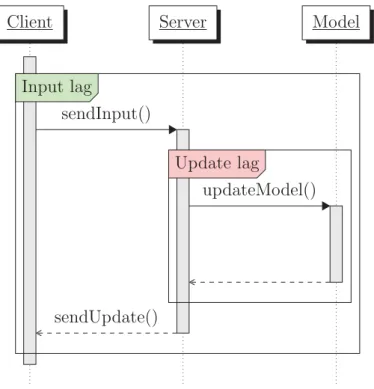
In general, lag is strongly correlated to the time it takes to run the game loop. Two main types of lag are most reported in interactive applications such as games: update lag and input lag.
The main difference between both lags is that, the update lag is not directly related to an action from the player, whereas the input lag is mostly associated with an action performed by the player. This differentiation is supported by Matthias Wloka in virtual reality in general [Wloka, 1995]. He defines input lag as: ”the time between when a user performs an action and when the application displays the result of that action”. Input lag is also known as the end-to-end lag (see figure2.4). It hence influences game’s responsiveness and interactivity, which (as we saw in the previous section) are very important for player’s QoE and enjoyment of the game.
The update lag is more about the delays in the execution of the game logic. It concerns the server’s update phase where actions of game objects are executed and game model is updated. It is also referred to as the spectator lag, and can also be found in simulations, since there is no user-system interaction.
As human beings, we are extremely sensitive to lag. For instance, depending on the task and the surrounding environment, a lag of as little as 100 ms can degrade human performance. In the same token, a lag exceeding 300 ms, causes the human to start to dissociate his/her movements from displayed effects, thus destroying any flow state [Held and Durlach,1991].
24 CHAPTER 2. BACKGROUND
Client Server Model
sendInput() updateModel() Update lag Update lag sendUpdate() Input lag Input lag
Figure 2.4 – Input lag and update lag
The example of figure 2.5 illustrates input lag as it applies to targeting and shooting at another character with an instant-hit weapon in an online game.
Lets imagine a scenario where a player with a weapon is trying to shoot at a game character (Xaero in the figure). At the same time, s(he) is experiencing 200 ms of delay. At this moment of the game, because of lag, the character will be seen at position (1) on player’s screen instead of position (2) where it actually is on the server. If the player presses the attack button, his/her command with the button pressed will reach the server when the character is at position (3). Consequently, the player will miss it. To be able to hit the character, the player will have to target the position (3) even though s(he) is seeing it at the position (3).
With this example, we can see how a lag can affect the real-time nature of a game. The responsiveness of the game is degraded and players with no precise control of the game, will perceive their experiences more negatively.
2.4.2
Causes of lags
To understand the lag experienced by end-users, it is important to determine the response time of network games. The interactive response time is defined as the elapsed time between when an input of the player is captured by the system and when the result of this trigger can be perceived by the player. [Choy et al.,2012] formulated the interactive response time T of a cloud game. This overall delay includes several types of delays: Formulation:
T = Tclient+ Tnetwork+ Tserver
— Tclientis the playout delay, which refers to time spent by the client to send controller inputs, receive game updates and display the resulting scene on the screen. Client’s
2.4. QUALITY OF EXPERIENCE 25
Figure 2.5 – The Effects of lag on targeting [Unlagged,2002]
hardware is responsible of Tclient; it is the notorious ”built-in 50 ms lag”. This delay can be the consequence of bursty graphics ( Central Processing Unit (CPU)/Graphic Processing Unit (GPU) Interaction), bursty application (CPU/Memory), hard-drive accesses, memory management/swapping and background apps/tasks.
— Tnetwork is communications delay referring to the time it takes for data transmission from the client to the server and vice versa. Internet Service Providers (ISP) and data centers of cloud providers are responsible for this delay. Communications delay is affected by poor client bandwidth, long routes (hops), high latency, packet loss, faulty equipment, ISP congestion, backbone congestion and bursty datagrams. — Tserver is the processing delay which refers to time spent by the server to process
incoming information from the client, to update the game model and to transmit the game state back to the client. This delay is affected by a number of compu-tational parameters: input processing (validation of user actions), per-user calcu-lations, output processing (per-object message passing), server network bandwidth and back-end interactions (e.g Database).
[Beverly, 2009] illustrates the distribution of these main causes of lag. According to this study, playout delay, communications delay and processing delay are in average respectively responsible for 35%, 30% and 35% of the overall lag experienced by players. These are average values that change from one game to another. In addition, studies on traditional gaming systems have found that different styles of games tolerate different thresholds for maximum latency before the QoE begins to degrade. [Claypool and Clay-pool, 2006] introduces a novel categorization of the effects of latency on different player actions based on two salient action properties: the precision required to complete the ac-tion and the deadline by which the acac-tion must be completed. Using this categorizaac-tion, M. Claypool et al. classified games into two interaction models:
26 CHAPTER 2. BACKGROUND — The Avatar model, where player controls a single character, and interacts with the game world through that character. Generally, the character exists at a particular location in the virtual world and can only influence its local vicinity. First person shooter (FPS) games, role-playing games (RPGs), action games, sports games and racing games are all examples of game genres that have an Avatar interaction model. These games have actions with higher precision and tight deadlines, making them sensitive to even modest latencies (e.g, first person shooter games, latency around 100 ms).
— The Omnipresent model, where player has the possibility to view and interact with different aspects of the game world simultaneously. The player is said to be om-nipresent controlling the entire set of resources under his/her control. The player’s actions, thus have a more global influence than do actions in an Avatar model. Real-time strategy games (RTS), and construction and simulation games (CMS) are examples of game genres with Omnipresent interaction model. These games have actions with lower precision and loose deadlines. Thus are nearly impervious to typical Internet latencies (e.g, strategy games, latency around 200 ms).
2.4.3
Attempts to fix the lag
Both players and game developers are trying to find solutions for the lag damaging online gaming experience. Figure 2.6 illustrates different attempts to limit delay and its effects on QoE. Client 35% of lag Server 35% of lag Internet 30% of lag What players do — upgrade,
— get faster hardware
— improve your ISP, — get more bandwidth, — lower latency, — use LAN
— find better server, — closer, faster, less
load,
— local hosting
What developers do
— game design,
— network code optimi-sation
— can not fix the Inter-net
— proper infrastructure, — scalable graphics, — low requirements, — network code
optimi-sation
2.4. QUALITY OF EXPERIENCE 27
1. Players: since they can only control their devices and the connection they can have, the two obvious solutions for them are:
— For the playout delay: players can simply upgrade their devices by acquiring faster hardwares (CPU and GPU).
— For the network delay: players can acquire more bandwidth from their ISPs for lower latency or host the server on a LAN for less latency.
— For the server delay: players must find better game servers. These are servers that are faster, have less load and are closer to their locations to minimize the network latency. The servers may simply choose to drop clients with high latencies in order to avoid having to deal with the resulting problems. They can also decide to deploy their server locally on a LAN.
2. Game developers: they have no control over the internet, nor the client hardware, but they have a range of techniques that they use to optimize their games against lag issues. They can use:
— Game design: here two design principles are possible; structure the server system to avoid lag and latency (restrict number of players par game server, use asynchronous gameplay, partitioning/sharding3, use lots of servers) or hide
the latency by using animation and prediction.
— Network code and protocol: the network code can implement some bandwidth conservation techniques and some delay compensation techniques such as dead reckoning. The description of these techniques will be presented in next sec-tion.
— Server infrastructure: choose the ”best” server infrastructure possible to host the game.
— Scalable graphic system with low system requirements: MMOGs such as World of Warcraft tolerate very high latencies (500ms+) and have very low system requirements because of their Last Gen 3D graphics [Dean and Kim,1999].
Networking techniques
To optimize the network traffic, several state of the art techniques have been developed empirically and are implemented in most networking game engines. They can be divided into two groups: bandwidth conservation and delay compensation techniques.
Bandwidth conservation
This category gathers techniques that minimize bandwidth usage and cope gracefully when bandwidth is constrained. Most known techniques are:
1. Encoding and compression: Compression means reducing message’s size by finding a more compact way to represent it. Making messages smaller enables to speed up transmissions by reducing bandwidth requirements [An et al., 2012]. In video streaming for example, the performance of video encoding and compression algorithm is very important in reducing transmission delay. The most used standard
3. The partitioning and sharding techniques exploit the geography of the game world, decomposing the game into different areas, each of which can be mapped to a hosting server.
![Figure 1.1 – Onlive cloud gaming solution [Onlive, 2010]](https://thumb-eu.123doks.com/thumbv2/123doknet/7712295.247483/15.892.133.760.814.1071/figure-onlive-cloud-gaming-solution-onlive.webp)
![Figure 2.5 – The Effects of lag on targeting [Unlagged, 2002]](https://thumb-eu.123doks.com/thumbv2/123doknet/7712295.247483/33.892.175.721.107.514/figure-effects-lag-targeting-unlagged.webp)
![Figure 3.1 – Screenshots of Ethereal: 2D multiplayer shooter game [Mogwai, 2012]](https://thumb-eu.123doks.com/thumbv2/123doknet/7712295.247483/45.892.107.788.106.533/figure-screenshots-ethereal-d-multiplayer-shooter-game-mogwai.webp)
![Figure 3.2 – Screenshots of SilentWings flight simulator gameplay [SilentWings, 2006]](https://thumb-eu.123doks.com/thumbv2/123doknet/7712295.247483/47.892.109.787.256.768/figure-screenshots-silentwings-flight-simulator-gameplay-silentwings.webp)
![Figure 3.3 – Screenshots of Tribes 2 gameplay [Gamespot, 2001]](https://thumb-eu.123doks.com/thumbv2/123doknet/7712295.247483/49.892.107.789.106.619/figure-screenshots-tribes-gameplay-gamespot.webp)
![Figure 3.4 – Screenshots of Unreal gameplay [MobyGames, 1998]](https://thumb-eu.123doks.com/thumbv2/123doknet/7712295.247483/50.892.109.788.107.617/figure-screenshots-unreal-gameplay-mobygames.webp)