HAL Id: hal-00763638
https://hal.archives-ouvertes.fr/hal-00763638
Submitted on 11 Dec 2012
HAL is a multi-disciplinary open access
archive for the deposit and dissemination of
sci-entific research documents, whether they are
pub-L’archive ouverte pluridisciplinaire HAL, est
destinée au dépôt et à la diffusion de documents
scientifiques de niveau recherche, publiés ou non,
R. Lenain, Benoît Thuilot, N. Bouton, P. Martinet. Off-road mobile robot control: An adaptive
approach for accuracy and integrity. 19th CISM-IFToMM Symposium on Robot Design, Dynamics,
and Control, ROMANSY 2012, Jun 2012, Paris, France. p. - p. �hal-00763638�
Off-road mobile robot control:
an adaptive approach for accuracy and
integrity
R. Lenain1 B. Thuilot2 N. Bouton3 and P. Martinet4 1
Irstea, 24 avenue des Landais, Clermont-Ferrand (France)
2
Clermont Universit´e, Universit´e Blaise Pascal, LASMEA, Clermont-Ferrand, (France)
3
Clermont Universit´e, Institut Franais de M´ecanique Avanc´ee, EA 3867 -Institut Pascal UMR 6602, Clermont-Ferrand (France).
4
Institut de Recherche en Communications et en Cybern´etique de Nantes (IRCCyN), CNRS: UMR6597, Universit´e de Nantes ´ecole Centrale de Nantes
Ecole des Mines de Nantes Ecole Polytechnique de l’Universit´e de Nantes AbstractThis paper proposes an algorithm dedicated to the con-trol of off-road mobile robots at high speed. Based on adaptive and predictive principles, it first proposes a control law to preserve a high level of accuracy in the path tracking problem. Next, the dynamic model used for grip condition estimation is considered to address also robot integrity preservation thanks to the velocity lim-itation.
1
Introduction
Mobile robotics, especially in off-road context, appears as a promising an-swer to future needs in various fields of applications [Siegwart and Nour-bakhsh (2004)], such as farming [Eaton et al. (2009)], surveillance [Schafer et al. (2008)], or military activities. In order to be efficient, such automatic devices must be accurate, efficient and robust, despite the harsh condi-tions encountered. If many approaches dedicated to on-road vehicles have been proposed (kinematic [Micaelli and Samson (1993)] or dynamic [Andr´ea-Novel et al. (1995)] model based), they are not suitable to address off-road path tracking at high speed. Indeed, they either do not describe encoun-tered dynamic phenomena or they require the knowledge of many param-eters, which can not be considered as constant in the considered context. Moreover, the fast off-road motion implies some risks for the robot integrity (rollover or spin around), which have to be accounted in the motion control.
law is derived for the steering angle, ensuring a good tracking accuracy whatever the grip conditions and the path to be followed, independently from the robot velocity. As a result, the robot speed can be designed in order to preserve the robot integrity, without changing the tracking per-formances. Then, the paper is organized as follows. First, the different levels of modeling are described and their relationships are highlighted. As this overall model requires the knowledge of some unmeasurable variables and parameters, an observer based on this multi-model point of view is de-veloped. Once the model is entirely known, the control strategy for path tracking and integrity preservation is presented. The efficiency of the pro-posed approach is investigated through full-scale experiments.
2
Robot models
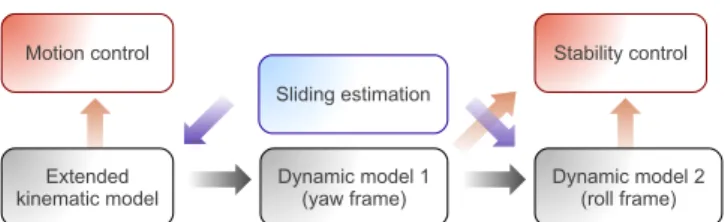
In order to permit an accurate off-road path tracking at high speed, the proposed control algorithm takes advantage of several levels of represen-tation, as depicted in figure 1. The first level is based on a kinematical representation and is so called extended kinematic model. It allows to describe robot motion including the influence of sliding. Based on Acker-mann model [Campion et al. (1993)] and detailed in [Lenain et al. (2006)], it is designed with respect to a reference trajectory, describing the evolution of the curvilinear abscissa, the lateral and angular deviations, with respect to the two control variables: the velocity at the middle of the rear axle and the front steering angle. This model accounts for sliding effects by the intro-duction of two sideslip angles on the two axles of the bicycle representation. The main advantage of this point of view lies in the fact that kinematic description of motion is preserved, allowing to derive a control law thanks to exact linearization techniques, as discussed in control section. Moreover, the estimation of sideslip angles at low speed can be proceeded thanks to this model (see the observer section). This level of representation is then sufficient for the motion control at limited speed. Nevertheless, dynamical effects are here neglected, and such a model appears to be inefficient when moving faster. As a consequence, a dynamic model is then required for fast sideslip angle estimation as well as for the preservation of the mobile robot integrity.
A 3D dynamical model is then considered using two 2D representations: • Dynamic model 1 (yaw frame). It is still based on the bicycle
Figure 1. Synopsis of considered modeling and interaction
assumption, as achieved in [Gillespie (1992)] or in [Ben Amar and Bidaud (1995)]. In addition to variables used for the kinematic repre-sentation, the global sideslip angle and the robot inclination are intro-duced. Since the path tracking task is here supposed to be performed with a slow varying velocity, the longitudinal forces are neglected. As a result, only the lateral components of contact forces (for the front and rear axles) are here considered. In order to be tractable, complex tire-soil interaction models (such as proposed in [Pacejka (2002)]) are avoided: these forces are considered to be linearly dependent on front and rear sideslip angles. The linear coefficients (namely cornering stiffnesses) are nevertheless considered as varying (estimated by an observer), allowing to account for contact variability and tire non-linearity.
• Dynamic model 2 (roll frame). It is fed by the outputs of dy-namic variables computed thanks to the yaw frame representation. It depicts the roll motion and is devoted to the computation of the robot lateral rollover risk. Only the normal forces Fn1 and Fn2 (for
the left and right sides) are then considered at the tire/ground con-tact interfaces. In order to evaluate the stability, this model is focused on the Lateral Load Transfer (LLT) computation, which is defined by LLT =Fn1−Fn2
Fn1+Fn2 and is representative of the mass repartition on robot
sides. If this metric reaches ±1, it means that two wheels of one side of the robot lift off.
The detailed equations of this model can be found in [Bouton et al. (2010)], and need several kinds of parameters. First, the “invariant” pa-rameters, which can be obtained by an off-line calibration procedure (such as the robot mass). Secondly, grip conditions parameters (contact variabil-ity and tire non-linearvariabil-ity), which are hardly measurable, and consequently estimated.
nering stiffnesses are correctly known (i.e. with a sufficient reactivity and accuracy). The other variables and parameters can indeed be measured by the sensors on-boarded, described in section 5.1, or off-line evaluated thanks to a previous calibration.
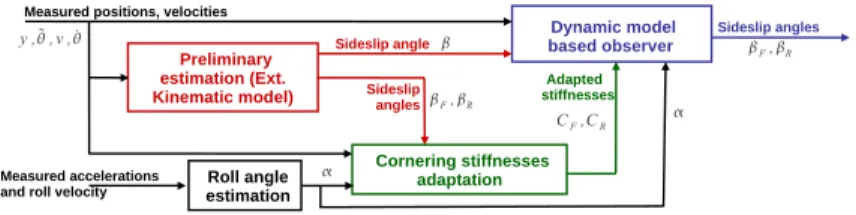
Figure 2. Global scheme of observation strategy
The proposed observer takes advantage of the relationship between kine-matic and dynamic representations thanks to the backstepping approach depicted in figure 2. First, a preliminary observation based on the ex-tended kinematic model is achieved. An estimation of sideslip angles is indeed obtained thanks to the convergence of kinematic model outputs to the measured lateral and angular deviations, as detailed in [Lenain et al. (2006)]. Alas, dynamical effects are neglected, leading to a slow-varying sideslip angle estimation, unsuitable when moving at high speed. Dynamic model 1 must be used to allow a faster adaptation. Nevertheless, such a model must be fed with the inclination of the suspended mass (measured by an accelerometer) and relevant values of cornering stiffnesses. They are on-line adapted thanks to a second step (Cornering stiffnesses adap-tation). As slow-varying estimations of sideslip angles are available, they are used to calculate the robot global sideslip angle, considered as a mea-sure in the sequel. A relevant value for cornering stiffnesses can then be evaluated, by ensuring the convergence of the dynamic model outputs to the measured yaw rate and global sideslip angle. The dynamic model is then totally known, and can finally be used to build an observer for the fast estimation of the sideslip angles. This last step is depicted by the box Dy-namic model-based observer in figure 2. The detailed equations of this observer (but neglecting for the robot inclination) can be found in [Lenain et al. (2011)]. Finally, the overall dynamic model is entirely known, enabling the fast observation of sideslip angles and the control of the robot integrity.
4
Motion control and integrity preservation
4.1 Accurate trajectory control algorithm
The control law associated with the extended kinematic model is deeply detailed in [Lenain et al. (2006)], and only briefly described in this sec-tion. It is based on an exact linearization of the proposed kinematic model, specifically a conversion into a chained form (see [Samson (1995)]). The control expression for the steering angle is then decomposed into two parts. The first term is reactive and relies mainly on current errors and observed sideslip angles. It can be then considered as adaptive, since it relies on the observed sideslip angles. The second term consists in a predictive cur-vature servoing using the knowledge of the reference trajectory. Based on Model Predictive Control theory (see [Richalet (1993)]), it considers the fu-ture path curvafu-ture in order to anticipate for low level actuator delays and mobile robot inertia.
4.2 Preservation of the mobile robot integrity
If the proposed control strategy fed with the observed sideslip angles allows to control accurately the robot motion at high speed and on different kinds of ground, it does not ensure the robot integrity. More precisely, the steering angle thus obtained, pending on the desired speed and on the terrain geometry, may generate hazardous situations, such as rollover or spin around, which are not considered within the above described path tracking control law.
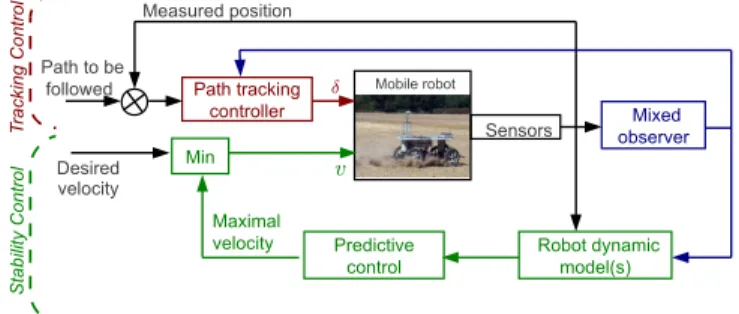
Figure 3. Global control scheme of autonomous robot
In order to design a robust control algorithm with respect to such phe-nomena, the second control variable (the robot velocity) is no more consid-ered as a constant to be chosen at the beginning of the path tracking, but as a degree of freedom, allowing to maintain the robot in a safe behavior. Since a dynamic representation is available, the relationship between the
steering angle is computed. It is then considered as the maximal velocity to be applied to the robot to preserve its integrity. The global control strategy can then be summarized by the scheme proposed in figure 3. Detailed equa-tions for velocity limitation can be found in [Bouton et al. (2010)] for rollover prevention and in [Hach et al. (2011)] regarding the steering saturation.
5
Experimental results
5.1 Experimental robot and on-boarded sensors
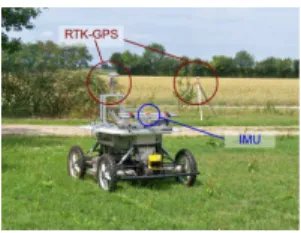
Figure 4. Experimental robot and embedded sensors
In order to study the capabilities of the proposed adaptive control strategy on uneven ground, the mobile robot de-picted in figure 4 is used. This electric vehicle can reach a 8m/s velocity and is able to climb slopes up to 30◦. Its weight
is 450Kg. The sensors used in the frame-work of this paper are:
• An RTK-GPS. The mobile an-tenna is settled up to the middle of the rear axle, providing an ab-solute position within an accuracy
of ±2cm. Thanks to this sensor, deviations with respect to the desired path as well as the velocity are known.
• A low cost IMU. This sensor provides three accelerations and three angular velocities, allowing to estimate lateral inclination and to feed the observer with the yaw rate.
Other sensors depicted in figure 4 (cameras and laser) are not used in the application described in this paper.
5.2 Motion control and rollover prevention
In order to point out the efficiency of the velocity moderation in order to ensure the robot integrity in the framework of path tracking, the proposed algorithm is here demonstrated only regarding the rollover prevention. The path to be followed, depicted in figure 5(a) is composed of two successive circles: one to the right, performed on asphalt, and the other to the left, performed on wet grass.
(a) Reference path 20 40 60 80 100 120 −0.8 −0.6 −0.4 −0.2 0 0.2 0.4 0.6 Curvilinear abscissa (m) Tracking Error (m) Circle 2 Circle 1 Error when LLT limitation is inactive Asphalt Grass Error when LLT limitation is inactive
(b) Tracking error with and without speed limitation
Figure 5. Comparison of tracking errors with/without integrity preserva-tion
The performances of the proposed algorithms are here investigated with a target speed of 4m.s−1, and path tracking is run two times: first without
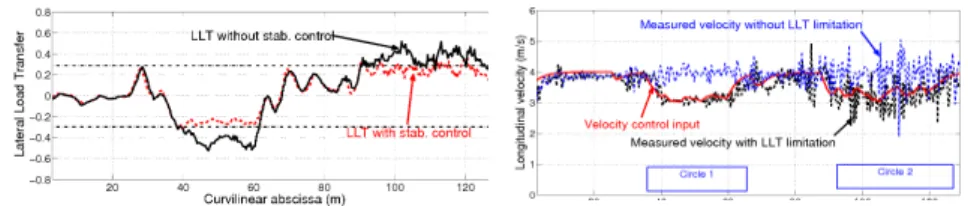
the velocity moderation (velocity is constant and equal to 4m/s), and sec-ondly with the limitation active, with a desired threshold of ±0.35 for the Lateral Load Transfer. We can first notice that the path tracking accuracy is independent from the velocity (both tracking errors are superposed) and despite the speed variation, depicted in figure 6, the tracking error does not exceed 40cm (during a transient phase), and does not rely on the kind of terrain (asphalt or wet grass do not influence the tracking accuracy). Classical path tracking control (typically neglecting sideslip angles), does not permit to reach such a precision, and huge errors (around 2 m, but not depicted here) are recorded during curve following on the grass part.
From a rollover point of view, when achieving the trajectory without speed moderation, the LLT reaches ±0.4 pending on the curve and grip conditions, as depicted in figure 6 (i.e. above the desired threshold of 0.35). The interest of using speed limitation for LLT control is then clearly high-lighted, since the LLT does not exceed 0.35 when integrity preservation is active.
Figure 6. Speed limitation and corresponding LLT recorded (target veloc-ity of 4m.s−1)
In order to keep the LLT within the desired range, the computed max-imal speed is inferior to the desired speed of 4m.s−1 and is adapted with
value of 0.35. This shows the efficiency of the algorithm in preserving the robot stability and motion accuracy, whatever the ground conditions and path to be followed. Other experiments achieved at higher speed demon-strate the efficiency of the approach on both tracking accuracy and stability preservation.
6
Conclusion
This paper proposes a predictive and adaptive approach for path tracking, enabling an accurate motion control at high speed in off-road context, and ensuring the robot integrity. The efficiency of the proposed approach has been investigated through full-scale experiments. If the speed modulation permits to preserve the accuracy, the developments here proposed are part of a project1
, in which the addition of non-classical degrees of freedom (e.g active anti-roll bar) are investigated to increase the robot stability. It supposes a higher level of prediction based on Numeric Terrain Model computation.
Bibliography
B. d’ Andr´ea-Novel, G. Campion, and G. Bastin. Control of wheeled mobile robots not satisfying ideal velocity constraints: a singular perturbation approach. International Journal of Robust and Nonlinear Control, 5(4): 243–267, 1995.
F. Ben Amar and P. Bidaud. Dynamic analysis of off-road vehicles. In Intern. symp. on experimental robotics, Standford, U.S.A., 1995. N. Bouton, R. Lenain, B. Thuilot, and P. Martinet. A new device dedicated
to autonomous mobile robot dynamic stability: application to an off-road mobile robot. pages 3813–3818, 2010.
G. Campion, G. Bastin, and B. d’ Andr´ea-Novel. Structural properties and classification of kinematic and dynamic models of wheeled mobile robots. In IEEE international conference on robotics and automation, pages 462–469, Atlanta, Georgia (USA), 1993.
R. Eaton, H. Pota, and J. Katupitiya. Path tracking control of agricultural tractors with compensation for steering dynamics. In International
con-1
This work is supported by French National Research Agency (ANR), under the grant ANR-07-ROBO-0008 attributed to the FAST project.
ference on decision and control (cdc), pages 7357–7362, Shanghai, China, 2009.
T.D. Gillespie. Fundamentals of vehicle dynamics. SAE International, War-rendale, U.S.A., 1992.
O. Hach, R. Lenain, B. Thuilot, and P. Martinet. Avoiding steering ac-tuator saturation in off-road mobile robot path tracking via predictive velocity control. In IEEE International Conference on Intelligent Robot and Systems, volume accepted, to be published, 2011.
R. Lenain, B. Thuilot, C. Cariou, and P. Martinet. High accuracy path tracking for vehicles in presence of sliding. application to farm vehicle automatic guidance for agricultural tasks. Autonomous robots, 21(1): 79–97, 2006.
R. Lenain, B. Thuilot, O. Hach, and P. Martinet. High-speed mobile robot control in off-road conditions: a multi-model based adaptive approach. In IEEE International Conference on Robotics and Automation, ICRA’11, page 6143:6149, 2011.
A. Micaelli and C. Samson. Trajectory tracking for unicycle-type and two-steering-wheels mobile robots. INRIA technical report, (n◦ 2097), 1993.
H. B. Pacejka. Tire and vehicle dynamics. Society of Automotive Engineers, 2002.
J. Richalet. Industrial applications of model based predictive control. Au-tomatica, 29:1251–1574, 1993.
Claude Samson. Control of chained systems. application to path following and time-varying point stabilization of mobile robots. IEEE Transactions on Automatic Control, 40(1):64–77, 1995.
H. Schafer, M. Proetzsch, and K. Berns. Action/perception-oriented robot software design: an application in off-road terrain. In International con-ference on control, automation, robotics and vision (icarcv), pages 223– 228, Hanoi, Vietnam, 2008.
R. Siegwart and I.R. Nourbakhsh. Introduction to autonomous mobile robots. MIT Press, 2004.