X-Linked and Autosomal Recessive Alport
Syndrome: Pathogenic Variant Features and
Further Genotype-Phenotype Correlations
Judith Savige1*, Helen Storey2, Hae Il Cheong3, Hee Gyung Kang3, Eujin Park3,
Pascale Hilbert4, Anton Persikov5, Carmen Torres-Fernandez6, Elisabet Ars7,
Roser Torra7, Jens Michael Hertz8, Mads Thomassen8, Lev Shagam9, Dongmao Wang1,
Yanyan Wang1, Frances Flinter10, Mato Nagel11
1 The University of Melbourne, Melbourne Health and Northern Health, Melbourne, Australia, 2 Molecular Genetics Laboratory, Guy’s and St Thomas’ Hospital, London, United Kingdom, 3 Research Coordination Center for Rare Diseases, Seoul National University Hospital, Seoul, Korea, 4 Institut de Pathologie et Genetique, Department of Molecular Biology, Gosselles, Belgium, 5 Lewis-Sigler Institute for Integrative Genomics, Princeton University, Princeton, New Jersey, United States of America, 6 Molecular Genetics Centre GENETAQ, Malaga, Spain, 7 Molecular Biology Laboratory and Department of Nephrology, REDINREN, Fundacio Puigvert, Universitat Autonoma de Barcelona, Barcelona, Spain, 8 Department of Clinical Genetics, Odense University Hospital, Odense, Denmark, 9 Institute of Pediatrics, Pirogov Russian Medical University, Moscow, Russia, 10 Department of Genetics, Guy’s and St Thomas’ Hospital, London, United Kingdom, 11 Centre for Nephrology and Metabolic Medicine, Weisswasser D-02943, Germany *[email protected]
Abstract
Alport syndrome results from mutations in theCOL4A5 (X-linked) or COL4A3/COL4A4 (recessive) genes. This study examined 754 previously- unpublished variants in these genes from individuals referred for genetic testing in 12 accredited diagnostic laboratories worldwide, in addition to all publishedCOL4A5, COL4A3 and COL4A4 variants in the LOVD databases. It also determined genotype-phenotype correlations for variants where clinical data were available. Individuals were referred for genetic testing where Alport syndrome was suspected clinically or on biopsy (renal failure, hearing loss, retinopathy, lamellated glo-merular basement membrane), variant pathogenicity was assessed using currently-accepted criteria, and variants were examined for gene location, and age at renal failure onset. Results were compared using Fisher’s exact test (DNA Stata). Altogether 754 new DNA variants were identified, an increase of 25%, predominantly in people of European background. Of the 1168COL4A5 variants, 504 (43%) were missense mutations, 273 (23%) splicing variants, 73 (6%) nonsense mutations, 169 (14%) short deletions and 76 (7%) complex or large deletions. Only 135 of the 432 Gly residues in the collagenous sequence were substituted (31%), which means that fewer than 10% of all possible variants have been identified. Both missense and nonsense mutations inCOL4A5 were not ran-domly distributed but more common at the 70 CpG sequences (p<10−41and p<0.001 respectively). Gly>Ala substitutions were underrepresented in all three genes (p< 0.0001) probably because of an association with a milder phenotype. The average age at end-stage renal failure was the same for all mutations inCOL4A5 (24.4 ±7.8 years), COL4A3 (23.3 ± 9.3) andCOL4A4 (25.4 ± 10.3) (COL4A5 and COL4A3, p = 0.45; COL4A5 and COL4A4, p =
a11111
OPEN ACCESS
Citation: Savige J, Storey H, Il Cheong H, Gyung Kang H, Park E, Hilbert P, et al. (2016) X-Linked and Autosomal Recessive Alport Syndrome: Pathogenic Variant Features and Further Genotype-Phenotype Correlations. PLoS ONE 11(9): e0161802. doi:10.1371/journal.pone.0161802
Editor: Shree Ram Singh, National Cancer Institute, UNITED STATES
Received: April 27, 2016 Accepted: August 14, 2016 Published: September 14, 2016
Copyright: © 2016 Savige et al. This is an open access article distributed under the terms of the Creative Commons Attribution License, which permits unrestricted use, distribution, and reproduction in any medium, provided the original author and source are credited.
Data Availability Statement: All primary data are available at the LOVD websites for COL4A5, COL4A3 and COL4A4 genes (http://www.LOVD.nl). Funding: JS received seed funding to establish the Alport mutation databases from the US Alport Foundation and the Australian Alport Foundation ($USD 10,000 and $AUD 20,000 respectively). HIC, HGK and EP received funding from the Korean government through the Korean Health Technology R&D Project, Ministry of Health & Welfare, Republic of Korea ($USD142,000) (HI12C0014).The funders had no role in study design, data collection and
0.55;COL4A3 and COL4A4, p = 0.41). For COL4A5, renal failure occurred sooner with non-missense than non-missense variants (p<0.01). For the COL4A3 and COL4A4 genes, age at renal failure occurred sooner with two non-missense variants (p = 0.08, and p = 0.01 respectively). Thus DNA variant characteristics that predict age at renal failure appeared to be the same for all three Alport genes. Founder mutations (with the pathogenic variant in at least 5 apparently- unrelated individuals) were not necessarily associated with a milder phe-notype. This study illustrates the benefits when routine diagnostic laboratories share and analyse their data.
Introduction
Alport syndrome is the commonest cause of inherited renal failure after polycystic kidney dis-ease [1]. It affects at least one in 10,000 individuals and is characterised by progressive kidney failure, hearing loss, and ocular abnormalities [2]. Inheritance is X-linked withCOL4A5 muta-tions [3] in 85% of cases and autosomal recessive withCOL4A3 or COL4A4 mutations in most of the others [4,5]. Individuals with heterozygousCOL4A3 or COL4A4 mutations usually have Thin basement membrane nephropathy with normal renal function [6,7,8] but some develop renal impairment [9].
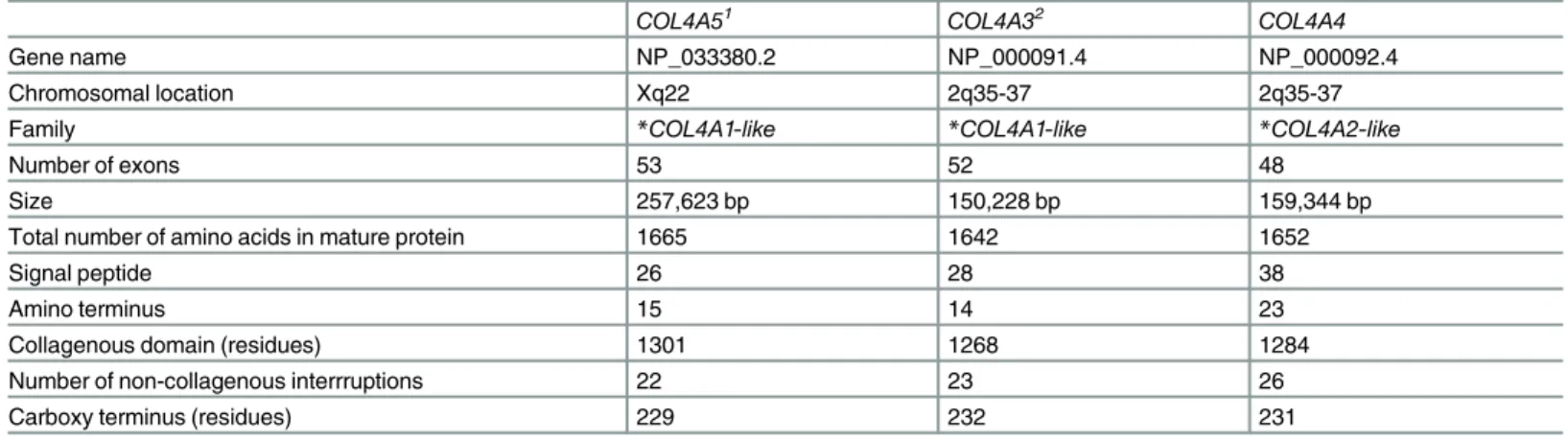
The clinical features in Alport syndrome are explained because theCOL4A5 and COL4A3/ COL4A4 genes code for the collagen IV α5 chain, α3 and α4 chains which form a heterotrimer in the basement membranes of the glomerulus, cochlea and eye [10] (Table 1). Each collagen IV chain has non-collagenous amino and carboxy termini, and an intermediate collagenous domain with Gly-X-Y, with multiple short non-collagenous interruptions [10]. Glycine is found at each third residue in the collagen sequence and is critical for triple helix formation.
The‘Expert guidelines on the diagnosis and management of Alport syndrome’ [2] recom-mend that all individuals with likely Alport syndrome should undergo genetic testing, to con-firm the diagnosis and mode of inheritance, and predict the age at renal failure. The Guidelines also recommend cases of suspected Thin basement membrane nephropathy undergo genetic testing when it is important to exclude X-linked Alport syndrome [2].
Mutations in theCOL4A5, COL4A3 and COL4A4 genes are mainly nonsense or missense. Genotype-phenotype correlations have only been characterised for X-linked disease [11,12,13]. Nonsense mutations are typically associated with early onset renal failure (before 30), lentico-nus and central retinopathy. Deletions and insertions often cause a frameshift, and down-stream nonsense variant. Many missense mutations result in a milder phenotype with later onset renal failure without ocular features [11,12,13,14].
The commonest method used currently for mutation detection is whole exome sequencing (WES). The widespread adoption of WES together with the Exome Aggregation Consortium (ExAc collaboration,http://exac.broadinstitute.org/, the‘1000 genomes’,http://1000genomes. org/and Hapmap,https://hapmap.ncbi.nlm.nih.gov/, projects), have greatly increased the number of reported pathogenic and normal DNA variants [15].
Collecting all pathogenic and normal variants for each disease-related gene in a publicly-accessible variant database avoids the duplication involved in assessing pathogenicity, and improves the speed and accuracy of testing while limiting cost.
The present study has reviewed known variants in the Alport genes, including 754 recently-submitted from members of the Alport mutation database Consortium to the publicly-accessi-ble LOVD databases, with the aims of further characterising DNA variants, and genotype-phe-notype correlations. The LOVD databases continue to be updated.
analysis, decision to publish, or preparation of the manuscript.
Competing Interests: The authors have declared that no competing interests exist, and that although most are involved in genetic testing for Alport syndrome this is in laboratories that are part of health services or research institutions.
Methods
Assembly of the variants
DNA variants were extracted from the literature, from other databases (eg ARUP) or from pre-viously-unpublished deidentified submissions direct to the LOVDCOL4A5, COL4A3 and COL4A4 database from contributing members of the International Alport Mutation Database Consortium in the UK and Europe, Korea, the US and Australia. Genetic testing from laborato-ries run by Consortium members was performed after written informed consent had been obtained by the treating clinicians. Submission of variants to the databases was undertaken with IRB approval where this was required (Northern Health HREC, IRB of Seoul National University, CEIC Fundacio Puigvert, Veltishev Pediatric Clinical Research Institute).
In general, individuals had been referred for genetic testing where Alport syndrome was sus-pected clinically or on renal biopsy (renal failure, hearing loss, retinopathy, lamellated glomer-ular basement membrane). Clinical data (age, gender, diagnosis and age at onset of renal failure, and, where known, hearing loss and ocular abnormalities) were obtained in a manner conforming with local IRB ethical guidelines according to the Declaration of Helsinki. The test-ing laboratory deidentified information before submission to the databases.
Variants had been collected by individual laboratories over a ten year period and mutation detection methods varied during this time. All laboratories had used Sanger sequencing at some stage, few had used MLPA, but recently most had used whole exome sequencing. Most diagnostic laboratories confirmed any variant found with WES using Sanger sequencing. All laboratories were accredited by their national board but there was no uniformity in how they confirmed variant pathogenicity. This was most often with consulting the LOVD, and recently, the ExAc databases, and sometimes using an online tool such as Alamut.
Variants were described according to the reference transcripts ofCOL4A5 (the longer form found in the kidney, LRG_232t2, NM_033380.2),COL4A3 (LRG_230t1, NM_000091.4) and COL4A4 (LRG_231t1, NM_000092.4), and the nomenclature guidelines of the Human Genome Variation Society (HGVS) [16]. Variant descriptions were confirmed with the Muta-lyzer programme (http://mutalyzer.nl/) [17]. Pathogenicity assessments were as published or as provided by the submitting laboratory. In general these were based on the HGVS definitions [18]. Variants were not checked independently with any algorithms such as the Human Splic-ing Finder because their efficacy and accuracy is not confirmed in the genes of interest. Our
Table 1. Characteristics ofCOL4A5, COL4A3 and COL4A4 genes and the corresponding proteins.
COL4A51 COL4A32 COL4A4
Gene name NP_033380.2 NP_000091.4 NP_000092.4
Chromosomal location Xq22 2q35-37 2q35-37
Family *COL4A1-like *COL4A1-like *COL4A2-like
Number of exons 53 52 48
Size 257,623 bp 150,228 bp 159,344 bp
Total number of amino acids in mature protein 1665 1642 1652
Signal peptide 26 28 38
Amino terminus 15 14 23
Collagenous domain (residues) 1301 1268 1284
Number of non-collagenous interrruptions 22 23 26
Carboxy terminus (residues) 229 232 231
*COL4A–like or COL4A2-like genes represent families that have arisen from common progenitors, COL4A1 or COL4A2, and thus have structural similarities doi:10.1371/journal.pone.0161802.t001
definition for splicing mutations included the 10 intronic nucleotides immediately adjacent to the exon-intron boundaries. Deep intronic variants were only included where the submitting laboratory believed them to be disease-causing.
Variants, demographic and clinical data were added to the LOVD databases that included all publishedCOL4A5, COL4A3 and COL4A4 variants. Disease-associated variants already recorded in the database but from apparently unrelated families were included to identify the prevalence of Alport syndrome and any common or founder mutations. Mode of inheritance, gender and clinical features were noted where available.
Analysis of the LOVD
COL4A5, COL4A3 and COL4A4 databases
Different variant types (deletions, insertions, short deletions, arbitrarily chosen as< than 26 bp, and splicing variants) direct or indirect nonsense mutations, missense variants (resulting in Gly or non-Gly substitutions, pathogenic or not, and synonymous changes) were counted. Each variant was included once only in the analysis.
Large deletions were mapped against the collagen sequence. Missense variants corrected for exon size were compared between exons to determine any increase in variants or gaps.
In addition,COL4A5 missense mutations were tested for a preferential occurrence in CpG-associated codons [19] (especially involving the first G of Gly) using an in-house Python script (www.python.org). CpG sites have an increased tendency for methylcytosine to spontaneously deaminate to thymine. CG>TG and the complementary changes have a 10 times higher muta-tion rate than normal.
The prevalence of Gly substitutions with each of 8 other amino acids or a stop codon was compared with the expected distribution determined from collagen codon preferences [20].
Age at onset of renal failure
The nature of mutations was correlated with early and late onset renal failure, using the criteria already identified forCOL4A5 ‘severe’ variants (copy number variants, frameshifts, nonsense and splice site mutations). Only one age was used for the variant in each family, and for COL4A5 variants, the ages at renal failure in males and females were studied separately. Where several members of the same family or unrelated individuals with the same mutation were described, the youngest age of onset of renal failure was recorded. ForCOL4A3 and COL4A4, the age at end-stage renal failure in males and females were combined, and the number of severe variants recorded as none, one or two.
Statistical analysis
Results were expressed as mean and SD, and results compared using Fisher’s exact test (DNA Stata). A p value of less than 0.05 was considered significant, and a p values less than 0.10, a trend.
Results
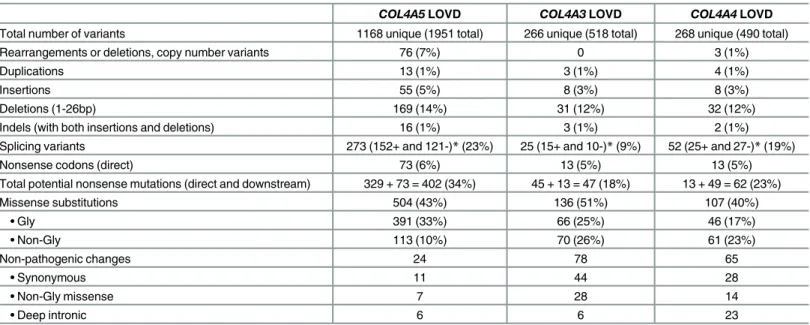
Twelve laboratories involved worldwide in mutation testing for Alport syndrome collaborated to submit 754 novel variants (504COL4A5, 133 COL4A3, 117 COL4A4 variants) to the LOVD databases. These contributions increased the total number of variants in the databases by 25% (754/2959), to 1168 unique variants forCOL4A5 (1951 total), 266 for COL4A3 (518 total) and 268 forCOL4A4 (490 total) (Table 2). Most variants were pathogenic, or of unknown signifi-cance, from individuals with Alport syndrome or Thin basement membrane nephropathy.
Most were from Europeans withCOL4A5 variants, or were from Chinese (72 pathogenic, 12 normal), African (10, 8 normal), Hispanic (7 pathogenic) or Indian (2 normal) people.
DNA variants in
COL4A5
The 1168COL4A5 unique variants included 76 complex mutations or deletions of more than 26 nucleotides (7%), 55 insertions (5%), 13 duplications (1%), 169 short deletions (with fewer than 26 nucleotides, 14%), and 16 indels (1%), 73 nonsense mutations (6%), 504 missense vari-ants (43%) and 273 (23%) splicing varivari-ants (Table 2). Uncommonly two pathogenic variants were found in the same individual (11/1168, 1%).
Large deletions/indels/rearrangements. There were 25 large deletions. Seven originated inCOL4A6 and terminated in exon 1 or the nearby intron of COL4A5. Eight large deletions originated in exons 1–4. Only 9 deletions (fewer than half) had their origins after exon 4, and six at exons 37 to 41.
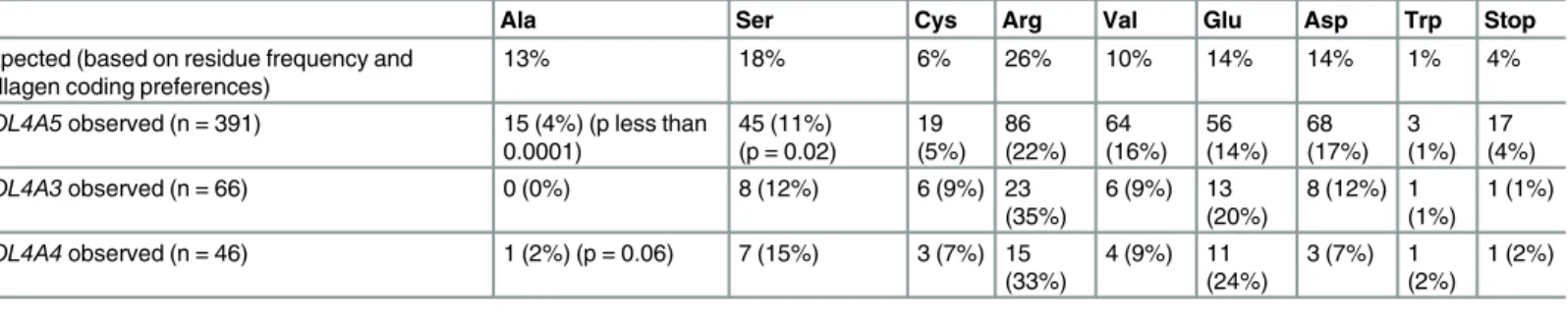
Direct nonsense mutations. There were 73 (6%) direct nonsense mutations but the inser-tions/deletions and duplications that result in a frameshift meant that there were potentially 402 variants producing a downstream nonsense change (34%). In addition, 17 direct stop codons resulted from Gly substitutions (4%) which matched the expected prevalence (4%) (Table 3).
Missense mutations. There were 504 missense variants (43%) of which 391 (33%) were Gly substitutions, and 113 (10%) non-Gly substitutions. Thus Gly inCOL4A5 was substituted three times more often than other amino acids. Glycine can be substituted nine ways (Table 3), and the substitutions with each residue occurred as often as expected except for Ala which was underrepresented (4% compared with 13% expected). Ala is the least destabilising amino acid, and results in a milder clinical phenotype, which may have been overlooked clinically
(p<0.0001)[20].
Table 2. Frequency of variants inCOL4A5, COL4A3 and COL4A4 genes in LOVD databases.
COL4A5 LOVD COL4A3 LOVD COL4A4 LOVD
Total number of variants 1168 unique (1951 total) 266 unique (518 total) 268 unique (490 total)
Rearrangements or deletions, copy number variants 76 (7%) 0 3 (1%)
Duplications 13 (1%) 3 (1%) 4 (1%)
Insertions 55 (5%) 8 (3%) 8 (3%)
Deletions (1-26bp) 169 (14%) 31 (12%) 32 (12%)
Indels (with both insertions and deletions) 16 (1%) 3 (1%) 2 (1%)
Splicing variants 273 (152+ and 121-)* (23%) 25 (15+ and 10-)* (9%) 52 (25+ and 27-)* (19%)
Nonsense codons (direct) 73 (6%) 13 (5%) 13 (5%)
Total potential nonsense mutations (direct and downstream) 329 + 73 = 402 (34%) 45 + 13 = 47 (18%) 13 + 49 = 62 (23%)
Missense substitutions 504 (43%) 136 (51%) 107 (40%) • Gly 391 (33%) 66 (25%) 46 (17%) • Non-Gly 113 (10%) 70 (26%) 61 (23%) Non-pathogenic changes 24 78 65 • Synonymous 11 44 28 • Non-Gly missense 7 28 14 • Deep intronic 6 6 23
* For splicing variants, + indicates that the variant is located within the intron immediately adjacent to the 3’ end of the exon; and—indicates that the exon is within the intron immediately adjacent to the 5’ end of the exon.
Of the 113 non-Gly substitutions, the most common replacements were of Arg, Asp, Glu, Ser (26, 9.5%), Val (10, 4%) or Ala (7, 2.6%), to Gly.
Only 135 of the 432 Gly in the collagenous sequence were substituted (31%). This was com-parable withCOL1A1 where fewer than 10% of all variants were calculated to be known (Marini, 2007). Most substitutions were with one amino acid only.
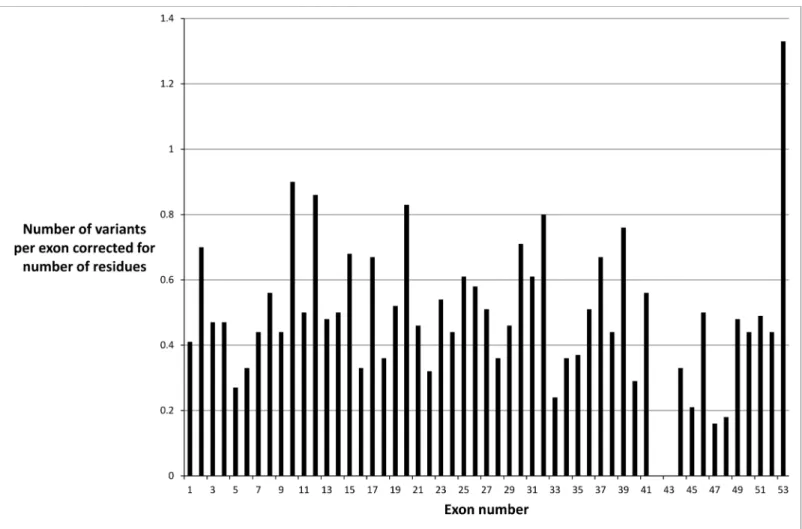
Missense variants were not distributed evenly throughout theCOL4A5 gene when exon size was taken into account (Fig 1). There were fewer mutations in exons 47 and 48, which sug-gested a milder phenotype or an ascertainment bias. It was unlikely that the fewer mutations were due to an embryonic lethal phenotype because the collagen IVα3α4α5 network is mainly expressed after infancy. However exons 47 and 48 correspond to the collagen IVα5 chain before the carboxy terminus, where there is a‘gap’ for entry of the cleavage enzymes, and the major epithelial binding site on the parallel IV alpha3 chain [21]. Mutations were also under-represented in exons 42 and 43 probably because these exons are small and not routinely sequenced.
CpG site mutations. There were 70 CpG sites among the 5076 nucleotide positions in COL4A5. Of all the mutations causing Alport syndrome, 89 were present at CpG sites which was more often than by chance (p less than10- 41by Fisher’s exact test). Nonsense mutations were also observed more often at CpG sites. Of the 89 mutations at 70 CpG sites, 27 were non-sense changes at 5 sites (p less than 0.001 by Fisher’s exact test).
Gly substitutions within the collagenous domains were also overrepresented inCOL4A5 mutations. Of the 491 missense mutations affecting the 1347 amino acid positions in collagen IVα5 chain, 435 (89%) were substitutions of one of the 449 collagenous domain Gly residues (p<0.001). Similarly, at the CpG sites, 46 missense mutations were observed at 43 CpG sites within the collagenous domains, with 39 resulting in Gly substitutions at 12 Gly positions (p less than 10−7by Fisher’s exact test).
Splice site mutations. There were 273 splicing variants (23% of total number) with a vari-ant within 10 nucleotides of the intron-exon boundary that was possibly pathogenic. At least one variant was identified for each intron, and there were 152 + (at the 3’ end of the exon) and 121–(at the 5’ end of the exon) splice variants.
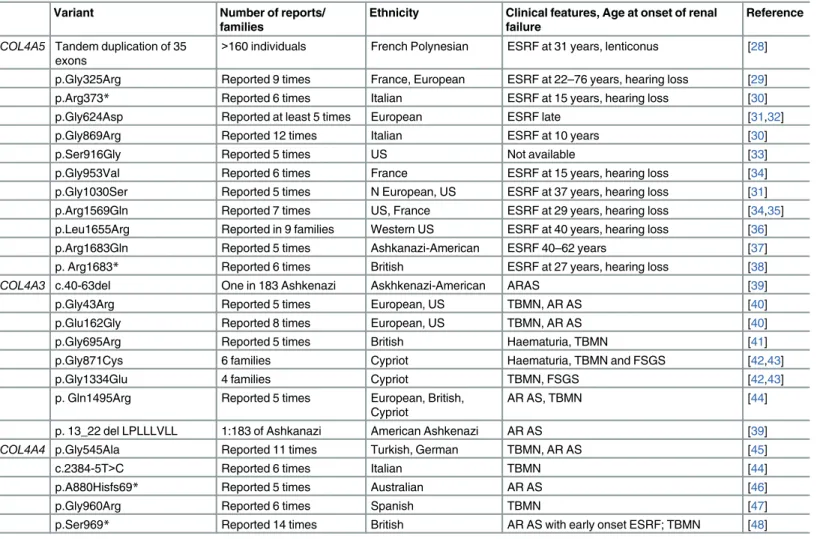
Founder mutations. Two hundred and sixty-five pathogenic variants (23%) were recorded more than once, but only 12 reported at least five times in apparently unrelated fami-lies (Table 4). Three were biochemically‘severe’ mutations being a duplication or nonsense variant. A further three were Gly substitutions. Six resulted in renal failure at less than 30 years of age, and five in a milder phenotype with later onset renal failure.
Table 3. Observed versus expected likelihood of Glycine substitutions in theCOL4A5, COL4A3 and COL4A4 genes in Alport syndrome and Thin basement membrane nephropathy. Observed number from the LOVD databases; expected number derived from data for collagen I [20].
Ala Ser Cys Arg Val Glu Asp Trp Stop
Expected (based on residue frequency and collagen coding preferences)
13% 18% 6% 26% 10% 14% 14% 1% 4%
COL4A5 observed (n = 391) 15 (4%) (p less than 0.0001) 45 (11%) (p = 0.02) 19 (5%) 86 (22%) 64 (16%) 56 (14%) 68 (17%) 3 (1%) 17 (4%) COL4A3 observed (n = 66) 0 (0%) 8 (12%) 6 (9%) 23 (35%) 6 (9%) 13 (20%) 8 (12%) 1 (1%) 1 (1%) COL4A4 observed (n = 46) 1 (2%) (p = 0.06) 7 (15%) 3 (7%) 15 (33%) 4 (9%) 11 (24%) 3 (7%) 1 (2%) 1 (2%)
p- not significant for all other comparisons doi:10.1371/journal.pone.0161802.t003
Some of these mutations will have arisen from independent events and others from a single individual, but the distinction can only be made with haplotype analysis. These mutations allow us to examine the consistency of age of onset of renal failure and the effect of modifying genes. More founder mutations are likely but laboratories may not have not reported them because of their‘lack of novelty’.
Genotype-phenotype correlation. Clinical data were most complete for age at end-stage renal failure. Formal hearing and ophthalmic examinations were rarely reported to the testing laboratory.
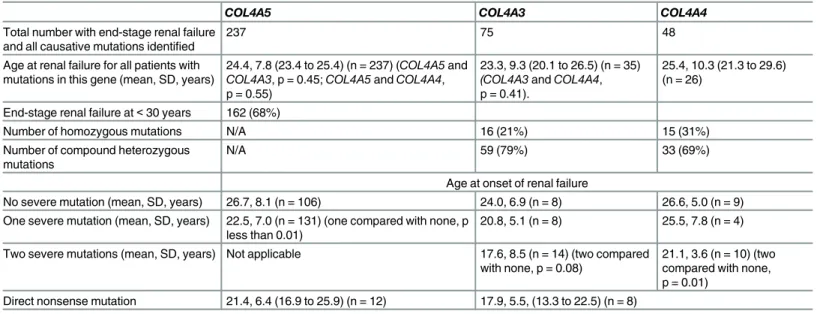
Reported mutations were associated more often with a severe phenotype. The age at onset of renal failure was available for 237COL4A5 mutations (12%) and the mean age was 24.3 years (Table 5). More mutations (162, 68%) were associated with end-stage renal failure before the age of 30 years, than later (75, 32%).
A severe mutation (rearrangement, large deletion, insertion/deletion, or nonsense change) was associated with a younger average age at onset of renal failure of 22.5 ± 7.0 years (n = 131) than in those without a severe mutation (26.7 ± 8.1 years, n = 106, p less than 0.01).
A direct nonsense mutation, that is where a codon was replaced by a stop signal, was associ-ated with a younger average age at onset of renal failure of 21.4 ± 6.4 years than with other mutations types (p = 0.03).
Fig 1. Distribution of missense variants in theCOL4A5 gene in each exon corrected for exon size and demonstrating a non-uniform distribution. doi:10.1371/journal.pone.0161802.g001
There was no difference in the age at onset of renal failure in individuals with Gly substitu-tions with Arg, Glu or Asp compared with other amino acids, nor with non-Gly substitusubstitu-tions (p all greater than 0.05).
COL4A5 mutations were reported in 68 females. Nine of the 23 (39%) who developed renal failure had a direct or indirect nonsense mutation or rearrangement or insertion/deletion, in contrast to 9 of the 45 without renal failure (20%, p = 0.14).
DNA variants in
COL4A3 and COL4A4
Many fewer DNA variants have been described for theCOL4A3 and COL4A4 genes, presum-ably because autosomal recessive Alport syndrome is less common, and genetic testing is per-formed infrequently for Thin basement membrane nephropathy.
DNA variants in the LOVD databases affected theCOL4A3 and COL4A4 genes equally fre-quently (Table 2). TheCOL4A3 database had 266 unique variants, and COL4A4 had 268. Com-pound heterozygous variants were more common than homozygous variants for bothCOL4A3 andCOL4A4 (69% and 59% respectively) suggesting lesser consanguinity.
Table 4. Common Founder mutations in theCOL4A5, COL4A3 and COL4A4 genes.
Variant Number of reports/
families
Ethnicity Clinical features, Age at onset of renal failure
Reference COL4A5 Tandem duplication of 35
exons
>160 individuals French Polynesian ESRF at 31 years, lenticonus [28]
p.Gly325Arg Reported 9 times France, European ESRF at 22–76 years, hearing loss [29]
p.Arg373* Reported 6 times Italian ESRF at 15 years, hearing loss [30]
p.Gly624Asp Reported at least 5 times European ESRF late [31,32]
p.Gly869Arg Reported 12 times Italian ESRF at 10 years [30]
p.Ser916Gly Reported 5 times US Not available [33]
p.Gly953Val Reported 6 times France ESRF at 15 years, hearing loss [34]
p.Gly1030Ser Reported 5 times N European, US ESRF at 37 years, hearing loss [31] p.Arg1569Gln Reported 7 times US, France ESRF at 29 years, hearing loss [34,35] p.Leu1655Arg Reported in 9 families Western US ESRF at 40 years, hearing loss [36]
p.Arg1683Gln Reported 5 times Ashkanazi-American ESRF 40–62 years [37]
p. Arg1683* Reported 6 times British ESRF at 27 years, hearing loss [38]
COL4A3 c.40-63del One in 183 Ashkenazi Askhkenazi-American ARAS [39]
p.Gly43Arg Reported 5 times European, US TBMN, AR AS [40]
p.Glu162Gly Reported 8 times European, US TBMN, AR AS [40]
p.Gly695Arg Reported 5 times British Haematuria, TBMN [41]
p.Gly871Cys 6 families Cypriot Haematuria, TBMN and FSGS [42,43]
p.Gly1334Glu 4 families Cypriot TBMN, FSGS [42,43]
p. Gln1495Arg Reported 5 times European, British, Cypriot
AR AS, TBMN [44]
p. 13_22 del LPLLLVLL 1:183 of Ashkanazi American Ashkenazi AR AS [39]
COL4A4 p.Gly545Ala Reported 11 times Turkish, German TBMN, AR AS [45]
c.2384-5T>C Reported 6 times Italian TBMN [44]
p.A880Hisfs69* Reported 5 times Australian AR AS [46]
p.Gly960Arg Reported 6 times Spanish TBMN [47]
p.Ser969* Reported 14 times British AR AS with early onset ESRF; TBMN [48] *stop codon; ESRF–end-stage renal failure, FSGS–focal segmental glomerulosclerosis, AR AS–autosomal recessive Alport syndrome, TBMN–thin basement membrane nephropathy
Large deletions/indels/rearrangements. The proportions of duplications, insertions, short deletions and other indels were similar to those found inCOL4A5.
Missense. Glycine substitutions were relatively less abundant than forCOL4A5 (Table 2). This was unexpected since they are the most common change in X-linked Alport syndrome and other collagen diseases such as osteogenesis imperfecta [20]. The explanation may be that milder disease with heterozygous Gly substitutions was overlooked. Gly to Ala or Ser substitu-tions were again underrepresented for theCOL4A3 and COL4A4 genes.
Too few missense variants were found to determine any mutational hot spots. Non-Gly sub-stitutions were more common than inCOL4A5, but their pathogenic significance was often not clear.
Nonsense. The % of direct nonsense mutations was similar toCOL4A5 but the total % (of direct and potential indirect nonsense mutations) was fewer because fewer large insertions/ deletions were reported.
Splicing. Very few potential splicing mutations were identified within the first 10 nucleo-tides of the intron-exon boundaries.
Founder mutations. Founder mutations were reported in bothCOL4A3 and COL4A4 in autosomal recessive Alport syndrome and Thin basement membrane nephropathy (Table 5). For example, the S969X variant inCOL4A4 was the commonest variant in British populations, and other variants were reported from Cyprus.
Genotype-phenotype correlations. Clinical features were compared between individuals with autosomal recessive Alport syndrome caused byCOL4A3 or COL4A4 pathogenic muta-tions and those with X-linked Alport syndrome andCOL4A5 mutations. The age at onset of renal failure was known for some homozygous or compound heterozygousCOL4A3 (n = 35) andCOL4A4 (n = 25) pathogenic mutations where both variants were known. Overall the mean age at onset of end-stage renal failure was not different for individuals withCOL4A3 (23.2 + 9.3, years, 95% CI 20.1 to 26.5) orCOL4A4 mutations (mean 25.4 ±10.3 years, 95% CI 21.3 to 29.6) compared withCOL4A5 mutations (24.4 ± 7.8 years, 95% CI 23.4 to 25.4, n = 237) (Table 4).
Table 5. Age at end-stage renal failure and severity of mutations withCOL4A5, COL4A3 and COL4A4 variants.
COL4A5 COL4A3 COL4A4
Total number with end-stage renal failure and all causative mutations identified
237 75 48
Age at renal failure for all patients with mutations in this gene (mean, SD, years)
24.4, 7.8 (23.4 to 25.4) (n = 237) (COL4A5 and COL4A3, p = 0.45; COL4A5 and COL4A4, p = 0.55)
23.3, 9.3 (20.1 to 26.5) (n = 35) (COL4A3 and COL4A4, p = 0.41).
25.4, 10.3 (21.3 to 29.6) (n = 26)
End-stage renal failure at< 30 years 162 (68%)
Number of homozygous mutations N/A 16 (21%) 15 (31%)
Number of compound heterozygous mutations
N/A 59 (79%) 33 (69%)
Age at onset of renal failure
No severe mutation (mean, SD, years) 26.7, 8.1 (n = 106) 24.0, 6.9 (n = 8) 26.6, 5.0 (n = 9) One severe mutation (mean, SD, years) 22.5, 7.0 (n = 131) (one compared with none, p
less than 0.01)
20.8, 5.1 (n = 8) 25.5, 7.8 (n = 4) Two severe mutations (mean, SD, years) Not applicable 17.6, 8.5 (n = 14) (two compared
with none, p = 0.08)
21.1, 3.6 (n = 10) (two compared with none, p = 0.01)
Direct nonsense mutation 21.4, 6.4 (16.9 to 25.9) (n = 12) 17.9, 5.5, (13.3 to 22.5) (n = 8) ‘Severe’ mutations were large rearrangements, deletions, insertions or other changes resulting in a nonsense codon. doi:10.1371/journal.pone.0161802.t005
The age at onset of renal failure was also the same for homozygous and for compound het-erozygousCOL4A3 and COL4A4 mutations (21.5 ± 7.2, 95%CI 17.2–25.9, n = 13; and 21.8 ± 7.0, 95% CI 19.8 to 23.7, n = 52).
Subjects with two severe mutations (direct or indirect nonsense mutations, insertions/dele-tions) developed end-stage renal failure at a younger age than those with none (Table 4). Indi-viduals with at least one direct nonsenseCOL4A3 or COL4A4 mutation also developed renal failure at a younger age than those with none. Thus, the age at onset of renal failure in autoso-mal recessive Alport syndrome depended on mutation severity using the same criteria as for COL4A5 mutations [11,12]. However this study did not demonstrate any difference in the age at end-stage renal failure due to Gly substitutions with Arg, Glu or Asp compared with other substitutions forCOL4A3 and COL4A4.
TwentyCOL4A3 or COL4A4 mutations were identified in the LOVD databases in individu-als diagnosed clinically with autosomal dominant Alport syndrome. Seven only had developed end-stage renal failure, at a mean age of 42 ± 15.1 years (range 20–60). The others either did not have renal failure or the age at onset was not known.
Biallelic and digenic mutations
There are occasional reports of individuals with twoCOL4A5 mutations [22,23], and others with autosomal recessive Alport syndrome and mutations in bothCOL4A3 and COL4A4 with a later age at onset of renal failure [15,24,25].
Discussion
This study confirmed thatCOL4A5, and COL4A3 and COL4A4 mutations in Alport syndrome all resulted in end-stage renal failure at the same age. Other studies have found thatCOL4A5 deletions, insertions, and nonsense variants, are associated with early onset renal failure [11,12,13]. This study confirmed that twoCOL4A3 or COL4A4 mutations resulted in earlier onset renal failure than one or no severe mutations. NonsenseCOL4A3 and COL4A4 muta-tions were also associated with a younger age at renal failure. Cohort studies indicate that hear-ing loss is common with all mutation types, and that the same mutation types that cause early onset renal failure in X-linked disease are associated with lenticonus and retinopathy [14].
The number of different publishedCOL4A5 variants has increased from 176 in 1997 [26], to 520 by 2010 [27], and 1200 in 2015. Many more pathogenic variants have been reported for COL4A5 than for COL4A3 and COL4A4. There was some bias in the types of mutations reported here (deletions and insertions were more common forCOL4A5) probably because of the detection techniques.
The major challenge for the future is to encourage all diagnostic laboratories including those that are commercially-based, to submit their variants to a database, together with accu-rate pathogenicity assessments and as much clinical information as possible. The classification of some so- called benign variants will be revised. We will understand better genotype-pheno-type correlations for heterozygousCOL4A3 and COL4A4 mutations in Thin basement mem-brane nephropathy, and any genetic distinctions from variants that cause autosomal dominant Alport syndrome. In addition we will better understand the consequences of biallelic, triallelic and digenicCOL4 mutations [25], and possibly why some heterozygousCOL4 mutations are associated with proteinuria.
Increasingly the value of sharing variants and pathogenicity assessments is realised. Some countries allow all variants identified in public laboratories to be shared in public databases without specific assent, and IRBs internationally are finding that the public benefit of sharing
outweighs any small adverse risk. Our study exemplifies the advantages of sharing variants in a rare disease.
Acknowledgments
This work was presented in part at the Alport Mutation Updates at Oxford University, January 2014 and at the University of Gottingen, September 2015. We would like to thank the many patients who allowed us to use their data, and the physicians who referred them. We would also like to acknowledge mutations submitted by the ARUP laboratory, Salt Lake City, USA, and by the Hopital Necker–Enfants-malades, Paris, France.
Author Contributions
Conceived and designed the experiments:JS HS HIC HGK EP PH AP CT-F EA RT JMH MT LS DW YW FF MN.
Performed the experiments:JS HS HIC HGK EP PH AP CT-F EA RT JMH MT LS DW YW FF MN.
Analyzed the data:JS HS HIC HGK EP PH AP CT-F EA RT JMH MT LS DW YW FF MN. Contributed reagents/materials/analysis tools:JS HS HIC HGK EP PH AP CT-F EA RT
JMH MT LS DW YW FF MN.
Wrote the paper:JS HS HIC HGK EP PH AP CT-F EA RT JMH MT LS DW YW FF MN.
References
1. Grunfeld JP, Joly D (1997) [Hereditary kidney diseases in adults]. Rev Prat 47: 1566–1569. PMID: 9366116
2. Savige J, Gregory M, Gross O, Kashtan C, Ding J, et al. (2013) Expert guidelines for the management of Alport syndrome and thin basement membrane nephropathy. J Am Soc Nephrol 24: 364–375. doi: 10.1681/ASN.2012020148PMID:23349312
3. Barker DF, Hostikka SL, Zhou J, Chow LT, Oliphant AR, et al. (1990) Identification of mutations in the COL4A5 collagen gene in Alport syndrome. Science 248: 1224–1227. PMID:2349482
4. Mochizuki T, Lemmink HH, Mariyama M, Antignac C, Gubler MC, et al. (1994) Identification of muta-tions in the alpha 3(IV) and alpha 4(IV) collagen genes in autosomal recessive Alport syndrome. Nat Genet 8: 77–81. PMID:7987396
5. Feingold J, Bois E, Chompret A, Broyer M, Gubler MC, et al. (1985) Genetic heterogeneity of Alport syndrome. Kidney Int 27: 672–677. PMID:4010153
6. Lemmink HH, Nillesen WN, Mochizuki T, Schroder CH, Brunner HG, et al. (1996) Benign familial hema-turia due to mutation of the type IV collagen alpha4 gene. J Clin Invest 98: 1114–1118. PMID:8787673 7. Buzza M, Wang YY, Dagher H, Babon JJ, Cotton RG, et al. (2001) COL4A4 mutation in thin basement
membrane disease previously described in Alport syndrome. Kidney Int 60: 480–483. PMID: 11473630
8. Savige J, Rana K, Tonna S, Buzza M, Dagher H, et al. (2003) Thin basement membrane nephropathy. Kidney Int 64: 1169–1178. PMID:12969134
9. van der Loop FT, Heidet L, Timmer ED, van den Bosch BJ, Leinonen A, et al. (2000) Autosomal domi-nant Alport syndrome caused by a COL4A3 splice site mutation. Kidney Int 58: 1870–1875. PMID: 11044206
10. Hudson BG, Tryggvason K, Sundaramoorthy M, Neilson EG (2003) Alport's syndrome, Goodpasture's syndrome, and type IV collagen. N Engl J Med 348: 2543–2556. PMID:12815141
11. Gross O, Netzer KO, Lambrecht R, Seibold S, Weber M (2002) Meta-analysis of genotype-phenotype correlation in X-linked Alport syndrome: impact on clinical counselling. Nephrol Dial Transplant 17: 1218–1227. PMID:12105244
12. Jais JP, Knebelmann B, Giatras I, De Marchi M, Rizzoni G, et al. (2000) X-linked Alport syndrome: natu-ral history in 195 families and genotype- phenotype correlations in males. J Am Soc Nephrol 11: 649– 657. PMID:10752524
13. Jais JP, Knebelmann B, Giatras I, De Marchi M, Rizzoni G, et al. (2003) X-linked Alport syndrome: natu-ral history and genotype-phenotype correlations in girls and women belonging to 195 families: a "Euro-pean Community Alport Syndrome Concerted Action" study. J Am Soc Nephrol 14: 2603–2610. PMID: 14514738
14. Tan R, Colville D, Wang YY, Rigby L, Savige J (2010) Alport retinopathy results from "severe" COL4A5 mutations and predicts early renal failure. Clin J Am Soc Nephrol 5: 34–38. doi:10.2215/CJN. 01030209PMID:19965530
15. Chatterjee R, Hoffman M, Cliften P, Seshan S, Liapis H, et al. (2013) Targeted exome sequencing inte-grated with clinicopathological information reveals novel and rare mutations in atypical, suspected and unknown cases of Alport syndrome or proteinuria. PLoS One 8: e76360. doi:10.1371/journal.pone. 0076360PMID:24130771
16. den Dunnen JT, Paalman MH (2003) Standardizing mutation nomenclature: why bother? Hum Mutat 22: 181–182. PMID:12938082
17. Wildeman M, van Ophuizen E, den Dunnen JT, Taschner PE (2008) Improving sequence variant descriptions in mutation databases and literature using the Mutalyzer sequence variation nomenclature checker. Hum Mutat 29: 6–13. PMID:18000842
18. Richards S, Aziz N, Bale S, Bick D, Das S, et al. (2015) Standards and guidelines for the interpretation of sequence variants: a joint consensus recommendation of the American College of Medical Genetics and Genomics and the Association for Molecular Pathology. Genet Med 17: 405–424. doi:10.1038/ gim.2015.30PMID:25741868
19. Schorderet DF, Gartler SM (1992) Analysis of CpG suppression in methylated and nonmethylated spe-cies. Proc Natl Acad Sci U S A 89: 957–961. PMID:1736311
20. Marini JC, Forlino A, Cabral WA, Barnes AM, San Antonio JD, et al. (2007) Consortium for osteogene-sis imperfecta mutations in the helical domain of type I collagen: regions rich in lethal mutations align with collagen binding sites for integrins and proteoglycans. Hum Mutat 28: 209–221. PMID:17078022 21. Parkin JD, San Antonio JD, Pedchenko V, Hudson B, Jensen ST, et al. (2011) Mapping structural
land-marks, ligand binding sites, and missense mutations to the collagen IV heterotrimers predicts major functional domains, novel interactions, and variation in phenotypes in inherited diseases affecting base-ment membranes. Hum Mutat 32: 127–143. doi:10.1002/humu.21401PMID:21280145
22. Guo C, Van Damme B, Vanrenterghem Y, Devriendt K, Cassiman JJ, et al. (1995) Severe alport pheno-type in a woman with two missense mutations in the same COL4A5 gene and preponderant inactivation of the X chromosome carrying the normal allele. J Clin Invest 95: 1832–1837. PMID:7706490 23. Mohammad M, Nanra R, Colville D, Trevillian P, Wang Y, et al. (2014) A female with X-linked Alport
syndrome and compound heterozygous COL4A5 mutations. Pediatr Nephrol 29: 481–485. doi:10. 1007/s00467-013-2682-6PMID:24337245
24. Malone AF, Phelan PJ, Hall G, Cetincelik U, Homstad A, et al. (2014) Rare hereditary COL4A3/ COL4A4 variants may be mistaken for familial focal segmental glomerulosclerosis. Kidney Int 86: 1253–1259. doi:10.1038/ki.2014.305PMID:25229338
25. Mencarelli MA, Heidet L, Storey H, van Geel M, Knebelmann B, et al. (2015) Evidence of digenic inheri-tance in Alport syndrome. J Med Genet 52: 163–174. doi:10.1136/jmedgenet-2014-102822PMID: 25575550
26. Lemmink HH, Schroder CH, Monnens LA, Smeets HJ (1997) The clinical spectrum of type IV collagen mutations. Hum Mutat 9: 477–499. PMID:9195222
27. Crockett DK, Pont-Kingdon G, Gedge F, Sumner K, Seamons R, et al. (2010) The Alport syndrome COL4A5 variant database. Hum Mutat 31: E1652–1657. doi:10.1002/humu.21312PMID:20574986 28. Arrondel C, Deschenes G, Le Meur Y, Viau A, Cordonnier C, et al. (2004) A large tandem duplication
within the COL4A5 gene is responsible for the high prevalence of Alport syndrome in French Polynesia. Kidney Int 65: 2030–2040. PMID:15149316
29. Knebelmann B, Deschenes G, Gros F, Hors MC, Grunfeld JP, et al. (1992) Substitution of arginine for glycine 325 in the collagen alpha 5 (IV) chain associated with X-linked Alport syndrome: characteriza-tion of the mutacharacteriza-tion by direct sequencing of PCR-amplified lymphoblast cDNA fragments. Am J Hum Genet 51: 135–142. PMID:1376965
30. Renieri A, Bruttini M, Galli L, Zanelli P, Neri T, et al. (1996) X-linked Alport syndrome: an SSCP-based mutation survey over all 51 exons of the COL4A5 gene. Am J Hum Genet 58: 1192–1204. PMID: 8651296
31. Martin P, Heiskari N, Zhou J, Leinonen A, Tumelius T, et al. (1998) High mutation detection rate in the COL4A5 collagen gene in suspected Alport syndrome using PCR and direct DNA sequencing. J Am Soc Nephrol 9: 2291–2301. PMID:9848783
32. Pierides A, Voskarides K, Kkolou M, Hadjigavriel M, Deltas C (2013) X-linked, COL4A5 hypomorphic Alport mutations such as G624D and P628L may only exhibit thin basement membrane nephropathy with microhematuria and late onset kidney failure. Hippokratia 17: 207–213. PMID:24470729 33. Barker DF, Denison JC, Atkin CL, Gregory MC (2001) Efficient detection of Alport syndrome COL4A5
mutations with multiplex genomic PCR-SSCP. Am J Med Genet 98: 148–160. PMID:11223851 34. Knebelmann B, Breillat C, Forestier L, Arrondel C, Jacassier D, et al. (1996) Spectrum of mutations in
the COL4A5 collagen gene in X-linked Alport syndrome. Am J Hum Genet 59: 1221–1232. PMID: 8940267
35. Zhou J, Gregory MC, Hertz JM, Barker DF, Atkin C, et al. (1993) Mutations in the codon for a conserved arginine-1563 in the COL4A5 collagen gene in Alport syndrome. Kidney Int 43: 722–729. PMID: 8455372
36. Barker DF, Pruchno CJ, Jiang X, Atkin CL, Stone EM, et al. (1996) A mutation causing Alport syndrome with tardive hearing loss is common in the western United States. Am J Hum Genet 58: 1157–1165. PMID:8651292
37. Barker DF, Denison JC, Atkin CL, Gregory MC (1997) Common ancestry of three Ashkenazi-American families with Alport syndrome and COL4A5 R1677Q. Hum Genet 99: 681–684. PMID:9150741 38. Plant KE, Green PM, Vetrie D, Flinter FA (1999) Detection of mutations in COL4A5 in patients with
Alport syndrome. Hum Mutat 13: 124–132. PMID:10094548
39. Webb BD, Brandt T, Liu L, Jalas C, Liao J, et al. (2014) A founder mutation in COL4A3 causes autoso-mal recessive Alport syndrome in the Ashkenazi Jewish population. Clin Genet 86: 155–160. doi:10. 1111/cge.12247PMID:23927549
40. Heidet L, Arrondel C, Forestier L, Cohen-Solal L, Mollet G, et al. (2001) Structure of the human type IV collagen gene COL4A3 and mutations in autosomal Alport syndrome. J Am Soc Nephrol 12: 97–106. PMID:11134255
41. Wang YY, Rana K, Tonna S, Lin T, Sin L, et al. (2004) COL4A3 mutations and their clinical conse-quences in thin basement membrane nephropathy (TBMN). Kidney Int 65: 786–790. PMID:14871398 42. Pierides A, Voskarides K, Athanasiou Y, Ioannou K, Damianou L, et al. (2009) Clinico-pathological cor-relations in 127 patients in 11 large pedigrees, segregating one of three heterozygous mutations in the COL4A3/ COL4A4 genes associated with familial haematuria and significant late progression to pro-teinuria and chronic kidney disease from focal segmental glomerulosclerosis. Nephrol Dial Transplant 24: 2721–2729. doi:10.1093/ndt/gfp158PMID:19357112
43. Voskarides K, Damianou L, Neocleous V, Zouvani I, Christodoulidou S, et al. (2007) COL4A3/COL4A4 mutations producing focal segmental glomerulosclerosis and renal failure in thin basement membrane nephropathy. J Am Soc Nephrol 18: 3004–3016. PMID:17942953
44. Longo I, Porcedda P, Mari F, Giachino D, Meloni I, et al. (2002) COL4A3/COL4A4 mutations: from familial hematuria to autosomal-dominant or recessive Alport syndrome. Kidney Int 61: 1947–1956. PMID:12028435
45. Ozen S, Ertoy D, Heidet L, Cohen-Solal L, Ozen H, et al. (2001) Benign familial hematuria associated with a novel COL4A4 mutation. Pediatr Nephrol 16: 874–877. PMID:11685592
46. Dagher H, Yan Wang Y, Fassett R, Savige J (2002) Three novel COL4A4 mutations resulting in stop codons and their clinical effects in autosomal recessive Alport syndrome. Hum Mutat 20: 321–322. PMID:12325029
47. Badenas C, Praga M, Tazon B, Heidet L, Arrondel C, et al. (2002) Mutations in theCOL4A4 and COL4A3 genes cause familial benign hematuria. J Am Soc Nephrol 13: 1248–1254. PMID:11961012 48. Storey H, Savige J, Sivakumar V, Abbs S, Flinter FA (2013) COL4A3/COL4A4 mutations and features in individuals with autosomal recessive Alport syndrome. J Am Soc Nephrol 24: 1945–1954. doi:10. 1681/ASN.2012100985PMID:24052634