ÉCOLE DE TECHNOLOGIE SUPÉRIEURE UNIVERSITÉ DU QUÉBEC
A THESIS PRESENTED TO THE ÉCOLE DE TECHNOLOGIE SUPÉRIEURE
IN PARTIAL FULFILLMENT OF THE THESIS REQUIREMENT FOR THE DEGREE OF PHILOSOPHIAE DOCTOR IN ENGINEERING
Ph.D.
BY
LUIZ EDUARDO SOARES OLIVEIRA
AUTOMATIC RECOGNITION OF HANDWRITTEN NUMERICAL STRINGS
MONTREAL, 4TH JULY 2003
Dr. Robert Sabourin, Thesis Supervisor
Département de Génie de la Production Automatisée, École de Technologie Supérieure
Dr. Ching Y. Suen, Thesis Co-Supervisor
Centre for Pattern Recognition and Machine Intelligence, Concordia University
Dr. Tonny Wong, President
Département de Génie de la Production Automatisée, École de Technologie Supérieure
Dr. Yoshua Bengio, External Examiner
Departement d'Informatique et Recherche Opérationnelle, Univeristé de Montréal
Dr. Jacques De Guise, Examiner
Département de Génie de la Production Automatisée, École de Technologie Supérieure
THIS THESIS WAS DEFENDED IN FRONT OF THE EXAMINATION
COMMITTEE AND THE PUBLIC
ON 18TH JUNE 2003
LA RECONNAISSANCE DES CHAÎNES NUMÉRIQUES MANUSCRITES DE LONGUEUR VARIABLE
Luiz Eduardo Soares Oliveira SOMMAIRE
La lecture automatique de champs numériques a été envisagée dans plusieurs do-maines tels que le traitement de chèques bancaires, la reconnaissance de codes postaux, et le traitement de formulaires qui constituent un large éventail des prob-lèmes implicites à la reconnaissance de l'écriture manuscrite. Par la suite, la recherche autour de cette problématique s'est rapidement développée dès lors que la puissance de calcul et les ressources de mémoire sont devenus disponibles à moindre frais. Dans le cadre de cette thèse, nous présentons un système modulaire de reconnaissance de chaînes numériques manuscrites. Celui-ci utilise une approche "segmentation-reconnaissance" pour la segmentation, une stratégie de reconnaissance et une stratégie de post-traitement pour la vérification. Le système combine les sorties issues des modules de segmentation, de reconnaissance et de vérification au sein d'un même modèle probabiliste. Un nouveau schéma de vérification que composent deux vérifi-cateurs traitant respectivement les cas de sur-segmentation et de sous-segmentation est présenté. Dans le but de vérifier les cas de sur-segmentation, un nouveau jeu de caractéristiques est considéré. L'étape de post-traitement utilisant un automate déterministe en association avec le module de décision globale permet le rejet ou l'acceptation de l'image traitée. Enfin, des résultats très significatifs ont été obtenus sur des images de montants numériques de chèques Bresiliens. Afin de montrer la robustesse et la moularité du système, ce dernier est testé sur la base de données de chiffres manuscrits NIST SD19.
Plus loin, nous discutons différentes stratégies que nous avons explorées dans le but d'améliorer la performance et la fiabilité du sytème. Nos efforts portent par-ticulièrement sur la vérification, la sélection de caractéristiques et les ensembles de classifieurs. L'analyse des résultats d'expériences obtenus aussi bien sur les chiffres manuscrits isolés et sur les chaînes de chiffres, met en relief la difficulté inhérente au problème de reconnaissance de chaînes numériques manuscrites.
Luiz Eduardo Soares Oliveira RÉSUMÉ
L'objet de notre travail est la reconnaissance de chaînes numenques manuscrites rédigées sans contraintes. Des chiffres manuscrits écrits sans contraintes ne sont pas transcrits soigneusement, ni écrits dans des emplacements isolés et ne respectent pas forcément une fonte spécifique. D'où le défis de reconnaître des images de nombres ou de montants que l'on peut trouver dans la vie réelle telles que des images de montants numériques de chèques ou des images de valeurs numériques dans les formulaires. Parmi les difficultés inhérentes à la reconnaissance de chaînes de chiffres figurent : le bruit, les chiffres fragmentés, les chiffres qui se recouvrent, les chiffres non isolés et la longueur inconnue des chaînes de chiffres. Aussi, la lecture des montants numériques inscrits sur les chèques peut compliquer davantage la tâche de reconnaissance en présentant des cas de classes non numériques, l'ambiguïté entre les caractères non numériques et les chiffres, et la présence de ligatures éventuelles qui lient les chiffres entre eux.
Ainsi, la difficulté de notre application dépend tout aussi bien de la reconnaissance de caractères individuels qu'à la séparation des caractères afin de les isoler les uns des autres dans la chaîne, lequel processus est appelé segmentation. Deux approches différentes de reconnaissance sont bien connues dans la littérature : l'approche de "segmentation puis reconnaissance" et l'approche "segmentation guidée par la recon-naissance"'( ou segmentation-reconnaissance). La première fournit une seule hypotèse de séquence, ou chaque composante de la séquence devant contenir un seul carac-tère est soumise au module de reconnaissance. La seconde quant à elle, est basée sur un formalisme probabiliste qui exprime la meilleure combinaison des scores de segmentation et de reconnaissance de l'image présentée à l'entrée su système. Bien que cette approche soit plus fiable que la première, son inconvénient majeure réside dans la complexité de calcul nécessaire à l'évaluation de toutes les hypothèses de segmentation possibles. En outre, le module de reconnaissance doit distinguer les différentes configurations possibles telles que : un chiffre fragmenté, un caractère isolé ou bien des caractères connectés. Dans cette stratégie, la segmentation peut être explicite lorsqu'elle utilise des règles de segmentation ou bien implicite lorsque chaque colonne de pixels est un point de segmentation potentiel.
Des travaux ultérieurs ont montré que l'approche "segmentation-reconnaissance" util-isant une segmentation explicite est plus performante que les autres. Toutefois, la
iv
précision du système reste sujet à la fiabilité de l'algorithme de segmentation (heuris-tiques) et à la capacité du module de reconnaissance à distinguer correctement un caractère segmenté d'un fragment de caractère (sur-segmentation) ou d'une chaîne de caractères (sous-segmentation). A la lumière de tout cela, le principal objectif de notre recherche est de développer un système de reconnaissance modulaire pour la reconnaissance de chaînes de chiffres manuscrits. Ce système intègre une approche de "segmentation-reconnaissance" où une segmentation explicite détermine les ré-gions de découpage et fournit une représentation spatiale de la solution. Comme argumenté plus haut, notre système doit être en mesure de distinguer et de dé-tecter les aléas éventuels que peuvent causer les phénomènes de "sur-segmentation" et de "sous-segmentation" de la chaîne, pendant la reconnaissance. Dans cette op-tique, nous avons proposé une stratégie basée sur la reconnaissance et la vérification. Ne considérant aucune hypothèse à priori sur l'entrée, le module de reconnaissance utilise un classifieur ad-hoc pour produire une hypothèse que le vérificateur peut soit entériner ou rejeter. Un second volet de notre recherche concerne l'optimisation du système. Pour ce faire, un effort particulier est porté sur la vérification, la sélec-tion de caractéristiques et les ensembles de classifieurs. Les résultats d'expériences réalisées sur des chiffres isolés et sur des chaînes de chiffres, mettent en relief la diffi-culté associée à l'amélioration de la performance d'un tel système. Les contributions originales de ce travail sont résumées comme suit :
e Un algorithme de segmentation explicite basé sur la relation de complémentar-ité de différents jeux de caractéristiques structurelles, à savoir, le contour, le profil et le squelette.
e Nous avons démontré comment la vérification peut améliorer la reconnaissance et la fiabilité du système en détectant les phénomènes de sous-segmentation et de sur-segmentation. La stratégie proposée est basée sur deux vérificateurs. Le premier gère les cas de sur-segmentation, tandis que le deuxième gère les cas de sous-segmentation. Un nouveau jeu de caractéristiques qui utilise l'analyse de concavités multi-niveau et l'information contextuelle a été développé pour la détection des cas de sur-segmentation dans le premier vérificateur. Nous mettons à l'avant aussi les concepts de modularité, de niveaux de vérification, et montrons comment un tel système peut être adapté à des applications dif-férentes.
e À la lumière de la performance des vérificateurs discutés ci-haut, nous avons
élaboré une autre stratégie de vérification, que nous avons appelé "vérificateur haut-niveau", qui vise à améliorer la fiabilité du sysème. Pour ce faire, deux stratégies ont été présentées : vérificateur un-A-un et vérificateur absolu. S'en suit une analyse d'erreurs qui vise à identifier sous quelles conditions expéri-mentales le vérificateur haut niveau est le plus pertinent.
e Nous avons introduit une méthodologie de sélection de caractéristiques qui op-timise une fonction objective multi-critère avec un algorithme génétique qui produit un ensemble de solutions alternatives et une méthode de validation croisée pour indiquer le meilleur compromis précision/complexité. Nous dé-montrons l'importance de la validation croisée lorsqu'un ensemble de solutions alternatives est considéré. Le résultat de classification est fourni par un réseau de neurones en conjonction avec une analyse de sensibilité.
e Nous proposons dans un autre chapitre, une stratégie de génération d'un
en-semble de classifie urs basée sur la sélection de caractéristiques. Un tel schéma a comme entrée les solutions différentes que génère l'algorithme de sélection de caractéristiques. La procédure exploite le fait que des sous-ensembles de carac-téristiques différents, issus du même jeu de caraccarac-téristiques, peuvent montrer un pouvoir discriminant appréciable en les combinant et ensuite améliorer la performance du système. Afin de trouver les meilleurs classifeurs de l'ensemble, une recherche de deuxième niveau est appliquée.
Nous présentons les résultats d'expérience sur des bases de données de montants numériques et de chiffres manuscrits (NIST SD19) pour démontrer l'apport de la modularité du système de reconnaissance et l'importance de la vérification sur la performance de celui-ci. Le système montre des taux de reconnaissance élevés à un seuil de rejet nul. Il exhibe enfin un compromis erreur/rejet très encourageant. Les résultats de notre système se comparent favorablement aux autres méthodes plubliées récemment dans la littérature.
ACKNOWLEDGEMENTS
I would like to express my sincere gratitude to Dr. Robert Sabourin and Dr. Ching Y. Suen for supervising my work over these last years. Special thanks to my early supervisor back in Brazil, Dr. Flavio Bortolozzi, who motivated me to pursue my studies.
My thanks go to Dr. Edouard Lethelier, Dr. Mounim El-Yacoubi, and Nadia Be-nahmed for their important contribution in this work. l'rn grateful also to all the friends at LIVIA, CENPARMI, and PUCPR for their help and friendship that en-riched my study these years.
I would like to thank the members of my examining committee: Dr. Tony Wang, Dr. Jacques De Guise, and Dr. Yoshua Bengio. Their comments helped to improve the quality of the final version of this thesis.
Most of all, thanks to my wife, Dr. Marisa Morita, who brought me peace, made me smile, and gave me strength all the way through. This work is dedicated to her and to our daughter Isabela.
This research has been supported by research grants from Fundaçao Araucaria, CEN-PARMI, and NSERC of Canada.
ABSTRACT SOMMAIRE RÉSUMÉ .. ACKNOWLEDGEMENTS CONTENTS . . . LIST OF TABLES LIST OF FIGURES
LIST OF ACRONYMS AND SYMBOLS. INTRODUCTION . . . . CHAPTER 1 STATE OF THE ART
1.1 1.2 1.3 1.3.1 1.3.2
1.4
1.5 Brief History . . . .Handwritten Isolated Digit Recognition Handwritten Numerical String Recognition Bank Cheque Processing .
Form processing Discussion . Summary . . . . CHAPTER 2 SYSTEM OVERVIEW
2.1 Definitions . . . . . 2.1.1 Probabilistic Model .. 2.1.2 Neural Classifiers . . . 2.1.3 Levels of Verification . 2.1.4 Modular System . . . 2.2 Summary . . . .
CHAPTER 3 COMPONENT DETECTION AND SEGMENTATION . 3.1 Component Detection . . . .
3.1.1 Connected Component Analysis . . . .
Page i ii lll vi vu x Xll XVI 1 10 10 11 16 18 20 24 25 27 28 28 31 35 36 38 40 40 40
3.1.2 3.1.3 3.2 3.2.1 3.2.2 3.2.3 3.3 Delimiter Detection Grouping . . . . Segmentation . . . .
Generation of the Segmentation Features . Building Segmentation Paths . . . . Generating Hypotheses of Segmentation Summary . . . . vm 42 43 44 45 48 52 54 CHAPTER 4 RECOGNITION AND VERIFICATION STRATEGY . 55
4.1 General-purpose recognizer . 55
4.2 Over-segmentation Verifier. . . 60 4.3 Under-segmentation Verifier . . . 62 4.4 How the Classifier and Verifiers Interact With Each Other 63 4.5 4.6
4.7
4.8 Hypothesis Generation . Post-Processor (PP) Global Decision . Summary . . . .CHAPTER 5 EXPERIMENTAL RESULTS 5.1
5.1.1 5.2 5.3
Experiments on Numerical Amounts Experiments on NIST SD19
Discussion and Comparison Summary . . . . CHAPTER 6 TOWARDS PERFORMANCE.
6.1 High-level Verification . . . . . 6.1.1 Absolute High-Level Verifier . . 6.1.2 One-to-One High-Level Verifier 6.1.3 Discussion . . . .
6.2 Feature Selection . . . . 6.2.1 Related Works . . . .
6.2.2 Multi-Objective Üptimization using GAs . 6.2.3 Proposed Methodology. 6.2.4 Experiments . . . . 6.2.5 Discussion . . . . 6.3 Ensemble of Classifiers . 6.3.1 Related Works . . . . . 6.3.2 Proposed Methodology .
6.3.3 Experiments on Isolated Digits 6.3.4 Experiments on Strings of Digits 6.3.5 Discussion . 6.3.6 Summary . . . . 65 69 71 72 73
74
77
81 84 85 8586
88 90 91 93 95 103 107 113 115 116 121 123 128 130 131CONCLUSION . . . . APPENDIX 1 Databases .
1.1 Numerical Amount Database 1.2 NIST SD19 . . . .
1.2.1 1.2.2
Isolated Digits . . N umerical Strings APPENDIX 2 Feature Sets . .
2.1 Edge Maps . . . .
2.2 Directional Distance Distribution APPENDIX 3 Confusion Matrix NIST-SD19 . BIBLIOGRAPHY . . . . 132
135
136
138
140
140
142143
144
147149
Table I Table II Table III Table IV Table V Table VI Table VII Table VIII Table IX Table X Table XI Table XII Table XIII Table XIV Table XV LIST OF TABLES Page
Compilation of sorne of the results reported in the literature (Rec: Recognition rate, Rej: Rejection Rate, and Rel: Reliabil-ity Rate). . . 16 Performance of sorne bank cheque systems. 20 Recognition rates on NIST databases reported in the literature. 23
Description of the classifiers used in our system. 33 Parameters used to train the neural networks. 34
Types of connected numeral strings [22]. . .. 45
(a) The original list of hypotheses and (b) the list after post-processing. . . 70
Recognition rates
(%)
for the numerical amounts (zero-rejection level). . . 76 Recognition rates (Rec.), Rejection rates (Rej.), and Reliability rates (Rel.) on the numerical amounts for different error rates. 77 Recognition rates for the NIST experiment. 79 Distribution of the system errors. . . 80 Recognition rates on NIST databases reported by other authors 83Recognition rates achieved by the absolute high-level verifiers. 87 Performance of the system on strings of digits using high-level verifiers. . . 88 Top 20 digit confusion with frequencies 89
Table XVI Comparison between the original and optimized classifiers. . . 110 Table XVII Performance of the system on strings of digits using the
general-purpose classifier optimized with isolated digits. . . 111 Table XVIII Performance of the system on strings of digits using the
general-purpose classifier optimized with strings of digits. 113 Table XIX Summary of the classifiers produced by the first level. 124 Table XX Performance of the ensembles on the test set. . . 126 Table XXI Performance of the system on strings of digits using the ensemble
of classifiers. . . 130
Table XXII Subset of the numerical amount database. . . 136 Table XXIII Isolated characters extracted from the numerical amounts. 137 Table XXIV HSF series distribution. . . 138 Table XXV Handwriting sample form (HSF) fields. 140 Table XXVI Number of samples by digit class- NIST SD19 141
Table XXVII Confusion matrix (%)of general-purpose recognizer on the train-ing set of 195,000. The first column shows the real identity of the sample while the top row is the result identity. . . 148 Table XXVIII Confusion matrix (%) of general-purpose recognizer on the test
Figure 1 Figure 2 Figure 3 Figure 4 Figure 5 Figure 6 Figure 7 Figure 8 Figure 9 Figure 10 Figure 11 Figure 12 Figure 13 LIST OF FIGURES Page
Examples of difficult problems when recognizing strings of digits: (a) noise, (b) broken digits, and (c) overlapping and touching dig-its . . . 3 Examples of numerical amounts: (a) non-numerical at the be-ginning and the end, and (b) digits connected to non-numerical classes . . . 3 Handwritten digits extracted from: (a) NIST SD19 and (b) numer-ical amounts of Brazilian bank cheques. . . 4
Using a validation database as stop criterion . . . . 32 Black diagram of a numeric string recognition system 37 Problems of using segmentation estimator: (a) Distribution of the segmentation points for isolated digit classes 1 ,4, 7 and 8 and (b) Samples of isolated digits where the segmentation will not provide any segmentation point. . . 38
3 x 3 mask for smoothing. . . 41 Result of the smoothing algorithm (a) Original image and (b) Im-age after smoothing. . . 41 Numerical amount with all components detected. 42 Definition of various geometrie quantities. 44 Features used by the segmentation algorithm. (a) Contour, (b)
Profile, and ( c) Skeleton. . . 46
Two different classes of IPs.
47
Distance verification between a BP and an IP (a) Distance verified by Equation 3.2 and (b) Distance verified by Equation 3.3. . . . 49
Figure 14 Figure 15 Figure 16 Figure 17 Figure 18 Figure 19 Figure 20 Figure 21 Figure 22 Figure 23 Figure 24 Figure 25 Figure 26 Figure 27 Figure 28
Segmentation pa th in the first case (a) Skeleton, (b) P skeleton, ( c)
P comp, and (d) Digits segmented. 49
Example of orthogonal cuts. . . . 50
Segmentation based on BP only. (a) Original image, (b) BP from the profile, and (c) Image segmented. . . 51 Examples of touching digits correctly segmented.
Lack of BPs . . . .
Segmentation graphs: (a) Sub-graphs representing all segmenta-tion hypotheses, and (b) segmentasegmenta-tion represented through a single
51 52
graph . . . 53
Concavities measurement: (a) Feature vector, (b) Concavities, (c) Auxiliary directions, and (d) 4-Freeman directions. . . 56 Contour rneasurement: (a) Contour image ofthe upper right corner zone, (b) Feature vector, and (c) 8-Freeman directions. . . 57 Contextual and structural features: (a) Numerical amount with the median line detected (b) Similarity between digit one and symbol comma, and (c) Structural features extracted of the skeleton. . . 58 Misclassification caused by over-segmentation (a, b, and c) and und er-segmentation ( d) . . . 59 Image labelled with ICL where the four possible labels are repre-sented. . . 60 Two sarnples (a and b) of Multi-level Concavity Analysis (MCA) and Contextual Information (CI). . . 61 Zoning used by the under-segmentation verifier. 62 Interaction between the general-purpose recognizer and verifiers. 64 Generation of global hypotheses: (a) Original image, (b) Segmen-tation hypotheses with rank-2 hypotheses of recognition, and ( c) Three best paths. . . 67
Figure 29 Figure 30 Figure 31 Figure 32 Figure 33 Figure 34 Figure 35 Figure 36 Figure 37 Figure 38 Figure 39 Figure 40 Figure 41 Figure 42 Figure 43 xiv
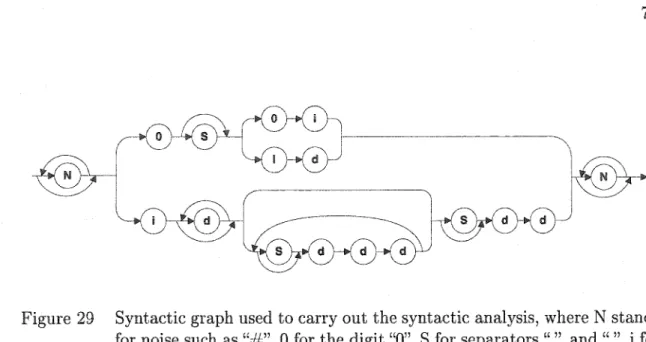
Syntactic graph used to carry out the syntactic analysis, where N stands for noise such as"#", 0 for the digit "0", S for separators "." and ",", i for the digits ranging from 1 to 9, and d for the digits ranging from 0 to 9. . . 70 Rejection mechanism: (a) Digit string, (b) Probability of each corn-panent, and ( c) Thresholds for the different classes. . . 72
Examples of numerical amounts on Brazilian bank cheques: (a) Recognized and (b) Not recognized (the correct string is the one in parentheses). . . 76 Error rate versus rejection rate for numerical amounts. 78 Error rates versus rejection rates for the NIST database: (a) Error-reject trade-off for strings of different lengths and (b) Error-Error-reject trade-off for all used fields in the test set. . . 79 Different classes of errors generated by the system: (a) Recognition errors, (b) Ligature between two digits, ( c) N atur al fragmentation, (d) Fragmentation caused by noise, and (e) Isolated digits classified as under-segmentation by Vu. . . . 81
Examples of digit strings (NIST SD19): (a) Not Recognized (the correct string is the one in parenthesis) and (b) Recognized. . . 82
Absolute verifiers. . 87
One-to-one verifier. 90
Misrecognized samples: 8 confused with 6 and 9 confused with 7. 90 Illustration of the weighted sum approach on a convex Pareto-optimal front [30]. . . 98
Ranking of a population by fronts. 99
Sorting population: (a) The population is classified into three non-dominated fronts and (b) Shared fitness values of six solutions .. 101 Flow chart of NSG A. . . . 102 Flow chart of the proposed methodology. . 104
Figure 44 Figure 45 Figure 46 Figure 47 Figure 48 Figure 49 Figure 50 Figure 51 Figure 52 Figure 53 Figure 54 Figure 55 Figure 56 Figure 57 Figure 58
Feature selection using the weighted-sum approach (a) evolution of the population in the objectives plane (one trial) and (b) Pareto-optimal solutions found by the classical approach after several tri-als . . . 108 Feature selection using a Pareto-based approach (a) Evolution of the population in the objective plane, (b) Pareto-optimal front found by NSGA and its correspondent validation curve . . . 109 Unselected features for handwritten digit recognition: (a) Concav-ities and (b) Contour . . . . 114 The fiowchart of the proposed methodology. . 122 Different kinds of classifiers found in the Pareto-optimal front. . 123 The Pareto-optimal front produced by the second-leve! MOGA: (a) Concavities, (b) Distances, and (c) Edge Maps. . . . . 125 Improvements yielded by the ensembles for (a) Concavities, (b) Distances, (c) Edge Maps, and (d) Combination of the three en-sembles. . . . 127 Examples of misclassification (the correct label is the one in paren-theses). . . . 128 Ensemble of classifiers replacing the general-purpose recognizer. 129
Examples of the numerical amount database. . . . 136 Handwriting Sample Form (HSF full-page form) . 139
Line detector masks used for extracting four-directional edge maps: (a) horizontal !ines, (b) verticallines, (c) 45-degree diagonallines, and ( d) -45-degree diagonal !ines. . . . . 143 Overall edge maps feature extraction. The compressed input image and compressed four-directional edge maps are used as features. 144 A sample pattern. . . . 145
AD BP
cc
CI CP CENPARMI CPU GA HMM HSF ICL IP NN MCA MLP MNIST MOGA NIST NP OCR PDALIST OF ACRONYMS AND SYMBOLS
Application Dependent Basic Point
Connected Component Contextual Information Contour Point
Centre for Pattern Recognition and Machine Intelligence Central Processing Unit
Genetic Algorithm Hidden Markov Model Handwritten Sample Forms Initial Concavity Level Intersection Point Nearest Neighbor
Multi-Level Concavity Analysis Multi-Layer Perceptron
Modified NIST
Multi-objective Genetic Algorithm
National Institute of Standards and Technology N ondeterministic Polynomial time
Optical Character Recognition Personal Digital Assistants
pp RR
ss
SI SD SP SVM TD TP e I* Post-Processor Recognition Rate Square Error String Image Special Database Segmentation Path Support Vector Machines Task DependentTerminal Point
State transition probability
Segmentation graph in the Viterbi algorithm Test set
States in a segmentation graph Euclidean distance
Survivor score in it
Classifier or expert
Classifier trained with three non-numerical classes Classifier trained with ten numerical classes
Classifier trained with both non-numerical and numerical classes Estimation of the thickness of the stroke
Learning rate term
Image after pre-processing Single optimal path
I(p)
A
-M N etiteration Netstep p P(·) proj(BPik) pp q XVlll Intensity of a pixel (0 or 1) Initial segment of the image Final segment of the image Set of specified patternsThe most probable interpretation of the written amount 1\1
Momentum term
Number of images in the test set
N umber of samples rejected by the system
N umber of samples correctly classified by the system N umber of samples misclassified by the system Number of epochs before reducing the learning rate Constant used to reduce the learning rate
Mutually exclusive set of the pattern space Pattern space
Number of decision variables Probability
Vertical projection of BP at the step k Post-processor
Initial state probability
Survivor terminating in state it
Desired number of distinct Pareto-optimal solutions Initial segmentation rule
s
Sh()
ashare(To, ... , Tn)
T(p)v
x Segmentation termSensitivity of the network model Sharing function
maximum distance allowed between two individuals to become a member of a niche
Thresholds used for rejection Fixed error rate
N umber of neighbors of a pixel p Over-segmentation verifier U nder-segmentation verifier Variant of a written amount Input pattern
INTRODUCTION
Handwriting consists of artificial graphical marks on a surface and its purposes are to communicate something and also to expand the human memory. It is a skill closely related to the human personality, which explains its great variability. In spite of all this variability, by the time they are five years old, most of the children can recognize digits and letters. Small characters, large characters, or rotated, aH are easily recognized by the young. The characters may be written on a cluttered background, on crumpled paper or may even be partially occluded. We take this ability for granted until we face the challenge of teaching a machine how to do the same. After 50 years of research, design of a general handwriting recognition machine remains an elusive goal.
At the beginning of a new millennium, technology has brought handwriting to a crossroads. Nowadays there are several ways to expand human memory and to facilitate communication. In the light of this, one may ask: Will handwriting be threatened with extinction? We could say no, and the reason that handwriting persists in the age of the digital computer is the convenience of paper and pen as compared to keyboards for numerous day-to-day situations. For example, students in a classroom are still not typing on a notebook computer. They store language, equations, and graphs with a pen on a paper. This typical paradigm has led to the concept of pen computing, where the keyboard is an expensive and nonergonomic component to be replaced by a pentip position sensitive surface superimposed on a graphie display that generates electronic ink. This led us to two different approaches: off-line and on-line handwriting. In the former the data are converted to digital format by scanning the writing on paper while in the latter the data are acquired by writing with a special pen on an electronic surface.
On-line systems for handwriting recognition are available in hand-held computers such as personal digital assistant (PDA). The performance of PDA is acceptable for processing hand-printed symbols. Off-line systems are less accurate than on-line systems because the temporal information is lost. However, they may have a significant economie impact on specialized domains such as interpreting handwritten postal address on envelopes, and reading numerical amounts on forms. The latter is the subject of this thesis.
A considerable number of paper-based documents are processed daily by computers all over the world in order to handle, retrieve, and store information. The great bulk of them are still processed manually by human operators, the most common and labor-consuming operation being document amount reading and typing. A common way to automate this process is to replace the human operator with an off-line handwriting recognition system which is able to do the operator's job. Such a system gets access to both theoretical and practical achievements of different fields such as pattern recognition, document analysis, machine learning, and artificial intelligence. Over the past years, severa! techniques and methodologies have been proposed in order to build faster and more reliable systems. However, notwithstanding all efforts made in this field, there is still a considerable gap between human and machine performances. Thus, the big challenge in this field is to make computers approach human performance.
Problem Statement
The focus of our work is the recognition of unconstrained handwritten numerical strings. Unconstrained handwritten numerals are handwritten numerals that are not written in separate boxes, nor written neatly, nor written with a specifie type of pen. Thus, the challenge is to recognize numbers written by people in real-life situations such as numerical amounts on cheques and numerical values on forms.
3
Sorne possible difficulties contributing to the unsatisfactory performance of many methods for recognizing handwritten numerical strings are: noise, broken digits, overlapping digits, touching digits, and unknown length of the string. Figure 1 depicts sorne of these problems.
Figure 1
Z..7C·
"'}
()9'~3 ~~
~~4
,!)""b
8lJ
(a) (b) (c)
Examples of difficult problems when recognizing strings of digits: (a) noise, (b) broken digits, and ( c) overlapping and tou ching digits.
When dealing with sorne specifie applications such as numerical amounts on bank cheques, other concerns should be added to those discussed above, e.g., non-numerical classes, possibility of expressing the same amount through different variants, ambi-guity among non-numerical characters and digits, and ligatures between digits and non-numerical characters. Figure 2 exemplifies sorne of these difficulties.
Figure 2
Jf/()46~
~B6.
O=t>
1
10-f
f
.500
()X)
5 0
-1
(a)~
'1
8
"ft
9
/0
:f.
2';15,
~5.----(b)Examples of numerical amounts: (a) non-numerical at the beginning and the end, and (b) digits connected to non-numerical classes.
On top of all this, we still have to deal with the intrinsic ambiguity of handwritten digits, which may vary depending on the database being considered. Figure 3 exhibits
such an ambiguity for the two databases used in this work. It can be observed from this Figure that the samples extracted from the numerical amounts of Brazilian bank cheques have more variability when compared to those extracted from NIST.
o
OOOb
tJOPtJ~
11//1
//11
}À2~~t?ei..l.~l.;t
3
3~35:?333
1/fl/t/~f-1./4~~
;-5::-55
5sS"S5
'-"
~
·;, /, 6 '
&>
6
6 '
7 . 7 7 7 7 7 / J
, . ,
tf.fiflfili'V
79?9f9&t991
(a)C)Oo&Voo([)(}t:?
1/f!A
:1.../.t.L/
&~.2J
Zd..l=tot2ofl
3-se6'3~Js~~
q4.44<{f~Ytj't
5s
5~~o5s5r
.G~btt~r:ob~Ç;6
r-t-=7
~
:f
7
t)%
~1"-1
g
?tl
1
f!!
9
e
8
Sr
q
~·
J
9
q
~
s
9
~
CJ
(b)Figure 3 Handwritten digits extracted from: (a) NIST SD19 and (b) numerical amounts of Brazilian bank cheques.
Summarizing, the difficulties of handwriting recognition do not lie only in recogniz-ing individual characters, but also to separate out characters from their neighbors within the string, a process known as segmentation. The literature shows us two different approaches for digit string recognition: segmentation-then-recognition and segmentation-based recognition. In the first approach, the segmentation module provides a single sequence hypothesis where each sub-sequence should contain an isolated character, which is submitted to the recognizer. The second strategy is based on a probabilistic assumption where the final decision must express the best segmentation-recognition score of the input image. Although this latter approach
5
gives a better reliability than the previous one, the main drawback lies in the com-putational effort needed to compare all the hypotheses generated. Moreover, the recognition module has to discriminate various configurations such as fragments, isolated characters and connected characters. In this strategy, segmentation can be explicit when based on eut rules [22, 122] or implicit when each pixel column is a potential eut location [14, 95].
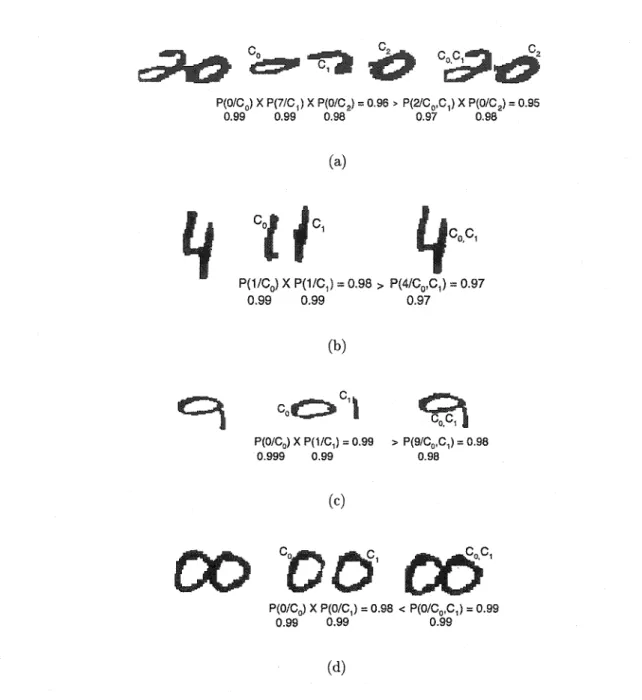
The literature has shown that segmentation-based recognition systems using explicit segmentation (sometimes also called heuristic over-segmentation [90]) have yielded better results than other approaches. However, in such an approach, the accuracy of the system depends upon the quality of the cuts generated by the segmentation algorithm (heuristics), and on the ability of the recognizer to distinguish correctly segmented characters from pieces of characters (over-segmentation) and multiple characters (under-segmentation). In our work we address the foregoing problem by using a strategy based on Recognition and Verification.
Goals of the Research
The primary goal of our research is to develop modular recognition system for hand-written numerical strings. This system takes a segmentation-based recognition ap-proach where an explicit segmentation algorithm determines the eut regions and pro-vides a multiple spatial representation. As stated before, such a system has to solve a crucial problem: distinguishing, at the recognition stage, a sequence corresponding to an inter-character segmentation from another relative to an intra-character seg-mentation. In order to deal with this problem we have proposed a strategy based on Recognition and Verification where the recognition function takes into account only a general-purpose recognizer while the verifiers evaluate the result produced by the recognizer.
A second aspect of our research lies in the optimization of the handwriting recognition system. To accomplish this, our efforts are geared towards the verification, feature selection, and ensemble of classifiers. Comprehensive experiments carried out on both isolated digits and strings of digits emphasize the difficulties in improving the performance of handwritten numerical string recognition systems.
Contributions
The original contributions of this work can be summarized as follows:
e An explicit segmentation algorithm which is based on the relationship of
com-plementary sets of structural features, namely, contour, profile, and skeletal points. In [122] such an algorithm was introduced. Sorne results using com-bination of different feature sets and comcom-bination of classifiers was presented in [121]. Finally, we developed a strategy based on graphs to manage and generate all segmentation hypotheses [120].
e We demonstrated how the verification can improve the recognition and reliabil-ity rates of the system by detecting over- and under-segmentation. Firstly, we have experimented a new scheme of verification based only on one verifier [124]. Afterwards, we realized that a strategy based on two verifiers would be more reliable. The first verifier tackles over-segmentation while the second one deals with under-segmentation. A new feature set, which takes into account multi-level concavity analysis and contextual information, was developed to feed the over-segmentation verifier. We present also the concept of modular recognition system, levels of verification, and show how such a recognition system can cope with different applications. In [125] we present a complete description of the Recognition and Verification strategy.
7
e In light of the success obtained by the verifiers discussed above, which we have called low-level verification, we elaborate another strategy of verification, called high-level verifier, to improve the reliability of the system. Two different strategies were developed: absolute and one-to-one verifiers. A thorough error analysis is also presented in arder to identify the conditions under which high-level verification is more appropriate. This work appeared in [123] and as extended version in [128].
e The issue of feature selection was first addressed in [119]. In this paper we
dis-cussed different strategies of genetic algorithms such as simple and iterative generic algorithm to perform feature selection for handwriting recognition. Thereafter, we realized that the use of a multi-objective genetic algorithms could be much more interesting since it can provide a set of different solutions (subsets of features) rather than just one solution. So we have introduced a methodology [126], that considers an efficient multi-objective genetic algorithm to generate a set of alternative solutions and a cross-validation method to in-dicate the best accuracy / complexity trade-off. We demonstrate that the cross-validation is very important when working with a set of alternative solutions. The classification accuracy is supplied by a neural network in conjunction with the sensitivity analysis. An extended version of this work will appear in [129].
e A strategy for generating an ensemble of classifiers based on feature selection was proposed in [127]. Such a scheme receives as input the different solutions provided by the feature selection algorithm. The idea is to take advantage of the fact that the feature selection algorithm yields different subsets of features with a high discriminant power, which use different parts of the same feature set. In arder to find the best classifiers to compose the ensemble, a second level of search is performed.
e As marginal contributions, we have demonstrated the reliability and appli-cability of our system by using it to recognize strings of digits in different applications such as day and year on handwritten dates [113). We also built a database of about 2,000 images of Brazilian bank cheques, which we have used to evaluate the proposed system. The specifications of this database are reported in [39] and Appendix 1.
Outline of the Thesis
This document consists of eight chapters (including the introduction and the con-clusion) and three appendixes. The current chapter outlined the problem we are working with, the goals, and the main contributions of the thesis. A review of the state of the art for off-line handwriting recognition is given in Chapter 1.
In Chapter 2, we present a brief overview of the system in order to be able to introduce all definitions related to the system. Firstly, the probabilistic model that the system is based on is introduced. Then, the classifiers, training method, and decision rules are defined. Finally, the definitions about levels of verification and modularity are presented.
In Chapter 3 we describe the two first modules of the system, namely component detection and segmentation. The former performs a very simple smoothing operation before detecting all the components in the image. Then, such components are used as input to the segmentation module, which produces a list of segmentation hypotheses that will be evaluated by the recognizer.
The Recognition and Verification strategy is addressed in Chapter 4. In this chapter all modules defined in Chapter 2 are described in detail. In addition, we present the feature set used by each classifier and also describe how the low-level verifiers and general-purpose recognizer interact with each other. In order to support the ideas
9
proposed in this thesis, Chapter 5 presents a series of comprehensive experiments, which are carried out on two different databases: numerical amounts and NIST SD19.
Chapter 6 reports our efforts towards the performance and reliability of the general-purpose recognizer. In this chapt er we discuss three well known and established techniques we have investigated: high-level verification, feature selection, and en-semble of classifiers. Finally, the final chapter concludes this thesis and shows an outlook on the future works as well.
We have assumed that the reader is familiar with the theory of pattern recognition, neural networks, and genetic algorithms. For this reason, we do not devote much attention to such subjects. For those who do not feel comfortable in these fields we would suggest the reading of the following references: [33] for pattern recognition, [9, 38] for neural networks, [48, 65] for genetic algorithms, and [30] for multi-objective genetic algorithms.
In this chapter we present the state of the art of handwritten isolated digit recog-nition and handwritten numerical string recogrecog-nition, which are the two main fields related to our research. First of all we present a very brief historie about character recognition, then we address the problem of isolated digits. Thereafter, we discuss the problem of handwritten numerical string recognition and finally sorne applica-tions of handwriting recognition.
1.1 Brief History
An interesting view about the evolution of the character recognition systems is pre-sented in [4]. The authors argue that such systems have been evolved in three ages: early ages, developments, and advancements. In the early ages (1900-1980), the first character recognizers appeared in the middle of the 40s with the develop-ment of digital computers. At that time, the works were concentrated either upon machine-printed text or upon a small set of well-distinguished handwritten text or symbols. Successful, but constrained algorithms have been implemented mostly for Latin characters and numerals [149]. The commercial character recognizers were available in the 1950s, when electronic tables capturing the x-y coordinates data of pen-tip movement was first introduced [153].
The developments age took place from 1980 to 1990. With the explosion of informa-tion technology and consequently easier access to personal computers, the previously methodologies found a very fertile environment for rapid growth in many application areas. Structural approaches [145] were initiated in many systems in addition to the statistical methods [70]. The character recognition research was focused basically on the shape recognition techniques without using any semantic information. This led
11
to an upper limit in the recognition rate, which was not sufficient in many practical applications. The state of the art of this period can be found in [112] and [153] for off-line and on-line cases respectively.
The real progress in character recognition was achieved in the advancements age (after 1990). In the early 1990s, image processing and pattern recognition were effi-ciently combined with artificial intelligence techniques. Efficient tools such as neural networks, support vector machines, hidden Markov models, fuzzy set reasoning, and natural language combined with more powerful computers and more accurate elec-tronic equipments have provided quite satisfactory results for restricted applications [134]. However, there is still a long way to go in arder to reach the ultimate goal of machine simulation of fluent human reading, especially for unconstrained off-line handwriting.
1.2 Handwritten Isolated Digit Recognition
Many researchers have tried to improve the performance of recognition systems by investigating features, classification methods, and different system architectures such as multi-experts and verification modules.
Selection of a feature extraction method is probably the single most important factor in achieving high recognition performance. For this reason, such a subject has gained considerable attention of the scientific community. A good survey about feature extraction can be found in [156]. The literature of handwritten digit recognition shows us basically three classes of features.
The first class are the gray-level or binary values of all the pixels in an image, usually represented by a N -dimensional vector, where N is the number of pixels in the image. Since no abstraction is applied, all the variances among the patterns are to be handled by a classification algorithm. One fast evolving approach is using pixel
features as direct input to neural networks [59, 90]. The reason of success can be explained by the fact that neural networks also act as a feature extractor during the learning.
Features of the second class are the structural features of the image, which are typically perceptual entities of the character such as bends, end points, intersections, loops, measures of concavity, distance information, and directional features [67, 93, 116, 118, 151, 169]. The last class of features are the statistical features. They are results of global transformations on an image. Typical mathematical transformations include moments [6, 68], Fourier descriptors [144], and wavelet transforms [27, 133]. In order to get more reliable systems, many researchers have turned towards the combination of statistical and structural features in a same structure of classification (e.g., in a one-shot classifier). Cai and Liu in [18] present an approach that integrates both statistical and structural information for the recognition of unconstrained hand-written numerals. Heutte et al [60] propose a combination of seven different families of features to feed a linear discrimination based classifier. The performances of these systems are reported in Table I.
Alongside these investigations of feature extraction methods, several works have ad-dressed classification methods. Different classifiers have been used for handwritten digit recognition, such as (i) template matching, (ii) statistical techniques, (iii) struc-tural techniques, and (iv) neural networks. Template matching operations determine the degree of similarity between two vectors (groups of pixels, shapes, curvatures, etc) in the feature space. Matching techniques can be grouped into two classes: direct matching [43], deformable templates and elastic matching [71].
Statistical techniques is concerned with statistical decision functions and a set of op-timality criteria, which determine the probability of the observed pattern belonging
13
to a certain class. Several popular handwriting recognition approaches belong to this domain, as suggested in [70]:
e The k-Nearest-Neighbor (k-NN) rule is a popular non-parametric recognition method, where the posteriori probability is estimated from the frequency of nearest neighbors of the unknown pattern. Good recognition results for hand-writing recognition have been reported by using this approach [53]. The prob-lem with this method is the high computational cost when the classification is conducted. To surpass such a problem sorne researchers have been proposed faster k-NNs methods [108].
o The Bayesian classifier assigns a pattern to a class with the maximum posteriori probability. Class prototypes are used in the training stage to estimate the class-conditional probability density function for a feature vector [24, 33, 114].
o The polynomial discriminant classifier assigns a pattern to a class with the maximum discriminant value which is computed by a polynomial in the com-ponents of a feature vector. The class models are implicitly represented by the coefficients in the polynomial [141].
o Hidden Markov Model (HMM) is a statistical framework for modelling sequen-tial input by state transitions. It has been widely used in speech recogni-tion and its applicarecogni-tions to handwritten digit recognirecogni-tion have been growing [14, 18, 135].
o Fuzzy set reasoning is a technique that employs fuzzy set elements to describe the similarities between the features of the characters. The literature shows different approaches such as fuzzy graphs [1], fuzzy rules (44], fuzzy logic [56], and linguistic fuzzy [87].
e One of the most interesting recent developments in classifier design was the introduction of the support vector machines (SVM) by Vapnik [157]. In the past few years, SVM has received increasing attention in the communities of machine learning and pattern recognition due to its excellent generalization performance. It is primarily a two-class classifier, but multiple SVMs can be combined to form a classification system for multi-class classification. Sorne SVM classification systems have been developed for handwritten digit recog-nition in the recent years, and sorne promising results have been reported [5, 17, 155].
In structural handwriting recognition the characters are represented as unions of structural primitives. It is assumed that the character primitives extracted from handwriting are quantifiable, and one can find the relations among them. Basically, structural methods can be divided into two classes: grammatical methods [145] and graphical methods [62].
In the past decade, there has been a tremendous increase of interest in neural net-works as a possible solution to the problem of recognizing handwritten numerals. A neural network is defined as a computing structure consisting of a massively parallel interconnection of adaptative "neural" processors. The main advantages of neural networks are
(i)
the ability to be trained automatically from examples,(ii)
good performance with noisy data,(iii)
possible parallel implementation, and (iv) efficient tools for learning large databases. The most widely studied and used neural network is the Multi-Layer Perceptron (MLP) [9]. Such an architecture trained with the gradient descent applied to a sum-of-square error function [91] is among the most popular and versatile forms of neural network classifiers and is also among the most frequently used traditional classifiers form handwriting recognition. See [164] for a review. Other architectures include Convolutional Networks [90], Self-Organized15
Maps [163], Radial Basis Function [9], Space Displacement Neural Network [106], Time Delay Neural Networks (96, 3], and Quantum Neural Networks [165].
In the recent years, combination of classifiers has been attracted theoretical and practical attention. In the long run, the combined decision is supposed to be better (more reliable) than the classification decision of the best individual classifier. Such an idea appears under a variety of names in the literature: classifiers fusion [46], classifiers combination [79, 159], mixture of experts [69], committees [9], classifiers ensembles [81, 57], etc.
The literature on theoretical classifier combination has grown rapidly [2, 79, 84, 92, 154, 159]. The papers advocate different fusion strategies, demonstrate the ben-efits of classifier, and provide a theoretical underpinning of the various strategies commonly used in multiple expert fusion. Sorne interesting results of combination scheme are also reported in practical applications. Suen et al [151] combined four structural methods using variants of majority vote. High performance was reported on CENPARMI database. Xu et al [159] used the same four classifiers and results are provided using Dempster-Shafter and Bayesian formalism. Lam and Suen [86] applied weighted voting to handwritten digit recognition using seven classifiers. Kit-tler et al [79] applied several classifier combination strategies such as product rule, sum rule, min rule, max rule, median rule, and majority vote to recognize handwrit-ten numerals. Gorski [50] demonstrated that for large databases, neural networks provide compelling results as a classifier integrator.
Another strategy that can increase the recognition rate in a relatively easy way with a small additional cost is through the use of verification. Such a scheme consists of refining the top few candidates in order to enhance the recognition rate economically. Such a kind of scheme has been successfully applied to handwriting recognition in [14, 152, 167].
Table I compiles sorne of the results reported in the literature from 1996 until nowa-days. It is important to point out that the recognition, rejection, and error rates are not directly comparable, since these results are based on different databases. The symbol "-" means that the rate was not reported by the author. For performance of the systems published before 1996, please see [94).
Table I
Compilation of sorne of the results reported in the literature (Rec: Recognition rate, Rej: Rejection Rate, and Rel: Reliability Rate).
Au thor Year Rec. Error Rej. Rel. Database No. of
(%)
(%)
(%) (%)
used ImagesLee [94] 1996 97.1 2.9 CENPARMI 4,000
Gader and Khabou [45) 1996 96.3 1.0 2.7 98.9 CENPARMI 10,000
Ha and Bunke [54) 1997 99.5 0.5 NIST SD3 173,124
Cheng and Yan [23) 1998 98.5 0.9 0.6 99.1 NIST 5,278
Hu and Yan [67] 1998 96.8 0.5 2.7 99.4 NIST 10,852
Heutte et al [60] 1998 94.8 0.5 4.7 99.5 NIST SD3 53,324
Oh et al [117] 1999 97.8 2.2 CENPARMI 2,000
Liu and Nakagawa [100) 1999 98.4 1.6 CENPARMI 2,000
Park et al [132) 2000 98.2 1.8 NIST SD3 53,301
Cai and Liu [18] 2001 98.4 1.6 CE DAR 2,213
Zhou et al [166] 2001 90.0 1.0 9.0 98.9 CENPARMI 2,000
Zhang et al [162] 2001 97.8 2.2 NIST 10,000
Lu et al [103] 2002 96.4 3.6 NIST SD3 10,426
Mayraz and Hinton [107] 2002 98.3 1.7 MNIST 10,000
1.3 Handwritten N umerical String Recognition
Handwritten numerical string recognition has been a topic of intensive research in recent years due to its large number of potential applications. The recognition of numerical strings differs from that of isolated digits because it requires the seg-mentation of a string into separate entities representing individuals digits. It is also
17
different from the problem of recognizing handwritten words form a dictionary in the sense that almost no contextual information is available, i.e., any digit can follow any other one. Segmentation of numerical strings is generally a difficult task because individual numerals in a string can overlap or touch each other, or a numeral can be broken into several parts.
Strategies for handwritten numerical string recognition can be divided into segmenta-tion-then-recognition [143, 145] and segmentation-based recognition [55, 105]. In the first approach, the segmentation module provides a single sequence hypothesis where each sub-sequence should contain an isolated character, which is submitted to the recognizer. This technique shows its limits rapidly when the correct segmentation does not fit with the pre-defined rules of the segmenter. Very often, contextual information is used in the segmentation process to improve the robustness of the system.
The second strategy is based on a probabilistic assumption where the final decision must ~xpress the best segmentation-recognition score ofthe input image. Usually, the system yields a list of hypotheses from the segmentation module and each hypothesis is then evaluated by the recognition. Finally, the list is post-processed taking into account the contextual information. Although this approach gives a better reliability than the previous one, the main drawback lies in the computational effort needed to compare ali the hypotheses generated. Moreover, the recognition module has to discriminate various configurations such as fragments, isolated characters and connected characters. In this strategy, segmentation can be explicit when based on eut rules [96, 22) or implicit when each pixel column is a potential eut location [14, 95]. A good review about segmentation can be found in [20].
Indeed, handwritten numerical string recognition is present in almost every applica-tion involving handwriting recogniapplica-tion, for instance, postal address [89, 77], cheque
processing [96, 74, 80], and form reading [14, 55]. Such applications have been very popular in handwriting recognition research, due to the availability of relatively inex-pensive CPU power, and the possibility to reduce considerably the manual effort in-volved in these tasks. In the following subsections we discuss two applications where handwritten numerical string recognition has been widely applied: bank cheque pro-cessing and form propro-cessing.
1.3.1 Bank Cheque Processing
Bank cheques are probably the most widespread documents. Nearly one hundred bil-lion cheques circulate yearly all over the world [51]. The great bulk of them are still processed manually by human operators, the most common and labor-consuming operation being document amount reading and typing. Automation of bank cheque processing uses both recent theoretical achievements of pattern recognition and doc-ument analysis, and practical approaches developed in adjacent applications such as postal automation or form recognition.
Processing numerical amounts in bank cheques is a difficult task due to the nature of the handwritten material. For instance, bank cheque systems have to take into account the great variability in the representation of a numerical amount, e.g. the number of components to be identified, which is not necessary, for example, for a zip-code recognition system since the number of digits is fixed and known a priori. Another important requirement from a bank cheque system is its reliability. It has been estimated that a system becomes commercially efficient only when the error rate is 1% or lower.
Several different approaches to recognize numerical amounts on bank cheques can be found in the literature. Lethelier et al [96] present a system to recognize numerical amounts on French cheques. It is based on a segmentation-based recognition strategy where an explicit segmentation algorithm provides the eut regions. Their classifier
19
is based on a combination of a Radial Basis Function network and a Timed Delay neural network. Besicles of the ten numerical classes, this system copes with four non-numerical classes ( "-", ".", ",", "F").
Kaufmann and Bunke [7 4] propose a system for Swiss postal cheques where the numerical amount is processed by the system presented in [55]. Sin ce su ch a classi-fier does not tackle the cents portion and non-numerical symbols such as currency characters, horizontal !ines, they are manually removed.
Dzuba et al [34] (Parascript) describe an industrial system for American persona! cheques which uses a classifier based on matching input subgraph to graphs of symbol prototypes. The symbol prototype consists of the symbol graph and the description of its elements (geometrical characteristics of edges, mutual position of edges and nades, etc.). In the prototype an obligatory subgraph is defined. The obligatory subgraph is a subgraph where each element of which should have a match in the input subgraph. Sorne pre-processing is done by means of Hough transformation. Another industrial system is described in [51]. The A2iA CheckReaderiM is designed to process cheques written in French or English and it is based on sorne key ideas such as Hierarchical organization, soft decision-making, modularity, complementar-ity, adaptivity and, segmentation-based recognition. Their classifier is composed of five neural networks. Four of them are feed with different feature sets and their outputs combined into a fifth neural network. They daim that the average read rate at the document level varies from 65 to 85% with error rate fixed at 1%, but they do not specify the performance achieved by the handwritten digit classifier. The performance of sorne applications found in the literature, including those discussed above are reported in Table II.
It is impossible to compare the results presented in Table II, since different databases and formats are used, different non-numerical classes are involved, and different sizes
Table II
Performance of sorne bank cheque systems.
Au thor Rec. Err or Rej. Test Year
(%) (%) (%) Data base
Lethelier et al [96] 60.0 40.0 10,000 French cheques 1995 Houle et al [66] 55.0 1.0 44.0 1,000 American cheques 1996 Parascript [34] 53.0 1.0 46.0 5,000 American cheques 1997 Lee et al [98] 72.7 27.3 121 Brazilian cheques 1997 Suen et al [150] 62.0 1.0 37.0 400 Canadian cheques 1998 Kaufmann and Bunke [7 4] 79.3 20.7 1,500 Swiss cheques 2000 of databases are considered. However, we can observe that the recognition rates of those systems that implemented a rejection mechanism ( error rate fixed at 1%) varies from 50 to 60%.
1.3.2 Form processing
Form processing such as census and tax forms also are potential application for handwritten numerical string recognition. The challenge here consists of recognizing strings of unknown length which are not neatly written. The most common data base used for research in this case is the NIST database.
NIST data base was originally designed for competition of First Census Optical Char-acter Recognition Systems Conference in May 1992 organized by the National Insti-tute for Standards and Technology (NIST). The event was for assessing the state of the art in OCR. In 1995 NIST released an upgrade called SD19 (Special Database 19) [52] (see Appendix 1). Severa! researchers have been used NIST databases to report results of algorithms for handwritten numerical string recognition. In the remaining of this section we discuss sorne of these works. The results claimed by authors are reported in Table III.
21
Martin et al in [104] propose the exhaustive and saccadic scan methods for integrat-ing segmentation and recognition of handwritten strintegrat-ings. In the first scan method (Method 1), a neural network trained with back-propagation exhaustively scans a numeral string, and it is trained to recognize whether its input window is centered over a single digit or between digits. When its input window is centered on a digit, it is classified. The weakness of this method is that it generates too many candi-date segments to be efficient. In the saccadic scan method (Method 2), the neural network is trained not only to recognize whether a character is centered on its input window, but also to compute ballistic "eye" movements that enable the input window jump from one digit to the next. A set of 5,000 numeral strings extracted from the NIST database and equally distributed into 5 string classes (2-,3-,4-,5-, and 6-digit string) is used for testing. No recognition rates have been reported. Thus, they were calculated from the reported reject and error rates.
Keeler and Rumelhart [75] use a neural network to simultaneously segments and recognizes connected characters. Their self-organizing integrated segmentation and recognition system takes position-independent information as targets and self-organizes the activities of the units in a competitive way to infer the positional information. A set of 5,000 numeral strings extracted from the NIST database and equally dis-tributed into 5 string classes (2-,3-,4-,5-, and 6-digit string) is used for testing. Again, the recogniton rates were calculated from the reported reject and error rates ( 1%). Fujisawa et al [41] introduce a region-based segmentation method for character seg-mentation and recognition, which takes into account the stroke shapes of touching patterns. The stroke shapes are analyzed in the case of touching characters. This sys-tem first extracts the connected components from a numeral string. These connected components are analyzed in terms of spatial interrelations. They can be grouped into meaningful character patterns or separated by means of a method for finding the touching position. Multiple hypotheses and verification based on digit recognition