Effect of encapsulated nanoparticles on thermophillic anaerobic digestion
Alaaeddin Al-Ahmad1*, Serge Hiligsmann1, Frank Delvigne1, Stéphanie D. Lambert2, Benoît Heinrichs2, , Frédéric Weekers3, Benoît Lavigne4, Philippe Thonart11Centre Wallon de Biologie Industrielle, Université de Liège, Gembloux Agro-Bio Tech, Passage des Déportés 2 5030 Gembloux, Belgium 2Laboratoire de Génie Chimique, B6a, Université de Liège, B-4000 Liège, Belgium
3ARTECHNO SA, rue Herman Meganck 21 à B-5032 Gembloux-Les Isnes, Belgium 4SANIFOX SPRL, Enhet-Centre, 47 B-5590 Chevetogne (CINEY)
The growing need of energy globally and the unavoidable increasing dependency on energy being produced from non-renewable source is unsustainable. The world is turning to a search for another energy source, among the possible fuel sources; methane produced by the anaerobic digestion offers tremendous potential as a renewable energy currency. Due to their characteristics, nanoparticles have a great potential in application to many science field. In anaerobic digestion microorganisms may tack advantages of nanoparticles by transferring more efficiently electrons to acceotors (1) and enhancing the activity of microorganisms
The purposes of this study are to investigate encapsulated nanoparticles that may be used as catalysts to enhance the anaerobic digestion. Specific objectives of this study are:
Study the effect of 10-5mol/L of nanoparticles on methane production
kinetic and aceticlastic methanogenes using acetate as substrate. Test different concentrations of nanoparticles which showed the best catalytic effect.
Introduction
Introduction
Objectives
Objectives
1. L. Beckers, S. Hiligsmann, S.D. Lambert, B. Heinrichs, and P. Thonart, 'Improving Effect of Metal and Oxide Nanoparticles Encapsulated in Porous Silica on Fermentative Biohydrogen Production by Clostridium Butyricum', Bioresour Technol, 133 (2013), 109-17.
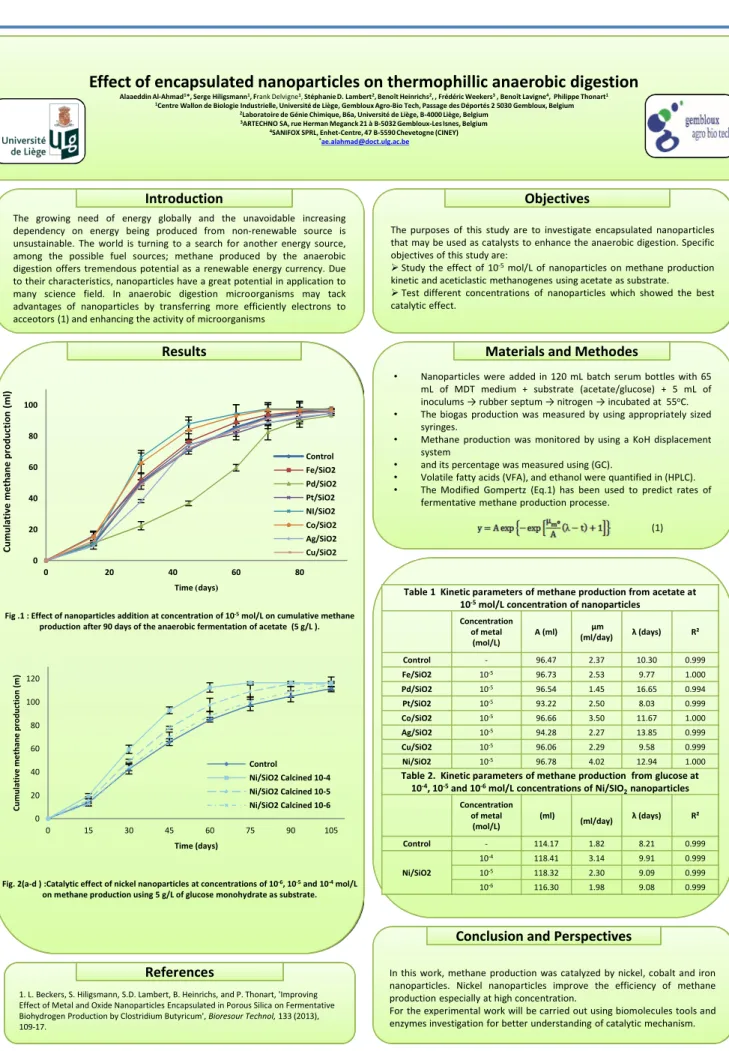
In this work, methane production was catalyzed by nickel, cobalt and iron nanoparticles. Nickel nanoparticles improve the efficiency of methane production especially at high concentration.
For the experimental work will be carried out using biomolecules tools and enzymes investigation for better understanding of catalytic mechanism.
• Nanoparticles were added in 120 mL batch serum bottles with 65 mL of MDT medium + substrate (acetate/glucose) + 5 mL of inoculums → rubber septum → nitrogen → incubated at 55oC.
• The biogas production was measured by using appropriately sized syringes.
• Methane production was monitored by using a KoH displacement system
• and its percentage was measured using (GC).
• Volatile fatty acids (VFA), and ethanol were quantified in (HPLC). • The Modified Gompertz (Eq.1) has been used to predict rates of
fermentative methane production processe.
(1)
Results
Results
Materials and Methodes
Materials and Methodes
References
References
Conclusion and Perspectives
Conclusion and Perspectives
0 20 40 60 80 100 0 20 40 60 80 Cumulative meth ane productio n (ml) Time (days) Control Fe/SiO2 Pd/SiO2 Pt/SiO2 NI/SiO2 Co/SiO2 Ag/SiO2 Cu/SiO2 0 20 40 60 80 100 120 0 15 30 45 60 75 90 105 Cumulative methane production (m ) Time (days) Control Ni/SiO2 Calcined 10-4 Ni/SiO2 Calcined 10-5 Ni/SiO2 Calcined 10-6
Fig .1 : Effect of nanoparticles addition at concentration of 10-5mol/L on cumulative methane
production after 90 days of the anaerobic fermentation of acetate (5 g/L ).
Fig. 2(a-d ) :Catalytic effect of nickel nanoparticles at concentrations of 10-6, 10-5and 10-4mol/L
on methane production using 5 g/L of glucose monohydrate as substrate.
Table 1 Kinetic parameters of methane production from acetate at 10-5mol/L concentration of nanoparticles
Concentration of metal (mol/L) A (ml) µm (ml/day) λ (days) R² Control - 96.47 2.37 10.30 0.999 Fe/SiO2 10-5 96.73 2.53 9.77 1.000 Pd/SiO2 10-5 96.54 1.45 16.65 0.994 Pt/SiO2 10-5 93.22 2.50 8.03 0.999 Co/SiO2 10-5 96.66 3.50 11.67 1.000 Ag/SiO2 10-5 94.28 2.27 13.85 0.999 Cu/SiO2 10-5 96.06 2.29 9.58 0.999 Ni/SiO2 10-5 96.78 4.02 12.94 1.000
Table 2. Kinetic parameters of methane production from glucose at 10-4, 10-5and 10-6mol/L concentrations of Ni/SIO
2nanoparticles Concentration of metal (mol/L) (ml) (ml/day) λ (days) R² Control - 114.17 1.82 8.21 0.999 Ni/SiO2 10-4 118.41 3.14 9.91 0.999 10-5 118.32 2.30 9.09 0.999 10-6 116.30 1.98 9.08 0.999