Â
Cooperative Extension
I~RAES-97Sensors for
Nondestructive Testing
Measuring the Quality of
Fresh Fruits and Vegetables
Proceedings from the
Sensors for Nondestructive Testing
international Conference and Tour
Orlando, Florida
February 18-21, 1997
Northeast Regional Agricultural Engineering Service
Cooperative Extension
152 Riley-Robb Hall
Ithaca, New York 14853-5701
APPLE
ST-IAPE
fNSPECTION WITH COMPUTER VISION
Leemans V., M. Sc.Department of Agricultural Engineering,
Faculté des Sciences Agronomiques de Gembloux (Belgium) Magein H., PhD.
Department of Horticulture,
Faculté des Sciences Agrollomiques de Gembloux (Belgium) Destain M.-F., PhD., AS.AE. Member Engineer
Department of Agricultural Engineering,
Faculté des Sciences Agronomiques de Gembloux (Belgium)
ABSTRACT
Two shape separation methods were compared for shape grading of 'Golden Delicious' apples using machine vision. The first one was based on moments and other geometric parameters while the second implied the computation of Fourier descriptors. Both methods required that one stem view and six cheek views of the fruit were presented to the camera. The Fourier descriptors were found the most efficient method since they allowed an accuracy in classification reachmg 96 % and can be made invariant to translation, rotation and scale. Furthermore, theyare obtained from boundary information and do not need to examine the
whole area of the apple. They permit the reconstruction of the apple shape from the
hannonics. Key-words
INTRODUCTION
Among other characteristics, such as colour, size, defects, ..., shape determines the overall quality of fruit. The European Union has edicted standards describing the characteristics of fruit aimed for exportation within its borders. For apples, the standards specify that the fruit belonging to "Extra" grade must conform to the characteristic shape of the variety (Journal Officiel des Communautés Européennes, 1989). Sorne misshapeness is tolerated under grade A and the tolerances increase in grade B.
Apple shapes vary with species and cultivar. According to an early study (Childers, 1949 quoted by Kuhn et aL,. 1982)~ the shape of Delicious' apples is characterised as being "conic with 5 more or less distinct ribs and 5 crowns on the shoulders at the calyx end". The apple
shape is influenced by the growing environment. For example, the dose and time of
application of gibberellins may influence the ratio of longitudinal to transversal diameter (Eccher and Boffeli, 1981).
Up to now in Europ . automated sorting machines are available to perform sorting operations of apples on basis of size and colour. Nevertheless, the grading process of apples on the basis of shape and defects continues to be a manual effort. In fact, shape is difficult to appreciate by a simple visual impression and, in certain circumstances, it may be that the attention of the operators would be more focused on the possible presence of severe defects such as scab than on misshapeness. It would thus be interesting to use machine vision as part of an automated shape inspection system in order to have a fair and impartial evaluation of apple shape.
Developing adequate algorithms to describe the shape of apples is complicated because of the high natural variability of these products, implying that the machine vision must be trained by
a great number of samples to ensure its reliability. The main techniques used for shape
description of food ·material may be summarised as follows. Sakar and Wolfe (1985), who develop algorithms for feature extraction of tomatoes, compute the curvature of chain-coded boundaries (8-neighbour chain). Van de Vooren et al. (1992) use image analysis for variety testing of mushrooms and rneasure morphological characters such as circularity, bending energy, sphericity, eccentricity, ... Singh and Delwiche (1994) study the performance of machine vision at detecting defects in stone fruit and quantify the shape by the ratio «maximum dimension)) to «minimum dimension )). Ding and Gunasekaran (1994) develop food shape feature extractors based on the comparison of the object to be tested with an average reference undamaged object. Heinemann et al. (1995) define a shape separator based on tOOd-order moments to form a basis for gtading 'Golden Delicious' apples. Tao et al. (1995) develop a Fourier-based shape separation rnethod for shape grading ofpotatoes. The objective of t is study was to develop an effective shape separation method for the grading of 'Golden Delicious' apples using machine vision. Two methods of feature extraction
were compared. The first one is based on moments and other geometric parameters while the
second implies the computation of Fourier descriptors. In order to judge the fairest method,
the following technical specifications are considered: - the classification accuracy;
- the invariance to translation, rotation and scale: - the speed of the computation.
IMAGE PROCESSING SYSTEM
The shape investigation is a part of a whole study, inc1uding colour information. In this aim, the image processing system comprises a Sony XC-003p 3-CCD camera, a lmascan Chroma colour image frame grabber, a Compaq 80S861133MHz computer equipped with a CD-ROM writer to store the images. The frame grabber captured 768 x 576 pixels images from the camera with eight-bit resolution per colour channel. With a lens of 16 mm focal length, the viewing frame was approximately 140 mm x 90 mm at a camera-to-object distance of 400 mm. The Image Pro plus software (2.0, 1993) containing basic functions for image acquisition and processing was used. The C++ (Microsoft, 2.0, 1994) programming language was used for the development of the algorithms.
Images were acquir under diffuse illumination provided by two fluorescent tubes, 20 W,
positioned in the lower part of a horizontal reflector cylinder (SOO mm in diameter). The
interior surface of the cylinder was painted flat white. A window at the top of the cylindrical chamber was made so that the camera can acquire an image of the upper part of the fruit. A
dark conveyor belt was chosen to provide a hîgh contrast between the fruit and the
background.
METHons
Two methods were used and compared to define the apple shape. On the basis of the
classification given by Sonka et al. (199S), the tirst method is "region-based" information while the second is based on apple "boundary" information.
Region-based infonnation
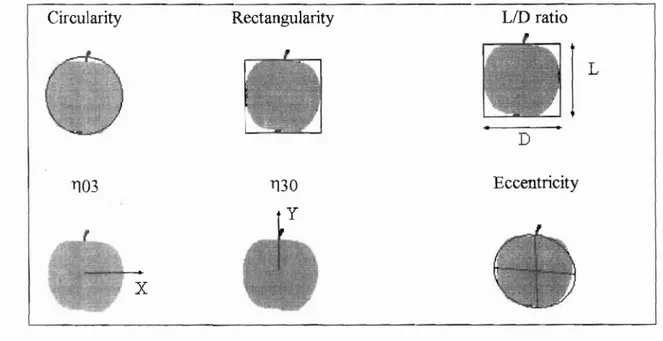
Simple region-based parameters can describe an object shape. The circularity is one of the simplest parameters ofthis kind (Fig. 1). It is defined as:
with p the perimeter and A the area. The circularity is a dimensionless number with a minimum value of 1 for circ1es. The circularity is 1.27 for a square and shows high values for
elongated objects. It does not depend on the orientation of the objects on the image plane.
The rectangulan'ty r is the ratio of apple area and the area of a bounding rectangle having an imposed direction (Fig. 1). Rectangularity assumes values comprised between 0 and 1 with 1
representing a perfect rectangle. LlD gives the ratio of the side lengths of the rectangle (Fig. j ).
The moments are weil known in statistics, where they are used to characterise data and probability density functions, as weil as in mechanics where they are associated with rotating
bodies problems. The central moments of order p, q are invariant to translation and are given
by:
<Xl <Xl
Il pq
=
L L
(i - x cY
(j -
ycr
f (i,j ) i= -00 j=-oowhere i, j, xc, yc are respectively the co-ordinates of the pixels and of the centroid of the apple. The function f(~j) is a binary, 2-dimensional function with level "1" within the apple and level "0" elsewhere.
Circularity Rectangularity LfD ratio
L
Eccentricity
1103 1130
Y
x
Figure 1 : Region-based parameters.
From the second order central moments, it is possible to compute the principal axes of the
apple and the principal moments. These are respectively the eigenvectors and the eigenvalues of the following rnatrix :
The eccentricity € can he defined as the ratio hetween square roots of the two principal
moments (Fig. 1). This parameter ranges from l to 00. It is one for a circular object and high
for a line-shaped object. It depends solely on the shape, not on size and orientation.
The third order central moments J.1.03 and J.1.30 are useful because they indicate the fruit imbalance with respect respectively to x and y axes (Fig. l). They are computed using the following relationships: '" J.1. 30
=
L
(i -
xc)
3 J.1. 03 =L
co(j -
y cY
i=: - ".(J j= - coIn order to arrive at a size independent description, J.1.03 and J.1.30 can be normalised using following expressions:
with Ct.
=
2.5 and J.1.oo is the area 0 f the 0 bject.Moment invariants <1> l and <1>2
,
defined by Hu (1982) and quoted by Jahne (1995), depend neither on position, nor size, nor orientation and are given by:<1>1
=
1120 +1102<1> 2
=
(11 20 - 1102 ) 2 + 4 (11Il ) 2where 11 Il, 1120 and 1102 are the second order normalised central moments. A disadvantage of the moment invariants is that it is difficult to give them a geometric interpretation.
Boundary infonnation
The Fourier descriptors use only the boundary of the object and consider it as a pair of cyclic
waveforms which provides a parametric description of the boundary trace. Let
e
be the anglebetween the radius drawn from the centroid to a point on the boundary and the x-axis for example. By travelling along the boundary curve, one describes the apple radius r(k) as a function of this angle. Boundary signature r(k) is one-dimensional and translated to Fourier domain by:
1 ~ ( -j27thk)
F(h)
=-
L..J r(k) exp\ )N k=l N
where N is the number of equiangular samples to describe the boundary, F(h) is the complex magnitude at harmonic h, with h
=
0,1,2 .... N/2-1. The Fourier descriptors give a complete description of an object which can be made translation, rotation and scale invariant. If an object is rotated byan angle y, the Fourier descriptors are multiplied bya phase factor. If an object is scaled by a factor ofa,
the Fourier descriptors are multiplied by the same factor. AlgorithmsFirstly, the RGB colour information issued from the camera was transformed to a 8-bits grey leve1. To extract the binary apple from image data, images were threshold at a 50 leve1. A succession of erosion, dilatation and erosion operators was then applied to remove the stem from the image without altering the apple shape. Before computing the Fourier descriptors, an edge detection was performed on the image. The harmonic components were computed thanks to a Fourier transform (FFT).
RESULTS AND DISCUSSION
Two samples of 20 apples 'Golden Delicious' were taken at random in grades A and B established by professional inspectors. 14 misshapen apples were selected within the rejected products. Whatever the chosen method for feature extraction, two particular fruit orientations were chosen. Firstly, the stem-calyx axis was placed perpendicular to the camera optical axis. Six· images of the fruit cheeks were acquired at 60° rotation increments, around the stem calyx axis. Setondly, the fruit was placed with the calix end on the conveyor. In tbis latter case, one view was acquired of the stem pole.
Region-based information
Circularity c, rectangularity r, eccentricity e, third order central normalised moments 1103, 1130 and invariants moments 4> 1, 4>2 were computed for the views from the stem end. Mean, maximum and minimum values of the same parameters were computed for the six views of the cheek apples.
The most significant parameters were found by performing an analysis of variance to compare the apple populations graded in class A, B and within the rejected fruit. It appears that for the stem view, the value of parameters c, e and 4>1 were significantly different. For the cheek views, rmax, Emax, Cmax, 1103min and 1130max, 4> 1max and 4>2max were different between
the grades and were considered as good indicators of apple shape. On the basis of the
numerical values of tbese parameters, it may be confirmed that commonly accepted 'Golden Delicious' has a co' 'hape and is aImost symmetric witb regard to stem - calyx axis (Kuhn et a1., 1982). The mean values of these parameters cOlTesponding to apples belonging to categories A and B are given in Table 1.
1@te l Mean values of 'hape1ara eters for apples belonging ta grades A and B rr ea~urçment on chc' ~ks I~ él!am~je.[s VaJue~ ( tlll larity c 1 17 R~ctangulanty l' 0.82 J ccel10icity ê 1.05 110 8.79 E-04 1 il ') 00 E-04
o
160? 7tB E 051 1111""1 ,ml qlladratll' dis .riminant functions were dey loped usmg the mosl slgnificant
Jl r nDtter.. and mcludmg either the third arder central nonnalised moments 1l03, 1130 or the
loment invariants
4l1,
<1>2.iv!leil Ising the Ihird orcier œntral normalised moments and taking mto accOlmt two grades
'ç, " :l'd: L\ t-B. rejcned), 1he classification accuracy reached about 90 %, provldt'd Thal par' fT! ~Ier, related li lx th the cheeks and the stem views were mtroduced. The best set ùf
N parameter'i mc1uded (rnOmaxkheek, and (g )stem. The accuracy in the discrimmation
,a.., lui r a1ly Improv d when three or lO\lT parameters were used On the other hand, li
, eCle'i'i~S dramaticallv when performing computations only on the basis of the eheek vjews or
> J'len I~ss lhan 6 I.:he~k vtews wert:: taken inl account. Furthe more, results were qulte
mtlar whatt:\oer th, kind uf dIScriminant functïon, linear or quadratlc. When considcring ~
, rw es l, A. B, 'ejected), the accuracy or the classification was smaller This resulted probahly
P'()Tfl thl. fa :t that the manua1 inspectiun considere<! as reference IS Ilot perfeet: grading on the
,",aSI, _' the ,hape 15 not easy to perform manually and, in sorne cases, does not appear a .
nm rd' 1JO f hl" m' nel 1
r
thl~ lllspect()rsWlI t tht> d:'lSSlficatlon was quite satisfactory by using the third order central Donnalised
1.1 JIlll:JUS, it sutTered Iron' the fact !hat results depended on the apple orientation. '10
·vere lme UliS problem, the moments were taken about the principal axes which are an
llherclll shape characteristll. Unfortunately., th orientation of these latter were found lo vary
VICie1 trom the paliltlOn of the stem-calyx . xi , from one apple 10 another, and hence this l ,t:hTIllfue was not adequate to characterise the symmetry or the conie shape of the fruit.
~1"I~n using the ml)ment invanants a basis for the classitîcation, tht: enor reached more than -'C (~'1 whatever thr krnd 0 f discriminating function clinear or quadratlc)
Il airst sta e the Founer descriptors were computed by taking N :- 256 (Fig. 2) The
magnnud 01 lhe hannonics F(h) were nonnalised by dlVlding each of them by F(O) which IS
Nlwn lt Înereases and, eonsequently. the number of samples N to describe the boWldary was .111l1ted to ')j j
2\
.
004 0035 003 d D?fi I} '2 ~ )f 1:. 011 UO! 0 8 l') 2L )9 36 43 50 57 64 71 78 85 92 99 106 113 120 1?7 HarmoniesFi~Lln' 2 l'''\H.lfÏer transform 'Jf the radius rl'!<)
l 'lhllit 1 ,lt tlw Int: hot! in shape reconstructlOn was tested by l:omputmg the Founer n r HesllL ,."cre compared when laking into account 1.., harmonies, WhlCh is ~he
na 'OltUl uumbeJ avaitabll: when N=32, and sm.aller numbers such as 2 a.nd 4.
--~ 1fi 11Fmnonics 4 harmonies ,
? tlamlOnlcs
JI appeared that a low number of harmonies were sufficient for representing the shape of ,ln
Ir
le ,yIthùllt lousing e sential in ormation (Fig 1). For example, fi Fig. 3, the global shapehy 4 hannum 'S, mort: accuracy m the reconstru1,1ion espeelalJyat the calyx pole. 15 !:3lam ~d llh l'i harmonies.
1hr l-' HU'jur jeslï'lptl)r~ céilry infonnation about the boundary shapt~ As mentioned above,
Il,1, the mean abject radIus, F( 1) represents the bending of an object. F(2) corresponds t0
l. lI! .·d ùb·tcts. l~(\) lS slgmficant in presence oftriangular objects, F(4) cal] he pointed ouI
. hCll he nh,rct.. are squared etc. Since the apple shape approaches a circular fom. as
1 Lt "kd namdy oy the geometric parameters computed above, the numerical valu ofr(O) IS
l~' ILr ~ff~ ,lof the apple shape on F( 1), F(2), ,..is shown al FIg 4
- - . _ - - - lU 1 iJ. , III r ~'. '
\
\ 1 1 JIU' "[ U 111 Harmonic~ 1 t b • 1 li. L... I}/ -.T II., r 1./
r.
1 1 1 /\• , \,/1 \
,il"',t
- 1 -t ---T -+---1---+--+ FI31 r(5) F(7) ! F(ql 1---""----+---+--I ~··-i 1~(11 rrl:l) 1"'(1:"1 Hmmonj~.J '/J 1\
.
1\
\ 1 \ l ' " ~-' 1 f --1 t----+--t-- +----1 - j -+- - "" 1-(J) !-(!:i) FO) Hl;!) r(11 j r (H) r (LI
Harmonies ri ... t- - t - + - - - - ! - I
---
"'=y' - - 1 - 1 -'1--- -1 --p==t=1 f(;~ r(6) F(7) f-(!:l) 1-(11) [-(1i) F(11-i1 HarmonÎesl' 1gUi 4 Apple Shape and. magrlltude of haf/1U1!H':!>
p) a d II b "e1ongoo W grad A ht~ir "pectrum Jndi :ated peaks ~orresI-0ndmg
'~rl 'l1 vdy (1 rU) 1'(4) and 1"(2), F(4)
111 "lUP' ot hoth truÎt could be relaled ta a square, but apple a .vas mure "triangubr" than
Ipplt: h wInch is mure elongated Apples c and d were relected by the inspectors because of h If ÎI1Jdmis__ tble shapt. Apple c was charactensed by 100 high amplitude or F( ) and! v'~ry
1 . '} • m. Wh~ll exhibited a too low F(4) 'aIlles
JI .'. un ,nt al1aly'il. \ as Ilsed to allocate the apple: mto ~ grad~,'. U\;R reJected) Ihe ei!~h
Ir 1 1iirnIOf11'.:S 'Nere considered as weil for the cheek views a liH th,' ,tem view, 1 h,
... 1ffi les lllVl'n above ..hovved that the extremum values of the check views wcre particularly
iPll 'K ml tCI descnbe rhe apple shape ClJnseqUt~tltly the maXInlllrrt and mmimum vétluç~ (Jf
tilt èlght I1rst hannofiles were introduced into the Lmear discriminant analysis Wlth thlS
1I11" 1" ..1 (H n" ot appl s were eorrectly graded. Witb quadratic dIse' ninant analysls, and
he 1 hOl ':1ll}; spe lai 1' nmcs, namely F( ), F(3), H 4) for the cheek VlewS and F( 1t F(.-' J,
01'" ( the ~rem VIt"W. the accuracy classification reached 96 (~'o The badly sorted apples 'Il JlI}l~Ù ~ent'rall:y to mterm diate grade B and il was noticed lh.it It 15 generally eaSl r to
epl1rd t' nUIts betwe'o A, H in on~ hand and reiect catcgory in the nther hand than wlthin A
'Ill! '
) r r dC~l,:nr)l)( ~\' t' ,; powerful LOoi v"hilh ensure\ <1 bel1er [1ccuracy 10 apple
11 • tim han regmn-based parameters, By taking six views 01 the cheeks spaced tlf (1)°
.1 '"," l i f t he st m and extracting extTemum values 0 f partiel!laI harmonies, accuracy in
atlun eadle5 96 ~'n Fwthennore, th Fourier descriptors can he made mvariant ta 1 am ru atmn nd slale this feature i5 Important to puint out for "on-Hne" !Tadmg \.' ~s fl1'y arc nhtained from boundary informalion and do not need to examme tle 1 ·1' are'. ~l th,.~ apple; ln t at way. they can ensure éI reduction of memory stOl'age when If I-)"r 'd W Ieglon based parameters su(;h as the moments Al Icast. thcy allow HIC
n 1.1 III ;)f th\., appk 'hapc
l unwlcdgemt'ut
.1· ruJI ,1 ",>uPPllt1eÙ Il)-' the MJnl'itère de l ',1~n,'Ullure (Belgllll1l). ProJecl "1 ri ut1~llIlC;;
" nvclltlon NI' 14-61~1/5703A
;ihn' eT'1I.1 j)l~ilf/I Imare Proce sing COf/f'ept" , a!v,onthm'i and w:/entijlc appliulflOfI~'.
\\e llll ptingcr-Yerl'g Ilj'I';
U ( lU élsekaran bap feature extractIfl1l and classlfica1ii'fl )ffood matcnal using
'11pU '! lS\I'n l/(/n.\GcfiOtnori/'w4Sr1E~7(:Î),11994LJ5,7154'j
l' • TB, fI.: l .. ' Eflens of dose and time oi applIcation ot (iA41 7 ~m ru~settlllg. fruit
~! . r ,l<;hè pt" If '(;(lIJe Dl"uCIOUS' apples ", Scipntta Iforticu!tlfTae 14. 119l{ Il. '114
Il IIll'l liUlll P.H 1 Varghe~ .. Z A., MOITOW CT., Sommer III lU" Crassweller leM.
'\111 hl t,' li '1nu lIIspection of 'Golden Deliclous apple~ ", Applied Engineenng in
'H:{ ,,,liure. 1~' E! \6),
r
199)], 901-9061 1/17 .. / (t,li 'ei de (~ommunaulés eurnpfo"tlft' , "Numle de ~\jalitc pour pommc~ t.l
Il 1'J L 1l'.; (~ . t 4 X
U Il , fnon 1. A., l jnratb C. R., " A Measurement Technique tor «DelicIOus » Apple
h,lP jfoJïi.";ciencr Vu. 17(5), [l9H2], /H5-7K7
ark,lr li.; )lfe R R, "Feature extraction techniques for sorting tomatoes by computer
.1 ln • 1ram. olthf' ASAE 2'1',(3), fl9gSl. 970-974
1I1 Il '\1. Delwid c M.J "Machine vIsion metbl.lds fOI ùdect sùliillg sionefruit", "t'!! (U;CIlS o/tlle ASAE. 17 (6), fl994]. 19X~-1 ~97
ilaval. Vaclav, Boyle Roger. Image Pmce's;l'Ig 4nuhsis and Machine ~ ,siun.
hapman &. Hall (omptrng, 1995,
1\)( ow t' l'. Hemerrumn PH .. SOnIDler III H.L . Fourier-Based Separalion
~ III lllt for Shape Grading ofPotatoes Using Machme Vision", Iransaction o} the AS:rIE
,,1 ~) . ,ll\).: pp 949-95/.
, 1 t Vûur~n J.\.;. Polder G . Van Der Heijden W AM .. ,. ldentificat1ùn of mushrooms
LUl> 1 11~1J l: IlTJagt' iillalYSlS ' frrmsactlOll!:J ofÎfœAL\'AE, .~5 (1). tQ',/2, pp, 347-V'iO