HAL Id: hal-01004986
https://hal.archives-ouvertes.fr/hal-01004986
Submitted on 5 Mar 2017
HAL is a multi-disciplinary open access
archive for the deposit and dissemination of
sci-entific research documents, whether they are
pub-lished or not. The documents may come from
teaching and research institutions in France or
abroad, or from public or private research centers.
L’archive ouverte pluridisciplinaire HAL, est
destinée au dépôt et à la diffusion de documents
scientifiques de niveau recherche, publiés ou non,
émanant des établissements d’enseignement et de
recherche français ou étrangers, des laboratoires
publics ou privés.
Distributed under a Creative Commons Attribution| 4.0 International License
Elastic model for partially saturated granular materials
Pierre Yves Hicher, Ching Chang
To cite this version:
Pierre Yves Hicher, Ching Chang. Elastic model for partially saturated granular materials. Journal
of Engineering Mechanics - ASCE, American Society of Civil Engineers, 2008, 134 (6), pp.505-513.
�10.1061/(ASCE)0733-9399(2008)134:6(505)�. �hal-01004986�
Elastic Model for Partially Saturated Granular Materials
P.-Y. Hicher
1and C. S. Chang
2Abstract:This paper presents the development of an elastic model for partially saturated granular materials based on micromechanical factor consideration. A granular material is considered as an assembly of particles. The stress-strain relationship for an assembly can be determined by integrating the behavior at all interparticle contacts and by using a static hypothesis, which relates the average stress of the granular assembly to a mean field of particle contact forces. As for the nonsaturated state, capillary forces at grain contacts are added to the contact forces created by an external load. These are then calculated as a function of the degree of saturation, depending on the grain size distribution and on the void ratio of the granular assembly. Hypothesizing a Hertz-Mindlin law for the grain contacts leads to an elastic nonlinear behavior of the particulate material. The prediction of the stress-strain model is compared to experimental results obtained from several different granular materials in dry, partially saturated and fully saturated states. The numerical predictions demon-strate that the model is capable of taking into account the influence of key parameters, such as degree of saturation, void ratio, and mean stress.
Keywords Granular materials; Stress strain relations; Elastic deformation; Unsaturated soils; Soil suction; Micromechanics.
Introduction
A granular material can be considered as a collection of particles of different sizes and shapes. This discontinuous medium can be represented by a fictitious continuous medium whose mechanical properties should depend on the geometric arrangement and con-tact interactions between interacting particles. For dry granular materials, the interparticle forces are related to the applied exter-nal stresses. When a certain amount of water is added to the grain assembly, significant changes, such as an increase in stiffness and strength, can be observed. These changes can be explained by the formation of water menisci between neighboring particles, which creates capillary forces. The amplitude of these capillary forces depends upon the degree of saturation and the morphology at particle level共grain and pore sizes兲 共Bishop and Blight 1963; Hicher 1998兲. A number of studies have addressed the determina-tion of the capillary forces for a two-particle system 共Fredlund and Rahardjo 1993; Lian et al. 1993; Taibi 1994; Cho and
Santamaria 2001; Molenkamp and Nazemi 2003a兲. However,
fewer results are available for more complex particle packing
共Molenkamp and Nazemi 2003b; Dangla and Coussy 1998兲.
Macroscopic analyses of the mechanical behavior of unsatur-ated granular materials in the elastic domain can be classified into
two categories. Most of the data are analyzed on the basis of the double-variable theory by considering that the strain tensor is governed by the total net stress tensorij− pg␦ij, pgbeing the
gas pressure, and the negative pore water pressure or suction s
共Fredlund and Rahardjo 1993; Alonso et al. 1990兲. However,
sev-eral authors have shown that the experimental results could be interpreted using the concept of a generalized effective stress⬘ by introducing a capillary stress c, function of the suction s
共Biarez et al. 1993兲
⬘= − pgI −c 共1兲
The above equation can be considered as a general formulation of the equation proposed by Bishop and Blight共1963兲 for unsat-urated soils
⬘= − pgI + X共Sl兲共pg− pl兲I 共2兲
where pl= liquid pressure; and X共Sl兲⫽function of the degree of
saturation Slof the liquid phase共X=0 for a dry material, X=1 for
a fully saturated material兲. Dangla and Coussy 共1998兲 have con-firmed theoretically the validity of the effective stress approach in the elastic domain.
An interesting method for granular material modeling is to develop homogenization techniques in order to derive a stress-strain relationship from forces and displacements at the particle level. Two different approaches can be followed based on the so-called kinematic hypothesis, which states that every particle displaces in accordance with a uniform deformation field共Chang 1988兲, or on the static hypothesis, which relates the average stress of the granular assembly to a mean field of particle contact forces
共Cambou et al. 1995; Chang and Gao 1996; Liao et al. 1997兲.
Hicher and Chang 共2005兲 demonstrated the capability of these two approaches to provide a good approximation of the nonlinear elastic behavior of dry granular materials along different loading paths. In this study, the static hypothesis was considered and the capillary forces were introduced at each grain contact in order to extend the model to unsaturated granular media. The
determina-1Professor, Research Institute in Civil and Mechanical Engineering,
UMR CNRS 6183, Ecole Centrale Nantes, BP 92101, 44321 Nantes Cedex 3, France. E-mail: [email protected]
2Professor, Dept. of Civil and Environmental Engineering, Univ. of
tion of the elastic parameters of the granular assembly based on the characteristics of the particle contacts will be discussed and the predictions of the model along different stress loading will be compared to experimental results obtained from different granular materials, in dry, partially, or fully saturated states.
Micromechanical Approach
In this model, we envision a granular material as a collection of particles. The deformation of a representative volume of this ma-terial is generated by the mobilization of contact particles inside the whole volume. Thus, the stress-strain relationship can be derived as an average of the mobilization behavior at all inter-particle contact planes in the representative volume. At the ␣th contact plane, the local forces fi␣and the local movements␦i␣can
be denoted as follows: fi␣=兵fn␣, fs␣, ft␣其 and ␦i␣=兵␦n␣,␦s␣,␦t␣其, where the subscripts n, s, and t represent the components in the three directions of the local coordinate system. The direction nor-mal to the plane is denoted as n; the other two orthogonal direc-tions, s and t, are tangential to the plane共Fig. 1兲.
The forces and movements at all contact planes are suitably superimposed to obtain the macroscopic stress-strain tensors. The macroscopic stiffness tensor is obtained by suitably superimpos-ing the stiffness properties at all interparticle contacts. In such a formulation, it has usually been assumed that the microstructure is statically constrained, which means that the forces acting on each contact plane are assumed equal to the resolve components of the macroscopic stress tensor.
Contact Forces and Capillary Forces
For dry samples, the contact forces are directly determined from the external stresses applied on the granular assembly. In the case of wetted samples, different stages of saturation can be iden-tified. The fully saturated regime corresponds to a two-phase ma-terial with water filling completely the voids between grains. The water pressure pw can be positive or negative 共suction兲, but in
both cases the effective stress concept 共Terzaghi 1925兲 can be applied and the contact forces determined by considering the ef-fective stresses ⬘ as the external stresses 共De Buhan and Dormieux 1996; Hicher 1998兲
⬘= − pwI 共3兲
In the case of partially saturated samples, the liquid phase is distributed in menisci located between close grains and as a con-sequence, capillary forces are applied on the grains and are added to the contact forces defined above. When the water content de-creases inside a saturated granular sample, the air breaks through at a given point. The negative water pressure or suction corre-sponding to that point is called the air-entry pressure. Its value depends on the pore sizes. Afterwards, the sample becomes un-saturated with the water phase being connected inside the pores. This state is called the funicular regime, in which a constant de-crease of the degree of saturation corresponds to a gentle dede-crease in pore water pressure, which is homogenized along the continu-ous water phase. The menisci start to form between two grains, not necessarily in contact, and are connected to each other. The pendular regime starts when the water menisci become discon-nected. The water is no longer continuous and equilibrium in the water pressure is obtained by the vapor pressure. At this stage, the capillary forces start to increase drastically according to the pore size. If the drying process continues, the water bridges begin to fail, at first with the noncontacting grains, until a completely dry state is achieved and no capillary forces are left inside the granu-lar assembly.
Several studies have shown that the attractive capillary forces between two grains connected by a water bridge are a decreasing function of the distance between the grains until the bridge fails
关see, for example Biarez et al. 共1993兲, Taibi 共1994兲, and Chateau
et al. 共2002兲兴. This function depends on the volume of liquid found between the grains. Different mathematical expressions have been proposed for these capillary forces, which are the sum of the pressure forces exerted by the liquid on the wetted area and the surface tension forces acting along the wetted perimeter. In this study, we retained the following expression:
fncap= fmaxe−C共d/R兲 共4兲
where fcap= capillary force between two neighboring grains, not
necessarily in contact; fmax= value of fcapfor two grains in
con-tact; and R = mean grain radius; d = distance between two grains and is equal to l − 2R, l being the branch length given as a distri-bution function of the grain size and the void ratio; c = material parameter, dependent on the grain morphology and on the water content; fmax depends on the capillary pressure defined as the
pressure jump across the liquid-air interface, on the liquid-air in-terface surface tension, as well as on the geometry of the menisci governed by the solid-liquid contact angle and the filling angle. In this study, a simplified approach was to consider an empirical relation between fmax and the degree of saturation Sr, without
taking into account the hysteresis along drying and wetting paths
共Hicher 1998兲 fmax= f0 Sr S0 for 0⬍ Sr⬍ S0 fmax= f0 S0共1 − Sr兲 Sr共1 − S0兲 for S0⬍ Sr⬍ 1 共5兲
where f0 and S0= material parameters; f0 depends on the grain
size distribution; S0= degree of saturation at which any further
drying of the specimen will cause substantial breaking of the menisci in the pendular domain; S0depends on the nature of the
granular material.
Since the menisci are not necessarily all formed in the funicu-lar regime, Eq. 共5兲 may not be applicable for high degrees of saturation. However, in this first approach, we decided to extend
it to the whole range of saturation, considering that the amplitudes of capillary forces were small for degrees of saturation higher than 80% and could, therefore, be approached with sufficient ac-curacy by using the same equation.
Interparticle Behavior
The contact stiffness of an orientation includes normal stiffness kn␣ and shear stiffness kt␣ of the contact plane. The elastic stiffness
tensor is defined in
fi␣= kij␣␦␣j 共6兲
where kij␣= interparticle contact stiffness tensor; ␦j␣= relative
dis-placement at the interparticle contact.
Let knbe the compressive contact stiffness in normal direction
and ksbe the shear contact stiffness. Assuming the shear contact
stiffness to be the same in s and t directions and that there is no coupling effect between normal and shear directions, the contact stiffness tensor kqkc can then be expressed in terms of the unit
vectors n, s, and t, as
kij␣= kn␣ni␣n␣j+ k␣t共si␣s␣j+ ti␣tj␣兲 共7兲
For each particle contact, the corresponding auxiliary local coordinate system is related to the global coordinate system ac-cording to共see Fig. 1兲
n =共cos ␥,sin ␥ cos ,sin ␥ sin 兲 s =共− sin ␥,cos ␥ cos ,cos ␥ sin 兲
t =共0,− sin ,cos 兲 共8兲
The vector s is on the plane defined by x and n. The vector t is perpendicular to this plane and can be obtained by the cross-product of n⫻s. The rolling resistances between two particles are not discussed in this paper.
The value of the stiffness for two elastic spheres can be
esti-mated from Hertz-Mindlin’s formulation 共Mindlin 1969兲. For
sand grains, a revised form can be adopted共Chang et al. 1989兲, given by kn= kn0
冉
fn fref冊
n kt= kt0冉
fn fref冊
n 共9兲where fn= contact force in normal direction; fref= reference force
to make the units consistent. In this paper, frefis selected to be 1
N. kn0, kt0, and n = material constants. For two spherical particles,
if the parameters are chosen to be kn0= Ggr
冉
冑
3 1 −g冊
2/3冉
fref GgR2冊
1/3 kt0= kn0 2共1 − g兲 2 −g 共10兲where Gg and g= respectively, the shear modulus and the
Poisson’s ratio for the grains; and r = mean radius of the grains. Eq.共9兲 is equivalent to Hertz-Mindlin’s contact formulation.
Macro-Micro Relationship
The stress-strain relationship for an assembly can be determined from integrating the behavior of interparticles at all contacts. In the integration process, a micro-macro relationship is required. For simplicity, the effects of particle spin and the change of in-terparticle orientations are not considered during a small strain
increment 共i.e., finite-strain condition is not considered兲. Using the static hypotheses proposed by Liao et al.共1997兲, we obtain the relation between the strain and interparticle displacement
u˙j,i= Aik
−1
兺
␣=1 N
␦˙␣jlk␣ 共11兲
where the branch vector lk␣ is defined as the vector joining the centers of two particles;␦j␣= relative displacement at the interpar-ticle contact关see Eq. 共6兲兴; and the fabric tensor is defined as
Aik=
兺
␣=1 Nli␣lk␣ 共12兲
The length of branch vectors for the unsaturated case may be greater than the summation of the two particle radius due to the film of water between particles. Thus, the branch vectors do not have the same value for all particle pairs. It is noted that in Eqs.共11兲 and 共12兲, the summation is not limited to direct contacts. The summation should also include indirect contacts of neighbor-ing particles within a Voronoi polygon, as discussed by Cambou et al.共2000兲.
Using Eq. 共11兲 and invoking the condition that the rate of energy dissipation expressed in terms of the assembly stress and strain must be equivalent to that expressed in terms of interpar-ticle forces and movements, we are seeking to establish the ex-pression of interparticle forces in terms of assembly stress. It is obvious that there exist an infinite number of solutions that can satisfy the conditions stated above. However, without invoking further constraints, it can be proved that the following relation-ship is always one of the possible solutions共Liao et al. 1997兲:
f˙␣j=˙ijAik
−1l
k
␣V 共13兲
Eq.共13兲 also satisfies the stress definition in terms of interparticle contact forces共Cauchy theory of stress mean兲
˙ij=
1 V
兺
␣=1N
f˙j␣li␣ 共14兲
Because of its approximation nature, Eq. 共13兲 can be viewed as an averaged solution. The interparticle force can be regarded as the mean value for forces on all contact planes of the same ori-entation. For convenience, we also regard the branch vector as the mean value for all contact planes of the same orientation.
Using the definition of Eq.共14兲, the stress induced by capillary forces can be computed and is termed as capillary stress, given by
共˙ij兲cap=
1 V␣=1
兺
N
f˙␣共cap兲j li␣ 共15兲
It is noted that this term is not analogous to the usual concept of capillary pressure or suction, which represents the negative pore water pressure inside the unsaturated material共Bishop and Blight 1963兲. In this model, the capillary stress depends on the geometry of the pores and is a tensor rather than a scalar. Only for an isotropic distribution of the branch lengths l␣, the capillary stress can be reduced to an isotropic tensor. This can be the case for an initially isotropic structure during isotropic loading, but during deviatoric loading, an induced anisotropy is created and the capillary tensor is no longer isotropic.
By adding the contact forces due to the external stresses
关Eq. 共14兲兴 and the capillary forces 关Eq. 共15兲兴, we can define a
*= + cap 共16兲
This equation represents a generalization of Eq. 共2兲 proposed by Bishop, in which the capillary stress is reduced to an isotropic tensor. Dangla and Coussy 共1998兲 demonstrated the validity of the effective stress approach in elasticity by means of an energy approach. They obtained an expression similar to Eq.共2兲, but with an additional term corresponding to the work of the interfaces. As pointed out before, the capillary forces in our model, and as a consequence, the capillary stresses depend on the negative pore water pressure, or suction, and on the water-air interface surface tension. A similar approach can be found in the work of Fleureau and et al.共2003兲 who obtained an explicit expression of the cap-illary stress as a function of the suction for regular arrangements of spherical grains by neglecting the surface tension. The defini-tion of the capillary stress tensor in Eq. 共15兲 can, therefore, be considered as an extension of the results obtained from these previous studies to cases of nonisotropic granular assemblies.
Stress-Strain Relationship
Using Eqs.共6兲, 共11兲, and 共13兲, the following relationship between stress and strain can be obtained:
u˙i,j= Cijmp˙mp where Cijmp= Aik
−1A mn −1V
兺
␣ 共kjp ␣兲−1l k ␣l n ␣ 共17兲For elastic behavior, Eq.共17兲 can lead to a closed-form solu-tion in the case of a random packing of equal-size particles共Liao et al. 1997兲. It is noted that for contacts in the same orientation, the branch vector and contact stiffness are their mean values.
The orientation of each interparticle contact can be expressed by two angles and ␥ in a spherical coordinate system as shown in Fig. 1. The orientational distribution of interparticle contacts can be described by a probability density function E共,␥兲. In the case of random packing with sufficient number of particles, the discrete probability density function can be approximated by a continuous probability density function. Integration of E共,␥兲 over the surface of unit sphere should equal to one 共i.e., self-consistency equation兲 1 =
冕
0 /2冕
0 2 E共,␥兲sin ␥dd␥ 共18兲For isotropic packing structure, E共,␥兲=1/2.
For any arbitrary parameter hc, which represents interparticle
contact property, the summation of hc over all interparticle
con-tacts can be approximated by an expression of an integral, given by 1 N
兺
c=1 N hc=冕
0 /2冕
0 2 E共,␥兲h共,␥兲sin ␥dd␥ 共19兲 where N = total number of interparticle contacts; and h共,␥兲 = continuous expression of hc.Using the definition of Eq. 共19兲 and assuming an isotropic packing structure, the following summation can be replaced by an integral form: Aik=
兺
c=1 N liclkc=Nl 2 2A ¯ ik where A¯ik=冕
0 /2冕
0 2 ninksin␥dd␥ 共20兲For convenience, we define a packing density index 共normal-ized number of contacts per unit volume兲, =Nl3/V. Note that the total number of contacts N per volume V is normalized by the cube of the mean branch length l. The packing density index is unitless. The branch length is defined as the length between cen-troids of two contact particles. For round particles, the mean branch length is approximately equal to the mean particle size D. The packing density index for an assembly of equal-sized spheres can be related to the mean coordination number n¯ and the void ratio e of the assembly共Chang et al. 1989兲
=Nl3
V = 3n¯
共1 + e兲 共21兲
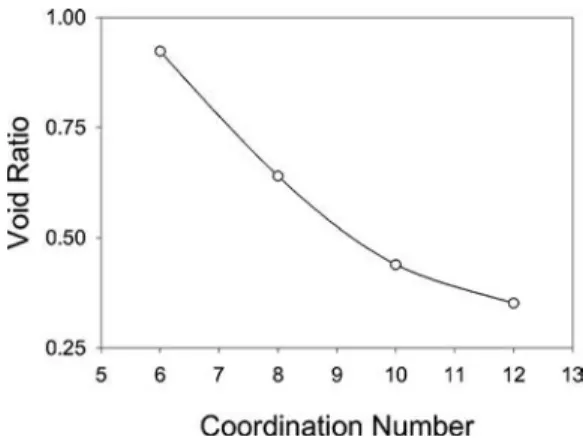
A relationship between n¯ and e obtained for a regular packing of spheres is plotted in Fig. 2. For an isotropic packing structure, using the packing density index, we can express the flexibility tensor Cijmp−1 =2l A¯ik −1A¯ mn −1
冕
0 /2冕
0 2 k−1jp共,␥兲nknnsin␥dd␥ 共22兲Although the packing structure is isotropic, the contact stiff-ness can be orientational dependent because the contact forces are orientational dependent关see Eq. 共9兲兴. Thus, the assembly can ex-hibit anisotropic behavior due to the anisotropy of applied stresses.
A numerical integration method can be used for the integrals in Eqs.共17兲 and 共22兲. The integrals are computed based on a set of integration points on the surface of a sphere. Each integration point represents a contact orientation and has a weighing factor. We found that the results were more accurate by using a set of fully symmetrical integration points. A study of the performance of using different numbers of orientations showed 37 points to be adequate共Chang and Hicher 2005兲.
Elastic Properties of Dry Granular Materials
As a first step, we will describe the procedure used to model the elastic behavior of dry granular materials. If one assumes an iso-tropic fabric for the material, the parameters of the proposed model are the following:
• packing density index: Nl3/V.
• mean particle size, D.
• interparticle elastic constants: kn0, kt0, and n.
The unit volume V and the mean particle size D are in fact related, so that only one of these two values has to be considered.
The number of contacts per unit volume governs the density of the packing. If we assume that the same relationship as the one presented in Fig. 2 for a regular packing of spheres can be roughly applied to irregular packing共Liao et al. 2000兲, a relation-ship can be obtained between N/V and void ratio e, for R=1.
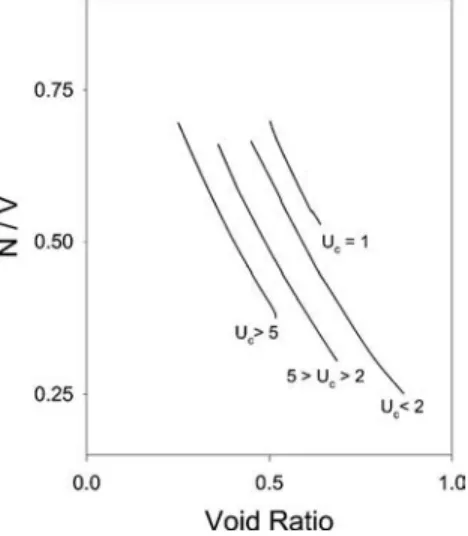
This relationship, applicable to spherical grains, has to be adapted for grains with irregular shapes, which can only be done by an empirical method. Based on the study of different granular materials behavior 共Hicher 2001兲, a chart, giving an empirical relationship between N/V and void ratio e for various coefficients of uniformity Uc = d60/d10, was proposed 共Hicher and Chang 2005兲 and is presented in Fig. 3.
One can, therefore, determine theoretically the shear modulus of an assembly of particles, knowing the elastic properties
共Gg,g兲 of the particles, the grain size distribution, and the void
ratio关Eq. 共22兲兴. In fact, Chang and Gao 共1996兲 have demonstrated that static approaches underestimate the true stiffness of the pack-ing. As a consequence, the approach hereby adopted was to determine the parameters of the model through the following pro-cedure. From the test results, we could directly determine the coefficient of nonlinearity n as well as the ratio␣=kt0/kn0, which
is directly related to the Poisson’s ratio of the assembly. The ratio N/V could be determined from Fig. 3. The value of kn0 could,
therefore, be determined by fitting predicted and experimental values obtained for the material stiffness共E or G兲. A typical value of kn0= 2,420 was derived by fitting predicted and experimental
values in the case of a glass ballotini assembly as well as for quartzic sands. Using this procedure, Hicher and Chang 共2006兲 showed the capacity of the present model to reproduce with very good accuracy the elastic behavior of different granular materials. The same procedure was used in this work to determine the parameters of the model for the studied granular materials in dry state. The grain size distribution curves of the studied materials are presented in Fig. 4.
Elastic Properties of Unsaturated Granular Materials
Resonant column tests made on fine-grained cohesionless soils by Wu et al.共1984兲 showed the influence of the capillary stresses on
the values of the shear modulus G. The unsaturated samples were compacted in a mold that was placed on the pedestal of the reso-nant column device, at a desired density and water content. Dry samples were prepared with a vibrator to obtain the required density. Fully saturated samples were prepared by introducing distilled water into prepared dry samples. For all the tested soils, the authors found a significant increase in the shear modulus with the decrease of the degree of saturation. A maximum influence was obtained for degrees of saturation between 5 and 20%, ac-cording to the nature of the soil. For lower degrees of saturation, a decrease of the shear modulus was observed, and completely dry samples had the same modulus as the fully saturated samples. The authors proposed a correlation of the optimum degree of saturation, giving the maximum shear modulus, with the grain size, represented by the d10value in mm
共Sr兲opt=共− 6.5 log共d10兲 + 1.5兲/100 共23兲
in which共Sr兲optis equivalent to S0in Eq.共5兲, d10being the
effec-tive grain size in mm.
Fig. 5 presents the results obtained for the glacier way silt for two different confining pressures 共see grain size distribution curve in Fig. 4兲. The value of G was the same for Sr= 0% and
Sr= 100%. A well-marked peak for the two confining pressures
could be observed, which occurred for a value of Sraround 17%.
The maximum value of G is 1.8 times its value for dry and satu-rated states at a confining pressure of 50 kPa and 1.6 times at a confining pressure of 100 kPa. The capillary effect appears more pronounced at lower confining pressures.
Fig. 3.Empirical relationship between contact density N/V and void ratio as a function of grain size distribution
Fig. 4.Grain size distributions of the studied granular materials
The general trend showing the evolution of the shear modulus with the degree of saturation is in agreement with the model concepts. That implies an identical value of G at dry and fully saturated states in the absence of capillary forces and a maximum influence of these forces at an optimum degree of saturation, as given by Eq.共5兲 in which S0corresponds to共Sr兲optin Eq.共23兲. To
determine the capillary forces, Eq.共4兲 includes two material pa-rameters c and d. Very little information could be gathered on these two parameters by simply using the test results. Therefore, we decided to take a constant value c = 8 and a value d function of the mean grain size d50: d = 1.1d50. These values give a standard
evolution for the capillary forces, function of the distance be-tween particles, as well as an initial isotropic distribution of these forces. For the numerical simulations, the following parameters had to be determined:
• The parameters of the elastic nonlinear law: kn0, kt0, and n.
• The parameters of the capillary forces equation: f0and S0.
kn0and n were determined from the values of G obtained at
dry共or saturated states兲. A ratio kt0/kn0= 0.35 was assumed,
lead-ing to a Poisson’s ratio n = 0.2, which corresponds to a standard value for this type of material共Hicher 1996兲.
The value of N/V was determined by using the chart in Fig. 3. For a material with Uc⬎5, a void ratio e=0.58 corresponds to
N/V=0.31.
S0 was considered equal to 共Sr兲opt in Eq. 共23兲 for
d10= 0.0024 mm. f0 was computed in order to fit the maximum
value of G for the confining pressure of 100 kPa. The material parameters for Glacier Way Silt are summarized in Table 1.
The numerical results are presented in Fig. 5 together with the experimental ones. A good overall agreement was obtained for the two confining pressures. Starting from the fully saturated state, the shear modulus values increase first slowly for degrees of satu-ration varying between 100 and 70% and then faster up to the maximum values obtained for Sr= S0. The computed peak value of
G was close to the experimental one for the confining pressure of 50 kPa, showing a more significant effect of the capillary forces at low confining pressure. For degrees of saturation lower than S0,
the shear modulus values decrease toward the values obtained for dry states.
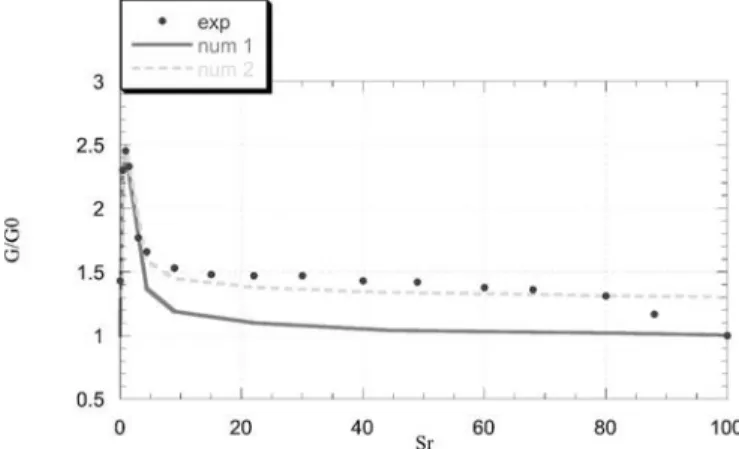
Cho and Santamaria共2001兲 also measured the elastic proper-ties of granular materials, using, however, a different preparation technique. The samples were prepared in a oedometric cell. They were mixed with distilled water at saturated conditions and gradu-ally poured into the cell. They were then subjected to gradual drying in an incubator at 50° C. Shear wave velocity was mea-sured continuously during drying by means of bender elements placed on top and bottom platens. In this study, we concentrated on two of the tested granular materials: monosize glass beads and sandboil sand共see grain size distribution curves in Fig. 4兲. The results obtained on glass beads are presented in Fig. 6. They show a continuous increase of the shear modulus with the decrease of the degree of saturation up to a peak value obtained for Sr= 0.007 and then a sharp decrease as drying continues. The G
value at the dry state remains slightly higher than the one obtained at a fully saturated state. The authors explain the differ-ence by an increase in internal coordination during drying and residual compressive stress. The value of Srat peak shear
modu-lus was found to be equal to 0.007, which differs from the value computed from Eq.共23兲: 共Sr兲opt= 0.053. This could be due to the
mode of preparation, which is different in the two cases and could lead to different specimen states at small degrees of saturation. For a specimen prepared at a given low water content, menisci might not form between two wet particles because the water film is not thick enough, whereas during drying, the menisci may sub-sist longer before starting to fail when the water continues to evaporate.
For the numerical simulations, kn0and n were determined from
the values of G obtained at saturated state, using previous studies on elastic properties on glass beads共Hicher and Chang 2006兲. S0 was chosen equal to 0.007 and f0was determined by fitting the G
peak value共Table 2兲.
The experimental testing was performed under a very small applied vertical stress: 1.5 kPa. Numerical simulations were per-formed at a higher stress共10 kPa兲 to prevent numerical errors. As a result, we decided to present the evolution of the ratio G/G0, rather than the absolute values of G, as function of Sr. A
compari-son of experimental and numerical results in Fig. 6 shows an
overall agreement in the pendular domain 共Sr⬍5%兲 except
for the very dry state where the computed ratio G/G0converges toward 1, while it remains around 1.4 in the test results. However, the numerical values are smaller than the experimental ones in the funicular domain. We can see in Fig. 6 that the difference is mainly due to the fact that the experimental values increase significantly between Sr= 100% and Sr= 80%: for Sr= 80%,
G/G0= 1.31, while this increase remains more limited between 80 and 10%: for Sr= 10%, G/G0= 1.51. A similar trend was obtained
in the numerical simulations in this intermediate range of degrees of saturation, while the initial strong increase failed to appear. Its physical meaning lies in the drying process, which follows a mechanism often termed “ink bottle.” When water is progres-sively removed from the sample, the pore space remains saturated as long as the negative water pressure is not big enough to allow the formation of a meniscus. The air entry point corresponds to the suction value for which an air bubble will form inside the pore. When the material is highly heterogeneous, this phenom-Table 1.Model Parameters for Glacier Way Silt
kn0 ␣ n N/V S0
f0 共N兲
2,200 0.35 0.5 0.31 0.175 0.02
Table 2.Model Parameters for Glass Beads共Simulation 1兲
kn0 ␣ n N/V S0
f0
共N兲
2,420 0.35 0.5 0.61 0.007 0.025
Fig. 6. Evolution of shear modulus with degree of saturation for glass beads
enon is progressive, as water is removed first from the biggest pores and then from smaller and smaller pores during the drying process. On the contrary, for monosized grain assemblies, the air entry point is well marked and corresponds to a given value of the negative water pressure and function of the grain size. In the studied case, the mean grain size was equal to 0.32 mm with a maximum value of 0.5 mm and a minimum value of 0.2 mm. A theoretical study by Taibi 共1994兲 gave the following relation between the pressure of desaturation and the grain size for mono-sized assemblies:
− uwd共kPa兲 = 300
bd共m兲 共24兲
where uwd= pressure of desaturation; d = diameter of the grains;
and b = parameter that depends on the density of the assembly. For
a void ratio e = 0.601 and 200m⬍d⬍500 m, we obtain:
1.2 kPa⬍−uwd⬍3.1 kPa. This small value of the suction is large enough to affect the material stiffness, due to the very small value of the confining stress applied to the specimen. Since we per-formed our numerical simulations at larger confining stress, the effect cannot be as marked, even if we replace the net applied stress by the effective stress, adding to the effect of the suction. Therefore, we decided to perform another series of numerical simulations, starting from the value of the shear modulus corre-sponding to Sr= 80%, as a reference point. The f0 value was
readjusted 共Table 3兲 and the numerical results are presented in Fig. 6. They are, this time, in much better agreement with the experimental values in the range 0⬍Sr⬍80%.
The same kind of test was conducted on a natural sand: The sandboil sand. For this material, the shear modulus increased con-tinuously and showed no drop even at perfectly dry conditions
共Fig. 7兲. The authors explained the absence of drop at dry states as
a consequence of chemical reactions, such as salt precipitation and bonding, at particles contacts. Our model is not elaborate enough at this stage to be able to deal with this kind of phenom-enon. Therefore, we decided to choose a small value for S0,
typi-cally S0= 10−3 and to investigate only the influence of degrees
of saturation higher than S0. The same procedure, as explained
before, was used to determine the material parameters, which are presented in Table 4. Fig. 7 shows the comparison between ex-perimental and numerical results for sandboil sand. A good agree-ment was obtained, in particular a gentle increase of G/G0 for degrees of saturation higher than 0.2 in the funicular regime and then a strong increase for lower values of Sr in the pendular
regime. The value of the negative pore water pressure at the air entry point was probably small enough in this case, due to the existence of bigger pores created by a more heterogeneous size distribution, to prevent any noticeable influence on the stiffness values at high degrees of saturation.
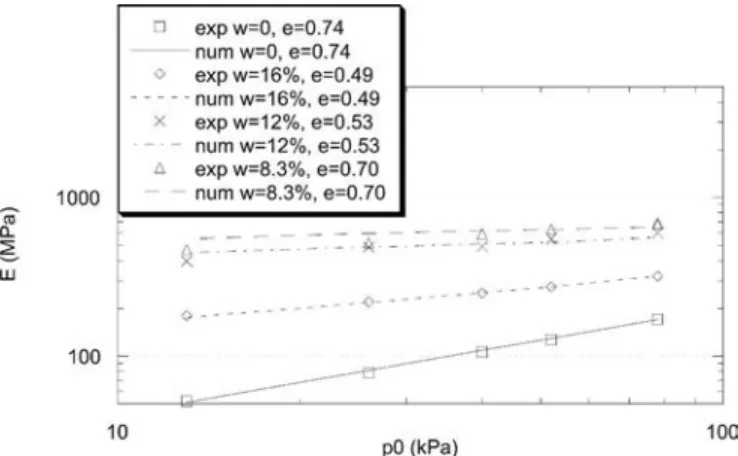
Hadiwardoyo 共2002兲 reported results on an Indonesian silty sand. The material is classified as a silty sand with spread distri-bution 共see grain size distribution curve in Fig. 4兲. The samples were all prepared according to the same procedure: The soil was mixed with a given quantity of water and then compacted to the chosen water content and density. The elastic properties were measured in a precision triaxial cell, equipped with local sensors for measuring axial and radial strains. The enhanced precision of the transducers allows the measurement of strains as small as 10−6. Tests were performed at different confining pressures on samples having different void ratios and water contents. Fig. 8 presents the evolution of the Young’s modulus E with the confin-ing pressure p0for dry specimen with void ratio equal to 0.74 and
unsaturated specimen with void ratio varying from 0.48 to 0.7 and water content from 8.3 to 16%, corresponding to various degrees of saturation from 33 to 90%.
The elastic parameters were determined by using the
experi-mental relation between E and p for dry samples 共Table 5兲.
Comparison between experimental and computed values is shown in Fig. 8. The test results did not allow us to determine S0. Using
the results by Wu et al. 共1984兲 and Eq. 共23兲, a typical value of S0= 0.26 was selected for d10= 0.2m. f0 was then determined
from the test results on unsaturated specimen at a given confining pressure 共p0= 52 kPa兲. The set of parameters for the Indonesian silty sand is presented in Table 5. Numerical results, as well as experimental ones, are presented in Fig. 8. A good overall agree-ment could be obtained. For unsaturated samples at a given void Table 3.Model Parameters for Glass Beads共Simulation 2兲
kn0 ␣ n N/V S0
f0 共N兲
2,420 0.35 0.5 0.61 0.007 0.045
Table 4.Model Parameters for Sandboil Sand
kn0 ␣ n N/V S0
f0 共N兲
2,420 0.35 0.5 0.52 0.001 0.051
Fig. 7.Shear modulus versus degree of saturation for sandboil sand
Fig. 8. Young’s modulus versus net confining pressure for Indonesian silty sand
ratio and water content, the relation between Young’s modulus and confining pressure in a bilogarithmic coordinate plane is lin-ear. The slope value decreases with the degree of saturation down to 0.3 for Sr= 33% and remains smaller than the one obtained on
dry samples, which was equal to 0.67. This decrease is due to the increased influence of the capillary forces compared to the ap-plied forces when Srdecreases. Using Eq.共15兲, we can calculate
the capillary stress tensor for each initial state. The material is assumed to have an isotropic structure and, therefore, the capil-lary stress tensor is also isotropic. The capilcapil-lary stress is a de-creasing function of the degree of saturation, which depends on the grain size distribution curve.
Using the definition of the generalized effective stress tensor in Eq. 共16兲, we can now plot the relation between the Young’s modulus E and the generalized mean effective stress for all the tests. The results are presented in Fig. 9. One can see that, in this plane, the relationship between log共E兲 and log共p*兲 is linear and
depends only on the void ratio e. This relationship can be written
E = a共e兲共p*兲n 共25兲
n being equal here to 0.67. The Young’s modulus appears, there-fore, to be a function of the generalized mean effective stress and of the void ratio.
In conclusion, the model is able to take into account the evo-lution of the elastic properties of a granular material with the degree of saturation varying from a perfectly dry state to a fully saturated state. The determination of the material parameters re-quires to know the elastic coefficients at dry or saturated state, assuming that they are equal in both cases. If we examine the model parameters obtained for each material in Tables 1–5, it appears that the parameters of the contact law kn0, kt0, and n have
very similar values, except for n in the case of the Indonesian silty sand, which has a significantly higher value than the standard value n = 0.5 obtained for the other materials. This difference can be explained by the higher content of clay material 共20% in
weight⬍2 m兲.
The model also requires the determination of the value of the parameters controlling the capillary force amplitude S0 and f0.
These can be obtained by knowing the values of the elastic
coef-ficients of the granular material at a given degree of saturation different from 0 and 1, and the degree of saturation corresponding to the peak stiffness value. If this last parameter is not determined experimentally, an approximate value can be derived from the grain size distribution using Eq. 共23兲. We have seen, however, that this parameter can be sensitive to the mode of preparation. For the two materials prepared by compaction at a given water content, i.e., Glacier Way silt and Indonesian silty sand, Eq.共23兲 can be applied and leads to values of S0 function of the grain
size of the smallest particles d10. In these conditions, f0 is also
a function of the grain size distribution and increases when d10decreases: f0= 0.02 N for d10= 0.0024共glacier way silt兲 and
f0= 0.1 N for d10= 0.2 mm共Indonesian silty sand兲. This shows the
influence of size of the smallest pores on the amplitude of the capillary forces. The same conclusions can be drawn by compar-ing the S0and f0values determined for the two materials prepared
by progressive drying. Eq. 共23兲 cannot be applied to determine S0, since the degree of saturation corresponding to the
maxi-mum stiffness appears to be smaller in this case than the com-puted one. However, one can see that S0is here also an increasing
function of d10: S0= 0.007 for d10= 0.26 mm 共glass beads兲 and
S0= 0.001 for d10= 0.17 mm 共sandboil sand兲. In the same way,
f0 is a decreasing function of d10: f0= 0.025 N to 0.045 N for
d10= 0.26 mm and f0= 0.051 N for d10= 0.17 mm.
In the case of uniform size grain material, such as the assem-bly of glass beads, the negative pore pressure corresponding to the air entry point needs to be considered and the calculation of the elastic coefficients has to be performed using the effective stress as long as the sample remains saturated.
Summary and Conclusion
An elastic model for granular materials has been developed based on micromechanics considerations. The material is considered as an assembly of particles. The stress-strain relationship for the assembly can be determined from integrating the behavior of in-terparticle contacts in all orientations, given a static hypothesis, which relates the average stress of the granular assembly to a mean field of particle contact forces. For each contact plane, an elastic behavior based on the Hertz-Mindlin contact formulation was assumed. Under these conditions, the stress-strain relation-ship leads to an elastic nonlinear behavior of the material.
The elastic coefficients at the level of the assembly depend on the parameters used to define the contact law at the level of the particles. These parameters comprise the contact law itself, i.e., the normal stiffness kn0and the shear stiffness as a function of the
normal stiffness kt0=␣kn0, as well as the number of contacts per
unit volume N/V along a given plane orientation. The depen-dency of the normal stiffness on the normal force gives a pressure-dependent behavior for the assembly, while the ratio␣ determines the value of Poisson’s ratio. The influence of the den-sity or void ratio of the assembly on the elastic properties is taken into account during the integration procedure by the ratio N/V. An empirical relationship has been proposed in order to link N/V values to the void ratio. This relationship was based on results obtained for different granular materials with different grain size distributions.
For dry samples, the contact forces are directly determined from the external stresses applied on the granular assembly. In the case of partially saturated samples, the liquid phase is distributed in menisci located between close grains and, as a consequence, capillary forces are applied on the grains and added to the contact Table 5.Model Parameters for Indonesian Silty Sand
kn0 ␣ n N/V S0
f0 共N兲
2,420 0.35 0.67 0.33 0.26 0.10
Fig. 9. Young’s modulus versus generalized effective stress for Indonesian silty sand
forces. The capillary forces were computed as a function of the pore morphology and of the water content, using a simple empiri-cal relationship. Further improvement of the model will require a better understanding of the capillary force amplitude and evolu-tion, based more closely on the physics of the phenomenon.
Comparison between numerical and experimental results on several granular materials demonstrated the ability of the model to reproduce the main characteristics of the elastic behavior of an unsaturated granular material. In particular, the model was able to reproduce the evolution of the material stiffness with the degree of saturation. The integration of the capillary forces over all spa-tial orientations permitted a definition of a capillary stress tensor. A generalized effective stress tensor could, therefore, be deter-mined by adding the total stress and the capillary stress tensors. It was demonstrated that the evolution of the Young’s modulus ob-tained on a given granular material at different water contents was controlled by the generalized effective stress.
References
Alonso, E. E., Gens, A., and Hight, D. W.共1990兲. “A constitutive model for partially saturated soils.” Geotechnique, 40共3兲, 405–430. Biarez, J., Fleureau, J.-M., and Taibi, S.共1993兲. “Mechanical constitutive
model for unsaturated granular media.” Proc., 2nd Int. Conf. on Mi-cromechanics of Granular Media, Thorton, Balkema, Rotterdam, The Netherlands, 51–58.
Bishop, A. W., and Blight, G. E. 共1963兲. “Some aspects of effective stress in saturated and partly saturated soils.” Geotechnique, 13共3兲, 177–197.
Cambou, B., Dedecker, F., and Chaze, M.共2000兲. “Relevant local vari-ables for the change of scale in granular materials.” Constitutive modeling of granular materials, D. Kolymbas, ed., Springer, Berlin, 275–290.
Cambou, B., Dubujet, P., Emeriault, F., and Sidoroff, F. 共1995兲. “Homogenization for granular materials.” Eur. J. Mech. A/Solids,
14共2兲, 255–276.
Chang, C. S. 共1988兲. “Micromechanical modeling of constructive rela-tions for granular material.” Micromechanics of granular materials, M. Satake and J. T. Jenkins, eds., Elsevier, Amsterdam, The Nether-lands, 271–279.
Chang, C. S., and Gao, J.共1996兲. “Kinematic and static hypotheses for constitutive modeling of granulates considering particle rotation.” Acta Mech., 115共1–4兲, 213–229.
Chang, C. S., and Hicher, P.-Y. 共2005兲. “An elastoplastic model for granular materials with microstructural consideration.” Int. J. Solids Struct., 42共14兲, 4258–4277.
Chang, C. S., Sundaram, S. S., and Misra, A.共1989兲. “Initial moduli of particulated mass with frictional contacts.” Int. J. Numer. Analyt. Meth. Geomech., 13共6兲, 629–644.
Chateau, X., Moucheront, P., and Pitois, O.共2002兲 “Micromechanics of unsaturated granular media.” J. Eng. Mech., 128共8兲, 856–863. Cho, G. C., and Santamaria, J. C. 共2001兲. “Unsaturated particulate
materials—Particle-level studies.” J. Geotech. Engrg., 127共1兲, 84–96. Dangla, P., and Coussy, O.共1998兲. “Nonlinear poroelasticity for
unsatur-ated porous materials: An energy approach.” Proc., Biot Conf. on Poromechanics, J. F. Thimus et al., Balkema, Rotterdam, The Netherlands.
De Buhan, P., and Dormieux, L.共1996兲. “On the validity of the effec-tive stress concept for assessing the strength of saturated porous materials: A homogenization approach.” J. Mech. Phys. Solids,
44共10兲, 1649–1667.
Fleureau, J. M., Hadiwardoyo, S., and Gomes, Correia A. 共2003兲. “Generalized effective stress analysis of strength and small strains behaviour of a silty sand, from dry to saturated state.” Soils Found.,
43共4兲, 21–33.
Fredlund, D. G., and Rahardjo, H.共1993兲. Soil mechanics for unsaturated soils, Wiley, New York.
Hadiwardoyo, S. 共2002兲. “Caractérisation des matériaux granulaires.” Ph.D. thesis, l’Ecole Centrale de Paris.
Hardin, B. O., and Black, W. L.共1966兲. “Sand stiffness under various triaxial stresses.” J. Soil Mech. and Found. Div., 92共1兲, 27–42. Hicher, P.-Y. 共1996兲. “Elastic properties of soils.” J. Geotech. Engrg.,
122共8兲, 641–648.
Hicher, P.-Y. 共1998兲. “Experimental behaviour of granular materials.” Behaviour of granular materials, B. Cambou, ed., Springer, New York, 1–97.
Hicher, P.-Y.共2001兲. “Microstructure influence on soil behaviour at small strains.” Pre-failure deformation characteristics of geomaterials, M. Jamiolkowski, R. Lancellotta, and E. Lo Presti, eds., Swets and Zellinger, Lisse, The Netherlands, 1291–1297.
Hicher, P.-Y., and Chang, C. S. 共2005兲. “Evaluation of two homogen-ization techniques for modeling the elastic behavior of granular ma-terials.” J. Eng. Mech., 131共11兲, 1184–1194.
Hicher, P.-Y., and Chang, C. S. 共2006兲. “Anisotropic nonlinear elastic model for particulate materials.” J. Geotech. Geoenviron. Eng.,
132共8兲,1052–1061.
Lian, G., Thornton, C., and Adams, M. J.共1993兲. “A theoretical study of the liquid bridge forces between two rigid spherical bodies.” J. Colloid Interface Sci. 161, 138–147.
Liao, C. L., Chan, T. C., Suiker, A. S. J., and Chang, C. S. 共2000兲. “Pressure-dependent elastic moduli of granular assemblies.” Int. J. Numer. Analyt. Meth. Geomech. 24, 265–279.
Liao, C. L., Chang, T. P., Young, D. H., and Chang, C. S.共1997兲. “Stress-strain relationships for granular materials based on the hypothesis of best fit.” Int. J. Solids Struct. 34, 4087–4100.
Mindlin, R. D.共1969兲. “Microstructure in linear elasticity.” Arch. Ration. Mech. Anal., 16, 51–78.
Molenkamp, F., and Nazemi, A. H.共2003a兲. “Interactions between two rough spheres, water bridge and water vapor.” Geotechnique, 53, 195–206.
Molenkamp, F., and Nazemi, A. H. 共2003b兲. “Micromechanical con-siderations of unsaturated pyramidal packing.”Geotechnique, 53, 255–264.
Taibi, S.共1994兲. “Comportement mécanique et hydraulique des sols par-tiellement saturés.” Ph.D. thesis, Ecole Centrale de Paris共in French兲. Terzaghi, K.共1925兲. “Principles of soil mechanics. A summary of
experi-mental results of clay and sand.” Eng. News-Rec., 3–98.
Wu, S., Gray, D. H., and Richart, F. E., Jr.共1984兲. “Capillary effects on dynamic modulus of sands and silts.” J. Geotech. Engrg., 110共9兲, 1188–1203.