Titre:
Title:
A retroactive-burst framework for automated intrusion response
system
Auteurs:
Authors:
Alireza Shameli-Sendi, Julien Desfossez, Michel R. Dagenais et
Masoume Jabbarifar
Date: 2013
Type:
Article de revue / Journal articleRéférence:
Citation
:
Shameli-Sendi, A., Desfossez, J., Dagenais, M. R. & Jabbarifar, M. (2013). A retroactive-burst framework for automated intrusion response system. Journal of
Computer Networks and Communications, 2013, p. 1-8. Tiré
dehttps://doi.org/10.1155/2013/134760
Document en libre accès dans PolyPublie
Open Access document in PolyPublieURL de PolyPublie:
PolyPublie URL: https://publications.polymtl.ca/3639/
Version: Version officielle de l'éditeur / Published versionRévisé par les pairs / Refereed Conditions d’utilisation:
Terms of Use: CC BY
Document publié chez l’éditeur officiel
Document issued by the official publisherTitre de la revue:
Journal Title: Journal of Computer Networks and Communications (vol. 2013) Maison d’édition:
Publisher: Hindawi URL officiel:
Official URL: https://doi.org/10.1155/2013/134760 Mention légale:
Legal notice:
Ce fichier a été téléchargé à partir de PolyPublie, le dépôt institutionnel de Polytechnique Montréal
This file has been downloaded from PolyPublie, the institutional repository of Polytechnique Montréal
Volume 2013,Article ID 134760,8pages
http://dx.doi.org/10.1155/2013/134760
Research Article
A Retroactive-Burst Framework for Automated Intrusion
Response System
Alireza Shameli-Sendi, Julien Desfossez, Michel Dagenais, and Masoume Jabbarifar
D´epartment de Genie Informatique et G´enie Logiciel, ´Ecole Polytechnique de Montr´eal, P.O. Box 6079, Succ. Downtown, Montreal, QC, Canada H3C 3A7
Correspondence should be addressed to Alireza Shameli-Sendi; [email protected] Received 14 December 2012;Accepted 20 February 2013
Academic Editor: Rui Zhang
Copyright © 2013Alireza Shameli-Sendi et al. This is an open access article distributed under the Creative Commons Attribution License, which permits unrestricted use, distribution, and reproduction in any medium, provided the original work is properly cited.
Th aim of this paper is to present an adaptive and cost-sensitive model to prevent security intrusions. In most automated intrusion response systems, response selection is performed locally based on current threat without using the knowledge of attacks history. Another challenge is that a group of responses are applied without any feedback mechanism to measure the response eff ct. We address these problems through retroactive-burst execution of responses and a Response Coordinator (RC) mechanism, the main contributions of this work. The retroactive-burst execution consists of several burst executions of responses with, at the end of each burst, a mechanism for measuring the eff ctiveness of the applied responses by the risk assessment component. The appropriate combination of responses must be considered for each burst execution to mitigate the progress of the attack without necessarily running the next round of responses, because of the impact on legitimate users. In the proposed model, there is a multilevel response mechanism. To indicate which level is appropriate to apply based on the retroactive-burst execution, we get help from a Response Coordinator mechanism. Th applied responses can improve the health of Applications, Kernel, Local Services, Network Services, and Physical Status. Based on these indexes, the RC gives a general overview of an attacker’s goal in a distributed environment.
1. Introduction
Multisteps cyberattacks are common problems in distributed systems. Many security tools or system loggers may be installed in distributed systems and monitor all events in the network. Security managers often have to process huge numbers of alerts per day produced by such tools [1].
Th Linux Trace Toolkit next generation (LTTng) [2] is a powerful software tool that provides a detailed execution trace of the Linux operating system with low impact. Its counterpart, the User Space Tracer (UST) library, provides the same trace information from user mode for middle-ware and applications [3]. Th Target Communication Framework (TCF) agent collects traces from multiple systems. After collecting all traces, we need a powerful tool to monitor the health of a large system continuously such that system anomalies can be promptly detected and handled appropri-ately.
Intrusion Detection Systems (IDSs) are tools that monitor systems against malicious activities. We use network-based IDS (NIDS) to monitor the network and host-based IDS (HIDS) to locally monitor the health of a system. IDSs are divided into two categories: Anomaly-based and Signature-based [4, 5] techniques. Anomaly-based detection is inter-esting to detect unknown attack patterns and does not need predefin d signatures. On the other hand, it suffers from the fact that it is difficult to define normal behavior and that malicious activity may look like normal usage pattern [6, 7]. In signature-based techniques, we compare captured data with well-defi ed attack patterns. Because of the pattern matching, this technique has the advantage of being deterministic and can be customized for each system we want to protect. Moreover, signature-based techniques are stateless; once an attack matches a signature, an alert is emitted and the detection component does not record it as a state change.
2 Journal of Computer Networks and Communications One solution, to tackle the limitation of detection based
only on stateless signatures, is to use a finite state machine (FSM) to track the evolution of an attack. That way, while an attack is in progress, the state changes and we can trigger appropriate responses based on a confidenc level threshold, which leads to a lower false positive rate. Based on the previous discussion about the advantages and disadvantages between anomaly-based and signature-based techniques, and since LTTng produces accurate traces, we decided to develop our framework with the FSM approach in order to track multistep attacks.
The main contributions of this work are the following. The proposed framework has a novel response execution organization named retroactive-burst. The term retroactive refers to the fact that we have a mechanism for measuring the effectiveness of the applied responses. The term burst refers to the fact that each retroactive execution consists of several bursts each consisting in relevant responses to apply. The idea is that each burst mode execution of responses in each retroactive execution must mitigate the progress of attack and avoid the need to run another burst. In contrast to previous models, this model is round-based. Th online risk assessment measures the risk index of an applied round of responses instead of one applied response. Also, a multilevel response selection mechanism is implemented in our model. The higher level corresponds to strong responses. This helps to control the cost in performance and increases the intelli-gence of the Intrusion Response System (IRS). A Response Coordinator helps to select the appropriate level based on a global overview of past history of applied responses and attacks.
Th paper is organized as follows. First, we investigate ear-lier work and several existing methods for intrusion response. Th proposed model is discussed inSection 3. Experimental results are given inSection 4. Finally, we conclude and future work is discussed.
2. Related Work
Automated response systems try to be fully automated using decision-making processes without human intervention. The major problem in this approach is the possibility of executing an improper response in case of problem [8]. It can be classifi d according to the following characteristics.
Response Selection. There are three response selection models. (a) static model maps an alert to a predefin d response. This model is easy to build, but the major weakness is that the response measures are predictable [9]. (b) Dynamic model responses are based on multiple factors such as system state, attack metrics (frequency, severity, confidence, etc.) and network policy. In other words, the response to an attack may not be the same depending for instance on the targeted host. One drawback of this model is that it does not consider intrusion damage [10, 11]. (c) Cost-sensitive model is an interesting technique that tries to attune intrusion damage and response cost. To measure intrusion damage, a risk assessment component is needed [8].
Adjustment Ability. There are two types of adjustment ability. (a) Th fi st is non-adaptive: In this model, response selection mechanism remains the same during the attack period. It does not use the response history to order responses. (b) Th second is daptive. In these approaches, the system has an appropriate ability to automatically adjust the response selection based on success or failure of response in the past [12].
Response Execution. There are two types of response execu-tion [13]. (a) Th firs is burst: In this model, there is no mechanism to measure the risk index of the host/network once the response has been applied. Th major weakness in this model is the cost in performance caused by applying all responses, while a subset of the responses may be enough to mitigate the attack. (b) The second is retroactive: in these approaches, there is a feedback mechanism which has the ability to measure the response effect based on the result of the last applied response. There are some challenges in adaptive approaches. For example, how can we measure the success of the last applied response and how multiple concurrent malicious activities can be handled [12]?
Foo et al. [12] proposed a graph-based approach called ADEPTS. The responses for the affected nodes are based on some parameters such as confidenc level of attack and previous measurements of responses in similar cases. Thus, ADEPTS uses a feedback mechanism to estimate the success or failure of an applied response.
In [14], Stakhanova et al. proposed a cost-sensitive preemptive intrusion response system. It monitors system behavior in terms of system calls. The authors presented a response system which is automated, cost-sensitive, pre-emptive, and adaptive. The response is triggered before the attack completes. There is a mapping between system resources, response actions, and intrusion patterns which has to be defin d in advance. Whenever a sequence of system calls matches a prefi in a predefin d abnormal graph, the response algorithm, based on confidenc level threshold, decides whether to repel the attack or not. If the selected response succeeds in mitigating the attack, its success factor is increased by one, while on the contrary, it is decreased by one.
In [15], Lee et al. proposed a cost-sensitive model based on three factors: damage cost that characterizes the amount of damage that could potentially be caused by the attacker, operational cost that illustrates the effort for monitoring and detecting the attacks by an IDS, and response cost that is the cost of acting against attacks.
Retroactive approach was first proposed by Mu and Li [8]. Th y presented a hierarchical task network planning to repel intrusions. Thi model is able to avoid unnecessary responses and reduce the risk of false positive response by adjusting risk thresholds of subtasks. Th interesting idea in this paper is response time decision-making. It can estimate the execution time of each response. Each response has a static risk threshold associated. Th permission for running each response is the current risk index of the network.
In case of response execution, our technique closely relates to [8]. Th y try to measure the risk index after running
each response. Our experience shows that this measure is not enough to make the decision of running the next response and cannot be applied in a production environment. To tackle this issue, we have defined a retroactive-burst execution mechanism. For adjustment ability, our technique closely relates to [14], but there are many distinguishing features. Th y used a static damage cost for each node in abnormal graph. In other words, their risk assessment is static. By contrast, we have implemented a dynamic (online) risk assessment component that helps our response component to attune intrusion damage and response cost over time. Another distinguishing feature that separates our model from previous models is that the majority of the proposed response selection mechanisms focus on the local view of threats and responses to select a set of responses and do not have a general view of the network status. In the proposed model, we designed a novel approach named response coordinator to tackle this weakness.
3. Proposed Model
To design a strong intrusion response system, we should have a flexible response mechanism to handle different malicious activities.Figure 1illustrates the proposed structure for such an intrusion response system. Th proposed IRS framework consists of five modules.
3.1. Module (1) Manager. Manager is responsible for getting alerts from the detection and online risk assessment compo-nents and eventually run the appropriate responses on the attacked machine. Online risk assessment (ORA) component guarantees that our model is cost-sensitive. ORA measures the risk index of an applied round of responses (𝑅index). Th detection component has all the detailed information about the malicious activity such as the severity, the confidence level (𝐶level), and the type of resource targeted. It sends an alert aft r each state change in the FSM. In our FSM, a weight is associated to each state, and the sum of all weights is 100. Th confidenc level related to each raised alert is equal to the sum of all weights of all previous states. The confidenc level guarantees that our model is preemptive. Th Activator process gets all alerts from all the compo-nents. Once the following condition (1) is true, it starts the Establish Remote Connection and Select Response processes:
𝑅index× 𝐶level>Th eshold. (1) Th Establish Remote Connection part generates a connection string and sends it to the Open Channel process. Th Open Channel tries to connect to a remote agent running in the target host. Since TCF [16] is a lightweight and extensible communication daemon, we chose it as remote agent. After establishing a channel to the TCF remote agent, Run Plansprocess applies responses on the target computer asFigure 1illustrates.
Th Run Plans process is the core of our response frame-work. Unlike usual response systems, it considers the time factor and applies responses using a multistep reaction procedure. Mu and Li [8], tried to measure the risk index
after running each response. Our experience shows that this measure is not enough to make the decision of running the next response.
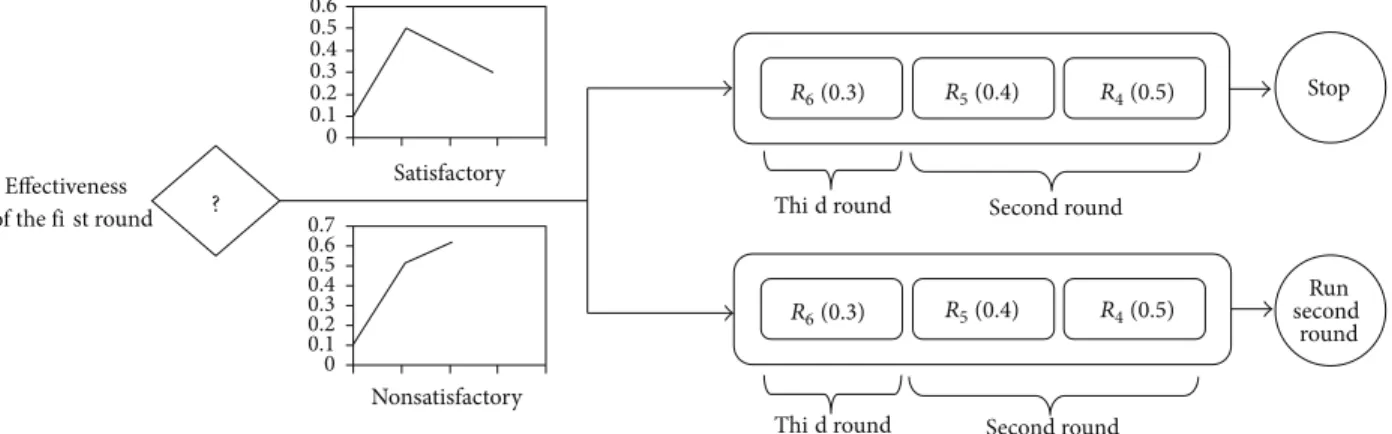
To tackle this issue, we have defin d a round-based response mechanism. Figure 2 illustrates six responses for a specifi malicious activity which are ready in pending queue in the Run Plans process before starting the fi st round. Sending the next round of responses is based on (1). Upon running a round of responses, new risk index of network has to be measured from the Online Risk Assessment component after a specifi time. As shown inFigure 2, each response has a Response Effect that defines how the selected responses are ordered in the pending queue.Figure 3 shows two possible scenarios after launching the first round of responses. In the first situation, since the risk index of the network is decreasing, the next round is not required. This intelligence prevents overly impacting the network. By contrast, in the second situation, in spite of the application of the first round, the risk index shows that malicious activity is still progressing. Thus, the second round of responses has to be applied.
3.2. Module (2) Strategy. An intrusion can be define as any set of actions that threaten the Confide tiality (C), Integrity (I), Availability (A), and Performance (P) of host/network resources such as files, kernel, or user accounts. To react against attacks, we have designed four strategies to evaluate all responses.
(1) MAX-Confide tiality ensures that any authorized user can have access only to the limited subset of resources required.
(2) MAX-Integrity verifies that any authorized user can only modify the resources in a conform manner. (3) Availability means that the resources are always
avail-able to the authorized users.
(4) Performance means that the system responds within the time expected.
3.3. Module (3) Responses. Thi module is responsible for managing the set of responses available. A database connects the Strategy and Responses modules. This connection is a structure to measure each response effect. Our evaluation relies on the positive effect and negative impact of responses to the strategies (C, I, A, and P).
3.4. Module (4) Response Coordinator (RC). Most of pro-posed response mechanisms focus on the local view of threats and responses and do not have a general view of the network status. Thus, they suffer from not having global information about the attacker’s goal. To tackle this issue, we introduce the RC module. We divide the system status in five general categories: Applications, Kernel, Local Services, Network Services, and Physical Status. The purpose of RC is to improve the quality of responses over time. Let us briefly describe the RC categories.
Application Status. There are many applications installed in the system like Web applications, desktop applications,
4 Journal of Computer Networks and Communications Response system Strategy Integrity Availability Confide tiality Performance Relationship between PR and strategy
Relationship between Select response
PR and FSM level
level
PE and NEChange response
ordering 1 7 3 8 4 3 1 6 9 Local decision Plans history Goodness
Alert (confidence l vel)
Manager Prepare
Activator Risk index Connect
Active Establishremote connection Open channel Apply Run plans PR queue
Second round First round Attacked
machine TCF agent Automated fault identific tion Alert optimization Online risk assessment Select responses
Log applied responses
Global decision
Response coordinator (RC)
Application status Network services status
Local services status Kernel status Physical status Index Relationship between PR and RC Proactive responses (PRs) 1 2 3 4 5 6 7 𝑛 .. .
Drop ping packets
Not allowed hosts Kill process Remove user Max file locks Change max logins
Delete file 𝐿1 𝐿2 𝐿2 𝐿3 𝑅3 𝑅3 𝑅4 𝑅8
Change fil ownership
Figure 1: Proposed architecture for automated response system.
Pending queue 0 0.1 0.2 0.3 0.4 0.5 0.6 Risk index Response eff ctiveness
First round Second round
Thi d round
𝑅6(0.3) 𝑅5(0.4) 𝑅4(0.5) 𝑅3(0.6) 𝑅2(0.7) 𝑅1(0.8)
Figur e 2: Pending queue in 𝑅𝑢𝑛 𝑝𝑙𝑎𝑛𝑠 process before starting the fi st round of responses.
Satisfactory Effectiveness of the fi st round Nonsatisfactory Stop Run second round Second round Thi d round Second round Thi d round 0 0.1 0.2 0.3 0.4 0.5 0.6 0 0.1 0.2 0.3 0.4 0.5 0.6 0.7 ? 𝑅6(0.3) 𝑅5(0.4) 𝑅4(0.5) 𝑅5(0.4) 𝑅4(0.5) 𝑅6(0.3)
programming tools, DBMS, OpenOffi , and web browsers. Malicious hackers are looking for vulnerabilities in these applications. The health of these applications is very impor-tant. AppArmor [17] or SELinux [18] are security modules for the Linux kernel that allow associating each program with a security policy that restricts its capabilities. Policy-based tools improve application health.
Kernel Status. It represents the higher level of criticality of a local system. In modern operating systems, the kernel and the kernel modules have access to any resource of a local machine. If an attacker gains access to the kernel, it can do anything on the local machine with very little chance of being detected.
Local Services Status. Virtually, each service represents a security threat that could be exploited by an intruder to gain further access to the system. Unlike local applications, the local services run at a higher level of privilege and could give attackers higher privileges if they were compromised. Network Services Status. Like the local services, network services represent a security risk that could be exploited to gain access to a system. Th major difference with local services is that they can be exploited from outside.
Physical Status. It represents the status of the physical devices of the machine in terms of usage and performance. For example, when a machine is under a network fl od attack, the network interface health is considered critical. Over time, we gather statistics about how many responses are applied in each category. These statistics help to discover major health problems of each host, detect major health problems of the whole network, help administrator to chose a policy suited for the organization, and it can help the select response levelprocess to select the more appro-priate levels of responses.
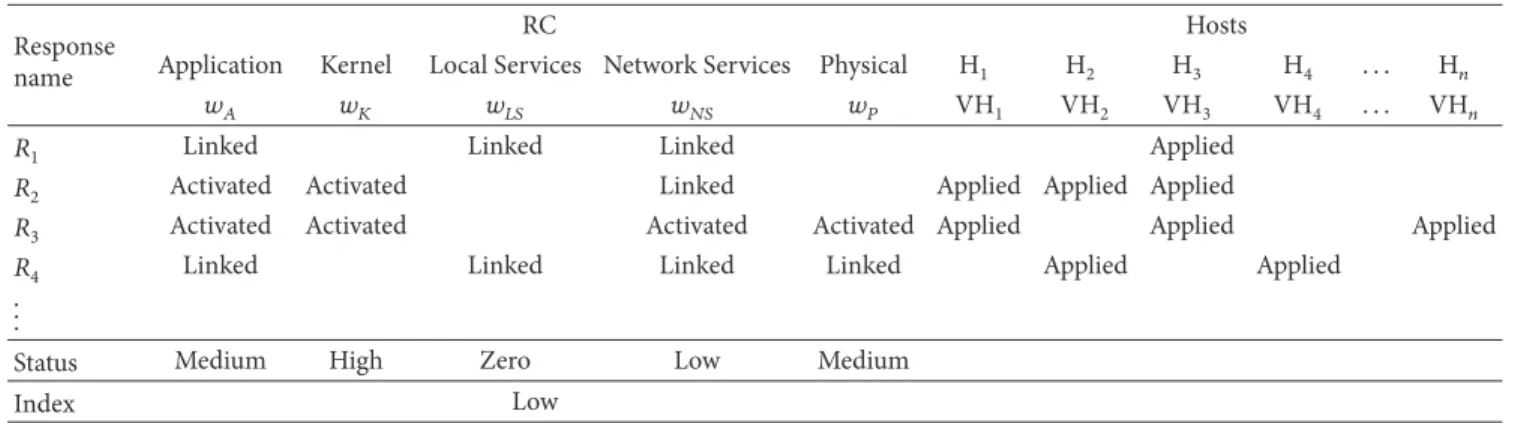
3.5. Relationship between Responses and RC DB. Table 1
shows the relationship between responses and RC categories. RC process updates Table 1based on the plans history database. Each response (𝑅𝑖) is associated with one or more RC category (Application, Kernel, . . .). For example, in Table 1, response 𝑅1is related to Application, Local Services, and Network Services (Linked). Each RC category has a weight (𝑊𝑖) which represents the importance of the category for the organization (𝑊𝐴, 𝑊𝐾, 𝑊𝐿𝑆, 𝑊𝑁𝑆, 𝑊𝑃). In the online risk assessment component, we associate each host (𝐻𝑖) with a value (𝑉𝐻𝑖), representing the priority of this host for the organization. InTable 1, Applied indicates that a response has been applied and on which hosts. We activate the categories associated with a response when the sum of the values of the hosts which applied this response is greater than a threshold based on the following (n is a subset of hosts that a specifi response has been applied on them).
𝑛 ∑ 𝑖=1
𝑉𝐻𝑖 >Th eshold. (2)
The status of each category of RC is computed using Status (𝑊𝑖) = Count (Activated)Count (Linked) . (3) Finally, the RC index is computed using a weighted average by (4). The result of Status and RC calculations is one of the values: Zero (0), L (Low), M (Medium), or H (High). k is five in our model with respect to the number of categories defin d for system status. Consider
𝑅𝐶index= ∑ 𝑘
𝑖=1𝑊𝑖×Status (𝑊𝑖)
𝑘 . (4)
3.6. Module (5) Prepare. Th prepared module is composed of two processes and two databases.
3.6.1. Relationship between Responses and FSM DB. Each attack pattern is associated with an FSM. For each defin d FSM, multiple response actions can be defined in advance. These response actions are organized in levels.
3.6.2. Plans History DB. It is a log file to store Target IP, User Name, Date, Time, Resource, Alert Name, Level Id, Round Responses, and Round Success. As explained in the Manager module, it is possible that all responses are not applied by the Run Plans process; so at the end of each round, it will update the plans history to store the status of the round. 3.6.3. Change Response Ordering Process. Afte selecting the appropriate level of responses required to repel the attack (using the Select Response Level), we need to order the responses of the selected level. Thi process guarantees that our model is adaptive. The ordering operation has to be done using
RE = [(Positive effect) − (Negative impact)] × Goodness. (5) Positive effect and Negative impact are static parameters. Goodness is a dynamic parameter that represents the history of success (S) or failure (F) of each response for a specifi type of host. The goodness parameter guarantees that our model is dynamic in case of response effectiveness and helps IRS component to prepare the best set of response over time. To measure the success or failure of a round of responses, we use the result of the online risk assessment component. As mentioned inFigure 3, if the risk index of the network is decreasing, the next round is not required and the status of the previous applied round is set to success. By contrast, in the second situation, in spite of the application of the first round, the risk index shows that malicious activity is still progressing. Thus, the second round of responses has to be applied, and the status of the previous applied round is set to failure.
3.6.4. Select Response Level Process. Information coming from the plans history database and the RC process are used
6 Journal of Computer Networks and Communications Table 1: Relationship between Responses and RC.
Response name
RC Hosts
Application Kernel Local Services Network Services Physical H1 H2 H3 H4 . . . H𝑛
𝑤𝐴 𝑤𝐾 𝑤𝐿𝑆 𝑤𝑁𝑆 𝑤𝑃 VH1 VH2 VH3 VH4 . . . VH𝑛
𝑅1 Linked Linked Linked Applied
𝑅2 Activated Activated Linked Applied Applied Applied
𝑅3 Activated Activated Activated Activated Applied Applied Applied
𝑅4 Linked Linked Linked Linked Applied Applied
...
Status Medium High Zero Low Medium
Index Low
Table 2: Policies for dynamic response level selection.
Policy RC.index Selected Level
P1= There is not any information in plans history Mediumlow 11
High 2
P2 = (The e is related information in plans history) and (Previous status was successful) and (Time of previous run is far to current time)
Low current level Medium current level High current level + 1 P3 = (The e is related information in plans history) and (Previous status was
successful) and (Time of previous run is near to current time)
Low current level Medium current level + 1
High current level + 2 P4 = (The e is related information in plans history) and (Previous status was not
successful) and (Time of previous run is far to current time)
Low current level + 1 Medium current level + 2 High current level + 3 P5 = (The e is related information in plans history) and (Previous status was not
successful) and (Time of previous run is near to current time)
Low current level + 2 Medium last level
High last level
to select the best response level to repel an intrusion in progress. When it receives a message from the Manager mod-ule, it tries to find related information in the plans history database. Depending on the existing knowledge about a similar attack and on the RC index, it selects the appropriate level.Table 2describes the different policies available to select dynamically a response level.
4. Experimental Results
Th Linux Trace Toolkit next generation (LTTng) is a power-ful software tool that provides a detailed execution trace of the Linux operating system with a low impact on performance. Using traces, LTTng records computer activities as seen by the kernel and eventually the userspace applications if they are instrumented with UST [7].
Although execution trace contains important and valu-able information to detect system faults and network attacks, this information is usually behind the large number of events. Trace-based detection systems usually need a preliminary
step to alleviate this problem. Trace abstraction is one possible solution that is used in the literature to reduce the trace size [19], to generate high level synthetic information [20], and to extract complete statistics of system resources usage [21]. Thi high level information can then be used easily in the detection phase.
In our experiments, Automated Fault Identific tion (our IDS) [20] and our framework were developed on IP xxx.xxx.72.12; the TCF agent and the attacked machine were developed on IP xxx.xxx.72.131but in a virtual machine. We have considered the Escaping a chroot jail attack. Chrooting changes the root directory of a process. AsFigure 4illustrates, when a process is in a chroot, it can only access a sub-directory of the fil hierarchy and does not have access to higher level directories. If an attacker can exploit a vulnerability in the chroot system, it can access higher level directories.
LTTng traces contain the related events and system calls; the Automated Fault Identific tion component can detect the attack using the appropriate FSM. It sends an alarm in the IDMEF [22] format to the automated intrusion
Tabl e 3: Plans history database, after applying the fi st round of level1.
Target IP User Name Date Time Resource Alert Name Level Id Round Responses Response success xxx.xxx.72.131 Smith 2012/10/02 10:05:06 Filesystem Root Chroot level1 RS1, RS2, RS4 S
Tabl e 4: Plans history database, after applying the fi st round of level2.
Target IP User Name Date Time Resource Alert Name Level Id Round Responses Response success xxx.xxx.72.131 Smith 2012/10/02 10:05:06 Filesystem Root Chroot level1 RS1, RS2, RS4 S
xxx.xxx.72.131 Peter 2012/10/02 10:10:23 Filesystem Root Chroot level2 RS1, RS3, RS4 S Chroot() Open() [same_pid()] save pid();} Chdir(“/”) [same pid()] {warning (“· · ·”);} {fork fsm(); S0 S1 S2
Figure 4: Escaping the chroot jail.
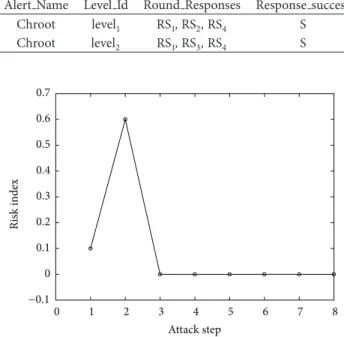
response framework. While this attack is in progress, the state changes and we can trigger appropriate responses based on a confidenc level threshold. Our threshold value for (1) is 0.5. If state S1sends an alert, since its confidenc level is 0.5 and risk index (output of online risk assessment component) is 0.1, the rule of (1) is not triggered. If state S2 sends an alert, since the confidenc level of S2 is 1 and the value of risk index is 0.6, the IRS component creates a channel to the target computer (xxx.xxx.72.131) and applies a first round of responses through the TCF agent. Sending the next round of responses is based on the new risk index and calculating (1). Our framework has two response levels for this attack:
List of Responses = {
RS1:KILL PROCESS, RS2: LOCK USER, RS3: REMOVE ALL USERS, RS4: LOGOUT,
RS5: RESET}
Level1= {Round1(RS1,RS2, RS4), Round2 (RS5)} Level2 = {Round1(RS1,RS3, RS4), Round2 (RS5)} 4.1. First Scenario. Since the plans history database does not have any information about this type of alarm, select response levelprocess selects level1(Policy = 𝑃1, RC.index = Low). 𝑅𝑆1 is the first response applied by the Run Plansprocess. It kills the problematic processes. Then, 𝑅𝑆2 is executed to change the current user’s password. 𝑅𝑆4 is then executed to logout the problematic user. From this moment, the user cannot login anymore to the machine using its system account.Table 3illustrates the content of the plan history database aft r these actions have been applied. Since round1 causes that risk index to decrease, round2 is not applied and this framework keeps the impact on service
0 0.1 0.2 0.3 0.4 0.5 0.6 0.7 0 1 2 3 4 5 6 7 8 Risk index Attack step −0.1
Figur e 5: Th online risk assessment result for escaping the chroot jail.
availability to a minimum. The risk curve caused by Escaping the chroot jail is shown inFigure 5. As seen, this attack has two steps. The risk index of the first and second step is 0.1 and 0.6, respectively. Since the IRS component will control this attack, the risk index will be zero after the second step. 4.2. Second Scenario. If other accounts are available on the victim machine, the attacker may login with another account. Suppose, at this time, that the RC index is Medium. The next time the same attack pattern reappears, the system will adapt its response and level2is selected (Policy = 𝑃3, RC.index = Medium). Once again the problematic process is killed and, this time, all users on the system are removed.Table 4 illustrates the updated plan history database aft r applying level2. At this point, all users of the system have been removed and logged out.
5. Conclusion
Network services are becoming larger and increasingly com-plex to manage. It is extremely important to maintain the users QoS, the response time of applications, and critical services in high demand. On the other hand, we see impres-sive changes in the ways in which attackers gain access to systems and infect computers. An intrusion response system has to accurately assess the value of the loss incurred by a compromised resource and has an accurate evaluation of
8 Journal of Computer Networks and Communications the responses cost. The aim of this paper is introducing a
novel framework for automated intrusion response system. In our model, unnecessary responses are controlled by an online risk assessment component. Each response is put in a multilevel mechanism for each FSM and run in a retroactive-burst mode execution. This is the main contribution of this paper. The response coordinator named RC enables us to have a general view of applied responses history. Taking control of the network status by RC leads us to have a reliable IRS which keeps the network quality of service.
Acknowledgments
Th support of the Natural Sciences and Engineering Research Council of Canada (NSERC), Ericsson Software Research, and Defence Research and Development Canada (DRDC) is gratefully acknowledged.
References
[1] F. Xiao, S. Jin, and X. Li, “A novel data mining-based method for alert reduction and analysis,” Journal of Networks, vol. 5, no. 1, pp. 88–97, 2010.
[2] M. Desnoyers and M. Dagenais, “LTTng: tracing across execu-tion layers, from the hypervisor to user-space,” in Proceedings of
the Linux Symposium, Ottawa, Canada, 2008.
[3] J. Blunck, M. Desnoyers, and P. M. Fournier, “Userspace appli-cation tracing with markers and tracepoints,” in Proceedings of
the Linux Kongress, October 2009.
[4] N. B. Anuar, H. Sallehudin, A. Gani, and O. Zakari, “Identifying false alarm fornetwork intrusion detection system using hybrid data mining and decision tree,” Malaysian Journal of Computer
Science, vol. 21,no. 2, pp. 101–115,2008.
[5] A. Lazarevic, L. Ertz, V. Kumar, A. Ozgur, and J. Srivastava, “A comparative study of anomaly detection schemes in network intrusion detection,” in Proceedings of the 3rd SIAM
Interna-tional Conference on Data Mining, 2003.
[6] Yusof, Automated Signature Generation of Network Attacks [B.S.
thesis], University Teknologi Malasia, 2009.
[7] “Difference between signature based and anomaly based detec-tion in IDS,”http://www.secguru.com/forum/difference. [8] C. P. Mu and Y. Li, “An intrusion response decision-making
model based on hierarchical task network planning,” Expert
Systems with Applications, vol. 37, no. 3, pp. 2465–2472, 2010.
[9] Y. M. Chen and Y. Yang, “Policy management for network-based intrusion detection and prevention,” in Proceedings of the
IEEE/IFIP Network Operations and Management Symposium, Application Sessions (NOMS ’04), pp. 219–232, Seoul, South
Korea, April 2004.
[10] G. B. White, E. A. Fisch, and U. W. Pooch, “Cooperating security managers: a peer-based intrusion detection system,”
IEEE Network, vol. 10, no. 1, pp. 20–23, 1996.
[11] P. Porras and P. Neumann, “EMERALD: event monitoring enenabling responses to anomalous live disturbances,” in
Pro-ceedings of the National Information Systems Security Confer-ence, 1997.
[12] B. Foo, Y. S. Wu, Y. C. Mao, S. Bagchi, and E. Spafford, “ADEPTS: adaptive intrusion response using attack graphs in an e-commerce environment,” in Proceedings of the International
Conference on Dependable Systems and Networks, pp. 508–517,
July 2005.
[13] A. Shameli-Sendi, N. Ezzati-Jivan, M. Jabbarifar, and M. Dagenais, “Intrusion response systems: survey and taxonomy,”
International Journal of Computer Science and Network Security,
vol. 12, no. 1, pp. 1–14, 2012.
[14] N. Stakhanova, S. Basu, and J. Wong, “A cost-sensitive model for preemptive intrusion response systems,” in Proceedings of
the 21st International Conference on Advanced Information Net-working and Applications (AINA ’07), pp. 428–435, Washington,
DC, USA, May 2007.
[15] W. Lee, W. Fan, M. Miller, S. J. Stolfo, and E. Zadok, “Toward cost-sensitive modeling for intrusion detection and response,”
Journal of Computer Security, vol. 10, no. 1-2, pp. 5–22, 2002.
[16] http://wiki.eclipse.org/DSDP/TCF.
[17] https://help.ubuntu.com/community/AppArmor/. [18] http://www.nsa.gov/research/selinux/.
[19] N. Ezzati-Jivan and M. Dagenais, “A stateful approach to gen-erate synthetic events from kernel traces,” Advances in Software
Engineering, vol. 2012, Article ID 140368, 12pages, 2012.
[20] H. Waly and B. Ktari, “A complete framework for kernel trace analysis,” in Proceedings of the 24th Canadian Cference on
Electrical and Computer Engineering (CCECE ’11), pp. 1426–
1430, Niagara Falls, ON, Canada, May 2011.
[21] N. Ezzati-Jivan and M. Dagenais, “A framework to compute statistics of system parameters from very large trace files,” ACM
SIGOPS Operating Systems Review, vol. 47, no. 1, pp. 43–54, 2013.
[22] H. Debar, D. Curry, and B. Feinstein, “The intrusion detection message exchange format,”http://www.ietf.org/rfc/rfc4765.txt.
Internatfional Journal of
A
e
ro
spa
c
e
Eng
fin
e
e
r
fing
Hfindawfi Publfishfing Corporatfion
http://www.hfindawfi.com Volume 2014
Robo
Journal ot
fics
f Hfindawfi Publfishfing Corporatfion
http://www.hfindawfi.com Volume 2014
H findawfi Publfishfing Corporatfion
http://www.hfindawfi.com Volume 2014
Actfive and Passfive Electronfic Components
Control Scfience and Engfineerfing
Journal of
H findawfi Publfishfing Corporatfion
http://www.hfindawfi.com Volume 2014 H
findawfi Publfishfing Corporatfion
http://www.hfindawfi.com Volume 2014 H
findawfi Publfishfing Corporatfion http://www.hfindawfi.com
Journal of
En
g
fin
e
er
fin
g
Volume 2014
Subm
fi
t
your
manuscr
fip
ts
a
t
h
t
tp
:
/
/www
.h
findaw
fi
.com
VLSI Desfign
Hfindawfi Publfishfing Corporatfion
http://www.hfindawfi.com Volume 2014
H findawfi Publfishfing Corporatfion
http://www.hfindawfi.com Volume 2014
Shock and Vfibratfion
H findawfi Publfishfing Corporatfion
http://www.hfindawfi.com Volume 2014
C
Advancesfiv
fi
l
Eng
finfinee
r
fing
AcousAdvancestficsfin and Vfibratfion
H findawfi Publfishfing Corporatfion
http://www.hfindawfi.com Volume 2014 H
findawfi Publfishfing Corporatfion
http://www.hfindawfi.com Volume 2014 Electrfical and Computer Engfineerfing
Journal of
Advancesfin OptoElectronfics
Hfindawfi Publfishfing Corporatfion
http://www.hfindawfi.com Volume 2014
The
Sc
fient
fific
Wor
ld
Journa
l
H findawfi Publfishfing Corporatfion
http://www.hfindawfi.com Volume 2014
Senso
JouHfindawfi Publrnafishfing Corporatl ofionfrs
http://www.hfindawfi.com Volume 2014
Modellfing & Sfimulatfion fin Engfineerfing
Hfindawfi Publfishfing Corporatfion
http://www.hfindawfi.com Volume 2014
H findawfi Publfishfing Corporatfion
http://www.hfindawfi.com Volume 2014
Chemfical Engfineerfing
InternatfionalJournal of Antennas and Propagatfion InternatfionalJournal of
H findawfi Publfishfing Corporatfion
http://www.hfindawfi.com Volume 2014 H findawfi Publfishfing Corporatfion
http://www.hfindawfi.com Volume 2014
Navfigatfion and Observatfion InternatfionalJournal of
H findawfi Publfishfing Corporatfion
http://www.hfindawfi.com Volume 2014