HAL Id: hal-00984312
https://hal.inria.fr/hal-00984312
Submitted on 28 Apr 2014
HAL is a multi-disciplinary open access
archive for the deposit and dissemination of
sci-entific research documents, whether they are
pub-lished or not. The documents may come from
teaching and research institutions in France or
abroad, or from public or private research centers.
L’archive ouverte pluridisciplinaire HAL, est
destinée au dépôt et à la diffusion de documents
scientifiques de niveau recherche, publiés ou non,
émanant des établissements d’enseignement et de
recherche français ou étrangers, des laboratoires
publics ou privés.
Physical Human-like Interaction with the Acroban and
Poppy Humanoid Platforms.
Matthieu Lapeyre, Pierre Rouanet, Pierre-Yves Oudeyer
To cite this version:
Matthieu Lapeyre, Pierre Rouanet, Pierre-Yves Oudeyer. Physical Human-like Interaction with the
Acroban and Poppy Humanoid Platforms.. IROS Workshop, Nov 2013, Tokyo, Japan. �hal-00984312�
Physical Human-like Interaction with the Acroban and Poppy
Humanoid Platforms.
Matthieu Lapeyre
1, Pierre Rouanet
1and Pierre-Yves Oudeyer
1Abstract— In this paper we will present two humanoid platforms (Acroban and Poppy) developed in our lab to study biped locomotion and physical interaction. We will present how their morphologies (compliance, vertebral column, and soft ma-terials) produce human-like movements and natural responses to external perturbations. We will illustrate this behavior with the example of the socially guided biped locomotion. We will also discuss the very positive emotional reactions aroused when presenting Acroban to the general public. We will hypothesize that this behavior could be explained by the contrast between its crude visual appearance and its smooth and compliant movements which increases the impression of like-likeliness.
I. INTRODUCTION
Humanoid robots draw more and more attention as they are predicted to play a key role in domain such as personal robotics, cognitive or social assistance and even entertain-ment. As they are brought from controlled environment such as factories or scientific laboratories to our everyday homes, robots and their users will have to operate in close proximity. Among the many challenges raised by sharing a common environment, it will necessarily lead to physical human-robot interaction. While those interactions could be intentional (e.g. taking the arm of a robot to show it how to perform a task) or unexpected (e.g. bumping into the robot while it was walking), they are known to significantly impact the user’s perception of the interaction (e.g. trust, acceptability) and to be a really powerful way to intuitively transmit information both from the human to the robot [1] and from the robot to the human [2].
Yet, most existing robots do not permit, or permit very limited and unsatisfying, physical interaction. This is particu-larly the case for humanoid robots (e.g. Honda’s ASIMO [3], HRP [4]) whose physical properties make them heavy, fragile and powerful. In this context, physical contacts likely risk to harm the human and/or the robot. Their rigidity (e.g. Nao [5], Darwin-OP [6]) make them not very robust to unknown external perturbations such as an expected physical contact and lead to rough, unpleasant and oversimplified physical interaction.
Several lines of research have flourished around physical human-robot interaction [7]. Researchers have investigated how accidental and/or unwanted contact with robots could be made intrinsically safe [8]. They have also explored the
*This research was partially funded by ERC Starting Grant EXPLORER 240007.
1 INRIA Flowers Team, Bordeaux, France pierre.rouanet,
matthieu.lapeyre, pierre-yves.oudeyer at inria.fr
potentiality of physical contacts for communication such as communicative touches to teach a robot correct pos-ture [9] or intuitively guiding a nursing assistant robot [10]. Learning by demonstration has also largely been used to demonstrate complex motion trough intuitive and simple interactions [11][12]. While physical interaction is known to have a strong impact on the user’s perception, very few researches have been made in this direction. Cramer et al. showed that touch and proactive behavior seems to have a linked effect on the perception of the interaction [13]. The Paro robot has been developed to further investigate the touch aspect of emotional communication and their effect on hospitalized persons [14].
In the rest of this abstract, we will first quickly describe two humanoid platforms developed in our lab (see sec-tion II). Those robots have notably been designed to allow for safe and full-body compliant physical interaction. Their conception follows the morphological computation principle, where the use of soft materials, springs and compliant mo-tors allows for direct body reaction through the mechanics. Such an approach as been shown to produce human-like movements [15]. We will illustrate in section III how the combination of the robot’s morphology and its compliance allows non-expert humans to intuitively guide it physically by the hand, producing a very human-like walking gait. Finally, we will describe qualitative observations made from public exhibitions of Acroban, where the difference between its crude visual appearance and its smooth and compliant motions seems to increase its life-likeliness (see section IV).
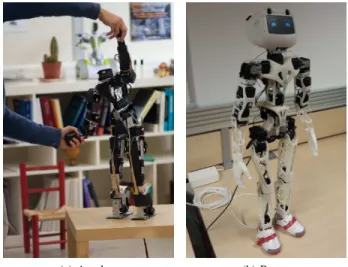
(a) Acroban (b) Poppy
II. HUMANOIDSPLATFORM FOR THE PHYSICAL INTERACTION
We developed two robotic platforms to explore compliant humanoid dynamics. First with the Acroban prototype [16] in 2009, which was the first robot with a 5 degree of freedom trunk. Combined with compliant actuators and elastic mate-rials Acroban showed highly interested physical interaction behavior and empathic emotion from non-expert user. As the robot appeared weak and clumsy, people were more willing to physically interact with Acroban to help it. This human-Acroban interaction lead to an emergent behavior to help the robot walks [17].
A second humanoid robot was developed in 2012, Poppy [18]. This robot integrates some of Acroban’s main features such as the articulated vertebral column and the full-body compliance. The legs were re-designed from scratch to study the challenge of producing a human-like biped locomotion. The head was changed to permit the expression of emotions trough a LCD screen. As this platform is the most advanced one, we will present an overview of its morphology:
Anatomical proportions are bio-inspired: Poppy’s limbs respect the proportion of the human being [19].
Large sensorimotor-space: Poppy has a large sensorimo-tor space composed of 25 Robotis Dynamixel1servo-motors (23 MX-28 and 2 AX-12). These servo-motors give access to a large number of internal sensors and allow the dynamical tuning of their compliance. The sensors space is extended by the addition of 8 force sensors under each foot, an inertial measurement unit located in the head, and two wide-angle HD cameras. The total sensorimotor space is composed by more than 150 dimensions giving access to several kinds of data (e.g. position, speed, load, temperature, acceleration, foot pressure).
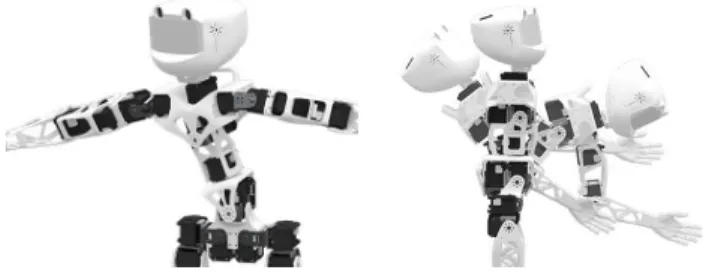
Articulated spine: Poppy has 5 motors in the trunk allowing the reproduction of the main DOFs of the human spine [20] (see Fig. 2). These DOFs enable more natural and fluid motions while improving the user experience during physical interaction [21]. In addition, the spine plays a fundamental role in bipedal walking and postural balance by actively participating in the balancing of the robot.
Bio-inspired bended thigh: The shape of the thigh is inspired of the human thigh. It is bended by angle of 6o, increasing the stability of the robot.
Lightweight: Poppy weights only 3.5kg allowing the use of less powerful motor which ensure that physical interaction with the robot is safe for humans.
Small feet with compliant toes: To produce an efficient and human-like walking gait, Poppy’s feet design takes some functional inspiration from the actual human foot such as the proportion (i.e. small compared to conventional humanoids), compliance and toes which are key features concerning both the human walking [22] and biped robots with a human-like gait [23].
1http://www.robotis.com/xe/dynamixel_en
Fig. 2: These figures illustrate some morphological features of the Poppy humanoid Robot: Poppy has an articulated trunk of 5 DoFs which allows more natural and fluid motions while improving the user experience during physical interaction and actively participating to the balance of the robot.
III. SOCIALLY GUIDED WALKING EXAMPLE:LEAD ME BY THE HANDS
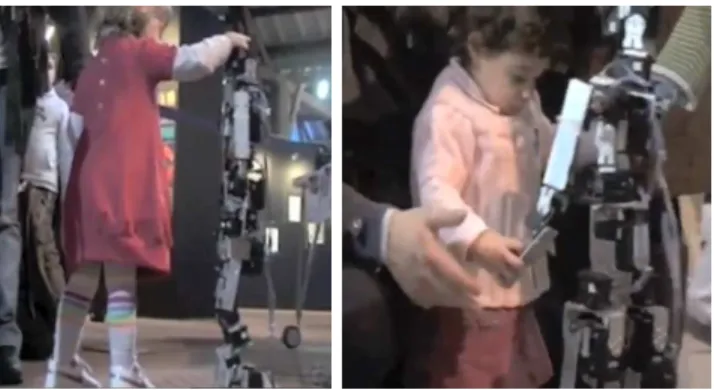
An original and initially unplanned feature of Acroban appeared during a public demonstration of the robot in Napoli’s Science Museum in Italy in November 2009, where children (around 150) could interact personally and physi-cally with the robot. While showing that Acroban could be pushed or pulled at various places of its body (head, torso, legs, arms...) without falling and keeping natural smooth compliant movements, some children began to take the hands of Acroban, like parents take the hands of their children, and tried to have Acroban follow them. And, to our surprise, Acroban followed. As we afterwards robustly and easily reproduced ourselves, they could lead Acroban by the hand in any direction, have it turn on itself, and this even by applying extremely gentle forces on one or both hands. Yet, no force sensors were used to measure such external perturbations and not a single line of code in Acroban was written to produce such a behavior.
Fig. 3: Users can physically help Poppy to learn how to walk by leading it by the hands and thus providing both balance and control of mass transfer. This social guidance is also a way to make sure that Poppy will learn a human-like gait.
On Poppy, we reuse this kind of social guidance where people lead the robot by the hands while it is walking to assist its gait. This allows an intuitive, playful and safe way
to teach the robot how to walk (see Fig. 3). In the video2, the experiment consists in playing an open-loop walking primitive while the robot is guided through the physical interaction of a human. The users role is to provide both balance and control of mass transfer. By producing small lateral motion on the upper-body they can help the robot to move its center of gravity from one foot to another. This approach seems really interesting to us as it could also be a way to circumvent the problem of defining what makes a gait human-like. By having users directly providing ”good” examples of what they think correspond to human-like steps we could make sure that the robot will produce motions which appear to users as human-like.
IV. EMOTIONS INPHYSICALHUMAN-ROBOT
INTERACTION WITHACROBAN
While demonstrating Acroban during public exhibitions such as Futuro Remoto (Napoli 2009) or Siggraph (Los An-geles 2010), we have discovered that it provokes spontaneous highly positive emotional reactions. Yet, as opposed to many other robots, its morphology is neither roundish nor cute. Even if we have not yet conduct thorough studies, we have formulate hypotheses to try to explain those reactions.
Fig. 4: Demonstration of Acroban during the Futuro Remoto exhibition in Napoli 2009. Children physically interacted with the robot provoking human-like mechanical responses of Acroban.
As one can see on the figure 4, its visual appearance creates low expectation of intelligence and life-likeness. He has no big eyes and no funny color. He has only three raw motors in place of the head. He is just made of metal, and its appearance shows it explicitly. But when it starts to move with smooth and compliant movements or when one physically perturbed it causing human-like mechanical responses, it triggers a high contrast and a positive surprise: life unexpectedly appeared. We can compare this effect to what happens in Pixar’s Luxo Jr animated cartoon where a neutral desk lamp provokes a positive surprise when animated like a life form [24]. While most recent robots tend to advocate the use of morphologies/shape/colors which
2http://vimeo.com/poppyproject/firstwalk
should trigger positive expectations before the interaction starts (e.g. by taking baby-like features without falling into the uncanny valley effect [25]), Acroban’s design tends to minimize expectations and thus maximize the effect of positive surprise due to its actual behavior. The user discovers that the robots is actually ”more” that it seemed at first sight. Acroban and Poppy also follows principles of animated cartoons to trigger the illusion of life: in particular, their high-compliance and passive dynamics allow observers to directly see/feel the weight and inertia of the robot, much like Disney’s explanations on the ”importance of weight” for animating walking creatures [26] (see also [27] for a related study).
As stated above we have not yet investigated thoroughly this effect. Systematic and quantitative HRI experiments should be conducted to verify and precise our hypothesis. Many parameters could be involved: e.g. the crudeness of the appearance, the lack of visible human-like sensors, the smoothness of motion. As one can see on the figures, while Poppy has been conceived after Acroban, its conception fol-lowed more traditional design guidelines (big head, roundish shape). Yet, as it has been made from 3D printed parts [18], it can be a really interesting tool to perform such comparative studies. One could imagine having different versions of Poppy - e.g. with a big head with visible eyes, without a head, with a rigid and closed trunk hiding the inertia of the robot, with square section limbs... - simply by 3D printing a new limb. The possibility of modifying and/or replacing parts of its design permits to easily separate and thus identify the possible underlying factors. To go further in this direction the Poppy platform will soon been opened (both the hardware and software) to the academic community.
REFERENCES
[1] Fabio Dalla Libera, Takashi Minato, Ian Fasel, Hiroshi Ishiguro, En-rico Pagello, and Emanuele Menegatti. A new paradigm of humanoid robot motion programming based on touch interpretation. Robotics
and Autonomous Systems, 57(8):846–859, 2009.
[2] Tiffany L Chen, Chih-Hung King, Andrea L Thomaz, and Charles C Kemp. Touched by a robot: An investigation of subjective responses to robot-initiated touch. In Proceedings of the 6th international
conference on Human-robot interaction, pages 457–464. ACM, 2011. [3] R Hirose and TOORU Takenaka. Development of the humanoid robot
asimo. Honda R&D Technical Review, 13(1):1–6, 2001.
[4] Kenji Kaneko, Fumio Kanehiro, Mitsuharu Morisawa, Kanako Miura, Shin’ichiro Nakaoka, and Shuuji Kajita. Cybernetic human HRP-4C. In Humanoid Robots, 2009. Humanoids 2009. 9th IEEE-RAS
International Conference on, pages 7–14. IEEE, 2009.
[5] David Gouaillier, Vincent Hugel, Pierre Blazevic, Chris Kilner, J´erˆome Monceaux, Pascal Lafourcade, Brice Marnier, Julien Serre, and Bruno Maisonnier. Mechatronic design of nao humanoid. In Robotics and
Automation, 2009. ICRA’09. IEEE International Conference on, pages 769–774. IEEE, 2009.
[6] I Ha, Y Tamura, H Asama, J Han, and D W Hong. Development of open humanoid platform DARwIn-OP. In SICE Annual Conference
(SICE), 2011 Proceedings of, pages 2178–2181. IEEE, 2011. [7] Agostino De Santis, Bruno Siciliano, Alessandro De Luca, and
Anto-nio Bicchi. An atlas of physical humanrobot interaction. Mechanism
and Machine Theory, 43(3):253 – 270, 2008.
[8] Alin Albu-Sch¨affer, Christian Ott, and Gerd Hirzinger. A unified passivity-based control framework for position, torque and impedance control of flexible joint robots. The International Journal of Robotics
[9] Matthew J Hertenstein. Touch: Its communicative functions in infancy.
Human Development, 45(2):70–94, 2002.
[10] Tiffany L Chen and Charles C Kemp. Lead me by the hand: evaluation of a direct physical interface for nursing assistant robots. In Proceedings of the 5th ACM/IEEE international conference on
Human-robot interaction, pages 367–374. IEEE Press, 2010. [11] Micha Hersch, Florent Guenter, Sylvain Calinon, and Aude Billard.
Dynamical system modulation for robot learning via kinesthetic demonstrations. Robotics, IEEE Transactions on, 24(6):1463–1467, 2008.
[12] Paul Evrard, Elena Gribovskaya, Sylvain Calinon, Aude Billard, and Abderrahmane Kheddar. Teaching physical collaborative tasks: Object-lifting case study with a humanoid. In Humanoid Robots, 2009.
Humanoids 2009. 9th IEEE-RAS International Conference on, pages 399–404. IEEE, 2009.
[13] Henriette SM Cramer, Nicander A Kemper, Alia Amin, and Vanessa Evers. The effects of robot touch and proactive behaviour on perceptions of human-robot interactions. In Proceedings of the 4th
ACM/IEEE international conference on Human robot interaction, pages 275–276. ACM, 2009.
[14] Kazuyoshi Wada, Takanori Shibata, Tomoko Saito, Kayoko Sakamoto, and Kazuo Tanie. Psychological and social effects of one year robot assisted activity on elderly people at a health service facility for the aged. In Robotics and Automation, 2005. ICRA 2005. Proceedings of
the 2005 IEEE International Conference on, pages 2785–2790. IEEE, 2005.
[15] Kojiro Matsushita, Max Lungarella, Chandana Paul, and Hiroshi Yokoi. Locomoting with less computation but more morphology. In
Robotics and Automation, 2005. ICRA 2005. Proceedings of the 2005 IEEE International Conference on, pages 2008–2013. IEEE, Ieee, 2005.
[16] Olivier Ly and Pierre-Yves Oudeyer. Acroban the humanoid: playful and compliant physical child-robot interaction. In ACM SIGGRAPH
2010 Emerging Technologies, page 4. ACM, 2010.
[17] P-Y Oudeyer, Olivier Ly, and Pierre Rouanet. Exploring robust, intuitive and emergent physical human-robot interaction with the humanoid robot acroban. In Humanoid Robots (Humanoids), 2011
11th IEEE-RAS International Conference on, pages 120–127. IEEE, 2011.
[18] Matthieu Lapeyre, Pierre Rouanet, and Pierre-Yves Oudeyer. The Poppy Humanoid Robot: Leg Design for Biped Locomotion. In
IEEE/RSJ International Conference on Intelligent Robots and Systems, Tokyo, Japon, 2013.
[19] Michel Dufour and M Pillu. Biom´ecanique fonctionnelle:
Membres-Tˆete-Tronc. Paris: Masson, 2005.
[20] J C Ceccato. Le tronc, de la locomotion `a la commande. PhD thesis, Montpellier II, 2009.
[21] Olivier Ly, Matthieu Lapeyre, and Pierre-yves Oudeyer. The Hu-manoid Robot Acroban: Leveraging Semi-Passive Dynamics in the Vertebral Column. 4(1):1–36, 2010.
[22] J Hughes, P Clark, and L Klenerman. The importance of the toes in walking. The Journal of bone and joint surgery. British volume, 72(2):245–51, March 1990.
[23] Ramzi Sellaouti, Olivier Stasse, Shuuji Kajita, Kazuhito Yokoi, and Abderrahmane Kheddar. Faster and Smoother Walking of Humanoid HRP-2 with Passive Toe Joints. 2006 IEEE/RSJ International
Con-ference on Intelligent Robots and Systems, pages 4909–4914, October 2006.
[24] Stuart Mealing. Art and Science of Computer Animation. Intellect Books, 1998.
[25] Masahiro Mori. The uncanny valley. Energy, 7(4):33–35, 1970. [26] Frank Thomas, Ollie Johnston, and Frank. Thomas. The illusion of
life: Disney animation. Hyperion New York, 1995.
[27] Thierry Chaminade, Jessica Hodgins, and Mitsuo Kawato. Anthro-pomorphism influences perception of computer-animated characters actions. Social cognitive and affective neuroscience, 2(3):206–216, 2007.