RESEARCH OUTPUTS / RÉSULTATS DE RECHERCHE
Author(s) - Auteur(s) :
Publication date - Date de publication :
Permanent link - Permalien :
Rights / License - Licence de droit d’auteur :
Bibliothèque Universitaire Moretus Plantin
Institutional Repository - Research Portal
Dépôt Institutionnel - Portail de la Recherche
researchportal.unamur.be
University of Namur
The scope of the economic sector regulation in electronic communications
De Streel, Alexandre
Published in: Communications et stratégies Publication date: 2006 Document VersionPublisher's PDF, also known as Version of record
Link to publication
Citation for pulished version (HARVARD):
De Streel, A 2006, 'The scope of the economic sector regulation in electronic communications', Communications et stratégies, vol. 62, pp. 147-167.
General rights
Copyright and moral rights for the publications made accessible in the public portal are retained by the authors and/or other copyright owners and it is a condition of accessing publications that users recognise and abide by the legal requirements associated with these rights. • Users may download and print one copy of any publication from the public portal for the purpose of private study or research. • You may not further distribute the material or use it for any profit-making activity or commercial gain
• You may freely distribute the URL identifying the publication in the public portal ?
Take down policy
If you believe that this document breaches copyright please contact us providing details, and we will remove access to the work immediately and investigate your claim.
COMMUNICATIONS & STRATEGIES, no. 62, 2nd quarter 2006, p. 147.
The Scope of Economic Sector Regulation
in Electronic Communications
Alexandre de STREEL ACKNOLO (*)
Faculty of Economics, University of Namur
Abstract: This paper proposes a market-based approach relying on a combination of
selection criteria and antitrust methodology to determine the scope of economic regulation and its balance with competition law. It suggests a clarified three criteria test related to the presence of high non-transitory and non-strategic entry barriers that are mainly of an economic nature, the absence of dynamic competition behind those barriers and a cross-checking criterion related to the insufficiency of antitrust remedies to solve the identified problems. The paper recalls the importance of using use antitrust methodology adapted to the characteristics of the sector and also suggests some clarification of the regulation of emerging markets. This article draws a distinction between retail services and the underlying wholesale infrastructures, and proposes that all wholesale access products used for the provision of similar retail services should be dealt with in the same way, independently of the infrastructures in question (the old copper pair or an upgraded VSDL network). The paper concludes that only wholesale access products used to provide new retail services should possibly escape regulation.
Key words: Regulation, electronic communications, market failures, balance between
antitrust and sector regulation and emerging markets.
his paper proposes an efficient test to determine the scope of economic regulation in the electronic communications sector and the balance between regulation and antitrust law. The suggested test is based on economic methodology, as well as its practice in the European Union.
The first section of the paper studies the rationale for public intervention. It starts by listing the reasons for such intervention (market failures) and then characterises the differences between the means of intervention (sector regulation and antitrust law). The second section proposes a test to determine the scope of economic regulation by recalling the approaches
(*) Acknowledgements are made to Allan Bartroff, Richard Cawley, Peter Johnston, Paul Richards and the participants of the EuroCPR 2006 conference for their very helpful comments and discussions.
currently followed in Europe and in the United States, by advocating a particular option in the European context and a clarification of the regulation of emerging markets. The final section rounds up the paper with some conclusions.
Rationale for public intervention
Market failures justifying public intervention
It is generally agreed that public authorities should aim to maximise the welfare of their citizens and markets are supposed to be the best means to ensure such welfare maximisation. Thus, governments should intervene only when the functioning of markets does not deliver this objective.
Economists distinguish between three types of market failure (See also Australian Productivity Commission, 2001; MOTTA, 2004, Chapter 2). The first type of failure is the presence of an excessive market power (such as a monopoly operator), which may lead to over-pricing and/or too little innovation. Excessive market power is mainly due to the presence of entry barriers. In economic literature, there are two opposing views (McAfee et al., 2004; OECD, 2006) to the controversial concept of entry barriers. The narrow (Stiglerian) view limits the barriers to the absolute cost advantages of incumbents (such as access to the best outlets in town, the presence of consumer switching costs, or any type of legal barriers), but excludes all entrants' costs that have also been borne by incumbents (for instance high fixed and sunk costs 1). The broad (Bainian) view extends the concept of
barriers to all factors that limit entry and enable incumbents to make a supra-normal profit and hence includes absolute cost advantages, as well as economies of scale and scope. In telecommunications economics literature, this first market failure corresponds to the one-way access (or access) model, which concerns the provision of bottleneck inputs by an incumbent network provider to new entrants (ARMSTRONG, 2002; LAFFONT & TIROLE, 2000; VOGELSANG , 2003).
1 The European Regulators Group defines sunk costs as: "Costs which, once incurred, cannot be recouped, e.g. when exiting the market. Examples for sunk costs are transaction costs, advertising expenses or investment in infrastructure for which there is no or little alternative use': Revised Common Position of May 2006 on remedies ERG(06) 33, p. 127.
The second market failure is the presence of an externality (like network externality or tariffs-mediated externality), which may lead to under-consumption in cases of positive externality and over-under-consumption in cases of negative externality 2. For instance, less than the optimal number of
customers may decide to join a network if new customers are not compensated, when joining the network, for the increase in welfare that they offer existing customers. In telecommunications economics literature, this second market failure corresponds to two-way access (or the interconnection) model, which concerns reciprocal access between two networks that have to rely upon each other for call termination (ARMSTRONG, 2002; LAFFONT & TIROLE, 2000; VOGELSANG , 2003).
The third market failure is the presence of information asymmetries (such as the absence of knowledge of price), which may lead to under or over consumption. For instance, the very high prices of international roaming may partly be due to insufficient knowledge of the price and techniques of such a service.
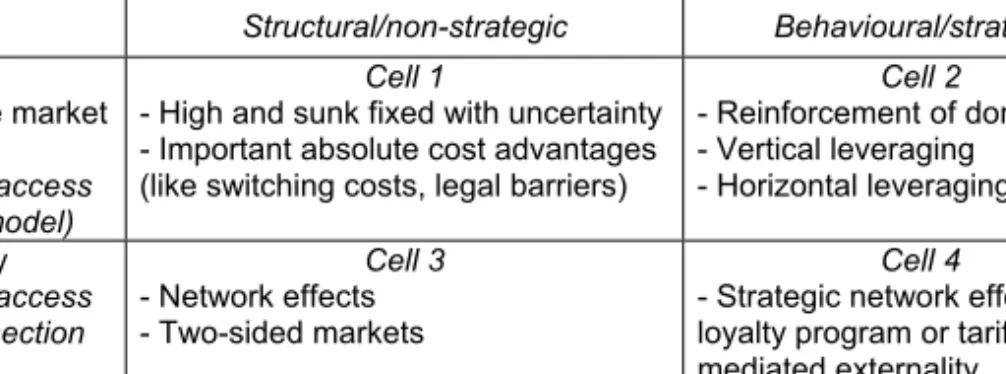
In addition, each type of market failure may be structural and result from the supply and demand conditions of the market, or may be behavioural and artificially (albeit rationally) 'manufactured' by firms, leading to the two-by-two matrix illustrated below 3. Since the decline of the
Structure-Conduct-Performance paradigm in industrial economics, it is now recognised that structural and strategic market failures are closely linked and that market structure influences the conduct of firms as much as their conduct influences market structure (SUTTON, 1991). Yet it remains possible (and useful when choosing between the different instruments of public intervention) to identify the causes of non-efficient market results and to distinguish between structural and strategic market failures.
However, this table is only a stylised and static view of the market and is consequently constitutes more of a starting point for raising relevant questions about the scope of public intervention, rather than a check list to provide definitive answers. Indeed, telecommunications markets are intrinsically dynamic and a rationale based on static view that does not sufficiently take into account investment incentives may lead to inappropriate
2 The European Regulators Group defines network externality as: "The effect which existing subscribers enjoy as additional subscribers join the network, which is not taken into account when this decision is made": ERG Revised Common Position on remedies, p. 126.
3 Several potential behavioural market failures have been identified by the European Regulators Group in its Revised Common position on remedies at Chapter 2.
and over-inclusive public intervention. For instance, a high level of market power when taking a static view may be welfare enhancing when taking a dynamic view because it stimulates investment. Thus, it will not justify intervention, provided they are some constrains in the long term as explained by SCHUMPETER (1964) in the theory of creative destruction. Conversely, public intervention may be welfare detrimental from a static view, but welfare enhancing from a dynamic view. For instance, the support of less efficient entrants may be justified to give these players time to consolidate their customer base and become more efficient over time 4.
Table 1 - Market failures susceptible to public intervention
Structural/non-strategic Behavioural/strategic
Excessive market power
One way access (access model)
Cell 1
- High and sunk fixed with uncertainty - Important absolute cost advantages (like switching costs, legal barriers)
Cell 2
- Reinforcement of dominance - Vertical leveraging
- Horizontal leveraging Externality
Two way access (interconnection model) Cell 3 - Network effects - Two-sided markets Cell 4
- Strategic network effects like loyalty program or tariff mediated externality Information
asymmetry Cell 5 Cell 6
Moreover, it is also important to look at the origin of market power and to intervene more stringently in the case of monopolies acquired under legal protection, but take a laxer approach to monopolies acquired under competitive conditions (there was competition for the market, although there is no competition in the market) along the lines of the 'original sin' rationale 5.
4 ERG Revised Common Position on remedies, p. 78 noting that: "In some cases however, 'inefficient' (e.g. small-scale) entry might be desirable as short-run productive inefficiencies may be more than outweighed by the enhanced allocative efficiencies and long-run (dynamic) advantages provided by competition". See also the Annex of the ERG Revised Common
Position on remedies and DG Competition Discussion Paper of December 2005 of Application
of Article 82 of the Treaty to exclusionary abuses, para 67.
5 This view was defended in the Opinion of the Advocate General Jacobs in Case C-7/97
Bronner v MediaPrint [1998] ECR I-7791. It was also implicitly suggested by the European
Commission at Article 13(2) of DG Information Society Working Document of April 27th 2000 on
a Common regulatory framework for electronic communications networks and services available at:
http://europa.eu.int/information_society/topics/telecoms/regulatory/maindocs/miscdocs/index_en.htm. This working document added the following text to the current definition of SMP: "And, where (a) undertaking has financed infrastructure partly or wholly on the basis of special or exclusive
rights which have been abolished, and there are legal, technical or economic barriers to market
entry, in particular for construction of network infrastructure; or (b) the undertaking concerned is a vertically entity owning or operating network infrastructure for delivery of services to customers and also providing services over that infrastructure, and its competitors necessarily
The choice of legal instruments to deal with market failures
To tackle these different market failures, public authorities dispose of several legal instruments (in particular competition law, sector regulation, consumer law) that they must combine in the most efficient way. In fact, the scope of each legal instrument varies across jurisdictions.
In the European Union, the scope of competition law (Articles 81-86 EC) is independent of sector regulation. Competition law has a constitutional value and applies to all market segments. An antitrust authority may consequently intervene in addition to the intervention of a sectoral regulator 6. On the other hand, the scope of sector regulation 7 is dependent
on competition law. Sector regulation applies when competition law remedies prove insufficient to solve a market failure problem (Recital 27 of the Framework Directive). However, it is difficult to determine when sector regulation has an added-value (i.e. is more efficient in dealing with market failure) compared to antitrust law because both instruments have converged over time in the electronic communications sector. Competition law has been applied extensively to maintain level competition, but also to increase such level 8 and has become a sort of 'regulatory antitrust'. Conversely, sector
regulation is now based on antitrust methodologies 9 and has become sort of
'premptive competition law' (CAVE & CROWTHER, 2005; de STREEL, 2004). As KRÜGER & DI MAURO (2003: 36) observe:
require access to some of its facilities to compete with it in downstream market." (my underlining).
6 Commission Decision of May 21st 2003, Deutsche Telekom, O.J. [2003] C 264/29, currently under appeal at the Court of First Instance as case T-271/03. In the United States, the Supreme Court decided in 2004 that antitrust would in practice not be applicable if sector regulation applies: Verizon v. Trinko 540 U.S. 682 (2004). For an analysis of the differences between the USA and Europe, see Larouche, 2006. For an analysis of the relationship between antitrust and sector regulation in other jurisdictions, see GERADIN & KERF, 2003.
7 Directive 2002/21/EC of the European Parliament and of the Council of March 7th 2002 on a
common regulatory framework for electronic communications networks and services (Framework Directive), O.J. [2002] L 108/33; Directive 2002/19/EC of the European Parliament and of the Council of March 7th 2002 on access to, and interconnection of, electronic
communications networks and services (Access Directive), O.J. [2002] L 108/7; Directive 2002/22/EC of the European Parliament and of the Council of March 7th 2002 on universal
service and users' rights relating to electronic communications networks and services (Universal
Service Directive), O.J. [2002] L 108/51.
8 Such approach has been explicitly endorsed by the Court of First Instance: Case T-87/05
Energias de Portugal v Commission [2005] ECR II-0000, para 91.
9 To regulate an operator, a regulatory agency must delineate the border of the relevant markets with competition methodology (the hypothetical monopolist test), select the market according to the three criteria test, and determine whether the operator enjoys a dominant position (as defined in competition law) in the delineated and selected market.
"The perceived antagonism between competition and regulation is, therefore, only apparent, and it is destined to disappear. In fact, competition has already been shaping regulation: it is the latter which has been adapting itself to suit the philosophy and the approach of the former. Regulatory policy cannot be seen anymore as independent of competition policy: it must be seen as a part of a broader set of tools of intervention in the economy based on competition analysis principles. […] competition instruments and regulatory tools are complementary, rather than substitute, means. They deal with a common problem and try to achieve a common aim. The problem is always high levels of market power and the likelihood of it being abused, and the aim is putting the end user at the centre of any economic activity. Only through a combination of both tools can we ensure that market power does not distort and hamper the development of competition in the communications markets. This in turn allows end users to drive and steer such development, as well as to benefit the most of it."
In practice, the two main and related substantive differences between sector regulation and antitrust 10 are that (1) the former intervenes ex-ante,
hence deals with unsatisfactory market structures whereas latter (with the exception of merger control, which is admittedly very important in the electronic communications sector) intervenes ex-post, and consequently deals with unsatisfactory behaviour 11 and (2) the burden of proof for sector
regulation to intervene is lower than antitrust law. The main institutional difference is that (3) sector regulation is only applied by national authorities, whereas antitrust law is applied by national and European authorities (DG Competition).
As a result of the first difference (related to structure and behaviour), it is efficient for sector regulation to deal with structural market failures and competition law to deal with behavioural ones. The second difference (related to the burden of proof) makes it efficient for the factor used to select markets for regulation to be set at a very high level because once a market area is selected, intervention is relatively easy. In other words, the selecting factor should ensure that regulation is limited to markets where the risks of type I errors (false condemnation) are low and the risks of type II errors (false acquittal) are high 12. This is all the more important since the costs of
10 On the differences between sector regulation and antitrust law, see also LAFFONT & TIROLE, 2000: 276-280; KATZ , 2004; TEMPLE LANG, 2006.
11 Paradoxically, the sectoral remedies are mainly behavioural and not structural.
12 I link here the burden of proof to intervene with the risks and the costs of type I and type II errors, following EVANS & PADILLA (2004) and references cited therein in footnote 5.
type I errors are significant in dynamic markets 13. Taking both arguments
together, any possible regulation should be limited to cells 1 and 3 of table 1, i.e. structural market failures due to excessive market power and externalities. Finally, because of the third difference (related to institutional design), it might be justifiable for antitrust law to apply in addition to sector regulation in cases where NRAs have not performed their tasks adequately 14.
A test to determine the scope of sector regulation
Two approaches to a general test
This section of the paper focuses on a test for the first market failure (excessive market power or one-way access) and disregards a test for the second market failure (network effects or interconnection) to alleviate any confusion between two very different economic problems 15. The distinction
between these two market failures is important because the first market failure may disappear over time in electronic communications and economic regulation could be limited to network affects. In the USA, for instance, some authors suggest that Congress should reform the Telecom Act and limit regulation to interconnection issues where there are few players, leaving all the other issues (like one-way access or interconnection with many players) to antitrust law 16.
For the first market failure, there are two main approaches to translating this economic rationale into legal provisions. The first approach is a market-based test and is currently followed in Europe. It relies on a combination of
13 HAUSMAN (1997) valued the delay of the introduction of voice messaging services from late 1970s until 1988 at USD 1.27 billion per year by 1994, and the delay of the introduction of mobile service at USD 100 billion, large compared with the 1995 US global telecoms revenues of USD 180 billion/year.
14 As was the case in the Deustche Telekom decision.
15 For interconnection, many authors argue for a move towards a generalized bill and keep rule: DEGRABA, 2002; HORROCKS ,2005.
16 See the Draft Bill of the Progress & Freedom Foundation proposing a blueprint for and U.S. Digital Age Communications Act, available at: http://www.pff.org/daca/. This can not necessarily be transposed in Europe due to the lower penetration rate of cable and the application of the calling party principle.
antitrust methodologies and additional criteria. Thus, regulators start by defining relevant retail markets according to antitrust methodologies (adapted to sector characteristics such as its dynamism) 17. In cases of
excessive market power at a retail level, regulators move to the linked wholesale network access market(s) and select markets for possible regulation on the basis of three criteria that are deemed to indicate which markets are not efficiently policed by competition law: entry barriers, no dynamics behind the barriers, and the insufficiency of competition law remedies to deal with the perceived problem 18.
Such an approach is praised by BUIGES (2004) and CAVE (2004) because it ensures flexibility (as antitrust principles are based on economic theory), legal certainty (as antitrust principles are based on over forty years of case-law) and harmonisation (as antitrust principles are strongly Europeanised) and should facilitate the transition towards the disappearance of economic regulation and a state of affairs where competition laws is solely remaining. However, this approach is criticised by LAROUCHE (2002:136-140), DOBBS & RICHARDS (2004), and RICHARDS (2006) because it is overly complicated and may contain a bias towards more regulation.
The second approach is an asset-based test and is currently adopted in the United States 19. It detects hard-core market power justifying regulation
with alternative and supposedly more direct economic methods. Thus, regulators do not start at the retail level, but focus directly on wholesale network segments with high fixed and sunk costs that make them unlikely to be replicable. One variant is the non-replicable asset defined as (1) an asset that has not already been replicated on a commercial basis in similar circumstances, and (2) with no functionally equivalent commercially viable and being able to deliver comparable services to end-users 20. Another
17 On this approach, see the Explanatory Memorandum of the Commission Recommendation on relevant markets, section 3.1.
18 Recitals 9-16 of the Commission Recommendation 2003/311 of February 11th 2003 on
relevant product and service markets within the electronic communications sector susceptible to
ex ante regulation in accordance with Directive 2002/21/EC of the European Parliament and of
the Council on a common regulatory framework for electronic communications networks and services, OJ [2003] L 114/45.
19 Note that the ERG Revised Common position on remedies refers to the non-replicable asset approach at p. 57-59 and the Recital 13 of the Access Directive links the need of regulation with the presence of bottleneck.
20 Indecent and Ovum (2005: 26). In practice, the authors considered that this test implies regulation for to the fixed local loop in all Member States and might also include backhaul facilities from the Main Distribution Frame to the core network in some Member States.
broader (i.e. including more assets for regulation) variant is the bottleneck defined as: "The parts of the network where there are little prospects for effective and sustainable competition in the medium term." 21
In the end, both approaches are less different than they may seem at a first sight, as they pursue the same goal of identifying the 'parts of the infrastructure' that justify regulation due to their structural characteristics. Yet, the starting point is different and the first approach may be a little more complicated, and thus more easily manipulated. On that basis, the first-best option and most efficient test may be an asset-based approach. However, this test would not be able to cover two-way access problems, which might remain the only area of regulation in the long term. It also requires some qualification to ensure that retail markets and the principle of technological neutrality are duly taken into account. In addition in the specific context of the European Union, regulators are now used to the market-based approach and such an approach justifies stringent control by the Commission over NRAs' decisions because it relies on antitrust methodology, an area of Commission expertise. In this specific context, this paper submits that the market-based approach is a second-best that should be maintained. However, it should be clarified.
A reformed and clarified market-based test
The market-based approach needs to be clarified at two levels: in terms of the use of antitrust methodologies and of the three criteria test. On the one hand, antitrust principles and their underlying economic theories should be adapted to the characteristics of the legal instrument and the markets conditions: for vertical chain of production, for Schumpeterian competition and for two-sided markets.
21 Ofcom Final statements of September 22nd 2005 on the Strategic Review of the
Telecommunications and undertakings in lieu of a reference under the Enterprise Act 2002, at Para 4.6. Currently Ofcom considers that this test implies regulation for shared and full metallic path facility, wholesale line rental, backhaul extension services, Wireless Access Network extension services and IPstream. The bottleneck approach was also favoured by SQUIRE-SANDERS & ANALYSYS (1999: 147). They did not define the concept, but pragmatically identified interconnection (especially termination practices), access to networks or digital gateways, local loop, distribution and access to scarce resources. For the (then) future, they also identified intellectual property rights, directory services, programming guides, and control over interfaces/web navigators. In his doctoral dissertation, LAROUCHE (2000: 359-402) also proposed to base regulation on the concepts of bottleneck and network effects.
On the other hand, the three criteria test should be qualified 22. (1) The
first criterion would be related the presence of entry barriers. As we have already seen, there are different conceptions of entry barriers and Schmalensee (2004:471) argues that the appropriate notion of entry barriers depends on the objectives of the legal instrument for which it is used. He submits that a Bainian approach is preferable for antitrust law pursuing the maximisation of consumer welfare 23. For the same reason, a Bainian
approach should be used in sector regulation. Indeed, the European Regulators Group defines the barriers to entry as:
"An additional cost which must be borne by entrants but not by undertakings already in the industry; or other factors which enable an undertaking with significant market power to maintain prices above the competitive level without inducing entry". (ERG Revised Common Position on remedies, p. 124)
Yet, such a notion needs to be qualified before being used as the first criterion to screen a market for regulation. Firstly, the barriers should be structural because strategic barriers (like excessive investment or reinforcement of network effects) would require idiosyncratic and episodic intervention that is better left to competition law (CAVE, 2004: 34).
Secondly, the barriers should be non-transitory because transient barriers do not justify heavy-handed intervention by sector regulators. The timeframe of what is 'transitory' is difficult to decide, but should at least cover the period until the next market review (a minimum of 2 to 3 years) and possibly beyond (ERG Revised Common Position on remedies, p. 59).
Thirdly, the barriers should principally be of an economic nature. Indeed, if the barriers are of a legal nature (such as a limitation of spectrum that cannot be traded), the best remedy consists of removing the barrier and not
22 If the tests were followed, the Commission Recommendation on relevant market would be substantially slimmed down. The retail markets, the fixed core network markets and most of the mobile markets would be removed, meaning that only the fixed terminating segments and the fixed and mobile interconnection markets would be identified for further analysis by NRAs. 23 Thus, the Commission proposes a broad definition of entry barriers, stating that: "Factors that make entry impossible or unprofitable while permitting established undertakings to charge prices above the competitive level." This includes many elements like economies of scale and scope, capacity constraints, absolute cost advantages, privileged access to supply, highly developed distribution and sales networks, the established position of the incumbent firms in markets, legal barriers, and other strategic barriers to entry: Discussion Paper on exclusionary abuses, para 38-40.
regulating the artificially uncompetitive market 24. In such cases, the
regulator would do better to advocate rather than intervene in the market, and to lobby the public authorities (legislator, government etc.) to remove legal barriers instead of regulating the market. Thus it is only if, and for the period when, there is no way of removing such legal barriers that the market may be selected for regulation.
Fourthly and most importantly, the barriers should be so high that no effective competition may be expected. The difficult question here is how 'high' is high? The issue is whether a 'natural' tight oligopoly should be regulated 25. To alleviate any type 1 error, this paper submits that the entry
barriers should be so high that only one operator, except in exceptional circumstances, can be profitable in the market. This paper does not contend that oligopolies should be regulated because the authorities do not have sufficient information to discriminate between efficient and inefficient oligopolies, or have efficient remedies for dealing with them under the sector regime 26 and most oligopoly situations could be resolved by removing legal
entry barriers.
Thus, the first criterion would cover non-transitory and non-strategic entry barriers that are mainly of an economic nature and that should be so high that only one operator is viable in the market, save exceptional circumstances. To make the criterion operational, the regulatory players could opt for a two-stage approach 27. They could start with an empirical
analysis and look at the degree to which operators in Europe or worldwide have built out competitive networks in similar circumstances and under viable economic conditions. Regulators could subsequently complement this finding with a cost analysis based on engineering models that estimate the cost curve or econometric cost functions (GASMI et al., 2002; FUSS & WAVERMAN, 2002). In practice, only some fixed segments may be
24 Indeed, the European Commission is encouraging a more flexible and marked-based approach for the allocation and the exchange of spectrum: Communication from the Commission of September 6th 2005 on a Forward-looking radio spectrum policy for the
European Union, COM (2005) 411.
25 As suggested by the E/IRG response to the 2006 Review, p. 22.
26 In general, remedies include transparency, non-discrimination, accounting separation, compulsory access, price control and cost accounting: Articles 9-13 of the Access Directive. 27 As proposed by CAVE (2006: 227). See also ERG Revised Common Position on remedies, pp. 59-60.
screened for one-way access regulation and no mobile segments, save exceptional circumstances 28.
The second criterion would ensure that a dynamic view is adopted and correct the static bias that the first criterion may carry. Thus regulators should assess whether the market would deliver the results of dynamic competition (i.e. innovation) despite high entry barriers; in other words, whether the market would deliver the benefits of Schumpeterian creative destruction. This may be the case, for instance, if there is ex-ante competition for the market, although there is no more ex-post competition in the market 29. This should, however, be applied in a nuanced way. TIROLE
(2004: 262) argues that if a monopoly is due to a legal monopoly, scale economies or pure network externalities, intervention is justified whereas if monopoly is due to genuine investment and innovation, regulators should forbear.
The third criterion would ensure that a market is selected for regulation solely in cases where antitrust remedies prove less efficient than sector regulation to solve the identified dynamic competitive problem and recall that sector regulation is subsidiary to competition law. This criterion should be based on the same structural elements as the first two criteria and be fulfilled when these criteria are met (i.e. when there are high entry barriers that do not deliver the dynamic benefit of competition) serving solely as a cross-check. This paper does not contend that the third criterion should be based on additional institutional elements (like the respective powers of the national competition authority relative to the national sector regulator) because such elements can vary from Member State to State, and could consequently undermine the consistency of regulation in the single market 30.
A complementing clause for emerging markets
This general screening test should complemented by clear provision regarding the treatment of emerging markets given the importance of
28 For a discussion of one-way access obligation in the mobile sector: ERGAS et al.,2005; VALETTI, 2004.
29 One of the first economists to argue this point was DEMSETZ (1968).
30 See similarly in the parallel issue of the relationship between the ex ante merger control and
ex post control of abuse of dominant position: TetraLaval C-12/03P [2005] not yet reported,
investment in the sector and of legal certainty for investors. To be sure, the screening test based on three criteria test already contains an investment safeguard, as the second criterion relates to dynamic considerations. However, such a safeguard may not provide sufficient legal certainty for investors 31.
To clarify the issue, the first step is to define an emerging market or service. The European Regulators Group defines the emerging market as:
"Distinct from a market that is already susceptible to ex ante regulation from both a demand and a supply perspective. This means that consumers of the new service should not move their custom to currently available services in response to a small but significant non-transitory price increase in the price of the new service. In a similar manner, firms currently providing existing services should not be in a position to quickly enter the new service market in response to a price increase" (ERG Revised Common Position on remedies, p. 19).
The ERG notes that such markets will normally not be selected for regulation because it isn't possible to assess the three criteria test as there is a high degree of demand uncertainty and entrants to the market bear higher risk 32.
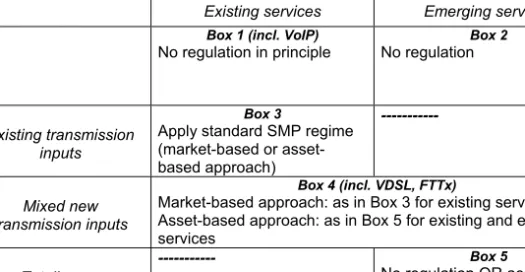
To make the definition operational, it is useful to distinguish further between the retail services and the underlying infrastructures relied upon to provide such services. As far as retail markets are concerned, a new service does not emerge/exist when it can be included in a relevant existing market according to the hypothetical monopolist test 33. This is the case when
end-users consider the new service as substitutable for existing services, hence the new service provider is constrained in its prices (cf. box 1 of table 2). This is the case with Voice over Broadband, for instance, now that it permits
31 In any case a test based on non-replicability or bottlenecks contains nothing to protect new investment.
32 Similarly, Indepen & Ovum (2005: 3) define an emerging market as: "Any relatively new market in which there is insufficient information (for example in terms of demand, pricing, price elasticity and entry behaviour) to carry out the necessary market definition procedures and/or tests as to whether the market is susceptible to ex ante regulation". BAAKE et al. (2005: 22) take: "As the necessary condition for a new market the existence of an innovation, i.e. an increase in general knowledge regarding the possibility of manufacturing or distributing goods and services."
33 As noted by many like RICHARDS (2006), the application of the SSNIP test to emerging markets is complex because little information is available.
nearly the same functionalities as voice over PSTN 34. Conversely, a new
service is considered to be emerging when this service cannot be included in a relevant existing market because end-users do not consider that this new service substitutes existing services (cf. box 2). This may be the case with the next generation of mobile broadband data services providing end users with internet access through a fast connection and with the added feature of mobility (ERG Revised Common Position on remedies, p. 20) or extremely fast fixed broadband access.
Table 2: Different cases of emerging markets (*)
Existing services Emerging services
R E T A I L
Box 1 (incl. VoIP)
No regulation in principle No regulation Box 2
Existing transmission inputs
Box 3
Apply standard SMP regime (market-based or asset-based approach) --- Mixed new transmission inputs Box 4 (incl. VDSL, FTTx)
Market-based approach: as in Box 3 for existing services Asset-based approach: as in Box 5 for existing and emerging services W H O L E S A L E Totally new transmission inputs --- Box 5 No regulation OR access holidays, depending of the characteristics of the new infrastructure
(*) This figure, which distinguishes between existing and new retail markets and between existing and new wholesale inputs, is adapted from a presentation that R. Cawley did at the CICT conference in Copenhagen in December 2005. For an alternative view, see Ovum & Indepen (2005).
In terms of the wholesale inputs, there are three possibilities. An infrastructure may exist (and possibly have been deployed under a legal monopoly) and be used to provide existing retail services (cf. box 3). This is the case of the PSTN network. Alternatively, an upgraded infrastructure or a new infrastructure may be used to provide both existing and new retail services (cf. box 4). This is the case with the VDSL or even the Fiber To The Curb or To The Home network (FTTx). Finally, a new infrastructure may be used solely to provide emerging retail services (cf. box 5). This was the case
34 Annex of the Communication from the Commission of 6 February 2006 on Market Reviews under the EU Regulatory Framework: Consolidating the internal market for electronic communications, COM(2006) 28, p. 4.
with the 2G network when digital mobile voice was launched at the beginning of the 1990s.
Once the emerging markets have been defined, the second step is to decide upon the optimal level of regulation required in order to preserve investment incentives 35. With regard to retail market regulation, existing
services (box 1) should, in principle, be left to competition and sector regulation phased out, possibly accompanied by a safeguard period to ensure that regulation at the wholesale level is efficient in removing barriers to retail entry. Emerging services (box 2) that entail a much higher risk should be left to antitrust law alone 36.
With regard to the regulation of wholesale inputs, the case of existing transmission infrastructures (box 3) is not controversial. These inputs should be subject to the standard three criteria test. Once this test is passed, NRAs may analyse further and possibly regulate the existing transmission inputs.
The case of totally new transmission inputs is not very controversial either, although it should rarely happen in practice. There are two hypotheses (box 5) 37. The input does not, and will not in the future, meet
the conditions of the screening test. In such circumstances, there is no need to intervene because the market is emerging, and more importantly, because there is no hard-core market power that justifies regulation.
Alternatively, the totally new transmission input may, in the future, meet the conditions of the screening test. This situation is trickier because on the one hand there is hard-core market power that may justify regulation, but on the other hand, investment incentives need to be preserved 38. Regulators
may adopt a radical approach and guarantee the operator 'access holidays' for a certain period of time, like an intellectual property right. The optimal
35 See also Ofcom, March 7th 2006, New Generation Networks: Developing the regulatory
framework.
36 This was the case with the ADSL tariffs in the Commission Decision of July 16th 2003, case 38.233 Wanadoo.
37 Another sub-category may also be created between new infrastructures put in place by incumbents and by new entrants, although such a distinction may not be relevant.
38 It can be argued that regulation will not impede the recoupment of investment risk (hence will not undermine future investment incentives), as any access regulation (and access price) should provide a premium for investment risk. However, the calculation of this premium is far from simple, as regulators face difficulties in distinguishing the ex post rewards for risky investment from monopoly rents, hence there is a possibility that the premium will be set too low. On this point, see Australian Productivity Commission (2001: 268).
length of such access holidays is difficult to determine. Indepen & Ovum (2005) propose one third of the life of the asset 39, whereas BAAKE et al.
(2005) propose a multiple stage approach whereby the situation is assessed every two to four years. Regulators may also be more interventionist and impose 'open access regulatory compacts' that leave operators the freedom to set the level of prices, but establish a structure of prices such that the operator can not foreclose its competitors in related markets 40.
The most controversial case is the mixed new transmission inputs (box 4). Some (LAROUCHE, 2006) start at the retail level (i.e. at the top of figure 1) and adopt a 'vertical approach'. They argue that box 4 should be treated in the same way as box 3 for existing services. This is the view taken by the Commission and the European Regulators Group 41. Thus, regulators
should deal equally with old and mixed new transmission inputs when they provide the same existing retail services. That may lead to further analysis, and possibly an imposition of remedies on the mixed new infrastructure, if the conditions of the three criteria test are met. For instance, if a VDSL line or a FTTH line replaces copper pairs, access regulation may continue to be imposed for the provision of existing retail services (like voice), but not for the provision of emerging services 42. However, NRAs should be cautious
not to extend existing regulation to new inputs without an articulated economic analysis. Indeed, the fact that a mixed new infrastructure has been deployed may be an indication that there is no structural market failure justifying regulation altogether.
39 Based on GANS & KING, 2004.
40 This is the approach followed in the Microsoft case, as the company is free to determine its price on the Operating System market, but it may not extend its monopoly from the OS market to related markets: Commission Decision of March 24th 2004, case 37.792 Microsoft.
41 Commission Decision of December 23rd 2005, Case DE/2005/262 (Wholesale Broadband
Access in Germany), available at: http://forum.europa.eu.int/Public/irc/infso/ecctf/library. See also the ERG Revised Common Position on remedies, p. 116-118. Note that Commissioner Reding appears to have changed her mind about regulatory holidays. At the beginning, she seemed to be in favour of such approach to stimulate investment in new broadband infrastructure (REDING, 2005). Now on the basis of the data gathered in the 11th Implementation Report (Communication from the Commission of February 20th 2006, European Electronic Communications Regulation and Markets 2005 (11th Report), COM(2006) 68) and an
independent study of London Economics (2006) done for the European Commission, she seems much more reluctant to accept regulatory holidays (REDING, 2006: 4).
42 To ensure that investment in new infrastructure is not impeded, regulators may decide to regulate the access price of the mixed new infrastructure at retail minus (instead of cost plus based).
Conversely, others (Indepen & Ovum, 2005) start at the wholesale level (i.e. at the bottom of figure 1) and adopt a 'horizontal' approach. They argue that box 4 should be treated in the same way as box 5. This is the view of the U.S. Federal Communications Commission 43. Thus the regulator should
deal equally wit all new infrastructures, independently of the services for which they are used. For instance, if a VDSL line or a FTTH line replaces copper, access regulation will be lifted even to provide existing retail services (like voice).
In practice
To put these principles into practice, this paper suggests that regulators start by screening markets with the proposed market-based test to detect structural market failures due to excessive market power. In particular, regulators should assess whether the supposed market failures are detrimental to user welfare in the long run; and in cases of conflict between static and dynamic efficiencies, regulators should favour latter because dynamic gains and losses are generally more important than static gains and losses (de BIJL & PEITZ, 2002; Indepen & Ovum, 2005: 22).
Regulators should then advance compelling arguments that the benefits of their intervention outweighs its cost. The benefit is the correction of the market failure and the consequent increase in welfare. The costs are the direct costs of designing and implementing the rules by the regulators and the regulatees and indirect costs due to type I errors (false condemnation), both of which are substantial in the electronic communications sector 44. As
cost/benefit analyses are extremely difficult to perform, especially as they involve predictions of future market developments, a qualitative argument should suffice when quantitative analysis is not possible or far too burdensome 45.
43 Note, however, that the position of the FCC is mainly due to the important cable penetration in the USA, which has no equivalent in most of the EU Member States.
44 For the direct costs of the implementation of the European regulation, Cave estimated at a CEPT conference in April 2005 that the average costs for the initial market review at 5 million Euros per Member State. Similarly, Australian Productivity Commission (2001) notes that the Australian incumbent is the biggest consumer of legal service in the country. For the indirect costs, see note 20.
45 In particular when choosing remedies, the NRAs should carry a regulatory impact assessment showing that the anticipated benefits of the option selected outweigh its potential costs: Revised Common Position on remedies, p. 56.
Conclusion
To conclude, it is important that regulators have a clear and soundly economic-based test to determine the scope of economic regulation in the electronic communications sector and its optimal balance with competition law. This paper proposes a market-based approach relying on a combination of selection criteria and antitrust methodology to determine the scope of economic regulation. I suggest a clarified three criteria test related to the presence of high non-transitory and non-strategic entry barriers that are mainly of an economic nature, the absence of dynamic competition behind those barriers and a cross-checking criterion related to the insufficiency of antitrust remedies to solve the problems identified. It recalls the importance of using antitrust methodology adapted to relect the characteristics of the sector. The paper also proposes a clarification of the regulation of emerging markets and suggests drawing a distinction between retail services and underlying wholesale infrastructures. It also suggests that all wholesale access products used for the provision of similar retail services should be dealt with in the same way, independently of their infrastructure (the old copper pair or an upgraded VSDL network) and that only wholesale access products used to provide new retail services should possibly escape regulation.
References
ARMSTRONG M. (2002): "The Theory of Access Pricing and Interconnection", in Cave M., Majumdar S., Vogelsang I (Eds), Handbook of Telecommunications
Economics V.I, North-Holland, pp. 295-384.
Australian Productivity Commission (2001): Telecommunications Competition
Regulation, Final Report, AusInfo.
BAAKE P., KAMECKE U. & WEY C. (2005): Efficient Regulation of Dynamic Telecommunications Markets and the New Regulatory Framework in Europe, Mimeo. de BIJL P. & PEITZ M. (2002): Regulation and Entry into Telecommunications
Markets, Cambridge University Press.
BUIGES P. (2004): "A Competition Policy Approach", in P. Buiges & P. Rey (Eds),
The Economics of Antitrust and Regulation in Telecommunications, E. Elgar, 9-26.
CAVE M.:
- (2004): "Economic Aspects of the New Regulatory Regime for Electronic Communication Services", in P. Buiges & P. Rey (Eds), The Economics of Antitrust
and Regulation in Telecommunications, E. Elgar, pp. 27-41.
- (2006), "Encouraging infrastructure competition via the ladder of investment",
Telecommunications Policy 30, pp. 223-237.
CAVE M. & VOGELSANG I. (2003): "How access pricing and entry interact",
Telecommunications Policy 27, pp. 717-727.
CAVE M. & CROWTHER P. (2005): "Pre-emptive Competition Policy meets Regulatory Antitrust", European Competition Law Review, pp. 481-490.
DEGRABA P. (2002): "Central Office Bill and Keep as a Unified Inter-Carrier Compensation Regime", Yale Jour. on Regulation 19, 36.
DEMSETZ H. (1968): "Why Regulate Utilities?", Jour. of Law and Economics XI, pp. 55-65.
DOBBS I. & RICHARDS P. (2004): "Innovation and the New Regulatory Framework for Electronic Communications in the EU", Eur. Comp. Law Rev., pp. 716-730. ERGAS H., WATERS P. & DODD M. (2005): Regulatory approaches to Mobile Virtual Network Operators (MVNOs), Study prepared for Vodafone.
EVANS D.S. & A. J. PADILLA (2004): "Designing Antitrust Rules for Assessing Unilateral Practices: A Neo-Chicago Approach", CEPR Discussion Paper 4625. FUSS M.A. & WAVERMAN L. (2002): "Econometric Cost Functions", in Cave M., Majumdar S., Vogelsang I. (Eds), Handbook of Telecommunications Economics, V.I, North-Holland, pp. 144-177.
GANS J. & KING S. (2004): "Access Holidays and the Timing of Infrastructure Investment", The Economic Record 80(284), pp. 89-100.
GARZANITI L. (2003): Telecommunications, Broadcasting and the Internet: EU
Competition Law and Regulation, 2nd ed., Sweet & Maxwell.
GASMI F., KENNET M., LAFFONT J.J. & SHARKEY W.W. (2002): Cost proxy
models and telecommunications policy: A new empirical research to regulation, MIT
Press.
GERADIN D. & KERF M. (2003): Controlling Market Power in Telecommunications:
Antitrust vs Sector-Specific Regulation, Oxford University Press.
HAUSMAN J.A. (1997): "Valuing the Effect of Regulation on New Services in Telecommunications", Brookings Papers: Microeconomics, pp. 1-38.
HAUSMAN J.A. & SIDAK J.G.:
- (1999): "A Consumer-Welfare Approach to the Mandatory Unbundling of Telecommunications Networks", Yale Law Jour. 109, pp. 417-505.
- (2005): "Did Mandatory Unbundling Achieve its Purpose? Empirical Evidence from Five Countries", Jour. of Competition Law and Economics 1(1), pp. 173-245.
HORROCKS J. (2005): A Model for Interconnection in IP-based Networks, ECC TRIS Report.
Indepen & Ovum (2005): Regulating Emerging Markets?, Study prepared for OPTA. KATZ M.L. (2004): "Antitrust or regulation? US public policy in telecommunications markets", in P. Buiges & P. Rey (Eds), The Economics of Antitrust and Regulation in
Telecommunications, E. Elgar, pp. 243-259.
KRÜGER R. & DI MAURO L. (2003): "The Article 7 consultation mechanism: managing the consolidation of the internal market for electronic communications",
Comp. Policy Newsletter 3, pp. 33-36.
LAFFONT J.J. & TIROLE J. (2000): Competition in Telecommunications, MIT Press. LAROUCHE P.:
- (2000): Competition Law and Regulation in European Telecommunications, Hart. - (2002): "A closer look at some assumptions underlying EC regulation of electronic communications", Jour. of Network Industries 3, pp. 129-149.
- (2006): "Contrasting Legal Solutions and Comparability of the EU and US Experiences", Presented at the Conference Balancing Antitrust and Regulation in Network Industries.
London Economics (2006): Measuring the impact of the regulatory framework on
growth and investments in e-coms, Study for the European Commission.
McAFEE R., MIALON H.G. & WILLIAMS M.A. (2004): "What is a Barrier to Entry",
American Economic Review: AEA Papers and Proceedings 94(2), pp. 461-465.
MOTTA M. (2004): Competition Policy: Theory and Practice, Cambridge University Press.
OECD (2006): Barriers to entry, DAF/COMP(2005)42. REDING V.:
- (2005): "The review of the regulatory framework for e-Communications", Speech September 15th.
- (2006): "The information society: Europe's highway to growth and prosperity", Speech March 6th.
RICHARDS P. (2006): "The limitations of market-based regulation of the electronic communications sector", Telecommunications Policy 30, pp. 201-222.
SCHUMPETER J. (1964): The Theory of Economic Development: An Inquiry into
Profits, Capital, Credit, Interest and the Business Cycle, Cambridge University Press.
SHARKEY W.W. (2002): "Representation of Technology and production", in Cave M., Majumdar S. & Vogelsang I (Eds), Handbook of Telecommunications Economics
V.I, North-Holland, pp. 180-222.
Squire-Sanders-Dempsey and Analysis (1999): Consumer demand for telecom-munications services and the implications of the convergence of fixed and mobile networks for the regulatory framework for a liberalised EU market, Study for the European Commission.
Squire-Sanders-Dempsey & WIK Consult (2002): Market Definitions for Regulatory
Obligations in Communications Markets, Study for the European Commission.
de STREEL A. (2004): "Remedies in the Electronic Communications Sector", in D. Geradin (Ed.), Remedies in Network Industries: EC Competition Law vs.
Sector-specific Regulation, Intersentia, pp. 67-124.
SCHMALENSEE R. (2004): "Sunk Costs and Antitrust Barriers to Entry", American
Economic Review: AEA Papers and Proceedings 94(2), pp. 471-475.
SUTTON J. (1991): Sunk Costs and Market Structure, MIT Press.
TEMPLE LANG J. (2006): "Competition Policy and Regulation: Differences, Overlaps, and Constraints", presented at the Conference Balancing Antitrust and
Regulation in Network Industries.
TIROLE J. (2004): "Telecommunications and competition", in P. Buiges & P. Rey (Eds), The Economics of Antitrust and Regulation in Telecommunications, E. Elgar, pp. 260-265.
VALLETTI T. (2004): "Market Failures and Remedies in Mobile Telephony", Jour. of
Network Industries 5, pp. 51-81.
VOGELSANG I. (2003): "Price Regulation of Access to Telecommunications Networks", Jour. of Economic Literature XLI, pp. 830-862.