HAL Id: dumas-01074743
https://dumas.ccsd.cnrs.fr/dumas-01074743
Submitted on 15 Oct 2014
HAL is a multi-disciplinary open access archive for the deposit and dissemination of sci-entific research documents, whether they are pub-lished or not. The documents may come from teaching and research institutions in France or abroad, or from public or private research centers.
L’archive ouverte pluridisciplinaire HAL, est destinée au dépôt et à la diffusion de documents scientifiques de niveau recherche, publiés ou non, émanant des établissements d’enseignement et de recherche français ou étrangers, des laboratoires publics ou privés.
Wishful thinking: a group approach
Charlotte Saucet
To cite this version:
Charlotte Saucet. Wishful thinking: a group approach. Economics and Finance. 2014. �dumas-01074743�
Wishful thinking : a group approach
When groups leads to worse decisions than individuals
Charlotte Saucet,
directed by M.C Villeval⇤June 23, 2014
Abstract
This study attempts to understand the wishful thinking effect through a group ap-proach. We build a group decision making model that tries to explain how a group dynamic can lead the group to interpret and recall data so that they correspond to more favorable beliefs about the group future prospects. Group members have to take one single common decision determining the group effort level in a joint production.
We find that (a) An agent’s incentive to enter into denial when others are in denial is higher than an agent’s incentive to enter into denial when he is alone; (b) An agent’s incentive to enter into denial when others are realist is lower than an agent’s incentive to enter into denial when he is alone; (c) An agent’s incentive to enter into denial increases with the riskiness of the project; (d) the presence of a leader can either increase or decrease the incentive to enter into denial depending on assumptions made on costs.
We build an experimental protocol allowing to try to test the previous model and validate or not its predictions.
Keywords: wishful thinking, group decision making, collective delusion
∗I am grateful to M.C Villeval who has guided my steps all along this research. I would like to thank her
Contents
1 Introduction 3
2 Related literature 8
2.1 Literature on wishful thinking . . . 8
2.2 Literature on groups . . . 9
3 A theoretical model of wishful group thinking in organizations 11 3.1 Baseline Model . . . 11
3.1.1 Definition of wishful group thinking . . . 12
3.1.2 Structure of the model . . . 12
3.1.3 Set of utilities . . . 15
3.1.4 Best responses and conditions for equilibrium . . . 18
3.2 The role of the riskiness of the project . . . 20
3.3 Introducing asymmetry in roles with the presence of a leader . . . 22
4 Experimental design and procedure 25 4.1 The game . . . 25
4.2 Sessions and final payoffs . . . 27
4.3 Hypothesis, method and predictions . . . 28
“A great deal of intelligence can be invested in ignorance when the need for illusion is deep.” Saul Bellow1
, To Jerusalem and Back
1
Introduction
It seems in the nature of human being to suit his beliefs so that they correspond to his desires. Lots of examples have shown that this phenomenon, called wishful thinking, could have huge and dramatic consequences especially when it occurs in groups. It can be difficult to understand how a group, who traditionally disseminates more information and thus behave rationaly, can sometimes enrol in crazy dynamics that get it away from rational decisions. Recently, the english journalist and author Christopher Booker said :
“When we embark on a course of action which is unconsciously driven by wishful thinking, all may seem to go well for a time, in what may be called the “dream stage”. But because this make-believe can never be reconciled with reality, it leads to a “frustration stage” as things start to go wrong, prompting a more determined effort to keep the fantasy in being. As reality presses in, it leads to a “nightmare stage” as everything goes wrong, culminating in an “explosion into reality”, when the fantasy finally falls apart”2
Some stylized facts show that organizations, markets, and groups in general can be victims of terrible disasters due to a too strong ascendancy of desires over reality in the pursuing of joint projects. The following patterns are illustrations of this impact of desires on our perception of the reality, that can lead to dramatic denial of reality. One of the most famous illustrations of wishful thinking is the Columbia accident in 2003 (Bénabou, 2013). When the shuttle was still in orbit, some engineers detected damages, but NASA managers limited the investigation on the grounds that even if problems were found they could not do much about it. In the Columbia Accident Investigation Board Final Report (2003), it is written that the Columbia accident was “ an unfortunate illustration of how NASA’s strong cultural bias and its optimistic organizational thinking undermined effective decision-making.” The Challenger disaster is also a powerfull example. The Shuttle Challenger disaster occurred in 1986 when the space shuttle Challenger broke in flight leading to the deaths of its seven-crew members. The disaster resulted in the formation of the Rogers Commision, a special commission appointed to investigate the accident. Results of the Commission showed that
1
Nobel Prize in literature in 1976
2
“the NASA’s organizational culture and decision-making processes had been key contributing factors to the accident”. NASA managers were informed of technical problems that could be potentially catastrophic but failed to address it properly. They also disregarded warnings from engineers about the dangers of launching posed by the low temperatures of that morning and failed to adequately report these technical concerns to their superiors. The report also considered that rather than solving the technical problems, managers came to define the problem as an acceptable flight risk. This example shows that the perception of the reality is different according to our motivations. Here, managers refused to see to what extent the technical problem highlighted by the engineers could have dramatic consequences. In 1986, the Nobel physicist Richard Feynman noted in his contribution to the Rogers Commission Report :
« It appears that there are enormous differences of opinion as to the probability of a failure with loss of vehicle and of human life. The estimates range from roughly 1 in 100 to 1 in 100,000. The higher figures come from the working engineers, and the very low figures from management. What are the causes and consequences of this lack of agreement? Since 1 part in 100,000 would imply that one could put a Shuttle up each day for 300 years expecting to lose only one, we could properly ask : What is the cause of management fantastic faith in the machinery? »
The Nobel prize reasoning shows that there is neither empirical evidence nor irrefutable proof that can reasonably justify such NASA management’s risk estimates. The risk perception depends on unobjective variables that are strongly driven by the strengh of our desires. Our desires lead us to deny bad news that don’t go in the same way than them. This is wishful thinking. For Benabou (2013, Appendix D), wishful thinking leads to preposterous probabil-ities (as shown in the previous quotation). Wishful groupthink has been highly documented concerning the Challenger and the Columbia space shuttle disasters, but evidences of collec-tive denial have also been observed as contributing factors in private enterprises’ disasters such as Enron or Worldcom, where managers seemed to have been subject of a form of willful blindness and overconfidence : “warning signals were systematically cast aside or met with denial, evidence avoided or selectively reinterpreted, dissenters shunned. Market bubbles and manias exhibit the same pattern of investors acting “color-blind in a sea of red flags”, followed by a crash” (Benabou, 2013).
These examples highlight that wishful thinking recur across most instances of organiza-tional meltdown. Thus, there are group decisions that can not be explained otherwise than
by crazy dynamic.
There are few papers on this subject. Recently, Benabou has built a model of collective delusion that studies how willful blindness (ex ante information avoidance) and wishful think-ing (ex post distorsion of information / denial of bad news) spread through organizations and markets. Results are the following : willful blindness and wishful thinking are contagious when harmful, and self-limiting when beneficial. Indeed, other’s ignorance/distortion of bad news imposes negative externalities3
. These negatives externalities make the news even worse and thus harder to accept : my incentive to ignore it is higher (Bénabou, 2013). Other papers deals with wishful thinking but without the group dimension (Landier, 2000; Scott-Kakures, 2000; Mayraz, 2011) 4
.
At the individual level, wishful thinking is the fact that what you want to be true affects what you believe to be true (Mayraz, 2011). A number of well studied bias can be considered as instances of wishful thinking. Over-confidence and over-optimism can be examples of wishful thinking. They impact the view of the reality and lead an agent to act responding to his desires and not to reality. Take a lotery (A = 10,0.5 ; B = 0,0.5). In this lotery, A and B have the same probability to occur. An agent (respecting the first stochastic order) will prefer A than B. Over-optimism may lead the agent to act as if he would win (as if A would be realized), changing his beliefs/his perception about the actual probabilities of the lottery. Wishful thinking is when you act according to what you want and not best responding to the real state of the world.
At the group level, there are two ways to consider beliefs distortion in a group, both of them can be subsumed under the term of Wishful Group thinking. The first one is to consider that each individual has distorted beliefs ex ante. Thus, the point consists in studying the dynamic of the spread or the self limitation of beliefs inside the group (see model of Benabou, 2013). If, as above, we consider the group as a sum of individuals who each has distorted beliefs ex ante, the questions of complementarity, substitutability, reinforcement or cancellation of beliefs raise. These conception follows the definition of Benabou, 2013 :
“Each agent derives anticipatory utility from his future prospects, and
conse-3
In a large definition, a negative externality is a cost (not necessarely monetary) that affects a party / an agent who did not choose to incur that cost (ie) who are not voluntarily responsible of that cost. Here negative externalities can be lower expected payoffs, increased risk, etc (see Benabou, 2013).
4
Notably, Mayraz made an experiment where farmers and bakers had to predict the price of wheat in a future given date after having observed an historical chart of past prices. An incentive for accuracy was given so that players anticipations really reflect their beliefs. He found a significant difference between prices given by the two categories of players. Indeed, the bakers (wheat buyers), who wanted that the wheat price be low predicted a significantly lower price than farmers (wheat sellers) who wanted that the wheat price be high.
quently faces a tradeoff: he can accept the grim implications of negative public signals about the project’s value (realism) and act accordingly, or maintain hope-ful beliefs by discounting, ignoring or forgetting such data (denial), at the risk of making overoptimistic decisions. The key observation is that this tradeoff is shaped by how others deal with bad news, creating cognitive linkages.”
Here, there is one effort decision per agent and each agent takes his decision “independently of what any one else may be doing”.
The second way to consider beliefs distortion into a group is to consider that beliefs distortion is due to the existence of the group (our beliefs change because of/thanks to our belonging to a group) (Weizacker, 2010). Here, the point is focused on the distortion created ex post by the group. For Janis (1972) :
"The more amiability and esprit de corps among the members of a policy making in-group, the greater is the danger that independent critical thinking will be replaced by groupthink”
From this point of view (social-psychology approach), groupthink is a phenomenon occurring when a pseudo-consensus group meets to think and make a decision. The danger of any group with a strong cohesion is that it folds on itself and creates its own reality. The interesting point is thus the process by which individuals in a group tend to search primarily a form of global agreement (who leads to a distorted view of reality) rather than understanding a realistic situation. The definition given by the Merriam-Webster’s dictionary also seems to follow this conception :
“Groupthink is a pattern of thought characterized by self-deception, forced manufacture of consent, and conformity to group values and ethics”.
To sum up, we consider two main ways to understand wishful group thinking. In the first one, wishful group thinking is exogenous (economics approach). It is the result of diffusion, a contagion of individual illusions. In this case, each agent faces a signal it will accept or reject. The decision to accept or reject the signal will propagate between agents of the same group. The collective delusion is the result (ex post) of a diffusion of individual illusions taken ex ante (each agent decides alone if it rejects or accepts the signal). In the second approach, collective delusion is endogenous (social-psychology approach). All agents of the same group take one single decision. The collective delusion here comes from pressures within the group that occur before the joint decision. The group leads to a homogenization of
opinions: within the group, each individual "looses" part of lucidity, rationality, due to influence of others’ members views. In this case, the greater homogeneity of the group, the greater the collective delusion is. It is important to note that in both conceptions, the degree of wishful group thinking could depend on degree of cohesion, group structure (symmetry of members or existence of a hierarchy), social identity strength and saliency of the group (a group is salient if members of the group recognize the existence of the group and believe that the other players also recognize it (Charness, Rigotti & Rustichini, 2007).
In this paper, the aim is to link wishful thinking and group decision making.
To explain wishful group thinking, we build a model where group members have to take one single common decision determining the group effort level in a joint production (level of investment or of upcoming production in firms, decisions about public policies or foreign policies in politics, etc). At the first period, each member of the group receives a common negative signal σ that he can either accept or reject, depending on his beliefs. Individual beliefs determine the average group belief and thus the effort level for the project. Whereas lots of articles have shown that groups lead to a rationalization of decisions (Sniezek, 1992; Sniezek and Pease, 1991; Starbuck and al, 1976), our predictions are that being in a group can lead to dramatic decisions that would not have occurred in a model of individual decision making. When each people has individually fixed beliefs, the fact to be in group will lead to a distortion of beliefs which may lead to a biased view of reality (wishful group thinking).
Our model differs from the model of Bénabou as it is a group decision making model. In his model, Bénabou studies the spread or the self-limiting of individual distorted beliefs inside the group. Our framework study the emergence of distorted beliefs due to the existence of the group.
More precisely, Bénabou compares the two situations when others are realist and when others are in denial in a individual decision making framework. Each agent takes his own effort decision. This decision depends on how others deal with bad news but is taken individually. He compares the incentive to enter in denial when others are realist versus when others are in denial and shows that the incentive when others are in denial is higher than when they are realist (which is also the case in our model). The main contribution is that our model compares the incentive to enter into denial in an individual decision making model (each individual takes his decision without considering what may do any other individual) versus in a group decision making model (there is one common decision for all the group). The main result is that compared to a individual decision, the group decision can sometimes lead to a “loss of realism” that can drive to dramatic situations.
Our approach seems relevant as it gathers in the same model three main dimensions. The economic one, using classical economics tools (expected utility, utility maximization, inter temporal dimension and attitudes towards information), the social-psychology one (group effect : saliency, normalization, conformity process, etc.) and the behavioral one (cognitive dissonance, self-deception, over-optimism, over-confidence, etc).
Section 2 reviews briefly the related literature. Section 3 presents the theoretical model, its variants and propositions on wishful-groupthinking. Section 4 presents the upcoming experiment to test the wishful group thinking effect. Section 5 concludes.
2
Related literature
2.1
Literature on wishful thinking
The belief distortion according to which what we want to be true affects what we believe to be true is called Wishful thinking (Mayraz, 2011). Yildiz identifies a player as a wishful thinker at a state if his expected payoff (according to his own probability distribution) at that state coincides with the highest possible expected payoff one can ever expect within the set of these possible outcomes (Yildiz, 2007). A number of biases are examples of wishful-thinking. Over-confidence is a belief-distortion about one’s abilities5
. Over-optimism is a belief-distortion about the probability that some events occur6
. Self serving bias and cognitive dissonance are other well-known biases (for a well-done summary of the literature on all these bias, see appendix A of Mayraz article, 2011). All these biases are channels to wishful thinking and exert a direct effect on beliefs. But people also influence their beliefs through the selection of signals (Akerlof and Dickens, 1982). Landier models overconfidence as an optimal response of the self to a given signal. In this model, at the third period, subjects can change the choice they made in period 1 consequently to a signal received in period 2. Results are the following : willing to believe they didn’t make too bad a choice at the beginning, agents tend to under-react when the possibility of a partial adjustment arises. This reluctance of agents to accept the (ex post) non optimality of their first choice will lead them to find some compromise with reality through “stubborn beliefs” (Landier, 2000). Benabou and Tirole
5
For examples, Svenson (1981) show that most people believe themselves to be better drivers than most other people. ; Alpert and Raiffa (1982) show that people are over-confident about the accuracy of their predictions. Camerer and Lovallo (2000) show that in lab-experiment, over-confident subjects have a higher tendency to enter into competition even if they have not higher abilities than other competitors.
6
For example, Weinstein (1980) shows that people under-evaluate the probability of life-positive events such as finding a good job after graduation and under-evaluate life-negative events such as having a divorce
capture mechanisms of defensive denial and self-deception through a simple game-theoretic model of endogenously selective memory. The supply side for self-serving beliefs is driven by an incentive to try to recall signals that help sustain long-term goals, and forget those that undermine them (Benabou and Tirole, 2002). These models allow to understand how people deal with signals. In the standard literature, the “homo-economicus” takes decisions considering all the information he has. Here, signals (informations) can be either taken into account, or denied. If our beliefs distort what we believe to be true from what is really true, our decisions are no more rational as they are a response of a false photography of reality. It is thus a very interesting field in two ways. In a research way to understand how the distortion works, in what environment, under what circumstances. And in a application way as it can be hugely used in management, marketing, finance, assurance, politics, etc.
Our paper distinguish itself from it introduces the group dimension into the wishful-thinking phenomenon.
2.2
Literature on groups
Previous quoted litterature shows that human beings are inclined to engage in wishful think-ing7
. The following question is thus to wonder to what extent groups are better or worse decision makers than individuals. This question connects two litteratures. The litterature who compare the rationality of group decisions versus individual decisions and the litterature relative to the group decision-making.
Traditionally, groups are considered as more rational and using less heuristics than indi-viduals (Kocher, Kugler, Kausel, 2012). There are three main reasons : groups benefit from higher available information, better confidence and rationalization processes. In groups, members can have different opinions. This disagreement between group members has the potential to lead to information processing that makes the group more realistic. The hy-pothesis is thus that groups are more realistic and higher performers than individuals due to their greater opportunities for sharing information (Snierek, 1992; Snierek and Pease, 1991; Starbuck and al. 1976). Concerning confidence, Snierek show that groups are overconfident but less so than individuals. Group create an optimal confidence that is a surrogate for group decision quality, and vice versa. Concerning rationalization processes, cascade games lead groups to a higher rationality than individuals thanks to rational herding (Fahr and Irlen-bush, 2011). For Charness and Sutter (2012) cognitive limitations (in the sense of bounded
7
Note that wishful thinking is not necessarily negative and inefficient even if we here focus on negative aspect of the phenomenon (ie) when wishful thinking leads to bad decisions.
rationality) apply less to groups and groups engage in more self-interested behavior than do individual. Thus, group decision-making may be a method for individuals to try to protect themselves from the consequences of their own behavioral irrationalities or limitation.
Nevertheless, these positive group effect assumptions can be attenuated. Indeed, in some cases, overconfidence, shared responsibility, preference for consensus instead of rational deci-sion can lead the group to a worse decideci-sion than if it has been taken by individuals. Snierek shows that the interest of finding a consensus regarding group preferences can overcome the reach of an optimal decision. Finding a consensus is a group success, but this form of success must not be confused with objective quality of the group decision itself. Thus, group mem-bers could be satisfied with the process or the fact that they reached some decision, but the decision remains highly uncertain. Concerning the argue according to which groups are more rational because they benefit from higher information, Stasser and al. (1985) answer that groups not necessarily exploit all information available. Sniezek, Paese and Furiya (1990) show that size 3 group videotaped discussion revealed that no more than 32% of individ-ual group members’ judgments were shared explicitly during discussion. For Janis (1972), concurrence seeking in cohesion groups might inhibit information processing and result in poor decisions (groupthink). Therefore, group are not necessarily better decision makers per se than individuals, even if they often learn faster in games in which the mutual level of reasoning is decisive (Kocher and Sutter, 2007).
The litterature on group decision-making tries to understand to what extent the nature of the group-decision making process has an influence on the final decision. The group decision making process can differ from the rule of decision (majority, unanimity, leader) and from the context of decision (anonymity, face-to-face, chat). Even if the general finding is that group decisions are closer to the rational game theoretic predictions than individual decisions, there are results with the opposite finding of less selfish group decisions. Kocher and Sutter (2007) show that the often uncontested result according to which group decisions are more rational and selfish than individuals is not always true and crucially depends on the decision making procedure. They shown that groups behave more selfishly than individuals in an anonymous computerized procedure, but not in a face-to-face unrestricted communication protocol. In reality, most of team decisions come out a face to face communication process (households, public authorities, boards of directors or management teams, etc). Kocher and Sutter also bring proof that acting in a group may shift initial individual choices. Very recently, Müller and Tan (2013) studied the group and individual play in a sequential market game. They found no significant differences in the behavior of groups and individuals in one-shot game whereas in repeated markets games they found that the behavior of groups was further away
from the subgame-perfect equilibrium of the stage game than that of individuals.
The litterature on rationalization process by groups and team-decision making thus not bring unconstestable proof that groups are always more rational. It depends on further crucial variables, such as the rule of the decision making, the nature of the task, the heterogeneity of members.
Our paper connects two dimensions : wishful thinking and group-decision making. The notion of groupthink have been hugely developed over the past decades as a process of conformity to group value and ethics, concurrence seeking, compliance pressure, leadership agreement and strong cohesiveness (Webmaster dictionary, Janis (1972), Turner & Prakatanis (1998), Peterson and al (1998), McCauley (1998))8
. Our contribution is to build a mathe-matical model and an experimental protocol on wishful groupthinking as collective denial.
3
A theoretical model of wishful group thinking in
orga-nizations
3.1
Baseline Model
To analyse the issue of wishfulthinking in groups, we develop a model of collective denial. This model tries to explain how a group dynamic can lead the group to interpret and recall data so that they correspond to more favorable beliefs about the group future prospects.
Agents are engaged in a joint enterprise where their final payoff will be determined by their own action and those of others. More precisely, the payoff of each agent depends on a collective part that affects commonly the payoffs of all the agents of the group and is a consequence of the final level of the group production; and on an individual part which varies according to individual beliefs (distance to the group’s belief and degree of realism).
In the model, each agent derives anticipatory utility from his future prospects and con-sequently faces a first tradeoff : he can accept the worrying implications of a negative public signal about the group project’s value (the agent is realist) or maintain hopeful beliefs ignor-ing the negative signal (the agent is in denial). The key point of this model is that the group can have an influence on agents’ initial belief. The tradeoff is shaped by how others deal with bad news. Indeed, whatever be the group average belief, the agent has the possibility to change his own belief so that their correspond to the group one. Each agent thus faces
8
For a theoretical review on groupthink, see Turner & Pratkanis (1998). For an empirical review on groupthink, see Esser (1998). See also Hart (1991), Moorhead & al. (1998)
a second tradeoff between the nature of his belief (realism or denial) and the fact to belong to the group (to have a belief similar to the group one). When the social identity is strong enough, it can be optimal to enter into denial whereas our initial belief was realism. Thus, the group decision can be highly disconnected from reality and potentially lead to dramatic consequences.
3.1.1 Definition of wishful group thinking
In this model, we are considering the second conception of wishful group thinking. Wishful group thinking refers to the case where an agent enters in denial because of the existence of the group, whereas he was initially realist. The logic is the following :
• Thinking is done by groups
• At the starting point, each individual of the group has a fixed belief who can be either realism or denial of information
• Group has the opportunity to overcome some of the beliefs (biased or not) shown by individuals
• We make the assumption of loyalty to the group : each agent is convinced that the group, and thus each member of the group, has the will to take the best possible decision. There is thus no sabotage or shirking behavior.
3.1.2 Structure of the model
A group of risk neutral agents i 2 {1, ...n} are engaged in a common project. They have to take one single decision about the effort they are willing to perform for this project (e = {0, 1}). Each member of the group has the same decision-making power (i.e. symmetric game) and the decision is taken at the majority9
. Once the level of effort has been chosen, the effort decision is binding : there is no free-rider behavior possibilities (these assumptions are all relaxed later on). At the end of the project, each agent reaps an expected utility Ui
2 :
U2i = 1nθne= θe
9
The majority rule has been here chosen as it seems to be the closest rule to situations that can be easily observed in reality (decision making in a management team, in a working group, etc.)
There are three periods. At t = 0, each member of the group receives a common signal σ that he can either accept (σ = ˆσ ) bi
0 = 0) or deny (σ6=ˆσ ) bi0 = 1).
At the end of the period, all agents receive an information about the majority beliefs (¯bI0): I0 + = {i 2 N, bi 0 = 1}, I0− = N \I+, ¯bI0 : 2 N ! {0, 1} , 8I 2 2N ¯bI0 = 8 < : 1 if #I ≥ N+12 0 otherwise
At t = 1, each agent can revise his belief about the signal received at the beginning of period 0 to maximize the expected present value of payoffs discounted at rate δ 2 [0; 1] :
Ui
1 = −Mi+ sE1i(U2i) + δE1i(U2i) − c0(|bi0− bi1|) − c1(|bi1− ¯b|)
Mi is the date-1 cost of agent i’s cognitive strategy. He occurs only when the final belief
of the agent is “denial”. It is the “the cost of being wrong”, of being into denial. s is a parameter of individual preferences; it represents the intensity with which agents i’s own expectation (at date 1) of his ultimate fate (utility at date 2) enters his well-being (Eliaz & Spiegler, 2006). Thus, sEi
1(U2i) is the anticipatory utility experienced from thinking about
one’s future prospects. c0 is the cost for going from bi0 to bi1. Indeed, if you change your
initial belief, it generates a cognitive cost, represented by c0. If at t = 1 your belief is the
same than at t = 0, the cost of change equals c0(|1 − 1|) or c0(|0 − 0|) which equals zero
in both cases. Indirectly, c0 depends on the group identity (Gid). The stronger is the group
identity, the lower will be the cost for individuals to change their initial beliefs ( ∂c0
∂Gid 0 ). c1
is a cost of effort disagreement, when you are obliged to purchase an effort you disagree with (i.e.) that does not correspond to your beliefs in the second period (t = 1). This situation can be easily observed when for example in a firm, the management team takes a decision concerning any firm strategic direction. The decision is often taken at the majority, which mean that some members of the team can disagree with the chosen decision. Nevertheless, they have to conform to this decision. This discordance between what an invidivual wants (relative to his beliefs) and what he has to do (the group decision) brings disutility repesented by the cost c1 (green area). As c0, c1 indirectly depends on the group identity (Gid). The
stronger is the group identity, the higher will be the cost to pay when an individual has to finally produce an effort he disagrees with ( ∂c1
∂Gid ≥ 0 ). Indeed, when a group is not cohesive
(for example in a minimal group), it is more acceptable for an individual that he disagrees with the majority. The sense of belonging to the group is not high, so having a divergent opinion is perceived as more "normal" and the cost of difference/disagreement is lower.
The set of beliefs possibilities is thus the following : bi 0 bi 1 {0; 0} {1; 0} {0; 1} {1; 1}
Table 1: Set of beliefs revision possibilities
At the end of the second period, a new majority belief is determined : I+1 = {i 2 N, bi 1 = 1}, I1− = N \I+, ¯b I1 : 2 N ! {0, 1} , 8I 2 2N ¯bI1 = 8 < : 1 if #I ≥ N+1 2 0 otherwise
This average belief determine the effort level decision of the joint project e = (e|¯bI1) :
e= 8 < : 1 if ¯bI1 = 1 0 if ¯bI1 = 0
Theoretically ¯bI0 and ¯bI1can be different but we may consider that ¯bI0 = ¯bI1 = ¯b . Indeed,
in such a model, we can reasonably exclude deviant and marginal behaviors that consist in changing its basic beliefs (bi
0) whereas they were consistent with the majority beliefs. Indeed,
it is here hardly conceivable that whereas you had an initial belief similar to the majority one, you decide to change your initial belief to a new belief that does not correspond anymore to the majority one. It is as if a manager who initially had the same opinion than other managers finally takes the opposite opinion when the final vote comes. Thus, we can avoid situations where bi
0 = ¯b = 0 and bi1 = 1 or when bi0 = ¯b = 1 and bi1 = 0, so that ¯bI0 always
equals ¯bI1 = ¯b.
Following these stages, at t = 0, each agent aims to maximize the discounted utility of all payoffs:
Ui
0 = δE0i(U1i) + δ2E0i(U2i)
With (1) and (2), we have : Ui
0 = δeE0i(θ)(s + δ) − δ
h
Mi + c0(|bi0− bi1|) + c1(|bi1− ¯b|)
Figure 1: Timeline of the game 3.1.3 Set of utilities
As bi
0, bi1and ¯bI1 are binary variables, there are 2
3 possible expected utilities for each member
of the group.
bi
0 = bi1 = ¯b = 0 bi0 = bi1 = ¯b = 1
(Ui
0,R,R,G) = δeθL(s + δ) (U0,D,D,Gi ) = δeθH(s + δ) − δMi
Table 2: Set of utilities when my prior beliefs are consistent with the majority beliefs (bi 0 =
bi 1 = ¯b)
When my initial beliefs are the same than the majority belief, I face the first tradeoff (realism vs denial) but I don’t face the second tradeoff (keep my inital belief or change them to belong to the group). Thus, there are neither a cost of change nor a cost of disagreement, as the final group decision is coherent with my beliefs. My utility only depends on the collective part (discounted futur expected payoff of the group effort) and a discounted cognitive cost if I am in denial (Mi) (see Table 2).
bi
0 = 0, bi1 = ¯b = 1 bi0 = 1, bi1 = ¯b = 0
(Ui
0,R,D,G) = δeθH(s + δ) − δ(Mi+ c0) (U0,D,R,Gi ) = δeθL(s + δ) − δc0
Table 3: Set of utilities when I change my prior beliefs to conform them to the majority beliefs (bi
0 6= bi1 = ¯b)
When my initial beliefs are different from the majority belief, I face at once the first tradeoff and the second one. In the left part of the chart, I was realist but I become in denial
so that my belief correspond to the majority one (the cost of disagreement is zero). My utility thus depends on a discounted future expected payoff of the group effort (δeθH(s+δ)), a
discounted cost of belief change and a discounted cognitive cost of being in denial (δ(Mi+c0)).
In the right part of the chart, I was in deny and I become realist so that my belief correspond to the majority one (the cost of disagreement is zero). My utility thus depends on a discounted future expected payoff of the group effort (δeθH(s + δ)), a discounted cost of belief change
(δ(c0)) (see Table 3). bi 0 = bi1 = 0, ¯b = 1 bi0 = bi1 = 1, ¯b = 0 (Ui 0,R,R, ¯G) = δeθL(s + δ) − δc1 (U i 0,D,D, ¯G) = δeθH(s + δ) − δ(Mi+ c1)
Table 4: Set of utilities when I do not change my basic beliefs and go against the majority beliefs (bi
0 = bi1 6= ¯b)
When my initial beliefs are different from the majority belief, I face at once the first tradeoff and the second one. If I decide to keep my initial belief and that the majority belief is different, I pay either a cost of disagreement if I am realist and the group is in denial (left chart part’s utility) or a cost of disagreement plus a cognitive cost if I am in denial and the group is realist (right chart part’s utility) (see Table 4).
bi0 = ¯b = 0, bi 1 = 1 bi0 = ¯b = 1, bi1 = 0 (Ui 0,R,D, ¯G) = δeθH(s + δ) − δ(Mi + c0+ c1) (U i 0,D,R, ¯G) = δeθL(s + δ) − δ(c0+ c1)
Table 5: Set of utilities when I change my prior beliefs whereas they were consistent with the majority beliefs (i.e.) deviant behavior, marginal (bi
0 = ¯b 6= bi1)
The case where I change my prior beliefs whereas they were consistent with the majority beliefs, theoretically exists but is very unlikely in reality. In this case I pay the cost of change and the cost of disagreement as I change my belief to the opposite of the group’s belief. The only difference between the two utilities is the cognitive cost Mi, paid when I become in
Figure 2: Areas of costs according to bi
0, bi0 and ¯b
Figure 2 is a representation of costs depending on the differents possible scenarii. Each of the 8 representations illustrates the total costs of the 8 previous utility (each draw illustrate the costs corresponding to a utility). Thus, the first two panels correspond to the two utilities in Table 2. The following two panels (second ligne) correspond to the two utilities in Table 3, the third ligne of panels correspond to the two utilities in Table 4 and to finish, the last ligne of panels corresponds to the Table 5. The purple area represents the cost of beliefs distortion, (ie) the cost paid for a change in beliefs (c0). The arrow represents to direction
goes to the right. The principle is the same concerning the cost of effort disagreement (green area). This cost occurs when the final group decision doesn’t correpond to the final belief. The orange area simply represents the cognitive cost to be in denial. Thus, it always and only appears in the denial red zone.
In this figure, the cost of beliefs distortion and the cost of effort disagreement are the same (both areas of c0 and c1 are equals). Nevertheless, there is no reason that it always be
the case, c0 can be higher than c1 and vice versa.
3.1.4 Best responses and conditions for equilibrium
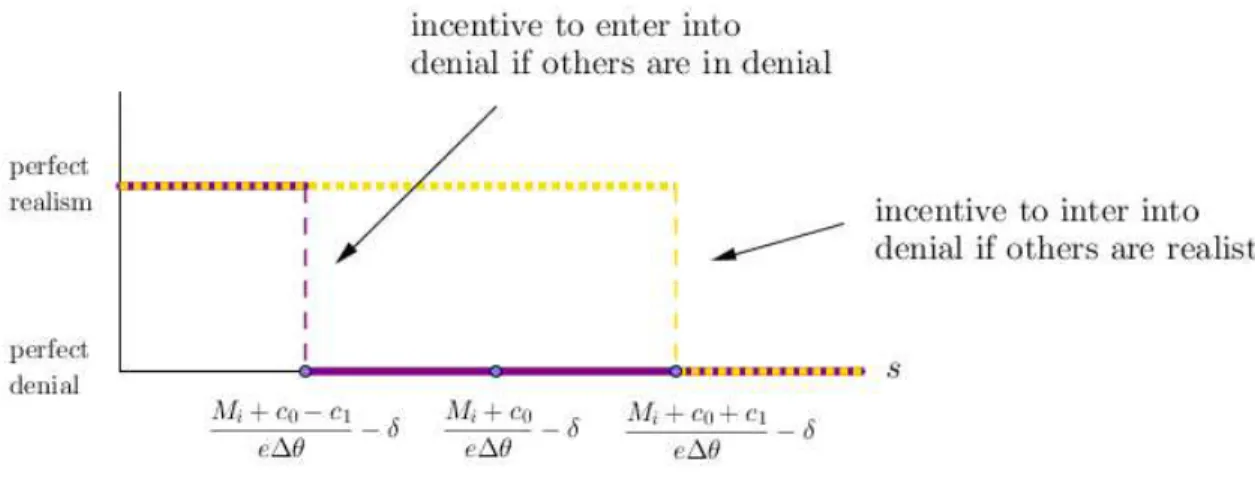
As said in the definition (3.1.1), wishful groupthinking refers to the case where an agent enters in denial because of the existence of the group, whereas he was initially realist. Incentive to enter into denial when others are in denial
Here, the interesting point is to study when, because of the group, an agent has an incentive to modify his beliefs to enter in denial. This incentive exists if his utility when he enters in denial when others are in denial is higher than his utility when he stays realist even if others are in denial. Thus, we are looking for the threshold above which it is optimal to engage in wishful thinking when others do so (ie) when wishful thinking increases the agent’s utility. For easier notations, utilities are subscripted by letters R for Realism, D for Denial, G when the final belief of the individual (period 1) is the same than the majority belief, and ¯G when belief of the individual in period 1 is different from the majority belief. The order of the second and third letters is also significant. The second letter indicates the state of the belief at period 0 while the third letter indicates the state of the belief in period 1.
The difference of utilities when Ithe agent’s becomes in denial is given by: (Ui
0,R,D,G) − (U0,R,R, ¯i G) = δeθH(s + δ) − δ(Mi+ c0) − [δeθL(s + δ) − δc1]
) (Ui
0,R,D,G) − (U0,R,R, ¯i G) = δe(s + δ)(θH − θL) − δ(Mi+ c0− c1)
Thus, if at least half of members of the group are in denial (if the majority belief is denial), an agent has an incentive to enter into denial if and only if (Ui
0,R,D,G) − (U0,R,R, ¯i G) ≥ 0, (i.e.)
if and only if :
s ≥ Mi+c0−c1
with ∆θ = θH − θL>0 and Mi+ c0− c1 ≥ δe∆θ, as s can not be negative.
As said in the presentation of the model, s is a parameter of individual preferences. It represents the intensity with which agent i’s own expectation (at date 1) of his ultimate fate (utility at date 2) enters his well-being. If this intensity is higher than the right part of the inequation, it is optimal for the agent to engage in wishful thinking when others are doing so.
Proposition 1 : An agent’s incentive to enter into denial when others are in denial is higher than an agent’s incentive to enter into denial when he is alone.
Incentive to enter into denial when others are realist
Here, we study the threshold at which the s (weight of expectations about own’s future income in the current well-being) is high enough so that the individual has interest to enter into denial even if others are realist.
(Ui 0,R,D, ¯G) − (U i 0,R,R,G) = δeθH(s + δ) − δ(Mi+ c0 + c1) − [δeθL(s + δ)] ) (Ui 0,R,D,G) − (U0,R,R, ¯i G) = δe(s + δ)(θH − θL) − δ(Mi+ c0+ c1)
Thus, if at least half of members of the group are realist, an agent has an incentive to enter into denial if and only if :
s≥ Mi+c0+c1
e4θ − δ
It is obvious that the first threshold is lower than the second one. It confirms the intuition that the group dynamic can reinforce the wishful thinking phenomenon.
Proposition 2 : An agent’s incentive to enter into denial when others are realist is lower than an agent’s incentive to enter into denial when he is alone.
Figure 3 represents these two equilibria thresholds. The point between them represents the equilibrium without the existence of the group (the threshold above which the agent should enter into denial when he does not belong to any group). At the equilibrium, when others are realist, the group dynamic leads to a “gain of realism”. On the opposite, when others are in denial, the group dynamic leads to a “loss of realism”. This is wishful groupthinking.
Figure 3: Equilibria threshold
3.2
The role of the riskiness of the project
The project value under the bad news can have two profiles, a “good” one and a “bad” one. The good one is when the project is desirable for the organization despite the bad news (and thus the low state). Here, the downside risk is limited (θL ≥ 0). The bad one is
when the downside is severe enough to have negative social value for the organization. Here, the downside risk activities is high (θL 0). Bénabou (2013) shows that the impact of
collective delusion totally differs according to the risk and the nature of the project. In the good state, individual’s motivation and overoptimism is always valuable to others (hunting, foraging, fighting, cultivation, team sport, political mobilization. . . ). On the opposite, in the bad state, collective denial can lead to dramatic decisions (for example see firms like Enron, Lehman Brothers, Citigroup or AIG, whose high-risk strategy could be dangerously misguided (state L)).
We study here the impact of the risk project value to see if the riskiness of the project influences the incentive to denial10
.
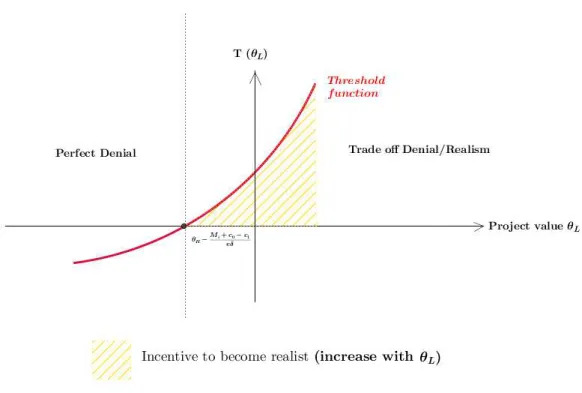
We show below that the riskier is the project (i.e. more negative is the project value due to the bad news), the lower the threshold above which agent have incentive to denial; and thus the incentive to denial is higher.
Let T > 0 be the threshold above which an agent has an incentive to enter into denial if others are in denial. As computed in part 3.1.4, we have :
10
We here do not take into account the risk and losses aversion of the agents. It is important to keep in mind that risk and losses aversion of the agent necessarily have an influence on the incentive to denial (losses aversion might increase the incentive for denial) but this needs an independant work that is not done here.
T = Mi+c0−c1
e(θH−θL) − δ
As explicited above, the numerator represents the total cost of engaging in wishful think-ing when others do so (respectively the cognitive cost of bethink-ing in denial plus the cost of belief distorsion less the cost of disagreement as others are also in denial). The denominator represents the benefits of a such collective denial (respectively the level of effort multiplied by the positive difference of the projet value between the good and the bad states). δ is the discounted rate. We consider all variables other than θL as parameters as they do not
represent the risk of the project. θL is the project value when the negative signal occurs. If
θL>0 , the project value is positive even in the bad state, the project is thus not risky. If
θL<0 , the project value is negative when the bad signal occurs. The project is thus risky as
payoffs can be negative. The question is thus, does the incentive to denial differ according to the risk degree of the project ? If not, when is T higher ?
We have :
dT dθL =
Mi+c0−c1
e(θH−θL)2≥0
Through simple comparative statics, we can show that the higher is the project value, the higher is the threshold and thus the lower is the incentive to denial. The risk of the project thus increases the incentive to denial. Intuitively, the riskier is the project, the higher will be the need for illusion11
.
Proposition 3 : An agent’s incentive to enter into denial increases with the riskiness of the project. (ie) Higher is the riskiness of the project, more an agent has an incentive to enter into denial.
Figure 4 represents the threshold function depending on the riskiness of the project. It graphically shows that the higher is the real project value θL, the higher is the threshold
above which agents have incentive to enter into denial, the higher is the degree of realism.
11
Obviously, the result is the same for the threshold concerning the agent’s incentive to inter into denial when others are realists.
Figure 4: Incentive to denial according to the riskiness project degree
3.3
Introducing asymmetry in roles with the presence of a leader
In centralized organisations, one member of the group decides alone for the group. In other words, the level of effort is solely determined by the beliefs of one member of the group. We call him the Leader. We have : e|¯b ! e|bLeader . Correspondance, we call Follower all
other agents that are not the Leader (all i 2 N \Leader). All followers play the same role. As the leader decides alone the level of effort, he never pays the cost of effort disagreement c1 (his belief totally determines the group level of effort) and does not changes his beliefs
(as he is not influenced by others’ beliefs). Intuitively, such situations can be observed in organizations where there is a strong hierarchy such that there is no strong interactions between the director and the workers12
.
The incentive for the Leader to enter into denial is thus : (ULeader
0,D ) − (U0,RLeader) = δeθH(s + δ) − δMi− δeθL(s + δ)
) (ULeader 0,D ) − (U
j
0,R) = δe(s + δ)(θH − θL) − δMi
Thus, the leader has an incentive to enter into denial if and only if :
12
However, this raises the question of the definition of a group. Is it convincing to consider as a group a configuration in which there is no interaction between one and/or many individuals? The hypothesis according to which the leader’s beliefs are not influenced by others is thus strong but we keep it as it makes the modelization easier.
sLeader ≥ e4θMi − δ
In the symmetric case, an agent had an incentive to inter into denial if and only if : ssymmetric roles ≥ Mi+ce4θ0−c1 − δ
The interesting point is that the loss or the gain of realism due to the existence of a leader depends on the costs c0 and c1. Indeed, if the cost of beliefs distortion is higher than the cost
of disagreement (ie) c0 ≥ c1, we have ssymmetric roles ≥ sLeader . If the cost of beliefs distortion
is lower than the cost of disagreement (ie) c0 < c1, we have ssymmetric roles < sLeader . The
respective weights of c0 and c1 might depend on a various panel of impalpable variables.
Nevertheless, the salience of the beliefs and the legitimity of the leader respectively can have a huge impact on these costs. Indeed, if the beliefs is very salient, the cost of beliefs distortion will be very high (as you are strongly convinced of your belief, it will be hard and costly for you to change it, so you will prefer to keep it and produce an effort not necessarily in adequation with it). Moreover, if the legitimity of the leader is strong, it will be less costly for the agents to produce an effort they disagree with (if the leader is legitimate, I strongly trust him so even if I have not the same beliefs, I agree to produce the effort that correspond to his beliefs and not mine).
Thus, if the beliefs are salient and that the leader is legitime, we can assume that c0 ≥ c1,
and thus that ssymmetric roles ≥ sLeader. In this case, the threshold to denial is lower in
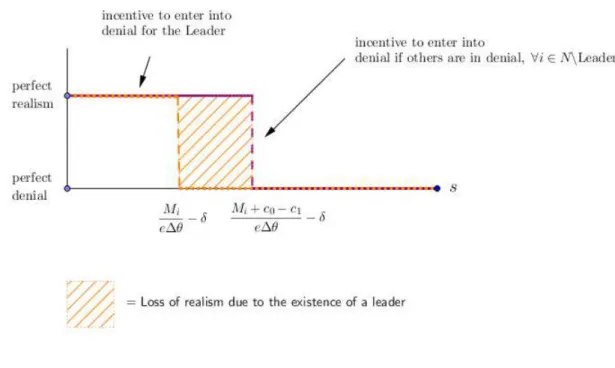
the presence of a leader than in the symmetric case (when there is no leader). Thus, the equilibrium with a leader shifts to the left, there is a loss of realism compared to the symmetric case. Nevertheless, prudence is needed concerning this result that crucially depends on the assumption made on c0 and c1. If c0 < c1, the leader equilibrium shifts to the right. The
results is reversed and the presence of a leader leads to a gain of realism compared to the symmetric case.
Proposition 4 : If c0 ≥ c1, an agent’s incentive to enter into denial is higher in the presence
of a leader than in a symmetric group. (ie) Under c0 ≥ c1, the presence of a leader
Figure 5: Equilibrium with a Leader when c0 > c1
Figure 5 represents the threshold function in a presence of a leader and in the symmetric case, when c0 > c1. Under this assumption, the threshold in the precense of a leader is lower
than the threshold in the symmetric case. The striped area reprensents the “loss of realism” due to the precense of a leader.
To go further, it will be interesting to extent the model to a “medium case” where there would be two kinds of members in the group, those whose decision-making power is high and those whose decision-making power is low. Intuitively, experience can explain this kind of situation in organizations. Indeed, even if there is no officially a “chief” or a leader in a work team, the fact that some members have more experience than others (individual who are new or with few experience in the firm) tacitly gives them more power in the final decision. More generally, the study of different hierarchical structures represents interesting extentions for this model.
4
Experimental design and procedure
4.1
The game
The experiment consists in 3 treatments, a Symmetric Treatment (ST) where subjects play symmetric roles, an Asymmetric Treatment (AT) where subjects play asymmetric roles (pres-ence of a leader) and a Control Treatment (CT).
The Symmetric Treatment
The Symmetric Treatment comprises three parts. The first part (individual part) is a replica-tion of the Mayraz (2011) experiment, the second part (group part) introduces group decision making in the protocole and the third part reproduces the individual part (part 1) to see if, when comparing the part 1 with the part 3, the part 2 has induced differences.
• Part one : Mayraz replication
To estimate individual wishful thinking, we first want to replicate the game used in Mayraz (2011). In each period, a chart of wheat price is showed to subjects. To maximize the realism of the task, prices come from real financial markets. For all charts, time is standardized in a 0-100 scale but prices showed to the subjects stop at an earlier date. Prices are also standardised so that the range of prices goes from 4000 to 16000.
Subjects have to fulfill two tasks. The first one is to predict the price of wheat at date 100. The second one is to give their confidence level about their prediction in a 0-10 scale. After giving their predictions, subjects can see a waiting screen until all other subjects have also made their prediction. Once it is the case, another similar period begins. As in the Mayraz experiment, subjects do not receive any feedback concerning the real price at the end of each period.
The experiment involves two types of subjects, farmers and bakers.
Farmers are informed that it costs them 4000 EMU to grow the wheat and that they will sell their wheat for the real price obtained at day 100. Thus, their profit from the sell of the wheat will be :
πF armers = W heat pricet=100− 4000
The profit of the farmers thus belong to the [4000 − 4000; 16000 − 4000] scale (ie) πF armers 2
Bakers are informed that they make the bread and sell it for a fixed price of 16000 EMU. To make the bread, they have to buy wheat at the price obtained at day 100. Thus, their profit from the sell of the bread will be :
πBakers= 16000 − W heat pricet=100
The profit of the bakers thus belong to the [16000 − 16000; 16000 − 4000] scale (ie) as for farmers, we have πBakers 2 [0; 12000].
• Part two : group decision making
To estimate wishful group thinking, we introduce group decision making in the Mayraz experiment. As in the part 1, in each period subjects are shown a chart of wheat prices. To maximize the realism of the task, prices are adapted from real financial markets. For all charts, time is standardized in a 0-100 scale but prices shown to the subjects stop up to an earlier date. Prices are also standardised so that the range goes from 4000 to 16000.
At the beginning of the period, subjects are randomly matched in groups of five players. All members of each group are allowed to discuss during five minutes thanks to a chat facility. During this chat, they have to come to an agreement about a prediction of the future wheat price for all the group (group prediction). At the end of the chat, each member of the group gives his prediction of the price of wheat at date 100. If a same prediction has been given by at least 3 members of the group, it becomes the group prediction (majority belief). As it is it easy to find 3 identical numbers in a group of 5 people when the range is as wide, if no agreement has been found (ie) if there is not at least 3 same predictions, the group prediction becomes the mean of the predictions given by each member of the group. Once that the group prediction is determined, each member of the group is informed of it. Then, each member gives his confidence level about the group prediction in a 0-10 scale. Once it is the case, another similar period begins.
• Part Three : individual decision making Part three replicates the part one.
The Control Treatment
The Asymmetric Treatment
As the Symmetric Treatment, the Asymmetric Treatment has three parts. The first and the third part are the same, only the second part changes as members of the group do not play anymore symmetric roles.
• Part two : group decision making with a leader
In each period, a chart of wheat price is showed to subjects. To maximize the realism of the task, prices come from real financial markets. For all charts, time is standardized in a 0-100 scale but prices showed to the subjects stop at an earlier date. Prices are also standardised so that the range of prices goes from 4000 to 16000.
At the beginning of the period, subjects are randomly matched in groups of five players. A leader is randomly chosen13
. He receives an information that he is the leader. Others members of the group are informed that they are not the leader. The leader gives his price prediction and his confidence level of his prediction. The leader prediction becomes the group prediction. After having fulfilling these two tasks, the leader has nothing to do until the end of the period. All other members of the group are informed of the price prediction of the leader. They then have to give independently their price prediction. The follower price predictions have no impact on the group prediction. They also have to give their confidence level about the leader prediction. Once that each member of the group has fulfilled these two tasks, another period begins.
Treatment Part 1 Part 2 Part 3
ST Individual Group with symmetric roles Individual AT Individual Group with a leader Individual
CT Group with symmetric roles
Table 6: Summary of the experimental design
4.2
Sessions and final payoffs
The aim is to implement a pair number of sessions where half the session are Farmer sessions and half the sessions are Baker session. To prevent any consistent relationship between the
13
A other way to choose the leader could be to give a quiz to each subject. They have to correctly anwser the maximum number of questions during a limited time. At the end of the time, the member that correctly answered the highest number of questions becomes the leader. This second method to choose the leader is a way to give more “legitimity” to the leader.
time of day in which the session is held and the role given to the subjects who took part in that session, the order of sessions will be randomized. In each session, there are 7 periods, 1 training period and 6 earning periods.
The total payoff for all the treatments comprises three parts : an unconditional partici-pation fee of 4 euros, the profit from the sale of the wheat (farmers) or from the sell of the bread (bakers) with the exchange rate of 1 euro for 1000 UME (1 U M E = 1
1000 ⇤ euros) and
a prediction accuracy bonus of 3 euros for a optimal prediction of the day 100 price. Less good is the prediction, lower is the bonus.
Thus, total payoffs are :
ΠF armers= 4 + πF armers⇤ 10001 + P rediction accuracy bonus
ΠBakers= 4 + πBakers⇤ 10001 + P rediction accuracy bonus
We have ΠF armers,ΠBakers2 [4; 21] euros.
To determine the final payoff in the Symmetric Treatment, one of the three part is ran-domly chosen inside one earning period previously ranran-domly selected. In other words, the computer first chooses at random a period on the 6 possibles, then it chooses at random a part on the 3 possibles of this period. The total payoff corresponding to the selected period is the final payoff.
The final payoff in the Asymmetric Treatment is determined through the same process. To determines the final payoff in the Control Treatment, one of the 6 earning periods is randomly chosen in the part 2. The corresponding total payoff is the final payoff.
4.3
Hypothesis, method and predictions
The Symmetric Treatment is built to test wishful thinking and wishful group thinking. The first part of this treatment is a replication of Mayraz experiment that allows to test the existence of the wishful thinking effect at the individual level. The hypothesis tested behind this first part is that any and all subjective individual judgments are affected by wishful thinking (Hyp 1) (ie) that there is a systematic difference in predictions between farmers and bakers. The method employed to test this hypothesis is to compare the predictions of farmers and those of bakers and see if there is a systematic significant difference between them. The expected result is that predictions of the two types are significantly different. In Mayraz experiment, the hypothesis is consistent.
The second part of the Symmetric Treatment allows to test two hypothesis. The first one is that, as individuals, any and all subjective group judgments are affected by wishful
thinking (Hyp 2) (ie) there is a systematic difference in prediction between farmers’ groups and bakers’ groups. The method employed to test this hypothesis is the same than in the part 1. The means of group predictions are computed for the two types and compared to see if there is any systematic significant difference. The second hypothesis is that the group effect can increases the wishful thinking bias (Hyp 3) (ie) the group prediction can be worse than if individuals had taken their decision alone (the group predictions can be farther to the real price than the individual predictions). The method to test this hypothesis is to compare the prediction of farmers (respectivly bakers) between the individual predictions and the group predictions.
The part 3 of the Symmetric Treatment tests the same hypothesis but trying to control a potential peer pressure effect that can occurs in the part 2. Indeed, in the second part, a member can agree with the group prediction because of peer pressure, but it doesn’t necessarily means that his beliefs concerning the prediction have changed. If in the part 3 the prediction is different than in the part 1, it could mean that the group has had a real influence on individual beliefs apart from any peer pressure. Nevertheless, it is not clear that the part 3 is the best way to isolate the effect of group on individual choice. Indeed, part 3 can also capture the learning effect. Going deeper into this question seems essential to better isolate the effect of group on individual beliefs by controlling the potential effects of learning but also herding behaviors.
The Asymmetric Treatment is built to test wishful group thinking is the presence of a leader. Here again, there are two hypothesis. The first one is that any and all subjective group-with-a-leader judgments are affected by wishful thinking (Hyp 4). Again, the method is to compare the predictions of farmers versus the predictions of bakers to see if there is any systematic significant difference. The second hypothesis is that the presence of a leader is a group can increases the wishful groupthinking bias (Hyp 5) as “followers” have a trade off between following the leader and being realist (ie) wishful groupthinking bias is higher in a leader group than in a symetric roles group. Here, the method is to compare, by types, the level of predictions in the symmetric roles groups versus in groups with a leader.
The Control Treatment (CT) allows to control for any potential anchoring bias. Indeed, in the Symmetric Treatment, there is a potential anchoring bias of the part one over the part 2 and 3 in a within subjects study (Hyp 3). Thus, doing a control treatment where subjects only have to do the part 2 allows to compare the results from this treatment to the results from the part 2 of the Symmetric Treatment. If there is no significant differences between the two of them, it means that there is not significant anchoring bias between the different parts of the Symmetric Treatment.
Hyp 1 Hyp 2 Hyp 3 Hyp 4 Hyp 5 Types F vs B F vs B F vs B By types F vs B By types Treatment ST-P1 ST-P2 ST-P1 vs ST-P2 ST-P1 vs ST-P2 AT-P2 ST-P2 vs AT-P2
Method Between Between Between Within Between Between
Table 7: Summary of treatments used for each hypothesis (Note: F for Farmers, B for Bakers) Remind of hypothesis :
1. Any and all subjective individual judgments are affected by wishful thinking 2. Any and all subjective group judgments are affected by wishful thinking 3. Groups are more affected by wishful thinking than individuals
4. Any and all subjective group-with-a-leader judgments are affected by wishful thinking 5. Groups with a leader are more affected by wishful thinking than groups with symmetric roles
5
Discussion and Conclusion
We studied the wishful thinking effect through an endogeneous group approach where dis-torted beliefs are created by the group and are not only an individual feature. We built a group decision making model where, by constrast to the individual decision making frame-work in Bénabou (2013), the group has to take one single decision on a joint project. The model shows that when facing the trade off between realistic beliefs and beliefs that belong to the group, it could be optimal for an agent to enter into denial when others are in denial above a given threshold of his individual preferences (intensity with which agents i’s own expectation of his ultimate fate enters his well being).
We also studied the reaction of the equilibrium to the riskiness of the project and showed that an agent’s incentive to enter into denial increases with the riskiness of the project. From a prescriptive point of view, this question might be powerful as it could allow to prevent from potentially dramatic consequences we saw in stylised facts. The third part of the model introduced an asymmetry in role members by looking at the effect over the equilibirum of the presence of a leader. Here, there is no strong evidence. Indeed, the presence of a leader can either increase or decrease the incentive to enter into denial depending on assumptions made on costs.
The last part of this paper is devoted to the setting up of an experiment that should allow to test the significance of the wishful thinking effect. Through three treatments, this experiment is built to test the existence of the wishful thinking effect at the individual and the group level. Moreover, it allows to compare the strengh of this effect between (a) individuals versus groups, and (b) symmetric role groups versus asymmetric role groups (presence of a
leader). As the experiment starts from the Mayraz one, it is not still perfectly correlated with the theoretical model. Improvement should be undertaken to this direction.
Further investigations are also needed to pursue the exploration of the wishful think-ing phenomenon in groups. More particularly, developthink-ing context-specific features such as different hierarchical structures, degree of group cohesiveness, or payoff should be very in-teresting, as it would allow to better identify and understand the causes of wishful group thinking. Given that this effect can have dramatic consequences on firms, organizations and more generally on any groups that have to take decisions, the prescriptive impact of such studies could be strongly powerful. In this sens, the wishful group thinking phenomenon represents a promising research topic that deserves to be further explored both theorically and empirically.
References
[1] Akerlof, George A; Dickens, W. T. (1982). The Economic Consequences of Cognitive Dissonance. The American Economic Review.
[2] Alpert, M. and Raiffa, H. (1982). A progress report on the training of probability as-sessors, in D. Kahneman, P. Slovic and A. Tversky (eds), Judgment Under Uncertainty: Heuristics and Biases, Cambridge University Press.
[3] Bénabou, R. (2013). Groupthink : Collective Delusions in Organizations and Markets. The Review of Economic studies.
[4] Bénabou, R. and J. T. (2002). Self-Confidence and Personal Motivation. The Quarterly Journal of Economics.
[5] Benabou, R., & Tirole, J. (2003). Intrinsic and Extrinsic Motivation. The Review of Economic studies.
[6] Camerer, C. and Lovallo, D. (2000). Overconfidence and Excess Entry, An Experimental Approach. Choices, Values, and Frames.
[7] Charness, G., Rigotti, L., Rustichini, A. (2007). Individual Behavior and Group Mem-bership. American Economic Review.
[8] Charness, G., & Sutter, M. (2012). Groups Make Better Self-Interested Decisions. Jour-nal of Economic Perspectives.
[9] Eliaz, K., & Spiegler, R. (2006). Can anticipatory feelings explain anomalous choices of information sources? Games and Economic Behavior.
[10] Esser, J. (1998). Alive and Well after 25 Years: A Review of Groupthink Research. Organizational Behavior and Human Decision Processes.
[11] Fahr, R., & Irlenbusch, B. (2011). Who follows the crowd—Groups or individuals? Jour-nal of Economic Behavior & Organization.
[12] Hart, P. (1991). Irving L. Janis’ Victims of Groupthink. Political Psychology.
[13] Janis, I. L. (1972). Victims of Groupthink: A Psychological Study of Foreign-Policy Decisions and Fiascoes.
[14] Kocher, M. G., Kugler, T., & Kausel, E. E. (2012). Are groups more rational than individuals? A review of interactive decision making in groups. Behavioural Economics. [15] Kocher, M. G., & Sutter, M. (2007). Individual versus group behavior and the role of
the decision making procedure in gift-exchange experiments. Empirica.
[16] Landier, A. (2000). Wishful thinking a model of optimal reality denial. Massachusetts Institute.
[17] Mayraz, G. (2011). Wishful Thinking. CEP Discussion Paper.
[18] Mccauley, C. (1998). Group Dynamics in Janis ’ s Theory of Groupthink : Backward and Forward. Organizational Behavior and Human Decision Processes.
[19] Moorhead, G., Neck, C., & West, M. (1998). The Tendency toward Defective Decision Making within Self-Managing Teams: The Relevance of Groupthink for the 21st Century. Organizational Behavior and Human Decision Processes.
[20] Müller, W., & Tan, F. (2013). Who acts more like a game theorist? Group and individual play in a sequential market game and the effect of the time horizon. Games and Economic Behavior.
[21] Peterson, R., Owens, P., Tetlock, P., Fan, E., & Martorana, P. (1998). Group Dynamics in Top Management Teams: Groupthink, Vigilance, and Alternative Models of Organi-zational Failure and Success. OrganiOrgani-zational Behavior and Human Decision Processes. [22] Scott-kakures, D. (2000). Motivated Believing : Wishful and Unwelcome. Nous.
[23] Sniezek, J. . (1992). Groups under Uncertainty : An Examination Group Decision Mak-ing of Confidence in. Organizational Behavior and Human Decision Processes.
[24] Sniezek, J. A. & Paese, P. W. (1991). Influences on the appropriateness of confidence in judgment: Practice, effort, information, and decision-making. Organizational Behavior and Human Decision Processes.
[25] Sniezek, J. A., Paese, P. W., & Furiya, S. (1990). Dynamics of group discussion to consensus judgment: Disagreement and overconfidence. Unpublished manuscript. [26] Starbuck, W. H., Hedberg, B. L., & Bystrom, P. C. (1976). Camping on seesaws:
Pre-scriptions for a self-designing organization. Administrative Science Quarterly.
[27] Stasser, G., & Titus, W. (1985). Pooling of unshared information in group decision mak-ing: Biased information sampling during discussion. Journal of personality and social psychology.
[28] Svenson, O. (1981). Are we all less risky and more skillful than our fellow drivers. Acta Psychologica.
[29] Turner, M. E., & Pratkanis, A. R. (1998). Model of Groupthink. Organizational Behavior and Human Decision Processes.
[30] Turner, M., & Pratkanis, A. (1998). Twenty-Five Years of Groupthink Theory and Re-search: Lessons from the Evaluation of a Theory. Organizational Behavior and Human Decision Processes.
[31] Weinstein, N. (1980). Unrealistic optimism about future life events. Journal of Person-ality and Social Psychology.
[32] Weizsäcker, B. G. (2010). Do We Follow Others when We Should ? A Simple Test of Rational Expectations. American Economic Association.
[33] Yildiz, M. (2007). Wishful Thinking in Strategic Environments. Review of Economic Studies.