
Bayesian inclusion of external evaluations into a national evaluation system: application to milk production traits
5
0
0
Texte intégral
(2) In our implementation DE were backsolved from reliabilities and EDC not directly used. This was also necessary as EDC for uI are not provided. DEE will be needed to compute associated reliabilities (RELE). VanRaden (2001) showed appropriate formulas also stressing that subtracting parent average PA from EBV allows to remove different genetic trends. In our situation this is a somewhat a philosophical problem because theoretically the trends should be identically. Also it is no easy to choose the right PA especially for external EBV. The final formula used in this implementation was uE = wLuL + wIuI. An alternative implementation that was not yet tested, would be to compute theoretical coefficients to predict uI from uL and uE using uI = vLuL + vEuE and backsolve for unknown uE uE = (uI - vEuE)/vL.. 2.3. Mixed model equations Bayesian integration. for. Modifications to standard mixed model equations for a local genetic evaluation with a generic mixed model ( y = Xb + Zu + e ) are small. We follow here the notation and set up as presented by Legarra et al. (2007):. ⎡ X'L R −1X L ⎢ −1 ⎣ Z'L R X L. X'L R −1Z L ⎤ ⎡bˆ ⎤ −1 ⎥ ⎢ ⎥ = Z'L R −1Z L + G* ⎦ ⎣uˆ ⎦. ⎡ X'L R −1y L ⎤ ⎢ ⎥ −1 ⎣ Z'L R y L + θ⎦ where yL is a vector of locally available data, XL and ZL are incidence matrices in the local linking effects and yL , b is a vector of fixed effects, u is a vector of random effects, external animal, that can also have local records, and exclusively locals animals will be considered sorted. Two basic changes are done where new elements can be defined as. 2.2. Transforming external (international) contributions to locally evaluated EBV Unfortunately evaluated traits are not necessarily those reported to Interbull and send back on that scale. Therefore in practice an additional step might be necessary converting external EBV. An example is milk, fat and protein yields were the trait reported to Interbull is for most countries the average of lactation yields for mostly three lactations. However mostly test-day records are evaluated (ulact). Also genetic effects are random regressions. In such a situation, elements of the real local genetic solution vector (uL) have to be chosen in an appropriate way to reflect ulact,O. For the Walloon genetic evaluation system and in this implementation, for yields the constant effect can be considered affected only which means that we assume no a priori knowledge of lactation curve shape parameters. Differentiating between first second and third lactation can be based on expected differences between EBV for those three lactations. In our implementation we considered all lactations as being equally affected. Also any base and expression of results change have to be taken care of. In general these steps need to be fine tuned for any routine implementation of this method.. −1 ⎡D −1 − G EE + G EE G EL ⎤ and G =⎢ ⎥ G LE G LL ⎦ ⎣ ⎡D −1uˆ E ⎤ Also we can define θ=⎢ ⎥. ⎣ 0 ⎦ Var ( u E ) = G EE and PEV ( uˆ E ) = D . Legarra * −1. et al. (2007) showed that conceptually −1 D −1 − G EE can be considered being the least square part of the left-hand side and D −1uˆ E can be considered being the right-hand side of the theoretical BLUP equations that provided uˆ E . In reality especially the complete D matrix is unknown as prediction error covariances are not known and D needs to be replaced by a diagonal matrix of PEV for every external evaluation. Similarly G EE needs to be simplified ignoring all relationships. Even if basic equations are simple additional nontrivial assumptions have to be made. First this consists in the nature of the theoretical external evaluation. In fact the external EBV can have any origin, however in our implementation we tried to consider them coming from a completely similar theoretical evaluation using. 71.
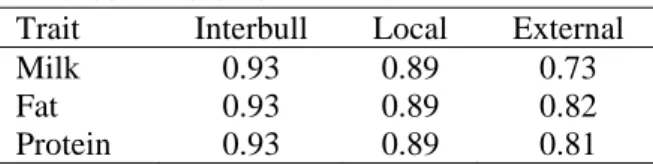
(3) 3. Results and Discussion. the same variances as in the local genetic evaluation. This is not required; however it is the simplest and most logical assumption.. 3.1. External evaluations A total of 4041 bulls with Interbull evaluations were also present in our local evaluation. Of these bulls 638 had local evaluations that were also provided to Interbull. The remaining animal had only Interbull evaluations, but had also independent local evaluations. Table 1 shows the average coefficients used to compute external EBV from Interbull EBV and from local EBV. The coefficients depend on heritabilities, and reliabilities. As those are potentially different across the three traits slightly different weightings were used.. 2.4. Application to milk production traits Data provided by the Walloon Breeding Association (AWE) for the routine evaluation for milk production of January 2008 were used and included 14,358,255 test-day records for 814,596 dairy and dual-purpose cows in production. The pedigree file contained 1,453,396 animals (cows with production records and ancestors). The model used in the Walloon region of Belgium was presented by Auvray and Gengler (2002) and Croquet et al. (2006).. Table 1. Average coefficients used to compute external EBV from Interbull EBV and from local EBV. Trait Interbull Local Milk 2.37 -1.63 Fat 2.37 -1.56 Protein 2.49 -1.69. Interbull files from the January 2008 routinerun were used that contained a total of 100,156 sires. Interbull files were matched with local evaluation files and sires identified in both evaluations were extracted. Interbull evaluations were discarded if not considered official. The following rules were used to identify prior evaluations:. In Table 2 gives correlations for all three traits of external EBV with Interbull EBV and local EBV.. 1. If there was no local evaluation send and used by Interbull, the Interbull evaluation was free of local information, therefore this evaluation was directly considered the external evaluation. 2. If a local evaluation contributed to the Interbull evaluation, the external evaluation was computed as described before. Table 2. Correlations for all three traits of external EBV with Interbull EBV and local EBV. Trait Interbull EBV Local EBV Milk 0.85 0.78 Fat 0.94 0.87 Protein 0.95 0.90. Table 3 summarizes average reliabilities of local EBV, Interbull EBV and external EBV.. In order to speed up convergence, converged solutions from the pure local evaluations were used as starting values. Additionally for animals with external evaluations starting values were computed a weighted average between local and external evaluations. This was preferred instead of directly putting the Interbull evaluation as those evaluations were not taking care of differences across the lactations.. Table 3. Average reliabilities of local, Interbull and external EBV Trait Interbull Local External Milk 0.93 0.89 0.73 Fat 0.93 0.89 0.82 Protein 0.93 0.89 0.81. 72.
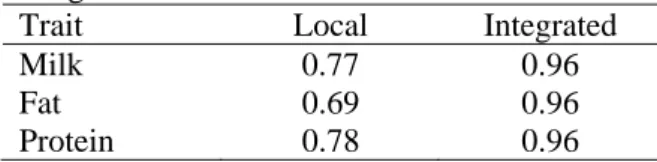
(4) 4. Conclusions and Implications. 3.2. Setting up and solving of modified mixed model equation. Bayesian inclusion of external evaluations into a national evaluation system and its application to milk production traits proved to be feasible. Even if overall solutions had very high correlations to solutions without integrated EBV, EBV for animals with external EBV changed as expected and became more similar to Interbull EBV. However the presented method needs some important fine tuning as several non-trivial assumptions are made and results are potentially very sensitive to these assumptions. The most important topics of future research are to investigate improved methods to get external EBV free of local information, to translate external EBV of Interbull traits to EBV of locally evaluated traits and other issues that lead to changes in means and variances. Legarra et al. (2007) showed a strategy to address mean differences for external EBV, however also changes in implementation or even in the theory to address variance differences can be imagined.. As shown before modifications of regular mixed model equations were small and could be done in a few lines of code. Solving was done using the same regular precondition conjugate gradient solver as for current genetic evaluations. Convergence of the modified system of equations was sufficient to obtain after 300 rounds a relative squared error, estimated as the difference between observed and computed right hand side elements, of 0.20 x 10⁻⁹ while the largest relative change of a genetic effect from one round to the other was below 0.8%.. 3.3. Modified mixed model equation solutions Bayesian integration of external EBV affects the whole system of equations from fixed effects to random effects. By keeping the joint estimation, estimates of contemporary effects will take into account differences of genetic merit of each member of such a group. Also all related animals will be affected by external EBV. Despite this, overall correlations for all effects were over 0.99 when comparing solutions with and without integrated external EBV. More important is in this context if the EBV for sires with external EBV moved closer to the expected values. In our case we expect that Interbull EBV should be the expected values. Table 4 shows the correlation of EBV of the 4041 of strictly local and integrated external EBV with Interbull EBV. The improvement of correlations was very impressive.. Acknowledgements Nicolas Gengler, who is Research Associate of the National Fund for Scientific Research (Brussels, Belgium), acknowledges his support. The authors gratefully acknowledge the financial support of the Ministry Agriculture of the Walloon Region of Belgium (MRW-DGA) (Namur, Belgium). Additional support was provided through grants 2.4507.02F (2) and F.4552.05 of the National Fund for Scientific Research.. References. Table 4. Correlations of strictly local and with integrated external EBV with Interbull EBV. Trait Local Integrated Milk 0.77 0.96 Fat 0.69 0.96 Protein 0.78 0.96. Auvray, B. & Gengler, N. 2002. Feasibility of a Walloon test-day model and study of its potential as tool for selection and management. Interbull Bulletin 29, 123-127. Croquet, C., Mayeres, P., Gillon, A., Vanderick, S. & Gengler, N. 2006. Inbreeding depression for global and partial economic indexes, production, type, and functional traits. J. Dairy Sci. 89, 2257-2267. Legarra, A., Bertrand, J.K., Strabel, T., Sapp, R.L., Sanchez, J.P. & Misztal, I. 2007. Multi-breed genetic evaluation in a Gelbvieh. Despite these very promising results, we noticed also that solutions for animals after integrated external EBV had different means and variances than original EBV. The observed differences were higher than what would be expected.. 73.
(5) Gengler, N. & Verkenne, C. 2007. Bayesian approach to integrate molecular data into genetic evaluations. Interbull Bulletin 37, 37-41. VanRaden, P.M. 2001. Methods to combine estimated breeding values obtained from separate sources. J. Dairy Sci. 84:E47-55E.. population. J. Anim. Breed. Genet. 124, 286295. Klei, L., Quaas, R.L., Pollak, E.J. & Cunningham, B.E. 1996. Multiple breed evaluation. In: Proceedings of Research Symposium and Annual Meeting, Beef Improvement Federation. Birmingham, AL, USA. Pp. 106-115.. 74.
(6)
Figure
Documents relatifs
The objectives of this study were: (1) to estimate addi- tive and dominance variance components for fertility and milk production traits in Holstein and Jersey cows using
These four different scenarios are attributed to four biological pathways: QTL that (1) increase or decrease total mammary gland production (a ffecting ASI only); (2) increase or
A Bayesian technique is introduced to handle this closed-loop system identification problem, in the case of arbitrarily short and non-informative data records.. To our best
Les résultats de cette étude montrent que la majorité des neurones auditifs enregistrés dans les couches profondes du CS présentent des réponses toniques lorsque
To our best knowledge, this paper is the first claiming unique determination of unbounded time-dependent coefficients, which is motivated by the problem of determining general
Also the results of this study in the traditional system (3.14 ± 0.66 lit./day) were in agreement with results reported by the same authors in the daily milk yield which
Material ow dynamic models to reason the management of livestock wastes within single farms [5, 9] or groups of farms [4]; the collective supply of a waste treatment plant [6];
Daily milk yield range was varying between 3.7 - 10 l/day in semi-intensive system, on the other hand the range of daily milk production of the camel reared under
