Design criteria for circular buildings
S Attia1 and M Al-Obaidy11Sustainable Building Design Lab, Dept. UEE, Faculty of Applied Science, University
of Liege, 4000, Belgium
Abstract. The term 'circular building' has mainly become popular over the last years and is now
widespread across architectural and building engineering – at least in Europe. With climate change high up on the political and corporate agenda and introduction of the European Unions' Green Deal, the identification of design criteria for 'circular building' is in demand. Numerous approaches and projects have been proposed to develop evaluation criteria, ranging from sustainability rating systems (e.g., BREEAM and LEED), life cycle analysis methods, the Cradle to Cradle approach, Circular Building Service Companies (e.g., Oaplis and Werflink), research projects (e.g., BAMB, Facades leasing, FCRBE) and the European Waste Framework Directive and Circular Economy Action Plan. Despite the proliferation of those knowledge resources, however, there is an apparent lack of technical criteria to what extent a 'circular building design' is characterized. The scientific literature is surprisingly scarce of clarifications, even though countless studies on reversible building design exist. This paper explores the apparent discrepancy between professional and scientific use of the term 'circular building'. It suggests scientific design criteria based on commonly accepted circularity principles and environmental assessment modeling approaches. The paper answer a fundamental research question on the design criteria of a 'circular building' with an overarching aim to define robust indicators for their design and characterization.
1. Introduction
The European Commission is looking forward to promoting circular economy principles for buildings' design. Leading EU members' states aim to have a circular economy by 2050 and be halfway to achieving this goal by 2030 [1]. The construction sector is one of the spearheads to make this possible and reduce raw materials, energy, and water [2]. Several companies and clients have already introduced the circularity concepts in new buildings. The building sector has a vital role in responding to the climate emergency, and addressing upfront building circularity, and carbon is urgent [3]. Bringing circularity and embodied carbon upfront and the fast energy transition towards carbon neutrality is crucial. However, despite the proliferation of several knowledge resources, it is not clear what the circular economy principles for buildings' design are. For example, the European Commission's Directorate-General for Internal Market, Industry, Entrepreneurship, and SMEs (DG GROW) is undertaking a study to answer this question. The overall aim of increasing the service life of buildings, ease using secondary materials, and improve resource efficiency throughout the building lifecycle.
Therefore, this study aims to help the European Commission identify design criteria for circular buildings to increase buildings' service life and ease using secondary materials to improve resource efficiency throughout the building life cycle. The commitment to reduce GHG emissions and other environmental impacts (e.g., end-of-life waste, energy efficiency) is part of those design criteria. The main research questions are:
What are the design criteria for circular buildings design?
How to take into account regeneration and impact recovery in those criteria?
The paper provides a set of key design criteria that addresses the circularity and carbon neutrality concepts. Based on a systematic literature review, circularity reclamation audits, and structured questionnaires for clients and designers of real case studies, the set of criteria is developed and validated
through six case studies. The research is focused on building construction systems, envelope technologies, and building materials. The paper is the audience is mainly scientists and actors involved buildings value chain, namely building owners, client representatives, building design consultants, contractors, and builders, including renovators, manufacturers of construction products, and government/regulators, including national, regional, and local municipal authorities.
2. Literature Review
In Europe, several studies and projects aimed to develop circularity indicators to evaluate building materials' environmental impact [4]. The development of circularity indicators has been influenced by Life Cycle Assessment approaches [5]. Still, new groups of scientists seek to define circularity using broader methods to extend building materials' reuse [1,6]. Furthermore, several research projects were conducted to enable a systemic shift in the building sector by creating circular solutions. For example, the 'Buildings As Material Banks (BAMB)' project [7] is one of the examples of developing and integrating tools concerning Materials Passports and Reversible Building Design [8,9]. The Flemish Public Waste Agency implemented the 'Design for Change' project, a consortium of Flemish institutions, published guidance documents that promote adaptability [10] and design principles for closed material loops in the building sector [11]. One of the project reports [12] provided an overview of building construction components' technical lifespan. The report reviewed more than 70 references, including The Ecology of Building Materials book [13]. 24 Technical Design Leaflets on change-oriented building design were published [14]. The project recommended nine disassembly criteria for circular buildings and suggested the development of a policy and transition framework [15].
We identified some key publications in the literature that aimed to develop multicriteria approaches and circularity design frameworks. For example, in 2010, Mulhall and Braungart presented cradle-to-cradle criteria for the built environment [16). Attia (2017) [17] showed a framework to design circular buildings. In the same year, Pomponi and Moncaster presented a research framework on circular economy for the built environment [18]. More recently, Eberhardt and Birkved presented building design and construction strategies for a circular economy[19]. Among the most globally recognized indicators and principles for buildings is the Material Circularity Indicator MCI, developed by the Ellen MacArthur Foundation. The indicator that is based on three parameters [20]:
1. amount of Virgin Material V; 2. product Utility X;
3. amount of unrecoverable Waste W.
Furthermore, the Material Reutilization Score (MRS) was proposed by the Environmental Protection Encouragement Agency through the Cradle-to-Cradle certification scheme [21]. It is assessed the Intrinsic Recyclability (IR) and the Recycled Content (RC) according to a specific formula: MRS=(2*IR
+ RC)/3
Verberne proposed improving the MCI by introducing the Building Circularity Indicators (BCI) [22]. The BCI is based on the MCI computed for each building product and included a design factor to weigh each product's impact on the whole building's environmental assessment.
A second version of the first BCI was suggested by van Vliet (2018) [23], a third and a fourth version was discussed by Alba Concepts [24]. Alba Concepts developed a new BCI based on three levels, i.e., a Product Circularity Index (PCI), an Element Circularity Index (ECI), and a Building Circularity Index (BCI). Van Schaik (2019) applied a slight modification of the Alba Concept indicator to building foundations [25].
In conclusion, the indicators mentioned above and circularity evaluation methods for building are still under development. There is a lack of a multicriteria approach that allows to evaluate circularity in building design, taking into account service life and durability, carbon emissions, flexibility and adaptability (i.e., concerning structural and functional design and potential for reuse or conversion, including cases of flexible or multiple functionality for different users), choice of materials and systems and lifecycle of materials, assembly techniques, lifecycle environmental impact (ex. embodied carbon) and maintenance related matters.
3. Methodology
A systematic literature review, circularity audits, and structured questionnaires for clients and designers of real case studies, a set of criteria is developed and validated. The inclusion criteria of the reviewed papers focused on papers with case studies. The inclusion criteria included manuscripts that aimed to create qualitative or quantitative design or performance criteria to increase buildings' service life and reduce their environmental impact. The case studies were mainly selected in Belgium or the Netherlands to assure field visits. An exception was made for one case study in Switzerland that was comprehensively documented in previous studies conducted by the first author [17, 26]. The exclusion criteria included studies that define circularity on an urban or territorial scale. The search focuses mainly on carbon neutrality and circularity on building scales [27].
3.1 Case studies
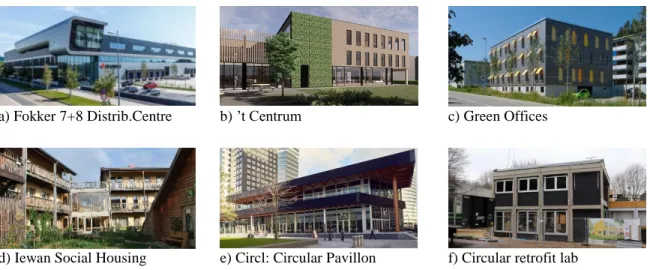
Six demonstration projects were selected and analyzed about the carbon footprint and circularity features. Four out of the cases were already examined in a previous study by the primary author [17]. Table 1 shows the necessary details and a brief description. Figure 1 shows an image for each case.
a) Fokker 7+8 Distrib.Centre b) ’t Centrum c) Green Offices
d) Iewan Social Housing e) Circl: Circular Pavillon f) Circular retrofit lab Figure 1. Photos of the selected projects
Table 1. Case studies description
Country Floor area (m2) Owner Type
Schiphol, Nl 37750 m2 Tata Steel Distribution Centre
Westerlo, Be 1000 m2 Kamp C Office building
Givisiez, Ch 1299 m2 Association Office building
Nijmegen, Nl 2200 m2 Municipality Residential housing
Amsterdam, Nl 3000 m2 ABN AMRO Office building
3.2 Audits
There is no recognized way to evaluate neither a neither building’s circularity nor any audits supporting such a goal. However, there are guidelines for the waste audits before demolition and renovation works [28]. Based on the existing guidelines, we developed our audit, a mix of questions and checklist items that we used to evaluate the six case studies during field studies. The audit aims to get familiar with the building construction details and materials to develop evidence-based circularity criteria and indicators. 3.3 Structured questionnaires
Structured and semi-structured questions were also developed for building owners, contractors, and suppliers based on a literature review [29]. We collected information on the used construction systems, products, materials, and their usage intensity and duration through several phone calls. The questions focus on three stages: the product's production stage, the usage stage, and the stage after use. The questions allowed us to understand the reuse potential of materials and how much material/components go into landfills or reclaimed for recycling. The questions also focus on maintenance and shared use of business models, including leasing and take-back services.
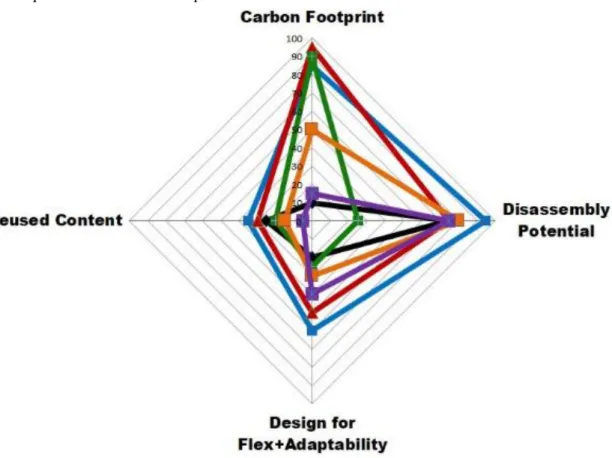
Finally, the audits and questionnaires were used to develop structured criteria to evaluate circularity, focusing on construction systems, spatial functions, and materials. Carbon emissions were used as a common denominator during all evaluations [30]. The different criteria were grouped through a radar graph, and each criterion provided a value between zero and hundred, where higher values indicate a higher circularity.
4. Design criteria for circular buildings
This section focuses on four primary critical design criteria used to assess the building's circularity. The four design criteria are chosen because they are the most effective design criteria that can help designers make strategic design decisions for a circular building design or renovation. The selection is based on the literature reviews, reclamation audits, and structured interviews with building waste management contractors [31, 32].
1. Carbon footprint of building materials comprising the embodied carbon and operational carbon emitted during the operation for at least 50 years. The evaluation was made with the help of the construction material pyramid illustrated in Figure 2.
2. Reused content of building materials comprising the amount of virgin materials, recycled content, and the total time a material is retained in a product system [33].
3. Disassembly potential and longevity of building components used to replace and disassemble building components [9,34]. The time of disassembly and the type of connection is part of the evaluation, as indicated in Table 2.
4. Building design flexibility and functional adaptation potential comprising the ability to change the building function and use in the long term after at least 50-100 years.
We applied the four circularity criteria mentioned above to facilitate evaluating the six case studies presented in Figure 01 and Table 01. Furthermore, we separated the building components and elements based on different lifespans to facilitate the evaluation and adapt the architectural design process's technical criteria [17]. According to Brand (1995) and Stankovic et al. (2015), buildings have a long lifespan concerning the six following layers [36,37]: Site lasts forever, the Structure from 30 to hundreds years, the Skin 20-40 years, the Services between 7-20 years, the Space Plan and the Stuff no more than ten years. Therefore, we adopted the building circularity framework proposed by Attia (2017) that groups the building materials under four building categories:
1. Construction system (embodied carbon, disassembly, reuse cycle, recycled content) 2. Envelope system (embodied carbon, disassembly, reuse cycle, recycled content)
3. Spatial function and use (function of building, years of occupation, function change/adaptation) 4. Building materials/products/services (embodied carbon, disassembly, replaceable, reuse cycle,
recycled content)
Figure 2. The construction material pyramid (CINARK, Julie Zepernick Jensen 2020 [35]) Table 2. Types of connection (based on the work of Verbene 2016 and Cattofava et al. 2021 [4,22])
Dry Connection Dry connection Click connection Velcro connection Magnetic connection
1
Connection with added elements Ferry connection Corner connections Screw connection Bolt and nut connection
0.8
Direct integral connection Pin connection Nail connection
0.6 Soft chemical compound Kit connection
Foam connection
0.2 Hard chemical connection Glue connection
Pitch connection Weld connection Cement bond Chemical anchors
Hard chemical connection 5. Results
The circularity analysis took place after the audits to evaluate each building based on the four key indicators or criteria shown in Figure 3. Each building was analyzed by calculating the material's content for the four building categories (see Section 4). Table 3 lists the total score for each building by adding up the score calculated in each criterion. Based on detailed evaluation criteria with different sub-criteria, we can confirm that the t'Centrum in Belgium (275/400) and Green Offices in Switzerland (250/400) are the most circular buildings. A detailed description of both buildings can be found in the literature [17,38]. The buildings have a low carbon footprint, if not a negative footprint, due to a high content of biobased materials, and were designed and constructed for disassembly. The modular and prefabricated modules of the structural system and envelope elements are mostly connected through dry connections. Also, the design included several scenarios for different future uses and functions that can take place beyond their current office use. Unfortunately, all investigated cases indicated a low score of reused materials content. Almost none of the projects used materials with high-recycled content or salvaged materials in the interior furniture and finishing. The discussion section provides more insights on the results implications and their interpretation.
Figure 3. Comparison of the circularity of the six case studies
Table 3. Evaluation scores of the six investigated case studies according to four key criteria of
Categories
Fokker
7+8 t'Centrum
Green
Offices Iewan Circl CR Lab
Carbon Footprint 10 85 95 90 50 15
Disassembly Potential 75 95 75 25 80 75
Design for Flex+Adaptability 20 60 50 25 30 40
Reused Content 25 35 30 20 15 5
Total Score 400 130 275 250 160 175 135
Finally, the six case studies analysis helped to validate our circularity criteria in a precise way. This study aimed to develop and validate critical design criteria for circular buildings that architects can easily use. Several iterations took place to validate the criteria and categorize them with an equal weight. The audits assured a high quality of our collected data and a reliable tracing of building components. The contractors' questionnaires on the potential of material reclamation were a revelation on the reality of materials reuse and the problem of disassembly time that discourage any systematic reclamation effort. Besides, the investigation of the materials suppliers and manufacturers' catalogs indicated a high use of virgin materials and the absence of recycled content. The triangulation of data sources and the tracing of the building's post-occupancy process is vital to validate our results to cross the limitation on relying mainly on the literature.
6. Discussion
This study aimed to identify four design criteria for circular buildings to increase service life and ease using secondary materials throughout the building lifecycle. The simple multicriteria approach allows architects and building designers to assess and compare different design alternatives quickly. The design criteria and radar graph can be used as a pre-design tool complementary to existing exhaustive circularity evaluation principles [6,10,20]. The simple approach allowed The following critical criteria are vital to assess the circularity of any building and can be used by a broad audience of building stakeholders, including the EU Directorate-General:
1. Carbon footprint of building materials comprising the embodied carbon and operational carbon emitted during the operation for at least 50 years. The evaluation was made with the help of the construction material pyramid illustrated in Figure 2.
2. Reused content of building materials comprising the amount of virgin materials, recycled content, and the total time a material is retained in a product system [33].
3. Disassembly potential and longevity of building components use comprising the ability to replace and disassemble building components. The time of disassembly and the type of connection is part of the evaluation, as indicated in Table 2.
4. Building design flexibility and functional adaptation potential comprising the ability to change the building function and use in the long term after at least 50-100 years.
The energy transition has a negative effect on material use and resource exploitation [39,40]. According to the OECD, the demand is exploding; our material requirement next decades will increase by a factor of four. EU leading member states that couple carbon neutrality and circularity requirements for new constructions are on the right track [1]. However, circularity criteria for buildings should not be treated in isolation from carbon neutrality. We highly recommend using the four criteria mentioned above and translating them to universal building design principles. Design teams and green public procurement authorities can select simple variables, sub-variables, measurement units, and requirements found in the literature to quantify those criteria while making any future design decision for circular buildings, including renovations [4]. From there, it will be easy for government regulators and municipal authorities responsible for land use, urban planning, and building regulations to develop policies that
can ensure products and materials remain in use as long as possible, using secondary materials and regenerating natural systems [41].
This study presented four simple criteria to assess the circularity of buildings tested and validated through a detailed analysis of six case studies that claim to be circular. The study strengths are centered on using real case studies and conducting qualitative and quantitative field works. The fieldwork (audits, interviews, and questionnaires), which were conducted during the data collection phase, allowed to evaluate the impact of materials from the cradle to the grave. We relied on our own collected data about the manufacturing process and reclamation and recycling of building materials. We relied on European standards like EN 15978 to trace and map materials use during different stages [42). At the same time, the research has limitations. The study remains in its initial stage and needs further development and nesting with existing frameworks and indicators found in the literature (see the literature review section).
We decided to weigh the four criteria equally when conducting the circularity evaluations and we used selected the case studies based on a random approach of data availability. The four suggested criteria are just an initial step that requires further refinement to address other criteria, including the land-use footprint issues, and to distinguish sub-criteria such as the reused and recycled content. We did not investigate the influence of circularity principles on structural stability, fire safety or acoustic quality or maintenance, and ease of repair and renovation of materials, products, and systems. We assumed that the six investigated case studies respect the national codes and provide safe structures and comfortable living spaces.
Therefore, we look forward to expanding the range of case studies and examining the circular building much closer and more extended periods. From our experience with the reclamation audits, we can confirm two vital parameters to evaluate the circularity of buildings. Firstly, the time or in other words: How long is the lifetime of buildings circularity calculation? In this study, we opted for a 50 years lifetime. However, buildings can reach longer periods of occupation, and evaluating circularity for a long lifetime is challenging for any scientist. Secondly, transformations or how many types of transformation can occur deliberately and based on previous design scenarios to emphasize the flexibility and adaptability of use in circular buildings. We believe that longitudinal studies of at least 20-60 years are necessary to assess the circularity of building and refine any set of indicators. Future research should also focus on developing design support tools for circular building, which is currently missing [43].
7. Conclusions
This study presents four design criteria for circular buildings based on literature review and extensive circularity and material reclamation audits of six case studies. The validation of the criteria was based on a questionnaire with stakeholders working in the field buildings materials waste management and demolishing. Also, a thorough materials mapping and environmental impact modeling of the six case studies was conducted. The research suggests four equally weighted circularity criteria, namely: 1) Carbon footprint of building materials, 2) Reused content of building materials, 3) Disassembly potential and longevity of building components use, and 4) Building design flexibility and functional adaptation potential. The four criteria can be easily used and applied to evaluate new constructions in a short time. We encourage designers and building owners to apply those criteria using universal metrics during the design process to make informed decisions. The study findings and recommendations can help the European Commission develop policy indicators to support the uptake of "Circular economy principles for buildings design."
8. Acknowledgments
Special thank is dedicated to architect Conrad Lutz (Green Offices) and architect Michel Post (Iewan Social Housing). Besides, we acknowledge the Sustainable Building Design (SBD) Laboratory at the
University of Liege for the circularity reclamation audits, structured questionnaires and impact analysis. The lab provided valuable support during the data collection, and data analysis.
9. Bibliography
[1] Attia S, Al-Obaidy M. Leadership of EU member States in building carbon footprint regulations and their role in promoting circular building design. In: Crossing Boundaries,. In: Crossing Boundaries. Parkstadt, The Netherlands: Zuyd University; 2021.: Zuyd University; 2021.
[2] van Oppen C, Bosch S. Circulair inkopen in 8 stappen [Internet]. Copper8; 2020 [cited 2020 Oct 5]. Available from: https://www.rvo.nl/actueel/nieuws/nieuwe-handreikingen-circulair-inkopen-8-stappen [3] WGBC. Bringing embodied carbon upfront: Coordinated action for the building and construction sector to tackle embodied carbon [Internet]. World Green Building Council; 2019 [cited 2020 Aug 25].
Available from:
https://www.worldgbc.org/sites/default/files/WorldGBC_Bringing_Embodied_Carbon_Upfro nt.pdf [4] Cottafava D, Ritzen M. Circularity indicator for residentials buildings: Addressing the gap between embodied impacts and design aspects. Resour Conserv Recycl. 2020;164:105120.
[5] Vandenbroucke M, Galle W, De Temmerman N, Debacker W, Paduart A. Using life cycle assessment to inform decision-making for sustainable buildings. Buildings. 2015;5(2):536–59.
[6] EC. Circular Economy - Principles for Building Design [Internet]. Brussels, Belgium: GROW.DDG1.C.4; 2020. Available from: https://ec.europa.eu/docsroom/documents/39984
[7] Luscuere LM. Materials Passports: Optimising value recovery from materials. In: Proceedings of the Institution of Civil Engineers-Waste and Resource Management. Thomas Telford Ltd; 2017. p. 25–8. [8] Debacker W, Manshoven S, Peters M, Ribeiro A, De Weerdt Y. Circular economy and design for change within the built environment: preparing the transition. In: International HISER Conference on Advances in Recycling and Management of Construction and Demolition Waste. 2017. p. 114–7. [9] Durmisevic E. Reversible Building Design: Reversible Building design guidelines [Internet]. University of Twente; 2018 [cited 2020 Oct 26]. Available from: https://www.bamb2020.eu/wp-content/uploads/2018/12/Reversible-Building-Design-guidelines-and-protocol.pdf
[10] Vandenbroucke M, Brancart S. Catalogus veranderingsgericht bouwen: Functionele lagen [Internet]. Mechelen, Belgium: OVAM; 2020. Report No.: D/2020/5024/02. Available from: https://www.ovam.be/sites/default/files/atoms/files/Veranderingsgericht%20bouwen%20Catalogus%2 0LR%20versie%20juni%202020.pdf
[11] Vandenbroucke, M, Galle W. Make and take design principles and solutions for closed material loops in the building sector [Internet]. 2019; Antwerp, Belgium. Available from: https://www.wrf-antwerp2019.be/sites/default/files/atoms/files/Closed%20material%20loops%20construction%20VUB %20VIBE.pdf
[12] Vandenbroucke M, Brancart S. Technische levensduur van gebouwcomponenten. Mechelen, België [Internet]. Mechelen, Belgium: OVAM; 2020. Report No.: D/2018/5024/18. Available from: https://www.ovam.be/sites/default/files/atoms/files/Technische%20levensduur%20van%20gebouwco mponenten%20Rapport%20versie%20juni%202020.pdf
[13] Berge B. The ecology of building materials. Routledge; 2009.
[14] Vandenbroucke M, Lam WC, Debacker W, Galle W. 24 Ontwerpfiches: Veranderingsgericht bouwen [Internet]. Mechelen, Belgium: OVAM; 2015. Available from:
[15] Debacker W, Galle W, Vandenbroucke M, Wijnants L, Lam WC, Paduart A, et al. Veranderingsgericht bouwen: ontwikkeling van een beleids- en transitiekader [Internet]. Mechelen,
Belgium: OVAM; 2015. Available from:
https://www.ovam.be/sites/default/files/atoms/files/TWOL%20Dynamisch%20Bouwen_%20EINDRA PPORT_finale%20versie_OVAM1_LR.pdf
[16] Mulhall D, Braungart M. Cradle to cradle criteria for the built environment. Ekon Rev Vasca Econ. 2010;75(04):182–93.
[17] Attia S. Regenerative and positive impact architecture. New York, NY: Springer Berlin Heidelberg; 2017.
[18] Pomponi F, Piroozfar PAE, Southall R, Ashton P, Farr EricRP. Energy performance of Double-Skin Façades in temperate climates: A systematic review and meta-analysis. Renew Sustain Energy Rev. 2016 Feb 1;54:1525–36.
[19] Eberhardt LCM, Birkved M, Birgisdottir H. Building design and construction strategies for a circular economy. Archit Eng Des Manag. 2020;1–21.
[20] Ellen MacArthur Foundation. Circularity indicators: An approach to measuring circularity [Internet]. Ellen MacArthur Foundation; 2015 [cited 2020 May 25]. Available from: https://www.ellenmacarthurfoundation.org/assets/downloads/insight/ Circularity-Indicators_Project-Overview_May2015.pdf
[21] Niero M, Kalbar PP. Coupling material circularity indicators and life cycle based indicators: A proposal to advance the assessment of circular economy strategies at the product level. Resour Conserv Recycl. 2019;140:305–12.
[22] Verberne JJ. Building circularity indicators: an approach for measuring circularity of a building. 2016;
[23] Van Vliet M. Disassembling the steps towards Building Circularity. Eindh Univ Technol Eindh. 2018;
[24] Alba Concepts. Circulair bouwen [Internet]. Alba Concepts ‘s-Hertogenbosch; 2020. Available from: https://albaconcepts.nl/circulairbouwen/
[25] Van Schaik CW. Circular building foundations. Delft Univ Technol Fac Civ Eng Geosci Stevinweg. 2019;1:2826.
[26] Attia S. Towards regenerative and positive impact architecture: A comparison of two net zero energy buildings. Sustain Cities Soc. 2016;26:393–406.
[27] Attia S. Net zero energy buildings (nzeb). 1st edition. Cambridge, MA: Elsevier; 2018.
[28] EU. Guidelines for the waste audits before demolition and renovation works of buildings [Internet]. Brussels, Belgium: European Commission, Directorate-General for Internal market, Industry, Entrepreneurship and SMEs; 2018. Available from:
file:///C:/Users/Administrator/Downloads/Final%20-%20Circular%20Economy%20Principles%20for%20buildings%20design%20(1).pdf
[29] Bruce-Hyrkäs T, Pasanen P, Castro R. Overview of Whole Building Life-Cycle Assessment for Green Building Certification and Ecodesign through Industry Surveys and Interviews. Procedia CIRP. 2018;69:178–83.
[30] Castro R, Terranova E, Bruce-Hyrkäs T, Pasanen P. The Embodied Carbon Review—Embodied Carbon Reduction in 100+ Regulations & Rating Systems Globally. 2018.
[31] Tallini A, Cedola L. A review of the properties of recycled and waste materials for energy refurbishment of existing buildings towards the requirements of NZEB. Energy Procedia. 2018;148:868–75.
[32] Kuittinen M. Method for the whole life carbon assessment of buildings. Helsinki: Ministry of the Environment. Retrieved from http://urn. fi/URN; 2019.
[33] Franklin-Johnson E, Figge F, Canning L. Resource duration as a managerial indicator for Circular Economy performance. J Clean Prod. 2016;133:589–98.
[34] Antonini E, Boeri A, Lauria M, Giglio F. Reversibility and durability as potential indicators for Circular building Technologies. Sustainability. 2020;12(18):7659.
[35] CINARK. The Construction Material Pyramid [Internet]. Centre for Industrialised Architecture, The Royal Danish Academy – Architecture, Design, Conservation, Copenhagen, Denmark; 2020 [cited 2020 Dec 18]. Available from: https://www.materialepyramiden.dk/
[36] Brand S. How buildings learn: What happens after they’re built. Penguin; 1995.
[37] Stankovic D, Tanic M, Kostic A, Nikolic M, Tamburic J, Milosevic V, et al. Reconditioning and Reconstruction: A Second Wind for Serbian Kindergartens. Procedia Eng. 2015;117:751–65.
[38] Al-Obaidy M, Santos MC, Baskar M, Attia S. Assessment of the circularity and carbon neutrality of an office building: The case of ’t Centrum in Westerlo, Belgium. In: Crossing Boundaries. Parkstadt, The Netherlands: Zuyd University; 2021.: Zuyd University; 2021.
[39] Rovers R. Existing buildings, a hidden resource, ready for mining. In: OECD/IEA joint workshop on sustainable buildings: towards sustainable use of building stock. 2004. p. 40.
[40] Rovers R, Kimman J, Ravesloot C. Towards 0-impact buildings and built environments. Techne Press; 2010.
[41] Pombo O, Rivela B, Neila J. Life cycle thinking toward sustainable development policy-making: The case of energy retrofits. J Clean Prod. 2019;206:267–81.
[42] EN 15978. Sustainability of construction works–Assessment of environmental performance of buildings–Calculation method. Bruss Belg Eur Comm Stand. 2011;
[43] Cambier C, Galle W, De Temmerman N. Research and Development Directions for Design Support Tools for Circular Building. Buildings. 2020;10(8):142.
![Figure 2. The construction material pyramid (CINARK, Julie Zepernick Jensen 2020 [35]) Table 2](https://thumb-eu.123doks.com/thumbv2/123doknet/6626543.180585/5.893.156.769.288.746/figure-construction-material-pyramid-cinark-julie-zepernick-jensen.webp)