Publisher’s version / Version de l'éditeur:
Proceedings of the 3rd International Symposium on Rules, Applications and
Interoperability, 2009, 2009-11-07
READ THESE TERMS AND CONDITIONS CAREFULLY BEFORE USING THIS WEBSITE.
https://nrc-publications.canada.ca/eng/copyright
Vous avez des questions? Nous pouvons vous aider. Pour communiquer directement avec un auteur, consultez la
première page de la revue dans laquelle son article a été publié afin de trouver ses coordonnées. Si vous n’arrivez pas à les repérer, communiquez avec nous à [email protected].
Questions? Contact the NRC Publications Archive team at
[email protected]. If you wish to email the authors directly, please see the first page of the publication for their contact information.
NRC Publications Archive
Archives des publications du CNRC
This publication could be one of several versions: author’s original, accepted manuscript or the publisher’s version. / La version de cette publication peut être l’une des suivantes : la version prépublication de l’auteur, la version acceptée du manuscrit ou la version de l’éditeur.
Access and use of this website and the material on it are subject to the Terms and Conditions set forth at
WellnessRules: A Web 3.0 Case Study in RuleML-Based Prolog-N3
Profile Interoperation
Boley, Harold; Osmun, Taylor Michael; Craig, Benjamin Larry
https://publications-cnrc.canada.ca/fra/droits
L’accès à ce site Web et l’utilisation de son contenu sont assujettis aux conditions présentées dans le site LISEZ CES CONDITIONS ATTENTIVEMENT AVANT D’UTILISER CE SITE WEB.
NRC Publications Record / Notice d'Archives des publications de CNRC:
https://nrc-publications.canada.ca/eng/view/object/?id=bd556cf7-d0e9-4e46-b9c1-74152f2e0245 https://publications-cnrc.canada.ca/fra/voir/objet/?id=bd556cf7-d0e9-4e46-b9c1-74152f2e0245WellnessRules: A Web 3.0 Case Study in
RuleML-Based Prolog-N3 Profile Interoperation
Harold Boley, Taylor Michael Osmun, and Benjamin Larry Craig Institute for Information Technology
National Research Council of Canada Fredericton, NB, E3B 9W4, Canada
Abstract. An interoperation study, WellnessRules, is described, where rules about wellness opportunities are created by participants in rule lan-guages such as Prolog and N3, and translated within a wellness commu-nity using RuleML/XML. The wellness rules are centered around partic-ipants, as profiles, encoding knowledge about their activities conditional on the season, the time-of-day, the weather, etc. This distributed knowl-edge base extends FOAF profiles with a vocabulary and rules about wellness group networking. The communication between participants is organized through Rule Responder, permitting wellness-profile transla-tion and distributed querying across engines. WellnessRules interoper-ates between rules and queries in the relational (Datalog) paradigm of the pure-Prolog subset of POSL and in the frame (F-logic) paradigm of N3. An evaluation of Rule Responder instantiated for WellnessRules revealed acceptable Web response times.
1
Introduction
Web 2.0 combined with Semantic Web techniques is currently leading to Web 3.0 techniques. As part of NRC-IIT’s Health & Wellness and Learning & Training efforts, we are exploring Wellness 3.0, employing Web 3.0 rules plus ontologies to plan wellness-oriented activities and nutrition.
We focus here on WellnessRules1
, a system supporting the management of wellness practices within a community based on rules plus ontologies. The idea is the following. As in Friend of a Friend (FOAF)2
, people can choose a (community-unique) nickname and create semantic profiles about themselves, specifically their wellness practices, for their own planning and to network with other people supported by a system that ‘understands’ those profiles. As in Find-XpRT [LBBM06], such FOAF-like fact-only profiles are extended with rules to capture conditional person-centered knowledge such as each person’s wellness activity depending on the season, the time-of-day, the weather, etc. People can use rules of various refinement levels and rule languages ranging from pure Pro-log to N3, which will be interoperated through RuleML/XML [Bol07]. Like our
1
http://ruleml.org/WellnessRules/
2
(RuleML-20xy) SymposiumPlanner [CB08] (and unlike FindXpRT), Wellness-Rules is based on Rule Responder [PBKC07,CB08], which is itself based on the Mule Enterprise Service Bus (ESB).
We will discuss an example where John (p0001) advertises Prolog-style rules on his wellness community profile, including a refinement of the following: p0001 may do outdoor running if it is summer and not raining. Hence, Peter and Paul can find p0001 via Prolog or N3 queries to Rule Responder expressing their own preferences, so that an initial group might be formed. Interoperating with translators, WellnessRules thus frees participants from using any single rule lan-guage. In particular, it bridges between Prolog as the main Logic Programming rule paradigm and N3 as the main Semantic Web rule paradigm.
The distributed nature of Rule Responder profiles, each queried by its own (copy of an) engine, permits scalable knowledge representation and processing. Since participants of a wellness community are supposed to meet in overlapping groups for real-world events such as skating, this kind of community (unlike a virtual-only community) has a maximal effective size (which we estimate to be less than 1000 participants). Beyond that size, it can be split into two or more subcommunities based on preferred wellness practices, personal compatibility, geographic proximity, etc. Rule Responder support thus needs to extend only to that maximal size, but can be cloned as subcommunities emerge.
The rest of the paper is organized as follows. Section 2 discusses the hybrid global knowledge bases of WellnessRules. Section 3 explains its local knowledge bases distributed via Rule Responder. Section 4 focusses on the interoperation between Prolog and N3. Section 5 explains and evaluates Rule Responder query-ing of WellnessRules knowledge. Section 6 concludes the paper.
2
Hybrid Global Knowledge Bases in WellnessRules
WellnessRules employs a hybrid combination [Bol07] of ontologies and rules. While the entire ontology and a portion of the rulebase is globally shared by all participants (agents), the other portion of the rulebase is locally distributed over the participants (agents).
As its (light-weight) ontology component, WellnessRules employs subClassOf taxonomies. We reuse parts of the Nuadu ontology collection [SLKL07], mainly the Activity and Nutrition ontologies. WellnessRules currently employs an Activitytaxonomy using Nuadu classes Running, Walking, WaterSports suming SwimmingCalm, WinterSports subsuming IceSkating, and Sports sub-suming a WellnessRules class Baseball, as well as WellnessRules classes Hiking, and Yoga. The corresponding RuleML-/N3-readable RDFS subClassOf state-ments are shared at http://ruleml.org/WellnessRules/WR-Taxonomy.rdf.
As its rule component, WellnessRules employs Naf Datalog POSL and N3 with scoped Naf. We restrict the use of Naf Datalog POSL to atoms with positional arguments, leaving F-logic-like frames with property-value slots to N3, thus demonstrating the range of our approach through complementary rule styles. For that reason, the POSL syntax corresponds to pure-Prolog syntax
ex-WellnessRules: Web 3.0 Profile Interoperation 3 cept that POSL variables are prefixed by a question mark while Prolog variables are upper-cased.
This Datalog POSL sublanguage uses (positional) n-ary relations (or, pred-icates) as its central modeling paradigm. N3 instead uses (unordered) sets of binary relations (or, properties) centered around object identifiers (OIDs, in the role of ‘subjects’ in N3).
For example, this is a global 4-ary meetup fact: meetup(m0001,walk,out,conniesStation). Similarly, this is its slotted counterpart: :meetup_1 rdf:type :Meetup; :mapID :m0001; :activity :run; :inOut :out; :location :conniesStation.
Both express that one meetup for walk activities of the supported wellness com-munity is conniesStation as found on map m0001.
An example of a global POSL rule defines a participation as follows: participation(?ProfileID,?Activity,?Ambience,?MinRSVP,?MaxRSVP)
:-groupSize(?ProfileID,?Activity,?Ambience,?Min,?Max), greaterThanOrEqual(?MinRSVP,?Min),
lessThanOrEqual(?MaxRSVP,?Max).
As in FindXpRT, the first argument of a WellnessRules conclusion predicate always is the person the rule is about. Similar to Prolog, the rule succeeds for its five positional arguments if the acceptable groupSize of the participant with ?ProfileID, for an ?Activity in an ?Ambience, is between ?Min and ?Max, and the emerging group has size between ?MinRSVP ≥ ?Min and ?MaxRSVP ≤ ?Max, where greaterThanOrEqual and lessThanOrEqual are SWRL built-ins as implemented in OO jDREW 0.961.
The corresponding global N3 rule represents this in frame form as follows: { ?rsvpQuery rdf:type :RSVPQuery; :profileID :p0001; :minRSVP ?MinRSVP; :maxRSVP ?MaxRSVP. ?groupSize rdf:type :GroupSize; :profileID ?ProfileID; :activity ?Activity; :inOut ?Ambience; :min ?Min; :max ?Max.
?MinRSVP math:notLessThan ?Min.
?MaxRSVP math:notGreaterThan ?Max. } => { _:participation rdf:type :Participation; :profileID :p0001; :activity ?Activity; :inOut ?Ambience; :min ?MinRSVP; :max ?MaxRSVP. }.
Here, the first premise passes the input arguments ?MinRSVP and ?MaxRSVP into the rule (cf. its use in section 5). The remaining premises correspond to those in the POSL version, where math:notLessThan and math:notGreaterThan are N3 built-ins as implemented in Euler.
The global OA rulebase is being maintained in both languages at http://ruleml.org/WellnessRules/WR-Global.posland *.n3.
3
Locally Distributed Knowledge Bases in WellnessRules
Each PA has its own local rules, which were selected from profiles created by participants of the NRC-IIT Fredericton wellness community.
This is an example of a local POSL rule from the PA rulebase of a participant p0001, defining the main predicate myActivity for running:
myActivity(p0001,?:Running,out,?MinRSVP,?MaxRSVP,?StartTime,?EndTime, ?Place,?Duration,?Level) :-calendar(p0001,?Calendar), event(?Calendar,?:Running,possible,?StartTime,?EndTime), participation(p0001,run,out,?MinRSVP,?MaxRSVP), season(?StartTime,summer), forecast(?StartTime,sky,?Weather), notEqual(?Weather,raining), map(p0001,?Map), meetup(?Map,run,out,?Place), level(p0001,run,out,?Place,?Duration,?Level), fitness(p0001,?StartTime,?ExpectedFitness), greaterThanOrEqual(?ExpectedFitness,?Level), goodDuration(?Duration,?StartTime,?EndTime).
The rule conclusion starts with the person’s profile ID, p0001, followed by the kind of activity, run, and its ambience, outdoors, followed by variables for the group limits ?MinRSVP and ?MaxRSVP, the earliest ?StartTime and ?EndTime, its actual ?Duration and its ?Level. The rule premises query p0001’s ?Calendar,
WellnessRules: Web 3.0 Profile Interoperation 5 an event of a possible (or tentative) ?:Running (the anonymous variable “?” has type Running), the participation (see above), an appropriate season and forecast, p0001’s ?Map, a meetup ?Place, the required level less than the expected fitness, as well as a goodDuration.
The corresponding local N3 rule is given abridged below (complete, online at http://ruleml.org/WellnessRules/PA/p0001.n3): { ... ?forecast rdf:type :Forecast; :startTime ?StartTime; :aspect :sky; :value ?Weather.
?Weather log:notEqualTo :raining.
... } => { _:myActivity rdf:type :MyActivity; :profileID :p0001; :activity :Running; :inOut :out; :minRSVP ?MinRSVP; :maxRSVP ?MaxRSVP; :startTime ?StartTime; :endTime ?EndTime; :location ?Place; :duration ?Duration; :fitnessLevel ?FitnessLevel. }.
The online version of the above POSL rule employs the premise naf(forecast(?StartTime,sky,raining)) instead of separate forecast and notEqualpremises. For the N3 online version, the above log:notEqualTo built-in call is more convenient. An irreducible Naf used built-in POSL’s onlbuilt-ine version adds the following premises in the myActivity rule (after the current event premise):
yesterday(?StartTime,?StartTimeYtrday,?EndTime,?EndTimeYtrday), naf(event(?Calendar,?:Running,past,?StartTimeYtrday,?EndTimeYtrday))
They make sure that p0001’s calendar does not contain a running event on the day before. The counterpart in N3 could use log:notIncludes, which in Euler, as in our online version, is replaced with e:findall, checking that the result is the empty list, ‘()’.
The resulting PA rulebases, which require Datalog with Naf and N3 with ‘()’-e:findall, are being maintained in both of these languages at
http://ruleml.org/WellnessRules/PA, e.g. those for p0001 at http://ruleml.org/WellnessRules/PA/p0001.posland *.n3.
4
Cross-Paradigm Rulebase Alignment and Translation
The WellnessRules case study includes a testbed for the interoperation (i.e., alignment and translation) of rulebases in the main two rule paradigms: Prolog-style (positional) relations and N3-style (slotted) frames. In our inter-operation methodology, we make iterative use of alignment and translation: An initial alignment permits the translation of parts of a hybrid knowledge base. This then leads to more precise alignments, which in turn leads to better translations, etc. Using this methodology for WellnessRules, we are maintaining a relational as well as a frame version of the rules, both accessing the same, independently maintained, RDFS ontology.
For rulebase translation, we first use a pair of online translators (http:// ruleml.org/posl/converter.jnlp) between the human-oriented syntax POSL and its XML serialization in OO RuleML. Based on the RDF-RIF combinations in [dB09], similar translators are being developed between N3, RIF, and RuleML. The interoperation between WellnessRules PAs that use different rule paradigms is then enabled by RuleML, which has sublanguages for both the relational and the frame paradigms, so that the cross-paradigm translations can use the common XML syntax of RuleML.
The alignment of sample relations and frames in sections 2 and 3 suggests translations between both paradigms. We consider here translations that are ‘static’ or ‘at compile-time’ in that they take an entire rulebase as input and return its entire transformed version. We can thus make a ‘closed-arguments’ assumption of fixed signatures for relations and frames. In particular, the arity of relations cannot change at run-time and no slots can be dynamically added or removed from a frame. The translations work in both directions:
Objectify (Prolog to N3): Mapping from an n-ary relation rel to a frame, this constructs a new frame with a generated fresh OID rel j, where j > 0 is the first integer making rel j a unique name, and with the argument positions p 1, p 2, . . ., p n as slot (or property) names.
Positionalize (N3 to Prolog): Mapping from a frame to a relation, this con-structs a new relationship with the first argument taking the frame OID and the remaining arguments taking the slot values of the sorted slot names from all frames of OID’s class (null values for properties not used in the current frame). Formally, positionalizing is specified as follows, using POSL’s frame notation with slot arrows (->) and an OID separated from its slots by a hat (ˆ):
1. Unite all slot names from all frames whose OID is an instance of a class cl into a finite set SNcl of nclelements.
2. Introduce (SNcl,<) as a total order ‘<’ over SNcl, where ‘<’ usually is the
lexicographic order. Assume without loss of generality that the elements of SNcl are prop1 <... < propncl.
WellnessRules: Web 3.0 Profile Interoperation 7 3. For each frame frel = cl(oidˆpropk1->TERMk1;...;propkm->TERMkm)
as-sume without loss of generality that propk1 <... < propkm. Replace frel by
a relation frel’ = cl(oid,TERMCOMP1,...,TERMCOMPncl), where for 1 ≤
i ≤ ncl and 1 ≤ j ≤ m we have TERMCOMPi = TERMkj if i = kj and
TERMCOMPi= ⊥ otherwise (‘⊥’ is the null value formalized as the bottom
element of the taxonomy, e.g. owl:NOTHING, which is equal only to itself, not to any other sort, constant, or variable).
Step 3 can be thought of as ‘replenishing’ the lexicographically sorted slots of a frame frel with slots propx->⊥ for all slot names propx ‘missing’ for their
class cl, and then making cl the relation name, inserting the oid, and omitting all slot names (keeping only their slot values).
An XSLT implementation of such a translator is available online (http://ruleml.org/ooruleml-xslt/oo2prml.html).
For the translation of a rule, the above relation-frame translation is applied to the relation (frame) in the conclusion and to all the relations (frames) in the premises. For a rulebase the translation then applies to all of its rules.
With the above-discussed human-oriented syntax translators, rulebases con-taining rules like the myActivity rule in section 3 can thus be translated via Prolog, POSL, RuleML (relations, frames), and N3. These translators permit rule and query interoperation, via RuleML/XML, for the Rule Responder in-frastructure of WellnessRules communities.
5
Distributed Rule Responder Querying of WellnessRules
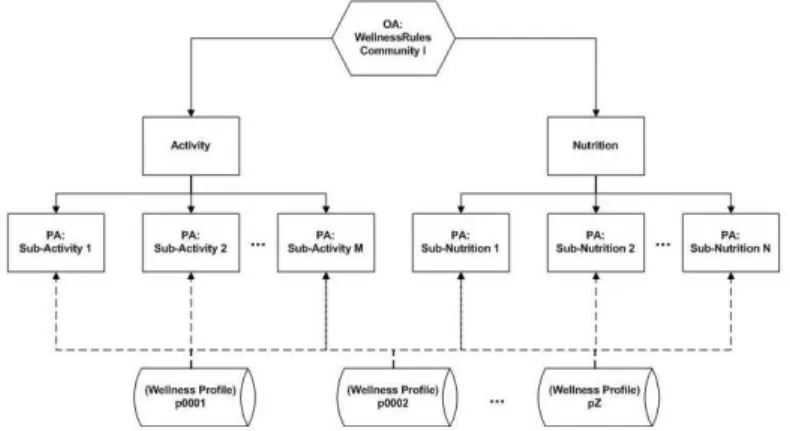
WellnessRules instantiates the Rule Responder multi-agent architecture as fol-lows: Rule Responder’s virtual organization is instantiated to a wellness commu-nity. An organizational agent (OA) becomes an assistant for an entire wellness community. Each personal agent (PA) becomes an assistant for one participant. Fig. 1 describes the OA/PA metamodel of WellnessRules for the activity and nutrition profiles of participants. Newcomers and participants can assume the role of an external agent (EA), (indirectly) querying participants’ profiles.
Rule Responder uses the following sequence of steps: An EA asks queries to an OA. The OA maps and delegates each query to the PA(s) most knowledgeable about it. Each PA poses the query to its local rulebase plus ontology, sending the derived answer(s) back to the OA. The OA integrates relevant answers and gives the overall answer(s) to the EA, by default not revealing the coordinates of the answering PA(s).
In this way, the OA acts as a mediator that protects the privacy of profiles of participants in a wellness community. Participants within the same community can of course later decide to reveal their real name and open up their wellness profiles for (direct) querying by selected other participants.
The above Rule Responder steps have been instantiated earlier, including to the SymposiumPlanner system [CB08].
On the basis of Rule Responder the knowledge bases of sections 2 and 3 can be queried, using the translators of section 4 for interoperation. The implemented
Fig. 1.WellnessRules OA/PA metamodel.
Rule Responder for WellnessRules is available for online use at http://ruleml. org/WellnessRules/RuleResponder/.
For example, this is a POSL query regarding p0001’s wellness profile, for execution by a top-down engine such as OO jDREW TD:
myActivity(p0001,?:Running,out,1:Integer,20:Integer,"2009-06-10T10:15:00", "2009-06-10T11:15:00",?Place,?Duration,?Level)
It uses the rule from sections 3 to check whether p0001 will possibly be ?:Running, outdoors, in a group of 1:Integer to 20:Integer, between start time "2009-06-10T10:15:00"and end time "2009-06-10T11:15:00". Using further rules and facts from p0001’s profile (http://ruleml.org/WellnessRules/PA/ p0001.posl), it produces multiple solutions, binding the meetup ?Place, the ?Duration, and the required fitness ?Level.
The corresponding N3 query for execution by a bottom-up engine such as EulerSharp EYE uses a temporary fact to pass the input arguments:
:rsvpQuery
rdf:type :RSVPQuery; :profileID :p0001; :minRSVP 1; :maxRSVP 20.
The N3 query itself then is as follows: @prefix : <wellness_profiles#>.
WellnessRules: Web 3.0 Profile Interoperation 9 _:myActivity rdf:type :MyActivity; :profileID :p0001; :activity :Running; :inOut :out; :minRSVP ?MinRSVP; :maxRSVP ?MaxRSVP; :startTime "2009-06-10T10:15:00"; :endTime "2009-06-10T11:15:00"; :location ?Place; :duration ?Duration; :fitnessLevel ?FitnessLevel.
After declaring two prefixes, it builds an existential ‘( )’ node, :myActivity, using slots for the fixed parameters and the fact-provided ?MinRSVP and ?MaxRSVP bindings to create slots with the ?Place, ?Duration, and ?Level bindings.
An evaluation of the response times of the Mule infrastructure and the Rule Responder engines (OO jDREW, Euler, and Prova) instantiated for Wellness-Rules has been conducted using the previously discussed scenario. We found that this Rule Responder instantiation operates with acceptable Web response times. Specifically, the execution times for the above myActivity query in Euler (N3), OO jDREW (POSL), and Rule Responder on average were 157ms, 1483ms, and 5053ms, respectively, measured as the Java system time, running in Java JRE6, Windows XP Professional SP3, on an Intel Core 2 Duo 2.80GHz processor. For this and similar WellnessRules queries, the major contribution to the overall execution time has come from the ESB (Mule), which is not the focus of this work. Rule Responder operates using a star-like connection architecture, where the OA dispatches network traffic to and fro the most appropriate PA. A separate study in distributed querying has worked on minimizing this commu-nication overhead.3
The above query could be specialized to produce exactly one solution, e.g. by changing the parameter outdoors to indoors. It would fail for ?MaxRSVP greater than 20. Using such queries, WellnessRules participants can check out profiles of other participants to see if they can join an activity group.
6
Conclusion
The WellnessRules case study demonstrates FOAF-extending Web 3.0 profile in-teroperation between a pure Prolog subset (Datalog with Naf) and N3 through RuleML/XML. With all of its source documents available, it has become a ma-jor use case for exploring various aspects, including scalability, of (distributed) knowledge on the Web (3.0), starting with derivation rules and light-weight on-tologies. While WellnessRules so far has probed the OO jDREW, Euler, and Prova engines, its open Rule Responder architecture will make it easy to bring in new engines. A GUI can generate rule profiles, e.g. extending FOAF-a-Matic.4
3
http://ruleml.org/papers/EvalArchiRule.pdf
4
WellnessRules currently emphasizes rulebase translation and querying. These constitute basic services that we intent to extend by superimposed update ser-vices, e.g. for changing calendar entries for activities from status possible to planned; this will require production rules. The next extension will be relevant for performing wellness events, which will call for event-condition-action rules. Both of these extended rule types are covered by Reaction RuleML [PKB07].
This case study will also provide challenges for RIF [BK09]: WellnessRules’ current derivation rules, for RIF-BLD5
implementations; its planned production rules, for RIF-PRD6
updates & implementations; and its envisioned reaction rules, for a possible RIF Reaction Rule Dialect (RIF-RRD).
7
Acknowledgements
We thank the wellness community at NRC-IIT Fredericton for their advice & enthusiasm. Thanks also go to Jos de Roo for his help with the Euler engine. NSERC is thanked for its support through a Discovery Grant for Harold Boley.
References
[BK09] H. Boley and M. Kifer. RIF Basic Logic Dialect. W3C Working Draft. http://www.w3.org/2005/rules/wiki/BLD, July 2009.
[Bol07] Harold Boley. Are Your Rules Online? Four Web Rule Essentials. In A. Paschke and Y. Biletskiy, editors, Proc. Advances in Rule Interchange and Applications, International Symposium (RuleML-2007), Orlando, Florida, volume 4824 of LNCS, pages 7–24. Springer, 2007.
[CB08] Benjamin Larry Craig and Harold Boley. Personal Agents in the Rule Re-sponder Architecture. In Nick Bassiliades, Guido Governatori, and Adrian Paschke, editors, RuleML, volume 5321 of Lecture Notes in Computer Sci-ence, pages 150–165. Springer, 2008.
[dB09] Jos de Bruijn. RIF RDF and OWL Compatibility. W3C Working Draft. http://www.w3.org/2005/rules/wiki/SWC, July 2009.
[LBBM06] Jie Li, Harold Boley, Virendrakumar C. Bhavsar, and Jing Mei. Expert Finding for eCollaboration Using FOAF with RuleML Rules. In Montreal Conference of eTechnologies 2006, pages 53–65, 2006.
[PBKC07] Adrian Paschke, Harold Boley, Alexander Kozlenkov, and Benjamin Craig. Rule Responder: RuleML-Based Agents for Distributed Collaboration on the Pragmatic Web. In 2nd ACM Pragmatic Web Conference 2007. ACM, 2007.
[PKB07] Adrian Paschke, Alexander Kozlenkov, and Harold Boley. A Homogenous Reaction Rule Language for Complex Event Processing. In Proc. 2nd In-ternational Workshop on Event Drive Architecture and Event Processing Systems (EDA-PS 2007). Vienna, Austria, September 2007.
[SLKL07] Anna Sachinopoulou, Juha Lepp¨anen, Hannu Kaijanranta, and Jaakko L¨ahteenm¨aki. Ontology-Based Approach for Managing Personal Health and Wellness Information. In Engineering in Medicine and Biology Soci-ety (EMBS 2007). 29th Annual Int’l Conference of the IEEE, August 2007.
5
http://www.w3.org/2005/rules/wiki/BLD
6