
HAL Id: tel-00719301
https://tel.archives-ouvertes.fr/tel-00719301
Submitted on 19 Jul 2012
HAL is a multi-disciplinary open access
archive for the deposit and dissemination of sci-entific research documents, whether they are pub-lished or not. The documents may come from
L’archive ouverte pluridisciplinaire HAL, est destinée au dépôt et à la diffusion de documents scientifiques de niveau recherche, publiés ou non, émanant des établissements d’enseignement et de
Cloning with gesture expressivity
Manoj Kumar Rajagopal
To cite this version:
Manoj Kumar Rajagopal. Cloning with gesture expressivity. Other [cs.OH]. Institut National des Télécommunications, 2012. English. �NNT : 2012TELE0013�. �tel-00719301�
Thèse de doctorat de Télécom SudParis
dans le cadre de l’école doctorale S&I en co-accréditation avec l’Université d’Évry-Val d’Essonne
Spécialité : Informatique
Par
Manoj Kumar Rajagopal
Thèse présentée pour l’obtention du diplôme de Docteur de Télécom SudParis
Clonage gestuel expressif
Soutenue le 11 mai 2012 devant le jury composé de
M. Patrice Dalle, Professeur à l'Université Paul Sabatier de Toulouse, rapporteur M. Rachid Deriche, Directeur de Recherche,
INRIA Sophia Antipolis-Méditerranée, rapporteur
Mme Sylvie Lelandais, Professeur à l’Université d’Évry-Val d’Essonne, examinatrice Mme Bernadette Dorizzi, Professeur à Télécom SudParis, directrice de thèse Mme Catherine Pelachaud, Directrice de Recherche,
CNRS - LTCI Télécom ParisTech, co-directrice de thèse M. Patrick Horain, Ingénieur d’Études à Télécom SudParis, encadrant
PhD Thesis prepared at Telecom SudParis
in the framework of École doctorale S&I in partnership with University of Evry-Val d’Essonne
Specialized in: Computer Science
By
Manoj Kumar Rajagopal
A dissertation submitted for the degree of Doctor of Philosophy at Telecom SudParis
Cloning with gesture expressivity
Defended on 11th
May 2012 before the jury composed of:
M. Patrice Dalle, Professor at University Paul Sabatier in Toulouse, reviewer M. Rachid Deriche, Director of Research,
INRIA Sophia Antipolis-Méditerranée, reviewer
Mme Sylvie Lelandais, Professor at University of Evry-Val d’Essonne, examiner Mme Bernadette Dorizzi, Professor at Telecom SudParis, thesis director Mme Catherine Pelachaud, Director of Research,
CNRS - LTCI Télécom ParisTech, co-directrice de thèse M. Patrick Horain, Associate Professor at Telecom SudParis, advisor
Abstract
Virtual environments allow human beings to be represented by virtual humans or avatars. Users can share a sense of virtual presence is the avatar looks like the real human it represents. This classically involves turning the avatar into a clone with the real human’s appearance and voice. However, the possibility of cloning the gesture expressivity of a real person has received little attention so far. Gesture expressivity combines the style and mood of a person. Expressivity parameters have been defined in earlier works for animating embodied conversational agents.
In this work, we focus on expressivity in wrist motion. First, we propose algorithms to estimate three expressivity parameters from captured wrist 3D trajectories: repetition, spatial extent and temporal extent. Then, we conducted perceptual study through a user survey the relevance of expressivity for recognizing individual human. We have animated a virtual agent using the expressivity estimated from individual humans, and users have been asked whether they can recognize the individual human behind each animation.
We found that, in case gestures are repeated in the animation, this is perceived by users as a discriminative feature to recognize humans, while the absence of repetition would be matched with any human, regardless whether they repeat gesture or not. More importantly, we found that 75 % or more of users could recognize the real human (out of two proposed) from an animated virtual avatar based only on the spatial and temporal extents. Consequently, gesture expressivity is a relevant clue for cloning. It can be used as another element in the development of a virtual clone that represents a person.
Résumé
Les environnements virtuels permettent de représenter des personnes par des humains virtuels ou avatars. Le sentiment de présence virtuelle entre utilisateurs est renforcé lorsque l'avatar ressemble à la personne qu'il représente. L’avatar est alors classiquement un clone de l’utilisateur qui reproduit son apparence et sa voix. Toutefois, la possibilité de cloner l'expressivité des gestes d'une personne a reçu peu d'attention jusqu'ici. Expressivité gestuelle combine le style et l'humeur d'une personne. Des paramètres décrivant l’expressivité ont été proposés dans des travaux antérieurs pour animer les agents conversationnels.
Dans ce travail, nous nous intéressons à l'expressivité des mouvements du poignet. Tout d'abord, nous proposons des algorithmes pour estimer trois paramètres d'expressivité à partir des trajectoires dans l’espace du poignet : la répétition, l'étendue spatiale et l’étendue temporelle. Puis, nous avons mené une étude perceptive sur la pertinence de l’expressivité des gestes pour reconnaître des personnes. Nous avons animé un agent virtuel en utilisant l’expressivité estimée de personnes réelles, et évalué si des utilisateurs peuvent reconnaître ces personnes à partir des animations.
Nous avons constaté que des gestes répétitifs dans l'animation constituent une caractéristique discriminante pour reconnaître les personnes, tandis que l'absence de répétition est associée à des personnes qui répètent des gestes ou non. Plus important, nous avons trouvé que 75% ou plus des utilisateurs peuvent reconnaître une personne (parmi deux proposée) à partir d'animations virtuelles qui ne diffèrent que par leurs étendues spatiales et temporelles. L’expressivité gestuelle apparaît donc comme un nouvel indice pertinent pour le clonage d’une personne.
Acknowledgments
Since this PhD adventure started, more than 3 years ago, I have been very fortunate to meet and work with many great people. Here, I would like to express my sincere gratitude to all of them who made the development of this thesis possible.
First and foremost I would like to thank my supervisor Patrick Horain, for choosing me to work on this interesting thesis. I am greatly indebted to his perfect mentoring, and support – both technical and personal. Interactions with him are always positive and fruitful. I would always cherish this 3½ years experience and take back plenty of wisdom that he has happily shared with me.
Another important person whom I would like to thank is my thesis Co-director, Catherine Pelachaud. During starting stage of thesis, she gave me variety of research publications to start my work. She showed me right direction whenever I struggled to proceed further in my thesis. I would also thank to her team members Andre-Marie Pez and Radoslaw Niewiadomski for giving me the technical support in using Greta and providing valuable inputs in my work.
Thanks to the jury members of my thesis for their valuable discussion during the thesis defense. Special thanks to Patrice Dalle and Rachid Deriche for their precise reviews and contributions which allowed enriching this thesis work.
I would like also to thank my thesis director, Bernadette Dorizzi, for accepting me in the EPH department of Télécom SudParis, where I found a very pleasant and great working environment during these years. Special thanks to Patricia Fixot and Marie-Thérèse Courcier, for her friendship and patience with me despite my several distractions. Thanks for helping me efficiently with the administrative problems that I had during these years.
I also would like to thank my wife Priya. Her constant encouragement and sacrifices need special mention here. I attribute a lot of my character to my parents. Thanks to them for that.
I need to give a special thanks to David Gomez, who is my senior in my lab. He helped me a lot when I faced language problem. He is my unofficial translator. Thanks a lot to David.
I am very grateful with all my laboratory colleagues and friends (Daniel, , Sesh, Maher, Daria, Quocdinh, Jerome ) for the great time spent, inside and outside the lab, and their valuable help and support during the past years. I am also very grateful
with all the good friends in the maisel and out of the maisel that I met during my PhD and whom I spent great times making my stay in France a wonderful experience.
Doing PhD has its ups and downs. I express my sincere apologies if I had hurt someone’s feelings or expectations during the last four years. Hope my thesis is at least a drop in the ocean of knowledge created by numerous research scholars over hundreds of years.
Table of Contents
List of Figures ... 14 List of Tables ... 18 Chapter 1 - Introduction ... 19 1.1 Problem Statement ... 19 1.2 Thesis contributions ... 201.3 Organization of the Thesis ... 20
Chapter 2 - State of the Art ... 21
2.1 Introduction ... 21
2.2 Communicative Gesture – Definition ... 21
2.3 Gesture Expressivity ... 22
2.3.1 Expressivity – Psychologists Views ... 22
2.3.2 Expressivity – Computer Scientists Views ... 25
2.3.2.1 Understanding Human Motion ... 25
2.3.2.2 Style and Content Separation by Low-Dimensional Mapping ... 26
2.3.2.3 Stylistic Motion Synthesis from Human Motion ... 27
2.3.2.4 Style and Content Separation using Dimensionality Reduction .. 28
2.3.2.5 Separating Style based on Time Invariant Model ... 32
2.3.2.6 On-line Motion Style Transfer ... 33
2.3.2.7 Expressive Animation ... 34
2.4 Expressivity Parameters ... 37
2.5 Customized Virtual Agents ... 42
2.5.1 Virtual Agent Based on GESTYLE Language ... 43
2.5.2 Greta ... 44
2.5.2.1 Spatial Extent ... 46
2.5.2.2 Temporal Extent ... 46
2.5.2.3 Repetition ... 48
2.6 Conclusion ... 48
Chapter 3 - Estimation of Expressivity Parameters ... 51
3.1 Learning Expressivity Estimation ... 51
3.1.1 Reference Corpus ... 52
3.1.1.1 Greta Editors and Player ... 52
3.2 Expressivity Estimator ... 53
3.3 Validation Process ... 53
3.3.1.1 Expressivity Parameter Validation ... 54
3.4 Estimation of Expressivity Parameters ... 54
3.4.1 Estimating Spatial Extent ... 54
3.4.1.1 Validating Spatial Extent Estimation ... 55
3.4.2 Estimating Temporal Extent ... 56
3.4.2.1 Validating Temporal Extent Estimation ... 58
3.4.3 Estimating Repetitions ... 59
3.5 Conclusion ... 70
4.1.1 Capturing Human Motion ... 72
4.1.2 Estimating Expressivity Parameters of a Real Human ... 73
4.1.3 Animating the Virtual Human with Expressivity ... 75
4.2 User Reviews ... 78
4.2.1 Review Setup ... 79
4.2.2 Analysis of User Responses ... 81
4.3 Conclusion ... 83
Chapter 5 - Conclusion... 85
5.1 Summary of Contributions ... 85
5.2 Perspectives ... 86
Appendix A ... 87
Greta Editors and Players ... 87
List of Figures
Figure 2-1 Different styles synthesized from the motion sequences. Five motion sequences synthesized from the same choreography, but in different styles(one per row). The actions, aligned vertically are tiptoeing, turning, kicking and spinning. The odd body geometry reflects marker placements in the training motion capture (Brand & Hertzmann, 2000). ... 28
Figure 2-2 Interpolating styles and contents (Elgammal & Lee, 2004) ... 29 Figure 2-3 Generation of Stylized motion (Urtasun, Glardon, Boulic, Thalmann, & Fua, 2004) ... 30
Figure 2-4 Transitions between different motions are achieved by linear interpolation (Wang, Fleet, & Hertzmann, 2007) ... 31
Figure 2-5 Style translation system transforms a normal walk (TOP) into a sneaky crouch (MIDDLE) and a sideways shuffle (BOTTOM) (Hsu, Pulli, & Popović, 2005) ... 32
Figure 2-6 Wu et al. (2006) Approach ... 33 Figure 2-7 Transfer the “stealthy” style of a walking motion (middle) to another walking motion (top) produces a new “stealthy walking” motion (bottom). ... 34
Figure 2-8 This 320-frame sequence of dance motion is choreographed from (1) the starting frame, (2) the ending frame and (3) the learnt motion texture from motion captured dance data. Four motion textons are generated from the motion texture and then used to synthesize all the frames in this sequence. A number of key frames are also shown in the figure to demonstrate that the synthesized motion is natural, smooth and realistic (Two red lines indicate the trajectories of the right hand and right foot) (Li, Wang, & Shum, 2002). ... 35
Figure 2-9(Top Left) Choice based interface. (Top Right) Sketch based Interface. (Middle Left and Bottom Left) The user performing a motion in front of a video camera and her silhouette extracted from the video. (Middle Right and Bottom Right ) the avatar being controlled through the vision based interface and the rendered silhouette that matches the user’s interface (Lee, Chai, Reitsma, Hodgins, & Pollard,
Figure 2-10 Architecture of Castellano and Mancini’s (Castellano & Mancini,
2009) system. ... 40
Figure 2-11 Architecture of Caridakis et al (2008) system. ... 42
Figure 2-12 Sample stills of virtual agent which is generated using GESTYLE which are taken from a longer demonstrator for GESTYLE which renders in VRML and in the STEP system Eliens et al (2002) ... 44
Figure 2-13 Greta Architecture outline (Hartmann, Mancini, & Pelachaud, 2005) 45 Figure 2-14 Examples of Greta gestures and facial expressions (Pelachaud, 2005) ... 45
Figure 2-15 Spatial Extent hand variation , (left) minimum spatial extent gesture, (middle) neutral spatial extent gesture, (right) maximum spatial extent gesture... 46
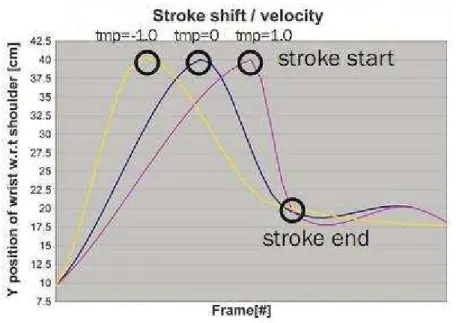
Figure 2-16 Temporal Extent - plot of wrist position over time in one dimension. (Hartmann, Mancini, & Pelachaud, 2005) ... 47
Figure 3-1 Step by Step learning process ... 52
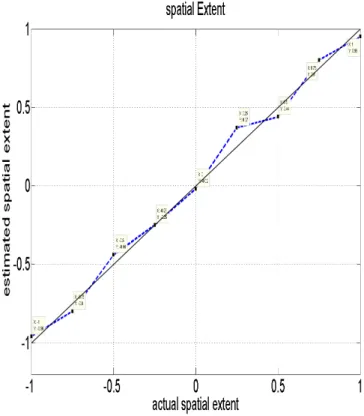
Figure 3-2 Estimated spatial extent vs input spatial extent for synthesized motions ... 56
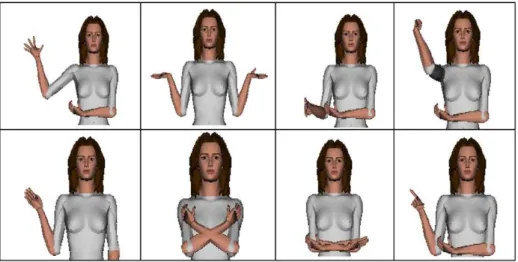
Figure 3-3 some of the poses in reference corpus ... 57
Figure 3-4 Higher instant speeds from synthesized motions ... 58
Figure 3-5: Set of poses in Testing Corpus ... 59
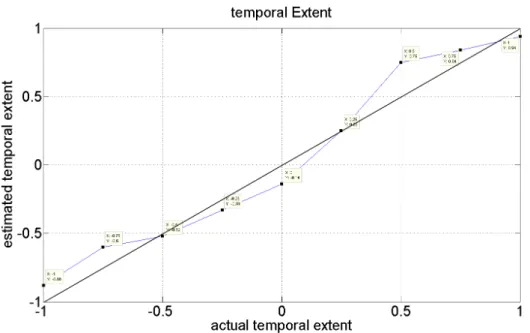
Figure 3-6: Estimated temporal extent vs input temporal extent for synthesized gestures ... 59
Figure 3-7: Stroke repetitions in wrist trajectory. Here, only the frontal coordinate of the wrist 3D trajectory is plotted. Some of the repetition phases are circled. ... 60
Figure 3-8: Example correlation with one repetition. Correlation over a sliding window between the current wrist 3D position at the current frame (given in abscise) and the upcoming wrist positions (delay given in ordinate). The wrist trajectory is sampled at 25 positions per second. ... 61
Figure 3-9: Example correlation with two repetitions. Correlation over a sliding window between the current wrist 3D position at the current frame (given in abscise)
and the upcoming wrist positions (delay given in ordinate). The wrist trajectory is
sampled at 25 positions per second. ... 62
Figure 3-10: Set of poses in Reference Corpus for Repetitions (available online from www-public.it-sudparis.eu/~rajagopa/RepVideos.htm). ... 63
Figure 3-11: Example distance with zero, one and two repetitions, respectively. The average over a sliding window of the distances between the current wrist 3D position at the current frame (given in abscise) and the upcoming wrist positions (delay given in ordinate). The wrist trajectory is sampled at 25 positions per second. ... 64
Figure 3-12: Schema of wrist distances in case of repetitions. Upper part: wrist trajectory; ST is the initial stroke, while R1 and R2 are respectively repetitions after T1 and T2 time shifts, respectively. Lower part: distances between wrist positions with respect to time and delay. Higher distances are shown in blue, while lower distances are in white. ... 65
Figure 3-13 Top Hat transform – structural element along vertically for 1 repetition ... 67
Figure 3-14 Top Hat transform – structural element along vertically for 2 repetitions ... 67
Figure 3-15 Top Hat transform – structural element along obliged for 1 repetition ... 68
Figure 3-16 Top Hat transform – structural element along obliged for 2 repetition ... 68
Figure 3-17 Top Hat transform – vertical X diagonal structural element for 1 repetition ... 69
Figure 3-18 Top Hat transform – vertical X diagonal structural element for 2 repetition ... 69
Figure 4-1: Cloning the gesture expressivity of a real human ... 72
Figure 4-2 Left: Real human motion; Right: Kinect tracking ... 73
Figure 4-3 Set of poses of real human motion in video sequence V1 ... 74
Figure 4-5 Set of poses of real human motion in video sequence V3 ... 74
Figure 4-6 Set of poses of real human motion in video sequence V4 ... 74
Figure 4-7 Tracking with Gómez Jáuregui et al. algorithm ... 75
Figure 4-8 Animated gesture using Greta for the spatial extent of V1. Note the large spatial extent. ... 76
Figure 4-9 Animated gesture using Greta for the spatial extent of V2. Note the small spatial extent. ... 76
Figure 4-10 Wrist trajectories synthesized using the Greta animation engine, with the temporal extent from V1 and V2. ... 77
Figure 4-11 : Stroke repetitions in wrist trajectory. Here, only the frontal coordinate of the wrist 3D trajectory is plotted. ... 78
Figure 4-12: Example page from the first user survey setup ... 79
Figure 4-13 Example page from the second user survey setup ... 80
Table 4-1 Reviewers statistics ... 82
Table 4-2 First review setup results ... 82
Table 4-3 Second review setup results ... 82
Figure A-1: Gesture Editor with expressivity window and visualization window (Hartmann, Mancini, & Pelachaud, 2002) ... 87
Figure A-2: BML Editor (Hartmann, Mancini, & Pelachaud, 2002) ... 88
List of Tables
Table 4-1 Reviewers statistics ... 82 Table 4-2 First Review setup Results ... 82 Table 4-3 Second Review set up Results ... 82
Chapter 1 -
Introduction
1.1
Problem Statement
Online virtual worlds allow multiple users to interact remotely by means of animated virtual representations, including virtual humans or avatars. They allow for interaction and collaboration around 3D objects.
Virtual humans are a new kind of intelligent Human-computer interface that allow human like animation and conversational skills (Cassell, Sullivan, Prevost, & Churchill, 2000). They may exhibit a human like aspect, both in appearance and behavior, including emotional states, personality traits etc. Virtual humans imply many complex problems that have been studied for years (Thalmann & Thalmann, 1991). Animating virtual humans with actions that reflect real human motion involves challenges (Thalman, 2000) such as controlling limbs deformations and collisions, high-level direction of avatars, adaptation of pre-defined movements and interacting with objects. Badler et al. (1999) state that animating a virtual human involves generating movements, reactions and interactions that appear “natural”, appropriate and contextually sensitive.
In order to interact socially with a real human, a virtual human needs to behave like a real human. A virtual human should present the appearance and voice of a real human. It should also gesture like a real human. The process of making a virtual human look like a real human is termed as cloning.
The behavior of the person depends on personal general tendencies, or “style” (Gallaher, 1992). Most of the approaches to style are based on low level parameters like joint angles (Tenanbaum & Freeman, 2000) (Elgammal & Lee, 2004) (Grochow, Martin, Hertzmann, & Popović, 2004), but, practically it is difficult to address the style in terms of joint angles or any other low level parameters. Cloning should also involve gesturing style.
Non-verbal behavior conveys user’s emotional states (Hassin, James, & Bargh, 2005). Mehrabian et al. (1967) says that body language expresses 55 % of the human feelings and intentions. Boone et al. (1998) work says hand gesture expresses emotional state of a person. Non-verbal behavior, body language and hand gestures play a major role in delivering human feelings. Human gestures are affected by their mood (Zhu & Thagard, 2002). The outcomes of the phase of action generation are
mental representations such as intentions, decisions, choices, or goals. These representations are usually on the higher level of the hierarchical organization of action and therefore are relatively abstract (Gallistel, 1980).
This motivates to have a virtual human that reproduces the non-verbal behavior of a real human. We aim at capturing the style and mood of a person, which we jointly refer to as “expressivity” (Hartmann, Mancini, & Pelachaud, 2005), and render this with virtual human in such a way that it can be perceived and recognized by users.
1.2
Thesis contributions
In our work, we first propose algorithms to estimate three expressivity parameters from 3D human motion.
Then, through a user survey, we evaluate whether expressivity works as a clue for virtual cloning of humans. Using the Hartman et al. (2005) animation engine and conversational agent, we animated a virtual human with the expressivity estimated from real humans. The survey showed that up to 88 % of users could recognize the real human (out of two proposed) behind the virtual animation, based on expressivity only.
1.3
Organization of the Thesis
This thesis is organized as follows:
Chapter 2 presents the state-of-the art on describing the style of human gestures, mood and expressive animation. It introduces parameters to describe expressivity in communicative gestures.
In chapter 3, we propose algorithms to estimate three expressivity parameters from 3D motion trajectories.
In chapter 4, experimentally evaluate whether users can recognize humans from virtual animations that encompass their estimated expressivity.
Chapter 5 concludes with a summary of contributions and discusses future directions.
Chapter 2 -
State of the Art
2.1
Introduction
Expressivity is conveyed by non verbal behavior of the person. . It conveys user’s mental and affective states. In the process of defining expressivity we first introduce communicative gesture and then we discuss human expressivity. We address human expressivity and body language from the psychologist’s point of view. We discuss the automated synthesis and analysis of human gestures from computer scientist’s view. We also discuss the expressivity parameters and available animation engine to animate a virtual human.
2.2
Communicative Gesture – Definition
Communication takes place not only through speech, voice but also by means of gestures such as facial expressions, gaze, head movements, hand movements etc. As per Oxford dictionaries, the gesture is a movement of part of the body, especially a hand or the head, to express an idea or meaning. According to Poggi and Pelachaud, (2008) definition a communicative gesture stems from a notion of communication, based on a model in terms of goals and beliefs. Poggi (2007) defines communication as the case in which sender produces a perceivable signal by performing an action (a word, gesture, a glace of view etc.) or exhibiting a morphological trait in order to transform the intention to someone.
Based on this, Poggi and Pelachaud (2008) define communicative gesture as “a particular movement of hands, arms or shoulders that is used by a sender for the goal of communicating some meaning to some addressee” involving shape and positions. The meaning is a belief or a set of beliefs. A communicative gesture can be presented as a signal which aims at transmitting some meaning. In the process of analyzing individual person communicative gestures, we process the video of a person who is communicating with others. After analysis we define the human expressivity based on the hand motions during communication.
2.3
Gesture Expressivity
In face-to-face communication, body language can convey up to 55 % of the information on feelings and intentions (Mehrabian & Wiener, 1967). According to Mehrabian, among channels can convey feelings: words account for 7%, tone of voice accounts for 38%, and body language accounts for 55%. They are often abbreviated as the "3 Vs" for Verbal, Vocal & Visual. Facial expressions are a great mean to express emotions (Ekman, 1982). He states that some facial expressions of emotion are not culturally determined, but universal across human cultures and thus biological in origin. Some studies (Boone & Cunningham, 1998) (Meijer, 1989) decode the emotional states from expressive body movements. These studies reveal that how body expressions play a role in reflecting the expressivity of a person.
Expressivity is also present how body gesture is performed. One of the most influential systems for describing the body gesture and its transcription came from sign language studies. During 1960’s William Stokoe (1960) first analyzed American Sign Language (ASL) sign in terms of a small set of parameters namely hand shape, hand movement and hand location. Later other parameters like, hand orientation, wrist orientation and arm position were added (Klima & Bellugi, 1979) (Prillwitz, Leven, Zienert, Hanke, & Henning, 1989). This way of analyzing sign language is also used to analyze gestures. Later temporal gestures came to limelight by other researchers (McNeill, 1992) (Kita, Gijn, & Hulst, 1998) (Kendon, 2004).
A gesture has an excursion, from when the hand leaves its resting position and up to its coming back to it. According to Efron’s (1941) gestural theory, all gestures are classified in three phases videlicet preparation, stroke and retraction. The stroke is always necessarily present, and it is the phase of the excursion in which the shape of the gesture and the movement dynamics are clear (Kendon, 2004) Several researchers (Wallbott & Scherer, 1986), (Gallaher, 1992), (Ball & Breese, 2000), (Pollick, 2003) have investigated human motion characteristics and encoded them in to dimensional categories. Some authors refer to body motion using dual categories such as slow vs. fast, small vs. expansive, weak vs. energetic, small vs. large, pleasant vs. unpleasant. Bevacqua et al. (2007) define expressivity of behavior as the “How” the information is communicated through the execution of some physical behavior.
2.3.1
Expressivity – Psychologists Views
Dancers show their expression in hand motions while dancing. Their hand motions have lot of variations they dance. They also used to communicate some message
describing, visualizing and notating all ways of human movement called Laban Movement Analysis (LMA). LMA is composed of five major components namely body, space, effort, shape and relationship. Body deals with which body parts move, where the movements initiate and how the movement spreads through the body. Space describes how large the mover’s kinesphere1 and what crystalline form is being revealed by spatial pathways of the movement. Shape describes the changing forms that the body makes in space while effort involves the dynamic qualities of the movement and the inner attitude towards using energy. Relationship describes modes of interaction with oneself, others, and the environment. Each individual has their own unique repertoire and preferences for combinations of these basic elements which can be sequences, phrased, patterned and orderly organized together in a particular personal and artistic way.
Modern Psychological and a virtual human animation researches on hand gestures are based on systematic observations or experiments conducted by Efron (1941). According to Efron’s gestural theory, in the preparation phase, the hands are raised to the location where the gesture begins. In the stroke phase, the actual gesture is performed and the hands relax and fall back to the resting places in the restoration phase.
Johansson (1973) worked with Moving Light Displays (MLD) affiliated with body parts showed that observers can almost identified biological motion patterns right away even when presented with only few of these moving dots. MLDs generate robust shape from motion cues that allow identity, gender, emotions and personality traits. This raised the question whether recognition of moving parts can be achieved directly from motion, without structure recovery.
Wallbott and Scherer (1986) classified the bodily behavior using five criterions: slow or fast, small or expensive, weak or energetic, small or large movement activity and unpleasant or pleasant. Behavior expressivity has been correlated to energy in communication, to the relation with characteristics of gestures and/or personality/emotion. Wallbott (1998) asked actors to portray fourteen different emotions for a given scenario. He aimed at characterizing emotions based on specific body movement and posture. A coding schema for body movement and posture was designed. Movement for each anatomy body part (hand, arm, head, shoulder, and upper body) is encoded as well as movement quality. For upper body, three dimensions are annotated namely ‘movement activity’ (overall quantity of movements), ‘expansiveness/spatial extension’ (of body parts), and ‘movement dynamics/energy/power’ (of body parts). Totally there are twenty six categories in
1
Kinesphere: the area that the body is moving within and how the mover is paying attention to it.
the annotation schema.From the analysis of the annotation it was apparent that most of the categories (seventeen in total) served to differentiate emotions.In particular, the three movement quality dimensions showed significant differences for the fourteen emotions.For example, the emotion ‘boredom’ is shown by low movement activity, un-expansive movements, and low movement dynamics, while ‘elated joy’ is characterized by high movement activity, expansive movement, and high movement dynamics. This shows human movements encode not only content information (information communicated through gesture shape) but also emotional information (the how it is communicated, the manner of execution).
McNeil (1992) explains gestures plays a major role between our conceptualizing capacities and our linguistic abilities. Humans use a very wide variety of gestures ranging from simple actions of using the hand to point at objects to the more complex actions that express feelings and allow communication with others.
Allport and Vernan (1933) consider three main features to describe gesture expressivity, namely an aerial factor of broad versus constricted movements, a centrifugal factor of movements away from the body versus towards the body and an emphasis factor of forceful versus weak movement. Inter-individuality differences are found between subjects performing different task. But there is also a lot of intra individual consistency: individuals showed the same behavior quality over the different tasks they performed.
Gallaher (1992) found consistencies in the way people behave. She conducted evaluation studies in which subject’s behavior style was evaluated by friends, and by self-evaluation. In a first study (Gallaher, 1992), she evaluated many characteristics of behavior: tendency to use body, face, head, gestures; qualities of movement, like fast-slow, small-large, smooth-jerky, etc. In that study friends are asked to observe subjects and rate their behavior styles (along 78 items) and personality traits (24 items). Gallaher performed a factor analysis was performed on the two sets of items. Four dimensions were retained: ‘expressiveness’, ‘animation’, ‘coordination’ and ‘expansiveness’. ‘Expressiveness’ embodies factors such as quantity and variation of movements; ‘animation’ is associated with adjectives such as ‘lethargic-animated’ and can be related to tempo-velocity; ‘coordination’ is correlated with ‘jerkiness-smoothness’ and ‘awkwardness-gracefulness’; and ‘expansiveness’ is linked to the quantity of space. The person's behavior tendency was shown to be an innate individual characteristic that the author claimed to be a personality trait. In the second study she investigated the consistency of a person's behavior across time and situations. Results demonstrated this consistency: people that are quick when writing have a tendency to be quick while eating; if a person produces wide gestures then she also walks with large steps. Energy of movements is also an enduring
characteristic, constant over time. This shows that human movements are consistent and irrespective of actions what they do.
2.3.2
Expressivity – Computer Scientists Views
2.3.2.1
Understanding Human Motion
Gestures can be acquired using electromagnetic sensors coupled with instrumented gloves to acquire gesture. In kinesiology the goal is to develop human body models and explain its mechanical functions and how one might increase its movement efficiency. A typical procedure involves obtaining 3-D joint data, performing kinematic analysis, and computing the corresponding forces and torques for a movement of interest (Calvert & Chapman, 1994). 3-D data is typically obtained in an intrusive manner, e.g., by placing markers on the human body.
Polana and Nelson (1994) referred to “getting your man without finding his body parts.” Models for human action are then described in statistical terms derived from these low-level features or by simple heuristics. The approach without explicit shape models has been especially popular for applications of hand pose estimation in sign language recognition and gesture-based dialogue management.
The character of gestures during communication and the meaning it conveys are addressed by Zhao’s (2001). He approached the gesture analysis on the basis of LMA and its effort and shape components. He used effort qualities and their combinations as a set of higher level features to be extracted for feature acquisition. For each effort dimension, dedicated neural network is constructed. Each network is trained, validated and tested over a number of motion samples. His research result says all the trained networks have a demonstrated accuracy of about 90 % in recognizing effort motion qualities for a group of people who deliberately made these expressions.
Camurri et al. studies (2003) illustrate analysis and classification of expressive gesture in human full-body movement and in particular in dance performances. They aim at (i) individuating motion cues involved in conveying the dancer’s expressive intentions (ii) measuring and analyzing them in order to classify dance gestures in term of basic emotions, (iii) testing a collection of models and algorithms for analysis of such expressive content by comparing their performances with spectators’ ratings of the same dance fragments. They used 4 layered approaches to model human movement and gesture, from low-level physical measures. Their analysis raised the hypothesis that the emotion categories can be differentiated by movement cues and that they are in line with the main predicted associations between emotion and movement cues.
For interpreting hand gestures, Quek (1995) used shape and motion features. According to Quek, during the hand motion individual fingers don’t contribute for hand gesture interpretation in gross motion. On the other hand, gestures in which fingers move with respect to each other will be performed with little hand motion.
2.3.2.2
Style and Content Separation by Low-Dimensional
Mapping
To our knowledge, Tenanbaum and Freeman (2000) were the first who addressed style and content separation. They considered handwriting style, recognizing a familiar face or object seen under unfamiliar viewing conditions and familiar words spoken in unfamiliar accent. They model the mapping from style and content parameters to observations as a bilinear mapping. The approach is also related to the “learning-to-learn” (Thrun & Pratt, 1998) research program also known as task transfer or multitask learning. Defining “learning-to-learn” is that learning problems often come in clusters of related tasks, and thus learners may automatically acquire useful biases for a novel learning task by training on many related ones. Tenanbaum and Freeman work focuses on how learners can exploit the structure in families of related observations, bound together by their style and content interaction.
Tenanbaum and Freeman model the mapping from style and content parameters to observations as a bilinear mapping. They used two kinds of bilinear models in their research namely symmetric bilinear model and asymmetric bilinear model.
In the symmetric model, they represent style and content as vectors in observation space. In the observation space, weight function acts as a bilinear map from style and content to observation space. The symmetric model exactly reproduces the observation when the dimensionalities of style and content are equal. The model provides coarser but more compact representations as these dimensionalities are decreased.
Sometimes linear combinations of a few basis styles learned during training may not describe new styles. So it leads to go for asymmetrical bilinear model. The asymmetric model’s high-dimensional matrix representation of style may be too flexible in adapting to data in new styles and cannot support translation tasks.
Even though they define these bilinear models for the style and content separation in four different applications as we said earlier, our interest lies in handwriting style and content separation. They used different style fonts for the separation of style and content. They showed it is possible to learn the style of a font from observations and extrapolate that style to unseen letters, using a bilinear model.
In a nutshell, Tenanbaum and Freeman work show style and content (alphabets) can separate from hand written characters based on a mathematical model (bilinear model) and it needs to be further improved in terms of high dimensionality and a priori constraints in model parameters.
2.3.2.3
Stylistic Motion Synthesis from Human Motion
The problem of stylistic motion synthesis is addressed by Brand and Hertzmann (2000) through learning motion patterns from a highly varied set of motion capture sequences. Learning identifies common choreographic elements across sequences, the different styles in which each element is performed. The learned model can synthesize novel motion data in any interpolation or extrapolation of styles.
Style is varied in the mapping from qualitative states to quantitative observations. They use Hidden Markov Model (HMM), state space representation to make style distinction. State space representation has a Gaussian distribution over a small space of full body poses and motion which is added to the HMM a multidimensional style that can be used to vary Gaussian parameters resulting in stylistic HMM called “Style Machine”.
They encoded style specific HMM by state means, square root covariance’s and state dwell times. New styles are generated by interpolation and extrapolation within the space. The dimensionality of the space is reduced by Principal Component Analysis (PCA), treating each HMM as a single observation and the generic HMM as the origin. Typically, only a few stylistic degrees of freedom (DOFs) are needed to span the many variations in the training set and these become the dimensions of the style.
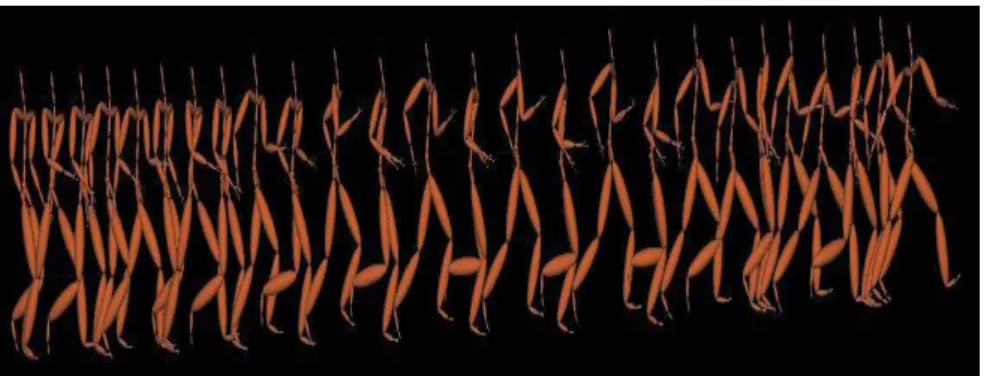
The algorithm automatically segments the data, identifies primitive motion cycles, learns transitions between primitives and identifies the stylist DOFs that make primitives look quite different in different motion capture sequences.Style machines are generative probabilistic models that can synthesize data in a broad variety of styles, interpolating and extrapolating stylistic variations learned from a training set which is shown in Figure 2-1. This work gives us an idea how stylistic motion can be synthesized in different varieties captured from real human motion.
Figure 2-1 Different styles synthesized from the motion sequences. Five motion sequences synthesized from the same choreography, but in different styles(one per row). The actions, aligned vertically are tiptoeing, turning, kicking and spinning. The odd body geometry reflects
marker placements in the training motion capture (Brand & Hertzmann, 2000).
2.3.2.4
Style and Content Separation using Dimensionality
Reduction
Later, Elgammal and Lee (2004) proposed to separate style and content through non-linear dimensionality reduction. Elgammal and Lee described human motion such as gait, facial expression and gesturing, in nonlinear manifolds. They aim at separating style and content on manifolds representing dynamic objects from human silhouette through the walking cycle for their experiments. Given several sequences of walking silhouettes, with different people walking decomposing the intrinsic body configuration through the action (content) from the appearance of the person performing the action (style).
According to Elgammal and Lee, style is time-invariant personal feature and content is a representation of the intrinsic body configuration characterizes activity. They represent content in continuous domain and style is represented by discrete style classes. They adapted the Local Linear Embedding framework, the neighborhood of each point is determined by its nearest neighbors based on the distance in the input space and their objective is to find such weights that minimize global reconstruction error.
They used three dimensional embedding, since this is the least dimensional embedding that can discriminate the different body poses through the cycle. They
geometry. After determining various people manifolds, they used LLE to embed different people manifolds. Given learned nonlinear mapping coefficients, the style parameters can be decomposed by fitting an asymmetric bilinear model to the coefficients.
Figure 2-2 Interpolating styles and contents (Elgammal & Lee, 2004)
Elgammal and Lee learnt a decomposable generative model that explicitly decomposes the content as a function of time from the appearance (style) of the person performing the action as time invariant parameter. This framework decomposes style parameters in the space of nonlinear functions that maps between a learned unified nonlinear embedding of multiple content manifolds and the visual input space.
The lesson learnt from this work is, based on silhouette analysis we can separate style and content on manifolds representing dynamic objects. Elgammal and Lee create styles from different style (Figure 2-2.) This work addresses style and content separation for repetitive actions by combining a set of base styles like walking. It doesn’t address non repetitive gestures such as communicative gestures.
Urtasun et al. (2004) defined style based motion synthesis. They modeled the specific style of an individual whose motion had not yet been recorded through linear sums of principal components. They have presented a real time motion generation technique that allows them to generate the motion of a particular individual performing parameterized displacement activities. More specifically, they have investigated the case of walking, running and jumping. The first two are cyclical and parameterized by speed. The third one, a jump is noncyclical and parameterized in terms of its jump length. Given one single example, they modified the speed, length or body size while preserving the individual’s specific style.
Instead of capturing full motion for each time for a person, in this work (Urtasun, Glardon, Boulic, Thalmann, & Fua, 2004) they extend the Principal Component Analysis (PCA) approach so that motion capture is drastically faster. In the whole classes of cyclic and non cyclic motions such as walking, running or jumping, it is enough to observe a person moving only once at a particular speed or jumping particular distance using either an optical motion captures system or a simple pair of synchronized video cameras.
They generate motion as a two step process. First, they project the new captured motion into the PCA space and measure its Mahalanobis distance to each recorded motion corresponding to the same speed or jump length. The generated motion is then taken to be a weighted average of motions at the target speed with the weights being inversely proportional to those distances. The principle for generating stylistic motion is identical. The new stylized motion is projected into the motion database. Weights are then computed based on the Mahalanobis distance and used to create the same style at a different speed. Figure 2-3 depicts a sneaking motion at 7 km/h generated by using a single example at 4.5 km/h and the standard walking database.
In this method they have validated only three specific cyclic and non cyclic motions. Other kinds of motions are not experimented. This system uses motions that can be captured on a treadmill like straight line motion sequences other motions such as curvilinear motions are not considered since it is not captured through treadmill. The motions they considered are linear motions, for non linear motions PCA approach is not suitable.
Wang et al. (2007) used multi-factor Gaussian process models for style and content separation in human motion. They developed multi linear models using non linear basis functions for human locomotion data in which each pose is generated by factors representing the person’s identity, gait and the current state of the motion. They applied the multifactor model to human motion data consisting of sequences of poses. A single pose is represented as a feature of 89 dimensions, including 43 angular DOFs their velocities, and the global translational velocity. For any particular motion sequence, it is assumed that style stays constant over time. They approached this problem in two ways namely Gaussian Process dynamics and Circle Dynamics Model (CDM).
They do not constrain corresponding poses in different sequences to share the same content because prior knowledge of the exact correspondences is not assumed. It is desirable, to restrict the content of different styles to lie on the same trajectory, especially for motion synthesis. Wang et al. (2007) demonstrates the ability of the model to generate smooth transitions from walking to running and from running to striding. The transitions are generated by linearly interpolating the gait vector with respect to the changing state vector. The subject vector is fixed to a particular person.
Figure 2-4 Transitions between different motions are achieved by linear interpolation (Wang, Fleet, & Hertzmann, 2007)
Later Wang et al. (2008) analyzed the human motion through non linear analysis. They used Gaussian Process Dynamic Models (GPDM) for non linear analysis. They learn models of human pose and motion from 50 dimensional motion capture
data using GPDM. GPDM represents 50 dimensional motion capture data in low dimensional latent space with associated dynamics, as well as map from the latent space to observation space. This results in a non parametric model for dynamical systems that account for uncertainty of the model. Despite the use of small data sets, the GPDM learns an effective representation of the non linear dynamics in the latent space.
2.3.2.5
Separating Style based on Time Invariant Model
Hsu et al. (2005) proposed to transform the style of human motion while preserving its original content, by aligning motions and linear time invariant model (LTI) to represent stylistic differences. For two motions in different styles typically contain different poses, Hsu et al propose iterative motion warping, which automatically computes dense correspondences between stylistically different motions. Motion warping demonstrates that many variations in motion can be modeled by smooth spatial distortions of individual degrees of freedom.
This method uses a LTI model to approximate the relationship between the input and output styles. Once the parameters are estimated from the training data, the model translates new motion with simple linear transformations. The output retains the content and the detail of the original input, but differs in its style of execution.
Figure 2-5 Style translation system transforms a normal walk (TOP) into a sneaky crouch (MIDDLE) and a sideways shuffle (BOTTOM) (Hsu, Pulli, & Popović, 2005)
They conducted some experiments using this algorithm. The data set contained various stylized locomotion and each style is performed in slow, medium and fast speeds. The results of this algorithm, iterative motion warping gave consistently better results which are shown in Figure 2-5. The coordinates of the motions were then interpolated and extrapolated to allow for continuous control of style and speed parameters.
Human identification based on gait analysis has been widely studied (Lee & Grimson, 2002) (Chellappa, Roy-Chowdhury, & Kale, 2007) (Ekinci, 2006) Gait, which can be regarded as a walking style, does convey information on the identity of a person.
Mancini et al. (2007) map acoustic cues and emotion to expressivity parameters they use to control the expressive virtual head of the Greta Embodied Conversational Agent (ECA). Pelachaud and Poggi (2002) aim at combining the Greta facial expressions in a complex and subtle way, just like humans do, by assessing and managing the multimodal communicative behavior of a person when different communicative functions have to be displayed at the same time. Pollick (2003) points out limits of dissecting movement features and ascribing discrete values to movement frequency and speed: the degree and manner in which this style is dependent on spatial and temporal encoding is not trivial and varies between different movements.
2.3.2.6
On-line Motion Style Transfer
Wu et al. (2006) propose a fast and convenient algorithm for human-motion style editing. They define the style of a motion as statistic properties of mean and standard covariance of joint quaternion in 4D unit sphere space. Their algorithm can transfer the style of a motion to another by transferring these properties.
The goal of their approach is to transfer the style of the reference motion MR to the
source motion MS, producing a target motion MT. The target motion can preserve the
details of the source motion and can inherit the style of the reference motion. Their approach is shown in Figure 2-6.
Figure 2-6 Wu et al. (2006) Approach
MS and MR are input directly into the time warping module to setup frame
correspondence. Then, the time-warped motions are fed into the statistic style transfer module for style transferring. In the post-processing stage, they apply a
reverse time warping to obtain target motion MT. The obtained target motion will
have the style of the reference motion and preserve the details of the source motion. They define the style based on Reighar et al. (2001) work. Reighar et al. define the style of an image as the mean and standard covariance of color components in a linearized space, and has successfully transferred the style of an image to the other by transferring the mean and standard variance of color components in this space. Using this definition, Wu et al. transfer the motion style by modifying the mean and variance of the source motion MS according to that of the reference motion MR.
They apply this algorithm in quaternion domain and obtained smooth results. Their results are shown in Figure 2-7.
From this work, we see that style is defined based on image processing approach and it is applied to the full body motion. Also this approach cannot be applied to transfer style between figures that do not have identical structures. The style is defined through low level parameters joint angles.
Figure 2-7 Transfer the “stealthy” style of a walking motion (middle) to another walking motion (top) produces a new “stealthy walking” motion (bottom).
2.3.2.7
Expressive Animation
We start our discussion with how complex human motion (e.g., dancing) is synthesized and then proceed on with available methods to animate the human motions in virtual environment. In the end we will finish up with how these animation methods bring style and emotion in the virtual character.
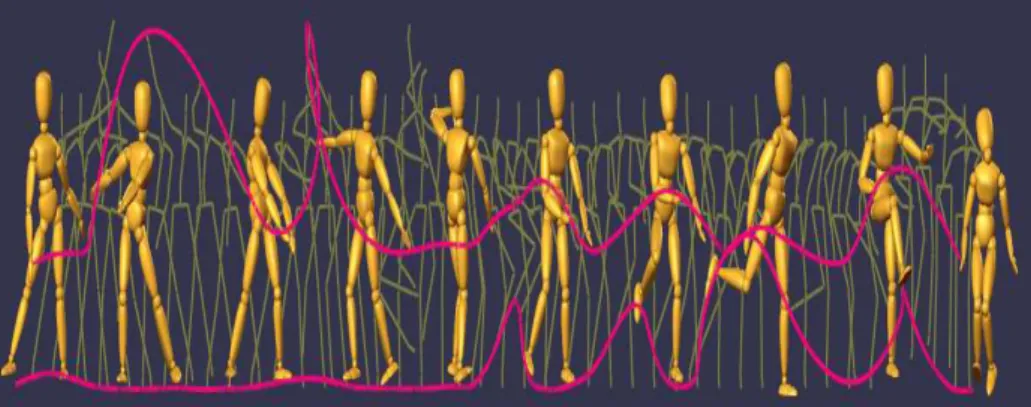
There are many works aiming at generating modified animations based on motion capture data. Li et al. (2002) propose a technique called motion texture for synthesizing complex human figure motion that is statistically similar to the original motion capture data. They describe motion texture as a set of motion textons2 and their distribution which characterize the stochastic and dynamic nature of the captured motion. They define motion sequence into segments, such that each segment can be represented by one of the textons. Multiple textons could be represented by the same texton. A motion texton is represented by a linear dynamic system (LDS) that captures the dynamics shared by all instances of this texton in the motion sequence. Once the motion texture is learnt, it can be used for synthesizing novel motion sequences. The synthesized motion is statistically similar to, yet visually different from, the motion captured data. This model enables users to synthesize and edit the motion at both the texton level and the distribution level. Synthesized motion is shown in Figure 2-8.
Figure 2-8 This 320-frame sequence of dance motion is choreographed from (1) the starting frame, (2) the ending frame and (3) the learnt motion texture from motion captured dance data. Four motion textons are generated from the motion texture and then used to synthesize all the frames in this sequence. A number of key frames are also shown in the figure to demonstrate that the synthesized motion is natural, smooth and realistic (Two red lines indicate the trajectories of the right hand and right foot) (Li, Wang, & Shum, 2002).
Kopp et al (2003) explained a virtual agent can imitate and recognize natural gestures performed by a human using marker motion capture. The imitations have two phases. In the first phase, the agent extracts and reproduces the essential form features of the stroke which is the most important gesture phase. The second phase is the meaning based imitation level that extracts the semantic content of gestures to re express them with different movements.
Arikan and Forsyth (2002) developed a method for automatic motion generation at interactive rates. They establish high level constraints and a random search
2
Textons refer to fundamental micro structure composed of local image features , are “the putative units of pre-attentive human texture perception” (Julesz, 1981).
algorithm is used to find the right pieces of motion data to fill in between. Close to their work, the concept of a motion graph (Kovar, Gleicher, & Pighin, 2002) is defined to enable one to control a character’s locomotion. The motion graph contains the original motion and automatic generated translations and allows the user to have high level control on movements of the characters.
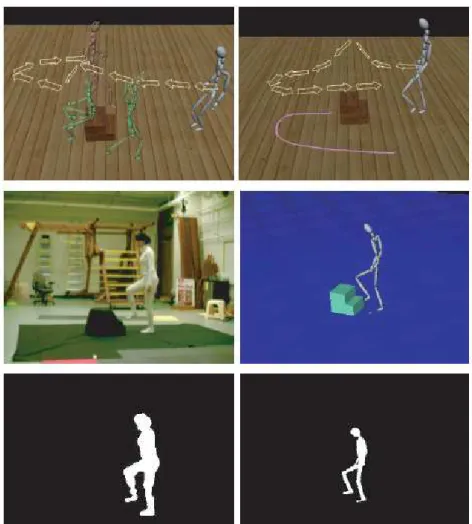
Lee et al. (2002) developed a new technique to control a character in real time using possible interfaces. They aim at obtaining a rich set of avatar behaviors is to collect an extended, unlabeled sequence of motion data appropriate to the application. So they developed a method for such a motion database and it’s preprocessed for flexibility in behavior and efficient search and exploited for real-time avatar control. Three interfacing techniques are used to control avatar motion using the data structure videlicet user select set of available choices, user sketches a path through an environment or acts out a desired motion in front of a video camera. All three interfaces are tested and shown in Figure 2-9.
Figure 2-9(Top Left) Choice based interface. (Top Right) Sketch based Interface. (Middle Left and Bottom Left) The user performing a motion in front of a video camera and her
silhouette extracted from the video. (Middle Right and Bottom Right ) the avatar being controlled through the vision based interface and the rendered silhouette that matches the
This method gives us an introduction, how the real human motion can be brought in the virtual environment as personalized avatars. In this work, they showed how to handle the motion capture data in terms of human behavior. This work will be the starting point in deriving identity and mood of a real human in virtual environment.
From the results, sketch based interface is easy to use and responds instantly to the user input by finding a matching action and updating the display while the path is being drawn. Sometimes, the sketch-based interface was not able to distinguish different styles. In the case of vision based interface, the silhouette comparison usually can discriminate different styles. If the user acts out a motion that is not available in the database, the system selects motion that looks similar.
Any of the above techniques would be appropriate when the user has a large database of movements.
The emotional state of a person can be recognized from facial expressions. It is a combination of sadness, anger, worrying, uncertainty, happiness and surprise (Poggi & Pelachaud, 2000). Pelachaud (2009) developed a model that is based on perceptual studies and encompasses several parameters that modulate multimodal behaviors. This emotional state of the person is also carried out based on bodily motion (Niewiadomski, Hyniewska, & Pelachaud, 2009).
In the process of animating quality human movements, Chi et al. (Chi, Costa, Zhao, & Badler, 2000) proposes a method that allows animators to enhance the style of pre existing motions in a natural way. They use the principles of Laban Movement Analysis to create a new interface for the application of the particular qualities movement to movement.
Ball and Breese (2000) work gives correlation between temporal and spatial tendencies in gesture/posture and personality/emotion – movement frequency and speed were related to emotional arousal, as was the size of overall body outline.
We started to discuss how human motion is brought in the virtual environment and within the next section we address how the identity and mood of a real human can be brought in a virtual agent.
2.4
Expressivity Parameters
Computer scientists (Hartmann, Mancini, & Pelachaud, 2005) (Poggi, 2001) designed bodily expressive virtual agent based on the psychologists study. This helps us to design the virtual agent with high level parameters. They present a
computational model of gesture quality. Once a certain gesture has been chosen for execution they characterize bodily expressivity with a small set of dimensions derived from a review of psychology literature (Wallbott, 1998).
Based on the introspection and observational studies Poggi (2001) proposed to analyze the gesture movement based on following parameters.
a) Part of the hand or arm involved – different parts of the limbs may be involved in the gesture movement. For example, saying “no” by shaking only the index finger with still fist is less intense than shaking it along with the whole fist, or even with the entire forearm.
b) Direction – the point in the space toward which the gesture is directed. Forward, backward, outward, inward, upward, downward and their combinations.
c) Path – the route of a gesture outlines in space (straight, oblique, circular, half-circular, thrumming, oscillation, etc.,)
d) Size – how large is the movement in width (long, short, narrow)
e) Pressure – the strength of the movement, which includes three sub parameters:
1. Tension – the muscular tension of the hand or arm in performing the movement (tense, normal relaxed)
2. Impact – the way in which the gesture stops at the end of the movement ( block, normal, skim)
f) Tempo – the set of temporal features of the movement, that can be distinguished in to three categories namely
1. Duration - how long the movement lasts (long, normal, short)
2. Speed – how speedy the gesture moves (fast, slow, normal)
3. Rhythm – if and how the gesture is repeated and in which rhythmical structure.
Hartmann et al., (2005) characterize expressivity for human bodily movement based on perceptual studies conducted by Wallbott (1998) (1985), Wallbott and Scherer (1986) and by Gallaher (1992). Their approach is driven by a perceptual stand point – how expressivity is perceived by others. So their work focuses on surface realizations of movement and do not attempt to model underlying muscle activation patterns. They define an intermediate level of behavior parameter as a useful enabling tool to facilitate the mapping of holistic, qualitative communicative functions such as mood, personality and emotion to low level animation parameters like joint angles. On the basis of these literatures Hartmann et al., (2005) proposed six dimensions that characterize expressivity in qualitative terms. They are:
a) Spatial Extent – amplitude of movements. That is, quantity of space taken by a body part (how extended are the arms). This dimension is related to the dimension ‘expansiveness/spatial extension’ defined by Wallbott and to the ‘dimension expansiveness’ by Gallaher.
b) Temporal Extent – Velocity of execution of a movement t (how fast or how slow an arm moves). It is related to the ‘animation’ factor of Gallaher.
c) Power – Dynamic properties of the movement m (weak vs. strong). It is related to the degree of acceleration of body parts. It corresponds to the dimension ‘movement dynamics/energy/power’ defined by Wallbott. d) Fluidity – Level of continuity of successive movements (jerky vs. smooth
movements). It is similar to the ‘coordination’ dimension defined by Gallaher.
e) Overall Activation – Overall quantity of movement on a given channel for the whole animation (many hand gestures vs. none, passive / static or animated / engaged). This dimension embodies similar information as the ‘expressiveness’ dimension defined by Gallaher.
f) Repetition – Tendency to rhythmic repeats of specific movements. This dimension is newly added.
Each of the parameters except repetition is float-valued and defined over the interval
[-1, 1], where zero point corresponds to the action without expressivity control. Repetition parameter has the values of 0, 1 and 2.
2.4.1
Related works on Expressivity Parameters
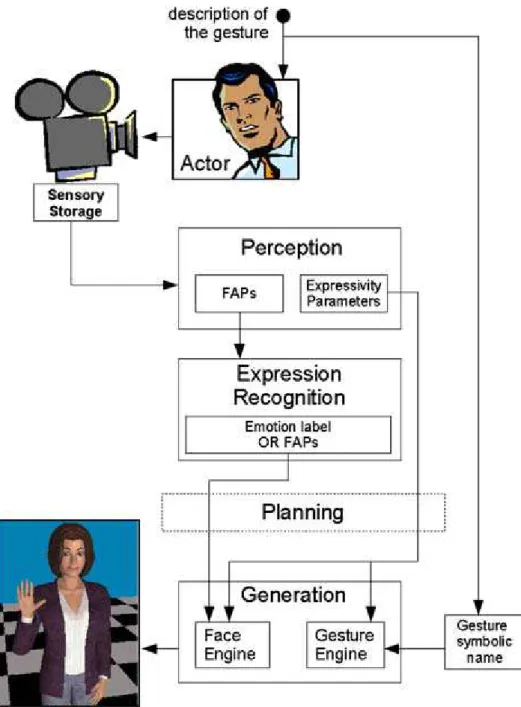
Castellano and Mancini (2009) analyzed the emotional gestures through expressivity parameters and animated the emotional gestures in an embodied agent. Their system allows for the real-time analysis of human movement and gesture expressivity and the generation of expressive copying behavior in an agent which is shown in Figure 2-10. Their system two different platforms: EyesWeb (2004) and Greta.
EyesWeb is used track the human motion and EyesWeb Expressive Gesture Processing Library is used to extract the expressive motion cues. Similar to the expressivity parameters (Hartmann, Mancini, & Pelachaud, 2005) they used contraction index (CI), velocity, acceleration and Fluidity based on Wallbott’s work (1998).
Figure 2-10 Architecture of Castellano and Mancini’s (Castellano & Mancini, 2009) system.
Human motion is tracked continuously through EyesWeb. They do not segment the human movements but they segment the gestures based on time window. They define a time window at the end of which they send the computed motion cues from EyesWeb to the rest of the system. The duration of the time window corresponds to the duration of a gesture performed by the agent.
After extracting expressive motion cues in real time, their system associates them with emotions joy, anger or sadness. Based on Wallbott’s study (1998) they defined correspondences between expressive motion cues and emotions. They do linear mapping between contraction index, velocity, acceleration, fluidity and spatial extent, temporal extent, power, fluidity of Hartmann’s et al. (2005) expressivity parameters. With the mapped values as input to the Greta, the virtual agent is animated.
They conducted perceptual study to evaluate their estimation. In their test, they evaluated the three different emotions, joy, anger and sadness. They selected videos from GEMEP corpus (Bänziger, Pirker, & Scherer, 2006), in which two persons showing these emotions separately, totally 6 videos are selected for perceptual study. In their study, twelve users are asked to observe the animated movements and asked to choose an emotional label (joy, anger or sadness). User’s emotion recognition rated 83.3 % for joy and anger and 70.8 % for sadness for the Greta animated virtual agent.
In their work, the EyesWeb parameters (CI, velocity, acceleration and fluidity) are evaluated for the discrete motions. Discrete motions are made based on time window, not based on gesture segmentation. They aim at replicating human emotions such as joy, anger and sadness in the virtual agent. This work doesn’t concern about the style of the person.


![[PDF] Initiation à la programmation en Basic | Cours informatique](data:image/gif;base64,R0lGODlhAQABAIAAAP///wAAACH5BAEAAAAALAAAAAABAAEAAAICRAEAOw==)