HAL Id: hal-01015747
https://hal.inria.fr/hal-01015747
Submitted on 27 Jun 2014
HAL is a multi-disciplinary open access
archive for the deposit and dissemination of
sci-entific research documents, whether they are
pub-lished or not. The documents may come from
teaching and research institutions in France or
abroad, or from public or private research centers.
L’archive ouverte pluridisciplinaire HAL, est
destinée au dépôt et à la diffusion de documents
scientifiques de niveau recherche, publiés ou non,
émanant des établissements d’enseignement et de
recherche français ou étrangers, des laboratoires
publics ou privés.
Recognizing shrinkable complexes is NP-complete
Dominique Attali, Olivier Devillers, Marc Glisse, Sylvain Lazard
To cite this version:
Dominique Attali, Olivier Devillers, Marc Glisse, Sylvain Lazard. Recognizing shrinkable complexes
is NP-complete. ESA 2014 - 22nd Annual European Symposium on Algorithms, Sep 2014, Wroclaw,
Poland. pp.74-86, �10.1007/978-3-662-44777-2_7�. �hal-01015747�
Dominique Attali,1
Olivier Devillers,2
Marc Glisse2
, and Sylvain Lazard2
1 Gipsa-lab, France. www.gipsa-lab.grenoble-inp.fr/~dominique.attali/ 2 INRIA, France. www.inria.fr/sophia/members/Olivier.Devillers geometrica.saclay.inria.fr/team/Marc.Glisse/ www.loria.fr/~lazard/
Abstract. We say that a simplicial complex is shrinkable if there exists a sequence of admissible edge contractions that reduces the complex to a single vertex. We prove that it is NP-complete to decide whether a (three-dimensional) simplicial complex is shrinkable. Along the way, we describe examples of contractible complexes which are not shrinkable.
1
Introduction
Edge contraction is a useful operation for simplifying simplicial complexes. An edge contraction consists in merging two vertices, the result being a simplicial complex with one vertex less. By repeatedly applying edge contractions, one can thus reduce the size of a complex and significantly accelerate many computa-tions. For instance, edge contractions are used in computer graphics to decimate triangulated surfaces for fast rendering [14, 16]. For such an application, it may be unimportant to modify topological details and ultimately reduce a surface to a single point since this corresponds to what the observer is expected to see if he is sufficiently far away from the scene [21]. However, for other applications, it may be desirable that every edge contraction preserves the topology. This is particularly true in the field of machine learning when simplicial complexes are used to approximate shapes that live in high-dimensional spaces [1, 6, 8, 10]. Such shapes cannot be visualized easily and their comprehension relies on our ability to extract reliable topological information from their approximating com-plexes [7, 11, 20].
In this paper, we are interested in edge contractions that preserve the topol-ogy, actually the homotopy type, of simplicial complexes. It is known that con-tracting edges that satisfy the so-called link condition preserves the homotopy type of simplicial complexes [13] and, moreover, for triangulated surfaces and piecewise-linear manifolds, the link condition characterizes the edges whose traction produces a complex that is homeomorphic to the original one (a con-straint that is stronger than preserving the homotopy type) [12, 19]. An edge ab satisfies the link condition if the link of ab is equal to the intersection of the links
⋆
This work has been supported by ANR project TopData ANR-13-BS01-0008 and by the Advanced Grant of the European Research Council GUDHI (Geometric Under-standing in Higher Dimensions).
2 Attali, Devillers, Glisse, & Lazard Link(a) Link(b) Link(ab) a b
of a and b, where the link of a face f is a simplicial complex defined as follows (see figure): consider the smallest simplicial complex that contains all the faces containing f , i.e. the star of f ; the link of f is the set of faces disjoint from f in that simplicial complex [12].3
We only consider contractions of edges that satisfy
the link condition, which implies that the homotopy type is preserved. We refer to such edge contractions as admissible; an admissible edge contraction is also called a shrink and the corresponding edge is said to be shrinkable. After some sequence of shrinks, the resulting complex (possibly a point) does not admit any more shrinkable edges and the complex is called (shrink) irreducible.
We are interested in long sequences of shrinks because they produce irre-ducible complexes of small size and it is natural to ask, in particular, whether a simplicial complex can be reduced to a point using admissible edge contractions. If this is the case, the simplicial complex is called shrinkable.
Barnette and Edelson [3] proved that a topological disk is always shrinkable (by any sequence of shrinks). They use this property to prove that a compact 2-manifold (orientable or not) of fixed genus admits finitely many triangulations that are (shrink) irreducible [3, 4]. For instance, the number of irreducible trian-gulations of the torus is 21 [17] and it is at most 396 784 for the double torus [22]. We address in this paper the problem of recognizing whether an arbitrary sim-plicial complex is shrinkable.
Tancer [23] recently addressed a similar problem where he considered admis-sible simplex collapses instead of admissible edge contractions. An admissible simplex collapse (called elementary collapse in [23]) is the operation of removing a simplex and one of its faces if this face belongs to no other simplex.4
Such collapses preserve the homotopy type. Similarly to edge contractions, collapses are often used to simplify simplicial complexes, and a simplicial complex is said collapsible if it can be reduced to a single vertex by a sequence of admissible collapses. Tancer proved that it is NP-complete to decide whether a given (two-dimensional) simplicial complex is collapsible [23]. The proof is by reduction from 3-SAT and gadgets are obtained by altering Bing’s house [5], a space that is contractible but whose triangulations are not collapsible.
Both questions of collapsibility and shrinkability are related to the question of contractibility: given a simplicial complex, is it contractible? This question is known to be undecidable for simplicial complexes of dimension 5. A proof given in Tancer’s paper [23, Appendix] relies on a result of Novikov [24, page 169], which says that there is no algorithm to decide whether a given 5-dimensional
3
In other words, in an abstract simplicial complex, the link of σ is the set of faces λ disjoint from σ such that σ ∪ λ is a face of the complex.
4
Strictly speaking, Tancer calls several of our admissible simplex collapses an elemen-tary collapse. His elemenelemen-tary collapse is the removal of a nonempty non-maximal face σ and the removal of all the faces containing σ if σ is contained in a unique max-imal face of the simplicial complex, where maxmax-imality is considered for the inclusion in an abstract simplicial complex [23].
triangulated manifold is the 5-sphere. We thus cannot expect shrinks and col-lapses, even combined, to detect all contractible complexes, but they still provide useful heuristics towards this goal (e.g. [2]) and can even be sufficient in specific situations [13]. Actually, it is always possible to reduce a contractible simplicial complex to a point if we allow another homotopy preserving operation: the anti-collapse (the reverse operation of anti-collapse) [9] but, of course, undecidability of contractibility implies that the length of the sequence is not bounded.
Contributions. A shrinkable simplicial complex is clearly contractible and the converse is not true because of the above undecidability result. We first present a simple shrink-irreducible contractible simplicial complex with 7 vertices. This simple complex is interesting in its own right and it inspired the proof of our main result, which is that it is NP-complete to decide whether a given (three-dimensional) simplicial complex is shrinkable. Our proof uses a reduction from 3-SAT similarly as in Tancer’s NP-completeness proof of collapsibility [23] but, noticeably, our gadgets are much smaller than those used for collapsibility.
Our NP-completeness result on shrinkability together with Tancer’s analog on collapsibility naturally raises the question of whether it is also NP-complete to decide if a given simplicial complex can be reduced to a single vertex by a se-quence combining admissible edge contractions and admissible simplex collapses. In this direction, we present a contractible simplicial complex with 12 vertices that is irreducible for both shrinks and collapses.
2
Preliminaries
In this paper, simplicial complexes are abstract and their elements are (abstract) simplices, that is, finite non-empty collections of vertices. We can associate to every abstract simplicial complex a geometric realization that maps every ab-stract simplex to a geometric simplex of the same dimension. The union of the geometric simplices forms the underlying space of the complex.
As mentioned in the introduction, given a simplicial complex, we are inter-ested in operations that preserve the homotopy type of the underlying space. One of these operations is the shrink, which is the contraction of an admissi-ble edge, also called shrinkaadmissi-ble edge. Below, we give a useful characterization of shrinkable edges in terms of blockers. Let K be a simplicial complex and recall that a face of a simplex is a non-empty subset of the simplex. The face is proper if it is distinct from the simplex.
Definition 1. A blocker of K is a simplex that does not belong to K but whose proper faces all belong toK.
A blocker is also sometimes called a missing face [18], a minimal non-face [13], or a simplicial hole [15].
Lemma 1 ([13]). An edge ab of K is shrinkable if and only if ab is not contained in any blocker of K.
4 Attali, Devillers, Glisse, & Lazard 0 1 2 3 4 5 6 0 0 1 2 0 3 5 0 1 2 4 0 0 1 2 0 3 5 0 1 2 3 5 6 0 0 1 2 0 3 5 4 3 5 6 (a) (b) (c) (d) (e)
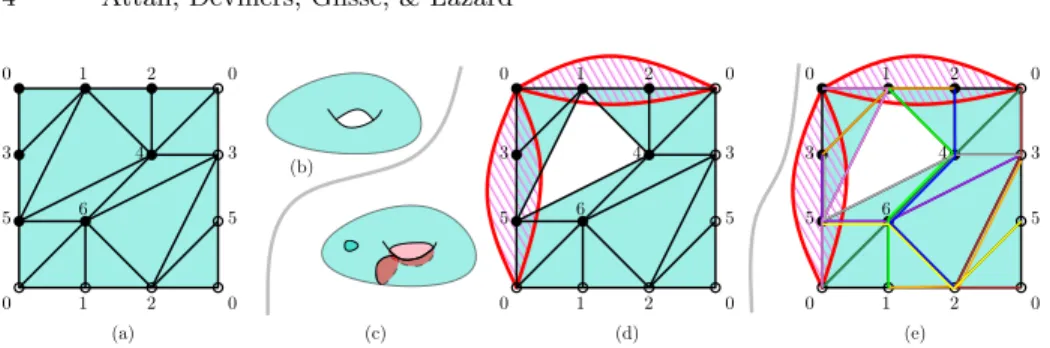
Fig. 1.(a) triangulation of the torus with 7 vertices, (d) a contractible non-shrinkable simplicial complex and (b,c) an embedding of their underlying spaces in R3
. (e) high-lights 8 blockers (015, 023, 123, 146, 246, 256, 345, 256) that suffice to cover all edges.
Note that one of the direction is straightforward: if σ is a blocker containing ab, then σ \ {a, b} ∈ Link (a) ∩ Link (b) but σ \ {a, b} 6∈ Link (ab).
As we contract shrinkable edges, blockers may appear or disappear and there-fore edges may become non-shrinkable or shrinkable. For instance, consider the simplicial complex L = {a, b, c, d, ab, bc, cd, da} whose edges form a 4-circuit and the cone K on L with apex w, that is, the set of simplices of the form {w} ∪ σ where σ ∈ L. The complex K does not contain any blocker and therefore all edges are shrinkable. Note however that the contraction of edge ab creates a blocker which disappears as we contract wa. Hence, as we simplify the complex, an edge that used to be shrinkable (or not) may change its status several times later on during the course of the simplification. Interestingly, the only blockers we need to consider in the paper are triangles.
3
A simple non-shrinkable contractible simplicial complex
To construct a contractible simplicial complex that is shrink-irreducible, we start with the triangulation of the torus with 7 vertices described in Fig. 1-(a,b) (Cs´asz´ar polyhedron). Notice that the vertices and edges of this triangulation form a complete graph. Thus, every triple of vertices forms a cycle in this graph, which may or may not bound a face.
We now modify the complex as follows. The idea is to add two triangles so that every (arbitrary) cycle on the modified torus is contractible and to remove a triangle so as to open the cavity; see Fig. 1-(c). Namely, we add triangles 012 and 035 and remove triangle 145; see Fig. 1-(d). The resulting complex is contractible because it is collapsible; indeed all edges and vertices inside the “square” and on the boundary of the (expanding) hole can be collapsed until the hole fills the entire square, then it only remains triangles 012 and 035, which can also be trivially collapsed into a single vertex.
To see that the resulting complex is shrink irreducible, note that every edge is incident to at most 3 triangles; indeed, every edge is incident to 2 triangles in the initial triangulation of the torus, and we only added two triangles, which
do not share edges. On the other hand, every edge belongs to exactly 5 cycles of length 3 since the graph is complete on 7 vertices. Hence, every edge belongs to at least 2 blockers, which implies that no edge is shrinkable, by Lemma 1.
4
NP-completeness of shrinkability
Theorem 1. Given an abstract simplicial complex of dimension 3 whose under-lying space is contractible, it is NP-complete to decide whether the complex can be reduced to a point by a sequence of admissible edge contractions.
The proof is given in this section by reduction from 3-SAT. We show that any Boolean formula in 3-conjunctive normal form (3CNF) can be transformed, in polynomial time, to a contractible 3-dimensional simplicial complex, such that a satisfying assignment exists if and only if the complex is shrinkable.
4.1 Gadgets design
In the following, the gadgets are defined as abstract simplicial complexes but, for clarity, we describe geometric realizations of these gadgets in R3
. Then the gadgets are assembled by identifying one triangle of one gadget with a triangle of another; this operation preserves the blockers and thus the unshrinkability of edges. A shrinkable edge remains shrinkable if it does not belong to the identified triangles or if it was shrinkable in both gadgets.
Forward gadget
Properties. The forward gadget has a special triangle with edges A, B, C such that A is the only shrinkable edge of the gadget and once A is contracted (thus identifying B and C) there is a sequence of shrinks that reduces the gadget to a single point.
Usage. By gluing the triangle ABC to a triangle of another construction, we enforce that A is contracted before B and C, thus preventing some sequences of shrinks.
Realization. Refer to Fig. 2. Start with four points a, b, x and y in convex posi-tion in R3
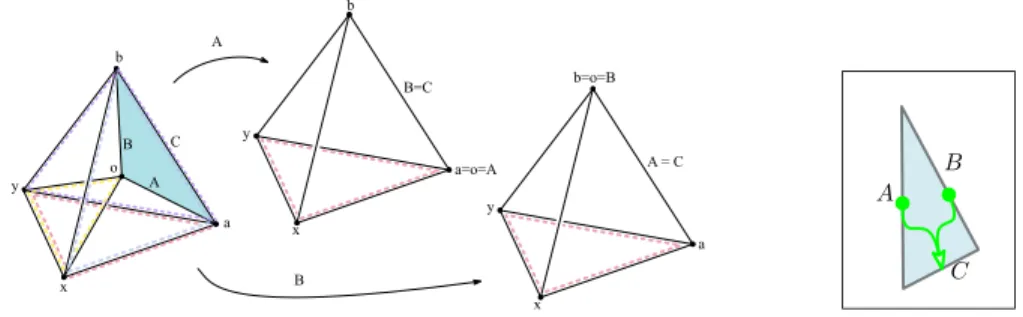
and consider the tetrahedron abxy. Split this tetrahedron in four by adding a point o in its interior. The result is a simplicial complex with 5 ver-tices, 10 edges, 10 triangles and 4 tetrahedra. We then remove the 4 tetrahedra, by applying four triangle collapses. The first three collapses dig a gallery start-ing at triangle axy by successively removstart-ing the pair of simplices (axy, axyo), (oxy, oxyb), (oxb, oxba). The fourth collapse removes the pair (ayb, oayb). The obtained simplicial complex has 5 vertices, 10 edges, 6 triangles: 2 triangles of the initial tetrahedron (axb and xyb) and 4 triangles incident to o (oab, oax, oay and oyb). Notice that as we collapse these pairs of simplices (σ, Σ), the triangle σ
6 Attali, Devillers, Glisse, & Lazard B A C b A o x y a B=C a=o=A B C A x y b
Fig. 2. Left: The forward gadget with triangle ABC in blue. Its 1-skeleton is the complete graph with vertices o, a, b, x and y and its (dotted) blockers axy, oxy, oxb, ayb are the triangles that have been collapsed. Middle: Contracting edge A produces a complex with a unique blocker, axy. Right: Schematic representation of the gadget.
becomes a blocker. Thus, the resulting simplicial complex has a unique blocker-free edge A = oa. Let B = ob and C = ab. If A is contracted, the resulting complex contains the triangles axb, xyb, oyb, thus any of the edges incident to b can be shrunk, which reduces the complex to a triangle, which is shrinkable. Freezer gadget
Properties. The freezer gadget has a special triangle with edges A, B, C such that A and B are the only shrinkable edges of the gadget, and once A or B is contracted (identifying the other with C), there is a sequence of shrinks that reduce the gadget to a single point.
Usage. By gluing the triangle ABC to a triangle of another construction, we enforce that C is non-shrinkable (or frozen) until either A or B is contracted; such a contraction identifies C with the uncontracted remaining edge (B or A). Realization. Refer to Fig. 3. We start with the same construction as for the for-ward gadget except that instead of collapsing the pair (oxb, oxba), we collapse the pair (xab, oxab). The list of blockers thus created is axy, oxy, xab, ayb, and the resulting complex contains only 1 triangle of the initial tetrahedron (xyb) and 5 triangles incident to o (oab, oax, oay, oyb and oxb). The result is a sim-plicial complex with exactly two blocker-free edges, A and B. Similarly as for
B A C A B B=C A = C a=o=A x a b y y o y x a x b b=o=B A B C
Fig. 3.The freezer gadget. Left: realization. Middle: contraction of edge A or B. Right: schematic representation.
B A B A X ¯ X L A L B L B A L B A L X ¯ X X ¯ X X ¯ X X ¯ X
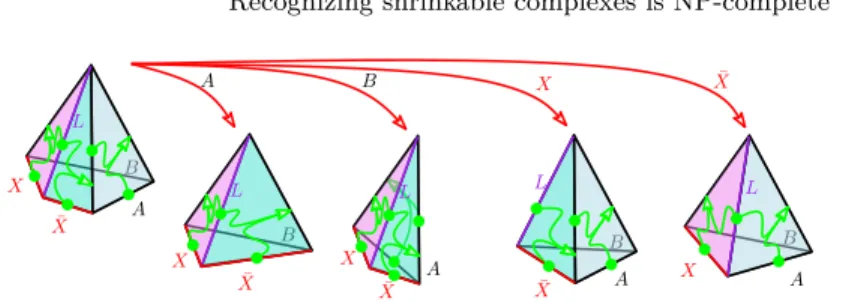
Fig. 4.The variable gadget: realization (left) and various edge contractions.
the forward gadget, once edge A or B is contracted, the resulting complex is shrinkable.
Variable gadget
Properties. The variable gadget associated to a variable x has three special edges: X, ¯X and L (lock). At the beginning X and ¯X are shrinkable edges. When X or
¯
X has been contracted, the other one is not shrinkable before L and there is a sequence of shrinks that reduces the gadget to a single point.
Usage. Given a truth assignment, true (resp. false), for variable x, the edge X (resp. ¯X) of the associated gadget is contracted before the other edge ¯X (resp. X). Gluing the lock edge to some key edges (see the clause gadgets), we ensure that once an assignment is chosen for the variable, the other edge, ¯X (resp. X), cannot be contracted unless all the keys needed to open the lock have been released (i.e. all the blockers passing through L have been removed).
Realization. Refer to Figure 4. We consider the four triangles of a squared-base pyramid. From a vertex of the base, X and ¯X are the incident edges on the base and L is the third incident edge on the pyramid. We glue three freezer gadgets onto three triangles incident to the apex, as shown in Figure 4, to ensure that the 3 edges that are incident to the apex and distinct from L are contracted after L, and that the edges on the base remain shrinkable. Contracting any edge on the base transforms the base into a blocker and L remains the only shrinkable edge, ensuring that L will be shrunk before one of X or ¯X.
Two-clause gadget
Properties. The two-clause gadget has three special edges: two literals V and W and a key K. We require that the key is not contracted before one of the two literals. Namely, at the beginning V and W are shrinkable edges and K is not shrinkable. K cannot be contracted before one of V or W and there are sequences of shrinks that contract any non-empty subset of {V, W } before K.
8 Attali, Devillers, Glisse, & Lazard K V A K=V K V W W W
Kcannot be contracted before V
K V W W K B K A V= W A K=V= W A B A′ A′ A′
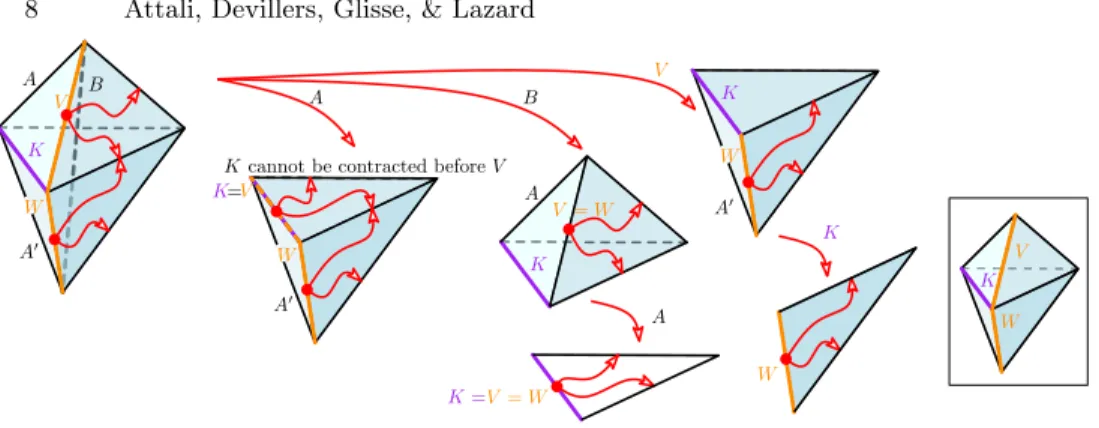
Fig. 5. The two-clause gadget. Left: realization. Middle: various edge contractions. Right: schematic representation.
Usage. Gluing the key edge to a lock edge of a variable gadget ensures that the lock will not be contracted before the key has been released (i.e. K has become shrinkable).
Realization. Consider a horizontal triangle and a vertical edge B that pierces it. Each of the triangle edges together with the piercing edge define a tetrahedron, and we consider the simplicial complex defined by these three tetrahedra; see Fig. 5. The initial triangle we considered is not part of this complex and is thus a blocker. We place K on the blocker and take for V and W the edges incident to an endpoint of K not in the blocker. Finally, we glue a forward gadget to the face incident to V but not to K and another one for W , symmetrically.
Let A (resp. A′) be the third edge of the triangle defined by edges V (resp.
W) and K, and recall that B is the central edge. The only edges that are initially shrinkable are A, A′, B, V , and W . Contracting A identifies V and K, ensuring
that K will not be contracted before V . Contracting A′is similar to contracting
A (exchanging V and W ). Contracting B identifies V and W , and yields a configuration where A= A′ and V = W are the only shrinkable edges; then
contracting A identifies V , W , and K ensuring that K will not be contracted before V nor W . Thus, K cannot be contracted (strictly) before one of V or W. Finally, we can contract V then K, which yields a forward gadget whose only contractible edge is W . Hence possible ordering to shrink V , W , and K are V W K, W V K, V KW , or W KV .
Three-clause gadget
Properties. The three-clause gadget has four special edges: three literals U , V , and W and a key K. We enforce that the key is not contracted before one of the three literals. Namely, at the beginning U , V , and W are shrinkable and K is not. K cannot be contracted before one of U , V , or W and there is a sequence of shrinks that contracts any non-empty subset of {U, V, W } before K.
K V W U V W U A K
Fig. 6.Left: two glued two-clause gadgets. Right: The three-clause gadget.
Realization. Refer to Fig. 6. The realization is done by sim-ple association of two two-clause gadgets, gluing the key of one clause on one literal of the other, as described in Fig. 6-left. We furthermore add the two tri-angles defined by KV and KW (note that the triangle KU al-ready belongs to the gadget).
These two extra triangles will be needed when gluing gadgets together. By con-struction, our two glued two-clause gadgets satisfies the properties we require for the three-clause gadgets. Adding the two triangles KV and KW does not invalidate these properties. Indeed, let A be the third edge of triangle KV ; the addition of A has created a blocker (in red in Fig. 6-right). Thus A cannot be contracted and it does not block the contraction of U , V , W , or K. Once V or K is contracted, A is identified with K or V and this extra triangle disappears. Thus, the gadget keeps its properties with these two additional triangles. 4.2 Wrap up
3-SAT and shrinkability. Given a 3CNF Boolean formula, we build a three-clause gadget per three-clause and a variable gadget per variable. The literal edge of each clause gadget is glued to the relevant edge of the variable gadget, that is, a literal x (resp. ¬x) is glued to the edge X (resp. ¯X) of the variable gadget associated to x. The lock edge of each variable gadget is glued to the key edge of each clause it appears in. We assume that the obtained complex is connected, otherwise the 3-SAT problem can be decomposed into independent subproblems, which can be solved separately.
Notice that a pair of edges key/literal forms a triangle in the three-clause gadget and that the pair of edges lock/X (or lock/ ¯X) also forms a triangle in the variable gadget. Thus, the third edges of these triangles are also glued. Actually, the effect of this construction is that the edges K and L of all gadgets are identified and become a single edge in the final complex. By construction, the complex is contractible since each gadget is contractible and we are gluing them by triangles that all have a common edge, K.
Our construction is 3 dimensional, thus it can be embedded in R7
using general position for the vertices.
From a truth assignment to a sequence of shrinks. For every variable, if it is assigned true (resp. false), edge X (resp. ¯X) is contracted in the associated gadget. These edges are identified to literal edges of the clause gadgets, so their contractions make edge K shrinkable from the point of view of all clause gadgets and K can thus be contracted. All edges corresponding to the other values of the variable gadgets become shrinkable and the complex can be contracted to a point.
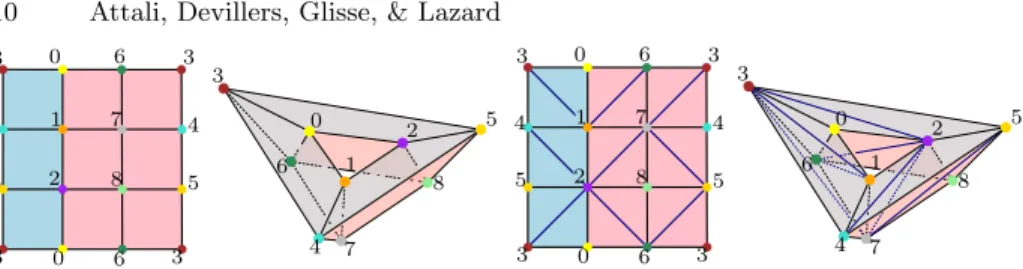
10 Attali, Devillers, Glisse, & Lazard 3 0 1 3 3 6 5 6 4 3 7 4 5 2 8 0 3 0 1 3 3 6 5 6 4 3 7 4 5 2 8 0 0 3 1 5 8 4 2 7 6 0 3 1 5 8 4 2 7 6
Fig. 7.Triangulation of a torus with 9 vertices. From left to right: the torus represented as a square with opposite edges identified and its embedding in R3
as a polyhedron with 9 trapezoidal faces; a non-shrinkable triangulation; and its embedding.
From a sequence of shrinks to a truth assignment. For every variable gadget, if edge X (resp. ¯X) is contracted before ¯X (resp. X), we assign true (resp. false) to the variable associated to the gadget. All clauses are satisfied by this assignment since K cannot be contracted before all clause gadgets have one of their literal edge contracted.
5
A non-shrinkable Bing’s house
In this section, we construct a contractible simplicial complex which is irre-ducible, both for shrinks and for collapses.5
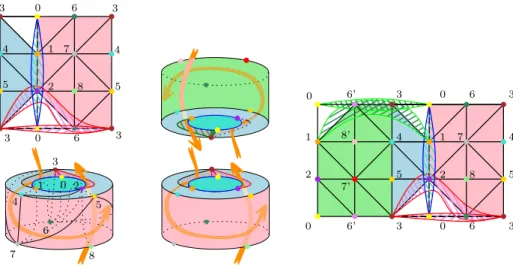
The idea is to triangulate carefully Bing’s house, in such a way that no edge is shrinkable. Bing’s house has two rooms, one above the other. The only access to the upper room is through an underground tunnel that passes through the lower room and the only access to the lower room is through a chimney that passes through the upper room; see Fig. 9-middle.
To triangulate the lower room (and the tunnel), we start with a triangulation of the torus with 9 vertices presented in Fig. 7. We now proceed to two successive alterations of the complex; see Fig. 8. First, we create a room inside the torus, by adding the two (pink hashed) triangles: 036 and 236 and removing triangle 013; the two added triangles delimit the room inside the torus and the removed triangle provides access to the room from outside. We then build a tunnel through the middle of the room by removing two triangles: 023 and 026 and by adding the (blue hashed) triangle 012.
To see that the resulting complex is shrink-irreducible, notice that the trian-gulation of the torus is shrink-irreducible to start with. During the modification, the only way an edge may become non-shrinkable is if there are more triangles incident to that edge that are added than the ones that are removed. The only edges that fulfill that condition are 36 and 12 and one can check that they are still covered by blockers at the end: 361 and 123 respectively. Similarly, one can check that the room has only three collapsible edges, namely 02, 03 and 13, all lying on the roof. Indeed, no edges are collapsible in the initial triangulation of
5
0 3 1 5 8 4 2 7 6
=
S S 0 3 2 8 7 6 3 5 2 1 1 0 3 5 4 4 7 6 8Fig. 8.Triangulation of the lower room and underground tunnel using 18 triangles: 5 (blue) triangles are coplanar and form the roof, 7 triangles (5 pink and 2 hashed) bound the tunnel under the roof and 6 (pink) triangles lie on the outer walls of the room. The arrow indicates a passage through the tunnel from the underground entrance 678 to the roof exit 023. The red loops indicate the 3 triangles removed from the torus.
the torus and an edge is collapsible in the final complex if and only if the number of added triangles incident to that edge is one less than the number of removed triangles. The only edges with this property are 02, 03 and 13.
To finish our construction of Bing’s house, we consider a copy of the lower room, which we place above the original one; see Fig. 9. Renaming vertices x by x′in the copy, this boils down to the following identifications: vertices 0 with 0’,
1 with 2’, 2 with 1’, 3 with 3’, 4 with 5’ and 5 with 4’. The result is a simplicial complex with 12 vertices which is still shrink-irreducible but in which no edge is collapsible anymore; see Fig. 9.
AcknowledgementsThis work was initiated during the 12th
INRIA–McGill–Victoria Workshop on Computational Geometry at the Bellairs Research Institute. The authors
wish to thank all the participants for creating a pleasant and stimulating atmosphere. The authors thank Uli Wagner for fruitful discussions and interesting references.
7 8 8 0 0 0 1 1 2 4 5 8’ 7’ 7 3 3 6’ 6’ 6 4 5 2 3 0 3 8 0 1 4 5 7 3 6 3 4 5 2 3 0 3 6 6 4 1 3 5 2 0 6
Fig. 9.Building the Bing’s house. Left: triangulation of the lower room and schematic representation. Middle: the two rooms one above the other with the four arrows repre-senting the way through the underground tunnel to the upper room and through the chimney to the lower room. Right. Triangulation of Bing’s house.
12 Attali, Devillers, Glisse, & Lazard
References
1. D. Attali, A. Lieutier, and D. Salinas. Vietoris-Rips complexes also provide topolog-ically correct reconstructions of sampled shapes. Computational Geometry: Theory
and Applications, 46:448–465, 2012. doi.
2. ——. Collapsing Rips complexes. In EuroCG’13, 2013. url.
3. D.W. Barnette and Allan Edelson. All orientable 2-manifolds have finitely many minimal triangulations. Israel Journal of Mathematics, 62(1):90–98, 1988. doi. 4. ——. All 2-manifolds have finitely many minimal triangulations. Israel Journal of
Mathematics, 67(1):123–128, 1989. doi.
5. R. H. Bing. Some Aspects of the Topology of 3-Manifolds Related to the Poincar´e Conjecture. In Lectures on Modern Mathematics, Vol. II. Wiley, New York, 1964. 6. G. Carlsson and V. de Silva. Topological approximation by small simplicial
com-plexes. Technical report, Mischaikow, and T. Wanner, 2003. url.
7. G. Carlsson, T. Ishkhanov, V. De Silva, and A. Zomorodian. On the local behavior of spaces of natural images. Int. J. of Computer Vision, 76(1):1–12, 2008. doi. 8. F. Chazal, D. Cohen-Steiner, and A. Lieutier. A sampling theory for compact sets
in Euclidean space. Discrete & Computational Geometry, 41(3):461–479, 2009.doi. 9. M.M. Cohen. A course in simple-homotopy theory. Springer-Verlag, 1973.
Grad-uate Texts in Mathematics, Vol. 10. doi.
10. Vin De Silva. A weak characterisation of the Delaunay triangulation. Geometriae
Dedicata, 135(1):39–64, 2008. doi.
11. Vin De Silva and Gunnar Carlsson. Topological estimation using witness com-plexes. In Proceedings of the First Eurographics conference on Point-Based
Graph-ics, 157–166. Eurographics Association, 2004. doi.
12. T.K. Dey, H. Edelsbrunner, S. Guha, and D.V. Nekhayev. Topology preserving edge contraction. Publ. Inst. Math. (Beograd) (N.S.), 66:23–45, 1999. url.
13. Richard Ehrenborg and G´abor Hetyei. The topology of the independence complex.
European Journal of Combinatorics, 27(6):906–923, 2006. doi.
14. Michael Garland and Paul S Heckbert. Surface simplification using quadric error metrics. In SIGGRAPH’97 proc., 209–216, 1997. doi.
15. Xavier Goaoc. Transversal Helly numbers, pinning theorems and projections of simplicial complexes. Habilitation thesis, Universit´e Nancy 1, 2011. url.
16. Hugues Hoppe. Progressive meshes. In SIGGRAPH’96 proc., 99–108, 1996. doi. 17. Serge Lawrencenko. Irreducible triangulations of the torus. Journal of
Mathemat-ical Sciences, 51:2537–2543, 1990. url.
18. Sergey Melikhov. Combinatorics of embeddings. Research Report arXiv, 2011.url. 19. Eran Nevo. Higher minors and Van Kampen’s obstruction. Mathematica
Scandi-navica, 101(2):161–176, 2006. url.
20. P. Niyogi, S. Smale, and S. Weinberger. Finding the Homology of Submanifolds with High Confidence from Random Samples. Discrete & Computational Geometry, 39(1-3):419–441, 2008. doi.
21. Jovan Popovi´c and Hugues Hoppe. Progressive simplicial complexes. In
SIG-GRAPH’97 proc., 217–224, 1997. doi.
22. Thom Sulanke. Irreducible triangulations of low genus surfaces. Research Report arXiv, 2006. url.
23. Martin Tancer. Recognition of collapsible complexes is NP-complete. Research Report arXiv, 2012. url.
24. IA Volodin, VE Kuznetsov, and Anatoly Timofeevich Fomenko. The problem of discriminating algorithmically the standard three-dimensional sphere. Russian
For the final version, we will make this material available on a web page.
If you want to build the non-shrinkable Bing’s house with two rooms, you can print the following pages (A4 format yields to a Bing’s house of about 10 cm) on some reasonably rigid paper or cardboard. Fold it convex on the solid black lines, concave on the dashed black lines, and glue the parts with the same label together:
A A B B C C Glue both edges with label C together
A’
A’ B’
B’
C’ Glue both edges with label C’ together