HAL Id: hal-00661890
https://hal.archives-ouvertes.fr/hal-00661890
Submitted on 20 Jan 2012
HAL is a multi-disciplinary open access
archive for the deposit and dissemination of
sci-entific research documents, whether they are
pub-lished or not. The documents may come from
teaching and research institutions in France or
abroad, or from public or private research centers.
L’archive ouverte pluridisciplinaire HAL, est
destinée au dépôt et à la diffusion de documents
scientifiques de niveau recherche, publiés ou non,
émanant des établissements d’enseignement et de
recherche français ou étrangers, des laboratoires
publics ou privés.
Jean-Michel Hufflen
To cite this version:
Jean-Michel Hufflen. Multidirectional Typesetting in XSL-FO. BachoTeX 2009 Conference, 2009,
Poland. pp.37–40. �hal-00661890�
Jean-Michel HUFFLEN
LIFC (EA CNRS 4157) University of Franche-Comté 16, route de Gray 25030 BESANÇON CEDEX FRANCE [email protected] http://lifc.univ-fcomte.fr/home/~jmhufflen Abstractxsl-fo texts use an xml-like syntax that aim to describe high-quality print
out-puts. This article complements the introduction to xsl-fo EuroBachoTEX 2007. We show how xsl-fo allows users to typeset texts belonging to different writing systems: from left to right, from right to left, . . . We compare this implementation to TEX-like typeset engines, e.g., X E TEX.
Keywords multidirectional typesetting, Unicode, X E TEX.
Streszczenie
xsl-fo są tekstami xmlowymi, których celem jest opisywanie wydruków o
wy-sokiej jakości. Niniejszy artykuł jest uzupełnieniem wprowadzenia do xsl-fo przeprowadzonego na konferencji EuroBachoTEX 2007. Pokażemy, jak xsl-fo pozwalają użytkownikowi składać teksty w różnych systemach pisma: z lewej do prawej, z prawej do lewej, . . . Porównamy tę implementację do maszyn TEXowych takich jak np. X E TEX.
Słowa kluczowe drukowanie wielokierunkowe, Unicode, X E TEX.
0 Introduction
This article continues the introduction to xsl-fo1
given in [7]. Let us recall that this language aims
to describe high-quality print outputs using xml2
syntax. Reading this article requires basic knowl-edge of xsl-fo, as introduced in [7], and of Unicode [12]. More complete introductions to xsl-fo’s gen-eral features are [1, 9, 10], the official document be-ing [15]. At first glance, texts written usbe-ing xsl-fo may seem to be very verbose, but let us recall that this language is not devoted to direct use. The ‘nor-mal’ way to build an xsl-fo text is to get it as an
output file of xslt3
, the language of transformations
used for xml texts4
. We demonstrated this point in [7, § 2], but do not use it in the present article.
∗Title in Polish: Skład wielokierunkowy w xsl-fo. 1
eXtensible Stylesheet Language — Formatting Objects.
2
eXtensible Markup Language. Readers interested in a general introductory book to this formalism can refer to [11].
3
eXtensible Stylesheet Language Transformations.
4
Besides, some xsl-fo processors — e.g., Apache fop [2] — allow users to join transformations performed by means of xslt and typesetting xsl-fo texts. But they are still based on xslt’s ‘old’ version (1.0) [14], introduced in [5, 6].
Here we focus about multidirectional typeset-ting in xsl-fo and explain the principles guiding
it. Let us recall that some natural languages —
e.g., Hebrew and Arabic — are typeset from right to left, some — e.g., traditional Japanese — uses
verti-cal writing. Our demonstrations5
will be performed
by using Apache fop6
[2], which yields pdf7
or png8
figures.
1 Layout and writing mode
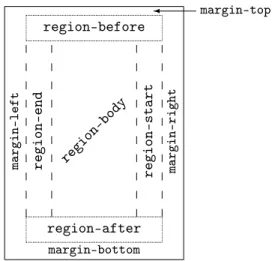
Let us consider the xsl-fo text given in Figure 1. The layout, given by the fo:simple-page-master element, defines a paper format and its margins, where anything cannot be printed. It also defines regions, as shown in Figure 2. The localisation of pages’ margins is physical, that is, the top mar-gin will be always. . . at the top of the page, the bottom one will be always at the bottom, and so
5
Passive TEX [3] is a TEX-based engine that may be used as an xsl-fo processor, but it does not provide multidimen-sional typesetting.
6F
ormatting Objects Processor.
7P
ortable Document Format.
<?xml version="1.0" encoding="ISO-8859-2"?>
<fo:root xmlns:fo="http://www.w3.org/1999/XSL/Format"> <fo:layout-master-set>
<fo:simple-page-master master-name="page-simple" page-height="297mm" page-width="210mm" margin-top="10mm" margin-bottom="20mm" margin-left="25mm" margin-right="25mm" writing-mode="lr-tb">
<fo:region-body margin-top="20mm" margin-left="20mm" margin-right="20mm"/> <fo:region-before extent="20mm"/>
<fo:region-after extent="20mm"/>
<fo:region-start extent="15mm" reference-orientation="90"/> <fo:region-end extent="15mm"/>
</fo:simple-page-master> </fo:layout-master-set>
<fo:page-sequence master-reference="page-simple" font-family="serif" font-size="18pt" text-align="left" xml:lang="po">
<fo:static-content flow-name="xsl-region-before">
<fo:block text-align="center" font-size="10pt">Pieśń ludowa z opolskiego</fo:block> </fo:static-content>
<fo:static-content flow-name="xsl-region-start">
<fo:block text-align="center" font-size="10pt">III Symfonia</fo:block> </fo:static-content>
<fo:flow flow-name="xsl-region-body">
<fo:block>Ej, ćwierkejcie mu tam,</fo:block> <fo:block>wty ptosecki boze,</fo:block> <fo:block>kiedy mamulicka</fo:block> <fo:block>znaleźć go nie moze.</fo:block>
<fo:block start-indent="10pt">A ty, boze kwiecie,</fo:block> <fo:block start-indent="10pt">kwitnijze w około,</fo:block> <fo:block start-indent="10pt">niech się synockowi</fo:block> <fo:block start-indent="10pt">choć lezy wesolo.</fo:block> </fo:flow>
</fo:page-sequence> </fo:root>
Figure 1: Henryk Mikołaj Górecki’s 3rd Symphony, 3rd movement, last stanza.
on. On the contrary, regions’ placement depend on a writing mode. This information specifies two di-rections: the first is the inline-progression-direction, which determines the direction in which words will be placed, and the second is the block-progression-direction, which determines the direction in which blocks and lines are placed one after another. This information is expressed within the page model by means of a writing-mode attribute, that can be set to:
lr-tb for ‘left-to-right, top-to-bottom’ (the default
value), suitable for languages such as English, Polish, etc.;
rl-tb for ‘right-to-left, top-to-bottom’, suitable for
languages such as Hebrew and Arabic;
tb-rl for ‘top-to-bottom, right-to-left’, suitable for
traditional Japanese;
lr-alternating-rl-tb inline components within
the first line are stacked left-to-right, within the second line they are stacked right-to-left, continuing in alternation; lines and blocks are
stacked top-to-bottom9
;
lr-alternating-rl-bt like the previous value, but
lines and blocks are stacked bottom-to-top10
;
lr-inverting-rl-bt like the previous value, but
in addition, inline components within even lines
are inverted11
; 9
This writing system is called boustrophedon: from Greek etymology, that means ‘turning like oxen in ploughing’. Some archaic Greek inscriptions used this system.
10
Some pre-Columbian scripts in Classical Quechuan — the Inca Empire’s language — used this system.
11This reverse boustrophedon was discovered in some
margin-bottom region-after region-before margin-left region-start region-body region-end margin-right ✛ margin-top
Figure 2: A page’s regions for lr-tb writing mode.
tb-lr-in-lr-pairs text is written in
two-charac-ter, left-to-right, pairs; these pairs are then stacked top-to-bottom to form a line; lines and
blocks are stacked left-to-right12
.
Other analogous values are13
:
tb-lr14 bt-lr bt-rl lr-bt rl-bt
lr-inverting-rl-tb
rl, tb are shorthands for lr-tb, rl-tb, tb-rl. In regions, something can be printed as a static
content— e.g., a page number — or a flow — for a
text possibly printed on regions belonging to sev-eral successive pages. Regions’ names do not ex-press ‘geographical’ directions, such as ‘top’ or ‘bot-tom’, but come from a relative frame reference
de-pending on a writing mode15
. The ‘before’ and ‘af-ter’ (resp. ‘start’ and ‘end’) regions are always re-lated to the block-progression-direction (resp. inline-12This writing system was used by the pre-Columbian
Mayan language.
13
Readers interested in the history of writing systems can refer to [4], written in French but very clear and providing many examples.
14This writing system was used by some old Mongolian
scripts.
15
In addition, the declaration order for the elements mod-elling these regions is fo:region-body, fo:region-before, fo:region-after, fo:region-start, fo:region-end; all but but the first being optional. [7, Fig. 2] was correctly pro-cessed by some xsl-fo processors’ previous versions that were lazy about this point, but that is faultly. The correct order is given in Figure 1. In addition, let us mention that the body’s margins are specified ‘geographically’, by means of the attributes margin-top, margin-bottom, margin-left, and margin-right. Do not confuse body’s margins with pages’: there is no overlapping between pages’ margins and pages’s re-gions. Last, let us notice that if you do not define body’s mar-gins, the region-before, region-after, region-start and region-endwill overlap the region-body.
margin-bottom
region-after region-before
margin-left region-end region-body region-start margin-right
✛ margin-top
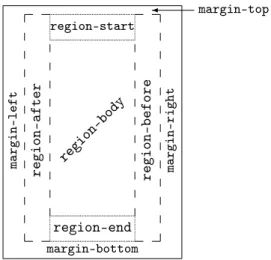
Figure 3: A page’s regions for rl-tb writing mode.
progression-direction). A writing-mode attribute set to "lr-tb" yields to what is pictured in ure 2. Other region placements are given in Fig-ures 3 & 4 for rl-tb and tb-rl writing modes. If the writing mode specifies an inline-progression-direction of left-to-right for odd-numbered lines, and right-to-left for even-numbered lines — that is, when the writing mode is ‘lr-alternating-rl-...’ or ‘lr-inverting-rl-...’ — the region-start (resp. region-end) is located at the left (resp. right). If the writing mode is tb-lr-in-lr-pairs, the place-ment rules are the same than for tb-lr.
In fact, the definitive placement of regions re-sults from a combination of a writing mode with a
reference-orientationattribute, which is an
an-gle whose value is given in degrees and defaults to zero. More detailed examples can be found in [10, Fig. 3.4]. Each region can define its own writing mode and reference orientation, otherwise these at-tributes are inherited from parent elements, as done usually in xsl-fo. As an example, we define such a reference orientation in Figure 1 for the ‘start’ re-gion, the result is pictured in Figure 5.
2 Present and future
As mentioned in [15, §§ 1.2.5 & 5.8], an xsl-fo pro-cessor must implement the Unicode bidirectional al-gorithm [13]. Let us recall that this alal-gorithm only applies to paragraphs, that is, blocks w.r.t. xsl-fo’s terminology. In addition, this algorithm requires some adaptations to fit into the xsl-fo process-ing model. The inline-progression-direction is de-termined at the block level by the writing mode — possibly refined by means of a fo:block-container
margin-bottom region-end region-start margin-left region-after region-body region-before margin-right ✛ margin-top
Figure 4: A page’s regions for tb-rl writing mode.
element [15, § 6.5.3] — and within the inline format-ting objects within a block — by refining the writ-ing mode of a fo:inline-container element [15, § 6.6.8] or by means of the attributes direction and
unicode-bidiassociated with a fo:bidi-override
element [15, § 6.6.2]. Character properties, as they are defined by the standard Unicode [12], are implicit or may be refined by means of the fo:character el-ement [15, § 6.6.3]. The inline-progression-direction
of each glyph16
is used to control the stacking of glyphs.
To sum up, xsl-fo bidirectional algorithm is not controlled by functionalities related to precise natural languages, as did in X E TEX [8] — by means of natural-language-oriented environments such as
araband urdu — but is superseded by informations
about writing modes.
At the time of writing, this algorithm is not fully implemented yet by xsl-fo processors. Be-sides, most processors difficultly deal with non-Latin characters. However, some interesting effects can be observed by using the attributes writing-mode and direction, even on texts writing using the Latin alphabet. As two additional examples:
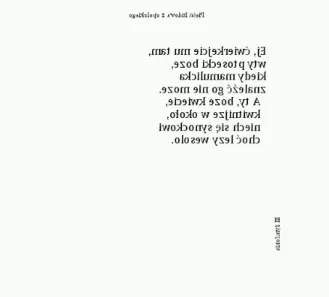
• the source text of Figure 6 is obtained from Fig-ure 1’s text by changing the writing-mode at-tribute of the fo:root element to "rl-tb"; • the source text of Figure 7 is obtained from
Fig-ure 1’s text by applying the following changes:
– the writing-mode attribute of the root
el-ement, fo:root, is set to "tb-rl"; 16See [12] for more details about Unicode’s terminology.
Figure 5: The formatted output of Fig. 1.
– the font size used for the start-region’s
contents has become smaller: <fo:block text-align="center"
font-size="9pt"> III Symfonia
</fo:block>
– the second fo:block element is replaced
by:
<fo:block-container writing-mode="rl-tb">
<fo:block text-align="right"> wty ptosecki boze,
</fo:block>
</fo:block-container>
More examples will be demonstrated at the Ba-choTEX 2009 conference.
3 Acknowledgements
Many thanks to Jerzy B. Ludwichowski, who has translated the abstract and keywords in Polish very quickly.
Figure 6: Formatting a text in tb-rl writing mode (page’s upper part).
References
[1] Bernd Amman et Philippe Rigaux : Comprendre xslt. Éditions O’Reilly France. Février 2002.
Figure 7: Formatting a text in tb-rl writing mode (page’s upper part).
[2] Apache fop. March 2009. http://xmlgraphics. apache.org/fop/.
[3] David Carlisle, Michel Goossens and Sebas-tian Rahtz: “De xml à pdf avec xmltex, xslt et PassiveTEX”. Cahiers GUTenberg, Vol. 35–36, pp. 79–114. In Actes du congrès GUTenberg 2000, Toulouse. May 2000.
[4] James G. Février : Histoire de l’écriture. 2e
édi-tion. Payot. 1984.
[5] Jean-Michel Hufflen: “Introduction to xslt”. Bi-uletyn gust, Vol. 22, pp. 64. In BachoTEX 2005 conference. April 2005.
[6] Jean-Michel Hufflen: “Advanced Techniques in xslt”. Biuletyn gust, Vol. 23, pp. 69–75. In Ba-choTEX 2006 conference. April 2006.
[7] Jean-Michel Hufflen: “Introducing LATEX users to
xsl-fo”. tugboat, Vol. 29, no. 1, pp. 118–124. Eu-roBachoTEX 2007 proceedings. 2007.
[8] Jonathan Kew: “X E TEX in TEX Live and beyond”. tugboat, Vol. 29, no. 1, pp. 146–150. EuroBa-choTEX 2007 proceedings. 2007.
[9] Manuel Montero Pineda und Manfred Krüger: xsl-fo in der Praxis. xml-Verarbeitung für pdf und Druck. 2004.
[10] Dave Pawson: xsl-fo. O’Reilly & Associates, Inc. August 2002.
[11] Erik T. Ray: Learning xml. O’Reilly & Associates, Inc. January 2001.
[12] The Unicode Consortium: The Unicode Stan-dard Version 5.0. Addison-Wesley. November 2006. [13] The Unicode Consortium, http://unicode. org/reports/tr9/: Unicode Bidirectional Algo-rithm. Unicode Standard Annex #9. March 2008. [14] W3C: xsl Transformations ( xslt). Version 1.0.
w3c Recommendation. Edited by James Clark. November 1999. http://www.w3.org/TR/1999/ REC-xslt-19991116.
[15] W3C: Extensible Stylesheet Language ( xsl). Ver-sion 1.1. w3c Recommendation. Edited by An-ders Berglund. December 2006. http://www.w3. org/TR/2006/REC-xsl11-20061205/.