Coordinated Motion Design on Lie Groups
Alain Sarlette, Member, IEEE, Silvère Bonnabel, and Rodolphe Sepulchre, Senior Member, IEEE
Abstract—The present paper proposes a unified geometric framework for coordinated motion on Lie groups. It first gives a general problem formulation and analyzes ensuing conditions for coordinated motion. Then, it introduces a precise method to design control laws in fully actuated and underactuated settings with simple integrator dynamics. It thereby shows that coordination can be studied in a systematic way once the Lie group geometry of the configuration space is well characterized. Applying the proposed general methodology to particular examples allows to retrieve control laws that have been proposed in the literature on intuitive grounds. A link with Brockett’s double bracket flows is also made. The concepts are illustrated on (3), (2) and
(3).
Index Terms—Cooperative systems, distributed control, motion planning, Lie groups, geometric control.
I. INTRODUCTION
R
ECENTLY, many efforts have been devoted to the design and analysis of control laws that coordinate swarms of identical autonomous agents—e.g., oscillator synchronization [1], [2], flocking mechanisms [3], [4], vehicle formations [5]–[9], spacecraft formations [10]–[15], mechanical system networks [16]–[18] and mobile sensor networks [19]–[23]. For systems on vector spaces, so-called consensus algorithms are shown to be efficient and robust [3], [24]–[28], and allow to address many relevant engineering issues and tasks [5], [24], [29]. However, in many applications, the agents to coordinate evolve on nonlinear manifolds: oscillators evolve on the circle , satellite attitudes on and vehicles movein or ; these particular manifolds share the
geometric structure of a Lie group. Coordination on nonlinear manifolds is inherently more difficult than on vector spaces [46]. The goal of the present paper is to propose a unified geometric framework for coordinated motion on Lie groups, from a geometric definition of “coordination” to a geometric derivation of control laws for coordination like those proposed in [19]–[21], [30]–[32], in fully actuated and underactuated settings with simple integrator dynamics. The objective is to reach a state where the motion of the agents is coordinated, Manuscript received July 28, 2008; revised April 01, 2009. First published February 02, 2010; current version published May 12, 2010. This work was sup-ported by the Belgian Network Dynamical Systems, Control, and Optimization (DYSCO), funded by the Interuniversity Attraction Poles Programme, initiated by the Belgian State, Science Policy Office, and A. Sarlette is supported as an FNRS Fellow (Belgian Fund for Scientific Research). Recommended by Asso-ciate Editor Z. Qu.
A. Sarlette and R. Sepulchre are with the Department of Electrical En-gineering and Computer Science, Université de Liège, Belgium (e-mail: [email protected]; [email protected]).
S. Bonnabel was with Department of Electrical Engineering and Computer Science, Université de Liège, Belgium. He is now with Mines ParisTech, Paris, France (e-mail: [email protected]).
Color versions of one or more of the figures in this paper are available online at http://ieeexplore.ieee.org.
Digital Object Identifier 10.1109/TAC.2010.2042003
while the values of their relative positions are a priori left arbitrary; definitions of “coordinated motion” and “relative positions” on a Lie group are the subject of Section II.
Symmetries: The key point for the developments in this
paper is invariance (or symmetry) in the behavior of the swarm of agents with respect to their absolute position on the Lie group: only relative positions (on the Lie group) matter. For instance, the configuration of a rigid body in the 3-D physical world is given by an orientation and a position vector in , whose com-bination corresponds to a position on Lie group . For rigid body coordination, it is then natural to write control laws that can be interpreted as internal forces in the swarm, rather than forces depending on an external reference frame which would privilegiate some arbitrary choice of orientation and origin. In-dependence with respect to reference frame corresponds to in-variance with respect to applying to all agents the same Lie group translation on .
The symmetries determine how to define meaningful quanti-ties for the swarm, like “relative positions” on the Lie group, and what the dynamics of the coupled agents can be. Coordinated
mo-tion—in short coordination—is defined as all situations where
relative positions on the Lie group are fixed. Feedback control laws that asymptotically enforce coordination must be designed on the basis of error measurements involving appropriately in-variant quantities (e.g., relative agent positions on the Lie group).
Previous Work: Results about synchronization (“reaching
a common point”) and coordinated motion (“moving in an or-ganized way”) on vector spaces are becoming well established [24], [26]–[28]. Because a vector space can be identified with its tangent plane, both synchronization and coordinated motion can be seen as consensus problems on the same vector space: the former is a position consensus while the latter is a velocity con-sensus. Note that considering the motion of agents with the Lie
group structure of implies that only position vectors in and associated translational motion are covered. In contrast, as soon as orientation/rotation of the vehicles or of the formation moving in a vector space is considered, the configuration space becomes the non-trivial Lie group . In general, when the configuration space is a Lie group, synchronization and coordi-nated motion are fundamentally different. The geometric view-point for dynamical systems on Lie groups is very well studied; see basic results in [33], [34] for simplified dynamics like those considered in the present paper, and [34]–[37] for a geometric theory of mechanical systems on Lie groups. General results for synchronization on compact Lie groups are proposed in [38], which points to related examples in the literature. But to the best of the authors’ knowledge, a unified geometric viewpoint for
co-ordinated motion—in short coordination—on Lie groups is still
lacking. Close to the present paper in its geometric flavor, [39] builds invariant observers for systems with Lie group symme-tries; observer design can be seen as two-agent leader-follower synchronization.
In applications, the ubiquitous example of motion on Lie groups is a rigid body in . When translational motion is discarded, the configuration space reduces to the compact Lie group characterizing the body’s orientation; an element
of can be represented by the rotation matrix
between a frame attached to the rigid body and a hypothet-ical fixed reference frame. The standard example of this type is satellite attitude control, where synchronization, i.e., ob-taining equal orientations, has recently attracted much attention [10]–[13], [15], [18], [31], [40]–[43], with and without external reference tracking; note that synchronization is a very special case of coordination. Considering rotations and translations, the configuration space of an -dimensional rigid body
be-comes the non-compact Lie group .
Recently, coordinated motion has been investigated on [8], [20], [21] and [9], [16], [17], [19] in the underactu-ated setting of steering control where the linear velocity is fixed in the body’s frame. Motion on with steering control is also directly linked to the evolution of a Serret-Frenet frame with curvature control, as explained in [33]. Results taking into account the full mechanical dynamics for rigid body motion are more difficult to obtain—see for instance applications of the framework of [35] for coordination on and in [18], [43] and [16], [17] respectively. Considering simplified dynamics, as in the present paper, can be useful either to build a high-level planning controller or as a preliminary step towards an integrated mechanical controller, as illustrated for synchronization on in [31] and [32], [44] respectively.
Contributions: The main goal of the present paper is to
pro-vide a unified geometric framework for coordinated motion on Lie groups, proceeding as follows. (i) Coordination on Lie groups is defined from first principles of symmetry, distinguishing three variants: left-invariant, right-invariant and biinvariant coordina-tion. (ii) Expressing the conditions for coordination in the associ-ated Lie algebra, a direct link is drawn between coordination on Lie groups and consensus in vector spaces. (iii) It is investigated how biinvariant coordination restricts compatible relative posi-tions through a geometrically meaningful relation. These prop-erties are independent of the dynamics. Going over to control laws, simplified first-order dynamics are assumed for individual agents, but underactuation is explicitly modeled; communica-tion among agents is restricted to a reduced set of links that can possibly be directed and time-varying. (iv) Control laws based on standard vector space consensus algorithms are given that achieve the easier tasks of right-invariant coordination and fully actuated left-invariant coordination for any initial condition on general Lie groups. (v) A general method is proposed to design control laws that achieve biinvariant coordination of fully actu-ated agents when communication links are undirected and fixed; extension to more general communication settings can be made along the lines of [21]. Biinvariant coordination is a rather aca-demic problem, but (vi) the proposed design method is shown to apply to the practically most relevant problem of left-invariant coordination of underactuated agents. The proposed controller ar-chitecture consistsof two steps, adding to the consensus algorithm a position controller derived from geometric Lyapunov functions. The position controllers are directly linked to the double bracket flows of [45] for gradient systems on adjoint orbits.
The power of the geometry is illustrated on , and by analyzing the meaning of the geometric condi-tions for coordination, and by designing corresponding control laws with the proposed general methodology. The obtained con-trollers have been previously proposed in the literature, but were derived on the basis of intuitive arguments for particular appli-cations. In that sense, the novelty of the present paper is not in the expression of the control laws but in showing that they can be derived in a unifying and systematic manner with the proper geometric setting.
The present paper focuses on the achievement of coordinated
motion only, in the sense that the objective is for the swarm to
move and conserve relative positions on the Lie group; the ac-tual values of the relative positions on the Lie group, as long as they are compatible with the coordinated motion, are not con-trolled. However, applications often require to stabilize partic-ular relative positions on the Lie group which are more efficient than others e.g., for sensing, power consumption or at least col-lision avoidance. The focus of the present work—motion with fixed relative positions on the Lie group—can be viewed as “or-thogonal” to driving the agents towards particular relative posi-tions on the Lie group. Therefore it is expected that the results of the present work can be combined with appropriately invariant relative position control algorithms on the Lie group (as e.g., from [38]), in order to both reach a particular configuration of relative positions on the Lie group and stabilize a coordinated motion of the resulting configuration. A corresponding result is proposed in [20] for steering control of planar vehicles (Lie group ); remaining issues concerning a general theory for this combination are discussed in [46].
Table of Contents: The paper is organized as follows.
Sec-tion II examines the geometric properties of coordinaSec-tion on Lie groups (contributions (i), (ii), and (iii)). Section III presents the control setting and basic control laws for right-invariant coordi-nation and fully actuated left-invariant coordicoordi-nation (contribution (iv)). Sections IV and V present control law design methods re-spectively for biinvariant coordination [contribution (v)] and for underactuated left-invariant coordination [contribution (vi)]. Ex-amples are treated at the ends of Section II, Sections IV and V.
II. THEGEOMETRY OFCOORDINATION
This section proposes definitions for coordination on Lie groups by starting from basic symmetry principles. It estab-lishes conditions on velocities for coordination and examines implications. Except that the symmetries must be compatible, these developments are independent of the dynamics consid-ered for the control problem. Notations are adapted from [34].
A. Relative Positions and Coordination
Consider “agents” evolving on a Lie group , with denoting the position of agent at time . Let denote the group inverse of , denote left multiplication,
and right multiplication on .
Definition 1: The left-invariant relative position on
of agent with respect to agent is . The
right-invariant relative position on of with respect to is .
Indeed, (resp. ) is invariant under left (resp. right)
multiplication: .
Left-/right-in-variant relative positions are the joint inLeft-/right-in-variants associated to
left-/right-invariant action of on ( copies).
In the following, “relative positions” always refer to relative po-sitions on unless otherwise specified.
The two definitions of relative position lead to two types of coordination; a third type is defined by combining them.
Definition 2: Left-invariant coordination (LIC) means
con-stant left-invariant relative positions —resp. right-invariant coordination (RIC) means constant right-in-variant relative positions —for all pairs of agents . Biinvariant coordination (BIC) means simultaneous LIC
and RIC: and are constant for all .
The present paper thus associates coordination to fixed rela-tive positions. In contrast, synchronization is the situation where
all agents are at the same point on : ; this
is a very particular case of biinvariant coordination.
B. Velocities and Coordination
Denote by the Lie algebra of , i.e., its tangent space at identity . This paper always considers endowed with the Eu-clidean metric. Denote by the Lie bracket on . Let
and be the maps on
tan-gent spaces induced by and respectively. Let denote the adjoint representation.
Definition 4: Left-invariant velocity and right-in-variant velocity of agent are defined by
and .
Indeed, and (resp. ) have the same
left-invariant (resp. right-left-invariant) velocity (resp. ), for any fixed . Note the important equality
(1)
The adjoint orbit of is set .
Proposition 1: Left-invariant coordination corresponds to
equal right-invariant velocities . Right-invariant coordination corresponds to equal left-invariant velocities
.
Proof: For , .
But if , then .
Thus
. Since and
are invertible, is equivalent to
or equivalently . The proof for right-invariant coordi-nation is strictly analogous.
Proposition 1 shows that coordination on the Lie group is equivalent to consensus in the vector space . Consensus in vector spaces is well-studied, see [4], [24]–[28], [47]. Biin-variant coordination requires simultaneous consensus on and ; but the latter are not independent, they are linked through (1) which depends on the agents’ positions.
Proposition 2: Biinvariant coordination on a Lie group is equivalent to the following condition in the Lie algebra :
Proof: RIC requires ; denote the common value of the by . Then LIC requires
. The proof with is similar.
Proposition 2 shows that biinvariant coordination puts no con-straints on the relative positions when the group is Abelian, since in this case. In contrast, on a general Lie group, biinvariant coordination with non-zero velocity can restrict the set of possible relative positions as follows.
Proposition 3: Let .
a. For every , is a subgroup of .
b. The Lie algebra of is the kernel of , i.e., .
Proof:
a. since is the identity operator.
implies by simple inversion of the relation.
Moreover, if and , then
. Thus satisfies all group axioms and must be a subgroup of .
b. Let with and . Then
the tangent space to at . For constant ,
implies , with the basic Lie
group property . Therefore
is necessary. It is also sufficient since, for any such that , the group exponential curve
belongs to .
and are called the isotropy subgroup and isotropy Lie algebra of ; these are classical objects in group theory [35]. From Propositions 2 and 3, one method to obtain a biinvariantly coordinated motion on is to (1) choose in the vector space and set (2) position the agents on such that
for pairs corresponding to the edges of an undirected tree graph; the Lie group property of then ensures that
for all pairs . The same can be done with
and the . Note that a swarm at rest is
always biinvariantly coordinated.
Remark 1: In many applications involving coordinated
mo-tion, reaching a particular configuramo-tion, i.e., specific values of the relative positions, is also relevant. Specific configurations are defined as extrema of a cost function in [38]. Imposing rela-tive positions in the (intersection of) set(s) for some can be another way to classify specific configurations; unlike [38], it works for non-compact Lie groups. For compact groups, there seems to be no connection between configurations characterized through and those defined by [38].
Remark 2: One can also first fix relative positions and then characterize the set of velocities compatible with biin-variant coordination. For non-Abelian groups and a sufficiently large number of agents, this set generically reduces to .
C. Examples
The Lie group has trivial properties; it is presented to clarify the distinction with “motion of rigid bodies in ”, whose configuration space is the Lie group . Basic properties for the special orthogonal groups and special Euclidean groups , , can be found in e.g., [33]. Left-invariant coordination for and was already formulated in Lie group notation in [8], [9].
Example 1: : For , a point is denoted by
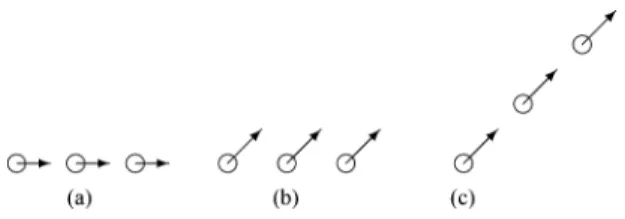
Fig. 1. Coordinated motion on (LIC = RIC = BIC). (a) An initial situa-tion of coordinated mositua-tion; circles represent agent posisitua-tions, arrows their linear velocities. (b) The same swarm in coordinated motion with a different velocity. (c) A coordinated motion that the swarm of the first plot cannot reach without breaking the coordinated motion to re-position the agents.
• Group multiplication corresponds to , inverse to , and identity to position vector 0. In partic-ular, the group structure is decoupled in each coordinate and Abelian (i.e., group multiplication is commutative). Relative positions take the familiar form
.
• The Lie algebra equals itself, operations and
reduce to the identity .
• Adjoint operator for all and the
Lie bracket is identically zero.
• LIC, RIC and BIC all collapse to the same and just require identical linear velocities in ; in particular BIC implies no restrictions on relative positions. Physically, coordinated motion means a rigid formation of points in moving with a fixed formation orientation. The direction of motion can change when varying the velocity vector, as between Fig. 1(a) and 1(b), but a rotation of the formation, as going from Fig. 1(a)–1(c), would require breaking coordination in . Example 2: : The special orthogonal group de-scribes 3-D rotations. A point on is represented by a
matrix with and .
• Group multiplication, inverse and identity are the corre-sponding matrix operations.
• The Lie algebra is the set of skew-symmetric 3 3
matrices , operations and are represented
by and , respectively. The invertible mapping
identifies with .
• With this identification, and
(vector product).
• In the standard interpretation of as rigid body orienta-tion, and are the angular velocities expressed in body frame and in inertial frame respectively.
• LIC (equal ), RIC (equal ) and BIC have a clear phys-ical interpretation in this case.
• For BIC with , and
. The dimension of ( of ) is 1. Agents in BIC rotate with the same angular velocity in inertial space and have the same orientation up to a rotation around .
Example 3: : The special Euclidean group in the plane describes planar rigid body motions (translations and rotations). An element of can be written
where is a position vector in the plane and is orien-tation (or “heading”).
• Group multiplication where
is the rotation of angle . Identity and inverse .
• Lie algebra . Operations
and .
• and
. • In the interpretation of rigid body motion, is the linear
velocity expressed in body frame, is the ro-tation rate. For , is not the body’s linear velocity expressed in inertial frame; instead, is the center of the circle drawn by the rigid body moving with . In [20], the intuitive argument to achieve co-ordination is to synchronize circle centers ; this actually synchronizes right-invariant velocities .
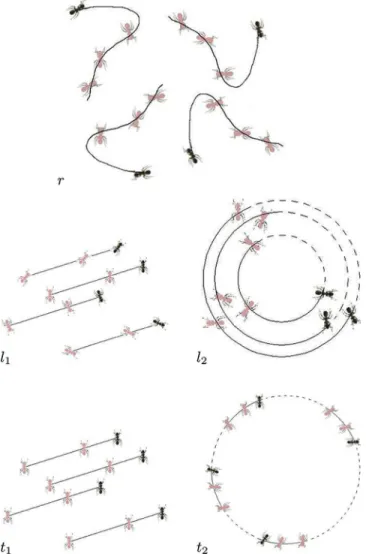
• In RIC, the agents move with the same velocity expressed in body frame (Fig. 2, ). In LIC, they move like a single rigid body (or “formation”): relative orientations and rel-ative position vectors on the plane do not change (Fig. 2, and ). Note that any combination of translation (as on Fig. 2, ) and rotation (as on Fig. 2, ) of the formation composed by the agents is possible.
• In BIC, the swarm moves like a single rigid body and each agent has the same velocity expressed in body frame. Propositions 2 and 3 characterize by
and by
. This leads to three different cases:
(o) and .
(i) , and
.
(ii) , any .
Define , the circle of radius containing
the origin, tangent to at the origin and such that and imply rotation in the same direction. Then solving
for and making a few calculations shows that
and tangent to at .
This is consistent with an intuitive analysis of possibilities for circular motion with unitary linear velocity and fixed relative position vectors and orientations in the plane. The dimension of ( of ) is (o) 3, (i) 2 or (ii) 1. In case (o), the configuration is arbitrary but at rest. In case (i), the agents have the same orientation and move on parallel straight lines (Fig. 2, ). In case (ii), they move on the same circle and have the same orientation with respect to their local radius (Fig. 2, ). Unlike for LIC, combinations of translations and rotations of the formation composed by the agents would not correspond to BIC.
Example 4: : This group describes 3-D rigid body mo-tions (translamo-tions and rotamo-tions). An element of can be
written , with a position vector in
and a rotation matrix describing orientation.
• , identity and
inverse .
• Lie algebra is
identified with with the same mapping as
for . Operations and
. As for , symbol “ ” denotes vector product.
Fig. 2. Coordinated swarms (light color: intermediate planar positions and ori-entations in time).r: RIC with varying velocity. l and l : LIC with ! = 0 and! 6= 0 respectively; note that any combination of translation (l ) and ro-tation(l ) of the formation composed by the agents still corresponds to LIC. t and t : BIC with ! = 0 and ! 6= 0 respectively; note that combinations of translations(t ) and rotations (t ) of the formation composed by the agents would not correspond to BIC.
• and
. • In the interpretation of rigid body motion, left-invariant
ve-locities and are the body’s linear and angular velocity respectively, expressed in body frame; the right-invariant is the angular velocity expressed in inertial frame; for
, a physical interpretation for the right-invariant is unclear.
• Similarly to , the agents move in RIC with the same velocity expressed in body frame; they move in LIC with fixed relative orientations and relative position vectors in
, like a single rigid body.
• In BIC, the swarm moves like a single rigid body and each agent has the same velocity expressed in body frame. Propositions 2 and 3 lead to three different cases charac-terizing
which requires
which requires
(o) and .
(i) ,
and characterizes rotation of
axis .
(ii) , any
and describing
left-invariant relative positions of agents that are on the
same cylinder of axis and radius , with
orientations differing around axis by an angle exactly equal to their relative angular position on the cylinder . This is again obtained by solving for in and making several basic computations; it is less obvious than for
to find this result intuitively.
The dimension of ( of ) is (o) 6, (i) 4 or (ii) 2. In case (o), the configuration is arbitrary but at rest. In case (i), the agents move on parallel straight lines and have the same orientation up to rotation around their linear velocity vector. In
case (ii), for , the agents draw helices of
constant pitch on the cylinder; the special case gives circular trajectories (see figures in [9], [19]).
In the degenerate situation , all agents are
on the rotation axis.
III. COORDINATION BYCONSENSUS IN THELIEALGEBRA
A. Control Setting
Left-invariant1 systems on Lie groups appear naturally in
many physical systems, such as rigid bodies in space and cart-like vehicles. Motivated by examples like 2-axes attitude control and steering control on or , this paper considers left-invariant dynamics with affine control
(2) where the Lie algebra is identified with , is a con-stant drift velocity, has full column rank and speci-fies the range of the control term ; without loss of gen-erality, the column vectors of are assumed orthonormal. The
set of all assignable is denoted . For
fully actuated agents , (2) simplifies to
without loss of generality. The following always considers en-dowed with the Euclidean metric. Feedback control laws must be functions of variables which are compatible with the symme-tries of the problem setting, i.e., invariant. In terms of left-invariant variables, LIC corresponds to fixed (left-left-invariant) rel-ative positions, while RIC corresponds to equal (left-invariant) velocities.
In a realistic scalable setting, full communication between all agents cannot be assumed. The information flow among agents is modeled by a restricted set of communication links;
denotes that sends information to . The communication topology is associated to a graph . is undirected if
1A right-invariant system is equivalent, simply by redefining the group
. is uniformly connected (see [24], [25]) if there
exist an agent and durations and such that, ,
taking the union of the links appearing for at least in time span
, there is a directed path from
to every other agent .
B. Right-Invariant Coordination
Right-invariant coordination requires . In the setting (2), this simply implies to agree on equal ; posi-tions can evolve arbitrarily. This problem is solved by the classical vector space consensus algorithm [4], [25]–[28], [47]
(3)
Using (2), it translates into . It
ex-ponentially achieves if is uniformly connected. Asymptotic RIC is then ensured for any initial and, of course, any relative positions which actually have no influence. Agent relies on the left-invariant velocity of .
For a time-invariant and undirected communication graph , (3) is a gradient descent for the disagreement cost function
with the Euclidean metric in .
C. Left-Invariant Coordination
Left-invariant coordination requires , which suggests to use
(4)
Using (1), in terms of the left-invariant variables, (4) becomes (5)
thanks to . To implement (4),
agent must know the relative position and velocity
of .
A priori, (5) converges as (3), ensuring global exponential
coordination for uniformly connected . However, in contrast to (3), nothing guarantees that (5) can be implemented in an underactuated setting. At equilibrium, (5) requires
(6) which, for arbitrary relative positions of the agents, might admit no solution . This issue motivates the further study of underactuated LIC in Section V. Similarly, biinvariant coordination requires simultaneous consensus on left- and right-invariant velocities. At equilibrium, this means that (6) must hold with equal controls , i.e.,
(7) which also puts constraints on the relative positions of the agents. For this reason, biinvariant coordination is further studied in Section IV.
The cost function
asso-ciated to (4) is not left-invariant in general (it involves positions ), so (5) cannot be a left-invariant gradient of .
Nevertheless, let be the subclass of compact groups with unitary adjoint representation, i.e., satisfying
and (for instance ). It is
possible to define a biinvariant (that is, left- and right-invariant) Riemannian metric on if and only if [48]. Using the Euclidean metric on left-invariant velocities, as in the present paper, comes down to using a left-invariant metric, in accordance with the left-invariant setting. If , then this
metric is biinvariant, and
for fixed undirected , (5) is a gradient descent for . In the following, it is assumed that the agents are controllable. Obviously, controllability is sufficient for coordination as it al-lows the agents to reach any position from any initial condition. However, it is not always necessary, as long as positions com-patible with (6) or (7) are globally reachable; in particular, for Abelian groups, all positions satisfy (6) and (7); in that case, (underactuated) LIC and BIC become trivial.
IV. CONTROL DESIGN: FULLY ACTUATED BIINVARIANTCOORDINATION
A. Biinvariant Coordination on General Lie Groups
Biinvariant coordination requires to satisfy two objectives, LIC and RIC, simultaneously. In a first step, assume that the agents are given a reference right-invariant velocity , such that LIC is ensured if each agent applies velocity . It remains to simultaneously achieve RIC, which, as previously shown, involves controlling relative positions. Write a general controller
(8) where is a desired velocity and is necessary for relative po-sition control. Thus for the present, . The question is how to design in order to achieve BIC. For fixed undirected communication graph , inspired by the cost function for RIC, define
where denotes Euclidean norm. characterizes the dis-tance from RIC assuming that every agent has velocity
. Since , the time
variation of due to motion of is
(9)
where denotes the canonical scalar product in , defined with
the Euclidean metric. Thus if then ; a proper
choice of should allow to decrease . Define2the bracket 2In facth; i expresses the effect of the Lie bracket on the dual space of .
It is directly related to the coadjoint representation ofG, commonly used for mechanical systems; in general,h; i does not satisfy the Lie bracket properties.
Fig. 3. Biinvariant coordination as consensus on right-invariant velocity and Lyapunov-based control to right-invariant coordination.
such that .
Then (9) rewrites and
the choice
(10)
ensures that is non-increasing along the solutions:
To obtain an autonomous, left-invariant algorithm for biin-variant coordination, it remains to replace the reference velocity by estimates on which the agents progressively agree. Since the goal is to define a common right-invariant velocity in , it is natural to proceed as in Section III-C and use the consensus algorithm
(11)
which in terms of left-invariant velocities rewrites
(12)
Thus the overall controller is the cascade of a consensus al-gorithm to agree on a desired velocity for LIC, and a position controller designed to decrease a natural distance to RIC. To implement the controller, agent must receive from communi-cating agents their relative positions and the values of their left-invariant auxiliary variables (see Fig. 3).
The following result characterizes the convergence properties of controller (8), (10), (12).
Theorem 1: Consider fully actuated agents communi-cating on a fixed, undirected graph and evolving on Lie group according to with controller (8), (10), (12). (i) For any initial conditions , the
exponentially converge to .
(ii) Define
All solutions converge to the critical set of . In particular, left-invariant coordination is asymptotically achieved for all initial conditions.
(iii) Biinvariant coordination is (at least locally) asymptoti-cally stable.
Proof: Regarding convergence, (12) is strictly equivalent
to (11). Therefore, (i) simply restates a well-known convergence result for consensus algorithms in vector spaces on fixed undi-rected graphs [26].
Fig. 4. Biinvariant coordination as consensus on left-invariant velocity and Lyapunov-based control to left-invariant coordination.
Since the converge, (8), (10) is an asymptotically au-tonomous system; the auau-tonomous limit system is obtained by
replacing . From the derivation of in (10),
the limit system is a gradient descent for ,
which is smooth because the adjoint representation is smooth. According to [49], the -limit sets of an asymptotically au-tonomous system correspond to the chain recurrent sets of the limit system. From [50] the chain recurrent set of a smooth gradient system is equal to its critical points. Therefore the -limit set of (8), (10) is equal to the critical points of , which proves (ii). Biinvariant coordination is locally asymptotically stable as it is a local (and global) minimum of
, which proves (iii).
Given , the region of attraction for BIC is a sublevel-set where has 0 as only critical point (in practice, as only min-imum). Other local minima can involve e.g., the evenly dis-tributed on a circular with a ring graph (see [38]).
Extensions to varying and directed can be made with ad-ditional auxiliary variables along the lines of [19], [21], [51], [52]: at a first level, consensus algorithms define a desired
and a desired , which must be on the same adjoint orbit; at a second level, cost functions for individual agents ensure that they asymptotically implement the desired velocities. The double-consensus part is non-trivial to write in a fully left-in-variant setting, because and must belong to the same
ad-joint orbit. The present paper proposes no explicit design of this
form. For fixed undirected , an advantage of algorithms with “double consensus” ( and ) would be that BIC becomes the only locally stable equilibrium: interaction-related issues only depend on the performance of the consensus algorithm, for the rest the agents behave individually. It is shown in [38] how aux-iliary variables can be used to build consensus algorithms that avoid spurious local minima on various spaces.
B. Biinvariant Coordination on Lie Groups With a Biinvariant Metric
When , i.e., has a biinvariant metric, the cost
func-tion can be used for
left-invariant control design.
A natural idea in this context would be to combine the cost functions for LIC and RIC, writing , and derive a gradient descent for of the form
. However, simulations of the resulting control law for always converge to . A possible explanation for this behavior is that the gradient controls velocities, not ex-plicitly positions, while it was shown in Section II that BIC at non-zero velocity involves restrictions on compatible positions. Nevertheless, the biinvariant metric allows to switch the roles of LIC and RIC in the method of Section IV-A, using a con-sensus algorithm to define a common left-invariant velocity for RIC, and a cost function to drive positions to LIC (see Fig. 4).
The RIC consensus algorithm on auxiliary variables asymp-totically defines a common velocity by
(13) Then defining the cost function
for LIC and proceeding as in the previous subsection, one ob-tains controller (8) with
(14)
Theorem 2: Consider fully actuated agents communi-cating on a connected, fixed, undirected graph and evolving
on according to with controller (8),
(13), (14).
(i) For any initial conditions , the exponentially
converge to .
(ii) Define
. All solutions converge to the critical set of . In particular, right-invariant coordination is asymptoti-cally achieved.
(iii) Biinvariant coordination is (at least locally) asymptoti-cally stable.
Proof: The proof is omitted because it is similar to the one
of Theorem 1.
The region of attraction for BIC behaves as for Theorem 1. An advantage of Theorem 2 over Theorem 1 is that control design is directly extended to underactuated agents. Indeed, (13) defines a valid consensus velocity
for underactuated agents provided that . The only change is that , instead of the exact gradient descent in (14), is its projection onto the control range of :
When is asymptotically defined with (13), the convergence argument for asymptotically autonomous systems must be ex-tended to projections of gradient systems; a general proof of this technical issue is lacking in the present paper. It is the only reason to restrict Theorem 2 to fully actuated agents.
Brockett [45] has developed a general double-bracket form for gradient algorithms on adjoint orbits of compact semi-simple groups, using the biinvariant Killing metric. The connection with the present paper is clear: once the consensus algorithm has converged, the gradient control for agent posi-tions involves a cost function on the adjoint orbit of or . One example in [45] involves minimizing the distance towards a subset of ; a similar objective will be pursued in Section V of the present paper (but with a different class of subsets). A main difference of [45] is its focus on the evolution of variables in , making abstraction of the underlying group, while the present paper actually controls positions of (possibly underactuated)
agents on . If is a compact group and the biinvariant Killing metric coincides with the left-invariant metric of the present
paper, then and control (10) for with
fixed implies that follows the double bracket flow
(15)
This is the case among others for .
C. Example: Biinvariant Coordination in
Control laws for coordination in abound in the lit-erature—see among others papers about satellite attitude con-trol mentioned in the Introduction. Biinvariant coordination on requires aligned rotation axes, and thus synchronizes satellite attitudes up to their phase around the rotation axis.
The compact group has a biinvariant metric, so Sec-tion IV-B applies. Algorithm (13) is used verbatim, with
the auxiliary variable associated to angular velocity . As
mentioned before (15), on . Thus in the fully
actuated case, (8), (14) lead to
(16)
Theorem 2 can be strengthened as follows for specific graphs.
Proposition 4: If is a tree or complete graph, then BIC is the only asymptotically stable limit set.
Proof: According to Theorem 2, it remains to show that
BIC is the only local minimum of . Fixing ,
critical points of correspond to
(17)
For the tree, start with the leaves . Then
where is the parent of . As a consequence, (17) for the
parent becomes where is the parent
of . Using this argument up to the root, all must be parallel. If the agents are partitioned in two anti-aligned groups, then moving those groups towards each other decreases ; thus is the only local minimum. For the complete graph,
(17) becomes , where . This
implies either that all must be parallel or that . In the first case, further discussion is as for the tree. Rewriting shows that corresponds to a maximum of .
Combining trees and cliques can yield more graphs with BIC as only asymptotically stable limit set. For others, local minima may exist. Classifying local minima of from graph properties is an open question.
It is straightforward to adapt (16) for underactuated agents; a popular underactuation on is to consider 2 orthogonal axes of allowed rotations and , either controlling both ro-tation rates, i.e., , or imposing a fixed rotation rate around one axis, i.e., . Both cases are con-trollable [33], so the Jurdjevic-Quinn theorem [53] ensures local asymptotic stability of BIC, if is fixed in advance or agreed on in finite time. A formal convergence proof for the
asymptotically autonomous case where the follow (13) is cur-rently missing.
V. CONTROL DESIGN: UNDERACTUATED LEFT-INVARIANTCOORDINATION
Biinvariant coordination may appear as a rather academic ob-jective, whose motivation in applications is not clear. However, the methodology developed in Section IV for BIC control de-sign is instrumental to achieve left-invariant coordination of un-deractuated agents. The latter is well motivated by practical ap-plications. Here the role of the cost function is no longer to add a second level of coordination, but to fulfill the underactuation constraints. Unlike the academic problem setting of BIC, the present section explicitly considers the most general setting of possibly directed and time-varying interconnection graph .
A. Left-Invariant Coordination of Underactuated Agents
The control design for underactuated LIC is decomposed in the two steps illustrated in Fig. 5. Analogously to the biinvariant coordination design of Section IV-A, a feasible right-invariant velocity is determined by a consensus algo-rithm. The corresponding left-invariant velocity is enforced by a Lyapunov-based feedback that decreases its distance from
.
The consensus algorithm must enforce a feasible right-in-variant velocity, that is a vector in the set
If is convex, then it is sufficient to initialize the consensus
algorithm (12) with . When is not convex, the
consensus algorithm must be adapted and the present paper has no general method. Strategies inspired from [38] for compact homogeneous manifolds may be helpful, as illustrated in the example below.
Now assuming a known feasible right-invariant velocity , the design of a Lyapunov based control to left-invariant coordi-nation proceeds similarly to Section IV-A.
Define to be the Euclidean distance in from to the set . Let be the projection of on ; since is convex, is the unique point in such that
. Following the same steps as in
Section IV-A, define . Writing
(18) the task is to design such that asymptotically, is driven to a point where and converges to 0; this would asymptotically ensure LIC. For each individual agent , write the cost function
where denotes Euclidean norm. characterizes the distance from to , that is the distance from LIC assuming that every
agent implements . The time variation of due to motion of is
(19)
Fig. 5. Underactuated left-invariant coordination as constrained consensus on right-invariant velocity and Lyapunov-based control to left-invariant coordination.
where denotes the canonical scalar product in . To go on along the lines of Section IV-A, it must hold
; this condition on Lie algebra structure and con-trol setting is satisfied for examples below. Then (19) implies
, where
(20) when identifying with , and a natural control is
(21) Note that when , the position control is unnecessary
and vanishes, yielding simply .
The overall controller is the cascade of a consensus algorithm to agree on a desired velocity for LIC, and a position controller designed from a natural Lyapunov function to reach positions compatible with underactuation constraints and so to actually achieve LIC. To implement the controller, agent must get from other agents their relative positions and the values of their left-invariant auxiliary variables . Since agents only interact through the consensus algorithm, not through the cost function, a connected fixed undirected graph is not required: can be directed and time-varying, as long as it remains uni-formly connected (see Fig. 5).
A general characterization of the behavior of solutions of the closed-loop system is more difficult here because the position controller is not a gradient anymore. A crucial step for which the present paper proposes no explicit general solution is the design of an appropriate consensus algorithm on auxiliary variables. The other assumptions in the following result can be readily checked for any particular case.
Theorem 3: Consider underactuated agents communi-cating on a uniformly connected graph and evolving on Lie group according to with controller (18), (21) where is defined in (20), assuming that , it holds . Assume that an appropriate con-sensus algorithm drives the arbitrarily initiated , ,
such that they exponentially agree on ,
independently of the agent motions .
(i) If the agents are controllable, then LIC is locally asymp-totically stable.
(ii) If, for any fixed , bounded implies bounded
, and implies ,
then all agent trajectories on converge to the set where .
Proof: The overall system is a cascade of the
exponen-tially stable consensus algorithm and position controller (18), (21) which is decoupled for the individual agents. Assumptions
and (21) exactly mean that is non-increasing along the closed-loop solutions. Therefore, if the agents are controllable, Jurdjevic-Quinn theorem [53] im-plies local asymptotic stability of the local minimum
for the position controller. Then the overall system is the cas-cade of an exponentially stable system and a system for which is locally asymptotically stable. Standard argu-ments on cascade systems (see e.g., [54], [55]) allow to conclude that is locally asymptotically stable for the overall system; this proves (i).
To prove (ii), first consider the case where constant . Then can only decrease, and since it is bounded from below it tends to a limit; therefore is integrable in time for . For the same reason, is bounded, so according to the assumption for (ii) is bounded as well; then , which is a continuous function of , is bounded as well for the closed-loop system, such that is uniformly continuous in time for . Barbalat’s Lemma implies that con-verges to 0, which implies that converges to 0, concluding the proof. Now in fact varies, it exponentially converges to the constant . This changes nothing to the fact that tends to a finite limit and is bounded, so the same argument applies.
Condition is not always true when
; however, it often holds in practice, as in the following example on steering control of rigid bodies. For this example, Theorem 3 is improved by showing that LIC is the only stable limit set. In general, possible improvements of the local stability result depend on the geometry of and related consensus al-gorithms; particular settings of the literature feature fairly large regions of attraction (at least in simulations).
B. Example: Steering Control on
Left-invariant coordination on under steering control is studied in [19]. The present section shows how the algorithms of [19] follow from the present general framework. Illustrations of the algorithms by numerical simulation can also be found in [19].
Using the notations of Section II-C, the position and orien-tation of a rigid body in 3-D space is written , which is an element of the Special Euclidean group ; group multiplication is the usual composition law for transla-tions and rotatransla-tions, see Section II-C. Then requiring agents to “move in formation”, i.e., such that the relative position and heading of agent with respect to agent is fixed in the ref-erence frame of agent , , is equivalent to requiring left-in-variant coordination. Moreover, since linear and angular ve-locity in body frame correspond to the components of , the problem of controlling each agent in its own frame with feedback involving relative positions and orientations of other agents only, fits the left-invariant problem setting described in Section III. The constraint of steering control—i.e., fixed linear velocity in agent frame —implies (2) of the form
Steering controlled agents on are controllable [33]. Following the method of Section V-A, write auxiliary
vari-ables ; then , cost function
and straightforward calculations show
that (19) becomes . This means that
and . Then (18),
(21) yield the controller
(22) This is the same control law as derived in [19] from intuitive ar-guments. If an appropriate consensus algorithm is built, then all assumptions of Theorem 3 hold, implying local asymptotic sta-bility of 3-D “motion in formation” with steering control (22); in fact, [19] slightly improves Theorem 3 by also showing that
globally, LIC is the only stable limit set.
It remains to design a consensus algorithm for the . For this, two cases are distinguished: linear motion and he-licoidal (of which a special case is circular) motion . The first case (almost) never appears from a consensus algorithm with arbitrary ; it can however be imposed by
, which will then remain true , in order to stabilize a coordinated motion in straight line.
• If (linear motion), then and
. Agreement on in the unit sphere can be achieved following [38], just achieving consensus in and normalizing; in fact nor-malizing is not even necessary, as it would just change the gain in (22). This leads to
(23)
for , again as in [19].
• If , then and
, and
. Designing a consensus algorithm, that
both achieves agreement on and can be written with left-invariant variables, appears to be difficult. Sim-ilarly to the first case, suitable algorithms can be built if the overall dimension of the variables used for the con-sensus algorithm is enlarged with respect to the dimen-sion of the configuration space. The consensus algorithm proposed in [19] replaces by three components
, and associated with the
vectors , , used to describe above; then . The advantage of this
em-bedding is that left-invariant consensus
algorithms can be decoupled for the , the and the . With the notations of the present paper, the corresponding consensus algorithm proposed in [19] is
. Comparing left-invariant relative position with the terms and fac-tors appearing in this consensus algorithm, one observes that the latter is indeed left-invariant. It can be verified (see [19]) that this algorithm indeed synchronizes the
Remark 3: LIC with , under steering control re-quires to align vectors for all agents. This is in fact
equiv-alent to BIC on with . The present
sec-tion thus illustrates the method for BIC on for uniformly connected (instead of fixed undirected as in Section IV).
Remark 4: LIC under steering control on is treated in [20], [21], where numerical simulations of the resulting al-gorithms can also be found. Like for , control algorithms obtained intuitively, with several simplifications due to the lower dimension, can be recovered with the general method of the present paper.
In fact, the group structure and control setting of steering
con-trol on are such that and steering controls
, one has
with (24)
On explicitly,
and , so
and . Then LIC automatically
implies equal , thus RIC, meaning that underactuated LIC is
equivalent to BIC and imposes the same constraints on relative
positions . This is the case for any group and control setting satisfying (24).
For steering control on , LIC is slightly different from
BIC because , so (24)
would require which is not true in
general. Therefore, for LIC under steering control the
can differ by arbitrary rotations around , while BIC would require equal .
VI. CONCLUSION
This paper proposes a geometric framework for coordination on general Lie groups and methods for the design of controllers driving a swarm of underactuated, simple integrator agents to-wards coordination. It shows how the general framework pro-vides control laws for coordination of rigid bodies, on , and , and allows to easily handle different set-tings. Formal convergence results are local, but authors working on particular applications have always observed fairly large re-gions of attraction (at least in simulations).
Following the numerous results about coordination on partic-ular Lie groups, various directions are still open to extend the general framework of the present paper. A first case often en-countered in practice is to stabilize specific relative positions of the agents (“formation control”). In [20], [21] for instance, the steering controlled agents on are not only coordinated on a circle, but regular distribution of the agents on the circle is also stabilized; in the present paper, relative positions of the agents are asymptotically fixed but arbitrary. The requirement of syn-chronization (most prominently, “attitude synsyn-chronization” on ) also fits in this category. A second important extension would be to consider more complex dynamics, like those of me-chanical systems.
REFERENCES
[1] S. Strogatz, Sync: The Emerging Science of Spontaneous Order. New York: Hyperion, 2003.
[2] S. Strogatz, “From Kuramoto to Crawford: Exploring the onset of syn-chronization in populations of coupled nonlinear oscillators,” Physica
D, vol. 143, pp. 1–20, 2000.
[3] A. Jadbabaie, J. Lin, and A. Morse, “Coordination of groups of mobile autonomous agents using nearest neighbor rules,” IEEE Trans. Autom.
Control, vol. 48, no. 6, pp. 988–1001, Jun. 2003.
[4] V. Blondel, J. Hendrickx, A. Olshevsky, and J. Tsitsiklis, “Conver-gence in multiagent coordination, consensus and flocking,” in Proc.
44th IEEE Conf. Decision Control, 2005, pp. 2996–3000.
[5] J. Fax and R. Murray, “Information flow and cooperative control of vehicle formations,” IEEE Trans. Autom. Control, vol. 49, no. 9, pp. 1465–1476, Sep. 2004.
[6] J. Desai, J. Ostrowski, and V. Kumar, “Modeling and control of for-mations of nonholonomic mobile robots,” IEEE Trans. Robot. Autom., vol. 17, no. 6, pp. 905–908, Jun. 2001.
[7] R. Olfati-Saber and R. Murray, “Graph rigidity and distributed forma-tion stabilizaforma-tion of multi-vehicle systems,” in Proc. 41st IEEE Conf.
Decision Control, 2002, pp. 2965–2971.
[8] E. Justh and P. Krishnaprasad, “Equilibria and steering laws for planar formations,” Syst. Control Lett., vol. 52, pp. 25–38, 2004.
[9] E. Justh and P. Krishnaprasad, “Natural frames and interacting particles in three dimensions,” in Proc. 44th IEEE Conf. Decision Control, 2005, pp. 2841–2846.
[10] M. Mesbahi and F. Hadaegh, “Formation flying control of multiple spacecraft via graphs, matrix inequalities, and switching,” J. Guid.,
Control Dyn., vol. 24, no. 2, pp. 369–377, 2001.
[11] M. VanDyke and C. Hall, “Decentralized coordinated attitude control of a formation of spacecraft,” J. Guid., Control Dyn., vol. 29, no. 5, pp. 1101–1109, 2006.
[12] J. Lawton and R. Beard, “Synchronized multiple spacecraft rotations,”
Automatica, vol. 38, pp. 1359–1364, 2002.
[13] T. Krogstad and J. Gravdahl, “Coordinated attitude control of satellites in formation,” in Group Coordination and Cooperative Control, Ser.
Lect. N. Control and Inform. Sci. New York: Springer, 2006, vol. 336, pp. 153–170.
[14] C. McInnes, “Distributed control for on-orbit assembly,” Adv.
Astro-naut. Sci., vol. 90, pp. 2079–2092, 1996.
[15] W. Ren, “Distributed attitude consensus among multiple networked spacecraft,” in Proc. Amer. Control Conf., 2006, [CD ROM]. [16] T. Smith, H. Hanssmann, and N. Leonard, “Orientation control of
mul-tiple underwater vehicles with symmetry-breaking potentials,” in Proc.
40th IEEE Conf. Decision Control, 2001, pp. 4598–4603.
[17] H. Hanssmann, N. Leonard, and T. Smith, “Symmetry and reduction for coordinated rigid bodies,” Eur. J. Control, vol. 12, no. 2, pp. 176–194, 2006.
[18] S. Nair, “Stabilization and Synchronization of Networked Mechanical Systems,” Ph.D. dissertation, Princeton Univ., Princeton, NJ, 2006. [19] L. Scardovi, N. Leonard, and R. Sepulchre, “Stabilization of collective
motion in three dimensions,” Commun. Inform. Syst. (Brockett Legacy
Issue), vol. 8, no. 3, pp. 1521–1540, 2008.
[20] R. Sepulchre, D. Paley, and N. Leonard, “Stabilization of planar collec-tive motion with all-to-all communication,” IEEE Trans. Autom.
Con-trol, vol. 52, no. 5, pp. 811–824, May 2007.
[21] R. Sepulchre, D. Paley, and N. Leonard, “Stabilization of planar collec-tive motion with limited communication,” IEEE Trans. Autom. Control, vol. 53, no. 3, pp. 706–719, 2008.
[22] N. Leonard, D. Paley, F. Lekien, R. Sepulchre, D. Frantantoni, and R. Davis, “Collective motion, sensor networks and ocean sampling,” Proc.
IEEE, vol. 95, no. 1, pp. 48–74, Jan. 2007.
[23] D. Swain, N. Leonard, I. Couzin, A. Kao, and R. Sepulchre, “Alter-nating spatial patterns for coordinated group motion,” in Proc. 46th
IEEE Conf. Decision Control, 2007, pp. 2925–2930.
[24] L. Moreau, “Stability of multi-agent systems with time-dependent communication links,” IEEE Trans. Autom. Control, vol. 50, no. 2, pp. 169–182, Feb. 2005.
[25] L. Moreau, “Stability of continuous-time distributed consensus al-gorithms,” in Proc. 43rd IEEE Conf. Decision Control, 2004, pp. 3998–4003.
[26] R. Olfati-Saber, J. Fax, and R. Murray, “Consensus and cooperation in networked multi-agent systems,” Proc. IEEE, vol. 95, no. 1, pp. 215–233, Jan. 2007.
[27] R. Olfati-Saber and R. Murray, “Consensus problems in networks of agents with switching topology and time delays,” IEEE Trans. Autom.
Control, vol. 49, no. 9, pp. 1520–1533, Sep. 2004.
[28] J. Tsitsiklis, “Problems in Decentralized Decision Making and Com-putation,” Ph.D. dissertation, MIT, Cambridge, MA, 1984.
[29] J. Tsitsiklis, D. Bertsekas, and M. Athans, “Distributed asynchronous deterministic and stochastic gradient optimization algorithms,” IEEE
Trans. Autom. Control, vol. AC-31, no. 9, pp. 803–812, Sep. 1986.
[30] H. Bai, M. Arcak, and J. Wen, “A decentralized design for group align-ment and synchronous rotation without inertial frame information,” in
Proc. 46th IEEE Conf. Decision Control, 2007, pp. 2552–2557.
[31] A. Sarlette, R. Sepulchre, and N. Leonard, “Cooperative attitude syn-chronization in satellite swarms: A consensus approach,” in Proc. 17th
IFAC Symp. Autom. Control Aerosp., 2007, [CD ROM].
[32] A. Sarlette, R. Sepulchre, and N. Leonard, “Autonomous rigid body attitude synchronization,” in Proc. 46th IEEE Conf. Decision Control, 2007, pp. 2566–2571.
[33] V. Jurdjevic, Geometric Control Theory. Cambridge, U.K.: Cam-bridge Univ. Press, 1997.
[34] V. Arnold, Mathematical Methods of Classical Mechanics. New York: Springer, 1989.
[35] J. Marsden and T. Ratiu, Introduction to Mechanics and Symmetry. New York: Springer, 1994.
[36] N. Leonard, “Averaging and Motion Control of Systems on Lie Groups,” Ph.D. dissertation, Univ. Maryland, College Park, 1994. [37] F. Bullo, “Nonlinear Control of Mechanical Systems: A Riemannian
Geometry Approach,” Ph.D. dissertation, CalTech, Pasadena, CA, 1998.
[38] A. Sarlette and R. Sepulchre, “Consensus optimization on manifolds,”
SIAM J. Control Optim., vol. 48, no. 1, pp. 56–76, 2009.
[39] S. Bonnabel, P. Martin, and P. Rouchon, “Symmetry-preserving ob-servers,” IEEE Trans. Autom. Control, vol. 53, no. 11, pp. 2514–2526, 2008.
[40] A. Bondhus, K. Pettersen, and J. Gravdahl, “Leader/follower synchro-nization of satellite attitude without angular velocity measurements,” in Proc. 44th IEEE Conf. Decision Control, 2005, pp. 7270–7277. [41] C. Beugnon, E. Buvat, M. Kersten, and S. Boulade, “GNC design
for the DARWIN spaceborne interferometer,” in Proc. 6th ESA Conf.
Guid., Navig. Control Syst., 2005, [CD ROM].
[42] S. Nair and N. Leonard, “Stabilization of a coordinated network of ro-tating rigid bodies,” in Proc. 43rd IEEE Conf. Decision Control, 2004, pp. 4690–4695.
[43] S. Nair and N. Leonard, “Stable synchronization of mechanical system networks,” SIAM J. Control Optim., vol. 47, no. 2, pp. 661–683, 2008. [44] A. Sarlette, R. Sepulchre, and N.E. Leonard, “Autonomous rigid body attitude synchronization,” Automatica, vol. 45, no. 2, pp. 572–577, 2009.
[45] R. Brockett, “Differential geometry and the design of gradient algo-rithms,” in Proc. Symp. Pure Math., AMS, 1993, vol. 54, pp. 69–92. [46] A. Sarlette, “Geometry and Symmetries in Coordination Control,”
Ph.D. dissertation, Univ. Liège, Liège, Belgium, 2009.
[47] A. Olshevsky and J. Tsitsiklis, “Convergence rates in distributed con-sensus and averaging,” in Proc. 45th IEEE Conf. Decision Control, 2006, pp. 3387–3392.
[48] V. Arsigny, X. Pennec, and N. Ayache, “Bi-invariant means in Lie groups. Application to left-invariant polyaffine transformations,” INRIA Res. Rep., 2006, vol. 5885.
[49] K. Mischaikow, H. Smith, and H. Thieme, “Asymptotically au-tonomous semi-flows, chain recurrence and Lyapunov functions,”
AMS Trans., vol. 347, no. 5, pp. 1669–1685, 1995.
[50] M. Hurley, “Chain recurrence, semiflows, and gradients,” J. Dynam.
Diff. Eq., vol. 7, no. 3, pp. 437–456, 1995.
[51] L. Scardovi and R. Sepulchre, “Collective optimization over average quantities,” in Proc. 45th IEEE Conf. Decision Control, 2006, pp. 3369–3374.
[52] L. Scardovi, A. Sarlette, and R. Sepulchre, “Synchronization and bal-ancing on theN-torus,” Syst. Control Lett., vol. 56, no. 5, pp. 335–341, 2007.
[53] V. Jurdjevic and J. Quinn, “Controllability and stability,” J. Diff. Eq., vol. 28, no. 3, pp. 381–389, 1978.
[54] E. D. Sontag, “Remarks on stabilization and input-to-state stability,” in
Proc. 28th IEEE Conf. Decision Control, 1989, pp. 1376–1378.
[55] R. Sepulchre, M. Jankovic´, and P. Kokotovic´, Constructive Nonlinear
Control. New York: Springer, 1997.
Alain Sarlette (M’09) received the M.S. degree
in physical and space engineering and the Ph.D. degree in applied mathematics and control from the University of Liège, Belgium, in 2005 and 2009, respectively.
He is currently a Postdoctoral Research Fellow at the Belgian FNRS, visiting at Mines Paris-Tech (2009–2010). His research interests include distributed systems and swarm control, quantum control, and space applications.
Dr. Sarlette received the 2009 EECI Ph.D. Award on Embedded and Networked Control.
Silvère Bonnabel was born in Marseille, France, in
1981. He received the M.S. degree in engineering and the Ph.D. degree in mathematics and control from Mines ParisTech, Paris, France, in 2004 and 2007, respectively.
He was a Postdoctoral Fellow at the University of Liège, Belgium, in 2008. He is currently a Researcher at Mines ParisTech. His research interests include ge-ometrical methods for filtering and control. He has worked on industrial applications (chemical reactor).
Rodolphe Sepulchre (SM’09) received the M.S.
degree in engineering and the Ph.D. degree in ap-plied mathematics from the University of Louvain, Belgium, in 1990 and 1994, respectively.
He is a Professor in the Department Electrical Engineering and Computer Science, Université de Liège, Institut Montefiore B28, B-4000 Liège, Belgium. He held research or teaching positions at the University of California, Santa Barbara (1994 to 1996), Princeton University, Princeton, NJ (2002 to 2003), and the University of Louvain (2001 to 2009). His research interests include nonlinear control systems, dynamical systems, and optimization on manifolds.