HAL Id: dumas-00578094
https://dumas.ccsd.cnrs.fr/dumas-00578094
Submitted on 18 Mar 2011
HAL is a multi-disciplinary open access
archive for the deposit and dissemination of sci-entific research documents, whether they are pub-lished or not. The documents may come from teaching and research institutions in France or abroad, or from public or private research centers.
L’archive ouverte pluridisciplinaire HAL, est destinée au dépôt et à la diffusion de documents scientifiques de niveau recherche, publiés ou non, émanant des établissements d’enseignement et de recherche français ou étrangers, des laboratoires publics ou privés.
Mechanical behavior of polyurea nanocomposites doped
with nanoparticles
Emilien Billaudeau
To cite this version:
Emilien Billaudeau. Mechanical behavior of polyurea nanocomposites doped with nanoparticles. Ma-terials. 2010. �dumas-00578094�
RESEARCH REPORT
Mechanical behavior of polyurea nanocomposites
doped with nanoparticles
Emilien Billaudeau
Ecole Centrale Lyon
September 2010
Raimondo Betti, Haim Waisman
Columbia University in the city of New York (USA) Monssef Drissi-Habti
Laboratoire des Ponts et Chauss´ees de Nantes (France) Michelle Salvia
Acknowledgments
My most earnest acknowledgment must go to my advisors from Columbia
Univer-sity1, professors Betti and Waisman who have been instrumental in ensuring my
integration in the Civil Engineering department. I also thank them to have given me scientific and financial support to perform my study.
My internship would not have been possible without the matchless help I got
from Dr. Monssef Drissi-Habti from the LCPC2 who connected me with this
labo-ratory and helped me in my research. This training period is conducted within the framework of the collaboration going on between LCPC and Columbia University.
My gratitude also stretches to my second French advisor, Pr. Michelle Salvia
from the ECL3. Her experience in material science and particularly in composites
was really helpful.
Mr. Adrian Brugger and Dr. Liming Li from the Carleton laboratory (Depart-ment of Civil Engineering at Columbia University) are greatly acknowledged for their assistance with the material manufacturing and the tension tests.
I would also like to thank Oya Okman for her help with the Scanning Electron Microscope and for her training session in order to give me access.
Last but not least, i would like to express my gratitude to Dr. Jorgen Bergstrom4 for his extra support he gave me on the computational modeling.
1(New York, USA)
2Laboratoire Central des Ponts et Chauss´ees (Nantes, France) 3Ecole Centrale (Lyon, France)
Abstract
Recently, carbon nanotubes and graphene nanoplatelets have attracted both aca-demic and industrial interest because of their capacity to produce a dramatic im-provement in properties at very low filler content. In this work, we focused on experimental studies and computational modeling of polymer nanocomposites in-tended for passive protection of civil structures. The material considered in this study consisted of a polyurea matrix enhanced by different quantities of nanopar-ticles. Different renforts and matrixes have been used to fabricate nanoparticles polymer nanocomposites by a range of methods. Several tensile tests were per-formed to evaluate and characterize the behavior of the studied materials in order to choose the appropriate manufacturing protocol and the suitable enhancement. Furthermore, a finite elements model was achieved The main goal of this study was to achieve a parametric determination of the tested materials in order to find a gen-eral model.
The manufacturing protocol study had led to an ultrasonic dispersion of the nanoparticles instead of a mechanical stirring. Degrading the properties of the ini-tial material, the mechanical mixing method does not disaggregate the nanoparticles, which is an important factor in the nanoreinforcement.
The results indicate that an arbitrary amount of carbon nanotubes and graphene nanoplatelets may result in suboptimal performance and more specifically 0.5% in weight of carbon nanotubes and 2% in weight of graphene nanoplatelets yield the best mechanical performance in each nanocomposite family. However, comparing these two optimums, the graphene nanoplatelets doped material leads to the best performance.
Keywords
Nanomaterials; carbon nanotubes; graphene nanoplatelets; polymer matrix; com-posite material; polyurea; finite elements; hyperelastic modeling.
Abbreviations
CNTs, carbon nanotubes; MWCNTs, multi-wall carbon nanotubes; CVD, chemical vapor deposition; GNPs, graphene nanoplatelets; SEM, scanning electron micro-scope; THF, tetrahydrofuran.
R´
esum´
e
R´ecemment, les nanotubes de carbone ainsi que les nanoplaquettes de graph`ene ont attir´e `a la fois universitaires et industriels en raison de leur capacit´e `a apporter une am´elioration spectaculaire des propri´et´es du composite. Au cours de cette ´etude, nous nous sommes concentr´es sur des ´etudes exp´erimentales et informatiques des nanocomposites `a base de polym`eres destin´es `a la protection passive des structures de g´enie civil. Le mat´eriau consid´er´e dans cette ´etude ´etait constitu´e d’une ma-trice polyur´ethane renforc´ee par diff´erentes quantit´es de nanoparticules. Suivant diff´erentes m´ethodes, diff´erents renforts et matrices ont ´et´e utilis´ees pour la fabrica-tion des nanocomposites. Plusieurs essais de tracfabrica-tion ont ´et´e r´ealis´es pour ´evaluer et caract´eriser le comportement des mat´eriaux ´etudi´es afin de choisir le protocole de fabrication appropri´e. En outre, un mod`ele ´el´ements finis a ´et´e d´evelopp´e afin de parvenir `a une d´etermination des param`etres relatifs aux mat´eriaux test´es dans le but de trouver un mod`ele g´en´eral.
L’´etude du protocole de fabrication a conduit `a une dispersion des nanopartic-ules par ultrasons plutˆot qu’une agitation m´ecanique. D´egradants les propri´et´es de la matrice, la m´ethode de brassage m´ecanique ne r´epartit pas les nanoparticules, ce qui est un facteur important dans la nanorenforcement.
Les r´esultats de cette ´etude indiquent qu’une quantit´e pr´ecise de nanotubes de carbone ou de nanoplaquettes de graph`ene pourrait entraˆıner une performance opti-male. En effet, 0,5 % de nanotubes de carbone et 2 % de nanoplaquettes de graph`ene permettent d’obtenir les meilleurs performances m´ecaniques. Toutefois, comparant ces deux optimums, les nanoplaquettes de graph`ene donnent les meilleures perfor-mances.
CONTENTS CONTENTS
Contents
1 Introduction 11 2 Literature review 12 2.1 Elastomer presentation . . . 13 2.1.1 Mechanical properties . . . 13 2.1.2 Polyurea . . . 14 2.2 Enhancement interest . . . 142.2.1 An example, the tire . . . 14
2.2.2 Composite families . . . 15
2.3 Carbon nanotubes . . . 16
2.3.1 High performances . . . 16
2.3.2 Growing methods . . . 17
2.4 Graphene Nanoplatelets . . . 17
2.4.1 Presentation and properties . . . 17
2.4.2 Comparison with the CNTs . . . 18
2.5 Nanocomposites . . . 19
2.5.1 Parameters influencing the nanocomposite behavior . . . 19
2.5.2 Process review . . . 20
3 Materials and methods 21 3.1 Manufacturing and experimental tests . . . 22
3.1.1 Materials manufacturing . . . 22
3.1.2 Experimental tests . . . 24
3.2 Material modeling . . . 25
3.2.1 Modeling using an MCalibration optimization . . . 26
3.2.2 Abaqus model definition . . . 28
3.2.3 Data treatment . . . 31
4 Results and discussion 33 4.1 Experimental tests . . . 34
4.1.1 SEM visualization . . . 34
4.1.2 First protocol results, CNT enhancement . . . 34
4.1.3 Second protocol results, CNT enhancement . . . 37
4.1.4 Second protocol results, GNP enhancement . . . 39
4.1.5 Optimal nanocomposite, amount and enhancement type . . . 42
4.2 Finite elements model . . . 43
4.2.1 MCalibration and Abaqus modeling . . . 43
4.2.2 Model generalization . . . 44
CONTENTS CONTENTS
6 Appendix 49
6.1 Which solvent for the nanoparticles dispersion . . . 50
6.2 Strain rate in the rubber materials . . . 55
6.3 Interaction between MCalibration and Abaqus . . . 56
LIST OF FIGURES LIST OF FIGURES
List of Figures
1 (a) Schematic drawing of unstressed elastomer; (b) Same elastomer
under stress . . . 13
2 SEM pictures of elastomer (TPE-PP40). (a) Load-elongation curves. The SEM pictures of the material drawn at (b) strain = 1.7, (c) strain = 5.5, (d) strain = 7.4 [1] . . . 14
3 Cut tire (Ref : http://www.aviation-fr.info/avion/pneus.php) . . . 15
4 Multi-wall carbon nanotubes (MWNTs) [6] . . . 16
5 CVD method (Ref : http://ipn2.epfl.ch/CHBU/NTproduction1.htm) . 17 6 Graphene sheet . . . 18
7 SEM picture of graphene nanoplatelets (Ref : http://www.xgscience.com/ products.html) . . . 18
8 CNTs network for polymer-based nanocomposites (Ref : http://www.nano-lab.com/) . . . 20
9 Facilities in the laboratory . . . 25
10 Uni-axial tensile test: (a) Strain = 0; (b) Strain = 400% . . . 26
11 Matlab smoothing (1 wt% (CNTs)) . . . 27
12 Experimental data used for the MCalibration optimization . . . 28
13 MCalibration program (material model optimization) . . . 29
14 MCalibration optimization result, Engineering stress (MPa) / Engi-neering strain . . . 30
15 Abaqus input file (MCalibration exported data) . . . 30
16 Boundary conditions in Abaqus . . . 31
17 Sample deformation in the Abaqus calculation (1st node coordinate) . 32 18 Nanoparticles visualization: (a) CNTs (Magnification x25000); (b) GNPs (Magnification x787) . . . 34
19 1st protocol results, Engineering stress (MPa) / Engineering strain . 35 20 First protocol samples: (a) Aqualine 300 picture; (b) Aqualine 300 + THF + 1 wt% of CNTs picture; (c) Aqualine 300 + THF + 1 wt% of CNTs SEM picture (Magnification x100); (d) Aqualine 300 + THF + 1 wt% of CNTs SEM picture (Magnification x6000) . . . 36
21 2nd protocol results, Engineering stress (MPa) / Engineering strain . 37 22 2nd protocol results: (a) maximum strain / wt%(CNTs); (b) ultimate stress (MPa) / wt%(CNTs) . . . 38
23 Nanocomposite (0.5 wt% of CNTs), interaction CNT/Matrix (Mag-nification x25000) . . . 39
24 2nd protocol results, Engineering stress (MPa) / Engineering strain . 40 25 2nd protocol results: (a) maximum strain / wt%(GNPs); (b) ultimate stress (MPa) / wt%(GNPs) . . . 41
26 Comparison , Engineering stress (MPa) / Engineering strain . . . 42
27 Ogden model parameters and interpolation (parameter value / wt%(CNTs)): (a) Mu1; (b) Alpha1; (c) Mu2; (d) Alpha2 . . . 45
LIST OF FIGURES LIST OF FIGURES
29 (a) Ultrasonic stirring by using a Sonicator hielscher UP50H ; (b)
Comparison of stirring methods : Ultrasonic (left) / Mechanical stir-ring (right) . . . 51
30 (a) Sonicated CNTs (Magnification x283); (b) Original CNTs
(Mag-nification x300); (c) Sonicated CNTs (Mag(Mag-nification x2500); (d) Orig-inal CNTs (Magnification x30000) . . . 52
31 Centrifuge Sorvall LEGEND X1 : filtration of the solutions to
high-light the solvent effect in the CNTs dispersion . . . 52
32 Solvent comparison after sonicator and centrifuge steps(0.34 g of
CNTs in 40 ml of solvent) From left to right : Distilled water, THF, Ethanol . . . 53
33 Solvent comparison after sonicator and centrifuge steps(34 mg of
CNTs in 40 ml of solvent) From left to right : THF, Distilled wa-ter . . . 53
34 THF or distilled water in the matrix? From left to right : THF,
Distilled water . . . 54
35 Behavior prediction, Engineering stress (MPa) / Engineering strain
(a) Strain rate = 0.02 ; (b) Strain rate = 0.2; (c) Strain rate = 0.5; (d) Strain rate = 2 . . . 55
LIST OF TABLES LIST OF TABLES
List of Tables
1 CNTs properties . . . 17
2 Comparison between CNTs and GNPs mechanical properties . . . 19
3 Nanocomposite compositions . . . 23
4 CNT-based composite properties . . . 38
5 GNP-based composite properties . . . 41
6 Ogden parameters for the CNT nanocomposite modeling . . . 43
1 INTRODUCTION
1
Introduction
Protection of civil infrastructure from environmental and aging deterioration and other extreme conditions is a key concern in any country and particularly in the United States[12]. In many urban cities, counties and states, the infrastructure suf-fers from corrosion, deterioration of structural elements due to climate and environ-mental changes, damage induced by wind or earthquake excitations or by man-made action, aging of materials and many more.
These issues require continuous monitoring, repairs and the strengthening and replacement of damaged components. All of these actions require significant resource allocation for maintenance. The development of new technologies and new materials offers an innovative route to solve some of the problems that currently afflict our in-frastructural system. Recently, the production and use of nanoparticles has become
a major research theme worldwide5. Many applications of these nanoparticles rely
on their incorporation into a host matrix to form the so called nanocomposite6. The
term ”nanocomposite” is usually used to describe multiphase solid materials where at least one of the phases is in orders of nanometers. This project consists in the nanoenhancement study in order to find a suitable manufacturing protocol and an optimum of the enhancement amount for the studied nanocomposites.
5Bibliography work in appendix (French document)
2 LITERATURE REVIEW
2
Literature review
Introducing the context of the study, this literature review describes the enhance-ment interest in polymer materials. Presenting several functions and properties of the materials involved in the composite and nanocomposite structure, this section highlights some theories on these complex materials.
2.1 Elastomer presentation 2 LITERATURE REVIEW
2.1
Elastomer presentation
2.1.1 Mechanical properties
Elastomer is a polymer with the property of viscoelasticity7. What makes elastomers
special is the fact that they can be stretched to many times their original length, and they can bounce back into their original shape without plastic deformation. The schematic drawing in figure 1 shows the elastomer structure. The behavior is due to the overlap of molecular chains (curved lines) and the cross-links (Black circles). Under stress, the molecules are forced to line up in the direction in which the rubber is being pulled. The covalent cross-linkages (energetic bond) ensure that the elastomer will return to its initial morphology when the stress is removed. As a result of this extreme elasticity, elastomers can reversely extend from 5-700% (depending on the material).
Figure 1: (a) Schematic drawing of unstressed elastomer; (b) Same elastomer under stress
Figure 2 shows SEM pictures [1] of the deformed elastomer during uni-axial tensile test (pictures at strains of 1.7, 5.5 and 7.4). As previously introduced and according to the SEM pictures (b,c,d), the distortion of the elastomer structure is highlighted. Because of its large deformation and its low stress, the curve (a) shows the hyperelastic behavior of the elastomers.
Because of the high viscoelasticity, the mechanical properties of the elastomers are strongly rate dependent. As presented in the article [13], the failure stress increases and the failure strain decreases with the strain rate. To be coherent, elas-tomer studies require standards tests and modeling to get comparable results [7]. These methods will be presented in the following section and in the appendix Strain rate in the rubber materials.
Temperature effect is also an important parameter in the rubber studies. Called the glass transition, this parameter exhibits an ultimate work temperature for the studied material. Glass transition is the temperature above which a polymer be-comes soft and pliable, and below which it bebe-comes hard and glassy.
2.2 Enhancement interest 2 LITERATURE REVIEW
Figure 2: SEM pictures of elastomer (TPE-PP40). (a) Load-elongation curves. The SEM pictures of the material drawn at (b) strain = 1.7, (c) strain = 5.5, (d) strain = 7.4 [1]
2.1.2 Polyurea
Polyurea is a fast reacting bi-component polymer system that contains 70% of amine. The first component is isocyanate, a -NCO group, which is the curative part, while the other one is a resin blend component. The reaction between the two components yields a urea linkage that makes the polymer solid.
The resulting polyurea is an elastomer that is usually sprayed under high pres-sure/temperature to produce a thick, strong and seamless waterproof coating with incredible abrasion, corrosion and chemical resistance. Due to these characteristics, this kind of material seems attractive in the civil infrastructure application.
2.2
Enhancement interest
2.2.1 An example, the tire
Tires are the most important and least understood parts of the vehicle. Everything concerned with driving, moving, starting, stopping involves tires. Because of their functions, tires have several main constraints, which are:
1. Abrasion, wear and tear resistance 2. Carry vehicle’s weight
2.2 Enhancement interest 2 LITERATURE REVIEW
3. Transmit forces 4. Withstand shocks
In order to get a part meeting the above requirements, a sophisticated material structure is needed. As shown in figure 3, a tire has a complex structure where each material has a unique role.
First, an elastomer covering is needed to absorb the shocks (hyperelastic ma-terial)), resisting against abrasion and insuring a control of the vehicle due to the material’s viscosity (forces transmission).
Second, an enhancement is required to ensure a mechanical resistance. In this example, the reinforcement is made of steel cable layers following different directions in order to get a strong structure in the high strength areas.
Figure 3: Cut tire (Ref : http://www.aviation-fr.info/avion/pneus.php)
2.2.2 Composite families
Tires are among the most famous example for composites based on elastomer and fiber enhancement. Founded on similar general meanings, several kinds of compos-ites are now developed8:
1. Short or long fibers reinforcement 2. Metal, concrete or polymer matrix 3. Stratified, sandwich or tissue composites 4. Macro, micro or nano enhancement
8These materials are not presented in this literature review, the aim is to introduce the
2.3 Carbon nanotubes 2 LITERATURE REVIEW
Nano-reinforcement is currently under consideration. The three sections below present these new composites with their interests. This review introduces severals nano-enhancements and the nanocomposite’s expected properties.
2.3
Carbon nanotubes
Discovered in 1991 by Pr. Iijima, a carbon nanotube (CNT) is a cylindrical molecule with outer diameter of 4-30 nm and a length of up to 1 microns [6]. The fashion of this molecule is due to its impressive properties in several domains (mechanical [17, 14], electrical [10, 5] or optical [5]).
2.3.1 High performances
This unique structure presented in figure 4 displays these properties. The perfect arrangement of carbon atoms, linked by covalent bonds9, limits the structural defects causing high mechanical strength. Table 1 compares the mechanical properties of the CNTs with its competitors. As shown in this table, the CNTs have a mechanical strength greater than that of Steel or Kevlar and a density lower than that of Aluminum.
Figure 4: Multi-wall carbon nanotubes (MWNTs) [6]
2.4 Graphene Nanoplatelets 2 LITERATURE REVIEW
Properties CNTs Competitors
Young Modulus 1 TPa Steel : 200 GPa
Tensile Strength 45 GPa Kevlar : 3.5 GPa
Density 1.3 g/cm3 Aluminum : 2.7 g/cm3
Table 1: CNTs properties
2.3.2 Growing methods
Since their discovery, several growing techniques were developed to make these new molecules. The first two growth methods of carbon nanotubes were based on the
graphite10 evaporation using an arc discharge or a laser ablation in an oven
(Tem-perature about 1200 degrees Celsius). At controlled tem(Tem-perature and pressure, the volatile molecules condensed on a substrate forming carbon nanotubes. These two
methods, costly in energy, were replaced by a chemical method called CVD11. This
synthesis (illustrated in figure 5) is achieved taking a carbon species in the gas phase (methane or carbon monoxide, for example) and using an energy source (oven) to ”crack” the molecules. These species then diffuse down to a substrate (quartz boat in the example) in order to form the CNTs. Since CVD is a simple and relatively cheap technique, it might be the most promising method for large-scale production of CNTs.
Figure 5: CVD method (Ref : http://ipn2.epfl.ch/CHBU/NTproduction1.htm)
2.4
Graphene Nanoplatelets
2.4.1 Presentation and properties
Graphene is the basic structural unit of some carbon allotropes [4, 8], including graphite, carbon nanotubes and fullerenes. Graphene can be prepared using similar methods as CNTs. Graphene is a single layer of carbon atoms packed densely in a honeycomb crystal lattice (figure 6). Along with its unique structure, graphene
10The most stable carbon configuration 11Chemical Vapor Deposition
2.4 Graphene Nanoplatelets 2 LITERATURE REVIEW
possesses a range of unusual properties like mechanical stiffness, strength and elec-trical and thermal conductivity. Figure 7 shows graphene nanoplatelets which are composed by numbers of graphene sheets. These particles have an average thickness
of approximately 6-8 nanometers and a typical surface area of 150 m2/g.
Figure 6: Graphene sheet
Figure 7: SEM picture of graphene nanoplatelets (Ref : http://www.xgscience.com/ products.html)
2.4.2 Comparison with the CNTs
Table 2 shows the GNP mechanical properties. Comparing these properties with that of the CNT, it is shown that the behavior is similar, the main difference between these particles is their shapes.
2.5 Nanocomposites 2 LITERATURE REVIEW
Properties CNTs GNPs
Young Modulus 1 TPa 1 TPa
Tensile Strength 45 GPa 10-20 GPa
Density 1.3 g/cm3 2.0 g/cm3
Table 2: Comparison between CNTs and GNPs mechanical properties
2.5
Nanocomposites
As presented in the above two sections, due to their impressive properties, CNTs and GNPs are envisaged to be the ideal reinforcement for polymer composites, especially for the enhancement of the mechanical properties [9]. However, while adding nanoparticles in a polymer matrix can enhance its performance, according to some theories, it can also degrade the initial behavior of the matrix. As presented below, composite properties are strongly influenced by the matrix enhancement interface, the fiber’s behavior and their dispersion.
2.5.1 Parameters influencing the nanocomposite behavior
Fiber’s behavior
Due to the nanoparticles ability to deform prior to break (hyper-elastic behavior), they give greater hardness than the carbon or glass fiber based composites which have a lower toughness because of the brittleness of the fibers.
Interface matrix/renforts
According to the article [19], a strong interface between the matrix and the fibers makes a composite with high stiffness and strength. A better interfacial adhesion can enhance composite transverse properties or flexural properties. The large interfacial
areas are due to the high aspect ratio12 of CNTs and GNPs, which creates the
matrix/renfort stress transfer. Enhancement dispersion
The nanoparticles dispersion [11, 15] in the polymer matrix is the key parameter to get the expected behavior. Picture 8 on page 20 shows the CNTs network needed to improve the polymer behavior. Several dispersion methods are presented in the appendix called Which solvent for the nanoparticles dispersion. The main aim is to obtain a homogeneous solution in order to get a spread out reinforcement. A bad dispersion causes an enhancement in the nanoparticle’s aggregates, allowing for several areas poor in CNTs or GNPs.
2.5 Nanocomposites 2 LITERATURE REVIEW
Figure 8: CNTs network for polymer-based nanocomposites (Ref :
http://www.nano-lab.com/)
2.5.2 Process review
Since the nanoparticles discovery, some manufacturing processes [20, 8] have been developed. the most effective processes are presented below.
Solution mixing and film casting
Solution mixing is based on a solvent system in which the polymer or pre-polymer is solublized and CNTs or GNPs are allowed to swell. Stirring CNTs or GNPs in a solvent is efficient due to the low viscosity of the solution. In this way, the particles motion is easier and the dispersion is more homogenous. These nanoparticles can be dispersed easily in a suitable solvent, such as water, acetone, chloroform, tetrahy-drofuran (THF), dimethylformamide (DMF) or toluene. Nevertheless, this method requires the use of a solvent which is expensive and need to be evaporated before the polymerization.
Melt mixing (extrusion, injection molding)
Without any solvent, the particles mix with the polymer matrix in the molten state. On one hand, by overcoming the need of the solvent, this method is cheaper than the first one, but on the other hand, the dispersion is worse (due to the high viscosity).
In-situ polymerization
In this manufacturing method, the nanoparticles are first swollen within the liquid monomer. A suitable initiator is then diffused and polymerization is initiated either by heat or radiation. This process has the advantage to stir the renfort in a low viscosity liquid without the need of a solvent. Due to its low price and its efficiency, this method is currently the most used in the nanocomposite manufacturing.
3 MATERIALS AND METHODS
3
Materials and methods
This section presents the methods used to conduct the research. The subsections that follow explain the materials used to perform the study; the several protocols found to make the nanocomposites; the tests completed to describe the nanocompos-ite’s behavior and the hyperelastic modeling used to predict the general performance of this kind of composite.
3.1 Manufacturing and experimental tests 3 MATERIALS AND METHODS
3.1
Manufacturing and experimental tests
3.1.1 Materials manufacturing
Materials used
The Multi-Walled Carbon nanotubes (CNTs) used in this study were purchased from Sigma Aldrich and were synthetized by Catalitic Chemical Vapor Deposition (CVD).
The Graphene Naoplatelets (GNPs) xGnP-M-15 were purchased from XG Sci-ence, Inc. and were also synthetized by CVD.
The Polyurea used in this study was ordered from ITW Futura Coatings as Aqualine 300 and from ITW Devcon as Flexane 80 liquid 15800 (equivalent to the Aqualine 300).
Tetrahydrofuran (THF) anhydrous was purchased from Sigma Aldrich. This is an organic solvent that is used to disperse CNTs in the polymer matrix. Ethanol and distilled water were also used as solvent in the nanoparticles dispersion.
The nanocomposite specimens have been prepared by adding different quantities in weight percentage [wt%] of nanoparticles (CNTs or GSs) as follows:
1. Polyurea 2. Polyurea + solvent + 0.1 wt% (CNTs or GNPs) 3. Polyurea + solvent + 0.5 wt% (CNTs or GNPs) 4. Polyurea + solvent + 1 wt% (CNTs or GNPs) 5. Polyurea + solvent + 1.5 wt% (CNTs or GNPs) 6. Polyurea + solvent + 2 wt% (CNTs or GNPs) 7. Polyurea + solvent + 2.5 wt% (CNTs or GNPs) 8. Polyurea + solvent + 5 wt% (CNTs or GNPs)
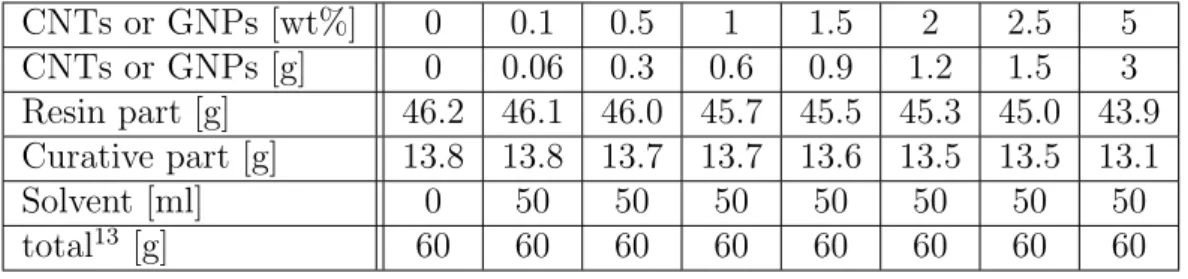
Table 3 indicates the needed quantities to manufacture the different nanocom-posites (around 30 g per sample).
One of the main goals is to evaluate which of the above mentioned nanocompos-ites yields the best overall mechanical performance.
Instrumentation
The nanoparticles dispersion was performed mixing the solution with a rotative helix IKA RW 20 digital.
3.1 Manufacturing and experimental tests 3 MATERIALS AND METHODS CNTs or GNPs [wt%] 0 0.1 0.5 1 1.5 2 2.5 5 CNTs or GNPs [g] 0 0.06 0.3 0.6 0.9 1.2 1.5 3 Resin part [g] 46.2 46.1 46.0 45.7 45.5 45.3 45.0 43.9 Curative part [g] 13.8 13.8 13.7 13.7 13.6 13.5 13.5 13.1 Solvent [ml] 0 50 50 50 50 50 50 50 total13 [g] 60 60 60 60 60 60 60 60
Table 3: Nanocomposite compositions
Another way to disperse these nanoparticles was the use of a probe sonicator hielscher UP50H and a ultrasonic bath L&R ultrasonic Guantrex 90.
A centrifuge Sorvall LEGEND X1, Thermo Scientific was also used to validate the nanoparticles dispersion in the solvent.
The polymerization acceleration and the solvent evaporation (if needed) was per-formed in a Vacuum oven Shel Lab VPX9-2 according to the Polyurea instructions. An aluminium mold was manufactured to produce specimens with constant di-mensions.
Protocols
To produce the nanocomposite specimens (nanoparticles + matrix), different quantities of enhancement have been added (as mentioned above). The objective is to determine the optimal structure for this material.
Due to the available materials (matrix composed of resin and hardener) the mixing solution protocol (presented in the literature review) had to been chosen to make the suitable nanocomposites. The first method used to produce these materials is explained below.
• To make the nanocomposites, nanoparticles were first dissolved in 50 ml of THF and stirred for 30 minutes using the rotating helix (2000 rpm).
• Then the curative part was added to the mix and stirred for another 30 minutes until the mixture became homogeneous.
• Finally, the resin part was added and the new mixture was mixed for an additional 5 minutes to get a homogeneous mix.
• The enhanced polymer was then poured into 5mm thick paper-boxes and stored for 4 days at controlled temperature/humidity to let the polymerization process cure until a hard nanocomposite material was created. Once cured, this nanocomposite was subdivided into stripes according to the standard ASTM D-412 to obtain the specimens suitable for the mechanical tests.
3.1 Manufacturing and experimental tests 3 MATERIALS AND METHODS
With the results found, the method had to be changed. In fact, the main point in the nanocomposite research was the nanoparticles dispersion in the matrix. An efficient method that needed an ultrasonic processor was used to get better results [11]. We also used an aluminum mold to get better precision in the specimen’s dimensions. The improved protocol follows.
• Like the first protocol, the nanoparticles were first dissolved in 50 ml of solvent (chose from a study presented in the appendix) and stirred for 45 minutes using the probe sonicator (Frequency : 30 kHz, Amplitude : 100 %, Cycle : 0.914). It is known that the ultra-sons are efficient for the dispersion, but it is also known that the ultra-sons damage the CNTs (after 1 hour the CNTs are 2 micrometer shorter). Balanced between a good dispersion (needed for the nanocomposite enhancement) and good nanoparticle’s geometry (also useful to have a better load transfer in the matrix), this step is one of the most important in the manufacturing.
• This solution was heated in order to evaporate the solvent and to keep only the nanoparticles unagglomerated (very thin powder). At controlled temperature (around the solvent boiling temperature), the solution was heated until the complete evaporation of the solvent (controlled by weighing the solution). • This powder and the resin were stirred for 5 minutes using the rotation helix
and then another 15 minutes in the ultrasonic bath.
• Before the casting step, the curative part was added in the solution and stirred for 5 minutes (around 500 rpm, to avoid creating bubbles). This solution was then hand mixed using a spatula to remove as many bubbles as possible. To facilitate the release15 after the polymerization process cure (10 hours in the mold), the mold was covered with a wax layer.
• 7 days of waiting were necessary to be sure of the properties16 and to obtain
the specimens suitable for the mechanical tests.
3.1.2 Experimental tests
Instrumentation
Tensile tests were controlled in displacement. According to the ASTM D-412: ”Standard test methods for vulcanized rubber and thermoplastic elastomers - Ten-sion” [7], tension tests were performed using an Instron 30K Universal Testing Ma-chine with a strain rate of 50.8 mm/min (2.00 inch/min). Tested specimen section was measured with a numerical caliper, in order to determine the engineering stress in the material using the tensile machine load measure.
140.9 second on / 0.1 second off 15Polyurea adhesion on the aluminum
3.2 Material modeling 3 MATERIALS AND METHODS
Figure 9: Facilities in the laboratory
Alignment procedure of the tensile machine
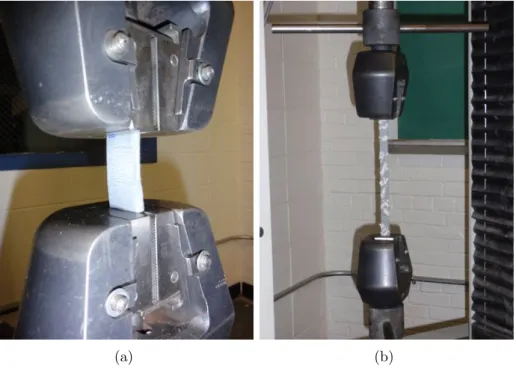
Tensile testing requires a precise mods alignment in order to get an accurate result. Stresses that inadvertently occur due to misalignment between the applied force and the specimen axes during tensile forces can affect the test results. Before a uni-axial tensile test, the user has to make certain of the machine alignment to get a free stress sample (in the tested area). Then using a steel sheet fixed in the machine (replacing the sample), the mods were then screwed respecting the alignment controlled by the steel sheet. Figure 10 shows the tensile test and particularly the mods alignment.
3.2
Material modeling
Some constitutive models are able to describe the mechanical behavior of rubber
materials. Based on quasi-static17 calculation, these models allow the material
de-scription using materials parameters (for simple behavior materials, the modeling is frequently determined manually). Due to the long strain behavior of the elastomer, the parameters definition is not trivial. In fact, the broad investigation domain does not allow the determination of a law for the whole range of deformation. Therefore, due to the complex theory used to model the rubber material (hyperelastic material with a strain rate dependence), the model research evaluated the material model using experimental data found in the previous part and using an optimization soft-ware to model the material.
17A quasi-static process often ensures that the system will go through a sequence of states that
are infinitesimally close to equilibrium (so the system remains in quasi-static equilibrium), in which case the process is typically reversible.
3.2 Material modeling 3 MATERIALS AND METHODS
(a) (b)
Figure 10: Uni-axial tensile test: (a) Strain = 0; (b) Strain = 400%
The main goal of this study is to achieve a parametric determination for several nanocomposites, in order to find a general model.
3.2.1 Modeling using an MCalibration optimization
What is MCalibration?
Developed by Jorgen Bergstrom18, MCalibration is a material evaluation software
using experimental data. Due to its many material models [2] and their algorithms, this program is suitable for our modeling. Some sophisticated models are available in
this software. The respective algorithms19 are based on the comparison between the
model curve and experimental data curve, in order to reduce this gap by changing the model parameters.
The way to use MCalibration
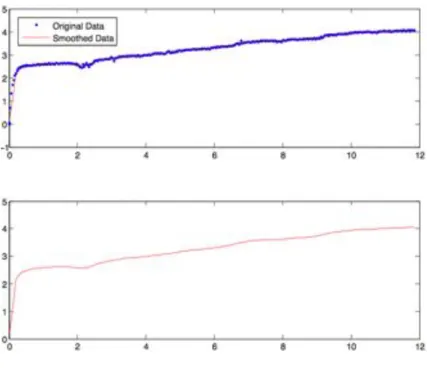
The first modeling step is based on the experimental data treatment in order to use them in the MCalibration optimization. To get an efficient material evaluation, the experimental stress/strain curves had to be smoothed. Figure 11 presents the Matlab smoothing. The appendix Matlab smoothing program shows the program.
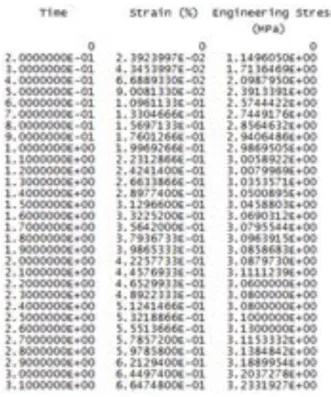
Figure 12 presents the experimental data used as the MCalibration input file.
18MIT Ph.D., Veryst Engineering
19By choice, the algorithms are not presented in this report, they are introduced in the article
3.2 Material modeling 3 MATERIALS AND METHODS
Figure 11: Matlab smoothing (1 wt% (CNTs))
Due to the strain rate20 of the studied material, the time for each increment needs
to be quantified in order to evaluate the model. This time has been arbitrarily de-termined because of the impossibility of the tensile machine to measure it. The way
to compensate21 this arbitrary time is described in the next paragraph, Interaction
between MCalibration and Abaqus.
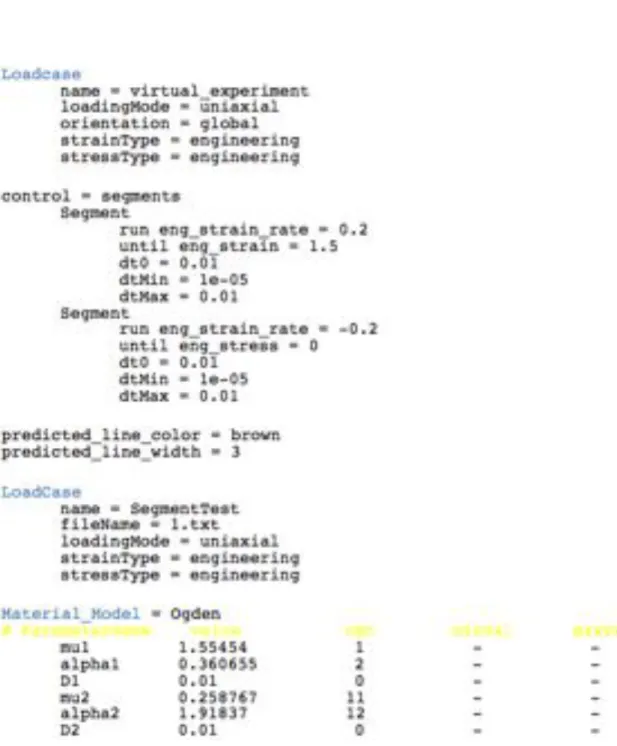
To generate the optimization, some program lines are needed. Figure 13 shows this MCalibration program [3].
• The second loadcase tells the experimental data used for the material evalu-ation, their meaning (engineering or true values) and the kind of test used to get these results.
• The material model chosen is presented in the MaterialModel section. In the program presented in figure 13 on page 29, the studied material model is the Ogden model. The following parameters are evaluated using an algorithm developed for this model [2, 3].
• The first loadcase, called virtual experiment, is needed to evaluate the Abaqus results using the parameters found by the MCalibration evaluation. In that case, a cycle was tested (load until 200% of engineering strain, unload until 0 MPa of engineering stress). In this section the strain rate was needed to eval-uate the material behavior (the appendix presents the influence of the strain
20dependence on the solicitation speed
3.2 Material modeling 3 MATERIALS AND METHODS
Figure 12: Experimental data used for the MCalibration optimization
rate and the required method to get results comparable with the experimental data).
Figure 14 compares the material model found by the optimization (SegmentTest (prediction)) with the experimental data (SegmentTest (experimental)) and the vir-tual experiment (prediction) curve in order to validate the material evaluation. This curve shows a good match between the calculated model and the input data.
3.2.2 Abaqus model definition
Interaction between MCalibration and Abaqus
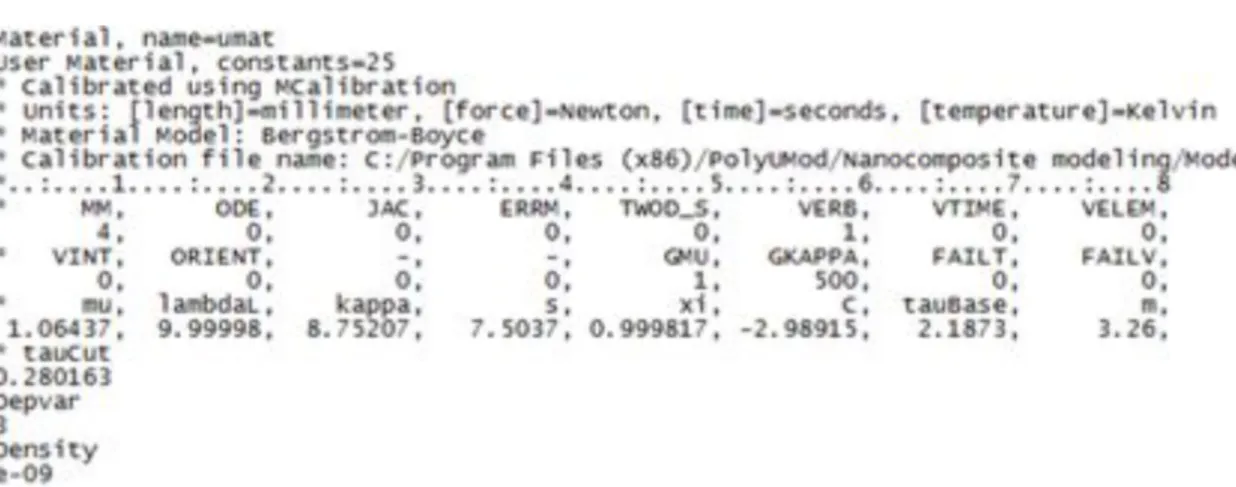
Using an Abaqus input file written by MCalibration (figure 15), the Abaqus ma-terial definition is workable. The Appendix Interaction between MCalibration and Abaqus presents the method to fill the estimated parameters in the Abaqus mate-rial definition tool. This file informs on the model. The first two parameter lines indicate which model was calculated, while the following lines explain the evaluated parameters.
Boundary conditions and calculation steps
The step following the material definition is to determine the Abaqus model [16] needed to estimate the behavior of the evaluated material. This step consists of the definition of the geometry, its boundary conditions and the calculation options required on the Abaqus model.
3.2 Material modeling 3 MATERIALS AND METHODS
3.2 Material modeling 3 MATERIALS AND METHODS
Figure 14: MCalibration optimization result, Engineering stress (MPa) / Engineer-ing strain
3.2 Material modeling 3 MATERIALS AND METHODS
To get a fast calculation, the cubic part is limited in elements. In fact, a material model needs only simple geometry with at least one element. In this case, the part is subdivided into 200 elements to get a more generalized model (suitable for complex parts modeling).
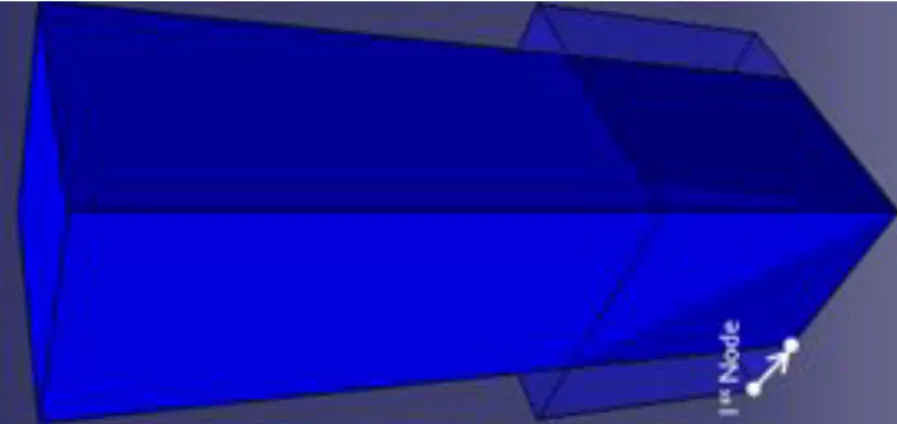
The boundary conditions used in this model have been chosen to simulate an uni-axial tensile test. Figure 16 presents these boundary conditions.
Figure 16: Boundary conditions in Abaqus
According to the tensile machine used in the experimental test, the loading step was controlled in displacement. 500 increments were used during calculation in order to get an accurate and smooth stress/strain curve. The following step is the strain rate determination (rates used in the Abaqus modeling). In order to compensate the arbitrary time used in the MCalibration estimation, the loading time had to be
changed22 to get comparable results between the experimental data and the Abaqus
model. 3.2.3 Data treatment σengineering = � 1stN odeCoordonatet=0 1stN odeCoordonatet �2 ∗ σtrue (1)
To validate the found model, a data treatment is needed to compare the model results with the experimental data. As presented in the experimental subsection, the engineering stress is the only stress value measured by the tensile machine (the
3.2 Material modeling 3 MATERIALS AND METHODS
section variation of the sample is not taken in consideration) while the Abaqus calculated stress is the true stress (the section variation is a key parameter for this stress determination), which is the load divided by the true section’s part. The formula 1 is used to evaluate the engineering stress using the true stress and a node coordinate (used to estimate the deformed section and to cancel its role in the true stress calculation). This formula was used to determine the engineering stress at each increment.
4 RESULTS AND DISCUSSION
4
Results and discussion
This section presents the found results, following the methods presented above. Several nanocomposites were made and tested in the purpose of the behavior
pre-diction and enhancement optimum23 research. To perform this study, the samples
were tested with the tensile machine. Then a fractography analysis followed in order to investigate the reasons of the noticed behavior. This section also presents the model determination and the path to find a general model for the tested materials.
4.1 Experimental tests 4 RESULTS AND DISCUSSION
4.1
Experimental tests
4.1.1 SEM visualization
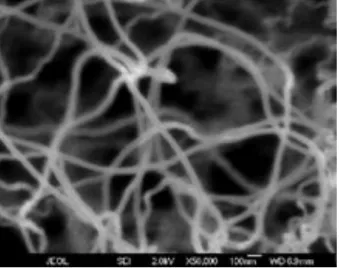
Scanning Electron Microscope (SEM) images were recorded using a Hitachi S-4700. To estimate the needed magnification in order to watch the nanoparticles in the polyurea matrix, we started the SEM visualization using pure CNT and GNP pow-ders glued on carbon stickers. Due to the SEM vacuum chamber, the sample prepa-ration is a key point in this method. It is necessary to ensure the sticking of the nanoparticles (a carbon sheet sticker was used to glue the powders), so that the microscope is not damaged.
Visualizing such particles is a tough task, so a good SEM knowledge is required to get clear pictures [18]. Figure 18 presents the pictures found using the microscope. Due to the different size24of the nanoparticles, the magnification needed to visualize these materials oscillates between x25000 for the CNTs and x700 for the GNPs.
(a) (b)
Figure 18: Nanoparticles visualization: (a) CNTs (Magnification x25000); (b) GNPs (Magnification x787)
4.1.2 First protocol results, CNT enhancement
Mechanical behavior
Figure 19 represents the stress/strain curves for several reinforcement amounts (the crosses symbolize the break of the samples). As shown in these curves, the behavior of the nanocomposites made by following the first protocol is worse than the pure polyurea matrix. In fact, adding nanoreinforcements in a matrix with a mechanical stirring seems to deteriorate the initial material. The result found is therefore inconsistent with the theory presented in the first section. In order to analyse this inconsistency, a microstructure study of the samples is required. The
4.1 Experimental tests 4 RESULTS AND DISCUSSION
following paragraph presents this study and the conclusions reached as a result of it.
Figure 19: 1st protocol results, Engineering stress (MPa) / Engineering strain
Fractographic analysis
Figure 20 represents the crack sections for the naked matrix (a) and the polyurea matrix enhanced by 1 wt% of CNTs (b). These macro-pictures show the effect of the CNT’s dispersion in the matrix. In fact, the nanocomposite is more porous than the pure polyurea because of the bad CNT’s dispersion forming agglomerates in the structure. In this case, the agglomerates of CNTs are equivalent to defects, giving a brittle material. These pictures are also useful to show the solvent (THF) effect. In fact, a vacuum area is present in the nanocomposite crack section. This bubble is responsible for the crack propagation during the tensile test. The voids in the matrix are due to the evaporation of the solvent after the polymerization process. In order to avoid this phenomena, solvent evaporation must be made before the polymerization. These points are also confirmed by microscopic analysis of the nanocomposite samples.
• As shown in fractography 20 (c), the enhancement bound seems weak because
of the the height difference between the CNTs aggregate25 and the matrix. In
fact, this visualization conveys the impression of a crack bypass around the
aggregate, concluding a low wetting26 of the reinforcement.
25figure 20 (d) shows the aggregate structure, confirming the presence of CNTs 26bound capacity of the reinforcement based on the surface tension theory [19]
4.1 Experimental tests 4 RESULTS AND DISCUSSION
(a) (b)
(c) (d)
Figure 20: First protocol samples: (a) Aqualine 300 picture; (b) Aqualine 300 + THF + 1 wt% of CNTs picture; (c) Aqualine 300 + THF + 1 wt% of CNTs SEM picture (Magnification x100); (d) Aqualine 300 + THF + 1 wt% of CNTs SEM picture (Magnification x6000)
4.1 Experimental tests 4 RESULTS AND DISCUSSION
• Otherwise, the bubble in the matrix assumes the solvent evaporation or a fast mechanical stirring. In all cases, this problem degrades the mechanical behavior of the material.
4.1.3 Second protocol results, CNT enhancement
Analyzing the results found by using the first protocol, the manufacturing method had to be modified. Presented as the second protocol in the subsection 3.3.1, the results are from tests on materials produced by this method. In this way, this section highlights the nanoparticle’s dispersion effect on the nanocomposite behavior. Mechanical behavior
From figure 21, it is noteworthy to highlight the mechanical behavior of the CNT-doped nanocomposite using the second manufacturing protocol. As shown in this graphic, it seems evident that the nanotubes are capable of a large strain reinforce-ment, increasing the mechanical properties of the material.
Figure 21: 2nd protocol results, Engineering stress (MPa) / Engineering strain
Nevertheless, this reinforcement is dependent on the CNTs amount. Showing the optimal nanocomposite behavior, the array 4 and the figure 22 underline this amount effect. As presented in the literature review, several parameters influence
4.1 Experimental tests 4 RESULTS AND DISCUSSION
the nanocomposites. Besides the mechanical behavior of the reinforcement, the en-hanced material behavior also depends on the nanoparticles dispersion [11, 15].
According to the results presented below, the optimal material seems to be the polyurea matrix reinforced with 0.5 wt% of CNTs. This enhancement proportion al-most doubles the maximum strain while a 13% increase is noticed on ultimate stress. Beyond the optimal CNT amount, the mechanical properties are degraded.
In-creasing the reinforcement quantity, the dispersion is worse. As the 1st protocol
results show, due to the CNT aggregates (equivalent to defects) in the material structures, the behavior is different from the expected one. The specimen with 2.5 wt% CNT added showed the worst behavior, as it broke almost immediately un-der small loads and small elongations, which is an indication of brittle-type behavior.
wt% CNTs Maximum strain Ultimate stress (MPa)
0 6.4 3.9 0.1 7.4 2.9 0.5 10.8 4.4 1 11.8 4.1 1.5 6.8 3.3 2 3.8 2.6 2.5 0.4 0.3
Table 4: CNT-based composite properties
(a) (b)
Figure 22: 2nd protocol results: (a) maximum strain / wt%(CNTs); (b) ultimate
stress (MPa) / wt%(CNTs)
Fractographic analysis
The SEM picture in figure 23, shows the nanostructure of the cracking section (CNT nanocomposite optimum found above).
4.1 Experimental tests 4 RESULTS AND DISCUSSION
• First, the CNT dispersion seems better in this case than in the 1st
proto-col. The SEM visualization on this type of material has not highlighted CNT aggregates with the same size as the previous nanocomposite. As shown in this picture, CNT network seems well dispersed; they are not assembled into packages.
• Second, the interaction reinforcement/matrix seems strong, as CNTs give the impression they are well coated by the polyurea matrix (good transition, be-tween the free CNTs and the matrix without cavity at their roots). Further-more, very few CNTs were actually observed, which suggest that the polymer matrix has thoroughly coated the nanoparticles, making strong bonds increas-ing the interface Polyurea/CNTs. At the same time, due to this good matrix adhesion, CNTs retard the crack propagation. Indeed, due to their impressive mechanical properties, CNTs with a vertical orientation relative to the plane of the crack limit the progress of it.
Figure 23: Nanocomposite (0.5 wt% of CNTs), interaction CNT/Matrix (Magnifi-cation x25000)
4.1.4 Second protocol results, GNP enhancement
Due to the current interest on the GNP as a matrix reinforcement, it was obvious to compare the behavior of the matrix with different enhancements. This subsection
presents the experimental results using the 2nd manufacturing protocol and GNPs
as polyurea reinforcement. Mechanical behavior
GNP-4.1 Experimental tests 4 RESULTS AND DISCUSSION
based nanocomposite. All the specimens show an initial linear behavior, with a high value of Young’s modulus, up to a stress level that ranges between 2.0 - 2.7 MPa. Once this value is reached, the stress/strain behavior remains linear but with a slope that depends on the amount of GNPs used.
Figure 24: 2nd protocol results, Engineering stress (MPa) / Engineering strain
As illustrated in the array 5 and figure 25, the addition of GNPs improves the ten-sile of some samples. Because of the improvement of the maximum strain and stress with the reinforcement amount, these curves portray the enhancement interest. The best performance is recorded for the sample with 2 wt% GNP doped-polyurea speci-men. The final elongation reached was almost 1400%, which indicates an increase of more than two times greater than the commercial matrix (elongation of about 600%). As previously shown, beyond the optimal GNP amount, the mechanical proper-ties are degraded. The specimen with 5 wt% GNP added showed the worst behavior as it broke faster than the other reinforcement quantities under small loads and small elongations.
4.1 Experimental tests 4 RESULTS AND DISCUSSION
wt% GNPs Maximum strain Ultimate stress (MPa)
0 6.4 3.9 0.1 9.0 3.5 0.5 9.3 3.3 1 10.0 3.7 1.5 11.4 3.9 2 13.9 4.8 2.5 3.8 2.7
Table 5: GNP-based composite properties
(a) (b)
Figure 25: 2nd protocol results: (a) maximum strain / wt%(GNPs); (b) ultimate
4.1 Experimental tests 4 RESULTS AND DISCUSSION
4.1.5 Optimal nanocomposite, amount and enhancement type
Comparing the both optimums found in the previous subsection, the GNP doped nanocomposite shows the best behavior. Figure 26 compares the stress/strain curves for the pure matrix with the CNT and GNP optimum nanocomposites. The GNP enhancement corresponds to a reinforcement almost twice that of CNT.
Due to the close behavior of these nanoparticles, the better behavior of the GNP nanocomposite could be explain by taking in consideration the shape of the reinforcements and their interaction with the matrix. Indeed, the load transfer between the matrix and the GNP is better because of the shape ratio of these nanoparticles comparing with that of the CNTs. i.e. the GNP/Matrix interaction surface is bigger than that of the CNT/Matrix.
4.2 Finite elements model 4 RESULTS AND DISCUSSION
4.2
Finite elements model
This subsection presents the computational material modeling for both nanocom-posites made by using the second protocol. At this stage of study, these results are not exhaustive. The aim is to introduce the main goal of the method. The material evaluation has been done for each enhancement amount in order to get a general model expressing a function of the model parameter with the reinforcement percentage.
4.2.1 MCalibration and Abaqus modeling
Using the modeling method presented above, two material models have been used to describe the mechanical behavior for the nanocomposites enhanced by CNT or GNP. The following paragraphs present quickly the theory and the optimization results relative to each model.
CNT nanocomposite modeling with the Ogden model λ1 = 1 + � λ2 = (1 + �)−1/2 U =�Ni=1 2∗µi α2 i � λαi 1 + λ αi 2 + λ−α1 iλ−α2 i− 3 � σ = λ1∂λ∂U1 (2)
Equation system 2 shows the Ogden model theory used in this material model. As presented in the method section, the hyperelastic model is based on the strain energy potential calculation in order to determine the behavior law of the material (σ = f (�)). N determines the order of the strain energy potential U. Used by MCalibration, this theory is able to describe the material behavior for a large scale of strain. The found parameters are presented in the array 6.
wt% CNTs µ1 α1 D1 µ2 α2 D2 0 1.35 0.37 0.01 0.29 2.09 0.01 0.1 1.29 0.34 0.01 0.25 1.82 0.01 0.5 1.68 0.33 0.01 0.24 2.02 0.01 1 1.55 0.36 0.01 0.26 1.92 0.01 1.5 1.68 0.34 0.01 0.26 1.81 0.01 2 1.45 0.04 0.01 0.27 1.14 0.01
4.2 Finite elements model 4 RESULTS AND DISCUSSION
GNP nanocomposite modeling with the Hyperfoam model λ1 = 1 + � λ2 = λ3 = (1 + �)−1/2 U =�Ni=12∗µi α2 i � λαi 1 + λ αi 2 + λ αi 3 − 3 + β1i ∗ (J −αi∗βi− 1) � σ = λ1∂λ∂U1 (3)
Equation system 3 is based on the same meaning as system 2. The parameters for this material model are highlighted in table 7.
wt% GNPs µ1 α1 β1 µ2 α2 β2 0 0.12 2.55 0.20 2.07 0.45 0.20 0.1 0.08 2.46 0.20 2.32 0.35 0.20 0.5 0.10 2.25 0.20 2.09 0.47 0.20 1 0.08 2.36 0.20 2.32 0.48 0.20 1.5 0.10 2.27 0.20 2.30 0.41 0.20 2 0.09 2.41 0.20 2.87 0.31 0.20 5 0.06 2.24 0.20 2.81 0.16 0.20
Table 7: Hyperfoam parameters for the GNP nanocomposite modeling
4.2.2 Model generalization
CNT nanocomposite
In order to get a general model, an interpolation is needed to get a general func-tion for each parameter of the model depending on the enhancement amount in the polyurea matrix. The aim goal being to predict the mechanical behavior of the nanocomposite by knowing the enhancement amount.
This interpolation had been proceeded using the interpolation toolbox in Mat-lab. Figure 27 shows the interpolation results, as related in the beginning of this section, these results are not exhaustive. In fact, due to the number of the points the interpolation is not accurate. A suitable model could be obtained with more experimental data from more sample compositions.
Although the results are not precise, they show the way to get a general material model definition for a complex material behavior. As presented in the modeling method section, because of the its nonlinearity, an hyperelastic material modeling is a tough task to achieve. Knowing the approximation of this method, it is a first step in the material modeling.
4.2 Finite elements model 4 RESULTS AND DISCUSSION
(a) (b)
(c) (d)
Figure 27: Ogden model parameters and interpolation (parameter value /
5 CONCLUSION
5
Conclusion
In this study we analysed the influence of CNTs and GNPs in Polyurea’s mechanical behavior to evaluate the optimal amount of each nanoparticles that yields the best overall mechanical performance.
Comparing the results presented above, the nanoparticles dispersion is the main parameter in the Polyurea enhancement. Without a doubt, the ultrasonic stirring is the most suitable way to brake the aggregates in order to get a homogenous nanopar-ticles solution. Hence, our first conclusion is that the manufacturing protocol is a key point on the nanomaterial enhancement expectation.
Working on the best suitable manufacturing protocol, we dispersed different quantities of CNTs and GNPs into the Polyurea matrix to obtain different nanocom-posites with varying mechanical behavior. These tests show that the mechanical performance of Polyurea can be significantly enhanced by adding a certain amount of nanoparticles. While we observed substantial enhancement when only 0.5 wt% CNTs or 2 wt% GNPs were added. Adding other quantities gave much weaker performance in terms of ultimate strength and elongation. Furthermore, comparing these nanocomposite optimums, the GNP doped-material showed a better behavior with a maximum strain and stress. The GNP enhancement corresponded to a rein-forcement twice that of CNT. Hence, our second conclusion is that the amount and the type of reinforcement should be carefully chosen to get a nanocomposite with the expected behavior.
Despite the conclusion presented above, due to the time allotted for this research,
the temperature effect, the aging impact and the tribology study27 was not studied.
These important parameters are required to conclude on material behavior on the spot. In order to finalize this study and to get an appropriate conclusion related to the application, Luciana Balsamo, a PhD student at Columbia University will continue this research project during her thesis. This thesis will be also provide the opportunity to use and develop the hyperelastic model to find a more suitable evaluation, taking into account the effects introduced above.
REFERENCES REFERENCES
References
[1] T. Asami and K-H. Nitta. Morphology and mechanical properties of polyolefinic thermoplastic elastomer i. characterization of deformation process. Polymer, 45:5301–5306, 2004.
[2] J. Bergstrom. J. PolyUMod, a library of user materials for ABAQUS. Veryst Engineering, LLC, 2010.
[3] J. Bergstrom. MCalibration manual. Veryst Engineering, LLC, 2010.
[4] Y. Geng, S. J. Wang, and J-K Kim. Preparation of graphite nanoplatelets and graphene sheets. Journal of Colloid and Interface Science, 336:592–598, 2009. [5] Y.H. Ho, C.P. Chang, F.L. Shyu, R.B. Chen, S.C. Chen, and M.F. Lin.
Elec-tronic and optical properties of double-walled armchair carbon nanotubes. El-sevier, Carbon, 42:3159–3167, 2004.
[6] S. Iijima. Carbon nanotubes: past, present, and future. Physica B, 323:1–5, 2002.
[7] ASTM International. Standard test methods for vulcanized rubber and ther-moplastic elastomers-tension. ASTM International, D412-06a:1–14, 2010. [8] T. Kuilla, S. Bhadra, D. Yao, N.H. Kim, S. Bose, and J.H. Lee. Recent advances
in graphene based polymer composites. Progress in polymer science, Accepted Manuscrit, 2010.
[9] M. Kulkarni, D. Carnahan, K. Kulkarni, D. Qian, and J. L.Abot. Elastic re-sponse of a carbon nanotube fiber renforced polymeric composite : a numerical and experimental study. Elsevier, B 41:414–421, 2009.
[10] V. Likodimos, S. Glenis, and L. Lin. Electronic properties of boron-doped multiwall carbon nanotubes studied by esr and static magnetization. Physical review, B 72:045436(1–7), 2005.
[11] P.C. Ma, N.A. Siddiqui, G. Marom, and J.K. Kim. Dispersion and function-alization of carbon nanotubes for polymer-based nanocomposites. Composites Part A: Applied Science and Manufacturing, In Press, Corrected Proof, 2010. [12] George R. International Journal of Critical Infrastructure Protection, 2008. [13] C.M. Roland, J.N. Twigg, Y. Vu, and P.H. Mott. High strain rate mechanical
behavior of polyurea. Elsevier, Polymer, 48:574–578, 2006.
[14] J.P. Salvetat, J.M. Bonard, N.H. Thomson, A.J. Kulik, L. Forro, W. Benoit, and L. Zuppiroli. Mechanical properties of carbon nanotubes. Applied Physics A, Materials Science and Processing, 69:255–260, 1999.
REFERENCES REFERENCES
[16] Simula. Abaqus user’s manual. Dassault Systemes, 2010.
[17] R. S.Ruoff, D. Qian, and W. Kam Liu. Mechanical properties of carbon
nanotubes : theoretical predictions and experimental measurement. C. R. Physique, 4:993–1008, 2003.
[18] Technische fakultat der christian albrechts universitat, Kiel. Test M604: Scan-ning electron microscopy.
[19] H.D. Wagner and R.A. Vaia. Nanocomposites : issues at the interface. Materials today, 7:38–42, 2004.
[20] M-K. Yeh, T-H. Hsieh, and N-H. Tai. Fabrication and mechanical properties of multi-walled carbon nanotubes/epoxy nanocomposites. Elsevier, Material science and engineering A, 483-484:289–292, 2006.
6 APPENDIX
6.1 Which solvent for the nanoparticles dispersion 6 APPENDIX
6.1
Which solvent for the nanoparticles dispersion
There is still a long road to create nanoparticle reinforcement composites, fully realizing the potential of high strength and stiffness of the CNTs or the GNPs. There are many reasons for this limitation. As presented in the method section, the nanoparticles dispersion is the main point in the nanocomposite manufacturing. This appendix investigates this effect and presents the way to reduce its influence in the nanocomposite behavior. This study presents the best method to disperse the CNTs (the GNPs dispersion is equivalent).
The CNTs dispersion
Figure 28: Photo of CNTs mechanically stirred in a solvent (THF)
Figure 28 shows the nanoparticles in the solvent after a mechanical stirring. These particles are visible with the naked eye (agglomerates in a solvent, see the circle in figure 28). The problem is that the nanocomposite needs a homogeneous enhancement in the matrix, to make the dispersion more homogeneous. To get a better solution, an ultrasonic stirring, using the probe sonicator in Figure 29 (a), was performed. With the same CNT amount and the same solvent, Figure 29 (b) shows the difference between a mechanical and an ultrasonic stirring. Obviously, the ultrasonic stirring is more efficient than the mechanically stirred solution. The black solution indicates a good CNT dispersion.
Solvent evaluation
A solvent evaluation was done to specify which available solvent is the most conve-nient for the CNT dispersion. In this section, CNTs were dispersed in 3 different
6.1 Which solvent for the nanoparticles dispersion 6 APPENDIX
(a) (b)
Figure 29: (a) Ultrasonic stirring by using a Sonicator hielscher UP50H ; (b) Com-parison of stirring methods : Ultrasonic (left) / Mechanical stirring (right)
solvents which are : Tetrahydrofuran, Ethanol and Distilled water. The disper-sion was performed using the previous protocol (1 hour of ultrasonic stirring). The amount of CNTs and the solvent volume were exactly the same for each solution.
After stirring, the solution is filtered. In fact, due to the high amount of CNTs and their quality (90 % pure), the stirring is actually not exactly done for all the nanoparticles. The using of a centrifuge (figure 31 on page 52) is used to filter the solution and to distinguish the dispersed CNTs to the CNT agglomerates and the other carbon particles (graphite for example). The solution was filtered for 4 min-utes at 5000 rpms, the upper part of the solution (3/4 of the solution) was then removed with a teated pipette to get only the CNTs dispersed in the solvent (CNTs are lighter than the other particles in the solution). The following figures present the results for several solvents.
Figure 32 on page 53 shows the CNT dispersion in the 3 studied solvents. In that study, 0.24 g of CNTs were dissolved in each solvent and then the solutions were stirred and filtered as previously. In that case, the darker the solution was, the more the CNTs were dispersed. In fact, a darker solution means a higher concen-tration in thin and light weight particles. This observation is more qualitative than quantitative. The aim is to compare the CNT’s dispersion in several solvents.
Figure 33 shows the CNT dispersion in the THF and the distilled water. In that study, 0.024 g of CNTs were dissolved in each solvent and then the solutions were stirred and filtered as previously. This experience shows the role of the amount of CNT in the dispersion. The higher the CNT amount, the harder the dispersion
6.1 Which solvent for the nanoparticles dispersion 6 APPENDIX
(a) (b)
(c) (d)
Figure 30: (a) Sonicated CNTs (Magnification x283); (b) Original CNTs (Mag-nification x300); (c) Sonicated CNTs (Mag(Mag-nification x2500); (d) Original CNTs (Magnification x30000)
(a) (b)
Figure 31: Centrifuge Sorvall LEGEND X1 : filtration of the solutions to highlight the solvent effect in the CNTs dispersion
6.1 Which solvent for the nanoparticles dispersion 6 APPENDIX
Figure 32: Solvent comparison after sonicator and centrifuge steps(0.34 g of CNTs in 40 ml of solvent) From left to right : Distilled water, THF, Ethanol
Figure 33: Solvent comparison after sonicator and centrifuge steps(34 mg of CNTs in 40 ml of solvent) From left to right : THF, Distilled water
6.1 Which solvent for the nanoparticles dispersion 6 APPENDIX
is. In fact, after the stirring and the filtering, the solutions are still dark and the wastes (other particles) are almost not present in the solution. The second goal of this experience was to choose the best solvent for the CNT’s dispersion and for the nanocomposite manufacturing.
As shown in the figure 33, the distilled water seems better than the THF (darker solution). In this way we tried to manufacture the nanocomposite using the distilled water as solvent. Due to the hydrophobic property of the used resin, we were forced to use another solvent more suitable. The withheld solvent for the nanocomposite manufacturing was then the THF (figure 34). The second main point about the use of the THF instead of the distilled water was the boiling temperature (66 degrees Celsius for the THF and 100 degrees Celsius for the water). In fact, the solvent boiling step required a higher temperature for the water.
Figure 34: THF or distilled water in the matrix? From left to right : THF, Distilled water
6.2 Strain rate in the rubber materials 6 APPENDIX
6.2
Strain rate in the rubber materials
In the determination of the strain rate effect, MCalibration is a suitable software. Due to the time limits to perform this research, it has been difficult to practice different tests on the samples. Because of the viscous behavior of the model, where the deformation speed is taken in consideration, the best way was to evaluate the strain rate effect using the computational model.
The four graphics in Figure 35 highlight this effect. In this study, four strain rates were loaded in the virtual experiment determination in the MCalibration soft-ware. Comparing the experimental data (strain rate about 0.2 corresponding to a 2.0 inch/min deformation speed) with the predictions, conclusions on this effect have been made. Indeed, as shown in the figure 35, the faster the deformation, the stronger the material.
According to these results, a standard [7] strain rate is required to get comparable results in experimental studies.
(a) (b)
(c) (d)
Figure 35: Behavior prediction, Engineering stress (MPa) / Engineering strain (a) Strain rate = 0.02 ; (b) Strain rate = 0.2; (c) Strain rate = 0.5; (d) Strain rate = 2
6.3 Interaction between MCalibration and Abaqus 6 APPENDIX
6.3
Interaction between MCalibration and Abaqus
6.4 Matlab smoothing program 6 APPENDIX
6.4
Matlab smoothing program
%%%%%%%%%%%%%%%%%%%%%%%%%%%%%%%%%%%%%%%%%%%%%%%%%%%%%%%%%%%%%%%%%%%%%%%%%%% %%%%%%%%%%% Carbon NanoTubes Enhancement %%%%%%%%%%% %%%%%%%%%%%%%%%%%%%%%%%%%%%%%%%%%%%%%%%%%%%%%%%%%%%%%%%%%%%%%%%%%%%%%%%%%%% clc clear all % 1 --> 0.1% CNTs % 2 --> 0.5% CNTs % 3 --> 1.0% CNTs % 4 --> 1.5% CNTs % 5 --> 2.0% CNTs % 6 --> 2.5% CNTs % 7 --> 0.0% (PURE) load yCNT.txt load xCNT.txt x = xCNT; y = yCNT; x1 = find(x(:,1)); x1 = x(x1,1); x2 = find(x(:,2)); x2 = x(x2,2); x3 = find(x(:,3)); x3 = x(x3,3); x4 = find(x(:,4)); x4 = x(x4,4); x5 = find(x(:,5)); x5 = x(x5,5); x6 = find(x(:,6)); x6 = x(x6,6); x7 = find(x(:,7)); x7 = x(x7,7); y1 = find(y(:,1)); y1 = y(y1,1); y2 = find(y(:,2)); y2 = y(y2,2); y3 = find(y(:,3)); y3 = y(y3,3); y4 = find(y(:,4)); y4 = y(y4,4); y5 = find(y(:,5)); y5 = y(y5,5); y6 = find(y(:,6)); y6 = y(y6,6); y7 = find(y(:,7)); y7 = y(y7,7);
sy1 = smooth(x1,y1,0.15,'rloess'); [xx1,ind] = sort(x1);
figure(1) subplot(2,1,1)
6.4 Matlab smoothing program 6 APPENDIX
title('Smoothed Diagrqm for 0.1% CNTs Concentration','FontSize',20) legend('Original Data','Smoothed Data','Location','NW')
subplot(2,1,2) plot(xx1,sy1(ind),'r-')
sy2 = smooth(x2,y2,0.08,'rloess'); [xx2,ind] = sort(x2);
figure(2) subplot(2,1,1)
plot(xx2,y2(ind),'b.',xx2,sy2(ind),'r-')
title('Smoothed Diagrqm for 0.5% CNTs Concentration','FontSize',20) legend('Original Data','Smoothed Data','Location','NW')
subplot(2,1,2) plot(xx2,sy2(ind),'r-')
sy3 = smooth(x3,y3,0.08,'lowess'); [xx3,ind] = sort(x3);
figure(3) subplot(2,1,1)
plot(xx3,y3(ind),'b.',xx3,sy3(ind),'r-')
title('Smoothed Diagrqm for 1% CNTs Concentration','FontSize',20) legend('Original Data','Smoothed Data','Location','NW')
subplot(2,1,2) plot(xx3,sy3(ind),'r-')
sy4 = smooth(x4,y4,0.09,'lowess'); [xx4,ind] = sort(x4);
figure(4) subplot(2,1,1)
plot(xx4,y4(ind),'b.',xx4,sy4(ind),'r-')
title('Smoothed Diagrqm for 1.5% CNTs Concentration','FontSize',20) legend('Original Data','Smoothed Data','Location','NW')
subplot(2,1,2) plot(xx4,sy4(ind),'r-')
sy5 = smooth(x5,y5,0.15,'lowess'); [xx5,ind] = sort(x5);
figure(5) subplot(2,1,1)
plot(xx5,y5(ind),'b.',xx5,sy5(ind),'r-')
title('Smoothed Diagrqm for 2% CNTs Concentration','FontSize',20) legend('Original Data','Smoothed Data','Location','NW')
subplot(2,1,2) plot(xx5,sy5(ind),'r-')
sy6 = smooth(x6,y6,0.05,'rloess'); [xx6,ind] = sort(x6);
figure(6) subplot(2,1,1)
plot(xx6,y6(ind),'b.',xx6,sy6(ind),'r-')
title('Smoothed Diagrqm for 2.5% CNTs Concentration','FontSize',20) legend('Original Data','Smoothed Data','Location','NW')
subplot(2,1,2) plot(xx6,sy6(ind),'r-')