JOURNAL OF HORTICULTURE AND POSTHARVEST RESEARCH 2020, VOL. 3(1), 85-100
Journal homepage: www.jhpr.birjand.ac.ir University of Birjand
Variability of physicochemical properties of ‘Deglet Nour’ date
fruits collected from different oases in Djerid Region, Tunisia
Rihab Taha1*, Ben Maachia Sihem2, Sindic Marianne3, Sahli Ali4, Namsi Ahmed2 and Messaoud
Mars5
1, Institut Supérieur Agronomique, 4042 Chott-Mariem, University of Sousse, Tunisia
2, Regional Research Center in Oasis Agriculture of Degache, road of Tozeur Km1, 2260 Degache, Tunisia
3, University of Liege, Gembloux Agro-Bio Tech. Laboratory of Agro-Food Quality and Safety, Passage of the Déportés 2, 5030 Gembloux, Belgium
4, National Agronomic Institute of Tunisia, Rue Charles Nicolle, 43, 1082 Tunis, Mahrajene, Tunisia 5, U.R. Agrobiodiversité, Institut Supérieur Agronomique, 4042 Chott-Mariem, University of Sousse, Tunisia
A R T I C L E I N F O A B S T R A C T Original article Article history: Received 23 June 2019 Revised 7 August 2019 Accepted 31 August 2019
Available online 30 September 2019
Keywords: maturation oases Phoenix dactylifera physicochemical properties Tunisia DOI: 10.22077/JHPR.2019.2569.1066 P-ISSN: 2588-4883 E-ISSN: 2588-6169 *Corresponding author:
Institut Supérieur Agronomique, 4042 Chott-Mariem, University of Sousse, Tunisia.
E-mail:[email protected]
© This article is open access and licensed under the terms of the Creative Commons Attribution License
http://creativecommons.org/licenses/by/4.0/ which permits unrestricted, use, distribution and reproduction in any medium, or format for any purpose, even commercially provided the work is properly cited.
Purpose: Quality and physical characteristics of date palm changes
during growth and maturation stages of fruits in main production areas in the south of Tunisia. Research Method: The effect of season, ripening date and climatic conditions (temperature and relative humidity) on physicochemical characteristics of fresh dates “Deglet Nour” grown at four different oases were evaluated using multivariate analysis. Main findings: Dates from Traditional Mountain Oases (TMO) had the highest values of length, width, weight, moisture content for the two seasons. Those from Modern Palm Plantation (MPP) had the highest values of fiber content, water activity, glucose and fructose in 2014. In 2014 and 2015, date palm fruits of Modern Continental Oases (MCO) had the highest values of sucrose. The lower values of the different parameters were registered for dates from Traditional Continental Oases (TCO). Meteorological data from the experimental station recorded higher temperature and relative humidity during fruit maturation (July, August and September) in 2014 compared to 2015. Results showed that the good quality of dates was obtained in oases TMO that had higher relative humidity and lower temperature compared to other oases (MPP, MCO, and TCO). Such changes may have resulted from earlier pollination and higher temperatures during the maturation period. Considering the two seasons 2014 and 2015, the highest thermal coefficients were observed in MCO (3726 and 3704, respectively) and the lower ones in TCO (3083 and 3025, respectively). Research limitation: No limitations were founded.
Originality/Value: Seasons and oases climate significantly affected
the physical and biochemical quality characteristics of date palm fruits. This engendered in the longest maturity period recorded in TCO. MPP where we recorded the highest spring temperatures, showed the shorted development cycle.
Taha et al.
JOURNAL OF HORTICULTURE AND POSTHARVEST RESEARCH VOL. 3(1) MARCH 2020
INTRODUCTION
South Tunisia is the main region producing date palm (Phoenix dactylifera L.) fruits (Besbes
et al., 2009). More than 300 cultivars of date palm are present in Tunisia. Deglet Nour
production in Djerid region is the most planted date palm variety (70% of the 5.9 million trees in all oases) because of its characteristics for both nutritional and sensorial properties
(MARHP, 2016).
In Tunisia, the export value of dates is around 486.5 million dinars annually (113.800 tons of Deglet Nour fruits). The Djerid region (governorate of Tozeur) is one of the important
areas producing high quality of Deglet Nour fruit (Fruits, 2016).
Cultivar growing in this hot arid region faces environmental stress such as drought,
salinity, and heat, which limit tree growth and productivity (Youssef & Awad, 2008). One of
the major problems in some zones of the Djerid region is a regression in quantities and qualities of Deglet Nour fruits. The most likely reason for regression in quantities and quality
of Deglet Nour fruits is the impact of climate change and cultural practices (Shabana & Al
Sunbol, 2007). Disturbances in the timing of fruit tree development have been observed as a
result of recent climate change. The major effect of temperature should be the advancement of the phenological stages (the period of maturity will be advanced from 3 to 5 weeks), which
can pose quality problems of the product by the advancement of the sensitive stages (Lavelle
et al., 2008). High temperatures cause a high risk of scalding and disturbance of flowering,
pollination and fruiting periods (Seguin & Stengel, 2002). The fruits of the date palm go
through distinct development stages known locally as kimri, khalal, rutab and Tamar. Commercially, these fruits are consumed at khalal and Rutab stages as fresh fruits and at
Tamar stage as dried fruits (Singh et al., 2012). The development duration of date fruits and
their physical and chemical characteristics vary greatly with seasons and environments (
Al-Farsi et al., 2007). Given the above, the objective of this study was to evaluate the
morphological and biochemical properties of dates «Deglet Nour» from four oases at the Djerid region (southern Tunisia) during the maturation stages for two consecutive seasons.
MATERIALS AND METHODS
Experimental sitesSamples of date palm fruits (Deglet Nour (DN) variety) were collected, during 2014 and 2015, at different development stages at four oases in Djerid region.
- TCO: Traditional Continental Oases: three strata system: date palm, other fruit trees (pomegranate, apple, pear, lemon tree), and vegetable and fodder crops. It is characterized by a high density of palms with more than 200 trees/ha. The water cycle lasts eight days.
- MPP: Modern Palm Plantation: monospecific cultivation: only date palm trees are grown. The distance between trees is about 8 m, giving about 150 palm trees/ha. The water cycle lasts ten days.
- TMO: Traditional Mountain Oases: three strata system dominated by pomegranate and olive trees. The lower stage is occupied by a mixture of different vegetable crops: squash, parsley
and forage crops. The number of palm trees is about 200 ha -1. The water cycle lasts six days.
- MCO: Modern Continental Oases: three strata system where the density of palm trees is
between 100 and 150 ha -1. The water cycle lasts four days.
The differences between these oases are based on climatic conditions about their geographical
positions, their mode of cultivation and management (Table 1). Irrigation system
JOURNAL OF HORTICULTURE AND POSTHARVEST RESEARCH VOL. 3(1) MARCH 2020
Table 1. Average of heat units for 2014 and 2015 at different Djerid oasis (calculated from the data recorded by the meteorology stations at TMO, TCO, MPP and MCO)
Date palm oases Heat Units (°C) 2014 Heat Units (°C) 2015
MPP 3456.44 3376.8
TCO 3542.54 3493.49
MCO 3726 3704.68
TMO 3083.52 3025.14
Table 2. Development stages recorded for Deglet Nour dates sampling
Date of sampling June July August September
Stage of sampling S3 S4 S5 S6
Kimri Khalal Rutab Tamar
Phenological characteristics
Dates of pollination and fruit maturity (Tamar stage) were recorded for all oases for the two seasons.
Date samples Collection
Fruit samples were taken monthly and for the different phenological stages (Table 2)
according to the method of Girard (1980). Samples were taken from 5 different trees for each
oases. Twenty homogeneous fruits of each sample were individually analyzed for morphological and physicochemical characteristics.
Morphometric characteristics
Fruit weight measured with an analytical balance, Fruit length and width were recorded for all
sampled fruits at the different maturation stages with a vernier caliper. Measures were taken twice per each fruit on twenty fruits for each sample.
Physicochemical characteristics
The date fruit color was determined by a Minolta CR 300 color-difference meter (Ramsey,
NJ) (C standard C.I.E. illumination, 0° viewing) (Artés et al., 2000). The CIE Lab coordinates
(L*, a*, b*) were recorded. L* measured the lightness ranging from black to white on a scale of 0 to 100; a* the greenness to redness on a scale of -100 to +100; and b* measuring the blueness (-100) to yellowness (+100). When the a* and b* values increase, the color saturated, while when they approach zero they indicate neutral colors white, grey or black.
The external husk color was determined as L*(lightness), or calculated as Chroma (C*=[(a*P 2
P + b*P 2 P)P 0.5P]) and Hue angle (H°= arctg b*/a*)).
The pH values were determined using the method Girard (1980). To determine the fruit
titratable acidity, 25 grams of date fruit were homogenized with 100 mL of distilled water. The mixture was heated into water bath at 90°C for 30min and filtered. The whole mixture was then filtered and titrated with O.1N NaOH with phenolphthalein as indicator. Titratable acidity was expressed as percent of tartaric acid. To measure water fruit content, 05grams of pulp were placed 24 hours in a stove at a temperature of 105°C.The water activity (aw) was determined by an aw-meter (Novasina Lab Master-aw, Swiss). The date palm samples were
analyzed for acid and neutral detergent fiber by the method of Prosky et al. (1988), (AOAC,
1995) and insoluble fiber by the modified enzymatic-gravimetric method.
The total sugars were determined by HPLC. Date fruits (3g) were prepared with aqueous
ethanol solutions (800 mL L-1) by shaking at 50 °C for 30 min (Bouabidi et al., 1996). The
filtrate was then centrifuged. After centrifugation, the supernatant was concentrated using a rotary evaporator at 40°C. Sucrose, glucose and fructose were analysed using
high-Taha et al.
JOURNAL OF HORTICULTURE AND POSTHARVEST RESEARCH VOL. 3(1) MARCH 2020
performance anion exchange chromatograph (HPAED-PAD) equipped with a quaternary pump, a pulsed amperometric detector and an injector valve type DIONEX, according to the
method described by Bouabidi et al. (1996).Total Sugars(sucrose, glucose and fructose)
standards were run to identify sample peaks. After comparison of retention time with the standards, the peaks were identified. The amount of total sugar in the date samples was quantified using calibration curves obtained from different concentrations of sucrose, glucose and fructose standards, which are the major sugars in date palm. They were quantified according to their percentage area, obtained by integration of the peaks.
Statistical analysis
Data were analyzed using ANOVA and a comparison of the means by a test of multiple comparisons (test of Newman-Keuls). The ANOVA was performed by the "STATISTICA" software. Pearson correlation coefficients (r) were determined using Statistica program. Principal component analysis (PCA) was used as a projection method from the statistical XLSTAT software which to determine the interrelationship among the investigated fruit parameters.
RESULTS AND DISCUSSION
Phenological characteristicsThe two-year phenological record show differences among fruit maturity date from an oasis
to another (Table 3). Differences were noted since the pollination date. MPP, where we
recorded the highest spring temperatures, seemed to be the earliest in fruit development. So
pollination was applied at April 04th and 08th for respectively 2014 and 2015. In TMO oases,
the coolest spring temperatures were recorded and pollination were conducted on April 10th
and 15 for 2014 and 2015, respectively.
It was observed that the phonological behavior of the fruit was usually somewhat variable from an oasis to another and from year to year. Date fruits of TMO take longer time to reach their final growth stage compared to other date palm fruit from TCO, MCO, MPP oases. The observation of fruit development and ripening allowed the conclusion of the existence of a relationship between the date development cycle and the oasis climatic conditions. Different date samples were taken during the fruit ripening process, and the last sample was collected in
full fruit maturity in the four oases. In our case, date fruits « Deglet Nour » required an
average of 185-196 days to reach their final size (Table 3). As for pollination, the fruit
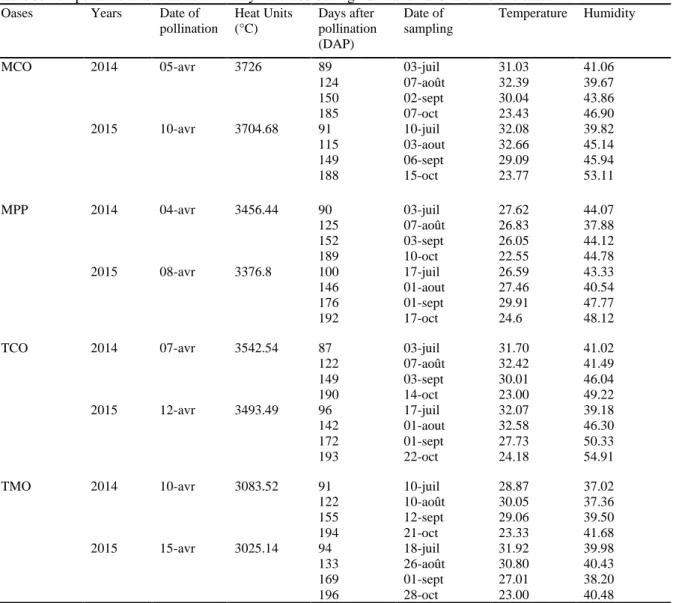
maturity was precocious in the MPP as compared to TCO and TMO. In fact, 189 and 192 days were necessary for dates Deglet Nour for the completion of maturity during 2014 and 2015, respectively. The TMO seems to have a significant influence on the period required for fruit maturity with a delay of 10 days on the fruit maturity date for both campaigns 2014 and 2015. The first mature fruits were harvested at October 07, 2014 in the MCO Oasis. The latest
ones were harvested on October 21, 2014 at the Mountain Oasis (Table 3).
These differences could be attributed to the differences of climate conditions in 2014 and 2015 in the Djerid region. Many environmental factors influenced the growth and
development of fruit (Bindi et al., 2001), but the maturation time and on the duration of fruit
development is regulated mainly by climatic factors related especially to temperature and
humidity (Zaid & De Wet, 2002). The highest heat unit values in 2014 and 2015 were found
in MCO oases (3726) and (3704.68), respectively. The lowest values were observed in TMO
oases (3083.52) and (3025.14), for 2014 and 2015, respectively. Hot season and zero
JOURNAL OF HORTICULTURE AND POSTHARVEST RESEARCH VOL. 3(1) MARCH 2020
date fruit ripening. The number of heat units (degree days) needed to ripen the fruit varies
with cultivar and ranges between 2100 and 4700 for early and late-ripening cultivars, respectively. From blossoming to ripening, the temperature optimal daily varied from 21°C for early ripening cultivars to 24°C for mid-season cultivars, and 27°C for late-ripening
cultivars (Rygg, 1975). Zaid and De Wet (2002) have summarized the climatic requirements
of date palm. To have a good quality of the fruit on date palm, the production must have high temperatures (an average of 30°C, low humidity, ample sunshine and adequate supplies of
underground water or irrigation (Purseglove, 1972).
Table 3. Temperature and relative humidity recorded during 2014 and 2015 at different oases
Oases Years Date of
pollination Heat Units (°C) Days after pollination (DAP) Date of sampling Temperature Humidity
MCO 2014 05-avr 3726 89 03-juil 31.03 41.06
124 07-août 32.39 39.67 150 02-sept 30.04 43.86 185 07-oct 23.43 46.90 2015 10-avr 3704.68 91 10-juil 32.08 39.82 115 03-aout 32.66 45.14 149 06-sept 29.09 45.94 188 15-oct 23.77 53.11 MPP 2014 04-avr 3456.44 90 03-juil 27.62 44.07 125 07-août 26.83 37.88 152 03-sept 26.05 44.12 189 10-oct 22.55 44.78 2015 08-avr 3376.8 100 17-juil 26.59 43.33 146 01-aout 27.46 40.54 176 01-sept 29.91 47.77 192 17-oct 24.6 48.12
TCO 2014 07-avr 3542.54 87 03-juil 31.70 41.02
122 07-août 32.42 41.49 149 03-sept 30.01 46.04 190 14-oct 23.00 49.22 2015 12-avr 3493.49 96 17-juil 32.07 39.18 142 01-aout 32.58 46.30 172 01-sept 27.73 50.33 193 22-oct 24.18 54.91
TMO 2014 10-avr 3083.52 91 10-juil 28.87 37.02
122 10-août 30.05 37.36 155 12-sept 29.06 39.50 194 21-oct 23.33 41.68 2015 15-avr 3025.14 94 18-juil 31.92 39.98 133 26-août 30.80 40.43 169 01-sept 27.01 38.20 196 28-oct 23.00 40.48
Taha et al.
JOURNAL OF HORTICULTURE AND POSTHARVEST RESEARCH VOL. 3(1) MARCH 2020
Morphological characteristics
The evolution of fruit length, width and weight during the ripening period in 2014 and 2015
are reported in Table 4. For all fruit morphological characteristics, statistical analyses showed
significant differences (P<0.05) at all phenological stages for the two seasons. High temperatures three months after pollination (Khalal stage) were registered and considered to be factors that greatly influence the ripening of Deglet Nour at the four oases. Deglet Nour fruit reaches their maximum length in September and October depending to the oases: 4.84-4.6 cm; 4.74-3.94 cm; 4.74-3.85 cm and 4.5 cm for TMO, MCO, MPP and TCO in 2014 and 2015, respectively.
Fruits increase in width from 0.57 to 2.32 cm and from 0.64 to 1.92 cm in 2014 and 2015 season, respectively. The weight of date palm fruit increased progressively in the four oases from 0.93 to 13.74 g and from 2.74 to 12.35 g in 2014 and 2015 season, respectively. In the first 4-5 weeks, date fruit became green at kimri stage and characterized by 27.5 mm length × 17.8 mm in diameter and 5.8g as average weight. In the khalal stage, the fruit characterized by 32.5 mm in length and 21 mm in diameter and the weight fruit became 8.7g. The hottest month in the oasis was July when temperatures go up to 44.4°C. The lowest temperature recorded during the study period was 15.1°C for October 2014 and 2015. From September to October, we marked a decrease of four regions date fruits length, width and weight. However, in TMO the date fruits had, at harvest date, the highest fruit length and width compared to all others (4.3-1.96 cm). TCO has the lower length and width significantly in 2014 than 2015 season (4.01-1.78 cm). Then, the width of the fruits decreased from 2.32 to 1.78 cm and from 1.92 to 1.7 cm in 2014 and 2015 season, respectively. However, the weight of date palm fruit increased from 13.74 to 8.83g and from 12.35 to 8.83g in 2014 and 2015 season, respectively.
Few years ago, El-Arem et al. (2012) reported that, during the maturation period, the length of
Deglet Nour varied from (4.30 ± 0.17–4.10 ± 0.11), width from (1.90 ± 0.17–1.60 ± 0.11 cm) and weight from (11.88 ± 0.16–10.49 ± 0.17 g) values from besser to tamar stage, respectively.
Mature TMO dates had the highest weight (10.9 g). However, TCO dates had the lowest fruit weight (8.83g). Differences observed for the same cultivar are mainly due to the climate
conditions and harvesting period (Somayeh et al., 2012). The relative humidity is high
throughout the two years 2014 and 2015. It was respectively, on average 78%) and (14-85%).
Date fruit color changes to green, red, light brown to dark brown during development. Results from this study showed that the highest parameters L*, Chroma and H° were recorded in MCO at stage 3for the two seasons 2014 and 2015 (48.89 ±0.58, 23.79 ±0.65, 72.55 ±0.69),
(54.2 ±0.41, 12.86 ±065, 85.94 ±0.44), respectively (Table 4). The highest values of these
parameters at the next stage were observed in TCO (45.52 ±0.61, 46.91 ±0.65, and 36.88 ±0.44), (43.18±0.69, 50.74±0.45, 50.91±0.37) in 2014 and 2015, respectively. These differences can be explained by variability on the ripening stage from an oasis to another.
Elleuch et al. (2008) reported that ‘Deglet Nour’ fruit at tamar stage has a L* = 31.71 ± 0.57
these values are comparable to this study. El-Zoghbi (1994) reported that metabolic and
physiological changes occur in date fruits during growth, development and ripening. These variations could be related to genotype, branch size, temperature and heat units, light and water potential, carbohydrate supply and hormonal changes, especially gibberellin, auxin and ethylene levels. The green color of Deglet Nour fruit was observed at the khimri and Khalal stages, red color was observed at rutab stage and yellow color were observed at tamar stage. At the khimri and khalal stage, MPP and MCO fruits had red color; TMO and TCO fruits had yellow color (in the two seasons). The change to the red color of MCO and MPP Deglet Nour fruits at the fourth stage (in two seasons) has been recorded earlier.
JOURNAL OF HORTICULTURE AND POSTHARVEST RESEARCH VOL. 3(1) MARCH 2020
The third development stage of date fruit (rutab) corresponded to light green color with a
slight yellowish tinge which is an indicated by the C* values. At the kimri and khalal stage, date fruits from all the four different oases showed lightness values in a narrow range, but at the rutab and tamar stages, the lightness values decreased. However, by the fourth stage, the MCO and MPP fruits had developed a reddish color indicated by a higher L* values (45.92 ±0.4/46.60 ±0.25, in 2014 and 2015, respectively). TMO and TCO fruits were yellow in color with a lower L*values (43.18 ±0.69/45.18 ±0.63 in 2014 and 2015, respectively). Mean values of L*, hue and C* of TMO fruits ranged from (52.21 ±0.93/30.55 ±0.76/60.38 ±0.63) in 2014 (54.72 ±0.45/12.01 ±0.64/69.61 ±0.54) in 2015, respectively. The L*, C* and hº Color Space can be grading ripe category of date fruits according to its color to more than color such as(yellow, light red and dark red), according to Chroma (C*) and hue angle (hº) for each variety of date fruits. Date color can be related to the moisture, sugar content and level of
acidity through the color and saturation for date fruit (Ibrahim et al., 2014).
Table 5. Physical characteristics of dates ”Deglet Nour” at the different stage from different oases in two seasons (2014 and 2015)
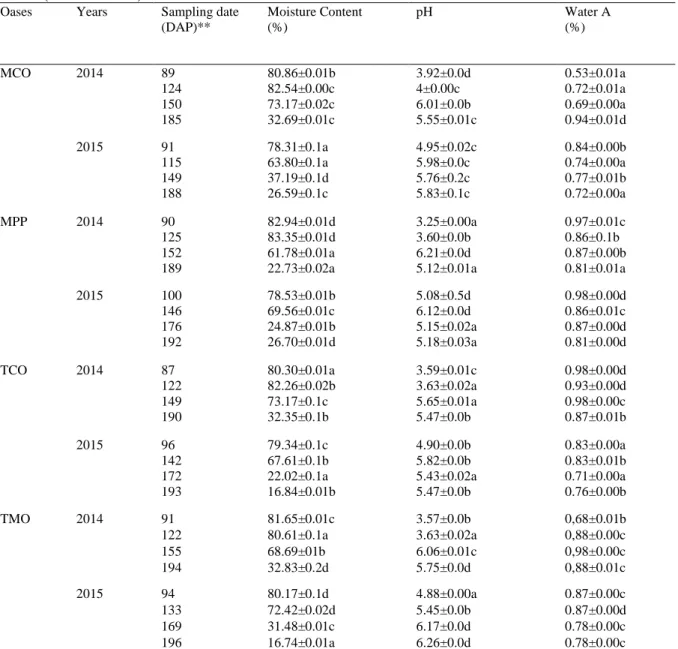
Oases Years Sampling date (DAP)** Moisture Content (%) pH Water A (%) MCO 2014 89 80.86±0.01b 3.92±0.0d 0.53±0.01a 124 82.54±0.00c 4±0.00c 0.72±0.01a 150 73.17±0.02c 6.01±0.0b 0.69±0.00a 185 32.69±0.01c 5.55±0.01c 0.94±0.01d 2015 91 78.31±0.1a 4.95±0.02c 0.84±0.00b 115 63.80±0.1a 5.98±0.0c 0.74±0.00a 149 37.19±0.1d 5.76±0.2c 0.77±0.01b 188 26.59±0.1c 5.83±0.1c 0.72±0.00a MPP 2014 90 82.94±0.01d 3.25±0.00a 0.97±0.01c 125 83.35±0.01d 3.60±0.0b 0.86±0.1b 152 61.78±0.01a 6.21±0.0d 0.87±0.00b
189 22.73±0.02a 5.12±0.01a 0.81±0.01a
2015 100 78.53±0.01b 5.08±0.5d 0.98±0.00d 146 69.56±0.01c 6.12±0.0d 0.86±0.01c 176 24.87±0.01b 5.15±0.02a 0.87±0.00d 192 26.70±0.01d 5.18±0.03a 0.81±0.00d TCO 2014 87 80.30±0.01a 3.59±0.01c 0.98±0.00d 122 82.26±0.02b 3.63±0.02a 0.93±0.00d 149 73.17±0.1c 5.65±0.01a 0.98±0.00c 190 32.35±0.1b 5.47±0.0b 0.87±0.01b 2015 96 79.34±0.1c 4.90±0.0b 0.83±0.00a 142 67.61±0.1b 5.82±0.0b 0.83±0.01b
172 22.02±0.1a 5.43±0.02a 0.71±0.00a
193 16.84±0.01b 5.47±0.0b 0.76±0.00b TMO 2014 91 81.65±0.01c 3.57±0.0b 0,68±0.01b 122 80.61±0.1a 3.63±0.02a 0,88±0.00c 155 68.69±01b 6.06±0.01c 0,98±0.00c 194 32.83±0.2d 5.75±0.0d 0,88±0.01c 2015 94 80.17±0.1d 4.88±0.00a 0.87±0.00c 133 72.42±0.02d 5.45±0.0b 0.87±0.00d 169 31.48±0.01c 6.17±0.0d 0.78±0.00c 196 16.74±0.01a 6.26±0.0d 0.78±0.00c
Fruits in each column followed by different letters (a, b, and c) indicate significant differences (P < 0.05) using the test of Newman-Keuls. **: DAP: days after pollination
Taha et al.
JOURNAL OF HORTICULTURE AND POSTHARVEST RESEARCH VOL. 3(1) MARCH 2020
Physical characteristics
The moisture content of dates ‘Deglet Nour’ varied from 83.35 to 22.73% in 2014, and from
82.54 to 16.74 in 2015, respectively (Table 5). During development, fruits decrease in
moisture content. The last stage of date growth, TMO had the highest moisture content (32.83- 26. 7% in 2014 and 2015, respectively). MPP and TCO had the lowest moisture
content (22.73-16.74% in 2014 and 2015, respectively). These results are comparable to Booij
et al. (1992), Sawaya et al. (1983) and Elleuch et al. (2008). Some differences were attributed
to varieties, agro-environmental conditions (Ahmed et al., 1995; Al-Hooti & Jiuan 1995;
Gasim, 1994). El-Arem et al. (2012) reported that the values of moisture content of Deglet
Nour varied from 65.50 to 21.95 % at besser to tamar stage, respectively.
Date palm of TMO, possessed higher pH (5.75- 6.26) in 2014 and 2015, respectively, and MPP showed the lowest values in these two seasons (5.12- 5.18).The fruit dates of MCO revealed a slightly acid pH equal to 5.83 compared to that of the fruits of the TMO 6.26. The dates of the MPP and TCO region present the most acid pH values 5.18 and 5.47 respectively
(Table 5). Good quality fruits of date palm had a pH of 6.43 (Khali et al., 2007). It increased
from a stage to another (Jarrah, 1983; Rastegar et al., 2012). El-Arem et al. (2012) showed
that fruit pH was 5.84 at besser stage, 6.34 at rutab stage and 6.85 at tamar stage. TMO possessed the high quality of fresh Deglet Nour in 2015 (6.26).
The high values of water activity (aW) were observed at the samples of MCO (0.94) and
MPP (0.81) in 2014 and 2015, respectively. Fruit of date palm is characterized by a low fatty
acid content (0.66) which protects them against all bacterial development (Besbes et al.,
2009). Guerin et al. (1978) showed that relative humidity is important for the stability of a
product. Indeed, the water content of food is directly related to the moisture of the air.
Biochemical characteristics
The highest TSS (total soluble solids) concentration was recorded in TCO (18.2) in 2014 and in MCO (17.7) 2015. However, in MCO, the date palm had the lowest TSS fruit (17.3) in
2014, and in 2015 MPP has the lowest TSS fruits (16.4). The results (Table 6) showed that
TSS increase gradually to the tamar stage. The TSS increased gradually from (2.5-17.3) in MCO, from (2.5-17.5) in MPP, from (2-18.2) in TCO, from (2.8-17.8) in TMO and from (3.2-17.7) in MCO, from (3.1-16.4) in MPP, from (3.5-16.9) in TCO, from (3.3-17.1) in TMO respectively, during fruit development.
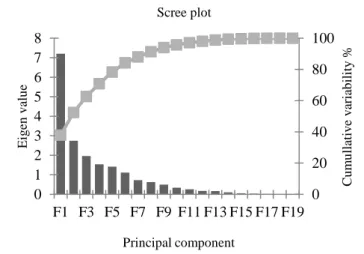
Fig. 1. Scree plot of variance explained by each factor of the principal component. 0 20 40 60 80 100 0 1 2 3 4 5 6 7 8 F1 F3 F5 F7 F9 F11 F13 F15 F17 F19 Cu m u llativ e v aria b ili ty % Ei g en v alu e Principal component Scree plot
JOURNAL OF HORTICULTURE AND POSTHARVEST RESEARCH VOL. 3(1) MARCH 2020
Table 6. Biochemical quality characteristics of dates ”Deglet Nour” at the different stage from different oases in
two seasons (2014 and 2015) Oases Years Sampling
date (DAP)** TSS° (%) Fiber S (%) Fiber I (%) Glucose (%) Fructose (%) Sucrose (%)
MCO 2014 89 3.6±0.01a 1.16±0.00c 11.69±0.00a 20.02±0.43c 8.19±0.1c 0.085±0.001a 124 9±0.02c 1.18±0.00b 9.14±0.01b 27.41±0.52c 8.89±0.24d 0.17±0.002a 150 12.6±0.00b 1.67±0.00d 4.92±0.01a 41.69±0.35b 20.77±0.24b 6.27±0.009a 185 17.3±0.01a 2.50±0.1c 4.70±0.01a 48.74±0.45c 24.31±0.35c 8.86±0.002d 2015 91 6.2±0.1b 1.34±0.00d 11.22±0.00b 12.41±0.00b 4.61±0.43d 0.085±0.009a 115 9.6±0.2a 1.61±0.00c 9.66±0.00c 40.82±0.17d 18.51±0.52c 0.72±0.01b 149 14.8±0.1c 1.87±0.00d 5.69±0.00a 30.78±0.08b 15.05±0.35b 5.75±0.003a 188 17.7±0.2d 2.34±0.00c 5.06±0.00a 41.64±0.26c 22.06±0.45c 7.40±0.006d MPP 2014 90 3.7±0.01b 0.96±0.01b 12.33±0.01b 14.33±0.28a 4.84±0.12a 0.11±0.005b 125 10.1±0.01d 0.99±0.01a 9.36±0.01c 23.83±0.43a 7.04±0.24c 0.17±0.002a 152 12.4±0.00a 1.16±0.01a 7.65±0.01c 41.87±0.33b 21.62±0.24c 6.99±0.001c 189 17.5±0.01b 2.79±0.00d 6.17±0.01b 57.95±0.59d 30.09±0.58d 8.71±0.007b 2015 100 5±0.1a 1.06±0.00b 12.38±0.00d 12.03±0.002b 4.52±0.28c 0.085±0.002a
146 10.6±0.1b 1.38±0.00b 9.63±0.00c 38.11±0.009c 19.04±0.35d 0.17±0.004a 176 13.2±0.1a 1.66±0.00c 6.87±0.00c 32.69±0.09c 16.34±0.33d 6.18±0.001b 192 16.4±0.1a 2.45±0.00d 6.17±0.00b 30.71±0.08b 16.91±0.53a 6.17±0.002a TCO 2014 87 3.8±0.01c 0.59±0.00a 15.01±0.01d 18.60±0.43b 7.12±0.12b 0.085±0.002a
122 8.9±0.01b 1.18±0.01b 8.82±0.01a 25.57±0.35b 7.39±0.24b 0.17±0.002a 149 14.7±0.02d 1.50±0.00c 6.88±0.00b 31.19±0.43a 13.85±0.12a 6.17±0.008a 190 18.2±0.03d 1.98±0.01a 6.52±0.00c 38.12±0.14a 17.53±0.44a 8.80±0.006c 2015 96 9.9±0.1d 0.89±0.00a 11.03±0.00a 12.08±0.17c 3.44±0.43a 0.085±0.001a
142 12.9±0.1d 1.18±0.00a 8.84±0.00a 34.77±0.00a 12.23±0.42a 0,17±0.01a 172 14.3±0.12b 1.5±0.00b 6.84±0.00b 33.07±0.17d 16.09±0.43c 7.46±0.009c 193 16.9±0.12b 2.19±0.00a 6.25±0.00c 26.50±0.00a 14.98±0.42b 6.46±0.007b TMO 2014 91 3.9±0.01d 1.19±0.01d 14.18±0.01c 14.64±0.48a 5.42±0.24a 0.085±0.003a
122 6.6±0.01a 1.30±0.01c 11.96±0.00d 25.20±0.45b 7.57±0.28c 0.17±0.002a 155 13.7±0.03c 1.38±0.02b 7.74±0.01d 47.89±0.48c 24.65±0.33d 6.81±0.017b 194 17.8±0.01c 2.18±0.02b 6.88±0.01d 39.92±0.07b 18.51±0.44b 6.89±0.02a 2015 94 7.2±0.12c 1.17±0.00c 12.17±0.00c 10.58±0.00a 3.93±0.43b 0.085±0.003a
133 10.8±0.12c 1.38±0.00b 10.96±0.00d 34.85±0.08b 11.92±0.34b 0.17±0.005a 169 14.8±0.12c 1.42±0.00a 6.99±0.00d 26.68±0.00a 16.87±0.43a 6.31±0.001b 196 17.1±0.1c 2.24±0.00b 6.28±0.00d 42.30±0.07c 22.50±0.43d 6.94±0.003c Fruits in each column followed by different letters (a, b, and c) indicate significant differences (P < 0.05) using the test of Newman-Keuls. **: DAP: days after pollination.
During all the maturation stages, the soluble fiber content of date flesh samples ranged from 0.65 to 2.79% and from 20.58 to 4.7%, for insoluble fiber in 2014 and 2015, respectively. The insoluble fiber was initially higher at khalal (S3) stage then sharply decreased during rutab and finally lowest at tamar stage (S6) in all date palm of the four oases
(Table 6).Highest fiber insoluble was recorded in TMO in the two-seasons (2014-2015), at
khalal, rutab and tamar stage (11.96-7.74-6.88%), (10.82-7.28-6.99%), respectively. Lowest fiber insoluble values (8.82-6.88-6.52%), (8.84-6.84-6.25%) were recorded in TCO, in 2014 and 2015, respectively. The date palm fruit of MPP possessed the highest values of soluble fiber in 2014 than 2015 season (2.79-2.45%). But TCO has the lowest values of soluble fiber (1.98-2.19%) in the two seasons (2014-2015).
According to Al-Farsi and Lee (2008), the dates contain an average total fiber content of
between 3.57 g/100 g and 10.9 g/100 g, which are divided into soluble fibers (0.4-1.3 g/100 g) and insoluble fibers (3.03-7.4 g/100 g). The date palm collected from MPP, TMO, MCO and TCO oases indicated that variation in the region, and climatic conditions could make an impact on the fruit quality and nutritional values. The results are comparable to those reported
Taha et al.
JOURNAL OF HORTICULTURE AND POSTHARVEST RESEARCH VOL. 3(1) MARCH 2020
previously, with some differences related to date variety and agro-climatic and environmental
conditions (Ahmed et al., 1995; Elleuch et al., 2008; Gassim, 1994).
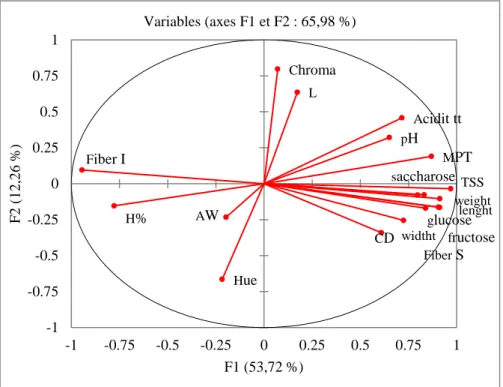
Fig. 2. Circle of correlation of variables (F1 and F2) during two study seasons
(Length : length of dates, width : width of dates, weight : weight of dates, H% : Moisture content, ACI : total acidité, TSS : total soluble solids, SAC : sucrose, MPT : protein content, AW: activité de l’eau)
observations on the factorial plan of two study seasons Projection of Fig. 3. MCO11 MCO12 MCO13 MCO14 MCO15 MCO16 MPP11 MPP12 MPP13 MPP14MPP15 MPP16 TCO11 TCO12 TCO13 TCO14 TCO15 TCO16 TMO11 TMO12
TMO13 TMO14TMO15 TMO16
MCO21 MCO22 MCO23 MCO24 MCO25 MCO26 MPP21 MPP22 MPP23 MPP24 MPP25 MPP26 TCO21 TCO22 TCO23 TCO24 TCO25TCO26 TMO21
TMO22TMO23 TMO24
TMO25 TMO26 -4 -3 -2 -1 0 1 2 3 4 -6 -5 -4 -3 -2 -1 0 1 2 3 4 5 6 F2 ( 1 2 ,2 6 %) F1 (53,72 %) Observations (axes F1 et F2 : 65,98 %) lenght widtht weight Acidit tt AW TSS FiberS Fiber I H% pH MPT CD glucose fructose saccharose L Hue Chroma -1 -0.75 -0.5 -0.25 0 0.25 0.5 0.75 1 -1 -0.75 -0.5 -0.25 0 0.25 0.5 0.75 1 F2 ( 1 2 ,2 6 %) F1 (53,72 %) Variables (axes F1 et F2 : 65,98 %)
JOURNAL OF HORTICULTURE AND POSTHARVEST RESEARCH VOL. 3(1) MARCH 2020
Fig. 4. Projection of the best-represented variables on the factorial plane 1-2 of two study seasons
Total dietary fiber contents varied significantly between 8.09 g/100g and 5 g/100g (dry
matter basis) in Deglet Nour (Besbes et al., 2009). Ripening condition, location, year of
development and method of studies can make the difference of characteristics (Besbes et al.,
2009).
The composition and amounts of sugars of date are shown in (Table 6). Sugars varied
within oases and stages of maturity. Sucrose, fructose and glucose are the main sugars in date. Significantly differences were observed in sugars content in dates from a different stage of maturation and in proportions between the regions. In season 2014, the high quantity of reducing sugars (glucose and fructose) ranged from 57.95 to 30.09% in MPP. Whereas, the elevated sucrose contents in MCO was about8.86%. The lower quantity of reducing sugars ranged from 38.12 to17.53% in TCO. Whereas, the lower sucrose contents in TMO was about6.89%.
The high content of reducing sugars and low values of sucrose was observed in the date palm fruit in the two seasons. To have a good quality of date fruit, we should have a high
temperature during maturation and development stage. The content of sucrose in the tamar
stage decrease because of the rising activity of the splitting enzyme invertase (Barreveld,
1993). Bousdira (2007) reported that the values of glucose in date ‘Deglet Nour’ was over
than 34%, the fructose content ranged from 21 to 30% and the amount of sucrose ranged from
0 to 12%. Reynes et al. (1994), Ahmed et al. (1995), and Bouabidi et al. (1996) showed that
the values of glucose in date ‘Deglet Nour’ ranged from 26% to 47%, the values of fructose ranged from 23% to 46% and the amount of sucrose ranged from 10% to 24%. However,
MCO11 MCO12 MCO13 MCO14 MCO15 MCO16 MPP11 MPP12 MPP13 MPP14 MPP15 MPP16 TCO11 TCO12 TCO13 TCO14 TCO15 TCO16 TMO11 TMO12 TMO13 TMO14 TMO15 TMO16 MCO21 MCO22 MCO23 MCO24 MCO25 MCO26 MPP21 MPP22 MPP23 MPP24 MPP25 MPP26 TCO21 TCO22 TCO23 TCO24 TCO25TCO26 TMO21 TMO22 TMO23 TMO24 TMO25 TMO26 -4 -3 -2 -1 0 1 2 3 4 -6 -5 -4 -3 -2 -1 0 1 2 3 4 5 6 F2 ( 1 2 ,2 6 %) F1 (53,72 %) Observations (axes F1 et F2 : 65,98 %)
Taha et al.
JOURNAL OF HORTICULTURE AND POSTHARVEST RESEARCH VOL. 3(1) MARCH 2020
Baliga et al. (2011) found that the chemical composition of dates in sugars ranged from
52.6-88.6 (g/100g) Glucose 17.6-41.4, Fructose 13.6-36.8, Sucrose 0.5-33.9.
Significantly differences were observed in the percentage of reducing sugars and sucrose for all the dates’ fruits of the different regions.
Multivariate analysis
Correlation of parameters was used to study the interrelationships among some major maturity chemical characteristic and climate conditions. Analytic results were reveled significant (P<0.05) strong relationships were observed among the investigated parameters. A
good correlation were showed significantly (P<0.05) between TSS and sugars (sucrose: r2
=0.803; fructose: r2=0.726; glucose: r2 =0.687), pH (r2 =0.708), soluble fiber (r2 =0.798).
There were also correlations between soluble fiber and sugars (sucrose: r2 =0.785; fructose:
r2=0.738; glucose: r2 =0.669), and very good correlations between glucose and fructose (r2
=0.967). Negative relationships (P<0.05) were observed between moisture content and TSS (r2 = -0.837), as well as between moisture content and soluble fiber (r2 = -0.829), then high negative correlations with sucrose (r2 = -0.93).
The highest positive correlation has been observed in the case of length with width and weight (r=0.744), (r=0.915), respectively, followed by TSS with pH (r=0.708). Significant positive correlations were found for the two successive years between insoluble fiber and moisture content (r=0.756), between fructose and TSS, soluble fiber and glucose (r=0.726), (r=0.738) and (r=0.738), respectively, while the highest negative correlation have been observed in the case of insoluble fiber with TSS (r= -0.919) and in the case of fructose with insoluble fiber (r=-0.707). The correlation coefficient was significant only in physicochemical parameters of date palm fruit for the two successive years. These differences can be due to environmental conditions or to the coexistence of different genotypes. Finally, some cropping techniques such as fertilization and irrigation can affect the weight, length and diameter of the date. In general, good fertilized and irrigated palms produce dates with better length, diameter
and date weight than poorly maintained dates (Munier, 1973). The length of date fruits
increased when pH increased and became an acid pH: TMO>MPP> TCO> MCO. Dry dates would be slightly more acid by contribution to dates soft and semi-soft.
The length of date fruit increased when the sucrose content increased: MCO> TCO>
MPP> TMO (Munier, 1973; Nixon et al., 1973; Sawaya et al., 1983) agree that the variability
of sugars content of dates according to variety, climate, and stage of maturation.
The weight increased when the sucrose content increased: MCO> TCO> MPP> TMO, the
sugar content increased with the ripening of the fruit. It is also known (Abdel-Nasser &
Harhash, 2007; Ahmed IA et al., 1995; Ahmed et al., 2014) that the softening of the texture of
dates is mostly a result of the reversal of sucrose to fructose and glucose.
A negative correlation was found between the moisture content and the sucrose content. This often indicated that dry dates had the most sucrose values and the soft dates were not richer in total sugars than the dry dates. The first (TMO, MPP) rich in glucose and the second
(TCO, MCO) were rich in sucrose (Ben Salah & Hellali, 2003). According to Awad et al.
(2011), dry date varieties contain high levels of sucrose. On the other hand, soft dates are very
rich in reducing sugars; half-soft dates contain as much sucrose as reducing sugars. Dates fruit had low sucrose content were rich in glucose content (TMO, MCPP). Dates fruit had rich sucrose content were dry dates (TCO, MCO), and dates had low values of sucrose are soft dates. The high Brix content reflects the richness of dates studied in carbohydrate.
This study was carried out with the aim to contribute the physic-chemical of date palm fruit collected from different oases of Djerid region. All the studied parameters (Insoluble and soluble fiber, sugars, moisture content, TSS and pH) were subjected to principal component
JOURNAL OF HORTICULTURE AND POSTHARVEST RESEARCH VOL. 3(1) MARCH 2020
analysis (PCA). Moreover, the agreement between the results of the ACP and the statistical
analysis reveals that the difference between morphological and physico-chemical parameters was observed in dates fruit collected from various oases. High temperature and low humidity during ripening of date fruit observed in some different oases can be the cause of similarities or variation in the physico-chemical composition.
CONCLUSION
The present study, conducted during two years on date fruit of Deglet Nour cultivar in Djerid Oases, permitted to conclude that the high length, width and weight of fruits were observed at modern oases. Deglet Nourdate fruits collected from Traditional Continental Oases were very rich in sucrose, TSS and soluble fibers. The composition of dates varied according to phenological stages and the sampling region.
Variation of climate condition (temperature and humidity) in oases could induce more disorders in composition and quality of date fruit, as well as significant changes in TSS, sugars content, total fiber content and water activity than in morphological characters (length, width and weight). So, climate change could affect directly and indirectly the production and quality of date fruits in different oases.
CONFLICT OF INTEREST
The authors have no conflict of interest to report.
REFERENCES
Abdel-Nasser G., & Harhash M. (2007). Response of "Seewy" Date Palm cultivar to salinity of well water under Siwa Oasis conditions- Egypt 1.Vegetative growth, yield and fruit quality. The Fourth Symposium on Date Palm in Saudi Arabia (Challenges of processing, marketing, and pests control), Date Palm Research Center, King Faisal University, Hofuf, Kingdom of Saudi Arabia, 18-21.
Ahmed, J., Al Jasass, F. M., & Siddiq, M. (2014). Date fruit composition and nutrition. In Dates:
Postharvest Science, Processing Technology and Health Benefits, John Wiley & Sons, Ltd.
261-283.
Ahmed A, Ahmed A. W. K., & Robinson R. K. (1995). Chemical composition of date varieties as influenced by the stage of ripening, Food Chemistry, 54, 305-309. https://doi.org/10.1016/0308-8146(95)00051-J
Al-Farsi, M.A., & Lee, C.Y. (2008). Nutritional and functional properties of dates: a review. Critical
Reviews in Food Science and Nutrition, 48, 877-887. https://doi.org/10.1080/10408390701724264
Al-Hooti, S. & Jiuan, H. (1995). Quabazard, Arab Gulf Journal of Scientific Research, 13, 553. AOAC. 1995. Official Methods of Analysis. 18th ed. Association of Official Analytical Chemists;
Arlington, VA, USA
Artés, F., Tudela, J.A., & Villaescusa, R. (2000). Thermal postharvest treatments for improving pomegranate quality and shelf life. Postharvest Biology and Technology, 18, 245-251. https://doi.org/10.1016/S0925-5214(00)00066-1
Awad, M. A., Adel, D., Al-Qurashi, S., & Mohamed, A. (2011). Biochemical changes in fruit of an early and a late date palm cultivar during development and ripening. International Journal of Fruit
Science, 11, 167-183. https://doi.org/10.1080/15538362.2011.578520
Ibrahim, A., Eissa, A., & Alghannam, A. (2014). Image processing system for automated classification date fruit. International Journal of Advanced Research, 2(1), 702-715.
Barreveld, W. H. (1993). Date palm products, FAO, Agricultural Services Bulletin N°101, Food and
Taha et al.
JOURNAL OF HORTICULTURE AND POSTHARVEST RESEARCH VOL. 3(1) MARCH 2020
Ben Salah, M., & Hellali, R. (2003). Phenopomologic description of 15 Tunisian cultivars of date palm (Phoenix dactylifera). Bulletin of the Phytogenetic Resources PGRI. https://hal.archives-ouvertes.fr/hal-00886069/document
Besbes, S., Drira, L., Blecker, C., Deroanne, C., & Attia, H. (2009). Adding value to hard date (Phoenix dactyliferaL.): Compositional, functional and sensory characteristics of date jam. Food
Chemistry, 112, 406-411. https://doi.org/10.1016/j.foodchem.2008.05.093
Bindi, M., Fibbi, L., & Miglietta, F. (2001). Free Air CO2 Enrichment (FACE) of grapevine (Vitis
vinifera L.): II. Growth and quality of grape and wine in response to elevated CO2
concentrations. European Journal of Agronomy, 14(2), 145-155.
Booij, G., Piombo, J., Risterucci, M., Coupe, M., Thomas, D., & Ferry, M. (1992). Study of the chemical composition of dates at different stages of maturity for the varietal characterization of various date palm cultivars (Phoenix dactylifera L.). Fruits, 47(6), 667-678.
Bouabidi H., Reyens M., & Roussi, M. B. (1996). Criteria for fruit characterization of some cultivars of date palms (Phoenix dactylifera L.) from southern Tunisia, INRAT, 69-87.
Bousdira (2007). Thesis, University of Boumerdes, Alger. p. 149.
El-Arem, A., Saafi, E. B., Flamini, G., Issaoui, M., Ferchichi, A., Hammami, M., & Achour, L. (2012). Volatile and nonvolatile chemical composition of some date fruits (Phoenix dactylifera L.) harvested at different stages of maturity. International Journal of Food Science & Technology,
47(3), 549-555. https://doi.org/10.1111/j.1365-2621.2011.02876.x
Elleuch, M., Besbes, S., Roiseux, O., Blecker, C., Deroanne, C., & Attia, H. (2008). Date flesh: Chemical composition and characteristics of the dietary fibre. Food Chemistry, 111, 676-682. https://doi.org/10.1016/j.foodchem.2008.04.036.
El-Zoghbi, M. (1994). Biochemical changes in some tropical fruits during ripening. Food Chemistry,
49, 33-37. https://doi.org/10.1016/0308-8146(94)90229-1
Fruits, G.I. (2016). Interprofessional grouping of fruits. Annual report.
Gasim, A. A. A. (1994). Changes in sugar quality and mineral elements during fruit development in five date palm cultivars in AI-Madinah AI-Munawwarah. Journal of King Abdul Aziz University,
Science, 6, 29-36.
Girard F. (1980). Palm plantations and date palm cultivation in the Air Massif (Nothern Niger). Fruits, 35, (6).
Jarrah, A. Z. (1983). Some physicochemical changes in Khadrawi date and determination of the depressed period. Date Palm Journal 2(2), 19-36.
Khali, M., Selselet-Attou, G., & Guetarni, D. (2007). Influence of thermization and modified atmospheric packaging on the chemical composition of the Deglet Nour date during cold storage.
Science & Technology, 26, 9-16.
Lavelle, C., Micale, F., Houston, T., Camia, A., & Hiederer, R. (2008). Climate change in Europe. 3. Impact on agriculture and forestry. Agronomy, 433-446.
MARHP, (2016). Agricultural statistics: Areas and productions. The Minister of Agriculture. Munier, P. (1973). The date palm. Ed. G-P Maisonneuvre and Larose, Paris, p. 220.
Nixon, P. R., Namken, L. N. & Wiegand, C. L. (1973). Spatial and temporal variations of crop canopy temperatures and implications for irrigation scheduling. In: F. Shahrokhi (Editor), Proceeding of earth resources observation and information analysis system: remote sensing of earth resources, Tullahoma, TN, Vol. 21, pp. 643-657.
Prosky, L., Asp, N. G., Schweizer, T. F., DeVries, J. W., & Furda, I. (1988). Determination of insoluble, soluble, and total dietary fiber in foods and food products: interlaboratory study. Journal-Association of Official Analytical Chemists, 71(5), 1017-1023.
Purseglove, J. W. (1972). Tropical crops. Monocotyledons. Longman London.
Rastegar, S., Rahemi, M., Baghizadeh, A., & Gholami, M. (2012). Enzyme activity and biochemical changes of three date palm cultivars with different softening pattern during ripening. Food Chemistry, 134(3), 1279-1286. https://doi.org/10.1016/j.foodchem.2012.02.208
Reynes, M., Bouabidi, H., Piombo, G. & Risterucci, A.M. (1994). Characterization of the main varieties of dates grown in the region of Djérid in Tunisia. Fruits, 49(4), 289-298.
JOURNAL OF HORTICULTURE AND POSTHARVEST RESEARCH VOL. 3(1) MARCH 2020
Rygg, G. L. (1975). Date development, handling and packing in the United States. Agric. Handbook. 482, Agricultural Research Service. Washington DC, US Department of Agriculture.
Sawaya, W., N., Miski, A., M., Khalil, J., K., Khatchadourian, A. A., & Mashadi, A. S. (1983). Date
Palm Journal, 2, 1.
Seguin, B., & Stengel, P. (2002). Climate change and greenhouse effect. Technical report, INRA
monthly.
Shabana, H., & Al Sunbol, A. (2007). Date palm flowers and fruit setting as affected by low temperatures preceding the flowering season. Acta Horticulture, 736, 193-198.
https://doi.org/10.17660/ActaHortic.2007.736.16
Singh, V., Guizani, N., Essa, M. M., Hakim, F .L. & Rahman, M. S. (2012). Comparative analysis of total phenolics, flavonoid content and antioxidant profile of different date varieties (Phoenix
dactylifera l.) from Sultanate of Oman. International Food Research Journal, 19, 1063-1070.
Youssef, T., & Awad, M. A. (2008). Mechanisms of enhancing photosynthetic gas exchange in date palm seedlings (Phoenix dactylifera L.) under salinity stress by a 5-aminolevulinicacid-based fertilizer. Journal of Plant Growth Regulation, 27, 1-9. https://doi.org/10.1007/s00344-007-9025-4 Zaid, A. & De Wet, P. F. (2002). Climatic requirements of date palm, In Date Palm Cultivation (Ed Zaid, A.), FAO Plant Production and Protection Paper No. 156, Rome, Italy, FAO.
Taha et al.
JOURNAL OF HORTICULTURE AND POSTHARVEST RESEARCH VOL. 3(1) MARCH 2020