Isokinetics and Exercise Science 13 (2005) 69–70 69 IOS Press
Abstract
Consequences of latissimus dorsi transfer on
shoulder function
B. Forthomme
a, O. Heymans
b, F.X. Granjean
b, S. Klinkenberg
a, S. Hoffmann
aand J.L. Croisier
aaDepartment of Physical Medicine and Rehabilitation, CHU Sart Tilman, Li `ege, Belgium bDepartment of Plastic, Esthetic and Reconstructive Surgery, CHU Sart Tilman, Li `ege, Belgium
Objectives: The latissimus dorsi is one of the largest
muscles in the body. This muscle recognizes many ap-plications in reconstructive surgery [1]. Since its in-troduction, the technique of latissimus dorsi myocu-taneous flap breast reconstruction has yielded results characterized by excellent tissue vascularity and low donor site morbidity [2]. This study was undertaken to determine the functional consequences associated with the latissimus dorsi muscle donor site.
Methods: Twelve women (mean age of 50.1 ± 7.5
years) were studied before and up to 3 months after a latissimus dorsi transfer following mastectomy (one woman sustained a bilateral musculo-tendinous trans-fer), six of the thirteen shoulders sustained a 6 month follow-up. They sustained a bilateral isokinetic shoul-der assessment involving the internal (IR) and exter-nal (ER) rotators and the abductor (ABD) and adduc-tor (ADD) muscles. The ER-IR were tested in a lying supine position (45◦of abduction in the frontal plane)
at 60◦/s and 240◦/s in the concentric mode. The
ABD-ADD were assessed in a newly designed lying lateral position between 0◦and 90◦of abduction in the frontal
plane at 60◦/s and 180◦/s in the concentric mode [3].
The passive goniometric range of motion was measured in flexion, extension, internal and external rotation with shoulder placed either at 0◦ or at 90◦ of abduction.
The subjective pain was evaluated by means of a vi-sual analogic scale (VAS) before and after isokinetic assessments. The subjects also benefited from specific clinical testing of conflict (Hawkins, Yocum and Neer test) on both shoulders.
Results and Discussion: Six months post-surgery,
pa-tients recovered a subnormal passive mobility, with only the external rotation at 0◦ of abduction standing
significantly inferior (p < 0.05; 7%) in comparison
with the contralateral healthy shoulder. They did not describe any complaints through the VAS either be-fore or after the isokinetic measurement except for one woman who presented a slight pain before and after the strength assessment (2.2. and 3.7 respectively on the VAS). Four out of thirteen operated shoulders (three months follow-up) and three out of six (six months follow-up) showed a Hawkins and/or Yocum positive testing.
Three months after the latissimus dorsi transfer, the affected shoulder developed a significant (p < 0.05)
weakness on the IR (16.8± 10.6% at 60◦/s), the ADD
(38.6± 12.5% at 60◦/s) and the ABD (9.3± 12.4% at
60◦/s) in comparison with the pre-surgery strength
pro-file. Hence, compared to the healthy side, the operated shoulder showed a significant (p < 0.05) decrease of
strength on the IR (14.8± 21.4% at 60◦/s) and ADD
(37.3 ± 9.4% at 60◦/s). No improvement occurred
within the 6 months follow-up group and they still pre-sented a significant (p < 0.05) deficit six months
af-ter surgery (20.9 ± 12.9% on the IR; 37.1 ± 7.9%
on the ADD; 17.9± 10.9 % on the ABD at 60◦/s) in
comparison with the non-operated shoulder.
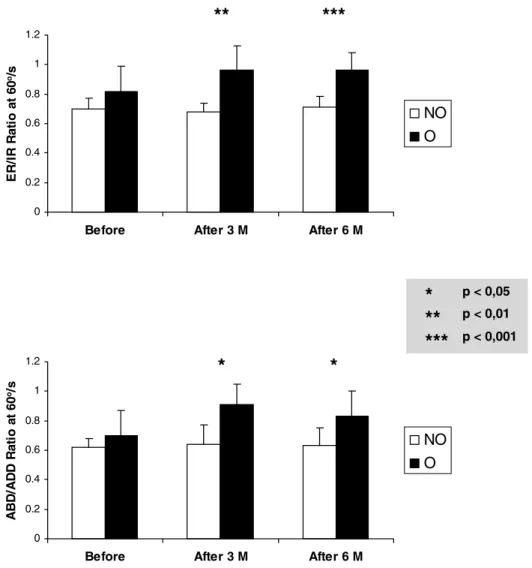
The ER/IR and ABD/ADD concentric ratios were increased on the operated shoulder comparatively to the healthy side after surgery. For instance, at 3 months post-surgery, we obtained 0.96± 0.17 versus 0.68 ± ISSN 0959-3020/05/$17.00© 2005 – IOS Press and the authors. All rights reserved
70 B. Forthomme et al. / Consequences of latissimus dorsi transfer on shoulder function p < 0,05 p < 0,01 p < 0,001
*
**
***
* *
0 0.2 0.4 0.6 0.8 1 1.2Before After 3 M After 6 M
E R /IR R at io a t 6 0 o/s NO O
***
**
0 0.2 0.4 0.6 0.8 1 1.2Before After 3 M After 6 M
AB D/ ADD Ra ti o a t 6 0 o/s NO O
Fig. 1. ER/IR and ABD/ADD ratios at 60◦/s in the concentric mode before, three (3 M) and six (6 M) months after latissimus dorsi transfer. 0.06 for the ER/IR ratio at 60◦/s and 0.91± 0.13 versus
0.64± 0.13 for the ABD/ADD ratio at 60◦/s (Fig. 1).
Conclusion: Three and 6 months after a latissimus dorsi
transfer following mastectomy, the operated shoul-der showed a significant weakness mainly in the IR and ADD muscles, entailing to higher ER/IR and ABD/ADD ratios in comparison with the contralateral side. In spite of a satisfactory passive motion pattern, some of these shoulders developed positive conflict signs.
References
[1] J.K.G. Laitung and F. Peck, Shoulder function following the loss of the latissimus dorsi muscle, Br J Plastic Surg 38 (1985), 375–379.
[2] S.A. Slavin, Improving the latissimus dorsi myocutaneous flap with tissue expansion, Plast Reconstr Surg 93 (1994), 811. [3] B. Forthomme, J.L. Croisier and J.M. Crielaard, Proposal for
the assessment protocols for different shoulder muscle groups,