20 Hypertelescope concepts: from Carlina prototypes into space
Team Ubaye: A. Labeyrie (CdF, FR), D. Mourard (OCA, FR) with team LISE
Contact email: [email protected]
Team OHP: H. Le Coroller (LAM, FR), J. Dejonghe (OCA, FR), L. Arnold (OHP,
FR), D. Defrère (ULg, BE)
Contact email: [email protected] Affiliations:
CdF: Collège de France, 06460 Caussols, France
OHP: Observatoire de Haute Provence, 04870 Saint-Michel-l'Observatoire, France
LAM: Laboratoire d'Astrophysique de Marseille, Rue Frédéric Joliot Curie, 13013 Marseille, France
OCA: Observatoire de la Côte d'Azur, Boulevard de l'Observatoire, 06300 Nice, France ULg: Space sciences, Technologies and Astrophysics Research (STAR) Institute, Université
de Liège, 19c Allée du Six Août, B-4000 Liège, Belgium
The performance of optical/infrared interferometers has largely increased over the past fifteen years. In particular, state-of-the-art interferometers, such as the VLTI, the CHARA array, and the LBTI, have taken the first images of stellar surfaces (e.g., Monnier et al. 2007), planet forming regions (e.g., Kluska et al. 2016), and even a Jovian moon (Conrad et al. 2015) at high-angular resolution (see also Chapter 2).
However, due to the relatively low sensitivity (mv < 10-12) and limited imaging capability of current facilities, the number of observable objects is still small. Numerous research works have been carried out to increase the sensitivity of the focal instruments by improving the co-phasing (Fringe Tracker), and/or the way the light is recombined (ex: Berger & Mérand 2013; Petrov 2014, etc.). Furthermore, a major challenge for future optical Interferometry will be to manage the complexity and cost of high resolution imaging arrays combining hundreds or thousands of sub-apertures. The hypertelescope concept addresses these shortcomings of optical long-baseline arrays.
20.1 Concept
The theory of hypertelescope imaging (Labeyrie et al., 1996, Lardière et al., 2007) indeed indicates that dilute arrays of many sub-apertures can concentrate most light collected from a resolved compact source into a direct high-resolution image, if the light is co-phased and co-focused through a pupil-densifier element. It also predicts a much better imaging performance and science output, for a given collecting area and meta-aperture size, to be achievable with many small apertures rather than with a few larger ones.
These theoretical predictions were verified with extended versions of the Fizeau interferometer, having a miniature size but using many sub-apertures and equipped with a pupil densifier by Pedretti et al., and Gillet et al. And large hypertelescopes are feasible with an opto-mechanical architecture similar to the Arecibo radio telescope. It has a fixed and diluted segmented concave meta-mirror, replacing its primary mirror and a focal camera, suspended above it, tracks the source's image, co-focused through an attached pupil-densifier.
Meta-apertures larger than a kilometer appear feasible at suitably concave terrestrial sites for milliarcsecond resolution. And much larger sizes, up to perhaps 100,000km, are proposed for space versions using a flotilla of small mirrors, accurately driven by small solar sails or a laser-trapping scheme.
Because it does not require optical delay lines, the hypertelescope's optics is thus much simplified with respect to that of multi-telescope interferometers. It employs specific components such as:
1. a pupil densifier system capable of accommodating the pupil drift;
2. optionally, a field-dissector for simultaneously observing multiple compact sources such as star clusters or galaxies, with astrometric capabilities;
3. coronagraphic cameras are also optionally usable for high-contrast imaging of sources such as exo-planets near their parent star.
A feature of terrestrial so-called Carlina architectures of the hypertelescope concept (Labeyrie 2000, Le Coroller et al. 2004), with a diluted Arecibo-like optical array of small spherical apertures, is the absence of a giant steerable mount for globally pointing the hypertelescope as a solid system. This causes an apparent drift of the sub-pupils pattern with respect to the meta-pupil observed by an eye located at the focal image of a moving star. This complication is balanced by removing the element which is currently limiting the optical diameter of ELT's to about 40m, namely the steerable mount. Instead, terrestrial hypertelescopes of the kilometric size can be considered based on the Carlina architecture (Labeyrie et al., 2012).
In space, no mount will be needed at all for supporting or steering a flotilla of mirrors together with its focal spaceships, using thrusters such as ion jets, small solar sails, or "laser trapping" beams. Meta-apertures as large as 100,000km may then become feasible. Several versions have been proposed to NASA and the European Space Agency (ESA), including a "Laser Trapped Hypertelescope
Figure 20-1: Carlina-OHP schema: in September 2013, the helium balloon (Papers I and II) was replaced by a truck crane. The thickness of the cables and the diameter of the primary mirrors (25 cm) have been enlarged to make them visible on this scale drawing. An elastic rope attached to the ground passes through a pulley at the top of the crane and pulls on the same cable, with the same force (1100 N) as the helium balloon.
The adaptive cophasing of terrestrial versions requires interferometric wave sensing, achievable by analyzing the science image according to the "Dispersed Speckle" or "Chromatic Phase Diversity" methods. And a high limiting magnitude can be expected if the applicability of Laser Guide Star systems becomes confirmed. For early science, before installing the adaptive cophasing system, images can be reconstructed by Speckle Imaging.
Pending hypertelescopes in space, where the reference star for wave sensing can be degrees away from that observed, terrestrial versions would much benefit from using an artificial reference star for adaptive cophased observing on faint sources, a mode which interferometers have not yet been able to attempt. The modified "Hypertelescope Laser Guide Star" (H-LGS) version (Nunez et al., 2014) of the Laser Guide Star (LGS) systems (Foy and Labeyrie, 1985) which became used at the largest telescopes is a candidate approach which requires further assessment, particularly regarding the laser power needed.
20.2 Carlina testbed at OHP
The principle of the diluted telescopes (ex: the hypertelescopes proposed by Labeyrie 1996) consists of recombining a large number of mirrors (telescopes) using direct imaging techniques in order to optimize the signal-to-noise ratio of the image. On-sky studies with Carlina-type technology have been performed at OHP (Le Coroller et al. 2004). Above the diluted primary mirror made of fixed co-spherical segments, a helium balloon or cables suspended between two mountains and/or pylons, carries a gondola containing the focal optics. This concept does not require delay lines and could work with hundreds of mirrors.
The Carlina prototype was built at the Haute-Provence Observatory (OHP, Figure 20-1, Figure 20-2, Figure 20-3) between 2003 and 2014. The main goals of this prototype were to explore
opto-Figure 20-2: On this figure, we see the crane that is carrying a metrology gondola (red point at the summit of the crane) at the curvature center of the diluted primary mirror (71 m above the ground), and the focal gondola (enlightened in white) 35.5 m above the ground. Three primary mirrors are around the table of metrology on the ground (see also Figure 20-3).
mechanical solutions to stabilize the optics attached under the cables, and to test this interferometer under real conditions: stellar fringes detection; S/N measurement; guiding performances.
20.2.1 State of technology
In 2012, metrology fringes have been obtained (Figure 20-4, left), and co-spherized the primary mirrors within one micron accuracy (Le Coroller et al. 2012). In 2013, the whole optical train has been tested: servo loop, metrology, and the focal gondola. Stellar fringes of Deneb have been recorded (Figure 20-4, right) in September 2013 (Le Coroller et al. 2015).
This work helped us to better understand the advantages of this system, and its limits: For example, we checked that the ground moves slowly (typical deformation <<100 microns during one night with ten meter baselines). This is clearly an advantage for Carlina-like architectures. But even if the ground deformations change relatively slowly, three motors by mirror at least will be necessary to adjust the piston and tip-tilt for each sub-aperture. With tens of mirrors, this can become relatively complex
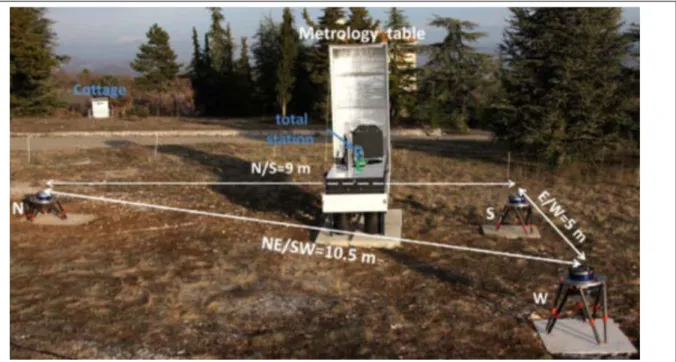
Figure 20-3: We see on this picture the three mirrors and baselines of the Carlina prototype, built at the Haute-Provence Observatory. The table of metrology has been used to align the whole system (the primary mirrors, metrology and focal gondola).
Figure 20-4: Left: Metrology fringes obtained with the Carlina OHP prototype. The red dashed lines indicate the trace of the oscillations of the fringes. Right: Square modulus of the Fourier transform of the stellar fringes recorded on Deneb with a photon-counting camera. We see the fringe peaks of the 5m baseline (P1 mark).
(number of servo loops, etc.).
The OHP experiment was stopped once the main goals were reached with the technical demonstrator. More studies are also required to determine if such an opto-mechanical design can work with AO systems (for example, regarding high frequencies vibrations in the cables).
20.3 Carlina testbed at Ubaye valley
16As previously described in more details, hypertelescopes are multi-aperture interferometers providing a direct image of compact sources. The meta-beam, containing beams from all sub-apertures which converge on their way toward the image plane where they are co-focused, is then densified before reaching it. Such densification does not destroy the direct image, but shrinks the diffractive envelope of the interference function. The notion of a point spread function then vanishes since the image of a point source becomes position-dependent. The image of an extended source may then be described by a pseudo-convolution with the source function. It restricts the field size which can be directly imaged down to a "Direct Imaging Field" (DIF) (Labeyrie, 2007, Lardière et al., 2007). And it intensifies the image, approximately as 2 if is the pupil densification factor, by concentrating into the interference peak the light diffracted across the sub-aperture lobe. Sources smaller than the DIF are directly imaged. Larger ones can to some extent be reconstructed post-detection with the algorithm of Mary et al, or extended versions of the CLEAN algorithm exploiting the a priori known off-axis evolution of the interference function. The DIF size is /s , on the order of 0.1 second in visible light if the primary sub apertures are spaced s= 1m apart, but only 0.01 arc-second if s= 10m .
16 See also: http://hypertelescope.org/
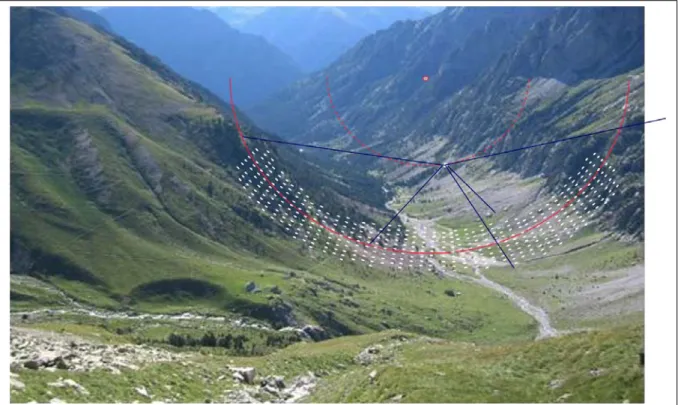
Figure 20-5: Representation of the diluted M1 mirror of the Ubaye Carlina hypertelescope prototype with the focal gondola suspended to a cable crossing the valley and connected to six cables wires to adjust translation and position to form the direct image.
Hence the advantage of using, for a given meta-aperture size and total collecting area, more mirrors of smaller size, which also improve the contrast of the interference peak, and thus the dynamic range of the direct images.
To progress in the direction of performance estimation, we tested a prototype hypertelescope during the last four years on the heights of the ubaye Valley in the upper Moutière valley of the Southern Alps (Figure 20-5). It demonstrated the feasibility and operability of the concept with its cable-suspended focal camera, driven with millimetric accuracy for tracking the motion of a star's image (Autuori et al., 2016). The prototype also served to develop co-spherization techniques for the primary meta-mirror, in tip/tilt and piston, as well as auto-guiding techniques for the focal gondola. Adaptive devices will be needed in the future to fulfil the sensitivity requirements of the various science programs. Among the future perspectives, we are also studying the possibility of removing the suspension cable and of replacing it by an autonomous drone supporting the focal optics.
20.4 Outlook
We think that an interesting scientific case for a diluted telescope of 70-120m, as post-E-ELT facility, could be to image, and study planets in the most interior orbits of the nearest stars. A 70m baseline indeed provides the required resolution to image such systems, and the number of mirrors required for this topic is probably reasonable. More work is needed to determine if we will be able to reach very high contrast (<10-7) at 2-3 times smaller inner working angle than the E-ELT. This kind of light recombination may benefit from the recent progresses achieved in the field of mono-pupil telescopes (itself, often inspired from interferometry techniques): sensor post-coronagraphy, phase-diversity methods, Kernel-Phase, etc. (Baudoz, P. 2006; Martinache, F., 2011; Paul, B. et al.2013). A study of an interferometric recombination (as 3rd generation or visitor instrument) on the E-ELT (Le Coroller, 2016), could also help to prepare such a project and to evaluate the possible gains in terms of contrast, sensitivity, etc. In the very long term, diluted telescopes could offer the possibility to launch and build giant apertures (>> 100m) in space to carry out very ambitious science programs, such as imaging exoplanet surfaces.
20.4.1 Proposal for a "European Extremely Large HYPERtelescope (E-ELHyt)"
The current Moutière site of the Ubaye testbed (Sect. 20.3) in the Southern Alps has a topography suitable for upgrading the meta-aperture diameter toward about 200m, a modest size relative to that possible at other potential sites in wider valleys. Although considered to be among the best astronomical sites in Europe, being located very close to the Restefond pass where many European amateur astronomers bring their instruments for summertime observing, its astronomical quality is likely below that of some world-class sites outside Europe. We selected it, among many other candidate sites in the southern Alps, for its rather smooth curvature, the high ridges at 2600m to the North and South, the access road section (2km, unpaved) from the neighbouring village, and the quality of "seeing", with a frequent near-zero local wind at night during typical good observing conditions, a rare feature in mountain valleys where strong thermal solar effects tend to create katabatic winds. Their near absence at Moutière may result from the valley's slope to the West, which may conflict with the prevailing westerly winds. The appreciable snow cover in wintertime may allow unattended remote observing once sufficient automation is installed. A small laboratory may be installed in a temporary or permanent building, more comfortable than the laboratory tent used during the four recent years.
Other potential sites in the same area are located much closer to established observatories, such as the Calern observatory which has a strong tradition in optical and infra-red interferometry. It itself lacks the deep depression needed for installing a sufficiently large meta-mirror, 100m or more. But nearby valleys are potentially suitable. Calern itself now has a full-size test-bed, flat and static, for preparing the Moutière observing.
Following the demonstration of construction and alignment techniques with the Moutière prototype, and the development of its operating software, we propose the step-wise construction of a "European Extremely Large HYPERtelescope (E-ELHyt)" (Labeyrie et al., 2012). As achieved successfully by ESO for the ALMA, a low-risk strategy with low initial cost involves the on-site testing of a few small mirror segments feeding a small flying focal camera. It is carried by an electric drone which is assisted by a small helium balloon for reduced generation of air turbulence. Once the embryonic array reaches a sufficient Technology Readiness Level for science operation, it can be expanded by adding mirror segments. Their optimal size is comparable with Fried's radius of the turbulent cells, on the order of 20 to 60cm for visible and near-infrared optimization. A meta-aperture size on the order of a kilometer appears feasible in sites featuring a suitably concave topography; its collecting area can eventually become comparable to that of the E-ELT, i.e. about 1500m2. The mirror supporting system can be similar to the FAST radio telescope, currently being completed in China, and can similarly provide active piston corrections for a spherical or active paraboloidal geometry, which may be quickly switchable to either mode if only three actuators carry each mirror segment. The former geometry allows many focal gondolas to observe different sources at the same time, but requires within each a pair of additional small mirrors for correcting spherical aberration.
20.4.2 Feasibility of an E-ELT-coupled hypertelescope
Following the successful interferometric coupling of smaller ATs with one or more UTs at the VLTI, numerical simulations have evidenced the science potential of larger coupled systems involving an ELT and the many small mirrors of an adjacent hypertelescope. There is an optical synergy which significantly improves the resolution and luminosity of the cophased direct image. No adjustable optical delay lines are required, in addition to the short-stroke cophasing actuators, if the hypertelescope's meta-mirror virtually intersects the mechanical node of the ELT mount. Then, the ELT's coudé beam can be directed toward the hypertelescope's focal camera for a combined image. This appears feasible at the E-ELT site, which dominates a 500m-deep, and 5.5km wide, valley on its East side, oriented North-South. And an embryonic test system can probably be installed at low-cost once, or even before, the E-ELT construction is completed. Two potential limitations must however be considered: the North-South valley orientation reduces the declination coverage; and the prevailing winds at the E-ELT site are appreciably faster than at some other sites, requiring faster adaptive phasing.
References
1. Monnier, J. D.; Zhao, M.; Pedretti, E. 2007, ”Imaging the Surface of Altair” Science, 317, 342 2. Kluska, J. et al. 2016, SPIE, “The innermost astronomical unit of protoplanetary discs” 3. Conrad, A. et al. 2015, EPSC, “High resolution LBT imaging of IO and Jupiter”,vol. 10, 351
4. Berger, J.-P., Mérand, A. 2013, “The Very Large Telescope Interferometer: status and plans”, Improving the performances of current optical interferometers & future designs, Proceedings of Haute Provence Observatory Colloquium (23 - 27 September 2013)
5. Petrov, R.G. et al, “Hierarchical Fringe Tracking”, SPIE proceedings 9146, 2014. 6. Labeyrie 1996, A&As,”Resolved imaging of
extra-interferometric arrays”,118, 517
7. Labeyrie, A. 2000, “Design solutions for extremely large telescopes and their interferometric uses”, Proceedings of the Backaskog workshop on extremely large telescopes : Backaskog Castle, Sweden, June 1-2, 1999, ESO conference and workshop proceedings, no. 57, p.12 8. Le Coroller, H., Dejonghe, J., Arpesella, C., et al. 2004, A& A,”Tests with a Carlina-type
hypertelescope prototype. I. Demonstration of star tracking and fringe acquisition with a balloon-suspended focal camera”, 426, 721
9. Le Coroller, H., Dejonghe, J., Regal, X. et al. 2012, A&A, “Tests with a Carlina-type Diluted Telescope, II. Primary mirrors coherencing”, 539, id.A59
10. Le Coroller, H., et al. 2015, “The Carlina-type diluted telescope. Stellar fringes on Deneb”, A&A, 573, A117.
11. Baudoz, P., 2006, “The Self-Coherent Camera: a new tool for planet detection”, Direct Imaging of Exoplanets: Science & Techniques, Proceedings IAU Colloquium No. 200, 2005 12. Martinache, F., 2011,“Kernel-phases for high-contrast detection beyond the resolution limit”,
SPIE, 8151, 11
13. Paul, B. et al. 2013, A&A ,”Coronagraphic phase diversity : performance study and laboratory demonstration”, 552, 48
14. Le Coroller 2016, HDR, Aix-Marseille university:
http://lecoroller.obs-hp.fr/uploads/htmlHerve/HDR_LeCoroller_PLUS_Annexes.pdf
15. Autuori et al. 2016, ‘Optical design options for hypertelescopes and prototype testings’, Proc. SPIE 9907, Optical and Infrared Interferometry and Imaging V, 99071J (September 7, 2016); doi:10.1117/12.2234434
16. Foy, R.; Labeyrie, A., 1985 "Feasibility of adaptive telescope with laser probe", Astronomy and Astrophysics (ISSN 0004-6361), vol. 152, no. 2, Nov. 1985, p. L29-L31.
17. Labeyrie, A,; Mourard, D.; Allouche, F.; et al. 2012, "Concept study of an Extremely Large Hyper Telescope (ELHyT) with 1200m sparse aperture for direct imaging at 100 micro-arcsecond resolution",2012, Optical and Infrared Interferometry III. Proc. of the SPIE, Volume 8445, article id. 844512, 9 pp.).
18. Labeyrie, A. et al. 2013, "Hypertelescope Optical Observatory", proposal to the European Space Agency , https://lise.oca.eu/IMG/file/WhitepaperProposalHypertelescope.pdf 19. Lardière, O.; Martinache, F.; Patru, F., 2007 "Direct imaging with highly diluted apertures - I.