L41
2-7/- L
Université de Montréal
Cooperative agents for enhancing learner practice
Par Hongtao Chen
Département d’informatique et recherche opérationnelle Faculté des arts et des sciences
Mémoire présenté à la faculté des études supérieures En vue de l’obtention du grade de
Maîtrise es sciences (M.Sc.)
en informatique
Octobre, 2004
—1 t
-flD
uc!
o
Université
de Montréal
Direction des bibliothèques
AVIS
L’auteur a autorisé l’Université de Montréal à reproduire et diffuser, en totalité ou en partie, par quelque moyen que ce soit et sur quelque support que ce soit, et exclusivement à des fins non lucratives d’enseignement et de recherche, des copies de ce mémoire ou de cette thèse.
L’auteur et les coauteurs le cas échéant conservent la propriété du droit d’auteur et des droits moraux qui protègent ce document. Ni la thèse ou le mémoire, ni des extraits substantiels de ce document, ne doivent être imprimés ou autrement reproduits sans l’autorisation de l’auteur.
Afin de se conformer à la Loi canadienne sur la protection des
renseignements personnels, quelques formulaires secondaires, coordonnées ou signatures intégrées au texte ont pu être enlevés de ce document. Bien que cela ait pu affecter la pagination, il n’y a aucun contenu manquant.
NOTICE
The author of this thesis or dissertation has granted a nonexciusive license allowing Université de Montréal to reproduce and publish the document, in part or in whole, and in any format, solely for noncommercial educational and research purposes.
The author and co-authors if applicable retain copyright ownership and moral rights in this document. Neither the whole thesis or dissertation, nor substantial extracts from it, may be printed or otherwise reproduced without the author’s permission.
In compliance with the Canadian Privacy Act some supporting forms, contact information or signatures may have been removed from the document. While this may affect the document page count, it does not represent any loss of content from the document
Université de Montréal
Faculté des tudes suprieures
Ce mémoire de maîtrise intitulé
Cooperative agents for enhancing learner practice
Présenté par Hongtao Chen
A été évalué par un jury composé des personnes suivantes:
Président rapporteur: Max Mignotte Directeur de recherche : Claude Frasson Membre de jury: Victor Ostromoukhov
Sommaire
En permettant de simuler les interactions d’un système de formation a distance, les agents intelligents peuvent fournir un outil puissant pour améliorer la formation en ligne. Un agent fournit un moyen d implémenter et de simuler les aspects humains de l’interaction de façon plus efficace que les autres méthodes contrôlées par l’ordinateur. De plus, du point de vue architecture, ceci permet plus de flexibilité dans la conception étant donné que les agents sont des objets indépendants de l’environnement d’apprentissage. Ainsi, des environnements tels que CLE (Cooperative Learning Environment) que nous présentons ici, permettent d’étudier l’effet d’un support personnalisé dans un environnement coopératif; il permet aussi d’adapter le processus d’apprentissage à des apprenants et d’organiser automatiquement des groupes d’apprentissage.
Les résultats préliminaires des recherches sur le CLE montrent que des systèmes basées sur plusieurs agents peuvent être utilisés pour améliorer effectivement la pratique chez l’apprenant. En termes d’impacts la création d’environnements basés sur des agents pour examiner permet d’être à la pointe de la recherche sur les agents intelligents et d’explorer de nouveaux paradigmes sur l’apprentissage et la formation en ligne.
Mot-clé : Agent, Système basées sur des agents, Système de formation i distance, Cooperative Learning Environment, Java FAQ.
Abstract
By using intelligent agents to simulate instruction in an online learning environment, agent-based learning environments can supply as a powerful research tool to study online leaming improvement. The agent provides a way to implement and simulate the “human” aspect of instruction in a more ecologically valid way than other controlled computer based rnethods. Additionally, from an architectural perspective, since agents are independent objects in the learning environment, it allows for more flexibility in research design. In particular, agent-based leaming environments, in systems such as CLE (Cooperative Leaming Environment), allow for studying the effect of providing a personalized leaming support in a cooperative leaming environment, can customize the learning process for individuaÏ leamers, and organize the leaming groups automatically.
Preliminary results from the CLE research indicate that multiple agent-based online learning systems can be used to effectively enhance the leamer practice. In terrns of overall impact, creating agent-based learning environments to study instructional issues is at the leading edge of research integrating intelligent agent with online education, and in exploring new paradigms for researching online teaching and leaming.
Keyword: Agent, Agent-Based System, Online Learning System, Cooperative Leaming Environment, Java FAQ.
Acknowledgement
I wouÏd like to acknowledge many people for helping me during my thesis work. I would especially like to thank my advisor, Professor Claude Frasson, for lis generous time and commitment. Througlout my thesis work, le encouraged me to develop independent thinking and research skills. He continually stimulated my analytical thinking and greatÏy assisted me with scientific writing. Professor Frasson has been a great source of encouragement and inspiration to me. Without his support this dissertation would flot have been written.
I owe my wife Wei Li for lier encouragement and support, witliout lier lielp it would have been a far more difficuit task to complete my thesis.
Finally, I tliank tlie Departrnent of Computer Science at the University of Montreal for giving me this opportunity and providing me an environment to do researdi.
Table of content
Sommaire Abstract ii Acknowledgement iii Table of content iv List of figures ix List of tablesList of equatïons xii
Chapter 1 Introduction 1
1.1 Purpose 3
1.2 Cooperative learning environrnent 3
1.3 Prototype application 5
1.4 Overview 6
1.5 Contribution 7
Chapter 2 Agent and online learning system 8
2.1 Agent $
2.1.1 Definition 9
2.1.2 Characteristic 13
2.1.3 Classification 14
2.1.4 Agent and Object 16
2.2 Online leaming system 19
2.2.1 Characteristic . 20
2.2.2 Agent-based onhine leaming system 21
2.2.3 Multi-agents system 22
2.3 Online leaming system mode! 24
2.4Summary 26
Cliapter 3 Personalized learning support 27
3.1 PersonaÏized !eaming support 27
3.2 Comparison 27
3.3 Cha!Ïenges 29
3.4 The Onhine Learning Ability 31
3.5 PLS design 32
3.6 Personahization Framework 34
3.7Summary 36
Chapter 4 Cooperative learning environment 37
4.1 Cooperative leaming 3$
4.1.1 Benefit 3$
4.1.2 Ehements ofCooperative Learning 3$
4.2 Online cooperative heaming 40
4.3 Existing on!ine CLE 41
4.3.1 Simu!ated student agent 42
4.3.2 Computational mode! of distance heaming 42
4.3.3 Mu!ti-agent architecture for cooperative leaming 44
4.4 Agents in cooperative leaming 45
4.5 Mechanisms 46
4.6PLE&CLE 4$
4.8 Overview. 51
Chapter 5 Prototype application 53
5.1 Three-tier application 53
5.1.1 Definition 53
5.1.2 Two-ticr versus three-tier 54
5.1.3 Three-tie architecture 55
5.2 System architecture 56
5.2.1 Presentation module 58
5.2.2 Presentation modules reference 58
5.2.3 Agents’ structure 59
5.2.4 Data access structure 60
5.3 XML 60
5.4 Data structure 62
5.4.1 FAQ item and it’s related tables 62
5.4.2 Leamer profile and its related tables 62
5.4.3 FAQ category 63
5.5 Summary 63
Chapter 6 Methodologies and algorithms 65
6.1 Agent’s responsibility 65
6.2 Architecture 66
6.3 Problem situation 68
6.4 Problem detecting routine 69
6.4.1 Problem agent action’s process 69
6.4.2 Affective difficulty reaction roles 70
6.4.3 Interpersonal difficulty reaction roles 72
6.5 Leaming from Feedback 72
6.6 Vector-based similarity weight measure. 73
6.7Summary 76
Chapter 7Implementation 77
7.1 Run-time environment and development tools 77
7.1.1 Development environrnent 77
7.1.2 Database engine 79
7.2 CÏass diagram 80
7.2.1 User class 80
7.2.2 Item class $1
7.2.3 Database helper class 82
7.3 Scenario diagram 83 7.3.1 Browsing scenario 83 7.3.2 Search scenario 84 7.3.3 Reading scenario 85 7.3.4 Recommending scenario $6 7.4 User interface 86
7.4.1 Login & Register $6
7.4.2 Select the interesting section 87
7.4.3 FAQ list $7
7.4.4 Section list 88
7.4.5 Question & answer 89
7.4.6 Search resuit 90
7.4.7 Recommend a reference 91
7.4.8 Customized mouse right click menu 92
7.5 Examples & Scenarios 93
Chapter 8 Conclusion. 100
8.1 Conclusion 100
8.2 Future work 102
Bibliography 105
Lïst of figures
Figure 1-1: Cooperative leaming environment .4
f igure 2-1: Abstract view of an agent in its environment 13
Figure 2-2: Classification of Agents 15
Figure 2-3: Multi-agent system 24
Figure 2-4: A Developing Conceptual framework for Online Learning 25
Figure 4-1: Social Icaming mode! 44
Figure 4-2: Communication in CLE learning group 4$
Figure 5-1: Typical three-tier application architecture 54
Figure 5-2: System architecture 57
Figure 5-3: Presentation modules structure 5$
Figure 5-4: Presentation modules reference 59
Figure 5-5: Agents structure 59
Figure 5-6: Virtual database interface 60
Figure 5-7: FAQ items and it’s related 62
Figure 5-8: User table and it’s related 63
Figure 6-1: Logical Architecture 66
Figure 7-1: User class and its related 81
Figure 7-2: A FAQ item and its related $2
Figure 7-3: Data access helper class $2
Figure 7-4: Browse scenario 84
Figure 7-5: Search scenario $5
f igure 7-6: Reading scenario 85
Figure 7-7: Recommending scenario $6
Figure 7-9: Select the interesting section $7
Figure 7-10: FAQ list 8$
Figure 7-11: Client side agent pops up to display a message 8$
Figure 7-12: Section list 89
Figure 7-13: fAQ item- question & answer 90
Figure 7-14: Search resuit 91
Figure 7-15: Asking recommendation 91
Figure 7-16: Recommendation web dialog 92
Figure 7-17: Customized mouse right click menu 92
Figure 7-1$: Find definition 93
Figure 7-19: Search in Google 93
Figure 7-20: Agent suggests the leamer to use the search box 94
Figure 7-2 1: Learner’s Start Page 94
Figure 7-22: Recommend the leamer 95
Figure 7-23: Motivation Tips 96
Figure 7-24: Searching without result 96
Figure 7-25: Search selected text in the web page 97
Figure 7-26: Original List 9$
Figure 7-27: After leame?s recommendation 98
Figure 7-28: Comment the topic 99
List of tables
Table 2-l: Definitions of agent 11
Table 2-2: Evolution ofprogramrning approaches 1$
Table 5-l: XML example 61
List of equations
Equation 6-1: Basic distance 74
Equation 6-2: Step distance 74
Equation 6-3: Document distance 75
Equation 6-4: Ciosest distance 75
Equation 6-5: Continuai length 75
Equation 6-6: Document weight for query 75
Chapter 1
Introducfion
With the growing interconnectedness such as the internet and wireless tools we want distributed computing and multiple computers to be able to cooperate on difficult tasks efficiently. The web lias attracted a great deal of consideration as a medium for delivering the distance education, in a synchronous and asynchronous manner [Buraga 20031.Online learning using agents is a domain in which much progress has recently been realized. Different techniques sucli as reinforcernent learning [Dahistrom and Wiewiora 2002] [Paletta and Rorne 2000], artificial neural networks [Billard and Hayes 1997] or genetic algorithrns have been studied extensively and have produced good results. Recently researchers have focused on how agents can perform cooperative tasks, evaluate the actions and improve the leaming process. A number of algorithms have been produced to enhance the behaviours and the learning process of agents [Peeters 2003].
One of the active research aspects is to provide personalized learning support in the online learning system. Personalized learning support system analyses the leaming style, the learning process and the learning resuits ofthe learner to adjust the curriculum ofthe learning system according to the learner’s knowledge level, adapt the selection of learning material like presentations, examples, illustrations, feedback, tests etc. Because the leamer’s psychological states are flot well considercd or difficult to gather in the online learning system, a personalized learning support is stili a limitation in most researches [Zhang et al. 2003].
For instance, a leamer miglit Yack of motivation to complete a leaming session when he faces to a problem or a leaming situation. The main reason is that leamers have varying levels of knowledge, learning styles, and needs. Most of the online learning systems tbat apply the sarne approach to ail leamers cannot deal with them as personalized individuals [Razek et aÏ. 2002].
in the oniine learning environment, the difficulties of a personalized leaming support include:
Leaming process personalization
Ail the online leaming systems are pre-programrned. Some systems bave the ability to adjust the process to a certain extent for the leamer, but they stili have some kind of pre-defined procedures, structures or frameworks.
This framework could take effect in most of the situations, but it aiways bas the exception situation in real learning circumstances and the percentage of this kind of exception is higher than the researcher’s imagination. The flexibility of the leaming process is one of the open research issues even now.
Leaming materiai personaiization
In most of the online leaming system, learning materials are limited in the arranged documentations. Especially in the self-enclosed individual Ïearning system, the leamer cannot obtain any information outside flue system, even from the other leamers. The leamers, in the traditional cooperative leaming system, can exchange their experience each other, but ail the materials they faced are stiil the predetermined which certainly cannot meet ail the leamers’ needs. On the other hand, a great quantity of information resource is available on the Internet which might be convenience for the leamers. How to make efficient use of this kind of resources stiil is a question in the field ofonline leaming.
1.1 Purpose
Since the goal ofthe research is to build a cooperative leaming environment (CLE) based on several agents able to help automatically the learner, according to the questions above, our research is concerned to create a personalized leaming support system which can enhance the online leaming practice through custornized leaming process and materials by using cooperative agents.
A collection of agents in the system help the learner to constitute a personal learning environment (PLE), in which the leamer stores, organizes and comments information about the leaming, and from which new requirernent for CLE arises.
1.2 Cooperative learning environment
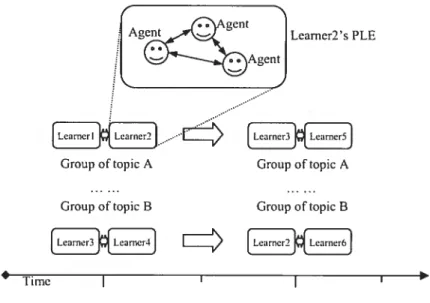
The CLE is the structuring ofvirtual leaming groups so that leamers can work together to maximize their own and each other’s leaming. Based on the leamer’s interest, leaming style and knowledge level etc, learners compose leaming groups automatically by the system. Group members focus on the same leaming topic and are able to go deep into the topic by communicating each other.
Since the CLE is generated dynamically during the leaming session, learners in the online leaming system are capable of having their own leaming practices. As a result, online leaming system can provide dynamic leaming process to support the personalized leaming through the CLE.
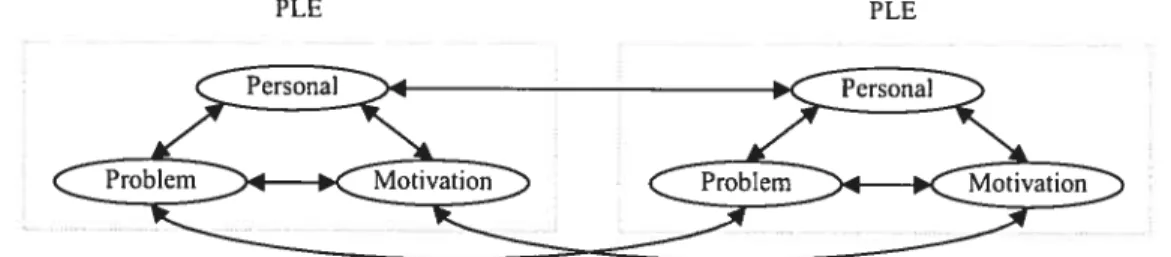
In a cooperative leaming environment (CLE), leaming practice information, including the leaming experience, reference documentation and valuable commentary, are shared via agents in PLE. In this way, agents change their behaviours not only in response to the
leamers’ leaming progress, state and history, but also to other agents’ actions and experience.
Following is a sketch about the CLE:
Learneri jÇ_Learner2j L...? Group oftopic A Group oftopic B [Learner3][.c4 LE> [ner3j(Learner] Group oftopic A Group oftopic B [Learner2)(i.earner6]
Figure 1-i: Cooperative learning environment
In every leaming phase of this environrnent, leamers study in their own PLE which provides leaming supports by several leaming agents. Agents inside the PLE support the leamer in accordance with learner’s leaming experience; simultaneously they refer to other leamer’s experience in the leaming group to present additional information to the learner.
11e leamer’s leaming process is customized by his own knowledge through the agents, but also adapted by the other Ieamer’s experience if the agents can detect the significant information from the other leamer. For example, if most leamers failed on a certain learning question, for leamers who can answer it correctly at the first time, they either have enough knowledge background to respond it, or get useful information from the previous leamer’s commentary in CLE.
Leamer2’s PLI
lOTie I I
1.3 Prototype application
We have developed a prototype application (a Java FAQ helping system) for the use of this framework which we cail the cooperative learning environment (CLE). In contrast to the existing models (refer Chapter 4 for detail), it’s a combination of the individual leaming system and the cooperative leaming system. In this application, agents can explicitly communicate each other, either that the action choices of the other agents are directly observable, or that the agents share the learners’ status and leaming history information. Agents observe ail the other agents in the CLE; refine these behaviours with its own experience. They try to detect the information about its potential action capabilities rather than duplicate the behaviours of other agents.
In our CLE, each personal leaming environment (PLE) is an independent entity. Yhey are homogeneous and communicate each other in the CLE, and there’s no mentor or director in the learning environment. This mechanisrn makes it possible that the leamers in the PLE have their individual leaming process based on their knowledge level, personal requirement and leaming state. li also resolves the problem in the system which lias an expert in the background, and tries to teach the leamer by the arranged style and process.
The CLE is composed by the PLEs inside it. Because the agents can provide the extra reference information through the Google web services, the leaming materials of the application is not only limited to the prepared documents in the database, but also includes the Google reference which searches documents in more than 1 billions web pages.
Inside the PLE, several agents work together to assist the learner during the Ïeaming session. Personal search agent grasps the reference documents from FAQ database and also the Internet by the Google Web Services. Problem agent detects the learner’s
weakness and pre-fetches the related information via the search agent. Motivation agent reinforces the learner’s motivation by the presentation and dialogue and transfcrs the resuÏt to the problem agent to complete the knowledge.
Ail the extra reference documents and related information corne from the Internet with the Web Services dynamically. Therefore, for different leamers with different situation, the reference information couid be completely different even with die same question. This mechanism makes the material of the learning system become infinite and possible to personalized material support for the individual leamers.
1.4 Overview
In the chapter two, we introduce the basic definitions ofthe agent and agent-based system. This is needed to have a common view on the subject; we introduce terrninoÏogy needed for the rest of the thesis and the research situation of agent-based system.
Chapter three discusses online learning, more especially agent-based onhine leaming. Except the benefit of the online leaming, we also introduce the agent roles in the leaming system and talk about multi-agent learning environments and issues.
Chapter four explains the cooperative agent learning environment, introduces the cooperative learning algorithm. We also present some existing cooperative learning models and discuss the mechanisms and structure of the cooperative leaming in that chapter.
Chapter five introduces the prototype application. We focus on the application’s architecture, system’s structure and data structure which should be used in following chapters for more detail discussion.
Chapter six presents the methodologies and algorithms using our application. We discuss the leaming situations analysis and detection and the vector based similarity weight measure which should be used by the agents in our application for the leamers’ status analysis and the leaming process detection.
Chapter seven introduces the implementation of the prototype application. We focus on the class diagrams and the important scenarios ofthe application. Through the description of the web interfaces, we present sorne detail technologies used in the application to enhancing the cooperative leaming.
In the final chapter we present our conclusions, restate the work done and suggest topics for further research.
1.5 Contribution
In this thesis, we discuss one of the techniques to enhance the online learning process
-providing personalized leaming support by intelligent agents. We introduce a cooperative learning environment to demonstrate the enhancement of agent-based online leaming system. We describe a learner difficutty detecting routine to analyze leamers’ situation and provide the personalized learning process. We also present a cooperative-based similarity measure algorithm to enhance the search process and result. A prototype application is included in this thesis which implernents the leaming environment and algorithm.
Chapter 2
Agent and online learning system
Our mode! of cooperative leaming environment is based on the frarnework of multi agents online leaming systems. This chapter briefly reviews some of the most relevant material and concepts within these fields.2.1 Agent
As we know, intheory, the only thing a computer really can do is binary mathematics. A
computer can only work under a series of the orders we designed in advance. If the computer steps into a situation we did flot anticipate, the resuit may become unexpected. For ail the stages during the computation, every situation has to be expiicitly anticipated and coded by a programmer. This simple fact is at the heart of our relationship with computers.
In the beginning, this behaviour is adequate. What we need the computer to do are just some simple and repeating jobs, such as the mathematic calculation. We assign the expressions and input the arguments, than the computer can aiways output the expected resuit. We accept that computers are well-trained, unimaginative labour. However, with the increment of the computation power of the machines, for the appearance of the large number of applications, we require systems that can decide for themselves what they need to do in order to satisfy their design objectives. When we have agents that can operate in rapidly changing, unpredictable, or open environments where there is a significant chance of failure we give them the name of intelligent agents, or also autonomous agents [Peeters 2003].
2.1.1 Definition
Although the term agent is widely used by many people working in closely related areas,
there is no single universally accepted definition of an agent. This is because agents can have different degrees of cornplexity. At one end of the spectrum, agents are extremely simple and have very limited capabilities. Simple agents simulate unintelligent machines such as thermostats, logic gates, and fuses. At the other end, agents have intricate structures and are capable of perforrning elaborate functions. Complex agents are comparable to biological organisms, complex machines, and people. The lack of a unique definition need not necessarily be a problem; after ail, if many peopie are successfuiiy
developing interesting and useful applications, then it hardly matters that they do not
agree on terminological details. However, there is also the danger that unless the issue is discussed, “agent” migbt become a “noise” tenu, subject to both abuse and misuse, to the potential confusion. Hence, we do flot intend to introduce yet another definition for software agent, but our objective is to identify the common characteristics of software agents and explain the concept of agency as related to our framework.
Wooldridge and Jennings [Wooldridge and Jennings 1992] have proposed one of the
most comprehensive definitions of agents. They distinguish two general usages of the term “agent”: the first is weak, and relatively un-contentious; the second is stronger, and
potentially more contentious.
Weak notion of agency: Perhaps the rnost general way in which the term agent is used is
to denote a hardware or software-based computer system that possesses the following properties:
• Autonomy: agents operate without the direct intervention of humans or others, and have some kind of control over their actions and internal state;
• Sociability: agents interact with other agents (and possibly humans) via an interface or possibly some kind of agent-communication language;
• Reactivity: agents perceive their environment, (which may be the physical world, a user via a graphical interface, a collection of other agents, the Internet, or perhaps ail of these combined), and respond in a timely fashion to changes that occur in it;
• Pro-activeness: agents do not simply react to their environment; they are able to exhibit goal-directed behaviour by taking the initiative.
In mainstream computer science, the notion ofan agent as a self-contained, concurrently executing software process, that encapsulates some states and is able to communicate with other agents via message passing, is secn as a natural development of the object based concurrent programming paradigm.
The weak notion of agency is also used in agent-based software engineering:
• “Lsojhvare agentsJ communicate with their peers bv exchanging messages in an
expressive agent communication language. Agents eau be as simple as subroutines; bttt typicaÏÏy they are larger entities with some sort of persistent control.” [Genesereth and Ketchpel 1994]
Stronger notion of agency: for some researchers - particularly those working in
Artfficial Intelligence (AI) - the term “agent” has a stronger and more specific meaning
than that sketched out above. An agent is generally referred to as a computer system that, in addition to having the properties identifled above, is either conceptualized or implemented using concepts that are more usuaÏly applied to humans. It is quite common in AI to characterize an agent using mentalistic notions, such as knowledge, belief, intention, obligation, or emotion.
Some other typical (and flot necessary mutually exclusive) definitions of agents are presented in the table following (Table 2-1) which provide a list of attributes often found in agents: Autonomous, goal-oriented, collaborative, flexible, setf-starting, temporal continuity, charactcr, communicative, adaptive, and mobile.
Table 2-1: Definitions of agent
Researchers Definition
Russel and “An agent is anything that can be viewed as perceiving its
. environment through sensors and acting upon that environment
Norvig
through effectors
“An agent is a software entity which functions continuously and Shoham autonomously in a particular environment, often inhabited by other
agents and processes”.
“Agents are viewed as having certain mental attitudes, beliefs, desires, and intentions that represent their infonriational, Kinney, motivational, and deliberative states, respectively. In BDI (Belief Georgeff, and Desire, and Intention) architecture an agent can be completely Rao specified by the events that it can perceive, the actions it may perform, the beliefs it may hold, the goals it may adopt, and the plans that give rise to its intentions”.
“An autonomous agent is a system situated within and part of an franklin and environment that senses that environment and acts on it, over time, in Graesser pursuit of its own agendas and so as to effect what it senses in the
future”.
“Intelligent agents continuously perform three functions: perception of dynamic conditions in the environment; action to affect conditions
Hayes-Roth . .
in the environment; and reasoning to intercept perceptions, solve problems, draw inferences, and determine actions”.
“Autonomous agents are computational systems that inhibit some Maes complex dynamic environment, sense and act autonomously in this environment, and by doing so realize a set of goals or tasks for which they are designed”.
“Autonomous agents are systems capable of autonomous, purposeful
Brus o O11l action in the real world. The fact that agents are to perform
purposeful action is often interpreted as meaning that they are goal
Researchers Definition
somewhat “psychological” sense), and devote their resources to satisfying these drives. In doing so, one can observe purpose in their actions. 1f the agents are to be autonomous, they have to either know or else be able to find out how to satisfy drives and achieve goals”. “An agent is a persistent software entity dedicated to a specific Smith, purpose. ‘Persistent’ distinguishes agents from subroutines; agents Cypher, and have their own ideas about how to accomptish tasks, their own Spohrer agendas. ‘Special purpose’ distinguishes them from multi-function
applications; agents are typically much smaller”.
“The term agent is used to represent two orthogonal concepts. The first is the agent’s ability for autonomous execution. The second is the agent’s ability to perfonn domain oriented reasoning”. For The MuBot example, Microsoft Word’s Spelling Assistant is a simple example of A entg an agent. The spelling assistant assists the user of Microsoft Word by autonornously watching over the words that are typed (sensing the environment) and underlines the words that it does not recognize (acting upon the sensed data). The recognition is based on understanding the domain of English words and their spellings. “Intelligent agents are software entities that carry out some set of operations on behaif of a user or another program with some degree The IBM of independence or autonomy, and in doing so, employ sorne Agent knowledge or representation ofthe user’s goals or desires. Intelligent agents work by allowing people to delegate work that they could have done, to the agent software”
“An agent is the central computational entity, which serves as an Steiner, explicit model of all entities participating in cooperation. it can be Mahling, and decomposed into the following three components: the functional, Haugeneder task-solving component, the cooperative super-strate, and the
communication functionality”.
By these definitions, we can sketch out the basic essences ofthe agent. A key property of agents is autonomy. They are independent which means they are capable of independent action without user interference. Another important property of agents is goal-driven. Agents have a purpose, and act in accordance with that purpose. Agents are also reactive. That is, an agent senses changes in its environment and responds in a timely fashion to these changes. This characteristic of agents is also at the core of delegation and automation. They are flot entirely pre-programmed but can make decisions based on
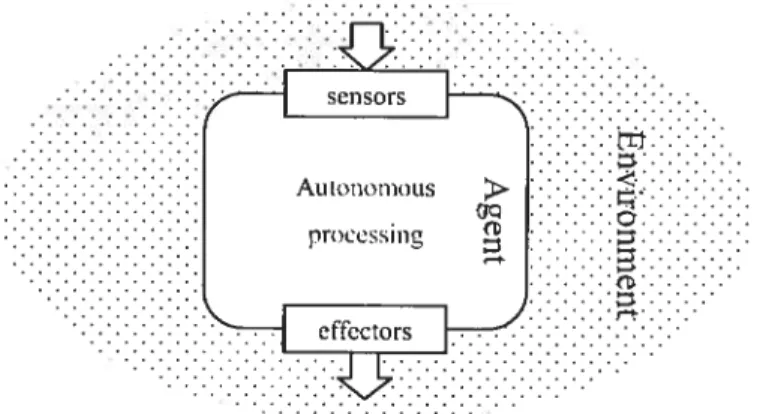
information from their environment or other agents. Figure 2.1 gives an idea how an
agent is situated in the environment.
- sensors
Autonomous i
procesiig
Figure 2-1: Abstract view of an agent in its environment
Chiefly, this abstract view of an agent describes that the agent receives information from its environment through different sensors and processes of these input values
automatically. The agent acts in its environment, possibly changing it flnally.
furthermore, the intelligent agent lias a great deal in common with flexibility. Intelligent
agents must be able to adapt to new environrnents and unpredictable situation. 2.1.2 Characteristic
The concept of agency in this work supports the weak notion of agency, and includes the common characteristics of software agents, as outlined by definitions in the table. We recognize an agent as a software module that possesses the foltowing attributes:
• Agents are situated in and are part of some environment. They continuously exist in the environment and are continually interacting with it.
• Agents sense their environment and act upon their perceptions. An agent can detect changes in its environment and react to those in a timely matter by
responding to events and initiate actions.
• Agents are (semi-)autonomous. That is, an agent lias control over its own actions and is able to work and launch actions independent of other agents.
• The interaction with the environrnent is performed continuously and is flot restricted to a specific time interval. This temporal continuity distinguishes the agent from most ordinary programs.
• Agents in a multi-agent system are communicative. An agent is abÏe to cooperate and communicate with other agents.
• Agents are also goal-driven. An agent bas a purpose and acts in accordance with that purpose. There are several ways ofrnaking goals known to an agent:
1. A rudimentary agent could be driven by a script that predefines its actions. The script would then define the agent’s goals.
2. An agent could also be a program, as long as the program is driven by goals, and shares the other characteristics of agents.
3. An agent couid also be driven by mies, which is a more general way of defining the agent’s goals.
4. There are even more sophisticated ways of embedding agent goals, such as “planning” methodologies, and in some cases, the agent may even have the flexibility to change its own goals over tirne.
• Agents have to make their next behavioural decisions by consuming bounded resources, such as time and computational power. This very characteristic is called bounded rationality.
2.1.3 Classification
As with the definition of an agent, researchers have proposed a number of ways to categorize agents. In this work, we classify agents in terms of the amount of intelligence they exhibit in their behaviour. Intelligence is defined as the degree of reasoning and learning ability. At one extreme are the agents with little or no intelligence that simply react to change in the environment. They do not reason about their responses or actions, do not plan, and neyer leam from experience. At the other extreme are the agents that behave more like humans. They reason about their actions, make plans to achieve their
goals, and even leam from the experience and change their behaviour. This classification
of agents is shown in (figure 2-2) [Mehrdad 20031.
Figure 2-2: Classification of Agents
Reactive Agents
Reactive or sensing-and-acting agents act or respond in a stimuli-response manner to changes in the environment. They are the simpÏest, fastest, and least intelligent agents and are implemented as control systems and automata. A reactive agent can be viewed as a collection of modules which operate autonomously and are
responsible for specified tasks. The agent has all the knowledge that it ever needs
and uses this built-in knowledge to cope with whatever stimuli it may face. Since reactive performance is computationally tractable, reactive agents are
deterministic and have bounded worst-case execution tirnes.
As a resuli, they are suitable for real-tirne applications. Moreover, many embedded applications are designed according to the principles of control theory [Rosenschein and Kaelbling 1995]. They are reactive and do not require elaborated reasoning and planning capabilities.
• Reasoning Agents
Reasoning agents interpret perception, use a knowledge base to draw inference, and reason to find the appropriate actions. They show a higher level of intelligence, as compared to reactive agents, by inferring and reasoning about
5tirnuli-Response tnference Planning Leaming
their responses. Reasoning algorithms are computationally expensive and have exponential complexity.
Planning Agents
Planning agents, as their name suggests, compute and devise a plan (a sequence of actions) to achieve their goal. Planning is essentially automatic programming: the design of a course of action that, when executed, will resuit in the achievement of some desired goal. Contrary to control systems and autornata, there is no well developed, generally accepted way to perfonn planning. The problem with planning is that it is computationally expensive. It is also hard to plan in real-tirne.
• Adaptive Agents
Adaptive or leaming agents are capable of planning as well as acquiring the knowledge required for planning. The process of domain leaming gives theagents the ability to do things they previously were not able to do. Adaptive agents change their behaviour based on their previous experience. Adapting requires search in domain knowledge and is computationally even more expensive than planning. Hence, it is even less tractable than planning.
2.1.4 Agent and Object
A common question that arises in the context of agent system is “how different or the same are objects and agents?” Developers use them together in the research object for most related subjects. Some consider agents to be objects, the others see agents and objects as different even though they share many things in common. In evidence, both of these two distinct notions have its own particular place in software development. We think that the agent-based way of thinking brings a useful and important perspective for system development, which is similar but stili different from the objcct-oriented way.
As programs become more complex, the problems of local variable control and access manage tum into an issue for the modular programming. Object orientation (00) added to the modular approach by maintaining its segments of code or methods as weÏl as by gaining local control over the variables manipulated by its methods. km 00, objects are considered passive because their methods are invoked only when some extemal entity sends them a message. In additional, the data-abstraction is achieved by users defining their own data-structures - objects. These objects encapsulate data and methods for
operating on that data. Furthermore, the 00 allows new objccts to be created that inherit the properties (both data and methods) of existing objects. This allows archetypal objects to be defined and then extended by different purposes, which needn’t have complete understanding of exactly how the undcrlying objects are implemented.
In contrast, software agents have their own thread of control, localizing not only code and state but their invocation as well. Such agents can also have individual rules and goals, making them appear like “active objects with initiative.” In other words, when and how an agent acts is determined by the agent [Odell 2002].
Agents are commonly regarded as autonomous entities, because they can monitor their environment for the own set of their intemal responsibilities. Furtherrnore, agents are interactive entities that are capable of using the external messages. These messages can support method invocation as well as informing the agents of particular events, asking something of the agent, or receiving a response to an earlier query. Lastly, because agents are autonomous they can initiate interaction and respond to a message in the way they choose. Instead of physically launching an agent method, agents can inspire themselves because of the interactive and autonomous nature. Van Pamnak in [Parunak and Van Dyke 1997] summarizes it well: “In the ultimate agent vision, the application developer simply identifies the agents desired in the final application, and the agents organize
themselves to perform the required functionality.” No centralized thread or top-down organization is necessary since agent systems can organize themselves.
Whule we can develop an agent architecture using an object-oriented framework, the 00 approach aiso has some kinds of the attributes about the behavioural autonomy of the agents, i.e. the ability of accessing their methods is controlied by the object itself The process of hiding data and associated rnethods from other objects is achieved by specifying access penhlissions on object-internal data elements and methods. By offering functionality through the public rnethods, object internai data is invisible from outside the object. The locus of control is placed upon external entities that manipulate the object through its public methods [Joseph and Kawamura 2001].
In the agent approach, we could think about objects as agents that make requests of each other. Since the agent’s actions are voluntary as opposed to be invoked be the caller in an 00 environment, agent systems would provide more fine-grained access and security control through an agent communication language interface.
Thus, the important aspect ofthe Agent Oriented approach is that, in opposition to object method specification, an agent communication language interface requires that the communicating parties must be declared aliowing the agent to control access to its internai methods, and thus its behaviour. This in itself means that the agent’s objectives must be considered, even if only in terms of which other entities the agent will collaborate with [Joseph and Kawamura 2001]. Table 2-2 summarizes the evolution of pro gramming languages.
Table2-2: Evolution of programming approaches
. Structured Objcct Orientcd Agent Oriented
Machine Language
Programming Programming Programming
. Object+
Relation to Previous Bounded unit of Subroutine+Persistent
Independent thread
level program local state
+Initiative Structural Unit Entire program Subroutine Object Agent
Structured Object Oriented Agent Oriented Machine Language
Programming Programming Programming How does a unit
Extemal Local Local Local
behave?_(code) What does a unit do
. Extemal Extemal Local Local
when it mns?_(state)
When does a unit
Extemal called Extemal called Extemal called Local truIes; goals) mn?
Originally, the basic unit of software was the complete program where the programmer had full control. The program’s state was the responsibility of the programmer and its
invocation determined by the system operator. The terrn modular did not apply because
the behaviour could flot be invoked as a reusable unit in a variety ofcircumstances.
As programs became more complex and memory space becamc larger, programmers
needed to introduce some degree of organization to their code. The modular
programming approach ernployed smaller units of code that could be reused under a variety of situations. Here, stnictured Ioops and subroutines were designed to have a high degree of local integrity. While cadi subroutine’s code was encapsulated, its state was determined by externally supplied arguments and it gained control only when invoked extemally by a CALL statement. This was the era of procedures as the prirnary unit of decomposition.
In contrast, object orientation added to the modular approach by maintaining its segments of code (or methods) as well as by gaining local control over the variables manipulated
by its methods. However in traditional 00, objects are considered passive because their
methods are invoked only when some extemal entity sends them a message.
Software agents have their own thread of control, localizing flot only code and state but their invocation as welI. Such agents can also have individual rules and goals, making them appear like active objects with initiative. In other words, when and how an agent acts is determined by the agent.
2.2 Online learning system
The onhine leaming systems are a class of important services in which the information infrastructures provide for leamers through the Internet. They base their operation on access to information, electronic transaction and communication services provided by the information infrastructures. Regarding the teaching process, new paradigms enable distribution of educational content, interaction among classes of learners (instructor learner, learner-learner and leaner-educational institution), testing, evaluation and eventually advice in different domain knowledge areas.
2.2.1 Characteristic
Development of information technology enabled foundation of the online learning systems that possess the following characteristics [Rosié et aï. 2002]:
• Distribution
Knowledge to which the online learning systems enable access can’t be found in one place but is distributed at more places which enable faster work of these systems along with making access to the systems’ resources possible for a large number of learners. In other words, distributed knowledge is clustered into a simple Imowledge-base through the online learning system.
• Adaptability
The systems have the possibility of adaptation to the learners habits and needs. Because of the variety of the online learners, an online learning system has to consider the flexibility and adaptability ofthe system.
• Multimedia orientation
The learning systems are based on multimedia presentations of domain knowledge to the learners. Internet-based online learning system provides the possibility to represent the multi type’s information over the network which does
flot just include the textual documents and the image, but also the audio and video, even including the online radio and television.
Cooperation
Different systems support common elements which are available to ail leamers (for example, different learning systems can use common databases with domain knowledge. Reference can cross ail over the Internet).
It is expected that online learning systems will in the near future keep ail these characteristics along with additional development of adaptability of the system to learners as well as ftirther developrnent of cooperation. Online learning systems will have a dynamic life cycle where there wilI flot be a clear une between the phase of development and usage of the system. The oniine learning system itself and its environment will be frequentiy updated in response to changes in: infoniiation, services, hardware, software and learners’ requirements. The systems will enable diversity in information formats and execution platforms. Furthermore, leamers of online learning systems will range from expert to novice with a wide variety of purposes. It is necessary to provide the use of
services for ail those groups in a qualitative way. No matter to which group the Ïearner belongs, increase of quantity of the available information and the services offered via the information infrastructure often puts the learner in a state of information overioad, where the learner’s productivity decreases due to processing too large amount ofreceived data.
2.2.2 Agent-based online learning system
In the online leaming system, agents could be a cognitive user tools belong to system and providing essential help when the user requested them. The two major roles of an agent in the onhine learning system are [Baylor
19991:
1) cognitive tools 2) intelligent tutors. According to achieve functions of the two roles above, agent should achieve four responsibilities following [Huang and Edwards 2003]:• Helping learner effective to find his/her personai learning styles. • Navigating leamer to motivate him/her.
• Watching and evaluating leamer’s attitude anytime. • Organizing infonriation and course for learner.
During the leaming session, agent shouÏd support, guide, and extend the thinking processes of their students. In terms of educational psychological theory, the concept of distributed cognitions readiiy applies to intelligent agents since they couid be used to serve as extensions of a person’s intellectual capacity. By extending the cognitive capabilities of the learner, intelligent agents could decrease the leamer’s limit of his ability to imitate processes demonstrated by others.
To best improve the learning process, agents actively participate in the leaming activities rather then passiveiy retrieve information. In this way the agent provides an environment where the leamer lias a personal learning secretary and/or partner whom makes him think harder and more deepiy about the content, and using the agent as a natural cognitive extension. In this manner, the agent also could serve as a teaclier, prompting the leamer to engage in analysis of his/her own cognitive processes, and promoting the leamer to consider what strategies are being used through the leaming session.
2.2.3 Multi-agents system
Sometimes the problems in an agent-oriented system are too large and complex for a centralized agent to handie. Sometimes we have to interconnect or interoperate with the iegacy system in the agent system. Sometimes the problems and recourses are inherently distributed. In ail these situations, we must consider a multi-agent’s ieaming system which contains a number of agents which interact with one another through communication. The agents are able to act in an environment; where each agent wili act
upon or influence different parts of the environment. The motivation of a multi-agent system including [Pinar 1996]:
• Solve problems those are too large for a centralized agent
• Allow interconnection and interoperation of multiple legacy systems • Provide a solution to inherently distributed problems
• Provide solutions which draw from distributed information sources • Provide solutions where expertise is distributed
• Offer conceptual clarity and simplicity of design
It is possible to organize the execution of agents in the environment of a multi-agent system. The multi-agent systems have the following characteristics:
1. Each agent may have different knowledge, capabilities, reliability, resources, responsibilities or authority.
2. Different agents may perceive the same event or object differently.
3. The agents may specialize in or focus on diffcrent problems and sub-problems. 4. An important goal is the convergence of solutions despite the incomplete or
inconsistent knowledge or data.
It is clear from the mentioned characteristics that the realization of the multi-agent system is complex because with such systems the global supervision of the system most oflen doesn’t exist, cadi and every agent has the access to the limited set of data, and each and every agent isn’t able to independently solve the set problem. The data is distributed and the agents have to communicate with each other while solving the set problem.
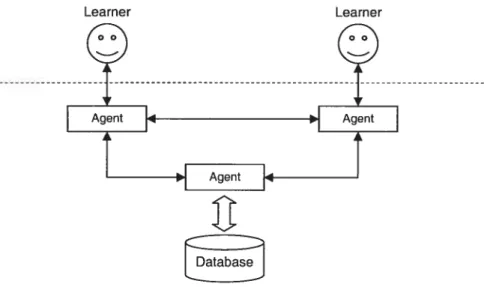
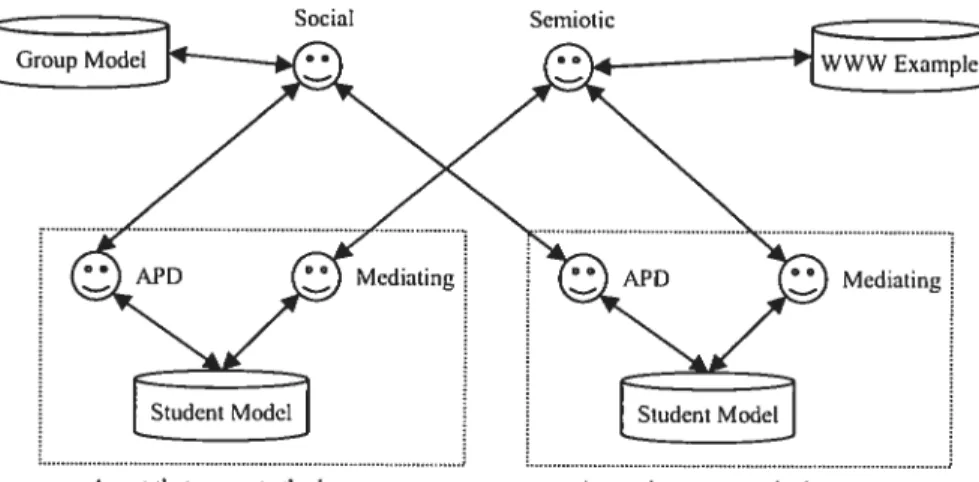
In the multi-agent system more personal agents that cooperate with each other are assigned to the user. In addition, in such environments the agents assigned to different users also cooperate (see Figure below).
Learner Learner
We can even say the communication and cooperation between the agents are the essential features of multi-agent system. They negotiate and discuss one another. Agents are organized into team formation to support a collective goal. Information is shared arnong team members. They joint beliefs, goals and plans. Some of the benefits of using multi agent system including:
• Speedup and efficiency—due to the asynchronization and parallel computation
• Robustness ofreliability—“graceful degradation” when an agent fails
• Scalability and flexibility—easy to add new agents
• Cost — assumption - less communication cost since less need to transform raw
data
• Development and reusability— easier to develop and maintain a modular software
2.3 Online learning system model
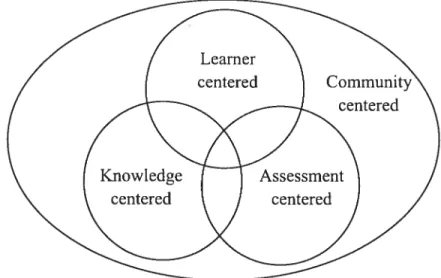
In the National Academy of Sciences supported book, “How People Leam” [Bransford, et aÏ 2002], John Bransford and a distinguished group of scholars reflect on the question of what constitutes a good learning environment. They suggest the good leaming
n
aseFigure 2-3: MuIti-agent system
environrnents are characterized by these areas of emphasis. They are learner centered, knowïedge centered, assessment centered and community centered.
• Knowledge Centered - Outcomes oriented - knowledge, skills, and attitudes
needed for successfuÏ transfer.
• Learner Centereil - connect to the strengths, interests, and preconceptions of
leamers and help them leam about themselves as learners.
• Assessment Centered - provide multiple opportunities to make students’ thinking
visible so they can receive feedback and be given a chance to revise.
• Community Centered - environment where students feel safe to ask questions,
leam to work collaboratively, and are helped to develop lifelong leaming skills.
Knowledge Centered Learning Environments are careftully based on what we want leamers to know and be able to do when they finish with our materials or course and provide them with the foundational knowledge, skills, and attitudes needed for successful transfer.
Learner Centered Environments connect to the strengths, interests, and preconceptions of leamers and help them leam about themselves as learners.
Community Centered Learning Environments provide an atmosphere both within and outside the classroom— where students feel safe to ask questions, leam to use technology
to access resources and work collaboratively, and where they are helped to develop lifelong learning skills.
Assessment Centered Leaming Environments provide multiple opportunities to make leamers’ thinking visible so they can receive feedback and be given a chance to revise their mental models.
2.4 Summary
This chapter started out by explaining agent’s definition and its major properties, and then we also described classification of agent. After that, we present a comparison of the agent and object oriented system. And then, we introduce the online learning system and it’s characteristic. We also present the agent based leaming system. At the end of this chapter, we descript an online learning model.
Chapter3
Personaïized learning support
Throughout the chapter, we will be refeiied to a number of background references for more details about the personalized leaming support (PLS).3.1 Personalized tearning support
Personalized leaming support analyse the leaming style, the learning process and the leaming resuits of the leamer to adjust the curriculum of the leaming system according to the leamer’s knowledge level, adapt the selection of leaming material like presentations, examples, illustrations, feedback, tests etc.
Personalized leaming support (PLS) focuses on the dominant factors that impact self motivation, self-directedness, and leaming autonomy. It is based on research into the neurobiology of learning and memory, and incorporates the dominant impact of emotions, intentions, and social factors, as well as cognitive issues. PLS explores design of the online learning environment, online presentation of instruction, the role of the instructor, and expected outcomes. It also describes strategies to help leamers improve online leaming ability as they become more self-motivated, self-managed, independent leamers.
3.2 Comparison
In this session, we present a simple comparison between the traditional approach and personalized leamingsupport (PLS).
In traditional approach, the learning topic is lirnited by the rnentor’s ability. Design often centers on what he/she likes to do or is comfortable to do. On the contrary, personalized leaming topic design centers on what and how the leamer will learn on their own. It provides a learner centered learning environment to the leamer, instead of knowledge centered or assessment centered.
Traditionat PLS
what likes to do or is comfortable • what and how the leamer wiÏl
to do leam on their own
Learning process (What vi11 learners learn?)
Traditional leaming processes are normally fixed by the materials. Conversely, PLS process is based on the learner’s completion behaviour, which is adjustable and dynamic.
Traditional PLS
• Based on Textbooks • Based on task analysis and
needs assessment • Centers around chapters
. . • Emphasized application of
• Focus on covenng the material
knowledge, skills, abibties • focus on what leamers will be
capable ofupon successful completion
Progress evaluation (When have learners learned?)
Traditional approach’s progress evaluation is based on the exam which is a norm-based assessment. In contrast, PLS achievement measures against pre-stated performance standards. Leamers only progress when competency is mastered.
Traditional PLS
• When an exam is passed • Relies on performance
. demonstration of skill,
• Completion often based on seat
. ,, knowledge, and attitudes
time
• Achievement measured against
pre-stated performance Norm-based assessment
standards
Leamers only progress when _______________________________________
cornpetency is rnastered
Achievement (110w wilI learners develop)
Because leamers have different roles in traditional learning approach and PLS, passive in the former and active in the latter, learners’ achievernents are also diverse.
Traditional PLS
• Lecture-based: relies on faculty to • Features leamer-centered
deliver instruction activities
• Places leamer in passive role • Places learner in active role
• Often offers little variety in • Offers varied leaming activities
leaming style for varied learning styles
• Connections between intended • Ties leaming activities to
outcomes and leaming activities intended outcomes blurred
3.3 Challenges
The transition of instruction from classroom teacher-directed to online user-directed has not always been smooth. In the traditional classroom, students learned to depend (often too much) on instructors for their motivation, direction, goal setting, progress monitoring, self-assessment, and achievement.
In contrast, online learners find that they need to take greater responsibility for their own leaming. But too many are unprepared or unwilling to do so. Perhaps this is because as adult leamers their leaming skills are the product of years of development and habituation in the classroom.
In an online leaming environment, it’s clear that most learners have had littie time to acquire and perfect a satisfactory online leaming ability. It is flot surprising that completion rates in onhine courses are low, since the majority oftoday’s solutions rely on traditional classroom design perspectives. Satisfying leamers online and ensuring that they will capably finish courses, achieve objectives, and acquire new knowÏedge and skills are today’s online leaming challenge.
Meeting this challenge requires a better understanding of the psychological sources that influence an individual’s online leaming ability and how a leamer may want or intend to leam. Specifically, the search for more sophisticated leaming theories requires a bettcr understanding ofonline leaming process.
In the past, explanations of differences in the ways that people leam have focused on cognitive factors having to do with thinking and information processing, such as learning styles. However, now several arcas of research point towards the important effect of emotions on successflil personalized leaming. This kind of research supports better designs because it addresses a more comprehensive set of key psychological factors. Consequently, we can determine the issues that may particularÏy frustrate or encourage the leaming audience.
However, information processing, knowledge and skill building are stiil important considerations in the design of instruction. These primarily cognitive aspects support more traditional approaches. Leamers who are more dependent on the teacher-pupil relationship benefit from having an instructor to promote leaming and manage needs (e.g., emotions, intentions and social issues). Hence, it is important for the leaming process both to address fundamental leaming needs and to specifically promote seÏf-directed and self-motivated leaming.
3.4 The Online Learning Abïlity
Successful instructors and trainers know that they can make a huge difference in the classroom with personalized attention, particularly in recognizing and tapping into how individuals may need to leam differently. As good instructors, they intuitively manage key human factors (e.g., passion, happiness, dislike, fear, striving, will, frustration, satisfaction, and anger) to promote learning. Online these factors may be overlooked.
By considering the impact of emotions and intentions, we can better understand how and why individuals leam differently. for example, some learners are happiest Ïeaming in collaborative, facilitated environments with leaming tasks accornplished in a structured or linear fashion. Other leamers thrive in competitive leaming environments that focus on specific details, tasks, and projects. Sorne learners are passionate about exploring new challenges and taking risks, and they enjoy using leaming to achieve long-tenu personal goals. Finatly, some leamers are fonnalÏy or situational resistant to any kind of leaming that appears to have littie value or benefit to them.
Some onÏine learning models consider these important distinctions between leaming types and, when necessary, try to manage these differences. Translating this kind of psychological information into Ïeaming strategies helps designers create leaming situations that work best for the intended audience. As we put more leamers online, we expect them to take on more responsibility for their leaming, raise their online leaming achievement, and improve their abiÏity over time. We will begin to see how each person may or may not need additional or reduced support. At the same time, key success attributes and pattems will emerge that identify gaps in people’s readiness to engage in online leaming.
Understanding learning differences allows us to tap into key psychological factors that will help people to Iearn online successfully.
Personalized learning portrays characteristics, influences, and relationships between three key construct factors: (1) conative (emotions) and affective (intentions) intrinsic motivational aspects, (2) self-directed strategic planning and committed learning effort, and (3) leaming autonomy. Combined, these three factors greatly influence an individual’s general approach to learning. This model offers explanations for fundamental leaming differences, and suggests specific strategies for accommodating leaming needs for audiences differentiated by leaming type.
Leaming orientations are an effective way to segment the audience according to higher order psychological factors (e.g., affective, conative, and social outlooks). These factors foster how we develop, manage, and sometirnes override our cognitive leaming preferences, strategies, and skills.
Profiles or archetypes have been developed for these orientations to describe their emotions and intentions with respect to leaming and performance. Thesc profiles provide specific scales for measuring common leamer-difference attributes (e.g., high-to-low motivation, self-directedness, and autonomy). The leamer-difference profiles can also guide analysis and design of instruction and environment. The resuit is a set of tailored solutions that help raise leaming ability and that improve the leaming experience.
3.5 PLS design
As designers, we can collect and analyze information about how individuals leam in a given situation and more effectively provide personalized solutions.
Collecting critical success attributes common to the learning group is vital in helping
learners improve learning abiîity, understand how they icam best, and make educated choices about managing their learning environments.
• Shifts more responsibility to learner
Since learner has become the center of learning process, learner’s responsibility should be also emphasized to enhance the motivation, self-directedness and autonorny.
• Reduces inefficiencies in learning process
In a seif-prompting PLS environrnent, it’s the duty of designer to provide an efficient learning process to learner.
• Changes focus of learning from: process to outcornes
Emphasizing the leaming outcomes instead of process, that is one of principal
strategies in PLS.
Personalization includes using learner-specific strategies that may take many forrns as it
adapts environments and offers alternative choices, including sequencing or presentation
of content, practice, feedback, and assessment. Good instructors have been offering these personalization strategies in classrooms for years. In onhine learning situations, technology should ensure that these same strategies can be applied and increasingly self managed by the online learners over time.
Basing instrnctional analysis, interpretations, and decisions on a standardized
multidimensional framework developed by identifying critical success attributes helps to
formalize the personalization process. Once organized for the targeted audience, the framework can be used to create a blueprint for more personalized leaming.
The blueprint for personalized leaming should use well-developed criteria based on iterative cycles of measurement to track each learner’s interaction with the personalized solution. Resuits should measurably show how the leaming solution becornes more valuable to the learner. The desired result should show an increased loyalty and affinity for the online leaming solution over others.
The goal for personalized learning: Two individuals accessing the same personalized instruction simultaneously may sec different presentations and progrcss and Ïrnprove differently-- with greater satisfaction.
3.6 Personalization Framework
There are rnany ways to personalize leaming. Using a well-tested personalization framework helps ensure that solutions and interpretations are consistent, relevant, and useful with measurable improvernents. The personalization frarnework described here lias four levels or perspectives. The fourth level has five major dimensions. Froin the sirnptest to the most complex, the dimensions for them are: 1) name recognition; 2) self-managed; 3) segmented; 4) cognitive-based; and (5) whole-person-based. Each dimension lias a specific purpose and resulting impact. Your targcted goals and outcomcs should govem your choice of these dimensions. These dimensions can work separately or in tandem to enhance the personalized leaming experience.
• Name Recognition Personalization
Name recognition personalization is useful because most people value being acknowledged as an individual. As an example, the leamer’s name appears at the top of the screen or previous accomplishments are marked.
• Self-Managed Personalization
SeIf-managed personalization enables learners (using questionnaires, surveys, registration forrns, and comments) to describc preferences and common attributes. As an example, teamers may take a pre-course quiz to identify existing skills, leaming preferences, or past experiences. Afierwards, solutions appear based on the leamer-provided answers.
• Segmented Personalization
Segmented personalization uses demographics, geographics, psychographics, or other information to divide or segment leaming populations into smalÏer, identifiable and manageable groups for personalization. As an example, leamers that share a common job title or work in a certain department would receive content based on prescriptive rules that would support the leaming and performance requirernents for that specific segmented group.
• Cognitive-Based Personalization
Cognitive-based personalization uses information about leaming preferences or styles from a primarily cognitive perspective to deliver content specifically targeted to differing leamer attributes. As an example, leamers may choose to use an audio option because they prefer hearing text rather than reading it. Or, a leamer may prefer the presentation of content in a linear fashion, rather than a random presentation with hyperlinks. This type of personalization operates on more complex algorithms than the other types and is able to factor more leamer attributes into each interaction. This type of personalization generally works by collecting data, monitoring leaming activity, comparing that activity with other leamer behaviour, and predicting what the user would like to do or see next.
Whole-person personalization seeks to understand the deep-seated psychological sources (more than the conventional cognitive-based prescriptions) impacting differences in learning behaviour, make predictions about delivering content, and deliver content specificalÏy to help the leamer achieve leaming objectives and more importantly, improve leaming ability and enhance online leaming relationships. As the individual leams, the system also leams as it collects data, tracks progress, and compares responses and common pattems to improve responses, i.e., it becomes more precise over time. In its most sophisticated form, whole-person personalization requires real-time personalization to modify responses to a leamer based on a changing perception throughout the leaming experiences, as it occurs (like an instructor in the box).
3.7 Summary
In this chapter, we present the PLS model and its characteristics. Personalized leaming support lias become one of best solution for the online individual leaming environment. After present a comparison between traditional leaming and PLS, we also discuss the challenge ofPLS and its ability.