ÉCOLE DE TECHNOLOGIE SUPÉRIEURE UNIVERSITÉ DU QUÉBEC
THESIS PRESENTED TO
ÉCOLE DE TECHNOLOGIE SUPÉRIEURE
AS A PARTIAL REQUIREMENT TOOBTAIN A
MASTERS IN ELECTRICAL ENGINEERING M.Eng.
BY
ELIE MAALOUF
NONLINEAR CONTROL OF WHEELED MOBILE ROBOTS
MONTREAL, 2 SEPTEMBER 2005
Mr. Maarouf Saad, projet director
Department of electrical engineering at École de technologie supérieure
Mr. Hamadou Saliah-Hassne, codirector Télé Université
Mr. Vahé Nerguizian, president of jury
Department of electrical engineering at École de technologie supérieure
Mr. Bruno De Kelper, member of jury
Department of electrical engineering at École de technologie supérieure
IT HAS BEEN PRESENTED BEFORE A JURY AND PUBLIC
ON THE 22 OF JUNE 2005
NONLINEAR CONTROL OF A WHEELED MOBILE ROBOT
Elie Maalouf
SUMMARY
The purpose of this project is to implement an autonomous navigation system using nonlinear control techniques to control a wheeled mobile robot (WMR) to follow a preplanned trajectory and track a path. Two other aspects of navigation are studied: path planning and obstacle avoidance. Those three aspects are integrated into a navigation strategy that manages navigation and prevents deadlocks.
Two nonlinear control techniques for path tracking and trajectory following have been developed and implemented. In the first approach, a fuzzy logic controller is used to drive the robot through a set of waypoints leading to the destination. In another approach, a controller derived from a Lyapunov function is used to track a reference trajectory that is time dependent. For path planning, a novel optimization technique based on dynamic programming has been developed. The curvature velocity method has been used for obstacle avoidance.
The testing was conducted on a P3-AT ali-terrain mobile robot equipped with encoders, a gyroscope, and sonar sensors for localization and environment perception. The test results validate the effectiveness of the different approaches that have been developed.
ABSTRACT
The purpose of this project is to implement an autonomous navigation system using nonlinear control techniques to control a wheeled mobile robot (WMR) to follow a preplanned trajectory and track a path. Two other aspects of navigation are studied: path planning and obstacle avoidance. Those three aspects are integrated into a navigation strate gy that manages navigation and prevents deadlocks.
Two nonlinear control techniques for path tracking and trajectory following have been developed and implemented. In the first approach, a fuzzy logic controller is used to drive the robot through a set of waypoints leading to the destination. In another approach, a controller derived from a Lyapunov function is used to track a reference trajectory that is time dependent. For path planning, a novel optimization technique based on dynamic programming has been developed. The curvature velocity method has been used for obstacle avoidance.
The testing was conducted on a P3-AT aH-terrain mobile robot equipped with encoders, a gyroscope, and sonar sensors for localization and environment perception. The test results validate the effectiveness of the different approaches that have been developed.
COMMANDE NONLINÉAIRE D'UN ROBOT MOBILE À ROUES
Elie Maalouf
SOMMAIRE
Le but de ce projet de recherche est de développer un système de navigation autonome, en utilisant des méthodes de commande non-linéaires pour contrôler un robot mobile à roues pour le suivi d'un chemin ou la poursuite d'une trajectoire. Deux autres aspects de navigation sont examinés, la planification de trajectoire et l'évitement des obstacles. Les trois aspects sont intégrés dans une stratégie de navigation afin d'éviter le blocage du robot et de bien gérer la navigation.
Deux techniques de commande non-linéaires ont été développées et implémentées pour deux types différents d'exécution de trajectoire. Dans la première approche, un contrôleur logique floue est utilisé pour contrôler le robot pour suivre des points intermédiaires menant à la destination. Dans la deuxième approche où la trajectoire de référence est en fonction du temps, un contrôleur dérivé d'une fonction de Lyapunov a été implanté. Pour la planification de trajectoire, une nouvelle technique d'optimisation basée sur la programmation dynamique a été développée. Pour l'évitement d'obstacles, la méthode des courbures-vitesses a été implémentée.
Les tests ont été conduits sur le robot tout terrain P3AT équipé d'encodeurs, d'un gyroscope, ainsi que des capteurs sonar pour la localisation et la perception de l'environnement. Les résultats des tests ont validé la performance des travaux réalisés.
Elie Maalouf
RÉSUMÉ
Lors des deux dernières décennies, de nombreuses recherches sur la navigation des robots mobiles à roues motrices ont été réalisées. L'avancement en technologie VLSI et la disponibilité de processeurs performants à des prix compétitifs a largement contribué au développement de systèmes des robots mobiles autonomes et semi autonomes. Les robots mobiles sont de plus en plus disponibles sur le marché pour des applications dans l'agriculture, l'industrie des mines, l'exploration spatiale, les domaines militaires, ainsi que dans de nombreuses autres applications où 1' environnement peut être hostile à des êtres humains. La navigation en est un aspect commun dans tous les systèmes de robots mobiles. En gros, la navigation consiste en plusieurs tâches tel que la perception de l'environnement, la localisation, la planification de trajectoire, l'évitement d'obstacles, ainsi que l'exécution d'une trajectoire. Le but de ce projet est de réaliser un système de navigation dont la localisation et la perception de 1 'environnement sont disponibles. Une nouvelle technique de planification de trajectoire a été développée en partant de la programmation dynamique classique. Deux approches d'exécution d'une trajectoire ont été réalisées, une fait appel à un contrôleur logique floue et 1' autre en utilisant un contrôleur dérivé à partir d'une fonction de Lyapunov. Pour ce qui est de l'évitement d'obstacles, la méthode de courbure-vitesse a été utilisée. Le tout sera intégré dans une stratégie de navigation sous la forme d'une machine à états finis. Dû à des contraintes de temps, cette dernière étape n'a pas été implantée en temps réel, mais a été expliquée en détail dans le Chapitre 7. Les trois éléments de navigation ont été implantés en temps réel sur le robot P3-AT disponible dans le laboratoire du GREPCI à l'ÉTS. Ce robot robuste et performant est équipé d'encodeurs, d'un gyroscope bidimensionnel pour la localisation et de capteurs sonars pour la perception de 1 'environnement et la détection
lV
d'obstacles. La commande sur la dynamique n'est pas accessible, ce qui nous emmène à faire une commande sur le modèle cinématique du robot. Le robot est contrôlé par un microcontrôleur embarqué qui communique avec un PC ou un ordinateur embarqué par un port série. Une interface de haut niveau sous la forme d'une librairie C++ orientée objet dénommée ARIA s'occupe d'établir la communication avec le microcontrôleur alors que l'utilisateur peut mettre son effort sur la commande du robot à haut niveau. Le calcul à haut niveau est alors fait sur l'ordinateur, tandis que l'acquisition des données des capteurs et la commande à bas niveau des moteurs sont faites par le microcontrôleur. Le robot P3A T est un robot mobile à quatre roues qui est conduit par une traction différentielle, qu'on distingue des robots mobiles de type voiture et les autres classes mentionnées dans la première partie du Chapitre 3. Le modèle cinématique en coordonnées Cartésiennes ainsi que le modèle dynamique d'un robot à traction différentielle sont développés dans la deuxième partie du troisième chapitre.
La planification de trajectoire est faite lorsqu'un modèle de l'environnement du robot est disponible d'avance, soit sous la forme d'une image ou d'autre. Le modèle de l'environnement est discrétisé et est mit sous la forme d'une matrice de coût. En supposant que le robot se déplace dans un environnement bidimensionnel, l'environnement peut être classifié par des régions accessibles et des régions inaccessibles (les obstacles). Les éléments de la matrice qui correspondent aux régions inaccessibles sont négligés, et le reste est modélisé par des nœuds liés par des liens avec un coût qui correspond à la distance entre les nœuds. Plusieurs techniques ont été développées dans la littérature pour trouver un chemin optimal entre le nœud qui correspond à la position initiale du robot et le nœud qui correspond à une nouvelle position désirée dans l'environnement. La plus célèbre de ces techniques est l'algorithme de recherche A* de graphes et ses différentes variantes. Cette technique fait appel à une fonction heuristique pour estimer le coût jusqu'au nœud final à partir du nœud initial et les nœuds intermédiaires. La fonction heuristique est choisie par le programmeur, et la performance en dépend par conséquent. Dans ce projet, une nouvelle
technique pour déterminer une solution optimale a été développée en se basant sur la programmation dynamique classique qui ne peut pas être utilisée tel quel pour résoudre un graphe. Après un nombre d'itérations déterministe sur les différentes couches, une solution garantie optimale peut être trouvée. Cette nouvelle technique est capable d'exploiter le parallélisme dans un processeur multi-unités de traitement, tel qu'un DSP. Le Chapitre 4 contient les détails de cette approche, ainsi qu'une preuve formelle que la solution converge vers la solution optimale. Le seul défaut de cette approche par rapport à l'algorithme de recherche A* est le temps de calcul. Cependant, ce calcul est fait hors ligne lorsque le robot n'est pas entrain de se déplacer, et la performance, du temps réel du robot, ne sera pas altérée aucunement. Cette approche a été implémentée sur MATLAB dont l'interface facilite le développement rapide de programmes. La solution optimale est donnée sous la forme d'une liste de nœuds intermédiaires entre le premier nœud et la position finale désirée. Une trajectoire temporelle peut être définie à partir de cette liste de nœuds correspondants à des positions par rapport à un repère de référence globale. La programmation dynamique itérative trouve actuellement toutes les trajectoires optimales par rapport à tous les nœuds (le nœud initial bien-comprit) vers le nœud final. Cette information est stockée en termes de pointeurs entre les nœuds qui mènent à la position finale en passant sur la trajectoire optimale. Chaque nœud contient un seul pointeur vers un autre nœud. En suivant les pointeurs à partir d'un certain nœud, on arrive obligatoirement vers le nœud final sur une trajectoire optimale. Cette méthode a été testée sur de nombreux cas, et on obtient une trajectoire optimale dans tous les cas.
En utilisant la solution obtenue par la trajectoire optimale, un contrôleur est nécessaire pour conduire le robot sur cette trajectoire. Une approche pour le cas où la solution optimale n'est pas limitée par des contraintes temporelles a été développée. Un contrôleur par logique floue inspiré de la conduite d'une voiture par un être humain a été réalisé. La trajectoire désirée consiste de la liste des nœuds positions qui forme la solution optimale et sont utilisées en tant que points de référence 'waypoints', et le robot traverse vers sa destination à proximité de ces points. Selon la vitesse actuelle et la
Vl
courbure du trajet, le conducteur d'une voiture modifie la vitesse et oriente la voiture selon sa perception visuelle. Si la courbure est faible, il garde la même vitesse en passant. Selon la courbure il agit sur la vitesse et la direction de façon à obtenir une trajectoire lisse et continue. Le 'waypoint' actuel est défini comme étant le nœud le plus proche du robot sur la trajectoire optimale. Les deux angles entre le nœud actuel et les deux prochains nœuds sont calculés pour déterminer un facteur qui correspond au degré de la courbure. Ce facteur est utilisé comme une entrée 'feed-forward' pour le contrôleur à logique floue. Les autres entrées du contrôleur sont les erreurs de position et d'orientation ainsi que la vitesse actuelle. L'état de chaque entrée est déterminé par des fonctions membres d'une manière continue selon le niveau d'appartenance à un certain état. Une certaine valeur d'une entrée peut appartenir à un ou plusieurs états. Les sortis du contrôleur de type Takagi-Sugeno utilisé dans ce projet ont des états discrets. Une base de règles d'inférence fait le lien entre les états des entrées et les états des sorties. Les sorties des contrôleurs sont les vitesses linéaire et angulaire, et sont calculées selon le poids de chaque règle par rapport aux entrées. Le contrôleur à logique floue est robuste et fiable, malgré la difficulté de prouver sa stabilité théoriquement pour quatre entrées. Pour implanter le contrôleur à logique floue, la librairie Free Fuzzy Logic Library (FFLL) qui respecte un standard industriel sous forme de fichier FCL a été utilisée. Les résultats de tests ont prouvé la fiabilité de cette approche.
Une autre approche dont la trajectoire est en fonction du temps a été implémentée. Le contrôleur est dérivé par une fonction de Lyapunov, ce qui assure la stabilité du système. Les erreurs en position et en orientation sont développées pour obtenir les équations des erreurs sous forme d'un modèle dans l'espace d'états. La fonction d'énergie de Lyapunov est choisie de telle manière à stabiliser les variables d'erreur autour de zéro. La trajectoire de référence est obtenue en interpolant les positions de la trajectoire optimale et en les dérivant pour obtenir 1 'orientation de références en fonction du temps. Cette approche est moins robuste que l'approche précédente et a été utilisée pour faire une étude théorique, malgré sa performance adéquate.
Une approche en temps réel pour l'évitement des obstacles en cas d'obstacles dynamiques ou de changements dans l'environnement lorsque le robot est en train d'exécuter une trajectoire est nécessaire pour éviter des collisions éventuelles avec d'autres objets. La méthode de courbure-vitesse pour l'évitement des obstacles qui est bien connue dans la littérature a été le choix dans ce projet. Cette approche est notamment connue pour sa fiabilité et son efficacité en temps de calcul. Cette méthode peut être utilisée également pour explorer un environnement inconnu. Les obstacles perçus par les capteurs sonar sont modélisés sous forme de cercles à rayon constant, ce qui est convenable pour cette méthode qui fait appel à l'espace de courbure. Les positions des centres des obstacles sont déterminées selon un calcul géométrique simple. Les obstacles sont élargis par le rayon du robot pour être capable de modéliser le robot comme étant un point dans l'espace cartésien, ce qui sert à simplifier les calculs. Les obstacles à plus de trois mètres de robot seront négligés. Cette méthode consiste essentiellement à optimiser une fonction linéaire dans 1' espace des vitesses par rapport à trois critères : la vitesse de navigation, la sécurité de navigation, et la recherche de la position cible désirée. Une ligne droite tracée passant par l'origine du robot correspond à une courbure dans l'espace cartésien du repaire de référence global (voir Chapitre 6 pour plus de détails). L'espace des vitesses est divisé sur des intervalles d'obstacles par des lignes droites passant par l'origine, et limité par les contraintes dynamiques du robot tel que les accélérations et les vitesses maximales. Il s'agit de trouver un point dans ces intervalles qui maximisent la fonction objective. Ce point correspond à un couple de vitesses linéaire et angulaire. Des approximations ont été faites pour respecter l'efficacité du calcul en temps réel. Chaque intervalle entre deux courbures correspond à une distance entre le robot et 1' obstacle. Les distances des intervalles qui ne contiennent pas d'obstacles sont fixées à trois mètres. Les intervalles créent des zones triangulaires dans l'espace des vitesses émanant de l'origine et sont limités par les contraintes sur les vitesses et accélérations. La fonction objective dépend linéairement de la vitesse linéaire, de la distance associée à l'intervalle et de l'erreur d'orientation par rapport à la position de destination. La fonction objective est alors maximale sur les extrémités extérieures,
Vlll
ce qui rend le temps de calcul assez raisonnable. Le calcul sera fait pour deux points additionnels, 1' origine et le point qui oriente le robot vers la position désirée. Ceci étant dit, une stratégie de navigation pour faire la coordination entre les trois aspects de navigation et pour éviter que le robot ne soit bloqué est nécessaire. La stratégie de navigation est implantée sous forme d'une machine à états finis similaire à une architecture hybride de commande. Sous cette architecture, les résultats de perception de l'environnement sont utilisés par le module de planification de la trajectoire qui est considéré à haut niveau ainsi que par les modules à plus bas niveau dans le sens hiérarchique tel que l'exécution d'une trajectoire et l'évitement d'obstacles qui sont des actions de type comportemental. La machine à états est toujours dans un de quatre modes : mode d'arrêt quand le robot est stationnaire, mode de planification de trajectoire, mode d'exécution de trajectoire, ou en mode d'évitement d'obstacle. Au début le robot est en mode d'arrêt, et si un modèle de l'environnement est disponible, le robot passe en mode de planification de trajectoire. Lorsque la trajectoire est planifiée, le robot sera mit en mode d'exécution de trajectoire. Si un obstacle est détecté sur le chemin du robot, le robot passera en mode d'évitement d'obstacles, avec un nœud cible qui correspond à un 'waypoint' sur la trajectoire après l'obstacle. Quand le nœud cible intermédiaire est atteint, si un obstacle est encore sur la trajectoire, le robot reste en mode d'évitement d'obstacles et une autre cible intermédiaire est fixée. Lorsqu'il n'y a plus d'obstacle sur la trajectoire, le robot passe en mode d'exécution de trajectoire. Dans le programme de la machine à états, on vérifie continuellement si le robot passe dans une certaine région plus qu'une fois. Si c'est le cas, le robot passe en mode d'arrêt et puis en mode d'exécution de trajectoire. Le modèle de l'environnement est toujours modifié selon les valeurs retournées par les capteurs sonar.
Dans le cas où l'environnement n'est pas connu d'avance, le robot passe en mode d'évitement d'obstacles et construit l'environnement au fur et à mesure qu'il avance. Si le robot est bloqué, le robot passe en mode d'arrêt et puis en mode de planification de trajectoire en utilisation toute information disponible sur l'environnement jusqu'à
présent, et les régions inconnues seront considérées comme étant accessibles. Il y a toujours des limitations pratiques sur cette approche étant donné que les encodeurs de vitesse des moteurs ont une erreur de positionnement qui augmente tant que le robot se déplace. La même chose arrive avec le gyroscope, ce qui mène à une erreur d'orientation qui augmente avec le temps.
En conclusion, ce travail a été une opportunité pour la réalisation d'un prototype pour un système de navigation. D'autres étudiants qui vont faire la recherche sur le même sujet pourraient ajouter d'autres fonctionnalités tel qu'il est mentionné dans la section des recommandations à la fin de ce document.
ACKNOWLEDGEMENTS
1 would like to express my sincere thanks to Maarouf Saad, my project director for his
help and encouragement, and for his precious advice and remarks all throughout the
project.
1 express my thanks also to Hamadou Saliah, my project codirector, for his help and
encouragement. 1 equally thank Vahé Nerguizian, president ofthe jury.
My sincere thanks go to Bruno De Kelper, member of the jury, for his valuable remarks
and suggestions that helped enrich this document in terms of content and quality.
Finally and very specially, 1 dedicate this project to my parents for their help and support
ABSTRACT ... i
SOMMAIRE ... ii
RÉSUMÉ ... xi
ACKNOWLEDGEMENTS ... x
TABLE OF CONTENTS ... xi
LIST OF FIGURES ... xiv
LIST OF ABBREVIATIONS AND SYMBOLS ... xvii
INTRODUCTION ... 1
CHAPTER 1 LITERA TURE REVIEW ... 4
1.1 Introduction ... 4
1.2 Path Planning and Trajectory Generation ... 4
1.3 Path Following and Trajectory Tracking ... 4
1.4 Real Time Obstacle A voidance ... 8
1.5 Navigation Control Architectures ... 11
CHAPTER 2 TECHNICAL DESCRIPTION OF THE P3-AT MOBILE ROBOT AND ITS CLIENT INTERFACE ... 15
2.1 The Pioneer 3-AT Robot ... 15
2.1.1 Wireless Seriai Communications ... 16
2.1.2 Sonars ... 20
2.1.3 The Activmedia Robotics Operating System (AROS) ... 21
2.2 The SRI Simulator ... 23
2.3 The Activmedia Robot Interface for Applications (ARIA) ... 23
2.4 Conclusion ... 32
CHAPTER 3 TYPES AND MODELING OF DIFFERENTIALL Y STEERED WHEELED MOBILE ROBOTS ... 34
3.1 Introduction ... 34
Xll
3.2.1 Ackermann Steered WMR ... 35
3.2.2 Differentially Steered WMR ... 36
3.2.3 Single Wheel Drive WMR ... 37
3.2.4 Synchronous Drive WMR ... 38
3.2.5 Other Types ... 38
3.3 Modeling ofFour-Wheeled Skid-Steered Mobile Robots ... 39
3.3.1 Kinematic Modeling ... 39
3.3 .2 Dynamic Mode ling ... 43
3.4 Conclusion ... 47
CHAPTER 4 PATH PLANNING ... 48
4.1 Introduction ... 48
4.2 Cost Map Generation ... 48
4.3 Formulating the Problem ... 49
4.4 The A* algorithm ... 50
4.5 Dynamic Programming ... 53
4.5.1 Classical Dynamic Programming ... 53
4.5.2 Dynamic Programming: A Novel Approach ... 53
4.5.2.1 Convergence to the Optimal Solution ... 58
4.5.2.2 Iterative Procedure ... 61
4.6 Implementation on Parallel Processors ... 63
4. 7 Implementation on MATLAB ... 64
4.8 A* and Dynamic Programming: A Comparison ... 67
4.9 Performance and Results ... 68
4.10 Conclusion ... 72
CHAPTER 5 HIGH LEVEL PATH TRACKING AND TRAJECTORY FOLLOWING ... 73
5.1 Introduction ... 73
5.2 Fuzzy Logic Path Tracking Controller ... 73
5.2.1 Path Tracker Parameters ... 74
5.2.2 Fuzzy Path Tracking Controller ... 76
5.2.3 Real Time Implementation ... 83
5.2.3.1 FFLL and FCL Files ... 83
5.2.3.2 C++ Implementation ... 86
5.2.4 Simulation and Experimental Results: ... 87
5.3 Lyapunov Based Control Law Approach to the Problem ofPath Tracking .... 90
5.3.1 The Control Technique ... 90
5.3.2 Generating the Reference Trajectory: ... 94
5.3.3 Real Time Implementation ... 97
5.3.4 Simulation Results ... 97
CHAPTER 6 REAL TIME OBSTACLE AVOIDANCE ... 103
6.1 Introduction ... 103
6.2 Obstacle Representation in Real Time ... 103
6.3 The Curvature-Velocity Method ... 105
6.4 Modifications for Real Time Implementation ... 108
6.4.1 Modification of Curvature Intervals ... 109
6.4.2 Optimization of the Objective Function ... 112
6.5 Real Time Implementatiqn ... 112
6.6 Conclusion ... 113
CHAPTER 7 NAVIGATION STRA TEGY ... 114
7.1 Introduction ... 114 7.2 Navigation Strategy ... 114 7.3 Conclusion ... 119 CONCLUSION ... 120 RECOMMENDATIONS ... 123 APPENDICES 1 : Client Driver Program ... 124
2: Fuzzy Control Language Files (FCL) ... 130
3 : SRI Simulator World Files ... 130
Table 1 Inference rules for LAC ... 79
Figure 1 Figure 2 Figure 3 Figure 4 Figure 5 Figure 6 Figure 7 Figure 8 Figure 9 LIST OF FIGURES Page
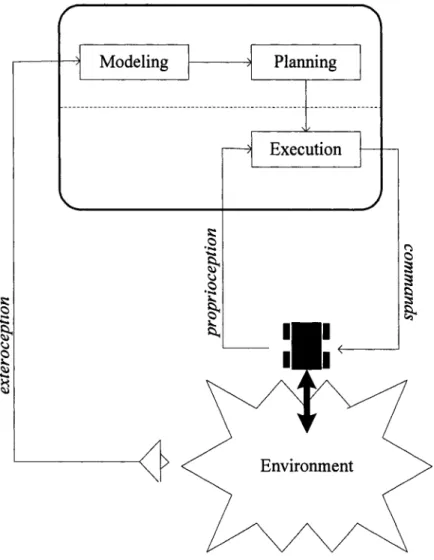
Hierarchical architecture: exteroception sensor readings are fed to
the top of the control hierarchy ... 12
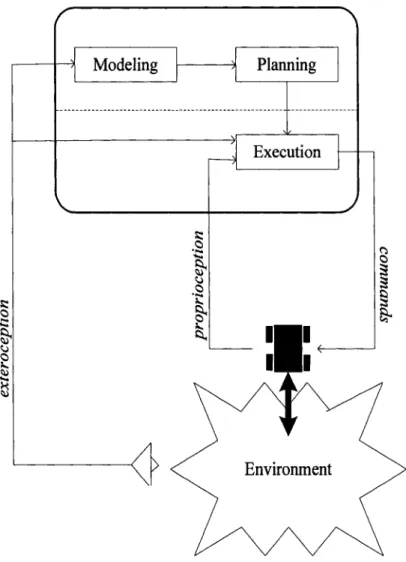
Hybrid architecture: exteroception sensor readings are fed to the top and execution levels of the control hierarchy ... 13
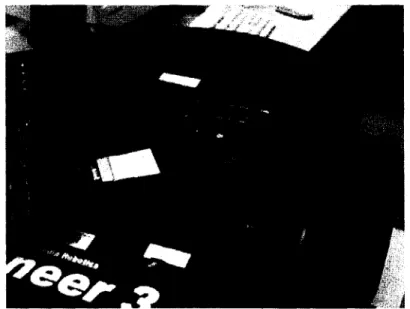
The P3-AT robot in the lab ... 15
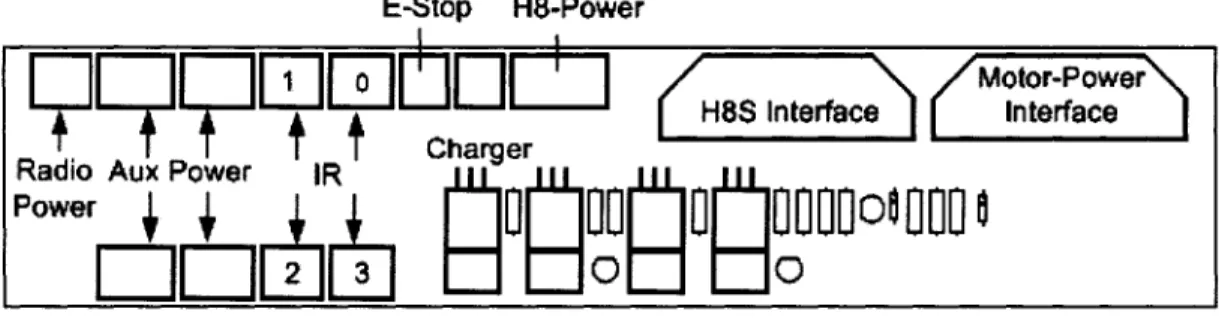
Power terminais on the P3-AT motor-power interface board ... 16
Close view of the user control panel ... 17
AIR cable Se rial DCE and DTE modules ... 18
Wireless connection schematic ... 18
DTE and DCE modules plugged on the laptop computer and the robot respective! y ... 19
R TS and CTS pins shorted ... 19
Figure 10 DTE and DCE modules with DB9 plugged into the intermediate DB9 connectors ... 20
Figure 11 Sonar array front and top views (Courtesy of ActivMedia Robotics, LLC) ... 21
Figure 12 Client-server control architecture ... 22
Figure 13 SRI simulator with the P3-A T parameters loaded snapshot.. ... 23
Figure 14 Robot commands ... 28
Figure 15 Action declarations ... 30
Figure 16 SetRobot member function ... 31
Figure 17 Ackermann steering mechanism ... 35
Figure 18 Skid-steering motion around the center ... 37
Figure 19 (a) Straight line motion (b) Curvilinear motion (c) Purely rotational motion around the center ... 3 8 Figure 20 (a) Carnegie Mellon Nomad2000 (Courtesy of Carnegie Mellon) (b) NASA Mars Rover for space exploration (Courtesy ofNASA) ... 39
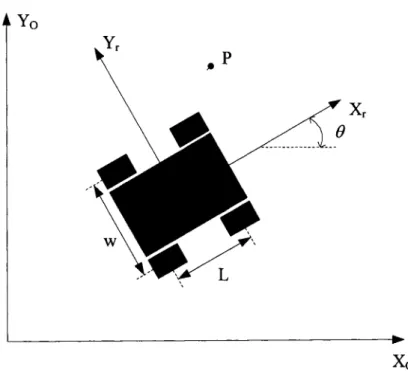
Figure 21 The two frames of reference used in the kinematic model.. ... .41
Figure 23 Eight passage directions through a node ... 49
Figure 24 Graphical illustration of connections between nodes ... 50
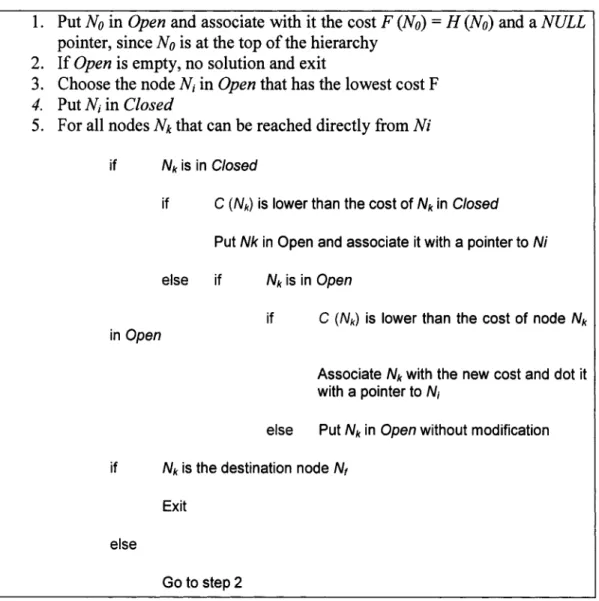
Figure 25 A* search algorithm pseudo code ... 52
Figure 26 (a) Layers emanating from the goal node (b) Layers arranged from the goal node downwards ... 54
Figure 27 Graph with nodes ... 56
Figure 28 Nodes aligned in stages ... 57
Figure 29 (a) Links going from nodes on layer i to layerj (b) are represented by a vector link from i to j ... 58
Figure 30 Inter layer connections ... 59
Figure 31 Connections to the final goal layer ... 59
Figure 32 Layered solution graph ... 60
Figure 33 Layer-vector link representation of the graph ... 62
Figure 34 Figure 35 Pseudo code of the iterative procedure ... 63
Hierarchy of functions ... 67
Figure 36 Two test cases in a 2-D environment ... 69
Figure 37 Optimal solution in a 3-D environment.. ... 70
Figure 38 3-D environment test case ... 71
Figure 39 Solution to a labyrinth ... 71
Figure 40 FLC parameters ... 75
Figure 41 Control diagram ... 76
Figure 42 FLC Schema tic ... 77
Figure 43 LAC parameters and their corresponding membership functions ... 79
Figure 44 Input-Output surface for LAC ... 80
Figure 45 Membership functions of path tracker parameters ... 81
Figure 46 V output wh en C and V c are zero ... 82
Figure 4 7 Angular speed output for C and V c are zero ... 83
Figure 48 Straight line with the robot 1meter away ... 87
Figure 49 Sine wave trajectory at 25 cm discretization ... 88
XVI
Figure 51 Current and reference postures and posture errors ... 91
Figure 52 Position and position errors ... 98
Figure 53 Velocities and velocity errors ... 99
Figure 54 Position and position errors ... 99
Figure 55 Velocities and velocity errors ... IOO Figure 56 Position and position errors ... 101
Figure 57 Velocities and velocity errors ... lOl Figure 58 Robot local frame of reference and obstacles ... 104
Figure 59 Obstacle representation in real time ... 104
Figure 60 A point in velocity space maps to a curvature in Carte sian space ... 105
Figure 61 Calculation oftravel distance before collision ... 106
Figure 62 Curvatures at the boundaries of an obstacle ... 108
Figure 63 Curvature intervals and piecewise constant approximation of Dumu ... 111
Figure 64 Matrix elements eclipsed by obstacles ... 115
Figure 65 Obstacle on the path of the robot.. ... 117
AMR ARIA AROS CVM FCL FFLL FLC IEEE LAC P3-AT RV SIP WMR al, a2
c
c
DPf
Autonomous Mobile Robot
Activmedia Robot Interface for Applications
Activmedia Robotics Operating System
Curvature-Velocity Method
Fuzzy Control Language
Free Fuzzy Logic Library
Fuzzy Logic Control
Institute of Electrical and Electronic Engineers
Look-Ahead Curvature
Pioneer 3- All Terrain
Rotational Velocity, rds/sec
Server Information Packets
Wheeled Mobile Robot
Curvature angles
Curvature
Curvature steepness
Current optimal cost
Optimal cost between nodes
Dynamic programming operator
Errors in positions in x and y respectively
F Traction force
G Cost to move from starting node to current node
H Estimated cost to reach destination node
2
Vector of eigenvalues of a matrixL Robot length in meters
Lmax Maximum sonar distance in meters
m Mass of robot in Kg
R VVheelradius
R(8) Rotation matrix with respect to. global frame of reference
8 Orientation with respect to the global frame of reference in radians
8g Goal heading
T; Torque on wheel i
t Time in seconds
Tc Time constant in seconds
TV Translational Velocity, rn/sec
v
Translational velocityVo Lyapunov energy function
V max Maximum translational velocity
w Angular velocity in radians per second
w Robot width in meters
x, y Robot coordinates
x,
y
Speeds in x andy
directions respective} yx,
y
Accelerations in x andy
directions respectivelyINTRODUCTION
Wheeled mobile robots (WMR) are widely used today in a variety of fields such as agriculture, industry, land mining, military applications, space exploration, and in many other applications where the environment is inaccessible or hazardous to humans such as in nuclear plants. Mobile robot navigation is a common aspect to all applications involving WMR, and is a common research topic in almost all engineering faculties.
For stationary robots such as manipulators with a fixed base, a rather complex dynamic controller is used to precisely control the motion of the robot, while trajectory planning and tracking is more easily achieved since the environment of the robot can be easily modeled and perceived. In the case of wheeled mobile robots, the problems of path planning, trajectory following, and obstacle avoidance are the more challenging and interesting topics.
The objective of this project is to develop an autonomous navigation system for the P3-AT robot available at the GREPCI research laboratory at ETS. Localization and sonar perception routines are already available with the robot through the ARIA application interface. The aim is to develop an optimal path planning technique to make good usage of any available information on the environment, and to develop a control technique to drive the robot along the planned path.
If no information is available about the environment or if a dynamic obstacle suddenly emerges, an obstacle avoidance technique that can autonomously drive the robot safely to the destination position without colliding with objects on its way is desirable. Those three aspects along with the already available localization and perception of the environment are then integrated into a navigation strategy that can detect failures and local minima and coordinate actions.
The project has been carried out having in mind that the navigation system might be adapted later on for navigation on a rugged three dimensional terrain.
The main objectives of the project are as follows:
• Evaluation of several path tracking techniques and the development and implementation of two techniques, one for path following and the other for trajectory tracking;
• Development of a path planning technique that can be used to plan a trajectory in a three-dimensional environment;
• Study and implementation of a real time obstacle avoidance technique available in the literature;
• Integration of all developed aspects in a reliable and robust navigation strategy that prevents the robot from getting blocked.
At the beginning of the project, a literature review of the available methodologies and techniques for robot navigation and control related to path planning, path tracking, and obstacle avoidance was performed. Sorne of the most remarkable researches done in these fields were discussed and evaluated. In the second phase of the project, a path planning algorithm was developed, analyzed, and tested. When the robot shipment arrived, the main work was to get familiarized with the ARIA robot interface and the operation of the robot, as well as with the user interface. Then two control techniques for path following and trajectory tracking were developed and implemented in real time. The first technique is based on fuzzy logic control while the second one is derived from a Lyapunov function and is based on an article available in the literature. Afterwards, an obstacle avoidance technique widely referred to in the literature was developed and implemented. Finally, a navigation strategy in the form of astate machine to integrate the three aspects of navigation developed throughout this project. This navigation strate gy fits in the class of hybrid control architectures.
3
This step by step and modular structured approach to the project helped simplify the development, testing, and debugging.
LITERATURE REVIEW
1.1 Introduction
During the past two decades, extensive research effort has been invested in all aspects of mobile robot navigation. The revolutionary advances that the VLSI industry has witnessed and the availability of high performance embedded systems at reasonable priees had a direct impact on the developments in mobile robotics. A literature review of what has been achieved in path planning, path tracking, and real time obstacle avoidance is presented. In the last section, mobile robot navigation architectures are briefly discussed and the ir use in the context of this project is explained.
1.2 Path Planning and Trajectory Generation
In many applications, a model of the environment in which the robot operates is often available. It would be quite advantageous to use this information to plan an optimal path even if sorne changes in the environment might occur in real time due to the appearance of sorne dynamic obstacles. In Chapter 3 of Pruski (1996), severa! of the techniques used in modeling static environments are described. In a commonly used approach, the environment is sampled at regular intervals and projected on a two dimensional space. The discrete samples are referred to as nodes, with each node Iinked to all adjacent nodes through links as in a graph. Each link is assigned a weight that would be calculated based on sorne optimization criteria, such as the safety of the robot, the time needed to traverse between two nodes, as well as other criteria that are task dependent.
5
position of the robot to the desired destination position, also modeled as nodes. There are numerous optimization algorithms that can be used for path planning. The most widely used is the A* search algorithm (Pruski, 1996) and sorne of its variants (hierarchical, differentiai, D*, parallel A*). Other algorithms that can be used include Dijkstra and numerous tree searching techniques (Pruski, 1996). In this article, a new algorithm based on dynamic programming that was developed will be described. The creation and development of this algorithm was inspired by the work published in Gifford and Murphy (1996). The advantage of this approach is that an optimal path is guaranteed, and the optimal paths from all nodes (positions) in the environment towards the destination nodes are determined in the process, which is useful in the case of a multi-robot system. Another advantage is the ability to use parallelism when implemented on a parallel processor without any compromise in the optimality of the solution.
1.3 Path Following and Trajectory Tracking
In mobile robot navigation, the path tracking controller is usually implemented at a low level in the control hierarchy. Its function is to execute a path planned by the higher level path planner with the least possible error in position and with minimal control effort. The high lev el planner' s function is planning a path either offline or online and depending on environment changes. The path can also be generated in such a way as to simply follow another robot. The task of the lower level path tracker controller is to guarantee that the robot will track the path in a precise, reliable, and efficient manner. The path following problem is highly nonlinear, and several approaches have been developed to solve the problem of path tracking through direct control of the robot' s dynamics. In sorne of the se approaches (Xu and Yang, 2001; De Santis, Hurteau et al., 2002; Zhang, Xu et al., 2002), nonlinear controllers are derived based on the Lyapunov approach. Other types of controllers were designed (Koh and Cho, 1995; Caracciolo, de Luca et al., 1999; Zhang, Xu et al., 200 1) using sliding mode control or other nonlinear
techniques and were applied to the nonlinear dynamic and kinematical model of the robot. A behavioral approach (Yang, Li et al., 2003) for path tracking was implemented using fuzzy logic control for wheel steering.
Irrespective of the performance of these approaches, they cannot be implemented if the robot dynamics are inaccessible. If no direct control on motor torques and traction forces can be done, such techniques cannot be used. A controller at a higher level can be used to solve this problem. Motion is controlled using the kinematic model of the robot as the system. The control law has to respect the kinematic constraints. The variables calculated by the control law are the translational and rotational velocities, based on the position, orientation, and the current values of the translational and rotational velocities. Here is a brief overview of sorne of the control techniques for control at the higher level on the kinematic model.
Many control techniques have been developed and proposed to control the robot at the kinematic lev el. In Xu and Yang (200 1 ), a con troUer is implemented using a biologically · inspired shunting model integrated into a bang-bang controller. In another approach (Weiguo, Huitang et al., 1999), a controller is designed using a back-stepping technique. ln Ollero and Heredia (1995) the stability of a pure pursuit path tracking algorithm is analyzed for a kinematical model using a linearized kinematical model. The analysis is done for the case of a straight line and a circle, with the reasoning that most trajectories can be decomposed into pieces of constant curvature.
A generalization of the quadrature curve approach (Yoshizawa, Hashimoto et al., 1996) has been implemented. The idea is to make the robot follow a quadratic curve to a reference point on a desired path. The reference point is moved in time until the goal destination reached.
7
on static path geometry with position feedback has been implemented on three types of wheeled mobile robots, one of which is differentially steered.
Despite the interesting features of ali these controllers, they are difficult to tune, in contrast to the flexibility that fuzzy logic control provides. Fuzzy logic control (FLC) is an interesting tool to be applied to the problem of path tracking since the output varies smoothly as the input changes. In this project, we will discuss a fuzzy path tracking controller designed based on expert experience and knowledge that was implemented on a four-wheel differentially steered mobile robot. The rules are based on reasoning similar to that of a human driving a car on a road that is free of obstacles and other cars. If the road is straight, the driver can displace at higher speeds. When faced with a curvature, he lowers the speed and makes a smooth turn. The behavior of the human driver is apparent in the fuzzy inference rules. The membership functions were derived based on the kinematical constraints of the robot. The built-in PID controllers were used to control the vehicle dynamics. Each wheel is controlled separately, and a user can only change the gains of the PID, which is virtually futile for the purpose ofpath tracking.
If the built-in dynamic level controller doesn't perform properly in accordance with the controller at the kinematic level due to changes in the physical properties of the surface, an adjustment technique can be used to sidestep the problem. An intelligent predictive control approach that adapts the reference inputs (velocities) based on real-time leaming (Yang, He et al., 1998) is one good technique to be explored and added in cascade after the path tracking controller in the control loop in case the robot dynamics are inaccessible.
Sorne of the path trac king control techniques mentioned above will be discussed in more detail in what follows.
done through direct servo control of the wheel motors. In (Koh and Cho, 1995), an adaptive feed-forward wheel controller was added to the wheel servo to obtain a higher level of accuracy. The wheel controller and the path tracking controller have been integrated to obtain smooth motion. Model parameters were estimated using the least squares method.
Sliding Mode Control (Zhang, Xu et al., 2001): The nonlinear dynamic model of the robot with coupled inputs is obtained in state space representation using a nonlinear transformation to decouple the inputs, and astate space trajectory is used as a reference. The controller uses the state trajectory starting from any point of state space and converges asymptotically on sliding surfaces towards an equilibrium position.
Backstepping Control (Weiguo, Huitang et al., 1999): A path tracking controller is derived by applying the backstepping technique to the kinematic model in polar coordinates. The translational velocity is assumed constant, and the model reference is avoided using polar angle as parameter. Backstepping design has the merit of simplifying the design of nonlinear control and rendering it simple.
ln Laumond (200 1 ), three types of control problems are discussed: pa th following, trajectory stabilization, and stabilization of fixed configurations. ln path following, the robot traces a curve at a constant velocity. A control technique using state feedback is proposed. In trajectory stabilization, the robot follows the reference curvature with time constraints and the translation velocity is not a constant. Control stabilizes the error in position and orientation to zero. In fixed configurations, the robot position and orientation are controlled in time.
1.4 Real Time Obstacle Avoidance
9
with obstacles. The robot must successfully reach a goal position without colliding with the obstacles encountered on its path, so as to prevent the robot and the objects encountered on its way from damage. Since no camera and laser range finder are installed on the robot, it will be assumed that the environment is flat or very smoothly inclined. In the case of a well known environment in which ali obstacles are static, one of the algorithms mentioned in section 1.1 can be used to find an optimal trajectory that avoids all static obstacles.
These techniques are too costly to be used in real time applications in a dynamic environment where objects can be displaced and new obstacles can come into the scene. Consequently, a real time approach is usually needed so that the robot can avoid obstacles in real time, and reach the destination. These techniques often drive the robot in non optimal paths; however it is necessary to compromise optimality to improve safety.
The first research done on obstacle avoidance in real time was done by Khatib (1985). The concept of artificial potential fields is used to control the behavior of the robot, hence the term behavioral approach. This approach is efficient in calculation time and is independent of the geometrie and kinematical transformations. The destination point in the space or plane is considered as an attractive pole and is dotted with a positive weight, while the obstacles are considered as repulsive poles and are dotted with negative weights. In this approach, the robot is prone to get stuck in local minima. This approach is also unstable when the destination point is close to an obstacle. The author's main interest at the time was in applying the technique on fixed base manipulators, but the concept can be applied to mobile robots as well.
An approach that makes use of artificial potential fields with simulated annealing (Lee, 2001) is used to plan local and global trajectories. This approach has been designed to avoid local minima and seems to produce interesting results. However the drawback of
this approach is the calculation time required, which makes it too costly to be used in real time.
In another technique (Ju, 2002), obstacles are modeled as ellipses so as to reduce the complexity of calculation and detect collisions with moving obstacles. It has the advantage of generating an optimal trajectory while avoiding the obstacles as modeled. Still, the calculation time required renders it costly to be used in real time. The usage of a single ellipse to represent elongated obstacles may result in a suboptimal trajectory with respect to real obstacles.
Sorne other techniques using the same concept with sorne improvements have been developed. The V ector Field Histogram (VFH) technique (Borenstein, 1990) has the capacity to maintain a static representation of an obstacle at the level of the world model and the intermediate data level. This approach has the advantage that the robot can navigate in narrow corridors without oscillating and at high speeds. Still, this approach can lead the robot into an obstacle in certain cases, and it does not take into account that the robot moves in arcs and not in straight lines. The same authors (Ulrich, 1998) improved this approach and enhanced its reliability. The VFH+ takes into account the radius of the robot and leads the robot in smoother trajectories. This approach can lead the robot to local minima and thus to a dead end. To eliminate this effect, the VFH+ technique was used along with the A* algorithm and upgraded it to become the VFH* (Ulrich, 2000). This technique projects the trajectory of the robot on a few steps ahead and evaluates the consequences. It is also capable of finding solutions for the case wh en the robot should slow down and even stop. Although this method has been proved to be effective, it is more costly in terms of the calculations involved.
In the curvature velocity method (Simmons, 1996), an objective function in the curvature-velocity space is optimized in terms of speed of navigation, safety, and goal seeking. This technique can be used if the environment is unknown and no reference
11
trajectory is available, and can be used for exploration purposes as well. This method will be used for this project.
Approaches based on the artificial potential fields act mainly as reactive systems and can be integrated with a global path planner for planning long trajectories in case the environment is partially known.
Supervised learning systems using neural networks, fuzzy logic, as well as neuro-fuzzy techniques (Fagg, Lotspeich et al., 1994; Beom and Cho, 1995; Mucientes, Iglesias et al., 2001; Macek, Petrovic et al., 2002; Xin, Vadakkepat et al., 2002) have been developed so that the robot can navigate autonomously while avoiding obstacles. Even if not all of the data corresponding to all possible single cases are supplied to the learning system, an intelligent system can adapt to individual cases of distribution of obstacles and perform adequately. Supervised leaming can be either done online or offline.
1.5 Navigation Control Architectures
According to Driankov and Saffiotti (200 1 ), navigation architectures that are used to control robot navigation can mainly be classified into two architectures: hierarchical and hybrid.
Exteroceptive sensors onboard the robot are used for the perception of the environment. The most common exteroceptive sensors used on wheeled mobile robots (WMR) are cameras, sonar arrays, and laser range finders. In contrast, proprioceptive sensors are used for the perception of the internai state of the robot, such as acceleration, velocity, and heading.
In hierarchical architectures (Figure 1) the data acquisitioned by exteroceptive sensors are used at the higher planning level, such as path planning. Consequently, planning is
done in real time, and a more expensive processor would be required to perform the required computations since the who le model of the environment might be used.
Mode ling Planning
Execution
Environment
Figure 1 Hierarchical architecture: exteroception sensor readings are fed to the top of the control hierarchy
In the case of a hybrid architecture (Figure 2), data acquisitioned by exteroceptive sensors are used both the higher level functions and the lower level execution layer. This would necessarily imply the need to separate the task into behaviors (actions) and the need to coordinate behaviors according to their priority.
13
Mode ling Planning
Execution
Environment
Figure 2 Hybrid architecture: exteroception sensor readings are fed to the top and execution levels of the control hierarchy
In this project, the proposed navigation architecture can be classified as hybrid and is implemented in the form of a state machine depending on sonar perception as input. In case no information about the environment is available, the robot would run in the curvature velocity mode, which is a combination of two different behaviors: goal seeking and obstacle avoidance.
If information about the environment is available, then the higher level planner finds an optimal path towards the user specified position if accessible from the current posture of
the robot. Then, a lower level path tracker executes the trajectory. In case the sonar arrays perceive obstacles in the path of the robot, the running routine switches to the curvature velocity mode until the obstacle is bypassed and the waypoint behind the obstacle on the path is reached, in which case the robot switches back to the initial mode and continues executing the initially planned trajectory.
In Chapter 2, the technical specifications of the Pioneer 3AT robot as well as the client interface are detailed. The types of wheeled mobile robots and the modeling of four-wheeled skid-steered robots are discussed in Chapter 3. In chapter 4, a brief discussion of the A* algorithm is presented and the dynamic programming approach is developed. In Chapter 5, a fuzzy path following controller and a path tracking controller based on a Lyapunov approach are examined. In Chapter 6, the implementation of the curvature velocity method for obstacle avoidance is discussed. Finally, a proposed method for the integration of the three aspects of navigation in a complete navigation strategy is discussed in Chapter 7.
CHAPTER2
TECHNICAL DESCRIPTION OF THE P3-AT MOBILE ROBOT AND ITS CLIENT INTERFACE
2.1 The Pioneer 3-AT Robot
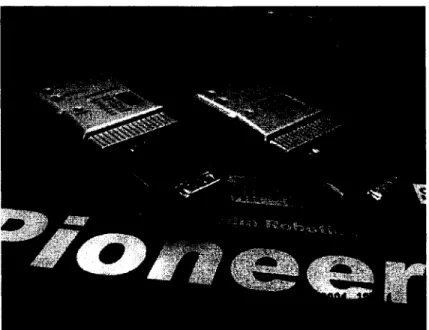
The algorithms and control methodologies developed throughout this project have been tested on the Pioneer 3 AU Terrain (P3-AT) mobile robot fitted with two sonar belts and a heading correction gyroscope in addition to the built-in 100 tick motor encoders.
Figure 3 The P3-A T robot in the lab
The P3-A T is a four-wheel drive robot based on skid-steer motion (see Chapter 3 on robot types and modeling). Its high power to weight ratio and its rigid aluminum platform render it robust on rugged outdoor terrain. Its relatively small size (50cm x 49cm x 26cm body and 21.5cm pneumatic wheels diameter and 9Kg with one battery) makes it suitable for indoor applications and navigation in narrow spaces. This also makes the P3-AT easy to handle, repair, and transport. The P3-AT robot can climb sills
of 9cm or ramps having a slope of 45%. On flat floor, it can move at speeds of up to lm/sec and it can rotate in place or it can move in a circle at a radius of 40cm with wheels moving on only one side. At slow speeds and on flat terrain, the P3-AT can carry loads ofup to 20Kg. The robot is powered by up to three 12 Volts batteries that have an endurance of three to six hours, depending on charge and terrain. When only one battery is used, it is well recommended to put it in the middle slot of the battery compartment at the rear of the robot to maintain balance. When two batteries are used, one battery is placed in each of the left and right slots.
The four reversible DC motors are powered by a 12 Volts terminal from the batteries and are controlled by a MOSFET H-bridge, while there is a 5 Volts terminal to power the onboard electronics. The robot's power system is protected with fuses to protect all electric and electronic onboard components from eventual current surges. Figure 4 is an upper view of the motor-power interface PC B.
E-stop HS-Power
Figure 4 Power terminais on the P3-AT motor-power interface board
For more information on power connections, refer to Appendix B of the 'Operations Manual' (Robotics, 2001).
2.1.1 Wireless Seriai Communications
17
control the robot. The original plate of the panel has been drilled to branch a 5 Volts power terminal outlet to the power board.
Since the robot used for this project has not been fitted with an onboard computer, a laptop computer fitted with a wireless seriai connection has been used to control the robot.
Figure 5 Close view of the user control panel
The wireless seriai connection is simply used to replace a seriai cable that is less convenient and restricts robot motion. Since the robot is used in a lab or at close proximity from the user, there is no need for an expensive industrial wireless seriai connection with ranges of 500 meters. Consequently, it was decided to use a relatively cheap AIRcable Seriai (Figure 6) which consists of two seriai to seriai wireless connecter modules: the Data Terminal Equipment (DTE) module and the Data Communications Equipment (DCE) module with a reliable range often meters.
Figure 6 AIRcable Seriai DCE and DTE modules
Conned to OTE OTE DCE Conned to DCE
Figure 7 Wireless connection schematic
The DTE has a Sub-D 9 pin female connector that is connected to the laptop's COMl seriai port and the DCE has a Sub-D 9 pin male adapter that is connected to the robot (Figures 7 & 8).
Since the robot does not support hardware handshake, the two modules cannot make a connection. To remedy this problem, pins 7 and 8 of each of the two modules should be shorted. The Request To Send (RTS) and Clear To Request (CTS) pins are shorted (Figure 9). If the R TS signais a request, it is immediately cleared by the CTS without requiring a handshake between the computer and the robot.
Figure 8 DTE and DCE modules plugged on the laptop computer and the robot respectively
19
Two DB9 connectors are used to short RTS and CTS for each module (Figure 10). The RTS and CTS of each of the two modules are shorted by intemally soldering a wire to the two pins of the DB9 connector that will be plugged to the robot or laptop computer.
Figure 10 DTE and DCE modules with DB9 plugged into the intermediate DB9 connectors
2.1.2 Sonars
The P3-AT robot used in this project is fitted with two sonar arrays each having eight transducers mounted on the front and rear sections of the robot. Every sonar element returns a range to an object in a certain direction. Obstacles up to more than five meters from the robot can be detected. The sonars in our case are used to detect obstacles and navigate safely. The sonar arrangement in each array is shown in Figure 11.
TOI
Figure 11 Sonar array front and top views
(Courtesy of ActivMedia Robotics, LLC)
21
Sonars can be used to detect obstacles of reasonable cross section with a sufficient accuracy for navigation purposes. For pinpoint accuracy, a laser range finder can be fitted onboard the robot. It scans in a horizontal plane and can accurately determine the position of the object with respect to the robot. Due to budget limitations, the robot used in this project was not fitted with a laser range finder.
2.1.3 The Activmedia Robotics Operating System (AROS)
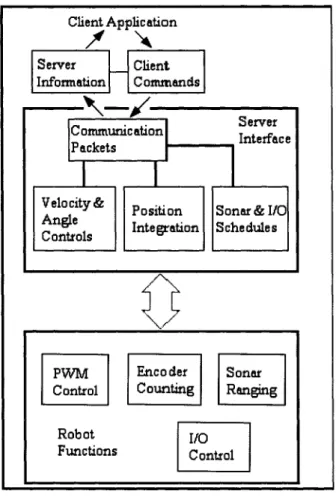
The AROS is the operating system that acts as the interface between a client application and the robot. In our case, the client application is an executable program on the laptop computer. The server is the microcontroller and its peripherals that executes the client application commands and provides it with sensor and robot information. The control architecture of the robot is shown in Figure 12. The client application sends packets to the robot server, containing motion commands and information requests on position and velocity as weil as sonar readings and receives back the information from the robot server that executes the motion commands.
Client Application
/
"
Server Client Information
,_/
CornrnandsServer
~~
ornmunic ationl
Interface Packets J1
1
1
Velo city&
Position Sonar& 110 Angle Inte gratien Schedules Controls
5t
""-/
~ ~
Encoder Counting 1 g Robot 110 Functions ControlFigure 12 Client-server control architecture
The communication between the control client and the robot is done using special client-server communication packet protocols. In general there are two packet protocols, client command protocol and the server information packet protocol. The client commands and data requests are encapsulated in a packet using the former protocol, while the server information data is encapsulated in the latter. The packets consist of a stream of bytes that are sent through the wireless seriai connection from one terminal and received and decoded at the other terminal to determine the type of information in the packet and its numerical arguments, if any. Fortunately, there is no need to deal with low level control and communications, since Activmedia has developed a reliable high level interface to control the robot. Th us the client pro gram would make use of the ARIA library that will be discussed in the next section.
23
2.2 The SRI Simulator
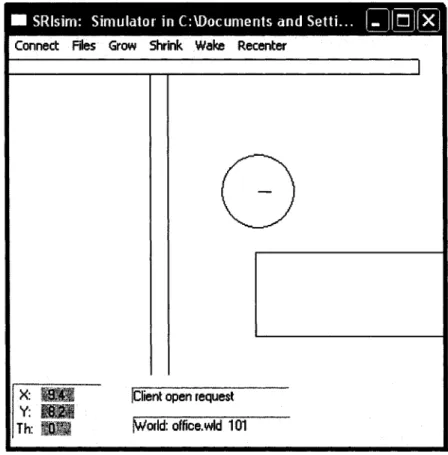
Developed by the SRI Intemational's Artificial Intelligence Center, the SRisim is an excellent tool to test and debug client applications and specially those in the autonomous
• SRisim: Simulator in (:\Documents and Setti...
[~IQli'RJ
Connect Files Grow Shrink Wake Recenter
1
0
!Client open request f'N'orld: office.wld 101
Figure 13 SRI simulator with the P3-AT parameters loaded snapshot
mode before implementation and testing on the real robot. The SRisim simulates real robot behavior in regards to odometer and sonar readings. The robot parameters and the environment can be loaded through the Files menu of the simulator window. The client application is connected to the simulator through TCP port 8081 (by default). A custom environment can be easily created using world files that can be loaded through the simulator menu (see Appendix 3 for a sample myWorld.wld file).
2.3 The Activmedia Robot Interface for Applications (ARIA)
To provide developers and researchers with a relatively easy to use interface, the ARIA open source object-oriented user interface was developed in the C++ programming language and is distributed with ActivMedia products. This library is · used in the development of a client application as an interface to all the low-level tasks such as establishing communication with the robot. It is highly versatile and flexible and can be used to implement virtually any high level task without worrying about communication with the server and provides easy to use methods to access all sensor information and control the robot. The server on the robot is the AROS operating system that is originally installed on the robot's microcontroller. AROS manages all the low level tasks of motion and mo tor control and performs sensor information ( encoders, gyroscope, and sonar) acquisition. Intelligent tasks such as navigation and sensor data fusion and interpretation are done at the lev el of the client application.
ARIA provides extensive methods and features for robot control and sensor data acquisition. The ARIA interface spares the user from developing all low level tasks such as packet encoding and decoding and supplies all needed interfaces to the robot. Only those methods and features used in this project will be discussed.
In this discussion, the C++ driver program in Appendix 1 that is based on the
"actionExample" distributed with the ARIA package is explained. This example contains all the needed functionalities to operate the robot. There are other ways to control the robot; however using actions is the most suitable way for this project. The communication with the robot is done through a seriai port as mentioned in the previous section. ARIA provides us with the methods necessary to establish the communication with the robot from the driver program without getting into the communications details. The most suitable method to communicate with the robot is done with the ArSimpleConnector method of the ARIA library. If the SRI simulator that is provided with the ARIA package is open, ArSimpleConnector will connect to the simulator,
25
even ifthe robot is connected to the COM1 seriai port. If no SRisim window is open, it tries to connect to the robot through the COM1 seriai port on the client computer. By default, ArSimpleConnector connects to the robot on COM1, however if another COM port is used, this has to be done by parsing the arguments through a command window. The statements in the code of the main function that parses the arguments to ArSimpleConnector are as follows:
ArSimpleConnector connecter( &argc, argv); Connector.parseargs( );
To change the settings as specified by the parsed arguments, the function ArSimpleConnector::logOptions is called:
If ( argc > 1 ){
Connector.logOptions( ); exit(1 );
}
If the number of arguments argc is not greater than 1, meaning no arguments are specified other than the name of the executable, the default settings will be automatically initialized.
To connect to the robot ArSimpleConnector::connectRobot is used to establish the connection. This function takes as argument a pointer to an ArRobot object. ArRobot will be discussed shortly thereafter in what follows. If the robot was correctly associated with the pointer to the ArRobot object and a true was returned by ArSimpleConnector: :setupRobot, a blocking connection is established with the robot, or if not a fa/se is returned. The function ArSimpleConnector: :setupRobot is called from connectRobot. This function first tries to establish a TCP connection on port 8101 with the simulator, if not it tries to connect to the deviee through the seriai port and returns true. If none was available, a fa/se is retumed meaning no connection could be established. The code in the main function in Appendix 1 is:
if ( !connector.connectRobot(&robot)) {
}
printf("Could not connect to robot ... exiting \n"); Aria::shutdown( );
return 1;
If a connection is established, execution of the main function proceeds, if not, a 1 1s returned and program execution ends here.
After this brief discussion about establishing a connection with the robot, we turn now to discuss the ArRobot method that is the core of ARIA. As mentioned earlier, the AROS operating system software installed on the microcontroller manages low level tasks such as the execution of motion commands and the acquisition of sensor data. The robot microcontroller acts as a server to a client (user program such as the one in Appendixl), and thus ARIA is a high level interface between the client and the server. ArRobot acts as a gateway between client and server communications, is the central database for collection and distribution of state-reflection information coming from the robot, and is the systems synchronization manager (Robotics, 2003).
The client-server communications adhere to packet-based protocols. ArRobot handles the low level communications details such as encapsulating and sending data in packets known as client command packets as well as receiving and decapsulating server information packets and information extraction (see section of for more information about packets and packet contents). Sorne more explanation about how the packets are handled by ArRobot are available in Robotics (2003). For even more details, check the header and source files ArRobot.h and ArRobot.cpp that are available with the ARIA package. The standard server information packets (SIP) containing odometry and sensor information are sent by the server every 100 msecs. The tasks that Ar Robot performs and are apparent in most client applications source codes are state-reflection as well as motion commands. State reflection consists of determining the state of the robot in what