Volatile composition and coma spatial associations in
46P/Wirtanen as revealed by iSHELL at the NASA-IRTF
Nathan X. Roth (1,9), Erika L. Gibb (1,9), Neil Dello Russo (2,9), Boncho P. Bonev (3,9), Michael A. DiSanti (4,9), Ronald J. Vervack, Jr. (2,9), Hideyo Kawakita (5,9), Mohammad Saki (1,9), Adam J. McKay (3,4,9), Anita L. Cochran (6,9), Emmanuel Jehin (7,9), Martin A. Cordiner (4,9), Harold A. Weaver (2,9), Nicolas Biver (8,9), Jacques Crovisier (8,9) (1) University of Missouri-St. Louis, 1 University Blvd. St. Louis, MO, 63121, USA ([email protected]), (2) Johns Hopkins Applied Physics Laboratory, 11100 Johns Hopkins Road, Laurel, MD 20723, USA, (3) American University, 4400 Massachusetts Ave. NW Washington DC, 20016, USA, (4) NASA Goddard Space Flight Center, 8800 Greenbelt Road, Greenbelt, MD, 20771, USA, (5) Koyama Astronomical Observatory, Kyoto Sangyo University, Motoyama, Kamigamo, Kita-Ku, Kyoto, 603-8555, Japan, (6) McDonald Observatory, University of Texas at Austin, 2512 Speedway, Stop C1402, Austin, TX, 78712, USA, (7) Institut d’Astrophysique et de Géophysique de l’Université de Liège, Allée du 6 août 17, 4000 Liège, Belgium, (8) LESIA, Observatoire de Paris, Université PSL, CNRS, Sorbonne Université, Université de Paris, Sorbonne Paris Cité, 5 Place Jules Janssen, F-92195 Meudon, France, (9) Visiting Astronomer at the Infrared Telescope FacilityAbstract
The 2018 perihelion passage of comet 46P/Wirtanen afforded an extraordinary opportunity for ground-based observations to measure the volatile composition and coma spatial associations in a Jupiter-family comet with nearly mission-scale sensitivity during its closest approach to Earth. We conducted near-infrared spectroscopic observations of 46P/Wirtanen using iSHELL [6,7] at the NASA-IRTF on UT 2018 December 18. We sampled fluorescence emission from a suite of volatiles, including H2O,
CH3OH, C2H6, HCN, C2H2, and NH3. Our
measurements were conducted simultaneously with observations using the newly upgraded NIRSPEC-2 [3,4] instrument at the Keck 2 telescope.
1. Introduction
The much anticipated 2018 perihelion passage of comet 46P/Wirtanen featured a highly active comet passing within ~30 Lunar distances from Earth (0.077 AU), resulting in a worldwide observing campaign [8], including an allocation of 150 hours of telescope time at the NASA/IRTF. In support of this campaign, we targeted 46P/Wirtanen with iSHELL, a high-resolution infrared spectrometer at the IRTF, on six dates in December near its closest approach to Earth. We accumulated very long on-source integration times in multiple settings (see presentation by N. Dello Russo et al.). The goal of this investigation is to
characterize the volatile composition and the coma spatial associations between volatiles in 46P. Here we report observations on UT 2018 Dec. 18, carried out simultaneously with observations using the newly upgraded NIRSPEC-2 spectrograph at the Keck 2 telescope.
2. Results
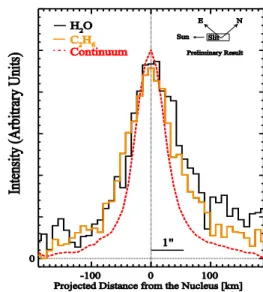
Figure 1. Spatial profiles of H2O, C2H6, and continuum at
~3.3 µm in 46P/Wirtanen near closest approach to Earth using iSHELL.
-100 0 100
Projected Distance from the Nucleus [km] 0
Intensity (Arbitrary Units)
H2O C2H6 Continuum Sun Slit N E 1" Preliminary Result EPSC Abstracts Vol. 13, EPSC-DPS2019-765-1, 2019 EPSC-DPS Joint Meeting 2019
c
We sampled fluorescence emission from multiple volatiles, including H2O, CH3OH, C2H6, HCN, C2H2,
and NH3. We will present rotational temperatures,
production rates (or stringent upper limits), and abundance ratios for each species. Additionally, our long-slit near-IR spectroscopic measurements afforded the opportunity to study the coma spatial associations of the targeted species through their derived column densities along the slit. These measurements can reveal whether each species is associated with common sources on the nucleus, and provide clues for how volatiles are associated or segregated in nucleus ices [1,2,5]. Owing to the close passage of 46P/Wirtanen to Earth, our measurements featured high spatial resolution (~19 km pix-1), and
sampled the inner coma (within ~200 km from the nucleus) in exceptional detail.
Additionally, our measurements were carried out simultaneously with observations using NIRSPEC-2 at the 10 m Keck 2 telescope (see presentation by B. Bonev et al.). These simultaneous observations are highly complementary, and afford a rare opportunity to compare highly sensitive measurements of coma composition and spatial distributions as revealed at near-infrared wavelengths.
Figure 2. Sample spectrum showing detection of H2O in
46P/Wirtanen with iSHELL on UT 2018 December 18. Overplotted are the best fit telluric (yellow) and H2O
fluorescence models (red).
Acknowledgements
We gratefully acknowledge the entire staff at the NASA-IRTF for their support, including coordination of a dedicated 46P/Wirtanen observing campaign. Data for this study were obtained at the NASA Infrared Telescope Facility (IRTF), operated by the
University of Hawai’i under contract NNH14CK55B with the National Aeronautics and Space Administration. We are most fortunate to have the opportunity to conduct observations from Maunakea, and recognize and acknowledge the very significant cultural role and reverence that the summit of Maunakea has always had within the indigenous Hawaiian community.
Various authors of this work wish to acknowledge support from the National Science Foundation Solar and Planetary Research Program (AST-1616306, AST-1615441), the NASA Solar System Observations (15-SSO15_2-0028, 80NSSC17K0705) and Solar Systems Workings (NNX17AC86G) Programs, the NASA Emerging Worlds Program (NNN12AA01C), the NASA Earth and Space Science Fellowship Program (NNX16AP49H), and the International Space Science Institute (Bern, Switzerland).
References
[1] Dello Russo, N., et al: The Volatile Composition and Activity of Comet 103P/Hartley 2 During the EPOXI Closest Approach, Astrophys. J. Lett. 734, L8, 2011. [2] Kawakita, H., et al: Parent volatiles in comet 103P/Hartley 2 observed by Keck II with NIRSPEC during the 2010 apparition, Icarus 222, 723-733, 2013.
[3] Martin, E. C., et al.: An overview of the NIRSPEC upgrade for the Keck II telescope, Proc. SPIE 10702, 10702a, 12 pp., 2018.
[4] McLean, I. S., et al.: Design and development of NIRSPEC: a near-infrared echelle spectrograph for the Keck II telescope, Proc. SPIE 3354, pp. 566-578, 1998.
[5] Mumma, M. J., et al: Temporal and Spatial Aspects of Gas Release During the 2010 Apparition of Comet 103P/Hartley 2, Astrophys. J. Lett. 734, L7, 2011.
[6] Rayner, J., et al.: iSHELL: a 1-5 micron cross-dispersed R=70,000 immersion grating spectrograph for IRTF, Proc. SPIE 8446, 84462C, 12 pp., 2012.
[7] Rayner, J., et al.: iSHELL: a construction, assembly and testing, Proc. SPIE 9908, 990884, 17 pp., 2016.
[8] See http://wirtanen.astro.umd.edu/; Comet Wirtanen Campaign Page, hosted by the University of Maryland.
3446 3448 3450 3452 3454 3456 3458 3460 0 0 5 10 15 20 2.90 Flux Density (10 -18 W/m 2/cm -1) Wavenumber (cm-1) λ (μm)
Total Fluorescence Model
Telluric Model
Observed
H2O
Residuals