arXiv:astro-ph/0404551v1 28 Apr 2004
(DOI: will be inserted by hand later)
WR 20a: a massive cornerstone binary system comprising two
extreme early-type stars
⋆
G. Rauw
1,⋆⋆, M. De Becker
1, Y. Naz´e
1,⋆⋆⋆, P.A. Crowther
2, E. Gosset
1,⋆⋆, H. Sana
1,⋆⋆⋆,
K.A. van der Hucht
3,4, J.-M. Vreux
1, and P.M. Williams
51 Institut d’Astrophysique et de G´eophysique, Universit´e de Li`ege, All´ee du 6 Aoˆut, Bˆat B5c, 4000 Li`ege, Belgium 2 Department of Physics & Astronomy, University of Sheffield, Hicks Building, Hounsfield Rd., Sheffield, S3 7RH, UK 3 SRON National Institute for Space Research, Sorbonnelaan 2, 3584 CA Utrecht, The Netherlands
4 Astronomical Institute Anton Pannekoek, University of Amsterdam, Kruislaan 403, 1098 SJ Amsterdam, The Netherlands 5 Institute for Astronomy, University of Edinburgh, Royal Observatory, Blackford Hill, Edinburgh, EH9 3HJ, UK
Received date / Accepted date
Abstract.We analyse spectroscopic observations of WR 20a revealing that this star is a massive early-type binary system
with a most probable orbital period of ∼ 3.675 days. Our spectra indicate that both components are most likely of WN6ha or O3If∗/WN6ha spectral type. The orbital solution for a period of 3.675 days yields extremely large minimum masses of 70.7±4.0
and 68.8 ± 3.8 M⊙for the two stars. These properties make WR 20a a cornerstone system for the study of massive star evolution.
Key words.binaries: spectroscopic – stars: early-type – stars: fundamental parameters – stars: individual: WR 20a
1. Introduction
Although it is generally accepted that Wolf-Rayet (WR) stars are evolved descendants of massive O-stars, many open ques-tions remain about the evolution of these objects. Among the most fundamental issues is the importance of mass transfer in the evolution of massive O + O binaries (e.g. Vanbeveren et al. 1998). It is therefore of prime interest to achieve as com-plete a census of WR binaries as possible and to investigate the fundamental properties of individual massive binary systems.
Among the 227 objects listed in the VIIth Catalogue of Galactic Wolf-Rayet Stars (van der Hucht 2001), there are only 52 known spectroscopic binaries and only 32 of them have re-liable orbital solutions. In addition to these confirmed bina-ries, van der Hucht (2001) provides a list of 30 rather faint and poorly studied objects that are potential WR + OB bina-ries. Most of these binary candidates were classified as such because of their comparatively weak emission lines that could be the result of the dilution by the continuum light of an OBtype companion. In order to search for a composite spectrum -and hence confirm multiplicity - we performed a snapshot spec-troscopic survey of a sample of WR binary candidates. One of
Send offprint requests to: G. Rauw
⋆ Based on observations collected at the European Southern
Observatory (La Silla, Chile)
⋆⋆ Research Associate FNRS (Belgium) ⋆⋆⋆ Research Fellow FNRS (Belgium)
Correspondence to: [email protected]
the most interesting objects that emerged from our survey was WR 20a.
WR 20a (= THA 35--036 = SMSP2) was catalogued by Th´e (1966) in an Hα emission line survey, and first discov-ered to be a WR star by Shara et al. (1991) in the course of a deep narrow and broadband photometric survey for galactic Wolf-Rayet stars in the southern Milky Way. The latter authors also obtained a low-resolution (2 pixel resolution of 7 Å) spec-trum of the star and proposed a WN7 spectral type, although they noted the lack of a He λ 5411 emission line. Shara et al. (1991) suggested that WR 20a had a rather high H/He abun-dance ratio. Later, the object was re-classified as WN7:h/WC by Shara et al. (1999). The star is believed to be a member of the young open cluster Westerlund 2 in the core of the H re-gion RCW 49 (Moffat et al. 1991).
In this letter, we first present our blue/violet observations of WR 20a (Sect. 2). The spectral features as well as the nature of WR 20a are revisited in Sect. 3.1, whilst Sect. 3.2 deals with an analysis of the radial velocities. Finally, we briefly discuss the implications of our results in Sect. 4.
2. Observations
Two snapshot spectra of WR 20a were obtained in March 2002 with the EMMI instrument mounted on ESO’s 3.5 m New Technology Telescope (NTT) at La Silla. The EMMI instru-ment was used in the BLMD medium dispersion spectroscopic mode with grating # 3 (1200 lines mm−1) providing a wave-length coverage of 460 Å per set-up. The central wavewave-length
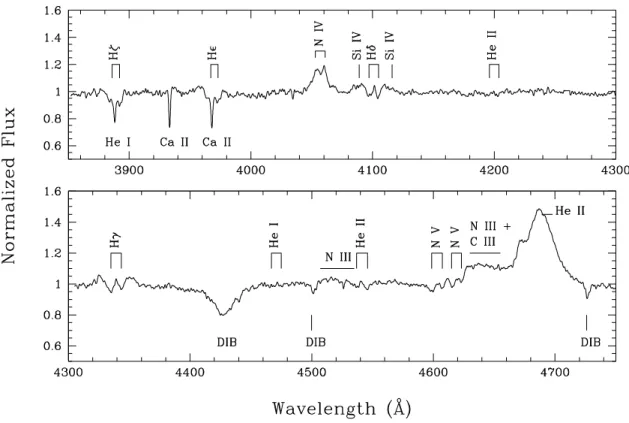
Fig. 1. Spectrum of WR 20a as observed on HJD 2 453 034.715 (violet setting, top panel) and 2 453 034.741 (blue setting, lower
panel). Note the double N λ 4058 emission line as well as the double N λ 4604 and N λ 4620 absorptions. The stellar lines are labelled above the spectrum, whereas the interstellar lines and diffuse interstellar bands (DIBs) are indicated below.
was set to 4080 Å (violet setting) or 4530 Å (blue setting). The exposure times were 30 min for each setting and the corre-sponding S/N was about 100. The spectral resolution as de-termined from the FWHM of the lines of the Th-Ar comparison spectra was about 1.25 Å. The data were reduced in the stan-dard way using the long context of the package. The violet spectrum taken on HJD 2 452 355.60 revealed double ab-sorption lines of hydrogen and helium as well as a moderately strong double-peaked N λ 4058 emission. On the other hand, the blue spectrum obtained on HJD 2 452 354.56 showed single absorption lines of hydrogen, He and N . These properties suggested that WR 20a could be a short period binary consist-ing of two very early extreme Of-type stars (Driesens 2003). We thus organized a follow-up observing campaign to confirm the binarity of WR 20a. The star was monitored over 12 con-secutive nights in January-February 2004 with the same instru-mentation as in March 2002. The weather conditions were good except for the last two nights where the seeing and the trans-parency were poor. The data were reduced in the same way as in 2002 and the complete journal of the useable observations is given in Table 1.
3. Results
3.1. The spectrum of WR 20a
Our data reveal that WR 20a is indeed a short-period binary system (see below). All prominent spectral features appear double with nearly identical intensities on most of our spectra
(see e.g. Fig. 1) indicating that the components of WR 20a must have identical spectral types and a visible brightness ratio of
∼1. The spectrum of WR 20a displays many absorption lines of H , He and N unlike what we would expect if WR 20a were indeed a ‘classical’ WN7 star (see however below). Only a few (rather narrow) emission lines are seen in the blue/violet spectrum: N λ 4058, He λ 4686 as well as a broad complex probably due to N λλ 4634-41, C λλ 4647-50 and possi-bly C λ 4658. The Balmer absorption lines also display some broad underlying emission wings on several spectra. The emis-sions seen around the Hδ absorption in Fig. 1 could actually be due to Si λλ 4089, 4116, but the spectra obtained on other nights do not allow us to unambiguously confirm this identifi-cation. In addition to the strong diffuse interstellar bands, we note the presence of the interstellar He λ 3889 absorption line. This latter feature was also observed in the spectra of several early-type stars of the Carina Nebula (Walborn & Hesser 1975). This line is not usually seen in interstellar sightlines (cf. ζ Oph, Shulman et al. 1974) and may be formed locally as in the case of the Carina stars.
No stellar He lines are clearly seen in the spectrum. Together with the presence of rather strong N absorption lines, this would suggest a very early O-type classification for the components of WR 20a. The presence of He λ 4686 in strong emission further suggests a supergiant luminosity class. Comparing our spectra to the classification scheme of Walborn et al. (2002, see also Walborn 2001), we would pro-pose an O3 If∗ spectral type for both stars. However,
is a very tricky issue. In this context, Crowther & Dessart (1998) proposed EW(He λ 4686) = 12 Å as a boundary be-tween O3 If∗/WN and WN5-6 stars. For WR 20a, we determine
EW(He λ 4686) = 13.1 Å with a 1-σ dispersion of 1.3 Å, right at the borderline proposed by Crowther & Dessart. Since the He λ 4686 emission could contain a contribution from a wind interaction process, we consider this an upper limit on the actual strength of the line. Comparing the spectrum of WR 20a obtained near conjunction with the spectra of several extreme Of and weak-lined WN stars, we find that the components of WR 20a are indeed intermediate between Mk 42 (O3If∗/WN)
and HD 97950C (= WR 47c, WN6ha). Finally, the spectrum of WR 20a presented by Shara et al. (1991) indicates that the Hβ line is in weak emission. The latter feature favours a WN6ha spectral type. We shall thus adopt a WN6ha classification for both components of WR 20a, though we cannot fully exclude an O3 If∗/WN6ha type. The Shara et al. (1991) spectrum of
WR 20a suggested the presence of a C λ 5808 emission with a normalized intensity stronger relative to He λ 5876 than in normal WN stars, thus leading to the WN/WC classification proposed by Shara et al. (1999). Note that our blue/violet spec-tra do not provide support for such a hybrid type.
3.2. Orbital solution
We have measured the radial velocities (RVs) of the compo-nents of WR 20a by fitting Gaussians. The typical uncertainties on individual RV measurements are of order 10 – 15 km s−1for those phases when the components are resolved1.
A major issue in determining the orbital period arises from the fact that the spectral types of both stars are identical. In fact, the spectra do not allow us to distinguish the components
a priori. Therefore, we performed a period search on the
abso-lute values of the radial velocity differences |RV1−RV2|. In this way, we expect to find the highest peak in the periodogram at
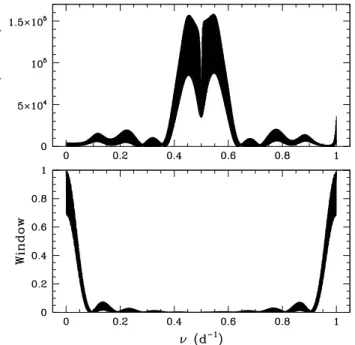
ν1 = 2/Porb. Using the Fourier technique of Heck et al. (1985, see also Gosset et al. 2001), we find that the most likely value of ν1is 0.544 ±0.009 day−1. However, there is a strong ambigu-ity with the 1 − ν1alias at 0.453 ± 0.009 day−1which produces only a slightly smaller (formal) peak in the periodogram (see Fig. 2). Our preferred value for the orbital period is therefore 3.675 ± 0.030 days, but we cannot discard the alternative value of 4.419 ± 0.044 days. Alternatively, if the (slightly smaller) peak at the 1 + ν1 alias (1.547 day−1) were to be selected, the orbital period would be ∼ 1.29 days, i.e. even shorter than the 1.64 day period of CQ Cep, the shortest period WN binary sys-tem known to date (see e.g. van der Hucht 2001).
As a next step, we determined the apparent systemic veloc-ity of each spectral line from an orbital solution obtained for the RVs of the specific line. In this way, we found apparent sys-temic velocities of −75, −18, −77, −42, −51 and −26 km s−1 for the Hγ, He λ 4542, N λ 4604, N λ 4620, N λ 4058 1 Note that we also determined the heliocentric radial velocities of the sharp interstellar features: we obtain RVs of −16.6 ± 15.0, −7.8 ± 10.5 and −10.2 ± 14.0 km s−1 for the He λ 3889, Ca λ 3934 and Ca λ 3968 lines. The 1σ dispersions listed here provide some rough indication of the accuracy of our wavelength calibration.
Fig. 2. Top panel: power spectrum of our |RV1−RV2|time se-ries of WR 20a. The bottom panel provides the corresponding power spectral window.
and Hδ lines respectively. Finally, we averaged the RVs of the different lines listed above after subtracting their systemic ve-locities. The results are listed in Table 1.
Due to the ambiguity about the right alias in the peri-odogram, we caution that the orbital phases as well as the pri-mary/secondary identifications in Table 1 are only valid if the orbital period is indeed 3.675 days. Adopting this period, we have derived the orbital solution of WR 20a using the technique described by Sana et al. (2003). Since the RVs show no indica-tion of a significant orbital eccentricity, we assumed a circular orbit. The results are provided in Table 2 and the RV curve is il-lustrated in Fig. 3. We emphasize that orbital solutions derived from the RVs of individual spectral lines overlap within the er-rors with the results in Table 2.
The most important results are the large minimum masses of 68.8 ± 3.8 and 70.7 ± 4.0 M⊙derived for the secondary and
primary component respectively. It should be emphasized that these values strongly depend on the adopted orbital period. In fact, the alternative orbital period (4.419 days) would lead to even larger minimum masses of 80.8 ± 5.1 and 84.0 ± 5.3 M⊙
respectively. If, on the contrary, the 1 + ν1alias corresponding to an orbital period of 1.293 days were selected, the minimum masses would be much lower (24.9 ± 1.4 and 25.9 ± 1.4 M⊙).
We note however, that in the latter case, the orbital solution is of significantly lower quality than the one obtained for an orbital period of 3.675 days.
4. Discussion and future perspectives
The WN6ha or O3 If∗/WN6ha spectral type of the components
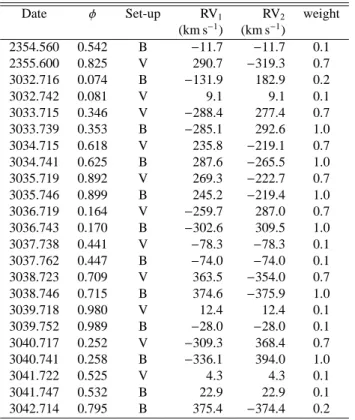
Table 1. Journal of our spectroscopic observations of WR 20a.
The first and second columns provide the heliocentric Julian date (in the format HJD−2 450 000) and the orbital phase as-suming a period of 3.675 days and adopting phase φ = 0.0 as given in Table 2. The third column indicates whether the blue (B) or violet (V) spectral range was observed. The recentred and averaged primary and secondary radial velocities are given in columns 4 and 5 respectively (see text). Finally, the last col-umn yields the weight that we assigned to the various RV data in the orbital solution.
Date φ Set-up RV1 RV2 weight
(km s−1) (km s−1) 2354.560 0.542 B −11.7 −11.7 0.1 2355.600 0.825 V 290.7 −319.3 0.7 3032.716 0.074 B −131.9 182.9 0.2 3032.742 0.081 V 9.1 9.1 0.1 3033.715 0.346 V −288.4 277.4 0.7 3033.739 0.353 B −285.1 292.6 1.0 3034.715 0.618 V 235.8 −219.1 0.7 3034.741 0.625 B 287.6 −265.5 1.0 3035.719 0.892 V 269.3 −222.7 0.7 3035.746 0.899 B 245.2 −219.4 1.0 3036.719 0.164 V −259.7 287.0 0.7 3036.743 0.170 B −302.6 309.5 1.0 3037.738 0.441 V −78.3 −78.3 0.1 3037.762 0.447 B −74.0 −74.0 0.1 3038.723 0.709 V 363.5 −354.0 0.7 3038.746 0.715 B 374.6 −375.9 1.0 3039.718 0.980 V 12.4 12.4 0.1 3039.752 0.989 B −28.0 −28.0 0.1 3040.717 0.252 V −309.3 368.4 0.7 3040.741 0.258 B −336.1 394.0 1.0 3041.722 0.525 V 4.3 4.3 0.1 3041.747 0.532 B 22.9 22.9 0.1 3042.714 0.795 B 375.4 −374.4 0.2
members (O6:V – O7:V) of Westerlund 2 analysed by Moffat et al. (1991).
Several authors have estimated the distance of Westerlund 2: 7.9+1.2
−1.0kpc (Moffat et al. 1991); 5.7 ± 0.3 kpc (Piatti et al. 1998); 6.4 ± 0.4 kpc (Carraro & Munari 2004). Adopting a visual brightness ratio of 1 together with the photometry of Moffat et al. (1991; V = 13.58, B − V = 1.51) the various distance estimates yield absolute magnitudes MV in the range −5.0 to −6.1. This is fainter than the average of three WN6ha stars in NGC 3603, namely −6.9 to −7.7 mag2, such that only the largest published distance of Westerlund 2 would be in marginal agreement with the photometry of WR 20a, allowing for a cosmic scatter of 0.5 – 0.7 mag on MV. This problem would be less severe if the absolute magnitudes of the components of WR 20a were more typical of O3 I stars (MV = −5.9 according to Crowther & Dessart 1998). Alternatively, WR 20a could actually be unrelated to Westerlund 2 (though the rarity of early-type stars and the
2 Moffat et al. (1994) derived an average M
V of −7.7 for the three H-rich WN stars in NGC 3603, whilst Crowther & Dessart (1998) re-evaluated their distance and reddening and obtained an average of −6.9 mag.
Table 2. Orbital solution for WR 20a assuming a circular orbit
and an orbital period of 3.675 days. T0 refers to the time of conjunction with the primary being behind. γ, K and a sin i denote respectively the systemic velocity, the amplitude of the radial velocity curve and the projected separation between the centre of the star and the centre of mass of the binary system. RRL stands for the radius of a sphere with a volume equal to that of the Roche lobe computed according to the formula of Eggleton (1983). All error bars indicate 1-σ uncertainties.
Primary Secondary T0(HJD−2 450 000) 3043.480 ± 0.014 γ(km s−1) 18.8 ± 5.6 −3.5 ± 5.7 K (km s−1) 353.1 ± 8.6 362.6 ± 8.8 a sin i (R⊙) 25.6 ± 0.2 26.3 ± 0.6 q = m1/m2 1.03 ± 0.03 m sin3i (M⊙) 70.7 ± 4.0 68.8 ± 3.8 RRL sin i (R⊙) 19.8 ± 0.2 19.5 ± 0.2
Fig. 3. Radial velocity curve of WR 20a for an orbital period
of 3.675 days. The filled (resp. open) symbols stand for the primary (resp. secondary) RVs. The sizes of the symbols re-flect the relative weight assigned to the various points in the orbital solution (see Table 1). The solid line and the dashed line yield our best fit orbital solution assuming a circular orbit (see Table 2).
angular proximity of WR 20a to the cluster strongly suggest membership) or the photometry of Moffat et al. could be af-fected by photometric eclipses. Concerning the last possibility, we note that given the extremely large minimum masses of the components in WR 20a, it appears very likely that the system could display eclipses. A photometric monitoring of this binary is therefore of the utmost importance in order to help derive its absolute magnitude, to get rid of the aliasing problem of the RV data and to constrain the orbital inclination. We intend to organize such a campaign in the near future.
An important issue in the context of the formation and the evolution of very massive stars is that of the mass of the most massive ones. Masses up to ∼ 200 M⊙ have been inferred for
the most luminous O2 stars from a comparison with evolution-ary tracks (Walborn et al. 2002). However, to date, none of the O2 stars is known to belong to a binary system that would allow to determine its mass in a less model dependent way. The most massive main-sequence stars in binary systems known so far were found in R 136-38 (O3 V + O6 V) and R 136-42 (O3 V
+ O3 V). Massey et al. (2002) determined masses of 57 and
40 M⊙respectively for the O3 V primary stars of these systems.
Another extremely massive object is the WN7ha primary in the 80-day period binary WR 22 (Rauw et al. 1996; Schweickhardt et al. 1999) with a minimum mass of 55 M⊙. WR 20a thus
prob-ably consists of two of the most massive stars with a direct mass determination known so far. Therefore, WR 20a is cer-tainly a cornerstone system for future investigations of massive star evolution.
Finally, we note that the emission lines in the spectrum of WR 20a display strong phase-locked profile variability. This as-pect will be discussed along with an analysis of the sas-pectrum with a model atmosphere code in a forthcoming paper.
Acknowledgements. The Li`ege team is greatly indebted to the Fonds
National de la Recherche Scientifique (Belgium) for multiple as-sistance. This research is also supported in part by contract P5/36 “Pˆole d’Attraction Interuniversitaire” (Belgian Federal Science Policy Office) and through the PRODEX XMM-OM and INTEGRAL projects. The SIMBAD database has been consulted for the bibliog-raphy.
References
Carraro, G., & Munari, U. 2004, MNRAS, 347, 625 Crowther, P.A., & Dessart, L. 1998, MNRAS, 296, 622 Driesens, L. 2003, Master thesis, University of Li`ege Eggleton, P.P. 1983, ApJ, 268, 368
Gosset, E., Royer, P., Rauw, G., Manfroid, J., & Vreux, J.-M. 2001, MNRAS, 327, 435
Heck, A., Manfroid, J., & Mersch, G. 1985, A&AS, 59, 63 Massey, P., Penny, L.R., & Vukovich, J. 2002, ApJ, 565, 982 Moffat, A.F.J., Shara, M.M., & Potter, M. 1991, AJ, 102, 642 Moffat, A.F.J., Drissen, L., & Shara, M.M. 1994, ApJ, 436, 183 Piatti, A.E., Bica, E., & Clari´a, J.J. 1998, A&AS, 127, 423
Rauw, G., Vreux, J.-M., Gosset, E., Hutsem´ekers, D., Magain, P., & Rochowicz, K. 1996, A&A, 306, 771
Sana, H., Hensberge, H., Rauw, G., & Gosset, E. 2003, A&A, 405, 1063
Schweickhardt, J., Schmutz, W., Stahl, O., Szeifert, T., & Wolf, B. 1999, A&A, 347, 127
Shara, M.M., Moffat, A.F.J., Smith, L.F., & Potter, M. 1991, AJ, 102, 716
Shara, M.M., Moffat, A.F.J., Smith, L.F., Niemela, V.S., Potter, M., & Lamontagne, R. 1999, AJ, 118, 390
Shulman, S., Bortolot, V.J., & Thaddeus, P. 1974, ApJ, 193, 97 Th´e, P.S. 1966, Contributions Bosscha Observatory, 35, 1
Vanbeveren, D., de Loore, C., & van Rensbergen, W. 1998, A&ARv, 9, 63
van der Hucht, K.A. 2001, New Astronomy Reviews, 45, 135 Walborn, N.R. 2001, in Eta Carinae and Other Mysterious Stars, ASP
Conf. Ser., 242, eds. T. Gull, S. Johansson, & K. Davidson, 217 Walborn, N.R., & Hesser, J.E. 1975, ApJ, 199, 535