HAL Id: hal-00646960
https://hal.inria.fr/hal-00646960
Submitted on 1 Dec 2011
HAL is a multi-disciplinary open access
archive for the deposit and dissemination of
sci-entific research documents, whether they are
pub-lished or not. The documents may come from
teaching and research institutions in France or
abroad, or from public or private research centers.
L’archive ouverte pluridisciplinaire HAL, est
destinée au dépôt et à la diffusion de documents
scientifiques de niveau recherche, publiés ou non,
émanant des établissements d’enseignement et de
recherche français ou étrangers, des laboratoires
publics ou privés.
Modular SMT Proofs for Fast Reflexive Checking inside
Coq
Frédéric Besson, Pierre-Emmanuel Cornilleau, David Pichardie
To cite this version:
Frédéric Besson, Pierre-Emmanuel Cornilleau, David Pichardie. Modular SMT Proofs for Fast
Re-flexive Checking inside Coq. First International Conference on Certified Programs and Proofs, 2011,
Kenting, Taiwan. �hal-00646960�
Modular SMT Proofs for Fast Reflexive
Checking inside Coq
?Fr´ed´eric Besson, Pierre-Emmanuel Cornilleau, and David Pichardie
INRIA Rennes – Bretagne Atlantique, France
Abstract. We present a new methodology for exchanging unsatisfia-bility proofs between an untrusted SMT solver and a sceptical proof assistant with computation capabilities like Coq. We advocate modu-lar SMT proofs that separate boolean reasoning and theory reasoning; and structure the communication between theories using Nelson-Oppen combination scheme. We present the design and implementation of a Coq reflexive verifier that is modular and allows for fine-tuned theory-specific verifiers. The current verifier is able to verify proofs for quantifier-free for-mulae mixing linear arithmetic and uninterpreted functions. Our proof generation scheme benefits from the efficiency of state-of-the-art SMT solvers while being independent from a specific SMT solver proof for-mat. Our only requirement for the SMT solver is the ability to extract unsat cores and generate boolean models. In practice, unsat cores are rel-atively small and their proof is obtained with a modest overhead by our proof-producing prover. We present experiments assessing the feasibility of the approach for benchmarks obtained from the SMT competition.
1
Introduction
During the past few years, interactive proof assistants have been very successful in the domain of software verification and formal mathematics. In these areas the amount of formal proofs is impressive. For Coq, one of the mainstream proof assistants, it is particularly impressive to see that so many proofs have been done with so little automation. In his POPL’06 paper on verified compilation [19, page 12], Leroy gives the following feedback on his use of Coq:
Our proofs make good use of the limited proof automation facilities pro-vided by Coq, mostly eauto (Prolog-style resolution), omega (Presburger arithmetic) and congruence (equational reasoning). However, these tac-tics do not combine automatically and significant manual massaging of the goals is necessary before they apply.
Yet, efficient algorithms exist to combine decision procedures for arithmetic and equational reasoning. During the late ’70s, Nelson and Oppen have proposed a cooperation schema for decision procedures [23]. This seminal work, joint with
?
This work was partly funded by the ANR DeCert, FNRAE ASCERT and R´egion Bretagne CertLogS projects.
the advances in SAT-solving techniques, has greatly influenced the design of modern SMT solvers [11, 4, 8]. Nowadays, these solvers are able to discharge enormous formulae in a few milliseconds. A proof assistant like Coq would gain a lot in usability with only a small fraction of this speed and automation.
Integrating such algorithms in a proof assistant like Coq is difficult. Coq is a sceptical proof assistant and therefore every decision procedure must justify its verdict to the proof kernel with an adequate typable proof term. We distinguish between two different methods for integrating a new decision procedure in a system like Coq. First, we can rely on an external tool, written in an other programming language than Coq, that builds a Coq proof term for each formula it can prove. The main limit of this approach is the size of the exchanged proof term, especially when many rewriting steps are required [17]. Second, we can verify the prover by directly programming it in Coq and mechanically proving its soundness. Each formula is then proved by running the prover inside Coq. Such a reflexive approach [17] leads to short proof terms but the prover has to be written in the constrained environment of Coq. Programming a state-of-the-art SMT solver in a purely functional language is by itself a challenging task; proving it correct is likely to be impractical — with a reasonable amount of time. Our implementation is a trade-off between the two previous extreme ap-proaches: we program a reflexive verifier that uses hints (or certificates) given by an untrusted prover (programmed in OCaml). Such an approach has the fol-lowing advantages: 1) The verifier is simpler to program and prove correct in Coq than the prover itself; 2) Termination is obtained for free as the number of validation steps is known beforehand; 3) The hint conveys the minimum amount of information needed to validate the proof and is therefore smaller than a gen-uine proof term. This last point is especially useful when a reasoning takes more time to explain than the time to directly perform it in the Coq engine. Recall that the Coq reduction engine [16] allows the evaluation of Coq programs with the same efficiency as OCaml programs. This design allows us to find a good trade-off between proof time checking and proof size.
The mainstream approach for validating SMT proofs [15, 20, 6] requires a tight integration with an explanation-producing SMT solver. The drawbacks are that explanations may contain too much or too little details and are solver specific. Despite on-going efforts, there is no standard SMT proof format. In contrast, our methodology for generating unsatisfiability proofs is based on a coarser-grained interaction with the SMT solver. Our current implementation only requires an SMT solver producing unsat cores and boolean models. In practice, unsat cores are relatively small and their proofs are obtained with a modest overhead by our hand-crafted proof-producing prover. Our prover is co-designed with the Coq verifier and therefore has the advantage of generating the exact level of details needed to validate the proof. The contributions of this work can be summarised as follows:
– A new methodology for exchanging unsatisfiability proofs between an un-trusted SMT solver and a sceptical proof assistant with computation capa-bilities like Coq. Our proof format is modular. It separates boolean reasoning
from theory reasoning, and structures the communication between theories using the Nelson-Oppen combination scheme.
– A modular reflexive Coq verifier that allows for fine-tuned theory specific verifiers exploiting as much as possible the efficient Coq reduction engine. The current verifier is able to verify proofs for quantifier-free formula mixing linear arithmetic and uninterpreted functions.
– A proof-generation scheme that uses state-of-the-art SMT solvers in a black-box manner and only requires the SMT solvers to extract unsat-cores and boolean models. (These features are standardised by the SMT-LIB 2 format.) – A proof-producing multi-theory prover that generate certificates to discharge theory lemmas, i.e., unsat-cores. It is based on a standard Nelson-Oppen combination of a simplex prover for linear arithmetic and a congruence clo-sure engine for uninterpreted functions.
To discharge SAT proofs, we use the reflexive boolean SAT verifier developed by Armand et. al. [2, 1]. We only consider ground formula and therefore quantifier instantiation is not in the scope of this paper.
Our Coq development, our proof-producing prover and the benchmarks of Section 6 are available at http://www.irisa.fr/celtique/ext/chk-no.
2
Overview
This section gives an overview of some concepts used in state-of-the-art SMT solvers. It presents the SMT solver approach in three layers. Our proof format follows closely this layered presentation. We focus on formulae that must be proved unsatisfiable. We take as running example the following quantifier free multi-theory formula, that mixes specifically the theories of equality and Unin-terpreted Functions (UF) and Linear Real Arithmetic (LRA).
f (f (x)−f(y)) 6= f(z) ∧ x ≤ y ∧ ((y +z ≤ x∧z ≥ 0)∨(y −z ≤ x∧z < 0)) (1) For UF, a literal is an equality between multi-sorted ground terms and a formula is a conjunction of positive and negative literals. The axioms of this theory are reflexivity, symmetry and transitivity, and the congruence axiom∀a∀b, a = b ⇒ f (a) = f (b) for functions. For LRA, a literal is a linear constraint c0+c1·x1+· · ·+
cn·xn1 0 where (ci)i=0..n∈ Q is a sequence of rational coefficients, (xi)i=1..nis a
sequence of real unknowns and1∈ {=, >, ≥}. Following Simplify [14], disequality is managed on the UF side. Therefore, a formula is a conjunction of positive literals.
From input formula to unsat multi-theory conjunctions. The lazy SMT solver approach [13] abstracts each atom of the unsatisfiable input formula by a dis-tinct propositional variable, uses a SAT solver to find a propositional model of the formula, and then checks that model against the theory. Models that are incompatible with the theories are discarded by adding a proper lemma to the original formula. This process is repeated until all possible propositional models
have been explored. For the given running example, the initial boolean abstrac-tion (2) is A∧ B ∧ ((C ∧ D) ∨ (E ∧ ¬D)) with the following mapping
A B C D E
f (f (x)− f(y)) 6= f(z) x ≤ y y + z ≤ x z ≥ 0 y − z ≤ x (3) The first boolean model, A:T rue, B:T rue, C:T rue, D:T rue, E:F alse, corresponds to the conjunction
(f (f (x)− f(y)) 6= f(z)) ∧ (x ≤ y) ∧ (y + z ≤ x) ∧ (z ≥ 0) ∧ ¬(y − z ≤ x) and can be proved unsatisfiable by a multi-theory solver. Hence the boolean model is discarded by adding the theory lemma¬(A ∧ B ∧ C ∧ D ∧ ¬E) to the original boolean formula. The process is repeated until no more boolean model can be found, showing that the current boolean formula is unsatisfiable.
This process can be speed up with several optimisations. First, theory lemmas can by obtained from unsat cores, i.e., minimal subsets of a propositional model still unsatisfiable for the theories. Some SMT solvers also check partial models incrementally against the theory in order to detect conflicts earlier. Second, the multi-theory solver may discover propagation lemmas, i.e., theory literals that are consequence of partial models. In a boolean form, such lemmas allow the SAT solver to reduce further its search tree. In all cases, a witness of unsatisfi-ability of the input formula is given by a proof of unsatisfiunsatisfi-ability of a boolean formula composed of the boolean abstraction of the input formula, plus boolean lemmas that correspond to negation of unsatisfiable multi-theory conjunctions. This leads to the first proof rule of our proof format:
fB, ¬CB
1, . . . , ¬CBn`Boolean certB: False
∀i = 1, . . . , n, σ(CB
i) `NOcerti: False
σ(fB)`SMT (σ, (certB: fB), [(cert1: CB
1), . . . , (certn: CnB)]) : False
In the following, a judgement of the form Γ ` cert : F means that formula F can be deduced from hypotheses in Γ , using certificate cert. In the judgement σ(fB) `SMT cert : False, the certificate cert is composed of three elements: a
mapping σ between propositional variables and theory literals, a boolean ab-straction fB of F and a list CB
1, . . . , CnB of conjunctions of boolean variables.
For this judgement to establish that the ground formula F is unsatisfiable, sev-eral premises have to be verified by the reflexive checker. First, σ(fB) must be
reducible to F . It means that the boolean abstraction is just proposed by the untrusted prover and checked correct by the reflexive verifier. Second, the con-junction of fBand all the negation¬CB
1, . . . ,¬CnBmust be checked unsatisfiable
with a boolean verifier. This verifier can be helped with a dedicated certificate certB(for example taking the form of a refutation tree). As explained before, the
current paper does not focus on this specific part. We instead rely on the reflexive tactic proposed by Armand et al., [2, 1]. At last, every multi-theory conjunction σ(CB
i) must be proved unsatisfiable with a dedicated certificate certi. This is
done with the judgement `NO which is explained in the next subsection. For
our example, the certificate would be composed of the mapping (3), the boolean abstraction (2), and the conjunctions (A∧ B ∧ C ∧ D) and (B ∧ ¬D ∧ E).
Generation of SMT proofs. To generate our SMT proof format, we implement the simple SMT loop discussed earlier using SMT-LIB 2 scripts to interface with off-the-shelf SMT solvers. The SMT-LIB 2 [3] exposes a rich API for SMT solvers that makes this approach feasible. More precisely, SMT-LIB 2 defines scripts that are sequence of commands to be run by SMT solvers. The asserts f
command adds the formula f to the current context and thecheck-sat
com-mand checks the satisfiability of the current context. If the context is satisfiable (check-sat returns sat), the get-model command returns a model.
Other-wise, the get-unsat-core command returns a so-called unsat core that is a
minimised unsatisfiable subset of the current context.
The SMT loop we described is implemented using SMT-LIB 2 compatible off-the-shelf SAT and SMT solvers (we chose Z3 for both). Given an initial un-satisfiable formula, the protocol is the following. To begin with, the boolean abstraction of the input formula is computed and sent to the SAT solver. For each boolean model returned by the SAT solver, the SMT solver is asked for an unsat core, whose negation is sent to the SAT solver. The loop terminates when the SAT solver returns anunsatstatus. Once all the unsat cores have been
dis-covered, our OCaml prover generate certificates for them using the proof system described in Section 3 and Section 4. This untrusted certifying prover imple-ments the Nelson-Oppen algorithm [23] described below. Overall, unsat cores tend to be very small (10 literals on average) and therefore our certifying prover is not the bottleneck. The boolean proof is obtained by running an indepen-dent certifying SAT solver. Unlike SMT solvers, DPLL-based SAT solvers have standardised proofs: resolution proofs.
Our prototype could be optimised in many ways. For instance, a boolean proof could be obtained directly without re-running a SAT solver. Our scheme would also benefit from a SMT-LIB 2 command returning all the theory lem-mas (unsat cores are only a special kind of those) needed to reach a proof of unsatisfiability.
From unsat multi-theory conjunctions to unsat mono-theory conjunctions. In the previous steps, the theory solvers have been fed with conjunctions of multi-theory literals. We now explain the Nelson-Oppen (NO) algorithm that is a sound and complete decision procedure for combining infinitely stable theories with disjoint signatures [23]. Figure 1 presents the deduction steps of this procedure on the previous first theory conflict (corresponding to the boolean conjunction (A∧B ∧C ∧D)). We start from the formula at the top of Figure 1 and first apply a purification step that introduces sufficiently many intermediate variables to flatten each terms and dispatch pure formulae to each theory. Then each theory exchanges new equalities with the others until a contradiction is found.
Theory exchange is modelled by the Nelson-Oppen proof rule given below.
Γi`Ti certi: (Γ 0 i, eqs) V xk=yk∈eqs(Γ1[j 7→ xk= yk], . . . , Γ 0 i, . . . , Γn[j 7→ xk= yk] `NO sons[k] : False)
LRA proves x = y LRA proves t6 = z f (f (x)− f(y)) �= f(z) ∧ x ≤ y ∧ y + z ≤ x ∧ z ≥ 0 purification LRA EUF provest3= t5
EUF provesUNSAT ! LRA proves t0 = z EUF (1) f (y) = t3 (0) t0 = 0 (2) f (x) = t5 (3) t3− t5+ t6 = 0 (4) f (t6) = t8 (7) y− x ≥ 0 (5) f (z) = t9 (8) −y + x − z ≥ 0 (6) t8 �= t9 (9) z ≥ 0 (11) x = y (12) t0 = z (14) t3− t5 = 0 (18) t6 = z
Fig. 1: Example of Nelson-Oppen equality exchange
We assume here a collection of n theories T1,. . . , Tn. In this judgement Γi
rep-resents an environment of pure literals of theory Ti. Each theory is equipped
with its own deduction judgement Γi `Ti certi : (Γ
0
i, eqs) where Γi and Γi0 are
environments of theory Ti, certi is a certificate specific to theory Ti and eqs is a
list of equalities between variables. Such a judgement reads as follows: assuming that all the literals in Γi hold, we can prove (using certificate certi) that all
the literals in Γ0
i hold and that the disjunction of equalities between variables
in eqs can be proved. The judgement Γ1, . . . , Γn `NO (certi, sons) : False holds
if given an environment Γ1, . . . , Γn of the joint theory T1+ . . . + Tn, the
cer-tificate (certi, sons) allows to exhibit a contradiction, i.e., False. Suppose that
certificate certi establishes a judgement of the form Γi `Ti certi : (Γ
0
i, eqs). If
the list eqs is empty (i.e., represents an empty disjunction), we have a proof that Γi is contradictory and therefore the joint environment Γ1, . . . , Γn is
con-tradictory and the judgement holds. An important situation is when the list eqs is always a singleton during a proof. This corresponds to the case of convex theories for which the Nelson-Oppen algorithm never needs to perform case-splits [23]. In the general case, we recursively exhibit a contradiction for each equality (xk = yk) using the kth certificate of sons, i.e., sons[k] for a joint
en-vironment (Γ1[j 7→ xk = yk], . . . , Γi0, . . . , Γn[j 7→ xk = yk]) enriched with the
equality (xk = yk). For completeness, the index j used to store the equality
(xk = yk) should be fresh. The judgement holds if all the branches of the
case-split over the equalities in eqs lead to a contradiction.
For the example given in Figure 1, we start with the sets ΓLRA and ΓUF of
LRA hypotheses (resp. UF hypotheses). A first certificate certLRA
1 is required
to prove the equality x = y, then a certificate certUF
1 to prove t3 = t5, then a
certificate certLRA
to find a contradiction. The whole reasoning is hence justified by the following certificate: (certLRA
1 ,{(certUF1 ,{(certLRA2 ,{(certUF2 ,{})})})}).
Discharging unsat mono-theory conjunctions. Each part of the NO proof is theory-specific: each theory must justify either the equalities exchanged or the contradiction found. A LRA proof of a = b is made of two Farkas proofs [27] of b− a ≥ 0 and a − b ≥ 0. Each inequality is obtained by a linear combination of hypotheses that preserves signs. For example, the previous certificate certLRA
1
explains that hypothesis (7) gives y− x ≥ 0 and (8) + (9) gives x − y ≥ 0. A UF proof of a = b is made of a sequence of rewrites that allows to reach b from a. For example, the certificate certUF
1 explains the equality t3 = t5 with the following
rewritings: t3
trans. with (1)
−−−−−−−−−→ f(y)−−−−−−−−−−→ f(x)congr. with (11) −−−−−−−−−→ ttrans. with (2) 5.
The rest of the paper is organised as follows. Section 3 presents the certificate format for the UF theory. Section 4 presents the certificate format for linear arithmetic. We present the modular Nelson-Oppen verifier in Section 5 and give some experiments in Section 6. We discuss related work in Section 7 and conclude in Section 8 with a discussion on further work.
3
Certificate checking and generation for UF
In this section we introduce the certificate language and checker for UF and present an overview of the certifying prover.
Certificate language. A certificate is a list of commands executed in sequence. Each command operates on the state of the checker which is a pair (Γ, eq). The assumption set Γ is a mapping from indices to assumptions, written Γ (i) 7→ a = b, and eq is the current equality, i.e., the last one proved. Each command corresponds to an axiom or a combination of axioms of the UF theory.
Inductive command :=
| Refl (t : term) | Trans (i : index) (sym : bool)
|Congr (i : index) (sym : bool) (pos : index) | Push (i : index).
The semantics is given by rules on judgements of the form (Γ, eq) −−→cmd (Γ0, eq0) where (Γ0, eq0) is the state obtained after executing the command cmd
from the state (Γ, eq). The boolean s in Trans and Congr commands makes symmetry explicit: if Γ (i) 7→ t = t0 then we define Γ (i)true
7→ t0 = t and Γ (i)f alse 7→ t = t0. Γ, . = .−−−−→ Γ, y = yRefl(y) Γ (i)s 7→ t = t0 Γ, x = t−−−−−−→ Γ, x = tTrans(i,s) 0 Γ0 = Γ [i 7→ x = t] Γ, x = t−−−−→ ΓPush(i) 0 , x = t Γ (i)s 7→ ap= a0p Γ, x = f (a0..ap..an) Congr(i,p,s) −−−−−−−→ Γ, x = f(a0..a 0 p..an)
The command Refl(y) corresponds to the reflexivity axiom and initialises the current equality with the tautology y = y, whatever the previous equality. Subse-quent commands will rewrite the right hand side of this equality. The command Trans(i, s) updates the right hand side of the current equality: if we can prove that x = t (current equality) and we know that t = t0 (equality indexed by
i) then we can deduce x = t0. The command Congr(i, p, s) rewrites a sub-term
of the right hand side: in any given context if we can prove x = f (y) (current equality) and we know that y = z (equality indexed by i) then we can deduce x = f (z) and make it the new current equality. The parameter p is used to deter-mine where to rewrite. The command Push(i) is used to update the assumption set Γ with the current equality x = t, creating a new context Γ0= Γ [i7→ x = t]
to be used to evaluate the next commands. It allows us to factorise sub-proofs and is mandatory to keep invariant the depth of terms.
The relation Γ `UF certUF : (Γ
0
, eqs) implements the theory specific judge-ment seen in Section 2.
Γ, z = z−−→cert ∗Γ0, x = y Γ `UF UF Eq(cert) : (Γ 0 , [x = y]) Γ, z = z−−→cert ∗Γ0, x = y Γ (i)7→ x 6= y Γ `UF UF False(i, cert) : (Γ 0 , nil ) Suppose that we obtain a state (Γ, x = y) after processing a list cert of com-mands. The certificate UF False(i, cert) deduces a contradiction if Γ (i)7→ x 6= y and the certificate UF Eq(cert) deduces the equality x = y.
Certificate generation follows closely [24] where the certifying prover maintains a proof forest that keeps track of the reasons why two nodes are merged. Besides the usual merge and find operations, the data structure has a new operator explain(a, b, forest) which outputs a proof that a = b based on forest. In our case the proofs are certificates, while in the original approach they were non-redundant unsatisfiable unordered sets of assumptions.
We show below the proof forest corresponding to the UF part of the example of Figure 1. Trees represent equivalence classes and each edge is labelled by assumptions. The prover updates the forest with each merge. Two distinct classes can be merged for two reasons: an equality between variables is added or two terms are equal by congruence.
(2) f (x) = t5 (1) f (y) = t3 (5) f (z) = t9 (4) f (t6) = t8 (11) x = y (18) z = t6 (12) t0= z t0 z t6 x y t5 t3 t9 t8
Suppose for example that the problem contains (2) f (x) = t5and (1) f (y) = t3
and we add the equality (11) x = y. First we have to add an edge between x and y, labelled by the reason of this merge, i.e., assumption (11). Then we have
to add an edge between t3 and t5, and label it with the two assumptions that
triggered that merge by congruence, i.e., (1) and (2).
To output a certificate that two variables are equal, we travel the path be-tween the two corresponding nodes, and each edge yields a list of commands. An edge labelled by an equality corresponds to a transitivity: t6
(18)
−−→ z yields [Trans(18, true)]. An edge labelled by two equalities uses congruence: t3
(1)(2)
−−−−→ t5
yields [Trans(1, f alse); Congr(11, 1, true); Trans(2, true)]. If the equality that triggered the congruence was discovered by UF and not an assumption, we have to explain it first, then update the environment accordingly using the Push com-mand, and finally use the stored equality with the Congr command.
4
Certificate checking and generation for LRA and LIA
In this section we introduce the certificate language and proof system for linear arithmetic and describe its certifying prover. Literals are of the form e1 0 with e a linear expression manipulated in (Horner) normal form and1∈ {≥, >, =}. Certificate language. Since our initial work [5], we are maintaining and enhanc-ing reflexive tactics for real arithmetic (psatz) and linear integer arithmetic (lia). Those tactics, which are now part of the Coq code-base, are based on the Positivstellensatz[28], a rich proof system which is complete for non-linear (real) polynomial arithmetic. Those reflexive verifiers are at the core of our current the-ory verifiers for linear real arithmetic (LRA) and linear integer arithmetic (LIA). We present here simplified proof systems specialised for linear arithmetic.
For linear real arithmetic Farkas’ lemma provides a sound and complete no-tion of certificate for proving that a conjuncno-tion of linear constraints is unsat-isfiable [27, Corollary 7.1e]. It consists in exhibiting a positive linear combina-tion of the hypotheses that is obviously unsatisfiable, i.e., deriving c 1 0 for 1∈ {>, ≥, =} and c a constant such that c 1 0 does not hold. To construct such a contradiction, we start with a sub-proof system that allows to derive an in-equality with a list of commands (a Farkas certificate). Each command is a pair Mul(c, i) where c is a coefficient (in type Z) and i the index of an assumption in the current assumption set. Such a command is used below in a judgement Γ, e1 0−−−−−→ ΓMul(c,i) 0, e0 10 0 with1 and 10 in {≥, >}. Γ ∪ {e 1 0} is the current
set of assumptions, e0 10 0 is a new deduced inequality and Γ0 is an enriched set
of assumptions. For LIA, the proof system is augmented with a Cut command to generate cutting planes [27, chapter 23] and a rule for case-splitting Enum. We also need a Push and a Get command in order to update the environment and retrieve an already derived formula. The semantics of the commands is given in Figure 2. The operators [∗], [+], [−] model the standard arithmetic operations but maintain the normalised form of the linear expressions. The rules for the Mulcommand follow the standard sign rules in arithmetic: for example, if e0 is
positive we can add it c times to the right part of the inequality e1 0, assuming c is strictly positive. To implement the Cut rule, the constant g is obtained by
c > 0 Γ (i) 7→ e0≥ 0 Γ, e1 0−−−−→ Γ, (c[∗]eMul(c,i) 0[+]e)1 0
Γ (i) 7→ e0= 0
Γ, e1 0−−−−→ Γ, (c[∗]eMul(c,i) 0[+]e)1 0
c > 0 Γ (i) 7→ e0> 0 Γ, e1 0−−−−→ Γ, (c[∗]eMul(c,i) 0[+]e) > 0
Γ (i) = e01 0 Γ, e100−−−−→ Γ, eGet(i) 01 0
Γ0= Γ [i 7→ e1 0] Γ, e1 0−−−−−→ ΓP ush(i) 0, e1 0
g > 0
Γ, (g[∗]e[−]d) ≥ 0−−→ Γ, (e[−]dd/ge) ≥ 0Cut g | d
Γ, (g[∗]e[−]d) = 0−−→ Γ, (e[−](d/g)) = 0Cut
¬(g | d)
Γ, (g[∗]e[−]d) = 0−−→ Γ, 0 > 0Cut Γ (i1) 7→ e[−]l ≥ 0 Γ (i2) 7→ h[−]e ≥ 0
∀v ∈ [l, h], Γ, e = v−−−→cv−l ∗Γv0, e0100
Γ, ·1 0−−−−−−−−−−−−−−→ Γ, eEnum(i1,i2,[c0;...;ch−l]) 0100
Fig. 2: LRA and LIA proof rules
computing the greatest common divisor of the coefficient of the linear expression. For inequalities, the rule allows to cut the constant. For equalities, it allows to detect a contradiction if g does not divide d (¬(g | d)).
A LRA certificate is then either a proof of 0 > 0 given by a list of commands or a proof of x = y given by two lists of commands (one for x− y ≥ 0 and one other for y− x ≥ 0.
Inductive LRA_certificate :=
|LRA False (l : list command) |LRA Eq (l1 l2 : list command)
Γ ` l : 0 > 0
Γ `LRA(LRA False(l)) : (Γ, nil )
Γ ` l1: e≥ 0 e = x[−]y Γ ` l2: [−]e ≥ 0
Γ `LRA(LRA Eq(l1, l2)) : (Γ, [x = y])
Because the theory LIA is non-convex, it is necessary to deduce contradictions but also disjunction of equalities.
Inductive LIA_certificate := | LIA False (l : list command)
| LIA Eq (eqs : list (var * var)) (l : list (list command))
Proving equalities is done by performing a case-split and each list of commands l∈ l is used to prove that a case is unsatisfiable.
Certificate generation. In order to produce Farkas certificates efficiently, we have implemented the Simplex algorithm used in Simplify [14]. This variant of the standard linear programming algorithm does not require all the variable to be non-negative, and directly handles (strict and large) inequalities and equalities. Each time a contradiction is found, one line of the Simplex tableau gives us the
expected Farkas coefficients. The algorithm is also able to discover new equalities between variables. In this case again, the two expected Farkas certificates are read from the current tableau, up to trivial manipulations.
For LIA, we use a variant of the Omega test [26]. The Omega test lacks a way to derive equalities but the number of shared variables is sufficiently small to allow an exhaustive search. Moreover, an effective heuristics is to pick as potential equalities the dis-equalities present in the unsat core.
5
Design of a modular Nelson-Oppen proof-verifier
This section presents the design of a reflexive Coq verifier for a Nelson-Oppen style combination of theories. Section 5 presents the main features of the theory interface. Section 5 explains the data-structures manipulated by the Nelson-Oppen proof-checker, i.e., its dependently typed environment and its certificates. Theory interface. A theoryTdefines a type for sortssort, termstermand
for-mulae form. Sorts, terms and formulae are equipped with interpretation
func-tionsisort,itermandiform. The functionisort:sort→Typemaps a sort to a Coq type. Terms and formulae are interpreted with respect to a typed envi-ronmentenv∈Envdefined byEnv:=var→∀(s:sort),isort s. Each theory uses an environmentΓ ∈Gammato store formulae. Environments expose the following API:
Record GammaAPI : Type := {|
empty : Gamma ; add : form → Gamma → Gamma;
ienv : Env → Gamma → Prop;
ienv_empty : ∀ env, ienv env empty;
ienv_add : ∀ (f : form) (s : Gamma) (env : Env), ienv env s →
iform env f → ienv env (add f s) |}.
Environments are equipped with an interpretation function ienv. The empty
environment represents an empty conjunction of formulae, i.e., the assertion true and is such thatienv env emptyholds for any environment. The operation addmodels the addition of a formula and is compatible with the interpretation iformof formulae. Our instantiations exploit the fact that environments are kept
abstract: for UF, environments are radix trees allowing a fast look-up of formulae; for LRA, they are simple lists but arithmetic expressions are normalised (put in Horner normal form) by theaddoperation.
The key feature provided by a theory T is a proof-checkerChecker. It takes
as argument an environment Γ and a certificate cert. Upon success, the checker returns an updated environment Γ0 and a list eqs = (x
1=s1 x
0
1, . . . , xn=snx
0 n)
of equalities between sorted variables. In such cases,Checker_soundestablishes
that Γ `T cert : (Γ0, eqs) is a judgement of the Nelson-Oppen proof system (see
Section 2). A representative theory record is given below. Record Thy := {|
sort_of_term : term → sort; isort : sort → Type;
Env := var → ∀ (s:sort), isort s;
iterm : Env → ∀ (t : term), isort (sort_of_term t);
iform : Env → form → Prop
...
Checker : Gamma → Cert → option(Gamma * (list (Eq.t sort)));
Checker_sound : ∀ cert Γ Γ0
eqs, Checker Γ cert = Some(Γ0, eqs)
→ ∀ (env : Env), ienv env Γ → ienv env Γ0
/\∃s, ∃x, ∃y, (x =s y) ∈ eqs /\ env x s = env y s |}.
Nelson-Oppen proof-checker. Given a list of theoriesT1,. . . ,Tn the environment
of the Nelson-Oppen proof-checker is a dependently typed list such that the ith element of the list is an environment of type Ti.(Gamma). Dependently typed
lists are defined as follows:
Inductive dlist (A : Type) (typ : A→ Type) : list A → Type := | dnil : dlist A typ nil
| dcons : ∀ (x : A) (e : typ x) (lx : list A) (le : dlist lx),
dlist A typ (x::lx).
A termdcons x e lx leconstructs a list with headeand taille. The type of eistyp xand the type of the elements ofleis given by(List.map typ lx).
It follows that the environment of the Nelson-Oppen proof-checker has type:
dlist Thy Gamma (T1::...::Tn)
A single proof-step consists in checking a certificate JCert of the joint theory
defined byJCert := T1.(Cert) + ... + Tn.(Cert).
Each certificate triggers the relevant theory proof-checker and derives an eventually empty list of equalities, i.e., a proof of non-satisfiability. Each equality
x =s y is cloned for each sort s’ such that isort s = isort s’ and
propa-gated to the relevant theory. Each equality of the list is responsible for a case-split that may be recursively closed by a certificate (see Section 2). A certificate for the Nelson-Oppen proof-checker is therefore a tree of certificates defined by: Inductive Cert := Mk (cert : JCert) (lcert : list Cert).
The Nelson-Oppen verifier consumes the certificate and returnstrueif the last
deduced list of equalities is empty. In all other cases, the verification aborts and the verifier returnsfalse.
6
Experiments
The purpose of our experiments is twofold. They first show that our SMT for-mat is viable and can be generated for a substantial number of benchmarks. The experiments also assess the efficiency of our Coq reflexive verifier. We have eval-uated our approach on quantifier-free first-order unsatisfiable formulae over the combinations of the theory of equality and uninterpreted functions (UF), linear
real arithmetic (LRA), linear integer arithmetic (LIA) and real difference logic (RDL). All problems are unsatisfiable SMT-LIB 2 benchmarks selected from the SMT-LIB repository that are solved by Z3 in less than 30 seconds.
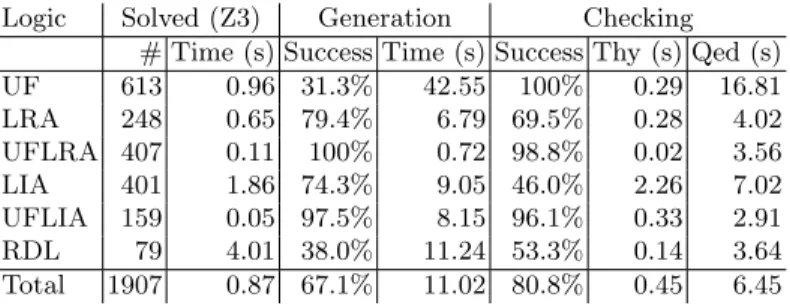
Table 1 shows our results sorted by logic. For each category, we measure the average running time of Z3 (Solved), the average running time of our certificate generation (Generation). The Solved time can be seen as a best-case scenario: the certifying prover uses Z3 and provide proofs that can be checked in Coq, so we do not expect faster results than the standalone state-of-the-art solver. We also measure the time it takes Coq to type-check our proof term (Qed) and have isolated the time spent by our Coq reflexive verifier validating theory lemmas (Thy). The generation phase (Generation) and the checking phases (Checking) have an individual timeout of 150 seconds. These timeouts account for most of the failures, the remaining errors come from shortcomings of the prototype.
Overall, the theory specific checkers account for less then 7% of checking time. However, this average masks big differences. For UFLRA, the checker spends less than 1% of its time in the theories, but for the integer arithmetic fragments it represents 11% of checking time for UFLIA and 32% for LIA. For UFLRA it can be explained by the simplicity of the problems : 80% of these formulae are unsatisfiable even if we only consider their boolean abstractions. For integer arithmetic the success ratio is rather low. It is hard to know whether this is due to the inherent difficulty of the problems or whether it pinpoints an inefficiency of the checker. The fault might also lie on the certifying prover side. In certain circumstances, it performs case-splits that are responsible for long proofs.
Sometimes, our simple SMT loop fails to produce certificates before time-out. For UF and RDL we only generate certificates for a third of the formulae. The generation of certificates could be optimised further. A more clever proof search strategy could improve both certificate generation and checking times: smaller certificates could be generated faster and checked more easily. Yet, the bottleneck is the reflexive verifier, which achieves 100% success ratio for UF only. Currently, we observe that our main limiting factor is not time but the mem-ory consumption of the Coq process. A substantial amount of our timeouts are actually due to memory exhaustion. We are investigating the issue, but the ob-jects we manipulate (formulae, certificates) are orders of magnitude larger than
Logic Solved (Z3) Generation Checking
# Time (s) Success Time (s) Success Thy (s) Qed (s)
UF 613 0.96 31.3% 42.55 100% 0.29 16.81 LRA 248 0.65 79.4% 6.79 69.5% 0.28 4.02 UFLRA 407 0.11 100% 0.72 98.8% 0.02 3.56 LIA 401 1.86 74.3% 9.05 46.0% 2.26 7.02 UFLIA 159 0.05 97.5% 8.15 96.1% 0.33 2.91 RDL 79 4.01 38.0% 11.24 53.3% 0.14 3.64 Total 1907 0.87 67.1% 11.02 80.8% 0.45 6.45
those manipulated on a day-to-day basis by a proof-assistant. We know we are reaching the limits of the system. Actually, to perform our experiments we al-ready overcome certain inefficiencies of Coq. For instance, to construct formulae and certificates we by-pass Coq front-end, which is not efficient enough for this application, and use homemade optimised versions of a few Coq tactics.
7
Related Work
The area of proof-generating decision procedure has been pioneered by Boul-ton for the HOL system [7] and Necula for Proof Carrying Code [21]. In the context of the latter, the Touchstone theorem prover [22] generates LF proof terms. In our approach, each decision procedure comes with its own certificate language, and a reflexive checker. It allows us to choose the level of details of the certificates without compromising correctness. Several authors have examined UF proofs [12, 24]. They extend a pre-existing decision procedure with proof-producing mechanism without degrading its complexity and achieving a certain level of irredundancy. However, their notion of proof is reduced to unsatisfiable cores of literals rather than proof trees. Our certificate generation builds on such works to produce detailed explanations. SMT solvers such as CVC3 [4], veriT [8] and Z3 [10] all generate proofs in their own proof language. Many rules reflect the internal reasoning with various levels of precision: certain rules detail each computation step, some others account for complex reasoning with no further details. Such solvers aim at discharging large and/or hard problems, at the price of simplicity. Our approach here differs because our proof rules are specific to the decision procedure we have implemented in our prover. We do not sacrifice soundness since our proof verifier is proved correct (and executable) in Coq.
Several approaches have been proposed to integrate new decision procedures in sceptical proof assistants for various theories. First-order provers have been integrated in Isabelle [25], HOL [18] or Coq [9]. These works rely generally on resolution proof trees. Similar proof formats have been considered to integrate Boolean satisfiability checking in a proof assistant. Armand et al. [2] have ex-tended the Coq programming language with machine integers and persistent array and have used these new features to directly program in Coq a reflexive SAT checker. On a similar topic, Weber and Amjad [29] have integrated a state-of-the-art SAT solver in Isabelle/HOL, HOL4 and HOL Light using translation from SAT resolution proofs to LCF-style proof objects.
Previous work has been devoted to reconstruct SMT solvers proofs in proof assistants. McLaughlin et al. [20] have combined CVC Lite and HOL light for quantifier-free first-order logic with equality, arrays and linear real arithmetic. Ge and Barrett have continued that work with CVC3 and have extended it to quan-tified formulae and linear integer arithmetic. This approach highlighted the diffi-culty for proof reconstruction. Independently Fontaine et al. [15] have combined haRVey with Isabelle/HOL for quantifier free first-order formulae with equal-ity and uninterpreted functions. In their scheme, Isabelle solves UF sub-proofs with hints provided by haRVey. Our UF certificate language is more detailed
and does not require any decision on the checker side. B¨ohme and Weber [6] are reconstructing Z3 proofs in the theorem provers Isabelle/HOL and HOL4. Their implementation is particularly efficient but their fine profiling shows that a lot of time is spent re-proving sub-goals for which the Z3 proof does not give sufficient details. Armand et al. [2] have recently extended their previous work [2] to check proofs generated by the SMT solver veriT [8]. Our approaches are similar and rely on proof by reflexion. A difference lies in the certificate generation scheme. Their implementation is tied to a specific SMT solver and its ability to generate proofs. In our approach, we do not require SMT solvers to generate proofs but instead designed our own proof-producing prover to discharge theory lemmas.
8
Conclusion and Perspectives
We have presented a reflexive approach for integrating a SMT solver in a sceptical proof assistant like Coq. It is based on a SMT proof format that is independent from a specific SMT solver. We believe our approach is robust to changes in the SMT solvers but allows nonetheless to benefit from their improvements. For most usages, the overhead incurred by our SMT loop is acceptable. It could even be reduced if SMT solvers gave access to the theory lemmas they use during their proof search. We are confident that such information could be generated by any SMT solver with little overhead. Implementing our approach necessitates proof-producing decision procedures. However, the hard job is left to the SMT solver that extracts unsat cores. A fine-grained control over the produced proof has the advantage of allowing to optimise a reflexive verifier and of ensuring the completeness of the verifier with respect to the prover. Our Nelson-Oppen Coq verifier is both reflexive and parametrised by a list of theories. This design is modular and easy to extend with new theories. Our prototype implementation is perfectible but already validates SMT formulae of industrial size. Such extreme experiments test the limits of the proof-assistant and will eventually help at improving its scalability. In the future, we plan to integrate new theories such as the theory of arrays and bit-vectors. Another theory of interest is the theory of constructors that would be useful to reason about inductive types.
References
1. M. Armand, G. Faure, B. Gregoire, C. Keller, L. Th´ery, and B. Werner. A Modular Integration of SAT/SMT Solvers to Coq through Proof Witnesses. In CPP 2011, LNCS. Springer, 2011.
2. M. Armand, B. Gr´egoire, A. Spiwack, and L. Th´ery. Extending Coq with imper-ative features and its application to SAT verification. In ITP’10, volume 6172 of LNCS, pages 83–98. Springer, 2010.
3. C. Barret, A. Stump, and C. Tinelli. The SMT-LIB standard: Version 2.0, 2010. 4. C. Barrett and C. Tinelli. CVC3. In CAV’07, volume 4590 of LNCS, pages 298–302.
Springer, 2007.
5. F. Besson. Fast reflexive arithmetic tactics the linear case and beyond. In TYPES’06, volume 4502 of LNCS, pages 48–62. Springer, 2007.
6. S. B¨ohme and T. Weber. Fast LCF-style proof reconstruction for Z3. In ITP’10, volume 6172 of LNCS, pages 179–194. Springer, 2010.
7. R. J. Boulton. Efficiency in a Fully-Expansive Theorem Prover. PhD thesis, Uni-versity of Cambridge Computer Laboratory, 1994. Technical Report 337.
8. T. Bouton, D. C. B. de Oliveira, D. D´eharbe, and P. Fontaine. veriT: an open, trust-able and efficient SMT-solver. In CADE’09, volume 5663 of LNCS, pages 151–156. Springer, 2009.
9. E. Contejean and P. Corbineau. Reflecting proofs in first-order logic with equality. In CADE’05, volume 3632 of LNCS, pages 7–22. Springer, 2005.
10. L. M. de Moura and N. Bjørner. Proofs and Refutations, and Z3. In LPAR’08 Workshops: KEAPPA, volume 418. CEUR-WS.org, 2008.
11. L. M. de Moura and N. Bjørner. Z3: An efficient SMT solver. In TACAS’08, volume 4963 of LNCS, pages 337–340. Springer, 2008.
12. L. M. de Moura, H. Rueß, and N. Shankar. Justifying equality. ENTCS, 125(3):69– 85, 2005.
13. L. M. de Moura, H. Rueß, and M. Sorea. Lazy theorem proving for bounded model checking over infinite domains. In CADE’02, volume 2392 of LNCS, pages 438–455. Springer, 2002.
14. D. Detlefs, G. Nelson, and J. B. Saxe. Simplify: a theorem prover for program checking. J. ACM, 52(3):365–473, 2005.
15. P. Fontaine, J-Y. Marion, S. Merz, L. P. Nieto, and A. F. Tiu. Expressiveness-+automation+soundness: Towards combining SMT solvers and interactive proof assistants. In TACAS’06, volume 3920 of LNCS, pages 167–181. Springer, 2006. 16. B. Gr´egoire and X. Leroy. A compiled implementation of strong reduction. In
ICFP’02, pages 235–246. ACM, 2002.
17. B. Gr´egoire and A. Mahboubi. Proving equalities in a commutative ring done right in Coq. In TPHOLs 2005, volume 3603 of LNCS, pages 98–113. Springer, 2005. 18. J. Hurd. Integrating Gandalf and HOL. In TPHOLs 1999, volume 1690 of LNCS,
pages 311–322. Springer, 1999.
19. X. Leroy. Formal certification of a compiler back-end or: programming a compiler with a proof assistant. In POPL’06, pages 42–54. ACM, 2006.
20. S. McLaughlin, C. Barrett, and Y. Ge. Cooperating theorem provers: A case study combining HOL-Light and CVC Lite. ENTCS, 144(2):43–51, 2006.
21. G. C. Necula. Compiling with Proofs. PhD thesis, CMU, 1998.
22. G. C. Necula and P. Lee. Proof generation in the Touchstone theorem prover. In CADE’00, volume 1831 of LNCS, pages 25–44. Springer, 2000.
23. G. Nelson and D. C. Oppen. Simplification by cooperating decision procedures. ACM Trans. Program. Lang. Syst., 1:245–257, 1979.
24. R. Nieuwenhuis and A. Oliveras. Proof-producing congruence closure. In RTA’05, volume 3467 of LNCS, pages 453–468. Springer, 2005.
25. L. C. Paulson and K. W. Susanto. Source-level proof reconstruction for interactive theorem proving. In TPHOLs’07, volume 4732 of LNCS, pages 232–245. Springer, 2007.
26. William Pugh. The omega test: a fast and practical integer programming algorithm for dependence analysis. In SC, pages 4–13, 1991.
27. A. Schrijver. Theory of Linear and Integer Programming. Wiley, 1998.
28. G. Stengle. A nullstellensatz and a positivstellensatz in semialgebraic geometry. Mathematische Annalen, 207(2):87–97, 1973.
29. T. Weber and H. Amjad. Efficiently checking propositional refutations in HOL theorem provers. J. Applied Logic, 7(1):26–40, 2009.