AcademyHealth’s 20th Annual Research Meeting June 26-29, 2003
Gaylord Oprylan – Nashville, TN
Regularity of performance to improve health services in developing countries
Porignon D1, Wodon A1,2, Dujardin B3, Hennart P4, Dramaix M5
1 Department of Epidemiology and Preventive Medicine, School of Public Health, Free University of Brussels
2 Cemubac, School of Public Health, Free University of Brussels
3 Head, Department of Health Policy, School of Public Health, Free University of Brussels
4 Head, Department of Epidemiology and Preventive Medicine, School of Public Health, Free University of Brussels
5 Head, Department of Medical Statistics, School of Public Health, Free University of Brussels
Corresponding author : Porignon D
Objectives: By handling routine health information related to post crisis Rwandan health system, this paper attempts to argue that regularity in delivering services has positive influence for better global performance of first line health facilities in terms of curative and preventive activities.
Design: Comprehensive, nationwide health routine data were collected in more than 300 health centres and compiled at the national level of the Ministry of Health. Analysis was operated for the year 1999. Health centres were categorized as regular (group II) or not (group I), according to their monthly performance for vaccination against tuberculosis (BCG) in 0-11 month old children. Performances were then scrutinized for 5 other first line activities. In order to validate the first results obtained on the basis of this a priori classification, a specific “cluster analysis” was also carried out after transformation into z-scores.
Population studied: The 318 health centres in Rwanda that performed first line activities during the year 1999 were eligible. These health centres were covering about 8 million inhabitants. Two million accessed first line curative care services and hundreds of thousand children and mothers were targeted for immunisation and antenatal care.
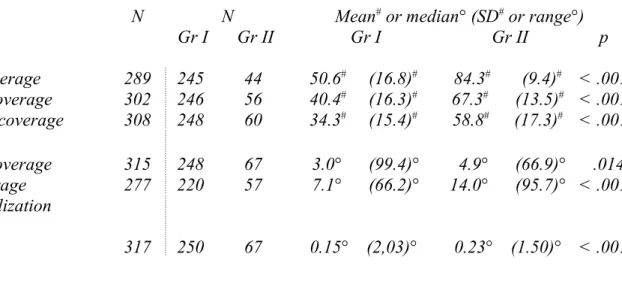
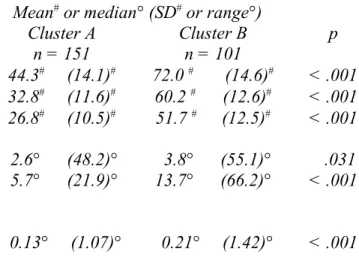
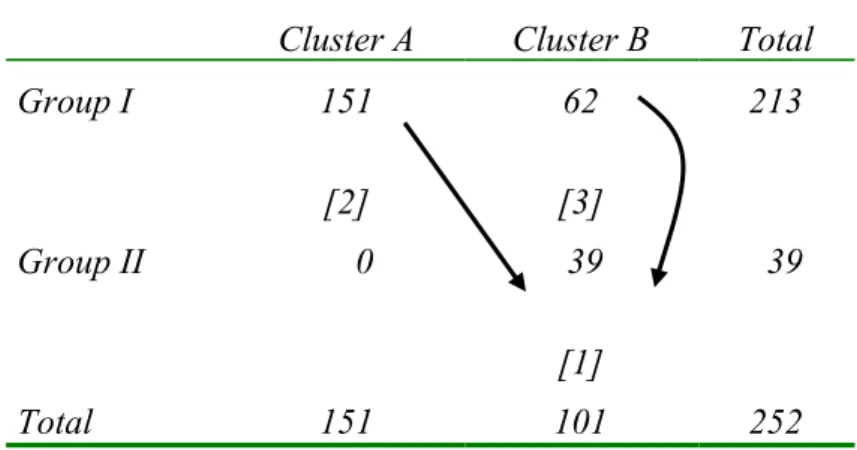
Principal findings: The results showed that health centres running BCG immunisation regularly were also those that systematically had significantly better performance for all other selected activities. For example Measles, antenatal care, obstetrical coverage as well as curative care utilisation rates were higher respectively in group I than in group II (see Table 1). Cluster analysis classified health centres into cluster A and cluster B. The latter showed better performance than cluster A (see Table 2). All health centres that were initially classified as regular according BCG activity were also those included in the best bunch by cluster analysis (see Table 3). The results showed then good similarity between cluster and grouping analyses, especially in identifying best, moderate and least performing health centres (n=39, 62 and 151 respectively) on which various efforts should then be focused. For example, sets [2] and [3] on Table 3 should benefit from improved qualitative situation analysis as well as training and supervision in a view to defining actions which will steer them to the lower right cell (see black arrows on Table 3). This participative analysis should be performed at national, intermediate and peripheral levels of the health system.
Conclusions: Regularity could be understood as a “pointer” or a mean to reach better performance. This conclusion should encourage health authorities in emphasizing performance regularity as a quality issue to be stressed during basic and on-going training.
It put forward that working on one activity’s regularity should lead to better performance in other activities. This argued in favour of global integrated approach for health system organisation and management.
Implications for policy:
(1)The argumentation provided medical authorities with relevant elements among which, health centre classification, integration of vertical programmes, comprehensiveness for influencing strategic thoughts and for decision making in terms of policy formulation at national or peripheral level.
(2) Routine information was useful for investigation and decision making in a view to improving health service performance analysis and ensuing decision making.
N N Mean# or median° (SD# or range°)
Gr I Gr II Gr I Gr II p
BCG vaccine coverage 289 245 44 50.6# (16.8)# 84.3# (9.4)# < .001
DTP 3 vaccine coverage 302 246 56 40.4# (16.3)# 67.3# (13.5)# < .001
Measles vaccine coverage 308 248 60 34.3# (15.4)# 58.8# (17.3)# < .001
Antenatal care coverage 315 248 67 3.0° (99.4)° 4.9° (66.9)° .014
Obstetrical coverage 277 220 57 7.1° (66.2)° 14.0° (95.7)° < .001
Curative care utilization
(NC/inh/yr) 317 250 67 0.15° (2,03)° 0.23° (1.50)° < .001
All results expressed as percentages except were noted NC/inh/yr = new cases per inhabitant per year
DTP 3 = Diphtheria Tetanus Pertussis (third dose)
Obstetrical coverage = deliveries that occurred under professional assistance in health centres Antenatal coverage = first contact with antenatal care during the first trimester of pregnancy Curative care utilisation = proportion of the population that attended clinics once during the year Gr I = health centres with < 9 months above 60 % of expected performance for BCG immunisation Gr II = health centres with >= 9 months above 60 % of expected performance for BCG immunisation p: significance value for t-Student or Mann - Whitney test
Mean# or median° (SD# or range°)
Cluster A Cluster B p
n = 252 n = 151 n = 101
BCG vaccine coverage 44.3# (14.1)# 72.0 # (14.6)# < .001
DTP 3 vaccine coverage 32.8# (11.6)# 60.2 # (12.6)# < .001
Measles vaccine coverage 26.8# (10.5)# 51.7 # (12.5)# < .001
Antenatal care coverage 2.6° (48.2)° 3.8° (55.1)° .031
Obstetrical coverage 5.7° (21.9)° 13.7° (66.2)° < .001
Curative care utilization
(Nc/inh/yr) 0.13° (1.07)° 0.21° (1.42)° < .001
All results expressed as percentages except were noted NC/inh/yr = new cases per inhabitant per year
DTP 3 = Diphtheria Tetanus Pertussis (third dose)
Obstetrical coverage = deliveries that occurred under professional assistance in health centres Antenatal coverage = first contact with antenatal care during the first trimester of pregnancy Curative care utilisation = proportion of the population that attended clinics once during the year p: significance value for t-Student or Mann - Whitney test
Cluster A Cluster B Total Group I 151 [2] 62 [3] 213 Group II 0 39 [1] 39 Total 151 101 252