Learning
by
Mohammadreza JAMALI
THESIS PRESENTED TO ÉCOLE DE TECHNOLOGIE SUPÉRIEURE
IN PARTIAL FULFILLMENT FOR THE DEGREE OF
DOCTOR OF PHILOSOPHY
Ph.D.
MONTREAL, AUGUST 30TH, 2018
ÉCOLE DE TECHNOLOGIE SUPÉRIEURE
UNIVERSITÉ DU QUÉBEC
BY THE FOLLOWING BOARD OF EXAMINERS:
Mr. Stéphane Coulombe, Thesis Supervisor
Department of Software and IT Engineering, École de technologie supérieure
Mr. Mohamed Cheriet, President of the Board of Examiners
Department of Automation Engineering, École de technologie supérieure
Mr. Carlos Vazquez, Member of the jury
Department of Software and IT Engineering, École de technologie supérieure
Mr. Omair Ahmad, External Independent Examiner
Department of Electrical and Computer Engineering, Concordia University
THIS THESIS WAS PRESENTED AND DEFENDED
IN THE PRESENCE OF A BOARD OF EXAMINERS AND THE PUBLIC
ON AUGUST 24TH, 2018
Stéphane Coulombe, for his dedication, encouragement and continuous support throughout this wonderful five-year journey. His enthusiasm, vision and patience have not just made this research possible but also have a lasting influence in my career and in my life.
I would also like to thank my friends in the Vantrix Industrial Research Chair in Video Optimization lab for their helps and encouragement: Esmaeil, Jean-François, Firouzeh and Luc.
I also thank Dr. Sadreazami for his collaboration to design and train a neural network model for function approximation in reinforcement learning framework.
My deepest gratitude goes to my parents for their endless support and continuous encourage-ment throughout these years of study.
Finally, I would like to thank the Vantrix Corporation and the Natural Sciences and Engineering Research Council of Canada for their financial support.
Mohammadreza JAMALI
RÉSUMÉ
La compression vidéo a retenu l’attention ces dernières années en raison de la popularité croissante des applications vidéo à haute définition (HD) et ultra HD et de la puissance de traitement accrue du matériel et des logiciels. Le codage vidéo à haute efficacité (HEVC)/H.265 est la norme de codage la plus récente. Elle permet une amélioration significative de l’efficacité de la compression par rapport aux normes antérieures et fournit une réduction de débit de 50%, pour la même qualité, par rapport à la célèbre norme H.264/advanced video coding (AVC) .
L’amélioration des performances de high efficiency video coding (HEVC) se fait au détriment d’une complexité de calculs beaucoup plus élevée au niveau de l’encodeur, rendant difficile le déploiement de HEVC dans des applications en temps réel. HEVC augmente le nombre de modes de codage intra à 35, offrant une plus grande efficacité de codage que les autres normes de codage vidéo tout en augmentant la complexité du codeur, principalement en raison du processus de décision de mode par optimisation débit-distorsion (RDO). En outre, dans le processus de fractionnement de trame, H.264/AVC utilise des macroblocs de 16× 16 pixels, tandis que HEVC introduit des unités de codage arborescent (CTUs) avec une taille maximale de 64× 64. Le CTU peut être fractionné, de manière récursive et adaptative selon le contenu, en unités de codage (CUs) possédant une structure en arbre quaternaire. Il en résulte un codage efficace des régions d’arrière-plan et des objets avec diverses tailles et formes. En plus de la complexité imposée par la décision de mode, le processus de partitionnement de trame entraîne une complexité de calcul importante.
Au vu de cela, dans cette thèse, le codage HEVC intra est étudié et de multiples méthodes sont proposées pour réduire sa complexité de calculs et son temps de codage. Les méthodes proposées tournent autour de deux domaines de décision, celui du mode de codage et celui de la taille des CUs.
La première méthode proposée est basée sur la prédiction du coût RDO par une métrique basée sur la SATD de plus faible complexité. Grâce à la prédiction du coût RDO, les modes non prometteurs sont écartés du traitement ultérieur; ce qui entraîne une économie de calculs substantielle. Cette méthode permet une réduction de 30% du temps de traitement avec une augmentation de 0,8% du Bjøntegaard delta rate (BD-Rate) par rapport au modèle de test HEVC (HM), représentant ainsi un compromis souhaitable.
Dans la deuxième contribution, une classification de mode lors du codage chromatique est proposée pour réduire de façon adaptative les modes intra-chromatiques en fonction de la texture du bloc. Par rapport au HM, la méthode proposée de décision de mode chroma fournit une réduction de temps de 6% avec une augmentation de BD-Rate de 0,07%.
La troisième contribution de cette thèse est une méthode basée sur le gradient, utilisant l’opérateur de Prewitt, pour éliminer les modes directionnels non pertinents de la liste des candidats. La méthode proposée permet une réduction du temps de 11,4% avec une augmentation de BD-Rate de 0,62% par rapport au HM.
Dans la quatrième méthode proposée, les modes les plus pertinents des blocs voisins sont considérés pour exploiter la redondance spatiale à travers une trame. Une classification des coûts de SATD est également proposée qui permet l’élimination de plusieurs modes candidats avant le RDO. Nous montrons que ces deux approches, combinées à l’algorithme basé sur le gradient, fournissent une réduction de temps de 35,6% avec une perte de BD-Rate de 1,07%.
Les méthodes de décision de mode proposées sont ensuite combinées, aboutissant à une réduction du temps de codage de 47,3% avec une perte de qualité de 1,37% de BD-Rate par rapport au HM.
La cinquième contribution de cette thèse est une méthode de codage intra rapide basée sur des gradients globaux et directionnels pour terminer rapidement le fractionnement au niveau des CUs et éviter d’effectuer le processus RDO à haute complexité pour les prochains niveaux de CUs. Cette approche, combinée à la décision de mode, réduit le temps de codage de 52% en moyenne, avec une faible perte de qualité de 1,50% de BD-Rate.
Dans la sixième contribution, une méthode basée sur la classification bayésienne est proposée pour réduire la complexité du processus de fractionnement des CUs. Deux problèmes de classification binaires sont considérés pour effectuer un fractionnement précoce et un arrêt anticipé du fractionnement. Il est montré qu’en utilisant la méthode proposée, une réduction de temps de 43,2% avec une perte de qualité de 1,07% de BD-Rate peut être obtenue.
La septième contribution est une méthode de décision de taille des CUs basée sur l’apprentissage par renforcement, l’acquisition de caractéristiques actives et les réseaux de neurones. Cette méthode effectue un fractionnement précoce et un arrêt anticipé du fractionnement en considérant le codeur et le CU comme un système agent-environnement. La méthode proposée fournit une réduction du temps de 51,3% avec une perte de BD-Rate de 0,84% . De plus, la combinaison des méthodes de décision de mode proposées avec cette nouvelle approche donne une réduction totale du temps de 62,4% pour une perte de BD-Rate de 1,23% comparativement au HM.
Mots clés: H.265, HEVC, compression vidéo, codage intra, décision de mode, AVC, décision de la taille des CUs, réduction de complexité
Mohammadreza JAMALI
ABSTRACT
Video compression technology has gained much attention in recent years due to the ever-increasing popularity of high-definition (HD) and ultra-HD video applications and increased processing power of hardware and software. High efficiency video coding (HEVC)/H.265 is the most recent video coding standard which achieves a significant improvement in compression efficiency as compared to the other standards and provides a 50% bit rate reduction compared to the well-known H.264/advanced video coding (AVC) with the same quality.
The performance improvement of HEVC is at the expense of much higher computational complexity at the encoder, making it challenging to deploy HEVC in real-time applications. In particular, HEVC increases the number of intra coding modes to 35, providing higher coding efficiency than the other video coding standards while increasing encoder complexity, which is mostly due to mode decision process by highly resource-demanding rate-distortion optimization (RDO). In addition, in frame splitting process, H.264/AVC employs 16× 16 macroblocks, while HEVC introduces coding tree units (CTUs) with a maximum size of 64× 64. The CTU may be split recursively and content-adaptively into coding units (CUs) in a quadtree-based manner, resulting in an efficient coding of background regions and objects with various sizes and shapes. In addition to the complexity imposed by mode decision, the frame partitioning process results in a significant computational complexity.
In view of this, in this thesis, the HEVC intra coding is studied and multiple novel methods are proposed to reduce its computational complexity and encoding time. The proposed methods are revolving around two areas of mode decision and CU size decision.
The first proposed method is based on the prediction of the RDO cost by a low-complexity SATD-based metric. Through predicting the RDO cost, the non-promising modes are discarded from further processing giving rise to substantial computation saving. This method provides a 30% time reduction with a 0.8% Bjøntegaard delta rate (BD-Rate) increase as compared to HEVC test model (HM); leading to a desirable trade-off.
In the second contribution, a mode classification in chroma coding is proposed to adaptively reduce chroma intra modes based on block texture. As compared to HM, the chroma mode decision method provides a 6% time reduction with a 0.07% BD-Rate increase.
The third contribution, in this thesis, is a gradient-based method, using the Prewitt operator, to eliminate the non-relevant directional modes from the list of candidates. The proposed method achieves a time reduction of 11.4% with a BD-Rate increase of 0.62% in comparison to HM.
In the fourth proposed method, the most relevant modes of the neighboring blocks are considered to exploit the spatial redundancy across a frame. A classification of SATD costs is also proposed which permits the elimination of several candidate modes prior to RDO. It is shown that these two approaches, combined with the gradient-based algorithm, provide a 35.6% time reduction with a 1.07% BD-Rate loss.
The proposed mode decision methods are combined, resulting in a 47.3% encoding time reduction with a quality loss of 1.37% BD-Rate as compared to the HM.
The fifth contribution, in this thesis, is a fast intra coding method based on global and directional gradients to early terminate the CU splitting and avoid performing the high-complexity RDO process for the next CU levels. This approach, combined with mode decision, reduces the encoding time by 52% on average, with a small quality loss of 1.50% BD-Rate.
In the sixth contribution, a method based on the Bayesian classification is proposed to reduce the complexity of CU splitting process. Two binary classification problems are considered for early splitting and early splitting termination. It is shown that using the proposed method a 43.2% time reduction with a quality loss of 1.07% BD-Rate can be achieved.
The seventh contribution is a CU size decision method based on reinforcement learning, active feature acquisition and neural networks. This method carries out early splitting and early splitting termination by considering the encoder and CU as an agent-environment system. The proposed method provides a 51.3% time reduction and a 0.84% BD-Rate loss. In addition, combining the proposed mode decision methods with this novel approach gives a total time reduction of 62.4% and a BD-Rate loss of 1.23% comparing to HM.
Keywords: H.265, high efficiency video coding (HEVC), video compression, intra video coding, mode decision, advanced video coding (AVC), CU size decision, complexity reduction
CHAPTER 1 INTRODUCTION . . . 1
1.1 Problem Statement and Motivations . . . 1
1.2 Objectives . . . 2
1.3 Contributions . . . 3
1.4 Thesis Structure . . . 5
CHAPTER 2 HEVC VIDEO ENCODER OVERVIEW . . . 7
2.1 Block-Based Hybrid Video Coding . . . 7
2.2 HEVC Video Encoding . . . 8
2.3 HEVC Computational Complexity Analysis . . . 11
2.4 HEVC Intra Coding . . . 15
CHAPTER 3 LITERATURE REVIEW ON HEVC INTRA CODING . . . 19
3.1 Mode Decision Complexity Reduction . . . 19
3.2 Coding Unit Size Decision Complexity Reduction . . . 25
CHAPTER 4 PROPOSED INTRA MODE DECISION METHODS . . . 31
4.1 Mode Decision Based on RDO Cost Prediction . . . 31
4.1.1 RDO Cost Modeling . . . 31
4.1.2 Candidates Selection . . . 36
4.1.3 Experimental Results and Discussion . . . 41
4.2 Fast Chroma Mode Decision . . . 44
4.2.1 Proposed Method . . . 44
4.2.2 Experimental Results and Discussion . . . 48
4.3 Low Complexity Edge Detection for Mode Decision . . . 51
4.3.1 Proposed Method . . . 51
4.3.2 Experimental Results and Discussion . . . 56
4.4 Fast Mode Decision Based on SATD Cost Classification . . . 60
4.4.1 Most Relevant Modes of the Neighboring Blocks . . . 60
4.4.2 Mode Ordering, Binary Classification and RDO Dodging . . . 62
4.4.3 Experimental Results and Discussion . . . 65
4.5 Experimental Results and Discussion for Overall Mode Decision . . . 68
CHAPTER 5 PROPOSED CODING UNIT SIZE DECISION METHODS . . . 77
5.1 Early Splitting Termination Based on Global and Directional Gradients . . . 78
5.1.1 Early Splitting Termination by Global Gradient . . . 79
5.1.2 Early Splitting Termination by Directional Gradient . . . 80
5.1.3 Experimental Results and Discussion . . . 81
5.2 Early Splitting and Early Splitting Termination Based on Bayesian Analysis . . . 83
5.2.1 Proposed Method . . . 83
5.2.2 Experimental Results and Discussion . . . 88
5.3 CU Size Decision Using Neural Network-Based Reinforcement Learning . . . 90
5.3.1 Problem Formulation . . . 98
5.3.2 State Representation and Action Space . . . .100
5.3.3 Cost Function . . . .103
5.3.4 Experimental Results and Discussion . . . .104
CONCLUSION . . . .111
Table 2.1 Test sequences. . . 12
Table 2.2 Encoding time for test sequences . . . 12
Table 2.3 Consumed time in encoder classes . . . 13
Table 2.4 Average share of encoding complexity . . . 14
Table 2.5 Most complex functions at the encoder and their complexity shares . . . 15
Table 2.6 Number of intra mode candidates, selected by the HM, for different prediction unit (PU) sizes . . . 17
Table 4.1 Goodness of fit test results for the normal model. . . 36
Table 4.2 Joint normality test results . . . 41
Table 4.3 Experimental results while implementing RDO cost modeling . . . 43
Table 4.4 Chroma intra modes . . . 44
Table 4.5 Number of selected chroma modes . . . 48
Table 4.6 Experimental results for the proposed chroma mode decision . . . 49
Table 4.7 Experimental results while implementing fast chroma mode decision . . . 50
Table 4.8 High and low limits of Gy/Gx for angular modes . . . 56
Table 4.9 Error rate of gradient operators . . . 57
Table 4.10 Experimental results of the proposed method, implementing different gradient operators, compared to HM . . . 58
Table 4.11 Average results over all recommended sequences of the proposed method compared to HM using different gradient operators . . . 58
Table 4.12 Experimental results while implementing gradient analysis (Prewitt) compared to HM, first hundred frames . . . 59
Table 4.13 Experimental results of the proposed SATD cost classification method compared to HM . . . 66
Table 4.14 Experimental results of the overall mode decision method compared
to HM . . . 69
Table 4.15 Experimental results of the overall mode decision method compared
to HM (CTC conditions) . . . 70
Table 4.16 Comparison of the proposed mode decision method with other MD
methods . . . 73
Table 4.17 Experimental results of the overall mode decision method compared
to HM for class E sequences which are not part of CTC . . . 73
Table 4.18 Hit ratio (%) for different algorithms . . . 74
Table 5.1 Experimental results of the early splitting termination method
compared to HM . . . 83
Table 5.2 Experimental results of the early splitting and early splitting
termination method compared to HM . . . 89
Table 5.3 Experimental results while implementing RL-based CU size
decision . . . .105
Table 5.4 Comparison of the proposed RL-based method to other CU size
decision methods . . . .106
Table 5.5 Experimental results while implementing RL-based CU size
decision combined with mode decision . . . .108
Table 5.6 Comparison of the proposed RL-based CU size decision method
Figure 2.1 General view of a hybrid video encoder. . . 8
Figure 2.2 HEVC video encoder.. . . 9
Figure 2.3 Frame splitting into CUs (red) and PUs (green) based on the quadtree structure. . . 9
Figure 2.4 Partitioning of a 64× 64 CTU into CUs and the coding order of CUs. . . 10
Figure 2.5 All possible modes of partitioning a CU into PUs in HEVC.. . . 10
Figure 2.6 HEVC intra prediction modes. . . 16
Figure 2.7 Intra prediction based on directional mode 2. . . 17
Figure 4.1 Block diagram of luma mode decision at PU level. . . 32
Figure 4.2 Scatter plot for RMD cost and RDO cost. . . 33
Figure 4.3 Best fitted distributions for CRDO . . . 35
Figure 4.4 Normal distributions for CRDO. . . 36
Figure 4.5 Block diagram of chroma mode decision. . . 45
Figure 4.6 Chroma mode decision methods. . . 47
Figure 4.7 Detected edge and three related modes. . . 55
Figure 4.8 Block diagram of the proposed SATD cost classification algorithm.. . . 60
Figure 4.9 Most relevant modes of the neighboring blocks. . . 62
Figure 4.10 A gap among SATD costs. . . 63
Figure 4.11 RD curve of the proposed SATD cost classification method and HM, RaceHorses . . . 67
Figure 4.12 RD curves of the proposed mode decision method and HM, BasketballPass.. . . 71
Figure 4.13 RD curves of the proposed mode decision method and HM,
PartyScene. . . 71
Figure 5.1 An optimal tree for efficient CU size decision . . . 78
Figure 5.2 Split and non-split CUs using RDO and their MGA feature. . . 81
Figure 5.3 Split and non-split CUs using RDO and their MDGA feature. . . 82
Figure 5.4 Block diagram of the two binary classification problems. . . 84
Figure 5.5 Histograms of the first feature for split and non-split blocks. . . 87
Figure 5.6 Histograms of the second feature for split and non-split blocks. . . 87
Figure 5.7 RD curve of the CU splitting method and HM, BasketballPass. . . 90
Figure 5.8 Reinforcement learning configuration.. . . 91
Figure 5.9 Three agents of a batch-mode reinforcement learning system. . . 96
Figure 5.10 Comparison of the proposed RL-based method to other CU size decision methods. . . .106
Figure 5.11 Comparison of the proposed RL-based CU size decision method combined with mode decision to other combined methods. . . .107
Algorithm 4.1 RDO best mode selection . . . 40
Algorithm 4.2 Chroma mode classification . . . 47
Algorithm 4.3 Selecting the promising modes based on SATD cost classification 64 Algorithm 5.1 Classifying a coding unit into split or non-split . . . 88
Algorithm 5.2 Fitted Q iteration . . . 97
Algorithm 5.3 Neural fitted Q iteration . . . 98
AVC advanced video coding
BD-Rate Bjøntegaard delta rate
BD-PSNR Bjøntegaard delta peak signal-to-noise ratio
BIC Bayesian information criterion
CB coding block
CDF cumulative distribution function
CL confidence level
CTB coding tree block
CTC common test conditions
CTU coding tree unit
CU coding unit
DP dynamic programming
HD high-definition
HEVC high efficiency video coding
HM HEVC test model
JCT-VC joint collaborative team on video coding
LD low delay
MDGA mean of directional gradient amplitudes
MDP markov decision process
MGA mean of gradient amplitudes
MI mutual information
MLP multi-layer perceptron
MPEG moving picture experts group
MPM most probable mode
MRM most relevant mode
MSE mean squared error
PB prediction block
PDF probability distribution function
PSNR peak signal to noise ratio
PU prediction unit
QP quantization parameter
RA random access
RD rate-distortion
RDO rate-distortion optimization
RL reinforcement learning
RQT residual quad-tree
SAD sum of absolute differences
SATD sum of absolute transformed differences
SSE sum of squared errors
SVM support vector machine
TB transform block
TR time reduction
TU transform unit
Rm Number of bits for PU encoding.
Rp Number of bits used for mode coding.
λp Lagrange multiplier in RMD cost.
λm Lagrange multiplier in RDO cost.
α Distance factor in mode classification.
BMode Number of bits for signaling the best intra mode.
BCoding Number of bits for the encoded block after entropy coding.
γ Discount factor in reinforcement learning framework. F Set of transition samples in batch mode learning. T Training set in batch mode learning.
φ Mapping form state space to feature space. ˆ
π∗ Estimation of an optimal policy.
The use of high quality video such as high-definition (HD) and beyond HD (4K× 2K and 8K× 4K) has created a demand for new video coding technologies beyond the capability of the well-known H.264/advanced video coding (AVC) standard (Wiegand et al., 2003). In view of this, ITU-T video coding experts group (VCEG) and ISO/IEC moving picture experts group (MPEG) have established a joint group named the joint collaborative team on video coding (JCT-VC) to design a new video coding standard, called high efficiency video coding (HEVC)/H.265 (Sullivan et al., 2012) in order to improve the coding efficiency as compared to the other video coding standards. It has been shown in (Ohm et al., 2012) that HEVC provides a significant bit rate reduction, i.e., up to 50%, for the same subjective quality in comparison to H.264/AVC.
The improved coding performance of HEVC is achieved through a highly flexible coding structure using several advanced tools. For instance, in intra prediction, unlike the 9 modes used in H.264/AVC, the number of modes increases to 35, including dc, planar and 33 directional modes. This allows HEVC encoder to make predictions more precisely, and thus, to exploit the spatial correlation efficiently. In addition, HEVC provides a new content-adaptive and recursive approach to split a frame into coding units (CUs) in a quadtree-based manner, resulting in an improved coding efficiency. However, finding the best candidate among the 35 modes and the best splitting pattern requires a highly complex rate-distortion optimization (RDO) process. In view of this, the computational complexity and encoding time significantly increase; making the real-time coding challenging.
1.1 Problem Statement and Motivations
The coding efficiency improvement of HEVC comes along with higher computational com-plexity in the structure of the codec, which limits HEVC utilization in low-delay real-time applications. This complexity may be manageable at the decoder, yet quickly goes beyond
the capability of the current hardware at the encoder. Thus, new algorithms are needed to reduce the complexity of the encoder without sacrificing its coding performance, especially in designing video encoders for rapidly developing portable devices.
In light of this, in this thesis, we aim at reducing the HEVC encoder’s computational complexity while preserving its high compression efficiency. The computational complexity of the encoder is studied and novel methods for complexity reduction are proposed. To this end, the focus is on coding mode decision and CU size decision, since they represent the most time-consuming modules of the encoder. The intra coding is selected because there is an all-intra profile for HEVC that is expected to replace the current intra coding techniques. In addition to all-intra profile, the intra coding is tested for all blocks even if a block is coded with an inter mode. This is due to the fact that for every block the encoder chooses between inter mode and intra mode. It is noted that the proposed methods may also be used in transcoding and transrating systems. Accordingly, the results of this thesis will help designing new generations of HEVC encoders, transcoders and transraters, especially in real-time applications.
1.2 Objectives
The objectives of this study are presented as follows:
• Computational complexity reduction of the HEVC intra encoder • Design of fast encoding algorithms in HEVC intra coding
• Mathematical analysis and creation of predictive models based on experimental data for mode decision
• RDO cost modeling and prediction to avoid running RDO process in an exhaustive manner for all modes and all depths
• Formulation of the coding unit splitting problem as a learning problem to predict the splitting pattern based on block’s features to do fast CU size decision
• Implementation of the proposed methods into the HEVC test model (Il-Koo, 2014) (HM) • Implementation of the proposed methods into the highly optimized x265 HEVC encoder to
transfer technology to industrial partner
• Publication of research results in reputable conferences and journals
The first objective is achieved by proposing techniques and methods for complexity reduction in the most time-consuming modules of the encoder. For instance, in mode decision, new algorithms are proposed to efficiently select the best mode among all candidates without losing the quality. In addition, in CU splitting, new methods are developed to find the best splitting pattern without performing exhaustive search for all coding levels. Since for every block the encoder chooses between inter mode and intra mode, the intra procedure is performed for all the blocks even if a block is coded in inter mode.
Since the high complexity encoder is usually run by the video providers and the decoder is in the hand-held devices, the objectives of this thesis help the video manufacturers provide high quality video content at a reasonable computational complexity. Reducing the complexity and encoding time allows the video providers to produce and deploy high quality and real-time applications with less hardware, which enables them to supply inexpensive video contents to consumers. In view of this, video industries will benefit from contributions of this thesis in both entertainment and interactive video applications as the main areas of video coding.
1.3 Contributions
In this thesis, several innovations are presented contributing to a significant complexity reduction in HEVC intra coding, while maintaining quality. The contributions are listed as follows:
• An RDO cost statistical modeling is developed for excluding non-promising candidate modes from further processing by rate-distortion optimization. More specifically, a
Gaussian modeling for the RDO cost is considered resulting in a very low-complexity and high-quality intra mode decision. This is due to the fact that it can effectively identify the smallest possible number of intra modes which need to be investigated by the rate-distortion optimization.
• Candidate selection is performed based on the bivariate normal distribution for RDO costs via considering correlation among these distributions.
• A chroma mode classification is carried out for fast chroma mode decision and a performance analysis of different proposed fast chroma mode decision approaches is conducted.
• Directional modes are selected by applying various gradient operators, and a performance analysis of different gradient kernels are conducted. An enhanced gradient-based mode decision is further proposed by assigning weights to three adjacent modes in order to improve the accuracy of the method.
• The neighboring blocks’ best modes are used in a novel way to reduce the number of final modes that should be considered by the RDO process for the current block.
• A sum of absolute transformed differences (SATD) cost classification approach is devel-oped to exclude non-promising candidates from RDO computations.
• New features are proposed for CU early splitting and CU early splitting termination. • A new fast intra coding method is proposed based on global and directional gradients to
early terminate the current CU splitting and avoid performing the high-complexity RDO process for the next CU levels.
• The CU size decision problem is addressed with two Bayesian classifiers for early splitting and early splitting termination.
• A new framework for CU size decision problem is proposed based on reinforcement learning, active feature acquisition and neural networks.
1.4 Thesis Structure
A brief overview of the HEVC video encoder is presented in chapter 2 in order to introduce the context and background of the thesis. We focus mainly on intra coding as the main subject of this study. The structure of the HEVC encoder is explained and it is shown how the new encoder achieves very high compression ratios.
The state-of-the-art studies that have been carried out during and after the standardization process of the HEVC are also presented. These studies have mostly focused on different encoder modules and propose methods for decreasing the complexity, while preserving the compression efficiency. These works may be categorized into two groups, namely, intra mode decision and coding unit size decision, reviewed in chapter 3.
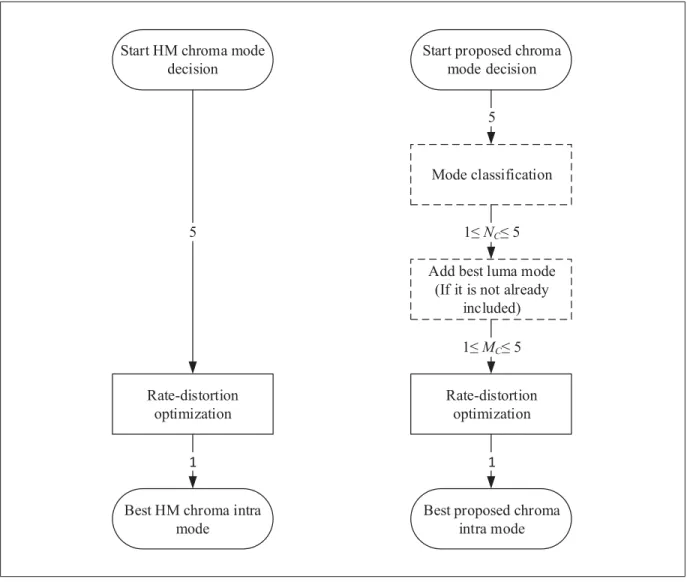
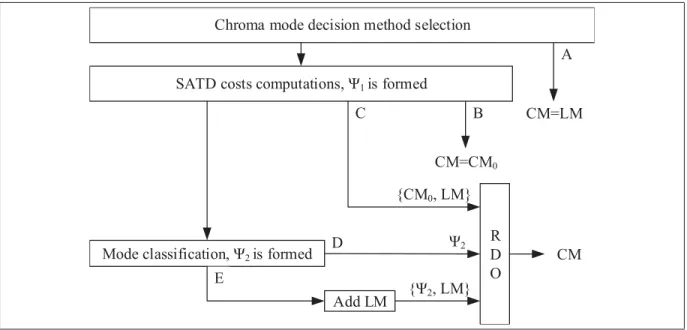
In chapter 4, we present the proposed mode decision methods. To lower the high computational complexity of the HEVC encoder, in section 4.1, an RDO cost prediction method is developed based on statistical models, which selects only promising candidates for RDO. In section 4.2, a fast chroma mode decision, which results in an extra complexity reduction, is proposed to reduce the number of RDO candidates by applying a mode classification. Section 4.3 introduces a gradient-based approach, to exclude non-promising directional candidates from further processing. Section 4.4 discusses the SATD cost classification applied to the mode decision. The results presented in chapter 4 have partly been presented in the following papers:
• (Jamali and Coulombe, 2018). "Fast HEVC Intra Mode Decision Based on RDO Cost Prediction". Accepted in IEEE Transactions on Broadcasting.
• (Jamali and Coulombe, 2016a). "RDO Cost Modeling for Low-complexity HEVC Intra Coding". In IEEE Canadian Conference on Electrical and Computer Engineering (CCECE).
• (Jamali et al., 2015). "Fast HEVC Intra Mode Decision Based on Edge Detection and SATD Costs Classification". In IEEE Data Compression Conference (DCC).
In addition, the following patent has been filed, which describes the proposed mode decision approach for complexity reduction in HEVC intra coding:
• (Jamali et al., 2014). "Method and System for Fast Mode Decision for High Efficiency Video Coding". https://patents.google.com/patent/US20160127725A1/en.
In chapter 5, the proposed methods for CU size decision are presented. Section 5.1 presents a method for fast CU size decision based on global and directional gradients and section 5.2 introduces a Bayesian problem for early splitting and early splitting termination. Finally, a reinforcement learning-based approach is presented in section 5.3 for fast CU size decision. Part of the results provided in this chapter have also been presented in:
• (Jamali and Coulombe, 2016b). "Coding Unit Splitting Early Termination for Fast HEVC Intra Coding Based on Global and Directional Gradients". In IEEE Workshop on Multimedia Signal Processing (MMSP).
In section 5.3.4, the experimental results are provided and finally the conclusion of the thesis and discussion on the future directions of the research in HEVC complexity reduction are presented.
In this chapter, we give a review on HEVC video encoding while focusing on intra coding. HEVC, similar to previous video coding standards, is a hybrid video coding scheme with motion estimation and compensation for decreasing the temporal redundancy, and intra prediction and transform for decreasing the spatial redundancy. Also the last step in the encoding process is an entropy coding module for further compression. Although the main functions in HEVC are similar to prior video coding standards, most of them have evolved compared to those standards. The improvements are mainly in frame splitting into prediction and transform blocks, inter and intra mode decision, in-loop filtering and entropy coding. Before we describe the structure of the HEVC encoder, we give a brief review on general hybrid video coding to better understand the context of the study.
2.1 Block-Based Hybrid Video Coding
The compression efficiency of video encoders has greatly improved during last three decades. However, the main concepts of video coding are still the same. All main video coding standards have been based on a same concept of block-based hybrid video coding (Richardson, 2010). Hybrid video coding is based on redundancy removal in some consecutive steps. The term hybrid means using both predictive coding and transform coding. Figure 2.1 shows a simplified structure of a hybrid video encoder. Each frame is partitioned into some rectangular regions called blocks which are coded by either inter or intra prediction. Inter prediction uses the previous frames to find the best prediction for the current block while intra prediction uses the information available in the current frame to make the prediction. The difference between the current block and its prediction forms the residual block. A transform is applied to the residual to remove spatial redundancy and to provide a more appropriate representation of the residual block for quantization. The quantization step provides a trade-off between compression ratio
and visual quality. Then entropy coding is used as the final step to achieve the maximum possible compression.
Prediction Transform Quantization Entropy Coding Frame
Partitioning
Input Output
Figure 2.1 General view of a hybrid video encoder.
2.2 HEVC Video Encoding
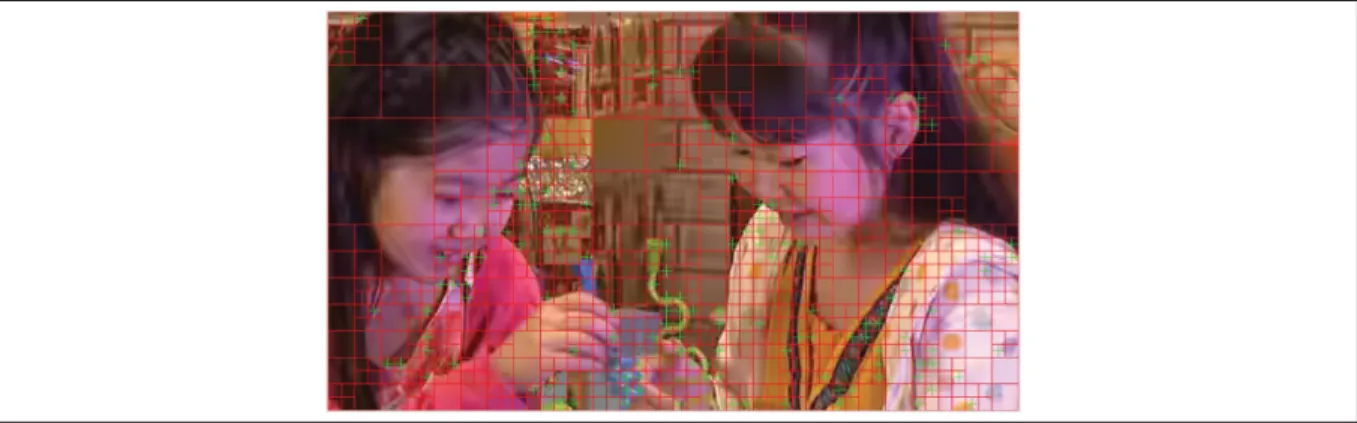
The architecture of HEVC is basically similar to the previous hybrid video coding standards such as H.264/AVC. Figure 2.2 shows the structure of the HEVC encoder. The most important difference between HEVC and H.264/AVC is how the splitting of a frame into blocks is performed for achieving prediction and transform, which contributes to an improved coding efficiency. While the main coding block in H.264/AVC is a macroblock with size of 16× 16, HEVC uses a more adaptive quadtree structure based on a block called coding tree unit (CTU) with maximum size of 64× 64. This quadtree structure comprises some blocks and units. A block includes a rectangular area of samples and a unit is formed by a luma block and two related chroma blocks with associated syntax information. For example, a CTU consists of a luma coding tree block (CTB) and two chroma CTBs with syntax determining the further subdivision. As a result of subdivision, new units called CU are generated. The CU is a unit which is coded by inter or intra prediction. The CUs could be divided into prediction units (PUs) and transform units (TUs) for performing prediction and transform. PUs inside a CU can be predicted by different prediction modes. CUs, PUs and TUs consist of associated luma and chroma blocks called coding blocks (CBs), prediction blocks (PBs) and transform blocks (TBs) respectively. As it is obvious, this splitting is more adaptive relative to the approach used in H.264/AVC and is especially useful for higher resolution videos like 4K×2K and 8K ×4K. Figure 2.3 shows an example of dividing a frame into CUs and PUs using quadtree structure and fig. 2.4 shows the coding order of CUs inside a CTU. The quadtree that is used for dividing
a CU into TUs has its root at the CU level and is called residual quad-tree (RQT) because it operates on the residual. Also, all possible modes of splitting a CU into PUs are illustrated in fig. 2.5. Split Video Input into CTUs Coder Control Transform, Scaling & Quantization Intra-Picture Estimation Intra-Picture Prediction Motion Compensation Motion Estimation Quantized Transform Coefficients Scaling&Inverse Transform Inter/Intra Selector Filter Control Analysis Deblocking & SAO Decoded Picture Buffer Intra Prediction Data Filter Data Motion Data General Control Data Header Formatting & CABAC Entropy Coder Coded Bitstream
Figure 2.2 HEVC video encoder, (Hojati, 2018).
Figure 2.3 Frame splitting into CUs (red) and PUs (green) based on the quadtree structure, BlowingBubbles.
1 2 3
4 5 6 7
8
9
10 11 12 13
64x64 32x32 16x16 8x81
2
3
4 5
6 7
8
9
10
11
12
13
Figure 2.4 Partitioning of a 64× 64 CTU into CUs and the coding order of CUs, (Hojati, 2018).
NxN
2Nx2N
2NxN
Nx2N
nRx2N
nLx2N
2NxnU
2NxnD
Figure 2.5 All possible modes of partitioning a CU into PUs in HEVC. Intra CUs can apply only the first two modes.
As it could be seen, there are many possibilities to split a picture into multiple units and blocks and there are also many ways to combine the coding tools. Although this may not have a significant impact on the decoder complexity, the encoder should perform heavy computations
to leverage the full capabilities of the standard. This is mostly because the encoder should choose the best coding tree structure and the best way for the subdivision of a CU into PUs and TUs. This process can be performed by an exhaustive execution of RDO and is extremely time consuming. The RDO process considers all the encoding possibilities and compares them with regard to bit rate and picture quality. Since CU is the root for PU partitioning and the RQT configuration, it could be generally deduced that the computational complexity of RDO increases monotonically with the depth of the CU splitting (Ma et al., 2013). Limiting the CU depth can reduce the complexity but decreases the coding efficiency because small CUs can cope efficiently with the regions of the picture with complex texture while large CUs cannot successfully cover these areas. The RDO problem is a very important one in complexity analysis of HEVC and determining the best partitioning pattern of CTUs in a picture in a reasonable time can dramatically decrease the complexity burden of the HEVC encoder.
2.3 HEVC Computational Complexity Analysis
In this section, we focus on the HEVC encoder from the complexity point of view and provide some analyses on the most complex parts of the encoder; the parts that need more attention for complexity reduction. Since the commonly used software for research and codec development is the HM, this implementation is considered as a test bed for evaluating the standard and three encoder configurations are used which are known as all-intra (AI), random access (RA) and low delay (LD). In some studies LD is considered as two different configurations called LP (or LD_P) and LB (LD_B). Considering the coding time as a measure of complexity, the first step for analyzing the encoder complexity is calculating the overall coding time for different video sequences and different encoder configurations. We have selected some papers that describe our problem in the best manner and help understand which parts of the codec are most complex and give guidelines to reduce this complexity.
A complexity and implementation analysis of the HEVC encoder and decoder is presented in (Bossen et al., 2012). For complexity analysis, first they consider the overall time that the encoder and the decoder consume for processing different sequences to show that real-time
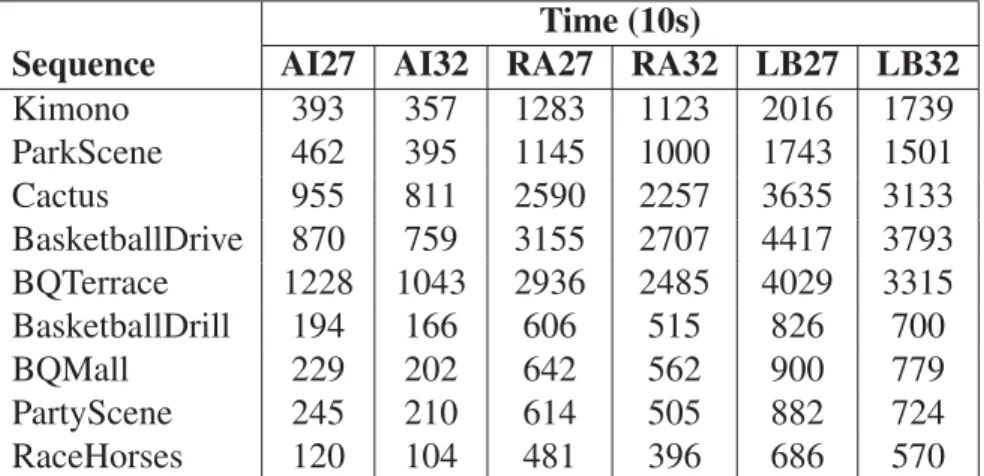
video coding is not easy to achieve with current implementation of HEVC. Tables 2.1 and 2.2 from this paper present some common sequences and the encoding time of HM for encoding these sequences. All of the test sequences are 10 seconds long and two values of 27 and 32 are considered for quantization parameter (QP); AI27 means all-intra with the quantization parameter (QP) equals to 27 and so on. These results are obtained using gcc 4.4.5 for compiling and a cluster with Xeon-based servers (E5670) clocked at 2.93 GHz.
Table 2.1 Test sequences, (Bossen et al., 2012)
Sequence Resolution Frame Rate (Hz)
Kimono 1920× 1080 24 ParkScene 24 Cactus 50 BasketballDrive 50 BQTerrace 60 BasketballDrill 832× 480 50 BQMall 60 PartyScene 50 RaceHorses 30
Table 2.2 Encoding time for test sequences, times are in tens of seconds, (Bossen et al., 2012)
Time (10s)
Sequence AI27 AI32 RA27 RA32 LB27 LB32
Kimono 393 357 1283 1123 2016 1739 ParkScene 462 395 1145 1000 1743 1501 Cactus 955 811 2590 2257 3635 3133 BasketballDrive 870 759 3155 2707 4417 3793 BQTerrace 1228 1043 2936 2485 4029 3315 BasketballDrill 194 166 606 515 826 700 BQMall 229 202 642 562 900 779 PartyScene 245 210 614 505 882 724 RaceHorses 120 104 481 396 686 570
As can be seen from the tables even in only intra, the coding time can be more than 1000 times of the sequence length and this makes real-time coding very challenging. To overcome this problem, we should know which modules of the encoder contribute the most to the complexity. In this regard, (Bossen et al., 2012) analyzes different C++ classes of the HM that relate to various parts of the codec. This analysis gives a sense on how much time is spent in each module of HEVC. Table 2.3 illustrates the classes and the time spent in each of them. This is shown for two AI and RA configurations. As it could be seen from the table, in AI setting, a significant amount of time is spent in TComTrQuant class. This class is responsible for rate distortion optimized quantization (RDOQ). TComPrediction and TComPattern classes, both of them related to intra-picture prediction, account for 16%. For the core entropy coder, TEncBinCABAC class is used which is comprised of TEncBinCABAC and TEncBinCABACCounter classes and small amount of time is spent in them (about 2%). However, more time is spent on scanning and context derivation that happened in TEncSbac. Another important class for intra coding is TEncSearch. This class consumes 11.8% of encoder time for AI configuration. This class is responsible for finding the best prediction signal for the current block.
Table 2.3 Consumed time in encoder classes, (Bossen et al., 2012)
Time (%) Function AI RA TEncSearch 11.8 7.4 TComTrQuant 24.4 10.7 TComRdCost 9.8 38.8 TComInterpolationFilter 0.0 19.8 TComYUV 0.1 1.7 partialButterfly 8.7 4.0 TComDataCU 5.8 2.7 TEncSbac 8.4 3.5 TEncEntropy 1.2 0.6 TEncBinCABAC 2.2 0.9 TComPrediction 10.0 1.1 TComPattern 6.6 0.4 memcpy/memset 11.0 7.1
Another good analysis of video coding complexity for HEVC is done in (Vanne et al., 2012). The main focus of this paper is comparison of the HM and the joint model (JM) as HEVC and H.264/AVC reference software respectively. It also presents an analysis of rate-distortion complexity problem of HEVC. This work shows that HM (Main Profile) achieves bit rate savings of 23%, 35%, 40% and 35% relative to JM (High Profile) in AI, RA, LB and LP configurations respectively. As it is expected this higher coding efficiency comes with a cost to the HEVC codec from the complexity point of view. The paper analyzes all of the configurations for software complexity comparison and presents the complexity percentage of each module at the encoder. Due to the large share of integer motion estimation (IME), fractional motion estimation (FME) and mode decision (MD), the paper focuses more on these stages and considers their internal functions. The high complexity of these modules is attributed to interpolation (IPOL), SATD and sum of absolute differences (SAD) functions in FME, FME/MD and IME respectively. Table 2.4 shows the average complexity contribution of these modules and other parts like intra prediction (IP), transform/ quantization/ inverse quantization/ inverse transform (T/Q/IQ/IT) and entropy coding (EC) over all the tested sequences. Table 2.5 shows most complex functions at the encoder and their complexity shares in AI, RA, LB and LP configurations. In AI setting only SATD is present for MD process and in the other configurations these three functions are responsible for the majority of the encoding complexity. As another result of the analysis, SAD share is about 65% of the IME complexity while around 95% of the FME/MD complexity is because of IPOL and SATD.
Table 2.4 Average share of encoding complexity, (Vanne et al., 2012)
Encoding stage AI RA LB LP IME 0% 16% 18% 17% FME/MD 9% 55% 59% 49% IP 24% 1% 1% 1% T/Q/IQ/IT 41% 14% 11% 18% EC 11% 4% 3% 5% Misc. 15% 10% 8% 10%
Table 2.5 Most complex functions at the encoder and their complexity shares, (Vanne et al., 2012) Function Al RA LB LP Interpolation 0% 37% 38% 31% SATD computation 9% 16% 18% 15% SAD computation 0% 10% 12% 11% Sum 9% 63% 68% 57%
2.4 HEVC Intra Coding
HEVC intra coding follows the same structure as previous hybrid video codecs (Lainema et al., 2012). It is mainly based on spatial prediction and transform coding. However, it carries some new features, such as an increased number of prediction modes and a new frame splitting approach. The encoder uses spatial correlation in one frame to reduce the amount of data for transmitting or storing the visual information. To this end, it chooses the best coding unit depth, best transform unit tree and best mode for each prediction unit. An intra mode determines the direction to predict a block. HEVC intra coding supports 35 prediction modes for the luma component. There are 33 directional modes, allowing an efficient prediction of different directional video contents, a dc mode for homogeneous regions, and a planar mode to predict the smooth surfaces. Using the dc and planar modes let HEVC intra predict areas of the image which do not follow an edge model. Figure 2.6 shows HEVC luma intra prediction modes. In the early versions of the standard the number of modes which could be used to predict a block was dependent on the size of PU and only a subset of modes could be selected. Now, however, for all sizes of PU, all 35 modes are examined. The decision for coding a block as intra is made at the CU level, but the intra mode is selected for each PU, and it is possible for PUs in the same CU to have different intra modes. After the intra mode is selected, the prediction is done for TUs inside the PU. This means that in determining the prediction signal, the spatially neighboring TUs are used. For a TU with size N×N, there are 4N +1 samples for prediction from the above, above-right, above-left, left and below-left TUs. Samples from the below-left TU are not always available, and can only be used when they have been processed
and decoded beforehand. As an example a prediction by mode 2 is shown in Figure 2.7 for a 4× 4 block. 0: planar 1:dc 2 10 18 26 34
Figure 2.6 HEVC intra prediction modes.
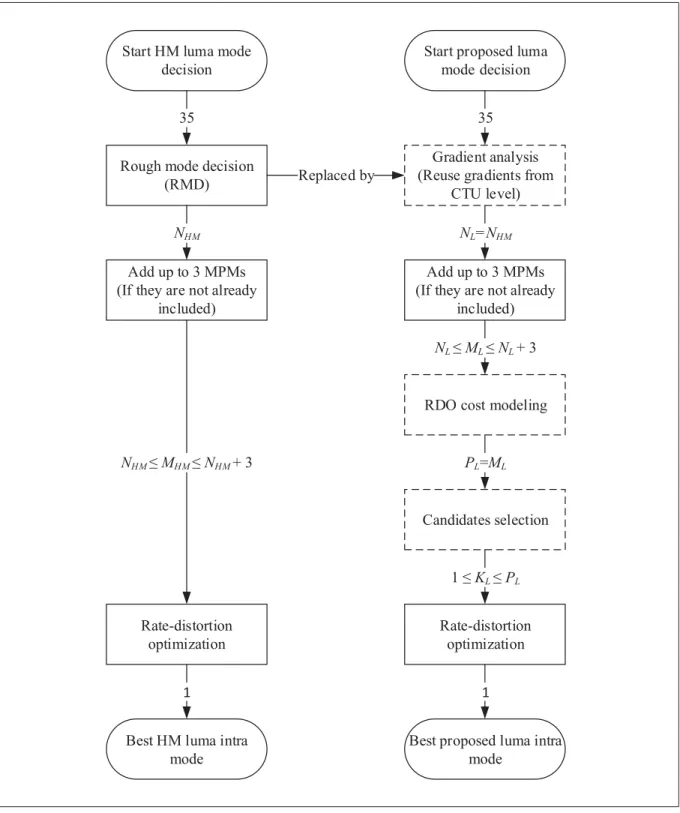
Although this increased number of modes results in an improved coding efficiency, it renders the encoding process much more complex due to the increased number of RDO computations required. To lower this high complexity, the HM uses a two-step approach to find the best intra mode. The first step, rough mode decision (RMD), selects N candidates with the lowest RMD costs to be processed by the second step, RDO, where the candidate with the lowest RDO cost is selected as the best mode. Table 2.6 shows N for different PB sizes. Although this approach reduces the computational complexity to some extent, the HM encoder still needs to be improved substantially for real-time and fast encoding.
The RMD cost(CRMD) is computed as:
Boundary Pixels
Current Block Directional mode 2
Figure 2.7 Intra prediction based on directional mode 2.
Table 2.6 Number of intra mode candidates, selected by the HM, for different PU sizes
PU size 64× 64 32 × 32 16 × 16 8 × 8 4 × 4
N 3 3 3 8 8
where SATDl, as a measure of distortion, is the SATD between the original luma component
and its prediction block, Rpis the number of bits used for mode coding, andλpis the Lagrange
multiplier, which is determined based on the QP (Sze et al., 2014). The RDO cost(CRDO) for
the N selected candidates is computed using the following cost function:
CRDO= (SSEl+ ωc× SSEc) + λm× Rm, (2.2)
where SSEl and SSEc are the sum of squared errors (SSE) between the original luma and
chroma components and their reconstructed blocks,ωcis the chroma weight (depending on the
mentioned that before RDO computations, a maximum of three most probable modes (MPMs) are added to the candidates list based on the best modes of the neighboring blocks. The final prediction mode is the candidate with the minimum RDO cost.
For chroma components, HEVC provides five intra modes, regardless of the block size, which include planar, dc, vertical, horizontal and the best luma mode. If the best luma mode is one of the first four modes, a diagonal mode (34) is used as the fifth mode. Using this concept of derived mode results in an efficient signaling when chroma content follows the same structure as the luma, and thus, the same intra mode, which is a very likely scenario. There is no rough mode decision for chroma intra prediction, and to select the best mode among the five candidates, the HM evaluates the RDO cost for all of them, which makes the chroma component a complex module as well. In section 3.1, we review some works which propose methods to reduce the encoding complexity by decreasing the number of modes to be processed by RDO.
In this chapter, we give an overview of the state-of-the-art works on complexity reduction for HEVC intra coding. In the last decade, many works have proposed different methods for reducing the complexity of HEVC and H.264 intra coding. These methods propose decreasing the number of modes processed by RDO (mode decision) (Ruiz et al., 2016; Marzuki et al., 2016; Pakdaman et al., 2016; Tariq et al., 2016; Wang and Siu, 2013; Park and Jeong, 2015; Gao et al., 2015; Zhang et al., 2015; Pan et al., 2005; Li et al., 2009), or avoiding exhaustive search to find the optimal CU sizes inside a CTU (fast CU size decision) (Cho and Kim, 2013; Saurty et al., 2015; Shen et al., 2014; Fang et al., 2013; Min and Cheung, 2015), or a combination of these techniques (Zhang et al., 2017a; Shang et al., 2016; Zhang and Ma, 2014; Song et al., 2017; Zhao et al., 2014, 2012; Zhang and Ma, 2013; BenHajyoussef et al., 2017; Liu et al., 2016). In the following, we present the major works in these two categories separately. Since many works combine the two techniques, we will see some overlaps in the following sections.
3.1 Mode Decision Complexity Reduction
In this section, several works regarding mode decision optimization while focusing on intra mode decision are presented. In intra mode decision, the goal of the researches have been mainly reducing the number of modes that enter the RDO process.
For mode excluding, (Yan et al., 2012) have proposed a group-based intra mode decision approach to accelerate the encoding process. The idea is based on a statistical analysis of the modes generated by RMD. As mentioned before, RMD is a process that is performed before rate distortion calculation to reduce the number of intra modes. It calculates a cost for each prediction unit by applying Hadamard transform on residual between the original prediction block and its prediction and then computes the SATD for the transform coefficients. In (Yan et al., 2012), the output modes of the RMD are found to be adjacent together in most cases, and
as a result, represent same direction. In addition, they reduce the number of candidate modes for RDO by merging adjacent modes into some groups and also performing a pixel-based edge detection. Early termination of block partitioning is another tool that is used in this work to reduce the time consumed in the intra mode decision module. It has been shown that for blocks with the size of 16×16, 32×32 and 64×64, only one mode from the RMD process is selected. For blocks with the size of 4× 4 and 8 × 8 selecting only one mode depends on the difference between the two lowest RMD costs among the 35 modes. It has also been shown that the more the adjacency of the modes generated by RMD is, the better the results become.
In (Ma et al., 2013), a low-complexity rate distortion optimization method for complexity reduction has been proposed. This method is comprised of three stages: fast intra mode decision, adaptive reference selection and CU splitting early termination. It is noted that this method is applied to the most complex stages at the encoder. The method uses the directional information from the neighboring blocks and the correlation between energy of prediction residuals and CU splitting for intra and inter-prediction respectively to early terminate CU splitting. The energy of prediction residuals is defined as:
E= 1 m× n m
∑
i=0 n∑
j=0 r2i, j. (3.1)In addition, the method employs the spatial and temporal correlations among the neighboring frames and CUs to limit the number of reference frames. It has been shown that by using these three techniques, it is possible to implement HEVC for complexity-constrained encoders.
Another work on intra mode decision by applying mode excluding has been presented in (Zhang et al., 2012). This work claims that the RMD is not a perfect strategy for reducing the number of intra modes, since it is the same for different blocks and does not consider their variations. Accordingly, an adaptive approach for fast intra mode decision has been proposed. In this work, based on statistical analysis, it has been shown that it is highly likely that the first two candidates in RMD and especially the first one is selected by the RDO process as a final optimum mode. It has also been observed that in blocks with highly complicated texture or
blocks with smooth content, dc and planar modes have more chances of being selected as the lowest cost mode.
There are some works on intra mode decision that have used texture characteristics to decide which modes are the most probable ones to win the RDO race. Most of them have employed edge detection algorithms based on gradient to determine the best matched modes for a specific PU. In (Chen et al., 2013), a fast mode decision algorithm to lighten the computation complexity in intra mode prediction has been proposed. The method is based on edge detection and includes a sub-method for depth decision. The work takes the most probable modes from the neighboring blocks to improve the accuracy of the intra mode prediction.
A method has been proposed in (da Silva et al., 2012) to use edge information of the current prediction unit in addition to the modes of the neighboring PUs to reduce the number of modes that are going to be tested by the rate distortion optimization process. The idea is based on categorizing the edges into five groups namely horizontal, vertical, 45 degree, 135 degree and one non-directional edge. The algorithm uses the pixel values to select one of these five directions as a dominant edge for the prediction unit, and thus, limited modes are selected for cost calculation which reduces the encoding time.
Another work on intra mode decision using gradient and edge concepts has been presented in (Jiang et al., 2012). In this work, a gradient-based fast mode decision algorithm has been proposed to reduce the computational complexity of the encoder. The gradient directions are determined before the intra prediction, and for each PB, a gradient-mode histogram has been obtained. Consequently, limited numbers of modes are selected for the final RMD and RDO processes.
(Wang et al., 2014) have presented a fast intra coding algorithm. In this work, the number of modes in RMD and RDO processes is reduced by taking into account the correlation among neighboring blocks. A depth range prediction method has also been proposed by exploiting the correlation between the neighboring CTUs. To this end, they define three prediction depth
ranges:
R0= [0,3], R1 = [0,2], R2 = [1,3] (3.2)
The depth range R1 is used for homogeneous regions and the depth range R2 is used for inhomogeneous regions. Depth range R0 would be used if it is not possible to determine the homogeneity of the block. The depth range of the current CTU, DRcurr, is defined as:
DRcurr = ⎧ ⎪ ⎪ ⎪ ⎨ ⎪ ⎪ ⎪ ⎩
R1, Dle f tmax≤ 1 & Dupmax≤ 1
R2, Dle f tmax> 1 & Dupmax> 1
R0, other
(3.3)
where Dle f tmax and Dupmax are the maximum depths of the left and upper CTUs, respectively.
In (Ruiz et al., 2016), a novel algorithm has been presented based on the orientation detection, which uses the local directional variance along some predefined lines. Based on this analysis, orientations with the lowest directional variances are considered as dominant orientations, and the number of intra mode candidates to be further processed by RDO is reduced accordingly.
The authors in (Marzuki et al., 2016) have proposed a context-adaptive fast intra coding based on the best modes of the upper CU and neighboring PUs. The method includes early termination approaches for RDO as well as RQT using adaptive thresholding.
In (Pakdaman et al., 2016), the authors have proposed a novel method based on the dual-tree complex wavelet transform (CWT) to effectively determine edges leading to the selection of the most appropriate candidates for intra mode decision. This approach considers only few adjacent candidates for the best estimated mode selected by the edge analysis. It is noted that CWT decomposes an image into various frequency sub-bands. The algorithm uses the energy distribution in these sub-bands to exploit texture information and obtain the dominant direction for each block.
The authors in (Tariq et al., 2016) have proposed a method for intra coding complexity reduction based on the following quadratic relation between the RDO cost and SAD:
RDcost= α1SAD2+ α2SAD+ α3. (3.4)
Using this method, it is possible to avoid entropy coding, Hadamard transform, and distortion computations for mode selection and thus save time and computations. The method also formulates the distortion and rate as functions of SAD and QP, in order to avoid performing the RDO process.
A method has been presented in (Wang and Siu, 2013) for fast intra HEVC coding based on three optimized candidate sets including 1, 19 and 35 modes. Using the neighboring reference samples, the encoder selects the optimal set for each PU. This results in an accelerated encoder due to the reduced number of modes needed to be processed by RDO for the first two sets. Further, the number of bits needed for mode signaling is reduced.
In (Park and Jeong, 2015), the PU has been converted from the pixel domain to the transform domain, and the main directions have been determined in the latter. Based on these directions, a short list of candidate modes is selected for the RDO process.
The authors in (Zhang et al., 2017a) have proposed a low-complexity HEVC intra coding method based on both fast mode decision and early CU size determination. For the fast mode decision, a gradient-based approach is used to reduce the number of candidate modes to be processed by RMD and RDO. For the fast CU size decision, texture homogeneity along with a support vector machine (SVM)-based approach are used to make early CU splitting and early CU termination decisions. The SVM uses the depth differences, Hadamard cost and rate-distortion (RD) cost as features.
In (Shang et al., 2016), a low-complexity intra HEVC encoder has been proposed based on a fast PU mode decision (FPUMD) and a fast coding unit size decision (FCUSD). The FPUMD reduces the number of intra mode candidates based on the correlation of the PU mode and RD
cost of the different depth levels. The FCUSD for its part excludes unnecessary CU sizes from further processing, using the depth of neighboring CUs and a RD cost threshold determined from previous frames. To update the coding parameters, an online method is used leading to an accurate decision for various sequences types.
In (Zhang and Ma, 2014), a method has been proposed for fast intra coding, and achieves significant time reduction by using the Hadamard cost-based progressive rough mode search (pRMS) and early CU splitting termination. Using pRMS, the algorithm selectively checks the potential modes instead of traversing all candidates. This allows fewer modes to enter the RDO process. Further, the early CU split termination excludes the lower depths if the estimated RD cost (aggregated cost of the sub-CUs) is already larger than the RD cost of the current CU.
In (BenHajyoussef et al., 2017), a gradient-based pre-processing step has been proposed to reduce the number of intra mode candidates. A gradient-based approach has also been developed to make an early decision for CU splitting. This approach is based on texture complexity and CU sizes.
In short, several works have proposed notable and novel ideas regarding intra mode decision complexity reduction. However, they exhibit some shortcomings, which could be addressed in a bid to design even faster HEVC intra encoders. In gradient-based approaches, gradients could be computed at the CTU level, instead of at the PU level, and then reused for every block inside the CTU. This makes it possible to use the same edge information at each depth and to avoid repetitive calculations for each block. In addition, since the picture edges are not perfectly aligned with intra modes, works in this area need to come up with a solid strategy to relate the gradients at each pixel to directional intra modes. Relying only on the modes of neighboring blocks as is the case in some works, may result in a domino effect, where a wrong decision can propagate to other blocks and affect coding efficiency negatively. To avoid this drawback, these kinds of algorithms need to be accompanied by other methods. Other works aimed at reducing the number of modes for RDO process based on low-complexity measures keep N best modes as a candidates list. Using a fixed number of candidates, they either waste
computations by including modes with no potential to be the best mode or reduce the coding efficiency by excluding the best mode. In addition, the methods which select an adaptive number of candidates end up with limited time reduction or high quality loss due to imperfect RDO candidates selection. In chapter 4, we have proposed our methods for intra mode decision complexity reduction to improve other approaches in this area by addressing the shortcomings noted.
3.2 Coding Unit Size Decision Complexity Reduction
It is known that HEVC introduces a new kind of picture partitioning in hybrid video coding; the picture is partitioned into CUs, PUs and TUs in a very flexible manner to improve the coding efficiency as much as possible. The structure of these three basic processing blocks let the encoder do the encoding process optimally and improve the compression capability significantly. Even though this highly flexible scheme has been successful in increasing the coding performance, it imposes a huge amount of computations especially on the encoder. These computations mostly come from the exhaustive rate distortion cost calculation for all the combinations of the units, forcing the video coding community to find solutions to reduce this complexity and alleviate the codec structure. Generally, in this area, researchers look for methods which exclude some combinations of these blocks and try to avoid examining all depths of the coding unit by early termination of the splitting process or early splitting of the coding unit. In this section, a review of some of these works are presented.
In (Yu et al., 2012), a method for early termination of CU splitting has been proposed to reduce the complexity. Although the method has been developed for inter coding, it may also be used for intra coding. The method is based on the fact that for temporally stationary and spatially homogeneous regions, the residuals are small and the use of large CUs is the efficient way of partitioning. In addition, for early terminating the CU splitting, the characteristics of prediction residuals have been used. This approach is based on computing the mean squared errors (MSEs) between the prediction and the original block for the current CU level and comparing it with an adaptive threshold. This comparison forces the CU splitting process to
early terminate. It is noted that the threshold is set adaptively for each depth and an adjustable factor tunes its impact on complexity reduction and coding efficiency. Although this method is useful for homogeneous and stationary regions, it may lead to more computations in picture areas with high spatially and temporally changes due to considering an additional threshold parameter.
A method for fast CU size decision, using machine learning, has been presented in (Liu et al., 2017). In this work, CU complexity classification (CC) is used to adaptively determine the size of the current CU. To obtain the CC, the most important features related to the size of the CU are extracted. Having the features at hand, the classification model of the CU is constructed using SVM. The most important features they use are the block complexity, directional complexity and difference complexity. The block complexity is represented by variance as follows:
var= 1 N2 N−1
∑
i=0 N−1∑
j=0 (h(i, j) − ¯h)2 ¯h= 1 N2 N−1∑
i=0 N−1∑
j=0 h(i, j), (3.5)where N is the block size and h(i, j) and ¯h are the pixel value and the mean pixel value of the block, respectively. The directional complexity is represented by:
DCom= 1 N2 N−1
∑
i=0 N−1∑
j=0(Ghor(i, j) + Gver(i, j) + G45(i, j) + G135(i, j)), (3.6)
where G is the gradient computed in different directions. Finally, the sub-CU complexity difference is defined as:
SCCD= 1 4 3
∑
i=0 (vari− var)2, (3.7)where variis the variance of a sub-CU and var is the average variance of four sub-CUs.
(Shen et al., 2014) have proposed a method for fast CU size decision which speeds up the splitting process by reducing the number of candidate CU sizes. This method employs the texture homogeneity to achieve adaptive thresholds for early determination of the CU size.
In addition, a combination of texture property and sizes of the neighboring CUs are used to develop a bypass strategy for CU size decision. To determine the block homogeneity, they use the concept of mean absolute deviation (MAD) for the overall block and horizontal and vertical directions as follows: MAD= 1 u× v u−1
∑
y=0 v−1∑
x=0 |p(x,y) − m| (3.8) MADH= 1 u× v u−1∑
y=0 v−1∑
x=0 |p(x,y) − my| (3.9) MADV = 1 u× v u−1∑
y=0 v−1∑
x=0 |p(x,y) − mx|, (3.10)where p(x,y) is the pixel value and m is the average pixel value of the CU. In addition, my is
the mean of pixel values at the yth row and mx is the mean of pixel values at the xth column.
Then, texture homogeneity of the CU is determined as follows: ⎧
⎨ ⎩
homogeneous, if min(MADH,MADV,MAD) ≤ T
complex, otherwise (3.11)
where T is a threshold.
In (Lee and Jeong, 2017), a method has been proposed for fast CU size decision using statistical information. This method uses the image complexity along with an adaptive depth prediction process to early determine the size of the CU. The CU splitting is terminated early based on the results of a Bayesian classification and a quadratic discrimination analysis.
In (Zhang et al., 2013), an approach for accelerating the CU depth decision has been proposed to reduce the complexity of the encoding process. This approach is based on limiting the search range by using the spatial and temporal correlation between the current block and adjacent blocks as well as excluding some depths from the CU splitting tree.
(Kim et al., 2012) have proposed a method for early termination of CU splitting tree. This method is based on the rate-distortion analysis of the prior skipped CUs and adjusts the